Article

Toward Superior Product Distribution: Ga-Loaded over Etched Attapulgite as an Efficient Catalyst for Olefin Aromatization


1
Key Laboratory of Geriatric Nutrition and Health, Ministry of Education, Beijing Technology and Business University, Beijing 100048, China
2
State Key Laboratory of Coal Conversion, Institute of Coal Chemistry, Chinese Academy of Sciences, Taiyuan 030001, China
3
National Energy Center for Coal to Liquids, Synfuels China Co., Ltd., Beijing 101400, China
*
Authors to whom correspondence should be addressed.
These authors contributed equally to this work.
Catalysts 2026, 16(2), 203; https://doi.org/10.3390/catal16020203
Submission received: 26 January 2026 / Revised: 12 February 2026 / Accepted: 20 February 2026 / Published: 23 February 2026

Abstract

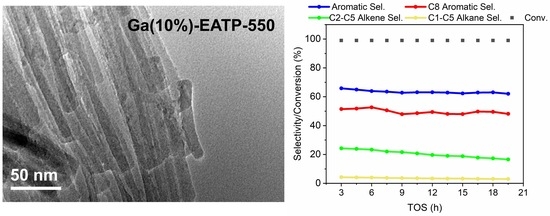
Although olefin aromatization reactions offer a potential route for the high-value utilization of Fischer–Tropsch naphtha, their industrial implementation is hindered by challenges such as coke-induced deactivation and the formation of large amounts of low-value alkane by-products. In this work, a series of Ga(x%)-EATP-550 catalysts were prepared via equal-volume impregnation of Ga onto an acid-etched attapulgite (EATP) support, followed by calcination at 550 °C. The catalysts were evaluated for the aromatization of olefins. The results show that the reaction proceeds mainly through direct dehydrogenative aromatization, yielding approximately 65% aromatics, while generating short-chain olefins (about 20% yield) as the main by-products. This system effectively suppresses the formation of long-chain aromatics and low-value alkanes, presenting a promising technical pathway for upgrading Fischer–Tropsch naphtha.

Graphical Abstract

1. Introduction

In Fischer–Tropsch synthesis using iron-based catalysts, olefins constitute over 70% of the total products [1]. To increase the octane number of gasoline products, converting olefins into aromatics is a highly effective approach [2]. Current industrial practice typically involves first hydrogenating olefins to achieve saturation, followed by the aromatization of the resulting alkanes [3]. In contrast, direct olefin aromatization can significantly reduce reaction steps and improve economic efficiency. However, a major limitation hindering its practical application is the highly complex product distribution [4]. On the one hand, the yield of aromatics is usually below 50%. On the other hand, the product distribution of aromatics is extremely broad and uncontrollable. To the best of our knowledge, reports on the specific conversion of olefins with certain carbon numbers into corresponding aromatics with matching carbon numbers remain scarce, which severely restricts the high-value utilization of Fischer–Tropsch naphtha.
For HZSM-5, a commonly used catalyst in olefin aromatization reactions, the catalytic mechanism involves the initial cracking of olefins into smaller molecules such as ethylene and propylene [5]. This results in a weak correlation between the type of feedstock olefins and the final carbon number of the aromatics produced. Subsequently, these small molecules undergo coupling and aggregation to form longer-chain olefins, which are then converted into aromatics through hydrogen transfer dehydrogenation and cyclization [6]. From a structural perspective, HZSM-5 possesses a stable crystal structure and excessively long diffusion pathways [7]. Our previous work demonstrated that in olefin aromatization reactions with HZSM-5 catalysts, diffusion-related kinetic factors, rather than the thermodynamic barrier of aromatization, are the key determinants of the reaction rate [8]. This significantly increases the probability of carbon chain cleavage and polymerization [9], making it extremely unlikely for olefins to be specifically converted into aromatics with a defined carbon number.
Attapulgite (ATP) is a hydrated magnesium-rich aluminosilicate clay mineral with a chain-layer structure. Due to its large specific surface area, ATP is commonly used as a support material in heterogeneous catalysis, including applications such as desulfurization [10] and photocatalysis [11]. Its theoretical formula is Mg5Si8O20(OH)2(H2O)·4H2O, and it exhibits a nanorod-like crystal morphology (approximately 0.5–5 μm in length and 20–70 nm in diameter) [12]. Similar to zeolites, ATP possesses a regular channel structure (0.37 nm × 0.64 nm) [13,14]. However, unlike zeolites, the pore structure of ATP relies on the support of water molecules [15]. Under high-temperature conditions, structural dehydration causes a certain degree of pore collapse. Consequently, the use of ATP as a porous catalyst under high-temperature reaction conditions remains underexplored in the existing literature. On one hand, this partial collapse likely shortens the diffusion pathways, reducing the probability of changes in carbon chain length. On the other hand, the high-temperature structural transformation of ATP remains confined to the scope of topological change, with no significant alteration in its overall morphology [16]. We anticipate that this will help the structure retain certain microporous features, which is beneficial for the dehydrogenation and cyclization of olefins.
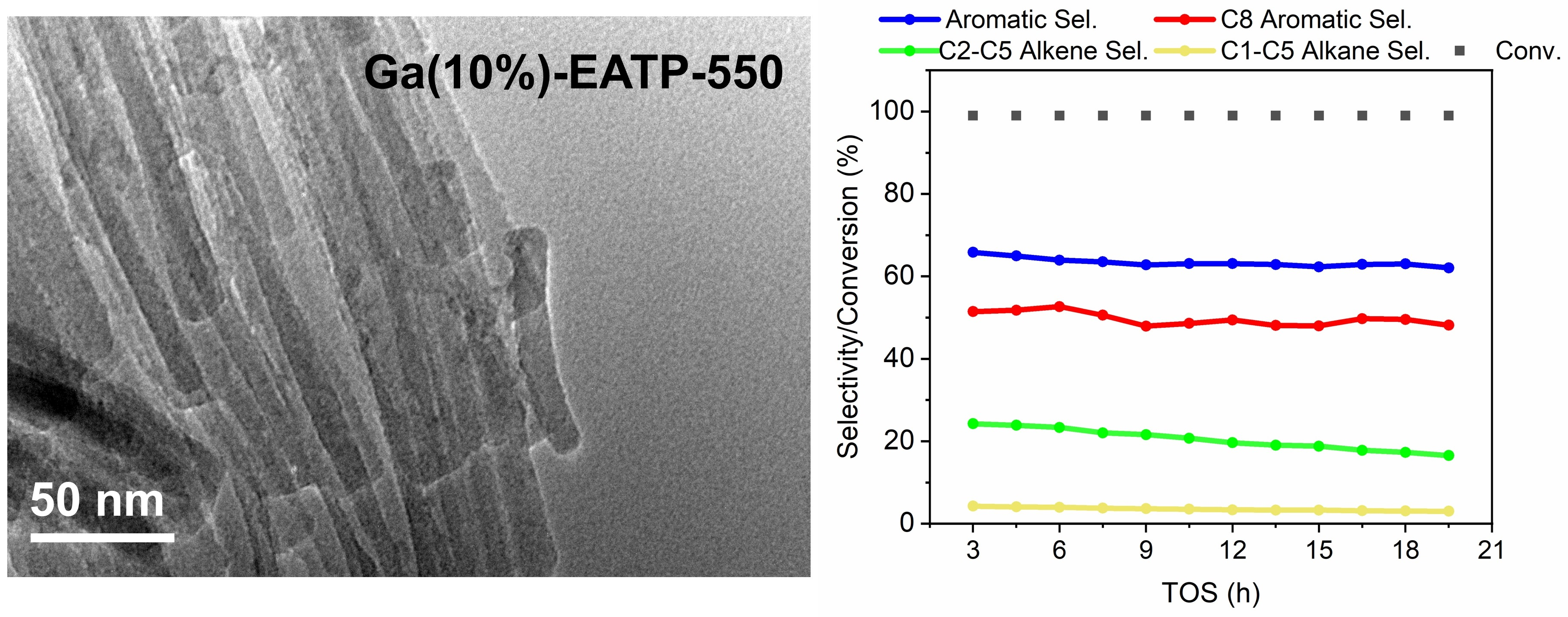
In this study, a series of Ga(x%)-EATP-550 samples was prepared by equal-volume impregnation of Ga onto an etched ATP support by acid treatment, followed by calcination at 550 °C. X-ray powder diffraction and transmission electron microscopy results indicated that most of the Ga was successfully incorporated into the ATP structure without forming distinct Ga oxide nanoparticles. X-ray photoelectron spectroscopy, X-ray absorption near-edge structure, and extended X-ray absorption fine structure analyses further revealed the absence of substantial Ga-O-Ga structural units, confirming the high dispersion of Ga within the support. Pore structure analysis demonstrated that the Ga(10%)-EATP-550 sample possessed abundant micropores and mesopores, providing a physical foundation for cyclization reaction and rapid diffusion, respectively. Evaluation of the aromatization performance showed that the reaction products were dominated by direct dehydrogenative aromatization of olefins, with short-chain olefins of high added value as the main by-products. This reaction system effectively suppressed the formation of long-chain aromatics and low-value alkanes, offering a promising technological pathway for the high-value utilization of Fischer–Tropsch naphtha.

2. Results and Discussion

2.1. Structural Characterization of the Samples Before Heat Treatment

Natural attapulgite (ATP) is typically not a pure-phase mineral but contains various associated impurities. According to the XRD pattern (Figure 1a), commercially available natural ATP exhibits characteristic diffraction peaks not only of itself but also of crystalline phases such as quartz and dolomite [17]. This phenomenon complicates fundamental research on its intrinsic physicochemical properties. Nonetheless, related studies remain highly valuable, as natural ATP holds significant cost advantages compared to synthetic materials.
As shown in Figure 1b, the crystal structure of ATP is a modulated rod-like phyllosilicate with a 2:1 type layered-chain structure [18]. It possesses abundant pore system along the c-axis direction, with a pore cross-sectional size of 0.64 × 0.37 nm, which is comparable to that of HZSM-5 zeolite. This provides potential cyclization active sites for aromatization reactions. However, the common metal cations in ATP, such as Mg, Al, and Fe, cannot serve as efficient Brønsted acid sites for catalyzing olefin dehydrogenation [19]. In this work, etched ATP (EATP) was first obtained via acid treatment. Subsequently, EATP was used as a support to load gallium-based catalysts with different contents, denoted as Ga(x%)-EATP.
XRD analysis shows that after acid treatment, the characteristic peaks of dolomite completely disappear in the EATP sample, while those of quartz remain stable (Figure 1a). In contrast, the characteristic peaks of ATP are significantly weakened, indicating a notable reduction in its crystallinity due to the acid treatment [20]. Since ATP contains a high and variable proportion of water, which is sensitive to temperature and environmental conditions, conventional ICP results based on unit mass often show large fluctuations (Table S1) [21]. Therefore, we used the stable silicon content during acid treatment as a reference to examine changes in the molar ratios of other elements to Si (Figure 1c). Compared with ATP, the EATP sample exhibits a significant decrease in the molar ratios of Mg, Al, and Fe to Si.
As the Ga loading increases, ICP-OES analysis confirms a progressive rise in the Ga/Si molar ratio (Figure 1c). However, no new diffraction peaks emerged in the XRD patterns when the Ga loading was increased from 2% to 15%. This absence of Ga-species related peaks can be attributed to two possible factors: on one hand, the incorporated Ga may primarily occupy cation sites vacated by structural collapse; on the other hand, the low loading level and/or high dispersion of Ga may prevent the formation of detectable crystalline phases [22]. N2 physisorption and BET analysis show that acid etching significantly increased the specific surface area from 132.3 m2/g to 239.6 m2/g (Figure S1, Table S2). With increasing Ga loading, the BET surface area gradually decreased to 144.5 m2/g, yet remained at a relatively high level compared to the original sample.

2.2. Structural Characterization of the Samples After Heat Treatment

There are four types of water in PAL: surface-adsorbed water, zeolitic water within the tunnels, coordinated water involved with magnesium ions at the tunnel edges, and structural water coordinated to cations in the center of the octahedral sheet. Heat treatment of PAL selectively removes different types of water, thereby adjusting its pore structure and surface properties [23]. Given that the olefin aromatization reaction in this work proceeds at 550 °C, it is crucial to investigate the catalyst’s structure after high-temperature treatment (denoted as Ga(x%)-EATP-550) in order to establish meaningful structure–activity relationships.
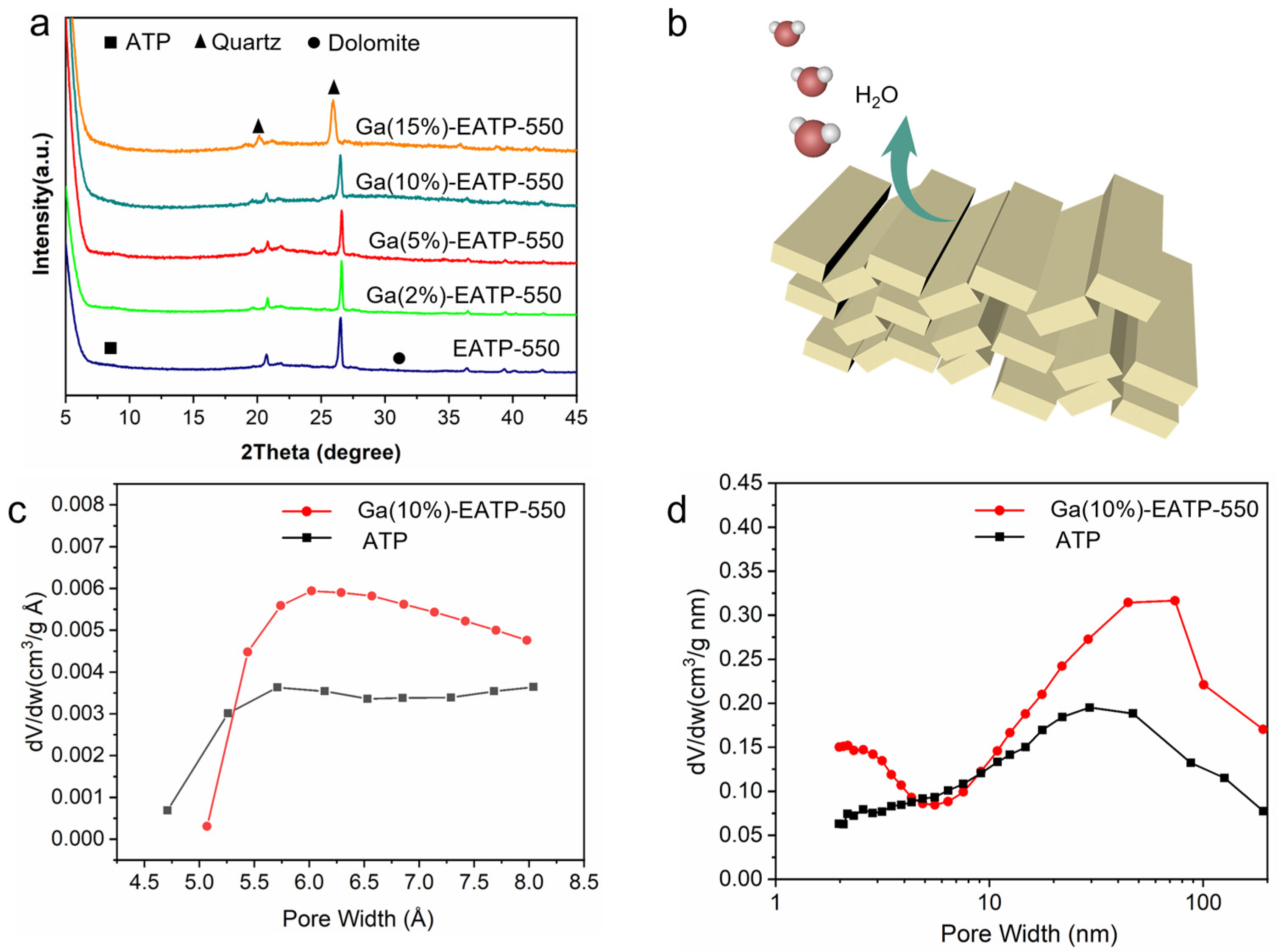
XRD analysis indicates that after high-temperature calcination, both the EATP and Ga(x%)-EATP-550 samples no longer show the characteristic diffraction peaks of ATP, while the quartz peaks remain stable (Figure 2a). This suggests that the 550 °C treatment leads to the collapse of the ATP crystal structure (Figure 2b), which is consistent with previous reports [24].
As a support for heterogeneous catalysts and a cyclization reaction center, the specific surface area and pore structure of the catalyst after heat treatment are key factors worthy of attention. The BET surface area of the Ga(10%)-EATP-550 sample is 122.5 m2/g, which remains essentially comparable to that of the original ATP sample (132.3 m2/g). Given that the aromatization reaction is sensitive to the pore structure of the catalyst, the micro- and mesopore distributions of the Ga(10%)-EATP-550 sample and the pristine ATP were further compared. Figure 2c shows that compared to the pristine ATP, with its abundant crystalline pore structure, the heat-treated Ga(10%)-EATP-550 sample exhibits a more pronounced microporous distribution in the range of 0.55–0.8 nm. This is likely because water molecules in the original ATP structure occupied the pores, rendering some of them inaccessible. After heat treatment, the removal of water molecules exposed and made these previously filled micropores accessible. This change also provides the Ga(10%)-EATP-550 sample with a pore structure more suitable for catalyzing the aromatization reaction [25]. Further analysis of the mesoporous structure indicates that the sample also possesses a richer pore network within the 2–4 nm and 10–100 nm range. Given that the original ATP typically has a rod-like morphology with a width of about 20 nm and a length of several hundred nanometers (Figure 3), these 2–4 nm mesopores are likely formed by nano-scale gaps resulting from the structural collapse of ATP crystals induced by high-temperature heat treatment.
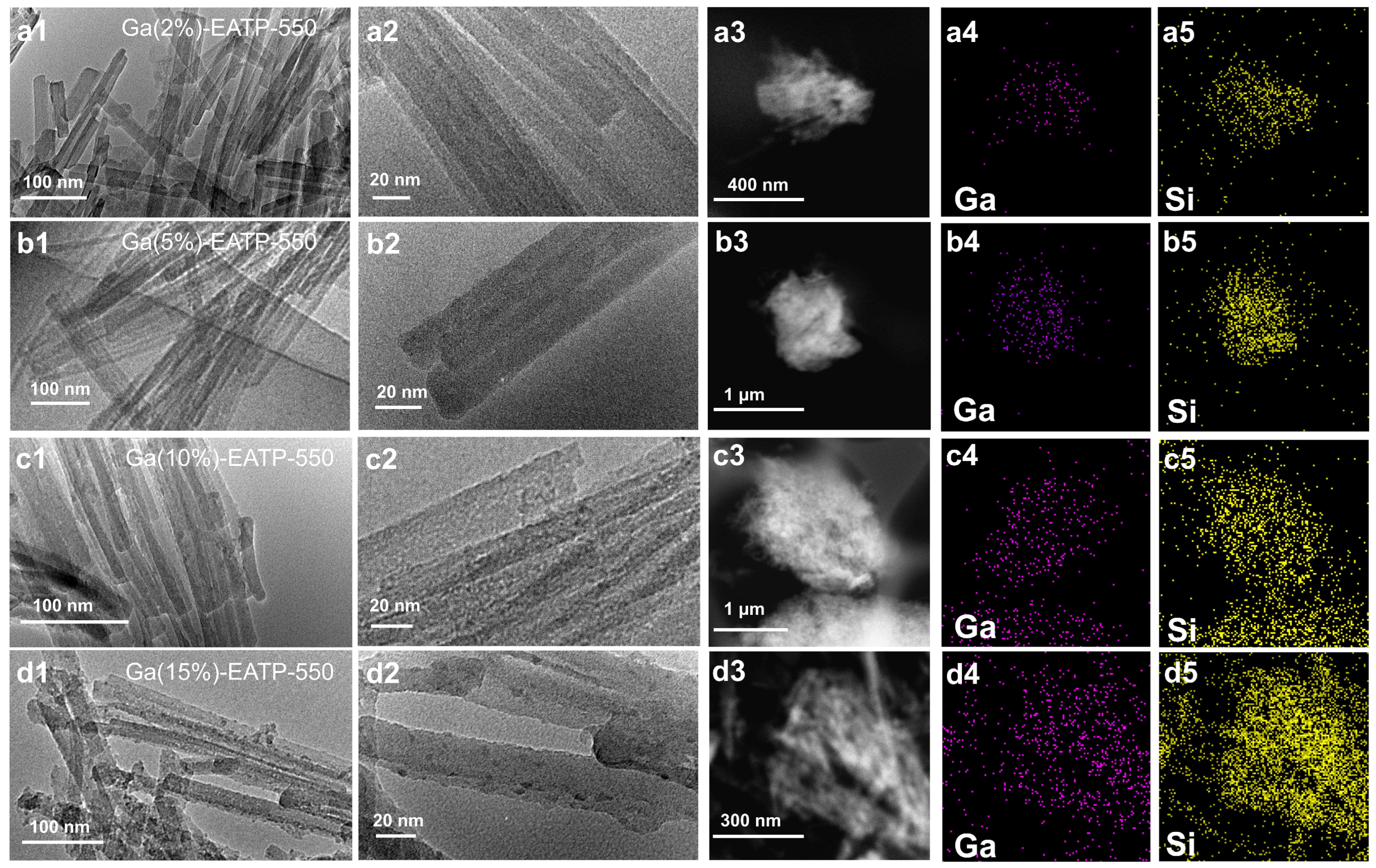
For the transmission electron microscopy (TEM) image of the Ga(x%)-EATP-550 samples (Figure 3), we observed that all four samples with Ga loadings ranging from 2% to 15% maintained the rod-like structure of ATP. This indicates that although heat treatment caused lattice collapse, the characteristic topological structure of ATP was preserved. In the three samples with 2% to 10% Ga loading, no distinct Ga oxide particles were observed, suggesting that the incorporated Ga did not agglomerate significantly. A similar result was observed for the Ga(10%)-ATP-550 sample without acid treatment (Figure S2). However, in the 15% Ga-loaded sample, the size distribution histogram reveals the emergence of nanoparticles with an average particle size of approximately 4 nm (Figure S3). This demonstrates that the upper limit for Ga incorporation into the acid-treated EATP structure is below 15%. In addition, elemental mapping analysis based on high-angle annular dark-fieprovesanning transmission electron microscopy (HAADF-STEM, Figure 3) displays a uniform and homogeneous distribution of Ga and Si, which further proves the high dispersion of Ga in the samples.
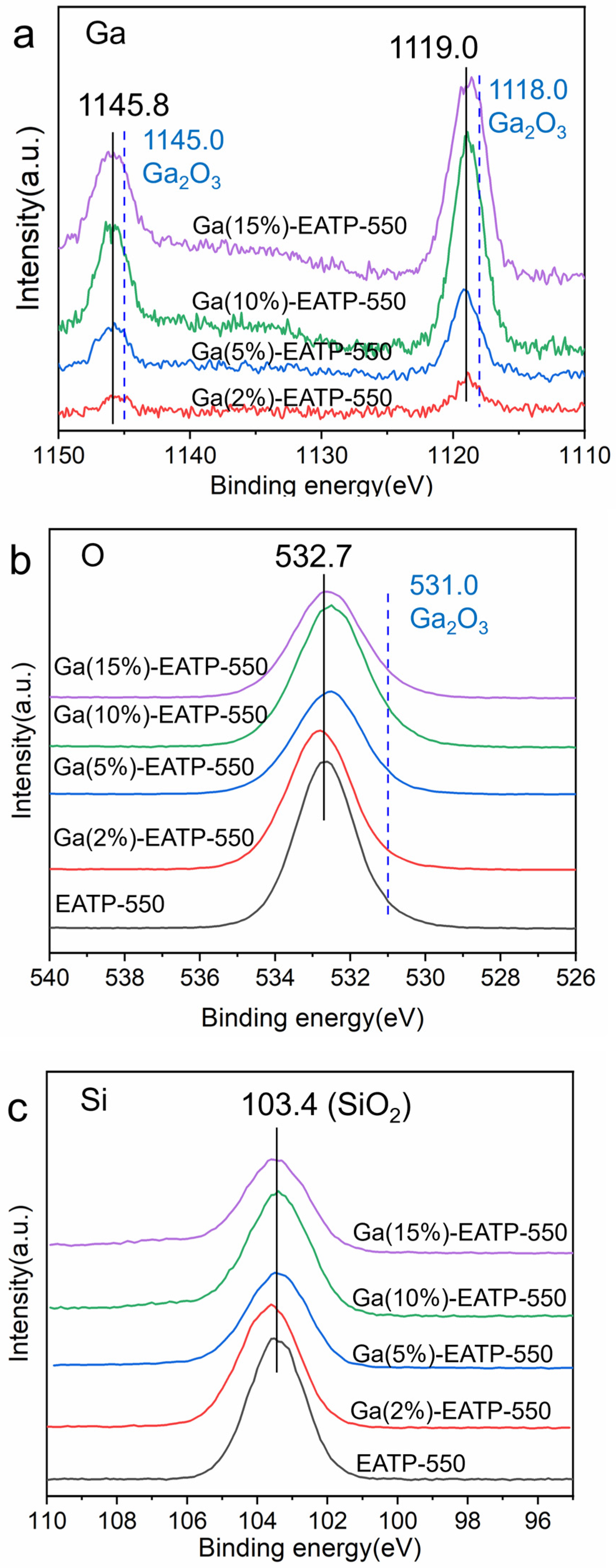
X-ray photoelectron spectroscopy (XPS) was used to study the electronic structure information of EATP-550 and Ga(x%)-EATP-550 samples (Figure 4). For the Ga(x%)-EATP-550 samples, the peaks at 1119.0 and 1145.8 eV are attributed to Ga 2p3/2 and Ga 2p1/2, respectively. Compared with Ga2O3 (where Ga 2p3/2 and Ga 2p1/2 are located at 1118.0 and 1145.0 eV, respectively), the Ga peaks shift to a higher binding energy (Figure 4a). Regarding the XPS results for Si and O, the peak positions of the Ga(x%)-EATP-550 samples are essentially consistent with those of EATP, and no characteristic oxygen peak of Ga2O3 (commonly at 531.0 eV) is observed (Figure 4b,c). The relevant peak positions are also consistent with the spectral features of SiO2, reflecting that the structure is predominantly composed of SiO2-like chemical configurations.
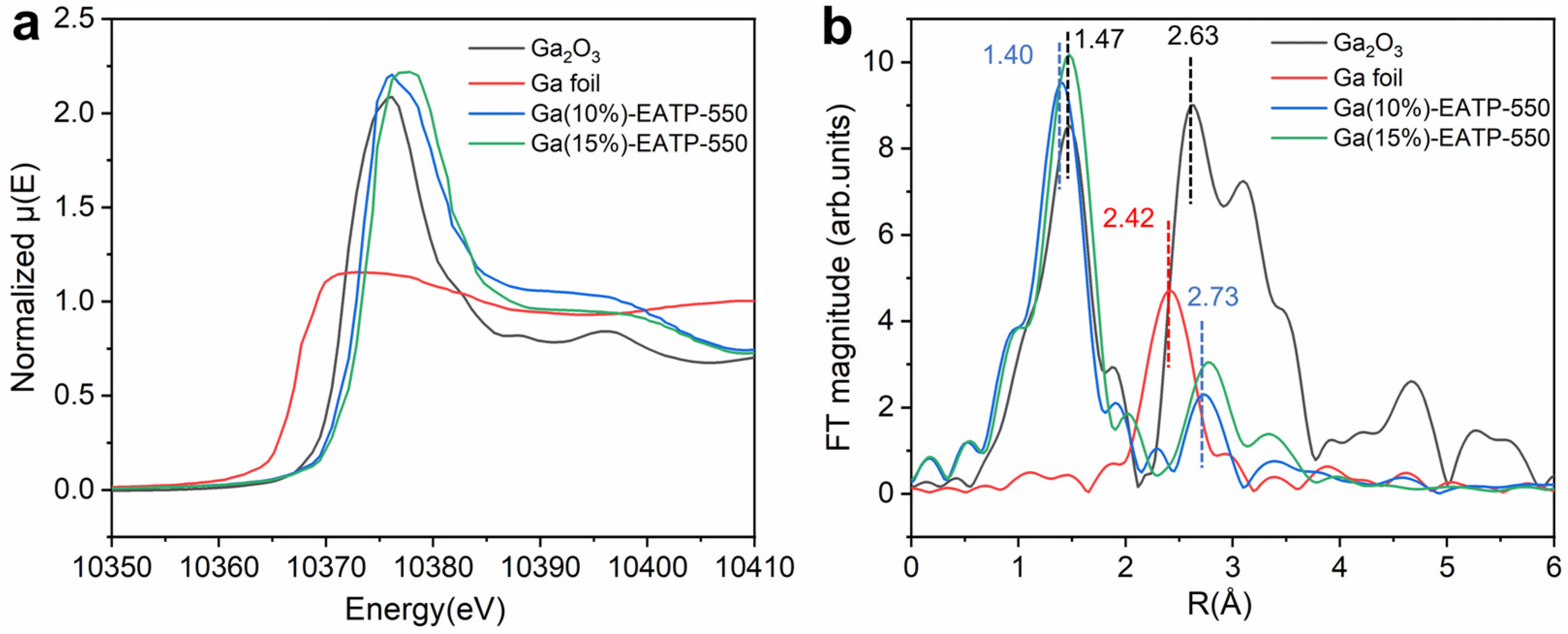
The Ga K-edge X-ray absorption near-edge structure (XANES) spectra show that the Ga(10%)-EATP-550 and Ga(15%)-EATP-550 samples exhibit a higher absorption-edge energy and an enhanced white-line intensity compared to Ga2O3 (Figure 5a) [26]. This indicates that in the Ga(x%)-EATP-550 samples, Ga predominantly bonds with Si via Ga–O–Si linkages, leading to an increased electron binding energy in Ga, which is consistent with the XPS results.
From the Fourier transform EXAFS spectra at the Ga K-edge (i.e., the R-space plot in Figure 5b), the Ga-EATP-550 samples exhibited a coordination structure in the first Ga-O shell (~1.4 Å) similar to that of Ga2O3 [27]. However, the intensity of the second Ga-Ga coordination peak (~2.7 Å) was significantly weaker than that of the Ga2O3 reference, especially for the Ga(10%)-EATP-550 sample. Combined with the TEM results (Figure 3), this indicates that Ga in the Ga(x%)-EATP-550 samples is predominantly highly dispersed within the amorphous silica framework, forming a substantial amount of Si-O-Ga bonds, thereby reducing the presence of Ga-O-Ga linkages. Moreover, the increased Ga-Ga coordination peak (~2.7 Å) indicates that the Ga(15%)-EATP-550 sample contains more Ga2O3 nanoparticles compared to the Ga(10%)-EATP-550 sample.
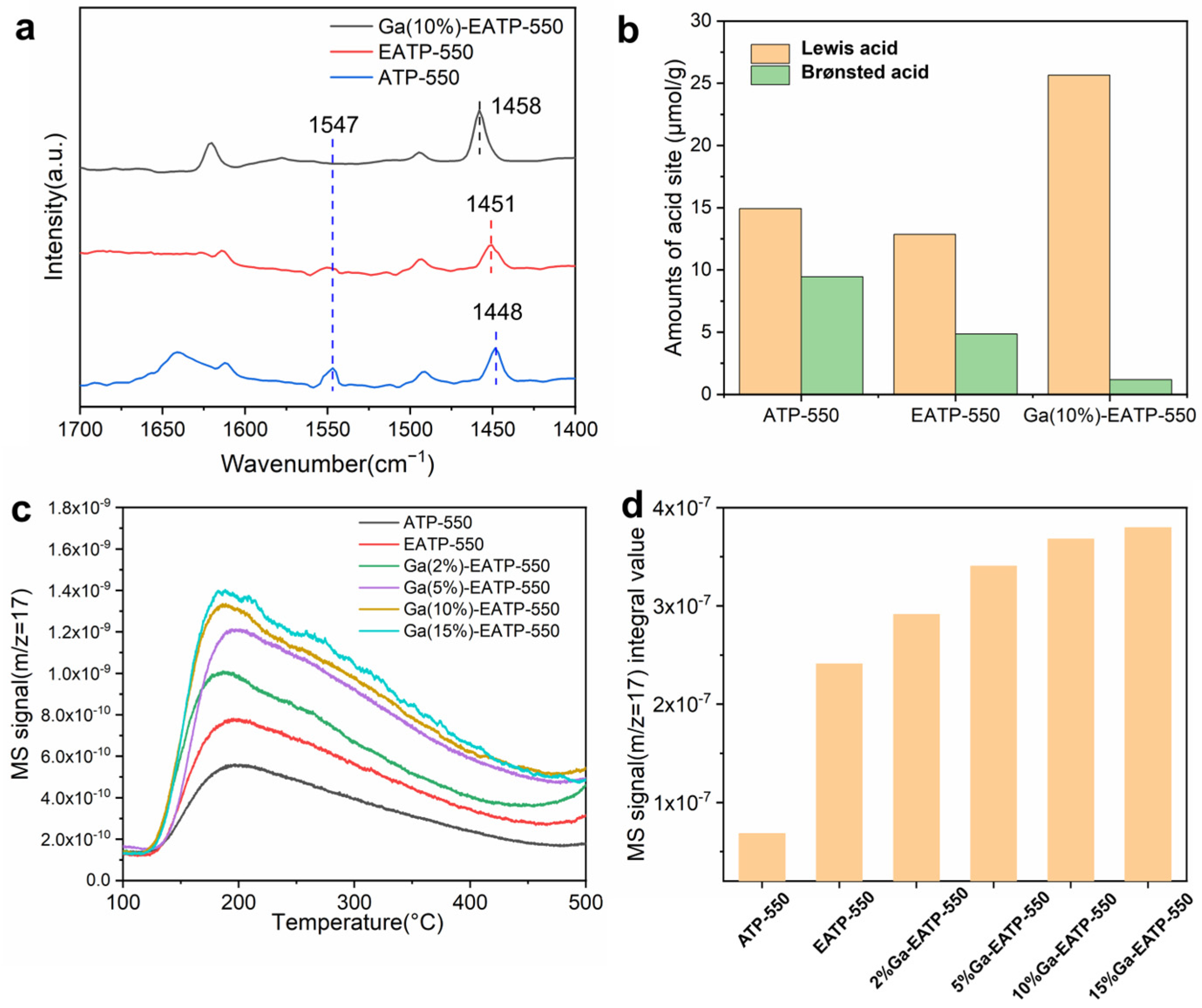
Olefin aromatization is a typical acid-catalyzed reaction. For conventional HZSM-5 catalysts, Brønsted acid sites are recognized as the primary active centers. Pyridine adsorbed FT-IR (Py-IR) is a powerful technique for distinguishing between Brønsted and Lewis acid sites [28]. As shown in Figure 6, the peaks around 1547 cm−1 and 1450 cm−1 are attributed to Brønsted acid sites and Lewis acid sites, respectively [29]. Compared with the ATP-550 and EATP-550 samples, the Ga(10%)-EATP-550 sample shows a significant decrease in Brønsted acidity and a notable increase in Lewis acidity, indicating that the Ga(x%)-EATP-550 samples are dominated by Lewis acid sites [30]. NH3-TPD results reveal that the number of acid sites in the Ga(x%)-EATP-550 system gradually increases with higher Ga loadings, demonstrating that the introduction of Ga is the main source of Lewis acidity. Combined with the chemical state and coordination environment of Ga revealed by XPS (Figure 4), XANES (Figure 5a), and EXAFS (Figure 5b), it can be inferred that monodisperse Ga in the form of Si–O–Ga structures serves as the primary Lewis acid center in the catalyst.

2.3. Evaluation of the Catalytic Behavior

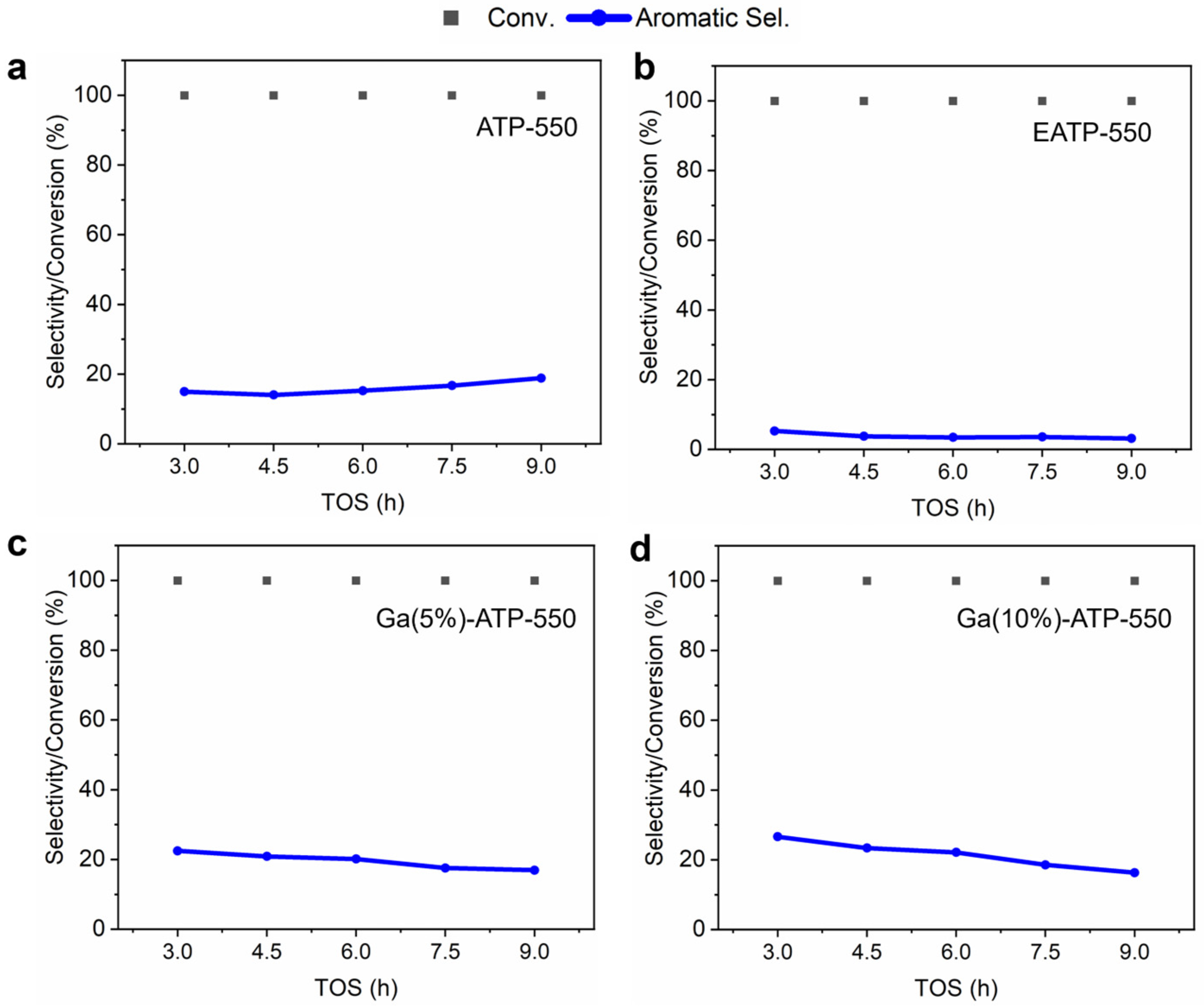
Using the 1-octene aromatization reaction as a model catalytic system, the catalytic performance was first evaluated for the ATP-550 and EATP-550 samples (Figure 7). The conversion of octene approached 100% in both cases, but the selectivity for aromatic hydrocarbons was below 20%. This can be attributed to the relatively low amounts of acid in both the ATP-550 and EATP-550 samples, as indicated by the Py-IR and NH3-TPD results (Figure 6). Even for the Ga(x%)-ATP-550 samples loaded with Ga, such as Ga(5%)-ATP-550 and Ga(10%)-ATP-550, the yield of aromatic hydrocarbons remained significantly lower than 30%, which still shows a considerable gap compared to the performance of commonly used H-ZSM-5 samples [31]. This may be due to the fact that untreated ATP is not suitable as a support to disperse Ga.
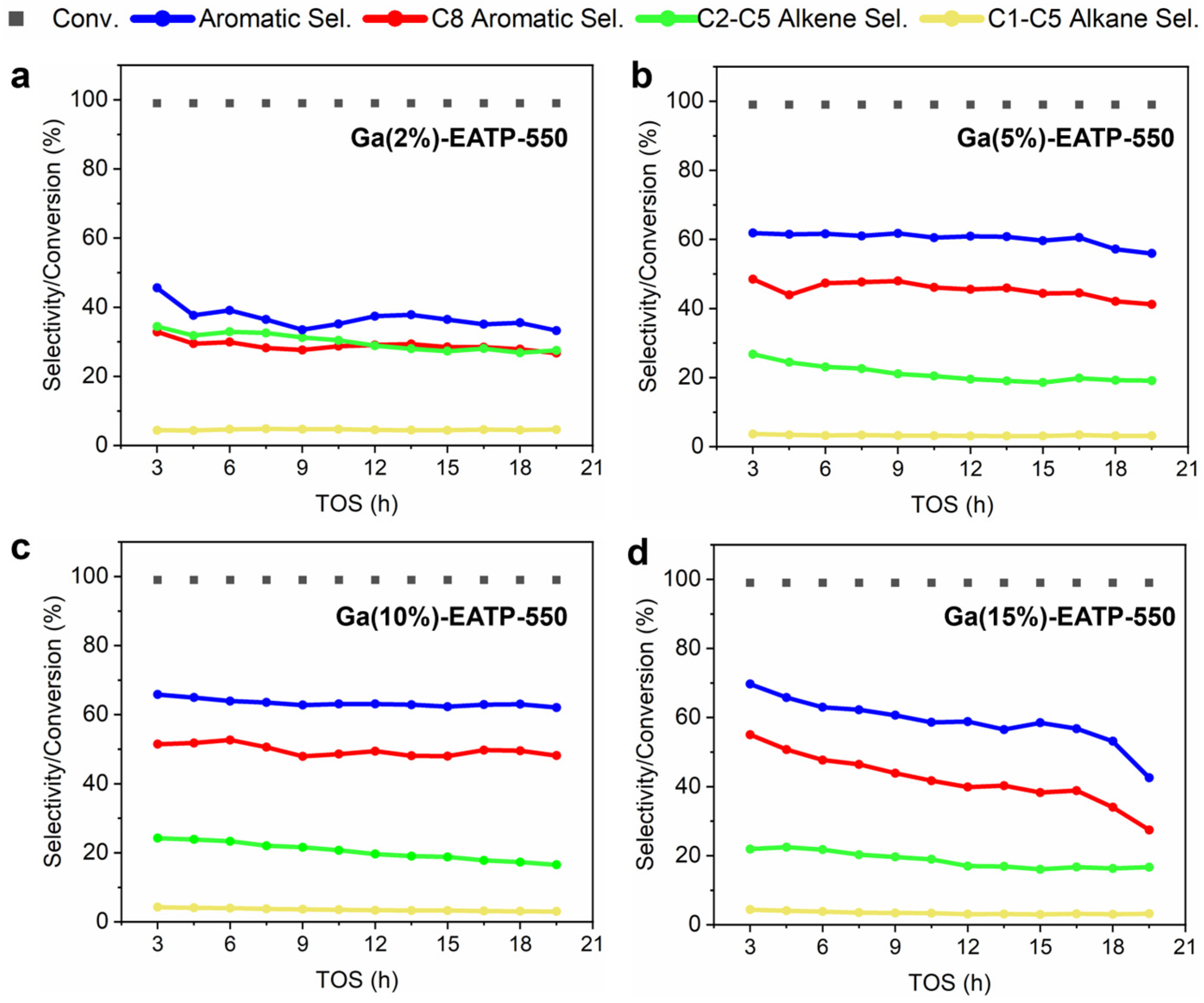
The same 1-octene aromatization reaction was evaluated for the target Ga(x%)-EATP-550 samples. As the Ga loading increased from 2% to 10%, the selectivity toward aromatic hydrocarbons progressively improved from 40% to 65% (Figure 8), which can be attributed to the gradually increasing number of Lewis acid sites (Figure 6). The main by-products were light olefins, accounting for approximately 20–35%. In contrast, the alkane by-products in the conventional HZSM-5 system remained consistently below 5%, indicating a relatively weak hydrogen transfer mechanism. Compared to light alkanes, light olefins possess higher economic value, which can be considered an additional advantage of this catalytic system. Py-IR results demonstrate that, unlike the ATP-550 and EATP-550 samples, the Ga(10%)-EATP-550 sample consists almost exclusively of Lewis acid sites (Figure 6b). This effectively avoids the hydrogen transfer mechanism typical of Brønsted acid systems, thereby suppressing the formation of short-chain alkanes.
However, when the Ga loading was further increased to 15%, significant catalyst deactivation occurred, leading to a pronounced decline in aromatic yield after 15 h of reaction. Excessive Ga loading may hinder diffusion within the micropores. In our previous work, we observed that within confined microporous structures, the desorption of large molecules requires elevated temperatures [30]. As reported in prior studies [32], thermal gravimetric analysis (TGA) is widely employed to confirm the generation of carbonaceous deposits during aromatization reactions. Within zeolite crystals, these deposits predominantly form on acid sites located inside micropores, which can lead to severe channel blockage and consequently a rapid decline in aromatization activity]. By comparing with prior representative olefin aromatization catalysts, our Ga(10%)-EATP-550 sample demonstrated comparable aromatic yield and significant advancement at slower deactivation rates (Figure S4).
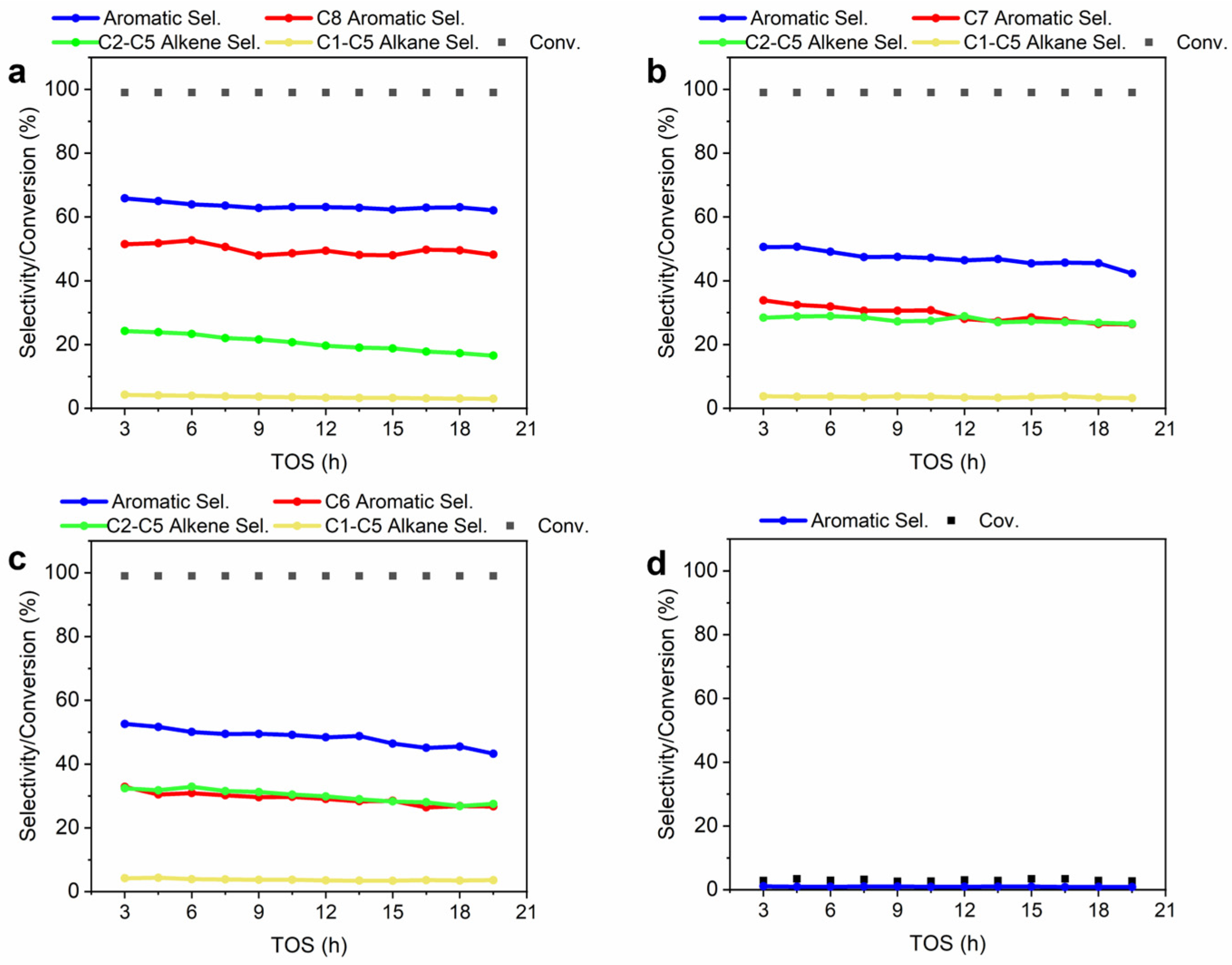
Notably, for the Ga(10%)-EATP-550 sample, the selectivity toward C8 aromatics reached as high as 50%, representing 77% of the total aromatic products. We also investigated the reactions using 1-hexene and 1-heptene as feedstocks (Figure 9). Similarly, it was found that the proportion of aromatics with the same carbon number as the feedstock exceeded 50% of the total aromatic products. In contrast, experiments using propylene as the feedstock showed extremely low conversion and very poor aromatic selectivity, further indicating that the olefin polymerization capability of this catalyst is weak. These results strongly suggest that the direct dehydrogenative aromatization of olefins is the dominant reaction pathway for the Ga(10%)-EATP-550 sample. This characteristic not only enhances selectivity toward aromatics of specific carbon numbers but also effectively prevents the formation of large aromatic molecules, thereby mitigating catalyst deactivation.

3. Experimental Section

3.1. Materials

Chemical reagents, including Ga(NO3)3·9H2O and HCl, were purchased with a purity of analytical reagent grade (AR). Deionized water was used in all the experimental processes. The attapulgite (purity 99.5%) in the experiment was used as purchased.

3.2. Synthesis of EATP and Ga(x%)-EATP-550

At room temperature, 5 g of attapulgite (ATP) was stirred with 60 mL of hydrochloric acid solution (3 mol/L) for 0.5 h. The mixture was transferred to a 100 mL stainless steel autoclave for a six-hour hydrothermal treatment at 120 °C. After cooling, the resulting precipitate was collected, thoroughly washed with deionized water until the pH of the filtrate reached 7, and dried at 100 °C. The acid-etched product was denoted as EATP. Subsequently, a series of catalysts with different gallium loadings was prepared by impregnating the EATP with solutions of varying Ga(NO3)3·9H2O concentrations. These catalysts were designated as Ga(x%)-EATP. Finally, the Ga(x%)-EATP samples were calcined at 550 °C under a nitrogen atmosphere to obtain the final catalysts, labeled as Ga(x%)-EATP-550.

3.3. Catalyst Characterization

The N2 adsorption data about the surface area (BET) of the samples were obtained by using a (Quantachrome Instruments, Boynton Beach, FL, USA) sorption analyzer at 77 K. Elemental analysis of the Ga metal in the samples was performed using a PerkinElmer Optima-2100DV (PerkinElmer, Waltham, MA, USA) inductively coupled plasma atomic emission spectroscopy (ICP-AES). The X-ray diffraction (XRD) patterns of the samples were obtained on a Bruker D8 (Bruker, Billerica, MA, USA) Advance powder diffractometer (Cu Kα radiation). Low-temperature N2 adsorption–desorption experiments were performed on a Micromeritics ASAP 2420 (Micromeritics, Norcross, GA, USA) analyzer. Morphological characteristics and grain size of the molecular sieves were obtained by transmission electron microscopy (TEM) using a QUANTA 400 from (FEI Company, Hillsboro, OR, USA). Characterization of the electronic state of metal Zn in catalysts was performed using X-ray photoelectron spectroscopy (XPS) with the Thermo Scientific ESCALAB 250Xi (Thermo Fisher Scientific, Waltham, MA, USA) model.
The acidity of the zeolites was determined by temperature-programmed desorption of ammonia (NH3-TPD) using an Autochem II 2920 instrument (Micromeritics, USA). The zeolite samples were pre-treated at 500 °C in a He flow (50 mL/min) for 1 h first, and then saturated with NH3 (with 50 mL/min He as balance gas) for 10 min at 100 °C. In order to remove the physically adsorbed ammonia, the He flow (50 mL/min) continued purging for 1 h. Finally, the samples adsorbed with ammonia were heated to 500 °C at a rate of 10 °C/min under a flow of pure helium (50 mL/min). The NH3 concentration was monitored with a quadrupole mass spectrometer (MS) (Omnistar Pfeiffer, Aßlar, Germany).
Transmission Fourier transform infrared spectra of adsorbed pyridine (Py-IR) were recorded on an EQUINOX 70 spectrometer (Bruker, Mannheim, Germany). A self-supporting wafer with about 20 mg of power was placed in an in situ cell equipped with a CaF2 window and a vacuum system. The sample was evacuated under a high vacuum at 500 °C for 1 h and then absorbed pyridine vapor for 30 s at 40 °C after balancing for 0.5 h. It was then continuously evacuated at 200 °C for 0.5 h, and spectra were measured at 200 °C. The quantitative concentration of Brønsted acid sites was calculated using the Lambert–Beer Law: C = AS/εm. And the molar absorption coefficient for Py-IR was εB = 0.73 cm/μmol, and for Me3Py-IR, it was εB = 8.1 cm/μmol.

3.4. Evaluation of the Catalytic Performance

Catalyst tests of different samples (0.2 g catalyst, 40–60 mesh) were carried out in a fixed-bed microreactor at atmospheric pressure under 10 mL/min N2, and the weight hourly space velocity was 0.2–0.5 h−1. Before the reaction, catalysts were pretreated at 550 °C for 60 min to remove impurities. The pipeline was kept at 180 °C. All the gas-phase reaction products were analyzed by on-line gas chromatography Agilent 7980A) (Agilent Technologies Inc., Santa Clara, CA, USA) equipped with a thermal conductivity detector (TCD) and two flame ionization detectors (FIDs). C1~C4 hydrocarbons in the tail gas were separated by a GS-Gas Pro capillary column with a flame ionization detector (FID). C5+ hydrocarbons were separated on a DM-PONA capillary column with an FID.
The n-octene/propylene conversion (X), selectivity for products (S) and dehydrogenation proportions (DH) were calculated by the following formulas, respectively. Equations (1)–(3) were used to calculate the n-octane/propylene conversion (C), selectivity to products (S) and dehydrogenation proportions (DH).
C   ( % ) = m m 0 × 100 %
S   ( % ) = m x m × 100 %  
DH   ( % ) = n ( H 2 ) n H 2 + n ( a l k a n e s ) × 100 %

4. Conclusions

In summary, a series of Ga(x%)-EATP-550 samples was prepared and applied in a series of olefin aromatization reactions. X-ray powder diffraction and transmission electron microscopy results indicated that most of the Ga was successfully incorporated into the ATP structures without forming distinct gallium oxide nanoparticles. X-ray photoelectron spectroscopy, X-ray absorption near-edge structure, and extended X-ray absorption fine structure analyses further revealed the absence of substantial Ga-O-Ga structural units, confirming the high dispersion of Ga within the support. Pore structure analysis demonstrated that the Ga(10%)-EATP-550 sample possessed abundant micropores and mesopores, providing a physical foundation for cyclization reaction and rapid diffusion, respectively. Based on the structural foundations discussed above, this system exhibits the following characteristics in olefin aromatization reactions:
  • The aromatization reaction with the prepared catalysts proceeds predominantly via the direct dehydrogenative pathway, with aromatics constituting the primary products.
  • Short-chain olefins of high added value are generated as the main by-products, contributing to an improved overall product value distribution.
  • The catalytic system effectively suppresses the formation of both long-chain aromatics and low-value alkanes, thereby enhancing the selectivity toward desired products.
Therefore, these results demonstrate a promising technological route for the high-value utilization of Fischer–Tropsch naphtha through selective olefin aromatization.

Supplementary Materials

The following supporting information can be downloaded at: https://www.mdpi.com/article/10.3390/catal16020203/s1, Figure S1: Nitrogen (N2) physical adsorption-desorption isotherm; Figure S2: TEM images of the Ga(10%)-ATP-550 sample; Figure S3: The determination of the crystal size of Ga2O3 in the Ga(10%)-ATP-550 sample; Figure S4: Performance comparison regarding aromatic yield and deactivate rate of aromatic yield per hour on the Ga(10%)-ATP-550 sample and prior reports in olefin aromatization reaction [1,30,31,33,34,35]; Table S1: The contents of Ga, Mg, Al, and Fe measured by ICP-OES; Table S2: Textural properties of the ATP, EATP, and Ga(x%)-EATP samples.

Author Contributions

S.H. and F.W. conceived the research direction and supervised the project. A.Y. designed and carried out the experiments. C.Q. assisted with experimental work and characterizations. G.Z. contributed to the data analysis and discussion of the results. All authors contributed to the writing and revision of the manuscript. All authors have read and agreed to the published version of the manuscript.

Funding

This research was financially supported by the Coal-Major Project (No. 2025ZD1701300) and the National Natural Science Foundation of China (No. 22372188).

Data Availability Statement

Data is contained within the article.

Acknowledgments

A. Y. and C. Q. contributed equally to this work. The authors are thankful for the support of the BSRF (Beijing Synchrotron Radiation Facility) during the XAFS measurements at the beamlines of 1W1B and 1W2B.

Conflicts of Interest

Authors Ao Yin, Changlin Qi and Fei Wang were employed by the company National Energy Center for Coal to Liquids, Synfuels China Co., Ltd. The remaining authors declare that the research was conducted in the absence of any commercial or financial relationships that could be construed as a potential conflict of interest.

References

  1. Long, H.; Wang, X.; Sun, W. Study of n-octene aromatization over nanoscale HZSM-5 zeolite. Microporous Mesoporous Mater. 2009, 119, 18–22. [Google Scholar] [CrossRef]
  2. Fan, Y.; Bao, X.; Lei, D.; Shi, G.; Wei, W.; Xu, J. A novel catalyst system based on quadruple silicoaluminophosphateand aluminosilicate zeolites for FCC gasoline upgrading. Fuel 2005, 84, 435–442. [Google Scholar] [CrossRef]
  3. Liang, J.; Liang, Z.; Zou, R.; Zhao, Y. Heterogeneous Catalysis in Zeolites, Mesoporous Silica, and Metal-Organic Frameworks. Adv. Mater. 2017, 29, 1701139. [Google Scholar] [CrossRef] [PubMed]
  4. Wang, P.; Shen, B.; Gao, J. Synthesis of ZSM-5 zeolite from expanded perlite and its catalytic performance in FCC gasoline aromatization. Catal. Today 2007, 125, 155–162. [Google Scholar] [CrossRef]
  5. Chen, Z.; Zhao, W.; Zhao, H.; Ren, J.; He, P. Influence of intracrystalline diffusion constraints enhanced by channel fluctuation on zeolite catalyst performance in isomerization and aromatization. Fuel 2024, 362, 130797. [Google Scholar] [CrossRef]
  6. Song, Y.; Li, H.; Guo, Z.; Zhu, X.; Liu, S.; Niu, X.; Xu, L. Effect of variations in acid properties of HZSM-5 on the coking behavior and reaction stability in butene aromatization. Appl. Catal. A Gen. 2005, 292, 162–170. [Google Scholar] [CrossRef]
  7. Alenezy, E.K.; El-Molla, S.A.; El-Nasser, K.S.; Sabri, Y.; Ali, I.O. ZSM-5 Nanocatalyst from Rice Husk: Synthesis, DFT Analysis, and Au/Pt Modification for Isopropanol Conversion. Catalysts 2026, 16, 110. [Google Scholar] [CrossRef]
  8. Cnudde, P.; Wispelaere, K.D.; Vanduyfhuys, L.; Demuynck, R.; Van der Mynsbrugge, J.; Waroquier, M.; Van Speybroeck, V. How chain length and branching influence the alkene cracking reactivity on H-ZSM-5. ACS Catal. 2018, 8, 9579–9595. [Google Scholar] [CrossRef]
  9. Konno, H.; Okamura, T.; Kawahara, T.; Nakasaka, Y.; Tago, T.; Masuda, T. Kinetics of n-hexane cracking over ZSM-5 zeolites-effect of crystal size on effectiveness factor and catalyst lifetime. Chem. Eng. J. 2012, 207–208, 490–496. [Google Scholar] [CrossRef]
  10. Li, X.; Zhang, D.; Liu, X.; Shi, L.; Sun, L. Atandem demetalization–desilication strategy to enhance the porosity of attapulgite for adsorption and catalysis. Chem. Eng. Sci. 2016, 141, 184–194. [Google Scholar] [CrossRef]
  11. Shi, J.; Xiao, Y.; Yu, M.; Li, X. Oxygen Vacancy-Engineered Ni:Co3O4/Attapulgite Photothermal Catalyst from Recycled Spent Lithium-Ion Batteries for Efficient CO2 Reduction. Catalysts 2025, 15, 732. [Google Scholar] [CrossRef]
  12. Bao, C. Review of the Application of Attapulgite and Their Colloids. Acad. J. Sci. Technol. 2023, 6, 105–110. [Google Scholar] [CrossRef]
  13. Chen, F.; Lou, D.; Yang, J.; Zhong, M. Mechanical and thermal properties of attapulgite clay reinforced polymethylmethacrylate nanocomposites. Polym. Adv. Technol. 2011, 22, 1912–1918. [Google Scholar] [CrossRef]
  14. Wang, W.; Wang, A. Recent progress in dispersion of palygorskite crystal bundles for nanocomposites. Appl. Clay Sci. 2016, 119, 18–30. [Google Scholar] [CrossRef]
  15. Lu, Y.; Wang, A. From structure evolution of palygorskite to functional material: A review. Microporous Mesoporous Mater. 2022, 333, 111765. [Google Scholar] [CrossRef]
  16. Zhuang, G.; Li, L.; Li, M.; Yuan, P. Influences of micropores and water molecules in the palygorskite structure on the color and stability of Maya blue pigment. Microporous Mesoporous Mater. 2022, 330, 111615. [Google Scholar] [CrossRef]
  17. Liu, Y.; Wang, W.; Wang, A. Effect of dry grinding on the microstructure of palygorskite and adsorption efficiency for methylene blue. Powder Technol. 2012, 225, 124–129. [Google Scholar] [CrossRef]
  18. Guggenheim, S.; Krekeler, M.P.S. Chapter 1-The Structures and Microtextures of the Palygorskite–Sepiolite Group Minerals. Dev. Clay Sci. 2011, 3, 3–32. [Google Scholar] [CrossRef]
  19. Tian, G.; Wang, W.; Zong, L.; Kang, Y.; Wang, A. A functionalized hybrid silicate adsorbent derived from naturally abundant low-grade palygorskite clay for highly efficient removal of hazardous antibiotics. Chem. Eng. J. 2016, 293, 376–385. [Google Scholar] [CrossRef]
  20. Zhu, J.; Zhang, P.; Wang, Y.; Wen, K.; Su, X.; Zhu, R.; He, H.; Xi, Y. Effectof acid activation of palygorskite on their toluene adsorption behaviors. Appl. Clay Sci. 2018, 159, 60–67. [Google Scholar] [CrossRef]
  21. Díaz-Arriaga, C.B.; Pacheco-Catalán, D.E.; Uribe-Calderon, J. Enhanced electrochemical properties of polypyrrole upon addition of acid-treated palygorskitetemplates. Mater. Chem. Phys. 2021, 266, 124551. [Google Scholar] [CrossRef]
  22. Su, X.; Wang, G.; Bai, X.; Wu, W.; Xiao, L.; Fang, Y.; Zhang, J. Synthesis of nanosized HZSM-5 zeolites isomorphously substituted by gallium and their catalytic performance in the aromatization. Chem. Eng. J. 2016, 293, 365–375. [Google Scholar] [CrossRef]
  23. Vanscoyoc, G.E.; Serna, C.J.; Ahlrichs, J.L. Structural changes in palygorskite during dehydration and dehydroxylation. Am. Mineral. 1979, 64, 215–223. [Google Scholar]
  24. Chen, H.; Zhao, J.; Zhong, A.; Jin, Y. Removal capacity and adsorption mechanism of heat-treated palygorskite clay for methylene blue. Chem. Eng. J. 2011, 174, 143–150. [Google Scholar] [CrossRef]
  25. Chen, H.; Zhong, A.; Wu, J.; Zhao, J.; Yan, H. Adsorption behaviors and mechanisms of methyl orange on heat-treated palygorskite clays. Ind. Eng. Chem. Res. 2012, 51, 14026–14036. [Google Scholar] [CrossRef]
  26. Chen, D.; Cai, Y.; Xiao, Y.; Wang, C.; Li, Y.; Ma, K.; Xiao, D.; Wang, H.; Lee, C.; Zhang, L.; et al. Electrosynthesis of Urea on High-Density Ga—Y Dual-Atom Catalyst via Cross-Tuning. Adv. Mater. 2025, 37, 2420593. [Google Scholar] [CrossRef]
  27. Zhang, M.; Xu, W.; Ma, C.; Yu, J.; Liu, Y.; Ding, B. Highly Active and Selective Electroreduction of N2 by the Catalysis of Ga Single Atoms Stabilized on Amorphous TiO2 Nanofibers. ACS Nano 2022, 16, 4186–4196. [Google Scholar] [CrossRef]
  28. Wang, Y.; Liang, D.; Wang, Q.; Shi, L.; Xu, W.; Li, C.; Chen, M.; Wang, P.; Men, Z.; Wang, J.; et al. Optimization of attapulgite acidification temperature in NiCo/attapulgite for dry reforming of methane. Chem. Eng. J. 2025, 520, 165920. [Google Scholar] [CrossRef]
  29. Zhang, Y.; Zu, Y.; He, D.; Liang, J.; Zhu, L.; Mei, Y.; Luo, Y. Thetailored role of “defect” sites on γ-alumina: A key to yield an efficient methane dry reforming catalyst with superior nickel utilization. App. Catal. B Environ. 2022, 315, 121539. [Google Scholar] [CrossRef]
  30. Xing, M.; Chen, Y.; Cao, J.; Han, Y.; Tao, Z.; Wang, F.; Hao, K.; Zhang, L.; Zheng, W.; Xiang, H.; et al. Are olefin aromatization reactions structure sensitive over Al pairs and single Al in H-ZSM-5 Zeolite? Fuel 2023, 333, 126541. [Google Scholar] [CrossRef]
  31. Nash, R.J.; Dry, M.E.; O’Connor, C.T. Aromatization of 1-hexene and 1-octene by gallium/H-ZSM-5 catalysts. Appl. Catal. A Gen. 1996, 134, 285–297. [Google Scholar] [CrossRef]
  32. Zhang, L.; Zhang, H.; Chen, Z.; Ning, Q.; Ren, J.; Wen, X. Insight into the impact of Al distribution on the catalytic performance of 1-octene aromatization over ZSM-5 zeolite. Catal. Sci. Technol. 2019, 9, 7034. [Google Scholar] [CrossRef]
  33. Cao, J.; Xing, M.; Han, Y.; Hao, K.; Zhang, L.; Wang, F.; Zheng, W.; Wen, X.; Yang, Y. Improving the Hydrothermal Stability of ZSM-5 Zeolites in 1-Octene Aromatization by Sequential Alkali Treatment and Phosphorus Modification. Catalysts 2022, 12, 1629. [Google Scholar] [CrossRef]
  34. Gao, R.; Liu, W.; Lu, B.; Liang, S.; Li, M.; Yu, Z.; Ji, P.; Lu, Z.; Mao, S.; Wang, Y. Noble Metal-Free Low-Temperature Aromatization of Polyethylene Wastefor High-Quality Fuel Production. Angew. Chem. Int. Ed. 2025, 64, e202506815. [Google Scholar] [CrossRef]
  35. Shi, D.; Chen, Y.; Chen, X.; Wang, S.; Wang, Q.; Wang, P.; Zhu, H.; Dong, M.; Xu, J.; Deng, F.; et al. Single [Ga(OH)]2+ Species Supported on Mesoporous Hollow-structured H-ZSM-5: A Highly Efficient Light Alkanes Aromatization Catalyst. Chin. J. Catal. 2025, 72, 359–375. [Google Scholar] [CrossRef]
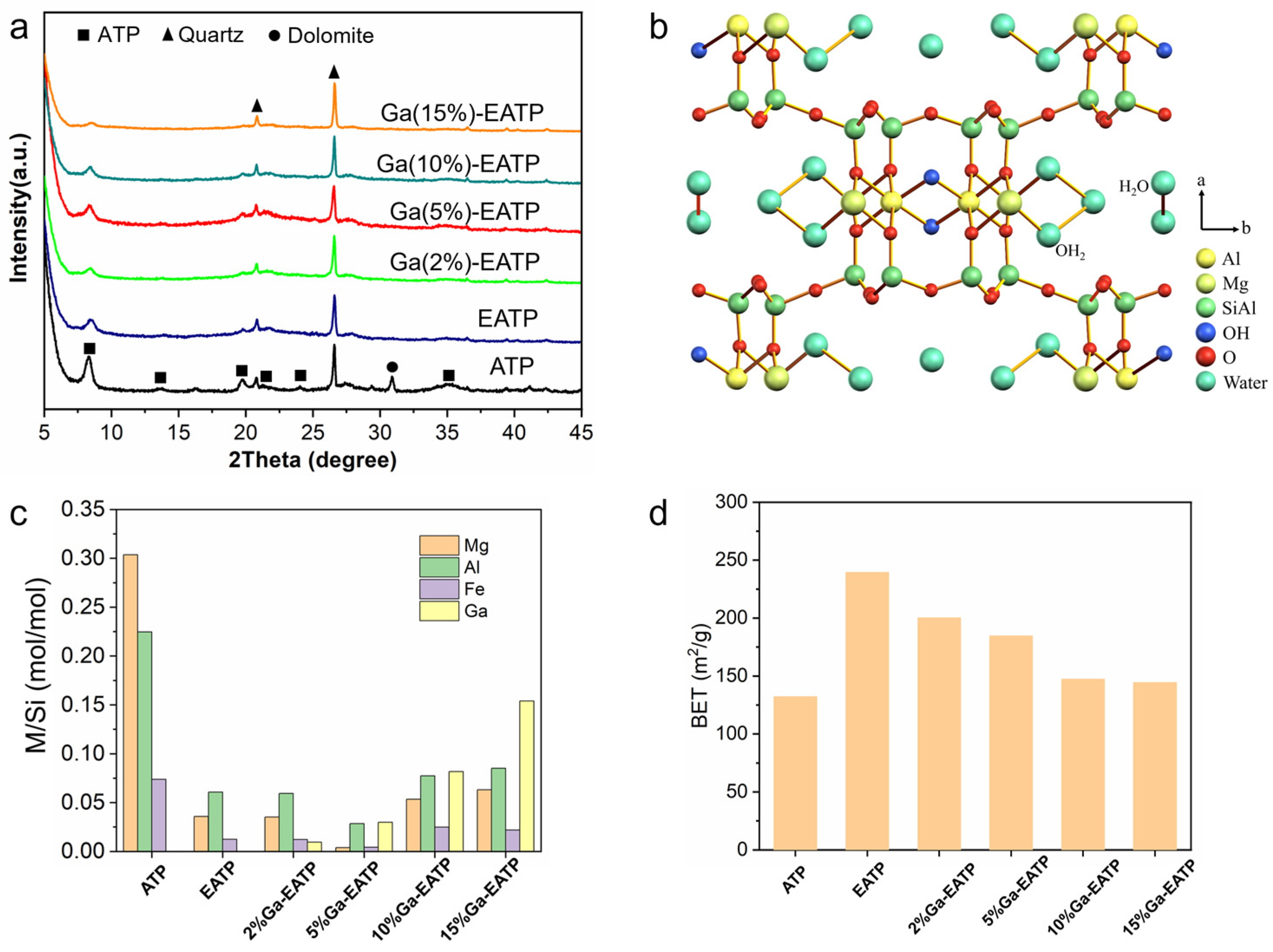
Figure 1. (a) XRD patterns of ATP, EATP, and Ga(x%)-EATP samples. (b) The crystal structure of monoclinic ATP from the 001-plane projection. (c) ICP-OES and (d) BET surface area of ATP, EATP, and Ga(x%)-EATP samples.
Catalysts 16 00203 g001
Figure 2. (a) XRD patterns of EATP-550 and Ga(x%)-EATP-550 samples. (b) Schematic diagram of the pore structure of ATP after heat treatment. Size distribution of (c) micropores and (d) mesopores of ATP and Ga(10%)-EATP-550 sample.
Catalysts 16 00203 g002
Figure 3. (a1,a2) TEM, (a3) STEM, and (a4,a5) corresponding EDS elemental mapping images of the Ga(2%)-EATP-550 samples. (b1,b2) TEM, (b3) STEM, and (b4,b5) corresponding EDS elemental mapping images of the Ga(5%)-EATP-550 samples. (c1,c2) TEM, (c3) STEM, and (c4,c5) corresponding EDS elemental mapping images of the Ga(10%)-EATP-550 samples. (d1,d2) TEM, (d3) STEM, and (d4,d5) corresponding EDS elemental mapping images of the Ga(15%)-EATP-550 samples.
Catalysts 16 00203 g003
Figure 4. XPS spectra of (a) Ga, (b) O, and (c) Si elements in the EATP and Ga-EATP-550 samples.
Catalysts 16 00203 g004
Figure 5. (a) XANES and (b) EXAFS spectra of Ga K-edge for Ga2O3, Ga foil, Ga(10%)-EATP-550 and Ga(15%)-EATP-550 samples.
Catalysts 16 00203 g005
Figure 6. (a) Pyridine adsorbed FT-IR spectra and (b) corresponding integrated area of characteristic peaks of the samples at 200 °C. (c) NH3-TPD patterns and (d) corresponding integrated area of the samples after adsorption of NH3 at 100 °C.
Catalysts 16 00203 g006
Figure 7. Catalytic performance of (a) ATP-550, (b) EATP-550, (c) Ga(5%)-ATP-550, and (d) Ga(10%)-ATP-550 samples in 1-octene aromatization reaction. Reaction conditions: T = 550 °C, WHSV = 0.2 h−1, P = 0.1 MPa.
Catalysts 16 00203 g007
Figure 8. Catalytic performance of Ga-EATP-550 samples in 1-octene aromatization reaction. Reaction conditions: T = 550 °C, WHSV = 0.2 h−1, P = 0.1 MPa. (a) Ga(2%)-EATP-550. (b) Ga(5%)-EATP-550. (c) Ga(10%)-EATP-550. (d) Ga(15%)-EATP-550.
Catalysts 16 00203 g008
Figure 9. Catalytic performance of Ga(10%)-EATP-550 sample in aromatization reaction. Reaction conditions: T = 550 °C, WHSV = 0.2 h−1, P = 0.1 MPa. Feedstocks: (a) 1-octene, (b) 1-heptene, (c) 1-hexene and (d) propylene.
Catalysts 16 00203 g009
Disclaimer/Publisher’s Note: The statements, opinions and data contained in all publications are solely those of the individual author(s) and contributor(s) and not of MDPI and/or the editor(s). MDPI and/or the editor(s) disclaim responsibility for any injury to people or property resulting from any ideas, methods, instructions or products referred to in the content.