Article

Chemically Bonded V-ZnIn2S4/MoS2 for Efficient Photocatalytic Hydrogen Evolution

1
Shenzhen Key Laboratory of Organic Pollution Prevention and Control, State Key Laboratory of Urban Water Resource and Environment, School of Eco-Environment, Harbin Institute of Technology Shenzhen, Shenzhen 518055, China
2
College of Urban and Environmental Sciences, Hubei Normal University, Huangshi 435002, China
3
Institute of Hydrogen and Fuel Cell, Harbin Institute of Technology Shenzhen, Shenzhen 518055, China
4
International Joint Research Center for Persistent Toxic Substances, Harbin Institute of Technology Shenzhen, Shenzhen 518055, China
*
Author to whom correspondence should be addressed.
These authors contributed equally to this work.
Catalysts 2026, 16(2), 188; https://doi.org/10.3390/catal16020188
Submission received: 15 January 2026 / Revised: 8 February 2026 / Accepted: 13 February 2026 / Published: 17 February 2026

Abstract

The construction of Z-scheme heterojunctions is regarded as one of the most effective modification strategies for photocatalysts. However, how to improve the interfacial charge transfer efficiency to further enhance the photocatalytic activity remains an urgent issue to be addressed. In this study, sulfur vacancy-enriched ZnIn2S4/MoS2 Z-scheme heterojunctions (V-ZIS/MS) containing interfacial Mo-S bonds was successfully synthesized using a hydrothermal method. The V-ZIS/2%MS showed the highest hydrogen evolution rate, achieving 19.21 ± 0.78 mmol·g−1·h−1 under visible light and 112.89 ± 10.98 mmol·g−1·h−1 under full-spectrum illumination, which are 5.07 and 4.41 times higher than ZIS (3.79 ± 0.79 mmol·g−1·h−1) and V-ZIS (4.36 ± 0.98 mmol·g−1·h−1) under visible light, respectively, outperforming most reported ZIS-based photocatalysts. This is because the composite of V-ZIS and MS enhanced its light absorption performance. More importantly, the formation of Mo-S bonds at the V-ZIS/MoS2 interface facilitated efficient charge transfer and reduced interfacial resistance, leading to significantly improved photocatalytic activity. Cycling experiments further demonstrate that V-ZIS/2%MS exhibits considerable photocatalytic stability. X-ray diffraction analysis before and after the reaction further confirmed the structural stability of the catalyst. This work provides a certain reference for the preparation of high-performance ZIS-based photocatalysts.

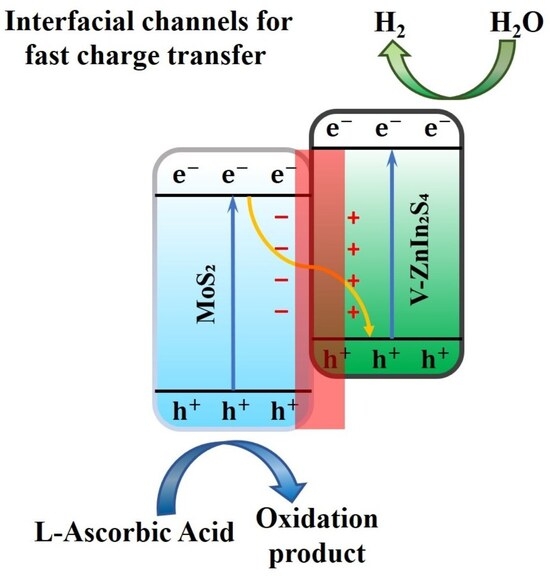
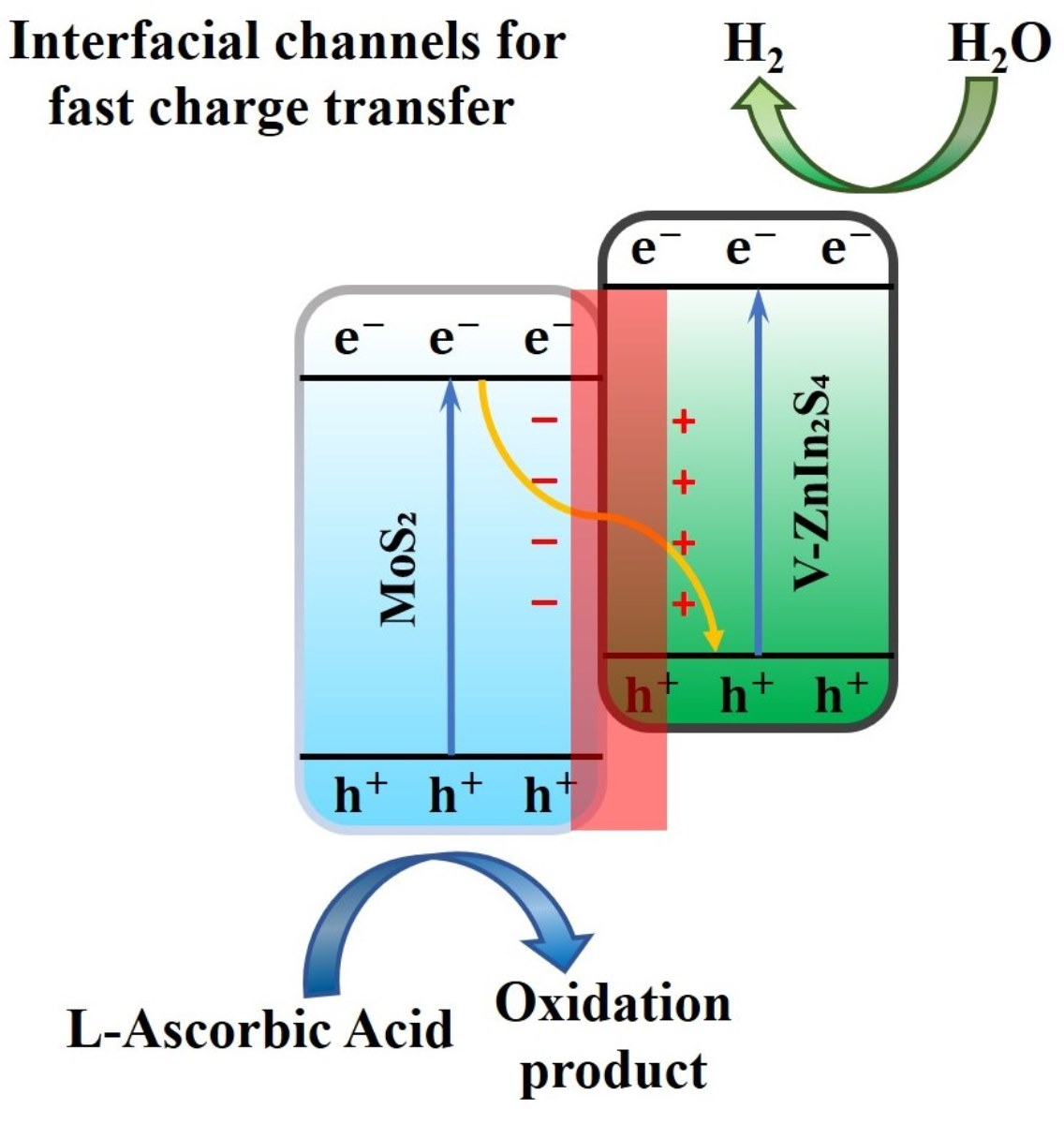
Graphical Abstract

1. Introduction

As industrialization has accelerated, the predicaments of energy scarcity and environmental contamination have progressively intensified [1,2,3]. Consequently, the exploration of alternative energy resources holds profound implications for the sustainable progression of human society. Photocatalytic water splitting enables the ingenious transformation of sustainable solar energy into hydrogen energy without producing pollutants during the reactive process [4,5].
Recently, metal chalcogenide photocatalysts, including CdS, ZnS and ZnIn2S4, have attracted significant attention due to their excellent visible-light response capabilities [6,7,8]. ZnIn2S4, a representative ternary layered metal chalcogenide semiconductor, possesses a tunable band gap in the range of 2.06–2.85 eV. Its conduction band potential of approximately −1.21 eV indicates strong reduction capability of the photogenerated electrons [9,10,11]. In addition to its favorable band structure, ZnIn2S4 also exhibits superior photostability and is more environmentally and biocompatible compared with CdS [12]. However, pristine ZnIn2S4 has limited photocatalytic efficiency, primarily due to rapid recombination of photogenerated charge carriers. To enhance its photocatalytic performance, various strategies have been explored, including phase and morphology control, elemental doping, cocatalyst loading, defect engineering, and heterojunction construction [13,14,15]. Among these approaches, defect engineering and heterojunction construction are recognized as one of the most effective approaches.
Z-scheme heterojunctions offer a unique advantage by maintaining a strong redox ability while promoting efficient separation of photogenerated charge carriers, making them a major focus in photocatalysis research. Tu et al. [16] constructed a CoSx@ZnIn2S4/MoS2 QDs dual Z-scheme heterojunction, which exhibited excellent photocatalytic activity. This was attributed to the formation of a dual Z-scheme heterojunction, which establishes multi-channel charge transfer pathways. Ning et al. [17] developed a core–shell Zn0.5Cd0.5S@ZnIn2S4/MoS2 Z-scheme photocatalyst with outstanding photocatalytic performance, which was attributed to improved charge separation and transport enabled by the core–shell architecture. Despite these advances, the overall efficiency of Z-scheme photocatalysts is often constrained by inefficient interfacial charge transfer. Precisely controlling the interfacial chemical environment and creating atomically connected structures that enable rapid charge migration remains a key challenge. Engineering chemical bonding at heterojunction interfaces represents a powerful approach for accelerating interfacial charge transfer and boosting photocatalytic performance. Xia et al. [18] synthesized a ZnIn2S4/HNb3O8 composite photocatalyst with Nb–S interfacial bonds using tetrabutylammonium as an exfoliation agent. During exfoliation, abundant oxygen vacancies were created on the HNb3O8 surface. These vacancies preferentially capture sulfur species during ZnIn2S4 growth, promoting the formation of Nb–S bonds under hydrothermal conditions. Therefore, developing simple and high-yield methods to form interfacial chemical bonds is essential. However, existing approaches that rely on intercalation agents often require harsh and hazardous conditions (e.g., tert-butyllithium) and typically result in low product yields. Furthermore, in previous studies [19,20,21,22,23], MoS2 serves as a cocatalyst in the ZnIn2S4/MoS2 system, rather than forming a Z-scheme heterojunction. Therefore, the fabrication of a chemically bonded ZnIn2S4/MoS2 Z-scheme heterojunction is of particular importance.
In this study, an interfacial chemical bond-mediated V-ZIS/MS Z-scheme photocatalyst was successfully synthesized via a hydrazine hydrate-assisted hydrothermal method for photocatalytic hydrogen evolution. XRD, Raman, FT-IR, XPS, SEM and TEM were employed to systematically characterize the crystal structure, surface chemical bonding, elemental composition, and morphology of the as-prepared photocatalysts. The separation efficiency of photogenerated charge carriers, light absorption properties, and photoelectrochemical behavior were investigated using PL, TRPL, UV–vis DRS, and EIS measurements. Furthermore, the photocatalytic hydrogen evolution performance of the synthesized samples was systematically evaluated. Electron paramagnetic resonance (EPR) measurements were conducted to further elucidate the defect states and charge transfer characteristics of the V-ZIS/MS Z-scheme photocatalyst. This work provides valuable guidance for the rational design of high-performance ZIS-based photocatalysts for photocatalytic hydrogen evolution.

2. Results and Discussion

2.1. Characterization of Photocatalysts

2.1.1. Composition and Vacancy Analysis of Photocatalysts

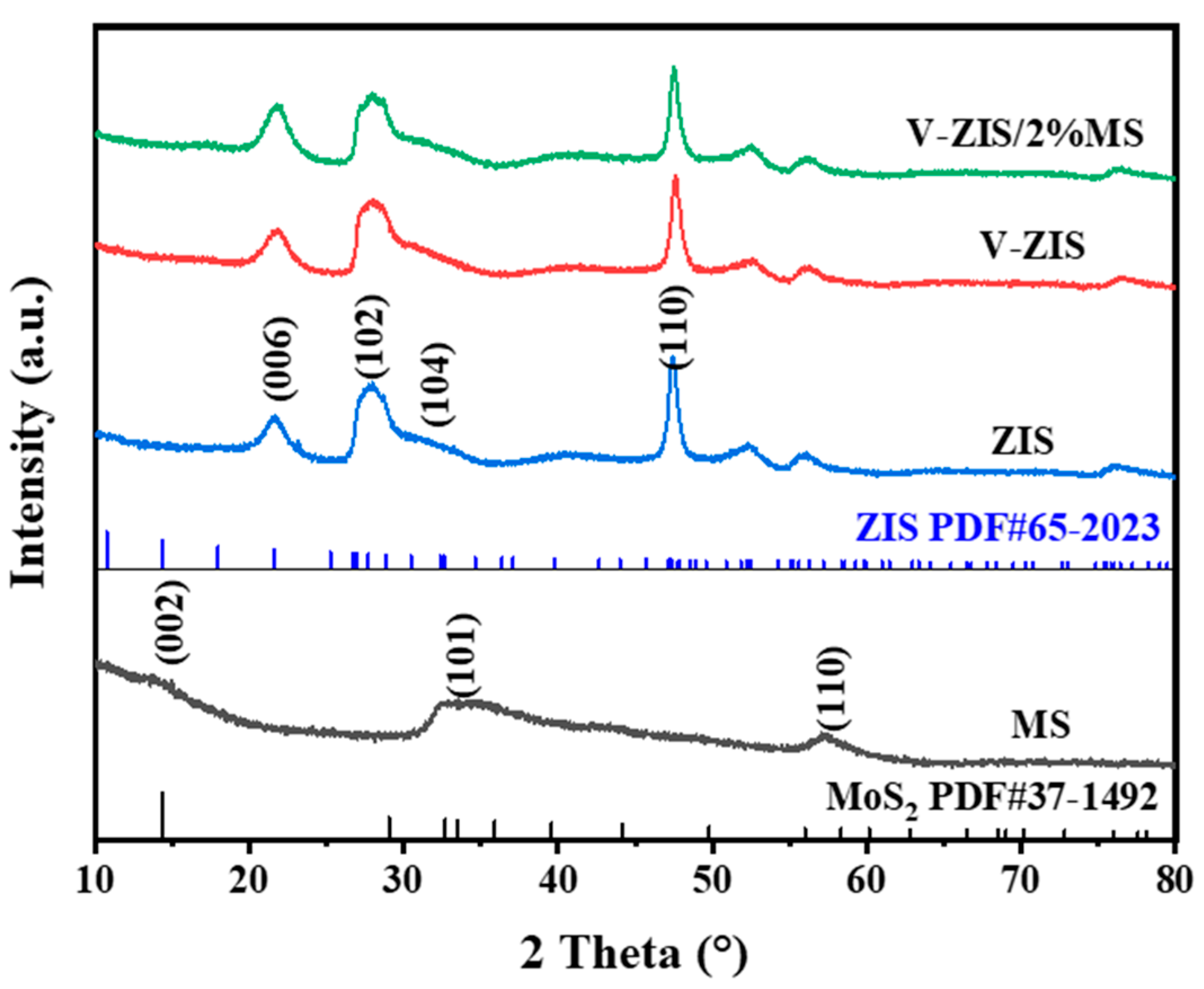
The XRD patterns of ZIS, V-ZIS, MS, and V-ZIS/2%MS are shown in Figure 1. The synthesized ZIS exhibits distinct diffraction peaks at 2θ = 21.54°, 27.60°, 30.60°, and 47.2°, corresponding to the (006), (102), (104), and (110) planes of hexagonal ZIS [24], confirming the successful formation of the typical hexagonal structure. The pure MoS2 sample displays diffraction peaks at 2θ = 14.91°, 32.96°, and 58.80°, which are indexed to the (002), (101), and (110) planes of standard MoS2 (JCPDS), confirming the formation of a typical MoS2 crystal structure [25]. In the XRD patterns of the V-ZIS and V-ZIS/2%MS composites, the characteristic diffraction peaks of ZIS are preserved, indicating that the ZIS crystal structure remains unchanged during the composite formation. Notably, no distinct MoS2 diffraction peaks are observed in the V-ZIS/2%MS composite, likely due to the low loading amount and high dispersion of MS. To determine the MS content in the composite sample, ICP-OES was used to measure the Mo content. The MS content in the composite photocatalyst was found to be only 1.47%, which is below the detection limit of XRD. Therefore, the absence of the MS peak in the XRD spectrum of V-ZIS/MS can be attributed to the low MS content.
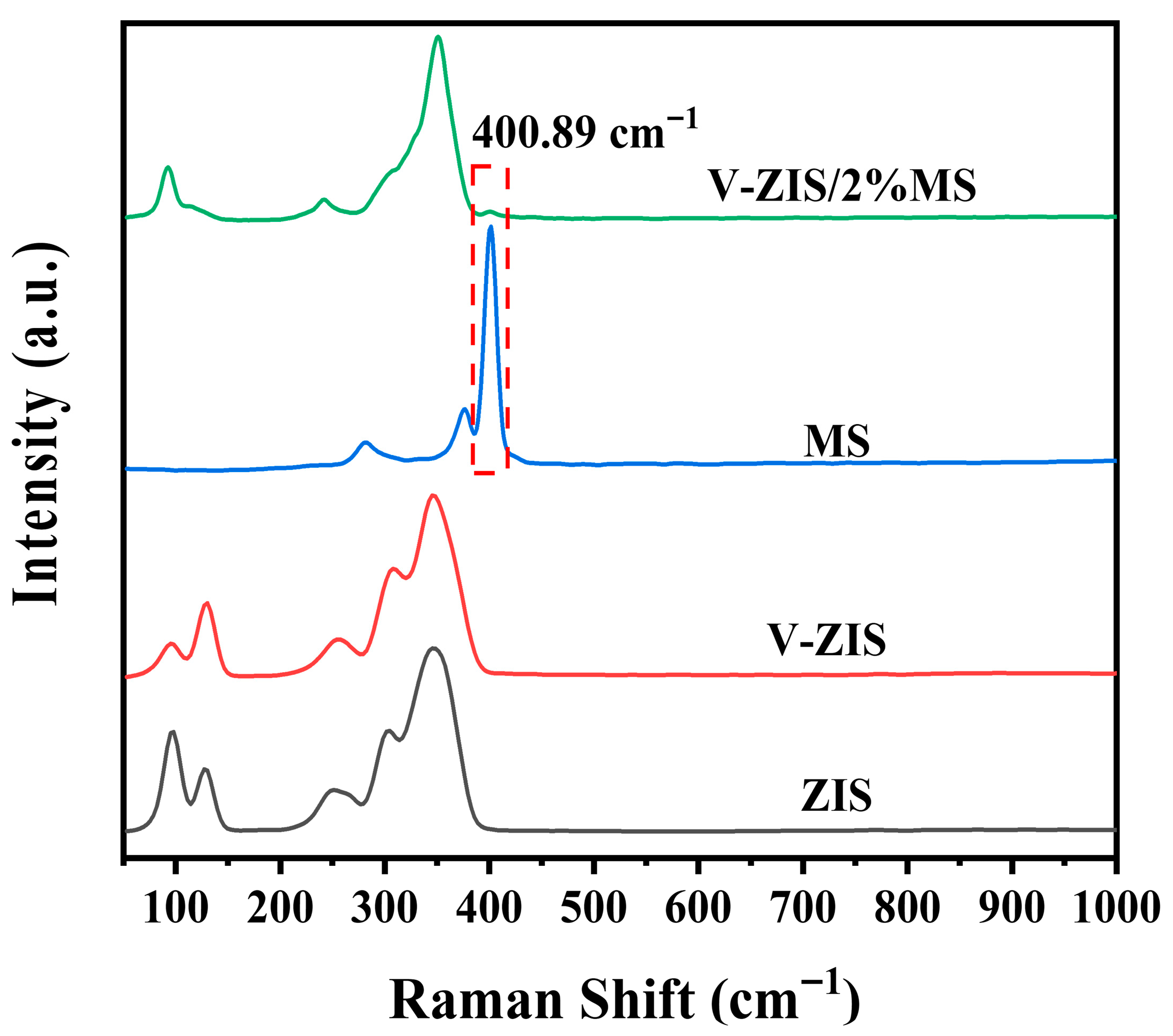
Raman spectroscopy was employed to investigate the vibrational modes and interfacial chemical bonding of ZIS, V-ZIS, MS, and the V-ZIS/2% MS composite [26]. As shown in Figure 2, the positions of the characteristic peaks for ZIS and V-ZIS are nearly identical, indicating that the V-ZIS structure has not undergone significant changes. However, noticeable peak broadening is observed, which can be attributed to lattice distortion and local electronic structure perturbations induced by sulfur vacancies. Additionally, a prominent characteristic peak of MS is observed at 400.89 cm−1, corresponding to the A1g vibrational mode of MoS2, confirming its layered dichalcogenide structure. In the V-ZIS/2%MS composite, in addition to all the ZIS peaks, a new peak appears at 400.89 cm−1, which corresponds to the characteristic peak of MS, indicating the presence of MS in the V-ZIS/2%MS composite.
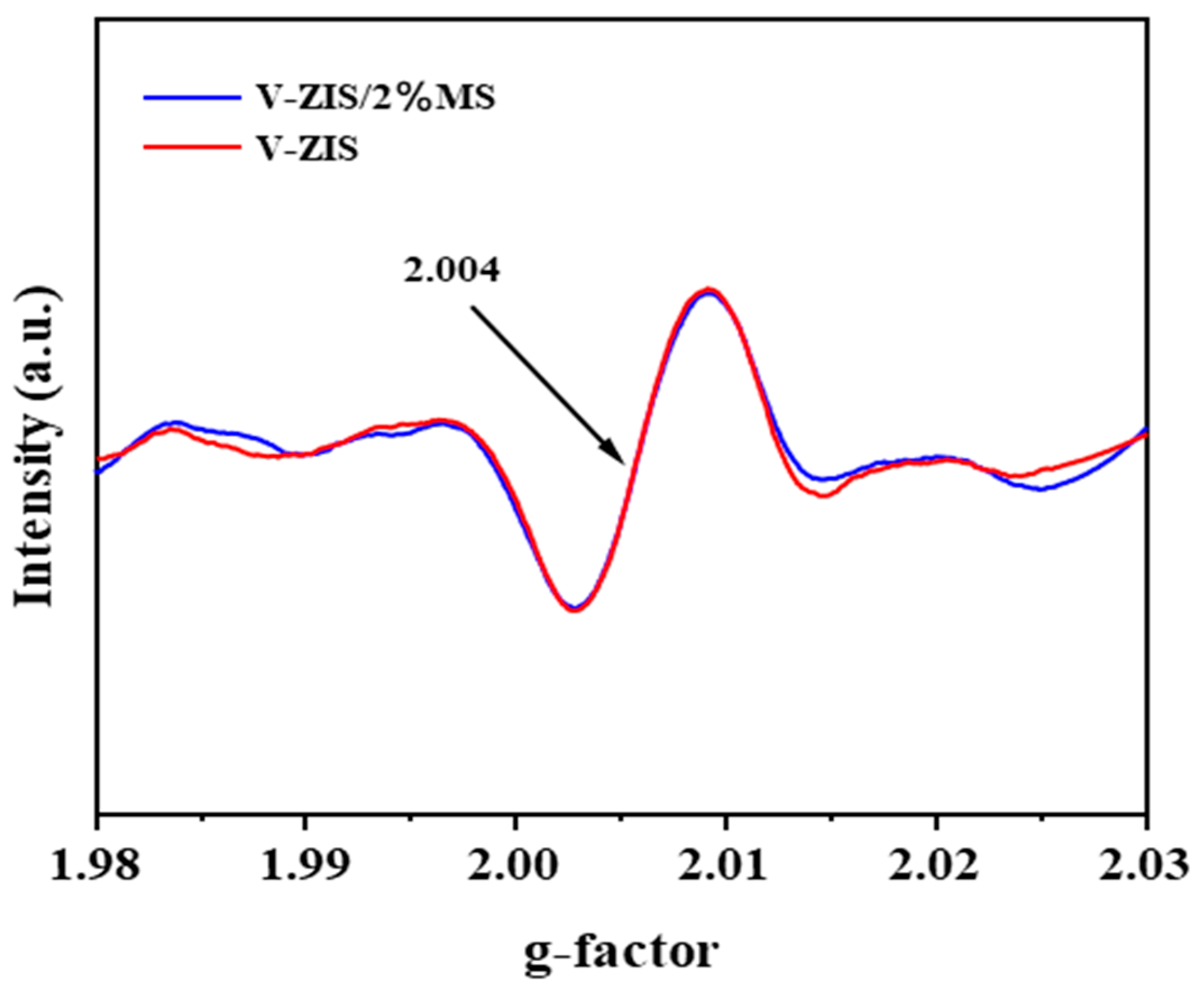
Electron paramagnetic resonance (EPR) spectroscopy was employed to investigate sulfur vacancy formation in V-ZIS and its evolution during the composite process in the V-ZIS/2%MS sample. As shown in Figure 3, the V-ZIS sample obtained after hydrazine hydrate-assisted hydrothermal treatment exhibits a distinct EPR signal at g ≈ 2.004. The same signal at g = 2.004 is also detected in the V-ZIS/2%MS composite, indicating that the sulfur vacancy structure of V-ZIS is largely preserved during composite formation [3,27]. Notably, the EPR signal intensity of the V-ZIS/2%MS sample is slightly weaker than that of pristine V-ZIS. This decrease in signal intensity is attributed to partial filling of sulfur vacancies by sulfur species from MS, indicating the formation of interfacial Mo–S bonds in the V-ZIS/2%MS composite [23,28,29].

2.1.2. Surface Element Valence States Analysis of Photocatalysts

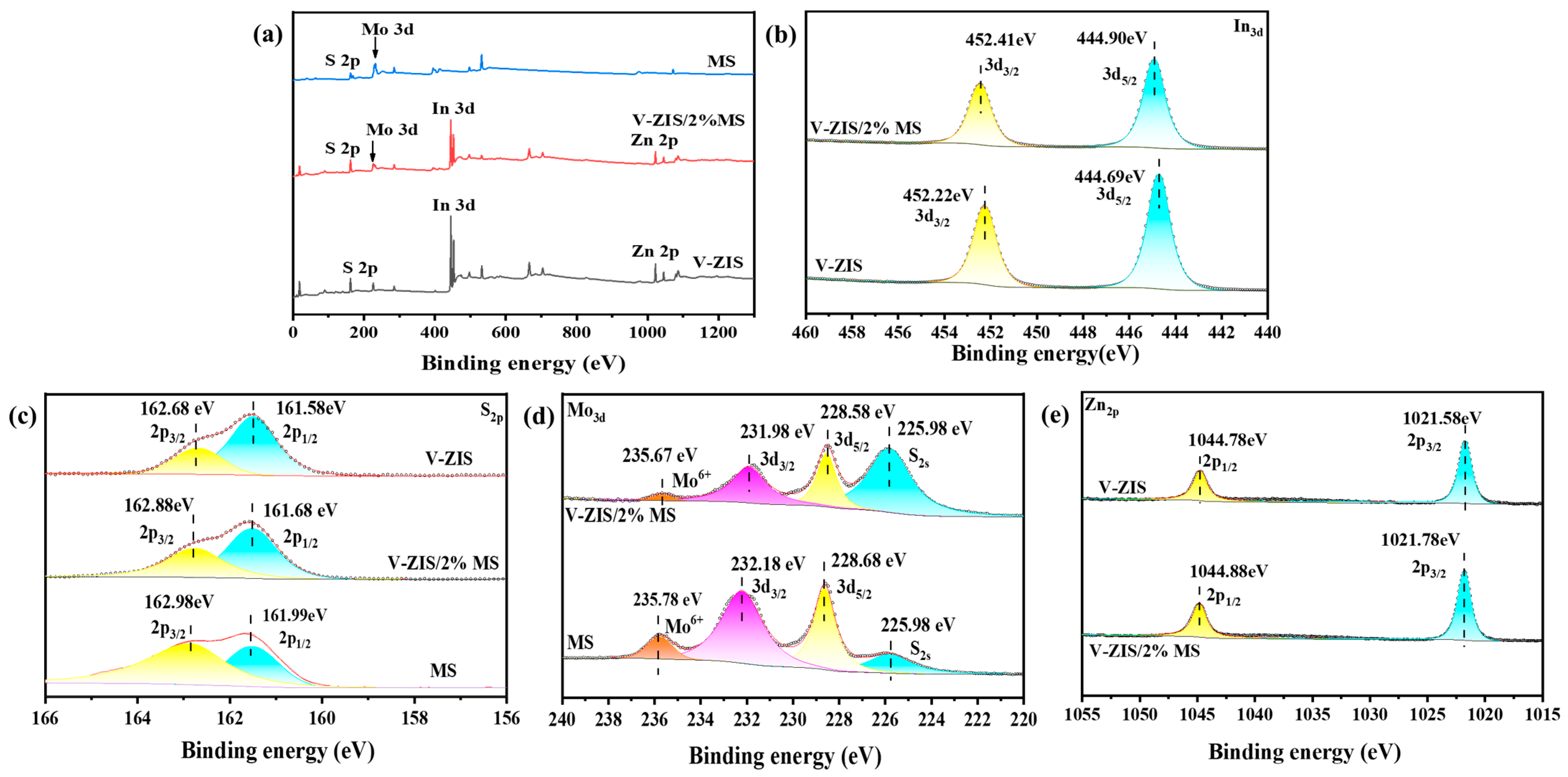
X-ray photoelectron spectroscopy (XPS) was employed to systematically investigate the surface elemental composition and chemical valence states of V-ZIS and V-ZIS/2%MS composite catalysts [30]. As shown in Figure 4a, the XPS survey spectrum of the V-ZIS/2%MS sample reveals distinct signals corresponding to S, Mo, In, and Zn, confirming the successful construction of a multicomponent composite. As shown in Figure 4b, two peaks for In 3d are observed in V-ZIS at 444.69 eV and 452.22 eV, corresponding to In 3d5/2 and In 3d3/2, respectively. However, in V-ZIS/2%MS, the In 3d5/2 and In 3d3/2 peaks shift to higher binding energies by 0.19 eV and 0.21 eV, respectively. As shown in Figure 4c, in MS, the peaks at 162.98 eV and 161.99 eV correspond to S 2p3/2 and S 2p1/2, while in V-ZIS, the peaks appear at 161.58 eV and 162.68 eV. In V-ZIS/2%MS, the peaks shift to 161.68 eV and 162.88 eV, with the binding energies of S 2p in V-ZIS/2%MS shifting by 0.31 eV and 0.10 eV to lower binding energies compared to MS. Compared to V-ZIS, the binding energies of S 2p in V-ZIS/2%MS shift by 0.20 eV and 0.10 eV to higher binding energies, respectively. As shown in Figure 4d, in MS, the peaks at 225.98 eV, 226.68 eV, 232.28 eV, and 235.78 eV are assigned to S 2s, Mo 3d5/2, Mo 3d3/2, and Mo6+, respectively. However, in V-ZIS/2%MS, the binding energies of Mo 3d5/2, Mo 3d3/2, and Mo6+ shift towards lower binding energies, which may be caused by the formation of Mo-S bonds between the sulfur atoms in ZnIn2S4 and Mo in MS [31]. Similarly, the Zn 2p spectrum (Figure 4e) shows characteristic peaks at 1021.78 eV (Zn 2p3/2) and 1044.88 eV (Zn 2p1/2), consistent with Zn2+ species [23].

2.1.3. Morphological Structure and Pore Analysis

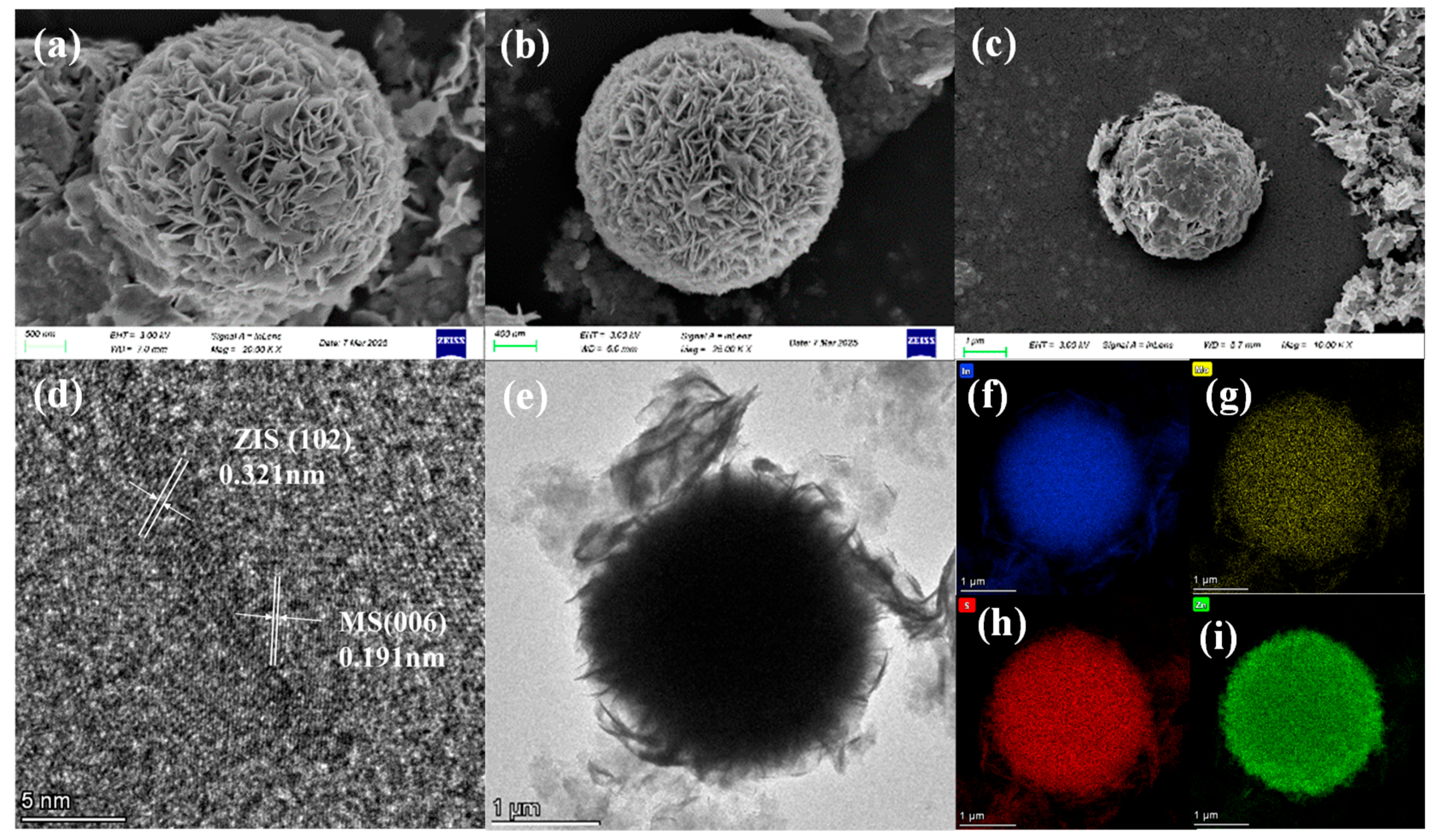
To elucidate the morphology and microstructural features of the as-prepared catalysts, SEM, TEM, and HRTEM were employed for systematic characterization. As shown in Figure 5a–c, ZIS, V-ZIS, and V-ZIS/2%MS are all nanoflower-like structures composed of nanosheets, with a diameter of approximately 1.5 μm. There are significant morphological changes between V-ZIS and ZIS, while more of the surface of V-ZIS/2%MS is covered with nanosheets, which may be due to the effects of the hydrothermal reaction process. The HRTEM image (Figure 5d) reveals clear lattice fringes for V-ZIS/2%MS. The interplanar spacings of 0.321 nm and 0.191 nm can be indexed to the (102) plane of ZIS and the (006) plane of MoS2, respectively. The coexistence of these lattice fringes at the nanoscale provides direct evidence for the successful construction of the V-ZIS/2%MS heterojunction. Elemental mapping further confirms that In, Zn, S, and Mo are homogeneously distributed throughout the particles, with no obvious aggregation or phase separation (Figure 5f–i).
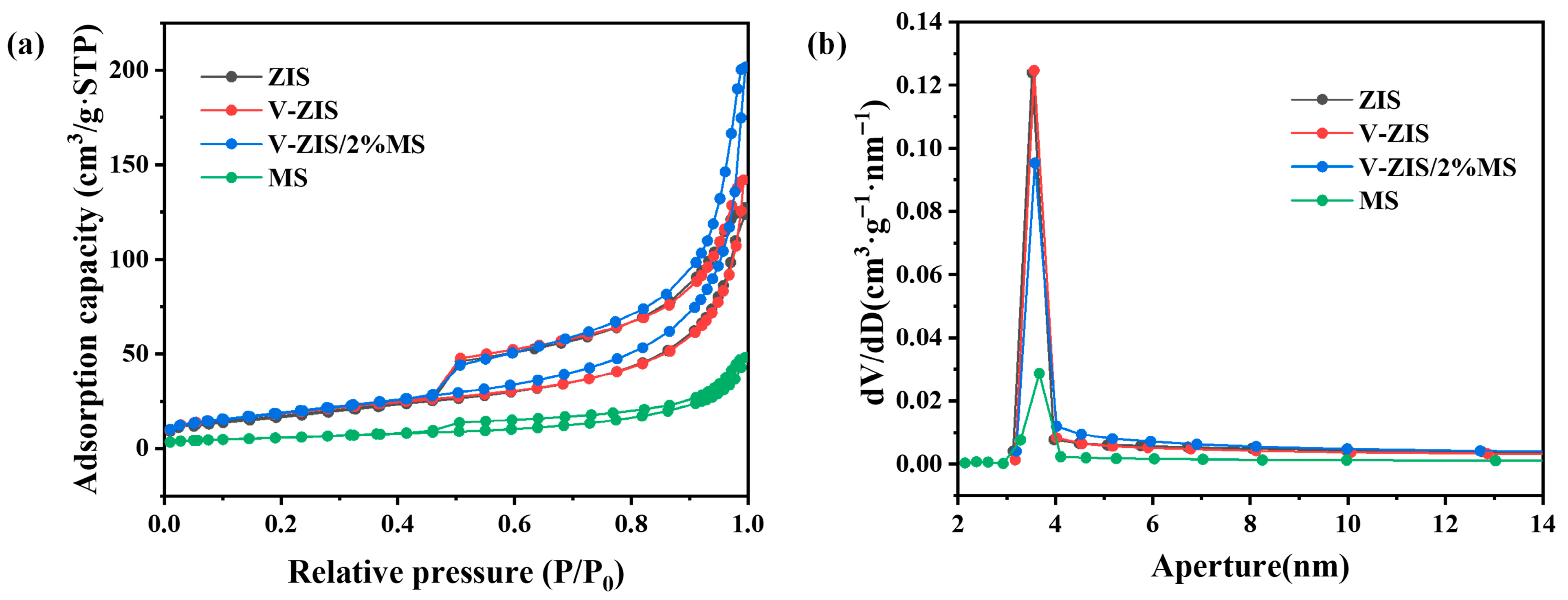
To elucidate the surface porosity of ZIS, V-ZIS, MS, and V-ZIS/2%MS, N2 adsorption–desorption measurements were performed to determine the specific surface area, pore volume, and pore size distribution. As shown in Figure 6a, all samples display typical type IV isotherms accompanied with H3-type hysteresis loops, indicating the presence of mesoporous structures. In the low relative (P/P0) region, the adsorption capacity increases gradually, which is attributed to monolayer adsorption. With increasing P/P0, the adsorption amount rises rapidly due to capillary condensation within mesopores, further confirming the mesoporous nature of these materials [32]. As shown in Figure 6b, the pore sizes distributions are mainly concentrated in the range of 2–6 nm. As shown in Table S1 in the Supplementary Materials, the specific surface area of MS is only 21.0436 m2/g, whereas the specific surface areas of V-ZIS, ZIS, and V-ZIS/2%MS are mainly distributed in the range of 54–67 m2/g. The ZIS-based photocatalysts exhibit only slight differences in surface area, with no significant changes observed. In addition, no obvious variations in pore volume or average pore size are found among V-ZIS, ZIS, V-ZIS/2%MS, and MS, which is consistent with the SEM results. Notably, the BET surface area, pore volume, and average pore size of V-ZIS, ZIS, and V-ZIS/2%MS do not show significant changes, indicating that the enhancement in photocatalytic hydrogen evolution activity is not attributed to variations in surface area, pore volume, or average pore size.

2.2. Photocatalytic Activity

2.2.1. Effect of Photocatalyst Composition

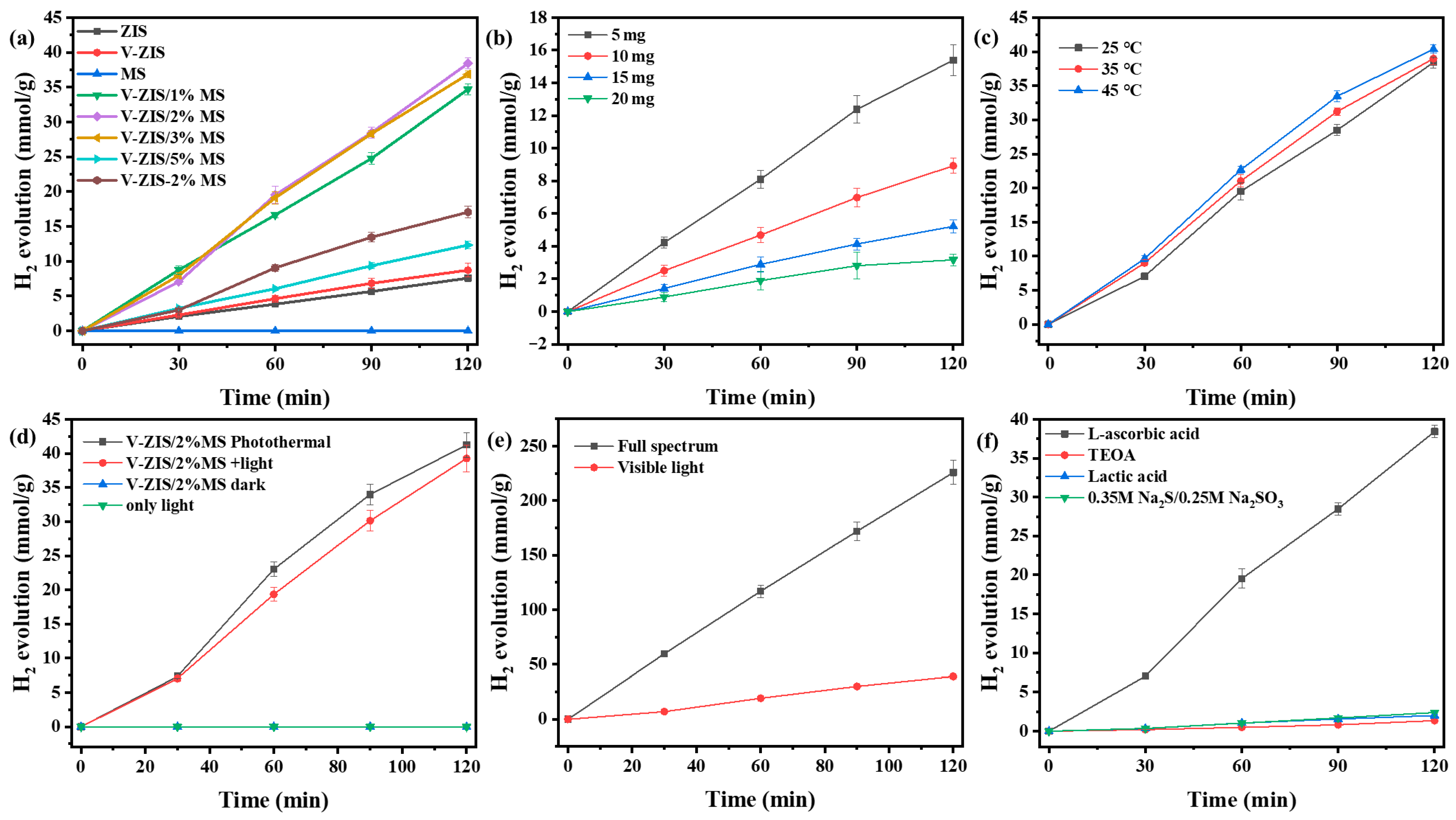
As shown in Figure 7a, pristine ZIS delivers an H2 evolution rate of 3.78 mmol·g−1·h−1, whereas MS exhibits negligible activity (0 mmol·g−1·h−1) under identical conditions. After loading MS onto V-ZIS, the H2 evolution activity of V-ZIS/MS is markedly enhanced. In general, the H2 evolution rate increases with MS loading at low contents and then decreases at higher loadings. Notably, the V-ZIS/2%MS sample shows the optimal performance, achieving an H2 evolution rate of 19.21 mmol·g−1·h−1, which is 5.06 times higher than that of pristine ZIS, indicating competitive activity relative to many reported ZIS-based photocatalysts (Table S2 in Supplementary Materials). Furthermore, the photocatalytic hydrogen production rate of V-ZIS/2%MS is 2.25 times that of V-ZIS-2%MS, indicating that the formation of Mo-S bonds effectively promotes interfacial charge transfer, enhancing its photocatalytic activity. This enhancement of photocatalytic hydrogen production rate of ZIS is mainly attributed to the formation of a Z-scheme heterojunction and interfacial Mo–S bonding, which promotes interfacial charge separation and transfer, thereby accelerating hydrogen evolution [33]. When the MS loading is further increased, the H2 evolution rate declines, which is likely due to the excessive loading of MoS2, leading to a shielding effect [34,35].

2.2.2. Effect of Photocatalyst Dosage

The influence of the photocatalyst dosage on hydrogen evolution activity is presented in Figure 7b. The initial H2 evolution rate decreases monotonically with increasing catalyst dosage, which is primarily attributed to the light-shielding effect at high catalyst concentrations. At excessive dosages, particle aggregation and mutual shading reduce light penetration and effective photon utilization, thereby lowering the apparent activity [36].

2.2.3. Effect of Reaction Temperature

As shown in Figure 7c, the effect of reaction temperature on photocatalytic hydrogen evolution activity was evaluated. The H2 evolution rates of V-ZIS/2%MS are 19.21 mmol·g−1·h−1 at 25 °C, 19.49 mmol·g−1·h−1 at 35 °C, and 20.19 mmol·g−1·h−1 at 45 °C, indicating a slight increase in activity with rising temperature. Overall, the modest change suggests that the promoting effect of temperature in this photocatalytic system is limited within the investigated range [37].

2.2.4. Effect of Light Conditions

The influence of illumination conditions on the H2 evolution performance of the V-ZIS/2%MS photocatalyst was also investigated. As shown in Figure 7d, negligible H2 was detected either in the presence of the photocatalyst without light or under illumination without the photocatalyst, demonstrating that hydrogen evolution in this system requires both light irradiation and the photocatalyst. Moreover, removing the cooling circulation caused little change in the H2 evolution rate of V-ZIS/2%MS, further indicating that the temperature effect on photocatalytic performance is limited under the present conditions. As shown in Figure 7e, the H2 evolution rate of the V-ZIS/2%MS photocatalyst reaches 112.89 mmol·g−1·h−1 under full-spectrum illumination, whereas it decreases to 19.21 mmol·g−1·h−1 under visible-light irradiation.

2.2.5. Effect of the Type of Sacrificial Agent

Figure 7f compares the effects of different sacrificial agents on the photocatalytic hydrogen evolution activity. Four sacrificial agents—L-ascorbic acid, triethanolamine (TEOA), lactic acid, and a mixed Na2SO3/Na2S solution—were evaluated. With TEOA, lactic acid, and Na2SO3/Na2S as the sacrificial agents, the H2 evolution rates are 0.68, 1.00, and 1.20 mmol·g−1·h−1, respectively. In contrast, using L-ascorbic acid markedly boosts the H2 evolution rate to 19.21 mmol·g−1·h−1, which is mainly ascribed to differences in hole-scavenging ability among the sacrificial agents. In particular, L-ascorbic acid has an efficient hole-scavenging ability, thereby suppressing charge recombination and improving photocatalytic activity, consistent with previous reports [38].

2.2.6. Cycling Experiments

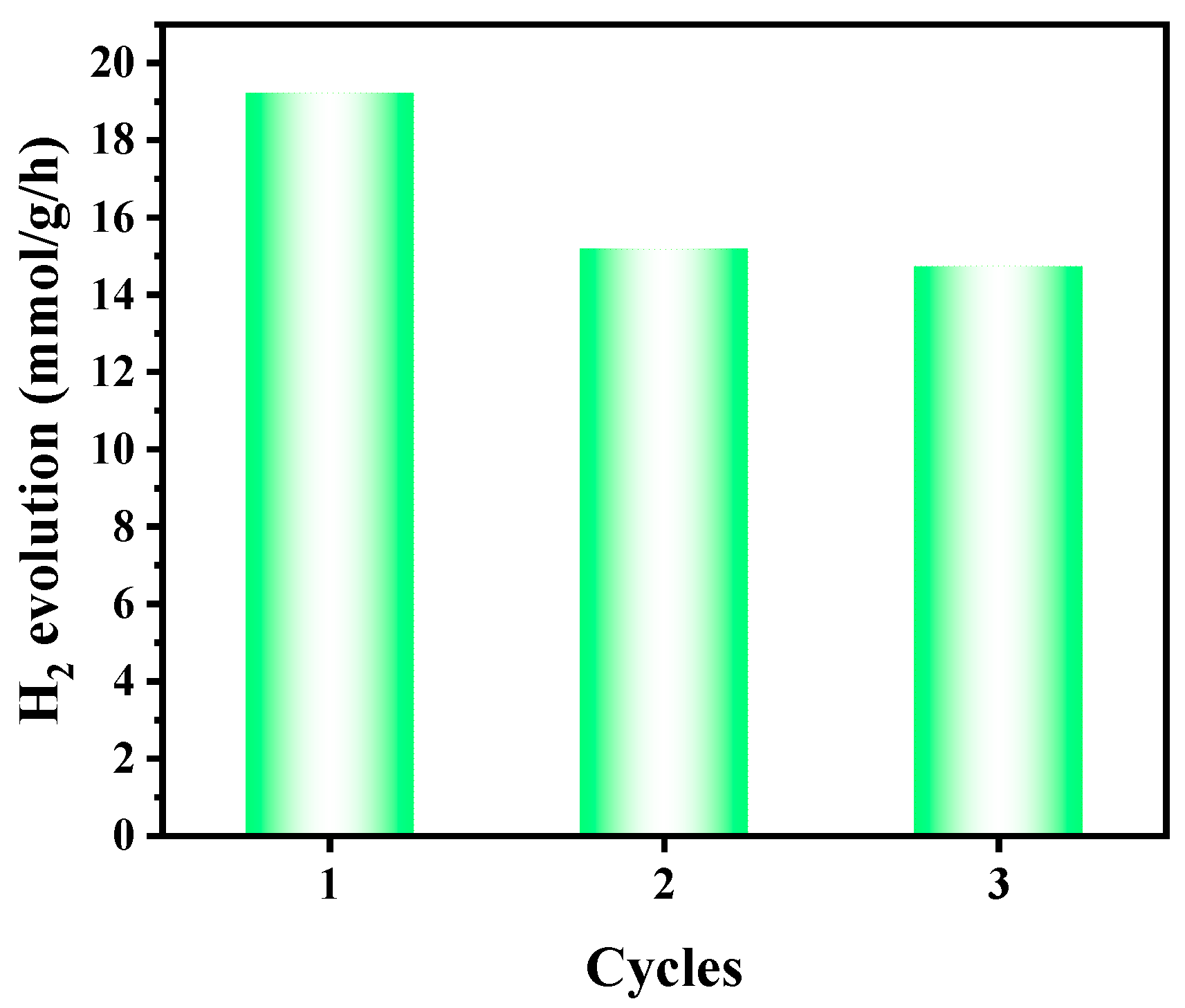
The photocatalytic stability of V-ZIS/2% MS was assessed by cycling tests. The cycling experiments were conducted under identical conditions, with aliquots collected every 2 h to quantify cumulative H2 production and to calculate the average evolution rate for each interval. As shown in Figure 8, the hydrogen production rates for the three cycles were calculated to be 19.21 mmol/g/h, 15.19 mmol/g/h, and 14.73 mmol/g/h. After three cycling tests, 76.7% of the photocatalytic activity was retained, indicating that V-ZIS/2%MS exhibits considerable photocatalytic stability.

2.3. Photocatalytic Mechanism Analysis

2.3.1. Light Harvesting Capability and Band Gap Structure

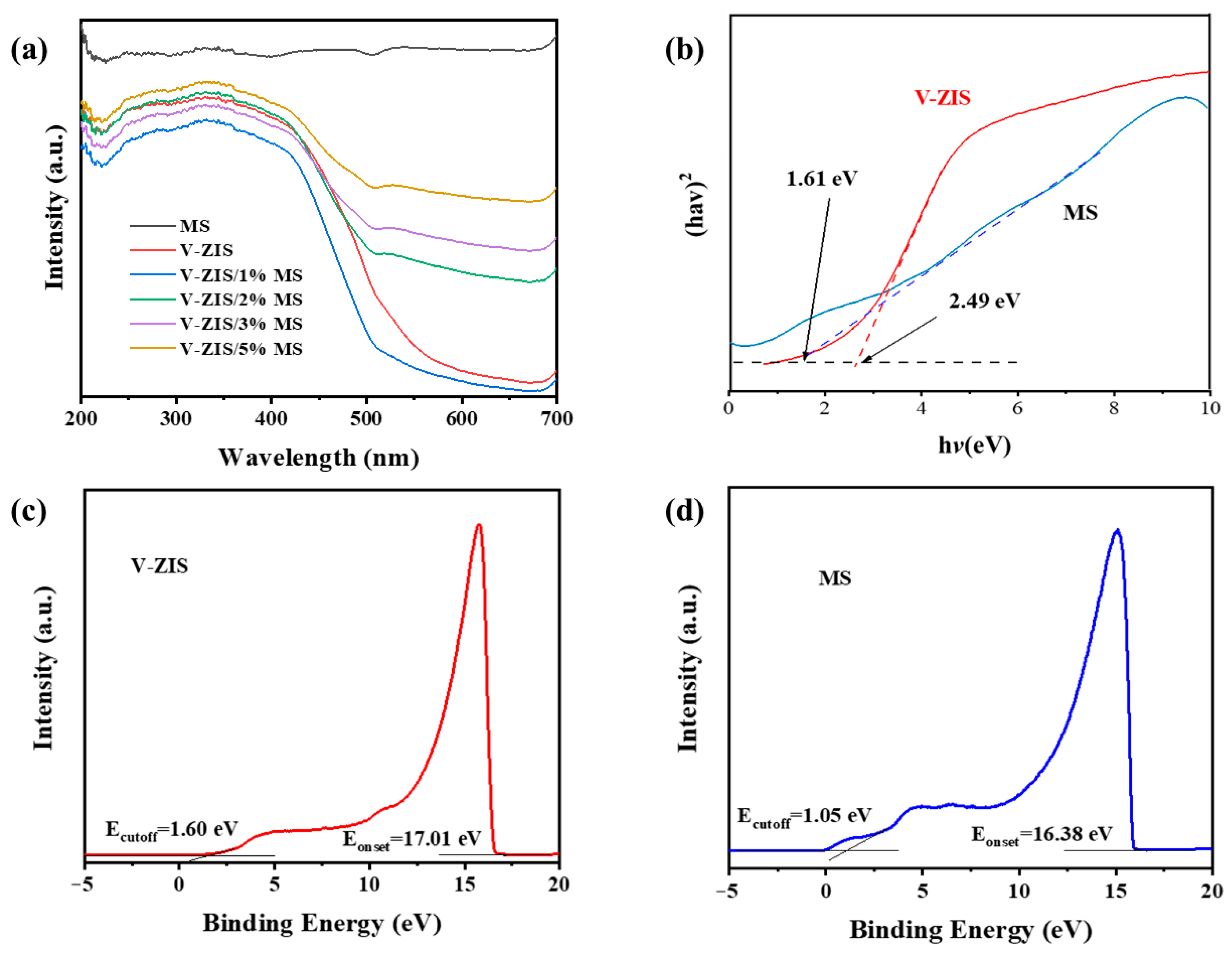
UV–Vis diffuse reflectance spectroscopy (DRS) was used to assess the optical properties of the V-ZIS/MS composite photocatalysts [39]. As shown in Figure 9a, MS has a small band gap and absorbs strongly from 200 to 800 nm, with particularly strong absorption in the visible region. As the MS content increases, the composites show progressively higher visible-light absorption, indicating that adding MS improves light harvesting and may support photocatalytic activity. The optical band gap (Eg) was estimated from the DRS data using the Tauc method based on (αhν)2 = A(hν − Eg) [40,41,42,43]. The reflectance data were converted to Tauc plots (Figure 9b), and the absorption edges were fitted by linear extrapolation. The resulting Eg values are 2.49 eV for V-ZIS and 1.61 eV for MS [44].
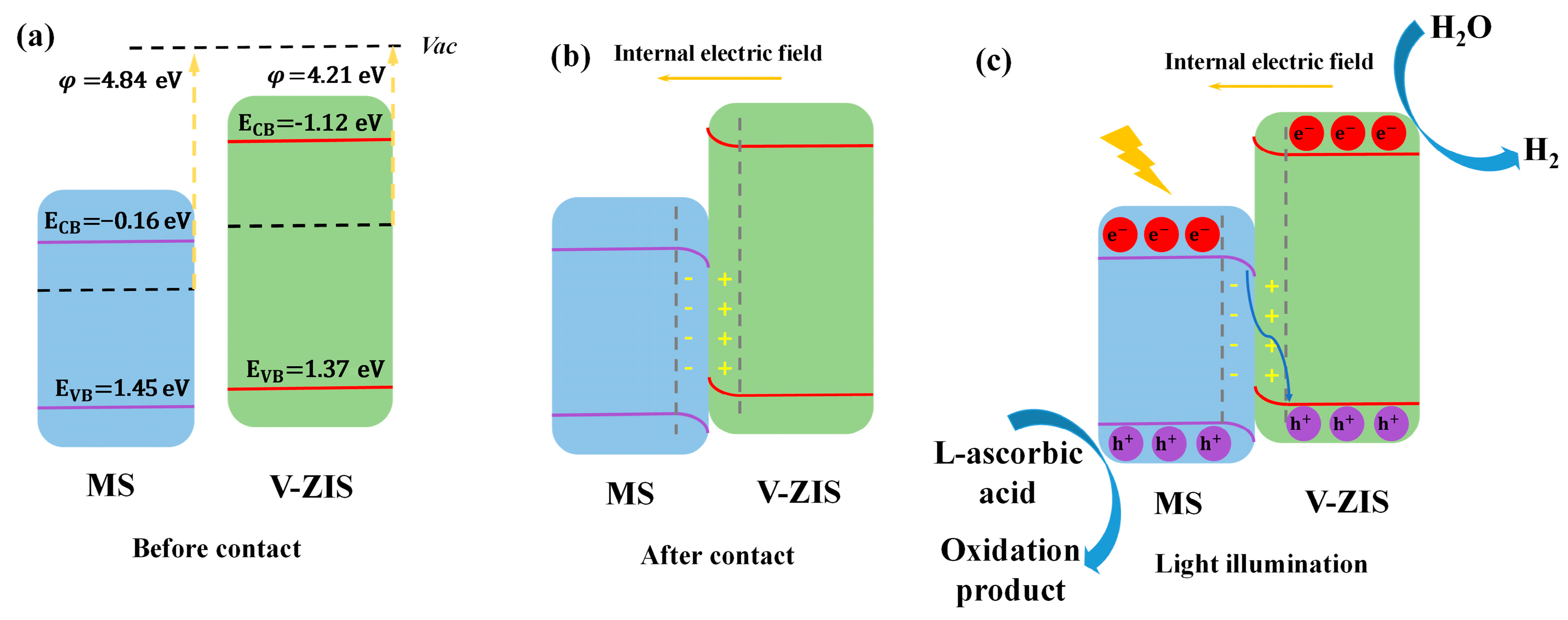
Ultraviolet photoelectron spectroscopy (UPS) was used to determine the work function (φ), valence band maximum (EVB) and conduction band minimum (ECB) of V-ZIS and MS [45]. Using φ = 21.22 − Ecutoff (Figure 9c,d and Figure S1) [1], φ is 4.21 eV for V-ZIS and 4.84 eV for MS. The valence-band positions were calculated from EVB = 21.22 − (Ecutoff − Eonset), giving EVB values of 5.81 eV (V-ZIS) and 5.89 eV (MS) relative to vacuum, corresponding to 1.37 eV and 1.45 eV vs. NHE, respectively. The conduction-band positions were then obtained from ECB = EVB − Eg, yielding ECB values of −1.12 eV for V-ZIS and −0.16 eV for MS (vs. NHE) [46].

2.3.2. Photoelectrochemical Properties

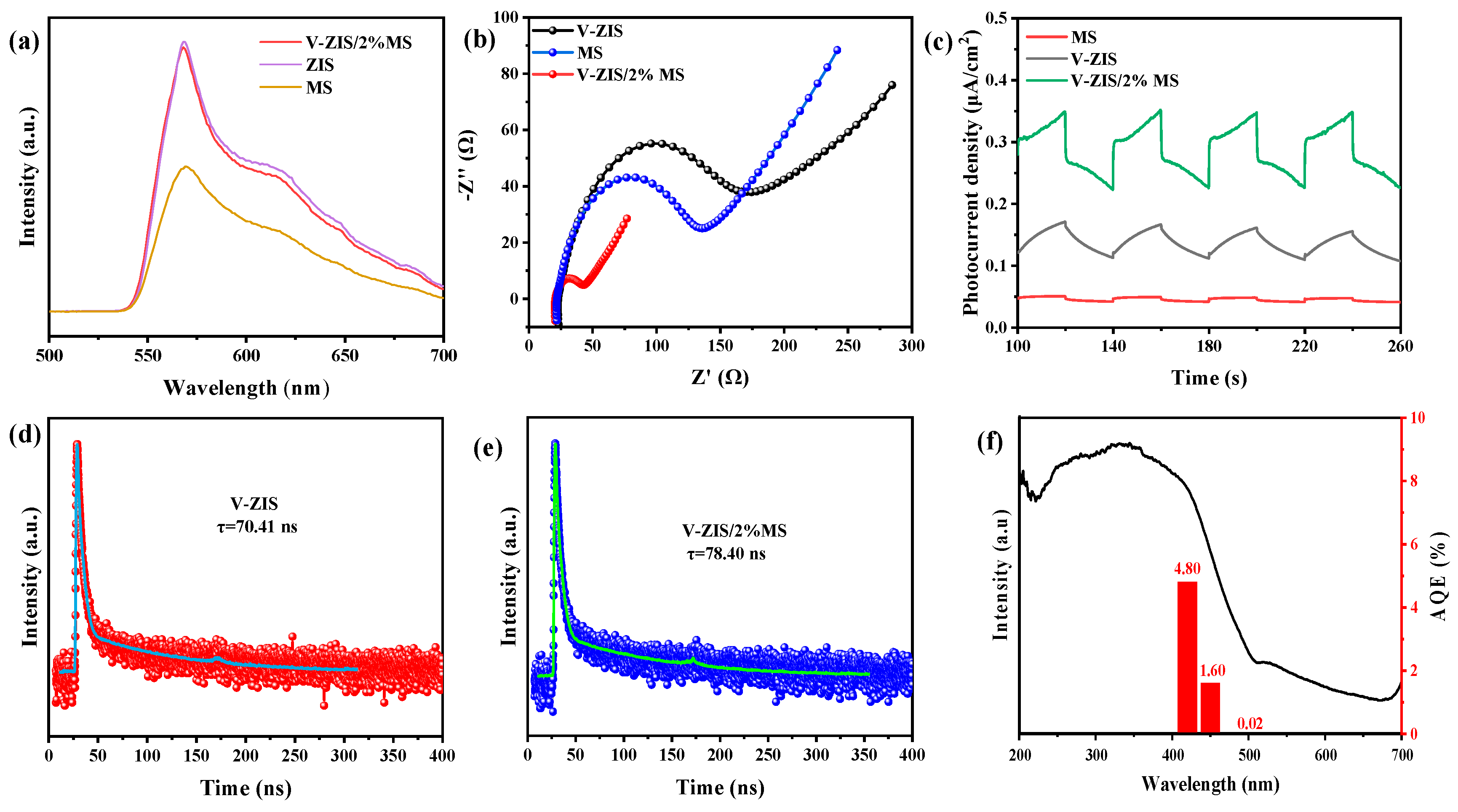
Photoluminescence (PL) spectroscopy was used to evaluate charge separation in the photocatalyst. In Figure 10a, the pristine V-ZIS sample shows a strong emission peak, which suggests rapid electron–hole recombination. In contrast, the V-ZIS/2%MS composite shows a much weaker PL signal, consistent with improved charge separation, likely due to Mo–S bonding and formation of a Z-scheme junction that promotes charge transfer.
Electrochemical impedance spectroscopy (EIS) was employed to assess the interfacial charge-transfer behavior and electron-transport efficiency of ZIS, MS, and V-ZIS/2%MS. The semicircle diameter of the semicircle in the Nyquist plot reflects the charge-transfer resistance (Rct) of the electrode/electrolyte interface [47]. As shown in Figure 10b, V-ZIS exhibits a relatively large semicircle, suggesting a higher Rct, which is unfavorable for efficient separation and transport of photogenerated charge carriers. By contrast, MS shows a markedly smaller semicircle radius, indicating reduced interfacial impedance and better conductivity, which facilitates rapid charge migration. The V-ZIS/2%MS composite photocatalyst presents the smallest semicircle diameter, which is substantially smaller than that of V-ZIS and MS, implying the lowest Rct and the most efficient interfacial charge separation and transfer. Consistently, Figure 10c shows that V-ZIS/2%MS delivers a much higher transient photocurrent density than MS and V-ZIS, corroborating the EIS results. This improvement is mainly attributed to the formation of interfacial Mo–S bonds and a Z-scheme heterojunction, which lowers the interfacial charge-transfer resistance and promotes charge transport.
Time-resolved photoluminescence (TRPL) spectroscopy was used to evaluate the photoluminescence decay dynamics of the V-ZIS/2%MS photocatalyst. The average lifetime was calculated according to τA = (A1τ12 + A2τ22 + A3τ32)/(A1τ1 + A2τ2 + A3τ3) [43,48,49]. As shown in Figure 10d,e, the τA value of V-ZIS is 70.411 ns, while that of V-ZIS/2%MS increases slightly to 78.397 ns, mainly attributed to interfacial Mo–S bonding and the construction of a Z-scheme heterojunction, which facilitate interfacial charge transfer and transport. Additionally, the apparent quantum efficiency (AQE) was evaluated, and the corresponding results are shown in Figure 10f. Under monochromatic light irradiation at 420, 450, and 500 nm, the AQE values of V-ZIS/2%MS were 4.80%, 1.60%, and 0.02%, respectively, demonstrating its favorable photocatalytic hydrogen evolution activity.
Based on the above photoelectrochemical characterization and band-structure analysis, the visible-light-driven photocatalytic H2 evolution mechanism of V-ZIS/2%MS can be systematically elucidated. In general, a smaller work function corresponds to a higher Fermi level (EF). According to the UPS results, V-ZIS has a higher EF than MS (Figure 11a). Upon contact, electrons transfer from V-ZIS to MS until EF equilibrium is reached. As a result, V-ZIS becomes positively charged and MS becomes negatively charged at the interface, creating a built-in electric field directed from V-ZIS to MS (Figure 11b) [47]. Under visible-light irradiation, both V-ZIS and MS are photoexcited, and electrons are promoted from the valence band (VB) to the conduction band (CB), generating electron–hole pairs. Driven by the built-in electric field, the CB electrons of MS transfer across the interface and recombine with VB holes in V-ZIS, which is characteristic of a direct Z-scheme charge-transfer pathway and effectively preserves the strong redox carriers (Figure 11c). Consequently, the remaining electrons in the ECB of V-ZIS with strong reduction ability reduce H+ to H2, while the holes accumulated in the VB of MS are scavenged by ascorbic acid, suppressing electron–hole recombination and sustaining continuous H2 evolution.

3. Experimental Section

3.1. Materials

Hydrazine hydrate (N2H4·xH2O), Anhydrous Ethanol (CH3CH2OH), Indium trichloride (InCl3·4H2O), L-ascorbic acid, Na2S, NaSO3, and triethanolamine (TEOA) were purchased from Shanghai Aladdin Biochemical Technology Co., Ltd. (Shanghai, China). Thioacetamide (CH3CSNH2, TAA), Lactic Acid (C3H6O3) and Sulfur power (S, ≥99.99% metal basis) were purchased from Shanghai Macklin Biochemical Technology Co., Ltd. (Shanghai, China). Zinc acetate ((CH3COO)2Zn·2H2O) was purchased from Tianjin Guangfu Fine Chemical Research Institute (Tianjin, China). All chemical reagents were purchased from commercial sources and are of analytical reagent (AR) grade, and were used without further purification.

3.2. Preparation of Photocatalyst

3.2.1. Preparation of ZnIn2S4

One millimole of indium chloride tetrahydrate, 0.5 mmol of zinc acetate dihydrate and 4 mmol of thioacetamide (TAA) were sequentially dissolved in 50 mL of deionized water, followed by continuous stirring for 30 min until complete dissolution. Subsequently, the resulting mixed solution was rapidly transferred into the liner of a 100 mL reaction autoclave, which was then placed in a blast drying oven and maintained at 180 °C for 18 h. After the reaction autoclave was naturally cooled to room temperature, the resultant precipitate was rinsed repeatedly with deionized water and absolute ethanol, and then dried in a vacuum drying oven at 70 °C. The final powder sample was collected and designated as ZIS.

3.2.2. Preparation of V-ZnIn2S4

One hundred milligrams of ZIS was added into 20 mL of deionized water, followed by ultrasonication for 30 min to achieve uniform dispersion. Then, 5 mL of hydrazine hydrate was added to the aforementioned solution, and the mixture was stirred for 30 min using a stirrer. Subsequently, the resultant solution was transferred into a 50 mL reaction autoclave, and the hydrothermal reaction was carried out at 220 °C for 5 h. After the reaction autoclave cooled down to room temperature, the solid product was rinsed repeatedly with deionized water and ethanol. Finally, the solid product was placed in a vacuum drying oven and dried at 70 °C. The yellow product obtained was designated as V-ZIS.

3.2.3. Synthesis of V-ZnIn2S4/MoS2

One hundred milligrams of ZIS was added into 20 mL of deionized water, followed by ultrasonication for 30 min to achieve uniform dispersion. Subsequently, 2 mg of sodium molybdate was added to the above solution, and the mixture was stirred for 30 min, which was designated as Solution A. Simultaneously, 1.06 mg of sulfur powder was added into 5 mL of hydrazine hydrate, and the mixture was stirred at 80 °C for 30 min, which was designated as Solution B. Afterwards, Solution B was added to Solution A and stirred for 30 min, and then the resultant mixture was transferred into a 50 mL reaction autoclave for a reaction at 220 °C for 5 h. After the reaction autoclave was naturally cooled to room temperature, the solid product was collected and rinsed repeatedly with deionized water and ethanol. Finally, the washed solid product was placed in a vacuum drying oven and dried at 70 °C. The obtained sample was V-ZnIn2S4/2%MoS2, denoted as V-ZIS/2%MS. By adjusting the masses of sodium molybdate and sulfur powder, the molar percentages of MoS2 relative to ZIS were controlled to be 1%, 2%, 3% and 5%, respectively, and the corresponding samples were ZnIn2S4/1%MoS2, ZnIn2S4/2%MoS2, ZnIn2S4/3%MoS2 and ZnIn2S4/5%MoS2, denoted as V-ZIS/1%MS, V-ZIS/2%MS, V-ZIS/3%MS and V-ZIS/5%MS. The preparation process for ZnIn2S4 (V-ZIS) was similar to that for ZIS/MS, except that sodium molybdate and sulfur powder were not added.

3.3. Characterization

Field emission scanning electron microscopy (SEM) and energy-dispersive spectroscopy (EDS) mapping combined with transmission electron microscopy (TEM) were employed to characterize the material microstructure and elemental distribution. The crystal phase structure was identified via X-ray diffraction (XRD) analysis. X-ray photoelectron spectroscopy (XPS) was utilized to determine the surface elemental composition and chemical states, with calibration performed using the C 1s peak. The light absorption properties were evaluated by ultraviolet-visible diffuse reflectance spectroscopy (UV-Vis DRS), and the optical band gap was calculated based on the Lambert-Beer law. Photoluminescence (PL) spectra were measured under 375 nm excitation to reflect the recombination behavior of charge carriers. The specific surface area and pore structure were determined using N2 adsorption–desorption isotherms (BET method). Furthermore, electron paramagnetic resonance (EPR) was applied to detect photogenerated radicals and unpaired electrons, thereby revealing the charge carrier separation and reaction mechanisms.

3.4. Photoelectrochemical Properties Test

Photoelectrochemical performance-including transient photocurrent response was studied under Xenon lamp irradiation and electrochemical impedance spectroscopy (EIS) was performed using a three-electrode system.

3.5. Photocatalytic Activity Test

The photocatalytic hydrogen production experiment was conducted using a 300 mL closed reactor. First, 5 mg of the photocatalyst was added to 100 mL of 0.1M L-ascorbic acid, and sonicated for 5 min to make it dispersed uniformly. Then, nitrogen was introduced into the reactor for 30 min to remove the air in the reactor. Next, the 300 W Xe lamp with 420 nm filters (λ ≥ 420 nm) was turned on to carry out the photocatalytic hydrogen evolution, and 1 mL of gas was manually injected with a 1 mL micro syringe. The reaction was analyzed every 30 min for 2 h using a gas chromatograph (GC 112A, Shanghai INESA Analytical Instrument Co., Ltd., Shanghai, China). The measurement of the apparent quantum efficiency (AQE) was carried out by replacing the 420 nm high-pass filter with band-pass filters (420 ± 10 nm, 450 ± 10 nm, and 500 ± 10 nm).
AQE ( % ) = 2 ×   amount   of   hydrogen   molecules   evolved number   of   incident   photons × 100
To evaluate the stability of the photocatalyst, the reacted samples were centrifuged, washed with ethanol and water, dried at 60 °C, and the same amount of photocatalyst was taken for the next experiment.
R = n/(t·m)
where R is the H2 evolution rate (mmol·g−1·h−1); n is the H2 evolution amount (mmol); t is the photocatalytic reaction time (h); and m is the photocatalyst dosage (g).

4. Conclusions

In this work, a V-ZIS/MS Z-scheme heterojunction photocatalyst featuring interfacial Mo-S bonds was successfully synthesized via a hydrothermal route. Among the samples, V-ZIS/2%MS delivered the highest H2 evolution rate of 19.21 ± 0.78 mmol·g−1·h−1, which is 5.07 and 4.41 times higher than those of pristine ZIS and V-ZIS, respectively, thus outperforming most reported ZIS-based photocatalysts. The enhanced activity is mainly attributed to the formation of interfacial Mo-S bonds, which promote charge transfer across the interface, reduce interfacial impedance, and effectively suppress charge-carrier recombination. Cycling experiments further demonstrate that V-ZIS/2%MS exhibits considerable photocatalytic stability. This study provides a valuable reference for the preparation of highly active photocatalysts for clean energy development. The future focus of research could involve determining how to scale up the preparation of photocatalysts and their immobilization.

Supplementary Materials

The following supporting information can be downloaded at: https://www.mdpi.com/article/10.3390/catal16020188/s1, Figure S1: The magnified local plot of the Ecutoff and Eonset for MS and V-ZIS; Table S1: Specific surface area and pore volume of the prepared catalysts; Table S2: Comparison of photocatalytic activity of ZIS-based photocatalysts; Table S3: Fitting parameters obtained from curve fitting of TRPL spectra for V-ZIS and V-ZIS/2%MS. References [17,19,38,41,50,51,52,53,54,55,56,57] are cited in Supplementary Materials.

Author Contributions

Conceptualization, L.Y. and R.Z.; methodology, L.Y., Q.C. and W.Z.; software, L.Y.; validation, L.Y., R.Z. and Q.C.; formal analysis, L.Y., Q.C. and W.Z.; investigation, L.Y., Q.C. and W.Z.; resources, R.Z.; data curation, L.Y. and Q.C.; writing—original draft preparation, L.Y., W.Z. and Q.C.; writing—review and editing, L.Y. and R.Z.; visualization, L.Y. and R.Z.; supervision, R.Z.; project administration, R.Z.; funding acquisition, R.Z. All authors have read and agreed to the published version of the manuscript.

Funding

This research was funded by Shenzhen Key Laboratory of Organic Pollution Prevention and Control (grant number SYSPG20241211173609007) and the Special Project for Sustainable Development Science Technology in Shenzhen (grant number KCXFZ20240830161708002).

Data Availability Statement

The original contributions presented in this study are included in the article. Further inquiries can be directed to the corresponding author.

Conflicts of Interest

The authors declare that they have no known competing financial interests or personal relationships that could have appeared to influence the work reported in this paper.

References

  1. Yi, L.; Zhu, R.; Jiang, H.; Zhang, G. Amorphous nitrogen-doped carbon layers forming the interfacial channel for rapid charge transfer in ZnIn2S4/BiVO4 Z-scheme photocatalyst for enhancing organic pollutants degradation with simultaneous hydrogen evolution. Sep. Purif. Technol. 2024, 349, 127885. [Google Scholar] [CrossRef]
  2. Deng, X.; Chen, P.; Cui, R.; Gong, X.; Li, X.; Wang, X.; Deng, C. Local charge rectification and electronic interactions in ZnIn2S4-x-Bi2MoO6-x heterojunction for enhancing synergistic piezo-photocatalytic hydrogen evolution and benzylamine oxidation. Nano Energy 2024, 126, 109657. [Google Scholar] [CrossRef]
  3. Yi, L.; Sun, Z.; Zhu, R.; Wu, X. Construction dual vacancies to enhance interfacial charge transfer on ZnIn2S4/BiVO4 Z-scheme heterojunction for efficient photocatalytic degradation of organic pollutants with simultaneous hydrogen evolution. J. Environ. Chem. Eng. 2025, 13, 117034. [Google Scholar] [CrossRef]
  4. Kosco, J.; Bidwell, M.; Cha, H.; Martin, T.; Howells, C.T.; Sachs, M.; Anjum, D.H.; Lopez, S.G.; Zou, L.; Wadsworth, A.; et al. Enhanced photocatalytic hydrogen evolution from organic semiconductor heterojunction nanoparticles. Nat. Mater. 2020, 19, 559–565. [Google Scholar] [CrossRef] [PubMed]
  5. Yang, J.L.; He, Y.L.; Ren, H.; Zhong, H.L.; Lin, J.S.; Yang, W.M.; Li, M.D.; Yang, Z.L.; Zhang, H.; Tian, Z.Q.; et al. Boosting Photocatalytic Hydrogen Evolution Reaction Using Dual Plasmonic Antennas. ACS Catal. 2021, 11, 5047–5053. [Google Scholar] [CrossRef]
  6. Kageshima, Y.; Shiga, S.; Ode, T.; Takagi, F.; Shiiba, H.; Htay, M.T.; Hashimoto, Y.; Teshima, K.; Domen, K.; Nishikiori, H. Photocatalytic and Photoelectrochemical Hydrogen Evolution from Water over Cu2SnxGe1–xS3 Particles. J. Am. Chem. Soc. 2021, 143, 5698–5708. [Google Scholar] [CrossRef]
  7. Kim, Y.; Coy, E.; Kim, H.; Mrówczyński, R.; Torruella, P.; Jeong, D.-W.; Choi, K.S.; Jang, J.H.; Song, M.Y.; Jang, D.-J.; et al. Efficient photocatalytic production of hydrogen by exploiting the polydopamine-semiconductor interface. Appl. Catal. B Environ. 2021, 280, 119423. [Google Scholar] [CrossRef]
  8. Liu, J.; Yang, Y.; Lin, W.; Wang, W.; Xiao, S.; Guo, X.; Zhu, C.; Zhang, L. Cu1.94S-ZnS-CdS ternary heteronanoplates with efficient carrier transfer for enhanced photocatalytic hydrogen evolution. J. Colloid Interface Sci. 2024, 672, 744–752. [Google Scholar] [CrossRef] [PubMed]
  9. Li, Z.; Wang, X.; Tian, W.; Meng, A.; Yang, L. CoNi Bimetal Cocatalyst Modifying a Hierarchical ZnIn2S4 Nanosheet-Based Microsphere Noble-Metal-Free Photocatalyst for Efficient Visible-Light-Driven Photocatalytic Hydrogen Production. ACS Sustain. Chem. Eng. 2019, 7, 20190–20201. [Google Scholar] [CrossRef]
  10. Liu, R.; Cui, Y.; Chai, N.; Yang, L.; Zhang, X.; Nie, Q.; Yu, H. Hollow spherical MoO2-C cocatalyst derived from Mo-polydopamine boosts photocatalytic hydrogen evolution of ZnIn2S4. Int. J. Hydrogen Energy 2025, 172, 151329. [Google Scholar] [CrossRef]
  11. Gao, F.; Cui, W.-G.; Wang, X.; Li, Z.; Chen, Y.; Shen, Z.; Wang, K.; Gao, Y.; Miao, J.; Yang, Y.; et al. Harnessing Hydrogen Spillover by Lattice Strain for Enhanced Photocatalytic Hydrogen Evolution of ZnIn2S4. ACS Catal. 2025, 15, 2367–2379. [Google Scholar] [CrossRef]
  12. Mohanty, B.; Chattopadhyay, A.; Nayak, J. Band gap engineering and enhancement of electrical conductivity in hydrothermally synthesized CeO2-PbS nanocomposites for solar cell applications. J. Alloys Compd. 2021, 850, 156735. [Google Scholar] [CrossRef]
  13. Yu, H.; Huang, J.; Jiang, L.; Shi, Y.; Yi, K.; Zhang, W.; Zhang, J.; Chen, H.; Yuan, X. Enhanced photocatalytic tetracycline degradation using N-CQDs/OV-BiOBr composites: Unraveling the complementary effects between N-CQDs and oxygen vacancy. Chem. Eng. J. 2020, 402, 126187. [Google Scholar] [CrossRef]
  14. Gao, D.; Wu, X.; Wang, P.; Yu, H.; Zhu, B.; Fan, J.; Yu, J. Selenium-enriched amorphous NiSe1+x nanoclusters as a highly efficient cocatalyst for photocatalytic H2 evolution. Chem. Eng. J. 2021, 408, 127230. [Google Scholar] [CrossRef]
  15. Rao, F.; Zhu, G.; Zhang, W.; Gao, J.; Zhang, F.; Huang, Y.; Hojamberdiev, M. In-situ generation of oxygen vacancies and metallic bismuth from (BiO)2CO3 via N2-assisted thermal-treatment for efficient selective photocatalytic NO removal. Appl. Catal. B Environ. 2021, 281, 119481. [Google Scholar] [CrossRef]
  16. Tu, H.; Wang, H.; Ou, Y.; Zhang, J.; Jiang, S.; Xiong, Y.; Xiang, X.; Wei, C.; Liu, X. A novel MOF-derived CoSx@ZnIn2S4/MoS2 QDs dual Z-scheme heterojunction photocatalyst with hierarchical hollow core-shell structure for enhanced photocatalytic performance. J. Environ. Chem. Eng. 2025, 13, 118981. [Google Scholar] [CrossRef]
  17. Ning, Y.; Wang, S.; Wang, H.; Quan, W.; Lv, D.; Yu, S.; Hu, X.; Tian, H. Novel hollow core-shell Zn0.5Cd0.5S@ZnIn2S4/MoS2 nanocages with Z-scheme heterojunction for enhanced photocatalysis of hydrogen generation. J. Colloid Interface Sci. 2024, 662, 928–940. [Google Scholar] [CrossRef] [PubMed]
  18. Xia, Y.; Zhu, S.; Liang, R.; Huang, R.; Yan, G.; Liang, S. Interfacial reconstruction of 2D/2D ZnIn2S4/HNb3O8 through Nb-S bonds for efficient photocatalytic H2 evolution performance. Mater. Des. 2021, 209, 110007. [Google Scholar] [CrossRef]
  19. Huang, L.; Han, B.; Huang, X.; Liang, S.; Deng, Z.; Chen, W.; Peng, M.; Deng, H. Ultrathin 2D/2D ZnIn2S4/MoS2 hybrids for boosted photocatalytic hydrogen evolution under visible light. J. Alloys Compd. 2019, 798, 553–559. [Google Scholar] [CrossRef]
  20. Bhatt, H.; Patel, M.S.; Goswami, T.; Yadav, D.K.; Patra, A.S.; Ghosh, H.N. Ultrafast electron transfer at the ZnIn2S4/MoS2 S-scheme interface for photocatalytic hydrogen evolution. Nanoscale 2025, 17, 7908–7916. [Google Scholar] [CrossRef]
  21. Pudkon, W.; Bahruji, H.; Miedziak, P.J.; Davies, T.E.; Morgan, D.J.; Pattisson, S.; Kaowphong, S.; Hutchings, G.J. Enhanced visible-light-driven photocatalytic H2 production and Cr(vi) reduction of a ZnIn2S4/MoS2 heterojunction synthesized by the biomolecule-assisted microwave heating method. Catal. Sci. Technol. 2020, 10, 2838–2854. [Google Scholar] [CrossRef]
  22. Liu, C.; Chai, B.; Wang, C.; Yan, J.; Ren, Z. Solvothermal fabrication of MoS2 anchored on ZnIn2S4 microspheres with boosted photocatalytic hydrogen evolution activity. Int. J. Hydrogen Energy 2018, 43, 6977–6986. [Google Scholar] [CrossRef]
  23. Zhang, S.; Liu, X.; Liu, C.; Luo, S.; Wang, L.; Cai, T.; Zeng, Y.; Yuan, J.; Dong, W.; Pei, Y.; et al. MoS2 Quantum Dot Growth Induced by S Vacancies in a ZnIn2S4 Monolayer: Atomic-Level Heterostructure for Photocatalytic Hydrogen Production. ACS Nano 2018, 12, 751–758. [Google Scholar] [CrossRef]
  24. Epp, J. X-ray diffraction (XRD) techniques for materials characterization. In Materials Characterization Using Nondestructive Evaluation (NDE) Methods; Elsevier: Amsterdam, The Netherlands, 2016; pp. 81–124. [Google Scholar]
  25. Wang, Z.M.; Ren, C.; Tian, H.; Yu, J.; Sun, M. MoS2, PTCDA Hybrid Hetero; Springer: Cham, Switzerland, 2013. [Google Scholar]
  26. Jones, R.R.; Hooper, D.C.; Zhang, L.; Wolverson, D.; Valev, V.K. Raman techniques: Fundamentals and frontiers. Nanoscale Res. Lett. 2019, 14, 231. [Google Scholar] [CrossRef]
  27. Du, C.; Zhang, Q.; Lin, Z.; Yan, B.; Xia, C.; Yang, G. Half-unit-cell ZnIn2S4 monolayer with sulfur vacancies for photocatalytic hydrogen evolution. Appl. Catal. B Environ. 2019, 248, 193–201. [Google Scholar] [CrossRef]
  28. Wang, X.; Wang, X.; Huang, J.; Li, S.; Meng, A.; Li, Z. Interfacial chemical bond and internal electric field modulated Z-scheme Sv-ZnIn2S4/MoSe2 photocatalyst for efficient hydrogen evolution. Nat. Commun. 2021, 12, 4112. [Google Scholar] [CrossRef]
  29. Wang, X.; Wang, X.; Yang, H.; Meng, A.; Li, Z.; Yang, L.; Wang, L.; Li, S.; Li, G.; Huang, J. Interfacial engineering improved internal electric field contributing to direct Z-scheme-dominated mechanism over CdSe/SL-ZnIn2S4/MoSe2 heterojunction for efficient photocatalytic hydrogen evolution. Chem. Eng. J. 2022, 431, 134000. [Google Scholar] [CrossRef]
  30. Gengenbach, T.R.; Major, G.H.; Linford, M.R.; Easton, C.D. Practical guides for x-ray photoelectron spectroscopy (XPS): Interpreting the carbon 1s spectrum. J. Vac. Sci. Technol. A 2021, 39, 013204. [Google Scholar] [CrossRef]
  31. Bao, J.; Zhang, X.; Fan, B.; Zhang, J.; Zhou, M.; Yang, W.; Hu, X.; Wang, H.; Pan, B.; Xie, Y. Ultrathin Spinel-Structured Nanosheets Rich in Oxygen Deficiencies for Enhanced Electrocatalytic Water Oxidation. Angew. Chem. Int. Ed. 2015, 54, 7399–7404. [Google Scholar] [CrossRef] [PubMed]
  32. Barsotti, E.; Piri, M. Effect of pore size distribution on capillary condensation in nanoporous media. Langmuir 2021, 37, 2276–2288. [Google Scholar] [CrossRef] [PubMed]
  33. Tuama, A.N.; Alzubaidi, L.H.; Jameel, M.H.; Abass, K.H.; Mayzan, M.Z.H.B.; Salman, Z.N. Impact of electron–hole recombination mechanism on the photocatalytic performance of ZnO in water treatment: A review. J. Sol-Gel Sci. Technol. 2024, 110, 792–806. [Google Scholar] [CrossRef]
  34. Yin, X.; Li, L.; Jiang, W.; Zhang, Y.; Zhang, X.; Wan, L.; Hu, J. MoS2/CdS Nanosheets-on-Nanorod Heterostructure for Highly Efficient Photocatalytic H2 Generation under Visible Light Irradiation. ACS Appl. Mater. Interfaces 2016, 8, 15258–15266. [Google Scholar] [CrossRef] [PubMed]
  35. Zhang, J.; Yu, J.; Jaroniec, M.; Gong, J.R. Noble Metal-Free Reduced Graphene Oxide-ZnxCd1–xS Nanocomposite with Enhanced Solar Photocatalytic H2-Production Performance. Nano Lett. 2012, 12, 4584–4589. [Google Scholar] [CrossRef] [PubMed]
  36. Shi, Y.; Li, L.; Xu, Z.; Qin, X.; Cai, Y.; Zhang, W.; Shi, W.; Du, X.; Guo, F. Coupled internal electric field with hydrogen release kinetics for promoted photocatalytic hydrogen production through employing carbon coated transition metal as co-catalyst. J. Colloid Interface Sci. 2023, 630, 274–285. [Google Scholar] [CrossRef]
  37. Yang, H. A short review on heterojunction photocatalysts: Carrier transfer behavior and photocatalytic mechanisms. Mater. Res. Bull. 2021, 142, 111406. [Google Scholar] [CrossRef]
  38. Bai, P.; Wang, P.; Wu, Y.; Pang, X.; Song, M.; Du, C.; Su, Y. Junction of ZnmIn2S3+m and bismuth vanadate as Z-scheme photocatalyst for enhanced hydrogen evolution activity: The role of interfacial interactions. J. Colloid Interface Sci. 2022, 628, 488–499. [Google Scholar] [CrossRef]
  39. Bols, M.L.; Ma, J.; Rammal, F.; Plessers, D.; Wu, X.; Navarro-Jaén, S.; Heyer, A.J.; Sels, B.F.; Solomon, E.I.; Schoonheydt, R.A. In situ UV-Vis-NIR absorption spectroscopy and catalysis. Chem. Rev. 2024, 124, 2352–2418. [Google Scholar] [CrossRef]
  40. Jubu, P.R.; Obaseki, O.; Nathan-Abutu, A.; Yam, F.; Yusof, Y.; Ochang, M. Dispensability of the conventional Tauc’s plot for accurate bandgap determination from UV-vis optical diffuse reflectance data. Results Opt. 2022, 9, 100273. [Google Scholar] [CrossRef]
  41. Feng, X.; Shang, H.; Zhou, J.; Ma, X.; Gao, X.; Wang, D.; Zhang, B.; Zhao, Y. Heterostructured core–shell CoS1.097@ZnIn2S4 nanosheets for enhanced photocatalytic hydrogen evolution under visible light. Chem. Eng. J. 2023, 457, 141192. [Google Scholar] [CrossRef]
  42. Zhang, S.; Zhang, Z.; Si, Y.; Li, B.; Deng, F.; Yang, L.; Liu, X.; Dai, W.; Luo, S. Gradient Hydrogen Migration Modulated with Self-Adapting S Vacancy in Copper-Doped ZnIn2S4 Nanosheet for Photocatalytic Hydrogen Evolution. ACS Nano 2021, 15, 15238–15248. [Google Scholar] [CrossRef]
  43. Su, T.; Men, C.; Chen, L.; Chu, B.; Luo, X.; Ji, H.; Chen, J.; Qin, Z. Sulfur Vacancy and Ti3C2Tx Cocatalyst Synergistically Boosting Interfacial Charge Transfer in 2D/2D Ti3C2Tx/ZnIn2S4 Heterostructure for Enhanced Photocatalytic Hydrogen Evolution. Adv. Sci. 2022, 9, 2103715. [Google Scholar] [CrossRef]
  44. Zhang, W.; Zhao, S.; Xing, Y.; Qin, H.; Zheng, Q.; Zhang, P.; Zhang, S.; Xu, X. Sandwich-like P-doped h-BN/ZnIn2S4 nanocomposite with direct Z-scheme heterojunction for efficient photocatalytic H2 and H2O2 evolution. Chem. Eng. J. 2022, 442, 136151. [Google Scholar] [CrossRef]
  45. Kim, J.W.; Kim, A. Absolute work function measurement by using photoelectron spectroscopy. Curr. Appl. Phys. 2021, 31, 52–59. [Google Scholar] [CrossRef]
  46. Shao, Q.; Lin, H.; Shao, M. Determining locations of conduction bands and valence bands of semiconductor nanoparticles based on their band gaps. ACS Omega 2020, 5, 10297–10300. [Google Scholar] [CrossRef] [PubMed]
  47. Hernández, H.H.; Reynoso, A.M.R.; Juan, C.; González, T.; Morán, C.O.G. Electrochemical Impedance Spectroscopy (EIS): A Review Study of Basic Aspects of the Corrosion Mechanism Applied to Steels. In Electrochemical Impedance Spectroscopy; Intech: London, UK, 2020. [Google Scholar]
  48. Wang, S.; Guan, B.Y.; Wang, X.; Lou, X.W.D. Formation of Hierarchical Co9S8@ZnIn2S4 Heterostructured Cages as an Efficient Photocatalyst for Hydrogen Evolution. J. Am. Chem. Soc. 2018, 140, 15145–15148. [Google Scholar] [CrossRef] [PubMed]
  49. Zhao, X.; Liu, M.; Wang, Y.; Xiong, Y.; Yang, P.; Qin, J.; Xiong, X.; Lei, Y. Designing a built-in electric field for efficient energy electrocatalysis. ACS Nano 2022, 16, 19959–19979. [Google Scholar] [CrossRef]
  50. Meng, S.; Wu, H.; Cui, Y.; Zheng, X.; Wang, H.; Chen, S.; Wang, Y.; Fu, X. One-step synthesis of 2D/2D-3D NiS/Zn3In2S6 hierarchical structure toward solar-to-chemical energy transformation of biomass-relevant alcohols. Appl. Catal. B Environ. 2020, 266, 118617. [Google Scholar] [CrossRef]
  51. Ru, J.; Li, K.; Sun, G.; Chen, M.; Hu, Y.; Wen, Z.; Wu, D.; Yi, X.; Chen, Z.; Wang, B. LSPR-enhanced hydrogen evolution via Au-UiO-67-NH2/ZnIn2S4/MoS2 hybrid nanostructures. J. Environ. Chem. Eng. 2025, 13, 117946. [Google Scholar] [CrossRef]
  52. Zhao, W.; Yan, A.; Su, Z.; Huang, F.; Zhang, J.; Gao, Y.; Yuan, H. Synergistically-mediated highly-efficient visible-light-driven hydrogen evolution activity using Ohmic/Schottky-type dual-junctions and sulfur vacancy. J. Colloid Interface Sci. 2025, 678, 256–265. [Google Scholar] [CrossRef]
  53. Li, X.; Wang, X.; Zhu, J.; Li, Y.; Zhao, J.; Li, F. Fabrication of two-dimensional Ni2P/ZnIn2S4 heterostructures for enhanced photocatalytic hydrogen evolution. Chem. Eng. J. 2018, 353, 15–24. [Google Scholar] [CrossRef]
  54. Ren, S.; Wang, S.; Chen, H.; Li, M.; Li, Z.; Liao, L.; Liang, Z.; Zhou, W. S vacancies engineering ZnIn2S4 nanosheets for boosted photocatalytic hydrogen evolution. Int. J. Hydrogen Energy 2024, 51, 1128–1135. [Google Scholar] [CrossRef]
  55. Pan, J.; Zhang, G.; Guan, Z.; Zhao, Q.; Li, G.; Yang, J.; Li, Q.; Zou, Z. Anchoring Ni single atoms on sulfur-vacancy-enriched ZnIn2S4 nanosheets for boosting photocatalytic hydrogen evolution. J. Energy Chem. 2021, 58, 408–414. [Google Scholar] [CrossRef]
  56. Li, Y.; Li, S.; Meng, L.; Peng, S. Synthesis of oriented J type ZnIn2S4@CdIn2S4 heterojunction by controllable cation exchange for enhancing photocatalytic hydrogen evolution. J. Colloid Interface Sci. 2023, 650, 266–274. [Google Scholar] [CrossRef] [PubMed]
  57. Liu, M.; Xiong, J.; Kong, D.; Liu, Y.; Wu, H.; Li, F.; Hu, H.; Wang, D.; Guo, X.; Jiao, Y.; et al. Anchoring ZnIn2S4 nanosheets on oxygen-vacancy NiMoOx nanorods for efficient photocatalytic hydrogen evolution. Sep. Purif. Technol. 2025, 359, 130608. [Google Scholar] [CrossRef]
Figure 1. XRD patterns of ZIS, V-ZIS, MS, and V-ZIS/2%MS.
Catalysts 16 00188 g001
Figure 2. Raman spectra of ZIS, V-ZIS, MS, and V-ZIS/2% MS.
Catalysts 16 00188 g002
Figure 3. EPR spectra of V-ZIS and V-ZIS/2%MS.
Catalysts 16 00188 g003
Figure 4. XPS spectra of V-ZIS, V-ZIS/2%MS, and MS: (a) survey spectra; (b) In 3d; (c) Mo 3d; (d) S 2p; (e) Zn 2p.
Catalysts 16 00188 g004
Figure 5. SEM images of (a) ZIS, (b) V-ZIS, (c) V-ZIS/2% MS. (d) and (e) HRTEM and TEM images of V-ZIS/2% MS. EDX elemental mapping of (f) In, (g) Mo, (h) S, (i) Zn over V-ZIS/2% MS.
Catalysts 16 00188 g005
Figure 6. (a) BET analysis of ZIS, V-ZIS, V-ZIS/MS, and MS. (b) Corresponding pore size distribution.
Catalysts 16 00188 g006
Figure 7. Hydrogen production activity of ZIS/MS series catalysts. (a) Photocatalytic hydrogen production curves under different illumination durations; (b) Effect of different dosages on the hydrogen production rate; (c) Effect of different temperatures on hydrogen production activity; (d) Hydrogen production activity under different photo-thermal conditions; (e) Photocatalytic activity under different illumination conditions; (f) Hydrogen production activity with different sacrificial agents.
Catalysts 16 00188 g007
Figure 8. Cycling experiments test.
Catalysts 16 00188 g008
Figure 9. (a) UV-Vis spectra of ZIS/MS series catalysts. (b) Tauc plots of ZIS and MS. UPS spectra of V-ZIS (c) and MS (d).
Catalysts 16 00188 g009
Figure 10. (a) UV-Vis spectra of V-ZIS/2%MS series catalysts; (b) EIS spectra of the catalysts; (c) photocurrent spectra of the photocatalysts; TRPL spectra of (d) V-ZIS, (e) V-ZIS/2%MS and (f) AQE.
Catalysts 16 00188 g010
Figure 11. Charge transfer pathway of the V-ZIS/MS Z-scheme heterojunction. (a) Before contact; (b) After contact; (c) Light illumination.
Catalysts 16 00188 g011
Disclaimer/Publisher’s Note: The statements, opinions and data contained in all publications are solely those of the individual author(s) and contributor(s) and not of MDPI and/or the editor(s). MDPI and/or the editor(s) disclaim responsibility for any injury to people or property resulting from any ideas, methods, instructions or products referred to in the content.