Article

Highly Dispersed Pd Clusters in Zeolite USY for Effective Hydrogenation of Naphthalene

Institute of New Catalytic Materials Science, School of Materials Science and Engineering, Nankai University, Tianjin 300350, China
*
Author to whom correspondence should be addressed.
Catalysts 2026, 16(2), 167; https://doi.org/10.3390/catal16020167
Submission received: 29 December 2025 / Revised: 27 January 2026 / Accepted: 29 January 2026 / Published: 4 February 2026
(This article belongs to the Special Issue State of the Art and Future Challenges in Zeolite Catalysts)

Abstract

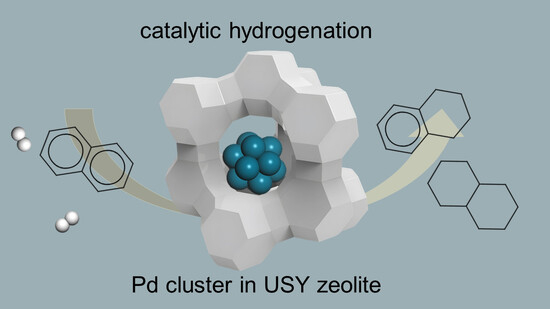
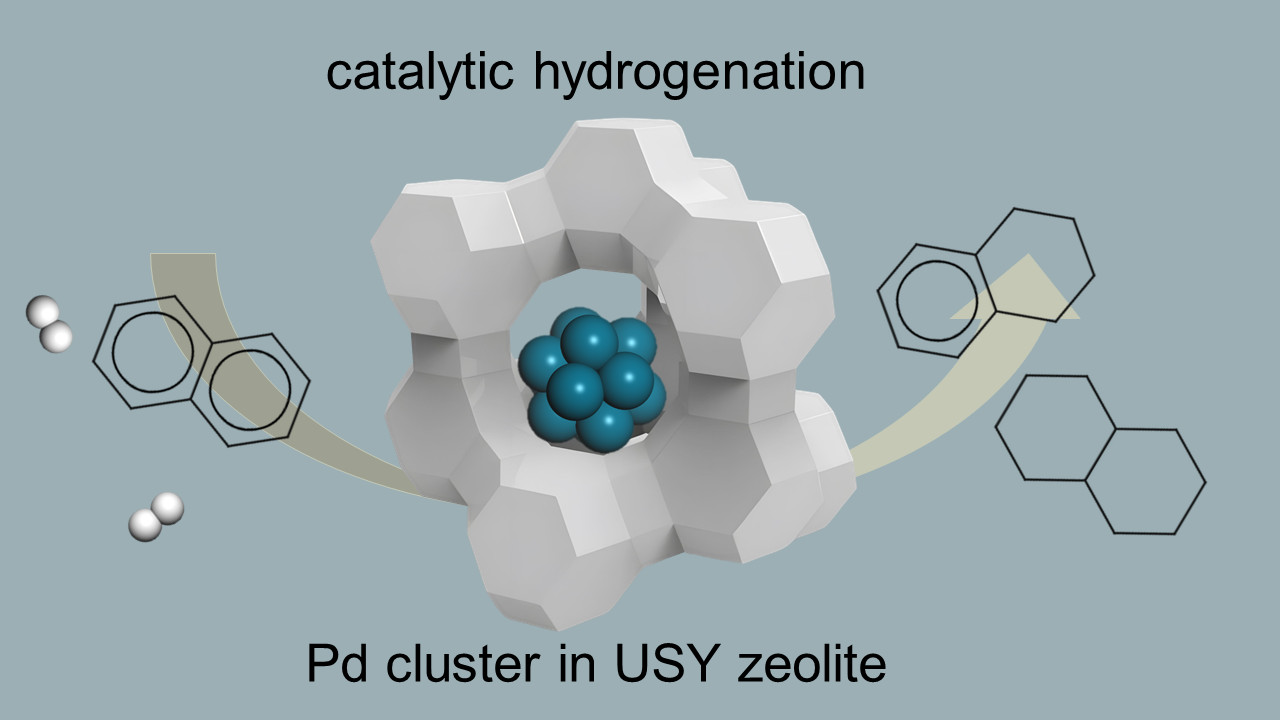
Pd-based catalysts with different Pd species (Pd ions, Pd clusters, and Pd nanoparticles) in USY were synthesized for naphthalene hydrogenation reaction. Among the catalysts, Pd clusters were prepared by controlled aggregation of Pd ions during the hydrogenation reaction with the assistance of physically adsorbed water in zeolite micropore. The coordination state and electronic structure of Pd species on these catalysts were analyzed to reveal the structure–performance relationship. Due to the high dispersion and optimized electronic structure, Pd clusters showed the highest activity for naphthalene hydrogenation compared to Pd ions and Pd nanoparticles.

Graphical Abstract

1. Introduction

Catalytic hydrogenation of aromatic compounds is of great importance for the production of high-value chemicals [1,2,3,4] and enhancement in quality of oil products [5,6,7,8,9,10,11,12,13]. Naphthalene, as a typical polycyclic aromatic hydrocarbon (PAH), is one of the components of coal tar and heavy oil, and it can be hydrogenated into tetralin or decalin. In the chemical industry, tetralin [14,15] and decalin [16,17,18,19] can be used as industrial solvent, chemical intermediate, fuel additive, lubricant, and heat transfer fluid. Moreover, in the petrochemical industry, hydrogenation of naphthalene and other PAHs can effectively improve the cetane number of diesel oil and meet the requirements of environmental protection. Therefore, developing efficient naphthalene hydrogenation catalysts can bring economic benefits to industrial areas, making it one of the important research fields.
H2 dissociation and substrate activation are crucial steps for the naphthalene hydrogenation process, in which transition metals with a special d-band structure are always necessary [20]. Among existing catalysts, although the cost of supported non-noble metal catalysts (nickel-based) was lower, higher pressure and temperature were often required to reach a high conversion of naphthalene [21,22,23,24]. For example, Ni/MFI with a Ni loading of ~4 wt.% showed an 84.9% conversion of naphthalene at 340 °C and 4 MPa of total H2 pressure [21]. Comparatively, noble metal catalysts (Pt [19,25,26,27,28,29], Pd [30,31,32,33,34], Ru [35], and Rh [20] based) showed better catalytic performance at low temperature. Correspondingly, Pt/MFI with a Pt loading of 0.25 wt.% showed 99.7% conversion of naphthalene at 250 °C and 5 MPa of total H2 pressure [19]. However, considering the high cost and scarcity of noble metal, reducing their loading amount and increasing their utilization became an important challenge to balance the performance and economic issues. To address this challenge, recent efforts mainly focused on modifying the size and electronic structure of noble metal through the regulation of components and supports.
Zeolite, as a typical crystalline microporous material, has been widely applied as a support for noble metal due to its large internal surface areas, abundant exchangeable ion sites, and controllable framework compositions [36,37,38,39,40,41]. Researchers have developed various zeolite-supported noble metal catalysts for naphthalene hydrogenation and discussed pore structures, acid properties, and metal species. Using zeolites with different Si/Al ratios and pore structures was a direct method to tune metal species and optimize catalytic performance. Liu et al. prepared Pt/HZSM-5 with different Si/Al ratios and found that Pt dispersion could be promoted by using ZSM-5 with lower Si/Al ratios [19]. Taking a further step, Zhang et al. and Liu et al. studied the catalytic performance of Pd/HY and Pt/HBeta with different Si/Al ratios and pore structures, respectively. They defined a factor called the mesopore-acid-metal factor (X = ln(A + B + 4M)) to describe the structure–activity relationship in their catalytic system [29,33]. The increases in mesopore volume, acid amount, and dispersion of metal were all beneficial in improving the catalytic activity of naphthalene hydrogenation. Specifically, considering the large size of naphthalene (0.68 × 0.91 nm), mesopores in Y-type zeolite could reduce the mass transfer resistance. Acid sites could regulate the size and electronic structure of Pd species and might facilitate hydrogen overflow. Dispersion of metal directly affected the number of active species involved in the reaction. Among the three factors, the coefficient of metal dispersion was 4, which was higher than the coefficients of mesopore volume and acid amount. Thus, optimizing the size and electronic structure of metal species was a more efficient way to enhance the catalytic activity of naphthalene hydrogenation. Developing new strategies to load or treat noble metal could also enhance the catalytic activity. Zhang et al. tuned the location of Pd nanoparticles to optimize the performance by a dual-solvent method [32]. Dispersion of Pd species and metal–support interaction could be modified with a proper amount of water during catalyst preparation. To achieve higher dispersion of noble metal species, Liang et al. used high-concentration O3 to remove the ligand under mild conditions [27]. As the aggregation of Pt could be inhibited, a series of Pt catalysts with single atoms, clusters, or nanoparticles were obtained. A catalyst with both a single Pt atom and small cluster was found to show higher hydrogenation activity. Moreover, the addition of specific components, such as Ce and P [31,34], could also optimize the size and electronic structure of noble metal species to enhance their catalytic performance. The stability of the catalyst could also be promoted by regulating the metal–support interaction, as the aggregation and leaching of Pd species could be inhibited. Although the above strategies regulated the noble metal on zeolite successfully, there were still problems such as low dispersion of nanoparticles or high complexity of preparation.
In this study, inspired by the fact that humid CO gas enabled the controlled reduction of Pd ions in FER zeolite to ultrasmall Pd4 clusters [42], we found that Pd clusters could also form in USY zeolite in the presence of water in zeolite micropores during the hydrogenation of naphthalene. Water played an important role in enhancing the reducibility of Pd ions in USY zeolite. When used in naphthalene hydrogenation, due to the optimized size and electronic structure, Pd clusters (Pdc) showed much higher activity compared to Pd ions (Pd2+) or Pd nanoparticles (Pdn) on USY.

2. Results and Discussion

2.1. Catalyst Characterization

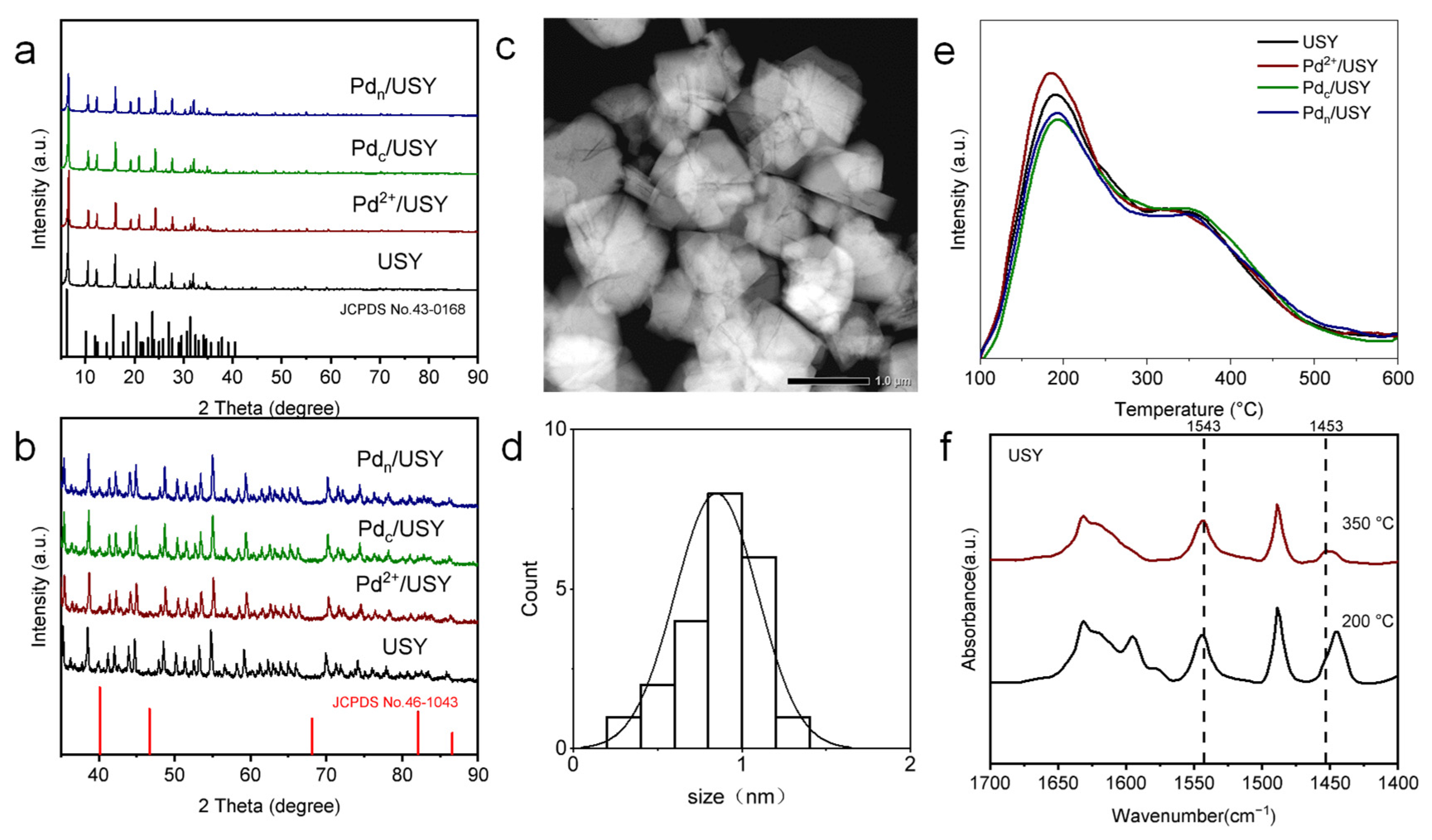
Pd species were loaded on a USY by the ion exchange method using Pd(NH3)4(NO3)2 as the precursor. The theoretical Pd loadings of the series catalysts was 0.20 wt.%. According to the XRF analysis, the actual Pd loading of the series catalysts was 0.15 wt.%. According to previous report, after calcination at 700 °C, Pd2+/USY with Pd ions stabilized by paired aluminum sites could be prepared [43]. The Pd2+/USY was used for hydrogenation of naphthalene without dehydration at 80 °C and 3 MPa of total H2 pressure to obtain Pdc/USY. Pdn/USY was prepared by reducing Pd2+/USY at 200 °C in 10% H2/N2 atmosphere. Figure 1a,b shows the XRD patterns of USY, Pd2+/USY, Pdc/USY, and Pdn/USY. The characteristic peaks of the catalysts were all consistent with the standard card of FAU zeolite (JCPDS No.43-0168), and the crystallinity of USY remained almost unchanged after the loading of Pd species, calcination, and reduction. Meanwhile, the diffraction peak corresponding to Pd crystal was absent in the XRD patterns (JCPDS No.46-1043), due to the low loading and high dispersion of Pd species. The average particle size of USY was ~900 μm (Figure 1c,d). The acid properties of the samples were measured by ammonia temperature-programmed desorption (NH3-TPD) and Pyridine-IR. As shown in Figure 1e, all samples show desorption peaks at 190 °C and 350 °C, which correspond to weak acid sites and strong acid sites, respectively. Loading of Pd had a small impact on the acid properties of USY. Specifically, the intensity of the high-temperature desorption peak was almost unchanged, which corresponded to an acid amount of about 300 μmol/g, while the weak acid amounts of USY, Pd2+/USY, Pdc/USY, and Pdn/USY were 542, 565, 530, and 525 μmol/g, respectively. Moreover, the B acid/L acid ratios were 1.4 and 6.4 according to the result of Pyridine-IR measured at 200 and 350 °C (Figure 1f).
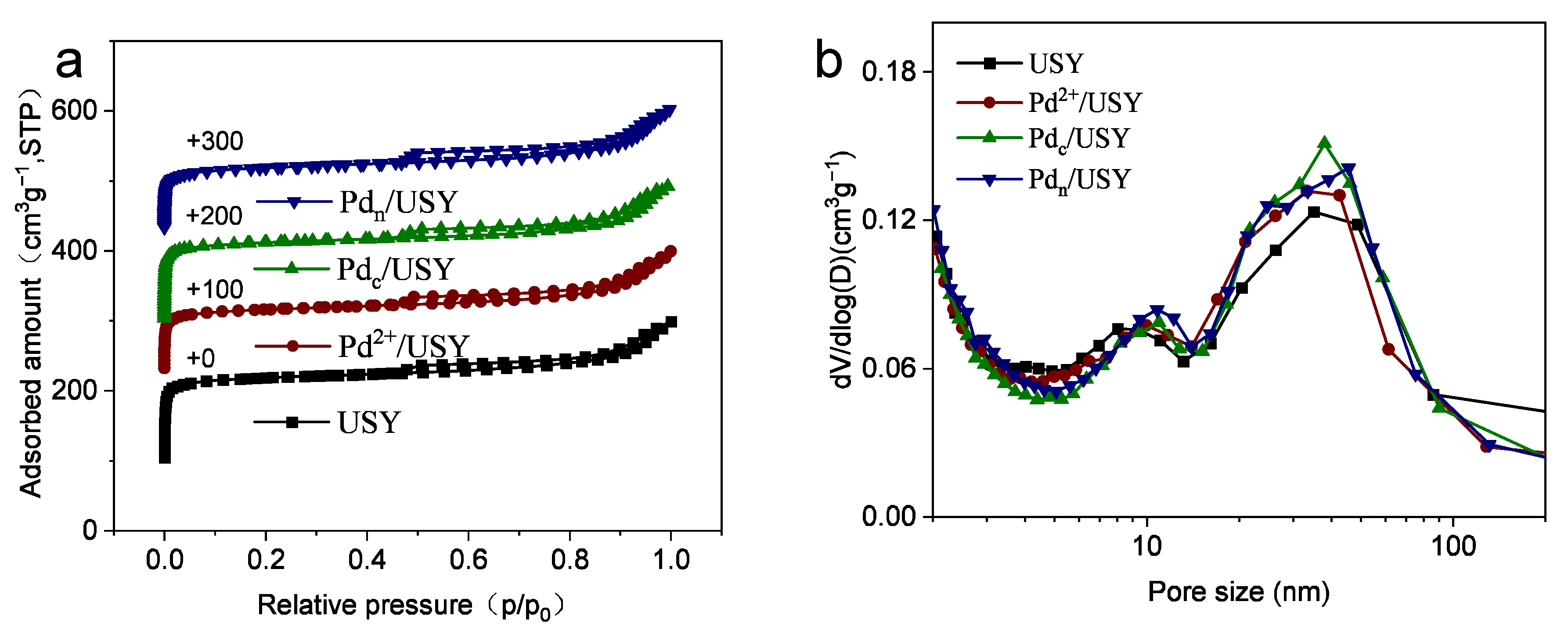
Figure 2a,b shows the nitrogen adsorption–desorption isotherms and pore size distribution curves of catalysts. All catalysts exhibited typical I–IV composite adsorption–desorption isotherms (Figure 2a) with mesopores of 30–50 nm (Figure 2b). The surface area, total pore volume, micropore volume, and mesopore volume are summarized in Table 1. Pd species on USY resulted in a slight reduction in zeolite specific surface area and micropore volume. Specifically, the specific surface area and micropore volume of USY were 883 m2·g−1 and 0.305 cm3·g−1. The specific surface area of Pd2+/USY, Pdc/USY, and Pdn/USY decreased to 880, 874, and 855 m2·g−1, and the micropore volume decreased to 0.293, 0.286, and 0.277 cm3·g−1.
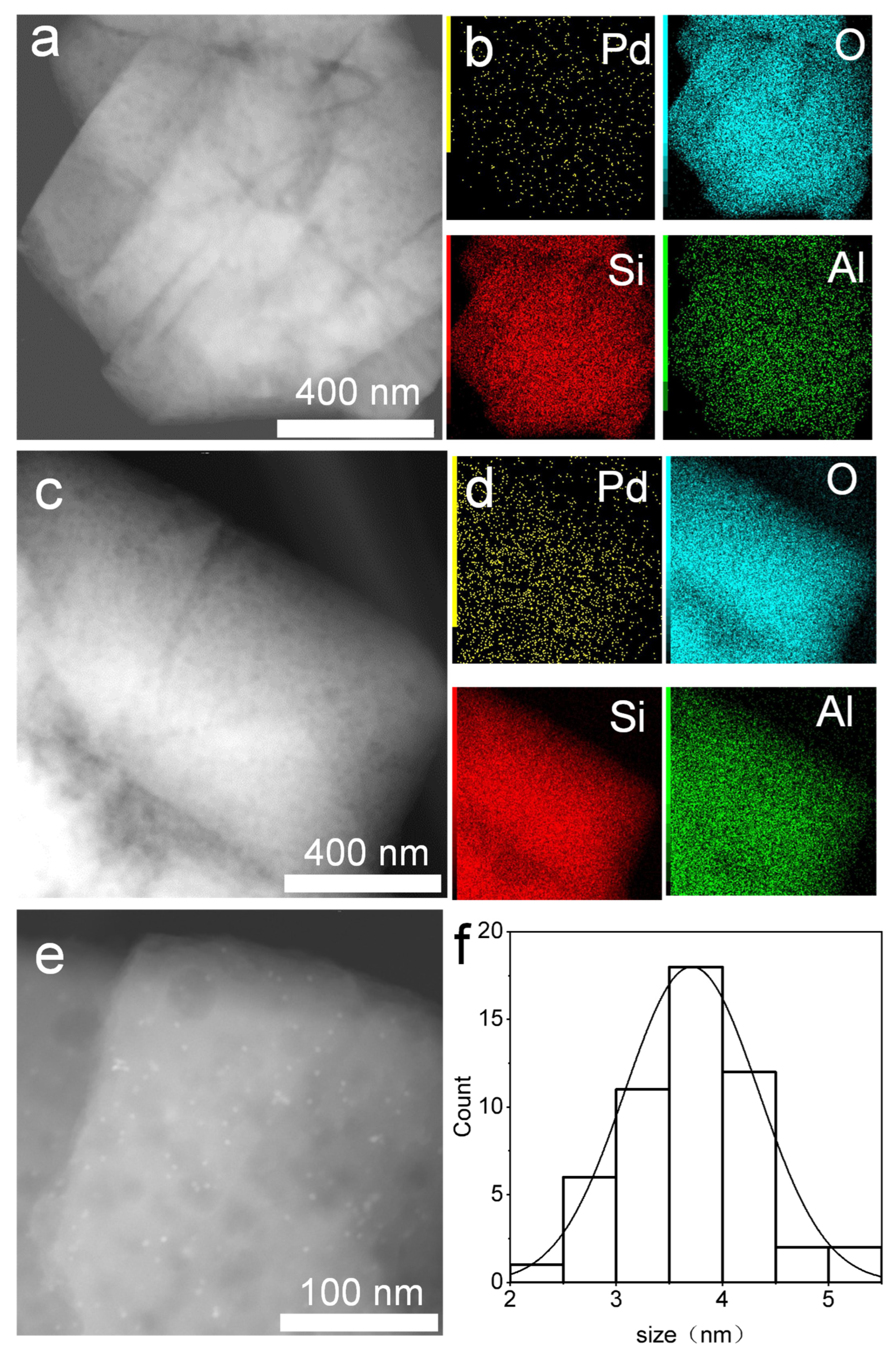
Figure 3 shows STEM images, EDS element mapping, and particle size distribution of catalysts. According to Figure 3a,b, for Pd2+/USY, it could be observed that Pd species were homogeneously dispersed through the USY crystal and no aggregates of Pd species could be observed. This result was consistent with a previous report that after calcination at high temperature, Pd species on USY zeolite would disperse into Pd ions [43]. For Pdc/USY, although Pd ions had been reduced to some extent under the hydrogenation condition, nanometer-sized Pd particles were still absent in the STEM image (Figure 3c,d), which meant that the aggregation of Pd species was regulated. Thus, for Pd2+/USY and Pdc/USY, the dispersion degree of Pd species was 100%. In contrast, after reduction at 200 °C in 10% H2/N2 atmosphere, ~3.8 nm Pd nanoparticles arose on Pdn/USY due to the excessive aggregation (Figure 3e,f), and the dispersion degree of Pd nanoparticles reduced to 29% according to the empirical formula, which was undoubtedly not conducive to the efficient utilization of Pd.

2.2. Electronic Structure of Pd Species

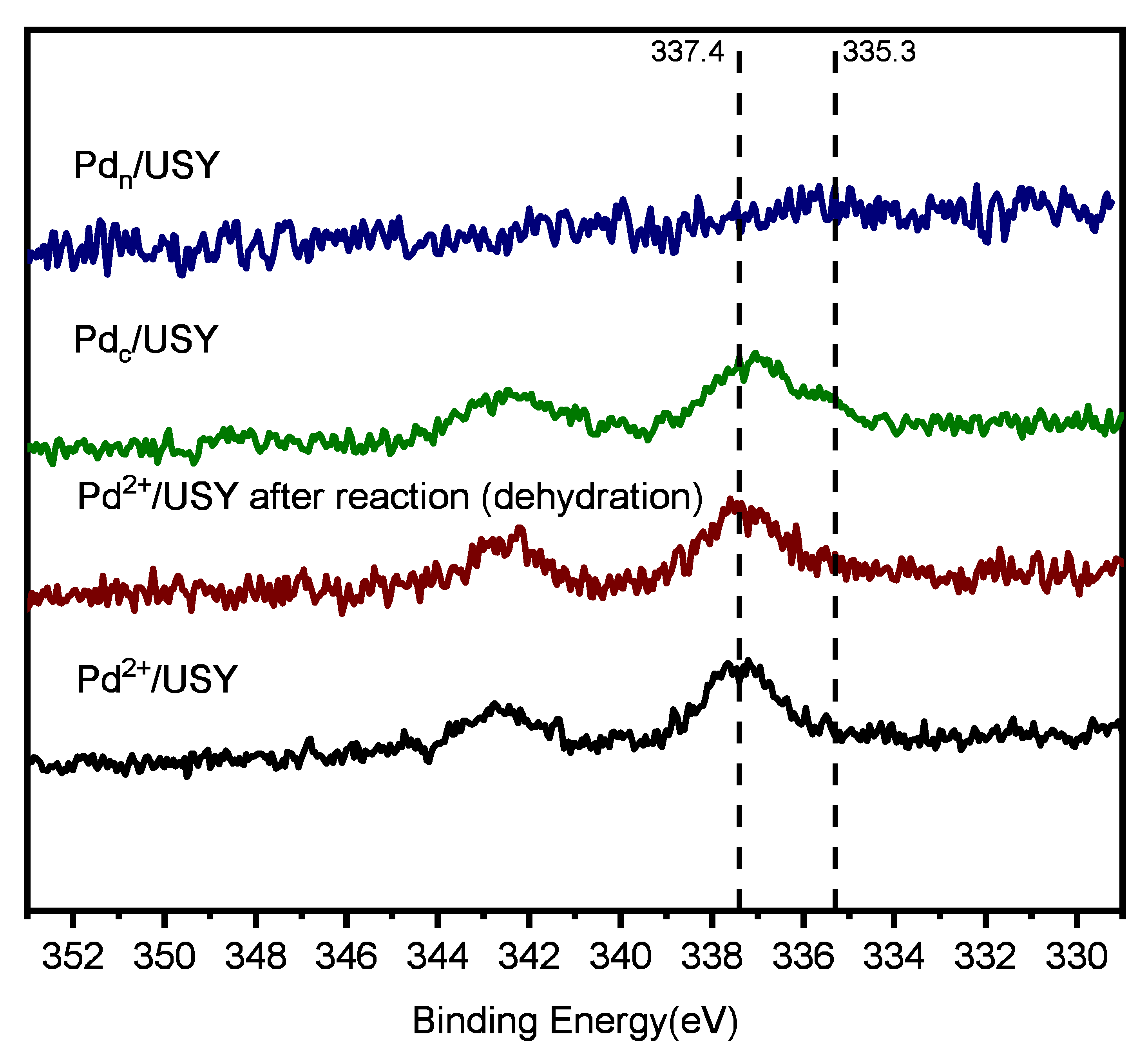
Pd 3d XPS spectra further provided information about the valence state of Pd in different catalysts. In Pd 3d XPS spectra, peaks located at 335.3 eV and 337.4 eV corresponded to the Pd 3d5/2 of Pd(0) and Pd(II), respectively. As shown in Figure 4, Pd2+/USY only contained Pd(II) with a binding energy of 337.4 eV, and after dehydration, Pd ions could not be reduced during the reaction, which demonstrated the strong interaction between zeolite and Pd(II). However, when physically adsorbed water was present, Pd(II) could be reduced to Pd(δ++) with a binding energy of 337.0 eV and Pd(δ+) with a binding energy of 335.6 eV. The binding energy of Pd(δ++) was 0.4 eV lower than that of Pd(II), while the binding energy of Pd(δ+) was 0.3 eV higher than that of Pd(0), and the ratio of Pd(δ++) and Pd(δ+) was ~7:3. These results proved that Pd ions could be reduced controllably into Pd clusters with physically adsorbed water, which reduced the interaction between Pd ions and the zeolite framework. For Pdn/USY, Pd species mainly existed as Pd(0), and the reduced intensity of Pd 3d peaks was a result of the migration of Pd species into intracrystalline mesopores during the reduction process [44]. The above result showed that the valence state of Pd in Pd clusters lay between that of Pd ions and metallic Pd, which optimized the electronic structure of Pd and thus exhibited higher catalytic activity.
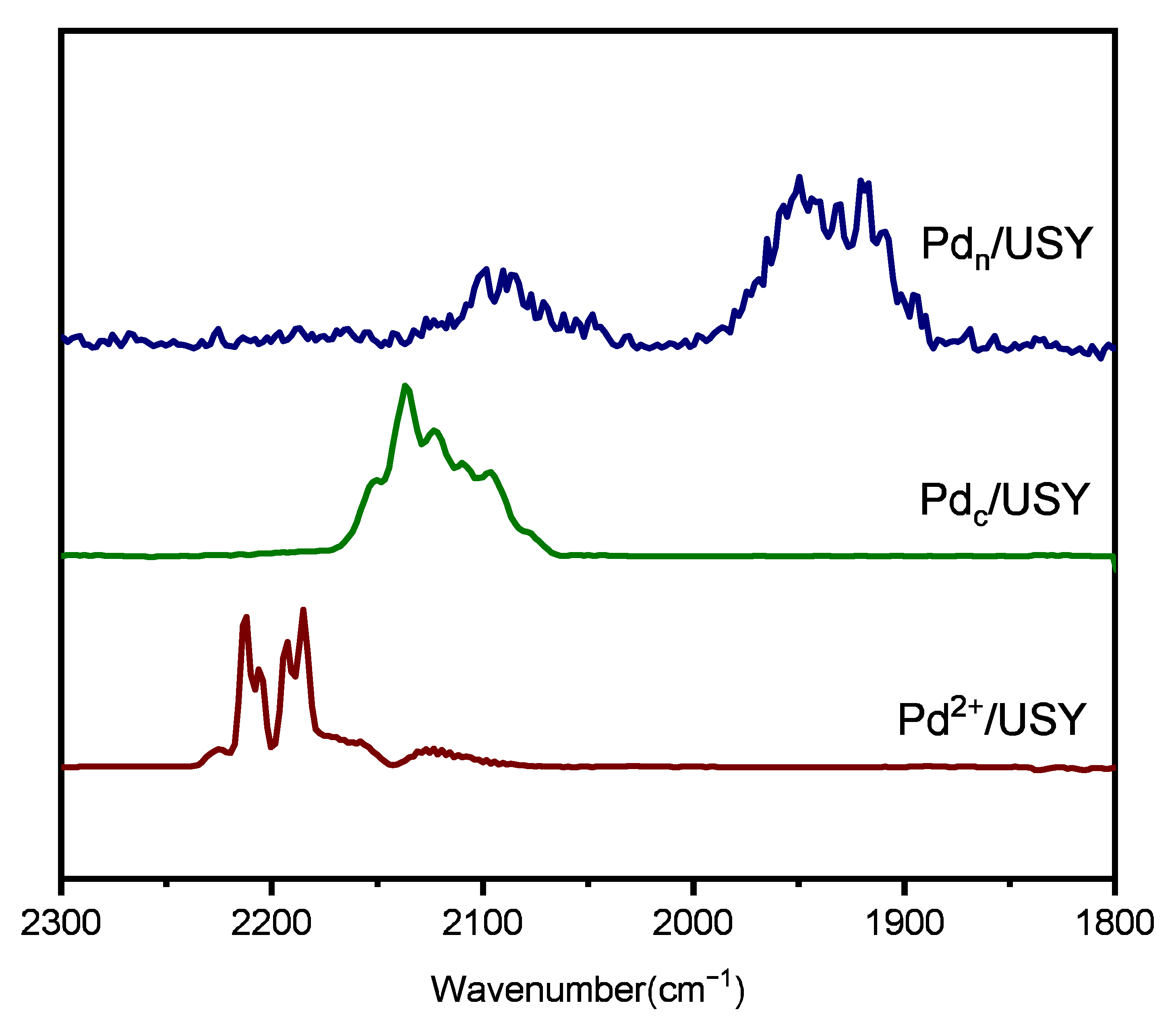
The electronic structures of Pd species in catalysts were further revealed by CO-FTIR. As shown in Figure 5, Pd2+/USY shows vco bands between 2170 and 2230 cm−1, which could be assigned to CO bonded to cationic Pd in Pd gem-dicarbonyls [43,45]. This was consistent with the result of XPS that Pd species in Pd2+/USY were Pd ions. For Pdc/USY, the vco bands red-shifted to 2090–2150 cm−1 due to the controllable reduction during the reaction. Moreover, CO molecules were all adsorbed onto Pd clusters in a linear adsorption form which further demonstrated the high dispersion of Pd species. Bridge-type adsorbed CO appeared on Pdn/USY, which showed a vco band located at 1900–1950 cm−1, while the CO peak located at ~2090 cm−1 originated from interface Pd species between Pd nanoparticles and zeolite. The frequency of the C=O stretching vibration of CO adsorbed on Pd species reflected its valence state. When the valence state of Pd decreased, the electron density increased, causing the Pd species to feed back more electrons to the anti-bond orbitals of CO. Thus, according to CO-FTIR, a similar conclusion could be drawn that Pd clusters had an electron density between those of Pd ions and nanoparticles, which optimized its ability to activate reactant molecules.
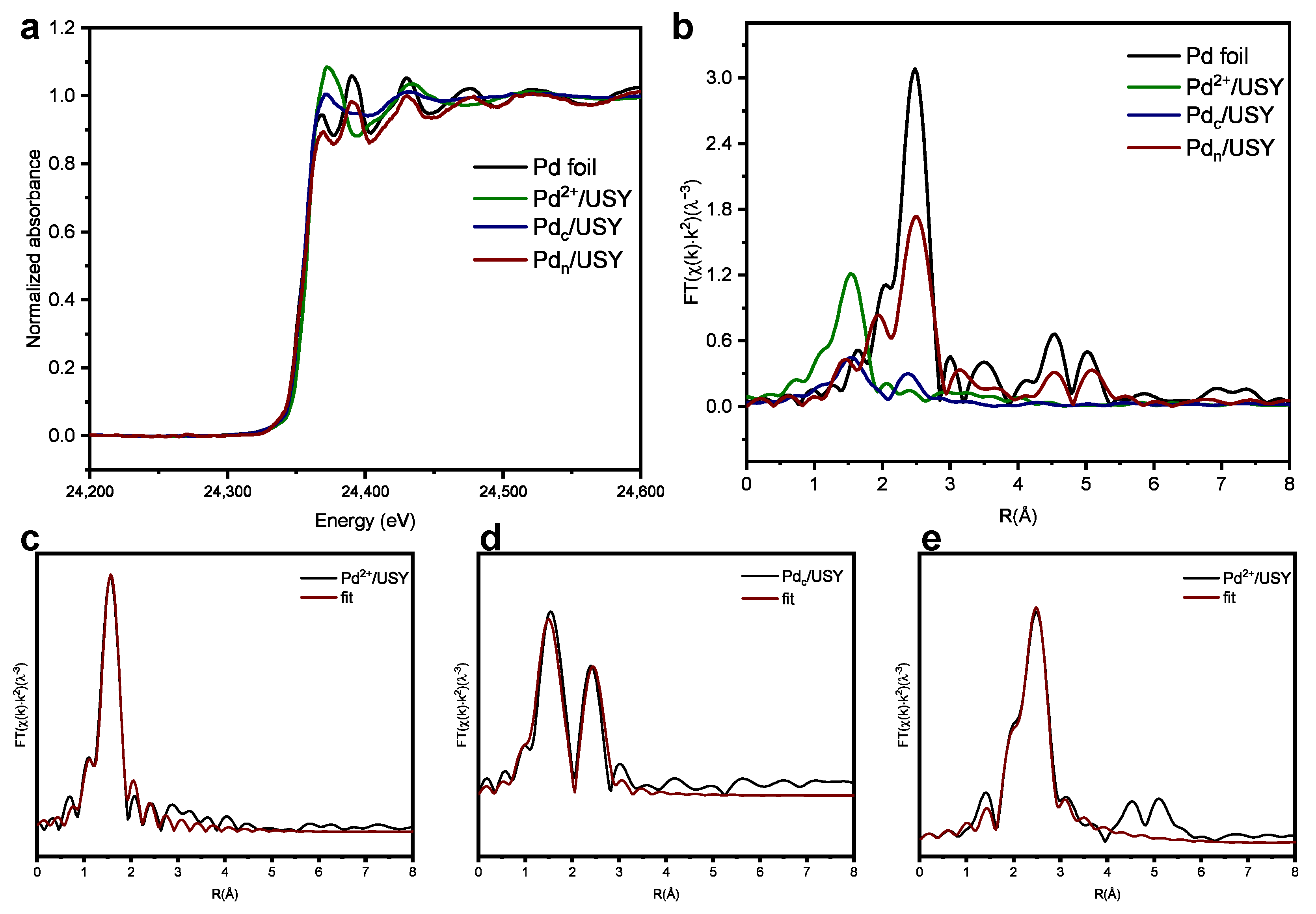
XAS was used to analyze the valence and coordination structure of Pd, and Pd foil was used as a reference sample. Figure 6a shows the Pd K-edge XANES spectra. According to the white line strength of catalyst, the valence states of Pd in Pdn/USY and Pd2+/USY were 0 and +2, respectively, while Pdc/USY showed a valence state intermediate between 0 and +2, which was consistent with the Pd 3d XPS and CO-FTIR results. Moreover, from the Pd K edge EXAFS data in R space (Figure 6b) and the fitting parameters (Figure 6c–e and Table 2), Pd2+/USY showed a peak at 2.02 A, which could be attributed to Pd-O with a coordination number of 2.9 ± 0.3, and Pdn/USY showed a peak at 2.74 Å, which could be attributed to Pd-Pd with a coordination number of 6.6 ± 1.0. Due to the reduction of Pd species, Pdc/USY showed a lower Pd-O coordination number (1.6 ± 0.4) than Pd2+/USY. Meanwhile, the Pd-Pd coordination number was also very low (2.6 ± 0.9), which demonstrated the highly unsaturated coordination of Pd in Pd clusters [42]. These results further proved the high dispersion and optimized coordination of Pd clusters compared to Pd ions and Pd nanoparticles.

2.3. Water Enables the Reduction of Pd Ions to Pd Clusters During Reaction

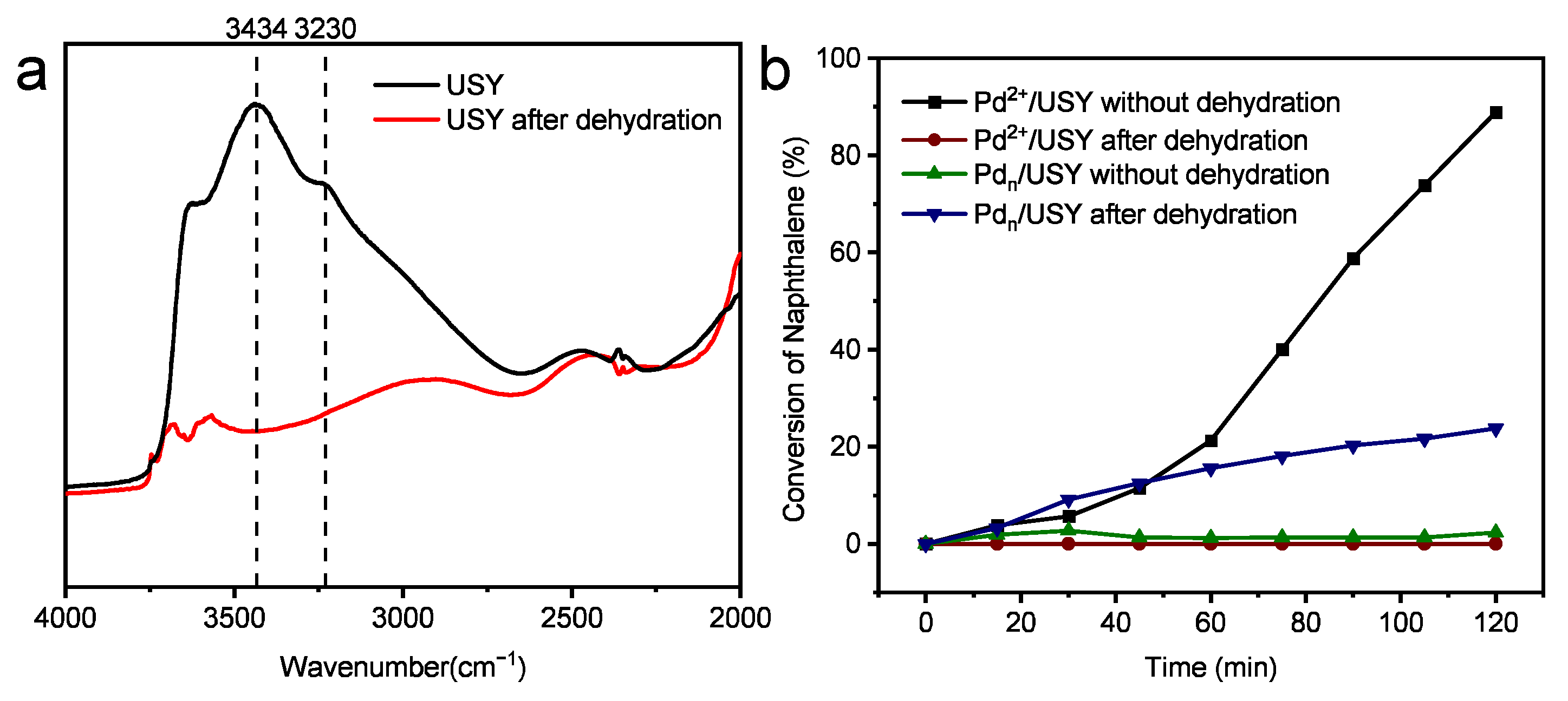
FAU-based catalysts could absorb moisture when stored under environmental conditions. According to the mass reduction in the catalysts after dehydration, the catalysts contained ~13 wt.% water. In DRIFTS spectra, the characteristic peaks at 3434 cm−1 and 3230 cm−1 corresponded to the physically adsorbed water in micropores of zeolite. After dehydration at 120 °C for 2 h, the peaks related to physically adsorbed water disappeared, which meant that almost all physically adsorbed water could be removed (Figure 7a). Whether the physically adsorbed water was removed would affect the catalytic performance of the catalyst. As shown in Figure 7b, Pd ions in FAU zeolite had no negligible catalytic activity in the hydrogenation reaction of naphthalene if physically adsorbed water was removed. In contrast, without dehydration, although Pd2+/USY only converted about 20% of naphthalene in the first 60 min, it converted about 70% of naphthalene in the following 60 min. This meant that Pd ions could be induced into a more reactive form in the presence of physically adsorbed water under the reaction condition. (It should be noted that the presence of naphthalene did not affect the formation of Pd clusters induced from Pd ions. Measuring the change in the reaction activity of Pd ions over time revealed that the presence of water played a crucial role in the aggregation of Pd during the reaction process. The Pd clusters induced in this process exhibited excellent catalytic activity. Thus, catalysts with Pd clusters in USY could be prepared by reducing Pd ions with the presence of physically adsorbed water at 80 °C and under 3 MPa of H2.) Based on the results of XPS and XAS mentioned in the previous text, with the presence of water, after the hydrogenation reaction of naphthalene, the Pd ions would be induced to form Pd clusters. For Pdn/USY with 3.8 nm nanoparticles, physically adsorbed water inhibited its catalytic activity. It showed only a 1.6% conversion of naphthalene at 120 min, while ~20% naphthalene could be hydrogenated at 120 min if physically adsorbed water was removed.

2.4. Naphthalene Hydrogenation Performance

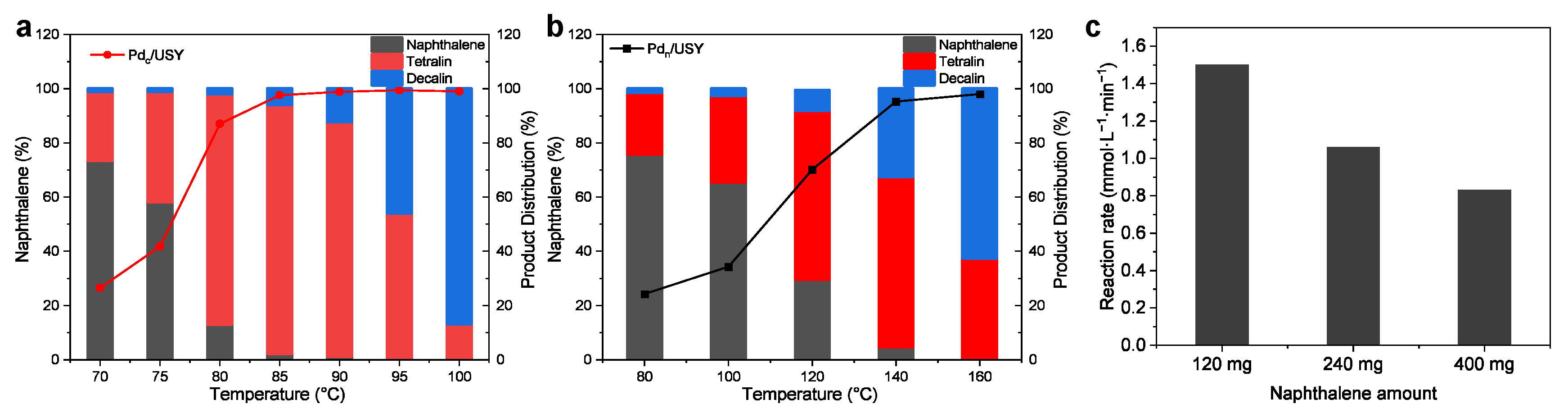
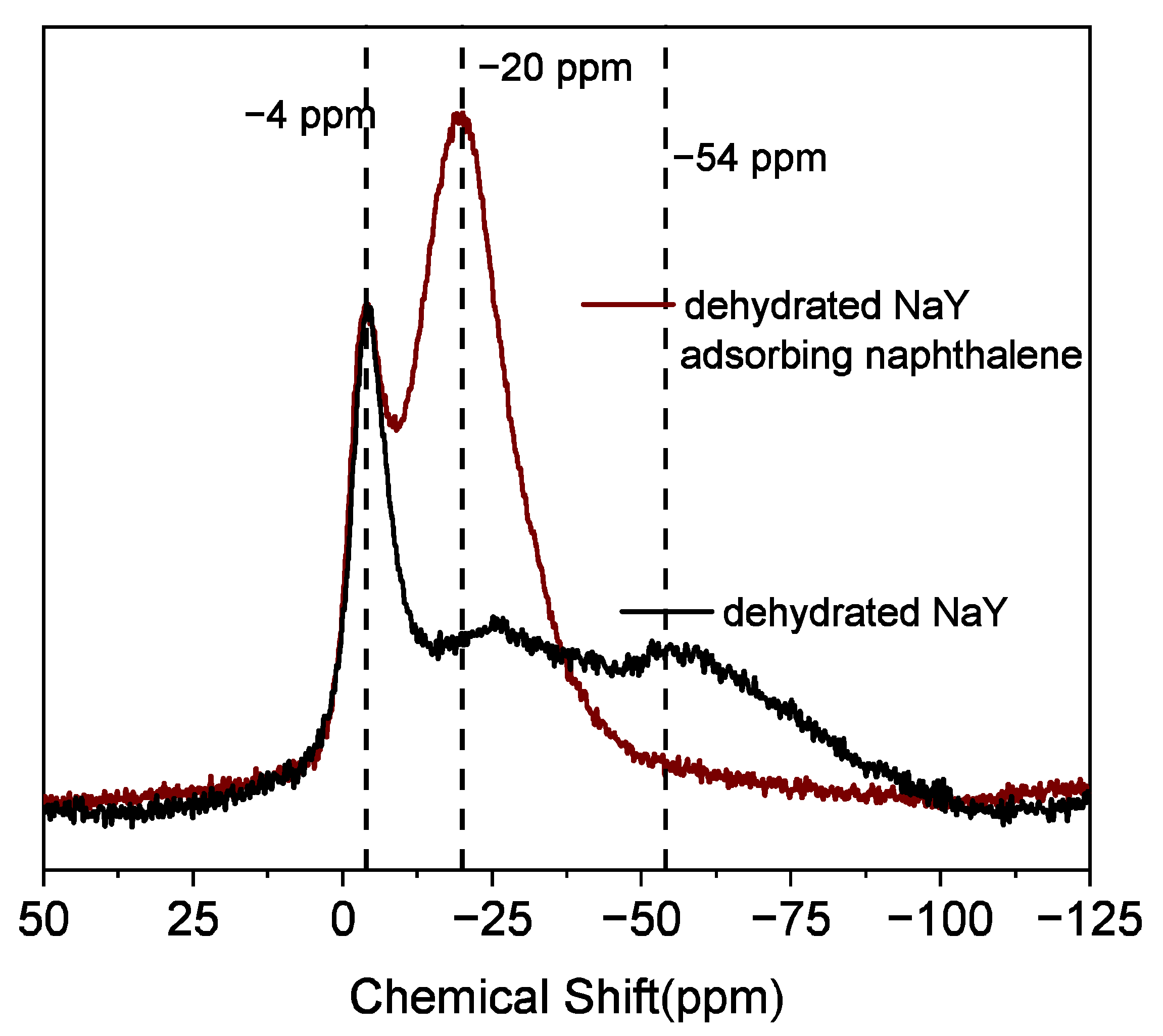
The naphthalene hydrogenation performance of Pdc/USY and Pdn/USY was further measured at different temperatures, and the conversion of naphthalene and product distribution are shown in Figure 8a,b. As mentioned above, for reduced Pd species, physically adsorbed water had an inhibitory effect on catalytic activity, so the catalyst should be dehydrated at 120 °C before being used in the reaction. According to the result, at 85 °C, Pdc/USY could convert 94% naphthalene with a selectivity of tetralin of 91%, and decalin yield could reach 86% at 100 °C, while for Pdn/USY, the decalin yield was only 62% even at 160 °C, which was much worse than Pdc/USY. The reaction rate of naphthalene hydrogenation with a more concentrated solution of naphthalene was also provided (Figure 8c). The reaction rate dropped to some extent when higher-concentrated naphthalene was used, which might be caused by the competitive adsorption of naphthalene and hydrogen or carbon deposition. Figure 9 provides the evidence that a naphthalene molecule can enter the supercage of USY. Dehydrated NaY shows peaks at −25 and −54 ppm in solid-state 23Na MAS NMR spectra, which correspond to Na species in the supercage. After adsorbing naphthalene, peaks at −25 and −54 ppm disappeared, while a new peak located at −20 ppm arose, and this peak originated from the Na species interacting with naphthalene. This result further proved that a naphthalene molecule could enter the supercage of Y zeolite. Therefore, the Pd clusters in the supercage were accessible during the hydrogenation reaction of naphthalene. Combined with the previous discussion, the higher catalytic activity of Pd clusters compared to Pd nanoparticles could be attributed to their high dispersity and suitable electronic structure. Moreover, since both tetralin and decalin could be the target products in different applications [14,15,16,17,18,19], Pd clusters demonstrated potential in a wide range of application fields.
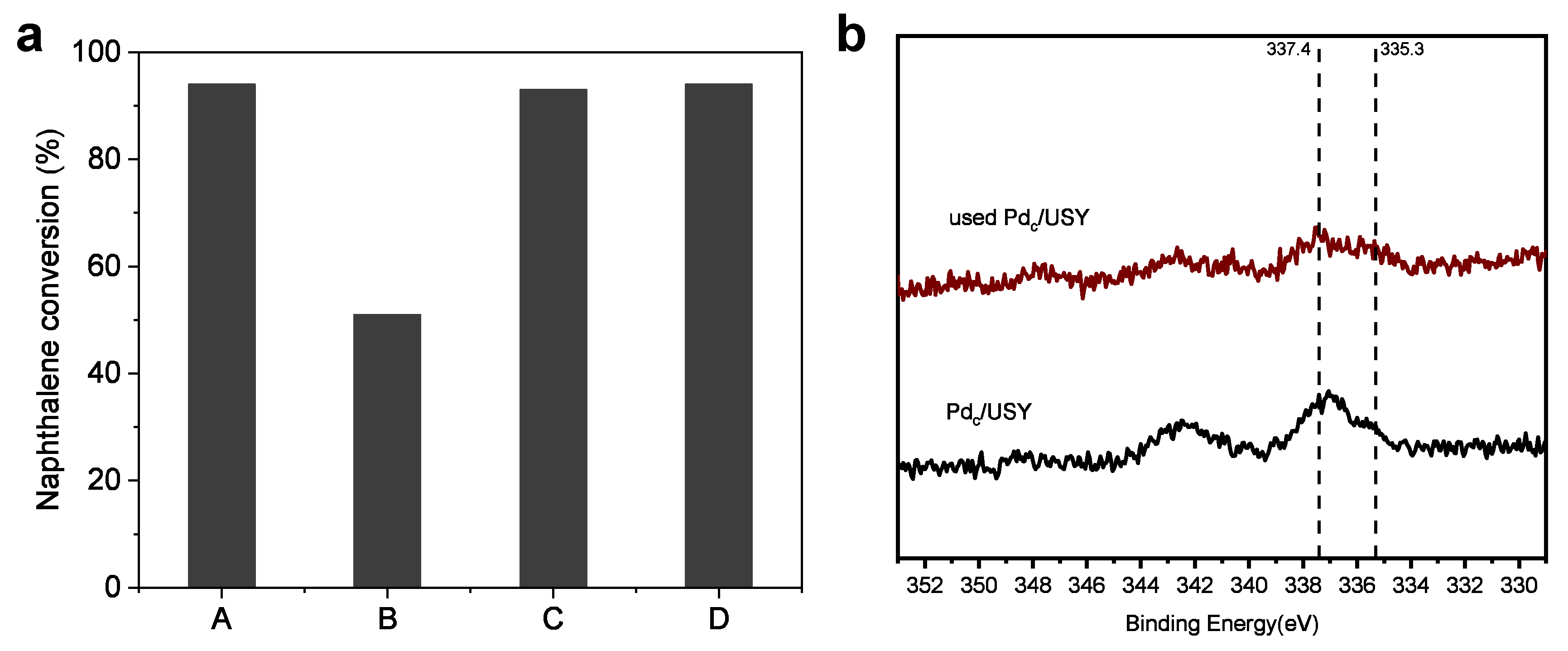
The stability of Pdc/USY was evaluated. As shown in Figure 10a, similar to a previous report [31], the catalytic activity decreased a lot for spent catalyst. Specifically, at the second cycle, the conversion of naphthalene on Pdc/USY dropped from 94% to 54.8%. However, according to XPS spectra (Figure 10b), the used Pdc/USY shows a similar valence state to Pdc/USY. Also, without naphthalene, after 5 h of reduction under the reaction conditions, the activity of Pdc/USY did not decrease (Figure 10a(C)). Thus, it could be deduced that the deactivation was due to carbon deposition rather than the aggregation of Pd species. As reported previously, Pd clusters and Pd ions in zeolite could interconvert under an oxidative or reductive atmosphere [43]. The activity of Pdc/USY could be fully recovered by high-temperature calcination and subsequent reduction (Figure 10a(D)).

3. Experimental Section

3.1. Materials

USY zeolite with a SiO2/Al2O3 mole ratio of 12 was purchased from Macklin (Shanghai, China). Naphthalene, tetralin, decalin, cyclohexane, CaF2, and tetraamminepalladium dinitrate (Pd(NH3)4(NO3)2) solution (10 wt.%) were purchased from Aladdin (Shanghai, China). All chemicals in this work were used as received. Pure H2 and He were purchased from Air Liquide (Tianjin, China), and 10%H2/N2 and 10%CO/He were purchased from Tianjin Baiya Chemical Co., Ltd. (Tianjin, China).

3.2. Catalyst Preparation

Synthesis of Pd2+/USY: Pd was incorporated into USY zeolite using an aqueous ion exchange procedure. An amount of 10 g of USY was dispersed in 100 mL of water at room temperature. Then, under strong magnetic stirring, 600 μL of Pd(NH3)4(NO3)2 solution was added. The mixture was covered and stirred under ambient condition for 24 h before separation by centrifugation. Separated solids were washed with deionized water and centrifuged three times before drying in an oven at 80 °C overnight. The dried Pd/USY sample was calcinated in a muffle furnace under static air, and the temperature was increased at 1 °C/min to 700 °C and held at that temperature for 6 h before the sample was cooled to room temperature. The obtained Pd2+/USY was stored under ambient temperature and humidity before further treatments.
Synthesis of Pdc/USY: 400 mg of Pd2+/USY was added to 20 mL of cyclohexane. The mixture was sealed in an autoclave. After purging with nitrogen three times to remove the air, the autoclave was pressurized with hydrogen (3 MPa). Then, the temperature was increased to 80 °C at 10 °C/min and held at that temperature for 2 h. Pdc/USY was separated by centrifugation and washed with cyclohexane three times before drying in an oven at 80 °C overnight.
Synthesis of Pdn/USY: Pd2+/USY was reduced in a tube furnace under a flow of 100 mL/min of 10% H2/N2. The temperature was increased to 200 °C at 1 °C/min and held at that temperature for 2 h.

3.3. Characterization

X-ray diffraction was performed using a Rigaku Smart Lab Powder XRD (Tokyo, Japan) instrument with Cu-Kα radiation at a tube voltage of 40 kV and a tube current of 40 mA.
N2 adsorption/desorption isotherms were measured on JW-TB220A apparatus at −196 °C. Surface areas were determined by the BET method, and the micropore volumes were determined by the t-plot method. Vtotal is the total pore volume at p/p0 = 0.99. VBJH is the mesopore and macropore volume calculated by the BJH method. Pore size distribution was calculated by the BJH method.
Elemental compositions of samples were determined by X-ray fluorescence spectroscopy (XRF) on a Rigaku-ZSX Primus IV; apparatus.
The STEM and element distribution of the samples were collected by transmission electron microscopy (TEM, JEM-2800, JEOL, Tokyo, Japan) with an energy dispersive spectrometer (EDS). Before the measurement, the catalysts were dispersed in ethanol by ultrasonication and then dropped onto the carbon-film-coated copper grids and dried until ethanol evaporated. The thickness of the carbon film was 3–5 nm, and it exhibited a relatively low background contrast when observed under TEM.
The surface elemental composition and Pd valence of the sample were determined by X-ray photoelectron spectroscopy (XPS, Thermo Scientific ESCALAB 250Xi, Thermo, Waltham, MA, USA) with an Al Kα X-ray source, and the C 1s peak (BE = 284.8 eV) was used for calibration. The test conditions were as follows: analysis chamber (10−7 mbar); controlling charging effects (combination of electron beam and ion beam gun); and software used for quantification (XPS Peak), line shapes (Gaussian/Lorentzian), and backgrounds (Shirley).
CO-FTIR was collected using a Nicolet (Madison, WI, USA) iS20 Fourier Transform Infrared Spectrometer instrument (4 cm−1 resolution and 32 scans per spectrum) and an accessory with a high-temperature environmental chamber. A spectrum of powdered CaF2 was used as the background, and the catalyst absorbance spectra were calculated using the Kulbelka–Munk equation. The used gas was dehydrated through a condenser, which was cooled by liquid nitrogen. In a typical measurement, 5–10 mg of catalyst powder was loaded onto the environmental chamber, and the chamber was purged with flowing He. After removing adsorbed water (500 °C, 3 h, atmospheric pressure), the sample was cooled to 30 °C before subsequent exposure to 10%CO/He. Then, spectra were collected after 2 min of He flow.
The Pd K-edge X-ray absorption spectra were collected at the BL14W1 beamline of the Shanghai Synchrotron Radiation Facility, operated at a voltage of 3.5 GeV and a maximum current of 250 mA.
NH3-TPD was measured on the Auto Chemisorb (Tokyo, Japan) II 2920 apparatus. For the NH3-TPD experiment, the sample was pretreated at 550 °C for 1 h under helium atmosphere. After the temperature cooled down to 100 °C, the gas was switched to 10%NH3/He for 1 h, then the gas was switched to He to purge the NH3 physically adsorbed. Then, an NH3-TPD curve was obtained by raising the temperature to 600 °C.
The solid NMR (23Na MAS NMR) was recorded on the Avance (Osaka, Japan) III WB 400 spectrometer equipped with a magnetic field strength of 9.39 T (400 MHz) and chamber cavity diameter of 89 mm. The rotation rate was 10 kHz and the cycle delay was 0.1 s.

3.4. Catalytic Hydrogenation of Naphthalene

Catalytic naphthalene hydrogenation was carried out in a 50 mL stainless steel autoclave with a quartz lining. Before the reaction, 20 mL of cyclohexane, 120 mg of naphthalene, and 400 mg of catalyst were added to the above reactor, purging 10 times with high-purity H2, and then the pressure was raised to 3 MPa. The catalysts were passed through an 80-mesh sieve to eliminate the influence of internal diffusion caused by the size of the catalysts. The reaction was carried out under stirring at 1200 rpm at the desired temperature. At this stirring speed, the influence of external diffusion on the reaction could be excluded. The product was analyzed with a JINGLU GC-7800 gas chromatograph (Grockway, Jining, China) equipped with an FID detector and capillary column. The conversion, selectivity, and yield were calculated using the following equations.
Conversion naphthalene = mole   of   naphthalene ( begin ) mole   of   naphthalene ( end ) mole   of   naphthalene ( begin ) × 100 %
Selectivity t e t r a l i n / d e c a l i n = mole   of   tetralin / decalin mole   of   tetralin + mole   of   decalin × 100 %
Yield t e t r a l i n / d e c a l i n = Conversion t e t r a l i n / d e c a l i n × Selectivity t e t r a l i n / d e c a l i n

4. Conclusions

In summary, it was found that Pd ions on USY could be reduced to Pd clusters in the presence of physically adsorbed water in zeolite micropores during the naphthalene hydrogenation reaction. Water influenced the reducibility of Pd ions and played an important role in the controlled aggregation of Pd species. The formed Pd clusters showed much higher activity for naphthalene hydrogenation compared to Pd ions and Pd nanoparticles due to their high dispersion and optimized electronic structure. Our study revealed the role of water on different Pd species during hydrogenation reaction and could provide guidance for synthesizing Pd-based catalysts with excellent naphthalene hydrogenation performance.

Author Contributions

Conceptualization, writing—original draft preparation, experiments, data analysis, Z.S.; TEM experiments, X.Z.; writing—review and editing, funding acquisition and supervision, T.C. All authors have read and agreed to the published version of the manuscript.

Funding

This work was supported by the National Key Research and Development Program of China (Project No. 2022YFA1503400), the Tianjin Natural Science Research Fund (23JCYBJC01630), the Special Fund for Basic Scientific Research of Central Universities (No. 63251130 and 63241533), and a research grant of Nankai University & Cangzhou Bohai New Area Institute of Green Chemical Engineering (NCC2022PY06).

Data Availability Statement

Date available upon request.

Conflicts of Interest

The authors declare that they have no known competing financial interests or personal relationships that could have appeared to influence the work reported in this paper.

References

  1. Nowicki, A.; Zhang, Y.; Léger, B.; Rolland, J.-P.; Bricout, H.; Monflier, E.; Roucoux, A. Supramolecular shuttle and protective agent: A multiple role of methylated cyclodextrins in the chemoselective hydrogenation of benzene derivatives with ruthenium nanoparticles. Chem. Commun. 2006, 3, 296–298. [Google Scholar] [CrossRef]
  2. Zahmakıran, M.; Tonbul, Y.; Özkar, S. Ruthenium(0) Nanoclusters Stabilized by a Nanozeolite Framework: Isolable, Reusable, and Green Catalyst for the Hydrogenation of Neat Aromatics under Mild Conditions with the Unprecedented Catalytic Activity and Lifetime. J. Am. Chem. Soc. 2010, 132, 6541–6549. [Google Scholar] [CrossRef]
  3. Tonbul, Y.; Zahmakiran, M.; Özkar, S. Iridium(0) nanoparticles dispersed in zeolite framework: A highly active and long-lived green nanocatalyst for the hydrogenation of neat aromatics at room temperature. Appl. Catal. B Environ. 2014, 148–149, 466–472. [Google Scholar] [CrossRef]
  4. Pla, P.; Wang, Y.; Martín, F.; Alcamí, M. Hydrogenated polycyclic aromatic hydrocarbons: Isomerism and aromaticity. Phys. Chem. Chem. Phys. 2020, 22, 21968–21976. [Google Scholar] [CrossRef] [PubMed]
  5. Roucoux, A.; Schulz, J.; Patin, H. Arene Hydrogenation with a Stabilised Aqueous Rhodium(0) Suspension: A Major Effect of the Surfactant Counter-Anion. Adv. Synth. Catal. 2003, 345, 222–229. [Google Scholar] [CrossRef]
  6. Song, C.; Ma, X. New design approaches to ultra-clean diesel fuels by deep desulfurization and deep dearomatization. Appl. Catal. B Environ. 2003, 41, 207–238. [Google Scholar] [CrossRef]
  7. Miao, S.; Liu, Z.; Han, B.; Huang, J.; Sun, Z.; Zhang, J.; Jiang, T. Ru Nanoparticles Immobilized on Montmorillonite by Ionic Liquids: A Highly Efficient Heterogeneous Catalyst for the Hydrogenation of Benzene. Angew. Chem. Int. Ed. 2006, 45, 266–269. [Google Scholar] [CrossRef] [PubMed]
  8. Tang, T.; Yin, C.; Wang, L.; Ji, Y.; Xiao, F.-S. Good sulfur tolerance of a mesoporous Beta zeolite-supported palladium catalyst in the deep hydrogenation of aromatics. J. Catal. 2008, 257, 125–133. [Google Scholar] [CrossRef]
  9. Chen, H.-J.; Liu, H.-W.; Liao, W.; Pan, H.-B.; Wai, C.M.; Chiu, K.-H.; Jen, J.-F. Highly active and reusable palladium nanoparticle catalyst stabilized by polydimethylsiloxane for hydrogenation of aromatic compounds in supercritical carbon dioxide. Appl. Catal. B Environ. 2012, 111–112, 402–408. [Google Scholar] [CrossRef]
  10. Kim, H.J.; Song, C. A refined design concept for sulfur-tolerant Pd catalyst supported on zeolite by shape-selective exclusion and hydrogen spillover for hydrogenation of aromatics. J. Catal. 2021, 403, 203–214. [Google Scholar] [CrossRef]
  11. Brem, B.T.; Durdina, L.; Siegerist, F.; Beyerle, P.; Bruderer, K.; Rindlisbacher, T.; Rocci-Denis, S.; Andac, M.G.; Zelina, J.; Penanhoat, O.; et al. Effects of Fuel Aromatic Content on Nonvolatile Particulate Emissions of an In-Production Aircraft Gas Turbine. Environ. Sci. Technol. 2015, 49, 13149–13157. [Google Scholar] [CrossRef]
  12. Li, T.; Cheng, J.; Huang, R.; Zhou, J.; Cen, K. Conversion of waste cooking oil to jet biofuel with nickel-based mesoporous zeolite Y catalyst. Bioresour. Technol. 2015, 197, 289–294. [Google Scholar] [CrossRef]
  13. Petrukhina, N.N.; Vinnikova, M.A.; Maksimov, A.L. Production of High-Density Jet and Diesel Fuels by Hydrogenation of Highly Aromatic Fractions. Russ. J. Appl. Chem. 2018, 91, 1223–1254. [Google Scholar] [CrossRef]
  14. Pang, M.; Liu, C.; Xia, W.; Muhler, M.; Liang, C. Activated carbon supported molybdenum carbides as cheap and highly efficient catalyst in the selective hydrogenation of naphthalene to tetralin. Green Chem. 2012, 14, 1272–1276. [Google Scholar] [CrossRef]
  15. Yang, Y.; Xu, B.; He, J.; Shi, J.; Yu, L.; Fan, Y. Magnetically separable mesoporous silica-supported palladium nanoparticle-catalyzed selective hydrogenation of naphthalene to tetralin. Appl. Organomet. Chem. 2019, 33, e5204. [Google Scholar] [CrossRef]
  16. Shirai, M.; Rode, C.V.; Mine, E.; Sasaki, A.; Sato, O.; Hiyoshi, N. Ring hydrogenation of naphthalene and 1-naphthol over supported metal catalysts in supercritical carbon dioxide solvent. Catal. Today 2006, 115, 248–253. [Google Scholar] [CrossRef]
  17. Du, M.; Qin, Z.; Ge, H.; Li, X.; Lü, Z.; Wang, J. Enhancement of Pd–Pt/Al2O3 catalyst performance in naphthalene hydrogenation by mixing different molecular sieves in the support. Fuel Process. Technol. 2010, 91, 1655–1661. [Google Scholar] [CrossRef]
  18. Escobar, J.; Barrera, M.C.; Santes, V.; Terrazas, J.E. Naphthalene hydrogenation over Mg-doped Pt/Al2O3. Catal. Today 2017, 296, 197–204. [Google Scholar] [CrossRef]
  19. Liu, J.; Zhang, H.; Lu, N.; Yan, X.; Fan, B.; Li, R. Influence of Acidity of Mesoporous ZSM-5-Supported Pt on Naphthalene Hydrogenation. Ind. Eng. Chem. Res. 2020, 59, 1056–1064. [Google Scholar] [CrossRef]
  20. He, J.; Zhao, B.; He, Q.; Jia, Y.; Liu, L.; Dong, J. Hydrogen-enriched Rh clusters on layered calcium silicate for high-efficiency hydrogenation of aromatics at room temperature. Nano Res. 2025, 18, 94908094. [Google Scholar] [CrossRef]
  21. Gong, P.; Li, B.; Kong, X.; Liu, J.; Zuo, S. Well-dispersed Ni nanoclusters on the surfaces of MFI nanosheets as highly efficient and selective catalyst for the hydrogenation of naphthalene to tetralin. Appl. Surf. Sci. 2017, 423, 433–442. [Google Scholar] [CrossRef]
  22. Shu, Y.; Song, X.; Lan, F.; Zhao, C.; Guan, Q.; Li, W. N-Doped Carbon Interior-Modified Mesoporous Silica-Confined Nickel Nanoclusters for Stereoselective Hydrogenation. ACS Catal. 2022, 12, 15386–15399. [Google Scholar] [CrossRef]
  23. Zhang, C.; Cao, J.-P.; Jiang, W.; Zhao, X.-Y.; Zhou, Y.-R.; Chen, C.-X.; Huan, Z.-X.; Tan, C.-R.; Hu, X.; He, Z.-M.; et al. Increasing Ni Dispersion on a Carbon-Supported Catalyst for Hydrogenation Saturation of Naphthalene: Effect of Different Alkanol Solvents. Energy Fuels 2023, 37, 19124–19136. [Google Scholar] [CrossRef]
  24. Zhang, C.; Cao, J.-P.; Zhao, X.-Y.; Xie, J.-X.; Zhao, L.; Jiang, W.; He, Z.-M.; Cong, H.-L.; Bai, H.-C. Selective Hydrogenation of Naphthalene to Produce Tetralin over a Ni/S950 Catalyst under Mild Conditions. Ind. Eng. Chem. Res. 2023, 62, 6780–6789. [Google Scholar] [CrossRef]
  25. Zhao, T.; Zhao, B.-B.; Niu, Y.-F.; Liang, Y.; Liu, L.; Dong, J.-X.; Tang, M.-X.; Li, X.-k. Hydrogenation of naphthalene to decalin catalyzed by Pt supported on WO3 of different crystallinity at low temperature. J. Fuel Chem. Technol. 2021, 49, 1181–1189. [Google Scholar] [CrossRef]
  26. Liang, Y.; Zhao, B.; Tang, Q.; Liu, L.; Dong, J. Adjusting Pt Nanoparticle Size on SBA-15 by a Sol-Immobilisation Method Towards Naphthalene Hydrogenation. Catal. Lett. 2022, 152, 3489–3497. [Google Scholar] [CrossRef]
  27. Liang, Y.; Wang, L.; Li, X.; Tang, M.; Tang, Q.; Dong, J.; Liu, L. Ozonation assisted synthesis of well-dispersed Pt on HY zeolite as highly efficient catalyst for deep hydrogenation of naphthalene. Appl. Catal. A Gen. 2023, 668, 119490. [Google Scholar] [CrossRef]
  28. Liu, Z.; Mei, J.; Wang, D.; Kong, X.; Yu, K.; Cao, Z.; Wang, C.; Gong, Y.; Duan, A.; Xu, C.; et al. Ultrafine Pt particles on hollow hierarchical porous β zeolites for selective hydrogenation of naphthalene. Fuel 2024, 368, 131642. [Google Scholar] [CrossRef]
  29. Liu, Z.; Wang, E.; Mei, J.; Wang, A.; Zou, Y.; Wang, C.; Shang, H.; Gong, Y.; Duan, A.; Xu, C.; et al. Hierarchical porous Pt/Hβ catalyst with controllable acidity for efficient hydrogenation of naphthalene. Chem. Eng. J. 2024, 481, 148763. [Google Scholar] [CrossRef]
  30. Li, P.; Wang, L.; Zhang, X.; Li, G. Deep Hydrogenation Saturation of Naphthalene Facilitated by Enhanced Adsorption of the Reactants on Micro-Mesoporous Pd/HY. ChemistrySelect 2021, 6, 5524–5533. [Google Scholar] [CrossRef]
  31. Song, Q.; Zhang, M.; Li, P.; Wang, L.; Zhang, X.; Li, G. Millesimal phosphorus promoted Pd/HY for efficient hydrogenation saturation. Mol. Catal. 2022, 528, 112453. [Google Scholar] [CrossRef]
  32. Zhang, M.; He, Z.; Zhang, M.; Wang, L.; Wang, Q.; Zhang, X.; Li, G. Tuning the location of Pd on HY zeolite by a dual-solvent method for efficient deep hydrogenation saturation of naphthalene. Fuel 2022, 316, 123166. [Google Scholar] [CrossRef]
  33. Zhang, M.; Song, Q.; He, Z.; Wang, Q.; Wang, L.; Zhang, X.; Li, G. Tuning the mesopore-acid-metal balance in Pd/HY for efficient deep hydrogenation saturation of naphthalene. Int. J. Hydrogen Energy 2022, 47, 20881–20893. [Google Scholar] [CrossRef]
  34. Zhang, M.; Xue, H.; Song, Q.; Wang, L.; Zhang, X.; Li, G. Trace ceria boosting HY supported Pd for deep hydrogenation saturation of polycyclic aromatic hydrocarbons. Mol. Catal. 2025, 584, 115331. [Google Scholar] [CrossRef]
  35. Zhu, L.; Shan, S.; Petkov, V.; Hu, W.; Kroner, A.; Zheng, J.; Yu, C.; Zhang, N.; Li, Y.; Luque, R.; et al. Ruthenium–nickel–nickel hydroxide nanoparticles for room temperature catalytic hydrogenation. J. Mater. Chem. A 2017, 5, 7869–7875. [Google Scholar] [CrossRef]
  36. Dusselier, M.; Davis, M.E. Small-Pore Zeolites: Synthesis and Catalysis. Chem. Rev. 2018, 118, 5265–5329. [Google Scholar] [CrossRef]
  37. Marcilly, C.R. Where and how shape selectivity of molecular sieves operates in refining and petrochemistry catalytic processes. Top. Catal. 2000, 13, 357–366. [Google Scholar] [CrossRef]
  38. Primo, A.; Garcia, H. Zeolites as catalysts in oil refining. Chem. Soc. Rev. 2014, 43, 7548–7561. [Google Scholar] [CrossRef] [PubMed]
  39. Verboekend, D.; Nuttens, N.; Locus, R.; Van Aelst, J.; Verolme, P.; Groen, J.; Pérez-Ramírez, J.; Sels, B. Synthesis, characterisation, and catalytic evaluation of hierarchical faujasite zeolites: Milestones, challenges, and future directions. Chem. Soc. Rev. 2015, 45, 3331–3352. [Google Scholar] [CrossRef]
  40. Sun, Q.; Wang, N.; Yu, J. Advances in Catalytic Applications of Zeolite-Supported Metal Catalysts. Adv. Mater. 2021, 33, 2104442. [Google Scholar] [CrossRef] [PubMed]
  41. Zhang, Q.; Gao, S.; Yu, J. Metal Sites in Zeolites: Synthesis, Characterization, and Catalysis. Chem. Rev. 2023, 123, 6039–6106. [Google Scholar] [CrossRef] [PubMed]
  42. Song, I.; Koleva, I.Z.; Aleksandrov, H.A.; Chen, L.; Heo, J.; Li, D.; Wang, Y.; Szanyi, J.; Khivantsev, K. Ultrasmall Pd Clusters in FER Zeolite Alleviate CO Poisoning for Effective Low-Temperature Carbon Monoxide Oxidation. J. Am. Chem. Soc. 2023, 145, 27493–27499. [Google Scholar] [CrossRef] [PubMed]
  43. Felvey, N.; Guo, J.; Rana, R.; Xu, L.; Bare, S.R.; Gates, B.C.; Katz, A.; Kulkarni, A.R.; Runnebaum, R.C.; Kronawitter, C.X. Interconversion of Atomically Dispersed Platinum Cations and Platinum Clusters in Zeolite ZSM-5 and Formation of Platinum gem-Dicarbonyls. J. Am. Chem. Soc. 2022, 144, 13874–13887. [Google Scholar] [CrossRef]
  44. Yalcin, K.; Kumar, R.; Zuidema, E.; Kulkarni, A.R.; Ciston, J.; Bustillo, K.C.; Ercius, P.; Katz, A.; Gates, B.C.; Kronawitter, C.X.; et al. Reversible Intrapore Redox Cycling of Platinum in Platinum-Ion-Exchanged HZSM-5 Catalysts. ACS Catal. 2024, 14, 4999–5005. [Google Scholar] [CrossRef] [PubMed]
  45. Wardani, M.K.; Kadja, G.T.M.; Fajar, A.T.N.; Subagjo; Makertihartha, I.G.B.N.; Gunawan, M.L.; Suendo, V.; Mukti, R.R. Highly crystalline mesoporous SSZ-13 zeolite obtained via controlled post-synthetic treatment. RSC Adv. 2019, 9, 77–86. [Google Scholar] [CrossRef]
Figure 1. (a,b) XRD patterns of the samples. (c) STEM image of USY. (d) The particle size distribution of USY. (e) NH3-TPD of the samples. (f) Pyridine-IR spectra of USY.
Catalysts 16 00167 g001
Figure 2. N2 physisorption isotherms (a) and pore size distribution (b) of USY, Pd2+/USY, Pdc/USY, and Pdn/USY.
Catalysts 16 00167 g002
Figure 3. STEM image (a) and EDS element mapping (b) of Pd2+/USY; STEM image (c) and EDS element mapping (d) of Pdc/USY; and STEM image (e) and Pd particle size distribution (f) of Pdn/USY.
Catalysts 16 00167 g003
Figure 4. XPS spectra of Pd 3d of Pd2+/USY, Pd2+/USY after reaction (dehydration), Pdc/USY, and Pdn/USY.
Catalysts 16 00167 g004
Figure 5. CO-FTIR of Pd2+/USY, Pdc/USY, and Pdn/USY.
Catalysts 16 00167 g005
Figure 6. Pd K-edge XANES spectra (a) and R-space spectra (b) from Pd K-edge EXAFS data. Corresponding EXAFS fitting curve of Pd2+/USY (c), Pdc/USY (d), and Pdn/USY (e).
Catalysts 16 00167 g006
Figure 7. (a) DRIFTS spectra of USY and USY after dehydration at 120 °C for 2 h; (b) naphthalene hydrogenation over Pd2+/USY and Pdn/USY without or after dehydration at 120 °C for 2 h. (Reaction condition: catalyst 400 mg, naphthalene 120 mg, cyclohexane 20 mL, H2 3 MPa, 80 °C, 1200 rpm.).
Catalysts 16 00167 g007
Figure 8. Naphthalene conversion and product distribution at different temperatures of Pdc/USY (a) and Pdn/USY (b) (reaction condition: catalyst 400 mg, naphthalene 120 mg, cyclohexane 20 mL, H2 3 MPa, 1 h, 1200 rpm). (c) Reaction rate with different naphthalene amounts (reaction condition: catalyst 400 mg, cyclohexane 20 mL, H2 3 MPa, 15 min, 1200 rpm, 85 °C).
Catalysts 16 00167 g008
Figure 9. Solid-state 23Na MAS NMR spectra of dehydrated NaY and dehydrated NaY adsorbing naphthalene.
Catalysts 16 00167 g009
Figure 10. (a) Naphthalene conversion of Pdc/USY (A), Pdc/USY in the second run (B), Pdc/USY after further reduction for 5 h under the reaction condition without naphthalene (C), and used Pdc/USY after regeneration (regeneration condition: calcination in air at 700 °C for 2 h, followed by reduction at 80 °C, H2 3 MPa for 2 h) (D) (reaction condition: catalyst 400 mg, naphthalene 120 mg, cyclohexane 20 mL, H2 3 MPa, 15 min, 1200 rpm, 85 °C). (b) XPS spectra of Pdc/USY and used Pdc/USY.
Catalysts 16 00167 g010
Table 1. Textural properties of catalysts.
SampleSBET
(m2·g−1) a
Vtotal
(cm3·g−1) b
Vmicro
(cm3·g−1) c
VBJH
(cm3·g−1) d
Smicro
(m2·g−1) e
Sexternal
(m2·g−1) f
USY8830.4530.2890.154744139
Pd2+/USY8800.4600.2830.161723157
Pdc/USY8710.4490.2860.158734137
Pdn/USY8560.4480.2770.155713142
a BET surface area. Linear range using the Rouquerol method and nitrogen (77 K) adsorption. b Vtotal is total pore volume at p/p0 = 0.99; c Vmicro is the micropore volume calculated by the t-plot method; d VBJH is the mesopore and macropore volume calculated by BJH method; e Smicro is the micropore specific surface area calculated by the t-plot method; f Sexternal is the external specific surface area calculated by the t-plot method.
Table 2. EXAFS fitting parameters at Pd K-edge for catalysts.
SampleShellCNR (Å)σ2R Factor
Pd2+/USYPd-O2.9 ± 0.32.020.002020.00416
Pdc/USYPd-O1.6 ± 0.42.000.008080.00873
Pd-Pd2.6 ± 0.92.680.01587
Pdn/USYPd-Pd6.6 ± 1.02.740.005460.02827
Disclaimer/Publisher’s Note: The statements, opinions and data contained in all publications are solely those of the individual author(s) and contributor(s) and not of MDPI and/or the editor(s). MDPI and/or the editor(s) disclaim responsibility for any injury to people or property resulting from any ideas, methods, instructions or products referred to in the content.