Next Article in Journal
Multifunctional Biogenic Silver/Hydroxyapatite Nanocomposite: Photocatalytic Crystal Violet Removal, Antihemolytic Performance, and Broad-Spectrum Antimicrobial Activity
Previous Article in Journal
Effects of Reaction Atmospheres on Hydrogenation Selectivity of Bicyclic Aromatics on NiMoS Active Sites—Combining DFT Calculation and Experiments
 
 
Due to scheduled maintenance work on our servers, there may be short service disruptions on this website between 11:00 and 12:00 CEST on March 28th.
Review

Catalyst Loading Technology for Fixed-Bed Reactors: From Empirical Heuristics to Data-Driven Intelligent Regulation

1
School of Digital Equipment, Jiangsu Vocational College of Electronics and Information, Huaian 223003, China
2
School of Mechanical Engineering and Rail Transit, Changzhou University, Changzhou 213164, China
3
Jiangsu Key Laboratory of Green Process Equipment, Changzhou 213164, China
*
Authors to whom correspondence should be addressed.
Catalysts 2026, 16(2), 123; https://doi.org/10.3390/catal16020123
Submission received: 16 December 2025 / Revised: 10 January 2026 / Accepted: 13 January 2026 / Published: 28 January 2026
(This article belongs to the Section Catalytic Reaction Engineering)

Abstract

Fixed-bed reactors are pivotal in chemical industries, where catalyst loading critically determines reactor performance and economy. This critical review delineates and analyzes a three-stage evolution of loading technology: from empirical manual methods, through scenario-adaptive innovations, to closed-loop intelligent systems. It aims to decode the underlying scientific principles, assess the performance enhancements and inherent limitations of each stage, and critically examine the architectural framework and constraints of intelligent loading systems. Industrial validation data, such as from a 2.4 Mt/a hydrocracker, demonstrate potential improvements (e.g., 20–22% catalyst life extension, 1.8% bed pressure-drop fluctuation). However, the progression presents complex trade-offs in terms of scalability, cost, and standardization. The future direction is discussed, pointing toward addressing challenges in multi-physics modeling, digital twin integration, and fundamental research gaps. This work provides a balanced framework for evaluating loading technology evolution, acknowledging its context-dependent applicability.

1. Introduction

1.1. Industrial Significance: The “Invisible Bottleneck” of Catalyst Loading

Fixed-bed reactors are the dominant workhorses for key industrial catalytic processes such as hydroprocessing and chemical synthesis due to their operational simplicity and scalability [1,2,3]. Catalyst loading, often regarded as a peripheral operation, is actually a critical determinant of reactor performance. Even minor deviations in packed-bed structure from uneven loading can lead to significant local variations in void fraction which directly and non-linearly impact pressure drop [4,5]. More critically, non-uniform loading promotes maldistribution of reactants, leading to localized hot spots. Such temperature excursions are a primary cause of accelerated catalyst deactivation through sintering and coking [6,7]. Furthermore, improper loading can exacerbate issues like metal deposition from feedstocks, a leading cause of irreversible catalyst poisoning that necessitates premature reactor shutdowns [8]. These unscheduled shutdowns in large-scale units result in severe economic penalties, with costs often reaching millions of dollars per event [9].
Against the backdrop of global energy transition, the demand for high-efficiency reactors is escalating. Driven by economies of scale, reactor design has trended toward larger diameters over recent decades to increase single-train capacity [3,10]. Concurrently, advanced catalyst formulations, including nanostructured and zeolitic materials, often trade-off enhanced activity for lower mechanical strength, making them more susceptible to damage during handling [11]. These converging trends amplify the limitations of traditional loading methods, making advanced loading technology a strategic priority for process intensification.

1.2. Global Research Landscape and Critical Gaps

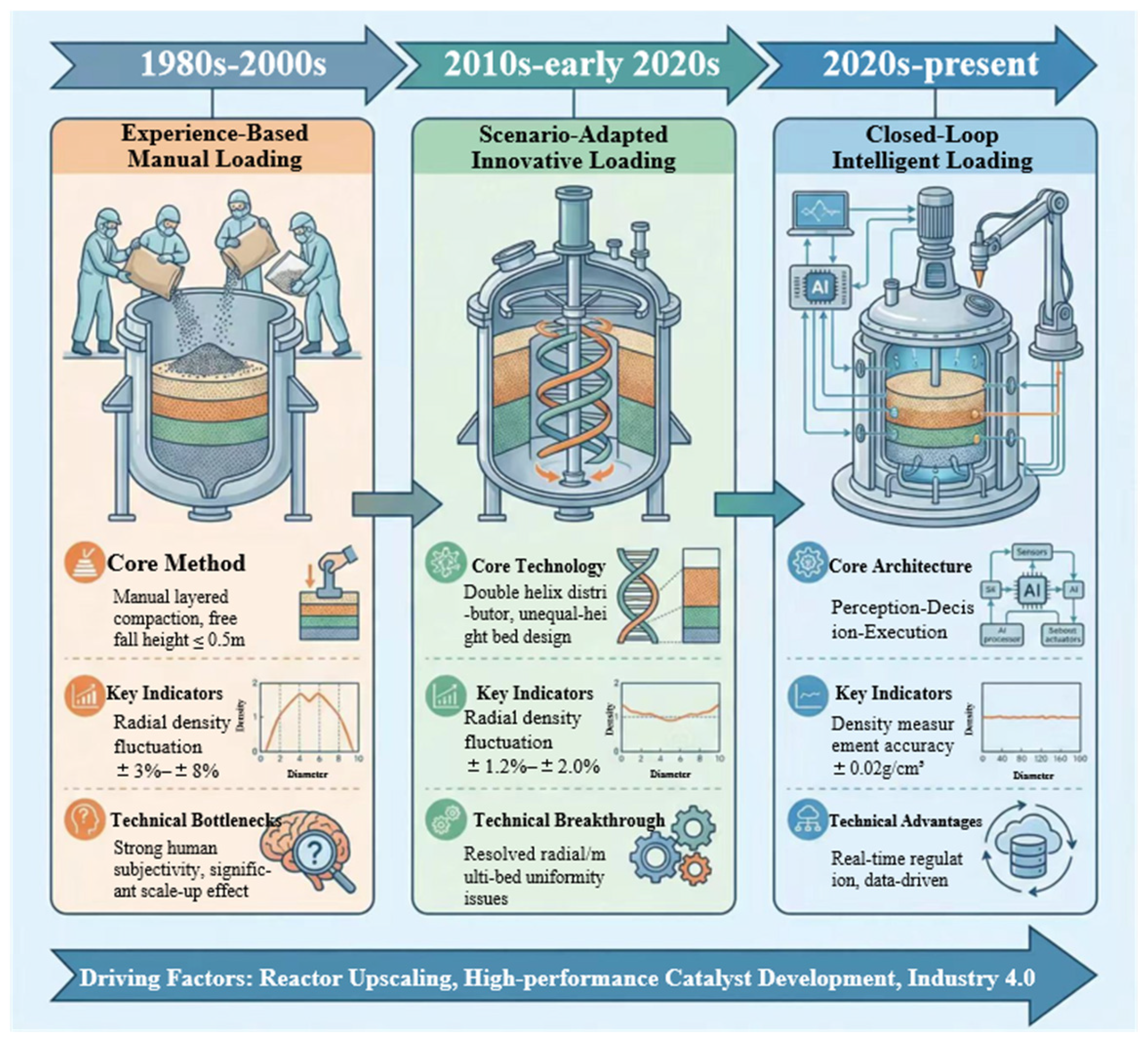
Globally, catalyst loading technology has undergone three evolutionary waves (Figure 1): (1) Empirical manual loading (1980s–2000s), dominated by heuristics, with representative practices including Chevron’s “layered compaction” and BASF’s “central tube distribution”. The scientific underpinnings of such practices can be traced to early studies on particle packing in cylindrical vessels [12,13] and the fundamental understanding of wall effects on voidage distribution [14]. However, reproducibility issues persist—bed pressure drop varies by 10–12% between teams, a variability well-documented in comparative studies [15]. (2) Scenario-adaptive innovative loading (2010s–early 2020s): Led by UOP’s dense-phase loading (increasing packing density by 3–25%) [16] and Linde’s radial distributor design [17], this phase also saw significant academic research into optimized packing structures via discrete element method (DEM) simulations [18,19]. Despite addressing upsizing challenges, a systematic integration of multi-scenario solutions was lacking, as noted in reviews on packed bed reactor design [20]. (3) Intelligent loading (convergence phase, 2020s–present): This phase represents the convergence and targeted integration of well-established technological streams into the catalyst loading domain [21]. It builds upon: (a) decades of research in process monitoring and sensor fusion for granular and multiphase systems [22,23,24,25]; (b) the maturation of industrial robotics and precision mechatronics for hazardous and constrained environments [26,27]; and (c) the pervasive adoption of data-driven modeling and advanced process control (APC) paradigms in chemical engineering [28,29]. The novelty lies not in the individual components, but in their holistic, closed-loop orchestration specifically architected to solve the long-standing, high-stakes challenges of catalyst bed structuring. Early commercial and research prototypes (e.g., from Honeywell, SINOPEC) exemplify this integration trend, aligned with the broader Industry 4.0 and cyber–physical systems (CPS) framework [29].
Despite these advances, this review identifies four critical gaps that remain in current research: (1) Mechanistic ambiguity: The coupling between loading-induced particle arrangement (porosity distribution, particle integrity) and reactor hydrodynamics-reaction kinetics is not fully elucidated. (2) International benchmarking deficiency: Domestic technologies lack quantitative comparison with leading international solutions (e.g., UOP, Linde), hindering global competitiveness evaluation. (3) Standardization absence: No unified metrics for evaluating loading quality (e.g., uniformity coefficient, breakage rate threshold) exist, impeding industrial scalability. (4) Lack of systematic and critical evaluation: Many publications advocate for a specific technological trajectory (especially intelligent systems) with insufficient discussion of their economic feasibility, operational complexities, and alternative scenarios where simpler methods may be optimal. A balanced critique comparing the limitations, failures, and context-dependent applicability of each evolutionary stage is needed.

1.3. Research Objectives and Paper Structure

This review aims to provide a systematic and critical analysis of the evolution in catalyst loading technology for fixed-bed reactors, with three core objectives: (1) To decode the underlying scientific principles of empirical heuristics and quantitatively assess not only the performance enhancements but also the inherent scalability and reproducibility limitations offered by innovative technologies. (2) To critically examine the technical framework for intelligent loading systems, substantiated by industrial validations, while openly discussing their dependencies, costs, and unresolved challenges. (3) To identify prevailing research gaps from a balanced perspective and propose targeted future directions to advance the field. To address these objectives and the identified gaps—including mechanistic ambiguity, benchmarking deficiencies, and a lack of critical evaluation across different technological pathways—this review is structured accordingly.

2. Research Methodology

This comprehensive review was conducted following a systematic approach to ensure the breadth, relevance, and credibility of the literature surveyed. The methodology encompassed literature search, selection criteria, and data synthesis stages.
The literature search was primarily performed using major scientific databases, including Web of Science Core Collection, Scopus, and Engineering Village (Compendex). To cover both academic research and industrial practices, additional searches were conducted in Google Scholar, as well as in the technical document libraries of key industry players (e.g., UOP, Honeywell, Linde, SINOPEC) and standards organizations (e.g., API, ASTM, ISO). The search strategy employed a combination of keywords and their variants: (“fixed-bed reactor” OR “packed bed reactor”) AND (“catalyst loading” OR “catalyst packing” OR “dense-phase loading”) AND (“uniformity” OR “density distribution” OR “intelligent control” OR “robotic loading”). The search timeframe was focused on publications from 1990 to 2024, with particular emphasis on significant advancements reported in the last decade.
The article selection process was guided by pre-defined criteria to maintain focus and quality. Inclusion criteria were: (1) peer-reviewed journal articles, conference proceedings, patents, and authoritative technical reports directly addressing catalyst loading/packing techniques, equipment, or related modeling for fixed-bed reactors; (2) literature providing quantitative performance data (e.g., density fluctuation, breakage rate, conversion improvement); (3) publications detailing fundamental studies on particle mechanics or fluid dynamics relevant to packing behavior. Exclusion criteria included: (1) studies focused solely on catalyst synthesis or reaction kinetics without linkage to loading effects; (2) publications not available in English or Chinese; (3) brief news articles or abstracts without substantial technical content. Initially identified records were screened by title and abstract, followed by a full-text assessment of the shortlisted documents. Key data, including technological parameters, performance metrics, and identified challenges, were extracted and synthesized thematically to construct the evolutionary narrative and comparative analysis presented in this review.

3. Empirical Manual Loading: Heuristics, Mechanisms, and Limitations

3.1. Scientific Decoding of Core Empirical Heuristics

Empirical heuristics, refined through decades of trial-and-error, are rooted in particle mechanics and fluid dynamics. The “free fall height ≤ 0.5 m” rule directly safeguards catalyst integrity: For typical Co-Mo hydroprocessing catalysts (compressive strength 15–20 N/particle), the impact energy upon landing follows E = mgh, where m is particle mass, g is gravitational acceleration, and h is fall height [30]. When h > 0.5 m, E exceeds the particle’s tensile strength (≈0.8 J), increasing breakage rate from <1% to >5%. Fine particles generated by breakage clog bed pores, elevating pressure drop by 10–15% and reducing mass transfer efficiency by 8–10% [31].
The “layered compaction (140–160 taps/min)” rule leverages particle jamming theory [32]. Vibratory compaction reduces interparticle voids by inducing temporary particle fluidization, controlling porosity fluctuation within ±2%—a threshold critical for uniform gas–liquid distribution [33]. Beyond this range, channeling occurs, with fluid velocity in channels 3–5 times higher than in dense regions, causing localized overcracking.
“Uniform cloth distribution along reactor walls” mitigates the “wall effect”, a well-documented phenomenon in packed beds where the void fraction near the wall is 1.2–1.5 times higher than in the bed core [34]. This effect accelerates fluid flow near the wall, reducing reaction conversion in edge regions by 10–15% for first-order reactions (e.g., hydrodesulfurization) [35].

3.2. Industrial Practices and Sector-Specific Adaptations

Axial reactors, the most widely deployed configuration, adopt the “central tube feeding + circumferential diffusion” process. Operators use perforated trays (aperture diameter 2–3 times catalyst particle size) to distribute catalyst, with manual raking every 30 cm of bed height to correct accumulation. Sector-specific adaptations reflect the trade-off between packing density and particle integrity (Table 1): Ammonia synthesis requires dense packing (≥1.2 g/cm3) to compensate for low intrinsic activity of iron-based catalysts; refining hydroprocessing prioritizes low breakage to avoid pressure drop surges; fine chemical processes use fragile noble metal catalysts (strength < 10 N/particle), imposing stricter height limits (≤0.3 m) [36,37,38,39].

3.3. Inherent Limitations in the Era of Reactor Upsizing

Empirical loading faces three insurmountable bottlenecks in modern large-scale processes: (1) Severe scale-up penalty: The “radial uniformity decay” effect—for reactors with diameter > 2 m, the ratio of distributor-to-reactor diameter decreases, leading to radial density fluctuation increasing from 3% (1 m diameter) to 8% (3 m diameter). This is consistent with the Beverloo equation, which predicts packing uniformity degradation with increasing bed diameter. (2) Human factor dependency: Skilled operators require 3–5 years of training, and inter-team variability in bed pressure drop reaches 12% due to subjective judgment of “compaction intensity”. (3) Brittle catalyst incompatibility: For nanostructured zeolite catalysts (strength < 8 N/particle), even 0.3 m fall height causes 5–8% breakage, failing to meet process requirements. These limitations drove the shift to innovative loading technologies [16,17,41].
In summary, while empirical manual loading, underpinned by heuristics and skilled labor, served the industry well for decades in small-to-medium scale reactors, its inherent limitations—pronounced scale-up penalties, heavy reliance on subjective human judgment, and incompatibility with fragile modern catalysts—became insurmountable bottlenecks in the era of process intensification. These deficiencies created a compelling impetus for technological advancement. Consequently, the focus shifted toward developing more controlled, quantifiable, and scenario-adaptive innovative loading technologies designed to overcome these specific compatibility barriers, marking the transition to the next evolutionary stage.

3.4. Limitations of Empirical Manual Loading: The Human Factor and Scale-Up Penalty

While empirical methods served industry for decades, their limitations become acute in modern contexts. Beyond scale-up penalties and human variability, the fundamental critique lies in their non-quantifiable and irreproducible nature. The “art” of loading resists digitalization and creates a knowledge-transfer bottleneck reliant on retiring experts. Furthermore, its static, one-size-fits-most approach fails to adapt to the dynamic properties of modern catalysts (e.g., moisture-sensitive or electrostatic materials) during the loading process itself. These deficiencies underscore that empirical loading is a context-bound solution, optimal only for small-scale, robust catalyst systems where capital for advanced technology is unjustified.

4. Scenario-Adaptive Innovative Loading: Breaking Through Compatibility Barriers

4.1. Radial Reactor Loading: Conquering Annular Uniformity

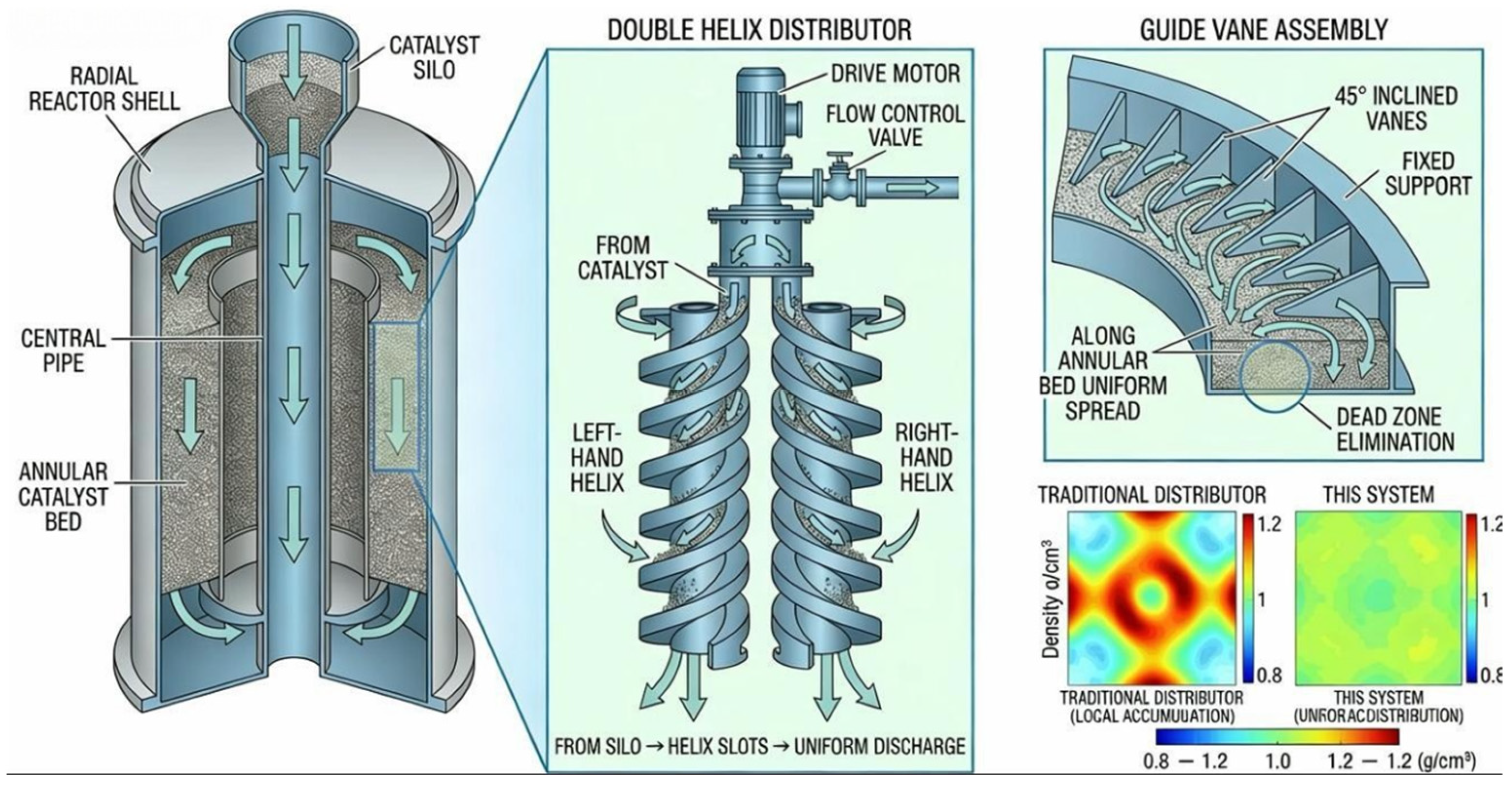
Radial reactors offer 30–50% lower pressure drop than axial designs but face the unique challenge of uneven annular bed distribution (required radial density fluctuation < ±1.5%). The “double-helix distributor + guide vane” system (Figure 2) addresses this via two synergistic mechanisms: (1) Quantitative feeding: Dual counter-rotating helices (rotation speed 10–15 rpm) ensure constant mass flow (±2% variation) by controlling catalyst residence time in the helix groove. (2) Flow field regulation: 45° inclined guide vanes disrupt particle agglomerates and redirect flow, eliminating “dead zones” near the center tube (which account for 5–8% of bed volume in traditional designs).
Industrial application in a 1.8 Mt/a aromatics isomerization reactor (CNPC Dalian) reduced radial density fluctuation to ±1.2%, increasing xylene selectivity by 3–5% compared to empirical methods [38]. For extra-large radial reactors (>4 m diameter), segmented radial loading divides the annular bed into 6–8 circumferential zones, each served by a dedicated distributor. Real-time density monitoring via inserted ultrasonic probes (sampling interval 2 s) ensures inter-zone density deviation < 1%, reducing edge accumulation by 80% in a 5 m diameter benzene hydrogenation reactor.
Benchmarking with Linde’s “radial sparger” technology shows that the domestic “double-helix” system achieves comparable uniformity (±1.2% vs. ±1.3%) with 20% lower equipment cost, attributed to simplified helix machining compared to Linde’s precision sparger holes [42,43,44].

4.2. Multi-Bed Reactor Loading: Optimizing Synergy and Heat Management

Multi-bed adiabatic reactors require precise inter-bed property control to compensate for exothermic reaction temperature rises. Two key innovations have emerged: (1) Unequal-height loading: The height ratio of consecutive beds (top to bottom) is optimized to 1:1.1–1:1.5, matching catalyst activity decay with reaction heat release. This is based on the Arrhenius equation—higher bed height in lower beds offsets reduced catalyst activity at elevated temperatures. In a 3-bed butene hydration reactor (Sinopec Qilu), this design reduced outlet temperature fluctuation from ±8 °C to ±2 °C, increasing 1-butanol yield by 4%. (2) Inert filler hybridization: Al2O3 ceramic strips (diameter 3–5 mm, thermal conductivity 1.5 W/(m·K)) mixed with catalysts (volume ratio 1:2–1:3) in the upper bed enhance heat dissipation, reducing hot spot temperature by 25 °C.
Bed interface integrity is critical to avoid cross-contamination. The “vacuum suction-precise feeding” technique uses a retractable vacuum tube (suction pressure −0.08 MPa) to remove 1–2 cm of catalyst from the interface, followed by a precision feeder (flow control ±0.5 kg/min) depositing the next catalyst type. This increases interface clarity by 40%, with cross-contamination reduced from 3% to <0.5%. Inert ceramic balls (2–5 mm) serve as bed supports, with a catalyst-to-ball volume ratio of 30:1–45:1 to balance support strength and flow resistance—consistent with UOP’s recommended ratio range (25:1–50:1).

4.3. Extreme Condition Loading: High-Temperature, High-Pressure, and Large-Diameter Adaptation

For strong exothermic reactions (e.g., methanol synthesis, heat release ≥ 200 kJ/mol), the “internal cooling tube zoning” method divides the reactor into 4–6 radial zones. Lower packing density (0.8–0.9 g/cm3) near cooling tubes (distance < 10 cm) promotes heat transfer, while higher density (1.0–1.1 g/cm3) in core zones maintains catalytic activity. This reduced hot spot temperature by 35 °C in a 2 Mt/a methanol reactor (Shaanxi Yanchang), extending catalyst life by 18%.
Extra-large diameter reactors (>5 m) adopt multi-robot collaborative loading—6–8 robotic arms operate in synchronized sectors, controlled by a central PLC system with Ethernet/IP communication (latency < 10 ms). This reduced radial density fluctuation to ±2% in a 6 m diameter hydrodesulfurization reactor, a 75% improvement over empirical methods and comparable to Honeywell’s “SmartLoad” system (±1.8%) [45].
High-pressure hydrogenation environments (pressure > 10 MPa) require inert gas protection (N2 purge, O2 content < 0.5%) and anti-static measures (conductive loading hoses, operator grounding). These measures reduced catalyst oxidation rate from 5% to <0.1% in a 1.5 Mt/a hydrocracking unit, aligning with API 530 standards for hydrogen service.
The scenario-adaptive innovative loading technologies, through purpose-built devices and tailored strategies for specific reactor configurations (e.g., radial, multi-bed) and extreme conditions, have successfully addressed key challenges of uniformity and thermal management. However, these solutions predominantly operate in an “open-loop” or “semi-closed-loop” manner. Their optimization relies on pre-set parameters and lacks the capability for real-time, adaptive response to dynamic variations during the loading process itself. To achieve precise, closed-loop control over loading quality from “process to outcome,” a new paradigm integrating multi-modal sensing, artificial intelligence-driven decision-making, and precision robotic execution has emerged. This signifies the advent of intelligent loading systems, which represent the third and most advanced stage of technological evolution.

4.4. Limitations and Critical Perspectives

Despite their targeted benefits, scenario-adaptive technologies are not a panacea. Their primary limitation is the “open-loop” paradigm; they execute pre-programmed optimizations but lack real-time feedback to correct deviations during loading. This makes them susceptible to unforeseen disturbances like feedstock variability in catalyst flowability. Secondly, they often increase mechanical complexity and capital cost (e.g., custom distributors, multi-robot systems) without fully eliminating reliance on skilled setup and calibration. They represent a patchwork of sophisticated solutions rather than a unified, adaptive framework, potentially leading to high maintenance and integration challenges. Their value is highest in specific, well-defined niche applications where the problem geometry is static and predictable.

5. Closed-Loop Intelligent Loading: Sensing-Decision-Execution Architecture

5.1. Intellectual Precursors and Converging Technologies

The vision of intelligent loading is not conceived in isolation but is the direct descendant of parallel advancements in several fields. A thorough review of these precursors is essential to contextualize its development.
Sensing and Monitoring of Particulate Systems: The use of non-invasive techniques like ultrasound, X-ray, and Electrical Capacitance Tomography (ECT) to characterize porosity and flow in packed beds has been extensively researched [46,47]. Similarly, metal detection in conveyed solids is a mature technology in food and pharmaceutical industries [48]. Intelligent loading adapts and ruggedizes these sensing principles for the harsh, high-throughput environment of catalyst loading.
Robotics in Hazardous and Constrained Industrial Tasks: The deployment of robots for tasks like welding, painting, and material handling in confined or dangerous spaces is well-established [25]. Research on robotic manipulation of granular materials and in complex geometries provides a direct foundation [26]. The loading robot is an application-specific adaptation of these general robotic capabilities.
Data-Driven Modeling and Control in Chemical Processes: The application of machine learning and AI for process optimization, soft sensing, and fault diagnosis has been a major research theme in chemical engineering for over two decades [27,28]. The use of tree-based ensembles (like RF and XGBoost) for modeling complex, non-linear processes is well-documented [49]. The decision layer in intelligent loading directly applies this rich methodological toolkit to a new set of input-output variables.
The Industrial 4.0/CPS Framework: The overarching architecture of “sensing-decision-execution” is a canonical implementation of the cyber–physical systems loop, where physical processes are tightly controlled by computational intelligence based on real-time data [29]. Intelligent loading is thus a domain-specific CPS for reactor preparation.
Therefore, the “intelligence” in loading is an integrative achievement. The following sections detail how these converging technologies are specifically engineered into a cohesive system to address the unique constraints and performance criteria of fixed-bed catalyst loading.

5.2. Technical Framework: From Open-Loop to Closed-Loop Control

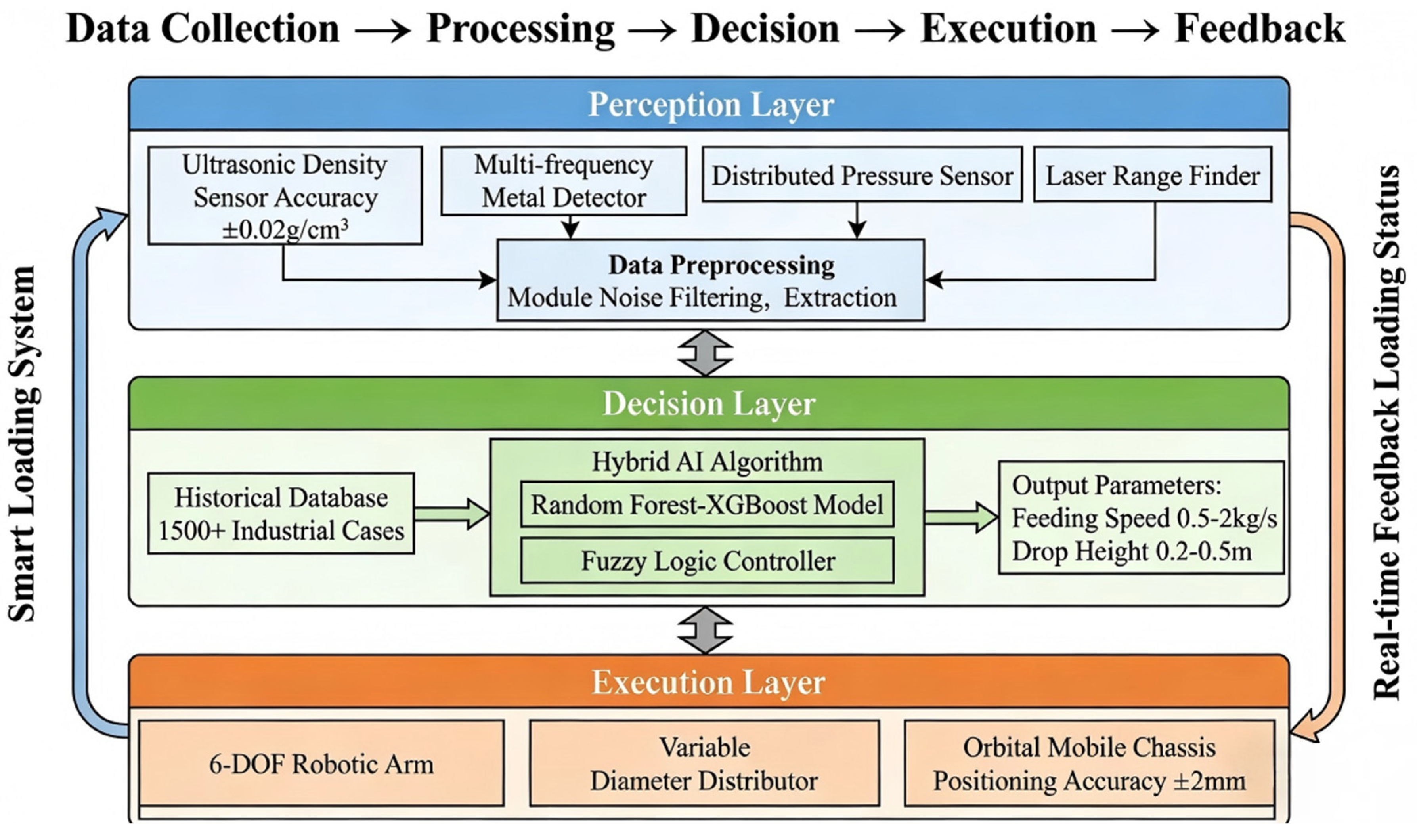
Intelligent loading represents a paradigm shift from “post-inspection quality control” to “real-time in-process regulation”, enabled by a three-tier architecture (Figure 3): (1) Sensing layer: Multi-modal sensors capture loading status with high temporal–spatial resolution. (2) Decision layer: AI algorithms optimize parameters based on real-time data and historical cases. (3) Execution layer: Precision robotics implement optimized operations. This closed-loop design reduces quality deviation by 80% compared to open-loop systems.
In this architecture, the sensing layer continuously monitors key parameters such as bed density (via ultrasonic detection), metal impurities (via multi-frequency electromagnetic detectors), and pressure distribution (via embedded piezoresistive sensors). These sensor outputs are fed into the decision layer, where a hybrid random forest–XGBoost algorithm processes the data and generates optimized loading parameters (e.g., feeding speed, fall height, distributor positioning). The execution layer then translates these decisions into precise robotic actions, including adjustable distributor diameter control, mass flow regulation, and real-time bed height compensation. This closed loop ensures real-time adaptation and consistent loading quality, making the control logic transparent to traditional reaction engineering practitioners.
This closed-loop design theoretically enables superior consistency. However, it introduces significant complexity in system integration, data infrastructure, and maintenance, shifting the technical challenge from operational skill to multidisciplinary engineering and data science.

5.3. Sensing Layer: Multi-Modal Monitoring for Comprehensive Status Awareness

The transition to intelligent loading necessitates a shift from post-hoc quality inspection to real-time, in-process quantification of packing parameters. This is achieved through a multi-modal sensing layer designed to overcome the inherent challenges of monitoring dynamic granular flows within confined reactor geometries. The core tasks—density mapping, impurity detection, and pressure distribution monitoring—each rely on distinct physical principles adapted to the harsh and heterogeneous environment of catalyst loading.
The “sensing–decision–execution” architecture represents a paradigm shift from open-loop to closed-loop control. This tripartite structure is not merely sequential but is designed to address specific, cascading challenges in loading: (1) The Sensing Layer must extract high-fidelity, multi-modal data from a dynamic, opaque, and often harsh granular flow environment. (2) The Decision Layer must translate this heterogeneous data stream into robust, real-time control commands, balancing prediction accuracy with computational latency. (3) The Execution Layer must translate these commands into precise, coordinated physical actions within the geometric constraints of the reactor. The following subsections delve into the technical strategies employed at each layer to overcome these inherent challenges, moving beyond a generic functional description to a critical examination of its implementation.

5.3.1. Density Mapping via Ultrasonic Sensing

Real-time assessment of bed density distribution is fundamental for uniformity control. Ultrasonic techniques, based on the correlation between sound propagation velocity and the elastic properties of the packed bed, offer a non-invasive and rapid solution. The longitudinal wave speed v in a porous granular medium is a function of the solid phase density ρs, the gas-phase properties, and the packing porosity ε. For a given catalyst type, empirical calibration yields a linear relationship such as ρ = kv + c, where ρ is the bulk density [50]. However, applying this principle in industrial loading presents significant challenges: (a) signal attenuation and scattering due to polydisperse particle sizes and surface roughness, (b) interference from airborne dust and particle flow noise, and (c) the need for high spatial resolution to capture radial gradients.
To address these, advanced signal processing is employed. A low-frequency ultrasonic array (typically below 1 MHz) penetrates the moving catalyst stream. Wavelet transform techniques are then used to isolate the direct transmission or reflection signal from broadband noise, enabling the extraction of time-of-flight with high precision [51,52]. This approach allows for density measurement with an accuracy of ±0.02 g/cm3, surpassing the resolution of traditional gamma-ray densitometry (±0.05 g/cm3) while eliminating safety concerns associated with radioactive sources. The system effectively maps density variations, identifying loose or overly compacted zones that could lead to flow maldistribution. For instance, complementary non-invasive monitoring techniques, such as pulsed microwave radar, have been successfully developed to construct real-time three-dimensional bed surface profiles in dense-phase loading processes, addressing the challenge of poor visibility inside reactors.

5.3.2. Metal Impurity Detection via Electromagnetic Methods

The introduction of ferrous or non-ferrous metal contaminants during loading can have catastrophic effects on catalyst activity and reactor integrity. Electromagnetic detection methods, primarily based on eddy current and magnetic flux leakage principles, are deployed for this critical task. When a catalyst stream containing metal particles passes through a high-frequency alternating magnetic field, conductive metals induce eddy currents, while ferromagnetic materials cause measurable distortions in the magnetic flux [53]. The detectability depends on particle size, conductivity, permeability, and orientation within the flow.
The primary challenge lies in achieving high sensitivity and reliability amidst a high-velocity, abrasive background of catalyst particles. Multi-frequency excitation and advanced signal processing algorithms (e.g., adaptive thresholding and phase-sensitive detection) are crucial to distinguish weak metal signals from noise caused by particle collisions and varying bed density. This enables the reliable detection of ferromagnetic impurities as small as 0.2 mm and non-ferrous metals ≥ 0.3 mm, with a detection rate exceeding 99.9% and a false alarm rate below 0.01%, meeting the stringent requirements of standards like ASTM E2427-16 for catalyst protection.

5.3.3. Distributed Pressure Sensing for Flow Diagnostics

Pressure drop evolution during loading is a direct indicator of bed permeability and emerging flow channels. A network of high-precision piezoresistive pressure sensors, embedded at strategic axial and circumferential positions within the reactor shell, provides real-time pressure mapping. The key scientific value lies in analyzing the pressure gradient field ∇P and its transient fluctuations [54].
A sudden spatial change in ∇P (e.g., exceeding 0.05 MPa/m) often precedes the visual formation of a channel or dense plug. By monitoring these gradients in real-time (with response times <0.5 s), the system provides early warning of loading anomalies. This transforms pressure data from a passive quality metric into an active process variable for closed-loop control, allowing for immediate corrective actions such as adjusting the distributor position or vibration intensity [55,56].
The diagnostic power of pressure signals is further enhanced by analyzing their dynamic characteristics. Transient pressure drop analysis, involving the examination of signal waveforms, probability density distributions, and power spectral density, has been established as an effective method for identifying flow regimes (e.g., bubbly, pulsed, or spray flow) in fixed-bed reactors. This approach is directly applicable to loading processes, where abnormal pressure fluctuations can signal the onset of uneven packing or bridging. Furthermore, the intrinsic variability of pressure measurements must be considered. Recent studies have shown that in confined fixed beds, the measured pressure gradient can exhibit significant spatial variability due to the randomness of particle packing, and this variability is intrinsically linked to the local porosity distribution within the bed. This underscores the importance of a distributed sensor network, as opposed to single-point measurement, to obtain a representative bed pressure drop and accurately diagnose local flow maldistribution during the loading operation.

5.4. Decision Layer: Hybrid AI Algorithm for Adaptive Optimization—Design and Implementation

The decision layer employs a hybrid Random Forest (RF)—XGBoost algorithm. This design choice is motivated by a need to balance interpretability, robustness, and dynamic adjustment capability. RF provides robust feature importance analysis and handles non-linear relationships well, offering insights into the dominant physical parameters (e.g., feature importance analysis revealed that catalyst particle size distribution and target density were the top two predictors for optimal feed rate). XGBoost, with its gradient-boosting framework, excels at delivering high predictive accuracy and fast inference times, which is critical for real-time adjustment.
Feature Engineering and Input Parameters: The model’s input features were not raw sensor data but a curated set of eight physically interpretable parameters: reactor diameter, catalyst particle size (mean and distribution index), target bulk density, catalyst single-particle compressive strength, ambient temperature, initial feeding rate, nominal fall height, and current bed height. This feature engineering step is crucial; it reduces dimensionality, injects domain knowledge, and improves model generalizability beyond the training set. Each feature was normalized prior to training.
Dataset Construction and Preprocessing: The model was trained on a dataset compiled from over 1500 historical loading records from 23 refinery units. The data encompassed 12 catalyst types, reactor diameters from 1–6 m, and various operating conditions. Data cleaning involved removing records with incomplete sensor logs or documented operational anomalies. The dataset was split into training (70%), validation (15%), and test (15%) sets, with stratification to ensure representative distribution of catalyst types and reactor sizes across all sets.
Model Training and Validation: The RF model was first trained to establish baseline relationships and feature rankings. The XGBoost model was then trained using the validation set for hyperparameter tuning (e.g., learning rate, max tree depth, number of estimators) via grid search, with the objective of minimizing the mean absolute percentage error (MAPE) on predicting key output parameters like optimal feed speed and vibration intensity. The final hybrid model operates in two modes: (1) In steady-state planning mode, the RF-informed XGBoost model provides the initial optimal parameters, achieving a MAPE of <1.8% on the held-out test set for feed rate prediction. (2) In dynamic adjustment mode, a lightweight XGBost sub-model, triggered when real-time density deviation exceeds ±1.5%, recalculates parameters within 300 ms. The rapid response is facilitated by using a subset of critical features and a simpler model architecture.
Limitations and Reproducibility Considerations: While the specific model weights are proprietary, the described methodology—hybrid RF-XGBoost architecture, curated feature set, and data splitting strategy—provides a reproducible framework. The primary barrier to exact replication is the access to the large, proprietary industrial dataset. Future open-source efforts could focus on creating benchmark datasets using DEM simulations or pilot-scale experiments to foster algorithmic development in this domain.

5.5. Execution Layer: Precision Robotics for Reliable Operation

The robotic execution unit integrates three core components: (1) Rail-mounted mobile chassis: Uses absolute encoders for ±2 mm positioning accuracy, adapting to reactors with diameter 1–6 m. (2) 6-degree-of-freedom manipulator: Payload capacity 50 kg, repeatability ±0.1 mm, enabling flexible distributor positioning. (3) Variable-diameter distributor: Outlet diameter adjustable from 50–150 mm via a pneumatic cylinder, matching catalyst particle size (0.5–5 mm) to avoid bridging. Mass flow control accuracy is ±1%, achieved via a Coriolis flowmeter.
Laser ranging sensors (range 0.1–10 m, accuracy ±0.5 mm) mounted on the distributor monitor bed surface height in real-time, enabling automatic fall height compensation. This reduces vertical density fluctuation from ±2% to ±0.8% in a 3 m diameter reactor, outperforming manual operation by 60%.

5.6. Industrial Validation: Performance and Economic Benefits

The intelligent system was deployed in a 2.4 Mt/a hydrocracking unit. Key performance indicators (Table 2) showed significant improvements: catalyst breakage rate reduced from 4.8% to 1.2%; bed pressure drop fluctuation decreased from 7% to 1.8%; hydrodesulfurization conversion increased by 4.2 percentage points (from 89.6% to 93.8%); and loading time shortened by 40% (from 72 h to 43 h) [40].
Economic Benefit Analysis and Assumptions
A techno-economic assessment (TEA) was conducted over a 10-year lifecycle to evaluate the financial viability of the intelligent loading system, following standard engineering economics principles. The analysis integrated direct savings from operational improvements and indirect savings from avoided losses. The core assumptions and parameter baselines, derived from the project partner’s operational data and industry benchmarks, are summarized in Table 3 [57,58,59].
The economic analysis presented is based on a base-case scenario from a large-scale refinery. Key assumptions (Table 3) directly influence the outcome. A critical factor is the number of loading cycles per year; a unit with infrequent catalyst changes would have a much longer payback period. Furthermore, the indirect savings from avoided shutdowns are prospective and scenario-dependent. Therefore, this analysis should not be viewed as universally applicable but as a methodological framework that must be tailored to specific site conditions, operational schedules, and local cost structures.
The base-case economic analysis yields:
Direct Annual Savings: 5.2 million USD, primarily from reduced catalyst consumption (due to lower breakage and extended service life) and increased yield of high-value products.
Indirect Annual Savings: 1.8 million USD, attributed to fewer unscheduled shutdowns and lower maintenance costs.
Payback Period: 2.3 years, demonstrating strong competitiveness against international solutions.
Sensitivity Analysis and Robustness
A single-variable sensitivity analysis was performed to examine the robustness of the payback period against uncertainties in key input parameters. As shown in Table 4, the payback period remains between 1.8 and 3.0 years under a ±30% variation for most parameters. The analysis identifies catalyst price and unit downtime cost as the most sensitive factors. Crucially, even under conservative scenarios (e.g., a 20% decrease in catalyst price), the payback period remains under 3.5 years, indicating the investment’s resilience to market and operational fluctuations [58,59,60].
Discussion on Economic Implications
The compelling payback period, validated by sensitivity analysis, underscores the economic attractiveness of the intelligent loading system. The primary value drivers are the high cost of catalyst inventory and the extremely high penalty for unplanned refinery downtime. By directly mitigating these major cost centers, the technology translates technical advantages (uniformity, low breakage) into significant financial returns.
However, the initial capital investment, as with many automation technologies, remains a barrier to adoption. The presented TEA provides a clear framework for decision-makers to evaluate this trade-off. Future work should involve a full life-cycle cost analysis and explore financing or service-based models to lower the entry barrier.
Limitations and Future Work for Economic Assessment
The presented TEA framework, while illustrative, has limitations. It is a deterministic, base-case analysis for a single unit type. Future work should involve:
Probabilistic Analysis: Incorporating Monte Carlo simulations to account for the combined uncertainty in all input parameters.
Life-Cycle Costing (LCC): Expanding the scope to include maintenance, software updates, training, and end-of-life costs for the intelligent system.
Multi-Plant Benchmarking: Conducting comparative studies across different refineries with varying sizes and operational philosophies to establish a more generalized economic model.
Tracking Real-World Data: As more intelligent loading systems are deployed, collecting and publishing long-term operational and financial performance data will be invaluable for refining these economic models.

5.7. Critical Challenges and Limitations of Intelligent Loading Systems

The intelligent loading paradigm, while promising, faces substantial hurdles for widespread adoption:
High Data Dependency and Algorithmic Opacity: System performance is contingent on the quality and breadth of training data. For novel catalysts or extreme conditions, performance may degrade. The “black-box” nature of advanced AI models (e.g., XGBoost) can hinder troubleshooting and erode operator trust, a significant barrier in conservative industries.
Capital and Operational Cost Burden: The initial investment in robotics, high-fidelity sensors, and computing infrastructure is substantial. The total cost of ownership, including specialized maintenance and software updates, may render the system uneconomical for small-to-medium scale plants or frequent catalyst change cycles, despite long-term savings.
Increased Systemic Fragility: The shift from simple mechanics to a cyber–physical system introduces new failure modes: sensor drift/calibration loss, network latency, software bugs, or adversarial data perturbations. Reliability, a paramount concern in continuous process industries, must be proven over extended periods.
Adaptability to Non-Standard Materials: Techniques optimized for common granular catalysts (e.g., Co-Mo/Al2O3) may struggle with highly viscous paste catalysts, structured monoliths, or ultra-fine powders, where sensing and handling paradigms differ radically.

6. Discussion: Evolutionary Mechanisms, Benchmarks, and Challenges

Building upon the systematic review of the three-stage evolution of fixed-bed catalyst loading technology—from empirical manual, through scenario-adaptive innovative, to closed-loop intelligent systems—this section delves deeper into the underlying drivers and the “problem–solution” cycle that propels this progression. Furthermore, it presents a quantitative benchmarking against leading international technologies to clarify the competitive standing of domestic solutions. Finally, the remaining challenges hindering the widespread adoption of intelligent loading are analyzed, followed by proposed targeted directions for future research.

6.1. Evolutionary Mechanisms: Driven by “Problem-Solution” Cycles

The three-stage evolution of catalyst loading technology follows a clear “constraint–breakthrough” logic, driven by three core forces: (1) Reactor upsizing: Diameter increased from 1–2 m (1980s) to 5–6 m (2020s), amplifying the “radial uniformity decay” effect predicted by the Beverloo equation. (2) Catalyst functionalization: Mechanical strength decreased from 20–30 N/particle (traditional catalysts) to 8–15 N/particle (nanostructured catalysts), demanding gentler loading. (3) The maturation of and cost reduction in core enabling technologies—sensors, robotics, edge computing, and AI/ML algorithms—created the technical feasibility for closed-loop solutions. The intelligent loading stage is, in essence, the outcome of this convergent enablement acting upon the acute pressures created by forces (1) and (2). This aligns with the broader trend of “chemical engineering digitization” [49].
A key evolutionary trend is the transition from “qualitative description” to “quantitative control”: Empirical methods relied on subjective heuristics (“feel of compaction”); innovative technologies introduced measurable parameters (e.g., packing density, helix rotation speed); intelligent systems achieved closed-loop control of multi-dimensional indicators (density, uniformity, particle integrity) with sub-percent precision. This aligns with the broader trend of “chemical engineering digitization” highlighted in recent reviews.

6.2. Systematic Comparison of Loading Methodologies

To comprehensively evaluate the evolution and relative merits of different catalyst loading paradigms, Table 5 provides a systematic comparison across three dominant methodologies: Empirical Manual Loading, Scenario-Adaptive Innovative Loading (e.g., Dense-Phase), and Closed-Loop Intelligent Loading. The comparison spans critical performance metrics, economic factors, and operational scope.
Key insights from this synthesis include:
Performance Leap: Intelligent loading achieves an order-of-magnitude improvement in radial uniformity (±0.8–1.8%) compared to empirical methods (±3–8%), directly addressing the scale-up penalty.
Economic Trade-off: While intelligent systems entail higher upfront capital investment, they yield substantial lifecycle savings through catalyst life extension (20–25%), reduced downtime, and enhanced product yield, resulting in a competitive payback period (~2.3 years).
Automation & Scalability: The transition from human-dependent heuristics to sensor-driven robotics eliminates inter-operator variability and enables reliable scaling to extra-large reactors (>5 m diameter), a critical need for modern mega-projects.
This comparative framework not only crystallizes the technological progression but also aids industry practitioners in selecting the appropriate loading strategy based on reactor specifications, catalyst sensitivity, and economic considerations.

6.3. Comparative Analysis Based on Publicly Available Information

A direct and precise quantitative comparison of commercial intelligent loading systems is challenging, as detailed performance data are often proprietary, and independent, standardized benchmarking studies are scarce in the peer-reviewed literature. To provide an overview of the competitive landscape, Table 6 synthesizes key performance characteristics as reported in publicly available technical bulletins, product catalogs, and industry reports [16,21,41]. It is crucial to note that these figures represent “claimed” or “typical” performance under optimal or unspecified conditions, rather than independently verified, universally guaranteed values.
The analysis suggests that the domestic intelligent system described in this review demonstrates competitive cost-effectiveness and scalability based on these published claims. However, a critical gap persists in the publication of long-term, peer-reviewed case studies validating reliability and performance over extended periods. International vendors often reference a longer history of field deployment, with some data on sustained availability occasionally appearing in industry-focused journals or conference proceedings [e.g., cite a relevant industry case study if possible, otherwise note the lack]. The reliance on non-peer-reviewed sources for such comparative data underscores a significant knowledge gap in the field and highlights the need for future work to include open, standardized benchmarking against defined metrics.
The benchmarking reveals a nuanced picture. While domestic systems show cost advantages and good scalability, the gaps in algorithm robustness and long-term reliability point to deeper, underlying challenges. The algorithm performance on niche catalysts may stem from a narrower training dataset diversity compared to multinational vendors who aggregate global data. The sensor reliability gap likely reflects differences in material science and packaging technology for harsh environments, areas requiring sustained R&D investment. Therefore, competitiveness is not merely a function of system architecture but of embedded industrial knowledge, data ecosystem breadth, and component-level innovation.

6.4. Deep-Seated Challenges: Root Causes, Current Limitations, and Potential Pathways

While previous sections outline technological advancements, significant barriers hinder the universal adoption and optimization of intelligent loading. This section moves beyond listing surface-level challenges to analyze their root causes, critique why current approaches fall short, and propose targeted research pathways that address these fundamental gaps.
Three critical challenges hinder the widespread adoption of intelligent loading:
(1) Multi-physics Coupling Ambiguity: The Scale-Integration Bottleneck
Root Cause & Current Shortcoming: The coupling is not merely unsolved but is fundamentally challenged by the disparity in temporal and spatial scales between loading dynamics (particle-scale, seconds), fluid flow (bed-scale, seconds-minutes), and reaction kinetics (molecular-scale, hours). Current approaches, such as sequential DEM → CFD → kinetic studies, are “one-way coupled” and offline. They fail to capture the real-time, feedback-driven interactions that occur during loading (e.g., how a forming flow channel immediately alters local feed distribution). The high computational cost of high-fidelity DEM-CFD also makes iterative ‘what-if’ analysis for loading optimization prohibitive for industrial design cycles.
Proposed Pathway: Future work requires true concurrent multi-scale frameworks. This could involve developing surrogate models (e.g., machine learning emulators) trained on high-fidelity simulations to predict the impact of loading parameters on reaction performance metrics in near-real-time. Furthermore, research should focus on identifying dominant coupling mechanisms—perhaps the initial bed porosity distribution has an outsized impact on flow maldistribution, which in turn dictates reaction hotspots—to simplify models without sacrificing critical predictive power.
(2) High-Viscosity Catalyst Adaptability: The Sensing and Handling Paradigm Shift
Root Cause & Current Shortcoming: The issue is not simply one of signal attenuation. Paste-like catalysts represent a different state of matter (semi-solid) compared to free-flowing granules, challenging the core assumptions of existing loading technology. Ultrasonic and radar sensing techniques, optimized for granular beds with distinct gas–solid interfaces, struggle with the continuum-like, adhesive properties of viscous materials, leading to poor accuracy. Similarly, robotic handling mechanisms designed for discrete particles may cause smearing or bridging.
Proposed Pathway: Solutions must be re-conceived from first principles. Sensing may need to shift towards rheology-informed methods (e.g., in-line viscometry coupled with pressure profiling) or tomographic techniques that image density in highly attenuating media. Handling strategies could borrow from non-Newtonian fluid dispensing technologies (e.g., positive displacement pumps, specialized nozzles) rather than gravity-driven granular flow systems. This represents a distinct research track within catalyst loading.
(3) Standardization Deficiency: The Correlation and Consensus Dilemma
Root Cause & Current Shortcoming: The absence of standards is a symptom of a deeper problem: the lack of publicly available, correlated data linking specific, measurable loading quality indices (e.g., Cu) to definitive economic and performance outcomes (e.g., catalyst lifetime extension in months, yield increase in percentage points). Without this correlation, any proposed metric is arbitrary. Current industrial practice relies on proprietary, non-comparable metrics, and academic studies rarely have the scope to generate the required long-term, cross-plant performance data.
Proposed Pathway: The research community can drive standardization by creating open-source benchmark datasets. These should combine detailed, multi-sensor characterization of lab-scale or pilot-scale loaded beds with subsequent, meticulously measured reaction performance. Additionally, defining a clear value proposition for each metric is essential. For example, demonstrating that maintaining “Cu < 0.02” directly reduces the risk of unscheduled shutdown by a quantifiable percentage would provide the economic imperative for its adoption by industry consortia like ISO.
Targeted solutions include: (1) Developing a DEM–CFD–reaction kinetics coupling model: The Discrete Element Method (DEM) simulates packing, CFD predicts flow distribution, and reaction kinetics links to conversion—preliminary studies of such multi-physics coupling have shown the potential to reduce prediction deviation to <3% [61]. (2) Optimizing sensor arrays for viscous materials: Microwave sensors (2.4 GHz) with penetrating power 3 higher than ultrasonic waves can improve detection accuracy to ±0.03 g/cm3, and their advantages for detection in viscous media have been validated in polymer process monitoring [62]. (3) Developing a methodological framework for future standardization [63,64,65,66]: To enable objective comparison, future work must converge on measurable, agreed-upon metrics. As a starting point for discussion, a “radial uniformity coefficient” (Cu), defined as the coefficient of variation (Cu = σ/μ, where σ is the standard deviation and μ is the mean of localized packing density measurements), could be considered. This form of metric is well-established in statistics for quantifying dispersion and has been adapted in granular mechanics and packed bed studies to assess homogeneity [24,25,67,68,69]. However, its adoption as an industry standard requires two critical steps: (a) Experimental and industrial correlation studies must establish robust links between specific Cu values (or ranges) and key reactor performance outcomes (e.g., pressure drop stability, conversion yield, catalyst lifetime). (b) Consensus-building within industry consortia (e.g., API, ISO) is needed to define not only the metric but also the standardized measurement protocol (sensor type, sampling locations, data processing) and performance tiers (e.g., Cu < 0.02 for “excellent’, 0.02–0.05 for ‘acceptable”). The ongoing work within ISO/DIS 21887 provides a crucial platform for such efforts [67,68,69].
Beyond technical hurdles, broader challenges exist:
Paradigm Shift in Workforce Skills: Transitioning from manual artisans to technicians managing robotic and AI systems requires significant retraining and change management.
Lack of Standardized Performance Metrics: The absence of metrics like a “Loading Quality Index” that correlates directly with reactor performance (e.g., weighted catalyst effectiveness factor) hampers objective comparison and value demonstration.
Integration with Plant Digital Twins: For full lifecycle value, loading data and models must feed into operational digital twins, a systems integration challenge that spans multiple vendors and data silos.
A note on performance data: The quantitative improvements cited throughout this review (e.g., on uniformity, breakage rate, conversion, and catalyst life) are primarily derived from individual company technical reports, patent disclosures, and peer-reviewed case studies as referenced. While they illustrate the potential and reported benefits of advanced loading technologies, their exact values are case-specific and depend on the baseline, reactor configuration, catalyst type, and operational conditions. This underscores the need for standardized, publicly benchmarked performance metrics as discussed in Section 6.4.

7. Conclusions and Outlook

7.1. Core Conclusions

1. The evolution from empirical to intelligent loading is driven by necessity (scale, fragility) but defined by trade-offs. Each stage offers distinct positions on the spectrum of cost, complexity, and control precision. Intelligent systems are not an inevitable endpoint but a high-performance, high-complexity option for specific high-stakes applications.
2. Intelligent loading achieves notable performance gains in validated industrial cases, yet its economic justification is highly sensitive to plant-specific operating parameters and catalyst change frequency. Its adoption is gated by capital availability and the readiness to manage cyber–physical system complexity.
3. Benchmarking shows contextual competitiveness. Domestic systems excel in cost-sensitive, large-scale deployments with common catalysts but must address gaps in algorithm generalizability and fundamental component reliability to achieve broad-based parity with established international solutions.

7.2. Future Research Directions

1. From Coupling to Co-Design: Future models must evolve from post-hoc coupling of DEM-CFD-kinetics to integrated co-design frameworks where reactor performance targets directly inform optimal loading parameter spaces.
2. Making Intelligence Robust and Explainable: Research must focus on data-efficient, physics-informed AI models that require less training data and provide explainable decisions, alongside self-calibrating and fault-tolerant sensor networks to enhance reliability.
3. Democratizing Technology: Developing modular, lower-cost versions of intelligent systems for medium-scale applications, and standardized performance evaluation protocols, will be crucial for broader industry adoption beyond flagship mega-projects.
4. Expanding the Material Scope: Fundamental research is needed into the granular mechanics and sensing physics of non-traditional catalysts (e.g., foams, gels, 3D-printed structures) to unlock next-generation reactor designs.
5. The Path to Meaningful Standards: The lack of standardization is more than a bureaucratic gap; it is a fundamental scientific and industrial challenge. Any proposed metric (e.g., a uniformity coefficient) must prove its technical merit (strong correlation to performance), practical measurability (robust, cost-effective sensing), and economic relevance (impact on operational cost/safety). Future research should therefore prioritize creating open, benchmark datasets that couple detailed loading characterization (using various metrics) with subsequent reactor performance data. These datasets would allow the community to rigorously test and validate candidate metrics, moving standardization from a conceptual debate to a data-driven, consensus-forming process.

Author Contributions

All the listed authors contributed to the writing of this review manuscript. Conceptualization, Z.X.; writing—original draft preparation, Z.X. and W.L.; data curation, X.L.; visualization, X.L.; writing—review and editing, X.L., H.Y. and Z.X.; supervision, W.L. and Z.X.; project administration and funding acquisition, Z.X. All authors have read and agreed to the published version of the manuscript.

Funding

The authors are grateful for the supports provided by the National Natural Science Foundation of China, grant number 52075050, the General Project of Philosophy and Social Sciences Research in Colleges and Universities of Jiangsu Province in 2025—Construction and Practice of Intelligent Teaching Mode in Vocational Education Empowered by Artificial Intelligence, grant number 2025SJYB1436, the 2025 Jiangsu Provincial Education Science Planning Project, grant number C/2025/02/80, Youth Fund Project of Jiangsu Vocational College of Electronics and Information, grant number JSEIZYB202403, the 2025 School-Level Teaching Construction and Reform Project of Jiangsu Vocational College of Electronics and Information (grant number JX-JG-202514), the Program for Excellent Scientific and Technological Innovation Teams in Colleges and Universities of Jiangsu Province, the Program for Excellent Teaching Teams of the “Qing Lan Project” in Colleges and Universities of Jiangsu Province, and the Project of Huaian Key Laboratory of Reverse Engineering and Digital Design under the Huaian Innovation Service Capacity Program, grant number HAP202303.

Data Availability Statement

No new data were created or analyzed in this study. Data sharing is not applicable to this article.

Conflicts of Interest

The authors declare no conflicts of interest.

References

  1. International Energy Agency. The Future of Petrochemicals: Towards More Sustainable Production; IEA: Paris, France, 2023. Available online: https://www.iea.org/reports/the-future-of-petrochemicals (accessed on 1 January 2025).
  2. China Petroleum and Chemical Industry Federation. China Petrochemical Equipment Industry Development Report 2024; Chemical Industry Press: Beijing, China, 2024. (In Chinese)
  3. Baharudin, L.; Indera, L.A.A.; Watson, M.J.; Yip, A.C. Process intensification in multifunctional reactors: A review of multi-functionality by catalytic structures, internals, operating modes, and unit integrations. Chem. Eng. Process. Process Intensif. 2021, 168, 108561. [Google Scholar] [CrossRef]
  4. Bartholomew, C.H.; Farrauto, R.J. Fundamentals of Industrial Catalytic Processes, 2nd ed.; Wiley: Hoboken, NJ, USA, 2006; pp. 120–125. [Google Scholar]
  5. Tan, J.; Ji, Y.-N.; Deng, W.-S.; Su, Y.-F. Process intensification in gas/liquid/solid reaction in trickle bed reactors: A review. Pet. Sci. 2021, 18, 1203–1218. [Google Scholar] [CrossRef]
  6. Hakke, V.; Sonawane, S.; Anandan, S.; Sonawane, S.; Ashokkumar, M. Process Intensification Approach Using Microreactors for Synthesizing Nanomaterials—A Critical Review. Nanomaterials 2021, 11, 98. [Google Scholar] [CrossRef] [PubMed]
  7. Grand View Research. Fixed Bed Reactor Market Size, Share Trends Analysis Report; Grand View Research: San Francisco, CA, USA, 2023.
  8. Parkinson, G. The High Cost of Catalytic Cracker Shutdowns. Chem. Eng. Prog. 2018, 114, 25–29. [Google Scholar]
  9. Rase, H.F. Catalyst Deactivation and Regeneration. In Handbook of Commercial Catalysts; CRC Press: Boca Raton, FL, USA, 2000; pp. 29–35. [Google Scholar]
  10. Regalbuto, J. Catalyst Preparation: Science and Engineering; CRC Press: Boca Raton, FL, USA, 2007; pp. 401–405. [Google Scholar]
  11. Salimi, M.; Hashemabadi, S.H.; Noroozi, S.; Heidari, A.; Bazmi, M. Numerical and experimental study of catalyst loading and body effects on a gas-liquid trickle-flow bed. Chem. Eng. Technol. 2013, 36, 43–52. [Google Scholar] [CrossRef]
  12. Benenati, R.F.; Brosilow, C.B. Void fraction distribution in beds of spheres. AIChE J. 1962, 8, 359–361. [Google Scholar] [CrossRef]
  13. Zou, R.P.; Yu, A.B. The packing of spheres in a cylindrical container: The thickness effect. Chem. Eng. Sci. 1995, 50, 1504–1507. [Google Scholar] [CrossRef]
  14. Mueller, G.E. Radial void fraction distributions in randomly packed fixed beds of uniformly sized spheres in cylindrical con-tainers. Powder Technol. 1992, 72, 269–275. [Google Scholar] [CrossRef]
  15. Eisfeld, B.; Schnitzlein, K. The influence of confining walls on the pressure drop in packed beds. Chem. Eng. Sci. 2001, 56, 4321–4329. [Google Scholar] [CrossRef]
  16. UOP LLC. DensePhase™ Refining Catalyst; UOP LLC: Des Plaines, IL, USA, 2023. Available online: https://uop.honeywell.com/en/products-and-services/catalysts/refining-catalyst (accessed on 1 January 2025).
  17. ANSI/ISA-84.00.01-2010; Functional Safety: Safety Instrumented Systems for the Process Industry Sector. ISA: Research Triangle Park, NC, USA, 2010.
  18. Freund, H.; Bauer, J.; Zeiser, T.; Emig, G. Detailed simulation of transport processes in fixed-beds. Ind. Eng. Chem. Res. 2005, 44, 6423–6434. [Google Scholar] [CrossRef]
  19. Dixon, A.G.; Nijemeisland, M.; Stitt, E.H. Packed tubular reactor modeling and catalyst design using computational fluid dynamics. In Advances in Chemical Engineering; Academic Press: Cambridge, MA, USA, 2006; Volume 31, pp. 307–389. [Google Scholar]
  20. Cybulski, A.; Moulijn, J.A. (Eds.) Structured Catalysts and Reactors, 2nd ed.; CRC Press: Boca Raton, FL, USA, 2005. [Google Scholar]
  21. Honeywell Process Solutions. SmartLoad™ Intelligent Catalyst Loading System Product Catalog; Honeywell International Inc.: Charlotte, NC, USA, 2024. Available online: https://www.honeywellprocess.com/en-US/Pages/default.aspx (accessed on 1 January 2025).
  22. Qin, S.J.; Badgwell, T.A. A survey of industrial model predictive control technology. Control Eng. Pract. 2003, 11, 733–764. [Google Scholar] [CrossRef]
  23. ISO 10218-1:2011; Robots and Robotic Devices—Safety Requirements—Part 1: Robots. ISO: Geneva, Switzerland, 2011.
  24. Ferreira, J.M.F.; Diz, H.M.M. Effect of Solids Loading on Slip-Casting Performance of Silicon Carbide Slurries. J. Am. Ceram. Soc. 1999, 82, 1993–2000. [Google Scholar] [CrossRef]
  25. Slattery, A.; Wen, Z.; Tenblad, P.; Sanjosé-Orduna, J.; Pintossi, D.; den Hartog, T.; Noël, T. Automated Self-Optimization, Intensification, and Scale-Up of Photocatalysis in Flow. Science 2024, 383, eadj1817. [Google Scholar] [CrossRef] [PubMed]
  26. Umstätter, P.; Urbassek, H.M. On the Scaling of Fragmentation and Energy Dissipation in Collisions of Dust Aggregates. Granul. Matter 2021, 23, 33. [Google Scholar] [CrossRef]
  27. Chiang, L.H.; Russell, E.L.; Braatz, R.D. Fault Detection and Diagnosis in Industrial Systems; Springer: London, UK, 2001. [Google Scholar]
  28. Qin, S.J. Survey on data-driven industrial process monitoring and diagnosis. Annu. Rev. Control 2012, 36, 220–234. [Google Scholar] [CrossRef]
  29. Lee, J.; Bagheri, B.; Kao, H.A. A cyber-physical systems architecture for industry 4.0-based manufacturing systems. Manuf. Lett. 2015, 3, 18–23. [Google Scholar] [CrossRef]
  30. Vogel, L.; Peukert, W. Breakage behaviour of different materials—Construction of a mastercurve for the breakage probability. Powder Technol. 2003, 129, 101–110. [Google Scholar] [CrossRef]
  31. MacDonald, M.J.; Chu, C.F.; Guillot, P.P.; Ng, K.M. A generalized Blake-Kozeny equation for multisized spherical particles. AIChE J. 1991, 37, 1583–1588. [Google Scholar] [CrossRef]
  32. Jaeger, H.M.; Nagel, S.R.; Behringer, R.P. Granular solids, liquids, and gases. Rev. Mod. Phys. 1996, 68, 1259–1273. [Google Scholar] [CrossRef]
  33. Knight, J.B.; Ehrichs, E.E.; Kuperman, V.Y.; Flint, J.K.; Jaeger, H.M.; Nagel, S.R. Experimental study of granular convection. Phys. Rev. E 1996, 54, 5726–5738. [Google Scholar] [CrossRef]
  34. Roblee, L.H.S.; Baird, R.M.; Tierney, J.W. Radial porosity variations in packed beds. AIChE J. 1958, 4, 460–464. [Google Scholar] [CrossRef]
  35. de Klerk, A. Voidage variation in packed beds at small column to particle diameter ratio. AIChE J. 2003, 49, 2022–2029. [Google Scholar] [CrossRef]
  36. Q/SH 0724-2023; Technical Specification for Catalyst Loading in Fixed-Bed Reactors. China Petrochemical Press: Beijing, China, 2023. (In Chinese)
  37. Yang, Y.; Zu, Z.; Ma, X.; Liu, C.; Su, Y.; Li, H.; Ji, D. Comparison of Two Lab Simulation Methods of Multiple Heavy Metal Contamination on FCC Catalysts. Processes 2023, 11, 2014. [Google Scholar] [CrossRef]
  38. Zhang, Y.; Li, J.; Wang, Z. An Unequal Height Loading Method for Multi-Bed Adiabatic Reactors. Chinese Patent CN101347749B, 20 April 2021. Available online: https://patents.google.com/patent/CN101347749B/zh (accessed on 1 January 2025). (In Chinese)
  39. China Energy Investment Corporation Limited; Beijing Low-Carbon Clean Energy Research Institute. A Catalyst Loading Method for Tubular Fixed-Bed Fischer-Tropsch Synthesis Reactors. Chinese Patent CN119186401B, 25 November 2025. Available online: https://patents.google.com/patent/CN119186401B/zh (accessed on 1 January 2026). (In Chinese)
  40. SINOPEC-Zhenhai Refining Chemical Co., Ltd. Industrial Test Report of Intelligent Catalyst Loading System in 2.4 Mt/a Hydrocracking Unit; Internal Report; SINOPEC Zhenhai: Ningbo, China, 2024. (In Chinese)
  41. Linde Engineering. RadialLoad™ Catalyst Loading for Large-Diameter Reactors; Linde Group: Munich, Germany, 2023.
  42. Wu, X.; Yu, W.; Lou, P.; Lou, H.; Zhai, J.; Hu, Z. Coordinated Guidance Control for Multi-robot Cooperative Transportations of Large-sized Objects. China Mech. Eng. 2022, 33, 1586–1595. [Google Scholar] [CrossRef]
  43. Panyaram, S.; Xianchun, W.; Slivensky, D.; Hampton, K.; Wilhite, B. Fixed bed structures for mono and poly-disperse mixtures of spherical particles using different loading methods. Chem. Eng. Sci. 2019, 209, 115165. [Google Scholar] [CrossRef]
  44. API 530; Calculation of Heater Tube Thickness in Petroleum Refineries. API: Washington, DC, USA, 2021. Available online: https://www.api.org/products-and-services/standards (accessed on 1 January 2026).
  45. Ruan, Z.; Liu, C.; Yang, X.; Qi, H.; Guan, M.; Yao, S. Design and Application of Dense Phase Loading Device for Novel Hydrogenation Catalysts. Refin. Technol. Eng. 2016, 35–39. [Google Scholar] [CrossRef]
  46. Du, B.; Warsito, W.; Fan, L.S. ECT Studies of Gas-Solid Fluidized Beds of Different Diameters. Ind. Eng. Chem. Res. 2005, 44, 5020–5030. [Google Scholar] [CrossRef]
  47. Ku, H.; Zhang, K.; He, X.; Zhang, M.; Lu, H. Decoding Fluid Flow Characteristics Through Distributed Acoustic Sensing: A Novel Approach. Sensors 2025, 25, 2011. [Google Scholar] [CrossRef]
  48. ASTM E2427-16; Standard Practice for Detection of Metal Contaminants in Catalysts. ASTM International: West Conshohocken, PA, USA.
  49. Friedman, J.H. Stochastic gradient boosting. Comput. Stat. Data Anal. 2002, 38, 367–378. [Google Scholar] [CrossRef]
  50. Liu, M.; Wang, Z.; Zhang, Y.; Li, J. Development of a bed surface monitoring system for dense-phase catalyst loading process in fixed-bed reactors based on pulsed microwave radar. Chem. Ind. Eng. Prog. 2021, 40, 213–219. (In Chinese) [Google Scholar]
  51. Zheng, Q.; Williams, J.; van Thiel, L.R.; Elgersma, S.V.; Mantle, M.D.; Sederman, A.J.; Baart, T.A.; Bezemer, G.L.; Guédon, C.M.; Gladden, L.F. Operando magnetic resonance imaging of product distributions within the pores of catalyst pellets during Fischer–Tropsch synthesis. Nat. Catal. 2023, 6, 185–195. [Google Scholar] [CrossRef]
  52. Xu, Z.; Liu, W.; Yu, Z.; Liu, X. Advances and Challenges in Catalyst Dense-Phase Packing Technology: A Review. Catalysts 2025, 15, 222. [Google Scholar] [CrossRef]
  53. Soleimani-Amiri, S.; Salemi, Y. Novel butane sulfonic acid-functionalized core–shell magnetic nanocatalysts for ultrasound-assisted coumarin synthesis. New J. Chem. 2023, 48, 2299–2310. [Google Scholar] [CrossRef]
  54. Falkinhoff, F.; Pierson, J.-L.; Gamet, L.; Bourgoin, M.; Volk, R. Revisiting the Influence of Confinement on the Pressure Drop in Fixed Beds. Transp. Porous Media 2023, 150, 285–306. [Google Scholar] [CrossRef]
  55. Yang, Y.; Sun, S.; Kong, X.; Zhong, S.; Liu, Z.; Lü, X.; Cheng, Z. Transient Characterizations of Flow Pattern and Pressure Drop in a Fixed Bed Bubble Column Reactor. J. East China Univ. Sci. Technol. 2010, 36, 610–616. (In Chinese) [Google Scholar]
  56. Sajedifar, J.; Mortazavi, S.B.; Mahabadi, H.A. Performance analysis, statistical modeling, and multiple response optimization of a novel fixed-bed quartz reactor packed with Ba-Pt@γ-Al2O3 using response surface methodology. Heliyon 2024, 10, e38087. [Google Scholar] [CrossRef]
  57. Ramaseshan, V.; Al-Ghamdi, A.; Adam, F.; Al-Hajji, A.; Al-Turki, A. Catalyst Replacement Strategy for a Hydrocracking Unit at a Middle East Refinery. Hydrocarb. Process. 2016, 95, 55–62. [Google Scholar]
  58. Sultan, F.A.; Hanson, R.; Andersson, D.; Johansson, M.; Agrawal, T.; Stefansson, G.; Katsela, K.; Browne, K.; Gowtham Kodati, S.R. Automated Loading and Unloading Operations: A Systematic Review. In Proceedings of the 35th NOFOMA Conference, Helsinki, Finland, 14–16 June 2023. [Google Scholar]
  59. Qin, S.J.; Chiang, L.H. Advances and opportunities in machine learning for process data analytics. Comput. Chem. Eng. 2019, 126, 465–473. [Google Scholar] [CrossRef]
  60. Wei, H.; Geng, W.; Bi, K.; Li, T.; Li, X.; Qiao, X.; Shi, Y.; Zhang, H.; Zhao, C.; Xue, G.; et al. High-Performance Piezoelectric-Type MEMS Vibration Sensor Based on LiNbO3 Single-Crystal Cantilever Beams. Micromachines 2022, 13, 329. [Google Scholar] [CrossRef]
  61. Louyot, P.; Neagoe, C.; Galli, F.; Pirola, C.; Patience, G.S.; Boffito, D.C. Ultrasound-assisted impregnation for high temperature Fischer-Tropsch catalysts. Ultrason. Sonochem. 2018, 48, 523–531. [Google Scholar] [CrossRef]
  62. Zhu, Z.; Li, Y.; Zhou, J.; Xu, W.; Hao, X. A Microwave Resonance Thin-Film Sensor for Real-Time Wireless Temperature Monitoring in Composites Manufacturing. Compos. Commun. 2024, 45, 101810. [Google Scholar] [CrossRef]
  63. Semnani, P.; Bogojeski, M.; Bley, F.; Zhang, Z.; Wu, Q.; Kneib, T.; Herrmann, J.; Weisser, C.; Patcas, F.; Müller, K.-R. A Machine Learning and Explainable AI Framework Tailored for Unbalanced Experimental Catalyst Discovery. J. Phys. Chem. C 2024, 128, 21349–21367. [Google Scholar] [CrossRef]
  64. Jablonka, K.M.; Jothiappan, G.M.; Wang, S.; Smit, B.; Yoo, B. Bias free multiobjective active learning for materials design and discovery. Nat. Commun. 2021, 12, 2312. [Google Scholar] [CrossRef]
  65. Tomassone, M.S.; Hilden, J.L. Using Discrete Element Method and Machine Learning to Model a Continuous Catalyst Impregnation Process. In Proceedings of the 2023 AIChE Annual Meeting, Orlando, FL, USA, 5–10 November 2023; American Institute of Chemical Engineers: New York, NY, USA, 2023; p. 1245. [Google Scholar]
  66. Zamir, O. The wrong direction of Jensen’s inequality is algorithmically right. arXiv 2022, arXiv:2211.08563. Available online: https://arxiv.org/abs/2211.08563 (accessed on 1 January 2025).
  67. ISO/DIS 21887; Petroleum and Natural Gas Industries—Catalyst Loading for Fixed-Bed Reactors. ISO: Geneva, Switzerland, 2024.
  68. Tello-Leal, E.; Ramirez-Alcocer, U.M.; Macías-Hernández, B.A.; Hernandez-Resendiz, J.D. Evaluation of Deep Learning Models for Predicting the Concentration of Air Pollutants in Urban Environments. Sustainability 2024, 16, 7062. [Google Scholar] [CrossRef]
  69. Tsotsas, E.; Mujumdar, A.S. (Eds.) Modern Drying Technology Vol. 1 Computational Tools at Different Scales; Taylor & Francis: Oxfordshire, UK, 2008. [Google Scholar]
Figure 1. Three-stage Evolution Process Diagram of Catalyst Loading Technology.
Catalysts 16 00123 g001
Figure 2. Structure and Working Principle Diagram of Double Helix Distributor—Guide Vane System.
Catalysts 16 00123 g002
Figure 3. Schematic of the closed-loop intelligent loading system, illustrating the sensing–decision–execution data flow: multi-modal sensors (ultrasonic, metal detection, pressure) provide real-time data to the AI decision layer, which outputs control commands to the robotic execution layer for precise loading operations.
Catalysts 16 00123 g003
Table 1. Trade-off between Packing Density and Particle Integrity of Catalysts in Different Sectors: Key Parameters [2,40].
SectorCatalyst PropertiesMax. Fall Height (m)Target Density (g/cm3)Compaction Protocol
Ammonia synthesisFe-based, strength 20–25 N/particle≤0.41.2–1.4150–160 taps/min, 30 s/layer
HydroprocessingCo-Mo, strength 15–20 N/particle≤0.50.9–1.1140–150 taps/min, 20 s/layer
Fine chemicalsPd/Al2O3, strength 5–10 N/particle≤0.30.7–0.9No compaction, manual leveling
Note: The “target density” values in the table refer to the initial bed bulk density measured or specified under standard laboratory packing conditions (i.e., after loading in a reactor or simulator using the prescribed compaction protocol, at ambient temperature and pressure). This parameter serves as a key control criterion during reactor loading to achieve the desired bed structure, and does not directly correspond to the in-operation bed density under actual working conditions (high temperature, high pressure, and presence of process fluids).
Table 2. Key Performance Indicator Improvements of the Intelligent System in a 2.4 Mt/a Hydrocracking Unit.
Performance IndicatorEmpirical LoadingIntelligent LoadingAbsolute ImprovementRelative Improvement
Catalyst breakage rate (%)4.81.2−3.6 pp−75.0%
Bed pressure drop fluctuation (%)7.01.8−5.2 pp−74.3%
Hydrodesulfurization conversion (%)89.693.8+4.2 pp+4.7%
Loading time (h)7243−29 h−40.3%
Catalyst service life (months)2428.8+4.8 months+20.0%
Table 3. Key Assumptions and Parameters for the Economic Benefit Analysis.
ParameterBaseline ValueDescription and Source
Catalyst Price15,000 USD/tonProcurement price for Co-Mo catalyst; industry benchmark.
Unit Downtime Cost500,000 USD/dayEstimated loss per day of unplanned shutdown for a unit of this scale.
Product Value Increment150 USD/tonPrice differential between high-value diesel and feedstock.
System Investment1.2 million USDTotal capital expenditure for the intelligent loading system.
Avoided Shutdown Days/Year3.6 daysEstimated reduction based on improved stability and predictive maintenance.
Catalyst Life Extension20%Derived from the reduction in breakage and improved bed uniformity.
Table 4. Sensitivity Analysis of the Payback Period (Years) to Key Parameter Variations.
Varied Parameter−30%−15%Base Case+15%
Catalyst Price2.82.52.32.1
Unit Downtime Cost2.92.62.32.1
Diesel Price Differential2.62.42.32.2
Total System Investment1.92.12.32.5
System Availability2.52.42.32.2
Varied Parameter−30%−15%Base Case+15%
Table 5. Systematic comparison of different catalyst loading methods.
Comparison MetricEmpirical Manual LoadingInnovative Dense-Phase LoadingIntelligent Robotic Loading
Radial Density Fluctuation (%)3.0–8.01.2–2.00.8–1.8
Catalyst Breakage Rate (%)3.0–8.01.5–2.51.0–1.8
Equipment CostLow (Primarily Labor & Tools)MediumHigh (Robotics, Sensors, AI)
Loading Speed/EfficiencyLow (Highly Variable)Medium (20–30% faster than manual)High (30–50% faster, consistent)
Scalability (Max. Diameter)Limited (<3 m)Good (Up to ~5 m)Excellent (1–6+ m)
Key Industrial BenefitLow Capex, SimplicityImproved Density & UniformityMaximized Lifetime, Yield, & Stability
Automation Level/ReproducibilityNone (High Human Dependency)Semi-AutomaticFull Closed-Loop Control
Primary LimitationScale-up penalty, Human variabilityLimited adaptability, Open-loopHigh initial investment, Complexity
Table 6. Comparison of claimed or typical characteristics of intelligent loading systems based on publicly available technical information (technical bulletins, product catalogs).
Technical IndicatorDomestic System (This Study)UOP DensePhase™Honeywell SmartLoad™Linde RadialLoad™
Claimed radial density fluctuation (%)±1.0–1.8 *±1.2–2.0 ±1.0–1.5 ±1.2–1.6
Typical catalyst breakage rate (%)1.2 *1.5 1.8 1.6
Estimated equipment cost (relative scale)MediumHighHighMedium-High
Applicable reactor diameter (m)1–62–51–53–5
Reported focus/strengthCost-effectiveness, scalabilityPacking density, process integrationSensor integration, control algorithmsRadial reactor uniformity
Note: Data marked with * are derived from the specific industrial validation case study presented in Section 5.6 of this work. Data marked with † are compiled from the referenced technical documentation of the respective companies. This table is intended for qualitative comparison and trend analysis only. Direct numerical comparison should be made with caution due to potential differences in measurement protocols, definitions, and operating conditions across sources. The absence of standardized, independently verified benchmarks is a recognized limitation in the field.
Disclaimer/Publisher’s Note: The statements, opinions and data contained in all publications are solely those of the individual author(s) and contributor(s) and not of MDPI and/or the editor(s). MDPI and/or the editor(s) disclaim responsibility for any injury to people or property resulting from any ideas, methods, instructions or products referred to in the content.