Review

Progress in Metal Oxide Catalysts for Carbon Monoxide Oxidation

1
School of Energy and Environmental Engineering, University of Science and Technology Beijing, Beijing 100083, China
2
State Key Laboratory of Advanced Metallurgy, University of Science and Technology Beijing, Beijing 100083, China
*
Author to whom correspondence should be addressed.
Catalysts 2026, 16(1), 7; https://doi.org/10.3390/catal16010007
Submission received: 5 November 2025 / Revised: 11 December 2025 / Accepted: 18 December 2025 / Published: 22 December 2025
(This article belongs to the Section Catalytic Materials)

Abstract

As one of the most intensively researched reaction systems in the field of multiphase catalysis, the technological breakthrough of CO oxidation is of great significance in addressing the health hazards and environmental pollution caused by high CO concentrations. Catalytic oxidation technology has become a core means of eliminating CO pollution due to its high efficiency and energy saving. This paper provides an in-depth analysis of various types of metal-catalyzed CO oxidation reactions and explores in detail the characteristics of the action of different mechanisms. On this basis, optimization strategies are proposed, including metal doping and controllable oxygen vacancy construction to enhance reaction selectivity and stability. In addition, the influence mechanisms of common gas components such as H2O and SO2 on the catalytic reaction of CO are analyzed, and targeted optimization strategies are proposed. The reaction mechanisms of CO on the metal catalyst surface are then examined. Finally, the development direction of catalysts in the field of CO deep purification is prospectively discussed, which provides theoretical support and technical routes for the construction of an efficient and stable industrialized CO oxidation system.

1. Introduction

Carbon monoxide is a colorless, odorless, flammable and toxic gas that can quickly combine with hemoglobin to form carboxyhemoglobin, thus causing hemoglobin to lose its oxygen-carrying capacity and resulting in hypoxia in human tissues, which is regarded as the “silent killer” [1]. Due to its abundance in the atmosphere, carbon monoxide is listed as one of the six main monitoring factors in the Air Quality Index in China [2]. Specifically, CO emissions primarily originate from two major sources: firstly, the transport sector, particularly motor vehicle exhaust emissions, which constitute the most direct and significant source of CO in urban environments; secondly, industrial production processes, including steelmaking, ironmaking, coke oven operations, and solid waste incineration [3]. Currently, common removal techniques for CO packages are adsorption [4], catalytic [5] and electrochemical [6]. It is widely recognized that thermal catalytic oxidation of CO is among the most effective methods of CO purification. This technology achieves effective CO removal by converting CO to CO2 under relatively mild reaction conditions using a catalyst [7].
There has been a significant increase in research and development focused on catalysts for the catalytic oxidation of CO. The most prevalent catalysts for CO oxidation are noble metals, such as Au [8], Pd [9], Pt [10], Ru [11], and Ag [12], as well as non-precious metals, such as Mn [13], Co [14], Fe [15], Cu [16], Zr [17] and Ce [18], etc. Among them, the noble metal catalysts showed higher adsorption capacity for CO, in contrast to the non-precious metal catalysts, which were limited by smaller atomic size and weaker electron trapping ability, and their surface electronic structures were more inclined to catalytic activation reactions with O2 molecules. Nonetheless, it is important to acknowledge that, in spite of the substantial advancements witnessed in this domain, there persists a dearth of systematic comparative studies that explore the conformational relationships exhibited by disparate metal systems. Firstly, the mechanism of the CO-catalyzed reaction remains to be fully elucidated. Secondly, the modulation of the catalytic properties is influenced by a multitude of parameters, including the size effect on the nanoparticles, oxygen vacancies (OV), strong metal–support interactions (SMSI), and reducibility, which are still subjects of debate. The design of CO catalysts necessitates the exploration of intrinsic and extrinsic characteristics, as well as dynamic synergistic interactions among catalyst components.
Based on an extensive review of the literature, this paper provides a comprehensive analysis of noble metal catalysts—highlighting their exceptional low-temperature activity, size-dependent effects, and support-mediated synergies—as well as non-noble metal systems, emphasizing their cost efficiency, redox properties, and regulatory roles when used as supports. It systematically evaluates the dual impacts of H2O and SO2 on CO oxidation performance and elaborates the underlying reaction mechanisms. In response to key challenges in the field, such as the scarcity of precious metals, their susceptibility to poisoning, the limited activity of non-noble metals, and the complexity of reaction pathways, this study proposes forward-looking strategies. These include the development of low-cost single-atom and cluster catalysts, the optimization of non-noble metal composite systems, and the design of bifunctional hydrophobic and sulfur-resistant protective layers to isolate toxic species. By integrating theoretical insight with practical design, this work lays a solid foundation for constructing highly efficient, stable, and environmentally benign industrial CO oxidation systems.

2. Typical Precious Metal Catalysts

In the process of CO oxidation, noble metal catalysts have been shown to possess exceptional CO adsorption capacity. This phenomenon can be attributed to the unique d-electron orbital properties of the catalysts, which serve to significantly reduce the activation energy barrier of the CO*→OOCO* conversion process. This reduction in energy barrier is achieved through the formation of stable carbonyl intermediates with the reactant molecules. The result of this process is a significant enhancement in catalytic activity and an improvement in reaction stability [19]. However, its high cost and limited resources have hindered its large-scale industrial application. At present, platinum group metals (Pt, Pd, Ru) and other noble metals (Au, Ag)-based loaded catalysts predominate in the industrial system. Their surface electronic structure tunability and anti-sintering properties provide important regulatory dimensions for optimizing catalytic performance.

2.1. Pt-Based Catalysts

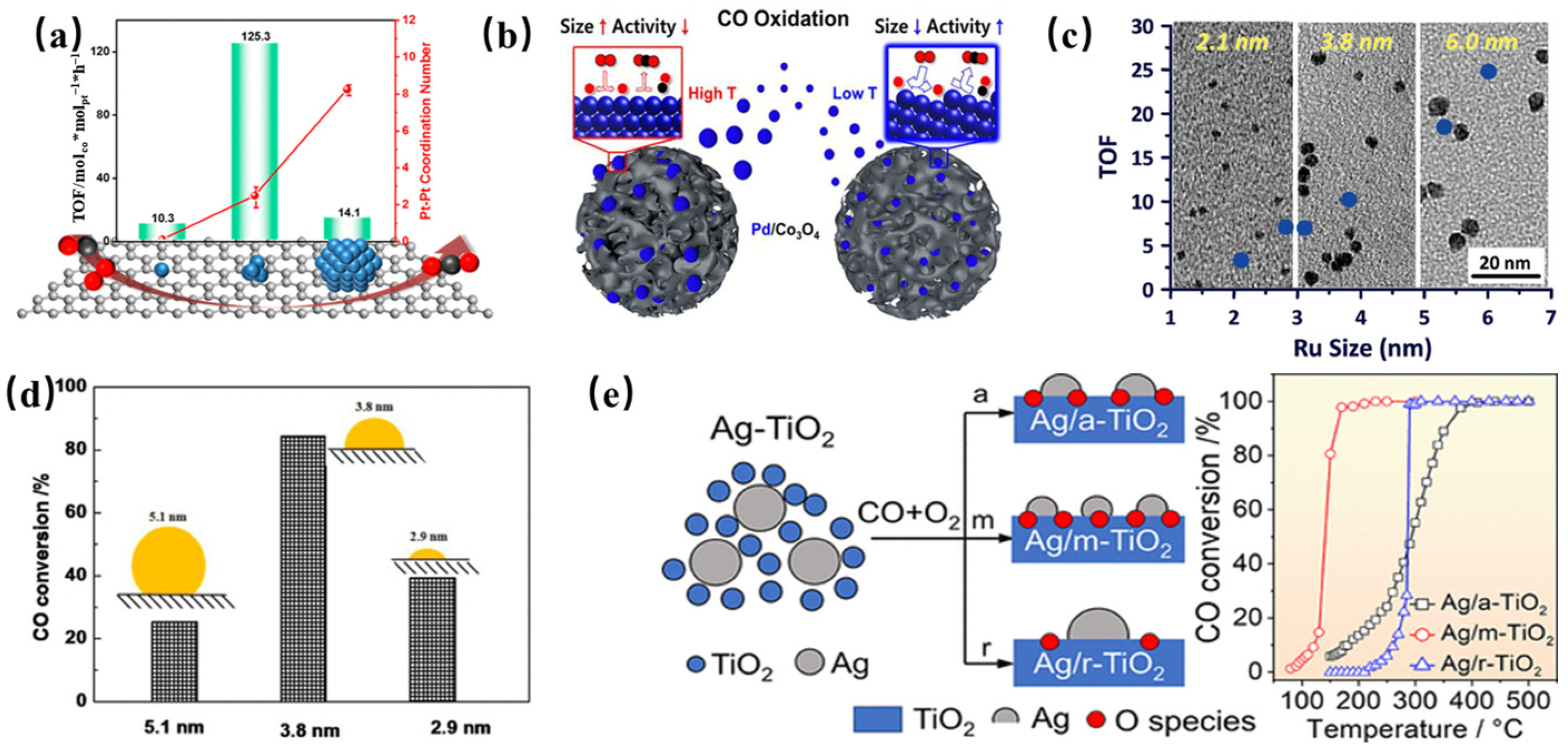
Platinum, recognized for its extensive research in the domain of precious metal catalysts, has garnered considerable scholarly attention in the context of CO oxidation reactions. The catalytic activity is affected by factors such as nanoparticle size and carrier type. Boubnov et al. [20] prepared a series of Pt/Al2O3 catalysts with Pt particle sizes ranging from 1 to 10 nm and found that those with sizes of 2–3 nm exhibited the highest activity. The Pt particles of these catalysts possessed a significant number of low-coordinated, highly active surface Pt atoms, which resulted in a substantial enhancement in the efficiency of the CO oxidation reaction. This finding corroborates Kim et al.’s [21] study in the Pt/TiO2 system, where small-sized Pt particles provide more active sites, thus increasing the probability of adsorption and reaction of the reactants and improving the reaction rate. As shown in Figure 1a. Jia et al. [22] prepared different morphologies of Pt species on ND@G composite carriers, including single atoms (Pt1), fully exposed clusters (Ptn) and nanoparticles (Ptp). It was found that the fully exposed Pt cluster catalyst (0.5 wt% Ptn/ND@G) exhibited excellent activity in low-temperature CO oxidation and that the fully exposed Pt clusters consisted of several Pt atoms, which provided multiple active sites and favored the co-adsorption and reaction of CO and O2. The attenuated CO adsorption and enhanced O2 dissociative adsorption compared to Pt nanoparticles help to reduce the CO poisoning phenomenon and make it easier for the active sites to adsorb O2, thus enhancing the catalytic activity.
The nature of the oxide carrier is found to be a critical factor in the catalytic reaction of highly dispersed precious metal catalysts. In the context of a given particle size, the carrier effect is typically explained through the concept of a reaction occurring at the metal/oxide interface or through the process of reactant spillover onto or from the oxide support [23]. Qiao et al. [24] loaded Pt onto Fe(OH)x using co-precipitation and found that the mixed carrier of Fe(OH)x and Fe3O4 contained a large number of OH groups. The function of these groups is hypothesized to be significant in the processes of adsorption and activation of O2, thereby enhancing the efficiency of CO oxidation. Bae et al. [25] loaded Pt onto SnO2, SiO2, and Sb-SnO2 carriers by means of wet impregnation. The Pt/Sb-SnO2 catalysts exhibited optimal activity and durability in CO oxidation. This phenomenon was attributed to the fact that Pt doping altered the nature of the oxygen on the surface of the Sb-SnO2, thereby facilitating the transfer of oxygen and reducing the formation of surface carbonates. The integration of heterogeneous metal elements has been demonstrated to induce electron transfer and strain effects between metals. These effects have the potential to modify the surface electronic structure of the catalyst and consequently alter the CO binding strength [26]. Lee et al. [27] deposited MnOx on Pt/Al2O3 catalysts by atomic layer deposition technique, and the introduction of Mn inhibited the sintering of Pt particles at 1073 K and enhanced the catalytic activity through the formation of Pt-MnOx interface. MnOx participates in the surface reaction by releasing lattice oxygen (Olatt), which induces the CO oxidation pathway of the Pt catalytic site to shift from the L-H mechanism to the Mars–van Krevelen (MvK) mechanism, and its CO oxidation rate is increased by 3–4 times compared with that of unmodified Pt/Al2O3. Wang et al. [28], to solve the problem of insufficient activity of Pt2+ species due to overstabilization by CeO2, proposed a strategy to regulate the local environment of Pt by introducing W additive. The high electronegativity of W promotes electron transfer from Pt to W, weakens the strong interaction between Pt and CeO2, lowers the energy barrier for the reduction of Pt2+ to active Pt0, and W induces the formation of low-oxygen vacancies in the active sites on the surface of CeO2, which promotes interfacial oxygen activation.
Surface oxygen vacancies have been identified as playing a pivotal role as active sites in CO oxidation. The concentration and fluidity of Ov are usually one of the key factors determining the CO oxidation activity of metal oxide catalysts. Designing catalysts with abundant and reversible oxygen vacancy generation capabilities is an important strategy for improving the oxidation performance of CO [29,30]. Liu et al. [31] used H2 reduction treatment to introduce a high concentration of Ov on the TiO2 surface to provide uniformly dispersed sites for Pt nanoparticles (NPs) and Pt mono-atoms, where Pt NPs are preferentially enriched with CO molecules to diminish the competing adsorption effect, and atomically dispersed Pt sites are highly efficiently dissociated from the activated molecular oxygen via SMSI. Combining in situ characterization and theoretical calculations, the study reveals a unique dual-mechanism coupling pathway: the Pt NP-dominated L-H mechanism completes the adsorption and dissociation of O2, while the lattice distortion triggered by the Pt-Ti ISAA promotes the direct participation of neighboring surface Olatt in CO oxidation via the MvK mechanism.

2.2. Pd-Based Catalysts

Owing to their superior efficiency, selectivity, and exceptional low-temperature activity in CO oxidation, palladium-based catalysts have attracted considerable research interest in recent years [32]. Shi et al. [33] revealed the structural synergistic mechanism of palladium–nickel (PdNi) nano-alloys in CO oxidation reaction by modulating their chemical composition, phase state, and atomic structure. The optimal catalytic activity at Pd:Ni ≈ 50:50 originated from the expanded interatomic distance between surface Pd atoms and elevated coordination number, which collectively enhanced CO and O2 adsorption and activation. In the study by Wu et al. [34], monodisperse CoPd NPs were synthesized through colloidal chemistry. It was observed that the Co component exhibited a tendency to migrate to the surface, resulting in the formation of a cobalt oxide active layer. This active layer is believed to contribute to an interfacial synergistic effect with the metallic Pd core. The mechanisms by which this effect occurs include: (1) Pd adsorption of CO, (2) CoOx provision of Olatt, and (3) Ov at the interface, which promote the O2 adsorption and reaction cycle. The collective effect of these mechanisms is said to significantly enhance the catalytic capacity. As shown in Figure 1b, Huang et al. [35] successfully achieved continuous control over the size of Pd nanoparticles in the Pd/Co3O4 catalyst by regulating the calcination temperature from 200 °C to 600 °C, causing it to gradually increase from 2.5 nm to 10.6 nm. Research indicates that smaller particle sizes significantly enhance CO oxidation catalytic activity. The fundamental mechanism underlying this size dependence lies in the fact that smaller Pd particles are more conducive to O2 dissociation adsorption and CO2 formation, while effectively preventing poisoning caused by excessive CO adsorption.
By modulating the nanostructures of the palladium species, the surface chemisorption behaviors were significantly altered when the particle size was reduced from the conventional nanoscale to sub-nanometer clusters: the linear CO adsorption conformation gradually became the dominant form, while the bridge-type and multidentate adsorption modes were reduced accordingly. This adsorption configuration shift reduced CO binding strength to active sites, accelerating intermediate desorption and mitigating CO poisoning at low temperatures [36]. To explore the nanoparticle size effect, Ma et al. [37] compared Pd/CeO2 catalysts ranging from single atoms to nanoclusters (1–2 nm) and NPs (>2 nm) for CO oxidation. The catalytic performance of Pd/CeO2 catalysts exhibited a discernible size dependence, with single-atom Pd/CeO2 catalysts demonstrating the highest intrinsic activity. Soni et al. [38] synthesized Pd NPs of different sizes (1–2 nm, 4–6 nm, and 7–10 nm) using a precipitation method and found that the CO oxidation activity of the catalysts exhibited a clear size dependence, with the smallest-sized Pd-S-N catalysts exhibiting the lowest ignition temperature and the highest activity. This may be because small-sized Pd NPs are more likely to desorb CO at low temperatures, thereby liberating active sites for enhanced O2 adsorption and activation. Satsuma et al. [39] compared Pd supported on different carriers for low-temperature CO oxidation, revealing the following activity order: Pd/CeO2 > Pd/TiO2 > Pd/Al2O3 > Pd/ZrO2 ≥ Pd/SiO2. This may be due to the ability of Ce to reduce PdO to Pd at low temperatures and the remarkable oxygen storage capacity (OSC) of Ce, which makes them show higher activity in CO oxidation reactions. Especially at high CO coverage, Ce can provide enough oxygen to sustain the CO oxidation reaction, and in addition, CeO2 stabilizes precious metals and prevents them from sintering at higher temperatures [40]. Liu et al. [41] to enhance the synergistic effect between Ti and Ce, successfully prepared a homogeneous TiO2-CeO2 solid solution using an in situ capture strategy and prepared a Pd/TiO2-CeO2 catalyst. The PTC-iC catalysts were found to contain elevated levels of reactive oxygen species (ROS) on their surface. These ROS play a crucial role in activating and dissociating gaseous O2, thereby replenishing the Olatt and enhancing the CO oxidation activity. Muravev et al. [42] identified CeO2 crystallite size as a key factor controlling Pd/CeO2 performance in CO oxidation. Their results show that smaller-sized CeO2 nanocrystals can improve the stability of noble metals. This phenomenon can be attributed to the fact that smaller CeO2 nanocrystals exhibit stronger oxygen mobility, enabling them to provide active oxygen more effectively during the reaction and thereby improving the redox performance of the catalyst.

2.3. Ru-Based Catalysts

Ru-based has analogous properties to Pt, yet it is significantly more economical, rendering it competitive for CO oxidation [11]. As shown in Figure 1c, Sunmi Kim et al. [43] prepared Ru NPs in two sizes, 2.8 nm and 6 nm, by modulating the precursor concentration and seed growth method. The 6 nm particles were found to maintain high activity through a stable core–shell structure, and smaller Ru NPs were more likely to be fully oxidized due to their large specific surface area, but the thin layer of RuO2 was unstable under the reaction conditions and susceptible to further oxidation to inactive oxides, which reduced catalytic reaction activity. Sang Hoon Joo et al. [44] reached a similar conclusion regarding the underlying cause of the observed discrepancy in catalytic activity. They determined that this variation is attributable to the kinetic stability of the Ru@RuO2 core–shell structure. Specifically, they ascertained that large particles possess a greater propensity to preserve an active thin oxide layer on their surface. In contrast, small particles are less active due to the formation of an inactive thick oxide layer resulting from complete oxidation. Yang et al. [45] successfully prepared unique RuO2 wire-like structures on TiO2(110) surface by precursor deposition, pyrolysis, and oxidation. These structures exhibit excellent stability at low temperatures and are capable of reversible reduction and re-oxidation by temperature modulation. Li et al. [46] examined the CO oxidation performance of three types of CeO2-supported ruthenium catalysts with distinct morphologies: nanorods (NR), nanocubes (NC), and nanooctahedrons (NO). Their findings indicated that the carrier morphology is instrumental in determining the catalytic activity by regulating the distribution and valence state of Ru species, as well as the SMSI. It is shown that CeO2 NR significantly promotes the high dispersion of Ru in the cationic state (Run+, 4 ≤ n ≤ 6) due to the exposure of defect-rich 111 crystalline surfaces and the formation of a strong SMSI via Ru-O-Ce bonds or Ru embedded in the CeO2 lattice, as well as inducing a high concentration of Ov. This structure enables 5Ru/CeO2 NR-r to exhibit excellent low-temperature activity after reduction treatment.

2.4. Au-Based Catalysts

Gold is usually considered to be chemically stable and chemically inert; however, when dispersed on a nanoscale, it exhibits significant catalytic activity in low-temperature CO oxidation reactions [47]. In the context of noble metal catalysts, it is widely acknowledged that oxygen adsorption and activation are pivotal rate-limiting steps. The incorporation of reducible oxides as carriers or co-catalysts has been demonstrated to enhance oxygen adsorption sites, thereby augmenting the activity of noble metal catalysts for CO oxidation [48]. TiO2 is a frequently utilized carrier that facilitates the participation of oxygen atoms or molecular oxygen in the low-temperature oxidation of CO. Yates et al. [49] revealed a two-site catalytic mechanism for the CO oxidation reaction on Au/TiO2 catalysts, where CO molecules are preferentially anchored to the five-coordinated titanium (Ti5C) active site on the TiO2 surface and form CO-O2 linear transition state complexes with activated oxygen species in the interfacial region between Au NPs and the carrier. The complex significantly reduces the O-O bond breaking energy barrier through the electronic synergistic effect of Ti5c-Au bimetallic sites to realize the efficient oxidation of CO under low-temperature conditions (120 K). As shown in Figure 1d, Du et al. [50] synthesized a series of Au/TiO2 catalysts with identical Au loading but varying particle size distributions by modulating the roasting temperature and plant extract concentration. The experimental results revealed that the CO oxidation activity of the Au catalysts was strongly dependent on the particle size. The most active catalysts possessed an average Au particle size of 3.8 nm. This optimal activity is due to the maximized interfacial contact between the hemispherical Au NPs and the TiO2 support. This resulted in the formation of the longest perimeter interfaces, thus indicating that the interface is the key determinant for CO oxidation. A comparable discovery was made by Tana et al. [51], in which a substantial enhancement in catalyst activity was witnessed when the catalyst crystal size was diminished from 7.5 nm to 3.9 nm, from 12% to 63% at 273 K. The activity of the catalyst was also found to exceed that of the other catalysts. This phenomenon may be attributed to the propensity of small Au particles to exhibit a greater proportion of low-coordination sites, thereby facilitating efficient adsorption of CO and expediting surface reactions of CO.
Lu et al. [52] proposed a strategy of modifying alumina carriers by nickel doping to address the low activity of traditional Au/Al2O3 catalysts in CO oxidation due to carrier inertness. Alumina nanosheet carriers with varying Ni/Al molar ratios (0.01–0.1) were synthesized via a precipitation–hydrothermal method. Nickel doping exhibited a dual effect: it reduced the average particle size of gold particles from 3.6 nanometers to 2.4 nanometers and enhanced oxygen adsorption and activation by forming Ov. In terms of carrier effect studies. Widmann et al. [53] systematically investigated Au catalysts on various metal oxide supports and found a positive correlation between the carrier’s reducibility and its OSC. Catalytic activity decreased in the order Au/TiO2 > Au/ZrO2 > Au/ZnO > Au/Al2O3, paralleling the trend in support reducibility. Specifically, it has been demonstrated that the reduction in the support material facilitates the formation of Ov, thereby enhancing the adsorption and activation of oxygen. These active sites have been shown to promote the adsorption and dissociation of O2, in addition to modulating the electronic structure of Au through SMSI. As a typical representative of “active carriers” in catalytic materials, cerium-based carriers show significant advantages in catalytic reactions involving redox processes compared to inert carriers such as alumina, which are irreducible. Its excellent redox properties can effectively participate in the catalytic cycle, and through the dynamic formation and repair mechanism of surface Ov, it can significantly increase the rate of catalytic reactions, including redox steps, such as CO oxidation [54,55]. Wang et al. [56] constructed an enriched Au-CeOx interface by uniformly anchoring CeOx NPs on the Au surface, which significantly enhanced the concentration of the electron-deficient state (Au4+) of Au, and the formation of [Au(CO)2]8+ intermediates at the interface and the ROS supplied by CeOx synergistically facilitated the highly efficient conversion of CO, and the activity was enhanced by 4-fold compared with that of unmodified Au/SiO2. A reduction in the particle size of the carrier to the nanometer level results in a significant change in the properties of the support. Carrettin et al. [57] significantly enhanced the activity of Au/CeO2 catalysts in CO oxidation reaction by depositing Au on nanoparticulated CeO2, which was two orders of magnitude higher than the catalysts prepared by conventional co-precipitation method or by depositing Au on conventional CeO2 support.

2.5. Ag-Based Catalysts

Unlike platinum group metals and Au, Ag, as a group IB metal, has its d energy band completely filled. Ag catalysts are more likely to absorb and activate oxygen molecules. The highest activity was observed for Ag clusters with a diameter of ~5 nm; smaller clusters inhibited the reaction due to over-adsorption at low-coordination sites, and larger clusters showed reduced activity due to decreased O2* adsorption capacity. Compared with Pt and Pd, Ag’s strong oxygen adsorption capacity makes it easier to form an oxygen cover layer under high O2 partial pressure conditions, effectively circumventing the CO poisoning effect. Compared to Ru, Ag has a relatively low critical pressure, which allows for a kinetic regional shift from CO-dominated to O*-dominated at a wider [O2]/[CO]2 pressure ratio, resulting in a higher oxidation activity [58]. Wang et al. [59] investigated the impact of Ag particle size on the activity and stability of the CO oxidation reaction. Through a meticulous combination of experimental and theoretical calculations, they ascertained that nano-sized Ag particles exhibit intrinsic activity that surpasses that of monoatomic Ag in this reaction. As the size of the silver particles increases, their activation capacity for oxygen is enhanced, resulting in an increase in CO oxidation activity; however, when the particle size is too large, the number of active sites on the surface decreases, leading to a decrease in apparent activity. E. Kolobova et al. [12] prepared Ag/ZSM-5 catalysts with different silver loadings (1–7 wt.%) by impregnation, where 5–7 wt.% silver loading catalysts showed optimal activity Ag+ and Agnδ+ charged clusters are the key active sites for CO oxidation, whereas silver NPs indirectly participate in the reaction by generating active Ag+ through surface oxidation. Zhang et al. [60] found that the pretreatment condition of low-temperature H2 reduction (≤200 °C) not only effectively modulates the dispersion of Ag particles but also maintains the stable presence of catalytically active surface oxygen species (Agnδ+ clusters). In contrast, when the reduction temperature exceeded 300 °C, the surface oxygen species completely disappeared, while significant aggregation of silver particles (particle size >9 nm) occurred, leading to a dramatic decrease in catalytic activity. In-depth analysis revealed that the synergistic effect of silver particle size (4.5–5.5 nm) and surface oxygen species (Ag2O and Agnδ+ clusters) is the key to achieving low-temperature, efficient catalysis in this system. Among them, Agnδ+ clusters acted as active sites to promote the adsorption–activation of CO molecules, whereas the metallic silver particles of specific sizes provided sufficient active specific surface area as well as maintained the stable presence of oxygen species on the surface, and the synergistic effect of the two significantly enhanced the CO oxidation reaction kinetics. As shown in Figure 1e, Tang et al. [61] systematically investigated the optimization of silver catalyst performance in the CO oxidation reaction by regulating the crystalline phase of the TiO2 support (anatase, rutile, and their mixed phases). The study revealed that mixed-phase m-TiO2 most effectively promotes Ag species dispersion due to its balanced surface hydroxyl and defect concentrations, yielding fine Ag particles with an average size of merely 3.5 nm. In contrast, Ag particles on single-phase supports exhibited larger dimensions. The m-TiO2 support not only provides abundant ROS but also enhances the catalyst’s reductive capacity, thereby promoting CO activation and oxidation.
Figure 1. (a) Effect of different forms of Pt on the oxidative capacity for CO oxidation. Reprinted with permission from [22]. Copyright 2022 American Chemical Society. (b) The influence of Pd with different particle sizes on the oxidation capacity of CO [35]. Reprinted with permission from Copyright 2019 American Chemical Society. (c) The influence of different Ru particle sizes on the oxidation capacity of CO. (The blue dots represent TOF values) [44]. Reprinted with permission from Copyright 2010 American Chemical Society. (d) The influence of Au with different particle sizes on the oxidation capacity of CO [50]. Reprinted with permission from Copyright 2014 American Chemical Society. (e) The influence of different support crystal planes on Ag oxidation of CO [61]. Copyright 2025 American Chemical Society.
Catalysts 16 00007 g001
Noble metal catalysts demonstrate outstanding performance in CO oxidation reactions. Their unique d-electron orbital structure facilitates strong CO adsorption and stabilizes key carbonyl intermediates, thereby markedly lowering the activation energy barriers of the reaction. However, the catalytic efficiency is significantly limited by the competition between CO and O2 for adsorption on the metal active sites. The strong binding affinity of CO leads to site poisoning, which suppresses O2 adsorption and its subsequent dissociative activation. In order to address this critical issue, the present study has sought to optimize the reaction pathway through the precise modulation of nanostructure and the design of synergistic effects among carriers. For Pt-, Pd-, and Au-based catalysts, a decrease in particle size has been shown to expose a greater number of low-coordinated active sites, thereby enhancing CO/O2 co-adsorption and weakening the CO poisoning effect. In contrast, Ru- and Ag-based catalysts have exhibited the opposite size-dependent characteristics. Furthermore, the incorporation of reducible oxides as carriers or co-catalysts can markedly enhance the provision of oxygen species at the reaction interface. This is achieved by furnishing surface oxygen adsorption sites, fostering the formation of Ov, and facilitating the dynamic OSC mechanism. Consequently, this mitigates the inhibition of O2 activation by strong CO adsorption, thereby circumventing the bottleneck. The performance summary of the precious metal catalyst is presented in Table 1.

3. Non-Precious Metal Catalysts and Their Supported Precious Metal Systems

The practical deployment of precious metal catalysts has long been challenged by their high cost. Consequently, significant endeavors have been undertaken to engineer cost-effective alternatives. Among the non-precious metal oxides, Mn2O3, Cu2O, Fe2O3, CeO2, and Co3O4 demonstrate superior catalytic efficacy in the oxidation of CO. In comparison with precious metals, non-precious metals characteristically exhibit lower electron affinities and reduced atomic radii. This property renders them more susceptible to chemical reactions with oxygen [19].

3.1. Fe-Based Catalysts

In the field of chemical engineering, there is growing interest in the potential of iron-based catalysts to replace precious metal catalysts in CO oxidation reactions. This interest is driven by several factors, including the catalysts’ environmental friendliness, cost advantages, and abundant natural reserves [84,85].
The findings demonstrated that the synergistic effect of the Fe2+/Fe3+ redox electron pair significantly enhanced the activation of surface oxygen species by modulating the catalyst’s electronic structure. This effect also provided an optimized electronic environment for the adsorption-dissociation of reaction intermediates, resulting in a substantial enhancement of catalytic performance [86]. K.S. Abdel Halim et al. [87] successfully prepared nanocrystalline Fe2O3 with crystal sizes ranging from 75 to 150 nm using a combined co-precipitation and ball-milling approach. Their study revealed a notable size effect: as the crystal size decreases, the CO conversion increases. Fe2O3 with a crystal size of 75 nm achieved 98% CO conversion at 500 °C, demonstrating good catalytic performance. Nanocrystalline Fe2O3 powders exhibit excellent performance in CO-catalyzed oxidation reactions due to their smaller crystal size and higher density of active sites. Furthermore, Liu et al. [88] demonstrated that Fe2O3 NR with a predominant (110) crystalline facet exhibits the optimal CO oxidation efficiency. The oxidation mechanism of CO on the surface of Fe2O3 under aerobic conditions involves the preferential adsorption of CO on the active site of Fe3+. This process results in the combination of the Olatt with unsaturated surface coordination, leading to the generation of CO2 and the formation of Ov. Subsequently, gas-phase oxygen molecules fill these Ov through dissociative adsorption, thereby completing the catalyst regeneration cycle. In an anaerobic environment, Fe2O3 directly oxidizes CO through a stepwise self-reducing path (Fe2O3→Fe3O4→FeO→Fe), and the simultaneously generated metal Fe further catalyzes CO disproportionation (2CO→C + CO2), which multiplies the efficiency of total CO removal [89]. li et al. [90] successfully prepared porous spongy Fe2O3 microspheres by spray pyrolysis combined with a sodium nitrate fusion template, whose surface-rich OH groups dominated the bicarbonate reaction pathway and accelerated the CO oxidation reaction rate. Song et al. [91] introduced surface defect charge state analysis on the basis of traditional AITM and constructed a surface phase diagram of α-Fe2O3(001) combining oxidation potential and Fermi level. Surfaces with iron-based ends exhibit the highest CO oxidation catalytic activity. Yu et al. [92] systematically revealed the mechanism of CO oxidation on the surface of Fe3O4 using a density functional theory method, where CO is preferentially adsorbed on the octahedral Fe3+, forming an inclined or vertical adsorption structure. The uncoordinated surface oxygen atom functions as a pivotal active site, instigating the oxidation reaction through a nucleophilic attack on the C atom of the adsorbed state CO. In the Fe3O4(001)-B termination surface, this process culminates in the formation of a linear transition state of CO2. While CO multimolecular adsorption changes the surface electronic environment, leading to a weakening of the Fe-O bond, which reduces the oxidation energy barrier of CO and creates a significant thermodynamic driving force.
Gao et al. [93] systematically compared gold catalysts supported on nanorod-shaped versus nanosphere-shaped hematite, revealing the crucial regulatory role of support morphology in CO oxidation performance. They observed that nanorod-shaped α-Fe2O3 exhibits a richer surface defect structure. These defects serve as effective anchoring sites for gold particles, enabling the formation of smaller, more uniformly distributed hemispherical structures that exhibit SMSI. In contrast, the relatively smooth surface of nanospheric α-Fe2O3 supports larger gold particles with poorer dispersion. Further investigations revealed that nanorod-shaped carriers not only enhance the binding strength between gold and the support but also significantly boost the activation capacity of interfacial oxygen. This synergistic effect collectively promotes the high activity and stability of the CO oxidation reaction. Shi et al. [94] systematically investigated the surface structure of iron oxide NR to elucidate its influence on the CO oxidation catalytic performance of supported gold NPs. The Au/FeOOH catalyst exhibited the most outstanding CO oxidation activity, potentially due to the abundant hydroxyl groups on the FeOOH support surface promoting oxygen activation. Furthermore, in situ transmission electron microscopy during the reaction process visually revealed the structural evolution of the catalysts: gold particles remained well dispersed in both Au/FeOOH and Au/α-Fe2O3, whereas Au/FeOx exhibited Ostwald ripening, forming larger particles that led to decreased activity. Zhao et al. [95] systematically compared gold catalysts supported on γ-Fe2O3 and α-Fe2O3, revealing a key mechanism whereby the crystalline phase of the support determines CO oxidation performance by regulating redox properties. As illustrated in Figure 2, the Au/γ-Fe2O3 catalyst exhibits outstanding activity at low temperatures, centered on its unique MvK redox cycle: CO molecules first adsorb and activate at gold active sites, subsequently reacting with carrier Olatt to form CO2, leading to local surface reduction to the Fe3O3 phase. Subsequently, gas-phase O2 rapidly replenishes the consumed Olatt, dynamically regenerating the catalytic cycle. Notably, the inverse spinel structure of γ-Fe2O3 and its cation vacancies provide strong anchoring sites for gold particles. This not only enhances metal–support interactions but also optimizes interfacial oxygen migration, enabling complete CO conversion at −20 °C with a turnover frequency of 2.02 s−1.

3.2. Cu-Based Catalysts

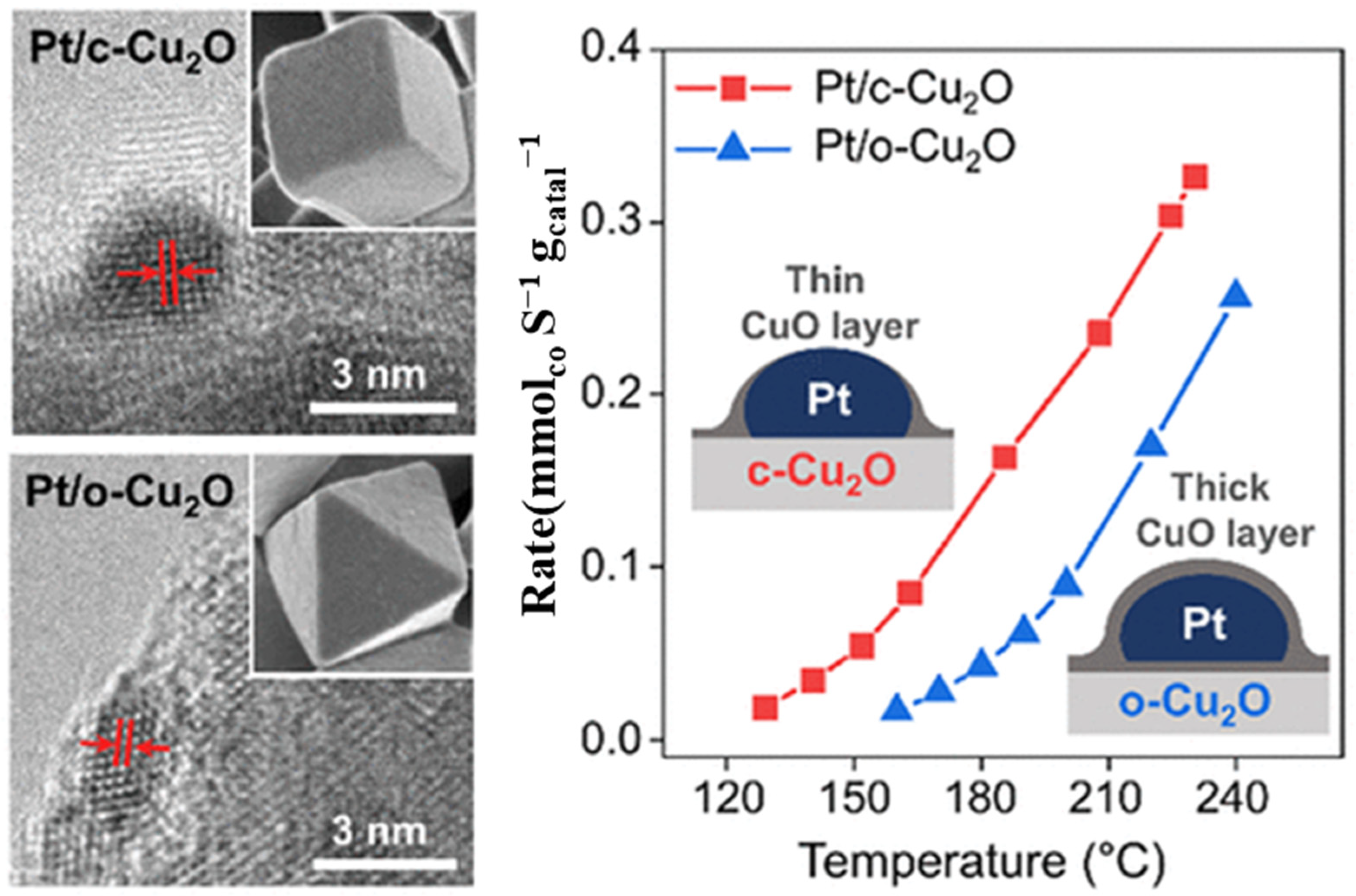
Copper-based catalysts show remarkable potential in CO catalytic oxidation due to their unique 3d electronic configuration, multivalent properties and low-cost advantages. It is shown that the Cu(II)/Cu(I) redox cycle plays a central role in regulating the adsorption–desorption equilibrium of ROS [96]. Under high-temperature conditions, CO reacts with CuO Olatt to produce CO2, leading to surface reduction to Cu2O, which is subsequently re-oxidized to CuO by ambient oxygen, forming a dynamic cyclic mechanism [97]. The adsorption of CO on the CuO surface at room temperature results in the formation of a carbonyl complex. This process is accompanied by reactions with surface and gas-phase oxygen, resulting in the formation of carbonate intermediates. Concurrently, this series of reactions initiates the valence transition of CuO to Cu2O [98]. Notably, the Cu+ cations at the grain boundaries on the Cu2O surface have been identified as highly active sites for low-temperature CO conversion [99,100]. Catalyst structural features also profoundly affect the performance. Zhang et al. [101] prepared five sizes of cubic Cu2O (1029, 682, 446, 109, 34 nm) to elucidate the contribution of different surface sites (face sites, edge sites) of catalyst NPs to the catalytic activity. The results revealed that the BET surface area was inversely proportional to the particle size. The activity of large-size Cu2O (>100 nm) is predominantly driven by the facet sites (CuO/Cu2O(100)). The reaction proceeds via the MvK mechanism. First, CO adsorbs onto surface oxygen sites of copper oxide. This then forms a carbonate intermediate, which subsequently decomposes to release CO2 and generate an oxygen vacancy. In contrast, the catalytic activity of small-sized Cu2O (<100 nm) switches to the edge site due to a significant increase in the density of the edge site (CuO/Cu2O(110)), which also proceeds via the MvK mechanism, but the reaction pathway in which CO reacts directly with the neighboring threefold-coordinated O ions site to produce CO2, reduces the activation energy to 0.60 eV. In-depth analysis showed that Cu-based catalysts follow a dual path in CO oxidation—direct oxidation dominates on the metallic copper surface, while Cu2O mediates the redox mechanism through Cu+/Cu2+ valence oscillations. Burcu Karagoz et al. [102] revealed the decisive role of surface atomic arrangement in catalytic activity. Whilst conventional Cu2O(111) crystal planes exhibit inert behavior towards CO oxidation at sub−100 K cryogenic temperatures, they demonstrate exceptional low-temperature catalytic performance when forming a unique PY reconstruction structure composed of nanopyramidal units. This activity stems from the unsaturated oxygen atoms exposed on the PY-reconstructed surface, which enable highly efficient reactions with CO molecules. Theoretical calculations further elucidate the intrinsic mechanism of this reaction: the energy barrier for the oxidation process is exceptionally low (merely 0.10 eV), while the resulting CO2 product adsorbs weakly in a configuration nearly parallel to the surface. This unique adsorption configuration facilitates rapid desorption of the product, thereby ensuring both the efficiency and sustainability of the reaction. Qiu et al. [103] systematically compared cubic and octahedral morphologies of Au-CuO/Cu2O catalysts, discovering that catalysts prepared based on the cubic morphology exhibited stronger Au-CuO interface interactions. This led to a reduction in the electron density of Au species and an increase in the proportion of surface hydroxyl oxygen, significantly enhancing catalytic performance. As illustrated in Figure 3, Hong et al. [104] reported similar findings: although octahedral supports exhibited higher activity, loading Pt onto cubic Cu2O catalysts yielded substantially greater activity gains than octahedral Cu2O, demonstrating a pronounced enhancement effect dependent on crystal plane orientation. This may arise because in Pt/cubic Cu2O, the (100) plane terminating at oxygen atoms dominates the formation of Pt–O–Cu interfacial bonding. This structure effectively suppresses oxygen adsorption, thereby forming only a thin layer of CuO and preserving the high activity of Pt.

3.3. Mn-Based Catalysts

Manganese oxide systems (MnO, Mn2O3, MnO2, Mn3O4) show excellent performance in the catalytic oxidation of CO, attributed to their unique redox multivalent (+2/+3/+4) and dynamic oxygen storage properties. This multivalent synergistic effect confers a flexible electron transfer capability: the Mn3+/Mn4+ oxidation pair rapidly activates gas-phase oxygen molecules, while the Mn2+/Mn3+ reduction electron pair promotes the release and regeneration of Olatt [105]. Gao et al. [106] thoroughly examined the carbon monoxide oxidation mechanism of α-MnO2 nanowires. This process involves the chemisorption of CO on the metal oxide surface and its subsequent reaction with Olatt, yielding MCO2 intermediates and concurrently generating Ov. Following the formation and desorption of CO2, an O2 molecule replenishes the oxygen vacancy, reforming the MO2 site. Subsequently, another CO molecule is adsorbed onto this site to form an MO2CO intermediate, which ultimately desorbs as CO2, thus completing the catalytic cycle. Liang et al. [107] prepared α-, β-, γ-, and δ-MnO2 NR via a hydrothermal method. They then systematically explored the catalytic performance and mechanism for CO oxidation. The catalytic activities were in the order of α ≈ δ > γ > β. The difference in activities was mainly attributed to the modulation effect of the crystalline phase structure on CO adsorption, Olatt activity, and intermediate conversion. Although the layered structure of δ-MnO2 enables optimal CO adsorption capacity, the α-phase exhibits a greater propensity to release Olatt and engage more actively in oxidation reactions. This tendency is attributed to the elongation of the Mn-O bond lengths, which results in a weakened binding energy of the Olatt. The reaction proceeds via the Mars–van Krevelen mechanism: CO is preferentially adsorbed onto surface hydroxyl sites and reacts with Olatt to form CO2. Concurrently, Mn4+ is reduced to Mn3+ or Mn2+, and subsequently O2 re-oxidizes Mn2O3/Mn3O4 to MnO2 to complete the cycle.
Liu et al. [108] successfully synthesized two α-MnO2 catalysts (MnO2-D and MnO2-P) with distinct oxygen vacancy concentrations via morphological control strategies, systematically investigating their low-temperature CO oxidation performance. The study revealed that MnO2-D, rich in defect-rich Mnδ+-Ov structures, exhibited outstanding catalytic activity. This may be attributed to the predominant exposure of the (310) crystal plane in MnO2-D, where the oxygen vacancy formation energy (0.69 eV) is significantly lower than that in MnO2-P (1.59 eV), thereby promoting the generation and activation of adsorbed oxygen species on the surface.
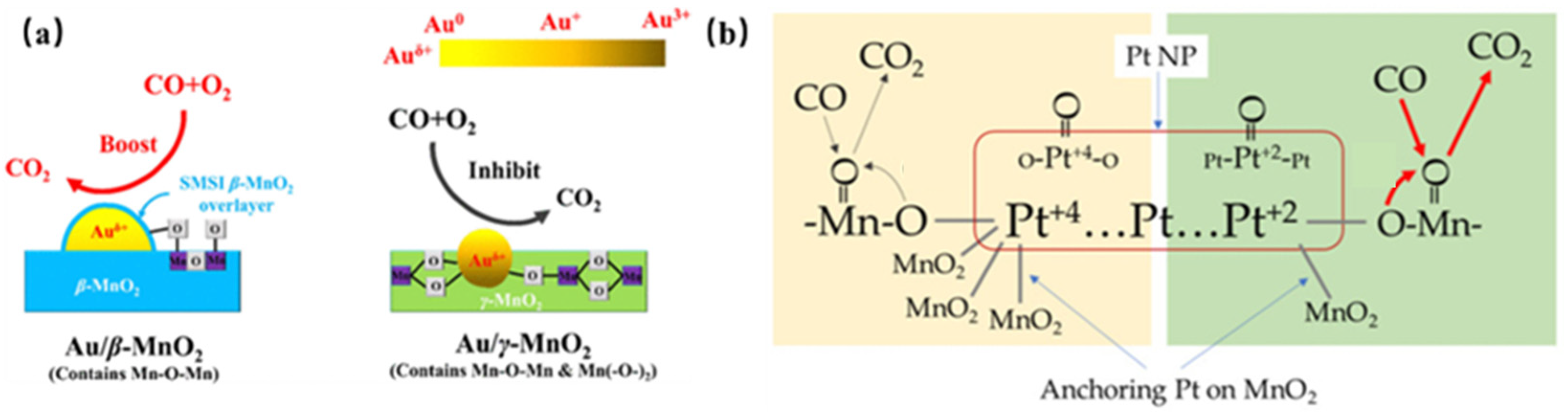
As shown in Figure 4a, Zhang et al. [109] loaded gold NPs onto β-MnO2 and γ-MnO2 via the precipitation deposition method. They observed that Au/β-MnO2 significantly enhanced CO oxidation activity, attributed to the SMSI effect promoting the formation of Au+ ions, Mn2+ species, and adsorbed oxygen (Oads), thereby enhancing oxygen vacancy regeneration and reaction sites. In contrast, Au/γ-MnO2 exhibited reduced catalytic efficiency due to gold NPs being trapped within the support pores, leading to a decreased Au+ fraction and Au3+ formation. As depicted in Figure 4b, Zhang et al. [88] constructed a 1 wt% Pt/β-MnO2 catalyst via the deposit-precipitation method. Pt/β-MnO2 catalyst via a deposit-precipitation method. They observed that Pt loading suppressed CO oxidation in the low-temperature range (<210 °C) but significantly enhanced activity at elevated temperatures (>210 °C). At low temperatures, the catalyst surface predominantly featured Pt4+-O-Mn structures, which, while relatively stable, hindered the oxidation of CO by the MnO2 support, resulting in low activity. As temperature increases, Pt4+ is reduced to Pt2+, shifting the structure towards Pt-Pt2+-Pt. This configuration facilitates oxygen activation and reactant transfer, substantially enhancing CO oxidation rates.

3.4. Ce-Based Catalysts

As a typical rare-earth metal oxide, cerium dioxide finds significant application in the domain of environmental catalysis by virtue of its unique Ce4+/Ce3+ redox pair property. The material is endowed with excellent OSC through a reversible oxygen vacancy formation mechanism, a property that stems from the dynamic migration behavior of Olatt during Ce3+/Ce4+ valence state transitions. Compared with noble metal catalysts, CeO2 systems are more advantageous in terms of cost-effectiveness and environmental friendliness, which makes them of interest in oxygen-demanding reaction systems such as CO catalytic oxidation. The exposed crystal facets of CeO2 significantly determine its catalytic performance. This phenomenon is primarily attributed to the differences in structural stability and oxygen defect formation ability of different crystal facets. CeO2 with 110 and 100 facets exhibits superior catalytic activity [111]. Lykaki et al. [18] synthesized CeO2 exposing specific crystal planes by the hydrothermal method. CeO2 NR with dominant exposure of 100 and 110 crystal planes showed optimal activity in CO oxidation reaction. Because they possess a lower energy barrier for forming Ov and higher mobility of surface oxygen. According to Breysse’s hypothesis [112], the initial interaction between CO and CeO2 entails the adsorption of CO on the CeO2 surface, followed by a reaction with Olatt, resulting in the formation of CO2. This process is concomitant with the formation of Ov. Subsequently, gas-phase O2 rapidly fills these vacancies, thereby restoring the Olatt. According to the kinetic study, the oxidation reaction is limited by the rate of CO adsorption and activation. Similar findings were made by Zheng et al. [113]. The adsorption of CO onto the ceria CeO2 surface leads to the generation of CO through the capture of Olatt. The subsequent formation of Ov initiates the reduction in neighboring Ce4+ to Ce3+. Pablo G. He et al. [114] systematically investigated the influence of CeO2 support morphology (nano-octahedra, cubes, particles, spheres, and rods) on the exposure of (111), (100), and (110) crystal planes and their catalytic mechanisms, thereby regulating the low-temperature CO oxidation activity of Pd/CeO2 catalysts through crystal plane engineering. Characterization revealed that the spherical 1Pd/CeO2-S catalyst, exhibiting simultaneous exposure of (111) and (100) planes, significantly promoted the formation of PdxCe1−xO2−y solid solutions. This generated the highest concentration of surface Ov, conferring exceptional low-temperature activity in the CO oxidation reaction.
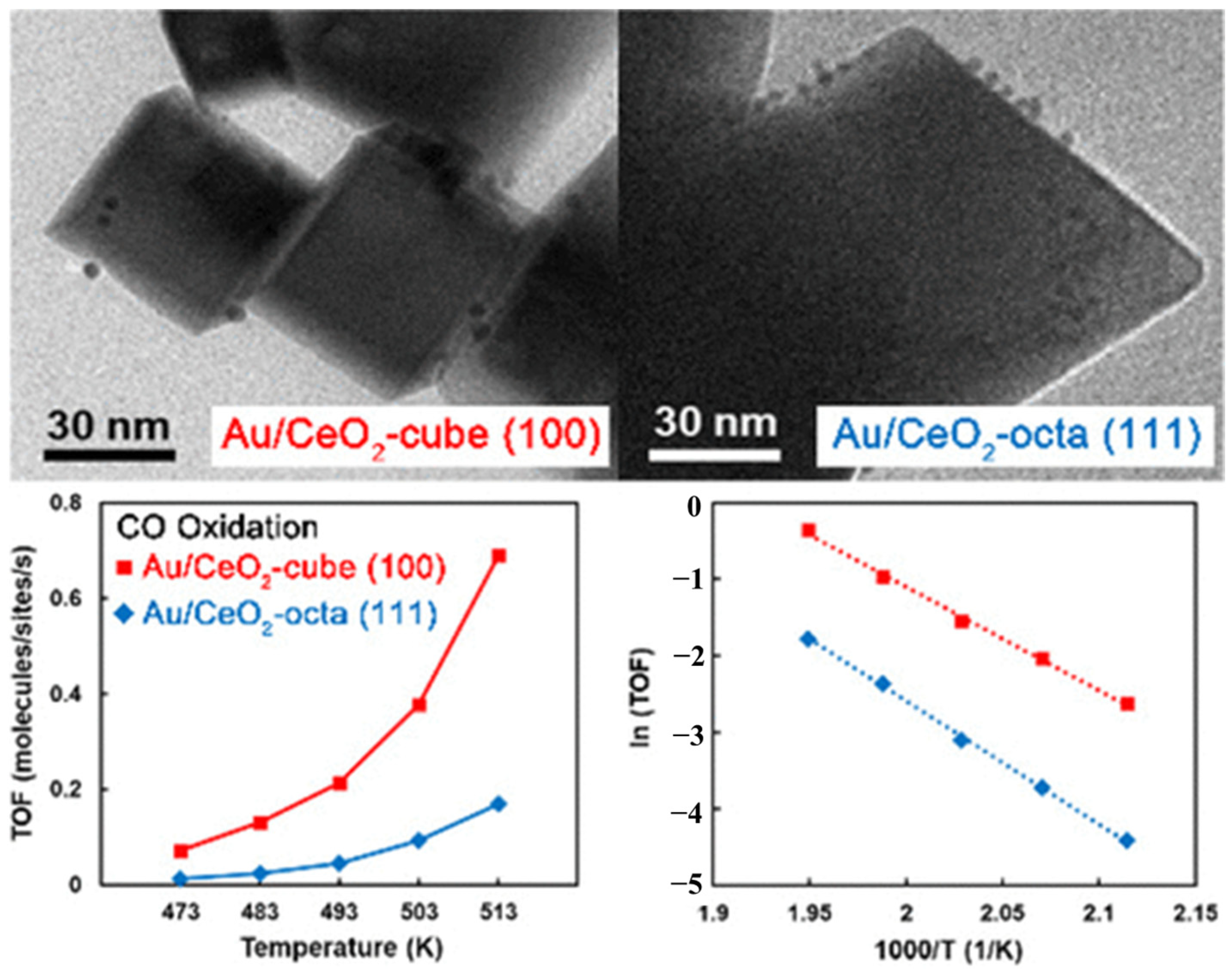
As shown in Figure 5, Ha et al. [115] synthesized morphologically controllable CeO2 supports via hydrothermal methods and loaded them with 3 nm Au particles. They discovered that the Au/CeO2 cubic structure exhibited significantly higher performance than the Au/CeO2 cubic structure. The fundamental reason lies in the interfacial structure: the cubic structure primarily exposes. The (100) crystal plane of the cube exhibits greater flexibility in its interface structure with the Au NPs. Theoretical calculations reveal that the Au/CeO2 (100) interface spontaneously forms an O-C-O intermediate (with an energy barrier of merely 0.4 eV), whereas the octahedral (111) interface requires overcoming a 0.86 eV energy barrier. This significantly reduces the overall reaction energy barrier, substantially enhancing the reaction rate.

3.5. Co-Based Catalysts

Cobalt-based oxides are one of the most competitive candidates for catalytic oxidative degradation of CO owing to their abundance of ROS, excellent redox properties, and multivalent metal character [116]. By controlling the crystal morphology and crystallographic orientation of Co3O4 nanostructures, Co-O active sites with specific coordination structures can be exposed in a targeted manner, thus optimizing their catalytic performance. The oxidation state of cobalt governs the catalytic activity, wherein Co3+ in octahedral coordination plays the role of the key active center. In contrast, tetrahedrally coordinated Co2+ contributes minimally to the reaction [117]. Co3O4 NR with predominantly exposed (110) planes demonstrates outstanding catalytic performance in low-temperature CO oxidation, attributed to their surface enrichment of active Co3+ species. Xie et al. [118] achieved the targeted exposure of 110 crystallites rich in octahedrally coordinated Co3+ active sites by modulating the synthesis of cobalt hydroxyl carbonate precursors with the calcination process, enabling them to exhibit excellent CO oxidation capability even at temperatures as low as −77 °C. Liu et al. [119] achieved a substantial increase in the Co3+ content and oxygen vacancy concentration on the catalyst surface through a hydrogen pre-reduction treatment. Concurrently, the Co3O4 particle size underwent a reduction from 32.7 nm to 14.3 nm. This change resulted in the exposure of a greater number of active sites, thereby enhancing the adsorption of Co3+ on CO and hindering the competition between O2 and CO adsorption. Liliana Lukashuk [120] systematically revealed the underlying mechanism and pathways of CO oxidation on Co3O4 catalysts. At temperatures above 100 °C, CO is preferentially adsorbed onto Co3+ active sites, where it reacts with surface Olatt to form CO2 and generate Ov. Subsequently, O2 rapidly refills these vacancies, enabling a continuous redox cycle. The dynamic equilibrium of surface Co3+ as the key active site Ov is essential for maintaining catalytic activity. The MvK mechanism’s efficacy hinges upon the activity of surface oxygen sites and its dynamic capacity for regeneration. Li et al. [121] exposed the Co-O layer by means of NaBH4 reduction and acid etching to effect a change in Co from six-coordinated (CoO6) to five-coordinated (CoO5). The geometrical unsaturation of the five-coordinated Co promotes the generation of Ov, which not only acts as an active site to adsorb O2 molecules but also enhances the MvK reaction rate by lowering the dissociation energy of O-O bonds. The CO oxidation reaction over cobalt-based catalysts follows the MvK mechanism. CO preferentially adsorbs onto Co2+ sites and is oxidized by Olatt from adjacent Co3+ sites, yielding CO2 in a vibrationally excited state. Subsequent to this, surface Ov are repaired by the rapid replenishment of oxygen, which realizes dynamic repair while completing the re-oxidation cycle from Co2+ to Co3+ [122].
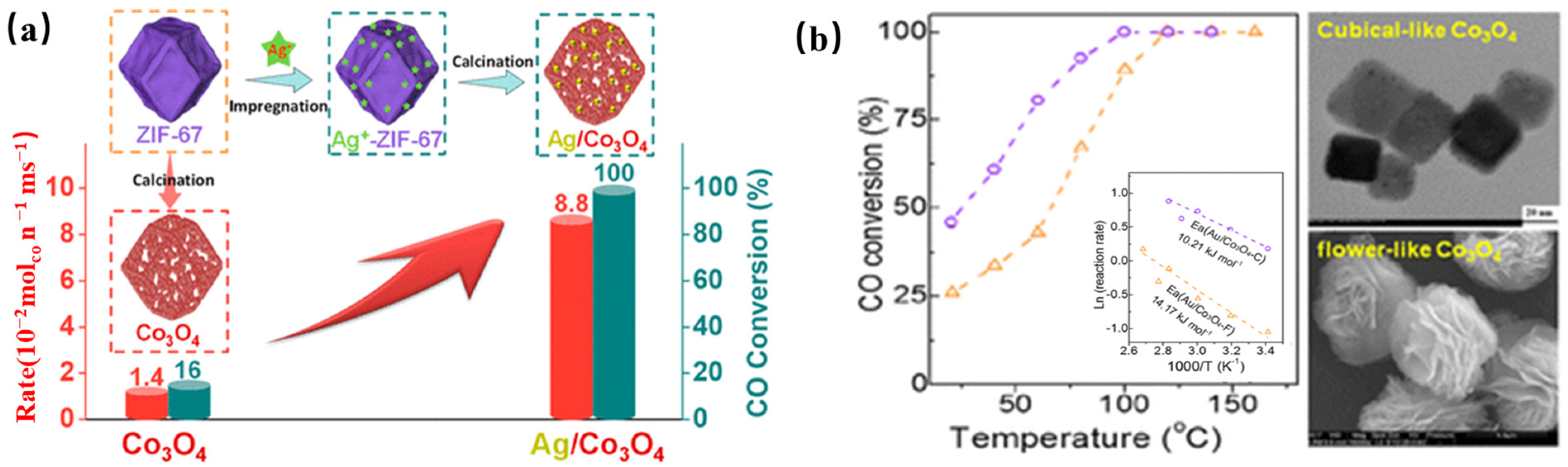
As depicted in Figure 6a, Li et al. [82] successfully synthesized hollow porous Co3O4 polyhedra by pyrolyzing ZIF-67 crystals. They then constructed an Ag/Co3O4 interfacial catalyst by loading silver NPs, which demonstrated highly efficient catalysis for CO oxidation. Characterization revealed that Ag incorporation substantially increased the proportion of surface Ov and adsorbed oxygen species, enhancing oxygen species migration and thereby significantly boosting catalytic activity. As depicted in Figure 6b, Sami Barkaoui et al. [123] employed a hydrothermal approach to synthesize nano-cubic Co3O4-C primarily exposing the 001 crystal plane, alongside nano-floral Co3O4-F predominantly displaying the 111 crystal plane. Subsequently, 2 nm gold NPs were loaded onto different morphologies of Co3O4, with the Au/Co3O4-C catalyst exhibiting superior performance. This may be attributed to the (001) plane providing a higher Co3+/Co2+ ratio and adsorbed oxygen content, thereby promoting oxygen activation and reaction rates. Catalyst deactivation primarily stems from the accumulation of the reaction product carbon dioxide at active sites, rather than metal sintering phenomena. The synergistic interaction between the (001) plane and gold interface effectively enhances oxygen activation and carbon monoxide adsorption processes, whereas the (111) plane is more prone to adsorbing carbon dioxide molecules.
Non-precious metal catalysts (Fe, Cu, Mn, Ce, Co) have emerged as promising alternatives to precious metals in CO oxidation due to their cost-effectiveness, environmental sustainability, and distinctive redox characteristics. The performance of these catalysts is strongly dependent on their capacity to chemisorb CO, which creates an essential precursor state for oxidation by enriching reactant concentration on the catalyst surface. However, the chemisorption of CO molecules needs to overcome certain energy barriers, which directly affects the overall activation energy requirement of the catalytic reaction. It is important to acknowledge that while non-precious metal catalysts can effectively mitigate the risk of carbon monoxide poisoning, which is a concern with conventional precious metal catalysts, the electronic structure properties of their surfaces may result in a reduction in the activation efficiency of CO molecules. This paradoxical characterization stems from the adsorption–activation equilibrium relationship between surface active sites and CO molecules. Overly strong chemisorption, while increasing the surface coverage, may weaken the subsequent activation process of the CO molecules. Conversely, weaker adsorption may lead to insufficient concentration of the effective reactants. Therefore, optimizing the surface electronic structure of non-precious metal catalysts to balance the adsorption strength and activation capacity becomes a key research direction to enhance their catalytic performance. A summary of the properties of common non-precious metal catalysts is provided in Table 2.

4. The Effect of H2O and SO2 on CO Oxidation

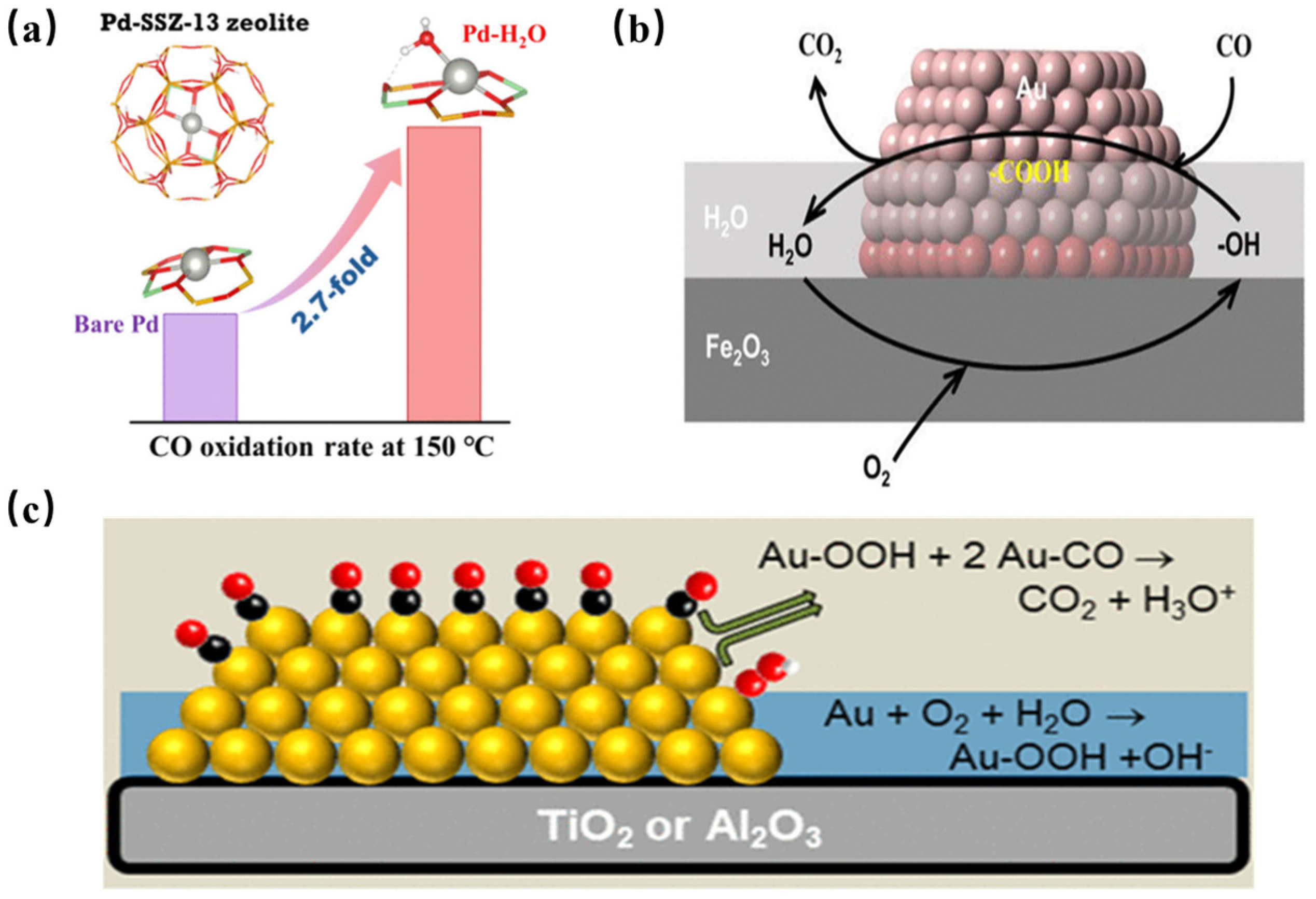
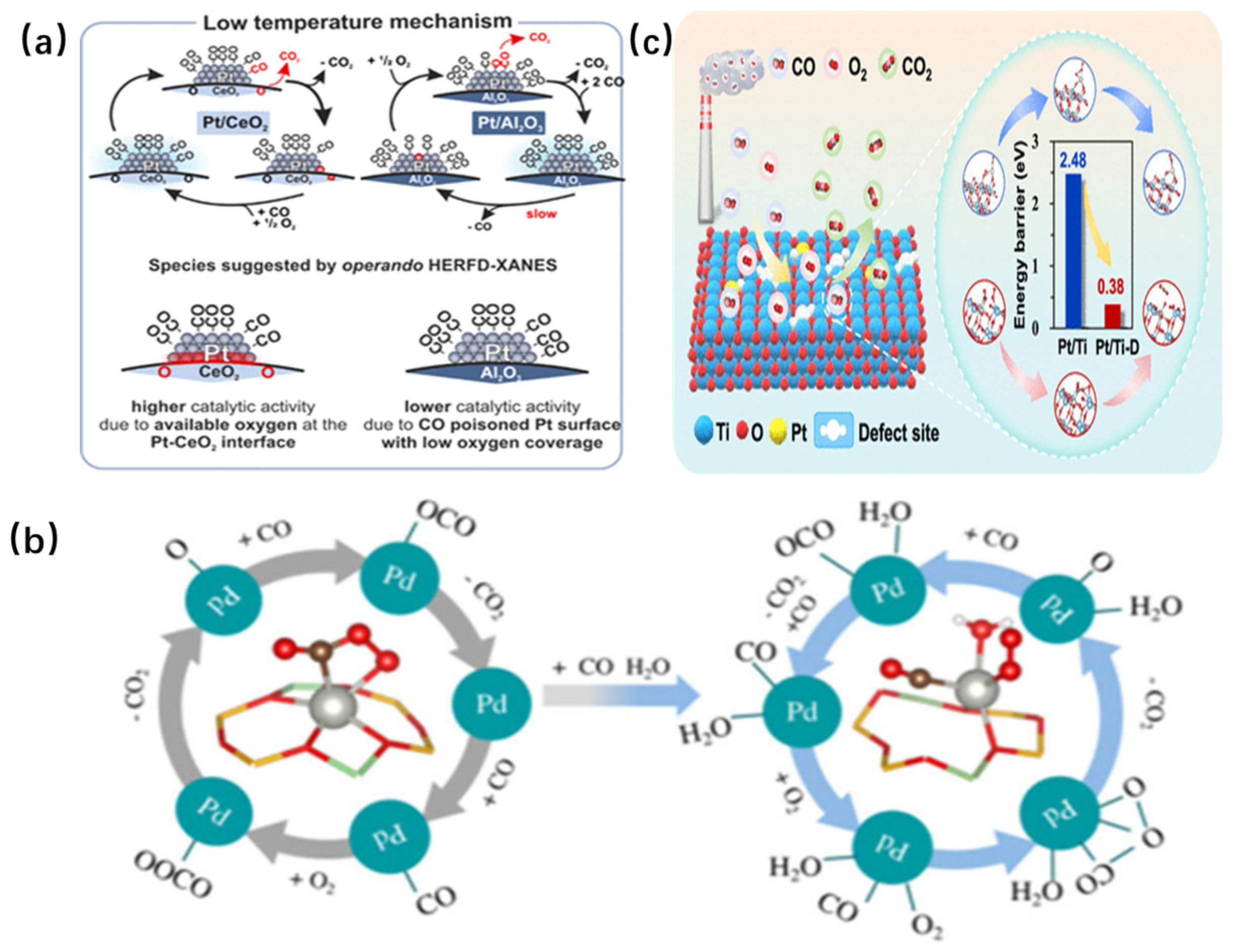
The dual role of water vapor in catalytic reaction systems has become an active area of research, as variations in its concentration profoundly influence the CO oxidation process. The presence of an optimal amount of water enhances catalytic activity mainly through three key pathways: (1) promoting catalyst surface remodeling to form new active sites [138,139]; (2) directly participating in the CO to CO2 oxidation pathway via a surface hydroxyl-mediated co-catalytic mechanism [140]; (3) facilitating the generation of OOH to effectively activate O2 molecules [141,142]. Figure 7a reveals that water molecules dynamically alter the local structure of Pd active sites through solvation, inducing partial dissociation of the Pd2+ cation originally firmly anchored within the SSZ-13 zeolite hexagonal ring. This forms a mobile Pd–H2O complex. This structural transformation markedly enhances the mobility of the Pd site and weakens the strong interaction between Pd and the zeolite framework oxygen through ligand exchange and charge shielding, thereby optimizing the coordination environment of the active site [143]. Figure 7b illustrates a co-catalytic mechanism mediated by surface hydroxyl groups, wherein water molecules at the Au–Fe2O3 interface promote O2 activation to generate highly reactive surface hydroxyl species. Subsequently, CO reacts with this hydroxyl to form a crucial carboxylate intermediate. This intermediate further decomposes into CO2, regenerating the hydroxyl, thereby establishing an efficient water-assisted cyclic catalytic process [144]. Johnny Saavedra et al. [145] discovered that water acts as a potent promoter within low to moderate water pressure ranges (approximately 300–600 Pa). As illustrated in Figure 7c, it aids in the activation of O2 at the metal–support interface of gold NPs to form the key intermediate (Au-OOH) by adsorbing onto the support surface and participating in the proton transfer mechanism. This also accelerates the decomposition of the rate-determining intermediate, thereby significantly enhancing the reaction rate.
Masakazu Daté et al. [146] found that the degree of OH dependence of different carriers was determined by their surface oxygen mobility and acidity, leading to differences in moisture sensitivity. TiO2 can still participate in the reaction via carrier oxygen at low humidity due to its high surface oxygen mobility, and the activity is further optimized at high humidity; Al2O3 is dependent on OH-mediated O2 activation, with activity significantly elevated at 200 ppm H2O; SiO2 has no surface oxygen mobility, and its activity is completely dependent on OH supply, which decreases abruptly at very low humidity (<1 ppm). Johnny Saavedra et al. [147] demonstrated that water plays a central role via a proton transfer-mediated interfacial reaction mechanism. Meanwhile, OH groups on the TiO2 surface primarily serve as anchoring sites for water molecules, indirectly modulating catalytic activity. This facilitation promotes the activation of O2 to form the key intermediate OOH through proton transfer, thereby enhancing the efficiency of CO oxidation. The inhibitory effect of water on the catalytic reaction manifests in two main aspects: first, surface lattice OH groups generated by the dissociative adsorption of H2O on Ov prevent the adsorption of gaseous O2 [148]; second, these species facilitate the formation of stable bicarbonate compounds near the active site, thereby blocking it [146,149]. Xu et al. [150] enhanced the water resistance of the catalyst by utilizing the strong interaction between Co and Sn. This effectively inhibited water molecule adsorption on the catalyst surface and reduced its hydrophilicity.
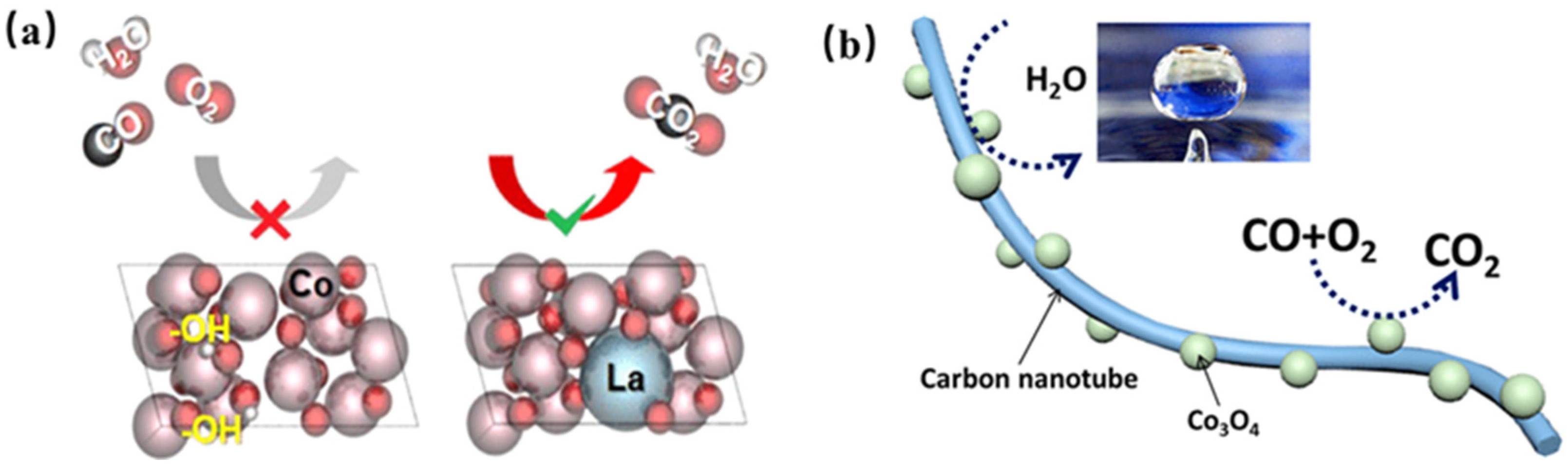
As shown in Figure 8a, Junemin Bae et al. [151] utilized La3+ to selectively replace Co2+ at the tetrahedral coordination site on the surface of Co3O4. This resulted in a significant increase in the formation energy of Ov by 0.3 eV. It also inhibited the dissociative adsorption of H2O molecules at Ov, blocking the generation of surface hydroxyls and the formation pathway of bicarbonate species, thereby enhancing water resistance. Water adsorption can be considerably reduced by establishing a hydrophobic interface. This is commonly accomplished through the incorporation of hydrophobic substances, for instance, polydimethylsiloxane and carbon nanotubes, as shown in Figure 8b [152].
SO2 poisoning primarily results from the competitive adsorption and chemical transformation processes that occur on the catalyst surface. In these processes, the active site combines with SO2 to form a non-volatile metal sulfate. Consequently, the catalytic performance deteriorates and ultimately progresses to complete deactivation [153]. The use of strongly acidic carriers has been found to be an effective method of preventing SO2 uptake. Sulfate species deposited on the surface of metal oxides (e.g., SiO2, TiO2, ZrO2, etc.) exhibit lower thermodynamic stability compared to other types of carriers and thus are more readily desorbed or removed from the surface of such metal oxide carriers [154,155,156,157]. Young Seok Ryou et al. [155] found that the sulfur adsorption decreased drastically with the decrease in Ce content after the introduction of Zr, which inhibited the formation of cerium sulfate. In addition, Zr stabilized the CeO2 lattice to maintain the pore structure, reducing sulfur enrichment in the collapsed pores. F.J. Gracia et al. [157] found that Al2O3 carriers exhibit short-term sulfur resistance advantages and that their surfaces can oxidize SO2 to sulfate storage, delaying the direct toxicity of sulfur to Pt. Liu et al. [158] methodically examined the mechanism of four carriers, SnO2, WO3, Al2O3 and CeO2, on the active structure and sulfur resistance of Pt catalysts. SnO2 carriers promote sulfur migration to the carrier surface through the formation of PtS2 and SnS species, reducing the active site coverage; WO3 inhibits sulfur adsorption and stabilizes sulfur to the WS3 structure by using its strong Brønsted acidic site. Al2O3 carriers trigger progressive deactivation, although they retard sulfur adsorption by virtue of their intermediate Lewis acidity. CeO2 reacts with SO2 to produce Ce(SO4)2 by the Ov-mediated sulfation pathway and triggers structural collapse and Pt particles. CeO2 reacts with SO2 to form Ce(SO4)2 due to the oxygen vacancy-mediated sulfation pathway, which triggers structural collapse of the carrier and agglomeration of the platinum particles, leading to a drastic decrease in activity. Constructing sacrificial sites to mitigate SO2 adsorption or modulating the structure and morphology of catalysts are considered to be effective methods to improve their SO2 resistance properties [159]. Gao et al. [131] fabricated a CeO2@TiO2 core–shell structure. The TiO2 shell layer not only reduces the direct contact between SO2 and CeO2 core through physical isolation but also inhibits the generation of Ce3+ and the formation of cerium sulfate. Additionally, its higher specific surface area (81.39 m2/g) and abundant surface Ov promote the CO oxidation reaction.

5. CO Oxidation Mechanism

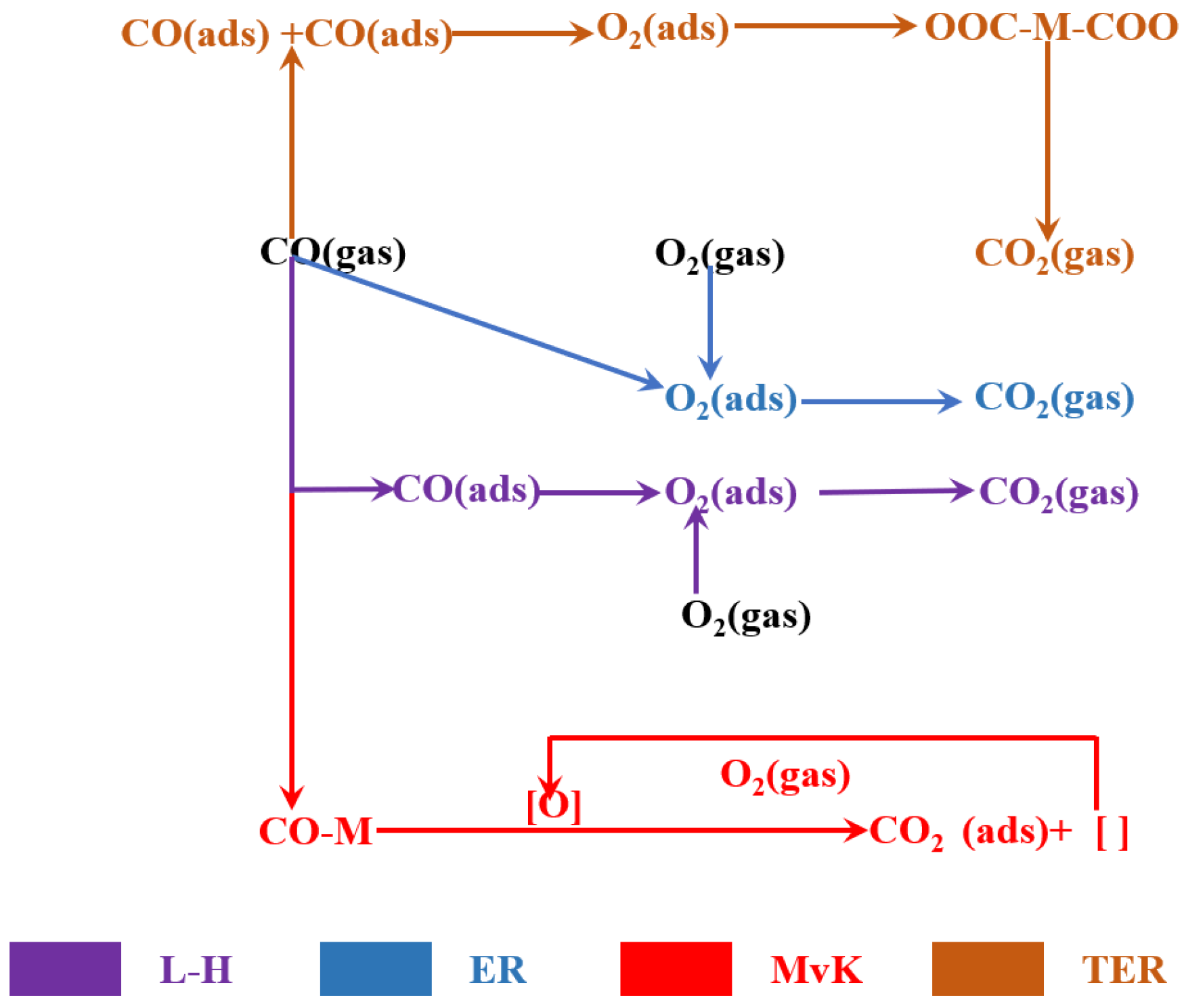
The catalytic oxidation mechanisms of CO have been extensively studied in recent years and are primarily categorized into three models: the Langmuir–Hinshelwood (L-H), Eley–Rideal (E-R), and MvK mechanisms. However, the current understanding of the CO oxidation mechanism, the role of vacancies and the source of oxygen for the reaction is somewhat lacking. Figure 9 summarizes common CO oxidation mechanisms.

5.1. The Langmuir–Hinshelwood Mechanism

The L-H mechanism is applicable to the process where CO and O2 are co-adsorbed and subsequently activated on the catalyst surface. In a typical reaction pathway, CO and O2 molecules first co-adsorb at adjacent active sites, forming OCOO* transition state intermediates with a peroxygen structure via electron transfer, followed by dissociation to produce CO2 molecules in the adsorbed state and a residual O species. The surface oxygen atom further reacts with another adsorbed state CO molecule via C-O bond recombination to produce CO2 [160]. As demonstrated in reaction Equations (1)–(5), the active site is denoted by M, while □ refers to the oxygen vacancy.
CO + M → CO*
O2 + M → O2*
CO* + O2* → OOCO*
OOCO* → CO2 + O*
CO* + O* → CO2
As shown in Figure 10a, the categorization of L-H mechanisms, based on the differences in reactant adsorption sites, can be divided into competitive and noncompetitive types. The competitive L-H mechanism (unit point model) is particularly typical in loaded metal catalyst systems, especially when noble metals (e.g., Pt, Pd) are loaded on irreducible carriers (e.g., Al2O3, SiO2) that are chemically inert and have low oxygen mobility; the competitive adsorption characteristics are more significant. The core feature of this mechanism is that CO and O2 need to compete to occupy the same metal active site to complete the adsorption–activation process [161]. At low temperatures, CO preferentially occupies the metal sites by virtue of its stronger adsorption affinity, resulting in the blocking of O2 adsorption, whereas as the temperature increases, CO adsorption decreases and desorption occurs, and the active sites are released for O2 activation, at which time the adsorption and dissociation of O2 become the quick-control steps of the reaction [162,163].
The noncompetitive L-H mechanism (two-site model) is observed in catalysts with multiple active sites. In these catalysts, CO is preferentially adsorbed to metal sites (e.g., Pt0 or PtOx), while O2 completes its adsorption and dissociation at the oxygen vacancy site on the surface of the carrier or at the interfacial site. This results in the formation of a highly ROS (e.g., O or O2−). The rate-limiting step in this process is the adsorption and activation of the reactants [161,164]. This approach offers the advantage of bypassing competitive adsorption-induced inhibition at the active site [165].

5.2. Eley–Rideal Mechanism

According to the E-R mechanism, O2 first chemisorbs on catalyst active centers, generating pre-adsorbed oxygen. Subsequently, gas-phase CO molecules collide with and react directly with Oads at the interface. The formation of C-O bonds during the interaction of O2 and CO is likely rate-limiting [166,167], as shown in reaction Equations (6)–(8)
O2 + M* → O2*
CO + O2* → CO2 + O*
CO + O* → CO2
As shown in Figure 10b, under dry conditions, the Pd2+ cation position within the molecular sieve’s hexagonal ring remains fixed. Adsorbed CO reacts directly with O2 molecules in the gas phase, following the E-R mechanism. In the presence of H2O, water molecules coordinate with Pd2+ to form partially framework-displaced, mobile Pd-H2O complexes. This reconfiguration of active sites enables both CO and O2 to adsorb simultaneously on the same Pd active center, thereby following the L-H mechanism [143].
Gong et al. [168] discovered that when Ov are in proximity to CuO, Cu+ exhibits a preference for adsorbing CO to form CO-Cu+. Subsequently, gas-phase O2 directly attacks the adsorbed state CO, resulting in the generation of CO2. The O2 molecule dissociatively participates in dual roles: one oxygen atom replenishes Ov, while its counterpart oxidizes CO. This process is followed by a second CO molecule combining with O-Cu+ to dissociate. The reaction unfolds in accordance with the E-R mechanism. Conversely, when the Ov moves away from CuO, O2 exhibits a preference for adsorbing to Ov and dissociating. The process entails the presence of one oxygen atom, which occupies the vacancies and subsequently forms Olatt. Concurrently, another oxygen atom undergoes a conversion to surface-active oxygen (O*). The O* then reacts directly with gas-phase CO, resulting in the generation of CO2. The reaction transforms into the Mvk mechanism. Mehdi D. Esrafili et al. [169] investigated the catalytic performance of Pd-doped graphene for CO oxidation reaction by DFT and found that Pd-graphene efficiently catalyzes CO oxidation through a synergistic LH-ER mechanism. Among them, the ER mechanism critically governs the second step, wherein gas-phase or weakly adsorbed CO directly reacts with oxygen adatoms generated via the initial L-H step to form a second CO2 molecule. The low-energy barrier property of the ER mechanism stems from the strong activation of O2 by Pd doping. As the study progressed, on the basis of the ER mechanism, the researchers identified the TER mechanism. The TER mechanism, in contrast, entails the synergistic activation of O2 by two pre-adsorbed CO molecules, resulting in the formation of the intermediate OOC-x-COO. This process is accompanied by the concurrent generation of two CO2. The OCO-x-OCO intermediate’s formation or breakdown could act as the rate-limiting step within the reaction sequence [170], as shown in reaction Equations (9)–(11).
CO + M → CO*
O2 + 2CO* → OOC-M-COO
OOC-M-COO → 2CO2 + M

5.3. Mars–Van Krevelen Mechanism

For multiphase catalytic systems with surfaces rich in Olatt atoms, the MvK mechanism exhibits a unique oxidation reaction pathway [171]. The mechanism is characterized by two key stages. Initially, CO molecules oxidize with the active Olatt on the catalyst surface, resulting in the production of CO2, while surface Ov are formed at the oxygen de-embedding sites. Subsequently, O2 replenishes Ov via chemisorption, followed by dissociative adsorption that regenerates Olatt while simultaneously oxidizing a second CO molecule [172]. As shown in reaction Equations (12)–(15) (where [] denotes an Ov). Based on the dependence on Olatt, the CO oxidation pathway on catalysts with high OSC is primarily governed by the MvK mechanism.
CO + X → CO*
CO∗ + Olatt→CO2* + []
CO2-→ CO2 + X*
[] + O2 → Olatt
Zou et al. [173] employed a defect-engineered Pt/Ti-D catalyst wherein Pt was robustly anchored in atomic form at defect sites, forming a unique Pt-O5 coordination environment. The pivotal role of this structure lies in transferring the adsorption and activation functions of O2 from the noble metal Pt sites to the Ti3+ defect sites on the support. This not only avoids competitive adsorption with CO but also substantially reduces the activation energy barrier for O2 to 0.38 eV. Consequently, the mechanism follows the MVK pathway, as illustrated in Figure 10c. Gu et al. [174] decomposed the CO oxidation reaction into two half-reactions: oxygen vacancy formation (Ce4+ reduction) and conversion (Ce3+ oxidation). They then quantified the kinetic rate of oxygen vacancy formation in CeO2-ZrO2-based catalysts using time-resolved energy dispersive X-ray absorption spectroscopy. Their findings revealed that in tetragonal-phase CZ solid solution (Ce/Zr = 1:1), the rate-determining step of the MvK mechanism is Vo formation. The addition of noble or transition metals has been shown to enhance the kinetics of Vo formation, reduce the activation energy, and improve the catalytic performance. Xu et al. [175] studied CO oxidation mechanism on α-Mn2O3 by systematically varying the partial pressures of CO and O2. Their results revealed a distinct temperature-dependent kinetic behavior: below 190 °C, the reaction rate showed dual dependence on the concentrations of both CO and O2. At temperatures above 190 °C, the reaction rate became independent of the O2 concentration, and the consumption rate of Olatt was controlled primarily by the diffusion of CO. This phenomenon can be attributed to the temperature-induced desorption of adsorbed oxygen, concurrent with an increase in the mobility of Olatt. Consequently, this results in a shift in the reaction path from surface-adsorbed oxygen to bulk Olatt. A similar phenomenon was also identified by Tian et al. [13]. At temperatures ranging from 50 to 90 °C, CO was adsorbed at the Mn3+-Ov site to form carbonate intermediates, following the Langmuir–Hinshelwood pathway. When the temperature was >190 °C, it transformed into the MvK pathway. The reaction order of O2 approaches 0, and Olatt directly participates in oxidation. Fan et al. [164] found that the inhomogeneity in the size of Pt NPs triggers an insufficient concentration of carrier Ov, leading to an inefficient O2 activation. Consequently, this inefficient O2 activation suppresses the adsorption of CO on Pt, which in turn retards the MvK mechanism.
Figure 10. (a) Effect of different natures of carriers on CO oxidation mechanism. Reprinted with permission from [161]. Copyright 2019 American Chemical Society. (b) Water causes the CO oxidation mechanism to shift from E-R to L-H. Reprinted with permission from [143]. Copyright 2025 American Chemical Society. (c) The MVK mechanism of CO oxidation. Reprinted with permission from [173]. Copyright 2025 American Chemical Society.
Catalysts 16 00007 g010

6. Conclusions and Outlook

In recent years, CO catalytic oxidation research has made remarkable progress in the design and mechanism exploration of precious and non-precious metal catalysts. Precious metals excel in low-temperature reactions by virtue of SMSI and efficient oxygen activation, but their high cost and anti-poisoning issues remain bottlenecks; non-precious metals show substitution potential through multivalent redox cycling and dynamic migration of Olatt. However, the dynamic resolution of the reaction mechanism (e.g., coupling of Langmuir–Hinshelwood (L-H) and MvK mechanisms and how water alters the catalyst reaction path) and the enhancement of anti-poisoning ability (e.g., hydrophobic modification, core–shell isolation) still need to be explored in depth. Therefore, future research should focus on the following directions: developing low-cost single-atom/cluster catalysts and catalysts for non-precious metal composite systems; combining in situ characterization techniques and machine learning simulations to reveal dynamic reaction pathways; designing hydrophobic-sulfur-resistant bifunctional shell layers to physically segregate H2O/SO2 and protect the catalyst active sites to enhance durability in complex environments; exploring photothermal synergistic catalysis to reduce energy consumption and enhance mass transfer efficiency; and constructing a highly efficient, stable and environmentally friendly CO catalytic oxidation system to support environmental governance and carbon neutrality goals.

Author Contributions

Y.Z.: Writing—Original draft preparation. H.Z.: Writing—Original draft preparation. W.S.: Supervision and Funding acquisition. Y.X.: Supervision and Funding acquisition. All authors have read and agreed to the published version of the manuscript.

Funding

This work was supported by the National Natural Science Foundation of China (52400119).

Data Availability Statement

No data was used for the research described in the article.

Acknowledgments

The author would like to express gratitude to the National Natural Science Foundation of China (52400119) for providing part of the funds, which laid a material foundation for constructing a systematic knowledge framework for this review and sorting out the key scientific issues and development context in the field.

Conflicts of Interest

The authors declare that they have no known competing financial interests or personal relationships that could have appeared to influence the work reported in this paper.

Abbreviations

The following abbreviations are used in this manuscript:
SMSIstrong metal–support interactions
Ovoxygen vacancies
NPsnanoparticles
ROSreactive oxygen species
NRnanorods
NCnanocubes
NOnanooctahedrons
Olatt lattice oxygen
Oads Adsorb oxygen
OSCoxygen storage/release capability
L-HLangmuir–Hinshelwood
E-REley–Rideal
MvKMars–van Krevelen

References

  1. Dey, S.; Dhal, G.C.; Mohan, D.; Prasad, R. Advances in transition metal oxide catalysts for carbon monoxide oxidation: A review. Adv. Compos. Hybrid Mater. 2019, 2, 626–656. [Google Scholar] [CrossRef]
  2. Liu, X.; Zou, Y.; Li, X.; Xu, T.; Cen, W.; Li, B.; Zhu, T. Ultralow Doping of Mn Species into Pt Catalyst Enhances the CO Oxidation Performance in the Presence of H2O and SO2. ACS Catal. 2023, 13, 14580–14597. [Google Scholar] [CrossRef]
  3. Beg, M.B.; Ali, L.; Shittu, T.; Khaleel, A.; Vermeire, F.H.; Altarawneh, M. Non-noble catalysts formulations using CuO-CeO2/Nb2O5 for low-temperature catalytic oxidation of carbon monoxide. J. Environ. Chem. Eng. 2024, 12, 113177. [Google Scholar] [CrossRef]
  4. Feyzbar-Khalkhali-Nejad, F.; Hassani, E.; Rashti, A.; Oh, T.-S. Adsorption-based CO removal: Principles and materials. J. Environ. Chem. Eng. 2021, 9, 105317. [Google Scholar] [CrossRef]
  5. Herzing, A.A.; Kiely, C.J.; Carley, A.F.; Landon, P.; Hutchings, G.J. Identification of Active Gold Nanoclusters on Iron Oxide Supports for CO Oxidation. Science 2008, 321, 1331–1335. [Google Scholar] [CrossRef] [PubMed]
  6. Bagger, A.; Arnarson, L.; Hansen, M.H.; Spohr, E.; Rossmeisl, J. Electrochemical CO Reduction: A Property of the Electrochemical Interface. J. Am. Chem. Soc. 2019, 141, 1506–1514. [Google Scholar] [CrossRef]
  7. Zhang, R.; Wang, J.; Zhu, X.; Liu, X.; Liu, H.; Zhou, Y.; Dong, S.; La, P.; Yao, J.; Liu, B. Phase-separated Ce–Co–O catalysts for CO oxidation. Int. J. Hydrogen Energy 2020, 45, 12777–12786. [Google Scholar] [CrossRef]
  8. Yoshida, T.; Murayama, T.; Sakaguchi, N.; Okumura, M.; Ishida, T.; Haruta, M. Carbon Monoxide Oxidation by Polyoxometalate-Supported Gold Nanoparticulate Catalysts: Activity, Stability, and Temperature—Dependent Activation Properties. Angew. Chem. Int. Ed. 2018, 57, 1523–1527. [Google Scholar] [CrossRef]
  9. Duan, Z.; Henkelman, G. CO Oxidation on the Pd(111) Surface. ACS Catal. 2014, 4, 3435–3443. [Google Scholar] [CrossRef]
  10. Taira, K.; Nakao, K.; Suzuki, K.; Einaga, H. SOx Tolerant Pt/TiO2 Catalysts for CO Oxidation and the Effect of TiO2 Supports on Catalytic Activity. Environ. Sci. Technol. 2016, 50, 9773–9780. [Google Scholar] [CrossRef]
  11. Huang, B.; Kobayashi, H.; Yamamoto, T.; Toriyama, T.; Matsumura, S.; Nishida, Y.; Sato, K.; Nagaoka, K.; Haneda, M.; Xie, W.; et al. A CO Adsorption Site Change Induced by Copper Substitution in a Ruthenium Catalyst for Enhanced CO Oxidation Activity. Angew. Chem. Int. Ed. 2019, 58, 2230–2235. [Google Scholar] [CrossRef] [PubMed]
  12. Kolobova, E.; Pestryakov, A.; Shemeryankina, A.; Kotolevich, Y.; Martynyuk, O.; Vazquez, H.T.; Bogdanchikova, N. Formation of silver active states in Ag/ZSM-5 catalysts for CO oxidation. Fuel 2014, 138, 65–71. [Google Scholar] [CrossRef]
  13. Tian, F.-X.; Zhu, M.; Liu, X.; Tu, W.; Han, Y.-F. Dynamic structure of highly disordered manganese oxide catalysts for low-temperature CO oxidation. J. Catal. 2021, 401, 115–128. [Google Scholar] [CrossRef]
  14. Tang, X.; Wang, J.; Ma, Y.; Li, J.; Zhang, X.; Liu, B. Low-temperature and stable CO oxidation of Co3O4/TiO2 monolithic catalysts. Chin. Chem. Lett. 2021, 32, 48–52. [Google Scholar] [CrossRef]
  15. Jia, Z.; Qin, X.; Chen, Y.; Cai, X.; Gao, Z.; Peng, M.; Huang, F.; Xiao, D.; Wen, X.; Wang, N.; et al. Fully-exposed Pt-Fe cluster for efficient preferential oxidation of CO towards hydrogen purification. Nat. Commun. 2022, 13, 6798. [Google Scholar] [CrossRef] [PubMed]
  16. Chagas, C.A.; de Souza, E.F.; Manfro, R.L.; Landi, S.M.; Souza, M.M.V.M.; Schmal, M. Copper as promoter of the NiO–CeO2 catalyst in the preferential CO oxidation. Appl. Catal. B Environ. 2016, 182, 257–265. [Google Scholar] [CrossRef]
  17. Piumetti, M.; Bensaid, S.; Fino, D.; Russo, N. Nanostructured ceria-zirconia catalysts for CO oxidation: Study on surface properties and reactivity. Appl. Catal. B Environ. 2016, 197, 35–46. [Google Scholar] [CrossRef]
  18. Lykaki, M.; Pachatouridou, E.; Carabineiro, S.A.; Iliopoulou, E.; Andriopoulou, C.; Kallithrakas-Kontos, N.; Boghosian, S.; Konsolakis, M. Ceria nanoparticles shape effects on the structural defects and surface chemistry: Implications in CO oxidation by Cu/CeO2 catalysts. Appl. Catal. B Environ. 2018, 230, 18–28. [Google Scholar] [CrossRef]
  19. Zhang, H.; Fang, S.; Hu, Y.H. Recent advances in single-atom catalysts for CO oxidation. Catal. Rev. 2022, 64, 491–532. [Google Scholar] [CrossRef]
  20. Boubnov, A.; Dahl, S.; Johnson, E.; Molina, A.P.; Simonsen, S.B.; Cano, F.M.; Helveg, S.; Lemus-Yegres, L.J.; Grunwaldt, J.-D. Structure–activity relationships of Pt/Al2O3 catalysts for CO and NO oxidation at diesel exhaust conditions. Appl. Catal. B Environ. 2012, 126, 315–325. [Google Scholar] [CrossRef]
  21. Kim, G.J.; Kwon, D.W.; Hong, S.C. Effect of Pt Particle Size and Valence State on the Performance of Pt/TiO2 Catalysts for CO Oxidation at Room Temperature. J. Phys. Chem. C 2016, 120, 17996–18004. [Google Scholar] [CrossRef]
  22. Jia, Z.; Peng, M.; Cai, X.; Chen, Y.; Chen, X.; Huang, F.; Zhao, L.; Diao, J.; Wang, N.; Xiao, D.; et al. Fully Exposed Platinum Clusters on a Nanodiamond/Graphene Hybrid for Efficient Low-Temperature CO Oxidation. ACS Catal. 2022, 12, 9602–9610. [Google Scholar] [CrossRef]
  23. Sun, Y.-N.; Qin, Z.-H.; Lewandowski, M.; Carrasco, E.; Sterrer, M.; Shaikhutdinov, S.; Freund, H.-J. Monolayer iron oxide film on platinum promotes low temperature CO oxidation. J. Catal. 2009, 266, 359–368. [Google Scholar] [CrossRef]
  24. Qiao, B.; Liu, L.; Zhang, J.; Deng, Y. Preparation of highly effective ferric hydroxide supported noble metal catalysts for CO oxidations: From gold to palladium. J. Catal. 2009, 261, 241–244. [Google Scholar] [CrossRef]
  25. Bae, J.; Kim, J.; Jeong, H.; Lee, H. CO oxidation on SnO2 surfaces enhanced by metal doping. Catal. Sci. Technol. 2018, 8, 782–789. [Google Scholar] [CrossRef]
  26. Pan, Y.; Xu, L.; Huang, L.; He, W.; Li, H.; Wang, S.; Long, Z.; Sun, Z. Identification of Active Sites in Pt–Co Bimetallic Catalysts for CO Oxidation. ACS Appl. Energy Mater. 2021, 4, 11151–11161. [Google Scholar] [CrossRef]
  27. Lee, S.; Lin, C.; Kim, S.; Mao, X.; Kim, T.; Kim, S.-J.; Gorte, R.J.; Jung, W. Manganese Oxide Overlayers Promote CO Oxidation on Pt. ACS Catal 2021, 11, 13935–13946. [Google Scholar] [CrossRef]
  28. Wang, M.; Tian, Z.; Nie, R.; Zhong, Q.; Cao, J.; Wang, M.; Chen, J.; Zhang, Q. Remarkable enhancement of CO oxidation over Pt1/CeO2 catalysts by atomically dispersed tungsten. Sep. Purif. Technol. 2024, 350, 127923. [Google Scholar] [CrossRef]
  29. Xie, C.; Yan, D.; Li, H.; Du, S.; Chen, W.; Wang, Y.; Zou, Y.; Chen, R.; Wang, S. Defect Chemistry in Heterogeneous Catalysis: Recognition, Understanding, and Utilization. ACS Catal. 2020, 10, 11082–11098. [Google Scholar] [CrossRef]
  30. Zheng, Y.; Fu, K.; Yu, Z.; Su, Y.; Han, R.; Liu, Q. Oxygen vacancies in a catalyst for VOCs oxidation: Synthesis, characterization, and catalytic effects. J. Mater. Chem. A 2022, 10, 14171–14186. [Google Scholar] [CrossRef]
  31. Zhang, T.; Zheng, P.; Gao, J.; Liu, X.; Ji, Y.; Tian, J.; Zou, Y.; Sun, Z.; Hu, Q.; Chen, G.; et al. Simultaneously activating molecular oxygen and surface lattice oxygen on Pt/TiO2 for low-temperature CO oxidation. Nat. Commun. 2024, 15, 6827. [Google Scholar] [CrossRef]
  32. Liu, C.-H.; Chen, J.; Toops, T.J.; Choi, J.-S.; Thomas, C.; Lance, M.J.; Kyriakidou, E.A. Hydrothermally stable Pd/SiO2@Zr Core@Shell catalysts for diesel oxidation applications. Chem. Eng. J. 2021, 425, 130637. [Google Scholar] [CrossRef]
  33. Shan, S.; Petkov, V.; Yang, L.; Luo, J.; Joseph, P.; Mayzel, D.; Prasai, B.; Wang, L.; Engelhard, M.; Zhong, C.-J. Atomic-Structural Synergy for Catalytic CO Oxidation over Palladium–Nickel Nanoalloys. J. Am. Chem. Soc. 2014, 136, 7140–7151. [Google Scholar] [CrossRef] [PubMed]
  34. Wu, C.H.; Liu, C.; Su, D.; Xin, H.L.; Fang, H.-T.; Eren, B.; Zhang, S.; Murray, C.B.; Salmeron, M.B. Bimetallic synergy in cobalt–palladium nanocatalysts for CO oxidation. Nat. Catal. 2019, 2, 78–85. [Google Scholar] [CrossRef]
  35. Huang, R.; Kim, K.; Kim, H.J.; Jang, M.G.; Han, J.W. Size-Controlled Pd Nanoparticles Loaded on Co3O4 Nanoparticles by Calcination for Enhanced CO Oxidation. ACS Appl. Nano Mater. 2020, 3, 486–495. [Google Scholar] [CrossRef]
  36. Guerrero-Ruiz, A.; Yang, S.; Xin, Q.; Maroto-Valiente, A.; Benito-Gonzalez, M.; Rodriguez-Ramos, I. Comparative Study by Infrared Spectroscopy and Microcalorimetry of the CO Adsorption over Supported Palladium Catalysts. Langmuir 2000, 16, 8100–8106. [Google Scholar] [CrossRef]
  37. Ma, K.; Liao, W.; Shi, W.; Xu, F.; Zhou, Y.; Tang, C.; Lu, J.; Shen, W.; Zhang, Z. Ceria-supported Pd catalysts with different size regimes ranging from single atoms to nanoparticles for the oxidation of CO. J. Catal. 2022, 407, 104–114. [Google Scholar] [CrossRef]
  38. Soni, Y.; Pradhan, S.; Bamnia, M.K.; Yadav, A.K.; Jha, S.N.; Bhattacharyya, D.; Khan, T.S.; Haider, M.A.; Vinod, C.P. Spectroscopic Evidences for the Size Dependent Generation of Pd Species Responsible for the Low Temperature CO Oxidation Activity on Pd-SBA-15 Nanocatalyst. Appl. Catal. B Environ. 2020, 272, 118934. [Google Scholar] [CrossRef]
  39. Satsuma, A.; Osaki, K.; Yanagihara, M.; Ohyama, J.; Shimizu, K. Activity controlling factors for low-temperature oxidation of CO over supported Pd catalysts. Appl. Catal. B Environ. 2013, 132–133, 511–518. [Google Scholar] [CrossRef]
  40. Jones, J.; Xiong, H.; DeLaRiva, A.T.; Peterson, E.J.; Pham, H.; Challa, S.R.; Qi, G.; Oh, S.; Wiebenga, M.H.; Hernández, X.I.P.; et al. Thermally stable single-atom platinum-on-ceria catalysts via atom trapping. Science 2016, 353, 150–154. [Google Scholar] [CrossRef]
  41. Liu, H.; Wu, S.; Sun, C.; Huang, Z.; Xu, H.; Shen, W. Fabricating Uniform TiO2–CeO2 Solid Solution Supported Pd Catalysts by an In Situ Capture Strategy for Low-Temperature CO Oxidation. ACS Appl. Mater. Interfaces 2023, 15, 10795–10802. [Google Scholar] [CrossRef]
  42. Muravev, V.; Parastaev, A.; Bosch, Y.v.D.; Ligt, B.; Claes, N.; Bals, S.; Kosinov, N.; Hensen, E.J.M. Size of cerium dioxide support nanocrystals dictates reactivity of highly dispersed palladium catalysts. Science 2023, 380, 1174–1179. [Google Scholar] [CrossRef] [PubMed]
  43. Kim, S.; Qadir, K.; Jin, S.; Reddy, A.S.; Seo, B.; Mun, B.; Joo, S.H.; Park, J.Y. Trend of catalytic activity of CO oxidation on Rh and Ru nanoparticles: Role of surface oxide. Catal. Today 2012, 185, 131–137. [Google Scholar] [CrossRef]
  44. Joo, S.H.; Park, J.Y.; Renzas, J.R.; Butcher, D.R.; Huang, W.; Somorjai, G.A. Size Effect of Ruthenium Nanoparticles in Catalytic Carbon Monoxide Oxidation. Nano Lett. 2010, 10, 2709–2713. [Google Scholar] [CrossRef] [PubMed]
  45. Yang, F.; Kundu, S.; Vidal, A.B.; Graciani, J.; Ramírez, P.J.; Senanayake, S.D.; Stacchiola, D.; Evans, J.; Liu, P.; Sanz, J.F.; et al. Determining the Behavior of RuO Nanoparticles in Mixed-Metal Oxides: Structural and Catalytic Properties of RuO2/TiO2(110) Surfaces. Angew. Chem. Int. Ed. 2011, 50, 10198–10202. [Google Scholar] [CrossRef] [PubMed]
  46. Li, J.; Liu, Z.; Cullen, D.A.; Hu, W.; Huang, J.; Yao, L.; Peng, Z.; Liao, P.; Wang, R. Distribution and Valence State of Ru Species on CeO2 Supports: Support Shape Effect and Its Influence on CO Oxidation. ACS Catal. 2019, 9, 11088–11103. [Google Scholar] [CrossRef]
  47. Lin, J.; Wang, X.; Zhang, T. Recent progress in CO oxidation over Pt-group-metal catalysts at low temperatures. Chin. J. Catal. 2016, 37, 1805–1813. [Google Scholar] [CrossRef]
  48. Lin, J.; Qiao, B.; Li, L.; Guan, H.; Ruan, C.; Wang, A.; Zhang, W.; Wang, X.; Zhang, T. Remarkable effects of hydroxyl species on low-temperature CO (preferential) oxidation over Ir/Fe(OH)x catalyst. J. Catal. 2014, 319, 142–149. [Google Scholar] [CrossRef]
  49. Green, I.X.; Tang, W.; Neurock, M.; Yates, J.T. Spectroscopic Observation of Dual Catalytic Sites During Oxidation of CO on a Au/TiO2 Catalyst. Science 2011, 333, 736–739. [Google Scholar] [CrossRef]
  50. Du, M.; Sun, D.; Yang, H.; Huang, J.; Jing, X.; Odoom-Wubah, T.; Wang, H.; Jia, L.; Li, Q. Influence of Au Particle Size on Au/TiO2 Catalysts for CO Oxidation. J. Phys. Chem. C 2014, 118, 19150–19157. [Google Scholar] [CrossRef]
  51. Tana Wang, F.; Li, H.; Shen, W. Influence of Au particle size on Au/CeO2 catalysts for CO oxidation. Catal. Today 2011, 175, 541–545. [Google Scholar] [CrossRef]
  52. Lu, R.; He, L.; Wang, Y.; Gao, X.-Q.; Li, W.-C. Promotion effects of nickel-doped Al2O3-nanosheet-supported Au catalysts for CO oxidation. Chin. J. Catal. 2020, 41, 350–356. [Google Scholar] [CrossRef]
  53. Widmann, D.; Liu, Y.; Schüth, F.; Behm, R.J. Support effects in the Au-catalyzed CO oxidation—Correlation between activity, oxygen storage capacity, and support reducibility. J. Catal. 2010, 276, 292–305. [Google Scholar] [CrossRef]
  54. Cargnello, M.; Doan-Nguyen, V.V.T.; Gordon, T.R.; Diaz, R.E.; Stach, E.A.; Gorte, R.J.; Fornasiero, P.; Murray, C.B. Control of Metal Nanocrystal Size Reveals Metal-Support Interface Role for Ceria Catalysts. Science 2013, 341, 771–773. [Google Scholar] [CrossRef]
  55. Ta, N.; Liu, J.; Chenna, S.; Crozier, P.A.; Li, Y.; Chen, A.; Shen, W. Stabilized Gold Nanoparticles on Ceria Nanorods by Strong Interfacial Anchoring. J. Am. Chem. Soc. 2012, 134, 20585–20588. [Google Scholar] [CrossRef]
  56. Wang, L.; Wang, L.; Zhang, J.; Wang, H.; Xiao, F.-S. Enhancement of the activity and durability in CO oxidation over silica-supported Au nanoparticle catalyst via CeOx modification. Chin. J. Catal. 2018, 39, 1608–1614. [Google Scholar] [CrossRef]
  57. Carrettin, S.; Concepción, P.; Corma, A.; López Nieto, J.M.; Puntes, V.F. Nanocrystalline CeO2 Increases the Activity of Au for CO Oxidation by Two Orders of Magnitude. Angew. Chem. Int. Ed. 2004, 43, 2538–2540. [Google Scholar] [CrossRef] [PubMed]
  58. Lachkov, P.T.; Chin, Y.-H.C. Catalytic Consequences of Reactive Intermediates during CO Oxidation on Ag Clusters. ACS Catal. 2018, 8, 11987–11998. [Google Scholar] [CrossRef]
  59. Wang, F.; Li, Z.; Wang, H.; Chen, M.; Zhang, C.; Ning, P.; He, H. Nano-sized Ag rather than single-atom Ag determines CO oxidation activity and stability. Nano Res. 2022, 15, 452–456. [Google Scholar] [CrossRef]
  60. Zhang, X.; Qu, Z.; Li, X.; Wen, M.; Quan, X.; Ma, D.; Wu, J. Studies of silver species for low-temperature CO oxidation on Ag/SiO2 catalysts. Sep. Purif. Technol. 2010, 72, 395–400. [Google Scholar] [CrossRef]
  61. Tang, C.; Huang, Q.; Wang, Z.; Sun, Y.; Ding, J.; Wang, F.; Huang, W.; Wen, X.; Zhang, Z. Crystal Phase-Dependent Dispersion and Catalysis of the Ag Species Supported on TiO2 for CO Oxidation with Excess Oxygen. ACS Catal. 2025, 15, 2630–2641. [Google Scholar] [CrossRef]
  62. Rasmussen, S.B.; Kustov, A.; Skotte, J.; Siret, B.; Tabaries, F.; Fehrmann, R. Characterization and regeneration of Pt-catalysts deactivated in municipal waste flue gas. Appl. Catal. B Environ. 2006, 69, 10–16. [Google Scholar] [CrossRef]
  63. Kucharczyk, B.; Tylus, W.; Okal, J.; Chęcmanowski, J.; Szczygieł, B. The Pt-NiO catalysts over the metallic monolithic support for oxidation of carbon monoxide and hexane. Chem. Eng. J. 2017, 309, 288–297. [Google Scholar] [CrossRef]
  64. Li, Z.; Liu, Z.; Gao, G.; Zhao, W.; Jiang, Y.; Tang, X.; Dai, S.; Qu, Z.; Yan, N.; Ma, L. Enhanced Catalytic Oxidation Reactivity over Atomically Dispersed Pt/CeO2 Catalysts by CO Activation. Environ. Sci. Technol. 2024, 58, 12201–12211. [Google Scholar] [CrossRef] [PubMed]
  65. Cai, J.; Yu, Z.; Fan, X.; Li, J. Effect of TiO2 Calcination Pretreatment on the Performance of Pt/TiO2 Catalyst for CO Oxidation. Molecules 2022, 27, 3875. [Google Scholar] [CrossRef] [PubMed]
  66. Maurer, F.; Beck, A.; Jelic, J.; Wang, W.; Mangold, S.; Stehle, M.; Wang, D.; Dolcet, P.; Gänzler, A.M.; Kübel, C.; et al. Surface Noble Metal Concentration on Ceria as a Key Descriptor for Efficient Catalytic CO Oxidation. ACS Catal. 2022, 12, 2473–2486. [Google Scholar] [CrossRef]
  67. Nan, B.; Fu, Q.; Yu, J.; Shu, M.; Zhou, L.-L.; Li, J.; Wang, W.-W.; Jia, C.-J.; Ma, C.; Chen, J.-X.; et al. Unique structure of active platinum-bismuth site for oxidation of carbon monoxide. Nat. Commun. 2021, 12, 3342. [Google Scholar] [CrossRef]
  68. Wang, W.; Li, D.; Yu, H.; Liu, C.; Tang, C.; Chen, J.; Lu, J.; Luo, M. Insights into Different Reaction Behaviors of Propane and CO Oxidation over Pt/CeO2 and Pt/Nb2O5: The Crucial Roles of Support Properties. J. Phys. Chem. C 2021, 125, 19301–19310. [Google Scholar] [CrossRef]
  69. Xu, H.; Zhang, Z.; Liu, J.; Do-Thanh, C.-L.; Chen, H.; Xu, S.; Lin, Q.; Jiao, Y.; Wang, J.; Wang, Y.; et al. Entropy-stabilized single-atom Pd catalysts via high-entropy fluorite oxide supports. Nat. Commun. 2020, 11, 3908. [Google Scholar] [CrossRef]
  70. Spezzati, G.; Benavidez, A.D.; DeLaRiva, A.T.; Su, Y.; Hofmann, J.P.; Asahina, S.; Olivier, E.J.; Neethling, J.H.; Miller, J.T.; Datye, A.K.; et al. CO oxidation by Pd supported on CeO2(100) and CeO2(111) facets. Appl. Catal. B Environ. 2019, 243, 36–46. [Google Scholar] [CrossRef]
  71. Cao, Z.; Dong, Z.; Yang, S.; Cui, R.; Zhang, L.; Chen, X.; Luo, L. Phase Separation of CuPd Alloy Nanocatalysts in CO Oxidation. ACS Nano 2025, 19, 1140–1149. [Google Scholar] [CrossRef] [PubMed]
  72. Wang, L.; Pu, C.; Xu, L.; Cai, Y.; Guo, Y.; Guo, Y.; Lu, G. Effect of supports over Pd/Fe2O3 on CO oxidation at low temperature. Fuel Process. Technol. 2017, 160, 152–157. [Google Scholar] [CrossRef]
  73. Wang, C.; Wen, C.; Lauterbach, J.; Sasmaz, E. Superior oxygen transfer ability of Pd/MnOx-CeO2 for enhanced low temperature CO oxidation activity. Appl. Catal. B Environ. 2017, 206, 1–8. [Google Scholar] [CrossRef]
  74. Liao, Y.; Xu, H.; Li, Z.; Ji, L.; Wang, L.; Gao, G.; Huang, W.; Qu, Z.; Yan, N. Boosting RuO2 Surface Reactivity by Cu Active Sites over Ru/Cu-SSZ-13 for Simultaneous Catalytic Oxidation of CO and NH3. J. Phys. Chem. C 2021, 125, 17031–17041. [Google Scholar] [CrossRef]
  75. Fang, C.; Jiang, X.; Hu, J.; Song, J.; Sun, N.; Zhang, D.; Kuai, L. Ru Nanoworms Loaded TiO2 for Their Catalytic Performances toward CO Oxidation. ACS Appl. Mater. Interfaces 2021, 13, 5079–5087. [Google Scholar] [CrossRef] [PubMed]
  76. Wang, C.; Liu, S.; Wang, D.; Chen, Q. Interface engineering of Ru–Co3O4 nanocomposites for enhancing CO oxidation. J. Mater. Chem. A 2018, 6, 11037–11043. [Google Scholar] [CrossRef]
  77. Qi, C.; Zheng, Y.; Lin, H.; Su, H.; Sun, X.; Sun, L. CO oxidation over gold catalysts supported on CuO/Cu2O both in O2-rich and H2-rich streams: Necessity of copper oxide. Appl. Catal. B Environ. 2019, 253, 160–169. [Google Scholar] [CrossRef]
  78. Wang, J.; Liu, W.; Hu, Y.; Song, L.; Hu, Y.; Hou, Y.; Hu, W. Optimizing low-temperature CO oxidation under realistic combustion conditions: The impact of CeO2 morphology on Au/CeO2 catalysts. J. Hazard. Mater. 2025, 487, 137182. [Google Scholar] [CrossRef]
  79. An, X.; Xu, J.; Lan, H.; Zhang, W.; Liu, Z.; Chen, Q.; Qu, J. Boosting the Low-Temperature CO Oxidation Activity of CeO2 via Photodirected Migration of Au Single Atoms. Environ. Sci. Technol. 2025, 59, 20367–20376. [Google Scholar] [CrossRef]
  80. Wang, Y.; Feng, S.; Leong, P.; Shi, X.; Zhu, G.; Tang, C. MnOx-encapsulated LaMnO3 core-shell structures with Au interactions for enhanced CO oxidation catalysis. Appl. Catal. B Environ. Energy 2025, 366, 125018. [Google Scholar] [CrossRef]
  81. Dutov, V.V.; Mamontov, G.V.; Zaikovskii, V.I.; Liotta, L.F.; Vodyankina, O.V. Low-temperature CO oxidation over Ag/SiO2 catalysts: Effect of OH/Ag ratio. Appl. Catal. B Environ. 2018, 221, 598–609. [Google Scholar] [CrossRef]
  82. Li, L.; Yang, Q.; Zhang, C.; Yan, J.; Peng, Y.; Li, J. Hollow-Structural Ag/Co3O4 Nanocatalyst for CO Oxidation: Interfacial Synergistic Effect. ACS Appl. Nano Mater. 2019, 2, 3480–3489. [Google Scholar] [CrossRef]
  83. Dutov, V.V.; Mamontov, G.V.; Zaikovskii, V.I.; Vodyankina, O.V. The effect of support pretreatment on activity of Ag/SiO2 catalysts in low-temperature CO oxidation. Catal. Today 2016, 278, 150–156. [Google Scholar] [CrossRef]
  84. Bliem, R.; van der Hoeven, J.; Zavodny, A.; Gamba, O.; Pavelec, J.; de Jongh, P.E.; Schmid, M.; Diebold, U.; Parkinson, G.S. An Atomic-Scale View of CO and H2 Oxidation on a Pt/Fe3O4 Model Catalyst. Angew. Chem. Int. Ed. 2015, 54, 13999–14002. [Google Scholar] [CrossRef]
  85. Liu, R.; Liu, H.; Xu, B.; Wang, Y.; Li, S.; Wang, Y.; Xu, W.; Zhu, T. The effect of Fe2O3 doping on a Pt/Co3O4 catalyst for CO oxidation: Improvement of thermal stability and catalytic activity. Process Saf. Environ. Prot. 2024, 189, 1–10. [Google Scholar] [CrossRef]
  86. Lin, H.-Y.; Chen, Y.-W.; Wang, W.-J. Preparation of nanosized iron oxide and its application in low temperature CO oxidation. J. Nanoparticle Res. 2005, 7, 249–263. [Google Scholar] [CrossRef]
  87. Abdel Halim, K.S.; Khedr, M.H.; Nasr, M.I.; El-Mansy, A.M. Factors affecting CO oxidation over nanosized Fe2O3. Mater. Res. Bull. 2007, 42, 731–741. [Google Scholar] [CrossRef]
  88. Liu, X.; Liu, J.; Chang, Z.; Sun, X.; Li, Y. Crystal plane effect of Fe2O3 with various morphologies on CO catalytic oxidation. Catal. Commun. 2011, 12, 530–534. [Google Scholar] [CrossRef]
  89. Li, P.; Miser, D.E.; Rabiei, S.; Yadav, R.T.; Hajaligol, M.R. The removal of carbon monoxide by iron oxide nanoparticles. Appl. Catal. B Environ. 2003, 43, 151–162. [Google Scholar] [CrossRef]
  90. Li, W.; Hu, Y.; Jiang, H.; Jiang, Y.; Wang, Y.; Huang, S.; Biswas, P.; Li, C. Fluxing template-assisted synthesis of sponge-like Fe2O3 microspheres toward efficient catalysis for CO oxidation. Appl. Surf. Sci. 2018, 444, 763–771. [Google Scholar] [CrossRef]
  91. Song, Y.-H.; Kye, Y.-H.; Pang, M.-I.; Ho, Y.-M.; Choe, H.-C.; Yu, C.-J.; Ri, C.-Y. Revealing the catalytic oxidation mechanism of CO on α-Fe2O3 surfaces: An ab initio thermodynamic study. Phys. Chem. Chem. Phys. 2025, 27, 3278–3290. [Google Scholar] [CrossRef]
  92. Yu, X.; Zhang, X.; Jin, L.; Feng, G. CO adsorption, oxidation and carbonate formation mechanisms on Fe3O4 surfaces. Phys. Chem. Chem. Phys. 2017, 19, 17287–17299. [Google Scholar] [CrossRef]
  93. Gao, Y.; Chiang, F.-K.; Li, S.; Zhang, L.; Wang, P.; Hensen, E.J.M. Influence of hematite morphology on the CO oxidation performance of Au/α-Fe2O3. Chin. J. Catal. 2021, 42, 658–665. [Google Scholar] [CrossRef]
  94. Shi, W.; Gao, T.; Zhang, L.; Ma, Y.; Liu, Z.; Zhang, B. Tailoring the surface structures of iron oxide nanorods to support Au nanoparticles for CO oxidation. Chin. J. Catal. 2019, 40, 1884–1894. [Google Scholar] [CrossRef]
  95. Zhao, K.; Tang, H.; Qiao, B.; Li, L.; Wang, J. High Activity of Au/γ-Fe2O3 for CO Oxidation: Effect of Support Crystal Phase in Catalyst Design. ACS Catal. 2015, 5, 3528–3539. [Google Scholar] [CrossRef]
  96. Wang, Y.; Yun, J.; Zhu, L.; Cao, B.; Gao, J.; Shi, X.; Huang, Y.; Liu, P.; Zhu, G. Mechanistic study of low-temperature CO oxidation over CuO/Cu2O interfaces with oxygen vacancy modification. Appl. Surf. Sci. 2022, 603, 154469. [Google Scholar] [CrossRef]
  97. Xanthopoulou, G.; Vekinis, G. Investigation of catalytic oxidation of carbon monoxide over a Cu–Cr-oxide catalyst made by self-propagating high-temperature synthesis. Appl. Catal. B Environ. 1998, 19, 37–44. [Google Scholar] [CrossRef]
  98. Plewa, J.; Skrzypek, J. Kinetics of the reduction of copper oxide with carbon monoxide. Chem. Eng. Sci. 1989, 44, 2817–2824. [Google Scholar] [CrossRef]
  99. El Kasmi, A.; Tian, Z.-Y.; Vieker, H.; Beyer, A.; Chafik, T. Innovative CVD synthesis of Cu2O catalysts for CO oxidation. Appl. Catal. B Environ. 2016, 186, 10–18. [Google Scholar] [CrossRef]
  100. White, B.; Yin, M.; Hall, A.; Le, D.; Stolbov, S.; Rahman, T.; Turro, N.; O’Brien, S. Complete CO Oxidation over Cu2O Nanoparticles Supported on Silica Gel. Nano Lett. 2006, 6, 2095–2098. [Google Scholar] [CrossRef]
  101. Zhang, Z.; Wu, H.; Yu, Z.; Song, R.; Qian, K.; Chen, X.; Tian, J.; Zhang, W.; Huang, W. Site-Resolved Cu2O Catalysis in the Oxidation of CO. Angew. Chem. Int. Ed. 2019, 58, 4276–4280. [Google Scholar] [CrossRef]
  102. Karagoz, B.; Hu, T.; Stenlid, J.H.; Hu, X.; Soldemo, M.; Abild-Pedersen, F.; Marks, K.; Öström, H.; Stacchiola, D.; Weissenrieder, J.; et al. Cryogenic Carbon Monoxide Oxidation on Cuprous Oxide. Angew. Chem. Int. Ed. 2025, e15673. [Google Scholar] [CrossRef]
  103. Huang, Q.; Ren, D.; Ding, J.; Tang, C.; Wang, H.; Huang, W.; Wen, X.; Zhang, Z. Tailoring Au-CuO interfaces for enhanced activity in CO oxidation. Appl. Surf. Sci. 2024, 651, 159231. [Google Scholar] [CrossRef]
  104. Hong, S.; Kim, D.; Kim, K.-J.; Park, J.Y. Facet-Controlled Cu2O Support Enhances Catalytic Activity of Pt Nanoparticles for CO Oxidation. J. Phys. Chem. Lett. 2023, 14, 5241–5248. [Google Scholar] [CrossRef]
  105. Gu, D.; Tseng, J.-C.; Weidenthaler, C.; Bongard, H.-J.; Spliethoff, B.; Schmidt, W.; Soulimani, F.; Weckhuysen, B.M.; Schüth, F. Gold on Different Manganese Oxides: Ultra-Low-Temperature CO Oxidation over Colloidal Gold Supported on Bulk-MnO2 Nanomaterials. J. Am. Chem. Soc. 2016, 138, 9572–9580. [Google Scholar] [CrossRef] [PubMed]
  106. Gao, J.; Jia, C.; Zhang, L.; Wang, H.; Yang, Y.; Hung, S.-F.; Hsu, Y.-Y.; Liu, B. Tuning chemical bonding of MnO2 through transition-metal doping for enhanced CO oxidation. J. Catal. 2016, 341, 82–90. [Google Scholar] [CrossRef]
  107. Liang, S.; Teng, F.; Bulgan, G.; Zong, R.; Zhu, Y. Effect of Phase Structure of MnO2 Nanorod Catalyst on the Activity for CO Oxidation. J. Phys. Chem. C 2008, 112, 5307–5315. [Google Scholar] [CrossRef]
  108. Liu, J.; Wang, J.; Zhao, M.; Xu, S.; Wang, M.; Cao, J.; Zhang, Q.; Chen, J. Engineering defective Mnδ+-OV active structure in α-MnO2 for efficient low-temperature CO oxidation. Appl. Surf. Sci. 2024, 670, 160602. [Google Scholar] [CrossRef]
  109. Zhang, T.; Xu, J.; Sun, Y.; Fang, S.; Wu, Z.; Gao, E.; Zhu, J.; Wang, W.; Yao, S.; Li, J. Unveiling the Role of Strong Metal–Support Interactions in Gold-Catalyzed CO Oxidation on MnO2 Polymorphs. Langmuir 2024, 40, 23739–23753. [Google Scholar] [CrossRef]
  110. Zhang, T.; Xu, J.; Sun, Y.; Fang, S.; Wu, Z.; Gao, E.; Zhu, J.; Wang, W.; Yao, S.; Li, J. Insight into the Metal–Support Interaction of Pt and β-MnO2 in CO Oxidation. Molecules 2023, 28, 6879. [Google Scholar] [CrossRef]
  111. Liu, S.; Xue, Y.; Jia, Y.; Wang, H.; Nie, Q.; Fan, J. Catalytic CO oxidation on CeO2-based materials: Modification strategies, structure-performance relationships, challenges and prospects. Sep. Purif. Technol. 2025, 359, 130556. [Google Scholar] [CrossRef]
  112. Breysse, M.; Guenin, M.; Claudel, B.; Veron, J. Catalysis of carbon monoxide oxidation by cerium dioxide: II. Microcalorimetric investigation of adsorption and catalysis. J. Catal. 1973, 28, 54–62. [Google Scholar] [CrossRef]
  113. Zheng, Y.; Li, K.; Wang, H.; Wang, Y.; Tian, D.; Wei, Y.; Zhu, X.; Zeng, C.; Luo, Y. Structure dependence and reaction mechanism of CO oxidation: A model study on macroporous CeO2 and CeO2-ZrO2 catalysts. J. Catal. 2016, 344, 365–377. [Google Scholar] [CrossRef]
  114. He, J.; Yang, X.; Zhu, Z.; Luo, X.; Wu, C.-E.; Cui, Y.; Ge, Q.; Qiu, J.; Xu, L.; Chen, M. Enhanced low-temperature CO oxidation activity through crystal facet engineering of Pd/CeO2 catalysts. Ceram. Int. 2024, 50, 36363–36374. [Google Scholar] [CrossRef]
  115. Ha, H.; Yoon, S.; An, K.; Kim, H.Y. Catalytic CO Oxidation over Au Nanoparticles Supported on CeO2 Nanocrystals: Effect of the Au–CeO2 Interface. ACS Catal. 2018, 8, 11491–11501. [Google Scholar] [CrossRef]
  116. Iliopoulou, E.F.; Darda, S.; Pachatouridou, E.P.; Lappas, A.A. Exploring Synthesis Approaches of Co-based Catalysts for the Efficient Oxidation of CH4 and CO. Top. Catal. 2023, 66, 999–1012. [Google Scholar] [CrossRef]
  117. Zeng, L.; Li, K.; Huang, F.; Zhu, X.; Li, H. Effects of Co3O4 nanocatalyst morphology on CO oxidation: Synthesis process map and catalytic activity. Chin. J. Catal. 2016, 37, 908–922. [Google Scholar] [CrossRef]
  118. Xie, X.; Li, Y.; Liu, Z.-Q.; Haruta, M.; Shen, W. Low-temperature oxidation of CO catalysed by Co3O4 nanorods. Nature 2009, 458, 746–749. [Google Scholar] [CrossRef]
  119. Liu, C.-F.; Wang, X.-F.; Wen, C.-H.; Li, B.; Tang, C.; Lu, J.-Q.; Luo, M.-F.; Chen, J. Discerning and modulating critical surface active sites for propane and CO oxidation over Co3O4 based catalyst. Appl. Surf. Sci. 2023, 617, 156572. [Google Scholar] [CrossRef]
  120. Lukashuk, L.; Yigit, N.; Rameshan, R.; Kolar, E.; Teschner, D.; Haevecker, M.; Knop-Gericke, A.; Schloegl, R.; Föttinger, K.; Rupprechter, G. Operando Insights into CO Oxidation on Cobalt Oxide Catalysts by NAP-XPS, FTIR, and XRD. ACS Catal. 2018, 8, 8630–8641. [Google Scholar] [CrossRef] [PubMed]
  121. Li, X.; Wang, X.; Ding, J.; Ma, M.; Yuan, S.; Yang, Q.; Wang, Z.; Peng, Y.; Sun, C.; Zhou, H.; et al. Engineering Active Surface Oxygen Sites of Cubic Perovskite Cobalt Oxides toward Catalytic Oxidation Reactions. ACS Catal. 2023, 13, 6338–6350. [Google Scholar] [CrossRef]
  122. Pollard, M.J.; Weinstock, B.A.; Bitterwolf, T.E.; Griffiths, P.R.; Piers Newbery, A.; Paine, J.B. A mechanistic study of the low-temperature conversion of carbon monoxide to carbon dioxide over a cobalt oxide catalyst. J. Catal. 2008, 254, 218–225. [Google Scholar] [CrossRef]
  123. Barkaoui, S.; Li, Z.; Cao, C.; Gu, X.; Zeng, Q.; Lumbers, B.; Li, G. Investigation of catalytic activity of Au/Co3O4(001) and Au/Co3O4(111) in the CO oxidation reaction. New J. Chem. 2024, 48, 631–639. [Google Scholar] [CrossRef]
  124. Li, F.; Zhao, B.; Tan, Y.; Chen, W.; Tian, M. Preparation of Al2O3–CeO2 by Hydrothermal Method Supporting Copper Oxide for the Catalytic Oxidation of CO and C3H8. Ind. Eng. Chem. Res. 2022, 61, 4739–4751. [Google Scholar] [CrossRef]
  125. Ge, C.; Sun, J.; Tong, Q.; Zou, W.; Li, L.; Dong, L. Synergistic effects of CeO2/Cu2O on CO catalytic oxidation: Electronic interaction and oxygen defect. J. Rare Earths 2022, 40, 1211–1218. [Google Scholar] [CrossRef]
  126. Zhao, G.; Guo, Y.; Huang, P.; Zhang, Z.; Zhao, C. Enhanced low-temperature CO oxidation over CuO-Co3O4 catalysts promoted with transition metal oxides. Fuel 2026, 403, 136113. [Google Scholar] [CrossRef]
  127. Liu, C.; Wang, Q.; Gao, F.; Teng, Y. Accelerated activation of lattice oxygen for CO Oxidation: Promoting the role of oxygen vacancies. Appl. Surf. Sci. 2025, 703, 163358. [Google Scholar] [CrossRef]
  128. Min, C.; Rao, F.; Zhu, G.; Liu, G.; Shi, H.; Wu, Q.; Liu, Y.; Zhang, B.; Zhang, F.; Zhang, M.; et al. Uv-light induced γ-MnO2 nanostructures with rich oxygen vacancies for efficient low-temperature catalytic oxidation of carbon monoxide. Chem. Eng. J. 2025, 504, 159033. [Google Scholar] [CrossRef]
  129. Jin, C.; Si, W.; Chen, Y.; Zhao, X.; Zhou, B.; Shen, Y.; Zhu, Q.; Chu, Y.; Liu, F.; Li, M.; et al. Enhancing CO catalytic oxidation performance over Cu-doping manganese oxide octahedral molecular sieves catalyst. J. Colloid Interface Sci. 2024, 663, 541–553. [Google Scholar] [CrossRef]
  130. Zhang, Z.; Fan, L.; Liao, W.; Zhao, F.; Tang, C.; Zhang, J.; Feng, M.; Lu, J.-Q. Structure sensitivity of CuO in CO oxidation over CeO2-CuO/Cu2O catalysts. J. Catal. 2022, 405, 333–345. [Google Scholar] [CrossRef]
  131. Gao, Q.; Dong, C.; Hu, X.; Zhang, J.; Zheng, Q.; Xue, J.; Zhao, Y.; Wang, X. SO2-Poisoning-Resistant CeO2@TiO2 Nanorod with the core–shell Structure for the Catalytic Oxidation of CO. J. Phys. Chem. C 2023, 127, 22955–22963. [Google Scholar] [CrossRef]
  132. Zhang, Y.; Yan, Z.; Li, W.; Xiao, M.; Ruan, L.; Zhong, Y.; Shen, T.; Yan, Y.; Dai, S.; Yu, Y.; et al. Co-modification of the separated active sites over CeO2/SnO2 catalysts via Ta doping for simultaneous CO and NOx removal. Appl. Catal. B Environ. Energy 2025, 371, 125241. [Google Scholar]
  133. Chen, Z.; Liu, Y.; Wang, J.; Ling, L.; Qiao, W. Efficient CO Oxidation using Co3O4−CeO2 Nanoparticles Supported on Resin–Based Spherical Activated Carbon with Controllable Oxygen Species. ChemistrySelect 2024, 9, e202400306. [Google Scholar] [CrossRef]
  134. Bulavchenko, O.A.; Afonasenko, T.N.; Sigaeva, S.S.; Ivanchikova, A.V.; Saraev, A.A.; Gerasimov, E.Y.; Kaichev, V.V.; Tsybulya, S.V. The Structure of Mixed Mn–Co Oxide Catalysts for CO Oxidation. Top. Catal. 2020, 63, 75–85. [Google Scholar] [CrossRef]
  135. Shen, Z.; Xing, X.; Wang, S.; Lv, M.; Zheng, Z.; Li, J.; Li, H. High activity of CuO/#-Fe2O3 for low temperature CO oxidation: Effect of support crystal types in catalyst design. J. Energy Inst. 2023, 110, 101339. [Google Scholar]
  136. Li, J.; Lu, G.; Wu, G.; Mao, D.; Guo, Y.; Wang, Y.; Guo, Y. Effect of TiO2 crystal structure on the catalytic performance of Co3O4/TiO2 catalyst for low-temperature CO oxidation. Catal. Sci. Technol. 2014, 4, 1268–1275. [Google Scholar] [CrossRef]
  137. Ge, C.; Yu, Y.; An, D.; Tong, Q.; Tang, C.; Gao, F.; Sun, J.; Dong, L. Surface configuration modulation for FeOx-CeO2/γ-Al2O3 catalysts and its influence in CO oxidation. J. Catal. 2020, 386, 139–150. [Google Scholar] [CrossRef]
  138. Karwacki, C.J.; Ganesh, P.; Kent, P.R.C.; Gordon, W.O.; Peterson, G.W.; Niu, J.J.; Gogotsi, Y. Structure–activity relationship of Au/ZrO2 catalyst on formation of hydroxyl groups and its influence on CO oxidation. J. Mater. Chem. A 2013, 1, 6051–6062. [Google Scholar] [CrossRef]
  139. Costello, C.; Yang, J.; Law, H.; Wang, Y.; Lin, J.-N.; Marks, L.; Kung, M.; Kung, H. On the potential role of hydroxyl groups in CO oxidation over Au/Al2O3. Appl. Catal. A Gen. 2003, 243, 15–24. [Google Scholar] [CrossRef]
  140. Wang, T.; Xing, J.-Y.; Zhu, L.; Jia, A.-P.; Wang, Y.-J.; Lu, J.-Q.; Luo, M.-F. CO oxidation over supported Pt/CrxFe2-xO3 catalysts and their good tolerance to CO2 and H2O. Appl. Catal. B Environ. 2019, 245, 314–324. [Google Scholar]
  141. Zhao, S.; Chen, F.; Duan, S.; Shao, B.; Li, T.; Tang, H.; Lin, Q.; Zhang, J.; Li, L.; Huang, J.; et al. Remarkable active-site dependent H2O promoting effect in CO oxidation. Nat. Commun. 2019, 10, 3824. [Google Scholar] [CrossRef] [PubMed]
  142. Wu, L.; Zhang, J.; Wu, Z.; Sun, G.; Teng, B.-T.; Huang, W. Pinpointing the catalytic role of water in low-temperature CO oxidation on gold catalysts at a molecular level. J. Catal. 2024, 433, 115486. [Google Scholar] [CrossRef]
  143. Xiong, W.; Cheng, H.; Lopez, A.; Lei, H.; Li, F.; Centomo, P.; Meneghini, C.; Yang, L.; Ye, D.; Simon, U.; et al. H2O-Enabled Switch of the CO Oxidation Pathway on Zeolite-Confined Cationic Pd Catalysts. ACS Catal. 2025, 15, 18348–18356. [Google Scholar] [CrossRef]
  144. Jin, C.; Zhou, Y.; Han, S.; Shen, W. Water-Assisted Low-Temperature Oxidation of CO at the Au–Fe2O3 Interface. J. Phys. Chem. C 2021, 125, 26031–26038. [Google Scholar] [CrossRef]
  145. Saavedra, J.; Pursell, C.J.; Chandler, B.D. CO Oxidation Kinetics over Au/TiO2 and Au/Al2O3 Catalysts: Evidence for a Common Water-Assisted Mechanism. J. Am. Chem. Soc. 2018, 140, 3712–3723. [Google Scholar] [CrossRef]
  146. Daté, M.; Okumura, M.; Tsubota, S.; Haruta, M. Vital Role of Moisture in the Catalytic Activity of Supported Gold Nanoparticles. Angew. Chem. Int. Ed. 2004, 43, 2129–2132. [Google Scholar] [CrossRef]
  147. Saavedra, J.; Doan, H.A.; Pursell, C.J.; Grabow, L.C.; Chandler, B.D. The critical role of water at the gold-titania interface in catalytic CO oxidation. Science 2014, 345, 1599–1602. [Google Scholar] [CrossRef]
  148. Ojeda, M.; Zhan, B.-Z.; Iglesia, E. Mechanistic interpretation of CO oxidation turnover rates on supported Au clusters. J. Catal. 2012, 285, 92–102. [Google Scholar] [CrossRef]
  149. Avgouropoulos, G.; Ioannides, T.; Matralis, H. Influence of the preparation method on the performance of CuO–CeO2 catalysts for the selective oxidation of CO. Appl. Catal. B Environ. 2005, 56, 87–93. [Google Scholar] [CrossRef]
  150. Xu, X.; Sun, X.; Han, H.; Peng, H.; Liu, W.; Peng, X.; Wang, X.; Yang, X. Improving water tolerance of Co3O4 by SnO2 addition for CO oxidation. Appl. Surf. Sci. 2015, 355, 1254–1260. [Google Scholar] [CrossRef]
  151. Bae, J.; Shin, D.; Jeong, H.; Kim, B.-S.; Han, J.W.; Lee, H. Highly Water-Resistant La-Doped Co3O4 Catalyst for CO Oxidation. ACS Catal. 2019, 9, 10093–10100. [Google Scholar] [CrossRef]
  152. Kuo, C.-H.; Li, W.; Song, W.; Luo, Z.; Poyraz, A.S.; Guo, Y.; Ma, A.W.K.; Suib, S.L.; He, J. Facile Synthesis of Co3O4@CNT with High Catalytic Activity for CO Oxidation under Moisture-Rich Conditions. ACS Appl. Mater. Interfaces 2014, 6, 11311–11317. [Google Scholar] [CrossRef]
  153. Zhou, H.; Su, W.; Xing, Y.; Wang, J.; Zhang, W.; Jia, H.; Hou, C.; Ye, L.; Jian, Y. Research progress of core-shell catalysts in the field of atmospheric catalysis. J. Environ. Chem. Eng. 2024, 12, 113941. [Google Scholar] [CrossRef]
  154. Shin, H.; Baek, M.; Ro, Y.; Song, C.; Lee, K.-Y.; Song, I.K. Improvement of sulfur resistance of Pd/Ce–Zr–Al–O catalysts for CO oxidation. Appl. Surf. Sci. 2018, 429, 102–107. [Google Scholar] [CrossRef]
  155. Ryou, Y.; Lee, J.; Lee, H.; Choung, J.W.; Yoo, S.; Kim, D.H. Roles of ZrO2 in SO2-poisoned Pd/(Ce-Zr)O2 catalysts for CO oxidation. Catal. Today 2015, 258, 518–524. [Google Scholar] [CrossRef]
  156. Hamzehlouyan, T.; Sampara, C.; Li, J.; Kumar, A.; Epling, W. Sulfur Poisoning of a Pt/Al2O3 Oxidation Catalyst: Understanding of SO2, SO3 and H2SO4 Impacts. Top. Catal. 2016, 59, 1028–1032. [Google Scholar] [CrossRef]
  157. Gracia, F.J.; Guerrero, S.; Wolf, E.E.; Miller, J.T.; Kropf, A.J. Kinetics, operando FTIR, and controlled atmosphere EXAFS study of the effect of sulfur on Pt-supported catalysts during CO oxidation. J. Catal. 2005, 233, 372–387. [Google Scholar] [CrossRef]
  158. Liu, X.; Wang, C.; Feng, F.; Wu, Y.; Chang, S.; Liu, G.; Tian, D.; Yang, W.; Cheng, X.; Yang, D.; et al. Unravelling the support-dependent active structures and SO2-tolerance of supported Pt catalysts to remediate toxic CO contaminant: An experimental and theoretical perspective. Appl. Catal. A Gen. 2025, 698, 120235. [Google Scholar] [CrossRef]
  159. Han, L.; Cai, S.; Gao, M.; Hasegawa, J.-y.; Wang, P.; Zhang, J.; Shi, L.; Zhang, D. Selective Catalytic Reduction of NOx with NH3 by Using Novel Catalysts: State of the Art and Future Prospects. Chem. Rev. 2019, 119, 10916–10976. [Google Scholar] [CrossRef]
  160. Liu, X.; Sui, Y.; Duan, T.; Meng, C.; Han, Y. CO oxidation catalyzed by Pt-embedded graphene: A first-principles investigation. Phys. Chem. Chem. Phys. 2014, 16, 23584–23593. [Google Scholar] [CrossRef] [PubMed]
  161. Gänzler, A.M.; Casapu, M.; Doronkin, D.E.; Maurer, F.; Lott, P.; Glatzel, P.; Votsmeier, M.; Deutschmann, O.; Grunwaldt, J.-D. Unravelling the Different Reaction Pathways for Low Temperature CO Oxidation on Pt/CeO2 and Pt/Al2O3 by Spatially Resolved Structure—Activity Correlations. J. Phys. Chem. Lett. 2019, 10, 7698–7705. [Google Scholar] [CrossRef]
  162. Allian, A.D.; Takanabe, K.; Fujdala, K.L.; Hao, X.; Truex, T.J.; Cai, J.; Buda, C.; Neurock, M.; Iglesia, E. Chemisorption of CO and Mechanism of CO Oxidation on Supported Platinum Nanoclusters. J. Am. Chem. Soc. 2011, 133, 4498–4517. [Google Scholar] [CrossRef]
  163. Fu, Q.; Li, W.-X.; Yao, Y.; Liu, H.; Su, H.-Y.; Ma, D.; Gu, X.-K.; Chen, L.; Wang, Z.; Zhang, H.; et al. Interface-Confined Ferrous Centers for Catalytic Oxidation. Science 2010, 328, 1141–1144. [Google Scholar] [CrossRef]
  164. Fan, J.; Hu, S.; Li, C.; Wang, Y.; Chen, G. Effect of loading method on catalytic performance of Pt/CeO2 system for CO oxidation. Mol. Catal. 2024, 558, 114013. [Google Scholar] [CrossRef]
  165. Yoon, S.; Ha, H.; Kim, J.; Nam, E.; Yoo, M.; Jeong, B.; Kim, H.Y.; An, K. Influence of the Pt size and CeO2 morphology at the Pt–CeO2 interface in CO oxidation. J. Mater. Chem. A 2021, 9, 26381–26390. [Google Scholar] [CrossRef]
  166. Zhang, Y.; Liu, Y.; Meng, Z.; Ning, C.; Xiao, C.; Deng, K.; Jena, P.; Lu, R. Confinement boosts CO oxidation on an Ni atom embedded inside boron nitride nanotubes. Phys. Chem. Chem. Phys. 2018, 20, 17599–17605. [Google Scholar] [CrossRef] [PubMed]
  167. Kiani, D.; Wachs, I.E. Practical Considerations for Understanding Surface Reaction Mechanisms Involved in Heterogeneous Catalysis. ACS Catal. 2024, 14, 16770–16784. [Google Scholar] [CrossRef]
  168. Gong, S.; Zhu, G.; Xie, X.; Rao, F.; Zhu, L.; An, Y.; Shi, X.; Huang, Y.; Liu, P.; Hojamberdiev, M. Engineering the CuO/MnO2 interface with multivalent conversion for low-temperature and efficient CO oxidation. Appl. Surf. Sci. 2024, 652, 159326. [Google Scholar] [CrossRef]
  169. Esrafili, M.D.; Nematollahi, P.; Nurazar, R. Pd-embedded graphene: An efficient and highly active catalyst for oxidation of CO. Superlattices Microstruct. 2016, 92, 60–67. [Google Scholar] [CrossRef]
  170. Talib, S.H.; Lu, Z.; Bashir, B.; Hussain, S.; Ahmad, K.; Khan, S.; Haider, S.; Yang, Z.; Hermansson, K.; Li, J. CO oxidation on MXene (Mo2CS2) supported single-atom catalyst: A termolecular Eley-Rideal mechanism. Chin. Chem. Lett. 2023, 34, 107412. [Google Scholar] [CrossRef]
  171. Zhang, L.-L.; Sun, M.-J.; Liu, C.-G. CO oxidation on the phosphotungstic acid supported Rh single–atom catalysts via Rh–assisted Mans–van Krevelen mechanism. Mol. Catal. 2019, 462, 37–45. [Google Scholar] [CrossRef]
  172. Hülsey, M.J.; Zhang, B.; Ma, Z.; Asakura, H.; Do, D.A.; Chen, W.; Tanaka, T.; Zhang, P.; Wu, Z.; Yan, N. In situ spectroscopy-guided engineering of rhodium single-atom catalysts for CO oxidation. Nat. Commun. 2019, 10, 1330. [Google Scholar] [CrossRef]
  173. Zou, Y.; Li, X.; Zhao, Y.; Liu, X.; Xie, S.; Liu, F.; Zhu, T. Boosting Oxygen Activation via Defect Engineering to Regulate CO Oxidation Pathway over Pt/TiO2 Catalysts. ACS Catal. 2025, 15, 6346–6360. [Google Scholar] [CrossRef]
  174. Gu, H.; Yokoya, T.; Kang, L.; Marlow, S.; Su, X.; Gong, M.; Yan, J.; Ren, Y.; Wang, Z.; Guan, X.; et al. Oxygen vacancy formation as the rate-determining step in the Mars-van Krevelen mechanism. ChemRxiv 2024, preprint. [Google Scholar] [CrossRef]
  175. Xu, J.; Deng, Y.-Q.; Luo, Y.; Mao, W.; Yang, X.-J.; Han, Y.-F. Operando Raman spectroscopy and kinetic study of low-temperature CO oxidation on an α-Mn2O3 nanocatalyst. J. Catal. 2013, 300, 225–234. [Google Scholar] [CrossRef]
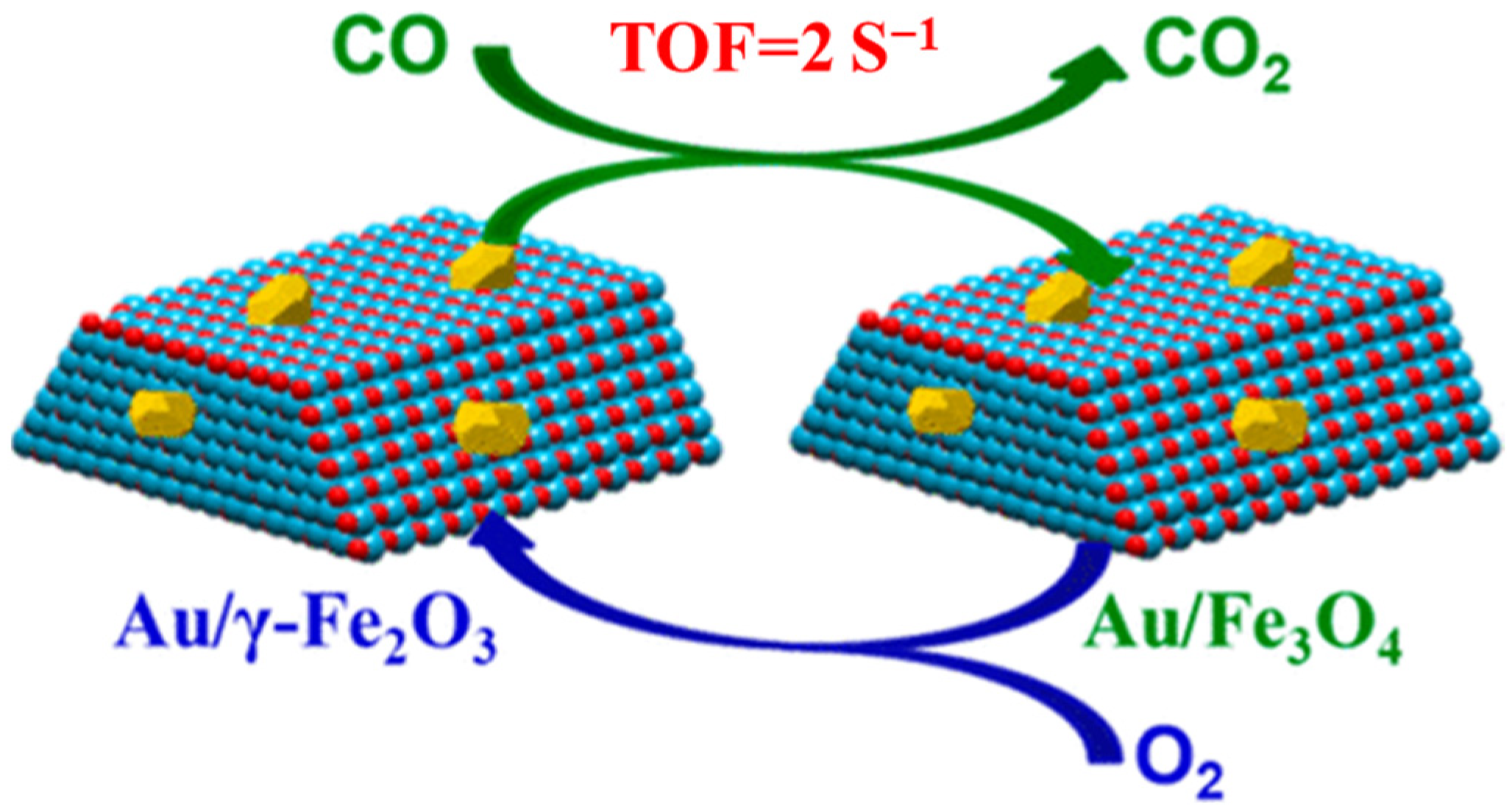
Figure 2. The Mechanism of CO Oxidation over Au/γ-Fe2O3. Reprinted with permission from [95]. Copyright 2015 American Chemical Society.
Catalysts 16 00007 g002
Figure 3. Comparison of microstructures and CO oxidation performance between Pt/c-Cu2O and Pt/o-Cu2O catalysts. Reprinted with permission from [104]. Copyright 2023 American Chemical Society.
Catalysts 16 00007 g003
Figure 4. (a) Interface structures of Au/β-MnO2 and Au/γ-MnO2 catalysts and their promotion and inhibition mechanisms for the CO oxidation reaction. Reprinted with permission from [109]. Copyright 2024 American Chemical Society. (b) The interaction of Pt and β-MnO2 in CO oxidation (adopted from [110]).
Catalysts 16 00007 g004
Figure 5. Differential influence of CeO2 carrier crystal faces on the CO oxidation activity of Au catalysts. Reprinted with permission from [115]. Copyright 2018 American Chemical Society.
Catalysts 16 00007 g005
Figure 6. (a) Synthesis Routes for Ag/Co3O4 Catalysts and Their CO Oxidation Performance. Reprinted with permission from [82]. Copyright 2019 American Chemical Society. (b) The effect of morphology control on the CO oxidation activity of Co3O4 (adopted from [123]).
Catalysts 16 00007 g006
Figure 7. (a) Water induces surface remodeling of catalysts to form novel active sites. Reprinted with permission from [143]. Copyright 2025 American Chemical Society. (b) The hydroxyl group directly participates in the oxidation of carbon monoxide. Reprinted with permission from [144]. Copyright 2021 American Chemical Society. (c) Promote the generation of OOH to effectively activate O2 molecules. Reprinted with permission from [145]. Copyright 2018 American Chemical Society.
Catalysts 16 00007 g007
Figure 8. (a) Inhibiting the formation of surface hydroxyl groups and the water-resistant mechanism of bicarbonate species. Reprinted with permission from [151]. Copyright 2019 American Chemical Society. (b) Incorporating hydrophobic substances to enhance water resistance. Reprinted with permission from [152]. Copyright 2014 American Chemical Society.
Catalysts 16 00007 g008
Figure 9. Common CO oxidation mechanisms.
Catalysts 16 00007 g009
Table 1. Common Precious Metal CO Catalysts.
CatalystsReaction ConditionsCO Conversion
(%)
Temperature (°C)Ref.
Reaction AtmosphereWHSV (mL g−1 h−1)
Pt/TiO2 79.8%N2 + 10%O2 + 0.2%CO30,00050213[62]
Pt(N)/Al2O3 1 vol% CO in air10,00090220[63]
Pt/CeO2-CA0.4%CO/10%O2240,00090136[64]
PtNP/TiO2-R1% CO + 16% O260,00050106[31]
Pt/TiO21% CO + 16% O247,900100100[65]
4.5%Pt/CeO21000 ppm CO + 8% O260,0005085[66]
1%Pt-2%Bi/SiO21% CO + 20% O2134,000100100[67]
1%Pt/SiO21% CO + 20% O2134,000100150[67]
Pt/CeO20.6% CO + 0.6% O280,000100180[68]
0.1%Pt/SiO21% CO + 1% O2120,000100270[25]
Pd@CeO24% CO + 20% O240,000100253[69]
Pd/CeO2(111)2% CO + 2% O260,000100150[70]
Pd/CeO2(100)2% CO + 2% O260,000100200[70]
PdCu-CeO21% CO + 20% O260,000100140[71]
Pd/CeO2(100)2% CO + 2% O260,000100200[70]
Pd/α-Fe2O31% CO + 20% O215,000100120[72]
Pd/γ-Fe2O31% CO + 20% O215,00010080[72]
Pd/MnOx–CeO22% CO + 5% O240,00010050[73]
Ru/Cu-SSZ-13 5000 ppm CO + 5% O23,000,00090190[74]
Ru NWs/TiO21.0% CO + 1.0% O2 + 98% He12,600100150[75]
5Ru/CeO2(110)1% CO + 20% O236,00050135[46]
5Ru/CeO2(111)1% CO + 20% O236,00050157[46]
5Ru/CeO2 (100)1% CO + 20% O236,00050135[46]
Ru/γ-Al2O31% CO + 1% O220,00050155[11]
Ru-Co3O41% CO + 20% O230,00010075[76]
Au/SiO22% CO + 16% O216,000100340[56]
Au/CuO1% CO + 21% O215,00010055[77]
Au/Cu2O1% CO + 21% O215,000100200[77]
Au/CeO2-NR1% CO + 5% O220,0009925[78]
CeOₓ@Au/SiO22% CO + 16% O2 + 82% He16,000100150[56]
111-SC5000 ppm CO + 20% O236,00010025[79]
Au-MLMO5000 ppm CO + 20% O2/100124[80]
Ag/SiO2-7001.0% CO + 1.0% O2 + 98% He12,0009858[81]
Ag/Co3O41.6% CO + 21.4% O230,000100120[82]
Ag/SiO2-9001.0% CO + 1.0% O2 + 98% He12,0009857[83]
Table 2. Common non-precious metal CO catalysts.
CatalystsReaction ConditionsCO Conversion
(%)
Temperature (°C)Ref.
Reaction AtmosphereGHSV(h−1)
CuO/Al2O3–CeO20.3% CO/5% O2/0.02% SO2/N260,0005067[124]
CeO2/o-Cu2O1.8% CO/10% O2/88.2% N240,00050190[125]
CuO-Co3O4-CeO20.4%CO/15%O224,000100125[126]
MCO-3001%CO/20%O224,00010080[127]
γ-MnO2-0.5 h1%CO/20%O218,000100156[128]
Cu-OMS-20.7%CO/10%O213,200100148[129]
13.2%CeO2–CuO/c-Cu2O1%CO/air36,000100140[130]
CuO/Cu2O1%CO/20%O230,000100150[96]
SLC-Omv-OL1% CO/20% O2/He.6000100150[121]
CeO2@TiO21000 ppm CO/5%O215,000100300[131]
Cu0.1MnOx1%CO/20%O236,0009580[106]
Ce–Co–O 600CO: O2 = 1:20 in He12,000100153[7]
CeO25000 ppm CO + 10% O2 in N225,000100400[132]
Co0.9Ce0.1/RSAC2500 ppm CO + 21% O2 in air8000100110[133]
Mn5Co1Ox1% CO in air30,00050183[134]
CuO/γ-Fe2O31% CO + 20% O2 in 79% N2/98.5180[135]
Co3O4/TiO2(A)1% CO/10% O2/89% N26000100−43[136]
FeCe/Al–Cl1.6% CO + 20.8% O2 in 77.6% N230,000100295[137]
Disclaimer/Publisher’s Note: The statements, opinions and data contained in all publications are solely those of the individual author(s) and contributor(s) and not of MDPI and/or the editor(s). MDPI and/or the editor(s) disclaim responsibility for any injury to people or property resulting from any ideas, methods, instructions or products referred to in the content.