
Article

ZnO Nanoparticles Synthesized via a Supercritical-CO2-Assisted Method as Photocatalysts for the Degradation of Water Pollutants
Chemical Engineering Group, Engineering and Technology Institute Groningen (ENTEG), University of Groningen, Nijenborgh 3, 9747 AG Groningen, The Netherlands
*
Author to whom correspondence should be addressed.
Catalysts 2026, 16(1), 64; https://doi.org/10.3390/catal16010064
Submission received: 1 December 2025 / Revised: 26 December 2025 / Accepted: 30 December 2025 / Published: 5 January 2026

Abstract

Zinc oxide (ZnO) is a widely studied photocatalyst for the degradation of organic pollutants in water, yet its conventional sol–gel synthesis often suffers from low yield and produces materials with low specific surface area. In this study, we tackled these limitations by synthesizing ZnO nanoparticles using a supercritical-CO2-assisted sol–gel method (ZnO-scCO2). The influence of the calcination temperature, precursor concentration, and solvent type on the synthesis of ZnO was systematically investigated, and the materials were characterized with a combination of techniques (XRD, SEM, N2 physisorption, UV-Vis-DRS spectroscopy). The photocatalytic performance of the ZnO-scCO2 materials was evaluated in the degradation of two probe pollutants (phenol and rhodamine B, 200 ppm), under UV and visible radiation. The scCO2-assisted method in ethanol as the solvent allowed achieving at least a four-fold higher ZnO yield and two-fold higher surface area compared to the materials prepared with a conventional sol–gel route without scCO2. These ZnO-scCO2 nanoparticles consistently showed enhanced photocatalytic activity in the removal of phenol and rhodamine B compared to their counterparts synthesized without scCO2 and compared to commercial ZnO. Among the screened synthetic parameters, the solvent in which ZnO was prepared proved to be the one with the strongest influence in determining the ZnO yield and its photocatalytic activity. The optimum results were obtained using 0.50 M zinc acetate as the precursor in 1-butanol as the solvent, and calcination at 300 °C.

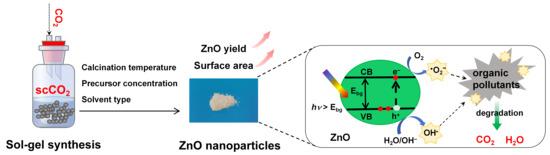
Graphical Abstract

1. Introduction

Persistent organic pollutants (POPs) are organic chemicals with high resistance to biodegradation, leading to their long-term persistence in the environment [1]. POPs can enter ecosystems through various pathways, including industrial effluents, agricultural runoff, and urban drainage [2]. The bioaccumulation of POPs can disrupt food chains and threaten the health of present and future organisms, contaminating freshwater resources [3]. Among these pollutants, phenol and rhodamine B (RhB), which are widely used in textile and paper industries, are often employed as model pollutants in wastewater treatment studies [4,5]. Several technologies have been extensively researched for their ability to remove phenol and RhB from water, such as distillation [6], adsorption [7], extraction [8], biodegradation [9], and chemical oxidation [10]. Among these, photocatalysis is an effective approach for remediating environmental pollutants, offering advantages such as the ability to degrade diverse hazardous contaminants, eco-friendliness, and applicability under mild reaction conditions [11]. Zinc oxide (ZnO) is a highly promising photocatalyst due to its cost-effectiveness, non-toxicity, and high chemical and thermal stability [12]. In general, ZnO nanoparticles exhibit better photocatalytic activity for the degradation of organic contaminants when compared with bulk ZnO due to their larger surface area and specific surface properties, including the presence of surface defects [13]. Various techniques, such as hydrothermal synthesis [14], homogeneous precipitation [15], and sol–gel methods [16], can be employed for the synthesis of ZnO nanoparticles. Sol–gel methods are widely applied because of their simplicity, mild reaction conditions, and tunability for obtaining specific features in terms of particle size and crystallinity [13]. However, they generally lead to low yields of the material and often require substantial amounts of organic solvents and surfactants to improve production efficiency. A strategy to enhance the preparation of nanostructured oxides by sol–gel methods involves the use of supercritical carbon dioxide (scCO2, T ≥ 31.1 °C, p ≥ 73.8 bar) as reaction medium, acting either as solvent or as anti-solvent [17]. ScCO2 is considered a green solvent due to its low toxicity and ease of removal from the reaction mixture, as it spontaneously separates as a gas upon depressurization. It has intermediate properties between those of a gas and a liquid, both in terms of diffusivity and density, with these properties being tunable by controlling the temperature and pressure. For these features, its use as a solvent can provide a green and efficient alternative to traditional solvents [18]. The introduction of scCO2 into the sol–gel solution alters the solvent properties by reducing its polarity and dielectric constant, thereby decreasing the solubility of the product and promoting precipitation, which in turn increases the yield [19]. In addition, the high diffusivity of scCO2 facilitates rapid mass transfer, which promotes the fast attainment of supersaturation and thereby accelerates nucleation and precipitation [20]. Only a few studies have investigated the use of supercritical CO2 in the synthesis of ZnO nanostructured materials, mainly by focusing on morphology/size control (e.g., flower-like architectures) or micronization of ZnO precursors [21,22,23]. However, these studies provide only limited systematic insight into the effects of supercritical processing conditions on the physicochemical properties and photocatalytic performance of the resulting ZnO [21,22,23]. In this study, we report for the first time a supercritical-CO2-assisted sol–gel method to synthesize ZnO nanoparticles with enhanced material yield and surface area, combined with an investigation of their photocatalytic activity in the removal of phenol and rhodamine B. The photocatalytic performance was compared with ZnO prepared without scCO2 treatment and with commercial ZnO, while examining the effects of synthesis parameters including calcination temperature, precursor concentration, and solvent type. Overall, our scCO2-assisted sol–gel method allowed improving ZnO yield and surface area, as well as the activity in the photocatalytic removal of phenol and RhB, compared to ZnO synthesized without scCO2 and commercial ZnO. Among the examined synthetic parameters, the solvent type emerged as the most influential factor.

2. Results and Discussion

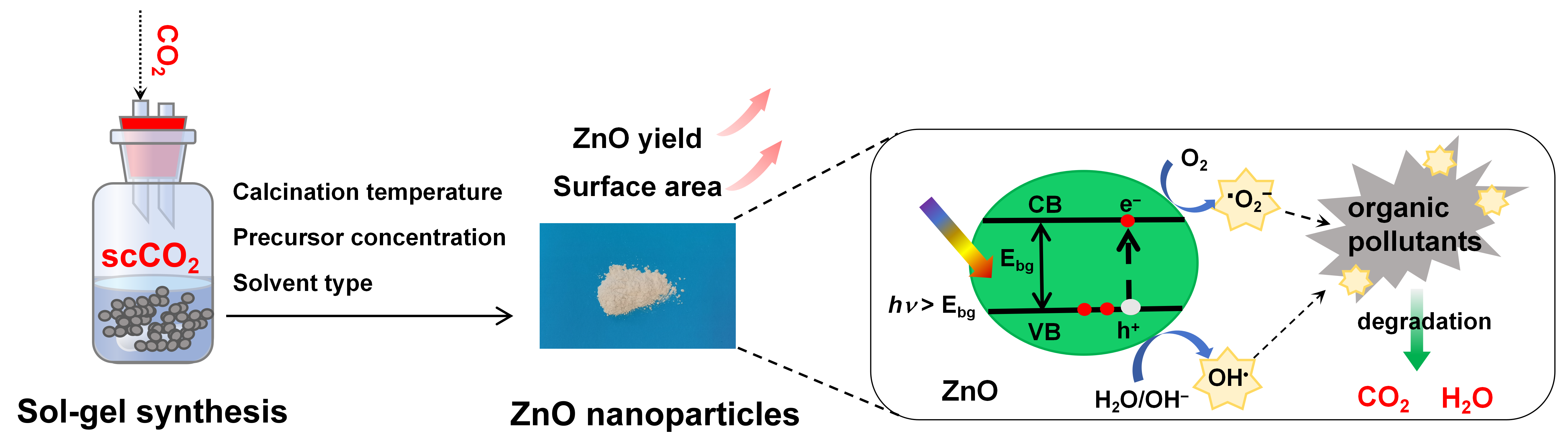
We explored the synthesis of nanostructured ZnO materials via a supercritical-CO2-assisted sol–gel method by investigating the parameters that were expected to exert the most relevant influence on their physicochemical properties and thus on their photocatalytic activity: the calcination temperature, the concentration of the Zn precursor, and the nature of the solvent. The target was to prepare enhanced ZnO photocatalysts and to produce these materials in high yield. The main steps of our sol–gel method in which scCO2 acts as an anti-solvent are summarized in Figure 1 and described in detail in the Section 3.

2.1. Effect of Calcination Temperature

To investigate the effect of calcination temperature on the physicochemical properties and photocatalytic activity of ZnO, a series of materials were prepared using zinc acetate as precursor (0.35 M in ethanol) and employing either our scCO2-assisted sol–gel method (ZnO-scCO2) or under the same conditions but without utilizing scCO2 (ZnO-Ref), followed by calcination at a chosen temperature (200, 300, 400, or 500 °C for 3 h).
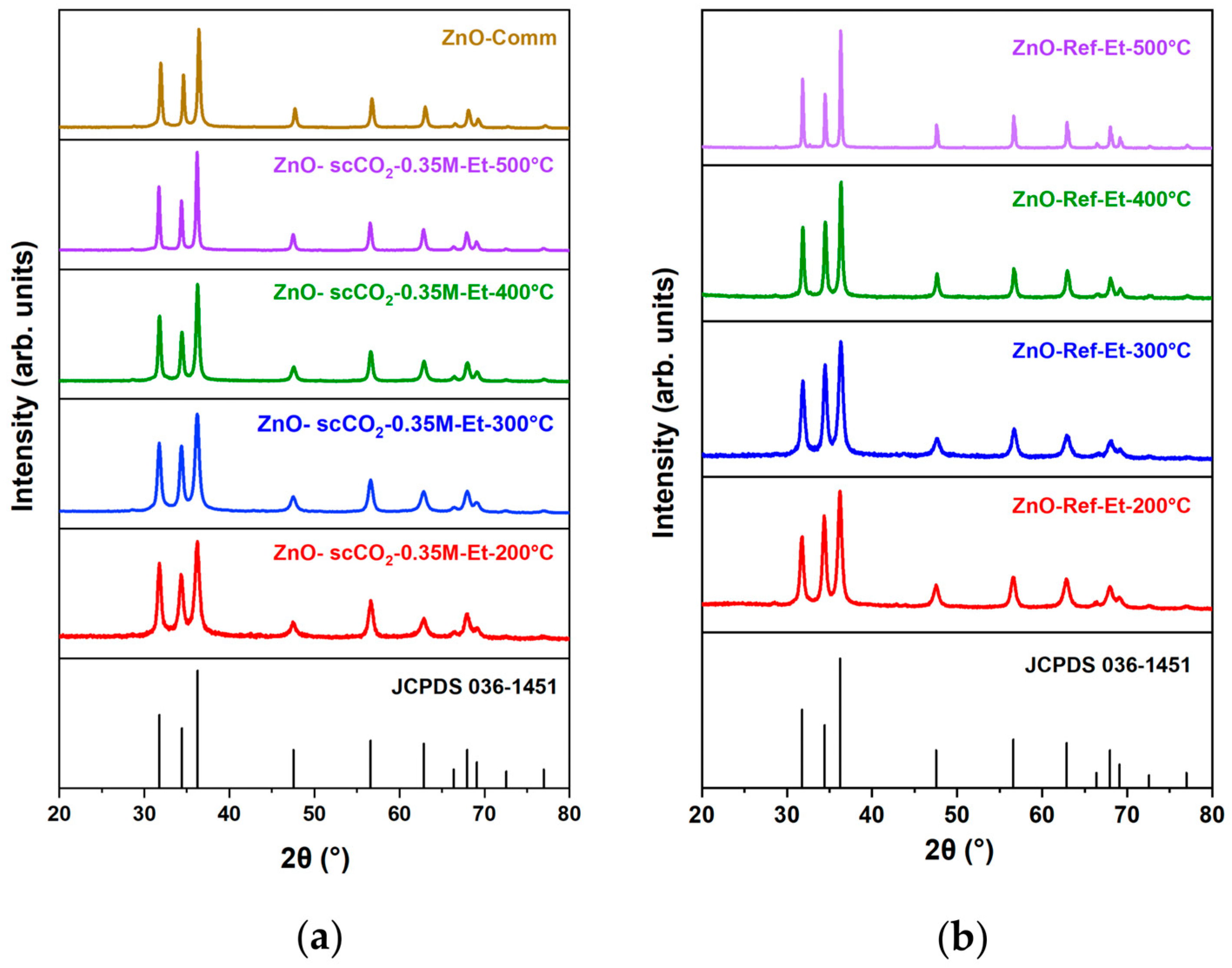
The crystal structure of the prepared ZnO materials was examined by XRD (Figure 2). All patterns display the characteristic diffraction peaks of hexagonal wurtzite ZnO (JCPDS 036-1451) at 2θ values of 31.8, 34.4, 36.4, 47.5, 56.6, 62.9, 66.4, 67.9, and 69.1°, corresponding to the (100), (002), (101), (102), (110), (103), (200), (112), and (201) planes, respectively [24]. No additional peaks were observed, indicating the high phase purity of all samples.
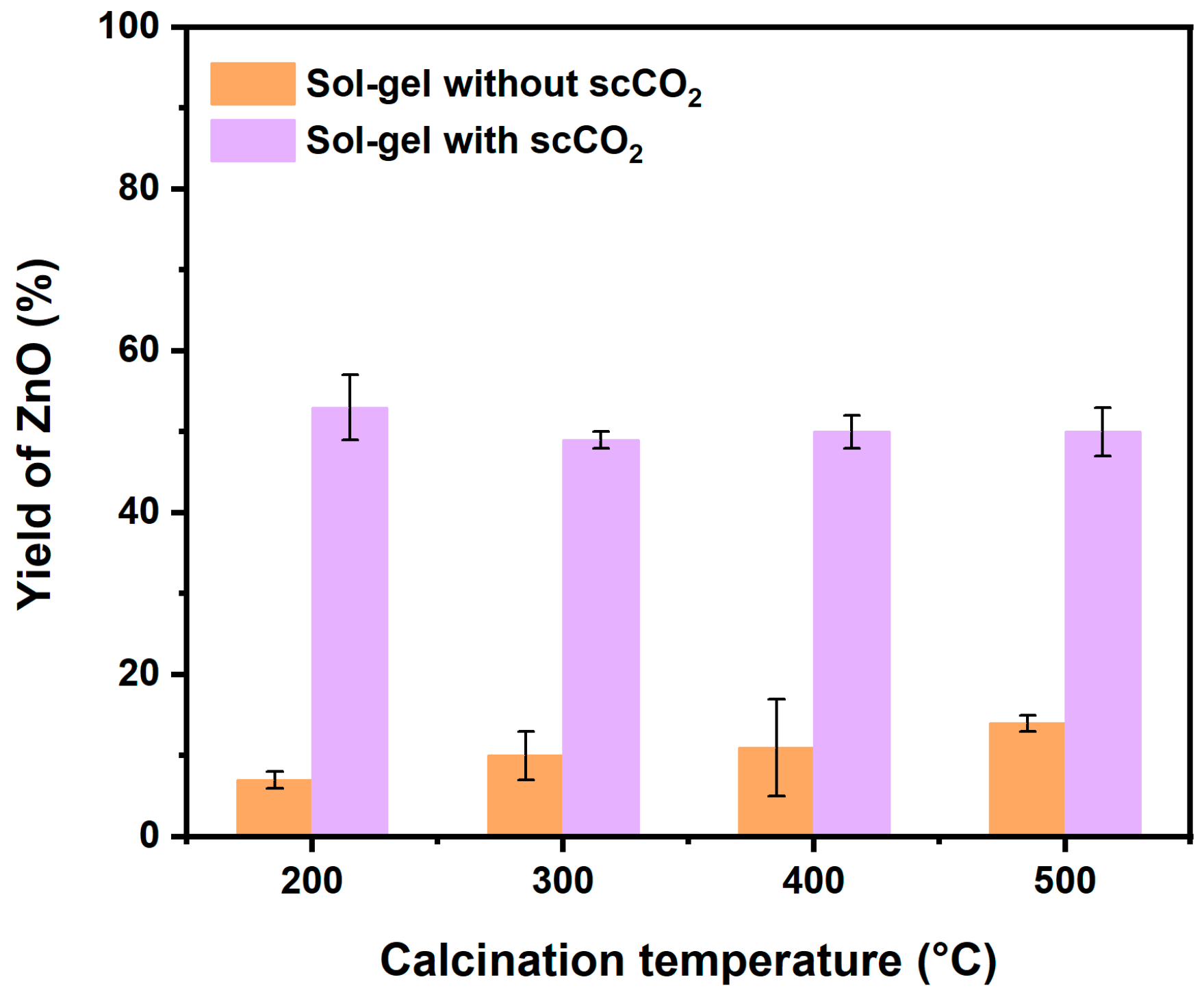
When comparing the yields of ZnO obtained with and without scCO2 assistance (Figure 3), an increase of more than four-fold in ZnO yield (from ~10 to >40%) was observed when employing the scCO2-assisted sol–gel method compared to the method without scCO2 treatment. This improvement is attributed to the role of scCO2 as an anti-solvent, which promotes precipitation during the sol–gel process [25]. The ZnO yield showed only minor changes with calcination temperature (200–500 °C, Figure 3), suggesting that the yield is mainly determined by the conditions during the earlier stages of the sol–gel method. This highlights the importance of factors such as precursor concentration and solvent environment on ZnO formation, which will be discussed further on.
After determining that the calcination temperature had little effect on the yield of ZnO, we examined how it influenced the crystallite size and specific surface area of the ZnO materials. As the calcination temperature increased, a gradual increase in crystallite size based on the Scherrer equation was observed (Table 1), consistent with previous reports indicating that high-temperature treatment promotes crystal growth in oxide semiconductor materials [24]. This is also supported by the SEM images (Figure 4a,b), which reveal that ZnO materials calcined at 500 °C consist of larger nanoparticles than those calcined at 300 °C, in agreement with the crystallite size trend calculated from XRD data. In both cases, noticeable particle aggregation is observed after calcination (Figure 4 and Figure S1). The surface area of the ZnO samples was analyzed by nitrogen adsorption–desorption isotherms, with all samples exhibiting type IV isotherm curves (Figure S2), with hysteresis loops indicating mesopores, which are probably originating from interparticle voids and thus non-structural. As shown in Table 1, increasing the calcination temperature led to a gradual decrease in surface area for all ZnO materials, regardless of whether scCO2 was used or not during the synthesis. When the calcination temperature was 300 °C, the surface area of ZnO-scCO2 (34 m2/g) was found to be more than twice that of ZnO-Ref (15 m2/g). This increase in surface area is expected to promote the adsorption of pollutants and enhance the photocatalytic activity [25]. The particle size and surface area of these materials are in the same range as those of commercial ZnO (ZnO-Comm), which also has the same crystalline phase (Figure 2 and Figure S1, Table 1).
The photocatalytic removal of phenol and RhB using the prepared ZnO materials was investigated to evaluate the effects of scCO2 treatment and calcination temperature on the photocatalytic activity. The mixture of photocatalyst and pollutant solution was first stirred at 1200 rpm in the dark for 1 h to achieve adsorption–desorption equilibrium. The results show that all the ZnO nanoparticles exhibited minimal adsorption of phenol and RhB molecules, as their removal was less than 5% after 1 h of stirring in the dark (Figure S3). The stability of phenol and RhB under UV radiation was examined in the absence of a photocatalyst (blank group, Figure 5a,b), and both compounds exhibited negligible photolysis, with less than 6% degradation after 3 h of UV irradiation. These control tests indicate that the degradation observed under UV radiation is primarily attributable to photocatalytic activity rather than photolysis or adsorption. After 3 h of UV irradiation, ZnO-scCO2-400 showed the highest phenol removal efficiency (42%) among the prepared materials (Figure 5a). This photocatalytic activity was significantly higher than that of ZnO-Comm (23% phenol removal). Also in the removal of RhB, the highest activity was achieved with ZnO photocatalysts prepared with the scCO2-assisted method (ZnO-scCO2-0.35M-Et-300 °C and ZnO-scCO2-0.35M-Et-400 °C), though in this case the improvement compared to ZnO-Comm was less marked (Figure 5b). At each calcination temperature, the ZnO photocatalysts prepared in scCO2 resulted in higher removal efficiencies for both phenol and RhB compared to those synthesized without scCO2 (Figure 5a,b). The observed enhancement in the photocatalytic performance of ZnO-scCO2 can be attributed to the increased surface area, which promotes the adsorption and degradation of these pollutants. The fact that ZnO-scCO2-0.35M-Et-300 °C and ZnO-scCO2-0.35M-Et-400 °C were more active photocatalysts compared to ZnO-scCO2-0.35M-Et-200 °C and ZnO-scCO2-0.35M-Et-500 °C suggests that both the surface area and the crystallinity (and the related number of defects) contribute to defining the performance in phenol and RhB removal efficiencies. Considering both photocatalytic performance and calcination energy demands, 300 °C was chosen as the preferred calcination temperature for subsequent studies on precursor concentration and solvent type.

2.2. Effect of Zn Precursor Concentration

To investigate the effect of the concentration of the Zn acetate precursor on the physicochemical properties and photocatalytic activity of ZnO, a series of ZnO-scCO2 materials were prepared using ethanol as the solvent. Different precursor concentrations were screened (0.10, 0.20, 0.35, 0.40, and 0.50 M), while the calcination temperature was fixed at 300 °C for 3 h.
XRD patterns (Figure S4) show that all ZnO materials obtained at different precursor concentrations exhibit the characteristic peaks of hexagonal wurtzite ZnO (JCPDS 036-1451) without any additional phases. The ZnO yields (Figure 6) range from 48 to 57%, indicating that the precursor concentration has only a minor influence on this feature. The similar ZnO yields at different precursor concentrations can be explained by considering how this synthetic parameter possibly affects the sol–gel steps. The hydrolysis degree is influenced by the chosen H2O:Zn ratio and reaction time [26,27], while condensation and gelation are expected to be triggered by the scCO2 anti-solvent effect [19]. In all cases in the concentration range between 0.10 M and 0.50 M, supersaturation is likely reached with scCO2 assistance, leading to the observed formation of a precipitate. Thus, increasing the concentration may only alter the gel volume and nucleation rate rather than significantly affecting the final yield [28].
The crystallite sizes of the ZnO nanoparticles were calculated to be 9–15 nm (Table 2), which is consistent with the SEM images, showing similar size for ZnO-scCO2-0.35M-Et-300 °C and ZnO-scCO2-0.50M-Et-300 °C (Figure 4a,c). As shown in Table 2, varying the precursor concentration caused a slight increase in crystallite size, while the specific surface areas were largely unaffected.
It is worth noting that the nanoparticles prepared with the scCO2-assisted sol–gel method display a nearly isotropic morphology and can be obtained with small size (<20 nm). This differs significantly from methods based on thermal decomposition of zinc salts (e.g., zinc acetate), which tend to produce larger, elongated nanostructures [29].
The photocatalytic degradation of phenol and RhB with this series of ZnO materials was examined to assess how precursor concentration influences ZnO photocatalytic activity. Also, in this case, control tests showed negligible dark adsorption (<5%) (Figure S5), indicating that the observed degradation is primarily due to photocatalytic activity. With increasing precursor concentration during the synthesis, the ZnO photocatalysts exhibited a gradual improvement in removal efficiencies, rising from 27 to 42% for phenol and from 31 to 61% for RhB (Figure 7a,b). The most active among the prepared photocatalysts, ZnO-scCO2-0.50M-Et-300 °C, exhibited markedly higher removal efficiencies than ZnO-Comm (phenol 21%; RhB 47%). Although the prepared ZnO materials exhibited similar specific surface area and crystallite size with different precursor concentrations, their photocatalytic activities varied, indicating that other factors also affect their performance. The possible reason may be that increasing precursor concentration leads to faster solution supersaturation and nucleation, and this in turn can facilitate the formation of ZnO materials that are richer in oxygen vacancies [28]. These vacancies can serve as sites that enhance charge separation and reactant adsorption, thereby improving the photocatalytic performance of ZnO [29]. Considering the enhanced photocatalytic performance of ZnO-scCO2-0.50M-Et-300 °C in removing phenol and RhB, a precursor concentration of 0.50 M was selected as the optimum value for subsequent studies on the effect of the solvent type used in the synthesis of ZnO.

2.3. Effect of Solvent Type

To investigate the effect of the solvent type used during the synthesis of the ZnO materials on their physicochemical properties and photocatalytic activity, a series of ZnO-scCO2 materials were prepared using a precursor concentration of 0.50 M in the following solvents: ethanol (the solvent used so far), 1-propanol, 1-butanol, 2-butanol, tert-butanol, and 1-hexanol. The calcination temperature was fixed at 300 °C for 3 h. The chosen solvents are all alcohols that are expected to be able to undergo solvolysis with the Zn precursor. They were selected for their differences in terms of polarity and steric hindrance (Table 3), as these factors are expected to influence the steps in the sol–gel synthesis of ZnO, i.e., the metal alkoxide formation, hydrolysis, condensation, and precipitation in supercritical CO2.
The XRD patterns (Figure S6) indicated that ZnO synthesized with different solvents consistently crystallized in the hexagonal wurtzite structure (JCPDS 036-1451), with no detectable additional phases. Although the crystal phase was the same, the solvent significantly affected the ZnO yield, ranging from approximately 50% with ethanol to over 90% with tert-butanol (Figure 8). The solvent not only determines the solubility of the Zn-containing species but also likely affects reaction rates and equilibria in metal-alkoxide formation, hydrolysis, condensation, and the effectiveness of scCO2 as an anti-solvent.
The formation of metal alkoxides (Equation (1)) is influenced by the polarity and the steric hindrance of the solvent (Table 3). As suggested in previous studies [30], short-chain alcohols, such as ethanol and 1-propanol, due to their high polarity and low steric hindrance, are likely to facilitate the rapid formation of metal alkoxides. In contrast, branched alcohols (such as 2-butanol and tert-butanol) and those with long chains (e.g., 1-hexanol), with their lower polarity and increased steric hindrance, tend to impede alkoxide formation.
Z n ( O A c ) 2 + 2 R O H Z n ( O R ) 2 + 2 A c O H
Solvent polarity, miscibility with water, and steric hindrance in combination affect the hydrolysis of Zn–OR species (Equations (2) and (3)). To assess if the reaction mixtures were mono- or biphasic, we prepared test mixtures without Zn precursors (10 mL solvent + 0.45 g H2O). Only with 1-hexanol the system was initially biphasic, but it merged into a single phase within ~5 min upon shaking. All other mixtures were visually monophasic (Figure S7). Consistent with their properties (Table 3), ethanol and 1-propanol, which are highly polar and display higher water solubility, likely enable faster hydrolysis. In contrast, 1-butanol, 2-butanol, tert-butanol and 1-hexanol are expected to hinder hydrolysis due to steric hindrance and their lower water solubility [31,32,33,34].
Z n ( O R ) 2 + H 2 O Z n ( O H ) ( O R ) + R O H
Z n ( O R ) 2 + 2 H 2 O Z n ( O H ) 2 + 2 R O H
Condensation is favored by frequent Zn–OH/Zn–OR encounters and low-hindrance alkoxy leaving groups (Equations (4) and (5)). Ethanol and 1-propanol display higher water solubility and have smaller alkoxy groups (OEt, OPr), so encounters are frequent. 1-Butanol displays lower water solubility, so encounter frequency and diffusion are lower. 2-Butanol and tert-butanol display higher steric bulk at the OR group (secondary, tertiary), which is expected to limit the condensation reaction (Equation (5)). 1-Hexanol displays the lowest water solubility among the alcohols tested as solvents and its larger molecular size is expected to decrease encounter frequency and diffusion [31,32,33,34].
Z n O H + Z n O H Z n O Z n + H 2 O
Z n O H + Z n O R Z n O Z n + R O H
When scCO2 is introduced, solvent–CO2 compatibility also plays a role. Ethanol, due to its higher polarity and stronger hydrogen bonding, has low affinity for scCO2, which implies that scCO2 is expected to dissolve only partially into the ethanol phase. In contrast, tert-butanol, with the lowest polarity among the tested alcohols, has higher solvation ability towards scCO2, which means that the effect of scCO2 as an anti-solvent is expected to be more marked than with 1-propanol, 1-butanol, and 2-butanol, promoting precipitation [32] and thus leading to the observed larger ZnO yield (Figure 8). In the subsequent cooling, depressurization, and aging steps, solvent-dependent solubilities of residual Zn species likely continue to affect the ZnO yield. Supersaturation of the solution and incipient gelation may immobilize soluble compounds (e.g., zinc acetate, zinc hydroxy/alkoxide clusters) within the gel network, making them less readily removed by washing, especially when using branched alcohols (2-butanol and t-butanol), as demonstrated in a previous report [31]. Upon calcination at 300 °C, these trapped species have been reported to decompose into ZnO [35]. Overall, solvent polarity, steric effects, CO2 compatibility, and residual Zn species act synergistically to determine the ZnO yield, with the overall observed trend of t-butanol > 2-butanol ≈ 1-butanol ≈ 1-propanol > 1-hexanol > ethanol (Figure 8).
Table 3. Physicochemical properties of the solvents used for ZnO synthesis, including polarity, molecular structure, molar volume, dielectric constant, and solubility of water [36,37,38].
SolventRelative
Polarity a
Structure
Type
Molar
Volume (mL mol−1)
Dielectric Constant εSolubility of Water (w/w) b
Ethanol0.65Linear (C2)5824.5100%
1-Propanol0.62Linear (C3)7521.8100%
1-Butanol0.59Linear (C4)9217.820%
2-Butanol0.51Branched (C4)9215.865%
t-Butanol0.39Branched (C4)9510.9n.a.
1-Hexanol0.56Linear (C6)12613.3n.a.
a Relative polarity is expressed as Reichardt’s normalized solvent polarity parameter E T N (0 for tetramethylsilane and 1 for water). b Solubility of water in each solvent (w/w) at 20 °C, data taken from refs. [36,37,38]. Note: “n.a.” indicates that data were not available in the consulted databases.
In addition to yield, it is also important to understand how the solvent influences the physicochemical properties of the obtained ZnO materials, including their crystallite size, specific surface area and morphology. The crystallite size of the ZnO materials (Table 4) was not markedly affected by the nature of the alcohol used as solvent, with a slight trend of increasing size with increasing molecular mass of the alcohols, going from 15 nm in ethanol to 22 nm in 1-hexanol. Correspondingly, the specific surface areas slightly decreased, ranging from 31 m2/g for the ZnO prepared in ethanol to 22 m2/g in 1-hexanol. SEM images revealed that the morphology of ZnO particles is not significantly affected by the nature of the solvent, showing that all are aggregated nanoparticles (Figure S8).
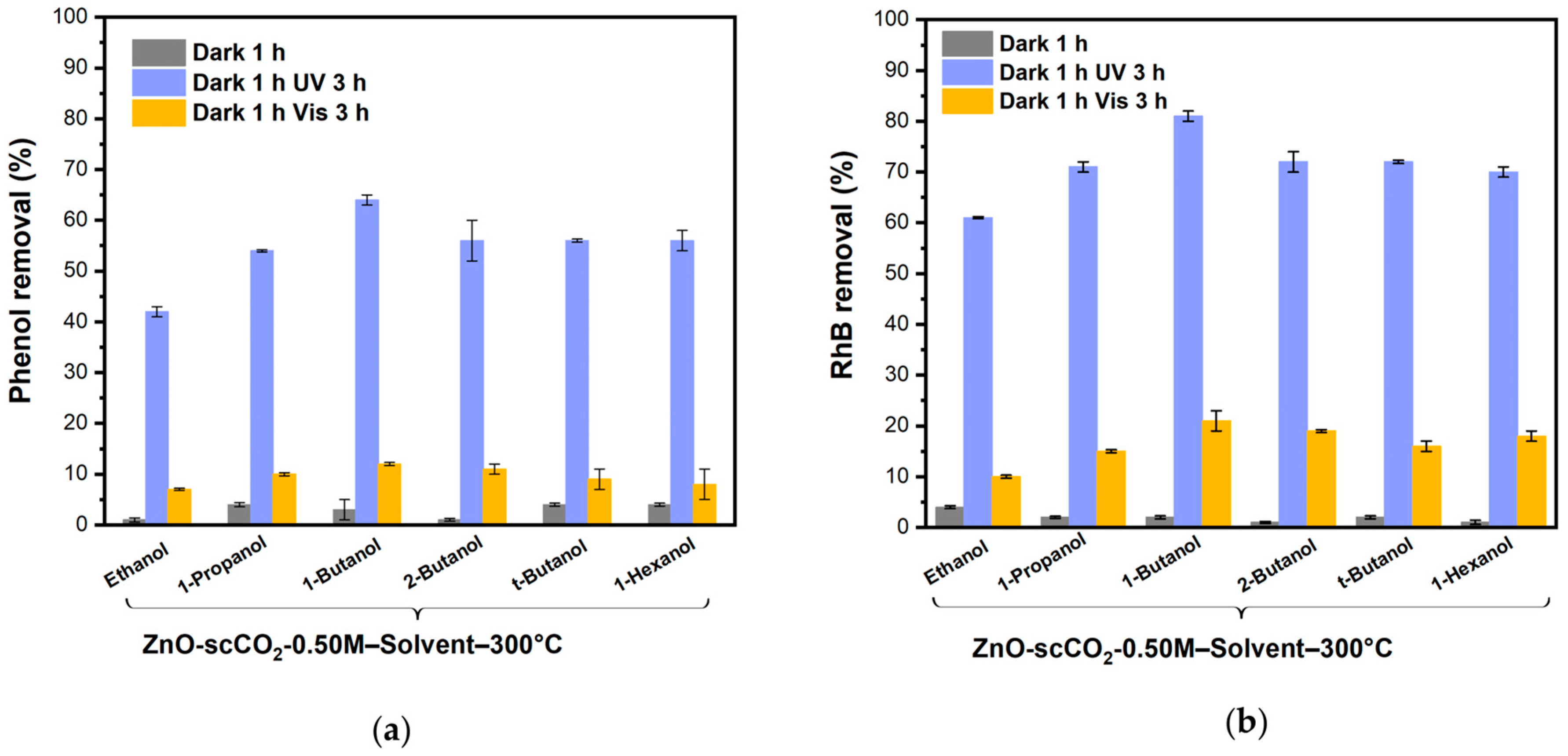
The effect of the solvent used in the synthesis of the ZnO materials on their photocatalytic performance was assessed by degrading phenol and RhB under UV and visible radiation. The observed removal was mainly attributed to photocatalytic degradation, since the dark adsorption of both phenol and RhB was less than 5% (Figure 9, Dark 1 h). Under UV irradiation, the removal efficiencies of phenol and RhB increased with the ZnO photocatalysts prepared using longer-chain linear alcohols from ethanol to 1-butanol. With 1-butanol, the highest activity was observed, achieving approximately 64% phenol removal and nearly 81% RhB removal after 3 h, which is an improvement over the material prepared in ethanol (42% for phenol and 61% for RhB). The removal efficiencies decreased when using branched alcohols (2-butanol, tert-butanol) and 1-hexanol, with these photocatalysts achieving similar removal efficiency, both for phenol (~56%) and RhB (~72%). It is worth noting that while these photocatalysts are highly effective in the removal of the probe organic pollutants, they do not lead to their complete mineralization within the test time. Indeed, additional peaks were observed by HPLC at the end of the photocatalytic test with phenol. Based on LC-MS analysis carried out in previous work from our group [29], these peaks are attributed to intermediates in the degradation of phenol to CO2 and H2O (e.g., catechol, hydroquinone, and benzoquinone).
For all solvents, the ZnO materials showed lower photocatalytic activity under visible radiation than under UV radiation, which is consistent with the wide bandgap of ZnO (~3.22 eV) [31] and its limited absorption of visible radiation (Figure S9). Under visible radiation, a similar trend in solvent influence was observed, with ZnO-scCO2-0.50M-1Bu-300 °C showing the best performance (12% phenol removal and 21% RhB removal). This result is in line with a previous report [31], which showed that using 1-butanol as the solvent (without scCO2) helps achieve higher photocatalytic activity compared to other solvents like ethanol, 1-propanol, 1-pentanol, and 1-hexanol.
From a sustainability perspective, most of the alcohols used in this work (e.g., ethanol, 1-propanol, 1-butanol) are ranked as recommended solvents [39]. Moreover, scCO2 is widely regarded as a green processing medium, as it can be readily removed from the reaction mixture by depressurization, recovered and reused [18]. Therefore, our scCO2-assisted method is not only effective for preparing small ZnO nanoparticles in high yield but can also be considered a sustainable approach.
Triggered by the relevant effect played by the nature of the solvent used in combination with scCO2 in synthesizing ZnO, we investigated the effect of using 1-butanol as the solvent, but without scCO2 treatment. When no scCO2 treatment was applied, the yield of the ZnO material (ZnO-Ref-1Bu) was 32%, which is higher than that obtained with ZnO-Ref-Et (8%), but much lower than that with the scCO2-assisted method (81%). ZnO-Ref-1Bu consists of phase-pure ZnO in hexagonal wurtzite structure (as shown by XRD, Figure S10) and has a surface area of around 25 m2/g. The photocatalytic activity of ZnO-Ref-1Bu was explored by removing phenol and RhB under UV radiation. For comparison, commercial P25-TiO2 with a specific surface area of ~60 m2/g and composed of small, irregular particles with an average diameter of ~27 nm [29], was tested under the same conditions as reference photocatalyst. ZnO-Ref-1Bu showed the highest removal of phenol (76%) and RhB (91%), outperforming ZnO-scCO2-0.50M-1Bu-300 °C (64% phenol, 81% RhB) and P25-TiO2 (65% phenol, 91% RhB) (Figure 10).
These results demonstrate that, while using scCO2 in combination with 1-butanol as the solvent allows enhancing the ZnO yield, it does not contribute to improving the photocatalytic activity of ZnO. On the other hand, with ethanol as the solvent scCO2 enhances both yield and activity (vide supra). These results show that in our sol–gel method, the effect of scCO2 is affected by the nature of the solvent. When ethanol is used, scCO2 leads to a ZnO material with increased surface area, which can contribute to the improved photocatalytic activity. With 1-butanol, scCO2 does not help increase the surface area. Furthermore, our results suggest that the addition of scCO2 to the ethanol solution rapidly creates a supersaturated environment, giving fast nucleation and possibly generating a material with oxygen vacancies that help with the photocatalysis [29]. By contrast, supersaturation of the Zn species tends to be reached in 1-butanol even without scCO2. Future work can aim at further rationalizing these results by investigating how the screened synthetic parameters affect the defect population of the prepared ZnO materials using different techniques (x-ray photoelectron spectroscopy, photoluminescence and electron paramagnetic resonance spectroscopy). Recent work from our group showed that the amount, type (Zn or O vacancies) and location (surface vs. bulk) of defects can influence the photocatalytic activity of ZnO, with surface O vacancies being beneficial for the photocatalytic activity [29]. Future work can also investigate the reusability of these ZnO photocatalysts, although in general ZnO-based photocatalysts have been reported to demonstrate good structural stability and recyclability under similar conditions to those used in this work [29,40,41,42].

3. Materials and Methods

3.1. Materials

Zinc acetate dihydrate (≥99%), commercial ZnO (ZnO-Comm), P25-TiO2, phenol (ACS reagent, purity > 99.0%), rhodamine B (RhB, ≥95%) were purchased from Sigma-Aldrich (Louis, MO, USA). Ethanol, 1-propanol, 1-butanol, 2-butanol, tert-butanol, and 1-hexanol (all ≥98% purity) were purchased from Sigma-Aldrich (Louis, MO, USA). Benzyl alcohol (≥98%), orthophosphoric acid (85% w/w aqueous solution), sodium dihydrogen phosphate (≥99%) were acquired from Merck (Rahway, NJ, USA). Acetonitrile was obtained from Honeywell (Thermo Fisher Scientific, Waltham, MA, USA). All aqueous solutions were prepared using Milli-Q water. All chemicals were used without further purification.

3.2. Synthesis of ZnO

The synthesis was conducted using a high-throughput scCO2 reactor (Figure S11), which allows multiple experiments to be performed simultaneously under controlled supercritical conditions [43]. The synthesis procedure was inspired by a previously reported sol–gel method [21], in which ZnO is formed through a sequence of metal alkoxide formation, hydrolysis and condensation reactions, with the crucial innovation of including a supercritical CO2 treatment. In our standard synthesis method (Figure 1), Zn(OOCCH3)2·2H2O (1.54 g) was dissolved in ethanol (20 mL) under magnetic stirring to prepare a 0.35 M zinc precursor solution. Deionized water was then added slowly to the solution to reach a molar ratio of H2O:Zn = 5:1. The mixture was transferred into the scCO2 reactor and stirred at 40 °C for 3 h. Subsequently, the system was heated to 80 °C and pressurized to 80 bar with CO2 under continuous stirring for 3 h. The reactor was cooled to 20 °C, and CO2 was removed by slowly depressurizing at an average rate of 1.5 bar min−1. The resulting white gel was aged overnight, thoroughly washed with ethanol and deionized water, and centrifuged three times until the pH of the supernatant reached neutrality. After drying at 100 °C overnight in an oven, the materials were transferred into an open crucible (without lid) and calcined in a muffle furnace (Nabertherm P330, Lilienthal, Germany) under static ambient air by heating from room temperature to 300 °C at 2 °C min−1, holding for 3 h, and then cooling naturally to room temperature inside the furnace. The ZnO sample obtained via this method was denoted as ZnO-scCO2-0.35M-Et-300 °C.
The above-described method was then modified to examine systematically the influence of calcination temperature (200–500 °C), Zn precursor concentration (0.10–0.50 M), and solvent type (ethanol, 1-propanol, 1-butanol, 2-butanol, tert-butanol, and 1-hexanol) on the physicochemical properties and photocatalytic activity of the ZnO materials. The samples were labeled as follows: ZnO-scCO2-[concentration of Zn precursor]-[solvent]-[calcination temperature].
To investigate the impact of scCO2 on the yield and photocatalytic activity, a reference catalyst (ZnO-Ref) was synthesized using a similar method in a round-bottom flask but without scCO2 treatment, while commercial ZnO was employed as the benchmark photocatalyst, denoted as ZnO-Comm.

3.3. Characterization

X-ray diffraction (XRD) patterns were recorded on a D8 Advance diffractometer (Bruker, Karlsruhe, Germany), employing Cu Kα radiation (λ = 1.5418 Å). 2θ scans from 20 to 80° were collected with a step size of 0.02° and a counting time of 1.00 s per step. The average crystallite size of the ZnO materials was calculated using the Scherrer equation [44],
D = K λ β c o s θ
where K is the Scherrer constant, λ is the X-ray wavelength, β is the full width at half maximum (FWHM) of the selected diffraction peak, and θ is the Bragg angle. The calculation was performed for five representative diffraction peaks, and the mean value was taken as the average crystallite size.
The morphology of the ZnO materials was examined using a scanning electron microscope (SEM, Nova NanoSEM 650, Thermo Fisher Scientific/FEI, Waltham, MA, USA). The images were recorded after gold sputter coating the samples with a thickness of approximately 20 nm.
Nitrogen adsorption–desorption isotherms were obtained using an ASAP 2420 analyzer (Micromeritics, Norcross, GA, USA) with approximately 100 mg of each powdered sample. Before the measurements, the samples were degassed at 200 °C for 12 h under vacuum (133 mbar). The specific surface area was determined using the Brunauer–Emmett–Teller (BET) method [45].
UV–visible diffuse reflectance spectra (UV–Vis–DRS) were recorded on a Jasco V-570 spectrophotometer (Jasco, Tokyo, Japan) equipped with an integrating sphere. Before measurement, the ZnO powders were finely ground and mixed with barium sulfate, which served as a non-absorbing reference to improve reflectance. Data were acquired in the 300–700 nm range with a scan rate of 200 nm min−1 and a spectral bandwidth of 0.2 nm. The optical band gap was estimated from Tauc plot analysis using the relation [46]:
( α h v ) 1 / n = K ( h v E g )
where α is the absorbance (cm−1, proportional to the absorption coefficient), is the photon energy (eV, where h = 6.62607015⋅10−34 J Hz−1 is Planck’s constant and ν [Hz] is the frequency, 1 eV = 1.602 × 10⁻¹⁹ J), Eg (eV) is the band gap energy, and K is the Tauc proportionality constant (cm−2 eV). For ZnO, which is a direct band gap semiconductor (n = 1/2), the data were plotted as (αhv)2 against hv. The band gap (Eg) was determined by drawing a tangent at the inflection point of the curve, then extending it to intersect the horizontal axis. The x-coordinate of this intersection represents Eg.

3.4. Photocatalytic Tests

The photocatalytic performance of the ZnO materials was evaluated through the degradation of phenol and rhodamine B (RhB) under both ultraviolet (UV) and visible radiation. A photoreactor with a rotating carousel (Figure S12) was used, allowing simultaneous testing of up to 16 samples. To ensure stable conditions, the temperature was kept at 35 °C by a flow of cool air. The reactor was fitted with eight lamps, either UV (FL8BL-B, Toshiba, Kawasaki, Japan, λmax = 350 nm) or visible light (F8T5/CW, cool white), manufactured by Hitachi (Tokyo, Japan). With all eight lamps switched on, the irradiance/illuminance at the sample position was 1.55 mW cm−2 (UV) or 10,200 lux (visible light). In a typical test, 5.0 mg of the photocatalyst was added to a Pyrex vial, followed by 5.0 mL of an aqueous solution containing 200 ppm (mg/L) of phenol or RhB. This concentration corresponds to 2.13 mmol/L for phenol and 0.418 mmol/L for RhB. We selected an initial concentration of 200 ppm to represent a high-concentration pollutant scenario relevant to industrial wastewaters, in which phenolic pollutants can reach hundreds to thousands of mg/L, whereas dye concentrations in textile wastewater are often in the tens of mg/L range [47,48,49]. A stirring bar was placed in the vial, and the vial was sealed with a Teflon-lined cap. In all the photocatalytic tests, the mixture was stirred at 1200 rpm in the dark for 1 h to reach adsorption–desorption equilibrium, after which it was irradiated for 3 h using either UV or visible radiation with the same stirring rate. At the end of the test, the phenol suspension was collected with a 5 mL syringe, filtered through a syringe equipped with a 0.20 µm PTFE membrane to remove the photocatalyst, and the resulting solution was used for determining phenol concentration by high-performance liquid chromatography (HPLC). The HPLC sample was prepared by mixing 0.50 g of the filtered solution with 0.50 g of a 500 ppm aqueous benzyl alcohol solution as the internal standard. The HPLC was equipped with a C18 column and operated with an injection volume of 5.0 μL each time. The mobile phase for analyzing phenol consisted of 25% (v/v) acetonitrile and 75% (v/v) 10 mM phosphoric acid aqueous solution, delivered at a flow rate of 1.25 mL/min, with phenol detection carried out at 270 nm (Figure S13a for the calibration curve). In contrast, the concentration of RhB was determined by UV–Vis spectroscopy on a Cary 600 spectrophotometer (Agilent, Santa Clara, CA, USA). The photocatalyst was removed by centrifugation at 4500 rpm for 10 min, and the supernatant was diluted 20-fold to keep the absorbance within the linear range of the Lambert–Beer law. RhB showed a maximum absorption at 554 nm, which was used to establish the calibration curve correlating absorbance with concentration (Figure S13b).
For both phenol and RhB, the quantification of pollutant removal was based on the change in concentration during the reaction, calculated using the following equation:
R = C 0 C t C 0 · 100 %
where C0 (ppm) is the initial concentration and Ct (ppm) is the concentration after the photocatalytic test.

4. Conclusions

In this study, a supercritical CO2-assisted sol–gel method was developed to synthesize ZnO nanoparticles for the photocatalytic degradation of phenol and RhB. The ZnO materials prepared with scCO2 were systematically compared with both ZnO prepared without scCO2 and commercial ZnO, in terms of material yield, physicochemical properties, and photocatalytic activity.
The introduction of scCO2 significantly enhanced the yield of ZnO, achieving more than a four-fold increase compared to the conventional sol–gel route without scCO2 treatment when using ethanol as the solvent. This improvement is attributed to the anti-solvent effect of scCO2, which promotes precipitation during the sol–gel process.
The effect of three key synthetic parameters, i.e., calcination temperature, precursor concentration, and solvent type, was systematically explored. Increasing the calcination temperature led to a larger average crystallite size and lower surface area. ZnO-scCO2-0.35M-Et-300 °C showed improved photocatalytic performance under UV radiation (38% phenol and 55% RhB removal), compared to ZnO-Ref-Et-300 °C (23% phenol and 44% RhB removal) and commercial ZnO (21% phenol and 47% RhB removal). Increasing precursor concentration from 0.10 M to 0.50 M under scCO2 brought about a gradual improvement in the photocatalytic performance. The optimum was reached using a 0.50 M concentration of zinc precursor, which led to a ZnO photocatalyst that achieved 42% phenol and 61% RhB removal under UV radiation. Among the investigated synthetic parameters, tuning the nature of the solvent showed the most beneficial effect. Using 1-butanol instead of ethanol allowed increasing the ZnO yield to 81%. Additionally, the obtained material (ZnO-scCO2-0.35M-1Bu-300 °C) displayed enhanced photocatalytic activity, reaching 64% phenol and 81% RhB removal under UV radiation. The counterpart ZnO prepared with the same solvent but without scCO2 treatment, though obtained in much lower yield (32%), showed slightly better activity in pollutant removal (76% phenol and 91% RhB). This proved that the effect of scCO2 on the photocatalytic activity of ZnO is strongly affected by the nature of the solvent.
In summary, we introduced a tunable scCO2-assisted method that is effective for the sustainable synthesis of small ZnO nanoparticles (≤20 nm) in high yield. The obtained materials were proven to be active photocatalysts for the degradation of water pollutants and might find additional use in the diverse applications in which ZnO nanoparticles are employed (e.g., cosmetics, agricultural products).

Supplementary Materials

The following supporting information can be downloaded at https://www.mdpi.com/article/10.3390/catal16010064/s1. Figure S1. SEM images of ZnO-Comm and ZnO-scCO2-0.35M-Et-300 °C. Figure S2. N2 adsorption-desorption isotherms of selected ZnO materials. Figure S3. Dark adsorption of phenol and RhB by the ZnO photocatalysts. Figure S4. XRD patterns of the ZnO materials synthesized with scCO2 assistance employing different precursor concentration. Figure S5. Dark adsorption of phenol and RhB by ZnO-scCO2 photocatalysts synthesized with different precursor concentrations. Figure S6. XRD patterns of the ZnO materials synthesized with scCO2 assistance with different solvents. Figure S7. Photographs of solvent–water mixtures. Figure S8. SEM images of ZnO-scCO2 materials synthesized using different solvents. Figure S9. UV–Vis absorption spectrum of ZnO-scCO2-0.35M-Et-300 °C. Figure S10. XRD pattern of ZnO-Ref-1Bu. Figure S11 High-throughput reactor used to prepare the ZnO materials with the scCO2-assisted method. Figure S12. In-house developed photoreactor used for the photodegradation experiments. Figure S13. Calibration curves of the two organic compounds used as probe pollutants.

Author Contributions

Conceptualization, P.P.P.; formal analysis, S.L.; investigation, S.L. and P.P.P.; visualization, S.L.; writing—original draft preparation, S.L. and P.P.P.; writing—review and editing, P.P.P. and S.L.; supervision, P.P.P. All authors have read and agreed to the published version of the manuscript.

Funding

China Scholarship Council Ph.D. grant of Shuangxue Li (No. 202106460006).

Data Availability Statement

Data will be made available upon request.

Acknowledgments

Shuangxue Li gratefully acknowledges the China Scholarship Council for a Ph.D. grant. The authors thank Wesley Browne (University of Groningen) for support with UV-Vis diffuse reflectance measurements. All authors thank Marcel de Vries and Henk van de Bovenkamp for technical support, and Léon Rohrbach and Gert-Jan Boer for analytical support.

Conflicts of Interest

The authors declare no conflicts of interest.

References

  1. Aravind Kumar, J.; Krithiga, T.; Sathish, S.; Renita, A.A.; Prabu, D.; Lokesh, S.; Geetha, R.; Namasivayam, S.K.R.; Sillanpää, M. Persistent organic pollutants in water resources: Fate, occurrence, characterization and risk analysis. Sci. Total Environ. 2022, 831, 154808. [Google Scholar] [CrossRef]
  2. Hidayati, N.V.; Asia, L.; Khabouchi, I.; Torre, F.; Widowati, I.; Sabdono, A.; Doumenq, P.; Syakti, A.D. Ecological risk assessment of persistent organic pollutants (POPs) in surface sediments from aquaculture systems. Chemosphere 2021, 263, 128372. [Google Scholar] [CrossRef] [PubMed]
  3. Ge, M.; Wang, X.; Yang, G.; Wang, Z.; Li, Z.; Zhang, X.; Xu, Q. Persistent organic pollutants (POPs) in deep-sea sediments of the tropical western Pacific Ocean. Chemosphere 2021, 277, 130267. [Google Scholar] [CrossRef]
  4. Mohamad Said, K.A.; Ismail, A.F.; Abdul Karim, Z.; Abdullah, M.S.; Hafeez, A. A review of technologies for the phenolic compounds recovery and phenol removal from wastewater. Process Saf. Environ. Prot. 2021, 151, 257–289. [Google Scholar] [CrossRef]
  5. Wierzbicka, E.; Kuśmierek, K.; Świątkowski, A.; Legocka, I. Efficient Rhodamine B dye removal from water by acid- and organo-modified halloysites. Minerals 2022, 12, 350. [Google Scholar] [CrossRef]
  6. El-Ashtoukhy, E.S.Z.; El-Taweel, Y.A.; Abdelwahab, O.; Nassef, E.M. Treatment of petrochemical wastewater containing phenolic compounds by electrocoagulation using a fixed bed electrochemical reactor. Int. J. Electrochem. Sci. 2013, 8, 1534–1550. [Google Scholar] [CrossRef]
  7. Yapar, S.; Yilmaz, M. Removal of phenol by using montmorillonite, clinoptilolite and hydrotalcite. Adsorption 2005, 10, 287–298. [Google Scholar] [CrossRef]
  8. Jiao, T.; Qin, X.; Zhang, H.; Zhang, W.; Zhang, Y.; Liang, P. Separation of phenol and pyridine from coal tar via liquid–liquid extraction using deep eutectic solvents. Chem. Eng. Res. Des. 2019, 145, 112–121. [Google Scholar] [CrossRef]
  9. Villegas, L.G.C.; Mashhadi, N.; Chen, M.; Mukherjee, D.; Taylor, K.E.; Biswas, N. A short review of techniques for phenol removal from wastewater. Curr. Pollut. Rep. 2016, 2, 157–167. [Google Scholar] [CrossRef]
  10. Park, H.; Kim, H.; Moon, G.; Choi, W. Photoinduced charge transfer processes in solar photocatalysis based on modified TiO2. Energy Environ. Sci. 2016, 9, 411–433. [Google Scholar] [CrossRef]
  11. Gusain, R.; Gupta, K.; Joshi, P.; Khatri, O.P. Adsorptive removal and photocatalytic degradation of organic pollutants using metal oxides and their composites: A comprehensive review. Adv. Colloid Interface Sci. 2019, 272, 102009. [Google Scholar] [CrossRef]
  12. Vaiano, V.; Matarangolo, M.; Murcia, J.J.; Rojas, H.; Navío, J.A.; Hidalgo, M.C. Enhanced photocatalytic removal of phenol from aqueous solutions using ZnO modified with Ag. Appl. Catal. B 2018, 225, 197–206. [Google Scholar] [CrossRef]
  13. Hariharan, C. Photocatalytic degradation of organic contaminants in water by ZnO nanoparticles: Revisited. Appl. Catal. A Gen. 2006, 304, 55–61. [Google Scholar] [CrossRef]
  14. Li, W.-J.; Shi, E.-W.; Zheng, Y.-Q.; Yin, Z.-W. Hydrothermal preparation of nanometer ZnO powders. J. Mater. Sci. Lett. 2001, 20, 1381–1383. [Google Scholar] [CrossRef]
  15. Zhu, H.; Jiang, R.; Fu, Y.; Guan, Y.; Yao, J.; Xiao, L.; Zeng, G. Effective photocatalytic decolorization of methyl orange utilizing TiO2/ZnO/chitosan nanocomposite films under simulated solar irradiation. Desalination 2012, 286, 41–48. [Google Scholar] [CrossRef]
  16. Ba-Abbad, M.M.; Kadhum, A.A.H.; Mohamad, A.B.; Takriff, M.S.; Sopian, K. The effect of process parameters on the size of ZnO nanoparticles synthesized via the sol–gel technique. J. Alloys Compd. 2013, 550, 63–70. [Google Scholar] [CrossRef]
  17. Tao, Y.; Pescarmona, P.P. Nanostructured oxides synthesised via scCO2-assisted sol–gel methods and their application in catalysis. Catalysts 2018, 8, 212. [Google Scholar] [CrossRef]
  18. Cinteza, L.O.; Bala, D. Synthesis and functionalization of nanoparticles in supercritical CO2. In Advanced Supercritical Fluids Technologies; Pioro, I.L., Ed.; IntechOpen Ltd.: London, UK, 2019. [Google Scholar] [CrossRef]
  19. Tang, Z.-R.; Edwards, J.K.; Bartley, J.K.; Taylor, S.H.; Carley, A.F.; Herzing, A.A.; Kiely, C.J.; Hutchings, G.J. Nanocrystalline cerium oxide produced by supercritical antisolvent precipitation as a support for high-activity gold catalysts. J. Catal. 2007, 249, 208–219. [Google Scholar] [CrossRef]
  20. Bristow, S.; Shekunov, T.; Shekunov, B.Y.; York, P. Analysis of the supersaturation and precipitation process with supercritical CO2. J. Supercrit. Fluids 2001, 21, 257–271. [Google Scholar] [CrossRef]
  21. Cinteza, L.O.; Bala, D.; Tablet, C.; Alexandrescu, E.; Somoghi, R.; Purcar, V.; Gifu, C.; Ianchis, R.; Petcu, C. Supercritical CO2 assisted synthesis of flower-like ZnO nanoparticles. J. Optoelectron. Adv. Mater. 2017, 19, 800–805. [Google Scholar]
  22. Franco, P.; Sacco, O.; De Marco, I.; Vaiano, V. Zinc oxide nanoparticles obtained by supercritical antisolvent precipitation for the photocatalytic degradation of crystal violet dye. Catalysts 2019, 9, 346. [Google Scholar] [CrossRef]
  23. Mottola, S.; Mancuso, A.; Sacco, O.; Vaiano, V.; De Marco, I. Photocatalytic systems based on ZnO produced by supercritical antisolvent for ceftriaxone degradation. Catalysts 2023, 13, 1173. [Google Scholar] [CrossRef]
  24. Yayapao, O.; Thongtem, T.; Phuruangrat, A. Synthesis and characterization of highly efficient Gd-doped ZnO photocatalyst irradiated with ultraviolet and visible radiations. Mater. Sci. Semicond. Process. 2015, 39, 786–792. [Google Scholar] [CrossRef]
  25. Kim, D.S.; Kwak, S.Y. The hydrothermal synthesis of mesoporous TiO2 with high crystallinity, thermal stability, large surface area, and enhanced photocatalytic activity. Appl. Catal. A Gen. 2007, 323, 110–118. [Google Scholar] [CrossRef]
  26. Nassar, K.I.; Teixeira, S.S.; Graça, M.P.F. Sol–Gel-Synthesized Metal Oxide Nanostructures: Advancements and Prospects for Spintronic Applications—A Comprehensive Review. Gels 2025, 11, 657. [Google Scholar] [CrossRef] [PubMed]
  27. Esposito, S. “Traditional” Sol–Gel Chemistry as a Powerful Tool for the Preparation of Supported Metal and Metal Oxide Catalysts. Materials 2019, 12, 668. [Google Scholar] [CrossRef]
  28. Wang, J.; Hou, S.; Zhang, L.; Chen, J.; Xiang, L. Ultra-rapid formation of ZnO hierarchical structures from dilution-induced supersaturated solutions. CrystEngComm 2014, 16, 7115–7123. [Google Scholar] [CrossRef]
  29. Li, S.; Li, J.; Acevedo-Guzmán, D.A.; Gerlach, D.; van Lieshout, F.J.A.; Rudolf, P.; Pescarmona, P.P. Tuning the Defects of Nanostructured Zinc Oxide for Enhanced Photocatalytic Degradation of Organic Pollutants. ChemistrySelect 2025, 10, e05661. [Google Scholar] [CrossRef]
  30. Brinker, C.J. Hydrolysis and condensation of silicates: Effects on structure. J. Non-Cryst. Solids 1988, 100, 31–50. [Google Scholar] [CrossRef]
  31. Motelica, L.; Vasile, B.S.; Ficai, A.; Surdu, A.V.; Ficai, D.; Oprea, O.C.; Andronescu, E.; Jinga, D.C.; Holban, A.M. Influence of the alcohols on the ZnO synthesis and its properties: The photocatalytic and antimicrobial activities. Pharmaceutics 2022, 14, 2842. [Google Scholar] [CrossRef]
  32. Brinker, C.J.; Scherer, G.W. Sol-Gel Science: The Physics and Chemistry of Sol-Gel Processing; Academic Press: San Diego, CA, USA, 1990. [Google Scholar]
  33. Livage, J.; Sanchez, C.; Henry, M.; Doeuff, S. The chemistry of the sol–gel process. Solid State Ion. 1989, 32–33, 633–638. [Google Scholar] [CrossRef]
  34. Hench, L.L.; West, J.K. The sol–gel process. Chem. Rev. 1990, 90, 33–72. [Google Scholar] [CrossRef]
  35. Dohrn, R.; Brunner, G. High-pressure fluid-phase equilibria: Experimental methods and systems investigated (1988–1993). Fluid Phase Equilib. 1995, 106, 213–282. [Google Scholar] [CrossRef]
  36. Haynes, W.M.; Lide, D.R.; Bruno, T.J. CRC Handbook of Chemistry and Physics, 104th ed.; CRC Press: Boca Raton, FL, USA, 2023. [Google Scholar]
  37. Linstrom, P.J.; Mallard, W.G. (Eds.) NIST Chemistry WebBook; NIST: Gaithersburg, MD, USA, 2025. Available online: https://webbook.nist.gov/ (accessed on 28 November 2025).
  38. Reichardt, C. Solvents and Solvent Effects in Organic Chemistry, 3rd ed.; Wiley-VCH: Weinheim, Germany, 2003. [Google Scholar]
  39. Prat, D.; Wells, A.; Hayler, J.; Sneddon, H.; McElroy, C.R.; Abou-Shehadad, S.; Dunne, P.J. CHEM21 selection guide of classical- and less classical-solvents. Green Chem. 2016, 18, 288–296. [Google Scholar] [CrossRef]
  40. Alasmari, A.; Alresheedi, N.M.; Alzahrani, M.A.; Aldosari, F.M.; Ghasemi, M.; Ismail, A.; Aboraia, A.M. High-Performance Photocatalytic Degradation—A ZnO Nanocomposite Co-Doped with Gd: A Sytematic Study. Catalysts 2024, 14, 946. [Google Scholar] [CrossRef]
  41. Dkhil, Y.O.; Peppel, T.; Sebek, M.; Strunk, J.; Houas, A. Green Synthesis of Photocatalytically Active ZnO Nanoparticles. Catalysts 2025, 15, 4. [Google Scholar] [CrossRef]
  42. Pantoja-Espinoza, J.C.; DelaCruz-Alderete, G.A.; Paraguay-Delgado, F. Photocatalytic Degradation of Methylene Blue Dye with g-C3N4/ZnO Nanocomposite terials Using Visible Light. Catalysts 2025, 15, 851. [Google Scholar] [CrossRef]
  43. Tao, Y.; Singh, B.; Jindal, V.; Tang, Z.; Pescarmona, P.P. Niobium oxide prepared through a novel supercritical-CO2-assisted method as a highly active heterogeneous catalyst for the synthesis of azoxybenzene from aniline. Green Chem. 2019, 21, 5852–5864. [Google Scholar] [CrossRef]
  44. Patterson, A.L. The Scherrer formula for X-ray particle size determination. Phys. Rev. 1939, 56, 978–982. [Google Scholar] [CrossRef]
  45. Brunauer, S.; Emmett, P.H.; Teller, E. Adsorption of gases in multimolecular layers. J. Am. Chem. Soc. 1938, 60, 309–319. [Google Scholar] [CrossRef]
  46. Viezbicke, B.D.; Patel, S.; Davis, B.E.; Birnie, D.P. Evaluation of the Tauc method for optical absorption edge determination: ZnO thin films as a model system. Phys. Status Solidi B 2015, 252, 1700–1710. [Google Scholar] [CrossRef]
  47. da Silva Aires, F.I.; Nascimento Dari, D.; Silveira Freitas, I.; Lopes da Silva, J.; de Matos Filho, J.R.; Moreira dos Santos, K.; de Castro Bizerra, V.; Bessa Sales, M.; de Souza Magalhães, F.L.; da Silva Sousa, P.; et al. Advanced and prospects in phenol wastewater treatment technologies: Unveiling opportunities and trends. Discov. Water 2024, 4, 20. [Google Scholar] [CrossRef]
  48. Nunes, A.D.L.S.; Santos, J.S.; Bassin, I.D.; Dezotti, M.; Bassin, J.P. Assessing the impact of increasing phenol loads on the performance and stability of an aerobic granular sludge system. Biochem. Eng. J. 2023, 198, 108997. [Google Scholar] [CrossRef]
  49. Etana, R.; Angassa, K.; Getu, T. Dye removal from textile wastewater using scoria-based vertical subsurface flow constructed wetland system. Sci. Rep. 2025, 15, 949. [Google Scholar] [CrossRef] [PubMed]
Figure 1. Schematic illustration of the supercritical-CO2-assisted sol–gel method used to synthesize ZnO nanoparticles.
Catalysts 16 00064 g001
Figure 2. XRD patterns of (a) the ZnO materials synthesized with the scCO2-assisted method and calcined at different temperatures, and commercial ZnO; and (b) the ZnO materials prepared with the same method but without scCO2 assistance and calcined at different temperatures. The standard JCPDS 036-1451 card is provided as a reference.
Catalysts 16 00064 g002
Figure 3. Effect of calcination temperature on ZnO yield in sol–gel synthesis with and without scCO2 assistance. Zinc acetate dihydrate (Zn(CH3COO)2·2H2O) was used as the precursor in ethanol solvent ([Zn2+] = 0.35 M). Water was added with a molar ratio of H2O/Zn = 5.
Catalysts 16 00064 g003
Figure 4. SEM images of ZnO-scCO2 synthesized with scCO2 treatment, using ethanol as the solvent, and employing a H2O/Zn molar ratio of 5. The ZnO materials were prepared: (a) with a Zn precursor concentration of 0.35 M and with calcination at 300 °C for 3 h (ZnO-scCO2-0.35M-Et-300 °C); (b) with a Zn precursor concentration of 0.35 M and with calcination at 500 °C for 3 h (ZnO-scCO2-0.35M-Et-500 °C); (c) with a Zn precursor concentration of 0.50 M and with calcination at 300 °C for 3 h (ZnO-scCO2-0.50M-Et-300 °C).
Catalysts 16 00064 g004
Figure 5. Phenol (a) and RhB (b) removal efficiencies of ZnO photocatalysts synthesized with and without scCO2 assistance at different calcination temperatures, compared to commercial ZnO. Test conditions: 200 ppm phenol or RhB solution in water (5.0 g), 5.0 mg ZnO, 1200 rpm stirring, 35 °C, 1 h in the dark (adsorption), followed by 3 h UV irradiation.
Catalysts 16 00064 g005
Figure 6. Effect of Zn precursor concentration on ZnO yield in sol–gel synthesis with scCO2 assistance. Zinc acetate dihydrate (Zn(CH3COO)2·2H2O) was used as the precursor, with concentrations of 0.10, 0.20, 0.35, 0.40, and 0.50 M in ethanol. Water was added with an H2O/Zn molar ratio of 5. All the materials were calcined at 300 °C for 3 h.
Catalysts 16 00064 g006
Figure 7. Phenol (a) and RhB (b) removal efficiencies of ZnO-scCO2 photocatalysts synthesized with different precursor concentrations, compared to commercial ZnO. Test conditions: 200 ppm phenol or RhB solution in water (5.0 g), 5.0 mg ZnO, 1200 rpm stirring, 35 °C, 1 h in the dark (adsorption), followed by 3 h UV irradiation.
Catalysts 16 00064 g007
Figure 8. Effect of solvent type on ZnO yield in sol–gel synthesis with scCO2 assistance. Zinc acetate dihydrate (Zn(CH3COO)2·2H2O, 0.50 M) was used as the precursor, with water added at an H2O/Zn molar ratio of 5. The calcination temperature was fixed at 300 °C for 3 h.
Catalysts 16 00064 g008
Figure 9. Effect of solvent type used to prepare ZnO on its photocatalytic activity in the removal of phenol (a) and RhB (b) under UV and visible radiation. Reaction conditions: 200 ppm phenol or RhB solution in water (5.0 g), 5.0 mg ZnO, 1200 rpm stirring, 35 °C, 1 h in the dark (adsorption) followed by 3 h irradiation.
Catalysts 16 00064 g009
Figure 10. Photocatalytic activity of ZnO-scCO2-0.35M-1Bu-300 °C, ZnO-Ref-1Bu, and P25-TiO2 in the removal of phenol and RhB under UV radiation. Reaction conditions: 200 ppm phenol or RhB solution in water (5.0 g), photocatalyst 5.0 mg, 1200 rpm stirring, 35 °C, 1 h in the dark (adsorption) followed by 3 h of UV irradiation.
Catalysts 16 00064 g010
Table 1. Effect of the calcination temperature on the crystallite size and specific surface area (SBET) of ZnO materials synthesized with and without scCO2 assistance.
PhotocatalystCrystallite Size (nm) aSBET (m2/g) b
ZnO-scCO2-0.35M-Et-200 °C1237
ZnO-scCO2-0.35M-Et-300 °C1334
ZnO-scCO2-0.35M-Et-400 °C1719
ZnO-scCO2-0.35M-Et-500 °C2411
ZnO-Ref-Et-200 °C13/
ZnO-Ref-Et-300 °C1215
ZnO-Ref-Et-400 °C2015
ZnO-Ref-Et-500 °C384
ZnO-Comm2233
a Crystallite size calculated from XRD patterns using the Scherrer equation. b Specific surface area determined by the BET method from N2 adsorption–desorption isotherms.
Table 2. Crystallite size and specific surface area (SBET) of ZnO-ScCO2 materials synthesized with different precursor concentrations (0.10–0.50 M).
PhotocatalystCrystallite Size (nm) aSBET (m2/g) b
ZnO-scCO2-0.10M-Et-300 °C929
ZnO-scCO2-0.20M-Et-300 °C1329
ZnO-scCO2-0.35M-Et-300 °C1334
ZnO-scCO2-0.40M-Et-300 °C1530
ZnO-scCO2-0.50M-Et-300 °C1531
a Crystallite size calculated from XRD patterns using the Scherrer equation. b Specific surface area determined by the BET method from N2 adsorption–desorption isotherms.
Table 4. Crystallite size and specific surface area (SBET) of ZnO-scCO2 materials synthesized in different solvents.
PhotocatalystCrystallite Size (nm) aSBET (m2/g) b
ZnO-scCO2-0.50M-Et-300 °C1531
ZnO-scCO2-0.50M-1Pr-300 °C1924
ZnO-scCO2-0.50M-1Bu-300 °C2026
ZnO-scCO2-0.50M-2Bu-300 °C2024
ZnO-scCO2-0.50M-tBu-300 °C2025
ZnO-scCO2-0.50M-1Hex-300 °C2222
a Crystallite size calculated from XRD patterns using the Scherrer equation. b Specific surface area determined by the BET method from N2 adsorption–desorption isotherms.
Disclaimer/Publisher’s Note: The statements, opinions and data contained in all publications are solely those of the individual author(s) and contributor(s) and not of MDPI and/or the editor(s). MDPI and/or the editor(s) disclaim responsibility for any injury to people or property resulting from any ideas, methods, instructions or products referred to in the content.