Article

Sequential Multilayer Design with SnO2-Layer Decoration for Inhibiting Photocorrosion of Cu2O Photocathode
1
Research Center for Combustion and Environment Technology, Shanghai Jiao Tong University, Shanghai 200240, China
2
Research Institute for Science and Technology, Tokyo University of Science, Chiba 278-8510, Japan
3
College of Smart Energy, Shanghai Jiao Tong University, Shanghai 200240, China
4
School of Mechanical and Power Engineering, East China University of Science and Technology, Shanghai 200237, China
*
Authors to whom correspondence should be addressed.
Catalysts 2026, 16(1), 37; https://doi.org/10.3390/catal16010037 (registering DOI)
Submission received: 2 November 2025 / Revised: 30 November 2025 / Accepted: 2 December 2025 / Published: 1 January 2026

Abstract

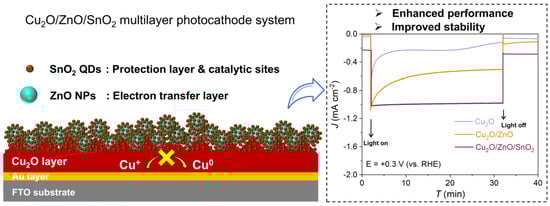
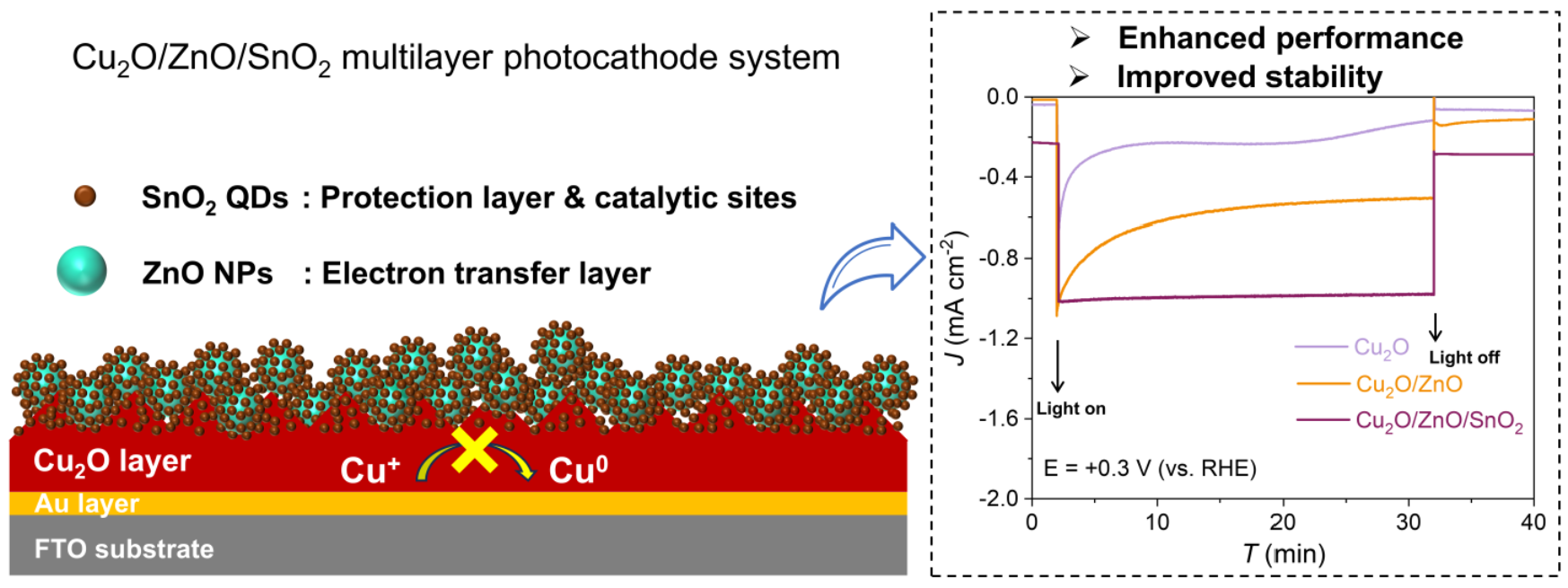
The Cu2O-based photocathode has been widely applied in photoelectrocatalytic hydrogen evolution and carbon dioxide reduction systems. However, the poor stability of Cu2O caused by photocorrosion highly restricts the application. In this work, a multilayer configuration is designed as Cu2O/ZnO/SnO2 via sequential depositions of electrodeposition and spin-coating. The liquid-phase epitaxial growths of the Cu2O and ZnO layers are achieved by sequential electrodepositions on a FTO/Au substrate. The decoration of a uniform SnO2 layer onto Cu2O/ZnO is realized by a SnO2 QDs coating and provides dual functions for boosted electron transfer and surface reaction. The protection of the SnO2 layer is fulfilled by the inhibition of Cu+ transformation, resulted from the compact covering of SnO2 QDs onto the exposed surface of the Cu2O and ZnO layers. Consequently, the enhanced photocurrent density and improved stability are obtained for Cu2O/ZnO/SnO2 compared to bare Cu2O and Cu2O/ZnO sample photocathodes. The necessary role of SnO2 QDs serving as electron transfer and protection layers studied in this work reveals the remarkable potential in the modification of other vulnerable electrode materials.

Graphical Abstract

1. Introduction

Cuprous oxide (Cu2O) semiconductor with an intrinsic p-type characteristic is a promising candidate for photoelectrocatalytic systems in terms of H2 evolution and CO2 reduction [1,2,3,4]. Due to the suitable band level being more negative than −0.7 V (vs. RHE), it is thermodynamically favorable to apply a p-type Cu2O photocathode to accomplish the reduction potentials of H+ to H2 and CO2 to C1 products (i.e., CO, CH4, CH3OH, HCHO, HCOOH) in the range of −0.2~0.2 V (vs. RHE) [5,6,7,8]. As estimated, a peak photocurrent density of 14.7 mA·cm−1 and a solar-to-hydrogen conversion efficiency of 18% could be obtained theoretically by the Cu2O photocathode under a simulated AM1.5G illumination. Nonetheless, the optimal performance is constrained by the unsatisfactory aspect ratio of light penetration depth (~10 μm) and diffusion length of minority carriers (<200 nm) within the electrodeposited Cu2O layer [9,10]. In addition to the mismatched ratio, the poor stability in an aqueous solution is perceived as the predominant limitation, which originated from the inevitable redox reactions of monovalent Cu+, as the corresponding potentials lie in the forbidden band (Cu+ reduction and oxidation approximately at 0.8 V and 0.65 V above valence band, respectively) [11,12]. The decoration of a Cu2O photocathode with a conformal overlayer coating, including an electron transfer layer (ETL) and a protection layer (PL), is essential for tackling the aforementioned two obstacles through the promotion of electron diffusion mobility and the inhibition of photocorrosion. The n-type oxide semiconductors (i.e., ZnO, Ga2O3, TiO2) have been applied as an effective ETL for efficient electron migration behaviors in a Cu2O photocathode [13,14,15,16,17,18]. The construction of a buried p-n junction in the interface induces the downward band bending between conduction band levels, hence boosting electron extraction and suppressing excessive electron accumulation within Cu2O layer [15,19,20,21]. The buried p-n junction contributes to a significantly earlier onset potential and higher photocurrent density for overlayered Cu2O photocathodes [16]. Moreover, PL introduction (i.e., TiO2) provides a protective shielding by cutting off water permeation for the reduced probability of physical contact between the Cu2O surface and H2O molecule for further inhibition of photocorrosion [22]. In addition, it is indispensable to decorate PL as the outmost layer due to the vulnerability of the ETL (i.e., ZnO is unstable in acid and strong alkali environments) [23,24]. Numerous efficient multilayer configurations have been proposed for the Cu2O photocathode (e.g., ZnO/TiO2, AZO/TiO2, Ga2O3/TiO2, ZnO/NiOx, etc.) and are obtainable by variable deposition techniques, including atomic layer deposition (ALD), magnetron sputtering deposition (MSD), electrodeposition, and spin-coating methods [25,26,27,28,29,30,31,32,33,34].
Due to the decisive role of the growth uniformity in fulfilling the ETL and PL functions of deposited overlayers, the compact deposition of the ETL and PL with a uniform distribution via a facile and economical route is necessary for constructing efficient and stable multilayer Cu2O-based photocathodes. As a prevalent selection of PL, TiO2 layers are usually decorated onto Cu2O via ALD and MSD techniques which are costly and complicated [35,36]. Nonetheless, the quality of ALD- and MSD-deposited TiO2 layers is highly sensitive to the surface to be coated, which requires pre-deposited layers (i.e., ZnO, Ga2O3) as buffer layers. It has been reported that the incomplete coverage of the TiO2 layer via ALD from titanium tetraisopropoxide and H2O fails to realize the dual function of PL and ETL in the direct contact (Cu2O/TiO2/Pt), leading to a considerable electron loss in the heterogeneous interface compared to bare Cu2O (Cu2O/Pt) [15]. In terms of the wet-chemistry electrodeposition method, the TiO2 layer derived from the dehydration of the deformable TiOxHy layer avoids the imperfect contact of Cu2O/TiO2 and decreases the interfacial recombination sites [22]. However, the extreme pH values of the Ti precursor solution restrict the universal application of the electrodeposited TiO2 layer. Based on the above considerations, it is appealing to seek an alternative PL for TiO2, which could be decorated onto Cu2O-based photocathodes feasibly and economically. Herein, n-type SnO2 has extraordinary optoelectronic properties, which have been extensively used in perovskite solar cells as ETL [37,38]. Compared to the TiO2 layer, the SnO2 layer exhibits superior electron transport mobility, a lower n-type resistivity, a higher transparency, and a lower conduction band level for better electron injection. The good chemical stability of SnO2 unlocks a potential to serve as PL for Cu2O-based photoelectrodes [39,40,41]. Based on the consideration of compact coating, it should be more suitable to apply SnO2 quantum dots (QDs) with relatively smaller particle size distribution for PL formation [42,43]. In addition, the SnO2 QDs layer could be fabricated via a simple solution method at a low-temperature [44]. The fabrication of the SnO2 QDs layer in mild conditions is more adaptable for vulnerable substrates and unrestricted by the surface quality of substrates in contrast to the TiO2 layer.
In this work, the tailored decoration of SnO2 QDs layer is introduced to construct a Cu2O/ZnO/SnO2 photocathode with a multilayer design for the promotion of photocurrent and improvement of stability. The sequential liquid-phase epitaxial growths of the Cu2O layer and ZnO layer have been achieved via controlled electrodeposition methods, which are assigned as an absorption layer and ETL. The uniform coating of SnO2 QDs leads to the compact decoration of SnO2 PL and covers the exposed surface of Cu2O and ZnO nanoparticles. SnO2 QDs at the outmost surface also provide more active sites for accelerated interfacial reduction. The dual functions of a SnO2 QDs layer decorated onto a Cu2O/ZnO multilayer in terms of better electron transfer and considerable protection are demonstrated, which facilitates the elevated photoelectrocatalytic performances with improved stability.

2. Results and Discussions

2.1. Observation of SnO2 QDs

Colloidal SnO2 QDs solution was obtained via a facile and reproducible room-temperature wet-chemistry method. The steady hydrolysis–dehydration–oxidation reactions of the SnCl2 precursor were assisted with thiourea for accelerating and stabilizing reactions. The observation of SnO2 QDs was realized by high-resolution transmission electron microscopy (HR-TEM). As displayed in Figure 1(ai,aii), the particle size distribution of SnO2 QDs was uniform with the estimated average size of 2~3 nm. The lattice information was acquired by a selected-area electron diffraction (SAED) pattern (Figure 1b) and lattice fringe (Figure 1c). The diameter of the recorded diffraction ring (Line #1) was measured as 5.874 nm−1 from the line distribution of intensity, as shown in Figure 1d, and the corresponding interplanar spacing was calculated as 3.40 Å. The direct measurements of lattice fringe (Line #2 and Line #3) were conducted specifically for the single dot (Figure 1c) and the corresponding spacing of the lattice facet was measured as 1.354 nm and 1.356 nm along Line #2 and Line #3 across four intervals, respectively (Figure 1(ei,eii)). The average facet spacing was calculated as 3.39 Å, in agreement with the parameter that resulted from SAED patterns, which was ascribed to the (110) crystal facet of rutile-phase SnO2 (d = 3.34 Å) [44]. The element distribution (Figure 1f) verified the detection of the Sn element. Based on the above results from HR-TEM characterization, SnO2 QDs with a uniform size distribution were determined. The smaller particle size of SnO2 was considered suitable and necessary for the compact layer deposition of the SnO2 layer.

2.2. Determination of Multilayer Design

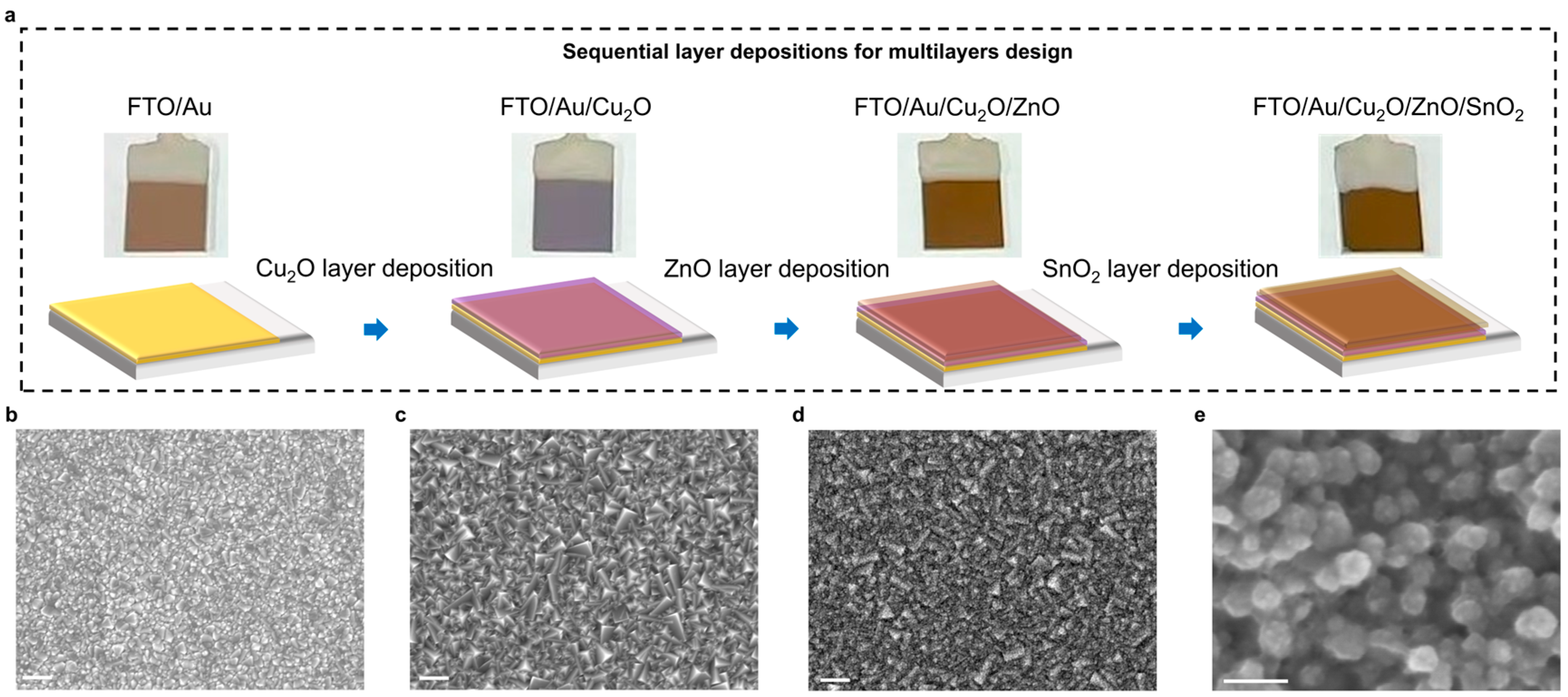
The illustration displayed the multilayer design for the Cu2O/ZnO/SnO2 sample via sequential layer depositions (Figure 2a), including the Cu2O layer and ZnO layer assembly via electrodeposition and the SnO2 layer assembly via spin-coating. The colors of the photocathodes were observed as purple, tawny, and tan for the Cu2O, Cu2O/ZnO, and Cu2O/ZnO/SnO2 samples, respectively. The corresponding top-view observations of the morphological microstructures of each layer were shown in Figure 2b–e.
The uniform deposition of Au nanoparticles provides an appropriate platform for the epitaxial growth of the Cu2O layer and improves the conductivity. The favorable growth of Cu2O along [111] orientation was prioritized on Au-sputtered substrate, leading to the high-quality Cu2O layer coating with the exposed corner of Cu2O nanocrystals (Figure 2c and Figure S2a). The exposed edges of the corners were hundreds of nanometers, and the surface around the corners was regarded as surface active sites. The higher density of the Cu2O {111} facets was bound to improve the surface reduction kinetics of the Cu2O-based photocathode [45,46,47]. After the assembly of the ZnO layer onto the Cu2O sample, the colors of the photocathodes turned tawny, which implied that the electrodeposited ZnO layer was thin and transparent. As shown in Figure 2d, the ZnO layer was composed of dispersive ZnO nanoparticles with a size distribution ranging from 50 nm to 100 nm. Spherical ZnO nanoparticles were embellished onto the exposed sharp corners of Cu2O nanocrystals. During the electrodeposition of the ZnO layer, the reduction in p-BQ molecules was predominant in the cathodic reactions, which caused the increase in pH value [48]. Subsequently, Zn(OH)2 was precipitated from Zn2+ ions with the increased pH in the local micro-environment and loaded onto the Cu2O surface. The relatively smaller size of ZnO nanoparticles (50~100 nm) compared to Cu2O nanocrystals (~500 nm) resulted from the decomposition of Zn(OH)2 species as the system was heated to 80 °C [49,50]. The structural retention of Cu2O nanocrystals with sharp corners indicated no erosion of Cu2O in a ZnO precursor solution as electrolyte (mildly acidic). Furthermore, the SnO2 layer was assembled by a tight and uniform coating of SnO2 QDs onto ZnO nanoparticles, as observed in Figure 2e. Specifically, the exposed surface of the ZnO nanoparticles were embellished by SnO2 QDs with a smaller size, which was similar to the plum pudding type. In summary, the anticipated multilayer design was successfully obtained via sequential layer deposition steps.
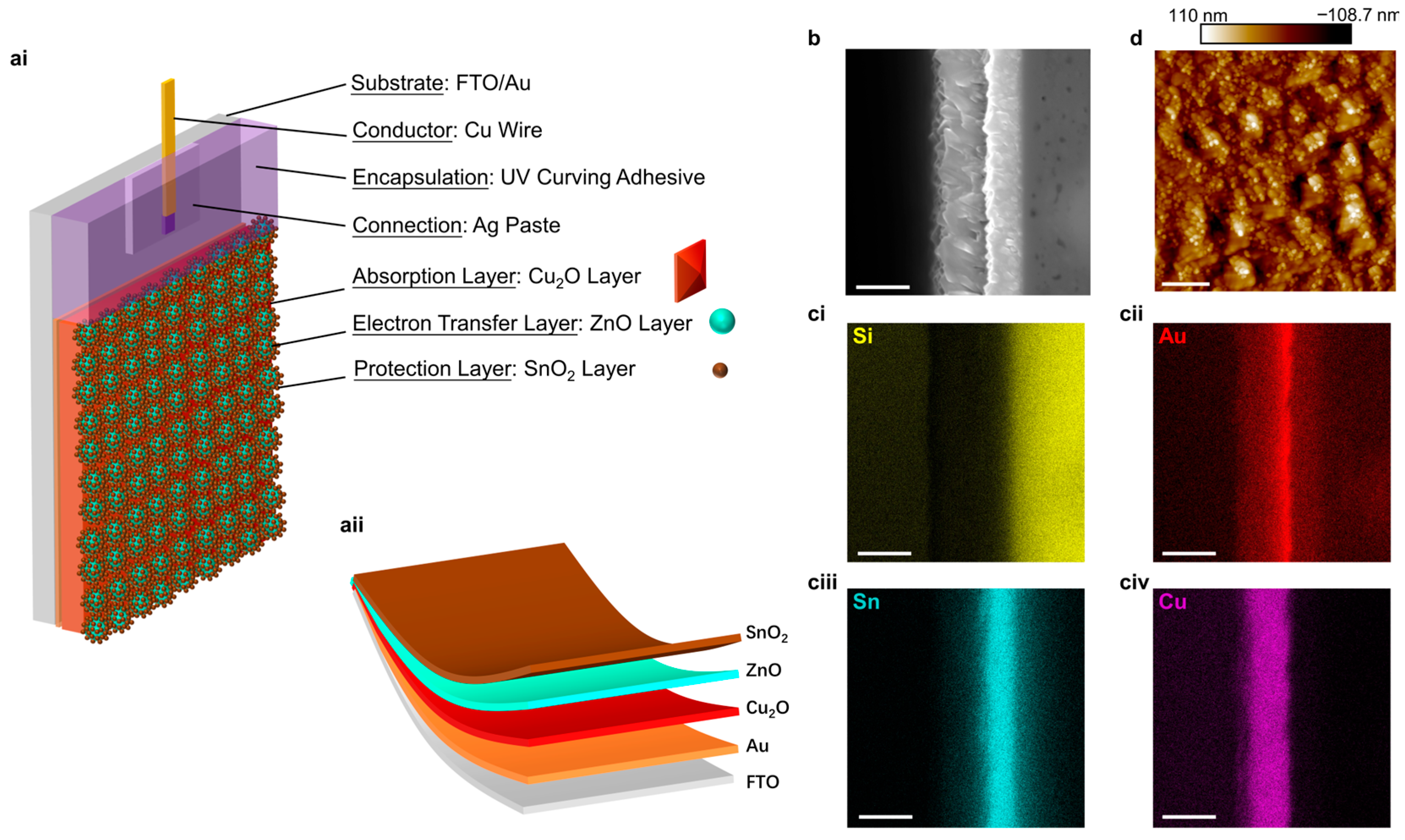
The multilayer design was further determined by EDX mapping in the cross-section view, as shown in Figure 3. From the direct observation in Figure 3b, the Cu2O/ZnO/SnO2 multilayer were epitaxially grown onto FTO/Au substrate at the right side. The depth of the Cu2O bulk layer was measured as 800 nm (Figure 3(civ)), which was directly deposited onto the Au layer (Figure 3(cii)). The signals of Cu and Au were apparently distinguished from the signals of Si and Sn in the FTO region (Figure 3(ci,cii)). In contrast, the relatively smaller depths of the ZnO and SnO2 layers with the smaller particle sizes led to the weaker signals of Zn (Figure S3) and Sn (Figure 3(cii)) on the surface of the Cu2O layer [51]. The signal of Cu away from the bulk Cu2O layer (in the left side of concentrated Cu signals in purple), observed in Figure 3(civ), might be ascribed to Zn distribution because of the adjacent element numbers of Cu and Zn. Furthermore, the evidence of the existence of ZnO and SnO2 was also provided by AFM results (Figure 3d and Figure S4). The dispersive small nanoparticles were observed, indicating the decoration of ZnO and SnO2 layers onto the Cu2O surface. Therefore, the anticipated multilayer structure in the sequence of the Cu2O, ZnO, and SnO2 layers onto FTO/Au substrate was preliminarily demonstrated, as displayed in the schematics of Figure 2(aii). The configuration of the sample photocathode was clearly presented in Figure 3(ai). The conductor Cu wire and connection Ag paste were encapsulated by UV curving adhesive, which was separated from the deposition region. The deposition region of the FTO/Au substrate was covered by the assembly of Cu2O (red cubes), ZnO (blue spheres), and SnO2 (brown spheres), as is vividly illustrated in Figure 3(ai).
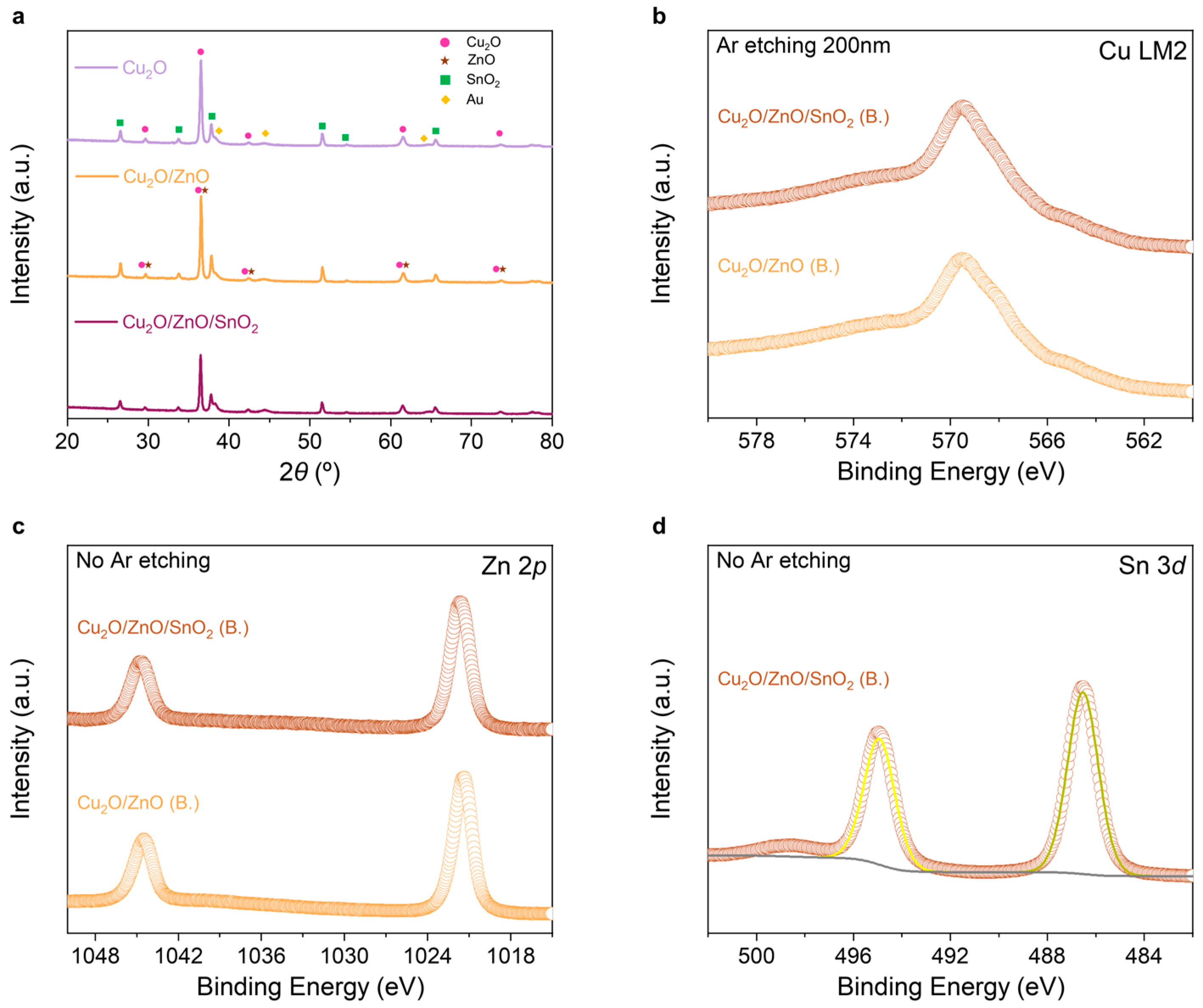
The physicochemical properties of Cu2O, Cu2O/ZnO, and Cu2O/ZnO/SnO2 sample photocathodes were characterized by spectroscopic measurements of XRD and XPS. The characteristic diffraction peaks of FTO, Au, and Cu2O species were clearly pointed out, as displayed in Figure 4a, according to the standard cards (#99-0024, #01-1172, and #77-0199), respectively. Particularly, the main peak of the Cu2O layer located at 36.5° was assigned to the (111) facet [10]. The deposited Au layer as a growth substrate induced the controlled growth orientation of Cu2O along the [111] direction [47]. Due to the similarity of the XRD peaks, the peak signals of ZnO and SnO2 might be involved in the Cu2O and FTO peaks, respectively. The supplementary information of surface chemical states was offered by XPS spectra, as shown in Figure 4b–d. Due to the fact that XPS measurement is a surface-sensitive detection technique, the detection depth normally lies in the range of several nanometers. For the detection of the Cu2O layer, which was beneath the ZnO and SnO2 layers, an etching process by Ar ions was conducted to remove the surface species and to expose the Cu2O bulk layer with an etching depth of 200 nm before detecting Cu signals [22]. Zn and Sn XPS signals were detected without Ar etching pre-treatment. The characteristic peak located at 569 eV corresponded to Cu+ states in Cu LM2 spectra (Figure 4b). In Zn 2p spectra, the doublet peaks of Zn 2p1/2 and 2p3/2 located at 1022.0 eV and 1044.0 eV, respectively, indicated the coating of the ZnO layer on the Cu2O surface [49]. In Sn 3d spectra, the doublet peaks of Sn 3d3/2 and 3d5/2 were detected at 486.5 eV and 495.0 eV, respectively, which verified the decoration of SnO2 at the outmost surface [52,53]. The similarity between the Cu2O/ZnO (B.) and Cu2O/ZnO/SnO2 (B.) sample photocathodes indicated the maintenance of chemical states and compositions in the multilayer structure with SnO2 layer deposition. The spin-coating step with mild conditions of suitable pH value and annealing temperature avoided destroying the ZnO and Cu2O layers.

2.3. Functions of SnO2 Layer Decoration

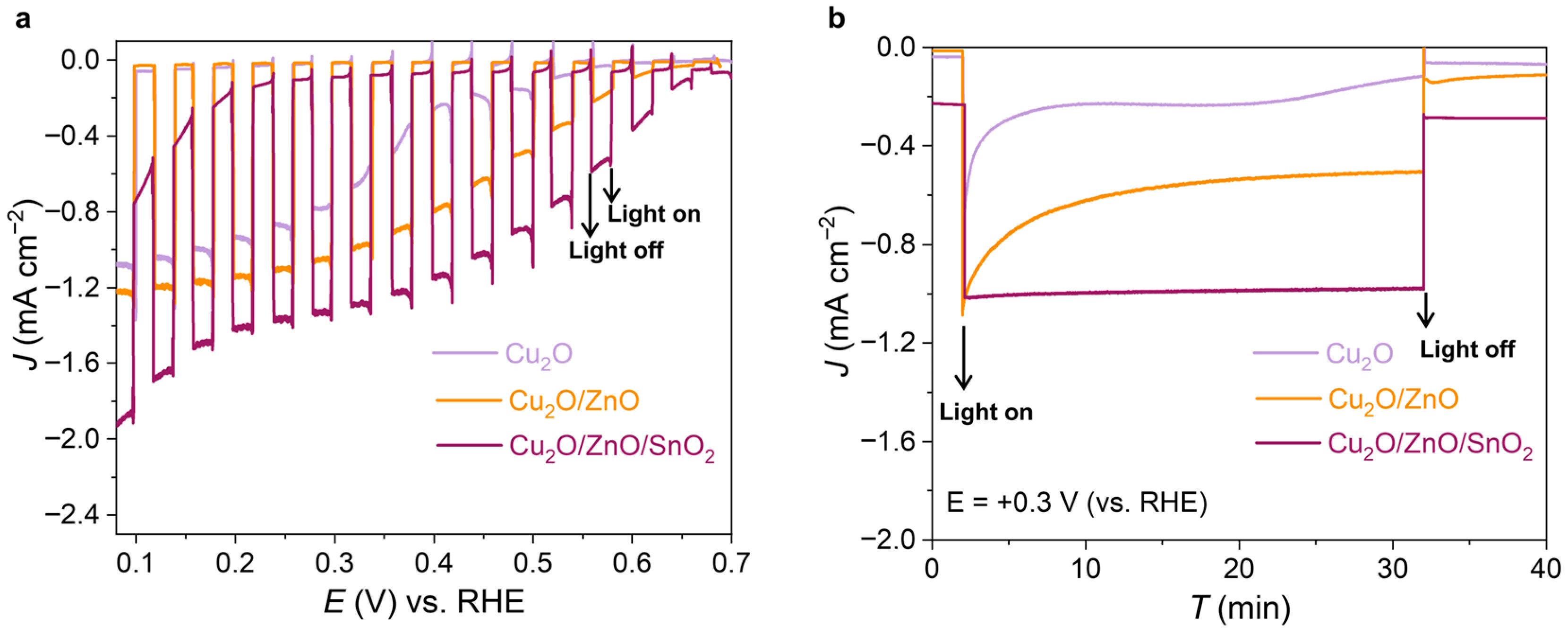
Based on the above results from microscopic and spectroscopic characterizations, it could be conservatively concluded that the Cu2O/ZnO/SnO2 multilayer photocathode had been assembled and determined. The measurements of photoelectrochemical performances in terms of photocurrent and stability were conducted in LSV and I-t experiments, as shown in Figure 5 and Figure S5. In terms of the response of cathodic current under the irradiation of simulated solar light (Figure 5a), the Cu2O/ZnO/SnO2 photocathode exhibited a superior performance compared to the pristine Cu2O and Cu2O/ZnO photocathodes. The decorations with the ZnO and SnO2 layers led to the elevated photocurrent density compared to the pristine Cu2O photocathode (Figure S5a), which verified the similar function of the SnO2 layer to the ZnO layer as the ETL. The larger improvement in the photocurrent density of the Cu2O/SnO2 photocathode compared to the Cu2O/ZnO photocathode indicated the better ability of electron extraction and migration for the SnO2 layer [42,43]. In addition, a considerable dark current was found in the relatively negative range of applied potentials (0.1~0.2 V vs. RHE), and a significant photocurrent was obtained in the relatively positive range (0.5~0.7 V vs. RHE) for sample photocathodes with SnO2 decoration, which indicated that the SnO2 layer could serve as the surface catalyst to reduce the overpotential [52]. Therefore, the SnO2 layer displayed the dual functions as ETL and active catalytic sites to accelerate electron transfer and interfacial reduction reaction.
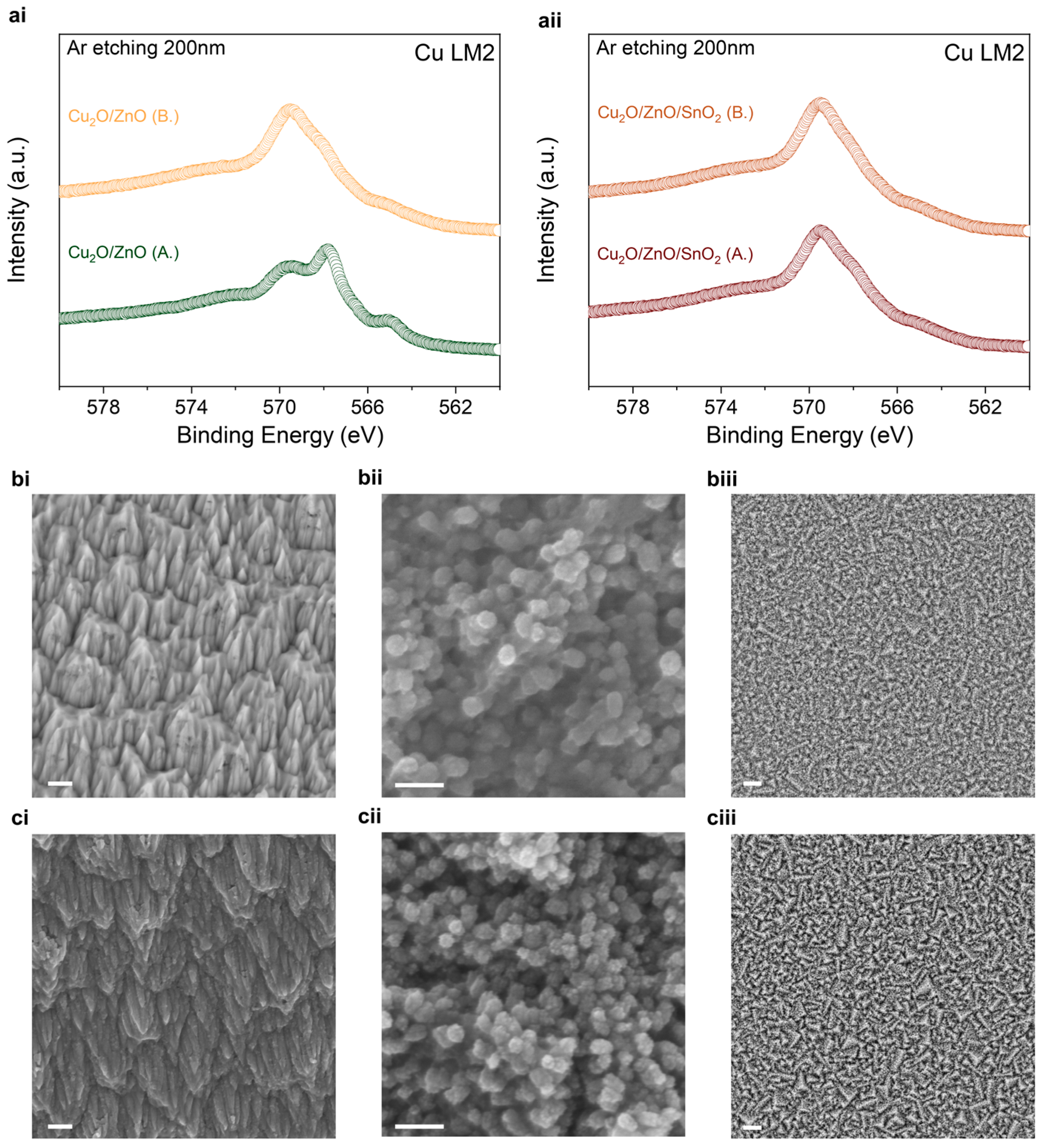
The comparisons of reaction stability among sample photocathodes were carried out by I-t experiments (Figure 5b). For the pristine Cu2O photocathode, a significant decrease in the response of photocurrent density by almost 90% indicated extremely poor stability of bare Cu2O by severe photocorrosion. The Cu2O/ZnO photocathode also displayed a decreasing tendency in photocurrent density by almost half, which implied that the ETL function of the ZnO layer helped to suppress photocorrosion to an extent. The color of the Cu2O/ZnO photocathodes changed from tawny to blackish green, apparently in contrast to the Cu2O/ZnO/SnO2 sample which has a slight color change (Figure S6). The decoration with the SnO2 layer largely inhibited photocorrosion as the stable photocurrent was obtained during constant irradiation (30 min) for the Cu2O/ZnO/SnO2 photocathode. The inhibition of photocorrosion by the SnO2 layer was revealed by the XPS comparison result, shown in Figure 6(ai,aii). In the comparison of the Cu2O/ZnO photocathodes, Cu2O/ZnO (B.) and Cu2O/ZnO (A.) represented samples before and after stability tests, respectively. The emergence of a new peak at 568.0 eV in Cu LM2 spectra, corresponding to the XPS signal of Cu0 state, was found for the Cu2O/ZnO (A.) sample [22]. The photocorrosion mechanism could be elucidated as the transformation from Cu+ to Cu0 species in the Cu2O layer contributed to the decreased performance. On the contrary, almost no change was found in Cu LM2 spectra for the Cu2O/ZnO/SnO2 (B.) and Cu2O/ZnO/SnO2 (A.) samples, indicating the protection of the SnO2 QDs layer to inhibit the generation of Cu0 species. For both the Cu2O/ZnO and Cu2O/ZnO/SnO2 samples, surface ZnO layers were relatively stable according to the similarity of Zn 2p signal (Figures S7b and S8), which implied the stable chemical state of ZnO in the reaction. In addition, the SnO2 layer also displayed chemical stability, as shown in Figure S7a. The structural change of Cu2O photocorrosion was also reflected by microscopic observations (Figure 6(bi–biii),(ci–ciii)). The Cu2O layer inside the Cu2O/ZnO (A.) sample showed more density of tiny cavities in the Ar etching region (Figure 6(ci)) compared to the Cu2O/ZnO (B.) sample. The transformation of Cu0 species in photocorrosion caused structural destruction and formed cavities in the Cu2O layer. For the ZnO layer without decoration of the SnO2 layer, the exposed surface of ZnO nanoparticles became rugged, implying the structural change in the ZnO layer (Figure 6(cii)). The structural deterioration of the ZnO layer resulted in the permeation of water molecules and the direct contact of the Cu2O layer and water molecules, leading to an increased possibility of photocorrosion. However, no obvious morphological change was observed for the Cu2O/ZnO/SnO2 sample in the Ar etching region (Figure 6(bi)) and decoration region (Figure 6(bii,biii)). In contrast, the application of the Al2O3 layer as a similar candidate for inert protection layers failed to enhance photocurrent density (Figure S5b) and improve stability (Figure S9a), which might be ascribed to the imperfect covering of the Al2O3 nanoparticles coating. The difference between the SnO2 layer and Al2O3 layer deposited by spin-coating was derived from uniformly coating the SnO2 QDs in perfect contact with the surface of Cu2O/ZnO, whereas coating Al2O3 nanoparticles with a similar size to ZnO nanoparticles still remained the interspace. Special Janus bilayers of SnO2 QDs were constructed by the sequential deposition of R-SnO2 and O-SnO2, which was modified by reduction and oxidation treatments before spin-coating. The Janus bilayers structures of R-SnO2/O-SnO2 and O-SnO2/R-SnO2 both diminished the dark current and further improved stability compared to merely the SnO2 layer (Figure S9b), which implied the surface reconstruction of SnO2 by redox modifications. Nonetheless, the comprehensive elucidation of the Janus bilayers and the contribution from surface Sn states of reduced and oxidized Sn species were necessary, which needs further deep study in future research.

3. Experimental Procedures

3.1. Preparation of Samples

Blank FTO/Au sample: The commercial FTO (F-doped tin oxide) glass (length: 18 mm, width: 12 mm, thickness: 2 mm) was applied as the substrate for the further fabrication of photoelectrode samples. Before the layer fabrication, successive purification procedures of 10 min ultrasonication in acetone, ethanol, and pure water for three cycles were conducted to remove the residual organic pollutants on the FTO surface followed by a N2 purge. A Au film with a thickness of 100 nm was coated onto the conductive surface of purified FTO via vacuum evaporation to obtain FTO/Au glass. The FTO/Au photoelectrode was assembled by FTO/Au glass and Cu wire covered with an insulating layer. The connection between the conductive surface of FTO/Au glass and the exposed section of the Cu wire was constructed by the adhesion of conductive Ag paste. The connection region was subsequently packaged by UV curving adhesive followed by UV illumination. The UV-curable encapsulant was supposed to cut off the contact between the Ag-paste connection and electrolyte solution, which excluded the interference of the exposed Ag paste and Cu wire for photoelectrochemical measurements. Apart from the packaged region, the exposed region was measured as 15 mm × 12 mm for the following decoration of the multilayer.
Cu2O sample: The fabrication of the Cu2O layer was achieved via the electrodeposition method according to previous reports. The Cu solution containing 160 mL pure water, 3M lactic acid, 0.5M K2HPO4, and 0.2M Cu2SO4·5H2O was prepared with vigorous stirring. The pH of the Cu solution was subsequently adjusted to around 12 by a 2M KOH solution and the initial Cu solution with a clear sky-blue color turned into a turbid solution and finally became a clear navy-blue color during the dropwise addition of the KOH solution. The pH-adjusted Cu precursor solution with a volume of approximately 600 mL was used freshly for Cu2O layer deposition. The electrodeposition was conducted in a water bath (30 °C) with galvanostatic mode (−0.1 mA·cm−2) in a two-electrodes cell using blank FTO/Au substrate and Pt wire as the working electrode and counter electrode, respectively. After Cu2O electrodeposition for 2 h, the deposited photoelectrode was immersed in pure water and dried by a N2 purge, which was designated as the Cu2O sample.
Cu2O/ZnO sample: The fabrication of the ZnO layer was achieved via the electrodeposition method according to previous reports. The Zn solution containing 40 mL dimethyl sulfoxide (DMSO), 0.1M p-benzoquinone (p-BQ), and 0.05M Zn(NO3)2·6H2O was prepared with vigorous stirring. The ZnO layer deposition was conducted in the fresh Zn precursor solution with galvanostatic mode (−0.125 mA·cm−2) heated by an oil bath (95 °C) in the same two-electrodes cell using the Cu2O sample as the working electrode. After ZnO electrodeposition for 7 min, the deposited photoelectrode was immersed in pure water and dried by a N2 purge, which was designated as the Cu2O/ZnO sample. It needs to be highlighted that the deposited side of the working electrode should be perpendicular to the flow vector in the stirring solution for steady mass transportation in both the Cu2O and ZnO electrodepositions with a constant stirring rate of 200 rpm. Bubbling treatment by nitrogen gas for 30 min was introduced before the Cu2O and ZnO electrodepositions, and nitrogen flow was maintained during the electrodepositions to remove residual dissolved oxygen.
Cu2O/ZnO/SnO2 sample: The synthesis of SnO2 QDs was achieved via the wet-chemistry solution method according to the previous report. The colloidal SnO2 QDs solution containing 30 mL pure water, 0.15M SnCl2, and 0.15M thiourea (CH4N2S) was obtained with vigorous stirring for 48 h. The initial milky yellow suspension turned into a clear yellow colloidal SnO2 QDs solution with sufficient exposure to air. The pH was further adjusted to around 9 by 2M KOH as the acid SnO2 QDs solution would etch the surface of Cu2O and ZnO. The fabrication of the SnO2 layer was implemented via the spin-coating method. The pH-adjusted SnO2 QDs solution (0.15M, 200 μL) was dropped onto the Cu2O/ZnO surface followed by spinning at 400 rpm for 3 s and 3000 rpm for 60 s. After annealing (160 °C, 2 h) and a N2 purge, the Cu2O/ZnO/SnO2 sample was finally constructed.
Cu2O/SnO2 sample: The synthetic procedures were the same as that of the Cu2O/ZnO/SnO2 sample except for the substitution of the Cu2O sample for the Cu2O/ZnO sample as the working electrode for the SnO2 layer deposition.
Cu2O/ZnO/Al2O3 sample: The synthetic procedures were the same as that of the Cu2O/ZnO/SnO2 sample except for the substitution of the Al2O3 solution for the colloidal SnO2 QDs solution in the spin-coating step. The Al2O3 solution (0.15M) was prepared by rigorously mixing Al2O3 nanopowders with pure water.
Cu2O/ZnO/R-SnO2/O-SnO2 sample: The synthetic procedures were the same as that of the Cu2O/ZnO/SnO2 sample except for the substitution of the R-SnO2 and O-SnO2 QDs solutions for the pristine SnO2 QDs solution in the spin-coating step. The R-SnO2 and O-SnO2 QDs solutions were then reduced and oxidized by the SnO2 QDs solution after mild reduction and oxidation treatments, respectively. The reduced R-SnO2 was obtained by the addition of fresh 0.1M NaBH4 solution (10 mol%) into pristine colloidal SnO2 QDs solution (clear yellow, pH = 9) after thoroughly stirring for 4 h. Similarly, the oxidized O-SnO2 was obtained by the addition of fresh 0.1M H2O2 solution (10 mol%) into pristine colloidal SnO2 QDs solution (clear yellow, pH = 9) after thoroughly stirring for 4 h. In the spin-coating step, the reduced SnO2 QDs solution (100 μL) was dropped onto the Cu2O/ZnO surface followed by spinning at 400 rpm for 3 s and 3000 rpm for 60 s. After annealing (160 °C, 2 h) and a N2 purge, the Cu2O/ZnO/R-SnO2 sample was obtained. Subsequently, a similar spin-coating step was repeated for the Cu2O/ZnO/R-SnO2 sample using the oxidized SnO2 QDs solution (100 μL) to obtain the Cu2O/ZnO/R-SnO2/O-SnO2 sample finally.
Cu2O/ZnO/O-SnO2/R-SnO2 sample: The synthetic procedures were the same as that of the Cu2O/ZnO/R-SnO2/O-SnO2 sample except for the reverse order of dropping the oxidized and reduced SnO2 in the spin-coating step. For the Cu2O/ZnO/O-SnO2/R-SnO2 sample, the spin-coating of the oxidized SnO2 QDs solution (100 μL) was followed by the spin-coating of the reduced SnO2 QDs solution (100 μL).

3.2. Characterizations

The compositions of the multilayer were characterized by X-ray diffraction (XRD) pattern spectra (Ultima IV system, Rigaku, Tokyo, Japan) using Cu-Kα radiation as an X-ray source. The diffraction range (2θ) was set from 10° to 80° at 5°/min scanning speed. The surface chemical states of the multilayer were determined by X-ray photoelectron spectra (XPS) (AXIS UltraDLD, Kratos, British) with monochromatic Mg-Kα radiation. The calibration by C 1s peak at 284.6 eV was carried out for all binding energies of XPS peaks. The light absorption ability was reflected by ultraviolet–visible (UV–vis) diffuse reflection spectra (DRS) (UV-1800, Shimadzu, Kyoto, Japan) fitted by an integrating sphere assembly. The microstructure and morphology were observed from the imaging of field-emission scanning electron microscopy (SEM) (JCM-6000, JEOL, Tokyo, Japan) and field-emission transmission electron microscopy (FE-TEM) (TALOS F200X G2, FEI, Waltham, MA, USA). The surface morphology was scanned by atomic force microscopy (AFM) (Dimension XR, Bruker, Karlsruhe, Baden-Württemberg, Germany).

3.3. Photoelectrochemical Measurements

All electrochemical measurements were conducted on an electrochemical workstation (Modulab XM PhotoEchem, Princeton Applied Research, Oak Ridge, Tennessee, USA) in a three-electrode cell configuration. A sodium borate buffer (pH = 10.6) was prepared by mixing a Na2CO3 (0.05M, 57 mL 05M, 57 mL) solution and a Na2B4O7 (0.05M, 6 mL 6 mL) solution followed by the addition of 0.1M 4-Hydroxy-TEMPO used as the electrolyte. The presence of 4-Hydroxy-TEMPO as the sacrificial agent accelerates surface redox reaction rates of photocathodes. A Pt filament and an Ag/AgCl (4 M KCl) electrode were selected as the counter electrode and reference electrode, respectively. The potentials measured against the Ag/AgCl reference electrode could be converted to potentials against a reversible hydrogen electrode (RHE) according to the following equation. A solar simulator was applied as the light source, and the corresponding irradiation intensity was adjusted to 100 mW·cm−2. The sample photocathodes were irradiated from the back side. Photoelectrochemical measurements of linear sweep voltammetry (LSV) and chronopotentiometry (I-t) were conducted to determine the photocurrent density and reaction stability of sample photocathodes. The conditions of LSV and I-t measurements were front-side irradiation from a simulated sunlight source and continuous steady N2 bubbling in a buffer solution containing sacrificial agents of 4-Hydroxy-TEMPO (pH = 10.6). LSV measurements were conducted with scanning applied potentials from +0.75 V to +0.05 V (vs. RHE) in a scanning rate of 20 mV/s and chopped light irradiation with an interval time of 1.5 s. I-t measurements were conducted with +0.3 V (vs. RHE) and chopped light irradiation with an interval time of 30 min.
E   vs .   RHE = E   vs .   Ag / AgCl + 0.1976 + 0.0591 × pH

4. Conclusions

In this work, a tailored multilayer design was applied for the Cu2O/ZnO/SnO2 photocathode via sequential deposition steps, including epitaxial growth of the Cu2O and ZnO layer via electrodeposition and decoration of the SnO2 QDs layer via spin-coating. The multilayer configuration was determined and demonstrated via top-view and cross-section SEM imaging, which was further supported by XPS detection. Compared to the Cu2O/ZnO photocathode, the decoration of the SnO2 layer exhibited dual functions for accelerating electron extraction and transfer and boosting surface reactions. Furthermore, the SnO2 layer in the form of SnO2 QDs coating facilitated to suppress photocorrosion of Cu+ species, superior to the decoration of the inert Al2O3 layer. The protection function of the SnO2 QDs layer was derived from the inhibition of Cu+ transformation and the perfect covering for the exposed surface of the Cu2O and ZnO layers, which were determined by morphological observation and XPS detection in terms of surface and Ar-etching regions. On the whole, key findings in this work could provide inspiration for the potential application of selective SnO2 QDs layer decoration on other photoelectrocatalytic and electrocatalytic electrode systems.

Supplementary Materials

The following supporting information can be downloaded at: https://www.mdpi.com/article/10.3390/catal16010037/s1. Figure S1: The schematic configuration of the designed cell used for electrodeposition experiments in this work; Figure S2: The amplified SEM imaging of Cu2O nanocrystals (a) and ZnO nanoparticles (b) for Cu2O/ZnO/SnO2 multilayer structure with the scale bars of 100 nm; Figure S3: . EDX mapping of Zn element in the cross-section view of Cu2O/ZnO/SnO2 multilayer structure; Figure S4: The supplementary AFM imaging in terms of height distribution for Cu2O/ZnO/SnO2 sample photocathode; Figure S5: The performance comparisons in terms of LSV measurements. The comparison among Cu2O, Cu2O/ZnO, and Cu2O/SnO2 samples photocathodes (a). The comparison between Cu2O/ZnO and Cu2O/ZnO/Al2O3 samples photocathodes (b); Figure S6: The contrast of photocathode image before and after tests between Cu2O/ZnO/SnO2 and Cu2O/ZnO samples; Figure S7: The comparisons in terms of Sn 3d (a) and Zn 2p spectra (b) between Cu2O/ZnO/SnO2 (B.) and Cu2O/ZnO/SnO2 (A.) sample photocathodes before and after stability tests, respectively; Figure S8: The comparison in terms of Zn 2p spectrum between Cu2O/ZnO (B.) and Cu2O/ZnO (A.) sample photocathodes before and after stability tests, respectively; Figure S9: The performance comparisons in terms of I-t measurements. The comparison among Cu2O/ZnO, Cu2O/ZnO/Al2O3, and Cu2O/ZnO/SnO2 samples photocathodes (a). The comparison among Cu2O/ZnO without SnO2 layer decoration, Cu2O/ZnO/SnO2 sample with SnO2 layer decoration, Cu2O/ZnO/R-SnO2/O-SnO2 and Cu2O/ZnO/O-SnO2/R-SnO2 samples with Janus structures (b).

Author Contributions

J.Y.: Conceptualization, Formal analysis, Data curation, Investigation, Methodology, Writing—original draft. K.T.: Formal analysis, Investigation, Methodology. Z.W.: Formal analysis, Investigation. M.M.: Formal analysis, Investigation. J.C.: Investigation. Y.Z.: Investigation, Writing—review and editing. C.T.: Supervision, Writing—review and editing. W.S.: Funding acquisition, Supervision, Writing—review and editing. A.F.: Writing—review and editing. All authors have read and agreed to the published version of the manuscript.

Funding

This work is supported by the Project of National Natural Science Foundation of China (22102095, 21773153) and the National Key Basic Research and Development Program (2018YFB1502001). This work also received financial support from the program of China Scholarships Council (No. 202306230242).

Data Availability Statement

All data is included in this paper.

Conflicts of Interest

The authors declare that there are no known competing financial interests or personal relationships that could have appeared to influence the work reported in this paper.

References

  1. de Almeida, J.C.; Wang, Y.; Rodrigues, T.A.; Nunes, P.H.H.; de Mendonça, V.R.; Falsetti, P.H.E.; Savazi, L.V.; He, T.; Bardakova, A.V.; Rudakova, A.V.; et al. Copper-based materials for photo and electrocatalytic process: Advancing renewable energy and environmental applications. Adv. Funct. Mater. 2025, 2502901. [Google Scholar] [CrossRef]
  2. Li, C.; He, J.; Xiao, Y.; Li, Y.; Delaunay, J.-J. Earth-abundant Cu-based metal oxide photocathodes for photoelectrochemical water splitting. Energy Environ. Sci. 2020, 13, 3269–3306. [Google Scholar] [CrossRef]
  3. Bagal, I.V.; Chodankar, N.R.; Hassan, M.A.; Waseem, A.; Johar, M.A.; Kim, D.-H.; Ryu, S.-W. Cu2O as an emerging photocathode for solar water splitting—A status review. Int. J. Hydrogen Energy 2019, 44, 21351–21378. [Google Scholar] [CrossRef]
  4. Ahmed, S.; Khan, M.K.; Kim, J. Revolutionary advancements in carbon dioxide valorization via metal-organic framework-based strategies. Carbon Capture Sci. Technol. 2025, 15, 100405. [Google Scholar] [CrossRef]
  5. Rej, S.; Bisetto, M.; Naldoni, A.; Fornasiero, P. Well-defined Cu2O photocatalysts for solar fuels and chemicals. J. Mater. Chem. A 2021, 9, 5915–5951. [Google Scholar] [CrossRef]
  6. Nitopi, S.; Bertheussen, E.; Scott, S.B.; Liu, X.; Engstfeld, A.K.; Horch, S.; Seger, B.; Stephens, I.E.L.; Chan, K.; Hahn, C.; et al. Progress and perspectives of electrochemical CO2 reduction on copper in aqueous electrolyte. Chem. Rev. 2019, 119, 7610–7672. [Google Scholar] [CrossRef] [PubMed]
  7. Meyer, B.K.; Polity, A.; Reppin, D.; Becker, M.; Hering, P.; Klar, P.J.; Sander, T.; Reindl, C.; Benz, J.; Eickhoff, M.; et al. Binary copper oxide semiconductors: From materials towards devices. Phys. Status Solidi (b) 2012, 249, 1487–1509. [Google Scholar] [CrossRef]
  8. Son, M.-K. Key strategies on Cu2O photocathodes toward practical photoelectrochemical water splitting. Nanomaterials 2023, 13, 3142. [Google Scholar] [CrossRef]
  9. Musselman, K.P.; Marin, A.; Schmidt-Mende, L.; MacManus-Driscoll, J.L. Incompatible length scales in nanostructured Cu2O solar cells. Adv. Funct. Mater. 2012, 22, 2202–2208. [Google Scholar] [CrossRef]
  10. Paracchino, A.; Brauer, J.C.; Moser, J.-E.; Thimsen, E.; Graetzel, M. Synthesis and characterization of high-photoactivity electrodeposited Cu2O solar absorber by photoelectrochemistry and ultrafast spectroscopy. J. Phys. Chem. C 2012, 116, 7341–7350. [Google Scholar] [CrossRef]
  11. Son, M.-K.; Pan, L.; Mayer, M.T.; Hagfeldt, A.; Grätzel, M.; Luo, J. Structural and compositional investigations on the stability of cuprous oxide nanowire photocathodes for photoelectrochemical water splitting. ACS Appl. Mater. Interfaces 2021, 13, 55080–55091. [Google Scholar] [CrossRef] [PubMed]
  12. Chen, S.; Wang, L.-W. Thermodynamic oxidation and reduction potentials of photocatalytic semiconductors in aqueous solution. Chem. Mater. 2012, 24, 3659–3666. [Google Scholar] [CrossRef]
  13. Huai, S.; Li, X.; Li, P.; Zhang, S.; Huang, X.; Ruan, W.; Chen, J.; Tang, Z.; Zhao, X.; Liu, H.; et al. Rapid Charge Extraction via Hole and Electron Transfer Layers on Cu2O Photocathode for Stable and Efficient Photoelectrochemical Water Reduction. Adv. Sci. 2025, 12, e09030. [Google Scholar] [CrossRef]
  14. Minami, T.; Miyata, T.; Nishi, Y. Cu2O-based heterojunction solar cells with an Al-doped ZnO/oxide semiconductor/thermally oxidized Cu2O sheet structure. Sol. Energy 2014, 105, 206–217. [Google Scholar] [CrossRef]
  15. Paracchino, A.; Laporte, V.; Sivula, K.; Grätzel, M.; Thimsen, E. Highly active oxide photocathode for photoelectrochemical water reduction. Nat. Mater. 2011, 10, 456–461. [Google Scholar] [CrossRef]
  16. Cendula, P.; Mayer, M.T.; Luo, J.; Grätzel, M. Elucidation of photovoltage origin and charge transport in Cu2O heterojunctions for solar energy conversion. Sustain. Energy Fuels 2019, 3, 2633–2641. [Google Scholar] [CrossRef]
  17. Li, C.; Hisatomi, T.; Watanabe, O.; Nakabayashi, M.; Shibata, N.; Domen, K.; Delaunay, J.-J. Positive onset potential and stability of Cu2O-based photocathodes in water splitting by atomic layer deposition of a Ga2O3 buffer layer. Energy Environ. Sci. 2015, 8, 1493–1500. [Google Scholar] [CrossRef]
  18. Siripala, W.; Ivanovskaya, A.; Jaramillo, T.F.; Baeck, S.-H.; McFarland, E.W. A Cu2O/TiO2 heterojunction thin film cathode for photoelectrocatalysis. Sol. Energy Mater. Sol. Cells 2003, 77, 229–237. [Google Scholar] [CrossRef]
  19. Zhou, Q.; Chen, Y.; Shi, H.; Chen, R.; Ji, M.; Li, K.; Wang, H.; Jiang, X.; Lu, C. The Construction of p/n-Cu2O Heterojunction Catalysts for Efficient CO2 Photoelectric Reduction. Catalysts 2023, 13, 857. [Google Scholar] [CrossRef]
  20. Wick, R.; Tilley, S.D. Photovoltaic and photoelectrochemical solar energy conversion with Cu2O. J. Phys. Chem. C 2015, 119, 26243–26257. [Google Scholar] [CrossRef]
  21. Ichimura, M.; Song, Y. Band alignment at the Cu2O/ZnO heterojunction. Jpn. J. Appl. Phys. 2011, 50, 51002. [Google Scholar] [CrossRef]
  22. Wi, D.H.; Lumley, M.A.; Xi, Z.; Liu, M.; Choi, K.-S. Investigation of electron extraction and protection layers on Cu2O photocathodes. Chem. Mater. 2023, 35, 4385–4392. [Google Scholar] [CrossRef]
  23. Pan, L.; Kim, J.H.; Mayer, M.T.; Son, M.-K.; Ummadisingu, A.; Lee, J.S.; Hagfeldt, A.; Luo, J.; Grätzel, M. Boosting the performance of Cu2O photocathodes for unassisted solar water splitting devices. Nat. Catal. 2018, 1, 412–420. [Google Scholar] [CrossRef]
  24. Tilley, S.D.; Schreier, M.; Azevedo, J.; Stefik, M.; Graetzel, M. Ruthenium oxide hydrogen evolution catalysis on composite cuprous oxide water-splitting photocathodes. Adv. Funct. Mater. 2014, 24, 303–311. [Google Scholar] [CrossRef]
  25. Kim, D.S.; Kim, Y.B.; Choi, J.H.; Suh, H.W.; Lee, H.H.; Lee, K.W.; Jung, S.H.; Kim, J.J.; Deshpande, N.G.; Cho, H.K. Toward simultaneous achievement of outstanding durability and photoelectrochemical reaction in Cu2O photocathodes via electrochemically designed resistive switching. Adv. Energy Mater. 2021, 11, 2101905. [Google Scholar] [CrossRef]
  26. Jian, J.; Kumar, R.; Sun, J. Cu2O/ZnO p–n junction decorated with NiOx as a protective layer and cocatalyst for enhanced photoelectrochemical water splitting. ACS Appl. Energy Mater. 2020, 3, 10408–10414. [Google Scholar] [CrossRef]
  27. Kalanur, S.S.; Lee, Y.J.; Seo, H. Enhanced and stable photoelectrochemical H2 production using a engineered nano multijunction with Cu2O photocathode. Mater. Today Chem. 2022, 26, 101031. [Google Scholar] [CrossRef]
  28. Zheng, L.; Su, K.; Liu, M.; Gao, J.; He, J.; Feng, D. Constructing p–n interfaces to accelerate carrier separation in a Cu2O photocathode through an in situ thermal oxidation method for highly active photoelectrochemical properties. Cryst. Growth Des. 2024, 24, 6610–6617. [Google Scholar] [CrossRef]
  29. Das, C.; Ananthoju, B.; Dhara, A.K.; Aslam, M.; Sarkar, S.K.; Balasubramaniam, K.R. Electron-selective TiO2/CVD-graphene layers for photocorrosion inhibition in Cu2O photocathodes. Adv. Mater. Inter. 2017, 4, 1700271. [Google Scholar] [CrossRef]
  30. Zimbovskii, D.S.; Kapitanova, O.; Xu, X.; Panin, G.N.; Baranov, A.N. Cu2O photocathodes modified by graphene oxide and ZnO nanoparticles with improved photocatalytic properties. Langmuir 2023, 39, 18509–18517. [Google Scholar] [CrossRef] [PubMed]
  31. Morales-Guio, C.G.; Liardet, L.; Mayer, M.T.; Tilley, S.D.; Grätzel, M.; Hu, X. Photoelectrochemical hydrogen production in alkaline solutions using Cu2O coated with earth-abundant hydrogen evolution catalysts. Angew. Chem. Int. Ed. Engl. 2015, 54, 664–667. [Google Scholar] [CrossRef]
  32. Shyamal, S.; Maity, A.; Satpati, A.K.; Bhattacharya, C. Amplification of PEC hydrogen production through synergistic modification of Cu2O using cadmium as buffer layer and dopant. Appl. Catal. B 2019, 246, 111–119. [Google Scholar] [CrossRef]
  33. Zhou, M.; Guo, Z.; Liu, Z. FeOOH as hole transfer layer to retard the photocorrosion of Cu2O for enhanced photoelctrochemical performance. Appl. Catal. B 2020, 260, 118213. [Google Scholar] [CrossRef]
  34. Wang, Y.-C.; Qin, C.; Lou, Z.-R.; Lu, Y.-F.; Zhu, L.-P. Cu2O photocathodes for unassisted solar water-splitting devices enabled by noble-metal cocatalysts simultaneously as hydrogen evolution catalysts and protection layers. Nanotechnology 2019, 30, 495407. [Google Scholar] [CrossRef] [PubMed]
  35. Reinke, M.; Kuzminykh, Y.; Hoffmann, P. Surface reaction kinetics of titanium isopropoxide and water in atomic layer deposition. J. Phys. Chem. C 2016, 120, 4337–4344. [Google Scholar] [CrossRef]
  36. Paracchino, A.; Mathews, N.; Hisatomi, T.; Stefik, M.; Tilley, S.D.; Grätzel, M. Ultrathin films on copper(i) oxide water splitting photocathodes: A study on performance and stability. Energy Environ. Sci. 2012, 5, 8673. [Google Scholar] [CrossRef]
  37. Deng, K.; Chen, Q.; Li, L. Modification engineering in SnO2 electron transport layer toward perovskite solar cells: Efficiency and stability. Adv. Funct. Mater. 2020, 30, 2004209. [Google Scholar] [CrossRef]
  38. Bu, T.; Li, J.; Zheng, F.; Chen, W.; Wen, X.; Ku, Z.; Peng, Y.; Zhong, J.; Cheng, Y.-B.; Huang, F. Universal passivation strategy to slot-die printed SnO2 for hysteresis-free efficient flexible perovskite solar module. Nat. Commun. 2018, 9, 4609. [Google Scholar] [CrossRef]
  39. Gao, L.; He, Z.; Zeng, K.; Liu, A.; Jiang, F.; Ma, T. Ultralow-temperature SnO2 electron transport layers fabricated by intermediate-controlled chemical bath deposition for highly efficient perovskite solar cells. ChemSusChem 2023, 16, e202300765. [Google Scholar] [CrossRef]
  40. Qian, Z.; Chen, L.; Wang, J.; Wang, L.; Xia, Y.; Ran, X.; Li, P.; Zhong, Q.; Song, L.; Müller-Buschbaum, P.; et al. Manipulating SnO2 growth for efficient electron transport in perovskite solar cells. Adv. Mater. Inter. 2021, 8, 2100128. [Google Scholar] [CrossRef]
  41. Azevedo, J.; Tilley, S.D.; Schreier, M.; Stefik, M.; Sousa, C.; Araújo, J.P.; Mendes, A.; Grätzel, M.; Mayer, M.T. Tin oxide as stable protective layer for composite cuprous oxide water-splitting photocathodes. Nano Energy 2016, 24, 10–16. [Google Scholar] [CrossRef]
  42. Kim, M.; Jeong, J.; Lu, H.; Lee, T.K.; Eickemeyer, F.T.; Liu, Y.; Choi, I.W.; Choi, S.J.; Jo, Y.; Kim, H.-B.; et al. Conformal quantum dot-SnO2 layers as electron transporters for efficient perovskite solar cells. Science 2022, 375, 302–306. [Google Scholar] [CrossRef]
  43. Yang, G.; Chen, C.; Yao, F.; Chen, Z.; Zhang, Q.; Zheng, X.; Ma, J.; Lei, H.; Qin, P.; Xiong, L.; et al. Effective carrier-concentration tuning of SnO2 quantum dot electron-selective layers for high-performance planar perovskite solar cells. Adv. Mater. 2018, 30, e1706023. [Google Scholar] [CrossRef]
  44. Liu, H.; Chen, Z.; Wang, H.; Ye, F.; Ma, J.; Zheng, X.; Gui, P.; Xiong, L.; Wen, J.; Fang, G. A facile room temperature solution synthesis of SnO2 quantum dots for perovskite solar cells. J. Mater. Chem. A 2019, 7, 10636–10643. [Google Scholar] [CrossRef]
  45. Niu, W.; Moehl, T.; Adams, P.; Zhang, X.; Lefèvre, R.; Cruz, A.M.; Zeng, P.; Kunze, K.; Yang, W.; Tilley, S.D. Crystal orientation-dependent etching and trapping in thermally-oxidised Cu2O photocathodes for water splitting. Energy Environ. Sci. 2022, 15, 2002–2010. [Google Scholar] [CrossRef] [PubMed]
  46. Wu, L.; Tsui, L.; Swami, N.; Zangari, G. Photoelectrochemical stability of electrodeposited Cu2O films. J. Phys. Chem. C 2010, 114, 11551–11556. [Google Scholar] [CrossRef]
  47. Pan, L.; Dai, L.; Burton, O.J.; Chen, L.; Andrei, V.; Zhang, Y.; Ren, D.; Cheng, J.; Wu, L.; Frohna, K.; et al. High carrier mobility along the [111] orientation in Cu2O photoelectrodes. Nature 2024, 628, 765–770. [Google Scholar] [CrossRef]
  48. Yang, B.; Zhang, Y.-M.; Wang, C.; Gu, C.; Li, C.; Yin, H.; Yan, Y.; Yang, G.; Zhang, S.X.-A. An electrochemically responsive B-O dynamic bond to switch photoluminescence of boron-nitrogen-doped polyaromatics. Nat. Commun. 2024, 15, 5166. [Google Scholar] [CrossRef]
  49. Kang, D.; Lee, D.; Choi, K.-S. Electrochemical synthesis of highly rriented, transparent, and pinhole-free ZnO and Al-Doped ZnO films and their use in heterojunction solar cells. Langmuir 2016, 32, 10459–10466. [Google Scholar] [CrossRef]
  50. Illy, B.N.; Cruickshank, A.C.; Schumann, S.; Da Campo, R.; Jones, T.S.; Heutz, S.; McLachlan, M.A.; McComb, D.W.; Riley, D.J.; Ryan, M.P. Electrodeposition of ZnO layers for photovoltaic applications: Controlling film thickness and orientation. J. Mater. Chem. 2011, 21, 12949. [Google Scholar] [CrossRef]
  51. Song, Y.; Ichimura, M. Improvement of electrochemically deposited Cu2O/ZnO heterojunction solar cells by modulation of deposition current. Jpn. J. Appl. Phys. 2012, 51, 10NC39. [Google Scholar] [CrossRef]
  52. Xia, M.; Pan, L.; Liu, Y.; Gao, J.; Li, J.; Mensi, M.; Sivula, K.; Zakeeruddin, S.M.; Ren, D.; Grätzel, M. Efficient Cu2O photocathodes for aqueous photoelectrochemical CO2 reduction to formate and syngas. J. Am. Chem. Soc. 2023, 145, 27939–27949. [Google Scholar] [CrossRef] [PubMed]
  53. Zhao, Q.; Zhang, B.; Hui, W.; Su, Z.; Wang, H.; Zhang, Q.; Gao, K.; Zhang, X.; Li, B.-H.; Gao, X.; et al. Oxygen vacancy mediation in SnO2 electron transport layers enables efficient, stable, and scalable perovskite solar cells. J. Am. Chem. Soc. 2024, 146, 19108–19117. [Google Scholar] [CrossRef] [PubMed]
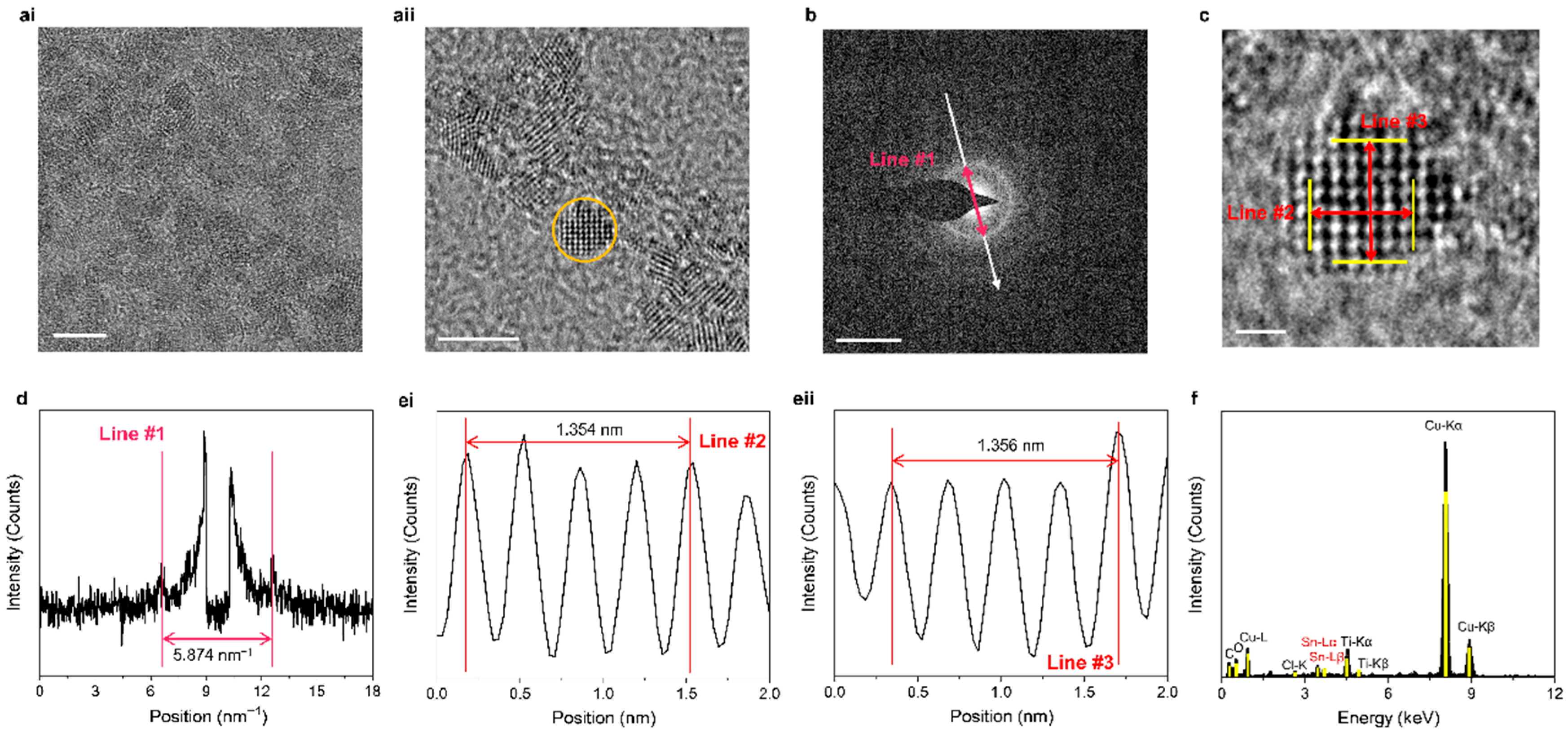
Figure 1. The microscopic determination of SnO2 QDs. The HR-TEM imaging of SnO2 QDs (ai,aii) with a scale bar of 5 nm. SAED pattern of SnO2 QDs (b) with a scale bar of 5 nm−1 and the corresponding line distribution of intensity for Line #1 (d). The HR-TEM imaging of single SnO2 (c) with a scale bar of 1 nm and the corresponding line distributions of intensity for Line #2 and Line #3 (ei,eii), respectively. The element distribution for the detection of Sn element (f).
Catalysts 16 00037 g001
Figure 2. The sequential layer depositions for Cu2O/ZnO/SnO2 multilayer. (a) The Cu2O/ZnO/SnO2 sample was assembled via sequential Cu2O, ZnO and SnO2 layer deposition steps with the corresponding photographs of sample photocathodes. The top-view observations by SEM imaging of FTO/Au (b), Cu2O (c), Cu2O/ZnO (d), and Cu2O/ZnO/SnO2 (e) sample photocathodes. The scale bars are 1 μm and 100 nm for (bd) and (e), respectively.
Catalysts 16 00037 g002
Figure 3. The schematics of photocathode configuration (ai) and Cu2O/ZnO/SnO2 multilayer structure (aii). The cross-section observation (b) and the corresponding EDX mapping distribution (ciciv) of Cu2O/ZnO/SnO2 multilayer onto FTO/Au substrate. The height distribution (d) detected by AFM technique of Cu2O/ZnO/SnO2 sample photocathode from the top-view observation.
Catalysts 16 00037 g003
Figure 4. Spectroscopic measurements of Cu2O/ZnO/SnO2 multilayer structure by XRD and XPS. XRD patterns (a) of Cu2O/ZnO/SnO2 in contrast to Cu2O and Cu2O/ZnO sample photocathodes. Cu LM2 spectra after Ar etching at 200 nm depth (b) and Zn 2p spectra (c) for Cu2O/ZnO/SnO2 in contrast to Cu2O/ZnO sample photocathode. Sn 3d spectrum (d) for Cu2O/ZnO/SnO2 sample photocathode.
Catalysts 16 00037 g004
Figure 5. The performance comparisons of LSV (a) and I-t (b) measurements among Cu2O, Cu2O/ZnO, and Cu2O/ZnO/SnO2 sample photocathode.
Catalysts 16 00037 g005
Figure 6. The comparisons of Cu2O/ZnO and Cu2O/ZnO/SnO2 sample photocathodes before and after stability tests. XPS comparison in terms of Cu LM2 between Cu2O/ZnO (B.) and Cu2O/ZnO (A.) samples (ai), Cu2O/ZnO/SnO2 (B.) and Cu2O/ZnO/SnO2 (A.) samples (aii) detected in Ar etching regions (200 nm depth). Morphology comparison by SEM imaging between Cu2O/ZnO (B.) (bibiii) and Cu2O/ZnO (A.) (ciciii) for Ar etching regions (bi,ci), high-resolution regions of surface ZnO nanoparticles (bii,cii), and low-resolution regions of Cu2O and ZnO layers (biii,ciii). The scale bars are 100 nm for (bi,bii,ci,cii) and 1 μm for (biii,ciii), respectively.
Catalysts 16 00037 g006
Disclaimer/Publisher’s Note: The statements, opinions and data contained in all publications are solely those of the individual author(s) and contributor(s) and not of MDPI and/or the editor(s). MDPI and/or the editor(s) disclaim responsibility for any injury to people or property resulting from any ideas, methods, instructions or products referred to in the content.