Article

Catalytic Deactivation Behavior over Pt/g-C3N4 in Photocatalytic H2 Evolution via Changes in Catalytic Properties of Pt Cocatalyst and g-C3N4 Surface
1
School of Chemical Engineering, University of Ulsan, Daehakro 93, Ulsan 44610, Republic of Korea
2
Department of Material Technology, Faculty of Applied Science, Ho Chi Minh City University of Technology and Education (HCMUTE), No. 1 Vo Van Ngan Street, Linh Chieu Ward, Thu Duc District, Ho Chi Minh City 700000, Vietnam
3
School of Chemistry and Chemical Engineering, Shanghai University of Engineering Science, Shanghai 201620, China
*
Author to whom correspondence should be addressed.
Catalysts 2026, 16(1), 29; https://doi.org/10.3390/catal16010029
Submission received: 21 November 2025 / Revised: 27 December 2025 / Accepted: 29 December 2025 / Published: 31 December 2025
(This article belongs to the Special Issue Design and Synthesis of Nanostructured Catalysts, 3rd Edition)

Abstract

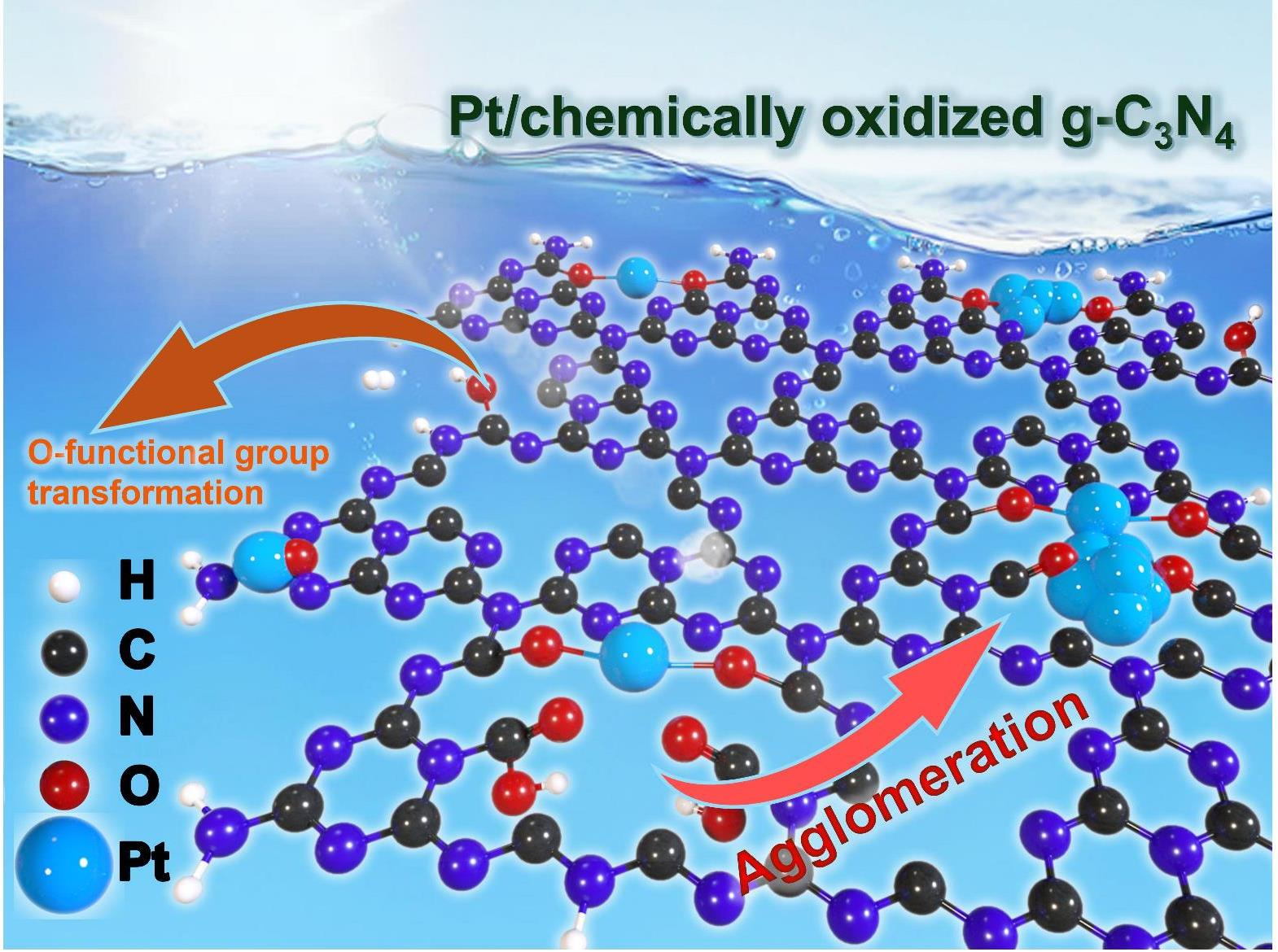
Since Pt cocatalysts play an important role in photocatalytic H2 evolution, it is necessary to track Pt over Pt/g-C3N4 catalysts during the evolution process to understand the associated photocatalytic deactivation behavior. In this study, bulk g-C3N4 (CN) and oxidized g-C3N4 (OCN) catalysts containing a Pt cocatalyst were prepared to investigate photocatalytic deactivation behavior through tracking changes in the catalytic properties of the Pt cocatalyst and g-C3N4 surface during photocatalytic H2 evolution. While CN catalysts show a lower photocatalytic activity than OCN catalysts, the former exhibit high resistance to catalytic deactivation with a lower deactivation rate than the latter. The high photocatalytic activity of OCN catalysts is caused by the highly dispersed Pt species on chemically oxidized g-C3N4 with abundant O-containing functional groups, relating to the excellent separation efficiency of photogenerated electron/hole pairs. During the evolution process, highly dispersed Pt species over fresh OCN are easily and rapidly agglomerated into large Pt nanoclusters due to its exfoliated thin-layered g-C3N4 structure, whereas the three-dimensional multi-layered g-C3N4 structure of CN catalysts hinders the agglomeration of Pt over the CN catalyst. In addition, during the photocatalytic H2 evolution, the O-containing functional groups on the OCN catalyst significantly disappear, which causes a weak metal/support interaction and, eventually, fast photocatalytic deactivation due to the agglomeration of Pt.

1. Introduction

In recent years, many researchers have made considerable efforts to transform solar energy into hydrogen via photocatalysis, thus producing a sustainable and clean fuel [1,2,3,4,5]. Photocatalytic water splitting is considered a simple, cheap, clean, and efficient platform for hydrogen production owing to its abundance and renewable nature [6,7,8,9]. Graphitic carbon nitride (g-C3N4), a metal-free polymeric semiconductor, has garnered significant attention as an n-type photocatalyst for visible light utilization owing to its high physicochemical stability, non-toxic nature, and proper band gap (2.7 eV) [10,11,12]. Moreover, platinum (Pt) has been incorporated as a cocatalyst into chemically treated g-C3N4 to overcome its drawbacks, such as low specific surface area, high recombination rate, and hydrophobicity [13,14,15,16,17].
In our previous work, a simple chemical oxidation of bulk g-C3N4 with a K2Cr2O7/H2SO4 mixture was introduced, resulting in an exfoliated defective g-C3N4 structure with a high concentration of O-containing functional groups [13,16,17]. In addition, Pt was applied as a cocatalyst onto chemically oxidized g-C3N4, which enhanced the photocatalytic activity in the H2 evolution process. The functional groups on the chemically oxidized g-C3N4 surface interacted with the Pt species, resulting in a homogeneous distribution of highly dispersed Pt species with a high efficiency in the separation of photogenerated electron/hole pairs. Consequently, the modification of bulk g-C3N4 with chemical oxidation influenced the photocatalytic properties of the Pt species that eventually determined the photocatalytic performance in the H2 evolution process.
Since the photocatalytic H2 evolution process is conducted at room temperature, it was widely believed that the catalytic deactivation would not be severe during the process. However, it was reported that there was a decrease in photocatalytic activity during photocatalytic H2 evolution [18,19,20]. Lie et al. introduced nano-sheet g-C3N4 hybridized CdS photocatalysts and observed their photocatalytic stability in H2 evolution [18]. It was suggested that the g-C3N4 nanosheets protected CdS from photocorrosion, which enhanced the photocatalytic stability in the cycling tests [18]. Yu et al. found that a CeO2@Ni4S3/g-C3N4 photocatalyst showed high resistance to deactivation in a 10 h photocatalytic H2 evolution, compared with pure g-C3N4 [19]. The decrease in photocatalytic evolution activity must be caused by changes in photocatalytic properties during the H2 evolution process. To date, there have been several works on photocatalytic deactivation for g-C3N4 materials, including those under extreme conditions [21,22,23,24,25]. However, to the best of our knowledge, there has been no report tracking the catalytic properties of a Pt cocatalyst and g-C3N4 surface during the H2 evolution process to investigate the photocatalytic deactivation behavior of Pt/g-C3N4 catalysts.
In this work, we prepared two types of Pt/g-C3N4 photocatalysts—bulk g-C3N4 (CN) and chemically oxidized g-C3N4 (OCN) incorporated with Pt—to investigate the photocatalytic deactivation behavior related to the properties of Pt and interactions between Pt and g-C3N4. First, we calculated deactivation rates for the prepared catalysts based on the photocatalytic data in 18 h H2 evolution and cycling tests. While OCN catalysts showed a high photocatalytic evolution rate compared to CN ones, CN catalysts exhibited a high resistance to photocatalytic deactivation with a lower deactivation rate. According to various characterization tools, the exfoliated g-C3N4 structure of OCN and weak interaction between OCN and Pt species induced rapid agglomeration of Pt species during H2 evolution, resulting in a sudden drop in photocatalytic activity.

2. Results

2.1. Photocatalytic H2 Evolution Performance

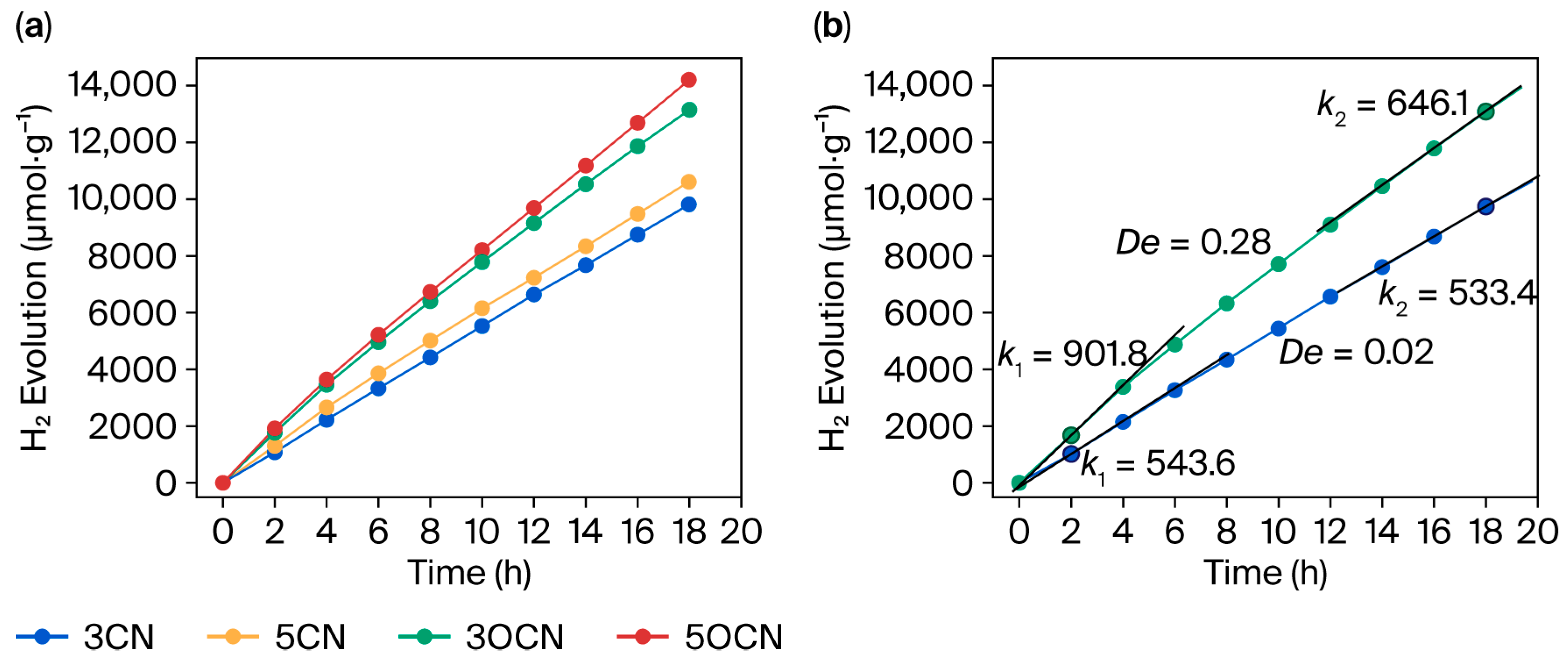
Figure 1a shows the 18 h photocatalytic H2 evolution results for CN and OCN catalysts. First, OCN catalysts efficiently produce H2 with 14,185 μmol∙g−1 for 5OCN and 13,145 μmol∙g−1 for 3OCN, compared with 5CN and 3CN, whose H2 production amounts are 10,614 and 9778 μmol∙g−1, respectively. This trend is consistent with that reported previously [13,17]. According to Nguyen et al., the chemically oxidized g-C3N4 contained highly dispersed Pt species with a high charge separation efficiency of the photogenerated electron/hole pairs, whereas the relatively large Pt nanoclusters over the bulk g-C3N4 exhibited a poor charge separation efficiency [13].
To compare the photocatalytic deactivation behavior, we calculated the deactivation rate (De) defined as De = (k1k2)/k1, where k1 is the initial evolution rate, and k2 is the final evolution rate. The calculated values of deactivation rates for the catalysts are presented in Table 1. Interestingly, the De values of CN catalysts are very low at 0.02 and 0.04, compared with those of OCN (0.28 for 3OCN and 0.19 for 5OCN), which clearly indicates that CN catalysts have a higher resistance to photocatalytic deactivation than OCN ones. Figure 1b compares the deactivation rates for 3CN and 3OCN. For 3OCN, the initial evolution rate (k1) and final evolution rate (k2) are 901.8 and 646.1 μmol∙g−1∙h−1, respectively. Even though its initial and final evolution rates are still higher than those for 3CN (k1 = 543.6 and k2 = 533.4 μmol∙g−1∙h−1), the drop in the evolution rate for 3OCN is much higher than that for 3CN. This naturally shows that the 3CN catalyst has a higher resistance to photocatalytic deactivation than the 3OCN catalyst. In addition, Figure S1 shows cycling tests for 3CN and 3OCN. The H2 production amount of each cycle for 3CN is 3901.2, 3848,5, and 3730.6 μmol∙g−1, resulting in a 4.4% decrease in photocatalytic evolution activity. In contrast, the H2 production amount for the 3OCN catalyst decreases from 4441.3 to 3737.3 μmol∙g−1, with a 15.8% decrease in photocatalytic activity. This also indicates the fast photocatalytic deactivation over the OCN catalyst. The photocatalytic deactivation behavior is closely connected with a change in the photocatalytic properties during the H2 evolution process.

2.2. Photocatalytic Properties of Fresh Catalysts

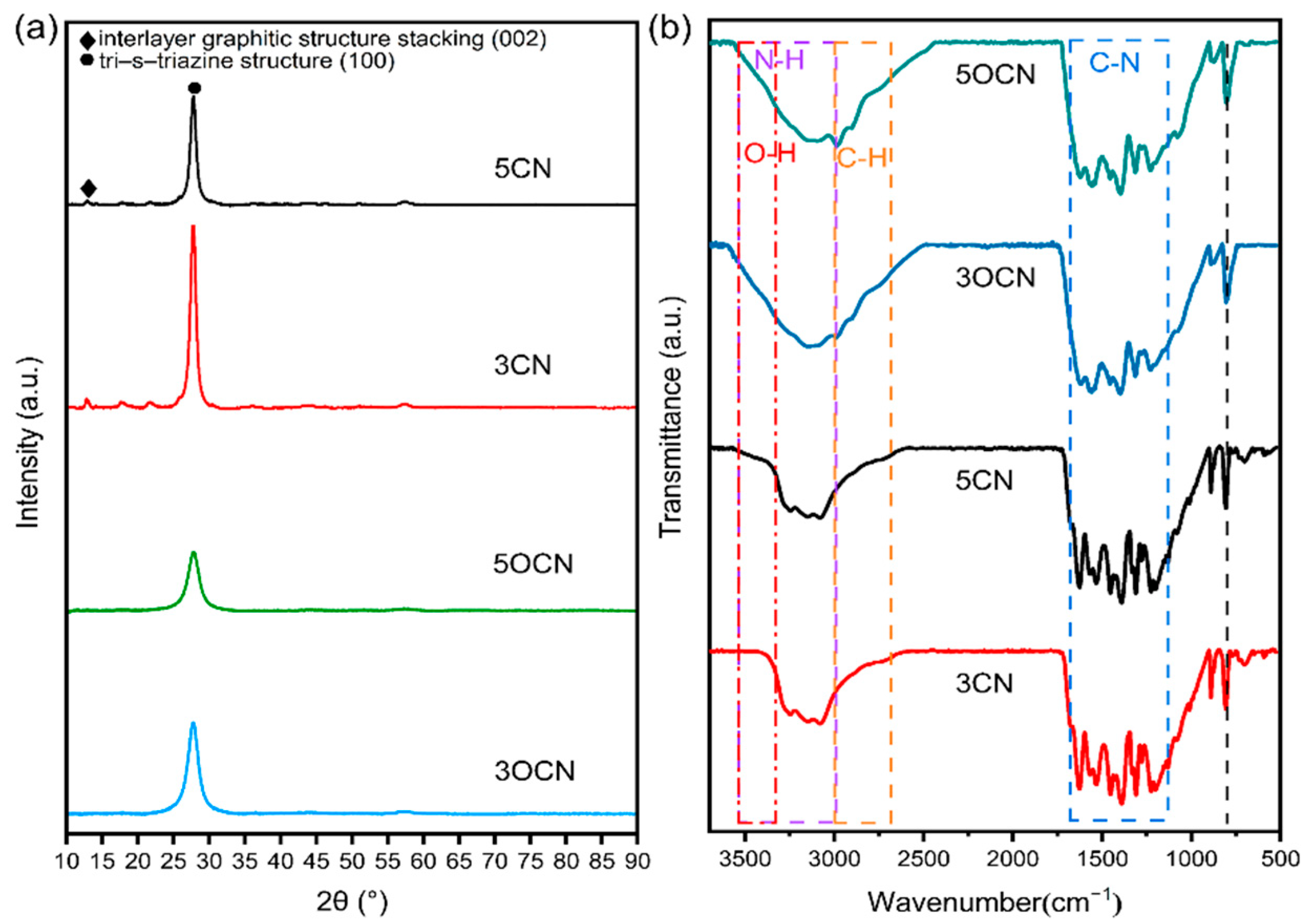
Table 1 also presents the Pt contents over the catalysts. The actual Pt contents over the prepared catalysts were almost the same as the nominal Pt contents. Figure 2a presents the XRD patterns for the prepared catalysts. All the catalysts clearly show a sharp characteristic XRD peak at 2θ = 27.6°, assigned to the (002) plane of g-C3N4 corresponding to the inter-planar distance between C3N4 layers. In addition, no typical XRD peak for Pt species was detected, implying that the Pt species were highly dispersed on the CN and OCN surfaces. Meanwhile, the XRD peaks at 2θ = 27.6° for 3OCN and 5OCN are weaker and broader compared with those for 3CN and 5CN, indicating the thin-layered structure of the inter-planar stacking of g-C3N4 due to exfoliation by chemical oxidation; that is, the chemical oxidation process can exfoliate the multi-layered structure of the CN catalysts [18,19]. In addition, the CN catalysts exhibit a small XRD peak at 2θ = 13.2°, representing the (100) plane of g-C3N4 corresponding to the in-planar structural packing motif of tri-s-triazine, whereas no peak was detected for the OCN catalysts. This also implies the strong crystallinity of g-C3N4 in the CN catalysts.
Figure 2b shows the FT-IR spectra for the prepared catalysts. All the catalysts present characteristic bands for successful synthesis of the g-C3N4 structure. A sharp band at 808 cm−1 corresponds to the vibration of tri-s-triazine in the g-C3N4 structure [13]. The bands around 1200–1700 and 3000–3600 cm−1 are assigned to the stretching vibration modes of the aromatic heterocycles and of the C–N and N–H bonds, respectively [13,14,15]. An interesting point in the FT-IR spectra between the CN and OCN catalysts is the broadening of the bands around 3000–3600 cm−1 for the OCN catalysts, caused by the introduction of an O–H bond (vibration modes around 3300–3600 cm−1) [14,17]. Comparing the FT-IR spectra before and after the reaction (Figure S2), no significant change was observed in the characteristic peaks, indicating that the material structure remained stable during the photocatalytic process. The chemical oxidation process not only exfoliates the multi-layered structure of g-C3N4 but also introduces functional groups into the g-C3N4 surface, which is in good agreement with the XRD data.
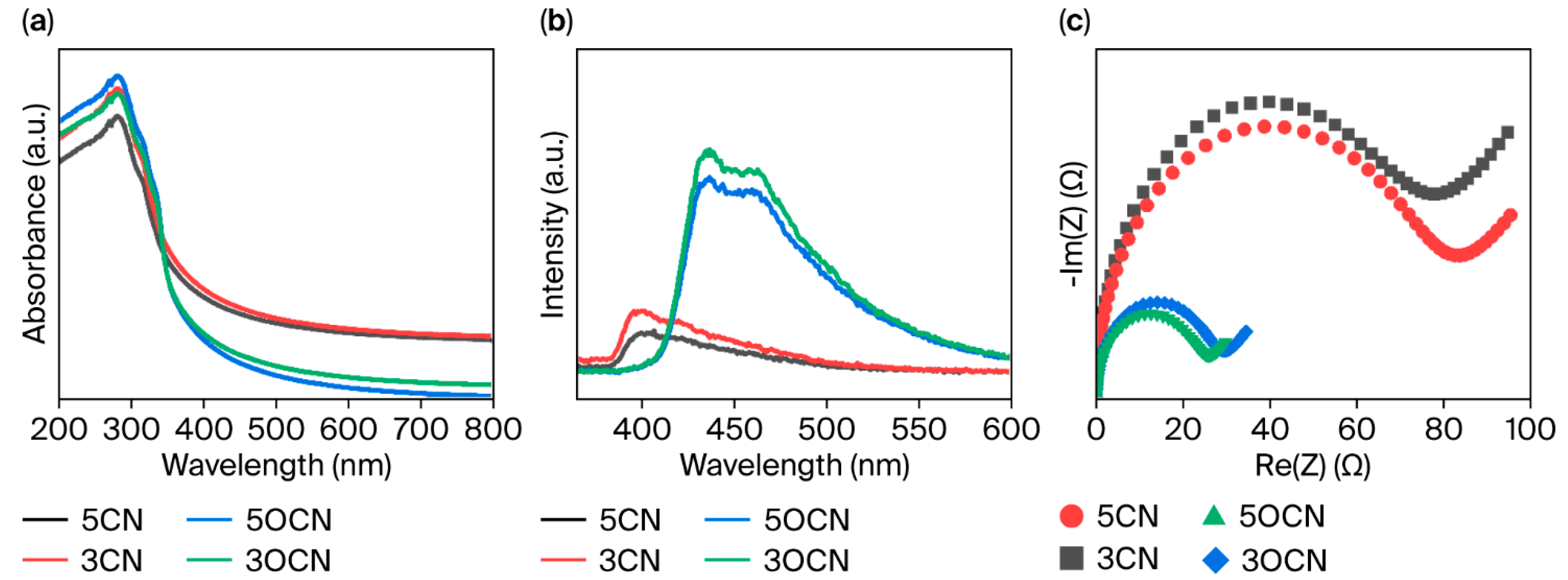
UV-Vis absorbance spectra of the prepared catalysts were collected to investigate the optical properties of the absorption edge and band gap (Figure 3a). The absorption band positions of all the catalysts are mainly located in the UV range, and band shoulders tail to the visible range. However, the CN catalysts have more tails in the visible range than the OCN catalysts. Figure S3 (see Supporting Information) presents the Tauc’s plot gained from the UV-Vis spectra, and corresponding band gap values are listed in Table 1. The band gaps for 3CN and 5CN are approximately 2.96 and 2.99 eV, respectively. The band gaps for 3OCN and 5OCN increased to 3.10 and 3.13 eV, which is explained by the quantum confinement effect owing to the exfoliation from bulk g-C3N4 to a thin-layered structure [17,26,27]. Photoluminescence (PL) emission spectra for the prepared catalysts were monitored under identical experimental conditions (same excitation/emission settings and measurement geometry) to investigate the charge recombination of all the catalysts (Figure 3b). Interestingly, CN has a similar light absorption capacity to OCN, but its PL intensity is much higher than that of OCN, meaning that OCN effectively promotes charge separation and suppresses recombination. First, the higher band gap of the OCN catalysts than that of the CN catalysts can cause the blue shift in the PL emission peak position. The peak positions of maximum intensity at 436 nm for the CN catalysts shift to 398 nm for the OCN catalysts. More interestingly, the OCN catalysts exhibit much lower PL emission intensity than the CN catalysts, as shown in Figure 3b. This indicates that the exfoliated g-C3N4 structure and the introduction of the functional groups via chemical oxidation effectively inhibit the band-to-band recombination of photogenerated electron/hole pairs, possibly through localization of the photoexcited electrons. EIS Nyquist plots for the prepared catalysts were also collected under the conditions of 0.2 V, frequency range of 100 kHz~100 mHz, and a certain equivalent circuit (R1 + C2/(R2 + W2)) to measure the interface resistance and transfer ability of photoexcited electrons (Figure 3c). Whereas the CN catalysts show poor charge separation with larger arc radii, the OCN catalysts present more efficient charge separation due to their smaller arc radii, consistent with the PL emission data.
From the characterization data for the fresh catalysts, the OCN catalysts not only have a thin-layered structure exfoliated from bulk g-C3N4 (CN) but also abundant functional groups on the defective g-C3N4 surface, caused by the chemical oxidation process. Moreover, the OCN catalysts show efficient charge separation of photogenerated electron/hole pairs, resulting in a high photocatalytic H2 evolution rate. However, in terms of photocatalytic deactivation behavior, the OCN catalysts exhibit poor catalyst stability, which is related to the properties of Pt and the metal/support interactions.

2.3. Tracking Pt Properties in Photocatalytic H2 Evolution

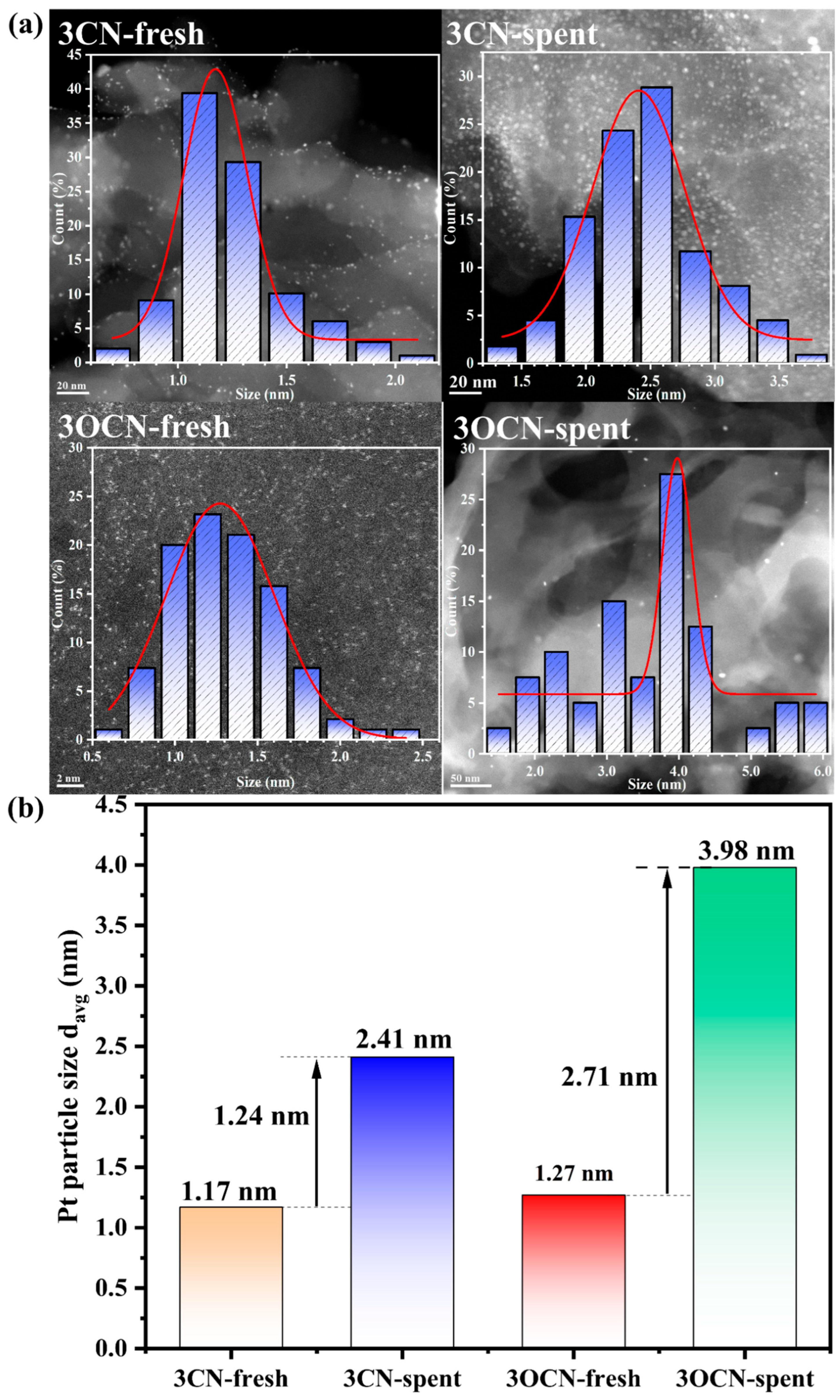
Figure 4 shows HAADF-STEM images and Pt size distributions of the fresh and spent 3CN and 3OCN catalysts. From the Pt size distributions over the catalysts (Figure 4a), it can be noted that the average Pt size for fresh 3OCN was 1.27 nm, similar to that for fresh 3CN (average Pt size = 1.17 nm). These results are in good agreement with those reported previously [13,15]. However, the average Pt size for spent 3OCN was 3.98 nm, indicating fast and severe agglomeration of Pt nanoclusters over the 3OCN catalyst during the photocatalytic H2 evolution. In contrast, the average Pt size for spent 3CN was 2.41 nm, which is more than the 1.17 nm for fresh 3CN. This reflects the mild Pt agglomeration over the 3CN catalyst in the evolution process. Figure 4b clearly presents changes in the average Pt sizes for the fresh and spent 3CN and 3OCN catalysts to elucidate the Pt agglomeration behavior during the 18 h H2 evolution. In summary, the average Pt size for fresh 3CN (1.17 nm) increases to 2.41 nm for spent 3CN by 1.24 nm. However, highly dispersed Pt species over fresh 3OCN with 1.27 nm of davg are significantly agglomerated to Pt nanoclusters over spent 3OCN with 3.98 nm of davg, which implies a considerable change in interactions between the Pt species and g-C3N4 surface over 3OCN during the H2 evolution test.
HR-TEM images of the fresh and spent 3CN and 3OCN catalysts were assessed to confirm the Pt agglomeration during the H2 evolution process. Figure S4 (see Supporting Information) shows the HR-TEM images and the corresponding Pt size distributions for fresh and spent 3CN and 3OCN. In the HR-TEM images, large Pt nanoclusters were detected even though the numbers of Pt nanoclusters in the TEM images were limited for all the catalysts. Similarly to the trend in the HAADF-STEM images, the average Pt size of 1.6 nm for fresh 3CN increased to 2.72 nm for spent 3CN in the TEM images. Likewise, the average Pt size of 2.06 nm for fresh 3OCN became 3.38 nm in the TEM images for spent 3OCN. Moreover, the XRD patterns of the spent catalysts were also collected to check for Pt agglomeration during the H2 evolution process (Figure S5; see Supporting Information). Although the characteristic XRD peaks of the g-C3N4 structure were apparently monitored even for the spent catalysts, there was no typical XRD peak of the Pt metallic phase, implying that large Pt nanoclusters did not form. In a previous study, when bulk g-C3N4 catalysts showed the characteristic XRD peak of Pt phases, their average Pt sizes were 5.46 and 5.98 nm—greater than the largest average Pt size in this study, namely, 3.98 nm [13]. Furthermore, Pt/chemically oxidized g-C3N4 catalyst (OCN-24) in the same study also showed the typical XRD peak of the Pt phase, with the average Pt size estimated at 4.58 nm. Therefore, in this work, even though there was no typical XRD peak of Pt phase for the spent catalysts, this does not mean that Pt agglomeration did not occur during the H2 evolution process. The davg values measured from the HAADF-STEM and HR-TEM images are also listed in Table 2.
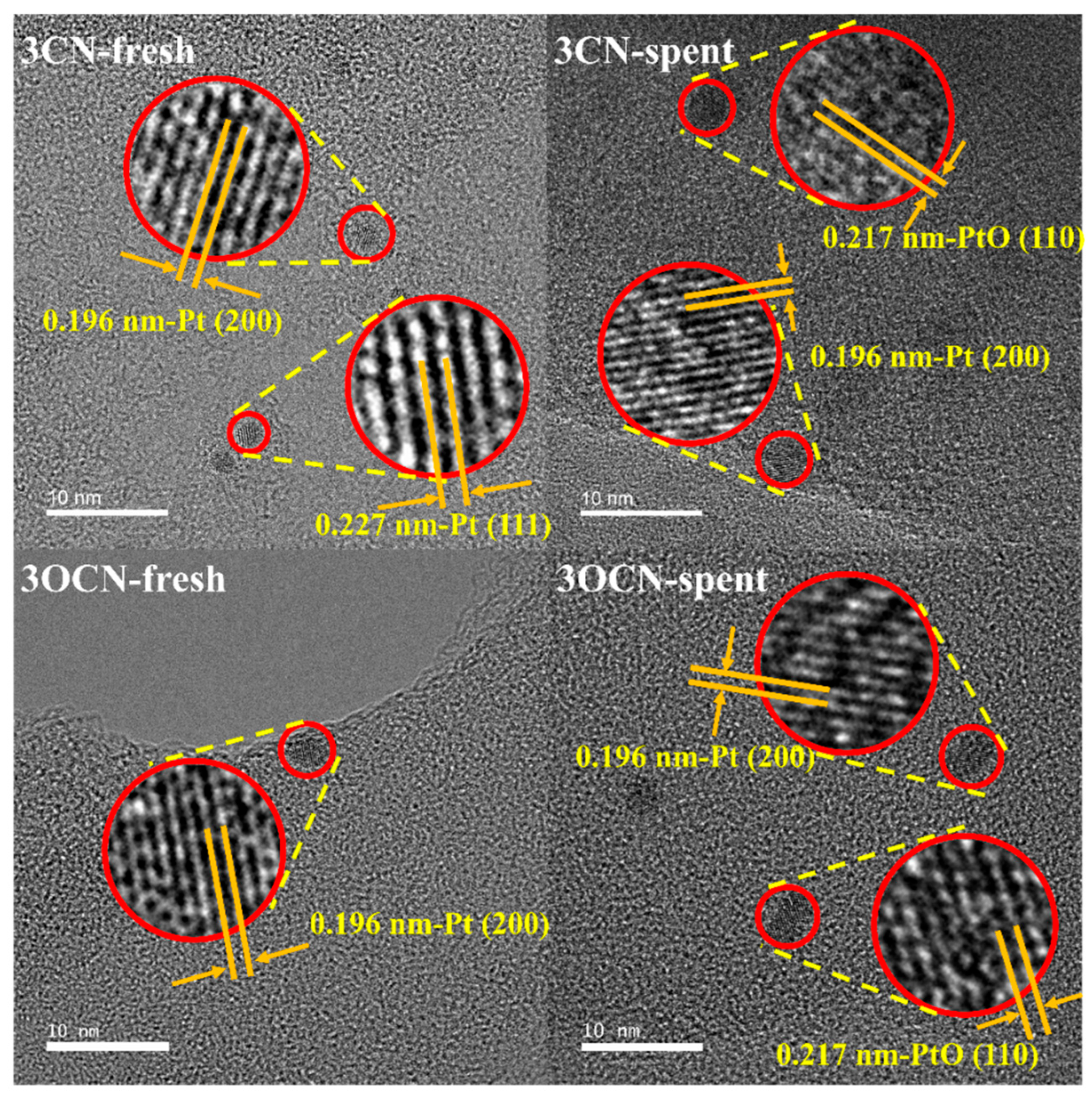
Figure 5 shows enlarged TEM images and d-spacing values of Pt nanoclusters for the fresh and spent 3CN and 3OCN catalysts to confirm the Pt oxidation states [28,29,30]. For fresh 3CN and 3OCN, there were no PtO nanoclusters, but Pt metallic phases were present, even though all the enlarged TEM images were checked for Pt nanoclusters. In Figure 5, 0.196 nm of the d spacing for Pt (200) and 0.227 nm of the d spacing for Pt (111) are detected. However, the spent CN and OCN catalysts contained additional nanoclusters with a d spacing of 0.217 nm for PtO (110), indicating the transformation of PtO nanoclusters during the H2 evolution process [13], which can be proved using FFT measurements (Figure S6; see Supporting Information). As shown in Figure S4 (see Supporting Information), the average sizes of the Pt nanoclusters for the spent CN and OCN catalysts were 2.72 nm and 3.38 nm, respectively. Therefore, PtO nanoclusters formed over the spent CN and OCN catalysts through the agglomeration of Pt and its interactions with the g-C3N4 surface and water.
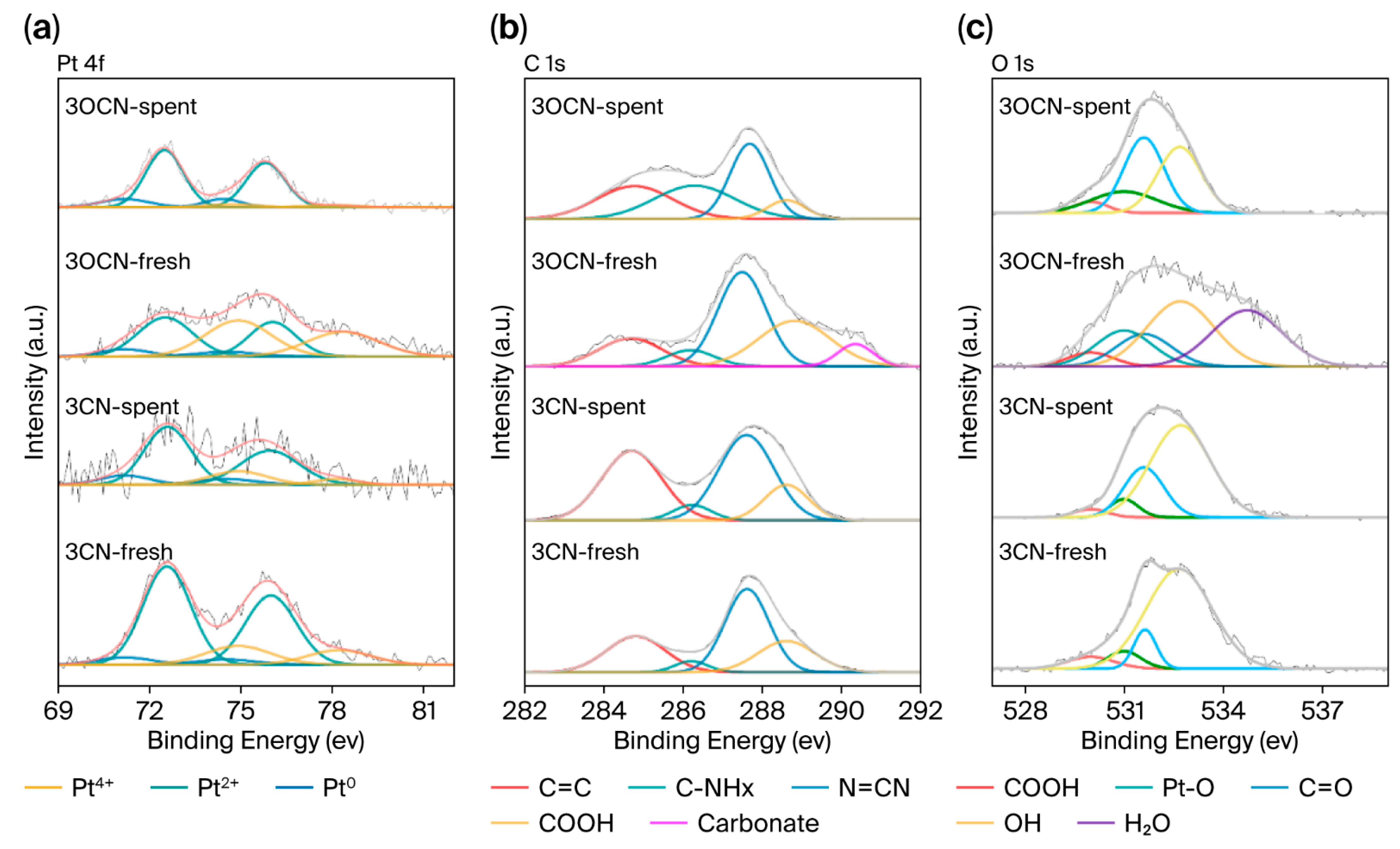
XPS measurements were conducted to investigate the surface composition and chemical state of all the catalysts. Figure S7 (see Supporting Information) shows the XPS survey spectra, which contain sharp peaks at around 71, 285, 394, and 528 eV for the Pt 4f, C 1s, N 1s, and O 1s, respectively. Figure 6a presents the XPS data for Pt 4f for the fresh and spent 3CN and 3OCN catalysts. The Pt 4f XPS data show three pairs of Pt 4f5/2 and Pt 4f7/2 doublets, consistent with a spin/orbit splitting of 3.3 eV. Doublets at 71.2 and 74.5 eV correspond to Pt0 species, whereas those at 72.5 and 75.8 eV are assigned to Pt2+ [16,17,31,32,33]. The existence of Pt0 and Pt2+ was also observed in the HR-TEM results. Additionally, pairs of doublets at 74.9 and 78.2 eV corresponding to Pt4+ species were also detected in the fresh 3CN and 3OCN catalysts [32,33,34]. The relative percentage of each Pt species is shown in Table 2. Specifically, the fresh 3OCN catalyst contained 48.8% of Pt4+ species, which sequentially decreased to Pt2+ and Pt0 during the H2 evolution test. As a result, 8.9% of Pt4+ remained in the spent 3OCN catalyst with 78.1% of Pt2+ and 13% of Pt0 species, representing a rapid reduction in Pt species and the dominance of Pt2+ species over the 3OCN catalyst. In contrast, even though fresh 3CN contained 19.3% of Pt4+ species with 74.5% of Pt2+ and 6.2% of Pt0 species, spent 3CN still had 19.5% of Pt4+ with 68.9% of Pt2+ and 11.6% of Pt0 species, respectively, indicating a slow reduction and less change in the Pt species over the 3CN catalyst. The three-dimensional multi-layered g-C3N4 structure of the 3CN catalyst can inhibit the interactions between the Pt species and hydrogen produced in the evolution test, resulting in strong catalyst stability and high resistance to photocatalytic deactivation. Conversely, the exfoliated thin-layered g-C3N4 structure of the 3OCN catalyst allows not only for a fast reduction in the Pt species due to the interaction with hydrogen species, but also easier agglomeration to Pt nanoclusters.
Pt2+ was the main Pt oxidation state over the fresh 3CN and 3OCN catalysts, as shown in Figure 6a. Whereas the PtO phase was not detected in HR-TEM for fresh 3CN and 3OCN, it was detected for spent 3CN and 3OCN with Pt agglomeration during the evolution test (Figure 5). Therefore, it is believed that the Pt2+ species are highly dispersed over the fresh 3CN and 3OCN catalysts, which chemically bond to functional groups on the g-C3N4 surface and then agglomerate to PtO nanoclusters while losing the interaction with the functional groups on g-C3N4 surface. Figure 6b presents XPS data for C 1s for the fresh and spent 3CN and 3OCN catalysts. The peaks appearing at binding energies of 284.8, 286.4, and 287.6 eV in the C 1s XPS data are assigned to the adventitious carbon (C=C) or C–C reference carbon, sp3 C atoms (C–NHx), and sp2 C atoms (N–C=N), respectively [35,36]. A peak at 288.8 eV associated with the COOH species is additionally generated during thermal polymerization and successive chemical oxidation [37]. Interestingly, one more peak appeared at 290.3 eV only for the fresh 3OCN catalyst, which was assigned to carbonate (–CO3 ) [38], which implies that the highly dispersed Pt species over the fresh OCN catalyst is linked with carbonate groups on g-C3N4 surface. However, the peaks associated with carbonate or COOH over the fresh 3OCN catalyst disappeared or decreased for the spent 3OCN catalyst, indicating the chemical reaction of the functional groups over the 3OCN catalyst during the H2 evolution test. Specifically, the atomic percentages of COOH and carbonate in the C 1s XPS data of the fresh 3OCN catalyst remarkably dropped from 36.6% to 14.7% and from 11.6% to 0%, respectively (Table S1; see Supporting Information). As mentioned before, the oxygen-containing functional groups fully developed through chemical oxidation on the 3OCN catalyst disappeared in the evolution test due to their interaction with evolved hydrogen. In contrast, 3CN presented a mere 7.5% drop in the relative percentage of COOH, indicating little change in the functional groups on the g-C3N4 surface of the 3CN catalyst during the photocatalytic H2 evolution process.
XPS data for O 1s for the fresh and spent 3CN and 3OCN catalysts are shown in Figure 6c. The four peaks appearing at 530.0, 531.0, 531.6, and 532.7 eV for all the catalysts can be attributed to COOH, Pt–O, C=O, and O–H groups, respectively [37,38,39,40]. An additional peak was detected at 534.7 eV only for the fresh 3OCN catalyst, indicative of the presence of a chemically adsorbed H2O bond (H2O/–OH and weakly bound oxygen-containing adsorbates) on this catalyst [41]. For the fresh and spent 3CN catalysts, there was little change in the portion of the O-containing functional groups, with an increase in the C=O group and gradual decreases in the COOH and OH groups during the H2 evolution process, which is consistent with the XPS C 1s results. However, for the fresh and spent 3OCN catalysts, the relative portion of the C=O group increased, while the H2O functional group disappeared, and the relative portion of the OH group decreased. Table S1 shows the atomic percentages of the O-containing functional groups of the fresh and spent 3CN and 3OCN catalysts from the XPS O 1s data. The fresh 3OCN catalyst contained 6.3%, 15.9%, 14.8%, 43.1%, and 47.5% of the COOH, Pt–O, C=O, OH, and H2O groups, respectively. After the H2 evolution test, the chemisorbed H2O functional group disappeared, and the atomic percentage of the COOH functional group decreased to 4.9%, while that of the C=O group significantly increased from 14.8% to 41.1%, suggesting that a transformation process occurs in the OH functional group, which fully turns to H2O in the photocatalytic process. A similar trend can be seen in the relative portion of the O-containing functional groups from the XPS C 1s data for the fresh and spent 3OCN catalysts. However, for the fresh and spent 3CN catalysts, there was no remarkable change in the atomic proportions of the O-containing functional groups, even though all the trends were similar to those for the 3OCN catalyst. The apparent difference between the 3OCN and 3CN catalysts in Table S1 is the large drop in the relative proportions of COOH and carbonate in XPS C 1s and the disappearance of adsorbed H2O in XPS O 1s.
Figure S8 shows the XPS data for N 1s for the fresh and spent 3CN and 3OCN catalysts. The existence of three distinct N species in the g-C3N4 structure is well known; N atoms forming part of the g-C3N4 structure are bound to two C atoms, whereas trigonal N atoms linking triazine units are bound to three C atoms. In Figure S8, the peaks observed at 397.9 and 398.8 eV correspond to the presence of the sp2-hybridized N2C atom (C–N=C) and N–C3 (N3C atom), respectively. The peak detected at 400.7 eV is assigned to amino functional groups (C–NHx) [37,39]. It is remarkable that the fresh 3OCN catalyst contains a strong intensity of C–NHx, which rapidly decreased during the H2 evolution process, while there was no large difference in the relative proportion of N 1s between the fresh and spent 3CN catalysts.
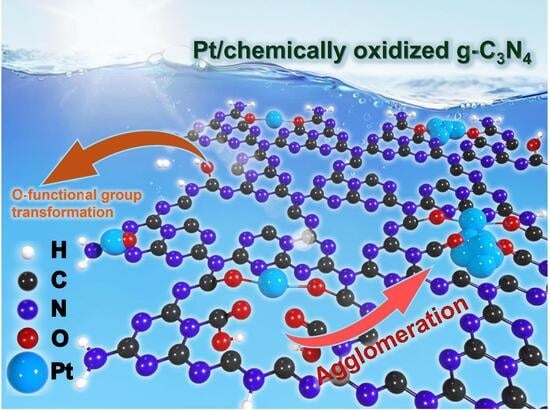
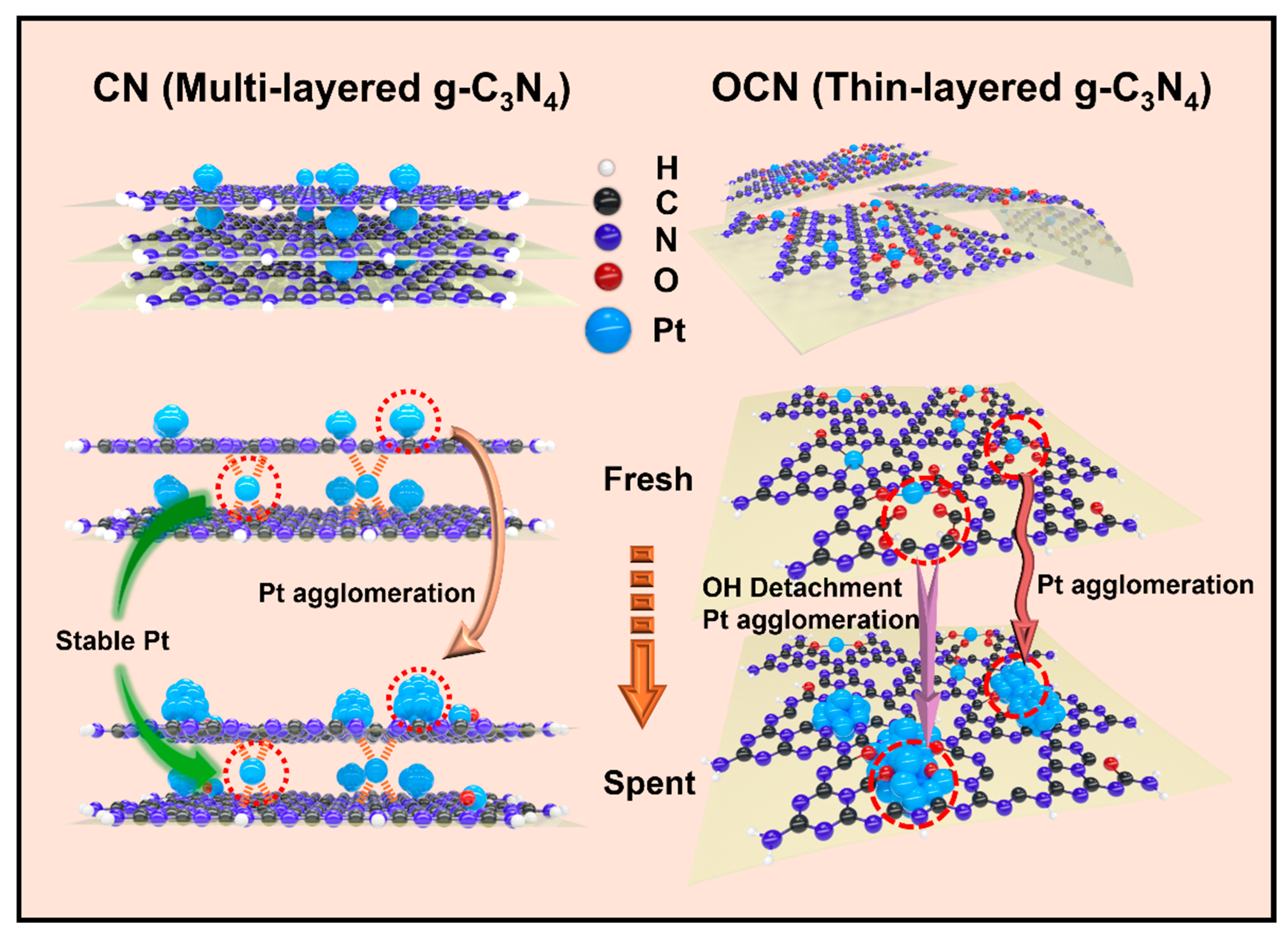
Figure 7 illustrates conceptual differences in the g-C3N4 structures between the CN and OCN catalysts, as well as their photocatalytic deactivation behaviors. For the CN catalyst, the Pt species can be located not only on the g-C3N4 surface but also between two layers in the three-dimensional bulk g-C3N4 structure. The latter prohibits the Pt species from agglomerating and reacting with chemicals during photocatalytic H2 evolution, while the former allows the Pt species to readily agglomerate into large Pt nanoclusters. Therefore, even though the CN catalysts exhibit low photocatalytic H2 evolution activity due to a poor separation efficiency of photoexcited electron/hole pairs and low dispersion of the Pt species, the Pt species between the multi-layered g-C3N4 structure naturally show strong resistance to Pt agglomeration, leading to slow reduction of the Pt species and, thus, very slow photocatalytic deactivation. In contrast, the Pt species on the g-C3N4 surface over the CN catalysts tended to significantly agglomerate into large Pt nanoclusters during the photocatalytic H2 evolution test. For the OCN catalysts, highly dispersed Pt species combined with the abundant O-containing functional groups resulted in high photocatalytic H2 evolution activity due to a high separation efficiency at the initial reaction time. However, the exfoliated thin-layered g-C3N4 structure of the OCN catalysts allowed the Pt species and the O-containing functional groups to readily react with chemicals in the photocatalytic H2 evolution, resulting in the fast disappearance of the O-containing functional groups on g-C3N4 and subsequent agglomeration of the Pt species into large Pt nanoclusters due to weak metal/support interaction. Consequently, the formation of large Pt nanoclusters over the spent OCN catalyst caused rapid photocatalytic deactivation during the photocatalytic H2 evolution test.

3. Materials and Methods

3.1. Chemicals

The chemicals utilized in this research include thiourea (CH4N2S, ≥99%), potassium dichromate (K2Cr2O7, 99%), chloroplatinic acid hexahydrate (H2PtCl6·6H2O), and triethanolamine (TEOA, C6H15NO3, 99%), all of which were sourced from Sigma-Aldrich Korea (Gyeonggi, Republic of Korea). Sulfuric acid (H2SO4, 98%) was acquired from Daejung Chemicals & Metals Co., Ltd. (Gyeonggi, Republic of Korea). High-purity gases (H2 and Ar) were provided by MS Gas Corporation (Busan, Republic of Korea). Deionized (DI) water was employed for all solution preparations and photocatalytic hydrogen evolution reactions.

3.2. Synthesis of CN and OCN

CN and OCN catalysts were synthesized via thermal polymerization and a chemical oxidation procedure, as described in our previous studies [13,15,26,27]. Initially, thiourea (CH4N2S) was placed in a crucible, covered with aluminum foil, and gradually heated to 550 °C at a rate of 5 °C/min. Following this, the material was calcined in an air atmosphere for 2 h at 550 °C, yielding yellow aggregates. These aggregates were then ground into a dispersed powder, which was designated as bulk g-C3N4, to be used in the subsequent chemical oxidation process. In a 100 mL flask, a mixture of H2SO4 and bulk g-C3N4 was first prepared under magnetic stirring at room temperature for 30 min. As the solution developed a brown color, K2Cr2O7 was gradually added to the mixture to maintain a gentle reaction environment. The resulting solution was stirred continuously for 1 h. Afterward, the mixture was diluted with deionized water and allowed to cool to room temperature. It was then repeatedly washed until the pH of the solution approached 7. To separate the non-dispersed g-C3N4, sonication and centrifugation were employed, leaving the water-dispersible, chemically modified g-C3N4.
In the Pt loading process, g-C3N4 at a concentration of 0.55 mg/mL was dispersed with H2PtCl6·6H2O in deionized (DI) water. This mixture was prepared in a 2000 mL three-neck flask under stirring while gradually increasing the temperature of the solution to 70 °C over 30 min. The Pt concentration was adjusted to 3 wt% and 5 wt%. A continuous flow of H2 was introduced into the solution at a rate of 25 mL/min. After the reaction, the precipitate was washed several times with DI water and then vacuum-dried for collection. The resulting catalysts were designated as xOCN and xCN, where x = 3 or 5 corresponds to a platinum content of 3 wt% or 5 wt%, respectively.

3.3. Photocatalytic Evaluation for H2 Production

Solar-simulated photocatalytic hydrogen evolution reactions were carried out using a 300 W Xe lamp (1.0 Sun) with an AM 1.5G filter as the light source. A 50 mg portion of the CN and OCN catalysts was suspended in 90 mL of deionized water and stirred magnetically for 30 min. The system was then purged with argon (Ar) gas for 30 min in the dark. Next, 10 mL of triethanolamine (TEOA) solution was added as a sacrificial agent, and the system was again purged with high-purity Ar before activating the light source to start H2 production. The hydrogen generated was continuously monitored using an online gas chromatograph equipped with a thermal conductivity detector (TCD). For catalyst performance and stability evaluation, H2 evolution was monitored over 18 h and in repetitive 4 h cycles under the same experimental conditions. At the beginning of each cycle, 10 mL of TEOA was introduced, while 30 mL was used in the 18 h test. The system was cleaned with pure Ar gas for 20 min before each cycle.

3.4. Structural Properties

X-ray diffraction (XRD) patterns were recorded in continuous scan mode using a Cu-target X-ray tube. The measurements were conducted over a 2θ range of 10–90° with a scan rate of 2°/min. The X-ray generator operated at 3 kW, with measurement conditions set at 40 kV and 30 mA. HR-TEM and HAADF-STEM were employed to analyze microstructures of materials with a JEM-ARM300F JEOL instrument (Tokyo, Japan). The size distributions of Pt particles in the OCN and CN catalysts were obtained using ImageJ software (FIJI 1.49) and calculated based on count (%), and the lattice space information was obtained using Digital Micrograph. The functional groups in the synthesized catalysts were analyzed using Fourier-transform infrared spectroscopy (FT-IR), conducted on a Thermo Scientific Nicolet 380 system (Waltham, MA, USA), equipped with an iD1 transmission accessory (Nicolet iS5). To analyze the elemental composition, chemical states, and electronic configurations of the elements, X-ray photoelectron spectroscopy (XPS) was performed using a Thermo Fisher K-alpha system (Waltham, MA, USA), equipped with a flood gun to mitigate sample charging. All binding energies in the spectrum were referenced to the C 1s peak of carbon, set at a binding energy (BE) of 284.8 eV. The data collected were processed following a Shirley background subtraction.

3.5. Optical Properties

The optical properties of the photocatalysts were examined using ultraviolet–visible (UV–Vis) diffuse reflectance spectroscopy (SPECORD® 210 Plus, Analytik Jena, Germany) and photoluminescence (PL) measurements (Agilent Cary Eclipse fluorescence spectrophotometer, Santa Clara, CA, USA), both conducted at ambient temperature with a diode laser. Electrochemical impedance spectroscopy (EIS) was conducted with a VSP impedance analyzer (BioLogic Science Instruments, Seysinet-Pariset, France) in a conventional three-electrode setup, with an applied potential of 2.0 mV. The electrodes used consisted of an Ag/AgCl reference, a platinum wire counter electrode, and a working electrode, which was prepared on a carbon substrate by depositing a mixture of photocatalyst, 1 mL of water, and 40 μL of 5% Nafion solution.

4. Conclusions

In this work, we prepared two types of Pt/g-C3N4 catalysts—bulk g-C3N4 (CN) and chemically oxidized g-C3N4 (OCN) containing Pt—to investigate their catalytic deactivation behavior during the photocatalytic H2 evolution process, which was achieved by tracking changes in the properties of Pt and metal/support interactions. In terms of photocatalytic activity, the OCN catalysts exhibited a higher H2 production rate than the CN catalysts. However, CN catalysts showed a lower deactivation rate than the OCN catalysts, as highly dispersed Pt species over the fresh OCN catalyst easily agglomerated to large Pt nanoclusters over the spent OCN catalyst during the H2 evolution test. The three-dimensional multi-layered g-C3N4 structure of the CN catalysts inhibited the agglomeration of Pt during the H2 evolution process, while the thin-layered g-C3N4 structure of the OCN catalysts generated by exfoliation due to chemical oxidation enabled severe Pt agglomeration. In addition, even though the O-containing functional groups over the OCN catalysts were efficiently produced via chemical oxidation, they disappeared through transformation during the H2 evolution process, causing weak metal/support interactions with the formed Pt agglomerates.

Supplementary Materials

The following supporting information can be downloaded at https://www.mdpi.com/article/10.3390/catal16010029/s1: Figure S1: Cycling results of photocatalytic H2 evolution for (a) 3CN and (b) 3OCN; Figure S2: FT-IR spectra of the fresh and spent catalysts; Figure S3: Tauc’s plot gained from the UV-Vis absorbance spectra of catalysts; Figure S4: HR-TEM images and Pt size distributions of fresh and spent 3CN and 3OCN; Figure S5: XRD patterns of spent catalysts; Figure S6: Determination of d-space for nanoparticles in photocatalysts using FFT; Figure S7: XPS survey spectra of fresh and spent 3CN and 3OCN catalysts; Figure S8: XPS pattern of N1s for fresh and spent 3CN and 3OCN catalysts; Table S1: Atomic percentages of functional groups over fresh and spent 3CN and 3OCN catalysts from XPS data of C 1s and O 1s.

Author Contributions

Investigation, writing—original draft, and editing, C.S.; Analysis and data curation, P.A.N.; Supervised the work and refined this manuscript, E.W.S.; Analysis and data curation, T.-T.P.; Analysis and data curation, Y.M.; Analysis and data curation, J.S.C. All authors have read and agreed to the published version of the manuscript.

Funding

This research was supported by the “Regional Innovation System & Education (RISE)” through the Ulsan RISE Center, funded by the Ministry of Education (MOE) and the Ulsan Metropolitan City, Republic of Korea (2025-RISE-07-001), and by the National Research Foundation of Korea (NRF) grant funded by the Korean government (MSIT) (nos. RS-2023-00217778 and RS-2025-00523315).

Data Availability Statement

The data presented in this study are available on request from the corresponding author.

Conflicts of Interest

The authors declare no conflicts of interest.

References

  1. Furukawa, H.; Yaghi, O.M. Storage of hydrogen, methane, and carbon dioxide in highly porous covalent organic frameworks for clean energy applications. J. Am. Chem. Soc. 2009, 131, 8875–8883. [Google Scholar] [CrossRef]
  2. Di, T.M.; Xu, Q.L.; Ho, W.K.; Tang, H.; Xiang, Q.J.; Yu, J.G. Review on metal sulphide-based Z-scheme photocatalysts. ChemCatChem 2019, 11, 1394–1411. [Google Scholar] [CrossRef]
  3. Kuang, P.Y.; Sayed, M.; Fan, J.J.; Cheng, B.; Yu, J.G. 3D Graphene-Based H2-Production Photocatalyst and Electrocatalyst. Adv Energy Mater. 2020, 10, 1903802. [Google Scholar] [CrossRef]
  4. Zhao, W.; She, T.T.; Zhang, J.Y.; Wang, G.X.; Zhang, S.J.; Wei, W.; Yang, G.; Zhang, L.L.; Xia, D.H.; Cheng, Z.P.; et al. A novel Z-scheme CeO2/g-C3N4 heterojunction photocatalyst for degradation of Bisphenol A and hydrogen evolution and insight of the photocatalysis mechanism. Mater. Sci. Technol. 2021, 85, 18. [Google Scholar] [CrossRef]
  5. Cao, M.; Yang, F.; Zhang, Q.; Zhang, J.; Zhang, L.; Li, L.; Wang, X.; Dai, W.L. Facile construction of highly efficient MOF-based Pd@UiO-66-NH2@ZnIn2S4 flower-like nanocomposites for visible-light-driven photocatalytic hydrogen production. Mater. Sci. Technol. 2021, 76, 189. [Google Scholar] [CrossRef]
  6. Joy, J.; Mathew, J.; George, S.C. Nanomaterials for photoelectrochemical water splitting—Review. Int. J. Hydrogen Energy 2018, 43, 4804. [Google Scholar] [CrossRef]
  7. Jafari, T.; Moharreri, E.; Amin, A.S.; Miao, R.; Song, W.; Suib, S.L. Photocatalytic Water Splitting—The Untamed Dream: A Review of Recent Advances. Molecules 2016, 21, 900. [Google Scholar] [CrossRef]
  8. Gu, Z.; Wang, Q.; Sun, X.; Lu, L.; Zhang, Y.; Wang, R.; Jin, S.; Shao, Y.; Qian, J.; Xu, X. SrTiO3-CaCr0.5Nb0.5O3 solid solutions as p-type photocatalysts for Z-scheme water splitting under visible light illumination. J. Mater. Sci. Technol. 2021, 87, 46–53. [Google Scholar] [CrossRef]
  9. Hemmerling, J.; Quinn, J.; Linic, S. Quantifying Losses and Assessing the Photovoltage Limits in Metal–Insulator–Semiconductor Water Splitting Systems. Adv. Energy Mater. 2020, 10, 1903354. [Google Scholar] [CrossRef]
  10. Ong, W.J.; Tan, L.L.; Ng, Y.H.; Yong, S.T.; Chai, S.P. Graphitic Carbon Nitride (g-C3N4)-Based Photocatalysts for Artificial Photosynthesis and Environmental Remediation: Are We a Step Closer To Achieving Sustainability? Chem. Rev. 2016, 116, 7159–7329. [Google Scholar] [CrossRef]
  11. Liu, X.; Ma, R.; Zhuang, L.; Hu, B.; Chen, J.; Liu, X.; Wang, X. Recent developments of doped g-C3N4 photocatalysts for the degradation of organic pollutants. Crit. Rev. Environ. Sci. Technol. 2021, 51, 751. [Google Scholar] [CrossRef]
  12. Limongi, T.; Tirinato, L.; Pagliari, F.; Giugni, A.; Allione, M.; Perozziello, G.; Candeloro, P.; Di Fabrizio, E. Fabrication and Applications of Micro/Nanostructured Devices for Tissue Engineering. Nano-Micro Lett. 2017, 9, 1. [Google Scholar] [CrossRef]
  13. Nguyen, P.A.; Dang, T.T.; Tran, V.T.; Dao, D.Q.; Hoang, T.V.A.; Choi, W.M.; Chung, J.S.; Shin, E.W. The coexistence of highly dispersed Pt2+ and Pt0 co-catalysts on chemically oxidized g–C3N4 via metal-support interaction: The effect of reduction time on Pt species and hydrogen evolution of Pt/g-C3N4 photocatalysts. J. Alloys Comp. 2024, 1007, 176392. [Google Scholar] [CrossRef]
  14. Hoang, T.V.A.; Nguyen, P.A.; Pham, T.-T.; Reddy, K.S.S.V.P.; Jeong, D.H.; Kang, S.G.; Shin, E.W. Homogeneous distribution of highly dispersed Pt species over O and P co-doped g-C3N4 and its superior photocatalytic H2 evolution activity. J. Alloys Comp. 2024, 997, 174923. [Google Scholar] [CrossRef]
  15. Nguyen, P.A.; Dao, Q.D.; Dang, T.T.; Hoang, T.V.A.; Chung, J.S.; Shin, E.W. Highly dispersed PtO over g-C3N4 by specific metal-support interactions and optimally distributed Pt species to enhance hydrogen evolution rate of Pt/g-C3N4 photocatalysts. Chem. Eng. J. 2023, 464, 142765. [Google Scholar] [CrossRef]
  16. Dao, Q.D.; Nguyen, T.K.A.; Dang, T.T.; Kang, S.G.; Nguyen-Phu, H.; Do, L.T.; Van, V.K.H.; Chung, K.; Chung, J.S.; Shin, E.W. Anchoring highly distributed Pt species over oxidized graphitic carbon nitride for photocatalytic hydrogen evolution: The effect of reducing agents. Appl. Surf. Sci. 2023, 609, 155305. [Google Scholar]
  17. Dao, D.Q.; Nguyen, T.K.A.; Kang, S.G.; Shin, E.W. Engineering Oxidation States of a Platinum Cocatalyst over Chemically Oxidized Graphitic Carbon Nitride Photocatalysts for Photocatalytic Hydrogen Evolution. ACS Sustain. Chem. Eng. 2021, 9, 14537–14549. [Google Scholar] [CrossRef]
  18. Liu, L.; Hu, P.; Cui, W.; Li, X.; Zhang, Z. Increased photocatalytic hydrogen evolution and stability over nano-sheet g-C3N4 hybridized CdS core@shell structure. Int. J. Hydrogen Energy 2017, 42, 17435–17445. [Google Scholar] [CrossRef]
  19. Yu, H.; Xu, J.; Yin, C.; Liu, Z.; Li, Y. Significant improvement of photocatalytic hydrogen evolution rate over g-C3N4 with loading CeO2@Ni4S3. J. Solid State Chem. 2019, 272, 102–112. [Google Scholar] [CrossRef]
  20. Cui, Y.; Wang, H.; Yang, C.; Li, M.; Zhao, Y.; Chen, F. Post-activation of in situ B-F codoped g-C3N4 for enhanced photocatalytic H2 evolution. Appl. Surf. Sci. 2018, 441, 621–630. [Google Scholar] [CrossRef]
  21. Xiao, M.; Lyu, M.Q.; Wang, Z.T.; Wang, L.Z. ‘Accelerated’ Deactivation of Carbon Nitride Photocatalyst for Solar Hydrogen Evolution. ChemSusChem 2024, 17, e202400937. [Google Scholar] [CrossRef]
  22. Hasabeldaim, E.H.H.; Swart, H.C.; Coetsee, E.; Kumar, P.; Kroon, R.E. Degradation and chemical stability of graphitic carbon nitride during ultraviolet light irradiation. Mater. Chem. Phys. 2023, 308, 128252. [Google Scholar] [CrossRef]
  23. Wang, Y.-D.; Lee, T.-W.; Lo, Y.-C.; Hong, W.-J.; Chen, C. Insights into photochemical stability of graphitic carbon nitride-based photocatalysts in water treatment. Carbon 2021, 175, 223–232. [Google Scholar] [CrossRef]
  24. Li, M.Q.; Liu, D.R.; Chen, X.; Yin, Z.H.; Shen, H.C.; Aiello, A.; McKenzie, K.R., Jr.; Jiang, N.; Li, X.; Wagner, M.J.; et al. Radical-Driven Decomposition of Graphitic Carbon Nitride Nanosheets: Light Exposure Matters. Environ. Sci. Technol. 2021, 55, 12414–12423. [Google Scholar] [CrossRef]
  25. Feng, Y.P.; Shen, M.Y.; Xie, Z.J.; Chen, P.; Zuo, L.Z.; Yao, K.; Lv, W.Y.; Liu, G.G. Photochemical transformation of C3N4 under UV irradiation: Implications for environmental fate and photocatalytic activity. J. Hazard Mater. 2020, 394, 122557. [Google Scholar] [CrossRef]
  26. Nguyen, T.K.A.; Pham, T.-T.; Nguyen-Phu, H.; Shin, E.W. The effect of graphitic carbon nitride precursors on the photocatalytic dye degradation of water-dispersible graphitic carbon nitride photocatalysts. Appl. Surf. Sci. 2021, 537, 148027. [Google Scholar] [CrossRef]
  27. Nguyen, T.K.A.; Pham, T.-T.; Gendensuren, B.; Oh, E.-S.; Shin, E.W. Defect engineering of water-dispersible g-C3N4 photocatalysts by chemical oxidative etching of bulk g-C3N4 prepared in different calcination atmospheres. J. Mater. Sci. Technol. 2022, 103, 232–243. [Google Scholar] [CrossRef]
  28. Shi, X.; Dai, C.; Wang, X.; Hu, J.; Zhang, J.; Zheng, L.; Mao, L.; Zheng, H.; Zhu, M. Protruding Pt single-sites on hexagonal ZnIn2S4 to accelerate photocatalytic hydrogen evolution. Nat. Commun. 2022, 13, 1287. [Google Scholar] [CrossRef]
  29. Li, Y.; Lu, Y.; Ma, Z.; Dong, L.; Jia, Z.; Zhang, J. Enhancing Photocatalytic Hydrogen Production of g-C3N4 by Selective Deposition of Pt Cocatalyst. Nanomaterials 2021, 11, 3266. [Google Scholar] [CrossRef] [PubMed]
  30. Mohamed, R.M.; Kadi, A.A.I.M.W.; Alresheedi, A.S.; Mkhalid, I. Fabrication of Mesoporous PtO–ZnO Nanocomposites with Promoted Photocatalytic Performance for Degradation of Tetracycline. ACS Omega 2021, 6, 6438–6447. [Google Scholar] [CrossRef] [PubMed]
  31. Wu, C.; Xue, S.; Qin, Z.; Nazari, M.; Yang, G.; Yue, S.; Tong, T.; Ghasemi, H.; Hernandez, F.C.R.; Xue, S. Making g-C3N4 ultra-thin nanosheets active for photocatalytic overall water splitting. Appl. Catal. B Environ. 2021, 282, 119557. [Google Scholar] [CrossRef]
  32. Wang, F.; Jiang, Y.; Lawes, D.J.; Ball, G.E.; Zhou, C.; Liu, Z.; Amal, R. Analysis of the Promoted Activity and Molecular Mechanism of Hydrogen Production over Fine Au–Pt Alloyed TiO2 Photocatalysts. ACS Catal. 2015, 5, 3924. [Google Scholar] [CrossRef]
  33. Bera, R.K.; Park, H.; Ko, S.H.; Ryoo, R. Highly dispersed Pt nanoclusters supported on zeolite-templated carbon for the oxygen reduction reaction. RSC Adv. 2020, 10, 32290–32295. [Google Scholar] [CrossRef] [PubMed]
  34. He, X.; He, Q.; Deng, Y.; Peng, M.; Chen, H.; Zhang, Y.; Yao, S.; Zhang, M.; Xiao, D.; Ma, D. A versatile route to fabricate single atom catalysts with high chemoselectivity and regioselectivity in hydrogenation. Nat. Commun. 2019, 10, 3663. [Google Scholar] [CrossRef]
  35. Yu, H.; Shi, R.; Zhao, Y.; Bian, T.; Zhao, Y.; Zhou, C.; Waterhouse, G.I.; Wu, L.Z.; Tung, C.H.; Zhang, T. Alkali-Assisted Synthesis of Nitrogen Deficient Graphitic Carbon Nitride with Tunable Band Structures for Efficient Visible-Light-Driven Hydrogen Evolution. Adv. Mater. 2017, 29, 1605148. [Google Scholar] [CrossRef] [PubMed]
  36. Zou, W.; Deng, B.; Hu, X.; Zhou, Y.; Pu, Y.; Yu, S.; Ma, K.; Sun, J.; Wan, H.; Dong, L. Crystal-plane-dependent metal oxide-support interaction in CeO2/g-C3N4 for photocatalytic hydrogen evolution. Appl. Catal. B Environ. 2018, 238, 111–118. [Google Scholar] [CrossRef]
  37. Yang, L.; Huang, J.; Shi, L.; Cao, L.; Yu, Q.; Jie, Y.; Fei, J.; Ouyang, H.; Ye, J. A surface modification resultant thermally oxidized porous g-C3N4 with enhanced photocatalytic hydrogen production. Appl. Catal. B Environ. 2017, 204, 335–345. [Google Scholar] [CrossRef]
  38. Ding, F.; Xu, W.; Chen, X.; Zhang, J.; Engelhard, M.H.; Zhang, Y.; Johnson, B.R.; Crum, J.V.; Blake, T.A.; Liu, X.; et al. Effects of Carbonate Solvents and Lithium Salts on Morphology and Coulombic Efficiency of Lithium Electrode. J. Electrochem. Soc. 2013, 160, A1894–A1901. [Google Scholar] [CrossRef]
  39. Peuckert, M.; Bonzel, H. Characterization of oxidized platinum surfaces by X-ray photoelectron spectroscopy. Surf. Sci. 1984, 145, 239–259. [Google Scholar] [CrossRef]
  40. Li, Y.; Ho, W.; Lv, K.; Zhu, B.; Lee, S.C. Carbon vacancy-induced enhancement of the visible light-driven photocatalytic oxidation of NO over g-C3N4 nanosheets. Appl. Surf. Sci. 2018, 430, 380–389. [Google Scholar] [CrossRef]
  41. Ganguly, A.; Sharma, S.; Papakonstantinou, P.; Hamilton, J. Probing the Thermal Deoxygenation of Graphene Oxide using High Resolution In Situ X-Ray based Spectroscopies. J. Phys. Chem. 2011, 115, 17009–17019. [Google Scholar] [CrossRef]
Figure 1. (a) Photocatalytic H2 evolution results of CN and OCN catalysts and (b) comparison of deactivation rates for 3CN and 3OCN catalysts.
Catalysts 16 00029 g001
Figure 2. (a) XRD patterns and (b) FT-IR spectra of the prepared catalysts.
Catalysts 16 00029 g002
Figure 3. (a) UV-Vis absorbance spectra; (b) PL emission spectra; (c) EIS Nyquist plots of the prepared catalysts.
Catalysts 16 00029 g003
Figure 4. (a) HAADF-STEM images and Pt size distributions and (b) average Pt nanocluster sizes of fresh and spent 3CN and 3OCN catalysts.
Catalysts 16 00029 g004
Figure 5. HR-TEM images and d-spacing information of Pt nanoclusters in fresh and spent 3CN and 3OCN.
Catalysts 16 00029 g005
Figure 6. XPS pattern of (a) Pt 4f, (b) C 1s, and (c) O 1s for 3CN and 3OCN catalysts.
Catalysts 16 00029 g006
Figure 7. Scheme of the deactivation mechanism of photocatalysts.
Catalysts 16 00029 g007
Table 1. H2 production amounts and deactivation rates from photocatalytic H2 evolution tests and physicochemical properties of the prepared catalysts.
CatalystsH2 Production 1k1 2k2 2De 3Pt 4Band Gap 5
3CN9778.1543.6533.40.022.842.96
5CN10,614560.6536.10.044.882.99
3OCN13,145901.8646.10.282.983.10
5OCN14,185935.7758.20.194.763.13
1 H2 production amounts were acquired from the 18 h H2 evolution test (μmol·g−1). 2 k1 is a slope calculated using the first 3 data points, and k2 is a slope calculated using the final 3 data points (μmol·g−1·h−1). 3 Deactivation rate is defined as De = (k1k2)/k1. 4 Pt contents (wt%) were obtained from ICP-OES. 5 Band gap values were obtained from Tauc’s plot in the UV-Vis absorbance spectra.
Table 2. Pt properties of fresh and spent 3CN and 3OCN catalysts.
Catalystsdavg adavg bPt0 cPt2+ cPt4+ c
3CN—fresh1.171.606.2%74.5%19.3%
3CN—spent2.412.7211.6%68.9%19.5%
3OCN—fresh0.182.067.3%43.9%48.8%
3OCN—spent3.983.3813.0%78.1%8.9%
a Average diameters of Pt particle sizes (nm) were estimated from HAADF-STEM images. b Average diameters of Pt particle sizes (nm) were estimated from HR-TEM images. c Pt oxidation state percentages were calculated from Pt 4f XPS data.
Disclaimer/Publisher’s Note: The statements, opinions and data contained in all publications are solely those of the individual author(s) and contributor(s) and not of MDPI and/or the editor(s). MDPI and/or the editor(s) disclaim responsibility for any injury to people or property resulting from any ideas, methods, instructions or products referred to in the content.