Communication

Double-Sided Illuminated Electrospun PAN TiO2-Cu2O Membranes for Enhanced CO2 Photoreduction to Methanol


by
Mathieu Grandcolas
Department of Sustainable Energy Technology, SINTEF Industry, 0373 Oslo, Norway
Catalysts 2026, 16(1), 107; https://doi.org/10.3390/catal16010107
Submission received: 14 December 2025 / Revised: 19 January 2026 / Accepted: 20 January 2026 / Published: 22 January 2026
(This article belongs to the Special Issue Advanced Semiconductor Photocatalysts)

Abstract

Photocatalytic reduction of CO2 into value-added chemicals offers a sustainable route to mitigate greenhouse gas emissions while producing renewable fuels. However, conventional TiO2-based systems suffer from limited visible-light activity and inefficient reactor configurations. Here, we developed electrospun polyacrylonitrile (PAN) membranes embedded with TiO2-Cu2O heterojunction nanoparticles and integrated them into a custom crossflow photocatalytic membrane reactor. The reactor employed bifacial illumination using a solar simulator (front) and a xenon/mercury lamp (back), each calibrated to 1 Sun (100 mW·cm−2). Membrane morphology was characterized by SEM, and chemical composition was confirmed by XPS. Photocatalytic performance was evaluated in CO2-saturated 0.5 M potassium bicarbonate solution under continuous flow. The PAN/ TiO2-Cu2O membrane exhibited a methanol production rate of approximately 300 μmol·g−1·h−1 under dual-light illumination, outperforming single illumination, PAN-TiO2, and PAN controls. Enhanced activity is attributed to extended visible-light absorption, improved charge separation at the TiO2-Cu2O heterojunction, and optimized photon flux through bifacial illumination. The electrospun architecture provided high surface area and porosity, facilitating CO2 adsorption and catalyst dispersion. Combining heterojunction engineering with bifacial reactor design significantly improves solar-driven CO2 conversion. This approach offers a scalable pathway for integrating photocatalysis and membrane technology into sustainable fuel synthesis.

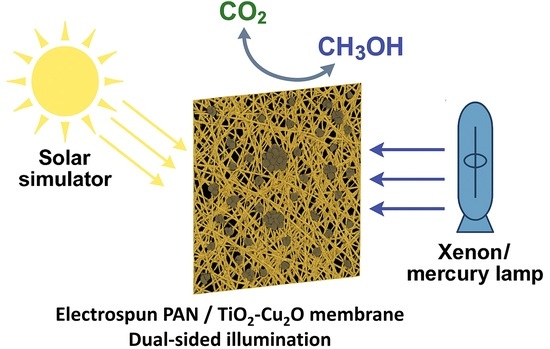
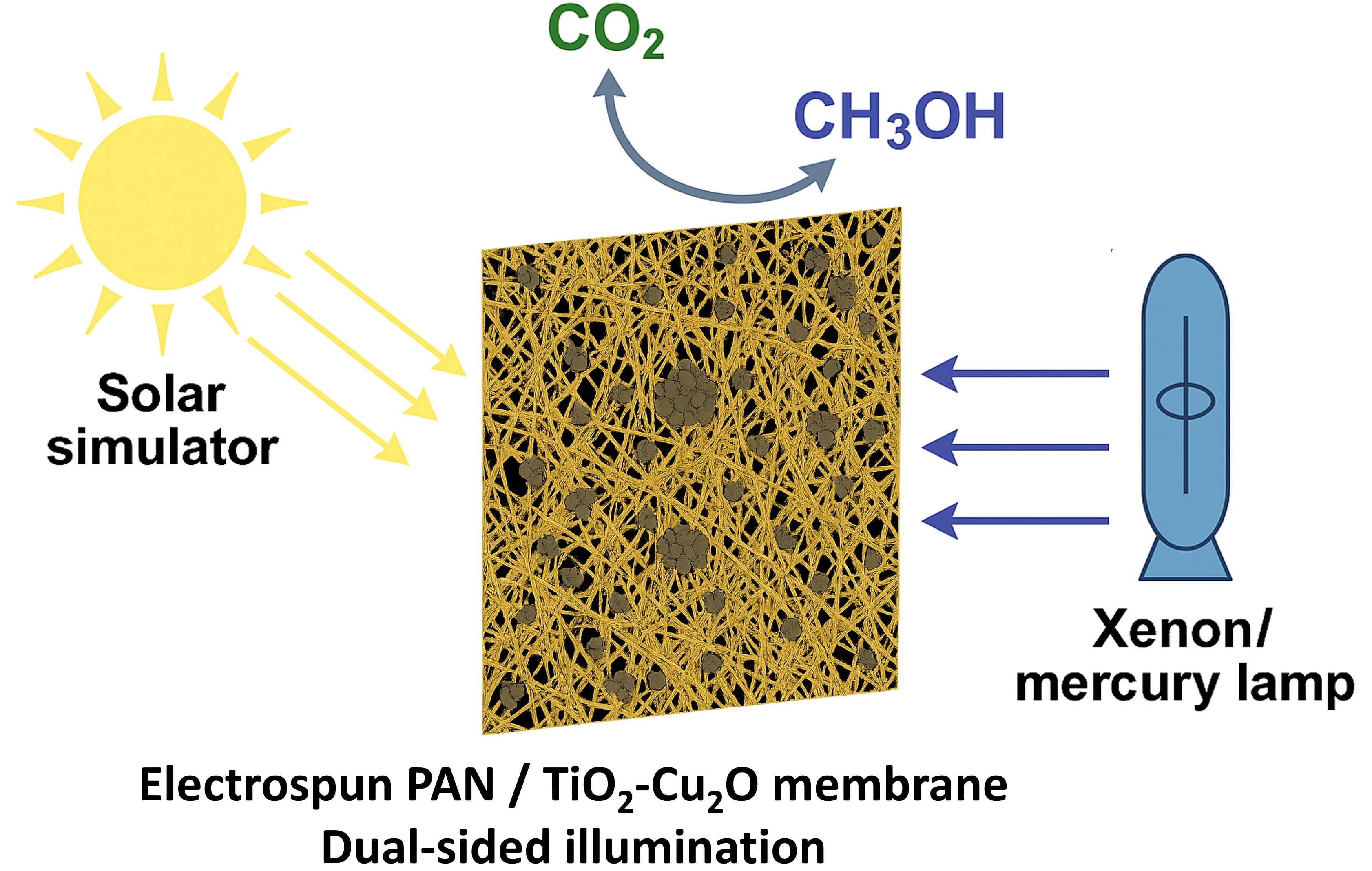
Graphical Abstract

1. Introduction

The increasing concentration of atmospheric CO2 and its associated environmental impacts have driven global efforts toward carbon capture and utilization technologies. Among these, photocatalytic reduction of CO2 into value-added chemicals such as methanol represents a promising route to mitigate greenhouse gas emissions while producing renewable fuels [1]. Titanium dioxide (TiO2) is widely recognized as a robust photocatalyst due to its chemical stability, low cost, and ability to drive photoreduction reactions. However, its limited absorption in the visible-light region significantly restricts solar-driven CO2 conversion [2,3]. To overcome this limitation, coupling TiO2 with narrow-band-gap semiconductors such as copper (I) oxide (Cu2O) has emerged as an effective strategy to extend light absorption and enhance charge separations [4]. Methanol formation during photocatalytic CO2 reduction is thermodynamically challenging under oxidizing conditions, requiring efficient charge separation and selective reaction pathways to suppress further oxidation. The formation of TiO2-Cu2O heterojunctions promote efficient electron–hole separation and suppress recombination, thereby improving photocatalytic performance. Recent studies have demonstrated that such composites can achieve higher activity for CO2-to-methanol conversion under simulated solar irradiation [5,6]. Several reviews summarize TiO2-based systems and alternative catalysts [7,8,9,10,11,12,13].
Despite advances in catalyst design, reactor configuration remains a critical bottleneck for photocatalytic CO2 reduction. Conventional slurry reactors often suffer from poor light utilization and mass-transfer limitations. Membrane-based photocatalytic reactors offer unique advantages, including enhanced surface area, controlled flow dynamics, and potential integration with separation processes [14]. Electrospinning enables the fabrication of highly porous nanofibrous membrane with tunable morphology, facilitating efficient catalyst dispersion and CO2 adsorption [15,16]. However, the concept of dual-sided (bifacial) illumination in membrane reactors has not been explored, despite its potential to maximize photon flux and minimize shadowing effects.
This work introduces a novel photocatalytic membrane reactor employing electrospun PAN/TiO2-Cu2O composite membranes under bifacial illumination. By integrating heterojunction engineering with reactor design, we aim to enhance solar-driven CO2 conversion to methanol. The study investigates membrane morphology, chemical composition, and photocatalytic performance under continuous flow, providing insights into scalable strategies for coupling photocatalysis with membrane technology.

2. Results and Discussions

Scanning electron microscopy (SEM) analysis confirmed successful incorporation of TiO2-Cu2O nanoparticles within the electrospun PAN matrix (Figure 1). The nanofibers exhibited high surface area with visible nanoparticle clusters embedded along the fibers. Minor irregularities, including occasional bead formation and variation in fiber diameter, were also observed. Aggregation of TiO2 particles into micron-sized clusters was noted, which may reduce effective surface area. Fiber diameter distribution ranged from 250 to 450 nm, and membrane thickness averaged 120 ± 5 μm. Previous studies [17] indicate that nanoparticle loading above 60 wt% compromises flexibility, leading to brittleness, a trend confirmed here.
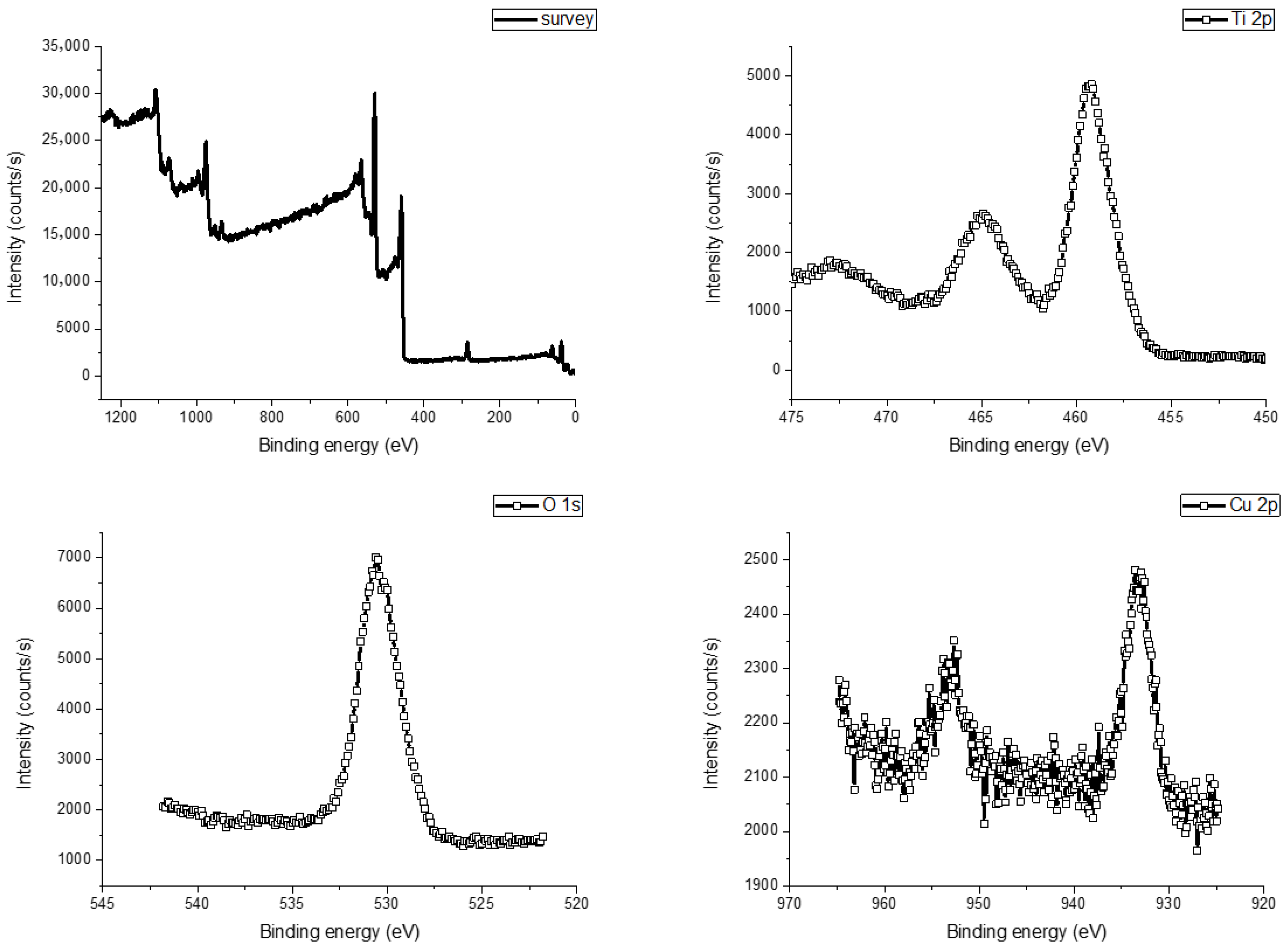
X-ray photoelectron spectroscopy (XPS) spectra (Figure 2) revealed Ti 2p peaks at ~458.5 eV (Ti 2p3/2) and ~464.2 eV (Ti 2p1/2), confirming Ti4+ in TiO2. Cu 2p peaks at ~932.5 eV and ~952.5 eV correspond to Cu+ in Cu2O, with no satellite peaks typical of CuO, indicating successful formation of the TiO2-Cu2O heterojunction [18,19]. This heterostructure is expected to promote charge separation and reduce electron–hole recombination.
These results are consistent with the optical and structural characterization (Figures S1 and S2), which indicate the presence of Cu2O through enhanced visible-light absorption despite its absence as a distinct crystalline phase in XRD.

Photocatalytic Activity and Discussion

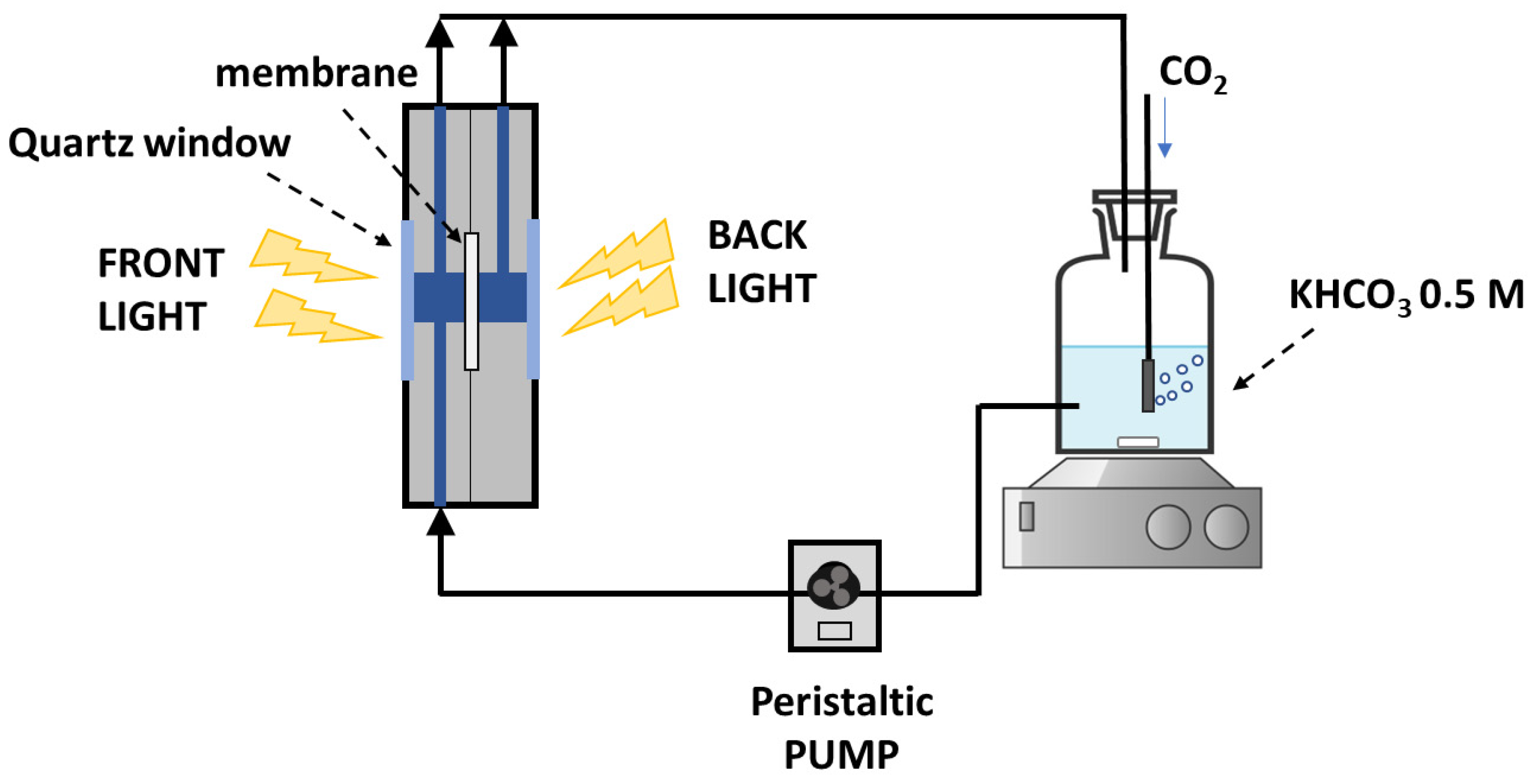
The photocatalytic activity of the PAN/TiO2-Cu2O electrospun membrane was assessed in the custom-designed crossflow reactor under dual-sided illumination, combining a solar simulator on the front side and a xenon/mercury lamp on the back side (Figure 3). The irradiance was maintained at 1 Sun (100 mW/cm2), and the feed solution consisted of 0.5 M KHCO3 saturated with high-purity CO2. Prior to illumination, the system was equilibrated for 30 min to ensure stable adsorption–desorption conditions. Methanol formation was monitored by gas chromatography coupled to a flame ionization detector (GC-FID) at regular intervals.
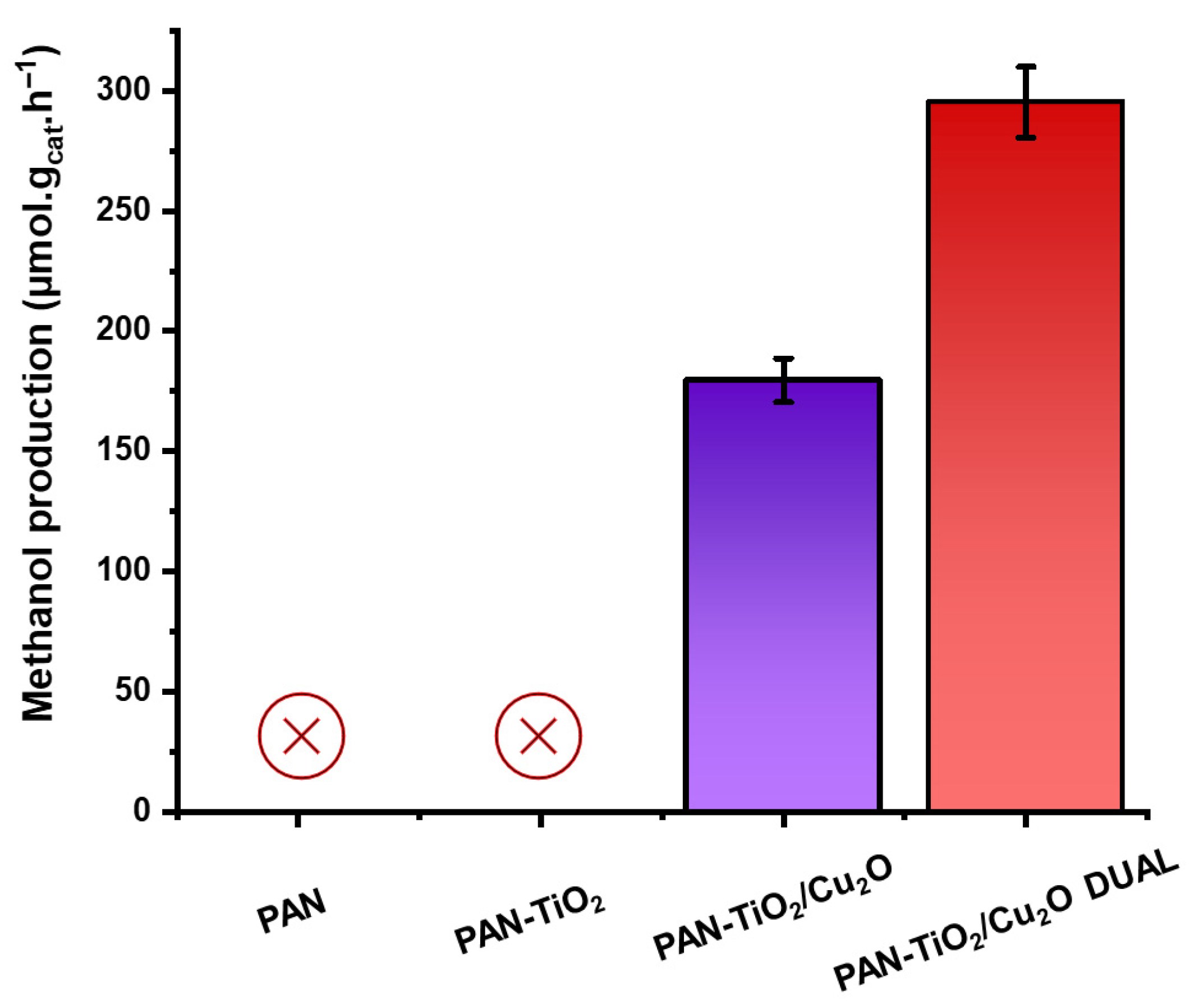
Figure 4 presents the methanol production rates under different conditions. Under dual-light illumination, the PAN/TiO2-Cu2O membrane achieved a methanol yield of ~300 µmol g−1·h−1, significantly higher than both the PAN/TiO2-Cu2O (~160 µmol g−1·h−1) and PAN-TiO2 P25 membrane under single light. This result confirms the synergistic effect of the TiO2-Cu2O heterojunction and the dual-light configuration. Interestingly, the PAN-P25 membrane produced only trace amounts of methanol, which contrasts with some previous reports where TiO2-based systems exhibited measurable activity under similar conditions. Control experiments performed under dark conditions and with N2-purged electrolyte showed no detectable methanol, confirming that the observed activity originates from photocatalytic CO2 reduction rather than contamination or thermal effects.
The improved performance can be explained by several factors acting in concert. The incorporation of Cu2O into TiO2 extends the light absorption range into the visible spectrum, enabling more efficient utilization of the solar light. The heterojunction formed between TiO2 and Cu2O promotes effective charge separation and reduces electron–hole recombination, which is a critical limitation in single-component photocatalysts. These improved charge-carrier dynamics likely facilitate the multi-electron transfer steps required for CO2 reduction to methanol.
The electrospun PAN membrane provides additional benefits beyond serving as a physical support. The nanofibrous architecture offers a large surface area and interconnected porosity, facilitating intimate contact between the photocatalyst and the reactants under flow conditions. In the present system, the primary role of the PAN matrix is to provide mechanical integrity and homogeneous dispersion of the TiO2-Cu2O particles within the membrane. Furthermore, the polymer matrix stabilizes the TiO2-Cu2O particles, preventing excessive aggregation and maintaining a uniform distribution across the membrane surface. This structural integrity is essential for sustaining photocatalytic activity under continuous flow conditions.
The dual-light configuration introduces a unique advantage by illuminating both sides of the membrane, thereby minimizing shadowing effects and maximizing photon flux across the entire catalytic surface. This bifacial approach ensures that regions of the membrane that might otherwise remain non- or under-illuminated in conventional single-light systems are actively engaged in the reaction. Combined with the crossflow reactor design, which maintains a constant supply of CO2 and mitigates concentration gradients, the system achieves improved mass transfer and reaction kinetics. These factors collectively contribute to the observed enhancement in methanol production, as shown in Figure 4. Unlike conventional photocatalytic membrane reactors (PMRs) that typically rely on single-sided illumination and often suffer from uneven photon distribution, our bifacial design ensures uniform light exposure and maximized photon flux. Together with the electrospun architecture offering high surface area and controlled flow dynamics, this configuration delivers superior CO2 conversion efficiency compared to traditional PMRs and further distinguishes itself through integrated crossflow operation.
Despite these promising results, certain limitations should be acknowledged. The tendency of TiO2 nanoparticles to form aggregates, as observed in SEM analysis, may reduce the effective surface area and hinder optimal light absorption. Additionally, the mechanical brittleness of membranes at high nanoparticle loadings imposes constraints on further increasing the catalyst content. Future work should focus on optimizing the dispersion of nanoparticles within the polymer matrix and exploring alternative heterojunction combinations to further boost performance. It will also be necessary to assess long-term membrane stability, including multi-cycle operation and post-reaction structural analysis, to establish the durability of the system under extended operation.
Overall, the findings highlight the potential of electrospun PAN/TiO2-Cu2O membranes in dual-light photocatalytic reactors as an innovative strategy for solar-driven CO2 conversion. By integrating material design with reactor engineering, this approach addresses key limitations of conventional photocatalytic systems and opens up pathways for scalable and efficient production of renewable fuels such as methanol.

3. Materials and Methods

3.1. Materials

Titanium dioxide (TiO2, P25, Evonik, Osaka, Japan) was used as received. Copper nitrate trihydrate (Cu(NO3)2·3H2O, ≥99%) and polyacrylonitrile (PAN, Mw ≈ 150,000 g·mol−1) were purchased from Sigma-Aldrich. Dimethylformamide (DMF, ≥99.8%, Merck, Darmstadt, Germany) served as the solvent. All chemicals were analytical-grade and used without further purification. Deionized water (18.2 MΩ·cm) was used throughout.

3.2. Preparation of TiO2-Cu2O Composite

TiO2-Cu2O heterojunctions were synthesized via a modified impregnation–calcination method. TiO2 P25 was dispersed in an aqueous copper nitrate solution (3 wt% Cu loading) and stirred overnight under rotary evaporation. After complete water removal, the powder was calcined at 500 °C for 1 h (heating rate: 2 °C·min−1) to ensure phase formation and crystallinity.

3.3. Fabrication of Electrospun Membranes

Photocatalyst nanoparticles were dispersed in DMF by mechanical stirring (30 min) and sonication (15 min). PAN was gradually added to achieve a final polymer concentration of 7.5 wt% and nanoparticle loading of 60 wt% (mass fraction of nanoparticles relative to the total solids in the solution). A PAN-only reference solution was prepared similarly. Electrospinning was performed using a Nanospider NS-LAB system (Elmarco, Liberec, Czech Republic) onto a nonwoven polypropylene substrate (Pegatex S, 30 g·m−2). Operating parameters: voltage 60 kV, electrode-to-substrate distance 20 cm, solution feed rate 100 mm·s−1. Membranes were air-dried for 2 h, peeled, cut into 5 × 5 cm pieces, and stored flat.

3.4. Characterization

Surface morphology was examined by scanning electron microscopy (SEM, FEI Nova NanoSEM 650 FEG, Thermo Fisher Scientific, Waltham, MA, USA). Fiber diameter distribution was determined from SEM images using ImageJ software (v1.52a) based on multiple measurements from representative areas. Chemical composition was analyzed by X-ray photoelectron spectroscopy (XPS, Kratos Axis Ultra, San Diego, CA, USA, Al Kα radiation, hν = 1486.6 eV). Membrane thickness was measured with a digital micrometer (±1 μm).

3.5. Photocatalytic Membrane Reactor

A custom crossflow photocatalytic membrane reactor was designed in Creo Parametric and fabricated by selective laser sintering (polyamide). The feed solution (0.5 M potassium bicarbonate KHCO3, saturated with CO2, 99.999%) was circulated at 30 mL·min−1 for 30 min to reach adsorption equilibrium. Illumination was provided by a solar simulator (ASAHI HAL-320, Tokyo, Japan, 300 W) on the front side and a xenon/mercury lamp (Newport) on the back side (Figure 4). Both light source were calibrated to 1 Sun (100 mW·cm−2) using a Si PV reference cell (Newport, Irvine, CA, USA, model 91150 V), corresponding to AM1.5G conditions, to ensure reproducibility. Spectral distribution was verified with a calibrated spectroradiometer. Liquid samples (1 mL) were withdrawn at selected intervals and analyzed by gas chromatography (Agilent 8860, FID detector, Santa Clara, CA, USA) using external methanol calibration curves. The illuminated circular area (diameter 2.3 cm) corresponds to ~16.6% of the membrane surface, containing approximately 60 mg of composite, of which ~36 mg is TiO2-Cu2O catalyst at 60 wt% loading.

4. Conclusions

This study demonstrates a novel approach for solar-driven CO2 conversion by integrating TiO2-Cu2O heterojunctions into electrospun PAN membranes and employing a bifacial photocatalytic membrane reactor. Dual-sided illumination significantly improved light utilization and photocatalytic efficiency, achieving a methanol production rate of 300 μmol·g−1·h−1 under simulated solar conditions. The enhanced performance is attributed to extended visible-light absorption, efficient charge separation, and optimized reactor design. By coupling material engineering with reactor configuration, this work addresses key limitations of conventional photocatalytic systems and provides a scalable pathway for renewable fuel synthesis. Future research should focus on isotopic verification, long-term stability, and performance evaluation under real solar conditions to accelerate practical deployment.

Supplementary Materials

The following supporting information can be downloaded at https://www.mdpi.com/article/10.3390/catal16010107/s1, Figure S1: UV–Vis absorption spectra of pristine TiO2 and TiO2-Cu2O samples; Figure S2: X-ray diffraction (XRD) pattern of the TiO2-Cu2O composite. References [20,21] are cited in the supplementary Materials.

Funding

The author gratefully acknowledges the support from the Research Council of Norway through the project METAMORPH (EEA & Norway Grant project TO01000329), as well as internal funding in SINTEF Industry.

Data Availability Statement

The data presented in this study are available on request from the corresponding author.

Acknowledgments

The author thanks Martin F. Sunding for SEM and XPS measurements.

Conflicts of Interest

The author declares no conflicts of interest.

References

  1. Nagireddi, S.; Agarwal, J.R.; Vedapuri, D. Carbon Dioxide Capture, Utilization, and Sequestration: Current Status, Challenges, and Future Prospects for Global Decarbonization. ACS Eng. Au 2024, 4, 22–48. [Google Scholar] [CrossRef]
  2. Al Jitan, S.; Palmisano, G.; Garlisi, C. Synthesis and Surface Modification of TiO2-Based Photocatalysts for the Conversion of CO2. Catalysts 2020, 10, 227. [Google Scholar] [CrossRef]
  3. Chakroborty, S.; Nath, N.; Soren, S.; Barik, A.; Kaur, K. Plasmonic-Based TiO2 and TiO2 Nanoparticles for Photocatalytic CO2 to Methanol Conversion in Energy Applications: Current Status and Future Prospects. Top. Catal. 2024, 67, 232–245. [Google Scholar] [CrossRef]
  4. Li, L.; Chen, X.; Quan, X.; Qiu, F.; Zhang, X. Synthesis of CuOx/TiO2 Photocatalysts with Enhanced Photocatalytic Performance. ACS Omega 2023, 8, 2723–2732. [Google Scholar] [CrossRef] [PubMed]
  5. Wang, J.; Ji, G.; Liu, Y.; Gondal, M.; Chang, X. Cu2O/TiO2 heterostructure nanotube arrays prepared by an electrodeposition method exhibiting enhanced photocatalytic activity for CO2 reduction to methanol. Catal. Commun. 2014, 46, 17–21. [Google Scholar] [CrossRef]
  6. Tai, Y.; Yang, B.; Li, J.; Meng, L.; Xing, P.; Wang, S. Design and Preparation of Heterostructured Cu2O/TiO2 Materials for Photocatalytic Applications. Molecules 2024, 29, 5028. [Google Scholar] [CrossRef] [PubMed]
  7. Zhuang, C.; Zhang, A.; Zhang, Y.; Zhu, H.; Zhang, W.; Shan, P.; Xu, P.; Jin, Z.; Huang, H.; Li, S. Photocatalytic cocatalysts: Classification, structural design and crucial role in various reactions. Coord. Chem. Rev. 2025, 542, 216867. [Google Scholar] [CrossRef]
  8. Razzaq, A.; In, S.-I. TiO2 Based Nanostructures for Photocatalytic CO2 Conversion to Valuable Chemicals. Micromachines 2019, 10, 326. [Google Scholar] [CrossRef]
  9. Chen, X.; Jin, F. Photocatalytic reduction of carbon dioxide by titanium oxide-based semiconductors to produce fuels. Front. Energy 2019, 13, 207–220. [Google Scholar] [CrossRef]
  10. Ulmer, U.; Dingle, T.; Duchesne, P.N.; Morris, R.H.; Tavasoli, A.; Wood, T.; Ozin, G.A. Fundamentals and applications of photocatalytic CO2 methanation. Nat. Commun. 2019, 10, 3169. [Google Scholar] [CrossRef]
  11. Fu, Z.; Yang, Q.; Liu, Z.; Chen, F.; Yao, F.; Xie, T.; Zhong, Y.; Wang, D.; Li, J.; Li, X.; et al. Photocatalytic conversion of carbon dioxide: From products to design the catalysts. J. CO2 Util. 2019, 34, 63–73. [Google Scholar] [CrossRef]
  12. Vu, N.-N.; Kaliaguine, S.; Do, T.-O. Critical Aspects and Recent Advances in Structural Engineering of Photocatalysts for Sunlight-Driven Photocatalytic Reduction of CO2 into Fuels. Adv. Funct. Mater. 2019, 29, 1901825. [Google Scholar] [CrossRef]
  13. Wang, C.; Sun, Z.; Zheng, Y.; Hu, Y.H. Recent progress in visible light photocatalytic conversion of carbon dioxide. J. Mater. Chem. A 2019, 7, 865–887. [Google Scholar] [CrossRef]
  14. Xu, R.; Qin, S.; Lu, T.; Wang, S.; Chen, J.; He, Z. Engineering photocatalytic membrane reactors for sustainable energy and environmental applications. Catalysts 2019, 15, 947–997. [Google Scholar] [CrossRef]
  15. Gehlot, K.; Raj, R.; Tiwari, S.; Bal, R.; Tiwari, S.K. Innovative CO2 conversion: Harnessing photocatalytic activity in polyvinylidene fluoride/TiO2 electrospun nanofibers for environmental sustainability. React. Kinet. Mech. Catal. 2024, 137, 2953–2966. [Google Scholar] [CrossRef]
  16. Behroozi, A.H.; Xu, R. Photocatalytic CO2 reduction: Photocatalysts, membrane reactors, and hybrid processes. Chem Catal. 2023, 3, 100550. [Google Scholar] [CrossRef]
  17. Grandcolas, M.; Oudin, E. Enhanced photocatalytic activity of electrospun TiO2/polyacrylonitrile membranes in a crossflow reactor using dual lights. Environ. Chem. Lett. 2023, 21, 633–638. [Google Scholar] [CrossRef]
  18. Jensen, I.J.T.; Gorantla, S.; Løvvik, O.M.; Gan, J.; Nguyen, P.D.; Monakhov, E.; Svensson, B.G.; Gunnæs, A.E.; Diplas, S. Interface phenomena in magnetron sputtered Cu2O/ZnO heterostructures. J. Phys. Condens. Matter Inst. Phys. J. 2017, 29, 435002. [Google Scholar] [CrossRef] [PubMed]
  19. Lin, L.; Lin, P.; Song, J.; Zhang, Z.; Wang, X.; Su, W. Boosting the photocatalytic activity and stability of Cu2O for CO2 conversion by LaTiO2N. J. Colloid Interface Sci. 2023, 630, 352–362. [Google Scholar] [CrossRef]
  20. Xu, H.; Ouyang, S.; Liu, L.; Wang, D.; Kako, T.; Ye, J. Porous-Structured Cu2O/TiO2 Nanojunction Material toward Efficient CO2 Photoreduction. Nanotechnology 2014, 25, 165402. [Google Scholar] [CrossRef] [PubMed]
  21. Rosa, R.H.; Silva, R.S.; Nascimento, L.L.; Okura, M.H.; Patrocinio, A.O.T.; Rossignolo, J.A.; Rosa, R.H.; Silva, R.S.; Nascimento, L.L.; Okura, M.H.; et al. Photocatalytic and Antimicrobial Activity of TiO2 Films Deposited on Fiber-Cement Surfaces. Catalysts 2023, 13, 861. [Google Scholar] [CrossRef]
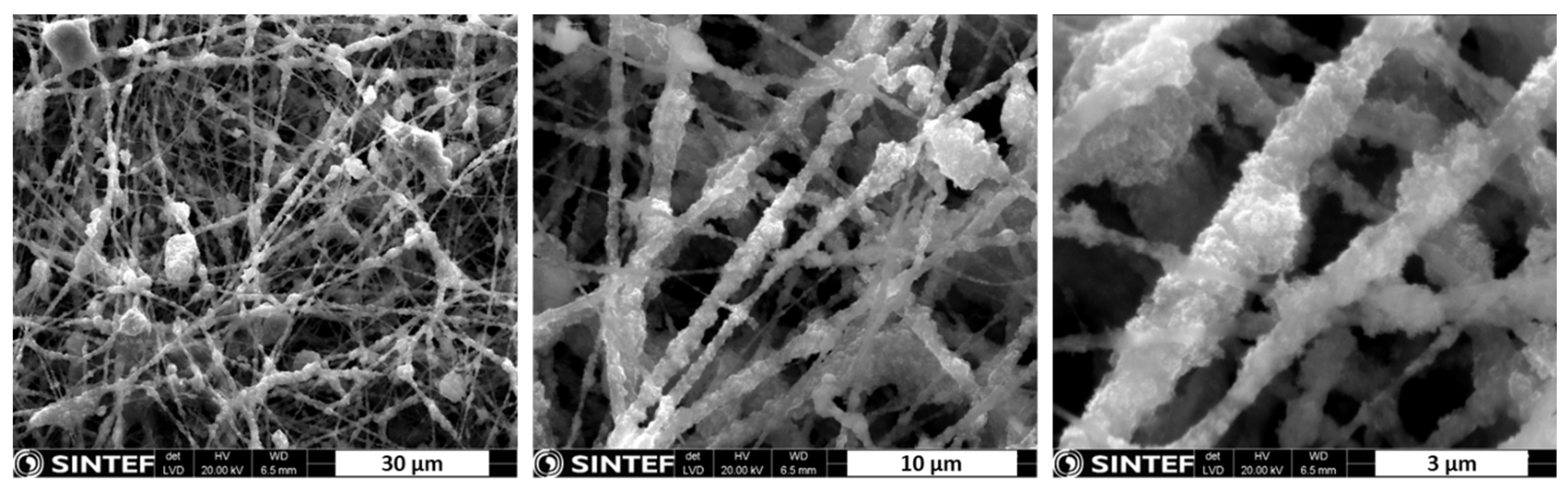
Figure 1. SEM images of electrospun PAN/TiO2-Cu2O membrane showing nanofibrous morphology and embedded nanoparticles.
Catalysts 16 00107 g001
Figure 2. XPS spectrum of the TiO2-Cu2O composite powder showing Ti 2p and Cu 2p peaks, confirming Ti4+ in TiO2 and Cu+ in Cu2O phase.
Catalysts 16 00107 g002
Figure 3. Schematic representation of the custom-designed crossflow photocatalytic membrane reactor with dual-sided illumination (solar simulator on the front side and xenon/mercury lamp on the back side).
Catalysts 16 00107 g003
Figure 4. Photocatalytic methanol production rates of the PAN/TiO2-Cu2O membrane under dual-sided illumination compared with PAN/TiO2-Cu2O, PAN/TiO2, and PAN control membranes under single-sided illumination.
Catalysts 16 00107 g004
Disclaimer/Publisher’s Note: The statements, opinions and data contained in all publications are solely those of the individual author(s) and contributor(s) and not of MDPI and/or the editor(s). MDPI and/or the editor(s) disclaim responsibility for any injury to people or property resulting from any ideas, methods, instructions or products referred to in the content.