Article

Regulating the Structures of Carbon Cloth and Carbon Nanotubes to Boost the Positive Electrode Reaction of Vanadium Redox Flow Batteries

1
School of Textile and Material Engineering, Dalian Polytechnic University, Dalian 116034, China
2
School of Electrical Engineering and Automation, Harbin Institute of Technology, Harbin 150006, China
3
Faculty of Science and Technology, Beijing Normal University-Hong Kong Baptist University United International College, Zhuhai 519088, China
*
Author to whom correspondence should be addressed.
These authors contributed equally to this work.
Catalysts 2025, 15(4), 345; https://doi.org/10.3390/catal15040345
Submission received: 23 February 2025 / Revised: 23 March 2025 / Accepted: 27 March 2025 / Published: 1 April 2025
(This article belongs to the Section Catalysis for Sustainable Energy)

Abstract

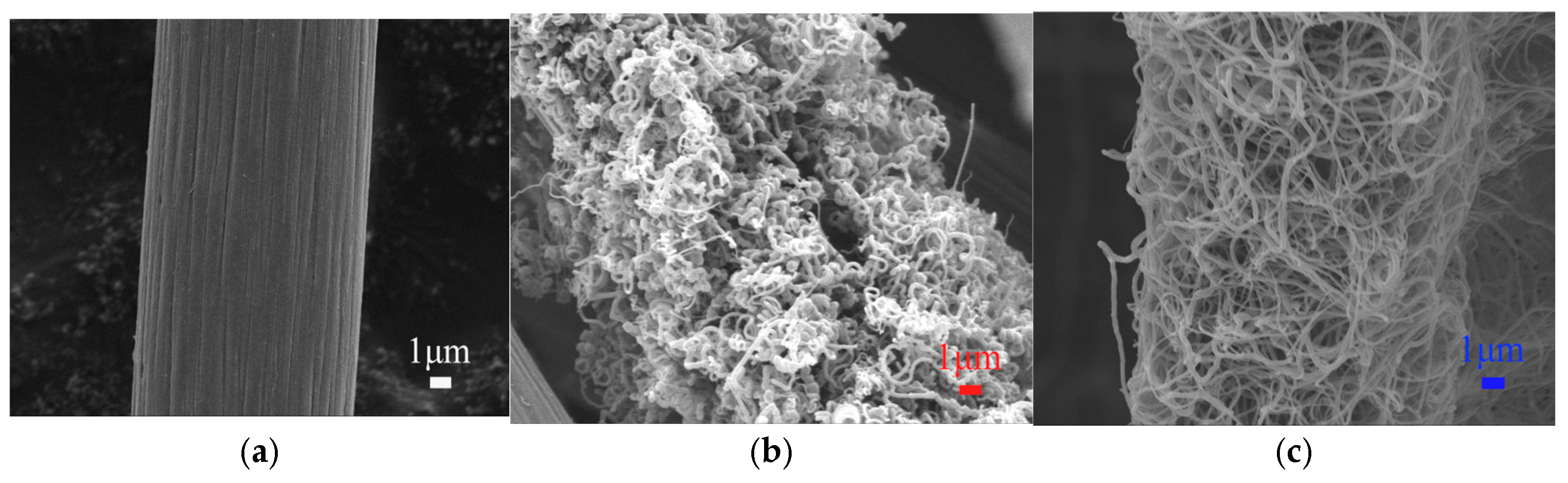
Considering the various morphologies of carbon nanotubes (CNTs), it is expected to solve the contradiction between concentration polarization and electrochemical polarization in vanadium redox flow batteries (VRFBs). This paper investigates the structural evolution of CNTs grown on the surface of thermally oxidized carbon cloth (TCC) and their impact on the performance of VRFBs. The morphological results indicate that thermal oxidation treatment forms pores on the surface of the TCC, providing nucleation sites for CNT growth. Spiral-shaped CNTs (TCC@s-CNTs) were formed in a short growth time (1 h), and their high defect density originated from the non-steady-state supply of carbon sources and the dynamic behavior of the catalyst. While 3 h of growth forms a network structure (TCC@n-CNT), the van der Waals force drives the self-assembly of its three-dimensional network. Although the TCC@s-CNT exhibits high catalytic activity due to its high defect density and edge active sites, the performance of VRFBs is more dependent on the three-dimensional conductive network of the TCC@n-CNT. At 240 mA/cm2, the energy efficiency (EE) of a VRFB assembled with the TCC@n-CNT reaches 71%, and the capacity retention rate is 15% higher than that of the TCC@s-CNT. This work reveals the synergistic mechanism of CNT morphology regulation on electrode performance and provides theoretical guidance for the design of VRFB electrodes.
Keywords: spiral-shaped CNTs; network-structured CNTs; all-vanadium redox flow battery; morphology control; carbon cloth; vapor phase growth spiral-shaped CNTs; network-structured CNTs; all-vanadium redox flow battery; morphology control; carbon cloth; vapor phase growth