Article

MOF-808 as Effective Support for Cu-Based Catalyst for CO2 Hydrogenation to Methanol

by
Abinavnataraj Ramakrishnan
1,
Simmy Rathod
2,
Wakshum Mekonnen Tucho
3,
Sachin M. Chavan
2,* and
Zhixin Yu
1,*
1
Department of Energy and Petroleum Engineering, University of Stavanger, 4036 Stavanger, Norway
2
Department Chemistry, Bioscience and Environmental Engineering, University of Stavanger, 4036 Stavanger, Norway
3
Department of Mechanical and Structural Engineering and Materials Science, University of Stavanger, 4036 Stavanger, Norway
*
Authors to whom correspondence should be addressed.
Catalysts 2025, 15(4), 324; https://doi.org/10.3390/catal15040324
Submission received: 4 March 2025 / Revised: 20 March 2025 / Accepted: 25 March 2025 / Published: 28 March 2025
(This article belongs to the Special Issue Catalysis for CO2 Conversion, 2nd Edition)

Abstract

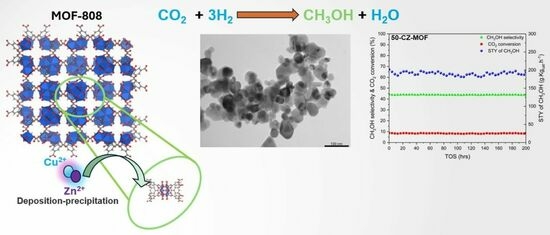
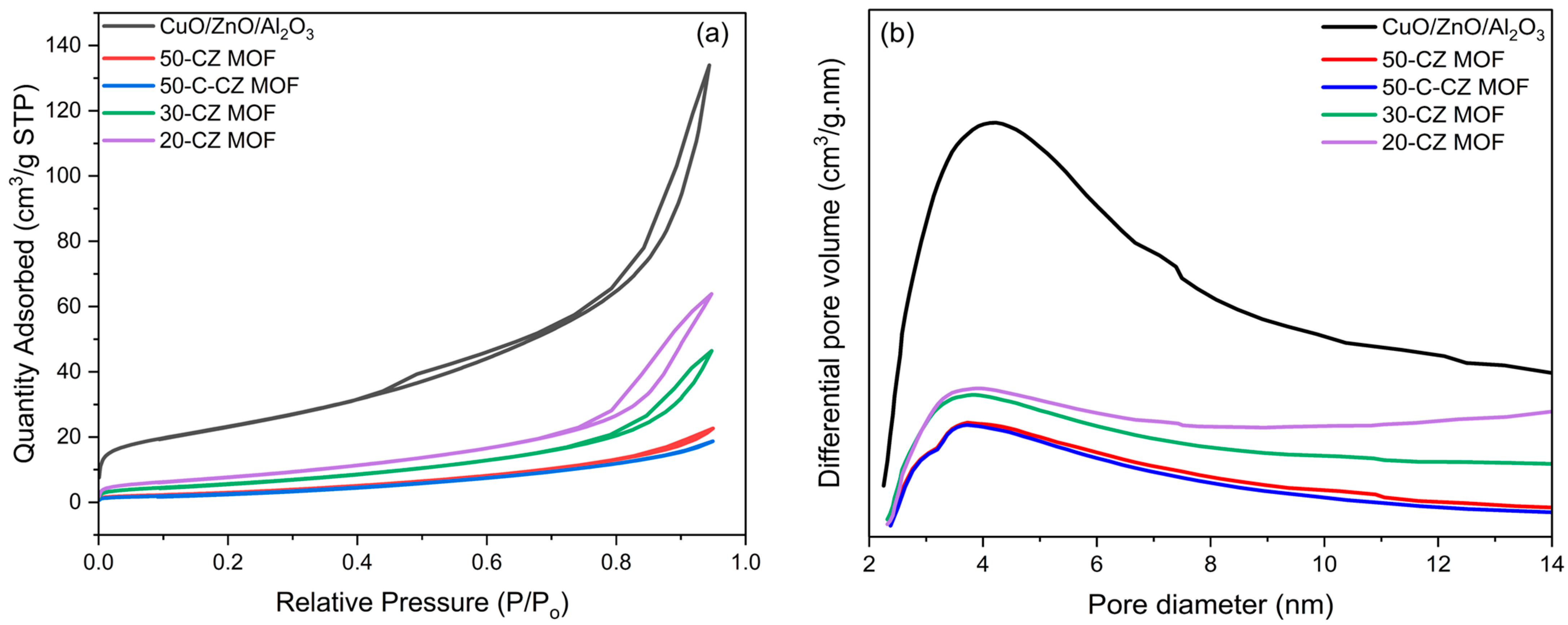
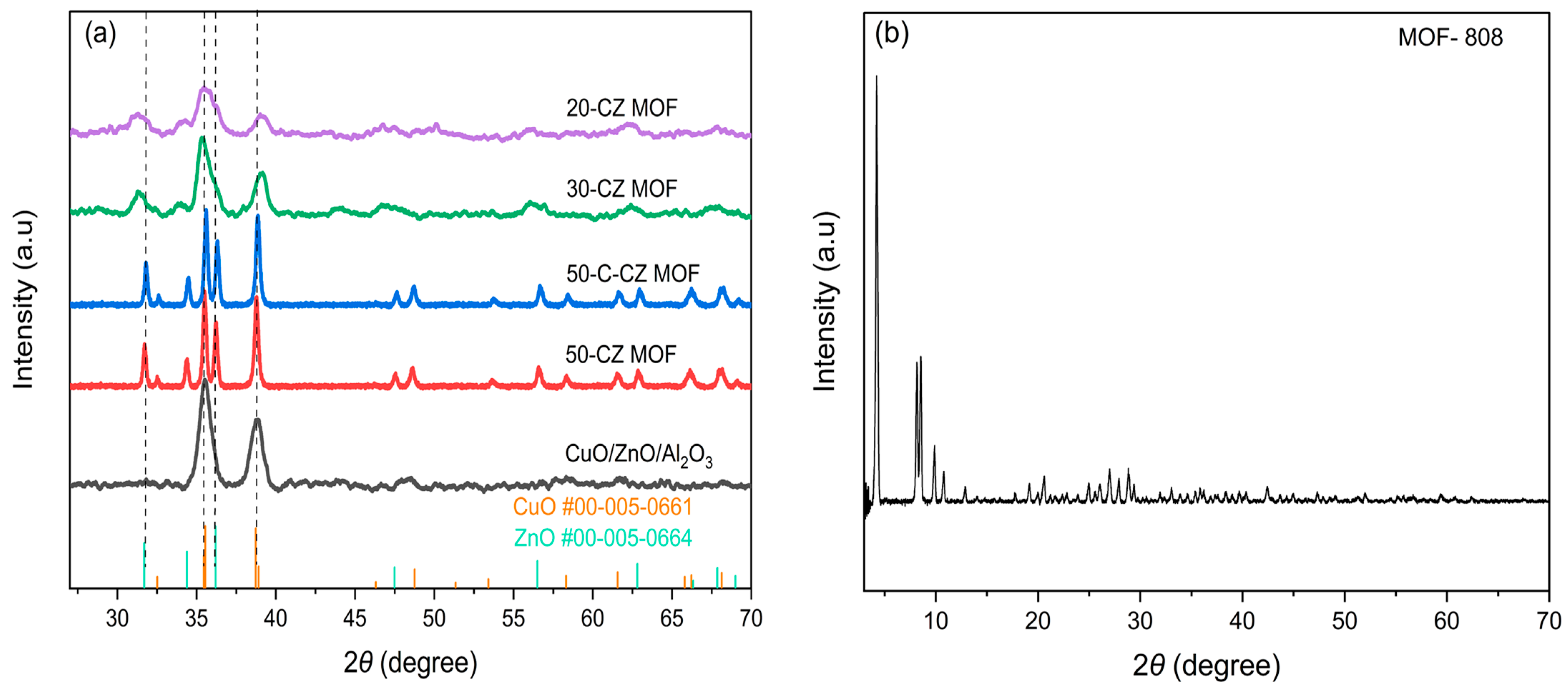
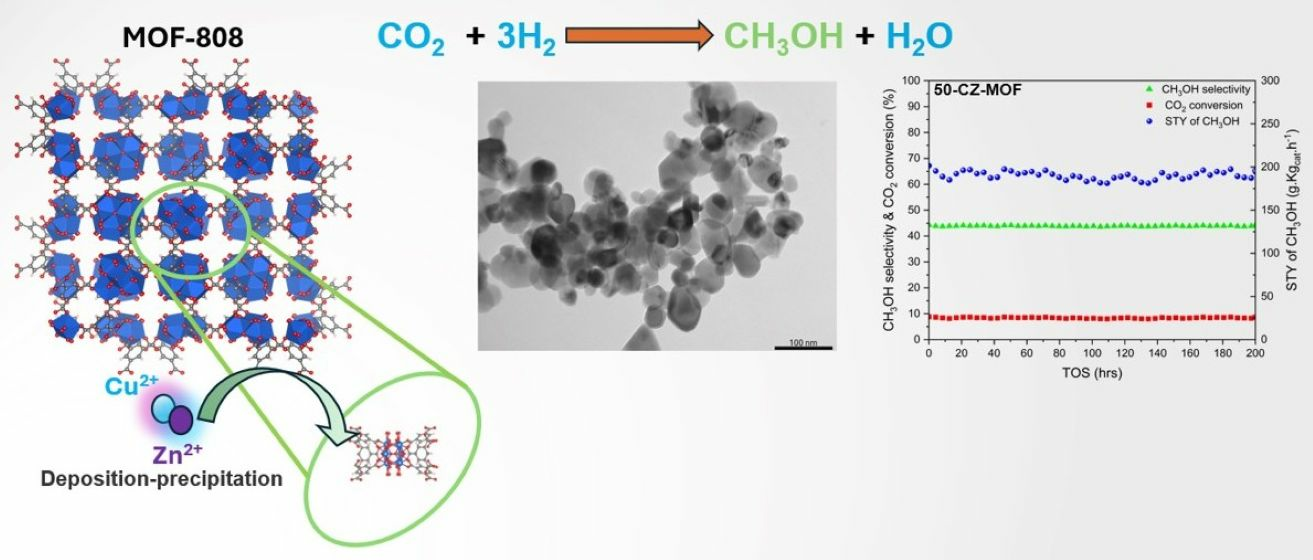
The thermocatalytic hydrogenation of CO2 to methanol offers a promising route for reducing greenhouse gas emissions (GHG) and producing valuable chemicals and fuels. In this study, copper–zinc bimetallic catalysts supported on a zirconium-based MOF-808 framework were synthesized via a facile deposition–precipitation method and compared to a conventional Cu/ZnO/Al2O3 (CZA) catalyst. MOF-808 was selected due to its high surface area and porous structure, which enhance metal dispersion. Characterization through X-ray diffraction (XRD) and N2 physisorption showed significant changes in surface area and pore structure after Cu-Zn incorporation and calcination. The 50-CuZn MOF-808 catalyst achieved the best catalytic performance at 260 °C and 40 bar, demonstrating a high STY of 193.32 gMeOH·Kgcat−1 h−1 and a turnover frequency (TOF) of 47.44 h−1, surpassing traditional CZA catalysts. The strong Cu-Zn-Zr interactions within the MOF-808 framework played a crucial role in promoting CO2 activation and methanol formation. This study underscores the potential of MOF-808-supported Cu-Zn catalysts as viable alternatives to traditional systems for CO2 hydrogenation to methanol.
Keywords: CO2 hydrogenation; MOF-808; methanol synthesis; copper CO2 hydrogenation; MOF-808; methanol synthesis; copper
Graphical Abstract