You are currently viewing a new version of our website. To view the old version click .
Catalysts
  • Article
  • Open Access

22 January 2025

Diastereoselective Synthesis of 2-Amino-spiro[4.5]decane-6-ones Through Synergistic Photocatalysis and Organocatalysis for [3 + 2] Cycloaddition of Cyclopropylamines with Olefins
and
Center of Chemistry for Frontier Technologies, Department of Chemistry, Zhejiang University, Hangzhou 310027, China
*
Author to whom correspondence should be addressed.
This article belongs to the Special Issue Sustainable Catalysis for Green Chemistry and Energy Transition

Abstract

This research employs 2-methylene-tetrahydronaphtalene-1-ones and N-cyclopropylanilines as starting materials, integrating photocatalysis and organic phosphoric acid catalysis to synthesize 2-amino-spiro[4.5]decane-6-ones via a [3 + 2] cycloaddition approach. This method boasts the advantage of mild reaction conditions that are photocatalyst-free and metal catalyst-free. It achieves 100% atom conversion of the substrates, aligning with the principles of green chemistry. Additionally, it attains a high diastereoselectivity result of up to 99:1, demonstrating good stereoselectivity. In the derivatives of 2-methylene-tetrahydronaphtalene-1-ones, substrates with alkane rings of different sizes or thiophene replacing the phenyl ring are also amenable to this method, enabling the synthesis of different [4.4], [4.5], and [4.6] spirocyclic compounds. In the derivatives of N-cyclopropylanilines, substrates with para-fluoro and meta-fluoro substitutions are also amenable to this method. Finally, a preliminary mechanistic investigation was conducted, proposing a plausible reaction mechanism pathway initiating from the intermediate N-cyclopropylanilines with chiral phosphoric acid.

1. Introduction

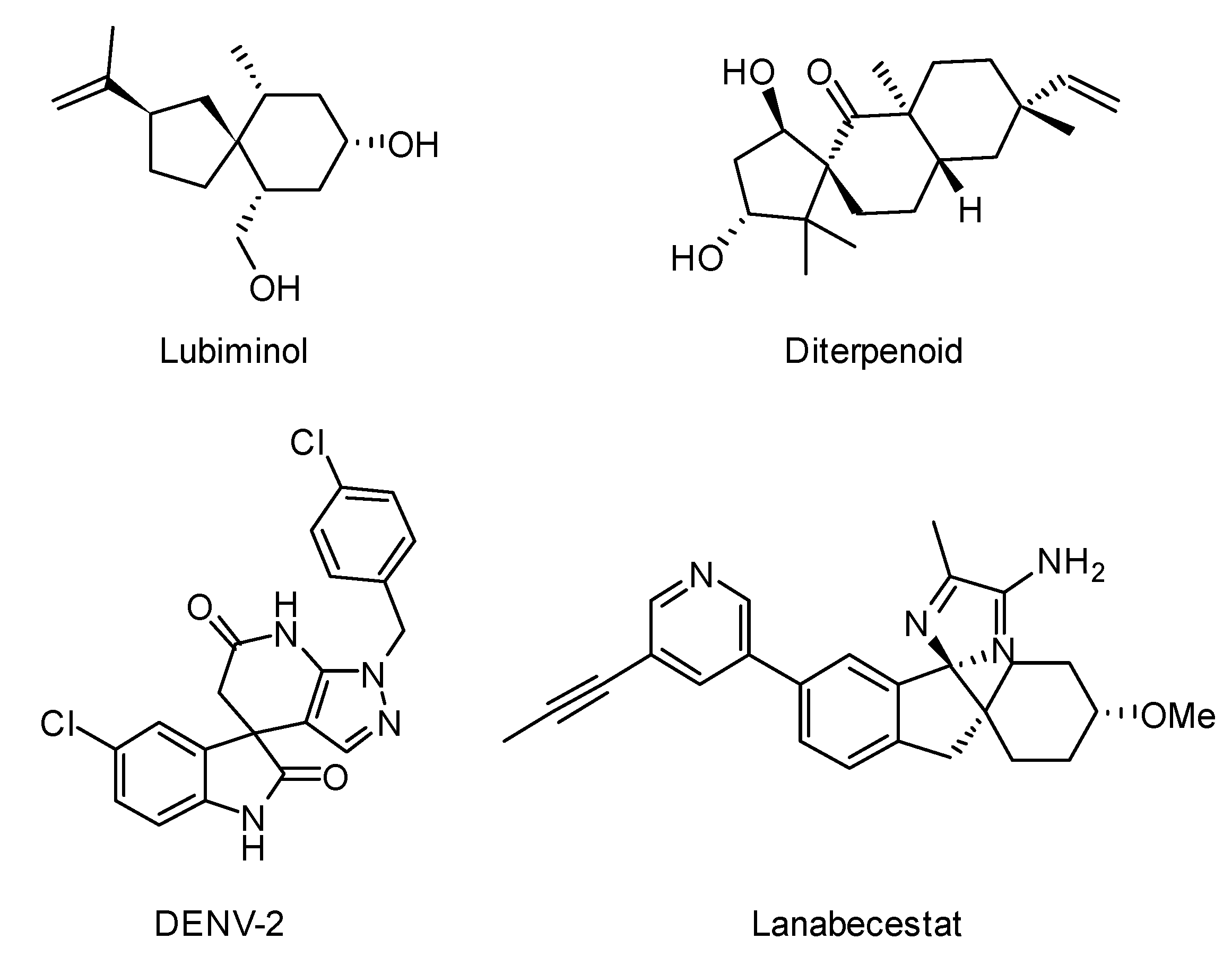
Spirocyclic compounds are widely present in various natural compounds, functional molecules, and active pharmaceutical molecules [1,2]. For instance, lubiminol, which shows antifungal activity against Fusarium oxysporum and Verticillium dahliae [3]; Diterpenoid, which shows NO inhibitory effects in lipopolysaccharide-stimulated BV-2 cells [4]; DENV-2 (dengue virus inhibitor) [5]; and Lanabecestat (BACE1 inhibitors for the treatment of Alzheimer’s disease) [6,7] have garnered significant attention due to their special pharmacological activities (Figure 1). Compared to monocyclic structures or planar aromatic structures, they have a larger three-dimensional spatial structure, offering excellent modification capabilities and promising applications [8,9,10].
Figure 1. Selected examples of spiro[4.5]decane compounds.
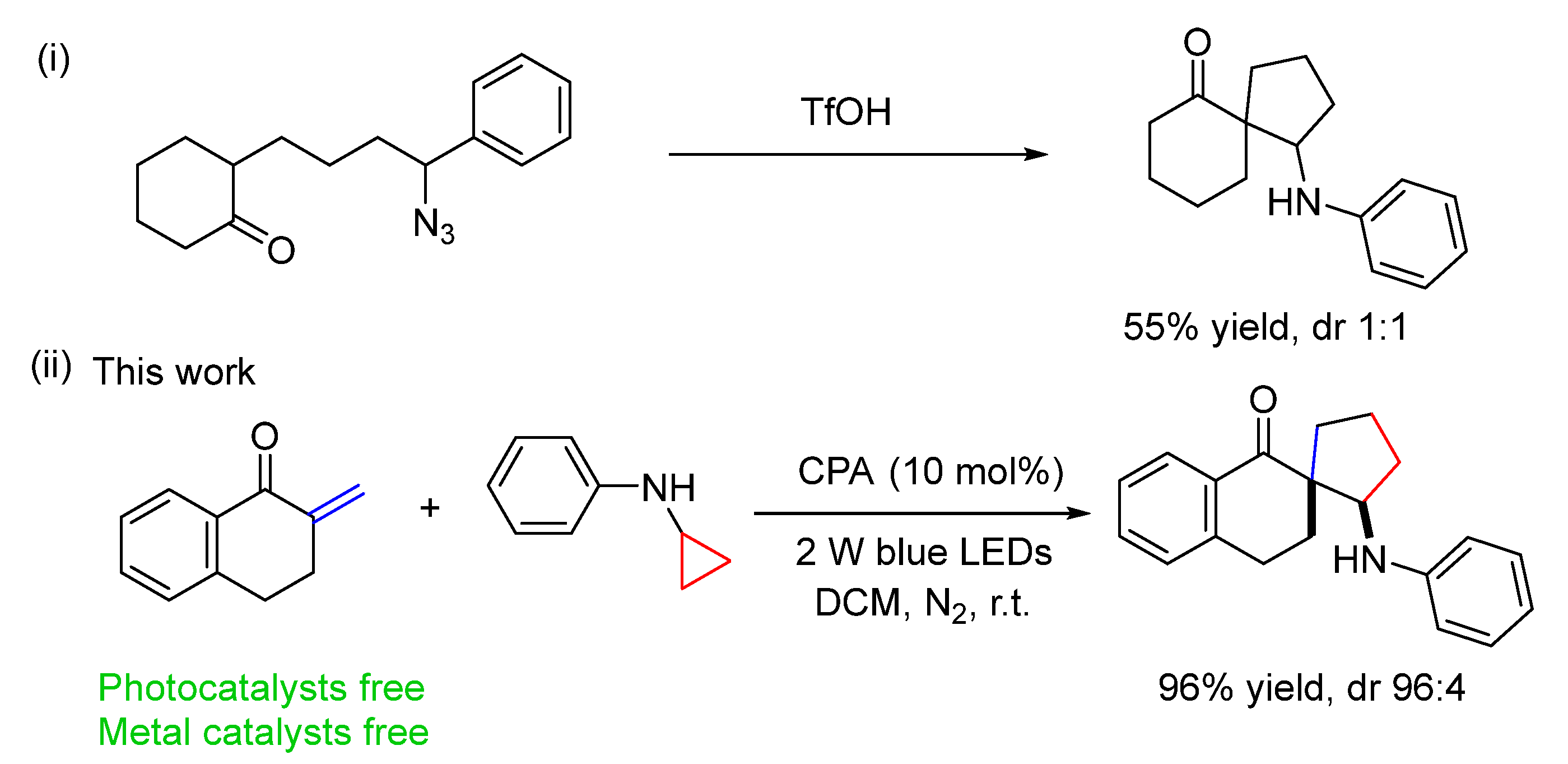
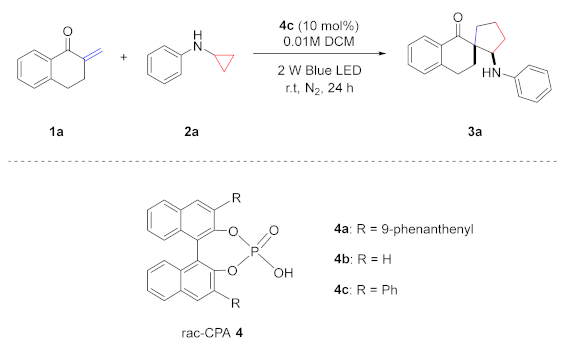
Spiro[4.5]decane represents a significant class of spirocyclic compounds, so the synthesis of this framework compound, especially with high selectivity, is of great importance. Previously, spiro[4.5]decane was generally synthesized by acid catalysis or metal catalysis [11,12,13]. In 2001, Jeffrey Aubé’s research group utilized the intramolecular Schmidt reaction of ketones and alkyl azides to synthesize 2-amino-spiro[4.5]decane-6-ones (Scheme 1, (i)) [14]. In 2015, Takayuki Doi’s research group reported the asymmetric synthesis of spiro[4.5]-1-one compounds catalyzed by Pd metals [15]. In 2020, Fan, Zhao, and their co-workers reported the synthesis of highly functionalized chiral spirocyclopentyl p-dienones with palladium catalysis [16]. In 2024, Cui’s research group reported the synthesis of polyfunctionalized cyclopentylamines that were Iron(II)-catalyzed [17]. Subsequently, this method of photocatalytic synthesis has shown better green chemistry characteristics [18,19]. In particular, in 2022, Wang’s research group reported a [3 + 2] cycloaddition for 2-amino-spiro[4.5]decane-6-ones, but only low diastereoselectivity for all products were obtained [20]. Inspired by these, we developed catalytic [3 + 2] cycloaddition reaction 2-methylene-tetrahydronaphtalene-1-ones with N-cyclopropylanilines by means of cooperative photocatalysis and organocatalysis, providing highly diastereoselective 2-amino-spiro[4.5]decane-6-ones that use phosphoric acid as a catalyst (Scheme 1, (ii)).
Scheme 1. Strategy for synthesis of 2-amino-spiro[4.5]decane-6-ones.

2. Results and Discussion

Optimization studies pertaining to the reaction between 2-Methylene-1,2,3,4-tetrahydronaphtalene-1-one (1a) and N-cyclopropylaniline (2a) were systematically performed, as shown in Table 1. In the initial phase of our study, a comprehensive evaluation of the solvents’ effects on the reaction yield was conducted at a temperature of −20 °C, utilizing phosphoric acid 4a as the catalyst (Entries 2–5). Among the solvents examined, dichloromethane (DCM) was identified as the most effective, yielding a 36% yield of product 3a with a favorable diastereomeric ratio (d.r.) of 80:20 (Entry 5).
Table 1. Optimization of reaction conditions [a].
A comparative analysis was conducted to assess the performance of various phosphoric acid catalysts (rac-CPAs) in the same type of reaction (Entries 5–8). Despite a modest decrease in the yield of the product 3a, its d.r. was significantly improved to 96:4, positioning it as the most effective catalyst within this series (Entry 7). The temperature dependence of the reaction was meticulously investigated to optimize the reaction conditions. It was determined that the reaction yield was substantially higher at room temperature compared to the previously assessed temperature of −20 °C. Notably, no further enhancement in yield was observed upon increasing the temperature beyond room temperature (Entry 1,7,9). The stoichiometric ratios and concentrations of the reactants were further refined to achieve optimal reaction conditions (Entry 1, 10–13). Through systematic optimization, a concentration of 0.01 M and a molar ratio of 1:2 (1a:2a) were determined to be the most favorable for the reaction, thereby enhancing the reaction efficiency and selectivity.
Screening of various photocatalysts was performed, leading to the conclusion that the reaction proceeded most favorably in the absence of a photocatalyst (Entries 14–16). The reaction time was systematically varied to optimize the balance between yield and d.r., with a duration of 24 h yielding the most advantageous results (Entries 17–18). Additionally, the reaction was subjected to excitation with different wavelengths of light, revealing that blue light (450–455 nm) was the most effective for promoting the desired transformation (Entries 19–21).
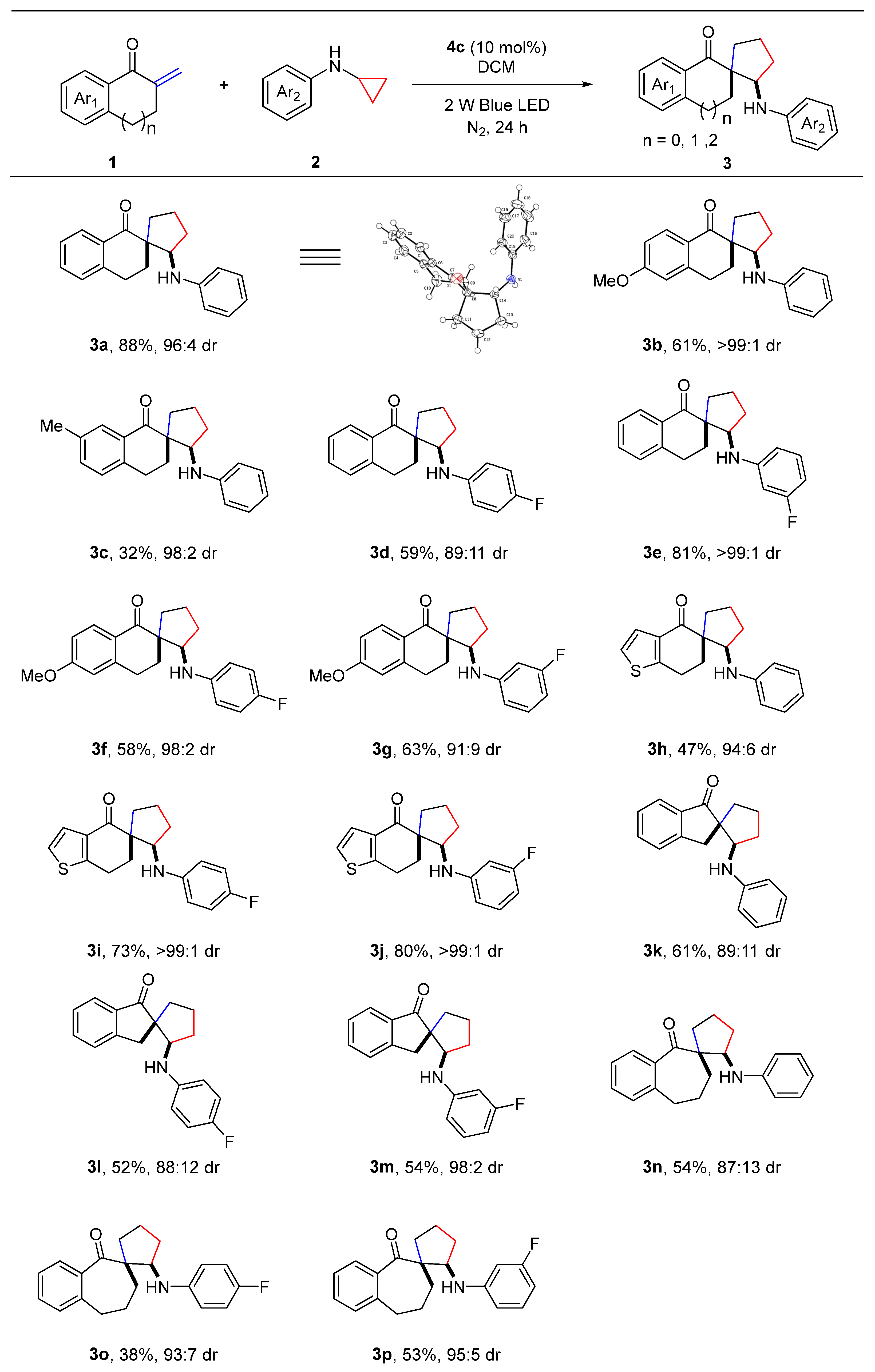
With the optimized reaction conditions established, we proceeded to explore the substrate scope, as detailed in Scheme 2. The electron-donating groups on the 1 aromatic ring, such as the -OCH3 at the 6-position and the -CH3 at the 7-position, yielded 61% and 32%, respectively (3b, 3c), whereas the electron-withdrawing groups such as 5, 6, 7-Cl, and 6-CN formed dimers with themselves, resulting in no product formation. The fluoro-substituted derivatives—no matter the p-F or m-F of 2—could also undergo the reaction, including compound 1 with various substitutions (3d3g), while N-cyclopropylanilines substituted with p-Nitro, p-OMe, or p-CF3 failed to undergo the reaction. Additionally, the reaction was compatible with thiophene heterocycles, affording a 47% yield (3h3j). The reaction was also tolerant to variations in the size of the alkane ring, forming [4.4] and [4.6] spirocyclic compounds (3k3p).
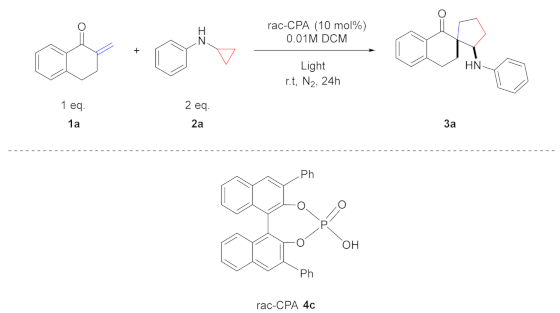
Scheme 2. Scope of substrates. Reaction conditions: 1a (0.025 mmol, 1.0 equiv.), 2a (0.05 mmol, 2.0 equiv.), 4c (10 mol%). Solvent (0.01 M DCM) and blue LEDs (450–455 nm) under N2 at r.t in 24 h.
To elucidate the mechanistic underpinnings of the reaction, a series of control experiments were designed. Employing the reaction between 1a and 2a as a paradigm, we found that the absence of light or the presence of 2,2,6,6-tetramethyl-1-piperidinyloxy (TEMPO) deterred product formation, thereby indicating that the reaction is a photoinitiated radical process (Entry 1, 2). Notably, in the absence of a phosphoric acid catalyst, the reaction still proceeded with moderate yields, but the d.r. value decreased (Entry 3) (Table 2).
Table 2. Control experiments [a].
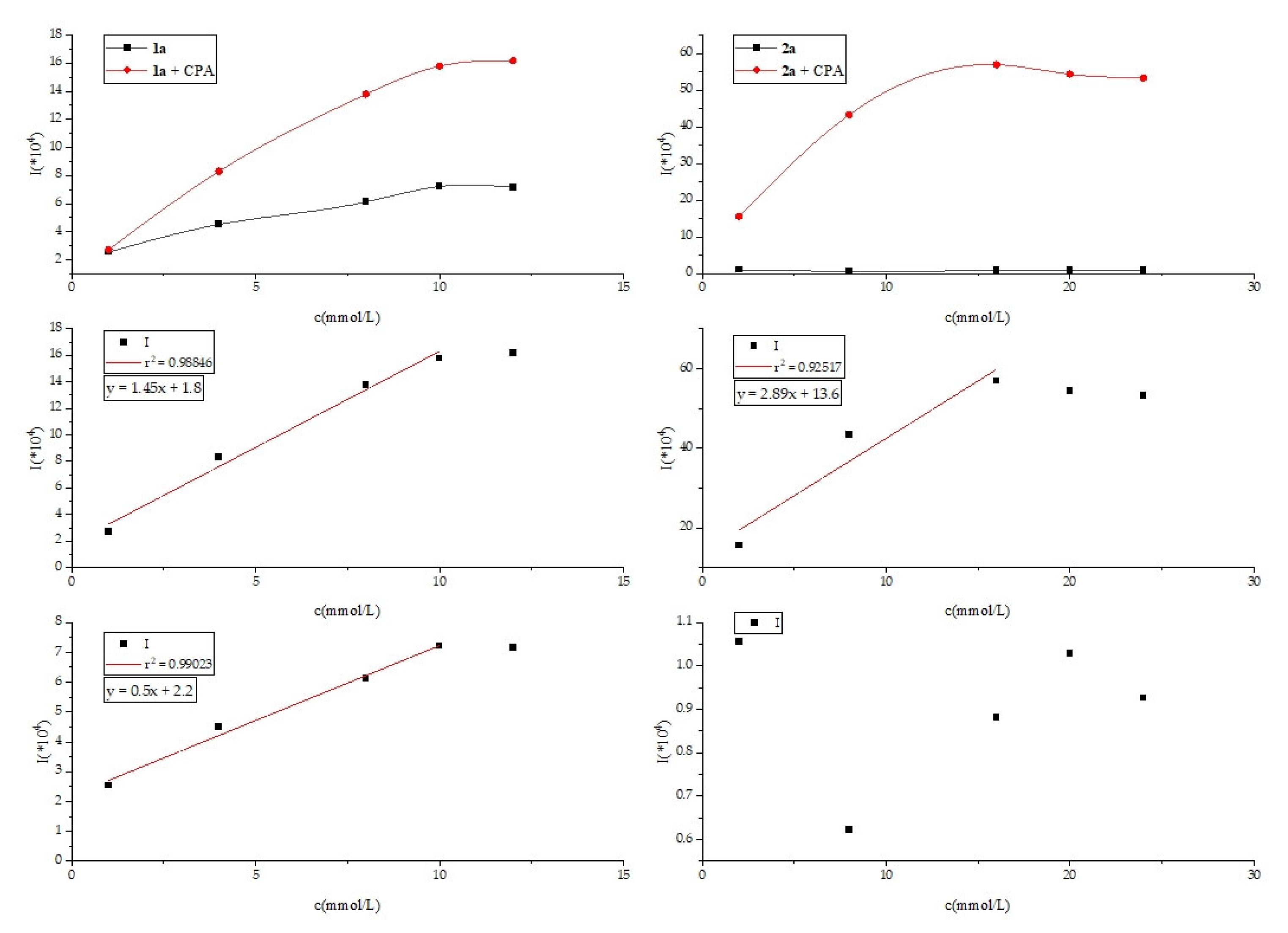
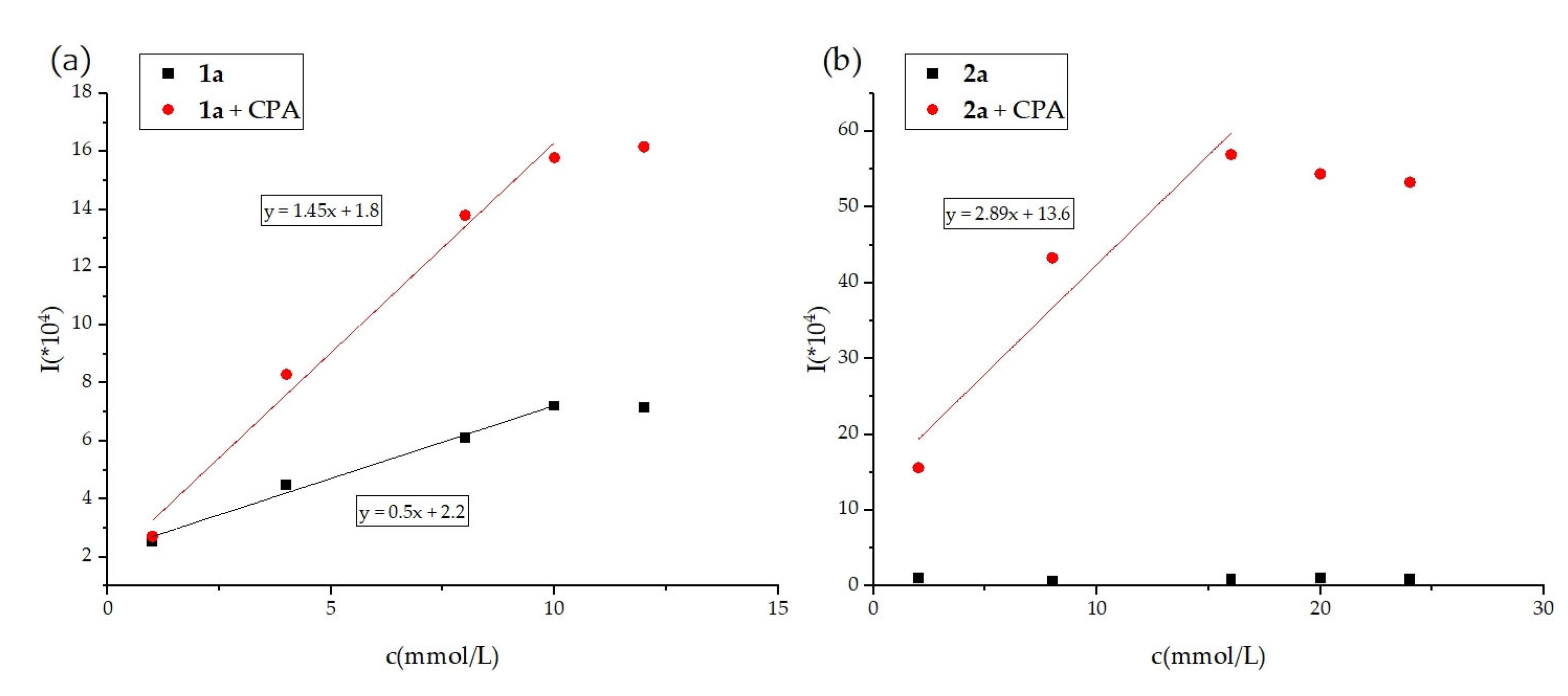
To further delineate the photoinitiated initiating intermediates of this reaction, ultraviolet fluorescence method experiments were strategically executed (Figure 2). The data revealed that for 1a and 1a with rac-CPA at concentrations below 10 mmol/L, the emission intensity increases with the rise in concentration, reaching a maximum of 10 mmol/L. Moreover, the emission intensity of 1a with a rac-CPA system is consistently stronger than that of 1a alone, indicating that the addition of rac-CPA enhances the light absorption and emission capabilities of 1a (Figure 2a). Conversely, a solution of 2a alone essentially does not emit light upon excitation. However, when 2a forms a hydrogen-bonded complex with CPA, its emission intensity is markedly increased, surpassing that of 1a with a rac-CPA system (Figure 2b). This enhanced luminescence capability signifies that the system can absorb more energy under light irradiation, transitioning to an excited state and thereby facilitating the progression of the reaction. This suggests that the initial step of the reaction likely involves the generation of radicals from 2a with a rac-CPA complex under the influence of light, thereby triggering subsequent reactions.
Figure 2. Ultraviolet fluorescence method experiments. (a). Fluorescence intensity of 1a solution and 1a + CPA solution. (b). Fluorescence intensity of 2a solution and 2a + CPA solution.
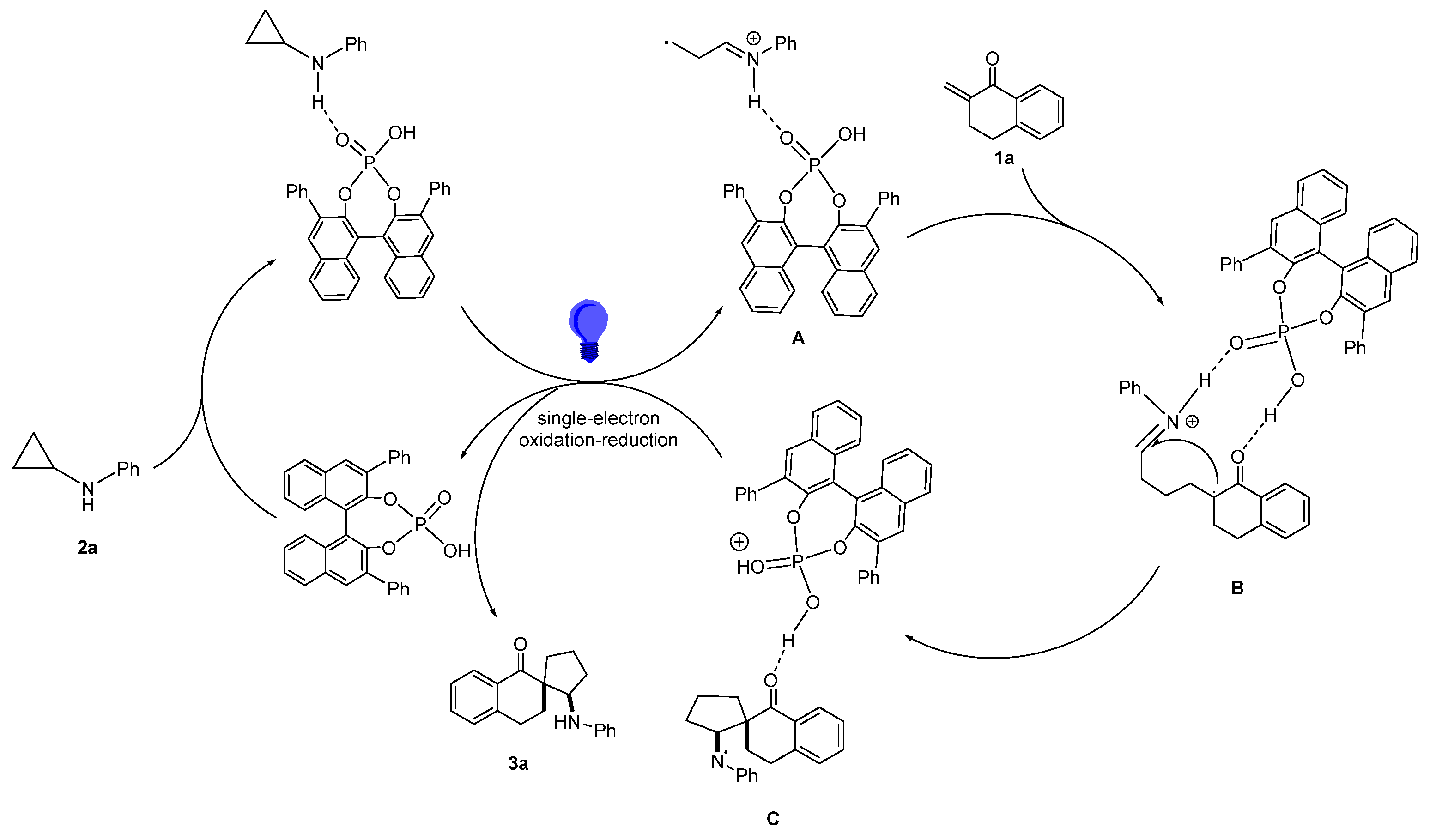
Drawing from the current research and previous reports, we propose a possible reaction mechanism for the [3 + 2] photocycloaddition reaction (Scheme 3). The mechanism commences with the formation of a H-bonded complex between 2a and rac-CPA which, upon photoirradiation, undergoes single-electron oxidation to generate the radical intermediate A. Subsequently, A is succeeded by an additional H-bonding interaction between the C=O group of 1a and the P-OH group of CPA, which orchestrates the intramolecular radical addition, leading to the formation of the radical intermediate B. Following this, the intramolecular cyclization of the alkyl radical onto the iminium ion ensues, effectively closing the five-membered ring and yielding the radical amine cation C. The reaction culminates in a final single-electron oxidation-reduction step involving the reactants, which results in the formation of the trans-cyclopentane product 3a. Within this mechanistic framework, rac-CPA serves to dictate the conformational bias of the reaction, thereby significantly improving the diastereoselectivity, as evidenced by a marked enhancement in the d.r. when compared to the reactions conducted in the absence of rac-CPA.
Scheme 3. Proposed mechanistic pathway.
Building upon this foundation, we aim to enhance the enantioselectivity of the reaction to achieve products with elevated e.e. values. A series of chiral CPAs, encompassing BINOL-PA, H8-BINOL-PA, SPA, and Planar-PA, were evaluated. As shown in Table S1 in the Supplementary Materials, ultimately, the optimal result would afford the desired product with a yield of 31%, 97:3 d.r., and only 22% e.e.

3. Materials and Methods

3.1. General Informatin

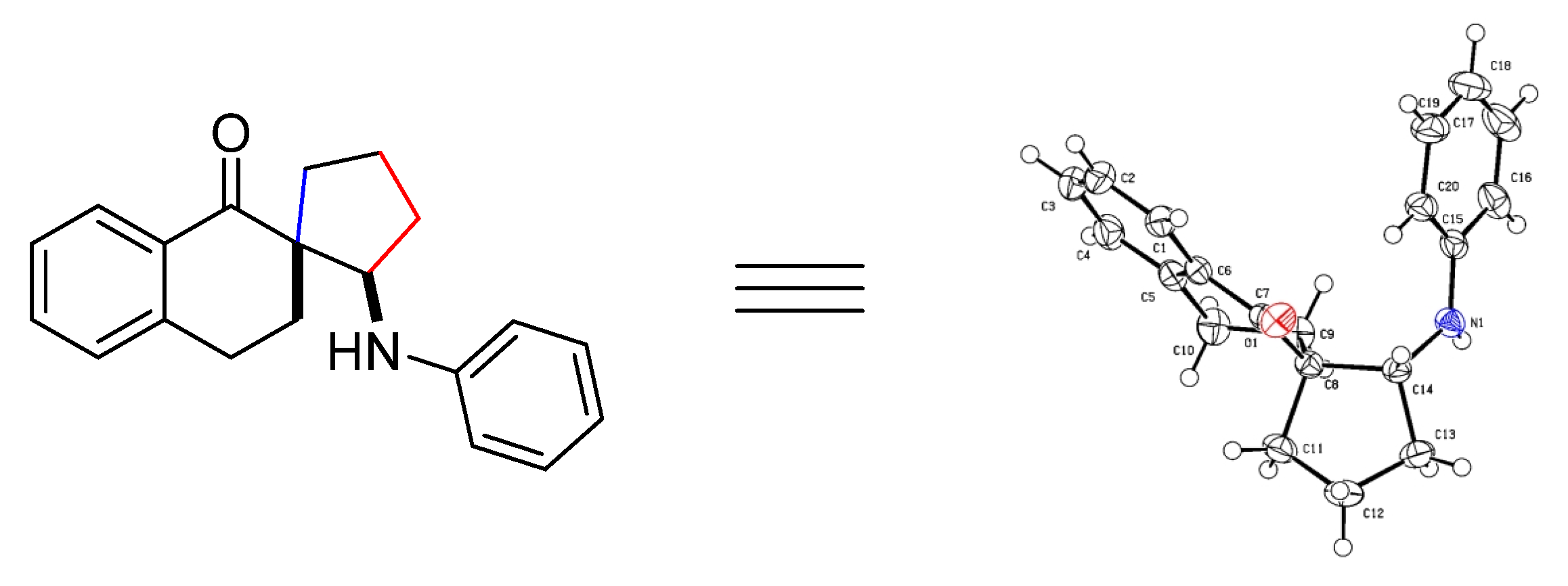
2-Methylene-1,2,3,4-tetrahydronaphtalene-1-one (1a) and N-Cyclopropylaniline (2a) were synthesized according to the literature [21,22]. All other solvents and reagents were purchased at a commercial standard and used without further purification. Visualization on TLC was achieved through the use of UV light (254, 365 nm). Column chromatography was performed using silica gel (200–300 mesh). NMR spectra were recorded on a spectrometer (Bruker DPX 400 NMR, Bruker, Billerica, MA, USA) at 400 MHz for 1H NMR, 101 MHz for 13C NMR. The solvent used for NMR spectroscopy was CDCl3. Chemical shifts for the 1H NMR and 13C NMR spectra were reported as δ in units of parts per million (ppm) downfield from standard tetramethylsilane (0.0), relative to the signal of the solvent (CDCl3 at 7.26 ppm). Multiplicities were given as s (singlet), d (doublet), dd (doublets of doublet), t (triplet), td (triplet of doublets), tt (triplet of triplets), q (quartet), m (multiplets), or bs (broad single). The number of protons (n) for a given resonance is indicated by H. Coupling constants were reported as a J value in hertz. A high-resolution mass spectrum (HRMS) was determined by TOF (6230B TOF LC/MS, Agilent, Santa Clara, CA, USA) using ESI ionization. The X-ray source used for the single crystal X-ray diffraction (Bruker APEX-II CCD diffractometer, Bruker, Billerica, MA, USA) analysis of compound 3a was MoKα (λ = 0.71073).

3.2. General Procedure for Synthesis of 3

A quartz tube was charged with 2-Methylene-1,2,3,4-tetrahydronaphtalene-1-one (1) (0.025 mmol, 1.0 equiv), N-Cyclopropylaniline (2) (0.05 mmol, 2.0 equiv), rac-BINOL-PA-Ph (4c) (10 mol%), and a magnetic stir bar. The tube was placed in a photoreactor and backfilled with N2 3 times, then DCM (0.01 M) was added by syringe. The reaction mixture was stirred for 30 min without light, and then irradiated with a 2 W blue LED (445–450 nm) at room temperature. After 24 h, the mixture was concentrated in a vacuum, then purified by silica gel column chromatography (PE:EA = 10:1) to afford the pure product, 3 (yellow oil).

3.3. Characterization Data for Products

(1R′,2S′)-2-(phenylamino)-11,12-dihydro-6H-spiro[cyclopentane-1,2′-naphthalen]-6-one (3a). 6.2 mg, 88% yield; yellow solid; 96:4 d.r.; 1H NMR (400 MHz, CDCl3) δ 8.09 (d, J = 7.8 Hz, 1H), 7.43 (dd, J = 10.4, 4.4 Hz, 1H), 7.30 (t, J = 7.6 Hz, 1H), 7.16 (d, J = 7.5 Hz, 1H), 7.07 (dd, J = 10.5, 5.3 Hz, 2H), 6.58 (t, J = 6.8 Hz, 1H), 6.50 (d, J = 8.5 Hz, 2H), 4.77 (t, J = 8.0 Hz, 1H), 3.64 (s, 1H), 3.03 (ddd, J = 16.6, 12.2, 4.5 Hz, 1H), 2.86 (dt, J = 16.9, 3.9 Hz, 1H), 2.47–2.29 (m, 1H), 2.11–1.68 (m, 6H), 1.55–1.44 (m, 1H); 13C NMR (101 MHz, CDCl3) δ 200.57, 146.62, 142.36, 132.11, 130.46, 128.29, 127.41, 127.11, 125.57, 115.74, 111.78, 56.39, 53.19, 34.82, 33.47, 28.17, 24.96, 20.97; HRMS (ESI-TOF, m/z): calcd for C20H21NO [M + H]+, 292.1703; found, 292.1697.
(1R′,2S′)-6′-methoxy-2-(phenylamino)-11,12-dihydro-6H-spiro[cyclopentane-1,2′-naphthalen]-1′-one (3b). 5.0 mg, 61% yield; yellow solid; >99:1 d.r.; 1H NMR (400 MHz, CDCl3) δ 8.05 (d, J = 8.8 Hz, 1H), 7.11–7.02 (m, 2H), 6.81 (dd, J = 8.8, 2.5 Hz, 1H), 6.63–6.54 (m, 2H), 6.53–6.47 (m, 2H), 4.76 (dd, J = 9.1, 7.3 Hz, 1H), 3.82 (s, 3H), 3.62 (s, 1H), 2.99 (ddd, J = 16.8, 12.3, 4.5 Hz, 1H), 2.81 (dt, J = 16.8, 4.1 Hz, 1H), 2.35 (tdd, J = 6.0, 5.0, 2.6 Hz, 1H), 2.11–1.64 (m, 6H), 1.54–1.41 (m, 1H); 13C NMR (101 MHz, CDCl3) δ 200.47, 163.38, 147.71, 145.80, 130.56, 129.30, 125.14, 116.71, 113.16, 112.82, 112.18, 57.46, 55.39, 53.90, 36.07, 34.51, 29.35, 26.43, 22.06; HRMS (ESI-TOF, m/z): calcd for C21H23NO2 [M + H]+, 322.1809; found, 322.1802.
(1R′,2S′)-7′-methyl-2-(phenylamino)-11,12-dihydro-6H-spiro[cyclopentane-1,2′-naphthalen]-1′-one (3c). 2.5 mg, 32% yield; yellow solid; 98:2 d.r.; 1H NMR (400 MHz, CDCl3) δ 7.89 (s, 1H), 7.23 (d, J = 1.5 Hz, 1H), 7.07 (dt, J = 8.5, 4.8 Hz, 3H), 6.58 (t, J = 7.3 Hz, 1H), 6.50 (dd, J = 8.6, 0.9 Hz, 2H), 4.77 (t, J = 8.0 Hz, 1H), 3.62 (s, 1H), 2.98 (ddd, J = 16.7, 12.2, 4.5 Hz, 1H), 2.82 (dt, J = 16.8, 4.1 Hz, 1H), 2.43–2.28 (m, 4H), 2.10–1.63 (m, 6H), 1.53–1.41 (m, 1H); 13C NMR (101 MHz, CDCl3) δ 201.82, 147.70, 140.49, 136.22, 134.14, 131.26, 129.32, 128.37, 128.24, 116.74, 112.82, 57.37, 54.24, 35.80, 34.50, 29.28, 25.57, 21.98, 20.98; HRMS (ESI-TOF, m/z): calcd for C21H23NO [M + H]+, 306.1860; found, 306.1854.
(1R′,2S′)-2-((4-fluorophenyl)amino)-11,12-dihydro-6H-spiro[cyclopentane-1,2′-naphthalen]-1′-one (3d). 4.9 mg, 59% yield; yellow solid; 89:11 d.r.; 1H NMR (400 MHz, CDCl3) δ 8.10–8.00 (m, 1H), 7.44 (td, J = 7.5, 1.4 Hz, 1H), 7.30 (t, J = 7.5 Hz, 1H), 7.18 (d, J = 7.6 Hz, 1H), 6.84–6.71 (m, 2H), 6.47–6.38 (m, 2H), 4.71 (t, J = 8.2 Hz, 1H), 3.51 (s, 1H), 3.04 (ddd, J = 16.7, 12.2, 4.5 Hz, 1H), 2.87 (dt, J = 16.9, 4.0 Hz, 1H), 2.41–2.30 (m, 1H), 2.09–1.63 (m, 6H), 1.53–1.41 (m, 1H); 13C NMR (101 MHz, CDCl3) δ 201.67, 155.37 (d, J = 234.2 Hz), 144.03, 143.36, 133.26, 131.52, 128.49, 128.16, 126.69, 115.71 (d, J = 22.3 Hz), 113.64 (d, J = 7.4 Hz), 58.21, 54.17, 35.72, 34.29, 28.98, 25.94, 21.90; HRMS (ESI-TOF, m/z): calcd for C20H20FNO [M + H]+, 310.1609; found, 310.1602.
(1R′,2S′)-2-((3-fluorophenyl)amino)-11,12-dihydro-6H-spiro[cyclopentane-1,2′-naphthalen]-1′-one (3e). 6.0 mg, 81% yield; yellow solid; >99:1 d.r.; 1H NMR (400 MHz, CDCl3) δ 8.13–7.99 (m, 1H), 7.44 (td, J = 7.5, 1.3 Hz, 1H), 7.30 (t, J = 7.6 Hz, 1H), 7.18 (d, J = 7.6 Hz, 1H), 6.98 (dd, J = 15.0, 8.1 Hz, 1H), 6.31–6.17 (m, 3H), 4.75 (s, 1H), 3.75 (s, 1H), 3.04 (ddd, J = 16.9, 12.3, 4.5 Hz, 1H), 2.87 (dt, J = 16.9, 4.0 Hz, 1H), 2.43–2.30 (m, 1H), 2.11–1.62 (m, 6H), 1.55–1.40 (m, 1H); 13C NMR (101 MHz, CDCl3) δ 201.35, 164.09 (d, J = 242.8 Hz), 149.44 (d, J = 10.8 Hz), 143.26, 133.24, 131.39, 130.36 (d, J = 10.3 Hz), 128.45, 128.20, 126.68, 108.52, 103.29 (d, J = 21.6 Hz), 99.68 (d, J = 25.5 Hz), 57.40, 54.13, 35.70, 34.34, 29.10, 25.91, 21.93; HRMS (ESI-TOF, m/z): calcd for C20H20FNO [M + H]+, 310.1609; found, 310.1598.
(1R′,2S′)-2-((4-fluorophenyl)amino)-6′-methoxy-11,12-dihydro-6H-spiro[cyclopentane-1,2′-naphthalen]-1′-one (3f). 4.8 mg, 58% yield; yellow solid; 98:2 d.r.; 1H NMR (400 MHz, CDCl3) δ 8.07–7.97 (m, 1H), 6.84–6.73 (m, 3H), 6.62 (d, J = 2.2 Hz, 1H), 6.48–6.39 (m, 2H), 4.71 (dd, J = 9.4, 7.2 Hz, 1H), 3.82 (s, 3H), 3.54 (s, 1H), 3.00 (ddd, J = 16.7, 12.4, 4.4 Hz, 1H), 2.81 (dt, J = 16.8, 3.9 Hz, 1H), 2.33 (tdd, J = 9.6, 6.5, 2.8 Hz, 1H), 2.07–1.79 (m, 4H), 1.76–1.63 (m, 2H), 1.51–1.42 (m, 1H); 13C NMR (101 MHz, CDCl3) δ 199.48, 162.40, 154.24 (d, J = 234.3 Hz), 144.74, 143.04, 129.50, 124.06, 114.60 (d, J = 22.2 Hz), 112.54 (d, J = 7.3 Hz), 112.16, 111.17, 57.14, 54.36, 52.73, 34.88, 33.21, 28.04, 25.28, 20.89; HRMS (ESI-TOF, m/z): calcd for C21H22FNO2 [M + H]+, 340.1715; found, 340.1710.
(1R′,2S′)-2-((3-fluorophenyl)amino)-6′-methoxy-11,12-dihydro-6H-spiro[cyclopentane-1,2′-naphthalen]-1′-one (3g). 5.6 mg, 63% yield; yellow solid; 91:9 d.r.; 1H NMR (400 MHz, CDCl3) δ 8.09–7.99 (m, 1H), 6.98 (dd, J = 15.0, 8.1 Hz, 1H), 6.82 (dd, J = 8.8, 2.5 Hz, 1H), 6.62 (d, J = 2.4 Hz, 1H), 6.32–6.15 (m, 3H), 4.74 (t, J = 7.7 Hz, 1H), 3.83 (s, 3H), 3.76 (s, 1H), 3.01 (ddd, J = 16.8, 12.4, 4.5 Hz, 1H), 2.81 (dt, J = 16.8, 4.0 Hz, 1H), 2.35 (dtd, J = 12.6, 6.5, 3.0 Hz, 1H), 2.07–1.63 (m, 6H), 1.52–1.43 (m, 1H); 13C NMR (101 MHz, CDCl3) δ 200.27, 164.14 (d, J = 242.6 Hz), 163.49, 149.56 (d, J = 10.9 Hz), 145.74, 130.67, 130.37 (d, J = 10.3 Hz), 125.05, 113.26, 112.25, 108.57, 103.24 (d, J = 21.6 Hz), 99.70 (d, J = 25.6 Hz), 57.48, 55.44, 53.83, 35.98, 34.38, 29.28, 26.37, 22.03; HRMS (ESI-TOF, m/z): calcd for C21H22FNO2 [M + H]+, 340.1715; found, 340.1712.
(2′S′,5R′)-2′-(phenylamino)-6,7-dihydro-4H-spiro[benzo[b]thiophene-5,1′-cyclopentan]-4-one (3h). 3.3 mg, 47% yield; yellow solid; 94:6 d.r.; 1H NMR (400 MHz, CDCl3) δ 7.41 (d, J = 5.3 Hz, 1H), 7.13–7.01 (m, 3H), 6.60 (t, J = 7.3 Hz, 1H), 6.56–6.48 (m, 2H), 4.77 (dd, J = 9.3, 7.3 Hz, 1H), 3.62 (s, 1H), 3.07–2.96 (m, 2H), 2.36 (dtd, J = 9.4, 6.4, 3.0 Hz, 1H), 2.15 (ddd, J = 13.4, 9.6, 7.0 Hz, 1H), 2.01–1.90 (m, 2H), 1.86–1.66 (m, 3H), 1.53–1.42 (m, 1H); 13C NMR (101 MHz, CDCl3) δ 195.61, 153.21, 146.60, 134.84, 128.33, 124.64, 122.16, 115.81, 111.75, 55.82, 52.57, 34.61, 33.58, 29.74, 21.46, 21.03; HRMS (ESI-TOF, m/z): calcd for C18H19NOS [M + H]+, 298.1267; found, 298.1273.
(2′S′,5R′)-2′-((4-fluorophenyl)amino)-6,7-dihydro-4H-spiro[benzo[b]thiophene-5,1′-cyclopentan]-4-one (3i). 5.5 mg, 73% yield; yellow solid; >99:1 d.r.; 1H NMR (400 MHz, CDCl3) δ 7.40 (d, J = 5.3 Hz, 1H), 7.05 (d, J = 5.3 Hz, 1H), 6.84–6.75 (m, 2H), 6.50–6.41 (m, 2H), 4.71 (dd, J = 9.4, 7.3 Hz, 1H), 3.47 (s, 1H), 3.07–2.98 (m, 2H), 2.39–2.30 (m, 1H), 2.19–2.09 (m, 1H), 2.01–1.66 (m, 5H), 1.52–1.42 (m, 1H); 13C NMR (101 MHz, CDCl3) δ 196.65, 155.41 (d, J = 234.4 Hz), 154.29, 144.04, 135.93, 125.67, 123.31, 115.73 (d, J = 22.2 Hz), 113.60 (d, J = 7.3 Hz), 57.63, 53.56, 35.46, 34.37, 30.51, 22.45, 21.94; HRMS (ESI-TOF, m/z): calcd for C18H18FNOS [M + H]+, 316.1173; found, 316.1167.
(2′S′,5R′)-2′-((3-fluorophenyl)amino)-6,7-dihydro-4H-spiro[benzo[b]thiophene-5,1′-cyclopentan]-4-one (3j). 6.3 mg, 80% yield; yellow solid; >99:1 d.r.; 1H NMR (400 MHz, CDCl3) δ 7.41 (d, J = 5.3 Hz, 1H), 7.08–6.95 (m, 2H), 6.33–6.19 (m, 3H), 4.75 (dd, J = 7.7 Hz, 1H), 3.73 (s, 1H), 3.07–2.98 (m, 2H), 2.36 (dtd, J = 9.7, 6.7, 2.9 Hz, 1H), 2.13 (ddd, J = 13.4, 9.5, 7.1 Hz, 1H), 2.01–1.64 (m, 5H), 1.54–1.41 (m, 1H); 13C NMR (101 MHz, CDCl3) δ 196.39, 164.14 (d, J = 243.0 Hz), 154.22, 149.47 (d, J = 10.8 Hz), 135.85, 130.44 (d, J = 10.2 Hz), 125.72, 123.34, 108.51, 103.40 (d, J = 21.6 Hz), 99.71 (d, J = 25.6 Hz), 56.87, 53.59, 35.50, 34.46, 30.68, 22.47, 22.00; HRMS (ESI-TOF, m/z): calcd for C18H18FNOS [M + H]+, 316.1173; found, 316.1171.
(1R′,2S′)-2-(phenylamino)-3′H-spiro[cyclopentane-1,2′-inden]-1′-one (3k). 4.4 mg, 61% yield; yellow solid; 89:11 d.r.; 1H NMR (400 MHz, CDCl3) δ 7.65 (d, J = 7.7 Hz, 1H), 7.50 (td, J = 7.6, 1.1 Hz, 1H), 7.37 (d, J = 7.7 Hz, 1H), 7.28 (dd, J = 10.9, 3.8 Hz, 1H), 7.02–6.95 (m, 2H), 6.54 (t, J = 7.3 Hz, 1H), 6.46–6.39 (m, 2H), 4.27 (t, J = 8.7 Hz, 1H), 3.53 (s, 1H), 3.41 (d, J = 17.1 Hz, 1H), 2.81 (d, J = 17.1 Hz, 1H), 2.43 (dtd, J = 12.5, 7.9, 4.2 Hz, 1H), 2.29–2.17 (m, 1H), 1.99–1.71 (m, 3H), 1.60–1.51 (m, 1H); 13C NMR (101 MHz, CDCl3) δ 210.68, 153.16, 147.19, 136.82, 134.72, 129.11, 127.27, 126.23, 123.94, 117.39, 113.23, 61.27, 60.02, 37.95, 35.84, 33.98, 21.43; HRMS (ESI-TOF, m/z): calcd for C19H19NO [M + H]+, 278.1547; found, 278.1541.
(1R′,2S′)-2-((4-fluorophenyl)amino)-3′H-spiro[cyclopentane-1,2′-inden]-1′-one (3l). 3.8 mg, 52% yield; yellow solid; 88:12 d.r.; 1H NMR (400 MHz, CDCl3) δ 7.63 (d, J = 7.7 Hz, 1H), 7.51 (td, J = 7.5, 1.1 Hz, 1H), 7.38 (d, J = 7.7 Hz, 1H), 7.28 (dd, J = 11.0, 3.8 Hz, 1H), 6.71–6.62 (m, 2H), 6.38–6.29 (m, 2H), 4.21 (dd, J = 9.6, 7.9 Hz, 1H), 3.49–3.32 (m, 2H), 2.81 (d, J = 17.1 Hz, 1H), 2.41 (dtd, J = 12.5, 7.9, 4.1 Hz, 1H), 2.28–2.18 (m, 1H), 1.99–1.70 (m, 3H), 1.61–1.49 (m, 1H); 13C NMR (101 MHz, CDCl3) δ 210.67, 155.67 (d, J = 235.2 Hz), 153.05, 143.43, 136.92, 134.76, 127.30, 126.18, 123.88, 115.40 (d, J = 22.3 Hz), 114.31 (d, J = 7.4 Hz), 62.26, 60.02, 37.71, 35.68, 33.70, 21.26; HRMS (ESI-TOF, m/z): calcd for C19H18FNO [M + H]+, 296.1452; found, 296.1447.
(1R′,2S′)-2-((3-fluorophenyl)amino)-3′H-spiro[cyclopentane-1,2′-inden]-1′-one (3m). 3.8 mg, 54% yield; yellow solid; 98:2 d.r.; 1H NMR (400 MHz, CDCl3) δ 7.67 (d, J = 7.7 Hz, 1H), 7.52 (td, J = 7.6, 1.1 Hz, 1H), 7.38 (d, J = 7.7 Hz, 1H), 7.29 (t, J = 7.7 Hz, 1H), 6.90 (td, J = 8.1, 6.9 Hz, 1H), 6.27–6.08 (m, 3H), 4.23 (dd, J = 17.2, 8.0 Hz, 1H), 3.66 (d, J = 7.6 Hz, 1H), 3.36 (d, J = 17.1 Hz, 1H), 2.82 (d, J = 17.1 Hz, 1H), 2.42 (dtd, J = 12.5, 7.9, 4.2 Hz, 1H), 2.29–2.17 (m, 1H), 2.00–1.70 (m, 3H), 1.62–1.51 (m, 1H); 13C NMR (101 MHz, CDCl3) δ 210.41, 163.82 (d, J = 243.0 Hz), 152.97, 148.93 (d, J = 10.8 Hz), 136.77, 134.84, 130.16 (d, J = 10.2 Hz), 127.39, 126.23, 123.99, 108.83, 103.88 (d, J = 21.5 Hz), 100.11 (d, J = 25.5 Hz), 61.09, 59.94, 37.77, 35.76, 33.74, 21.36; HRMS (ESI-TOF, m/z): calcd for C19H18FNO [M + H]+, 296.1452; found, 296.1450.
(2′S′,6S′)-2′-(phenylamino)-8,9-dihydro-7H-spiro[benzo[7]annulene-6,1′-cyclopentan]-5-one (3n). 3.8 mg, 54% yield; yellow solid; 87:13 d.r.; 1H NMR (400 MHz, CDCl3) δ 7.31–7.26 (m, 1H), 7.18–7.01 (m, 5H), 6.63 (t, J = 7.3 Hz, 1H), 6.60–6.48 (m, 2H), 4.64–4.53 (m, 1H), 3.48 (d, J = 8.9 Hz, 1H), 2.88–2.63 (m, 2H), 2.31–2.13 (m, 2H), 1.98–1.68 (m, 6H), 1.68–1.59 (m, 1H), 1.54–1.42 (m, 1H); 13C NMR (101 MHz, CDCl3) δ 216.14, 147.12, 140.90, 137.32, 131.09, 129.26, 128.06, 127.90, 126.58, 117.37, 113.63, 64.58, 58.33, 33.37, 32.83, 31.82, 25.81, 22.54, 21.49; HRMS (ESI-TOF, m/z): calcd for C21H23NO [M + H]+, 306.1860; found, 306.1856.
(2′S′,6S′)-2′-((4-fluorophenyl)amino)-8,9-dihydro-7H-spiro[benzo [7]annulene-6,1′-cyclopentan]-5-one (3o). 3.2 mg, 38% yield; yellow solid; 93:7 d.r.; 1H NMR (400 MHz, CDCl3) δ 7.29 (td, J = 7.5, 1.3 Hz, 1H), 7.13 (td, J = 7.5, 0.8 Hz, 1H), 7.06–7.00 (m, 2H), 6.84–6.75 (m, 2H), 6.48–6.40 (m, 2H), 4.54 (dd, J = 9.3, 7.8 Hz, 1H), 3.38 (s, 1H), 2.82–2.64 (m, 2H), 2.31–2.10 (m, 2H), 1.99–1.69 (m, 6H), 1.66–1.54 (m, 2H); 13C NMR (101 MHz, CDCl3) δ 216.16, 155.75 (d, J = 235.2 Hz), 143.46, 140.84, 137.32, 131.23, 128.13, 127.76, 126.62, 115.65 (d, J = 22.3 Hz), 114.74 (d, J = 7.4 Hz), 65.61, 58.22, 33.27, 32.62, 31.72, 25.44, 22.47, 21.36; HRMS (ESI-TOF, m/z): calcd for C21H22FNO [M + H]+, 324.1765; found, 324.1761.
(2′S′,6S′)-2′-((3-fluorophenyl)amino)-8,9-dihydro-7H-spiro[benzo[7]annulene-6,1′-cyclopentan]-5-one (3p). 4.3 mg, 53% yield; yellow solid; 95:5 d.r.; 1H NMR (400 MHz, CDCl3) δ 7.34–7.28 (m, 1H), 7.21–7.13 (m, 2H), 7.07–6.95 (m, 2H), 6.35–6.15 (m, 3H), 4.54 (t, J = 8.3 Hz, 1H), 3.64 (s, 1H), 2.83–2.65 (m, 2H), 2.31–2.13 (m, 2H), 1.99–1.79 (m, 4H), 1.79–1.68 (m, 2H), 1.66–1.58 (m, 1H), 1.52–1.44 (m, 1H); 13C NMR (101 MHz, CDCl3) δ 216.08, 164.09 (d, J = 242.8 Hz), 148.92 (d, J = 10.7 Hz), 140.70, 137.40, 131.30, 130.31 (d, J = 10.2 Hz), 128.20, 128.06, 126.69, 109.20, 103.72 (d, J = 21.6 Hz), 100.27 (d, J = 25.4 Hz), 64.33, 58.23, 33.52, 32.89, 31.87, 25.97, 22.51, 21.64; HRMS (ESI-TOF, m/z): calcd for C21H22FNO [M + H]+, 324.1765; found, 324.1762.

3.4. X-Ray Structure and Crystal Data of 3a

The crystallization information of 3a was obtained from a hexane solution maintained in a refrigerator for two weeks. The single crystal of product 3a was analyzed by X-ray diffraction analysis (Bruker APEX-II CCD diffractometer, Bruker, Billerica, MA, USA). The X-ray data have been deposited at the Cambridge Crystallographic Data Center (CCDC 2407020).
Catalysts 15 00107 i003

3.5. Ultraviolet Fluorescence Method Experiments

A Shimadzu RF-6000 Spectro Fluorescencephotometer (Shimadzu, Kyoto, Japan) was used to record the emission intensities. The 1a and 1a with CPA solutions were excited at 390 nm and the emission intensity at 475 nm was observed. The 2a and 2a with CPA solutions were excited at 350 nm and the emission intensity at 475 nm was observed. The data were shown in Scheme 4.
Scheme 4. Ultraviolet fluorescence method experiments data.

4. Conclusions

In summary, we have developed a new [3 + 2] cycloaddition reaction between 2-methylene-tetrahydronaphtalene-1-ones and N-cyclopropylanilines by means of cooperative photocatalysis and organic phosphoric acid catalysis. This reaction exhibits a good yield, reaching up to 88%, and good diastereoselectivity of up to 99:1, providing diverse 2-amino-spiro[4.5]decane-6-ones using BINOL-derived phosphoric acid as a catalyst under photocatalyst-free conditions. When the 1 aromatic ring was substituted by electron-donating groups or replaced by thiophene heterocycle, the fluoro-substituted derivatives of 2 can also undergo reactions, no matter the p-F or m-F. The same is true for cyclopentane and cycloheptane replaced the saturated naphthene of 1. However, the present reaction still falls short in terms of substrate generality. N-cyclopropylanilines substituted with p-Nitro, p-OMe, or p-CF3 fail to undergo the reaction. In addition, the exploration of enantioselectivity is also relatively limited, and high e.e. products cannot be obtained. This investigation into the mechanism is relatively comprehensive, and a plausible reaction pathway initiating from the intermediate N-cyclopropylanilines with chiral phosphoric acid has been proposed.

Supplementary Materials

The following supporting information can be downloaded at: https://www.mdpi.com/article/10.3390/catal15020107/s1. Screening of optimization of chiral phosphoric acids (CPAs), NMR spectra and HPLC chromatograms of products, X-Ray structure and crystal data of 3a.

Author Contributions

Conceptualization, X.L.; Data Curation, T.H.; Formal Analysis, X.L.; Funding Acquisition, X.L.; Investigation, X.L. and T.H.; Methodology, T.H.; Supervision, X.L.; Validation, T.H.; Writing—Original Draft, T.H.; Writing—Review and Editing, T.H. and X.L. All authors have read and agreed to the published version of the manuscript.

Funding

This research was funded by the National Natural Science Foundation of China (22071213) and the Fundamental Research Funds for the Central Universities (226-2022-00224).

Data Availability Statement

The data are contained within the article and the Supplementary Materials.

Acknowledgments

We gratefully acknowledge Jiyong Liu from the Analysis and Test Platform, Department of Chemistry, Zhejiang University for aiding with X-ray analysis.

Conflicts of Interest

The authors declare no conflicts of interest.

References

  1. Vessally, E.; Babazadeh, M.; Didehban, K.; Hosseinian, A.; Edjlali, L. Intramolecular ipso-Cyclization of N-Arylpropiolamides: A Novel and Straightforward Synthetic Approach for Azaspiro [4.5]decatrien-2-ones. Curr. Org. Chem. 2018, 22, 286–297. [Google Scholar] [CrossRef]
  2. Chada, R.R.; Karna, N.; Puthiya, P.V.; Uprety, A.; Rene, G. Electrochemical Domino Sulfonylation/Dearomative ipso-Annulation of 2-Alkynyl Biaryls to Access Spiro(indenyl)cycylohexadienones. Eur. J. Org. Chem. 2024, 48, e202400990. [Google Scholar]
  3. Nagaoka, T.; Goto, K.; Watanabe, A.; Sakata, Y.; Yoshihara, T. Sesquiterpenoids in root exudates of Solanum aethiopicum. Z. Naturforschung C 2001, 56, 707–713. [Google Scholar] [CrossRef] [PubMed]
  4. Du, M.; An, L.; Xu, J.; Guo, Y. Euphnerins A and B, Diterpenoids with a 5/6/6 Rearranged Spirocycylic Carbon Skeleton from the Stems of Euphorbia neriifolia. J. Nat. Prod. 2020, 83, 2592–2596. [Google Scholar] [CrossRef]
  5. Zou, B.; Chan, W.L.; Ding, M.; Leong, S.Y.; Nilar, S.; Seah, P.G.; Liu, W.; Karuna, R.; Blasco, F.; Yip, A.; et al. Lead Optimization of Spiropyrazolopyridones: A New and Potent Class of Dengue Virus Inhibitors. ACS Med. Chem. Lett. 2015, 6, 344–348. [Google Scholar] [CrossRef]
  6. Wessels, A.M.; Tariot, P.N.; Zimmer, J.A.; Selzer, K.J.; Bragg, S.M.; Andersen, S.W.; Landry, J.; Krull, J.H.; Downing, A.C.M.; Willis, B.A.; et al. Efficacy and Safety of Lanabecestat for Treatment of Early and Mild Alzheimer Disease: The AMARANTH and DAYBREAK-ALZ Randomized Clinical Trials. JAMA Neurol. 2020, 77, 199–209. [Google Scholar] [CrossRef]
  7. Dubbelman, M.A.; Hendriksen, H.M.A.; Harrison, J.E.; Vijverberg, E.G.B.; Prins, N.D.; Kroeze, L.A.; Ottenhoff, L.; Van Leeuwenstijn, M.M.S.S.A.; Verberk, I.M.W.; Teunissen, C.E.; et al. Cognitive and Functional Change Over Time in Cognitively Healthy Individuals According to Alzheimer Disease Biomarker-Defined Subgroups. Neurology 2024, 102, e207978. [Google Scholar] [CrossRef]
  8. Acosta-Quiroga, K.; Rojas-Peña, C.; Nerio, L.S.; Gutiérrez, M.; Polo-Cuadrado, E. Spirocyclic derivatives as antioxidante: A review. RSC Adv. 2021, 11, 21926–21954. [Google Scholar] [CrossRef]
  9. Feng, Y.; Ren, Y.Y.; Tang, K.-H.; Hu, Y.; Wang, J.; Huang, D.; Lv, X.; Hu, Y. Synthesis of difluoromethylated spiropyrazolones via [3 + 2] cycloaddition of difluoroacetohydrazonoyl bromides with alkylidene pyrazolones. Org. Biomol. Chem. 2024, 22, 2797–2812. [Google Scholar] [CrossRef]
  10. Elumalai, G.; Namboothiri Irishi, N.N. Synthesis of Fused Bromofurans via Mg-Mediated Dibromocyclopropanation of Cycloalkanone-Derived Chalcones and Cloke-Wilson Rearrangement. J. Org. Chem. 2013, 78, 910–919. [Google Scholar]
  11. Li, M.; Scheeff, S.; Chen, J.; Johnston, R.C.; Rizzo, A.; Krenske, E.H.; Chiu, P. Diastereo- and Enantioselective Construction of Stereochemical Arrays Exploiting Non-Classical Hydrogen Bonding in Enolborates. Chem. Eur. J. 2024, 30, e202401485. [Google Scholar] [CrossRef] [PubMed]
  12. Markó, I.E.; Ates, A.; Gautier, A.; Leroy, B.; Plancher, J.-M.; Quesnel, Y.; Vanherck, J.-C. Cerium(IV)-Catalyzed Deportection of Acetals and Ketals under Mildly Basic Conditions. Angew. Chem. Int. Ed. 1999, 38, 3207–3209. [Google Scholar] [CrossRef]
  13. Guo, L.-D.; Xu, Z.; Tong, R. Asymmetric Total Synthesis of Indole Diterpenes Paspalicine, Paspalinine, and Paspalinine-13-ene. Angew. Chem. Int. Ed. 2021, 61, e202115384. [Google Scholar] [CrossRef] [PubMed]
  14. Wrobleski, A.; Aubé, J. Intramolecular Reactions of Benzylic Azides with Ketones: Competition between Schmidt and Mannich Pathways. J. Org. Chem. 2001, 66, 886–889. [Google Scholar] [CrossRef] [PubMed]
  15. Tsukamoto, H.; Kawase, A.; Doi, T. Asymmetric palladium-catalyzed umpolung cyclization of allylic acetate-aldehyde using formate as a reductant. Chem. Commun. 2015, 51, 8027–8030. [Google Scholar] [CrossRef]
  16. Jia, Z.-L.; An, X.-T.; Deng, Y.-H.; Wang, H.-B.; Gan, K.-J.; Zhang, J.; Zhao, X.-H.; Fan, C.-A. Palladium-Catalyzed Asymmetric (2+3) Annulation of p-Quinone Methides with Trimethylenemethanes: Enantioselective Synthesis of Functionalized Chiral Spirocyclopentyl p-Dienones. Org. Lett. 2020, 22, 4171–4175. [Google Scholar] [CrossRef]
  17. Lv, S.; Xu, W.-F.; Yang, T.-Y.; Lan, M.-X.; Xiao, R.-X.; Mou, X.-Q.; Chen, Y.-Z.; Cui, B.-D. Iron(II)-Catalyzed Radical [3 + 2] Cyclization of N- Aryl Cyclopropylamines for the Synthesis of Polyfunctionalized Cyclopentylamines. Org. Lett. 2024, 26, 3151–3157. [Google Scholar] [CrossRef]
  18. Ha, J.D.; Lee, J.; Blackstock, S.C.; Cha, J.K. Intramolecular [3 + 2] Annulation of Olefin-Tethered Cyclopropylamines. J. Org. Chem. 1998, 63, 8510–8514. [Google Scholar] [CrossRef]
  19. Dai, Y.; Liang, S.; Zeng, G.; Huang, H.; Zhao, X.; Cao, S.; Jiang, Z. Asymmetric [3 + 2] photocycloadditions of cyclopropylamines with electron-rich and electron-neutral olefins. Chem. Sci. 2022, 13, 3787–3795. [Google Scholar] [CrossRef]
  20. Luo, Z.; Cao, B.; Song, T.; Xing, Z.; Ren, J.; Wang, Z. Visible-Light Organophotoredox-Mediated [3 + 2] Cycloaddition of Arylcyclopropylamine with Structurally Diverse Olefins for the Construction of Cyclopentylamines and Spiro[4.n] Skeletons. J. Org. Chem. 2022, 87, 15511–15529. [Google Scholar] [CrossRef]
  21. Gras, J.-L.; Gombatz, K.J.; Büchi, G. Methylene Ketones and Aldehydes by simple, direct Methylene transfer: 2-Methylene-1-oxo-1,2,3,4-tetrahydronaphthalene. Org. Synth. 1981, 60, 88. [Google Scholar]
  22. Maity, S.; Zhu, M.; Shinabery, R.S.; Zheng, N. Intermolecular [3 + 2] Cycloaddition of Cyclopropylamines with Olefins by Visible-Light Photocatalysis. Angew. Chem. Int. Ed. 2012, 51, 222–226. [Google Scholar] [CrossRef]

Disclaimer/Publisher’s Note: The statements, opinions and data contained in all publications are solely those of the individual author(s) and contributor(s) and not of MDPI and/or the editor(s). MDPI and/or the editor(s) disclaim responsibility for any injury to people or property resulting from any ideas, methods, instructions or products referred to in the content.

Article Metrics

Citations

Article Access Statistics

Multiple requests from the same IP address are counted as one view.