
Article

Glucose-Mediated Synthesis of Spherical Carbon Decorated with Gold Nanoparticles as Catalyst in a Hydrogen Generation Reaction
by
Erik Biehler
1,2 and
Tarek M. Abdel-Fattah
1,2,*
1
Applied Research Center, Thomas Jefferson National Accelerator Facility, Newport News, VA 23606, USA
2
Department of Biology, Chemistry and Environmental Science, Christopher Newport University, Newport News, VA 23606, USA
*
Author to whom correspondence should be addressed.
Catalysts 2025, 15(12), 1141; https://doi.org/10.3390/catal15121141
Submission received: 16 September 2025 / Revised: 16 November 2025 / Accepted: 29 November 2025 / Published: 4 December 2025

Abstract

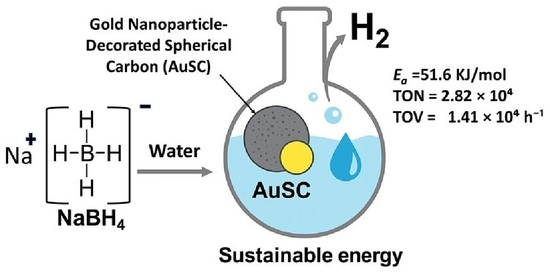
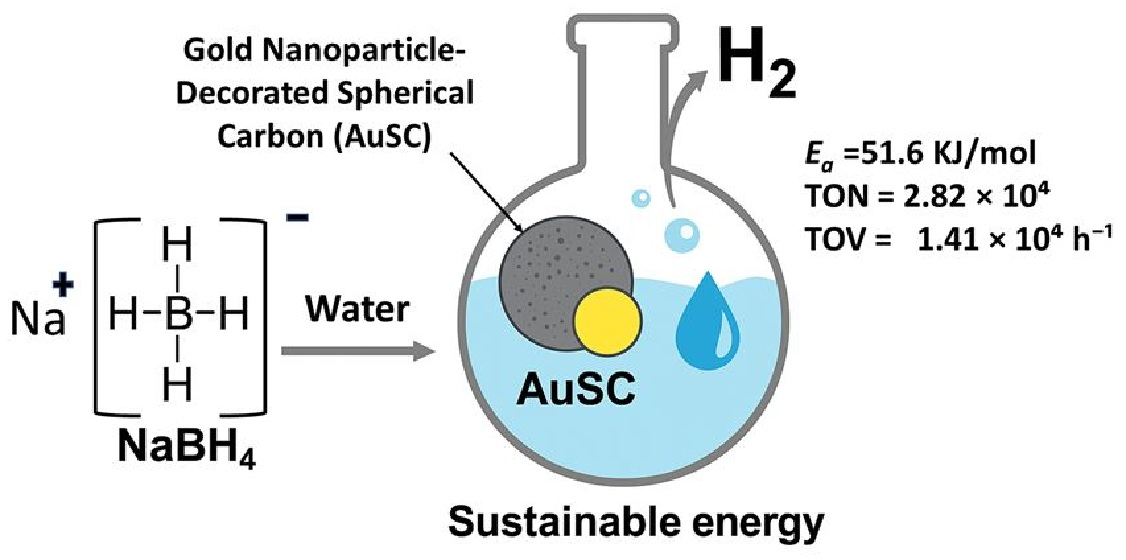
The growing environmental and economic impacts of carbon-based fuels have accelerated the search for sustainable alternatives, with hydrogen (H2) emerging as a clean and efficient energy carrier. Sodium borohydride (NaBH4) is a promising hydrogen storage compound, due to its high hydrogen content (10.6 wt%) and stability under ambient conditions. However, its hydrolysis with water proceeds slowly without an effective catalyst. In this study, gold nanoparticle-decorated spherical carbon (AuSC) composites were synthesized and evaluated as catalysts for NaBH4 hydrolysis. The spherical carbon support, prepared via a glucose-mediated route, provided a high-surface-area and conductive matrix that dispersed and stabilized Au nanoparticles, preventing agglomeration. Catalyst morphology and composition were characterized using XRD, TEM, SEM, and EDS analyses. The AuSC catalyst exhibited excellent catalytic activity, producing 21.8 mL of H2 at pH 7, 303 K, and 835 μmol NaBH4. The activation energy (Ea) was determined to be 51.6 kJ mol−1, consistent with a heterolytic B–H bond cleavage mechanism at the Au–C interface. The TON (2.82 × 10⁴) and TOF (1.41 × 10⁴ h−1) values confirmed high intrinsic catalytic efficiency. These results demonstrate that Au-decorated spherical carbon composites are efficient, stable, and promising catalysts for hydrogen generation from NaBH4 hydrolysis under mild conditions.

Graphical Abstract

1. Introduction

The limited quantity of nonrenewable fuel sources, such as fossil fuels, paired with a global increase in energy consumption and concern for environmental impact, has led to increased research into alternative energy sources [1]. Renewable energy sources such as solar, wind, geothermal, tidal, and hydrogen have shown promise as potential replacements for fossil fuels [2,3,4,5,6]. Solar is perhaps one of the most well-known sources of energy, as it is potentially unlimited, and an estimated 1.5 × 10⁹ TWh of the sun’s energy reaches the Earth every year [7]. There have been ongoing advances in this energy source; however, critics are quick to point out the disadvantages, such as intermittency, high initial cost, and low efficiency, as energy is lost in the form of heat [8,9]. Compared to solar, wind energy is a very popular method of energy generation, as it is relatively cheap to produce, costs less to maintain, and is viable at all times of the day [10]. While more energy efficient than solar, wind energy still only has a maximum efficiency of roughly 59% [10]. Additionally, wind energy also faces similar intermittency problems, similar storage issues, and even ecological concerns over migratory birds [10,11]. Geothermal energy is a method of harnessing the heat found within the Earth and has been utilized for millennia [4]. While some may argue geothermal is less popular than solar and wind energies, many countries have found great success with geothermal energy, and, globally, geothermal usage grew at annual compound rate of 8.7% between 2015 and 2020 [4]. Geothermal is not without its shortfalls, however, as concerns exist over land subsidence and the release of toxins into both the air and surrounding water [12]. Tidal energy, while in not as developed as other forms of alternative energy, shows promise as a method that takes advantage of the predictability of incoming and outgoing tides to spin turbines and generate electricity [13]. Tidal energy produces almost no pollutants outside of the construction of turbines, and some groups believe the world’s tides have the potential to produce 0.5 TW of energy annually [14]. One of the major drawbacks of tidal energy is that it is limited to coastlines, and, like wind energy, there are concerns that the turbines will disrupt wildlife [15]. Lastly, there is much ongoing research into using hydrogen as a fuel source. As the most abundant element in the universe, hydrogen and its diatomic gaseous form offer great promise as fuel sources. This gas can be combusted to produce almost three times as much energy as gasoline, with only water as a biproduct [16]. Currently, a major hurdle to the widespread implementation of hydrogen as a fuel source is current storage methods. Typically, hydrogen is stored as either a very volatile compressed gas or a very cold compressed liquid [17]. An effective method of generating hydrogen has been found in metal hydrides used as hydrogen feedstock materials (HFMs) [18,19,20]. HFMs, such as NaBH4 and lithium aluminum hydride (LiAlH4), are good reducing agents that can produce large yields of hydrogen gas. HFMs are good reducing agents due to the large amount of hydrogen contained in them, which can be released via oxidation to generate hydrogen gas [20]. NaBH4 is the preferred HFM, due to it being environmentally safe, and its high hydrogen content of 10.57% [21]. The generation of hydrogen through NaBH4 proceeds through Equation (1), but the reaction proceeds too slowly to be considered viable without the addition of a proper catalyst [21].
NaBH4 + 2H2O = NaBO2 + 4H2
The reaction (Equation (1)) can be catalyzed by a variety of different materials. Metal nanoparticles have shown promise in this area for their well-known catalytic abilities, deriving from their status as transition metals [22,23,24,25,26,27]. Gold nanoparticles (AuNPs) in particular have been shown to catalyze the hydrogenation of unsaturated substrates, carbon monoxide (CO) oxidation, and the reaction between carbon disulfide (CS2) and NaBH4 [28,29,30].
A known drawback of gold nanoparticles is their inherent instability. Without a suitable support structure, they tend to agglomerate, resulting in a significant loss of surface area and catalytic efficiency [31]. To overcome this limitation, spherical carbon has been employed as a structural backbone for gold nanoparticles, effectively anchoring them and enhancing their dispersion. Spherical carbon, though a relatively new area of research, has already shown great promise in advanced applications, such as supercapacitors and superconductors [32,33]. Beyond these, carbon microspheres have been successfully utilized in fuel cells, sensors, and heterogeneous catalysis [34,35,36], further underscoring their versatility and potential as catalytic supports [37,38,39].
In this study, carbon was selected as the support, owing to its high surface area, excellent electrical conductivity, and superior chemical stability, which collectively enhance the accessibility and durability of the active sites. Gold was chosen as the active phase because of its exceptional resistance to oxidation, catalytic efficiency toward borohydride hydrolysis, and stability in alkaline media. The synergistic interaction between the conductive carbon matrix and the dispersed gold nanoparticles facilitates efficient electron transfer and prevents agglomeration, leading to enhanced hydrogen generation performance. Furthermore, the spherical morphology maximizes the surface-to-volume ratio, improves reactant accessibility, and minimizes diffusion limitations, thereby boosting the overall catalytic activity [40].
Another significant advantage of spherical morphology lies in its ability to optimize mass transfer efficiency. The uniform and smooth structure of spheres minimizes resistance to molecular movement, allowing reactants and products to move freely across the catalyst’s surface [41]. This improved mass transfer is particularly important in dynamic systems, where rapid reaction rates are desired.
Carbon-based materials are already well studied and implemented in the field of renewable energy. There has been an increase in the study of carbon materials in the field of sustainable materials, as carbon is the second most abundant element in the biosphere and combines with oxygen and hydrogen to form carbohydrates. These abundant, natural carbon materials can make great storage vessels for hydrogen [42]. For borohydride hydrolysis applications, carbon, particularly in a spherical form, offers unique and advantageous properties. The size of the carbon spheres can be tailored to achieve specific catalytic outcomes, as variations in sphere size influence the interaction between the catalyst and the reactants [43]. Smaller spheres may provide higher surface-to-volume ratios, while larger spheres may offer distinct pathways for reactant diffusion and product release. Moreover, the spherical shape ensures uniform distribution of active sites, enhancing overall reaction uniformity and consistency.
Therefore, the spherical morphology of carbon not only impacts surface area, active site accessibility, and mass transfer efficiency, but also allows for the fine-tuning of catalytic properties through sphere size manipulation, making it a highly valuable feature for applications such as borohydride hydrolysis.
This study aimed to develop a novel composite catalyst composed of carbon microspheres decorated with gold nanoparticles (AuSC) for application in hydrogen generation via the hydrolysis of sodium borohydride (NaBH4). The synthesized composite was systematically evaluated for its catalytic performance in hydrogen evolution reactions, with NaBH4 serving as the hydrogen source. Structural and morphological characterizations were performed using scanning electron microscopy (SEM) coupled with energy-dispersive X-ray spectroscopy (EDS) and transmission electron microscopy (TEM) to confirm the dispersion and attachment of Au nanoparticles on the carbon microspheres. Furthermore, the influences of key reaction parameters, including temperature, pH, and NaBH4 concentration, on the hydrogen generation rate were thoroughly investigated to determine the optimal conditions for catalytic activity.

2. Results and Discussion

2.1. Catalyst Characterization

The TEM micrographs shown in Figure 1 show the absorbed gold nanoparticles on the surface of the spherical carbon. Widespread dispersion of the catalyst throughout the sample was observed in Figure 1I. The interactions between spheres are shown in Figure 1II,III, in a close-up of the functionalization of the gold nanoparticles to the surface of the spheres. Figure 1IV shows a close-up of the gold nanoparticles, averaging 22.6 nm long with diameters ranging from 6.84 to 47.52 nm. Nanoparticle size distribution (Figure S1) was determined via ImageJ (Version 1.54g) image processing and multiple measurements taken from nanoparticles in Figure 1.
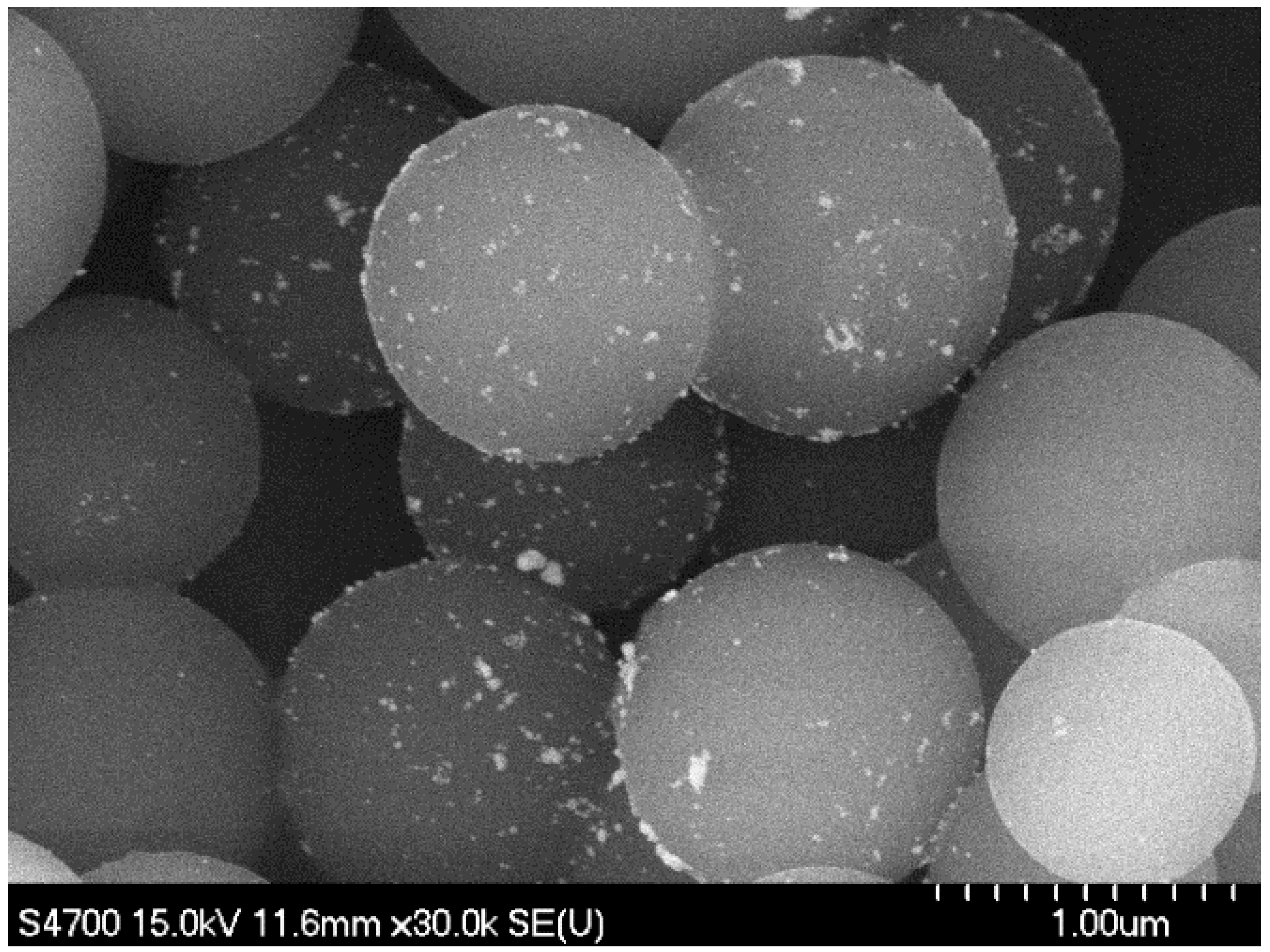
The SEM micrograph in Figure 2 provides a comprehensive visualization of the three-dimensional morphology of the synthesized microspheres. The image clearly reveals bright, well-dispersed gold nanoparticles appearing as discrete white spots distributed across the surface of the larger, darker carbon spheres. This contrast highlights the successful deposition of gold on the carbon support. The carbon microspheres exhibit an average diameter of approximately 1.79 μm, with individual particles ranging from 0.5 μm to about 5 μm in size, indicating a relatively broad but uniform size distribution. The spherical geometry and consistent morphology further confirm the structural integrity and uniformity of the composite material.
The EDS spectrum in Figure S2 confirms the presence and distribution of gold nanoparticles within the composite, corresponding to the regions shown in the accompanying micrograph. The localized gold content in the analyzed areas was approximately 0.46 wt%, while the overall average gold loading, determined by ICP analysis, was 0.49 wt%, compared to the theoretical target of 5 wt%. This discrepancy suggests a lower actual gold deposition efficiency, which may be attributed to partial loss of the precursor during synthesis, or incomplete reduction. Nevertheless, the observed distribution confirms the successful anchoring of gold nanoparticles on the carbon support. Furthermore, the spherical morphology of the carbon structures remained well preserved, indicating that the synthesis procedure maintained the structural integrity of the support without any noticeable deformation or collapse during nanoparticle deposition.
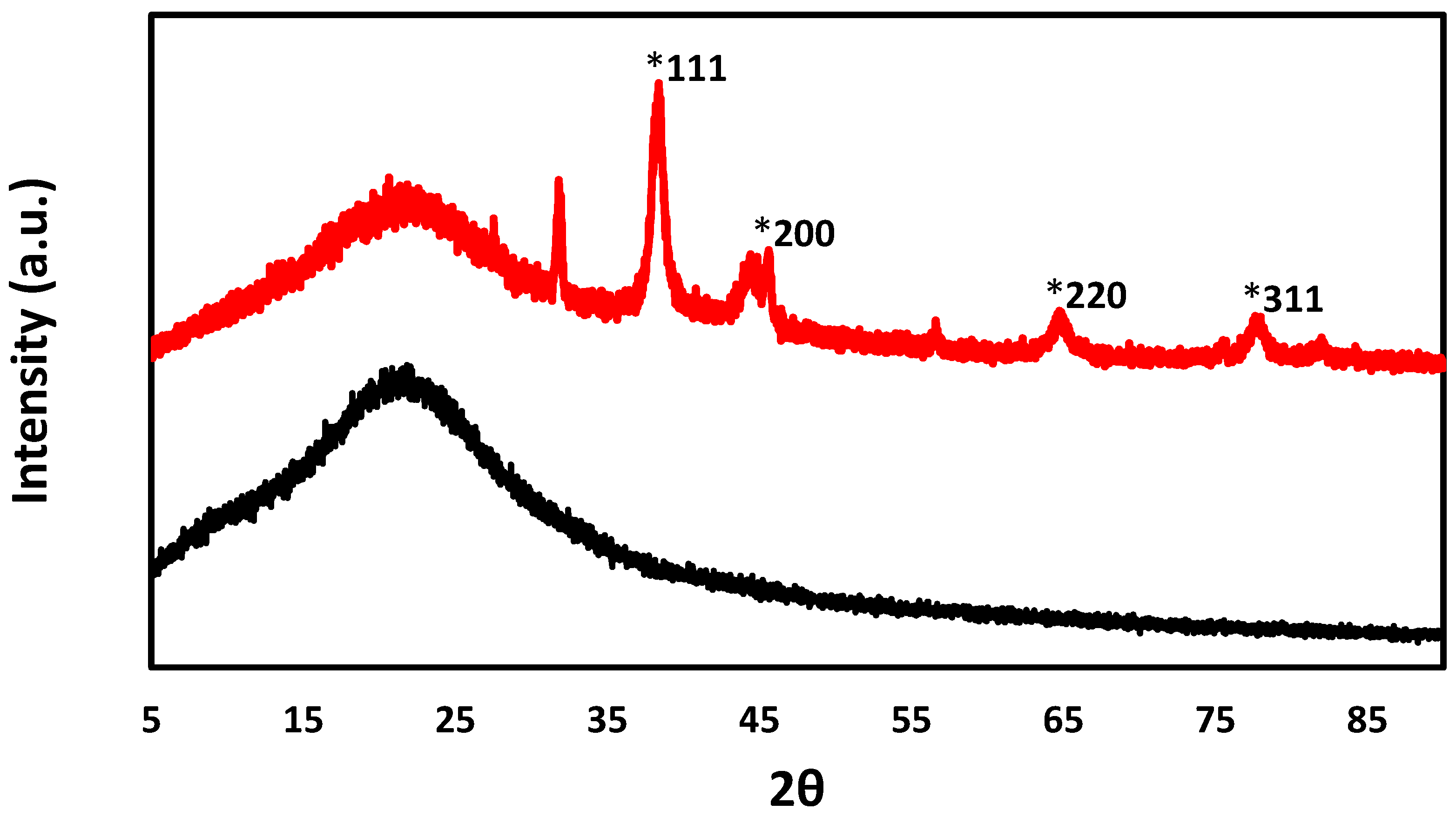
The XRD comparison in Figure 3 illustrates the diffraction profiles of the carbon support (black) and gold nanoparticles loaded on carbon (red). The carbon peak shows a broad hump centered around 2θ ≈ 23°, which is characteristic of amorphous carbon structures [44,45]. This broad feature corresponds to the (002) reflection of graphite-like domains, indicating that the carbon matrix lacks long-range crystallinity [45]. The absence of sharp peaks confirms that the carbon spheres are largely amorphous, with minor graphitic ordering [45]. Upon deposition of Au nanoparticles (red pattern, inset), distinct Bragg peaks emerge at approximately 38.2°, 44.4°, 64.6°, and 77.5°, corresponding to the (111), (200), (220), and (311) planes of face-centered cubic (fcc) gold (JCPDS 04-0784). The high intensity of the (111) reflection confirms preferential orientation, or dominant crystal growth, along this plane, typical for AuNPs synthesized via chemical reduction routes. A small reflection around 2θ ≈ 57° is observed, which aligns with the (004) plane of the underlying carbon material. This feature remains weak and broad, supporting the interpretation that it arises from the carbon support, rather than a secondary metallic or oxide phase. The overall diffraction pattern confirms successful decoration of AuNPs on the carbon sphere surface while retaining the amorphous carbon structure [45].
The average crystallite size of the gold nanoparticles was estimated from the X-ray diffraction (XRD) pattern using the Debye–Scherrer equation, applied to the most intense diffraction peak, corresponding to the (111) plane of face-centered cubic (fcc) gold, observed at 2θ ≈ 38.2°. Complementary TEM analysis (Figure 1) provided direct visualization of the supported AuNPs, revealing uniformly dispersed nanoparticles with an average particle diameter of approximately 22.6 nm. The larger particle size obtained from TEM, compared with the 9.3 nm crystallite size calculated from XRD, suggests that individual nanoparticles consist of multiple coherent crystalline domains, or that lattice strain and surface defects contribute to the peak broadening observed in the XRD profile. Such discrepancies between TEM- and XRD-derived particle sizes are well-documented for metallic nanoparticle systems and are consistent with previous findings for supported Au catalysts, where structural complexity and partial crystallinity influence the apparent crystallite size. Based on the measured particle dimensions, the dispersion of surface gold atoms was estimated to be approximately 3.8% for nanoparticles observed by TEM (22.5 nm) and 9.3% for crystallite domains determined from XRD (9.3 nm). These values indicate that only a small fraction of the total gold atoms is exposed on the surface, and they serve as the active sites responsible for catalytic activity. The variation between the TEM- and XRD-derived dispersion values highlights the distinction between overall particle size and coherent crystalline domain size. The smaller XRD-derived value suggests that each TEM-observed nanoparticle comprises several smaller crystallites, thereby increasing the apparent surface fraction. This surface-dominated behavior is characteristic of heterogeneous Au-based nano-catalysts, where the exposed atomic layers and high dispersion of surface atoms play pivotal roles in determining overall catalytic performance.

2.2. Effect of Au/CM Composite Catalyst on Hydrogen Generation Volume

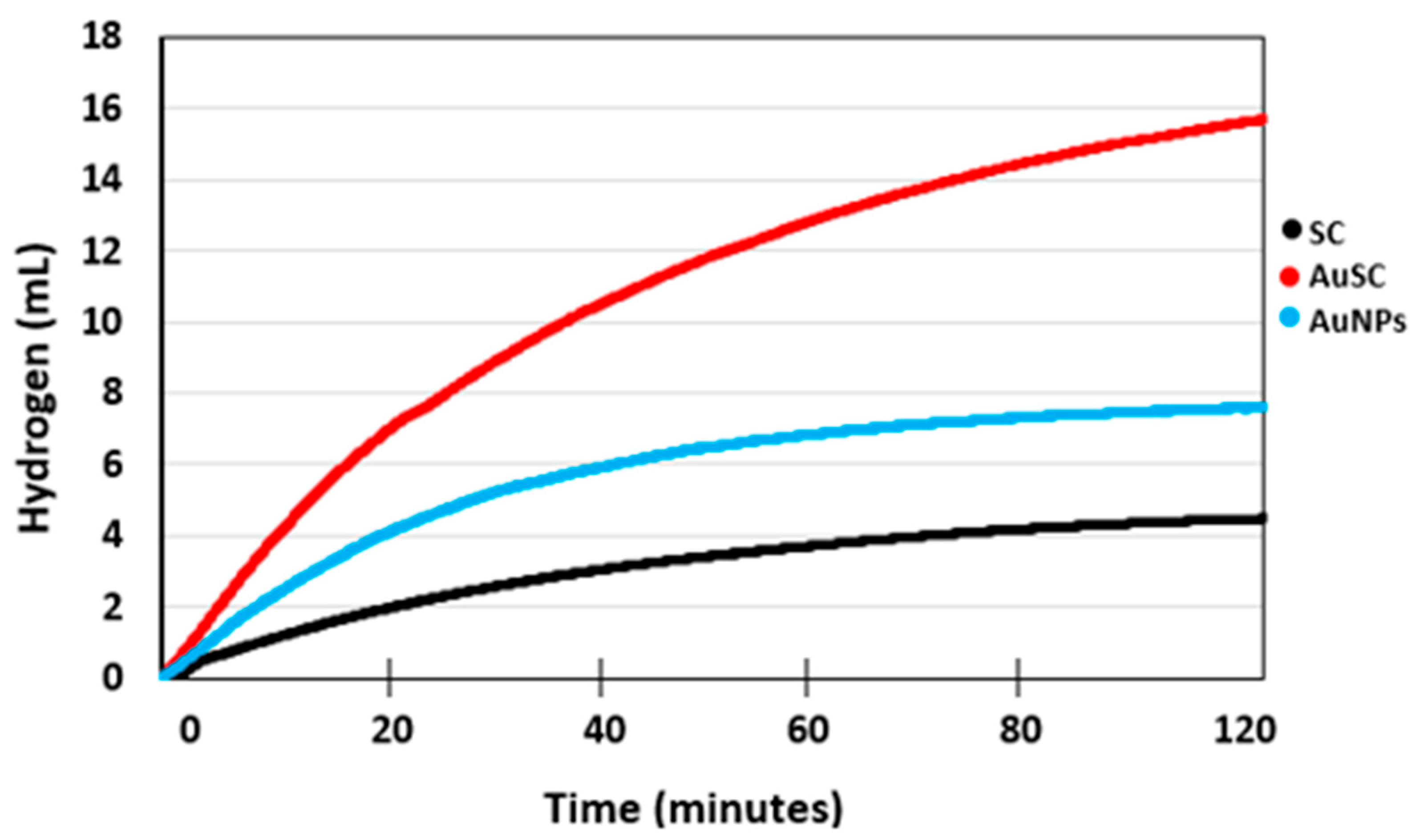
Preliminary catalytic testing of the synthesized composites demonstrated a clear synergistic enhancement in hydrogen generation performance compared to their individual components (Figure 4). The gold–spherical carbon (AuSC) composite catalyst exhibited the highest activity, generating 15.7 mL of hydrogen, which was more than double the volume produced by unsupported gold nanoparticles (7.6 mL), and nearly four times greater than that of pure spherical carbon (4.5 mL) under identical reaction conditions. This enhancement confirms that the intimate contact between Au nanoparticles and the conductive carbon spheres significantly improves catalytic efficiency. The carbon support not only facilitates uniform dispersion of Au nanoparticles, preventing agglomeration, but also promotes rapid charge transfer and enhanced accessibility of active sites during NaBH4 hydrolysis. The superior performance of AuSC thus arises from both structural synergy and electronic interaction between the metal and the carbon support, leading to a more efficient hydrogen evolution process. All reactions occurred over a 120 min period at ambient conditions (pH 7, 295 K, 835 μmoles of NaBH4).
In the pH-controlled trials (Figure S3), the catalyst exhibited its highest activity at neutral pH (7), producing 15.7 mL of hydrogen. This observation was somewhat unexpected, as sodium borohydride (NaBH4) typically generates greater volumes of hydrogen in the presence of strong acids, due to the higher concentration of H+ ions, which promotes hydrolysis and increases hydrogen evolution [21]. In contrast, under basic conditions, the abundance of OH ions tend to stabilize the reactants and suppress hydrogen release, thereby reducing the overall rate of hydrolysis (Equation (1)) [21,23,24,25,26]. Despite this deviation from classical behavior, similar neutral-pH enhancements have been observed in previous studies [22,23,24,25,26].
The concentration-controlled trials (Figure S4) yielded results consistent with expected trends. The standard concentration reaction exhibited the highest hydrogen generation volume of 15.7 mL, followed closely by the low-concentration trial, which produced 12.0 mL of hydrogen. This behavior aligns with established findings, where increased solution viscosity at higher NaBH4 concentrations limits reactant diffusion and catalyst accessibility, thereby influencing overall hydrogen volume and overall kinetics [46].
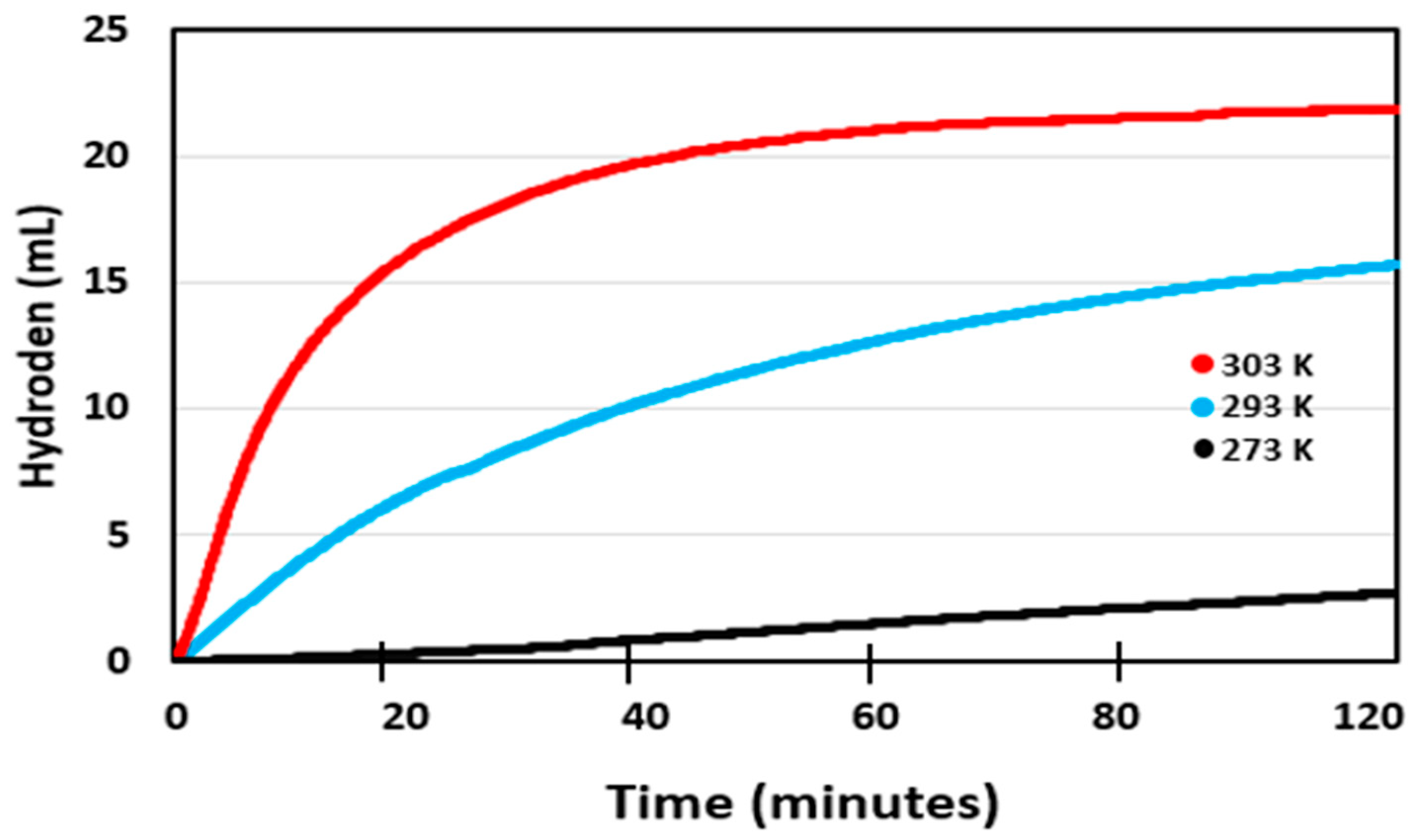
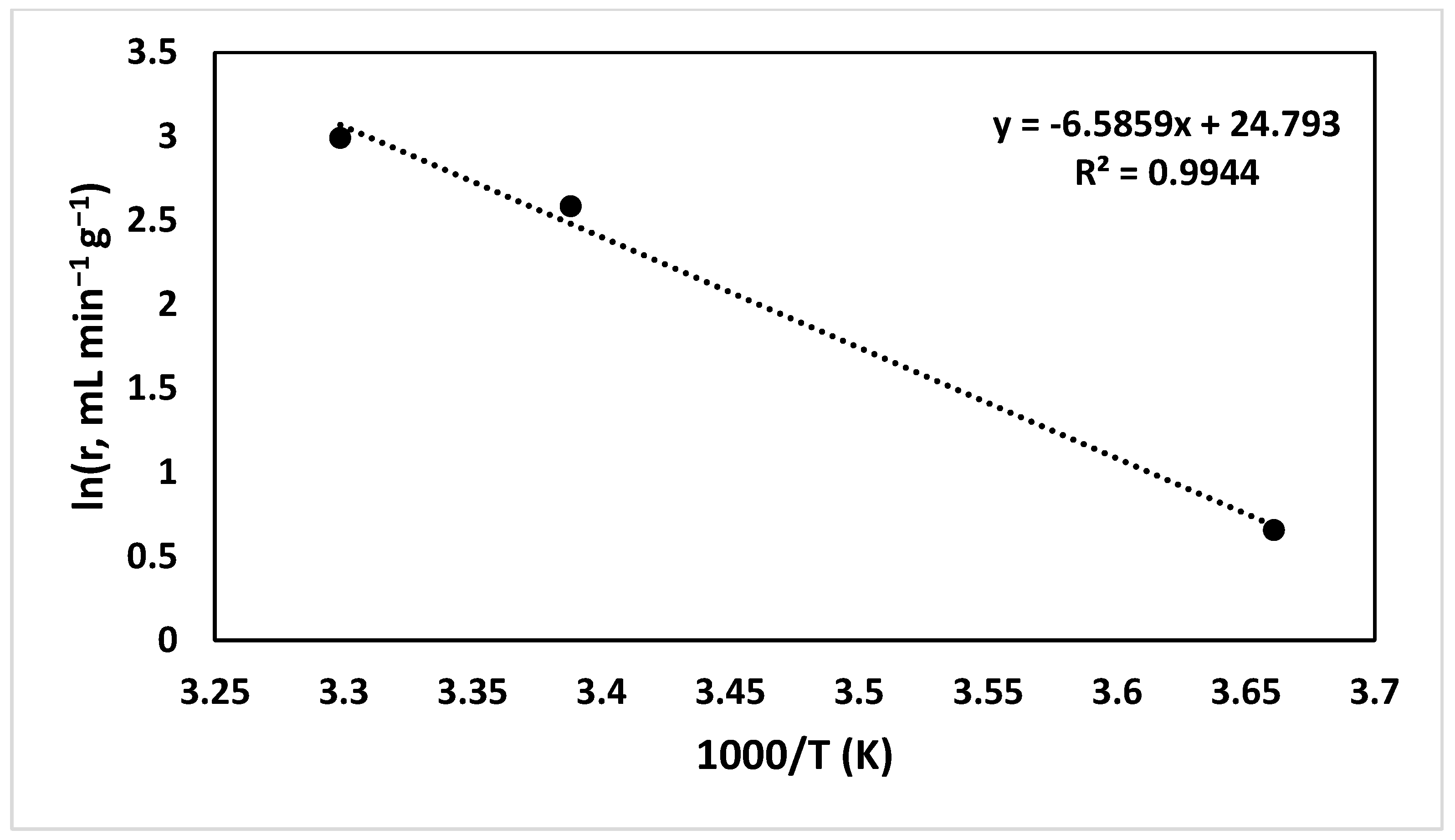
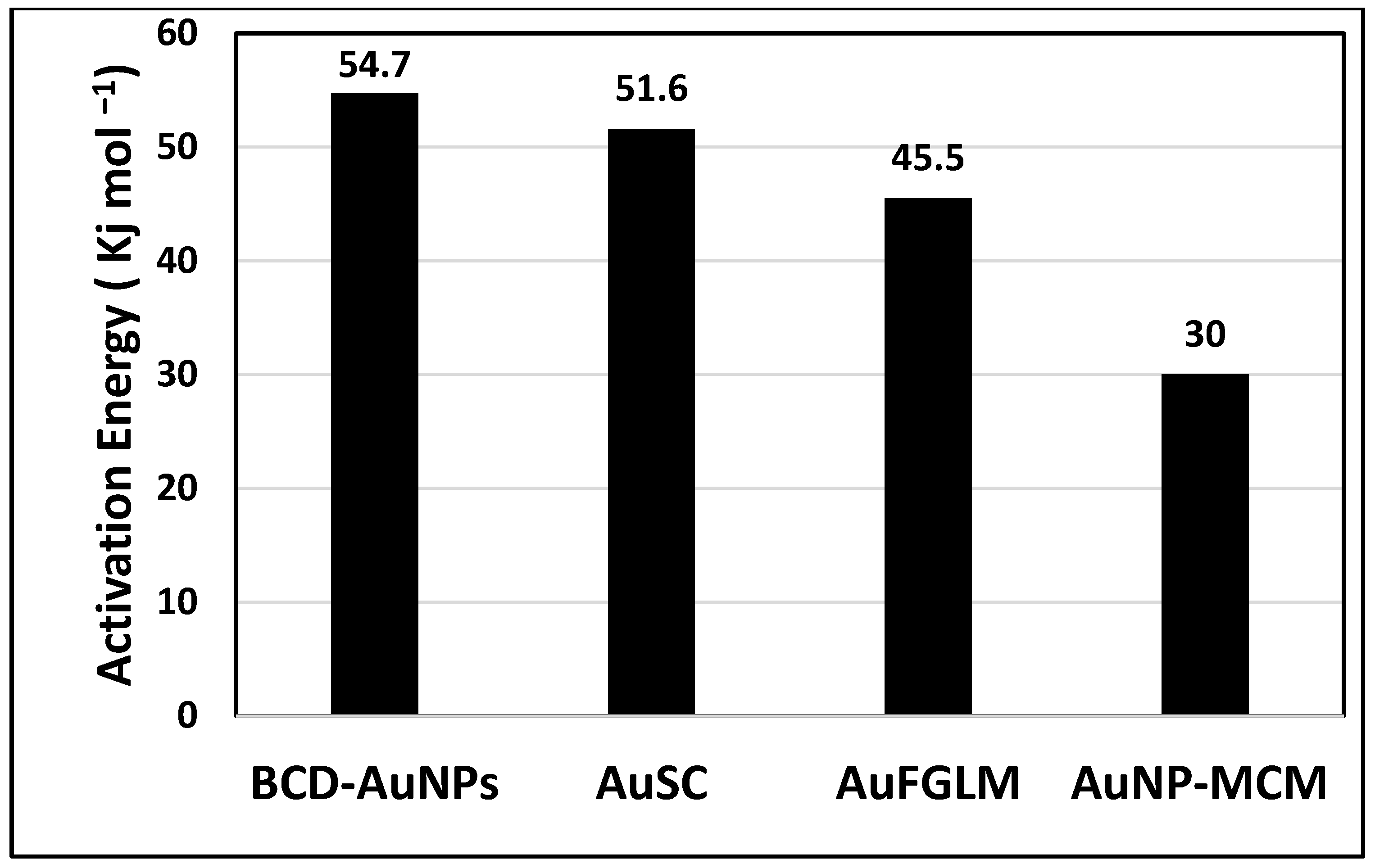
In the temperature-controlled trials (Figure 5), the reaction demonstrated endothermic behavior, with hydrogen evolution rates increasing significantly with temperature. The highest hydrogen volume (21.8 mL) was achieved at 303 K, surpassing both the standard (15.7 mL) and low-temperature (2.7 mL) runs. From these data, the activation energy (Ea) was determined to be 51.2 kJ mol−1 using the Arrhenius plot (Figure 6), which agrees well with the previously reported literature values (Figure 7 and Table 1) [22,23,24,25,26,27].
Figure 7 is a bar graph used to compare the activation energies of different composite materials studied by this team. First, for a comparison, we included gold nanoparticles we synthesized that were not supported by a carbon-based material, dubbed beta-cyclodextrin gold nanoparticles (BCD-AuNPs). This material had the highest activation energy of the four materials compared at 54.7 kJ mol−1 [23]. As mentioned in the introduction, it is not uncommon for nanoparticles to agglomerate in solution, which may explain this higher activation energy [47]. The next-highest activation energy observed in this study was Au/CM, with an Ea of 51.6 kJ mol−1, followed by (AuFGLM), observed to have a lower activation energy of 45.5 kJ mol−1 [48]. Finally, the lowest activation energy of our chosen materials was 30.0 kJ mol−1, belonging to mesoporous carbon materials decorated with gold nanoparticles AuNP-MCM [49]. From this comparison, it is clear that the addition of a support material is beneficial to lower the Ea of the reaction. The type of support material used also seems to have some effect on the Ea, as some of the used materials lowered the Ea more than others. Further study will be conducted into what characteristics of these carbon supports may make one more advantageous than another.
Additionally, catalyst comparisons are listed in Table 1. This table allows us to make comparisons between the different catalyst components. We already compared several materials containing gold that had been studied by this team in Figure 7. When looking at different metals, a few non-previous metals were notable for opposite reasons. Ruthenium seemed to be one of the worse metals to include in these catalysts, as ruthenium on carbon (Ru/C) had the highest activation energy, at 67 kJ mol−1. Ruthenium on graphite (Ru/Graphite) had a slightly lower Ea, at 61.1 kJ mol−1. Another nonprecious metal, cobalt, in its boride form (Co-B), had the second-highest Ea, at 64.9 kJ mol−1 while cobalt chloride (CoCl2) had one of the highest Ea’s, at 17.5 kJ mol−1. Precious metals like silver, palladium, and platinum were also reported to have varying activation energies, with one group of fused graphene-like materials (FGLM) showing values of 45.1 kJ mol−1, 45.5 kJ mol−1, and 46.8 kJ mol−1 for Pd, Au, and Cu, respectively. Gold on multiwalled carbon nanotubes (Au/MWCNTs), palladium on carbon (Pd/C), and silver nanoparticles on fused carbon spheres had lower activation energies, of 21.1 kJ mol−1, 28 kJ mol−1, and 37 kJ mol−1, respectively. Based on these reported results, it seems that the metal itself plays a less important role in the catalytic ability of a composite than either the other material, or possibly the synergistic effect between the materials. Of the carbon support materials, it seems that carbon nanotubes/multiwalled carbon nanotubes had the lowest reported activation energies. Altogether, this data does not indicate any clear pattern for what type of material makes a better catalyst for this reaction. It is clear that more research needs to be conducted to explore these factors. The novel AuSC catalyst places on the higher end of the middle of these activation energies. Our synthesis method may offer some advantages, with benign chemicals, lower temperatures, and relative ease of synthesis.
Table 1. Activation energies of similar catalysts.
CatalystEa (kJ mol−1)Temperature (K)Reference
AuSC51.6273–303This Work
Silica sulfuric acid17298–343[50]
CoCl217.5293–308[51]
Pt–Pd/CNTs19302–332[52]
Au/MWCNTs21.1273–303[25]
Pd/C28298–328[53]
AgNP-FCS37273–303[54]
PtNPs39.2283–303[55]
MWCNT Supported Co40.4298–333[56]
Ag/MWCNTs44.5273–303[26]
PdFGLM45.1283–303[57]
AuFGLM45.5283–303[49]
CuGLM46.8283–303[58]
PtFCS53283–303[59]
BCD-AuNP54.7283–303[23]
Ru/Graphite61.1398–318[60]
Pd/MWCNTs62.7273–303[27]
Co-B64.9283–303[61]
Ru/C67298–358[62]
The calculated turnover number (TON) and turnover frequency (TOF) provide valuable insights into the intrinsic catalytic activity of the synthesized AuSC nanocomposite toward NaBH4 hydrolysis. Based on the experimental data, a total of 15.7 mL of H2 was evolved using 0.001 g of catalyst, containing 2.49 × 10⁻⁵ mmol of Au, yielding a TON of approximately 28,200 and a TOF of 14,100 h−1.
These values indicate that each mole of gold atoms is capable of catalyzing the formation of tens of thousands of moles of hydrogen molecules within the two-hour reaction period, underscoring the high catalytic efficiency of the supported gold nanoparticles. The high TON and TOF can be attributed to the synergistic interaction between the metallic Au nanoparticles and the conductive carbon support, which enhances electron transfer and facilitates NaBH4 hydrolysis.
The relatively high dispersion of surface Au atoms (3.8–9.3%) ensures that a substantial proportion of the metal atoms are catalytically accessible, while the carbon support stabilizes the nanoparticles against agglomeration. Furthermore, the measured activation energy (51.63 kJ mol−1) and the reaction’s endothermic nature are consistent with the behavior of supported noble metal catalysts reported in the literature. These findings confirm that the Au/C composite functions as an efficient and stable catalyst, with performance values comparable to or exceeding those of other Au-based systems used for borohydride hydrolysis.
Table S1 summarizes the catalytic performance of various systems reported for NaBH4 hydrolysis, benchmarked against the present AuSC catalyst [62,63,64,65,66,67]. The AuNPs supported on spherical carbon developed in this work demonstrate high hydrogen generation activity under mild conditions (293 K, 1 atm), achieving TOF values of 3.57 × 10⁵ h−1 for the 22.5 nm TEM-measured particles and 1.48 × 10⁵ h−1 for the 9.3 nm XRD-derived crystallite domains. These values compare favorably with those reported for Ru(0)/zeolite (3.3 × 10⁴ h−1) [63] and Pt–Co/BN (4.0 × 10⁴ h−1) [64] systems, indicating that AuSC offers competitive activity despite its lower precious metal loading.
Non-noble catalysts, such as Co–Zr–B@Co3O4, Co-B-F/g-C3N4, and Co–Ru/C, generally display lower TOFs (103–104 h−1 range), though they remain attractive for their lower cost and scalability [62,65,66,67]. The relatively low activation energy (51.6 kJ mol−1) obtained for the AuSC catalyst aligns with efficient surface-mediated hydrolysis via heterolytic B–H bond cleavage at the Au–C interface.
Overall, the synergistic interaction between gold nanoparticles and the conductive carbon support plays a pivotal role in achieving high catalytic turnover frequencies, efficient electron transfer, and stable hydrogen generation performance under mild conditions. The optimized dispersion of gold nanoparticles across the carbon surface maximizes the number of accessible active sites, while the conductive network of the carbon spheres facilitates rapid charge transfer and stabilizes reactive intermediates during hydrolysis. Collectively, the high TON and TOF values confirm that enhancing nanoparticle dispersion and metal–support interactions markedly improve catalytic efficiency. These findings position the AuSC composite among the most active and durable catalyst systems reported for NaBH4 hydrolysis and provide valuable insight for the rational design of next-generation hydrogen generation catalysts operating efficiently under ambient conditions.

2.3. Reusability of AuSC Catalyst

Gold nanoparticles supported on spherical carbon (AuSC) exhibit great catalytic activity for NaBH4 hydrolysis, with turnover velocity (TOF) values ranging from approximately 14,100 h−1, depending on particle size and surface normalization. The AuSC catalysts show remarkable reusability and structural stability over multiple reaction cycles.
The strong interaction between Au nanoparticles and the carbon support prevent aggregation or sintering, while the noble character of Au resists oxidation and dissolution in aqueous NaBH4 media. Activity losses over cycles are typically due to the accumulation of NaBO2 byproducts on the surface, which can be mitigated through washing or mild NaOH regeneration. Reported studies indicate that AuSC retains over 80–90% of its initial activity after five reuse cycles under ambient conditions.

2.4. Proposed Mechanism and Structure–Function Relationship

The hydrolysis of NaBH4 over the AuSC catalyst proceeds via a heterolytic cleavage mechanism of the B–H bond, as shown in Equation (1). This mechanism is consistent with the observed catalytic behavior and performance parameters obtained from experimental data.
Mechanistically, the reaction involves several fundamental steps, as follows:
  • Adsorption of BH4 ions onto the metallic Au0 sites;
  • Hydride transfer to adsorbed water or hydroxide species, forming H2 molecules;
  • Desorption of hydrogen gas and the formation of surface borate intermediates, which are subsequently hydrolyzed to regenerate the active site.
The carbon support plays a vital role by mediating electron transfer between Au nanoparticles and reaction intermediates, stabilizing negatively charged species and maintaining an optimal hydrophilic–hydrophobic balance to enhance mass transport. Its high conductivity facilitates charge redistribution across the metal surface, sustaining hydride transfer and promoting reaction continuity.
This study’s findings strongly support this mechanistic interpretation. The pH-dependent studies (Figure S3) revealed that the catalyst achieved its maximum hydrogen yield at neutral pH (7), producing 15.7 mL of H2. This behavior is consistent with the proposed mechanism, where excess H+ ions in acidic media accelerate initial hydrolysis, but also destabilize borohydride, leading to uncontrolled decomposition, while neutral conditions favor balanced hydride–proton coupling on the Au surface.
Similarly, the temperature-dependent results (Figure 5) demonstrated a marked increase in hydrogen generation at 303 K, yielding 21.8 mL of H2, and an activation energy (Ea) of 51.6 kJ mol−1, characteristic of metal-catalyzed heterolytic pathways, rather than purely spontaneous decomposition. This supports a surface-mediated reaction mechanism, in which temperature enhances molecular mobility and facilitates hydride transfer between BH4 and water molecules.
The high turnover number (TON = 2.82 × 10⁴) and turnover frequency (TOF = 1.41 × 10⁴ h−1) further corroborate the proposed pathway, indicating that each Au atom participates in thousands of catalytic cycles. This high activity can be attributed to the strong electronic interaction between Au and the spherical carbon support, which maintains active Au0 species and prevents agglomeration, features critical to sustaining the multi-step adsorption–transfer–desorption sequence.
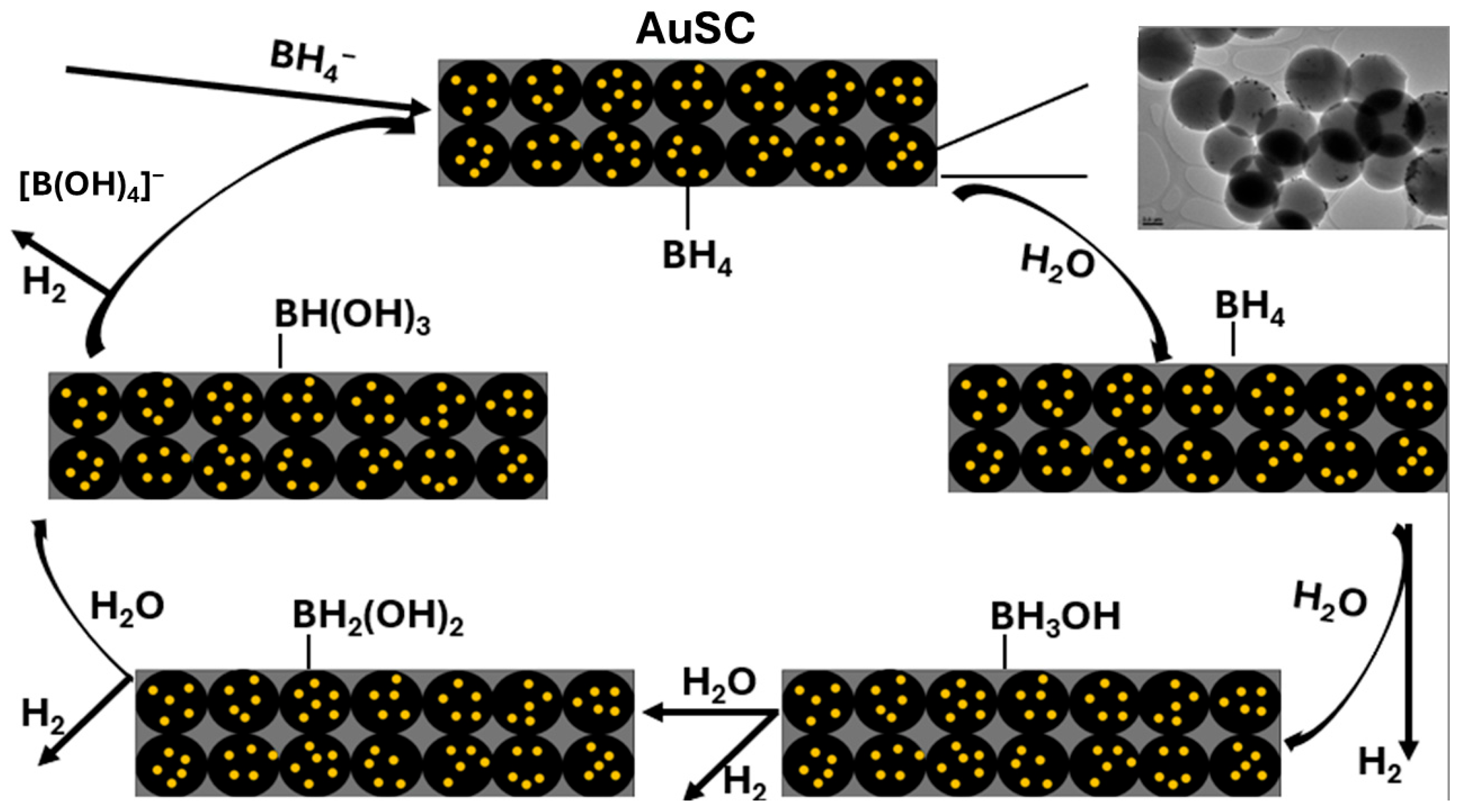
The mechanistic steps are illustrated schematically in Scheme 1, where a BH4 ion adsorbs onto a gold nanoparticle supported on the carbon microsphere, interacts with a nearby water molecule, and undergoes a hydride–proton coupling reaction to form H2 gas. The resulting hydroxylated intermediate successively reacts until the formation and desorption of tetrahydroxyborate ([B(OH)4]), completing the catalytic cycle. Each full cycle generates four molecules of H2, consistent with the stoichiometric reaction of NaBH4 hydrolysis [68,69].
Overall, the combined kinetic, structural, and performance data confirm that hydrogen generation over AuSC proceeds through a heterolytic, surface-mediated mechanism facilitated by electronically interactive Au–C interfaces, which provide enhanced hydride transfer and improved catalyst stability under mild conditions.

3. Experimentation

All materials were purchased from Sigma-Aldrich (St. Louis, MO, USA) at 99.9% purity unless otherwise stated.

3.1. Synthesis of Spherical Carbon (SC)

First, a 0.5 M dextrose solution was prepared via dissolving dextrose into 18 MΩ deionized water (DI). The dextrose solution was added to a 250 mL autoclave at a precise ratio of 3:2 of ambient atmospheric gas to the aqueous dextrose solution. The autoclave was then heated at 200 °C overnight to facilitate the formation of microspheres. The resulting product was isolated using vacuum filtration and dried in an oven for an hour at 100 °C.

3.2. Synthesis of Nanoparticles (AuNPs) and Composites (AuSC)

The gold nanoparticles (AuNPs) were synthesized following the method described by Quach et al. 2021 [23]. This method involved the reduction of chloroauric acid by 1% sodium citrate, which acted as a capping agent for the nanoparticles. Initially, chloroauric acid was dissolved into 100 mL of water, so that the final concentration was 1 mM. Then, the solution was heated to a boil, and a 1% w/w sodium citrate solution was introduced to the chloroauric acid solution dropwise. Once a color change was observed, the solution was removed from the heat and cooled to room temperature The carbon microsphere composites were then produced by incipient wetness impregnation of 100 mg of spherical carbon by 2 mL of the AuNP aqueous solution. The two components were mixed at room temperature, and the produced material was then stored at 100 °C for two days to allow for the evaporation of excess water from the composite.

3.3. Characterization

Scanning Electron Microscopy (SEM, JEOL JSM-6060LV, Akishima, Tokyo, Japan) with energy dispersive spectroscopy (EDS, ThermoScientific UltraDry, Waltham, MA, USA) was used to determine the size and shape of the metal nanoparticles. SEM was also used to analyze the morphology of the carbon used for microsphere synthesis and aided in the sample’s identification as spherical carbon. Transmission electron microscopy (TEM, JEM-2100F, JEOL, Akishima, Tokyo, Japan) was used to confirm the adhesion of the nanoparticles to the surface of the spheres, as well as to further confirm the final morphology of the nanoparticle-coated carbon microsphere composite. Powder X-Ray Diffraction (XRD, Rigaku Miniflex II, Cu Kα X-ray, nickel filters, Rigaku, Tokyo, Japan) was used to identify the crystalline peaks of gold within our sample.

3.4. Catalysis

The setup consisted of two vacuum flasks connected by a hose. One flask was designated as the reaction chamber, inside of which the hydrolysis reaction of NaBH4 catalyzed by carbon microsphere composites (AuSC) occurred. The second flask contained DI water, to be displaced by the hydrogen generated in the first flask. The reaction chamber was sealed using a rubber stopper. The second flask, containing the DI water to be displaced, was connected to a cup on a scale via a hose through the rubber stopper sealing the flask. This scale (Ohaus Pioneer Balance (Pa124)) was connected to a computer, which recorded the measured mass of the water displaced every 0.25 s. This study was conducted under a range of pH values (6, 7, and 8), temperatures (273 K, 295 K, and 303 K), and controlled NaBH4 concentrations (635, 835, and 1035 μmol) using 100 μg of catalyst containing 2.49 × 10⁻⁵ mmol of Au. These variations were designed to identify the optimal conditions for hydrogen generation. All reactions were continuously stirred with a magnetic stir bar throughout the two-hour duration of each trial. In the temperature-controlled studies, however, thermal insulation was employed to maintain the desired reaction temperature, which limited the use of the magnetic stir plate.

4. Conclusions

Gold nanoparticle-decorated spherical carbon (AuSC) composites were successfully synthesized and evaluated as catalysts for the hydrolysis of sodium borohydride (NaBH4) to generate hydrogen. The spherical carbon support was synthesized via a glucose-mediated route, while gold nanoparticles (AuNPs) were produced through the citrate reduction of chloroauric acid (HAuCl4) and immobilized on the carbon spheres using a simple wet impregnation method, forming a uniform and stable composite catalyst.
TEM and SEM analyses confirmed the well-dispersed attachment of AuNPs on the carbon microspheres. The AuSC catalyst exhibited superior hydrogen generation activity compared to its individual components, achieving optimal performance at neutral pH (7) and 303 K, producing 21.8 mL of H2 from 835 μmol of NaBH4. The reaction’s activation energy (51.6 kJ mol−1) aligns with the literature values for similar metal-supported catalysts, indicating a surface-mediated mechanism.
The high TON (2.82 × 10⁴) and TOF (1.41 × 10⁴ h−1) demonstrate the catalyst’s exceptional efficiency and rapid hydrogen evolution kinetics. Enhanced activity arises from the synergistic interaction between the dispersed AuNPs and conductive carbon support, which improves hydride transfer, electron mobility, and mass transport. The spherical carbon morphology further enhances surface area and active site accessibility.
Overall, the AuSC catalyst offers a promising, efficient, and stable platform for borohydride-based hydrogen generation under mild conditions.

Supplementary Materials

The following supporting information can be downloaded at https://www.mdpi.com/article/10.3390/catal15121141/s1, Figure S1: Distribution of nanoparticle sizes created via ImageJ, an image processing program. Figure S2: EDS spectra for the novel AuSC sample. Figure S3: Volume of hydrogen gas generated over two hours. Comparison of amount generated under varying pH conditions (pH 6, 7, 8). Figure S4: Amount of hydrogen gas generated over time. Comparison of amount generated when exposed to a controlled amount of NaBH4 (635 µmol and 835 µmol). Figure S5: Reusability study for AuSC catalyst for NaBH4 Hydrolysis. Table S1: Comprehensive NaBH4 hydrolysis catalyst comparison [63,64,65,66,67].

Author Contributions

Conceptualization, T.M.A.-F.; Methodology, T.M.A.-F.; Validation, T.M.A.-F.; Formal analysis, E.B.; Investigation, E.B.; Data curation, E.B.; Writing—original draft, E.B.; Writing—review and editing, T.M.A.-F.; Visualization, T.M.A.-F.; Supervision, T.M.A.-F.; Project administration, T.M.A.-F.; Funding acquisition, T.M.A.-F. All authors have read and agreed to the published version of the manuscript.

Funding

This research received no external funding.

Data Availability Statement

The original contributions presented in this study are included in the article/Supplementary Materials. Further inquiries can be directed to the corresponding author.

Acknowledgments

The corresponding author, Tarek M. Abdel-Fattah, acknowledges Lawrence J. Sacks’ Endowment in chemistry.

Conflicts of Interest

The authors declare no conflicts of interest.

References

  1. Metin, O.; Ozark, S. Hydrogen generation from the hydrolysis of ammonia-borane and sodium borohydride by using water-soluble polymer-stabilized cobalt nanoclusters catalyst. Energy Fuels 2009, 23, 3517–3526. [Google Scholar] [CrossRef]
  2. Wang, B.; Liu, Y.; Wang, D.; Song, C.; Fu, Z.; Zhang, C. A Review of the Photothermal-Photovoltaic Energy Supply System for Buildings in Solar Energy Enrichment Zones. Renew. Sustain. Energy Rev. 2024, 191, 114100. [Google Scholar] [CrossRef]
  3. Hannan, M.A.; Al-Shetwi, A.Q.; Mollik, M.S.; Ker, P.J.; Mannan, M.; Mansor, M.; Al-Masri, H.M.K.; Mahlia, T.M.I. Wind Energy Conversions, Controls, and Applications: A Review for Sustainable Technologies and Directions. Sustainability 2023, 15, 3986. [Google Scholar] [CrossRef]
  4. Lund, J.W.; Toth, A.N. Direct Utilization of Geothermal Energy 2020 Worldwide Review. Geothermics 2020, 90, 101915. [Google Scholar] [CrossRef]
  5. Jo, C.H.; Hwang, S.J. Review on tidal energy technologies and research subjects. China Ocean Eng. 2020, 34, 137–150. [Google Scholar] [CrossRef]
  6. Züttel, A. Hydrogen storage methods. Naturwissenschaften 2004, 91, 157–172. [Google Scholar] [CrossRef]
  7. Turakul ugli, T.J. The Importance of Alternative Solar Energy Sources and the Advantages and Disadvantages of Using Solar Panels in this Process. Int. J. Eng. Inf. Syst. (IJEAIS) 2019, 3, 60–64. [Google Scholar]
  8. Ebhota, W.S.; Tabakov, P.Y. Influence of Photovoltaic Cell Technologies and Elevated Temperature on Photovoltaic System Performance. Ain Shams Eng. J. 2023, 14, 101984. [Google Scholar] [CrossRef]
  9. Ingole, A.S.; Rakhonde, B.S. Hybrid Power Generation System Using Wind Energy and Solar Energy. Int. J. Sci. Res. Publ. 2015, 5, 1–4. [Google Scholar]
  10. Maradin, D. Advantages and Disadvantages of Renewable Energy Sources Utilization. Int. J. Energy Econ. Policy 2021, 11, 176–183. [Google Scholar] [CrossRef]
  11. Smallwood, K.S.; Rugge, L.; Morrison, M.L. Influence of Behavior on Bird Mortality in Wind Energy Developments. J. Wildl. Manag. 2009, 73, 1082–1098. [Google Scholar] [CrossRef]
  12. Kagel, A.; Bates, D.; Gawell, K. A Guide to Geothermal Energy and the Environment; Geothermal Energy Association: Washington, DC, USA, 2007; Available online: http://www.charleswmoore.org/pdf/Environmental%20Guide.pdf (accessed on 28 August 2024).
  13. Shetty, C.; Priyam, A. A review on tidal energy technologies. Mater. Today Proc. 2022, 56, 2774–2779. [Google Scholar] [CrossRef]
  14. Wani, F.; Dong, J.; Polinder, H. Tidal turbine generators. IntechOpen 2020. [Google Scholar] [CrossRef]
  15. Copping, A.E.; Hasselman, D.J.; Bangley, C.W.; Culina, J.; Carcas, M. A Probabilistic Methodology for Determining Collision Risk of Marine Animals with Tidal Energy Turbines. J. Mar. Sci. Eng. 2023, 11, 2151. [Google Scholar] [CrossRef]
  16. Veziroğlu, T.N.; Şahin, S. 21st century’s energy: Hydrogen energy system. Energy Convers. Manag. 2008, 49, 1820–1831. [Google Scholar] [CrossRef]
  17. Fellay, C.; Dyson, P.J.; Laurenczy, G. A viable hydrogen-storage system based on selective formic acid decomposition with a ruthenium catalyst. Angew. Chem. Int. Ed. 2008, 47, 3966–3968. [Google Scholar] [CrossRef] [PubMed]
  18. Patel, N.; Fernandes, R.; Miotello, A. Hydrogen generation by hydrolysis of NaBH4 with efficient Co-P-B catalyst: A kinetic study. J. Power Sources 2009, 188, 411–420. [Google Scholar] [CrossRef]
  19. Ouyang, L.; Liu, M.; Chen, K.; Liu, J.; Wang, H.; Zhu, M.; Yartys, V. Recent Progress on Hydrogen Generation from the Hydrolysis of Light Metals and Hydrides. J. Alloys Compd. 2022, 910, 164831. [Google Scholar] [CrossRef]
  20. Afanasev, P.; Askarova, A.; Alekhina, T.; Popov, E.; Markovic, S.; Mukhametdinova, A.; Cheremisin, A.; Mukhina, E. An Overview of Hydrogen Production Methods: Focus on Hydrocarbon Feedstock. Int. J. Hydrogen Energy 2024, 78, 805–828. [Google Scholar] [CrossRef]
  21. Schlesinger, H.I.; Brown, H.C.; Finholt, A.E.; Gilbreath, J.R.; Hoekstra, H.R.; Hyde, E.K. Hyde, Sodium Borohydride, Its Hydrolysis and its Use as a Reducing Agent and in the Generation of Hydrogen. J. Am. Chem. Soc. 1952, 75, 215–219. [Google Scholar] [CrossRef]
  22. Huff, C.; Long, J.M.; Abdel-Fattah, T.M. Beta-Cyclodextrin-Assisted Synthesis of Silver Nanoparticle Network and Its Application in a Hydrogen Generation Reaction. Catalysts 2020, 10, 1014. [Google Scholar] [CrossRef]
  23. Quach, Q.; Biehler, E.; Elzamzami, A.; Huff, C.; Long, J.M.; Abdel-Fattah, T.M. Catalytic Activity of Beta-Cyclodextrin-Gold Nanoparticles Network in Hydrogen Evolution Reaction. Catalysts 2021, 11, 118. [Google Scholar] [CrossRef]
  24. Huff, C.; Dushatinski, T.; Barzanji, A.; Abdel-Fattah, N.; Barzanji, K. Pretreatment of Gold Nanoparticle Multi-Walled Carbon Nanotube Composites for Catalytic Activity Toward Hydrogen Generation Reaction. ECS J. Solid State Sci. Technol. 2017, 6, M69. [Google Scholar] [CrossRef]
  25. Huff, C.; Dushantinski, T.; Abdel-Fattah, T. Gold nanoparticle/multi-walled carbon nanotube composite as novel catalyst for hydrogen evolution reactions. ECS J. Solid-State Sci. Technol. 2017, 42, 18985–18990. [Google Scholar] [CrossRef]
  26. Huff, C.; Long, J.; Abdelrahman, A.; Heyman, A.; Fattah, T. Silver Nanoparticle/Multi-Walled Carbon Nanotube Composite as Catalyst for Hydrogen Production. ECS J. Solid-State Sci. Technol. 2017, 6, 115–118. [Google Scholar] [CrossRef]
  27. Huff, C.; Long, J.; Heyman, A.; Fattah, T. Palladium Nanoparticle Multiwalled Carbon Nanotube Composite as Catalyst for Hydrogen Production by the Hydrolysis of Sodium Borohydride. ACS Appl. Energy Mater. 2018, 1, 4635–4640. [Google Scholar] [CrossRef]
  28. Milone, C.; Ingoglia, R.; Schipilliti, L.; Crisafulli, C.; Neri, G.; Galvagno, S. Selective Hydrogenation of α,β-Unsaturated Ketone to α,β-Unsaturated Alcohol on Gold-Supported Iron Oxide Catalysts: Role of the Support. J. Catal. 2005, 236, 80–90. [Google Scholar] [CrossRef]
  29. Tseng, C.-H.; Yang, T.C.K.; Wu, H.-E.; Chiang, H.-C. Catalysis of Oxidation of Carbon Monoxide on Supported Gold Nanoparticles. J. Hazard. Mater. 2009, 166, 686–694. [Google Scholar] [CrossRef] [PubMed]
  30. Torigoe, K.; Esumi, K. Preparation and Catalytic Effect of Gold Nanoparticles in Water Dissolving Carbon Disulfide. J. Phys. Chem. B 1999, 103, 2862–2866. [Google Scholar] [CrossRef]
  31. Maillard, F.; Schreier, S.; Hanzlik, M.; Savinova, E.R.; Weinkauf, S.; Stimming, U. Influence of particle agglomeration on the catalytic activity of carbon-supported Pt nanoparticles in CO monolayer oxidation. Phys. Chem. Chem. Phys. 2005, 7, 385–393. [Google Scholar] [CrossRef]
  32. Kim, H.; Fortunato, M.E.; Xu, H.; Bang, J.H.; Suslick, K.S. Carbon Microspheres as Supercapacitors. J. Phys. Chem. C 2011, 115, 20481–20486. [Google Scholar] [CrossRef]
  33. Bazargan, A.; Yan, Y.; Hui, C.W.; McKay, G. A Review: Synthesis of Carbon-Based Nano and Micro Materials by High Temperature and High Pressure. Ind. Eng. Chem. Res. 2013, 52, 12689–12702. [Google Scholar] [CrossRef]
  34. Antolini, E. Carbon Supports for Low-Temperature Fuel Cell Catalysts. Appl. Catal. B Environ. 2009, 88, 1–24. [Google Scholar] [CrossRef]
  35. Wang, C.; Xiangfeng, C.; Mingmei, W. Highly Sensitive Gas Sensors Based on Hollow SnO2 Spheres Prepared by Carbon Sphere Template Method. Sens. Actuators B Chem. 2007, 120, 508–513. [Google Scholar] [CrossRef]
  36. Kong, X.; Vasudevan, S.V.; Cao, M.; Cai, J.; Mao, H.; Bu, Q. Microwave-Assisted Efficient Fructose–HMF Conversion in Water over Sulfonated Carbon Microsphere Catalyst. ACS Sustain. Chem. Eng. 2021, 9, 15344–15356. [Google Scholar] [CrossRef]
  37. Zhang, H.; Zhang, L.; Rodríguez-Pérez, I.A.; Miao, W.; Chen, K.; Wang, W.; Li, Y.; Han, S. Carbon Nanospheres Supported Bimetallic Pt-Co as an Efficient Catalyst for NaBH4 Hydrolysis. Appl. Surf. Sci. 2021, 540, 148296. [Google Scholar] [CrossRef]
  38. Li, S.; Qiu, S.; Chua, Y.S.; Xia, Y.; Zou, Y.; Xu, F.; Sun, L.; Chu, H. Co–B Supported on Waxberry-Like Hierarchical Porous Carbon Microspheres: An Efficient Catalyst for Hydrogen Generation via Sodium Borohydride Hydrolysis. Mater. Chem. Phys. 2024, 319, 129399. [Google Scholar] [CrossRef]
  39. Abu-Zied, B.M.; Ali, T.T.; Adly, L. Sodium Borohydride Hydrolysis over Mesoporous Spherical Carbon Obtained from Jasmine Flower Extract. Int. J. Hydrogen Energy 2023, 48, 10829–10840. [Google Scholar] [CrossRef]
  40. Zhao, S.; Austin, N.; Li, M.; Song, Y.; House, S.D.; Bernhard, S.; Yang, J.C.; Mpourmpakis, G.; Jin, R. Influence of Atomic-Level Morphology on Catalysis: The Case of Sphere and Rod-Like Gold Nanoclusters for CO2 Electroreduction. ACS Catal. 2018, 8, 4996–5001. [Google Scholar] [CrossRef]
  41. Cerqueira, R.F.L.; Paladino, E.E.; Maliska, C.R. A Computational Study of the Interfacial Heat or Mass Transfer in Spherical and Deformed Fluid Particles Flowing at Moderate Re Numbers. Chem. Eng. Sci. 2015, 138, 741–759. [Google Scholar] [CrossRef]
  42. Titirici, M.-M.; White, R.J.; Brun, N.; Budari, V.L.; Su, D.S.; del Monte, F.; Clark, J.H.; MacLachlan, M.J. Sustainable carbon materials. Chem. Soc. Rev. 2015, 44, 250–290. [Google Scholar] [CrossRef]
  43. Wang, T.; Okejiri, F.; Qiao, Z.-A.; Dai, S. Tailoring Polymer Colloids Derived Porous Carbon Spheres Based on Specific Chemical Reactions. Adv. Mater. 2020, 32, 2002475. [Google Scholar] [CrossRef] [PubMed]
  44. Wahab, M.A.; Darain, F.; Islam, N.; Young, D.J. Nano/mesoporous carbon from rice starch for voltammetric detection of ascorbic acid. Molecules 2018, 23, 234. [Google Scholar] [CrossRef]
  45. Li, Z.Q.; Lu, C.J.; Xia, Z.P.; Zhou, Y.; Luo, Z. X-ray Diffraction Patterns of Graphite and Turbostratic Carbon. Carbon 2007, 45, 1686–1695. [Google Scholar] [CrossRef]
  46. Flory, P.J. Kinetics of Polyesterification: A Study of the Effects of Molecular Weight and Viscosity on Reaction Rate. J. Am. Chem. Soc. 1939, 61, 3334–3340. [Google Scholar] [CrossRef]
  47. Cartwright, A.; Jackson, K.; Morgan, C.; Anderson, A.; Britt, D.W. A Review of Metal and Metal-Oxide Nanoparticle Coating Technologies to Inhibit Agglomeration and Increase Bioactivity for Agricultural Applications. Agronomy 2020, 10, 1018. [Google Scholar] [CrossRef]
  48. Biehler, E.; Quach, Q.; Abdel-Fattah, T.M. Gold Nanoparticles AuNP Decorated on Fused Graphene-like Materials for Application in a Hydrogen Generation. Materials 2023, 16, 4779. [Google Scholar] [CrossRef] [PubMed]
  49. Biehler, E.; Quach, Q.; Abdel-Fattah, T.M. Gold Nanoparticle Mesoporous Carbon Composite as Catalyst for Hydrogen Evolution Reaction. Molecules 2024, 29, 3707. [Google Scholar] [CrossRef] [PubMed]
  50. Manna, J.; Roy, B.; Sharma, P. Efficient hydrogen generation from sodium borohydride hydrolysis using silica sulfuric acid catalyst. J. Power Sources 2015, 275, 727–733. [Google Scholar] [CrossRef]
  51. Levy, A.; Brown, J.B.; Lyons, C.J. Catalyzed Hydrolysis of Sodium Borohydride. Ind. Eng. Chem. 1960, 52, 211–214. [Google Scholar] [CrossRef]
  52. Peña-Alonso, R.; Sicurelli, A.; Callone, E.; Carturan, G.; Raj, R. A picoscale catalyst for hydrogen generation from NaBH4 for fuel cells. J. Power Sources 2007, 165, 315–323. [Google Scholar] [CrossRef]
  53. Patel, N.; Patton, B.; Zanchetta, C.; Fernandes, R.; Guella, G.; Kale, A.; Miotello, A. Pd-C power and thin film catalysts for hydrogen production by hydrolysis of sodium borohydride. Int. J. Hydrogen Energy 2008, 33, 287–292. [Google Scholar] [CrossRef]
  54. Biehler, E.; Quach, Q.; Abdel-Fattah, T.M. Silver-Nanoparticle-Decorated Fused Carbon Sphere Composite as a Catalyst for Hydrogen Generation. Energies 2023, 16, 5053. [Google Scholar] [CrossRef]
  55. Huff, C.; Biehler, E.; Quach, Q.; Long, J.M.; Abdel-Fattah, T.M. Synthesis of Highly Dispersive Platinum Nanoparticles and their Application in a Hydrogen Generation Reaction. Colloids Surf. A Physicochem. Eng. Asp. 2020, 610, 125734. [Google Scholar] [CrossRef]
  56. Huang, Y.; Wang, Y.; Zhao, R.; Shen, P.K.; Wei, Z. Accurately measuring the hydrogen generation rate for hydrolysis of sodium borohydride on multi-walled carbon nanotubes/Co-B catalysts. Int. J. Hydrogen Energy 2008, 33, 7110–7115. [Google Scholar] [CrossRef]
  57. Quach, Q.; Biehler, E.; Abdel-Fattah, T.M. Synthesis of Palladium Nanoparticles Supported over Fused Graphene-like Material for Hydrogen Evolution Reaction. Catalysts 2023, 13, 1117. [Google Scholar] [CrossRef]
  58. Quach, Q.; Biehler, E.; Abdel-Fattah, T.M. Synthesis of Copper Nanoparticles Supported over Graphene-like Material Composite as a Catalyst for Hydrogen Evolution. J. Compos. Sci. 2023, 7, 279. [Google Scholar] [CrossRef]
  59. Biehler, E.; Quach, Q.; Abdel-Fattah, T.M. Synthesis of Platinum Nanoparticles Supported on Fused Nanosized Carbon Spheres Derived from Sustainable Source for Application in a Hydrogen Generation Reaction. Nanomaterials 2023, 13, 1994. [Google Scholar] [CrossRef]
  60. Liang, Y.; Dai, H.-B.; Ma, L.-P.; Wang, P.; Cheng, H.-M. Hydrogen generation from sodium borohydride solution using a ruthenium supported graphite catalyst. Int. J. Hydrogen Energy 2010, 35, 3023–3028. [Google Scholar] [CrossRef]
  61. Jeong, S.U.; Kim, R.K.; Cho, E.A.; Kim, H.-J.; Nam, S.-W.; Oh, I.-H.; Hong, S.-A.; Kim, S.H. A study on hydrogen generation from NaBH4 solution using the high-performance Co-B catalyst. J. Power Sources 2005, 144, 129–134. [Google Scholar] [CrossRef]
  62. Zhang, J.S.; Delgass, W.N.; Fisher, T.S.; Gore, J.P. Kinetics of Ru-catalyzed sodium borohydride hydrolysis. J. Power Sources 2007, 164, 772–781. [Google Scholar] [CrossRef]
  63. Zahmakiran, M.; Özkar, S. Zeolite-Confined Ruthenium(0) Nanoclusters Catalyst: Record Catalytic Activity, Reusability, and Lifetime in Hydrogen Generation from the Hydrolysis of Sodium Borohydride. Langmuir 2009, 25, 2667–2678. [Google Scholar] [CrossRef]
  64. Hou, Z.; Ma, Z.; Sun, L.; Yang, Y.; Song, Z.; Zhang, H.; Song, H.; Ding, C.; Gao, X.; Wang, J.; et al. Optimized Pt–Co/BN Catalysts for Efficient NaBH4 Hydrolysis. Adv. Energy Sustain. Res. 2025, 6, 2400313. [Google Scholar] [CrossRef]
  65. Kenar, M.E.; Şahin, Ö.; Kutluay, S.; Genceli Güner, F.E. Boosting H2 Generation via NaBH4 Hydrolysis Using Co–Zr–B@Co3O4 as a Novel Catalyst: Insights on Characterization, Catalytic Evaluation, Kinetics and Reusability. Int. J. Hydrogen Energy 2025, 174, 151456. [Google Scholar] [CrossRef]
  66. Kenar, M.E.; Kutluay, S.; Şahin, Ö.; Genceli Güner, F.E. Cobalt–Boron–Fluoride Decorated Graphitic Carbon Nitride Composite as a Promising Candidate Catalyst for Highly Efficient Hydrogen Production via NaBH4 Hydrolysis Process. Int. J. Hydrogen Energy 2024, 90, 732–746. [Google Scholar] [CrossRef]
  67. Huang, W.; Xu, F.; Liu, X. Superior Hydrogen Generation from Sodium Borohydride Hydrolysis Catalyzed by the Bimetallic Co–Ru/C Nanocomposite. Int. J. Hydrogen Energy 2021, 46, 25376–25384. [Google Scholar] [CrossRef]
  68. Abdel-Fattah, T.M.; Biehler, E. Carbon Based Supports for Metal Nanoparticles for Hydrogen Generation Reactions Review. Adv. Carbon J. 2024, 1, 1–19. [Google Scholar] [CrossRef]
  69. Quach, Q.; Abdel-Fattah, T.M. Silver Nanoparticles functionalized Nanoporous Silica Nanoparticle grown over Graphene Oxide for enhancing Antibacterial effect. Nanomaterials 2022, 12, 3341. [Google Scholar] [CrossRef]
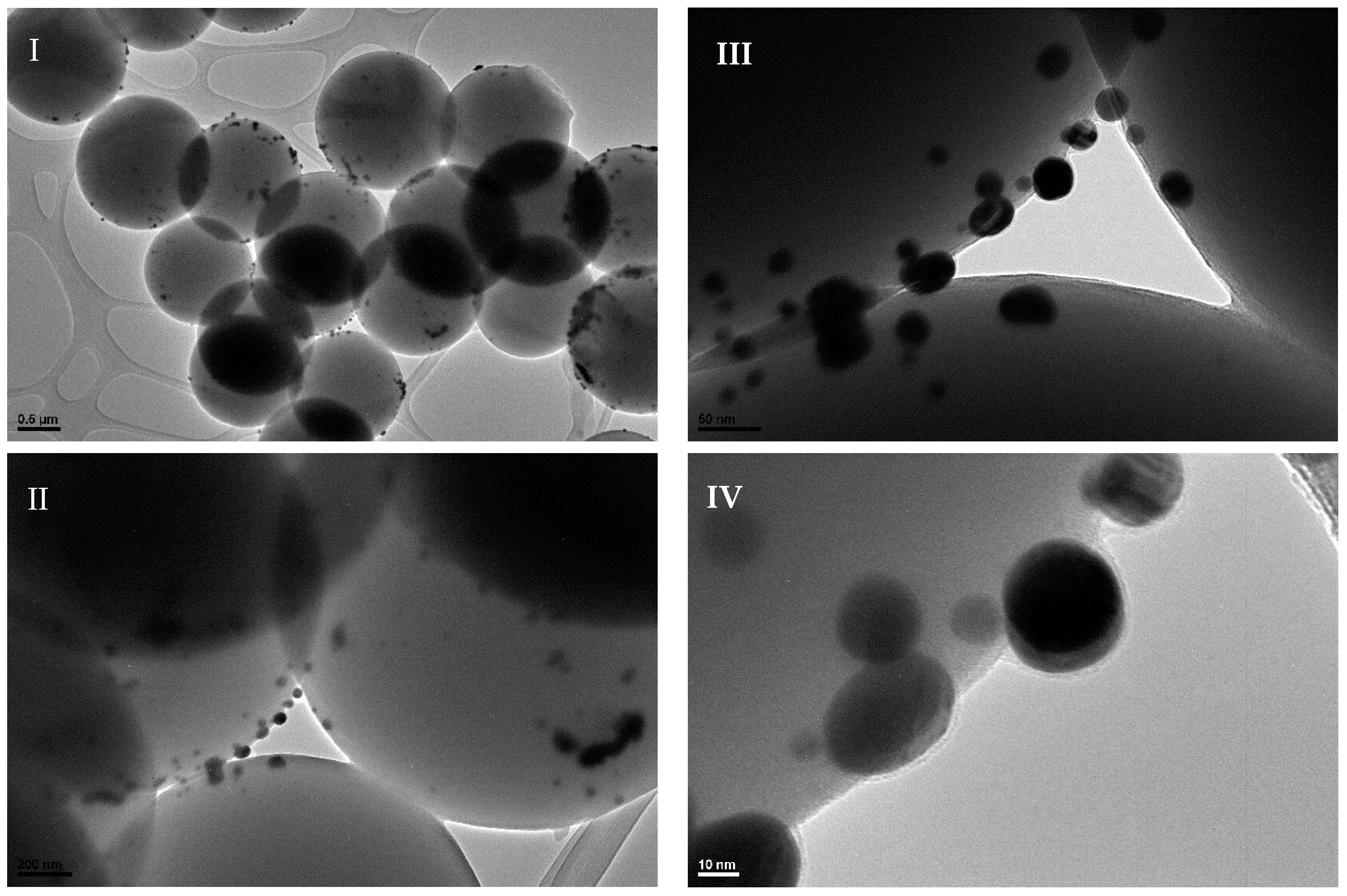
Figure 1. TEM images of carbon–gold nanoparticle composites (AuSC). (I) Micrograph with 0.5 μm scale bar showing expanse of carbon–metal composites. (II) Micrograph showing 200 nm scale bar. (III) A collection of gold nanoparticles on the surface of the sphere (50 nm scalebar). (IV) Nanoparticles (~10–100 nm) displayed with 10 nm scale bar.
Catalysts 15 01141 g001
Figure 2. SEM micrograph of the gold nanoparticle-coated spherical carbon (AuSC).
Catalysts 15 01141 g002
Figure 3. P-XRD data for the AuSC catalyst (red) compared to the unsupported SC (black). The inset figure highlights peaks corresponding to gold material which are denoted with an asterisk.
Catalysts 15 01141 g003
Figure 4. Amount of hydrogen gas generated over two hours (120 min) by the nanoparticle-coated spherical carbon (AuSC), Au nanoparticles, and undecorated spherical carbon. Reactions were conducted at 295 K, pH 7, and with 835 μmoles of sodium borohydride.
Catalysts 15 01141 g004
Figure 5. Amount of H2 gas generated versus time. Comparison of volume of hydrogen gas generated when exposed to different temperatures (273 K, 295 K, 303 K).
Catalysts 15 01141 g005
Figure 6. Arrhenius plot created using the temperature data from Figure 4.
Catalysts 15 01141 g006
Figure 7. Comparison of the activation energies of several material composites.
Catalysts 15 01141 g007
Scheme 1. Proposed mechanism for the Au/CM facilitated hydrolysis of NaBH4.
Catalysts 15 01141 sch001
Disclaimer/Publisher’s Note: The statements, opinions and data contained in all publications are solely those of the individual author(s) and contributor(s) and not of MDPI and/or the editor(s). MDPI and/or the editor(s) disclaim responsibility for any injury to people or property resulting from any ideas, methods, instructions or products referred to in the content.