Mechanism Investigation of Solvent Effect on Selective Decomposition of Formic Acid




Abstract
1. Introduction
2. Results and Discussion
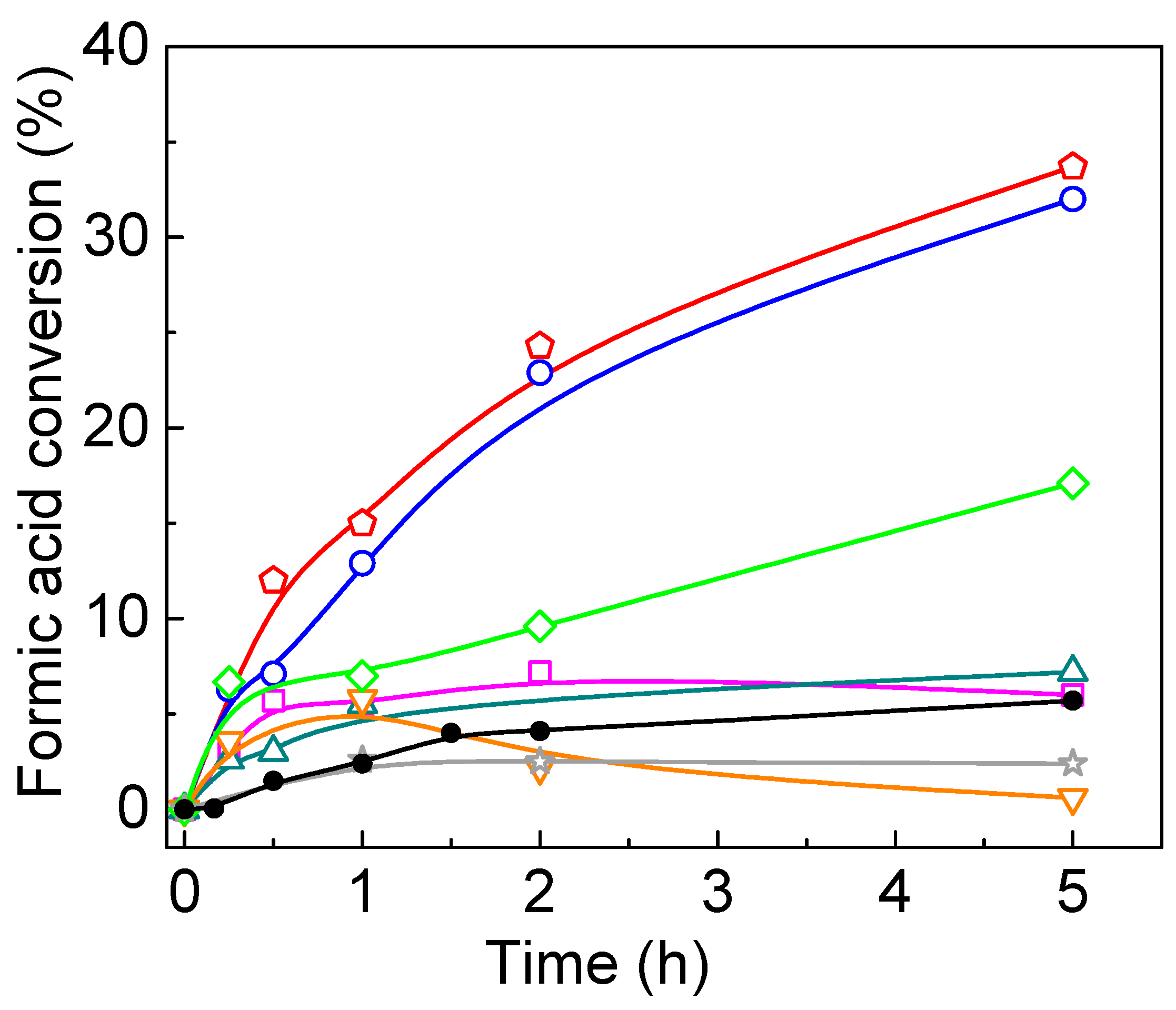
2.1. Formic Acid Decomposition in Different Solvent Systems
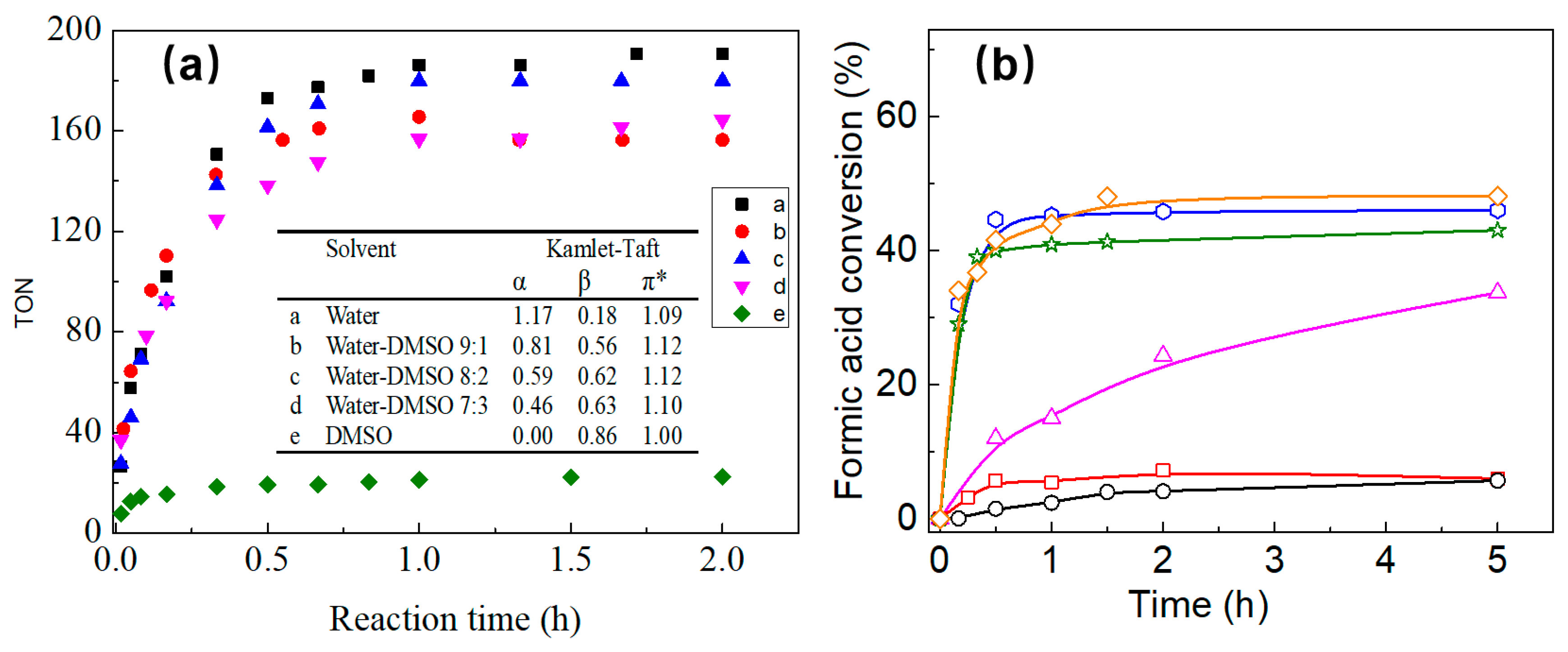
2.2. Correlation of TON with Reaction Solvent Parameters
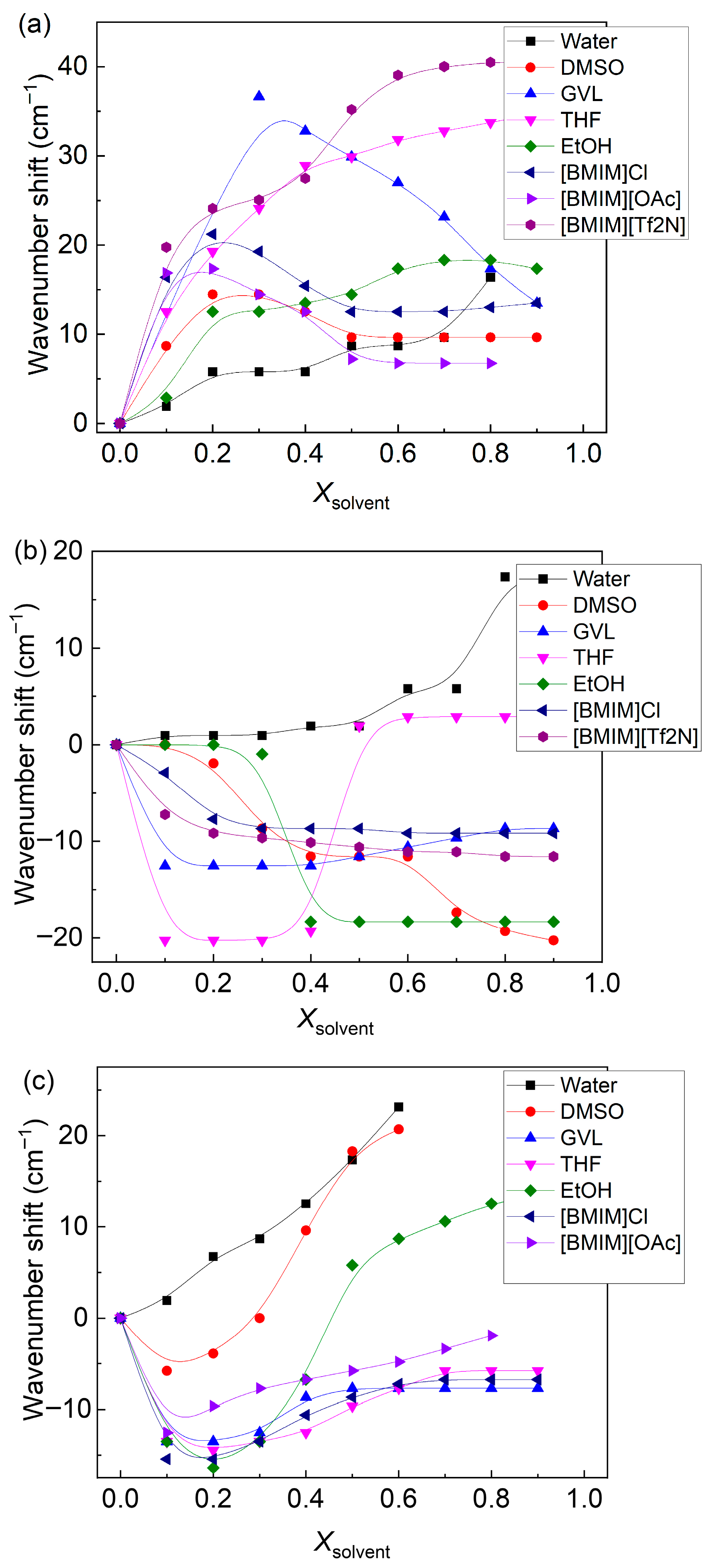
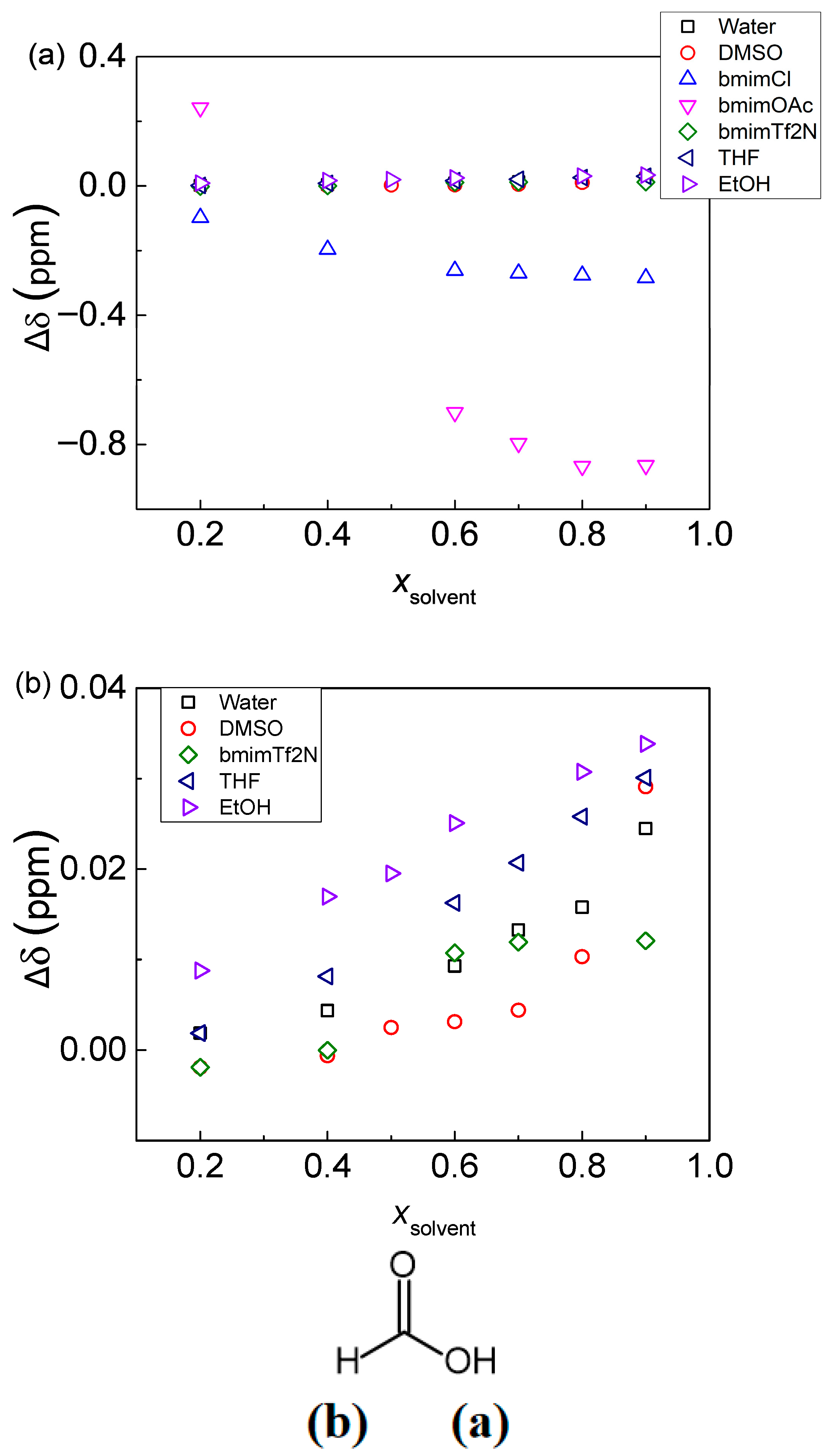
2.3. Estimation of the Hydrogen Bond of Formic Acid and Solvents
2.4. Mechanism for Formic Acid Decomposition
3. Materials and Methods
3.1. Materials
3.2. General Procedure for Reaction Experiments
3.3. Spectroscopy Techniques
3.3.1. Measurement of Kamlet–Taft Solvatochromic Parameters
3.3.2. ATR-Infrared Spectroscopy
H NMR Measurements
3.4. Calculations of Formic Acid Conversion and TON
4. Conclusions
Supplementary Materials
Author Contributions
Funding
Data Availability Statement
Conflicts of Interest
References
- Karatok, M.; Ngan, H.T.; Jia, X.; O’Connor, C.R.; Boscoboinik, J.A.; Stacchiola, D.J.; Sautet, P.; Madix, R.J. Achieving ultra-high selectivity to hydrogen production from formic acid on Pd–Ag Alloys. J. Am. Chem. Soc. 2023, 145, 5114–5124. [Google Scholar] [CrossRef]
- Mohideen, M.M.; Subramanian, B.; Sun, J.; Ge, J.; Guo, H.; Radhamani, A.V.; Ramakrishna, S.; Liu, Y. Techno-economic analysis of different shades of renewable and non-renewable energy-based hydrogen for fuel cell electric vehicles. Renew. Sustain. Energy Rev. 2023, 174, 113153. [Google Scholar] [CrossRef]
- Younas, M.; Shafique, S.; Hafeez, A.; Javed, F.; Rehman, F. An overview of hydrogen production: Current status, potential, and challenges. Fuel 2022, 316, 123317. [Google Scholar] [CrossRef]
- Enthaler, S.; von Langermann, J.; Schmidt, T. Carbon dioxide and formic acid-the couple for environmental-friendly hydrogen storage? Energy Environ. Sci. 2010, 3, 1207–1217. [Google Scholar] [CrossRef]
- Sordakis, K.; Tang, C.H.; Vogt, L.K.; Junge, H.; Dyson, P.J.; Beller, M.; Laurenczy, G. Homogeneous Catalysis for Sustainable Hydrogen Storage in Formic Acid and Alcohols. Chem. Rev. 2018, 118, 372–433. [Google Scholar] [CrossRef]
- Kim, Y.; Lee, H.; Yang, S.; Lee, J.; Kim, H.; Hwang, S.; Jeon, S.W.; Kim, D.H. Ultrafine Pd nanoparticles on amine-functionalized carbon nanotubes for hydrogen production from formic acid. J. Catal. 2021, 404, 324–333. [Google Scholar] [CrossRef]
- Mellmann, D.; Sponholz, P.; Junge, H.; Beller, M. Formic acid as a hydrogen storage material—Development of homogeneous catalysts for selective hydrogen release. Chem. Soc. Rev. 2016, 45, 3954–3988. [Google Scholar] [CrossRef] [PubMed]
- Dutta, I.; Chatterjee, S.; Cheng, H.; Parsapur, R.K.; Liu, Z.; Li, Z.; Ye, E.; Kawanami, H.; Low, J.S.C.; Lai, Z.; et al. Formic acid to power towards low-carbon economy. Adv. Energy Mater. 2022, 12, 2103799. [Google Scholar] [CrossRef]
- Bulushev, D.A.; Ross, J.R.H. Towards Sustainable Production of Formic Acid. ChemSusChem 2018, 11, 821–836. [Google Scholar] [CrossRef] [PubMed]
- Valentini, F.; Kozell, V.; Petrucci, C.; Marrocchi, A.; Gu, Y.; Gelman, D.; Vaccaro, L. Formic acid, a biomass-derived source of energy and hydrogen for biomass upgrading. Energy Environ. Sci. 2019, 12, 2646–2664. [Google Scholar] [CrossRef]
- Sadeghzadeh, S.M. Ionic liquid-modified fibrous silica microspheres loaded with PbS nanoparticles and their enhanced catalytic activity and reusability for the hydrogen production by selective dehydrogenation of formic acid. J. Mol. Liq. 2016, 223, 267–273. [Google Scholar] [CrossRef]
- Solis, B.H.; Maher, A.G.; Honda, T.; Powers, D.C.; Nocera, D.G.; Hammes-Schiffer, S. Theoretical analysis of cobalt hangman porphyrins: Ligand dearomatization and mechanistic implications for hydrogen evolution. ACS Catal. 2014, 4, 4516–4526. [Google Scholar] [CrossRef]
- Wang, W.H.; Wang, H.; Yang, Y.; Lai, X.; Li, Y.; Wang, J.; Himeda, Y.; Bao, M. Synergistic Effect of Pendant N Moieties for Proton Shuttling in the Dehydrogenation of Formic Acid Catalyzed by Biomimetic Ir(III) Complexes. ChemSusChem 2020, 13, 5015–5022. [Google Scholar] [CrossRef]
- Marcinkowski, M.D.; Murphy, C.J.; Liriano, M.L.; Wasio, N.A.; Lucci, F.R.; Sykes, E.C.H. Microscopic View of the Active Sites for Selective Dehydrogenation of Formic Acid on Cu(111). ACS Catal. 2015, 5, 7371–7378. [Google Scholar] [CrossRef]
- Barlocco, I.; Bellomi, S.; Delgado, J.J.; Chen, X.; Prati, L.; Dimitratos, N.; Roldan, A.; Villa, A. Enhancing activity, selectivity and stability of palladium catalysts in formic acid decomposition: Effect of support functionalization. Catal. Today 2021, 382, 61–70. [Google Scholar] [CrossRef]
- Carrales-Alvarado, D.H.; López-Olmos, C.; Dongil, A.B.; Kubacka, A.; Guerrero-Ruiz, A.; Rodríguez-Ramos, I. Effect of N-doping and carbon nanostructures on NiCu particles for hydrogen production from formic acid. Appl. Catal. B Environ. 2021, 298, 120604. [Google Scholar] [CrossRef]
- Mehar, V.; Liao, W.; Mahapatra, M.; Shi, R.; Lim, H.; Barba-Nieto, I.; Hunt, A.; Waluyo, I.; Liu, P.; Rodriguez, J.A. Morphology dependent reactivity of CsOx nanostructures on Au(111): Binding and hydrogenation of CO2 to HCOOH. ACS Nano 2023, 17, 22990–22998. [Google Scholar] [CrossRef]
- Ding, C.; Shen, T.; Yang, Y.; Xu, X. Involvement of the Unoccupied Site Changes the Kinetic Trend Significantly: A Case Study on Formic Acid Decomposition. ACS Catal. 2020, 10, 5153–5162. [Google Scholar] [CrossRef]
- Yoo, J.S.; Abild-Pedersen, F.; Nørskov, J.K.; Studt, F. Theoretical Analysis of Transition-Metal Catalysts for Formic Acid Decomposition. ACS Catal. 2014, 4, 1226–1233. [Google Scholar] [CrossRef]
- Elnabawy, A.O.; Murray, E.A.; Mavrikakis, M. Trends in formic acid electro-oxidation on transition metals alloyed with platinum and palladium. J. Phys. Chem. C 2022, 126, 4374–4390. [Google Scholar] [CrossRef]
- Alrais, L.; Gholap, S.S.; Dutta, I.; Abou-Hamad, E.; Chen, B.W.J.; Zhang, J.; Hedhili, M.N.; Basset, J.-M.; Huang, K.-W. Highly efficient immobilized PN3P-pincer iridium catalyst for dehydrogenation of neat formic acid. Appl. Catal. B Environ. 2024, 342, 123439. [Google Scholar] [CrossRef]
- Pandey, B.; Krause, J.A.; Guan, H. Cobalt-catalyzed additive-free dehydrogenation of neat formic acid. ACS Catal. 2024, 14, 13781–13791. [Google Scholar] [CrossRef]
- Qi, X.; Obata, K.; Yui, Y.; Honma, T.; Lu, X.; Ibe, M.; Takanabe, K. Potential–Rate Correlations of Supported Palladium-Based Catalysts for Aqueous Formic Acid Dehydrogenation. J. Am. Chem. Soc. 2024, 146, 9191–9204. [Google Scholar] [CrossRef] [PubMed]
- Li, G.; Chen, H.; Huang, D.; Fan, M. Comparative kinetic study of formic acid decomposition for hydrogen production in supercritical water and gas phase: Effect of water catalysis. Fuel 2024, 361, 130759. [Google Scholar] [CrossRef]
- Bai, S.; Jia, A.; Song, J.; Cao, S.; Wang, N.; Liu, X. Metal-support interactions in heterogeneous catalytic hydrogen production of formic acid. Chem. Eng. J. 2023, 474, 145612. [Google Scholar] [CrossRef]
- Zhao, Z.; Zhang, T.; Feng, Y.; Wang, N.; Sun, Q. Subnanometer palladium-manganese clusters in hydrophilic amino-functionalized zeolites for efficient formic acid dehydrogenation. Chem. Eng. J. 2024, 496, 154194. [Google Scholar] [CrossRef]
- Wang, X.; Zhang, Y.; Liang, H.; Jiang, W.; Fu, P. Catalytic hydrogenolysis of formic acid to hydrogen over heterogeneous catalysts: A review on modification strategies, catalyst deactivation and reaction mechanism. Appl. Catal. A Gen. 2024, 687, 119972. [Google Scholar] [CrossRef]
- Wang, X.; Meng, Q.; Gao, L.; Jin, Z.; Ge, J.; Liu, C.; Xing, W. Recent progress in hydrogen production from formic acid decomposition. Int. J. Hydrogen Energy 2018, 43, 7055–7071. [Google Scholar] [CrossRef]
- Li, X.; Zhu, Y.; Chen, G.; Yang, G.; Wu, Z.; Sunden, B. Theoretical study of solvent effects on the decomposition of formic acid over a Co(111) surface. Int. J. Hydrogen Energy 2017, 42, 24726–24736. [Google Scholar] [CrossRef]
- Herron, J.A.; Scaranto, J.; Ferrin, P.; Li, S.; Mavrikakis, M. Trends in Formic Acid Decomposition on Model Transition Metal Surfaces: A Density Functional Theory study. ACS Catal. 2014, 4, 4434–4445. [Google Scholar] [CrossRef]
- Hafeez, S.; Harkou, E.; Spanou, A.; Al-Salem, S.M.; Villa, A.; Dimitratos, N.; Manos, G.; Constantinou, A. Review on recent progress and reactor set-ups for hydrogen production from formic acid decomposition. Mater. Today Chem. 2022, 26, 101120. [Google Scholar] [CrossRef]
- Guo, L.; Zhuge, K.; Yan, S.; Wang, S.; Zhao, J.; Wang, S.; Qiao, P.; Liu, J.; Mou, X.; Zhu, H.; et al. Defect-driven nanostructuring of low-nuclearity Pt-Mo ensembles for continuous gas-phase formic acid dehydrogenation. Nat. Commun. 2023, 14, 7518. [Google Scholar] [CrossRef] [PubMed]
- Betts, A.; Briega-Martos, V.; Cuesta, A.; Herrero, E. Adsorbed Formate is the Last Common Intermediate in the Dual-Path Mechanism of the Electrooxidation of Formic Acid. ACS Catal. 2020, 10, 8120–8130. [Google Scholar] [CrossRef]
- Scaranto, J.; Mavrikakis, M. Density functional theory studies of HCOOH decomposition on Pd(111). Surf. Sci. 2016, 650, 111–120. [Google Scholar] [CrossRef]




Disclaimer/Publisher’s Note: The statements, opinions and data contained in all publications are solely those of the individual author(s) and contributor(s) and not of MDPI and/or the editor(s). MDPI and/or the editor(s) disclaim responsibility for any injury to people or property resulting from any ideas, methods, instructions or products referred to in the content. |
© 2025 by the authors. Licensee MDPI, Basel, Switzerland. This article is an open access article distributed under the terms and conditions of the Creative Commons Attribution (CC BY) license (https://creativecommons.org/licenses/by/4.0/).
Share and Cite
Zhang, Z.; Shan, J.; Shen, F.; Li, F.; Guo, H. Mechanism Investigation of Solvent Effect on Selective Decomposition of Formic Acid. Catalysts 2025, 15, 1112. https://doi.org/10.3390/catal15121112
Zhang Z, Shan J, Shen F, Li F, Guo H. Mechanism Investigation of Solvent Effect on Selective Decomposition of Formic Acid. Catalysts. 2025; 15(12):1112. https://doi.org/10.3390/catal15121112
Chicago/Turabian StyleZhang, Zheyuan, Jianrong Shan, Feng Shen, Fukuan Li, and Haixin Guo. 2025. "Mechanism Investigation of Solvent Effect on Selective Decomposition of Formic Acid" Catalysts 15, no. 12: 1112. https://doi.org/10.3390/catal15121112
APA StyleZhang, Z., Shan, J., Shen, F., Li, F., & Guo, H. (2025). Mechanism Investigation of Solvent Effect on Selective Decomposition of Formic Acid. Catalysts, 15(12), 1112. https://doi.org/10.3390/catal15121112