Article

Catalytic Co-Pyrolysis of Chinese Oil Shales for Enhanced Shale Oil Yield and Quality: A Kinetic and Experimental Study


1
State Key Laboratory of Advanced Environmental Technology, Institute of Urban Environment, Chinese Academy of Sciences, Xiamen 361021, China
2
Ningbo Key Laboratory of Urban Environmental Pollution Control, CAS Haixi Industrial Technology Innovation Center in Beilun, Ningbo 315830, China
3
Zhejiang Academy of Special Equipment Science, Hangzhou 310020, China
4
Zhejiang Ningbo Ecological and Environmental Monitoring Center, Ningbo 315048, China
5
Department of Chemical and Environmental Engineering, University of Nottingham Ningbo China, Ningbo 315100, China
*
Authors to whom correspondence should be addressed.
Catalysts 2025, 15(11), 1076; https://doi.org/10.3390/catal15111076
Submission received: 13 August 2025 / Revised: 10 October 2025 / Accepted: 10 November 2025 / Published: 13 November 2025

Abstract

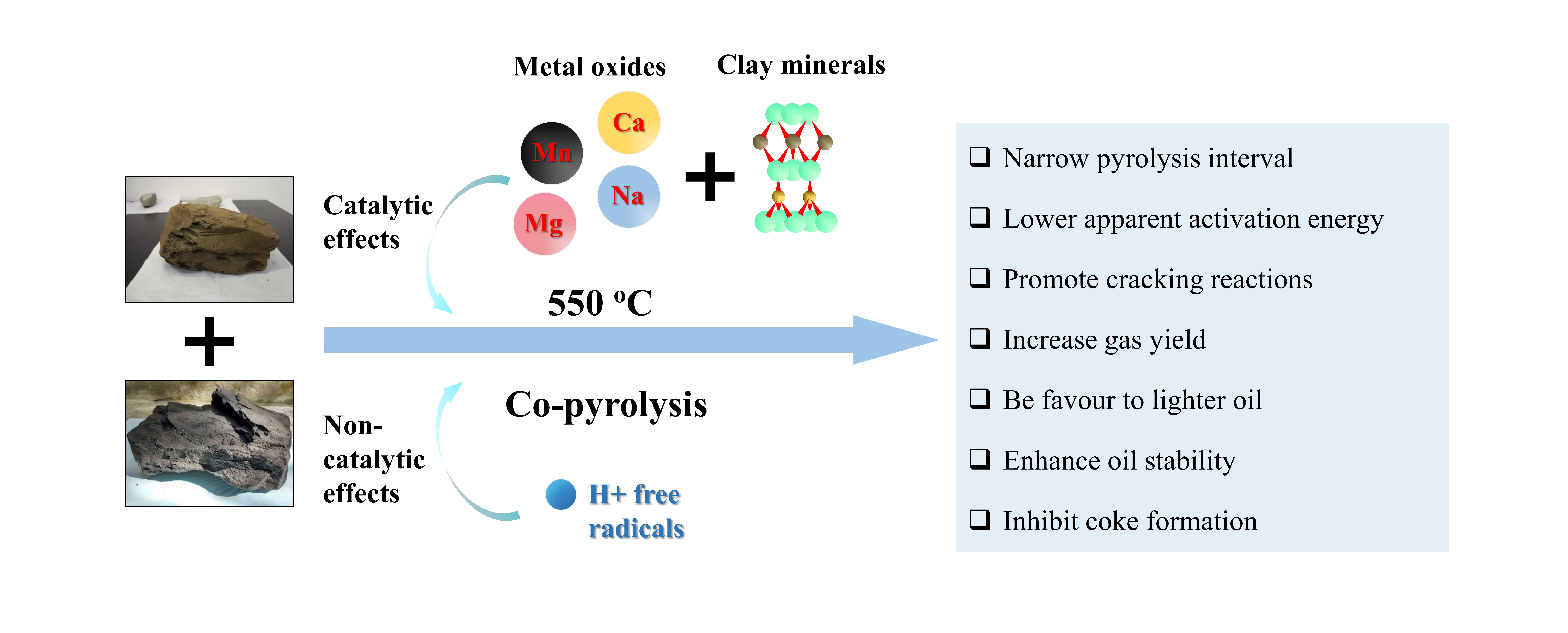
In response to the urgent need for sustainable energy solutions and efficient fossil resource utilization, the current research is conducted to examine the catalytic co-pyrolysis of four typical Chinese oil shales. The study assesses the ability of synergistic interactions, which are the result of organic and inorganic components, to improve the aspect of thermal behavior, decrease the activation energy and improve the shale oil quality. Thermogravimetric analysis in conjunction as Flynn–Wall–Ozawa (FWO), Kissinger–Akahira–Sunose (KAS) and integral master-plots approaches showed that there were low activation energies and better reaction kinetics in blended systems. Fischer assay and GC-MS were utilized in product distribution and product composition evaluation, respectively. Optimization increased gas yield and oil composition stabilization in the blended gas, which is found due to the catalytic functions of AAEMs and clay minerals. This contribution facilitates the development of catalytic co-processing solutions where better conversion and reduced carbon intensity are achieved in the production of fossil-based energy.

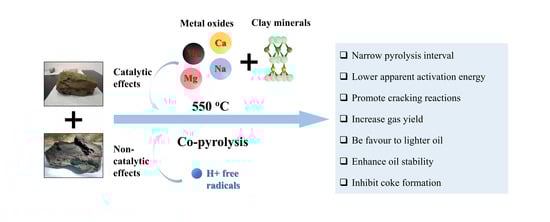
Graphical Abstract

1. Introduction

Fluctuating oil prices and the finite nature of liquid petroleum reserves have prompted many oil shale-rich countries to explore clean energy conversion technologies to produce liquid fuels from oil shale. Oil shale is a fine-grained sedimentary rock that contains organic matter, including kerogen and bitumen [1]. Upon heating, oil shale decomposes into lighter oils, gaseous hydrocarbons, and a porous mineral matrix. China holds vast oil shale reserves, and its shale oil production accounts for up to 16% of the global estimate [2], offering a promising alternative for oil supply.
Among various conversion processes, pyrolysis stands out as an efficient and effective method for converting oil shale into value-added products due to its relatively simple and less energy-intensive nature [3]. In general, pyrolysis refers to the thermal decomposition of oil shale at elevated temperatures under an inert atmosphere. During pyrolysis, kerogen undergoes a series of chemical reactions between 350 and 550 °C, initially converting to pyrolytic bitumen, which further decomposes into naphtha and subsequently lighter oils [4]. Typically, shale oil comprises alkanes, alkenes, aromatic hydrocarbons, oxygenated contents and few polycyclic aromatic hydrocarbons (PAHs) [5]. In contrast to crude oil, shale oil is enriched in both aromatic and sulphur content, leading to reduced stability, increased hydrogen and catalyst consumption during refining, and ultimately diminishing its potential as a petroleum alternative [6,7].
To improve kerogen conversion and enhance shale oil quality, extensive research has been conducted to develop affordable and efficient catalysts, encompassing alkali and alkaline earth metal (AAEM) [8], transition metal [9,10,11], zeolites [12] and naturally existing minerals [13,14]. Majority of these catalysts have shown significant potential in mitigating the apparent activation energy, promoting C–C bond scission and directing pyrolytic product distribution. For example, Jiang and co-workers [15] investigated the catalytic effects of Mn- and Co-containing species on Huadian oil shale pyrolysis. It is found that both additives reduced the energy barrier. Co-based catalysts exhibit a higher oil yield and more significant enhancement in aromatic hydrocarbons than their Mn-based counterparts. Moreover, many efforts have been devoted to investigating the catalytic effects of their inherent mineral matrix. For instance, Hu and co-workers [13] found that the catalytic effects of different minerals on kerogen decomposition follow the order: montmorillonite > gypsum > kaolinite. Lewis or Brønsted acid active sites naturally exist in clay minerals, which could provide protons during pyrolysis and lead to significant cracking reactions [16]. Similar phenomenon has also been found during the co-pyrolysis of montmorillonite and kerogen that separated from oil shale [17]. Moreover, Jiang and co-workers [18] investigated the synergistic effects between montmorillonite and CoCl2, and they found a 3.5 wt% increase in Huadian oil shale oil yield with significantly lower activation energy. However, recycling used catalysts from coke residues remains challenging. To address this issue, earlier studies [9,19,20] proposed co-pyrolysis of oil shale and its by-products (e.g., semi-coke and ash). The results showed that pyrolysis performance could be enhanced by adding oil shale ash. However, oil shale is intrinsically ash-rich, and the addition of extra oil shale ash may make the process more energy-intensive and also raise environmental concerns owing to the increasing amount of solid residues [21]. Therefore, there is a necessity to develop more sustainable and cost-effective approaches for fully utilising oil shale feedstocks.
Previous studies have investigated the co-pyrolytic behaviour of oil shale with other organic wastes, like biomass and plastic [22,23,24]. It is commonly acknowledged that biomass and plastic have higher volatile and hydrogen content than that of oil shale, which could facilitate the oil yield during pyrolysis. For instance, Aboulkas et al. [25] demonstrated that high-density polyethylene (HDPE) can serve as a hydrogen donor during the co-pyrolysis of oil shale, thereby enhancing oil yield while reducing the formation of oxygenated compounds. Similarly, Bozkurt et al. [26] observed comparable synergistic interactions when examining mixtures of oil shale and low-density polyethylene (LDPE). In the case of biomass, its thermal decomposition generates substantial amounts of hydrogen and free radicals, which lower the energy barrier and promote the production of more saturated hydrocarbons during the co-pyrolysis of oil shale and wheat straw [27]. These synergistic behaviors, primarily arising from physicochemical interactions rather than catalytic activity, are generally classified as non-catalytic effects.
Oil shales from distinct deposits often undergo varying geological processes, resulting in differences in both organic and inorganic compositions [1]. When blended in optimal ratios, these oil shales may exhibit synergistic effects during co-pyrolysis, driven by the catalytic influence of minerals and the non-catalytic effects of organic matter. Therefore, investigating the potential for co-utilizing oil shales from different deposits is essential for maximizing energy recovery. However, limited research has addressed the solid-state kinetics, reaction mechanisms, and product distribution during the co-processing of diverse oil shales. A more comprehensive investigation is required to evaluate the feasibility of blending oil shales for retorting.
This work investigates the interactive pyrolysis behavior of four representative Chinese oil shales from different deposits. Thermogravimetric analysis (TGA) was conducted to determine the key decomposition characteristics and to calculate the apparent activation energies using the Flynn–Wall–Ozawa [28] and Kissinger–Akahira–Sunose (KAS) [29] methods. The reaction model and corresponding pre-exponential factors were further identified through an integral master-plots approach. Pyrolysis experiments were performed in a standard Fischer assay retort to evaluate product yields for both single and blended shales, and the resulting shale oils were characterized by gas chromatography–mass spectrometry (GC–MS). The comprehensive kinetic and compositional insights obtained here provide a foundation for optimizing co-pyrolysis strategies involving oil shales of differing quality.

2. Results

2.1. Oil Shale Characterisations

The results of the proximate, ultimate, and Fischer assay analyses for the oil shale samples investigated in this study are presented in Table 1. The proximate analysis indicates that oil shale typically has a high ash content, low fixed carbon content, and high volatile matter, which distinguishes it from biomass and coal [1]. Specifically, the WL sample is notable for its high volatile content (27.32 wt%), relatively high fixed carbon content (15.55 wt%), and lower ash content (52.02 wt%). In contrast, FS, XS, and JZ samples display lower volatile content (ranging from 15.58 to 22.47 wt%) and fixed carbon content (1.9 to 15.25 wt%). The variations in the proximate components of the raw samples result in differences in their higher heating values (HHV), ranging from 3.07 MJ/kg to 12.34 MJ/kg. The shale oil yields followed the sequence: JZ (9.82 wt%) > WL (9.48 wt%) > FS (7.93 wt%) > XS (7.48 wt%). WL also showed the highest gas yield at 10.40 wt%, followed by XS (10.39 wt%), JZ (9.08 wt%), and FS (5.23 wt%). These results indicate that blending the organic-rich WL with lower-energy oil shales (FS, XS, and JZ) could enhance product yields in retorting processes [30].
At the elemental level, the organic matter in oil shale primarily consists of C and O, which together account for 81.46–92.64 wt%. This is followed by H, comprising 4.29–11.25 wt%, and a combined total of approximately 3.08–7.29 wt% for N and S. Consequently, different oil shale samples exhibit varying H/C and O/C ratios, as detailed in Table 1. Previous studies have shown that a higher H/C ratio in the feedstock favors the formation of light fractions and suppresses coke formation [6], whereas a higher O/C ratio preferentially yields oxygenated compounds [31]. The former characteristic (i.e., the enhanced production of light products and reduced coke) is especially desirable in the co-pyrolysis of low H/C oil shales such as WL. However, the increment in oxygenated species might raise the acidic components and require downstream deoxygenation; this trade-off could be mitigated by blending WL with a hydrogen-rich feed to simultaneously optimize the H/C ratio as well as dilute the total oxygen content.
The mineral composition of the selected oil shale samples is presented in Table 2. While the mineral species are similar across the samples, the distinct combinations of inorganic minerals likely result in different effects during oil shale pyrolysis [32,33,34,35]. The FS, XS, JZ, and WL samples all contained high levels of SiO2 and Al2O3, with contents of 82.86 wt%, 91.72 wt%, 84.21 wt%, and 91.29 wt%, respectively. The Si and Al elements, typically found as aluminosilicates or zeolites, are known for their strong catalytic cracking properties [13,36]. As listed in Table 1, the oil shale samples also contained appreciable concentrations of alkali and alkaline earth metals (AAEMs), ranging from 2.91 wt% to 4.03 wt%. Elements such as Na and K (alkali metals) and Ca and Mg (alkaline earth metals) are well recognized for their catalytic roles in promoting oil shale pyrolysis reactions [37]. Notably, the Fe and Mn contents varied significantly among these samples. The WL sample had a high Mn content of 2.69 wt%, while the other samples contained less than 0.10 wt%. However, Mn salts have minimal impact on reducing oxygenated compounds in shale oil, especially acids and phenols [15], which can be undesirable for shale oil production due to their instability and corrosiveness. In contrast, iron oxides are recognized desulfurization agents in hot coal gas [36], indicating that blending WL with Fe-rich oil shales could mitigate sulfur emissions during retorting.
The XRD patterns of the FS, XS, JZ, and WL oil shale are presented in Figure 1. The results indicate that the predominant minerals in these oil shales are clay and quartz (SiO2), with a small amount of pyrite (FeS2), siderite (FeCO3), and calcite (CaCO3). However, the types of clay minerals vary between different oil shales. FS and XS oil shales are mainly composed of kaolinite [(Al2Si2O5(OH)4)] and calcite (CaCO3), while JZ and WL contain both kaolinite [(Al2Si2O5(OH)4)] and montmorillonite [(Na, Ca)0.33(Al, Mg)2(Si4O10)(OH)2·nH2O]. The Al–OH and Si–OH groups on kaolinite and montmorillonite generate Brønsted and Lewis acid sites, while exchangeable Na+/Ca2+ in montmorillonite provides weak base sites. Referring to Hu and colleagues [13], clay minerals exhibit catalytic effects on oil shale decomposition, with the catalytic capacity ranked as montmorillonite > kaolinite > calcite. This finding suggests that blending different oil shales, particularly those containing montmorillonite, could enhance pyrolysis performance.

2.2. Pyrolysis Behaviours of Oil Shale and Their Blends Using TG Analysis

2.2.1. Pyrolysis Behaviours of Each Feedstock

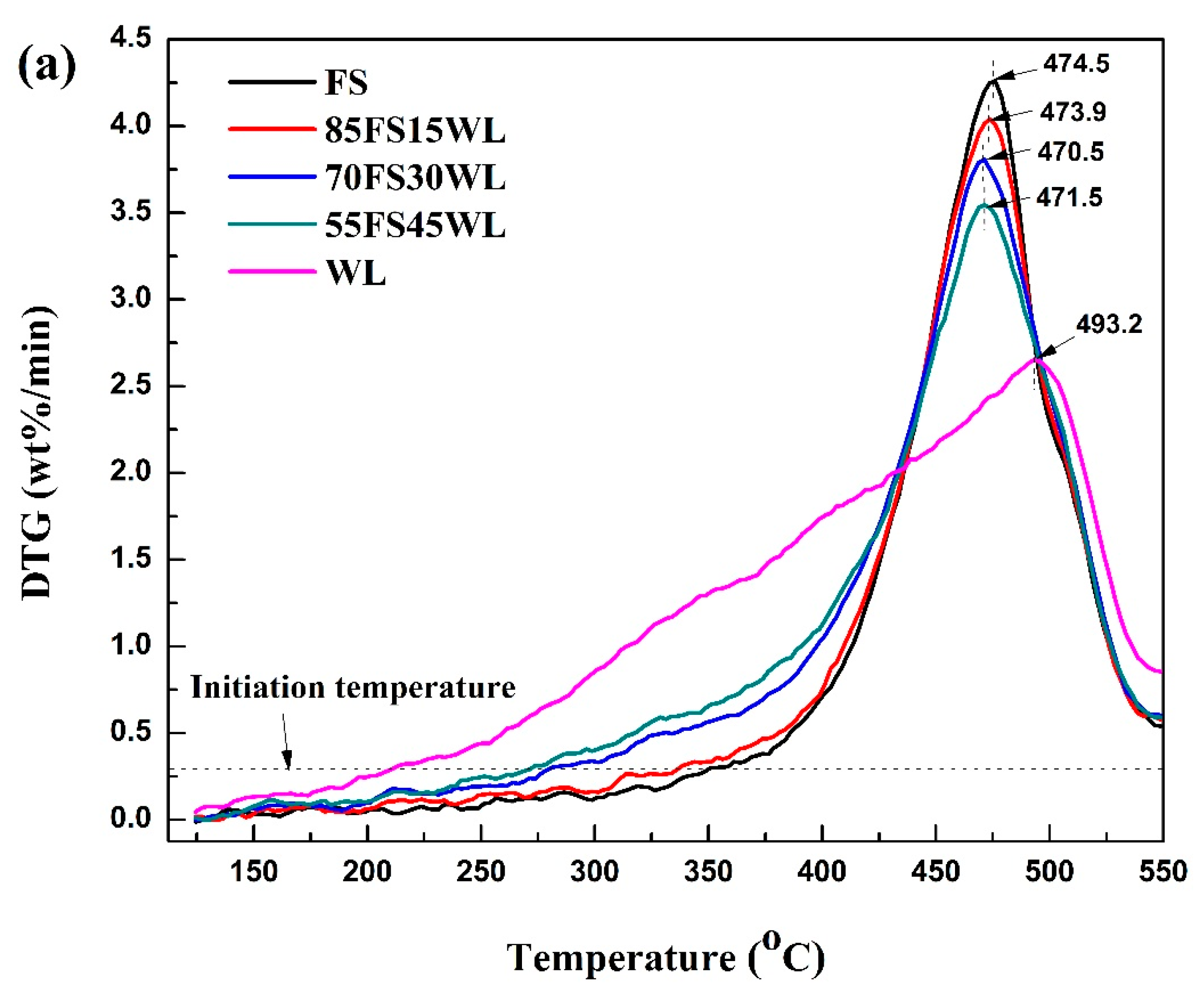
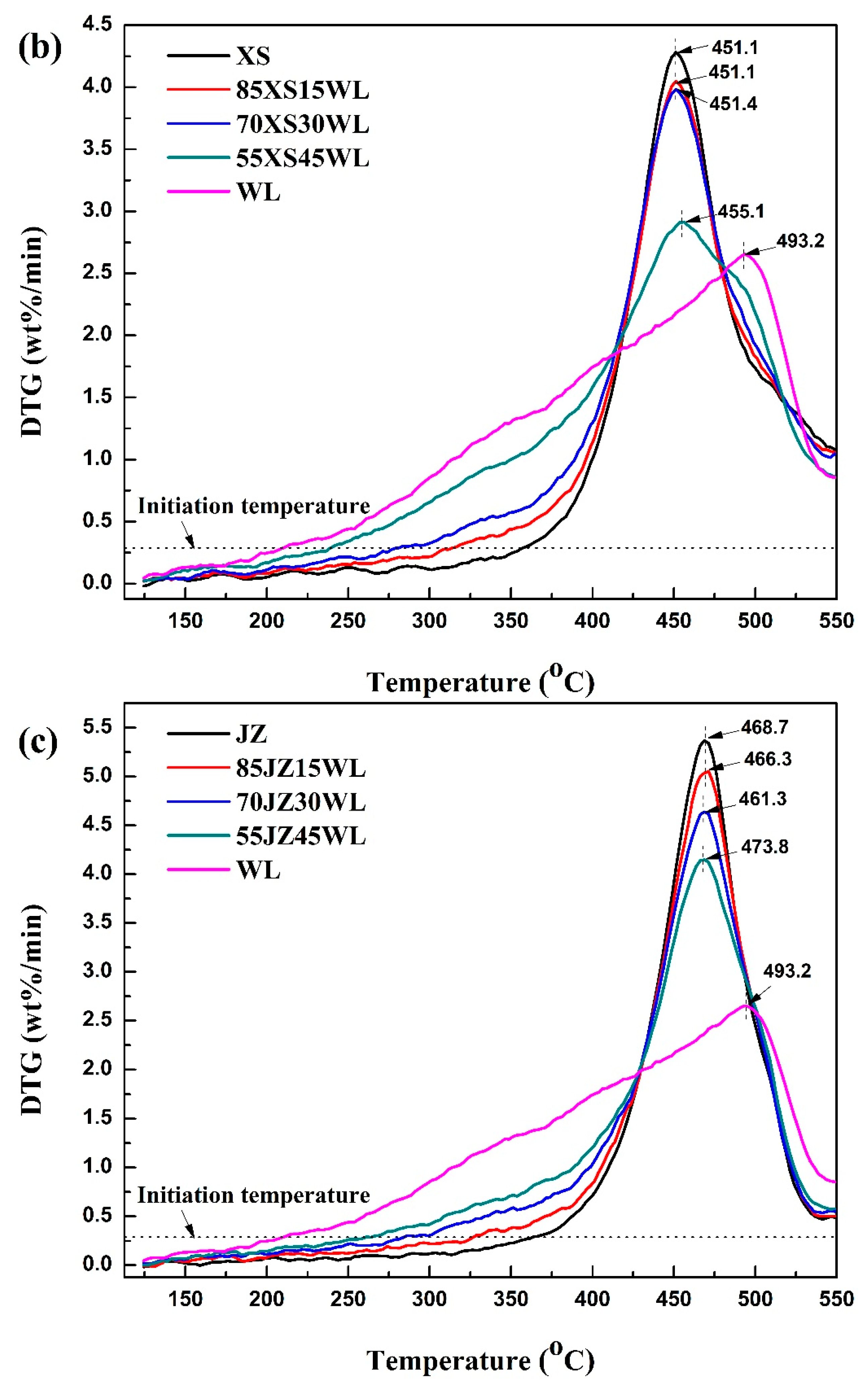
Figure 2 illustrates the pyrolysis profiles of the oil shale samples and their blends, with key characteristics summarized in Table 3. As seen in Figure 2, the FS, XS, and JZ samples exhibited a single sharp peak within the temperature range of 300–550 °C, while the WL sample displayed a broader decomposition stage. Previous studies [38,39] have demonstrated that the number of decomposition stages observed in DTG profiles is primarily governed by the intrinsic characteristics of the oil shale, rather than providing a direct representation of the detailed kerogen decomposition mechanism. Nonetheless, the thermal breakdown of kerogen generally occurs within the range of 400–550 °C and involves multiple concurrent reactions, like covalent bond scission and polycondensation, as illustrated in Figure 2. As shown in Table 3, the decomposition of WL started at a lower temperature range (154.2–253.2 °C) compared to FS (324.5–386.9 °C), XS (324.5–374.2 °C), and JZ (332.1–383.1 °C). The weight loss in the lower temperature range (<200 °C) is a consequence of the removal of interlayer water from clay, the decomposition of bicarbonates, as well as highly volatile compounds [38,40]. This also leads to an enhancement in gas yield of WL. In addition, WL also exhibited the highest total weight loss at 23.8 wt%, while FS had the lowest at 15.8 wt%, slightly lower than XS and JZ, which showed weight losses of 17.0 wt% and 17.4 wt%, respectively. These results are consistent with the proximate analysis presented in Section 2.1. Compared with FS, XS, and JZ, the peak temperature of WL occurred at a high-temperature region, with a low-peak weight loss rate of 2.6 wt%/min. It is approximately half of that observed in JZ. This extended the pyrolysis interval for WL, promoting secondary cracking reactions and increasing coke formation during the Fischer assay test. Similar phenomenon has been reported in studies of other oil shales [41,42].

2.2.2. Interactions Between the Selected Oil Shales at Different Blending Ratios

To investigate the effects of blending ratios on the co-pyrolysis behavior of oil shale, organic-rich WL was mixed with FS, XS, and JZ. The DTG profiles in Figure 2 showed non-linear trends, indicating interactions between the different oil shales. These changes were confirmed by the corresponding TG profiles (Figure S1), validating the reliability of the DTG data. As the WL fraction increased, the initiation temperature of the blends decreased, along with an increase in weight loss. This reduction in initiation temperature is primarily attributed to a lower activation energy, implying that the pyrolysis reaction becomes easier to start [24]. Additionally, the peak temperature of the blends shifted to a lower range, and reactivity intensity increased as the WL fraction decreased. This behavior can be explained by the softening and deformation of kerogen into bitumen at temperatures above 300 °C, which leads to particle coalescence, reduced porosity, and hindered volatile release [43]. The AAEMs in FS, XS, and JZ ash catalyze kerogen decomposition and semi-coke gasification, promoting faster pyrolysis [37,44]. Consequently, blending improved diffusion and heat transfer, as the viscous oil film decomposed more rapidly through catalytic cracking. As shown in Table 3, the peak temperature and weight loss rate of all samples shifted laterally as the heating rate increased from 5 to 15 °C/min. This shift may be caused by a greater temperature gradient between the inner and outer layers of the particles at higher heating rates, which hinders the decomposition of inner particles and consequently necessitates a higher peak temperature [45]. In addition, the blended samples exhibited a narrower pyrolysis interval than that of WL. The narrowing of this interval led to the release of pyrolysis products over a more concentrated temperature range, thereby enhancing product uniformity during the retorting process.

2.3. Kinetic Analysis

To gain a deeper understanding of the pyrolysis mechanisms and quantify the interactions among different oil shales, we determined the kinetic triplets, such as apparent activation energy (Ea), pre-exponential factor (A), and reaction model, at conversion degrees ranging from 0.2 to 0.8. These were calculated using both the model-free and integral master-plots methods at heating rates of 5 °C/min, 10 °C/min, and 15 °C/min. As shown in Figure S2, the Ea values obtained from the KAS and FWO methods were closely aligned, confirming the reliability of both approaches for assessing the pyrolysis activation energy of oil shale [39,40,46]. The average Ea for the oil shales and their blends ranged from 201.6 to 302.7 kJ/mol, which aligns with values reported in previous studies [35,37,39,46,47]. The correlation coefficient of the calculated Ea values ranged from 0.9239 to 0.9991, suggesting that the kinetic models used in this study were acceptably accurate.
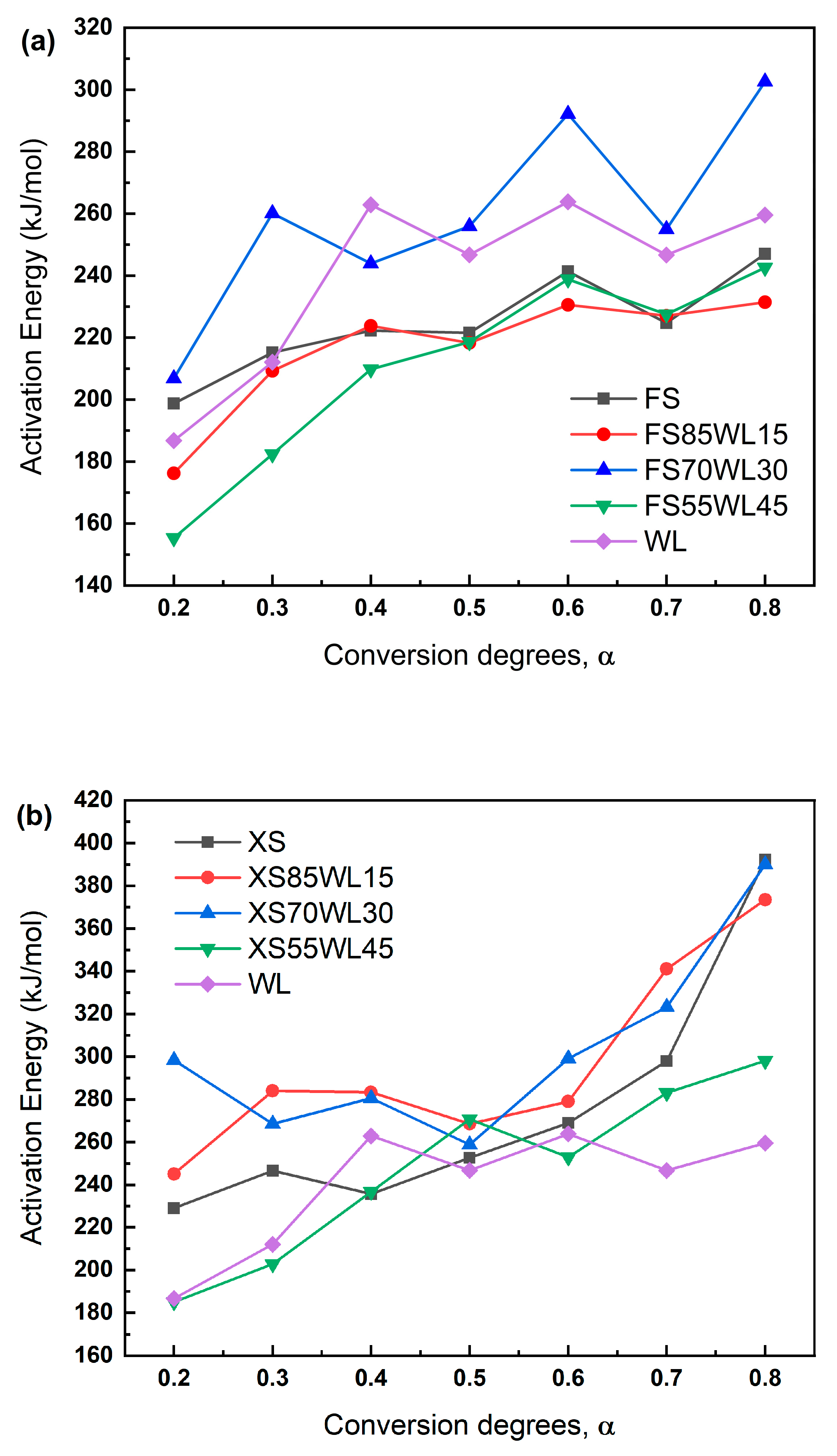
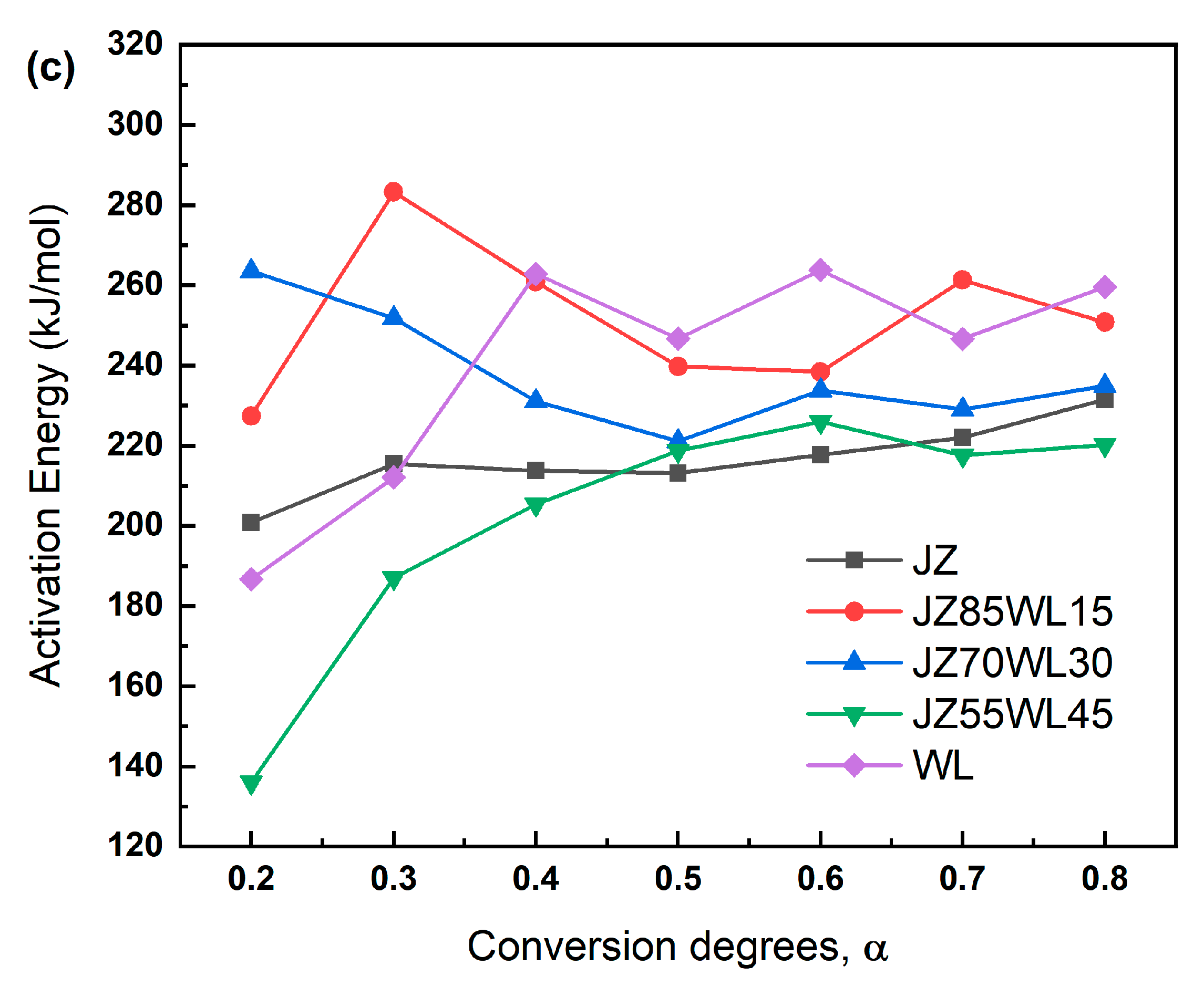
Figure 3 presents the Ea values of the oil shale samples and their blends that were calculated using the KAS method. For four raw oil shale samples, Ea values generally increased with conversion degrees, although some fluctuations were observed. Below a conversion degree of 0.2, pyrolysis temperatures remained under 430 °C, where reactions mainly involved dehydration and the breakdown of reactive organic material, processes that required relatively low energy to overcome the activation barrier. As the conversion progressed from 0.3 to 0.7, higher temperatures and more energy were required for kerogen decomposition due to its highly polymerized, three-dimensional structure and large molecular weight [48,49]. At this stage, the Ea values for FS and JZ ranged from 215.5 kJ/mol to 241.3 kJ/mol, following a similar pattern, while XS and WL showed higher Ea values of approximately 298.0 kJ/mol and 263.8 kJ/mol, respectively. These differences suggest that oil shales from various deposits possess distinct chemical characteristics and follow different reaction pathways. In terms of organic composition, FS and JZ had higher volatile-to-fixed carbon ratios than XS and WL, indicating greater volatility. The release of volatiles facilitated the formation of porous semi-coke [43,50], which improved heat and mass transfer. From an inorganic perspective, prior research [32,33] has shown that the mineral matrix in oil shale can either catalyze or inhibit pyrolysis reactions. Table 2 shows that FS and JZ are rich in Na and Mg, while WL contains higher levels of Ca and Mn. Previous studies have examined the impact of these elements on pyrolysis activation energy. For instance, Jiang et al. [15] reported that Mn has a catalytic effect on Huadian oil shale pyrolysis. Similarly, Lu et al. [37] found that Na and Mg reduced the activation energy of Changji oil shale from 58.76 kJ/mol to 46.56 kJ/mol and 57.01 kJ/mol, respectively, while Ca increased the overall Ea value. Therefore, the AAEMs (Na and Mg) in FS and JZ likely facilitated kerogen decomposition, lowering the energy required for pyrolysis. In contrast, the catalytic effects of Mn in WL may have been counteracted by Ca, resulting in a higher Ea value. Although XS shared a similar AAEM composition with FS and JZ, its lower volatile-to-fixed carbon ratio hindered decomposition, requiring more energy. As the conversion degree exceeded 0.7 and temperatures rose above 480 °C, Ea values for all samples increased, with XS showing the most significant rise. At this stage, the conversion was largely complete, with a minimum weight loss rate of approximately 1 wt%/min as shown in Figure 2. The sharp increase in Ea values is attributed to the multiple reactions, namely the rupture of coke residues (e.g., aromatic C–C bonds) and calcite/siderite dissociation [51].
In terms of oil shale blends, blending WL with other oil shales generally reduced the pyrolysis activation energy compared to the unblended samples, although the extent of this change varied across the different blends. Figure 3 shows how the WL fraction affects the average activation energy at various conversion degrees. Overall, the average Ea of the blends slightly increased with higher conversion degrees, reflecting the behavior of individual fuels. The pyrolysis performance of FS/WL and JZ/WL blends improved (except at the 15% WL fraction), while no significant enhancement was observed for XS/WL blends. Despite the Ea value of XS55WL45 dropping to 247.0 kJ/mol from 274.7 kJ/mol for unblended XS, the pyrolysis process was largely dominated by WL, as seen in the DTG profile of XS55WL45 (Figure 2). For FS/WL and JZ/WL blends, the highest Ea values occurred at the range of 15–30% WL, with average Ea values of 259.5 kJ/mol and 251.7 kJ/mol, respectively. This increase is attributed to the rapid decomposition of WL at lower temperatures, which produces sticky oil that limits volatile release. The high ash content in FS and JZ further hinders heat and mass transfer, raising the average Ea values. Similar observations were made by Lin and co-workers [23] and Dai and co-workers [24] in their studies on sludge/oil shale and spirulina/oil shale co-pyrolysis. As the WL fraction increased, the average Ea values of FS/WL and JZ/WL blends decreased, reaching the lowest values of 210.7 kJ/mol and 201.6 kJ/mol at a WL ratio of 0.45, respectively. As shown in Figure 3a,c, the Ea values of the blends decreased significantly compared to WL when the conversion degree was between 0.4 and 0.7. This range corresponds to the primary decomposition of kerogen, suggesting that FS and JZ contribute to accelerating the pyrolysis reaction. Although the Ea value of the blends increased at certain WL fraction, optimizing the blending ratio during co-pyrolysis could still reduce activation energy compared to using individual fuels, leading to a more efficient pyrolysis process.
Table 4 summarizes the kinetic triplets, namely Ea, ln(A), and mechanism functions f(α), for all oil shale samples at various heating rates, calculated using the master-plots method [52]. Using the integral master-plots method, the pyrolysis mechanism was determined by comparing the experimental profiles with theoretical master plots. Subsequently, the pre-exponential factor A at different heating rates was estimated from the slope by plotting G α against E a β R P ( u ) . All the correlation coefficients R2 were greater than 0.98, indicating the acceptable accuracy of A. As shown in Table 4, the pyrolysis reaction of oil shale followed an ‘nth order reaction’ model with f α as ( 1 α ) n , consistent with findings from other studies investigating the pyrolysis kinetics of various oil shales [35,37,53,54]. However, during the co-pyrolysis of WL with FS and JZ, the reaction order decreased, suggesting that the reaction rate became less dependent on the concentration of reactants.

2.4. Effects of Oil Shale Blending on Product Distribution

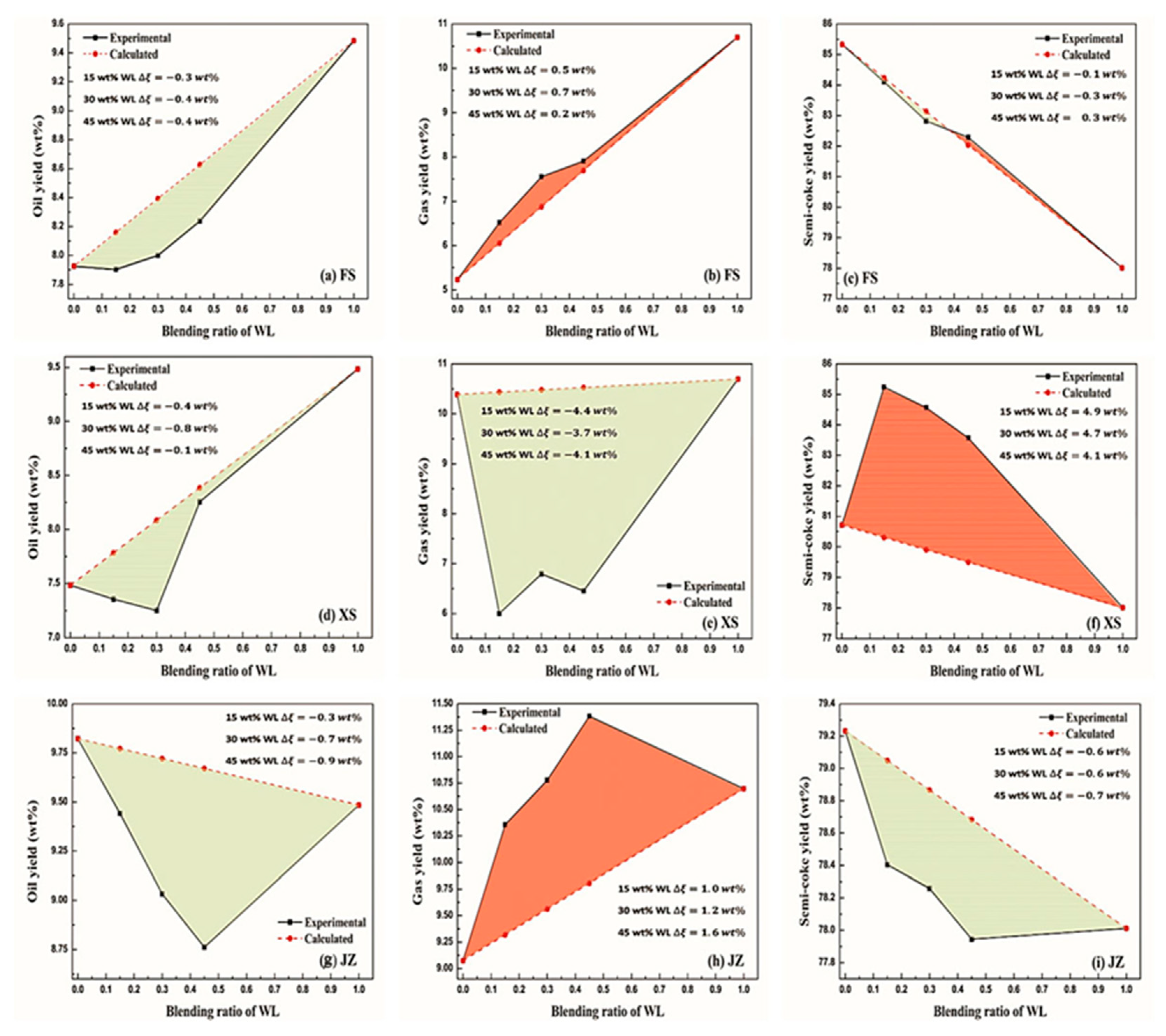
Table 5 shows the pyrolysis product distribution of FS, XS, and JZ with and without WL blending. Prior to retorting, the samples were dehydrated, resulting in low water yields between 1.4 wt% and 2.1 wt%. This water was mainly released from interlayer and structural water in the clay minerals [32]. Structural water continues to be released during pyrolysis through either homogeneous or heterogeneous dehydroxylation reactions [55,56]. For instance, kaolinite decomposes at 430 °C, releasing structural water [57], while montmorillonite releases it between 500 and 800 °C [58]. This indicates that water yield is influenced by the type of clay, with minimal increases observed after blending different oil shales. As shown in Table 5, the impact of WL addition on the pyrolysis product distribution varied across FS, XS, and JZ. These differences are attributed to the non-catalytic effects of organic matter (H/C ratio and volatility) and the catalytic effects of the mineral matrix (clay and metal salts). To quantify the synergistic interactions during co-pyrolysis, a synergistic index, ∆ξ, was introduced as an indicator of the synergistic effects, as defined in Equation (1):
ξ = ξ e x p , i ξ C a l , i
where ξ e x p , i represents the experimental yield of component i (shale oil, non-condensable gas, and semicoke) obtained from the co-pyrolysis of oil shale blends (FS/WL, XS/WL, and JZ/WL), and ξ C a l , i denotes the calculated yield of the same component, as determined by Equation (2):
ξ C a l , i = 1 α ξ m , i + α ξ W L , i
where ξ_(m,i) and ξ_(WL,i) denote the experimental yields from the pyrolysis of the individual oil shales (FS, XS, and JZ) and WL, respectively, and α represents the blending ratio of WL. This index provides a reference for evaluating the interaction between components by comparing calculated and experimental results, indicating a synergistic effect when ∆ξ > 0 and an inhibitory or deteriorating effect when ∆ξ < 0.
Figure 4 illustrates the variations in pyrolysis product distribution for FS, XS, and JZ under different WL blending ratios. The incorporation of WL modified the pyrolysis behavior, producing distinct effects on the yields of oil, gas, and semi-coke. For the FS/WL and JZ/WL blends, the synergistic index (∆ξ) for gas yield was positive, while that for shale oil yield was negative, indicating that co-pyrolysis enhanced non-condensable gas formation but suppressed oil production. In contrast, XS/WL blends exhibited lower oil and gas yields than the individual fuels, suggesting that WL addition hindered volatile release but promoted semi-coke formation. This observation is consistent with the negative ∆ξ values for oil and gas and the positive ∆ξ for semi-coke shown in Figure 4. These trends can be attributed to intensified secondary cracking reactions, a phenomenon frequently reported in co-pyrolysis studies involving oil shale and other solid fuels [10,18,32,37]. Owing to the inherently low permeability of oil shale, the release of pyrolysis volatiles remains limited, even with external carrier gases [59]. Thereby, inherently low permeability of oil shale, the movement of pyrolysis volatiles remains limited, even with external carrier gases [60]. However, the degradation pathway of oil largely depends on the chemical properties of the oil shale blends, particularly the H/C ratio and mineral composition. The degradation pathway of oil strongly depends on the chemical characteristics of the blends, particularly the H/C ratio and mineral composition. Compared with WL, FS, XS, and JZ contain higher concentrations of AAEMs, which catalyze C–C bond cleavage and increase gaseous product formation [10,37]. Moreover, the relatively high hydrogen content in FS and JZ enhances their hydrogen-donating ability, generating H+ and hydrocarbon radicals that stabilize kerogen intermediates and promote ring-opening reactions, thereby reducing polymerization [25,27]. In contrast, both XS and WL possess lower hydrogen contents, and their co-pyrolysis tends to intensify coke formation.

2.5. Effects of Oil Shale Blending on Shale Oil Compositions

The shale oil derived from the pyrolysis of FS, XS, and JZ, with and without WL blending, was characterized by GC–MS analysis. Compounds with mass fractions above 1 wt% were identified, implying that the oil mainly consisted of alkanes, alkenes, aromatics, and oxygenated species. The aromatic fraction was dominated by benzene, naphthalene, and their derivatives, whereas the oxygenated components included phenols, esters, acids, and alcohols, consistent with previous studies [9,18]. The identified compounds were further grouped according to their carbon numbers into light (C5–C12), middle (C13–C18), and heavy (C19–C25) distillates. As shown in Table 6, WL addition produced distinct effects on the carbon-number distribution of the shale oils. For the FS/WL and JZ/WL blends, the proportions of short-chain hydrocarbons (C5–C12) and middle distillates (C13–C18) increased with a higher WL fraction. This enhancement is attributed to the catalytic activity of AAEMs and aluminosilicate minerals (kaolinite and montmorillonite), which provide Lewis acid sites that facilitate the cleavage of long-chain hydrocarbons, promoting the conversion of heavy fractions into lighter compounds. In contrast, the XS/WL blends exhibited limited cracking efficiency due to their low H/C ratio. Under these conditions, the catalytic action of clay minerals further intensified dehydrogenation and aromatization reactions, leading to polymerization and condensation of aliphatic intermediates into heavier oils and coke precursors. This outcome corresponds with the reduced oil yield and higher semi-coke production described in Section 2.4.
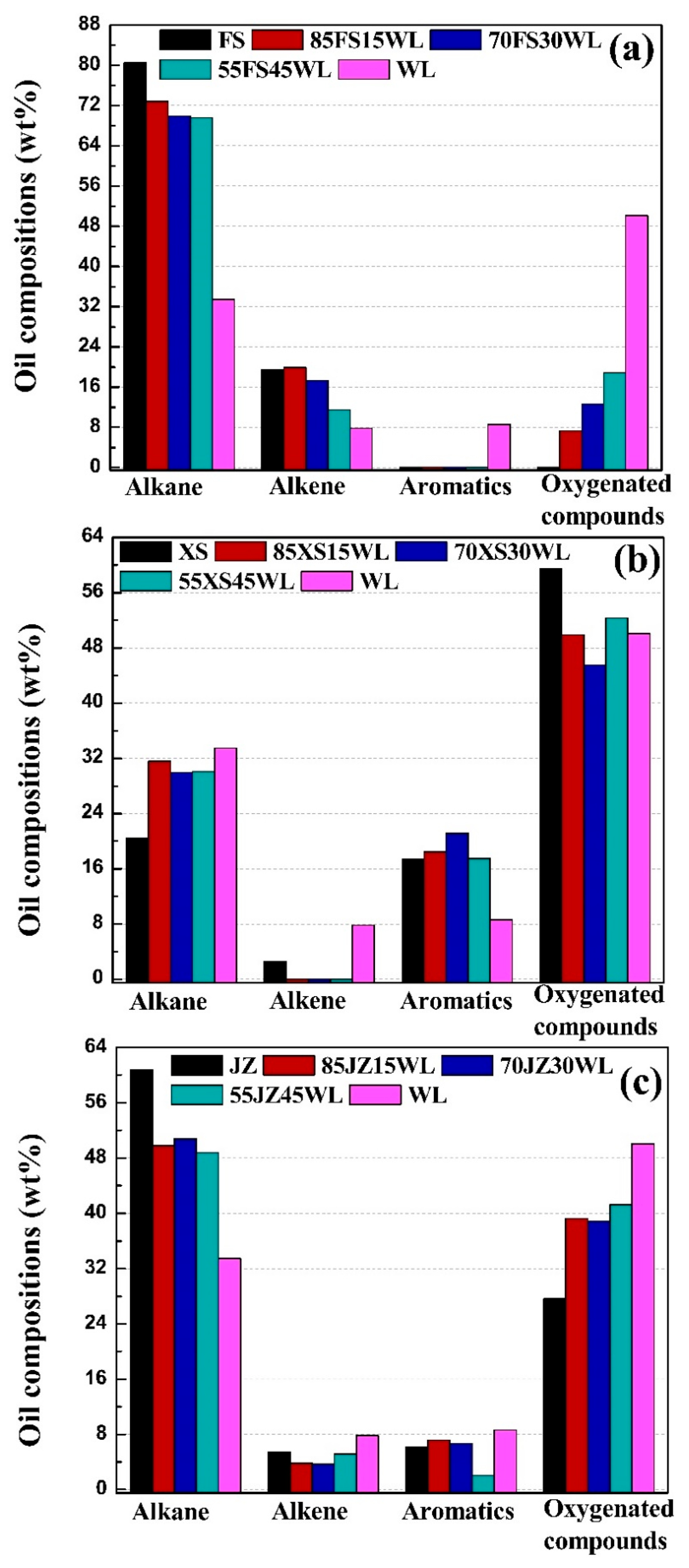
Figure 5 presents the influence of WL addition on the relative contents of the four major compound groups in shale oil. In the co-pyrolysis of FS/WL and JZ/WL, the proportion of oxygenated compounds decreased, mainly due to the decarboxylation activity of montmorillonite and kaolinite [18], which enhanced the chemical stability of the resulting shale oil. WL addition also led to a reduction in alkanes and an increase in alkenes compared with FS pyrolysis alone. Conversely, shale oil from JZ/WL co-pyrolysis exhibited decreases in both alkanes and alkenes, accompanied by a slight enrichment of aromatics. The increase in alkenes can be attributed to carbonium ion reactions of alkanes in the presence of solid acid catalysts, consistent with previous findings [61]. Clay minerals such as montmorillonite possess pronounced Lewis acidity and strong adsorption capacity, which promote aromatization, polymerization, and condensation reactions during oil shale pyrolysis, especially with increasing clay mineral content [13,15]. As seen in Figure 5, shale oil obtained from XS/WL blends was predominantly composed of aromatics and oxygenated compounds, indicating that the co-pyrolysis of XS/WL blends had minimal positive impact on oil quality.

3. Materials and Methods

3.1. Oil Shale and Preparation Method

The oil shale samples used in this study were obtained from four Chinese deposits: Fushun (FS), Xingsheng (XS), Jinzhou (JZ), and Wulin (WL). The as-received oil shale samples were pulverized and sieved to a particle size of ≤106 μm for the proximate analysis and ultimate analysis [1], whilst a particle size of ≤500 μm was prepared for Fischer assay analysis [62]. The as-received samples were dried at 80 °C overnight (c.a. 12 h) to remove the free water before being tested.

3.2. Retorting Experiment

The distribution of pyrolytic products from four oil shale samples was determined via a standard Fischer assay method in accordance with the Chinese Oil and Gas Industry Standard SH/T 0508-92 [62]. For each experiment, 50 g of pre-dried samples were placed in a standard retort reactor, which was then settled the reactor in a furnace. The temperature was raised to 520 °C at an average heating rate of 10 °C·min−1 and maintained isothermally for 20 min. After the reaction, the mass of semi-coke was measured directly, while the combined water/oil yield was determined from the weight difference in the collection flask before and after pyrolysis. The yield of non-condensable gases was calculated by the mass difference. The water content in the condensate was quantified using the Dean–Stark method with toluene as the solvent [30]. The yield of each pyrolysis product was expressed as the ratio of the specific product mass to the initial mass of the raw sample.
To investigate the co-pyrolysis behavior of different oil shales, WL was blended with FS, XS, and JZ at three different blending ratios for each pair: FS:WL = 85:15 (FS85WL15), 70:30 (FS70WL30), and 55:45 (FS55WL45); XS:WL = 85:15 (XS85WL15), 70:30 (XS70WL30), and 55:45 (XS55WL45); and JZ:WL = 85:15 (JZ85WL15), 70:30 (JZ70WL30), and 55:45 (JZ55WL45).

3.3. Characterisation

3.3.1. Oil Shale Characterisation

Proximate analysis was performed using a thermogravimetric analyzer (Netzsch STA449F3, Selb, Germany), while ultimate analysis was conducted with an elemental analyzer (Euro Vector EA3000, Pavia, Italy). The high heating value (HHV) of the oil shale samples was calculated based on their proximate components, as detailed in our previous study [1]. Moreover, mineral phases and composition were identified using an X-ray diffraction spectrometer (Bruker D8 Advance, Karlsruhe, Germany) and an X-ray fluorescence analyzer (Bruker S4-Explorer, Karlsruhe, Germany), respectively.

3.3.2. Shale Oil Characterisation

Shale oil from the pyrolysis experiment was diluted with dichloromethane (1:10 ratio) and analyzed using an Agilent 7890B gas chromatograph (GC) (Agilent Technologies, Santa Clara, CA, USA) coupled with an Agilent 5977B mass spectrometer (Agilent Technologies, Santa Clara, CA, USA). Helium was used as the carrier gas with a flow rate of 1 mL·min−1, and the injector temperature was set to 250 °C. The oven was initially held at 60 °C for 2 min, then ramped to 150 °C at 20 °C·min−1 and maintained isothermally for 3 min. The temperature was then increased at 20 °C·min−1 to 280 °C and held for 4 min. The mass range for this analysis was 50–550 m/z.

3.4. Evaluation of Pyrolysis Behaviour

The pyrolysis characteristics of oil shale samples and their blends were studied using a non-isothermal method with the same TGA instrument described earlier. Approximately 15 mg of pre-crushed sample (≤74 µm) was placed in each crucible. All samples were dehydrated and heated from 120 °C to 550 °C at heating rates of 5, 10, and 15 °C·min−1. While the ICTAC guidelines recommend using ≥4 heating rates and R2 ≥ 0.997 for ‘benchmark’ kinetics, the three-rate approach was chosen for comparative analysis [63]. A pure nitrogen atmosphere (flow rate of 40 mL·min−1) was maintained to investigate the decomposition behavior under oxygen-free conditions.
Derivative thermogravimetric (DTG) profiles were used to identify key features of the pyrolysis process. The initiation temperature, defined as the point at which the mass loss rate first reaches 0.3 wt%·min−1, was taken as the start of decomposition [64]. The peak temperature corresponds to the point at which the mass-loss rate reaches its maximum, with a lower peak temperature generally indicating higher reactivity. In addition, the half-width, which is defined as the peak width at half of its height, was applied to assess the effect of blending on the pyrolysis interval. A sharp DTG peak with a narrow width signifies the release of pyrolysis products within a more concentrated temperature range, which could enhance product uniformity and reduce overall energy consumption.

3.5. Kinetic Studies

The kinetic parameters derived from TGA are crucial for the effective design and operation of the pyrolysis process [65]. For a non-isothermal reaction, the reaction rate k(T) is given by Equation (3).
k T = A e x p E a R T
d α d t = k T f α = A e x p E a R T f α
where T is the absolute temperature (K), R is the universal gas constant (0.008314 kJ/mol·K), A is the pre-exponential factor (min−1), Ea is the apparent activation energy (kJ/mol), t is time (s), and f ( α ) is the reaction model in a differential form. The conversion degree α can be calculated using Equation (5), as shown below:
α = m 0 m t m 0 m f
where m 0 is the initial weight, m t is the instantaneous weight at time t and m f stands for the terminal weight at the end of reaction.
For a given heating rate of β , where β = d T / d t , Equation (5) can also be expressed as follows:
d α d T = A β e x p E a R T f α
Therefore, the integration form of Equation (6) can be further transformed as follows:
G α = 0 α d α f α = A β T 0 T e x p E a R T d T A β 0 T e x p E a R T d T = A E a β R P u
where u= E a R T and the function of P u is a temperature integration function without an exact analytical solution [66]. However, the approximations of P u have been solved via various numerical methods [67,68].
Model-free methods are widely used to evaluate kinetic parameters without assuming a specific reaction model, thus avoiding errors due to incorrect model assumptions [69]. In this study, the Flynn–Wall–Ozawa (FWO) and Kissinger–Akahira–Sunose (KAS) methods were chosen, as they have been effectively used to analyze the kinetic characteristics of oil shale thermal decomposition [18,46].
The FWO iso-conversional method is based on Doyle’s approximation [67,70], where P u = 0.0048 e 1.0516 u . Therefore, Equation (7) can be further expressed as shown in Equation (8), and the apparent activation energy E a is determined by the slope of the l n β vs. 1 / T plot at a given conversion degree α .
l n β = l n A E a G α R 5.331 1.052 E a R T
In contrast, the Coats–Redfern’s approximation, P u = u 2 e u , was used for KAS method [39,46], as expressed in Equation (9). For any given conversion degree α , the apparent activation energy Ea is calculated from the slope of the slope of l n β T 2 vs. 1 / T .
l n β T 2 = l n A E a G α R E a R T
The reaction model G α and pre-exponential factor A were estimated using an integral master plot method. Equation (10) was applied to compare the theoretical master plots of different G α functions and experimental master plots of P ( u ) with conversion degree at α = 0.5 as a reference point.
G α G 0.5 = P ( u ) P ( u 0.5 )
G 0.5 = A E a β R P u 0.5
where u 0.5 = E a R T 0.5 and T0.5 is the temperature at which the conversion degree is 0.5 [71], whilst G 0.5 is the integral reaction model at the conversion of 0.5.
Table 7 summarizes the most commonly used solid-state reaction mechanisms, along with their corresponding differential and integral reaction models [72]. The experimental master plots ( P ( u ) P ( u 0.5 ) vs. α ) obtained at given heating rate are roughly overlap with the theoretical master plot of G α G 0.5 vs. α when a best-fitted kinetic model is applied [73]. The pre-exponential factor of A can be determined by plotting G α against E a β R P ( u ) at a constant heating rate.

4. Conclusions

This study investigated the effects of WL addition on pyrolysis behaviour of FS, XS and WL via both TGA and Fischer assay retorting system. By analysing synergistic effects given different blending ratios, it is exemplified that inadequate co-utilization, in the event that there is some, can cost huge power boundaries and increase the shale oil yield and quality noticeably. The results point to the catalytic activity of mineral matrices and hydrogen-enriched organics in the activation of ring-opening and cracking reactions, which means that the described approach is highly applicable to the science and technology agenda of sustainable energy transition.

Supplementary Materials

The following supporting information can be downloaded at: https://www.mdpi.com/article/10.3390/catal15111076/s1: Figure S1: TG profiles of (a) FS/WL blends, (b) XS/WL blends and (c) JZ/WL blends heated at a heating rate of 10 °C/min; Figure S2. A comparison of Ea values of four oil shale samples obtained via KAS and FWO method.

Author Contributions

Y.M.: conceptualization, methodology and writing—original draft preparation; F.X. and J.F.: software and investigation; H.X. and C.P.: conceptualization, writing—review, editing and supervision. All authors have read and agreed to the published version of the manuscript.

Funding

The research was funded by Ningbo Natural Science Foundation (2023J366), Zhejiang Provincial Key R&D Programme (2025C02257(SD2)) and Research and Application of Big Data-Based Intelligent Decision-Making Technology for Risk and Hidden Hazards in Typical Special Equipment (CY2023212).

Data Availability Statement

All data investigated in this study are included in this published article and/or Supplementary Materials.

Acknowledgments

The authors would like to express gratitude to Chao Jiang and Anwei Shi for providing samples and conducting tests.

Conflicts of Interest

The authors declare no conflicts of interest.

References

  1. Meng, Y.; Yan, Y.; Jiang, P.; Zhang, M.; Oladejo, J.; Wu, T.; Pang, C.H. Investigation on breakage behaviour of oil shale with high grinding resistance: A comparison between microwave and conventional thermal processing. Chem. Eng. Process.-Process Intensif. 2020, 151, 107909. [Google Scholar] [CrossRef]
  2. Brendow, K. Global oil shale issues and perspectives (Synthesis of the Symposium on Oil Shale held in Tallinn (Estonia) on 18 and 19 November 2002). Oil Shale 2003, 20, 81–92. [Google Scholar] [CrossRef]
  3. Gao, N.; Wang, X.; Quan, C.; Wu, C. Study of oily sludge pyrolysis combined with fine particle removal using a ceramic membrane in a fixed-bed reactor. Chem. Eng. Process.-Process Intensif. 2018, 128, 276–281. [Google Scholar] [CrossRef]
  4. Chang, Z.; Chu, M.; Zhang, C.; Bai, S.; Lin, H.; Ma, L. Compositional and structural variations of bitumen and its interactions with mineral matters during Huadian oil shale pyrolysis. Korean J. Chem. Eng. 2017, 34, 3111–3118. [Google Scholar] [CrossRef]
  5. Huang, Y.; Han, X.; Jiang, X. Characterization of Dachengzi oil shale fast pyrolysis by curie-point pyrolysis-GC-MS. Oil Shale 2015, 32, 134. [Google Scholar] [CrossRef]
  6. Mu, M.; Han, X.; Jiang, X. Interactions between oil shale and hydrogen-rich wastes during co-pyrolysis: 1. Co-pyrolysis of oil shale and polyolefins. Fuel 2020, 265, 116994. [Google Scholar] [CrossRef]
  7. Williams, P.; Chishti, H. Reaction of nitrogen and sulphur compounds during catalytic hydrotreatment of shale oil. Fuel 2001, 80, 957–963. [Google Scholar] [CrossRef]
  8. Liu, Y.; Guan, Y.; Zhang, K. CO2 gasification performance and alkali/alkaline earth metals catalytic mechanism of Zhundong coal char. Korean J. Chem. Eng. 2018, 35, 859–866. [Google Scholar] [CrossRef]
  9. Lu, H.; Jia, F.; Guo, C.; Pan, H.; Long, X.; Liu, G. Effect of Shale Ash-Based Catalyst on the Pyrolysis of Fushun Oil Shale. Catalysts 2019, 9, 900. [Google Scholar] [CrossRef]
  10. Wang, S.; Song, L.; Jiang, X. Catalytic Effects of Fe- and Ca-Based Additives on Gas Evolution During Pyrolysis Of Dachengzi Oil Shale of China. Oil Shale 2018, 35, 39. [Google Scholar] [CrossRef]
  11. Chang, Z.; Zhang, C.; Bai, S.; Lin, H.; Ma, L. Investigation of the effect of selected transition metal salts on the pyrolysis of Huadian oil shale, China. Oil Shale 2017, 34, 354–367. [Google Scholar] [CrossRef]
  12. Kim, Y.-M.; Lee, H.W.; Jang, S.H.; Jeong, J.; Ryu, S.; Jung, S.-C.; Park, Y.-K. Production of biofuels from pine needle via catalytic fast pyrolysis over HBeta. Korean J. Chem. Eng. 2020, 37, 493–496. [Google Scholar] [CrossRef]
  13. Hu, M.; Cheng, Z.; Zhang, M.; Liu, M.; Song, L.; Zhang, Y.; Li, J. Effect of calcite, kaolinite, gypsum, and montmorillonite on Huadian oil shale kerogen pyrolysis. Energy Fuels 2014, 28, 1860–1867. [Google Scholar] [CrossRef]
  14. Gai, R.; Jin, L.; Zhang, J.; Wang, J.; Hu, H. Effect of inherent and additional pyrite on the pyrolysis behavior of oil shale. J. Anal. Appl. Pyrolysis 2014, 105, 342–347. [Google Scholar] [CrossRef]
  15. Jiang, H.; Song, L.; Cheng, Z.; Chen, J.; Zhang, L.; Zhang, M.; Hu, M.; Li, J.; Li, J. Influence of pyrolysis condition and transition metal salt on the product yield and characterization via Huadian oil shale pyrolysis. J. Anal. Appl. Pyrolysis 2015, 112, 230–236. [Google Scholar] [CrossRef]
  16. Ma, X.; Zheng, G.; Sajjad, W.; Xu, W.; Fan, Q.; Zheng, J.; Xia, Y. Influence of minerals and iron on natural gases generation during pyrolysis of type-III kerogen. Mar. Pet. Geol. 2018, 89, 216–224. [Google Scholar] [CrossRef]
  17. Wang, Q.; Zhang, H.; Chi, M.; Cui, D.; XU, X. Effect of smectite on the pyrolysis of kerogen isolated from oil shale. Chem. Ind. Eng. Prog. 2016, 20, 766. [Google Scholar]
  18. Jiang, H.; Hong, W.; Zhang, Y.; Deng, S.; Chen, J.; Yang, C.; Ding, H. Behavior, kinetic and product characteristics of the pyrolysis of oil shale catalyzed by cobalt-montmorillonite catalyst. Fuel 2020, 269, 117468. [Google Scholar] [CrossRef]
  19. Wang, Z.; Liu, X.; Wang, Y.; Liu, L.; Wang, H.; Deng, S.; Sun, Y. Studies on the co-pyrolysis characteristics of oil shale and spent oil shale. J. Therm. Anal. Calorim. 2016, 123, 1707–1714. [Google Scholar] [CrossRef]
  20. Ge, X.; Wang, S.; Jiang, X. Catalytic effects of shale ash with different particle sizes on characteristics of gas evolution from retorting oil shale. J. Therm. Anal. Calorim. 2019, 138, 1527–1540. [Google Scholar] [CrossRef]
  21. Meng, Y.; Yan, Y.; Wu, X.; Sharmin, N.; Zhao, H.; Lester, E.; Wu, T.; Pang, C.H. Synthesis and functionalization of cauliflower-like mesoporous siliceous foam materials from oil shale waste for post-combustion carbon capture. J. CO2 Util. 2020, 40, 101199. [Google Scholar] [CrossRef]
  22. Özsin, G.; Kılıç, M.; Apaydin-Varol, E.; Pütün, A.E.; Pütün, E. A thermo-kinetic study on co-pyrolysis of oil shale and polyethylene terephthalate using TGA/FT-IR. Korean J. Chem. Eng. 2020, 37, 1888–1898. [Google Scholar] [CrossRef]
  23. Lin, Y.; Liao, Y.; Yu, Z.; Fang, S.; Lin, Y.; Fan, Y.; Peng, X.; Ma, X. Co-pyrolysis kinetics of sewage sludge and oil shale thermal decomposition using TGA–FTIR analysis. Energy Convers. Manag. 2016, 118, 345–352. [Google Scholar] [CrossRef]
  24. Dai, M.; Yu, Z.; Fang, S.; Ma, X. Behaviors, product characteristics and kinetics of catalytic co-pyrolysis spirulina and oil shale. Energy Convers. Manag. 2019, 192, 1–10. [Google Scholar] [CrossRef]
  25. Aboulkas, A.; Makayssi, T.; Bilali, L.; Nadifiyine, M.; Benchanaa, M. Co-pyrolysis of oil shale and High density polyethylene: Structural characterization of the oil. Fuel Process. Technol. 2012, 96, 203–208. [Google Scholar] [CrossRef]
  26. Bozkurt, P.A.; Tosun, O.; Canel, M. The synergistic effect of co-pyrolysis of oil shale and low density polyethylene mixtures and characterization of pyrolysis liquid. J. Energy Inst. 2017, 90, 355–362. [Google Scholar] [CrossRef]
  27. Chen, B.; Han, X.; Mu, M.; Jiang, X. Studies of the co-pyrolysis of oil shale and wheat straw. Energy Fuels 2017, 31, 6941–6950. [Google Scholar] [CrossRef]
  28. Flynn, J.H.; Wall, L.A. A quick, direct method for the determination of activation energy from thermogravimetric data. J. Polym. Sci. Part B 1966, 4, 323–328. [Google Scholar] [CrossRef]
  29. Kissinger, H.E. Reaction kinetics in differential thermal analysis. Anal. Chem. 1957, 29, 1702–1706. [Google Scholar] [CrossRef]
  30. Smith, J.W. Specific gravity-oil yield relationships of two colorado oil-shale cores. Ind. Eng. Chem. 1956, 48, 441–444. [Google Scholar] [CrossRef]
  31. Huang, Y.-R.; Han, X.-X.; Jiang, X.-M. Comparison of fast pyrolysis characteristics of Huadian oil shales from different mines using Curie-point pyrolysis-GC/MS. Fuel Process. Technol. 2014, 128, 456–460. [Google Scholar] [CrossRef]
  32. Chang, Z.; Chu, M.; Zhang, C.; Bai, S.; Lin, H.; Ma, L. Influence of inherent mineral matrix on the product yield and characterization from Huadian oil shale pyrolysis. J. Anal. Appl. Pyrolysis 2018, 130, 269–276. [Google Scholar] [CrossRef]
  33. Espitalié, J.; Makadi, K.S.; Trichet, J. Role of the mineral matrix during kerogen pyrolysis. Org. Geochem. 1984, 6, 365–382. [Google Scholar] [CrossRef]
  34. Oja, V.; Elenurm, A.; Rohtla, I.; Tali, E.; Tearo, E.; Yanchilin, A. Comparison of oil shales from different deposits: Oil shale pyrolysis and co-pyrolysis with ash. Oil Shale 2007, 24, 101. [Google Scholar] [CrossRef]
  35. Al-Harahsheh, M.; Al-Ayed, O.; Robinson, J.; Kingman, S.; Al-Harahsheh, A.; Tarawneh, K.; Saeid, A.; Barranco, R. Effect of demineralization and heating rate on the pyrolysis kinetics of Jordanian oil shales. Fuel Process. Technol. 2011, 92, 1805–1811. [Google Scholar] [CrossRef]
  36. Williams, P.T.; Chishti, H.M. Two stage pyrolysis of oil shale using a zeolite catalyst. J. Anal. Appl. Pyrolysis 2000, 55, 217–234. [Google Scholar] [CrossRef]
  37. Lu, Y.; Wang, Y.; Wang, Q.; Zhang, J.; Zhao, Y.; Zhang, Y. Investigation on the catalytic effect of AAEMs on the pyrolysis characteristics of Changji oil shale and its kinetics. Fuel 2020, 267, 117287. [Google Scholar] [CrossRef]
  38. Williams, P.T.; Ahmad, N. Investigation of oil-shale pyrolysis processing conditions using thermogravimetric analysis. Appl. Energy 2000, 66, 113–133. [Google Scholar] [CrossRef]
  39. Bai, F.; Guo, W.; Lü, X.; Liu, Y.; Guo, M.; Li, Q.; Sun, Y. Kinetic study on the pyrolysis behavior of Huadian oil shale via non-isothermal thermogravimetric data. Fuel 2015, 146, 111–118. [Google Scholar] [CrossRef]
  40. Aboulkas, A.; El Harfi, K. Study of the Kinetics and Mechanisms of Thermal Decomposition of Moroccan Tarfaya Oil Shale and Its Kerogen. Oil Shale 2008, 25. [Google Scholar] [CrossRef]
  41. Lai, D.; Chen, Z.; Lin, L.; Zhang, Y.; Gao, S.; Xu, G. Secondary cracking and upgrading of shale oil from pyrolyzing oil shale over shale ash. Energy Fuels 2015, 29, 2219–2226. [Google Scholar] [CrossRef]
  42. Wang, S.; Jiang, X.; Han, X.; Tong, J. Effect of Residence Time on Products Yield and Characteristics of Shale Oil and Gases Produced by Low-Temperature Retorting of Dachengzi Oil Shale. Oil Shale 2013, 30, 501–516. [Google Scholar] [CrossRef]
  43. Bai, F.; Sun, Y.; Liu, Y.; Guo, M. Evaluation of the porous structure of Huadian oil shale during pyrolysis using multiple approaches. Fuel 2017, 187, 1–8. [Google Scholar] [CrossRef]
  44. Hu, S.; Jiang, L.; Wang, Y.; Su, S.; Sun, L.; Xu, B.; He, L.; Xiang, J. Effects of inherent alkali and alkaline earth metallic species on biomass pyrolysis at different temperatures. Bioresour. Technol. 2015, 192, 23–30. [Google Scholar] [CrossRef]
  45. Janković, B. The kinetic modeling of the non-isothermal pyrolysis of Brazilian oil shale: Application of the Weibull probability mixture model. J. Pet. Sci. Eng. 2013, 111, 25–36. [Google Scholar] [CrossRef]
  46. Han, J.; Sun, Y.; Guo, W.; Deng, S.; Hou, C.; Qu, L.; Li, Q. Non-isothermal thermogravimetric analysis of pyrolysis kinetics of four oil shales using Sestak–Berggren method. J. Therm. Anal. Calorim. 2019, 135, 2287–2296. [Google Scholar] [CrossRef]
  47. Li, S.; Yue, C. Study of pyrolysis kinetics of oil shale. Fuel 2003, 82, 337–342. [Google Scholar] [CrossRef]
  48. He, J.; Ju, Y.; Lammers, L.; Kulasinski, K.; Zheng, L. Tortuosity of kerogen pore structure to gas diffusion at molecular-and nano-scales: A molecular dynamics simulation. Chem. Eng. Sci. 2020, 215, 115460. [Google Scholar] [CrossRef]
  49. Weck, P.F.; Kim, E.; Wang, Y.; Kruichak, J.N.; Mills, M.M.; Matteo, E.N.; Pellenq, R.J.-M. Model representations of kerogen structures: An insight from density functional theory calculations and spectroscopic measurements. Sci. Rep. 2017, 7, 1–8. [Google Scholar] [CrossRef]
  50. Külaots, I.; Goldfarb, J.L.; Suuberg, E.M. Characterization of Chinese, American and Estonian oil shale semicokes and their sorptive potential. Fuel 2010, 89, 3300–3306. [Google Scholar] [CrossRef]
  51. Al-Ayed, O.S.; Matouq, M.; Anbar, Z.; Khaleel, A.M.; Abu-Nameh, E. Oil shale pyrolysis kinetics and variable activation energy principle. Appl. Energy 2010, 87, 1269–1272. [Google Scholar] [CrossRef]
  52. Liu, C.; Liu, J.; Sun, G.; Xie, W.; Kuo, J.; Li, S.; Liang, J.; Chang, K.; Sun, S.; Buyukada, M. Thermogravimetric analysis of (co-) combustion of oily sludge and litchi peels: Combustion characterization, interactions and kinetics. Thermochim. Acta 2018, 667, 207–218. [Google Scholar] [CrossRef]
  53. Syed, S.; Qudaih, R.; Talab, I.; Janajreh, I. Kinetics of pyrolysis and combustion of oil shale sample from thermogravimetric data. Fuel 2011, 90, 1631–1637. [Google Scholar] [CrossRef]
  54. Qing, W.; Hongpeng, L.; Baizhong, S.; Shaohua, L. Study on Pyrolysis Characteristics of Huadian Oil Shale With Isoconversional Method. Oil Shale 2009, 26, 148–162. [Google Scholar] [CrossRef]
  55. Wang, Q.; Bai, J.; Sun, B.; Sun, J. Comprehensive utilization strategy of Huandian oil shale. Oil Shale 2005, 22, 305–316. [Google Scholar]
  56. Horvath, I.; Galikova, L. Mechanism of the H 2 O (g) release during a dehydroxylation of montmorillonite. Chem. Pap. 1979, 33, 604–611. [Google Scholar]
  57. Al-Harahsheh, M.; Shawabkeh, R.; Al-Harahsheh, A.; Tarawneh, K.; Batiha, M.M. Surface modification and characterization of Jordanian kaolinite: Application for lead removal from aqueous solutions. Appl. Surf. Sci. 2009, 255, 8098–8103. [Google Scholar] [CrossRef]
  58. Emmerich, K.; Madsen, F.T.; Kahr, G. Dehydroxylation behavior of heat-treated and steam-treated homoionic cis-vacant montmorillonites. Clays Clay Miner. 1999, 47, 591–604. [Google Scholar] [CrossRef]
  59. Nazzal, J.M. Influence of heating rate on the pyrolysis of Jordan oil shale. J. Anal. Appl. Pyrolysis 2002, 62, 225–238. [Google Scholar] [CrossRef]
  60. Burnham, A.K. Chemistry of Shale Oil Cracking; ACS Publications: Washington, DC, USA, 1980. [Google Scholar]
  61. Kotrel, S.; Knözinger, H.; Gates, B. The Haag–Dessau mechanism of protolytic cracking of alkanes. Microporous Mesoporous Mater. 2000, 35, 11–20. [Google Scholar] [CrossRef]
  62. Han, X.X.; Jiang, X.M.; Cui, Z.G. Studies of the effect of retorting factors on the yield of shale oil for a new comprehensive utilization technology of oil shale. Appl. Energy 2009, 86, 2381–2385. [Google Scholar] [CrossRef]
  63. Vyazovkin, S.; Chrissafis, K.; Di Lorenzo, M.L.; Koga, N.; Pijolat, M.; Roduit, B.; Sbirrazzuoli, N.; Suñol, J.J. ICTAC Kinetics Committee recommendations for collecting experimental thermal analysis data for kinetic computations. Thermochim. Acta 2014, 590, 1–23. [Google Scholar] [CrossRef]
  64. Oladejo, J.M.; Adegbite, S.; Pang, C.H.; Liu, H.; Parvez, A.M.; Wu, T. A novel index for the study of synergistic effects during the co-processing of coal and biomass. Appl. Energy 2017, 188, 215–225. [Google Scholar] [CrossRef]
  65. Liang, Y.-g.; Cheng, B.; Si, Y.-b.; Cao, D.-j.; Jiang, H.-y.; Han, G.-m.; Liu, X.-h. Thermal decomposition kinetics and characteristics of Spartina alterniflora via thermogravimetric analysis. Renew. Energy 2014, 68, 111–117. [Google Scholar] [CrossRef]
  66. Xie, W.; Huang, J.; Liu, J.; Zhao, Y.; Chang, K.; Kuo, J.; He, Y.; Sun, J.; Zheng, L.; Xie, W. Assessing thermal behaviors and kinetics of (co-) combustion of textile dyeing sludge and sugarcane bagasse. Appl. Therm. Eng. 2018, 131, 874–883. [Google Scholar] [CrossRef]
  67. Chen, J.; Liu, J.; He, Y.; Huang, L.; Sun, S.; Sun, J.; Chang, K.; Kuo, J.; Huang, S.; Ning, X. Investigation of co-combustion characteristics of sewage sludge and coffee grounds mixtures using thermogravimetric analysis coupled to artificial neural networks modeling. Bioresour. Technol. 2017, 225, 234–245. [Google Scholar] [CrossRef]
  68. Coats, A.W.; Redfern, J. Kinetic parameters from thermogravimetric data. Nature 1964, 201, 68. [Google Scholar] [CrossRef]
  69. Vyazovkin, S.; Wight, C.A. Model-free and model-fitting approaches to kinetic analysis of isothermal and nonisothermal data. Thermochim. Acta 1999, 340–341, 53–68. [Google Scholar] [CrossRef]
  70. Tong, W.; Cai, Z.; Liu, Q.; Ren, S.; Kong, M. Evaluation of biochar combustion reactivity under pyrolysis temperature: Microstructure characterization, kinetics and thermodynamics. J. Energy Inst. 2020, 93, 1914–1923. [Google Scholar] [CrossRef]
  71. Long, Q.; Xia, Y.; Liao, S.; Li, Y.; Wu, W.; Huang, Y. Facile synthesis of hydrotalcite and its thermal decomposition kinetics mechanism study with masterplots method. Thermochim. Acta 2014, 579, 50–55. [Google Scholar] [CrossRef]
  72. Vyazovkin, S.; Burnham, A.K.; Criado, J.M.; Pérez-Maqueda, L.A.; Popescu, C.; Sbirrazzuoli, N. ICTAC Kinetics Committee recommendations for performing kinetic computations on thermal analysis data. Thermochim. Acta 2011, 520, 1–19. [Google Scholar] [CrossRef]
  73. Koga, N.; Criado, J.M. Kinetic Analyses of Solid-State Reactions with a Particle-Size Distribution. J. Am. Ceram. Soc. 1998, 81, 2901–2909. [Google Scholar] [CrossRef]
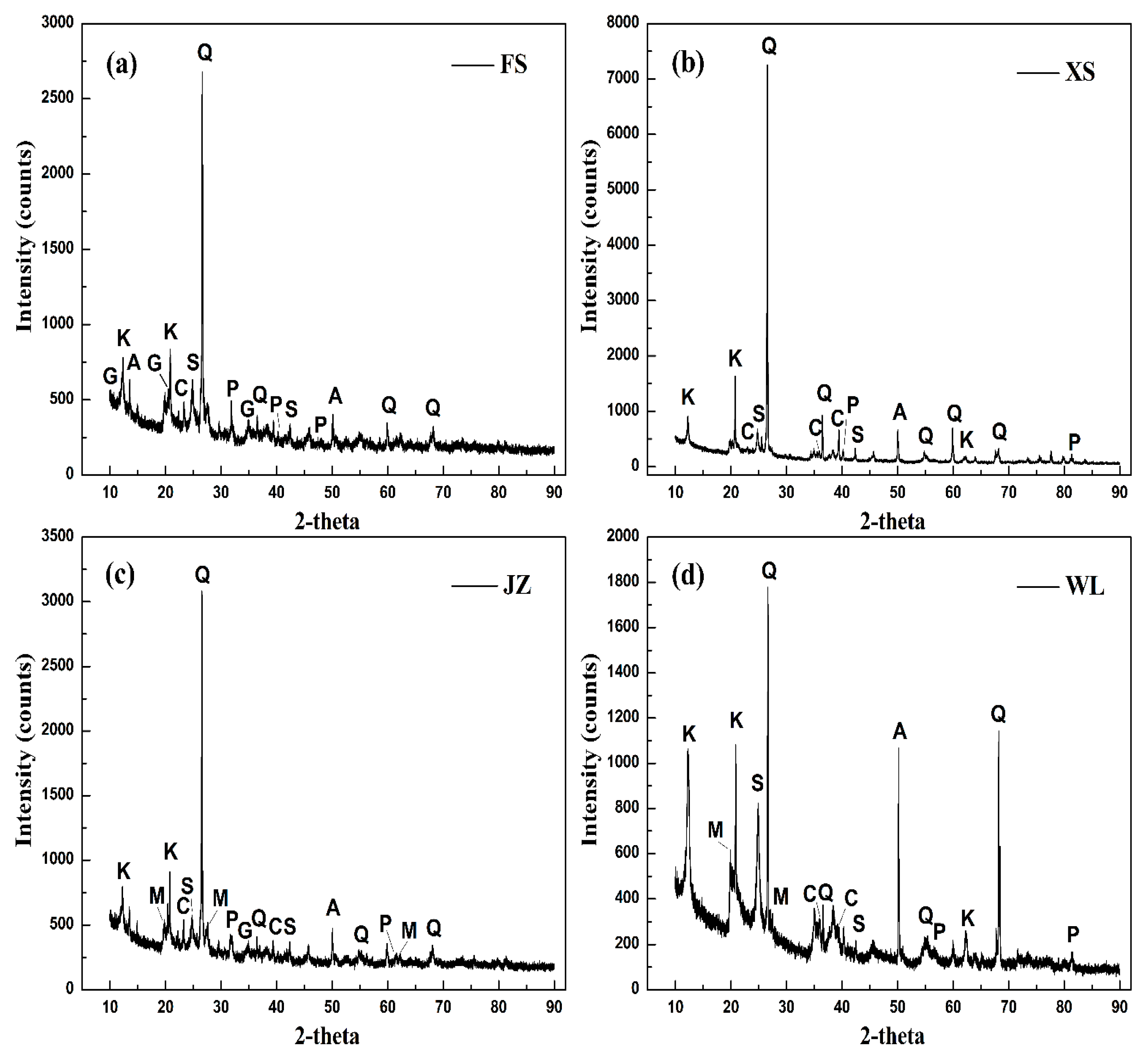
Figure 1. XRD spectrum of (a) FS, (b) XS, (c) JZ and (d) WL oil shale. Mineral phases identified: A–Albite (NaAlSi3O8); C–Calcite (CaCO3); G–Gypsum (CaSO4); K–Kaolinite (Al2Si2O5(OH)4); M–Montmorillonite (Na, Ca)0.33(Al, Mg)2(Si4O10)(OH)2·nH2O; P–Pyrite (FeS2); Q–Quartz (SiO2);.
Catalysts 15 01076 g001
Figure 2. DTG profiles of different oil shale blends with a heating rate of 10 °C/min: (a) FS/WL blends, (b) XS/WL blends and (c) JZ/WL blends.
Catalysts 15 01076 g002aCatalysts 15 01076 g002b
Figure 3. Activation energy (Ea) calculated using the KAS methods at various conversion degrees. (a) FS/WL blends; (b) XS/WL blends; (c) JZ/WL blends.
Catalysts 15 01076 g003aCatalysts 15 01076 g003b
Figure 4. Pyrolysis product yields of FS, XS, and JZ at various WL blending ratios, along with the corresponding synergistic index ∆ζ. The brown color denotes a positive synergistic effect, and the green color denotes a negative synergistic effect.
Catalysts 15 01076 g004
Figure 5. Relative contents of the main components in shale oil produced from the retorting process of (a) FS/WL, (b) XS/WL, and (c) JZ/WL blends.
Catalysts 15 01076 g005
Table 1. Textual properties of the selected oil shale samples.
FSXSJZWL
Moisture3.361.403.205.11
Volatiles15.5916.0322.4727.32
Fixed carbon1.9215.256.3115.55
Ash79.1367.3268.0252.02
C54.2062.3842.1166.74
H11.254.297.548.17
N4.171.863.632.05
S3.121.221.672.99
O a27.2630.2645.0520.05
H/C, mole ratio1.250.230.650.30
O/C, mole ratio0.380.360.800.23
Water1.511.431.872.11
Oil7.937.489.829.48
semi-coke85.3380.7079.2378.01
Gas5.2310.399.0810.40
HHV b, MJ/kg3.078.457.2312.34
a by difference; b by calculation.
Table 2. Inorganic contents of the selected oil shale samples (wt%).
ConstituentFSXSJZWL
Na2O0.790.730.550.00
MgO1.110.001.030.00
Al2O323.3727.5123.1335.15
SiO259.5064.2161.0856.14
P2O50.130.010.330.00
SO32.081.031.302.04
K2O1.442.061.421.63
CaO0.690.950.951.29
TiO21.291.661.380.62
MnO20.090.010.102.69
Fe2O39.511.678.420.00
Others0.030.160.330.46
Table 3. Pyrolysis properties of the selected oil shale and their blends.
PropertiesInitiation Temperature (°C)Peak Temperature (°C)Peak Weight Loss Rate
(wt% min−1)
Total Weight Loss (wt%)Pyrolysis Interval (min)
β
(°C min−1)
51015510155105101551015
FS386.9336.3324.5460.6474.5481.32.24.39.014.114.613.86.74.8
85FS15WL370.5321.3280.4458.2473.9497.22.14.08.615.014.914.77.55.1
70FS30WL369.7268.0208.9458.8470.5460.22.03.88.415.616.317.18.15.6
55FS45WL315.1258.8210.2458.2471.5480.31.83.57.616.716.516.58.76.6
WL253.2210.7154.2475.6493.2504.51.42.65.720.620.320.318.012.9
XS374.2359.4324.5440.5451.1460.02.24.39.216.515.915.36.64.9
85XS15WL368.1333.4260.8440.0451.1459.62.04.18.816.716.616.46.75.1
70XS30WL343.1273.3210.3440.5451.4459.61.94.08.417.717.717.17.55.7
55XS45WL273.1238.6189.2441.1455.1461.21.52.96.518.918.718.612.88.6
WL253.2210.7154.2475.6493.2504.51.42.65.720.620.320.318.012.9
JZ383.1358.8332.1456.4468.7478.52.85.411.616.216.316.05.74.0
85JZ15WL375.7331.3275.9455.3466.3477.52.85.010.217.217.115.75.34.4
70JZ30WL352.8288.8233.7454.8461.3476.92.34.69.817.117.717.47.15.0
55JZ45WL315.1258.8212.3454.3473.8477.52.24.29.117.818.217.77.35.5
WL253.2210.7154.2475.6493.2504.51.42.65.720.620.320.318.012.9
Table 4. Kinetic parameters of four oil shales and their blends at various heating rates, determined using the master-plot method.
SamplesEa (kJ mol−1)5 °C min−110 °C min−115 °C min−1
f(α)lnAf(α)lnAf(α)lnA
FS224.4(1 − α)2.135.9(1 − α)235.9(1 − α)1.935.9
85FS15WL216.7(1 − α)2.846.1(1 − α)2.846.1(1 − α)2.646.1
70FS30WL259.5(1 − α)2.135.2(1 − α)2.135.2(1 − α)235.2
55FS45WL210.7(1 − α)2.434.3(1 − α)2.334.3(1 − α)2.334.3
WL239.8(1 − α)340.2(1 − α)3.639.8(1 − α)3.740.5
XS274.7(1 − α)3.749.5(1 − α)3.449.0(1 − α)3.249.0
85XS15WL296.3(1 − α)4.155.0(1 − α)3.854.8(1 − α)3.654.6
70XS30WL302.7(1 − α)453.7(1 − α)3.853.7(1 − α)3.653.7
55XS45WL247.0(1 − α)3.440.5(1 − α)3.340.5(1 − α)3.240.5
WL239.8(1 − α)340.2(1 − α)3.639.8(1 − α)3.740.5
JZ216.3(1 − α)1.834.5(1 − α)1.734.5(1 − α)1.734.5
85JZ15WL251.7(1 − α)241.4(1 − α)241.4(1 − α)241.4
70JZ30WL237.9(1 − α)2.338.5(1 − α)2.238.5(1 − α)2.238.5
55JZ45WL201.6(1 − α)232.1(1 − α)232.1(1 − α)232.2
WL239.8(1 − α)340.2(1 − α)3.639.8(1 − α)3.740.5
Table 5. Pyrolytic product distribution of all testing samples via Fischer Assay test.
WaterOilSemi-CokeGas
FS1.5%7.9%85.3%5.2%
85FS15WL1.5%7.9%84.1%6.5%
70FS30WL1.6%8.0%82.8%7.6%
55FS45WL1.6%8.2%82.3%7.9%
WL2.1%9.5%78.0%10.7%
XS1.4%7.5%80.7%10.4%
85XS15WL1.4%7.4%85.2%6.0%
70XS30WL1.4%7.3%84.6%6.8%
55XS45WL1.7%8.3%83.6%6.5%
WL2.1%9.5%78.0%10.7%
JZ1.9%9.8%79.2%9.1%
85JZ15WL1.8%9.4%78.4%10.4%
70JZ30WL1.9%9.0%78.3%10.8%
55JZ45WL1.9%8.8%77.9%11.4%
WL2.1%9.5%78.0%10.7%
Table 6. Carbon number distribution of shale oil produced from the pyrolysis of oil shale with and without WL blending.
SamplesGasoline
(C5–C12)
Kerosene (C13–C14)Diesel
(C15–C18)
Lubricating Oil
(C19–C25)
FS12.810.235.037.4
85FS15WL17.610.136.730.8
70FS30WL21.810.030.132.2
55FS45WL27.315.823.226.6
WL64.17.00.023.5
XS74.68.18.58.9
85XS15WL65.28.18.215.3
70XS30WL55.912.211.816.8
55XS45WL62.49.518.76.2
WL64.17.00.023.5
JZ42.06.713.233.1
85JZ15WL44.29.910.036.0
70JZ30WL46.87.413.532.3
55JZ45WL46.47.231.45.7
WL64.17.00.023.5
Table 7. The common reaction mechanisms of solid-state reactions [72].
MechanismsSymbolDifferential Form f(α)Integral Form G(α)
Order of reaction
First-orderF11 − α−ln(1 − α)
Second-orderF2(1 − α)2(1 − α)−1 − 1
Third-orderF3(1 − α)3[(1 − α)−2 − 1]/2
Diffusion
One-way transportD10.5αα2
Two-way transportD2[−ln(1 − α)]−1α+(1 − α)ln(1 − α)
Three-way transportD31.5(1 − α)2/3[1 − (1 − α)1/3]−1[1 − (1 − α)1/3]2
Ginstling–Brounshtein equationD41.5[(1 − α)1/3 − 1]−1(1 − 2α/3) − (1 − α)2/3
Limiting surface reaction between both phases
One dimensionR11α
Two dimensionsR22(1 − α)1/21−(1 − α)1/2
Three dimensionsR33(1 − α)2/31−(1 − α)1/3
Random nucleation and nuclei growth
Two-dimensionalA22(1 − α)[−ln(1 − α)]1/2[−ln(1 − α)]1/2
Three-dimensionalA33(1 − α)[−ln(1 − α)]2/3[−ln(1 − α)]1/3
Exponential nucleation
Power law, n = 1/2P22α1/2α1/2
Power law, n = 1/3P33α2/3α1/3
Power law, n = 1/4P44α3/4α1/4
Disclaimer/Publisher’s Note: The statements, opinions and data contained in all publications are solely those of the individual author(s) and contributor(s) and not of MDPI and/or the editor(s). MDPI and/or the editor(s) disclaim responsibility for any injury to people or property resulting from any ideas, methods, instructions or products referred to in the content.