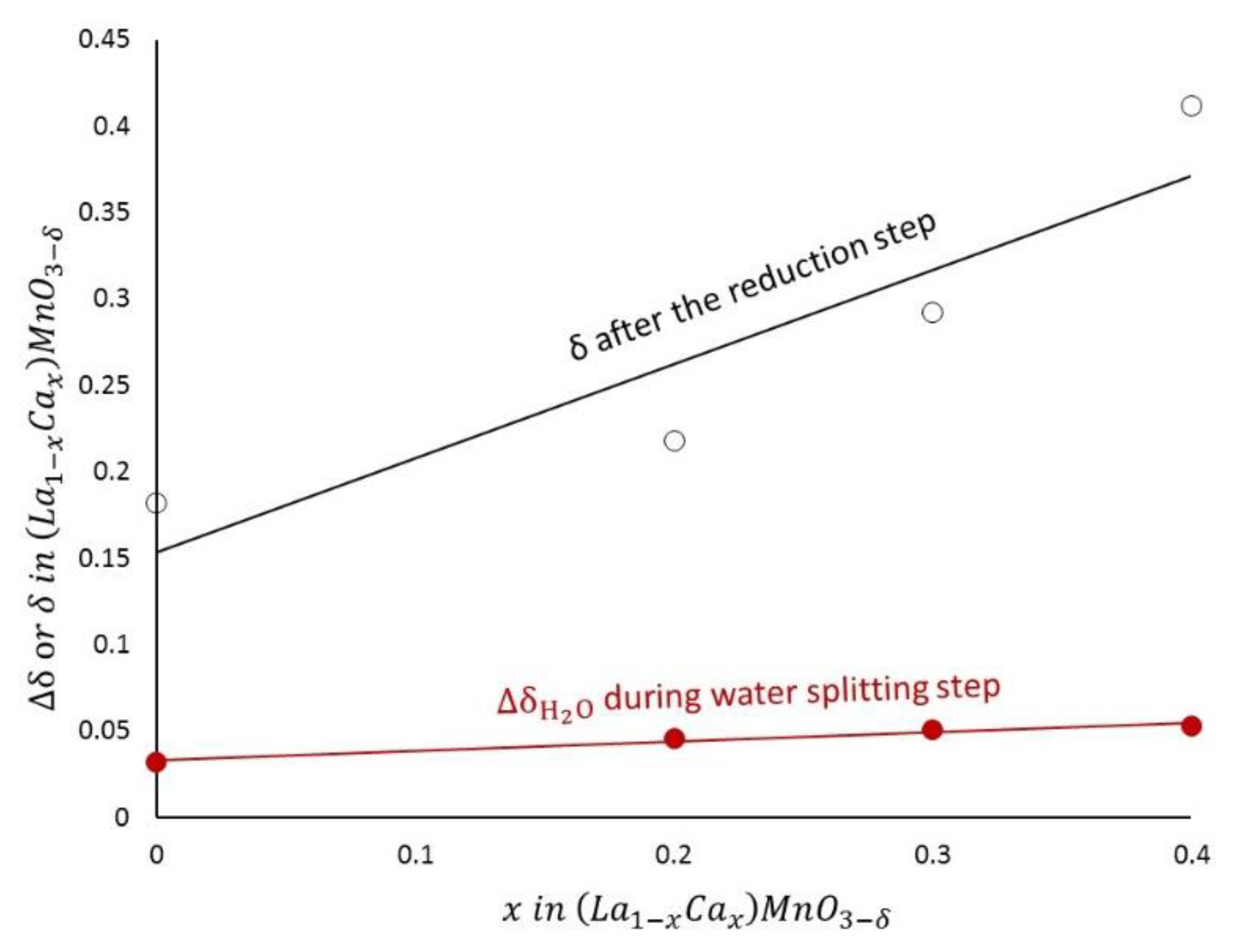

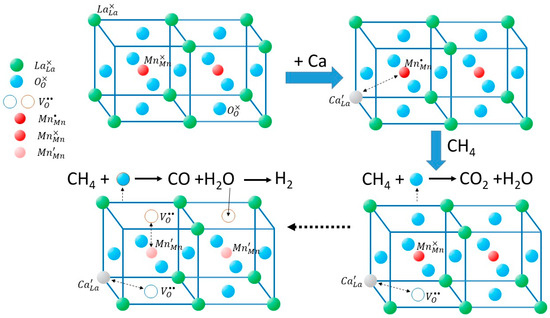
(La1−xCax)MnO3−δ (x = 0, 0.2, 0.3, 0.4) Perovskites as Redox Catalysts in Chemical Looping Hydrogen Production Process: The Relation between Defect Chemistry and Redox Performance


Abstract
Share and Cite
Moschos, M.; Evdou, A.; Zaspalis, V. (La1−xCax)MnO3−δ (x = 0, 0.2, 0.3, 0.4) Perovskites as Redox Catalysts in Chemical Looping Hydrogen Production Process: The Relation between Defect Chemistry and Redox Performance. Catalysts 2024, 14, 431. https://doi.org/10.3390/catal14070431
Moschos M, Evdou A, Zaspalis V. (La1−xCax)MnO3−δ (x = 0, 0.2, 0.3, 0.4) Perovskites as Redox Catalysts in Chemical Looping Hydrogen Production Process: The Relation between Defect Chemistry and Redox Performance. Catalysts. 2024; 14(7):431. https://doi.org/10.3390/catal14070431
Chicago/Turabian StyleMoschos, Moschos, Antigoni Evdou, and Vassilios Zaspalis. 2024. "(La1−xCax)MnO3−δ (x = 0, 0.2, 0.3, 0.4) Perovskites as Redox Catalysts in Chemical Looping Hydrogen Production Process: The Relation between Defect Chemistry and Redox Performance" Catalysts 14, no. 7: 431. https://doi.org/10.3390/catal14070431
APA StyleMoschos, M., Evdou, A., & Zaspalis, V. (2024). (La1−xCax)MnO3−δ (x = 0, 0.2, 0.3, 0.4) Perovskites as Redox Catalysts in Chemical Looping Hydrogen Production Process: The Relation between Defect Chemistry and Redox Performance. Catalysts, 14(7), 431. https://doi.org/10.3390/catal14070431