Article

Carbon-Conjugated Co Complexes as Model Electrocatalysts for Oxygen Reduction Reaction

1
Department of Chemistry, Southern University of Science and Technology, Shenzhen 518055, China
2
Department of Chemistry, City University of Hong Kong, Kowloon 999077, Hong Kong
3
Department of Applied Science, School of Science and Technology, Hong Kong Metropolitan University, Good Shepherd Street, Ho Man Tin, Kowloon 999077, Hong Kong
*
Authors to whom correspondence should be addressed.
Catalysts 2023, 13(2), 330; https://doi.org/10.3390/catal13020330
Submission received: 13 December 2022 / Revised: 30 January 2023 / Accepted: 30 January 2023 / Published: 2 February 2023
(This article belongs to the Special Issue Advanced Earth-Abundant Catalysts for Energy Related Electrochemistry)

Abstract

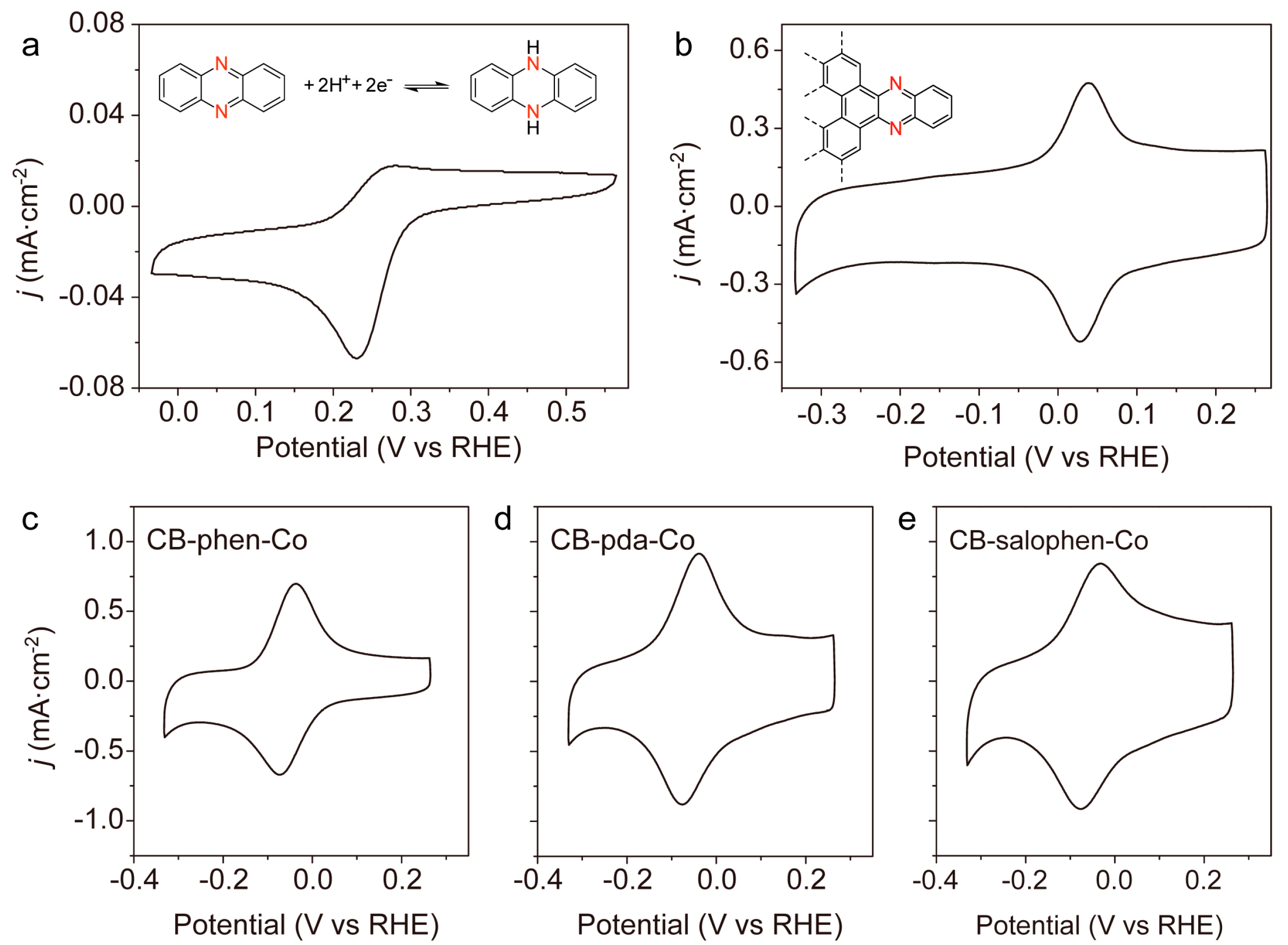
Single-atom catalysts are a family of heterogeneous electrocatalysts widely used in energy storage and conversion. The determination of the local structure of the active metal sites is challenging, which limits the establishment of the reliable structure-property relationship of single-atom catalysts. A carbon black-conjugated complex can be used as the model catalyst to probe the intrinsic activity of metal sites with certain local structures. In this work, we prepared carbon black-conjugated [Co(phenanthroline)Cl2], [Co(o-phenylenediamine)Cl2] and [Co(salophen)]. In these catalysts, the Co complexes with well-defined structures are anchored on the edge of carbon black by pyrazine moieties. The number of electrochemical accessible Co sites can be measured from the area of the redox peaks of pyrazine linkers in the cyclic voltammetry curve. Then, the intrinsic electrocatalytic activity of one Co site can be obtained. The catalytic performances of the three catalysts towards oxygen reduction reaction in alkaline conditions were measured. Carbon black-conjugated [Co(salophen)] showed the highest intrinsic activity with the turnover frequency of 0.72 s−1 at 0.75 V vs. the reversible hydrogen electrode. The strategy developed in this work can be used to explore and verify the possible local structure of active sites proposed for single-atom catalysts.
Keywords: electrocatalysis; single-atom catalyst; model catalyst; oxygen reduction reaction; Co complex electrocatalysis; single-atom catalyst; model catalyst; oxygen reduction reaction; Co complex