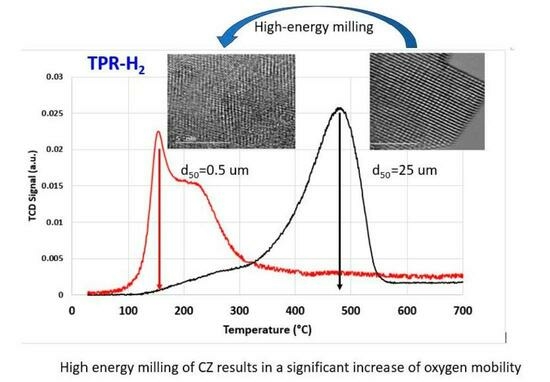
Effect of High-Energy Milling on Ceria-Zirconia’s Redox Properties

Abstract
Share and Cite
Bortun, A.; Bortun, M.; Brown, B.; Madynski, J. Effect of High-Energy Milling on Ceria-Zirconia’s Redox Properties. Catalysts 2023, 13, 1511. https://doi.org/10.3390/catal13121511
Bortun A, Bortun M, Brown B, Madynski J. Effect of High-Energy Milling on Ceria-Zirconia’s Redox Properties. Catalysts. 2023; 13(12):1511. https://doi.org/10.3390/catal13121511
Chicago/Turabian StyleBortun, Anatoly, Mila Bortun, Benjamin Brown, and Jeremy Madynski. 2023. "Effect of High-Energy Milling on Ceria-Zirconia’s Redox Properties" Catalysts 13, no. 12: 1511. https://doi.org/10.3390/catal13121511
APA StyleBortun, A., Bortun, M., Brown, B., & Madynski, J. (2023). Effect of High-Energy Milling on Ceria-Zirconia’s Redox Properties. Catalysts, 13(12), 1511. https://doi.org/10.3390/catal13121511