1. Introduction
With the increasing deployment of smart-city infrastructure and edge-intelligent systems, real-time object detection is relevant to practical scenarios such as traffic monitoring, campus monitoring, and public-safety surveillance [
1]. Pedestrians and bicycles frequently appear as small instances under long-range imaging or wide-field camera views, where limited pixel support increases sensitivity to background clutter, partial occlusion, and localization ambiguity. However, these scenarios provide application motivation only: the filtered VOC subset used in this study does not reproduce the fixed-camera geometry, crowd density, long-range scale distributions, or environmental variation of traffic or campus surveillance. The present study therefore addresses a controlled architecture-design question rather than validating traffic or campus surveillance performance. The difficulty of small-instance recognition is also reflected in general-purpose benchmarks such as COCO, where complex backgrounds, scale variation, and dense object layouts remain challenging [
2].
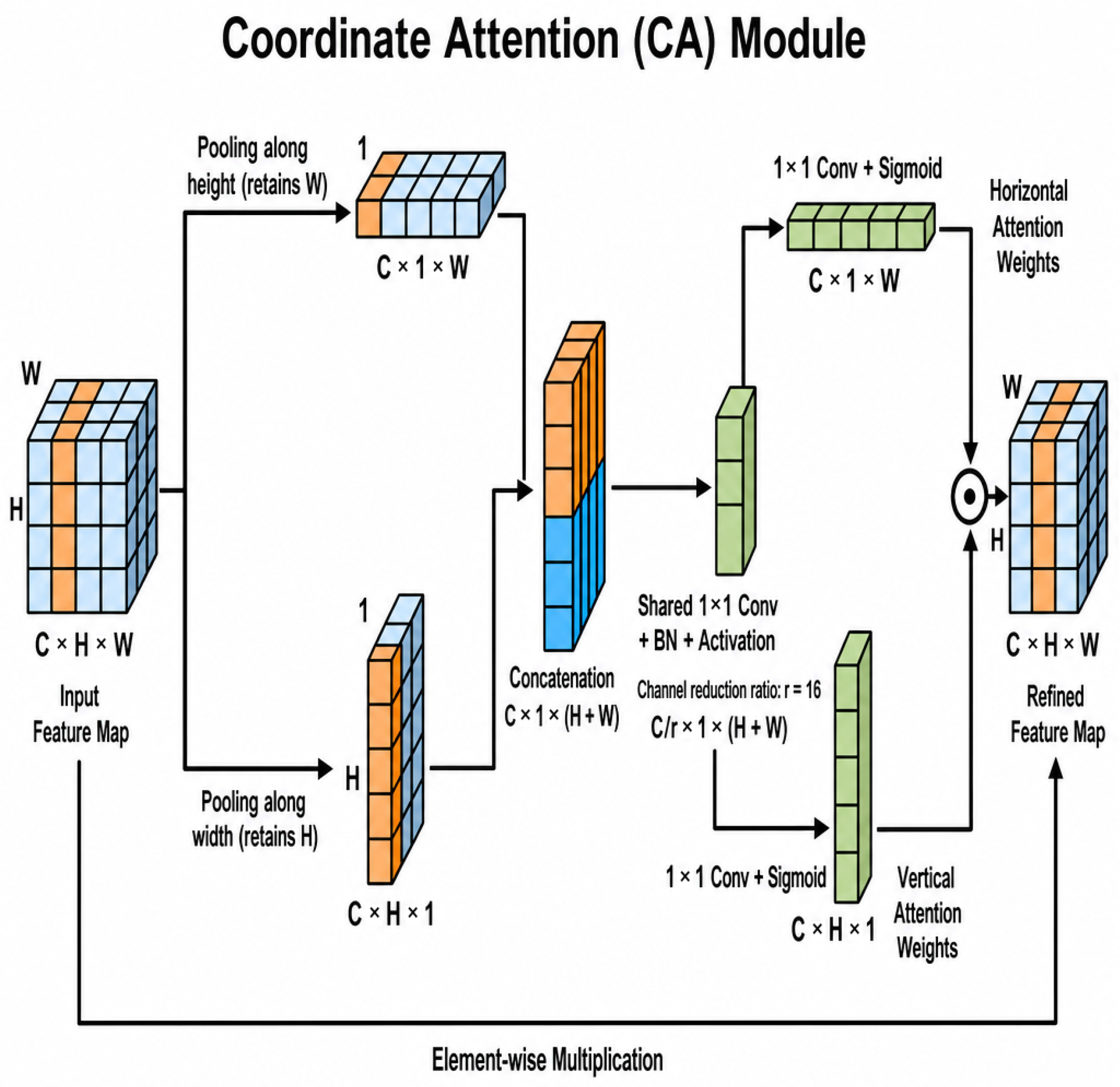
Coordinate Attention (CA) provides the coordinate-aware mechanism considered in this study [
3].
Standard YOLO-style detectors can lose spatial detail when representing small person and bicycle instances, because repeated downsampling and feature aggregation reduce the coordinate cues available for localization [
4]. The two categories may present different visual demands: bicycles can contain thin, elongated, and spatially separated parts, whereas person instances can exhibit different contour, texture, and pose patterns. These intrinsic properties could interact differently with CA’s directional encoding. However, the present study does not quantify class-conditioned shape, texture, pose, or occlusion distributions, so this proposition is treated as a mechanism hypothesis rather than as an explanation supported by the present data. Squeeze-and-Excitation (SE) performs channel-wise feature recalibration [
5]. Multi-scale feature aggregation, including Feature Pyramid Networks (FPNs), is another established strategy for preserving information across object scales [
6]. The Convolutional Block Attention Module (CBAM) [
7] emphasizes channel recalibration and global spatial summarization without explicitly retaining directional coordinate information. The narrower question examined here is therefore whether coordinate-aware recalibration improves the evaluated small-instance representations, while category-specific mechanisms remain to be tested.
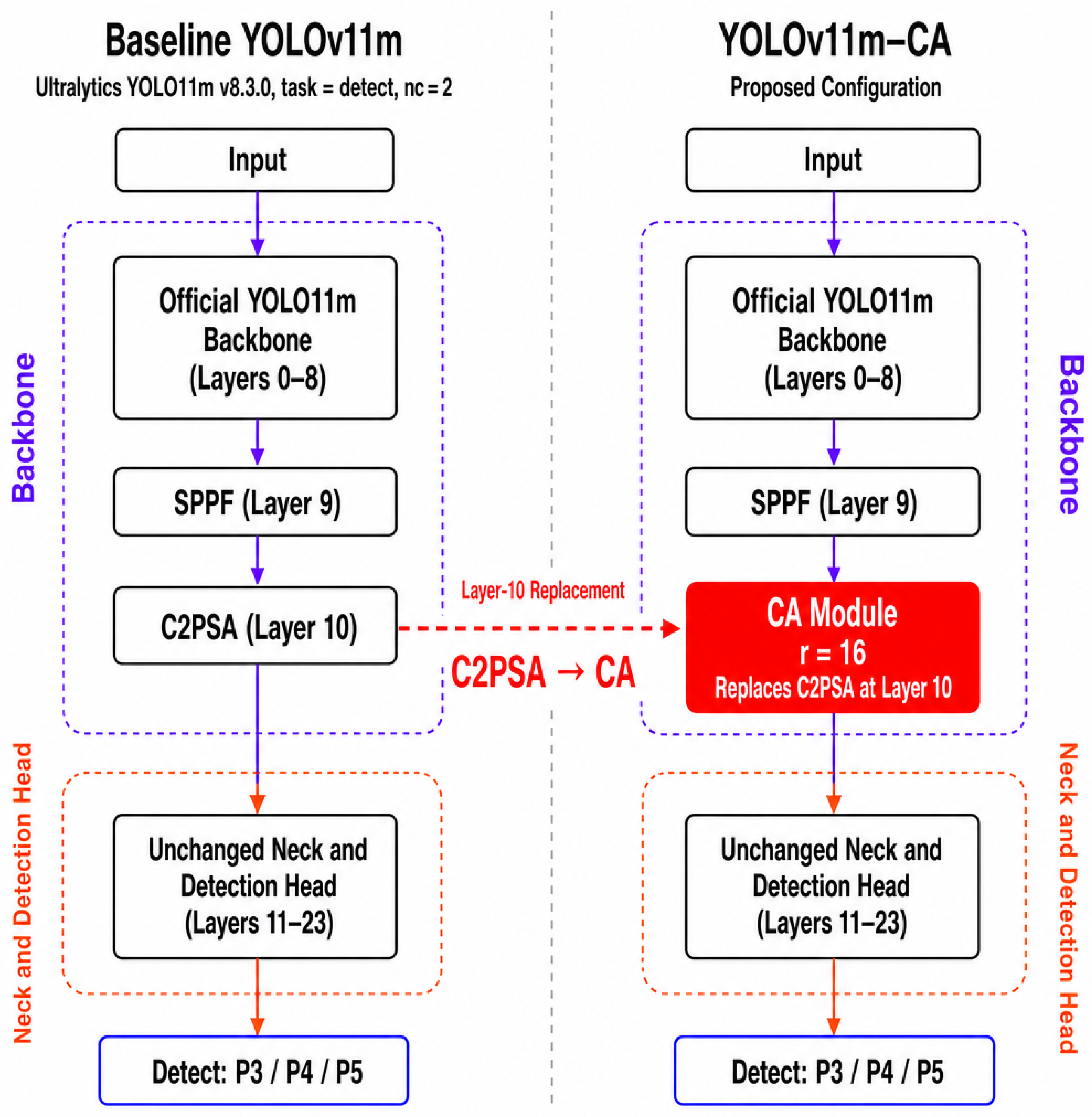
To address this issue, this study applies the established Coordinate Attention (CA) module within YOLOv11m; it does not propose a new attention mechanism. The resulting detector is denoted YOLOv11m–Coordinate Attention (YOLOv11m–CA). In the official Ultralytics 8.3.0 YOLO11m configuration, SPPF is followed by C2PSA [
8]. The design contribution examined here is a complexity-aware replacement in which CA substitutes for this post-SPPF C2PSA block rather than being appended to the unmodified architecture.
The experimental contribution is a controlled architecture-integration analysis under a common protocol. The study evaluates the defined post-SPPF C2PSA-to-CA replacement through directional-component variants, CA reduction ratios, and an append-versus-replace integration strategy whose configuration boundaries are recoverable from the archived campaign. These experiments examine whether the exact replacement provides a favorable observed accuracy–complexity trade-off under the stated VOC-based protocol. Accordingly, the evidence concerns the specified implementation and evaluation setting, not the novelty of CA itself, a general placement or attention module ranking, or a state-of-the-art claim.
This study uses a filtered person and bicycle subset of PASCAL VOC 2012 as a controlled setting for evaluating a lightweight CA integration strategy. The subset enables consistent analysis of two categories with different structural characteristics and small-instance distributions, but it is neither a dedicated dense surveillance benchmark nor a substitute for traffic monitoring or aerial imagery. Consequently, the objective is limited to establishing internal evidence under the evaluated VOC distribution; no claim of cross-domain generalization, broad category-level superiority, or real-world deployment readiness is made.
The technical contribution of this study is incremental and deliberately bounded. CA itself [
3] and its prior integration into YOLO-family detectors [
4] are not new. The contribution evaluated here lies in replacing the post-SPPF C2PSA block with CA rather than appending CA after the retained C2PSA block, and in examining this defined configuration through controlled directional-component, reduction ratio, and integration strategy comparisons. The study should therefore be interpreted as a controlled architecture-integration investigation and a candidate design for future validation on dedicated real-world benchmarks. It does not establish a general ranking of CA insertion positions. The main contributions are summarized as follows:
A replacement-based CA integration strategy is evaluated for YOLOv11m under a controlled VOC person and bicycle setting. The C2PSA block located immediately after SPPF in the official Ultralytics 8.3.0 YOLO11m configuration is replaced with CA, while the remaining backbone, neck, and Detect head are retained. This configuration evaluates whether directional coordinate recalibration can provide a favorable accuracy–complexity trade-off relative to the original C2PSA-equipped baseline. It does not introduce a new attention mechanism, and its effectiveness on resource-constrained devices is not evaluated.
Controlled ablation studies examine the effects of directional encoding, reduction ratio, and append-versus-replacement integration under the archived experimental protocol. Within the configurations whose operations and training boundaries are recoverable, the results characterize the accuracy–complexity behavior of replacing the official post-SPPF C2PSA block with CA. Relative to previously reported YOLO-based CA integration [
4], the present contribution is confined to this defined replacement strategy and its controlled architectural analysis; it does not claim a verified ranking of insertion positions or attention mechanisms.
Experiments on a filtered PASCAL VOC 2012 person and bicycle subset containing instances across multiple scale ranges show higher observed mAP@50, mAP@50–95, and than the YOLOv11m baseline while reducing the parameter count. YOLOv11m–CA achieves 90 FPS on the tested RTX 4060 Laptop GPU under the reported inference protocol. This value characterizes throughput only in the stated GPU environment and is not an on-device latency result. The evidence therefore supports lower model-side complexity and high throughput on the tested GPU, not edge-device deployment readiness.
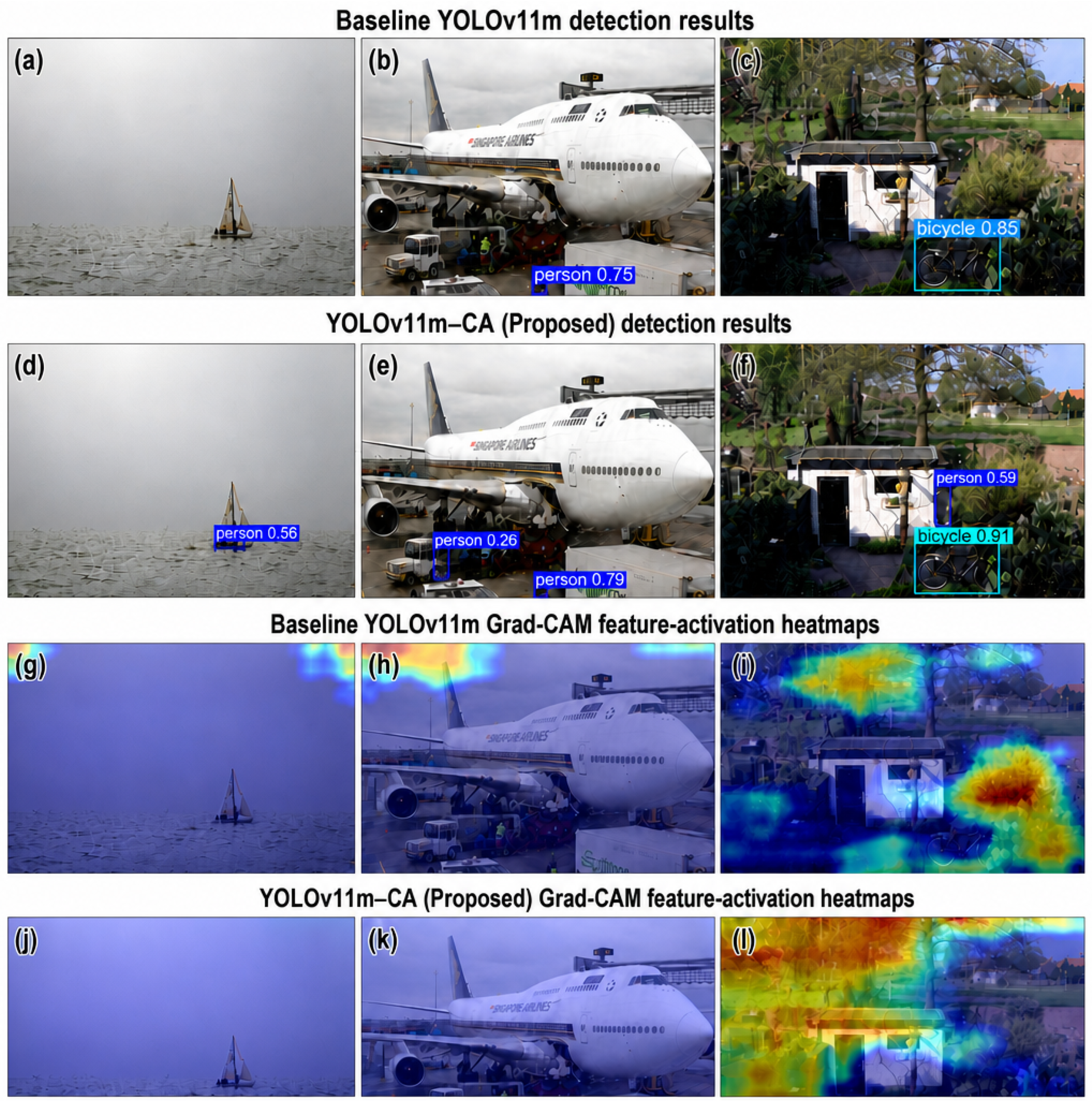
Qualitative analyses use directional attention visualization and Grad–CAM to illustrate coordinate-sensitive feature responses. These examples are interpreted as illustrative evidence rather than as causal or statistically representative validation.
The remainder of this study is organized as follows.
Section 2 reviews related work on efficient detectors and lightweight attention mechanisms.
Section 3 describes the YOLOv11m baseline, the Coordinate Attention mechanism, and the proposed replacement-based YOLOv11m–CA architecture.
Section 4 presents the experimental setup and reports the quantitative, ablation, qualitative, efficiency, cross-year validation, and discussion results. Finally,
Section 5 summarizes the main findings, limitations, and directions for future work.
2. Related Work
The broader efficiency literature includes ShuffleNet and its channel shuffle operation [
9], the YOLO11 architecture and its model implementation resources [
10], detector scaling in Scaled–YOLOv4 [
11], multi-scale fusion for small-object detection [
12], the official Ultralytics YOLO11 release and implementation details [
8], and the anchor-free YOLOX design [
13]. VOC-based person and bicycle detection remains challenging because small instances are vulnerable to feature attenuation, background interference, and localization ambiguity [
14]. Lightweight attention is relevant to complexity-aware detectors because it seeks to strengthen informative responses without a heavy architectural expansion [
15]. Recent attention and vision-transformer surveys provide additional methodological context [
16], while efficient detector-design principles provide a broader complexity-oriented perspective [
17]. Grad–CAM offers a post hoc visualization tool [
18], whereas dataset bias analysis and domain-specific benchmarks such as WIDER FACE and CityPersons illustrate the dependence of detection results on data distribution [
19,
20,
21]. The mechanism-oriented design space considered in this study includes Efficient Channel Attention (ECA), which uses local cross-channel interaction without dimensionality reduction [
22]; SimAM, which derives parameter-free three-dimensional attention weights from an energy function [
23]; Shuffle Attention, which combines grouped channel and spatial attention with channel shuffle [
24]; and Efficient Multi-Scale Attention (EMA), which uses grouped multi-scale and cross-spatial interactions [
25]. The latter three mechanisms were not implemented in the archived experimental campaign. These mechanisms are retained as literature context rather than as a numerical ranking. The archived campaign does not support a verified same-training-schedule comparison between CA and the alternative attention modules; consequently, no empirical superiority or state-of-the-art claim is made.
Coordinate Attention (CA) embeds directional positional information into channel attention [
3]. A recent YOLO-based application reports CA for small and dense remote-sensing targets [
4]; however, its dataset and protocol differ from those used here and it is therefore treated as qualitative context rather than a numerical comparator. CA was introduced in 2021 and is not itself a recent attention innovation. The gap addressed here is consequently narrow: the accuracy–complexity implications of replacing the official post-SPPF C2PSA block with CA, rather than appending CA after the retained C2PSA block, have not been examined for the present YOLOv11m implementation and controlled VOC person and bicycle protocol. The contribution should therefore be interpreted as an incremental, complexity-aware integration study rather than a new attention mechanism or a state-of-the-art detector.
Efficient Detectors
Recent real-time detectors pursue complementary efficiency routes. The Real-Time Detection Transformer (RT-DETR) combines an efficient hybrid encoder with end-to-end set prediction [
26]; YOLOv9 uses programmable gradient information to improve information utilization [
27]; YOLOv10 couples non-maximum-suppression-free training with efficiency–accuracy-driven design [
28]; and DETR with Improved Matching (DEIM) improves matching for faster convergence [
29]. These works define a substantially broader contemporary landscape than attention insertion alone. YOLOv11m is selected here as the implementation baseline because the official model and framework provide a current medium-scale one-stage detector [
8,
10], not because the present study establishes superiority over these recent methods. The evidence is limited to the controlled comparison of CA integration within YOLOv11m.
Accordingly, this study adopts YOLOv11m, the medium-scale variant of YOLOv11, as the baseline detector because it offers a practical compromise between representational capacity and model-side inference complexity. Rather than introducing a heavier backbone or extensive auxiliary components, this study examines whether spatially informative feature representation can be improved under an explicit lightweight-integration constraint. Deployment efficiency is not inferred from architecture size alone: the present evidence is limited to parameter count, FLOPs, and inference throughput on the stated GPU, while training-resource consumption and edge-device behavior remain unmeasured.
All quantitative comparisons retained to support the conclusions are restricted to configurations whose architectural operations and training conditions can be identified from the archived records. These comparisons cover the primary baseline-versus-proposed experiment, directional components, CA reduction ratios, and append- versus replacement-style CA integration. The former insertion position and attention module comparisons are excluded from the evidential basis because their exact configuration or training protocol boundaries could not be recovered consistently.
Published YOLO–CA and small-object detector studies are used only to establish prior design context [
4,
12,
14]. Their dataset composition, category definitions, preprocessing, augmentation, input resolution, training schedule, implementation, hardware, and evaluation code are not fully matched to those used in the present study. No externally reported AP, parameter count, FLOP, latency, or FPS value is transferred into the controlled experimental comparison. Because no key external method was reimplemented under the complete present protocol, these references support only qualitative literature positioning and not a numerical ranking or claim of superiority. The quantitative contribution is therefore limited to the configurations implemented and evaluated within this study.
4. Experiments
This section evaluates the proposed YOLOv11m–CA model under the defined VOC-based person and bicycle setting. It first describes the dataset, implementation details, and evaluation protocol and then reports the main results and controlled ablation studies. Numerical comparisons are restricted to the baseline and architectural configurations implemented and evaluated within the present experimental campaign. Published YOLO–CA and small-object methods that were not reproduced under this protocol are discussed only as qualitative literature context. The section subsequently presents qualitative analyses, inference-efficiency measurements, within-ecosystem VOC 2007 validation, and a discussion of the observed results and study limitations.
4.1. Experimental Setup
The proposed method is evaluated on a filtered PASCAL VOC 2012 subset containing only person and bicycle annotations; the official dataset is available at
https://www.robots.ox.ac.uk/~vgg/projects/pascal/VOC/voc2012/ (accessed on 17 August 2026). This selection provides a controlled two-category setting with standardized annotations and instances exhibiting differences in scale, occlusion, and structural appearance. It does not constitute a dedicated dense surveillance or small-object benchmark, is not restricted exclusively to tiny instances, and does not reproduce the target density, camera viewpoints, background distributions, or scale profiles of traffic monitoring and aerial datasets. Accordingly, all reported results are interpreted only within this filtered VOC distribution.
Unless otherwise stated, all experiments in
Section 4 follow a unified protocol with the same dataset split, input resolution, augmentation strategy, training schedule, optimization hyperparameters, initialization, hardware environment, and evaluation metrics. In each ablation study, only the factor under investigation is changed, while all other settings are kept identical.
The experiments use the archived train/validation partition derived from PASCAL VOC 2012. After retaining images containing at least one person or bicycle annotation, the filtered partition comprises 3751 training images and 437 validation images, corresponding to 4188 retained images in total. Each retained image therefore contains at least one target-category annotation. The filtered label set retains the corresponding person and bicycle annotations and excludes annotations from the other VOC categories. No separate VOC 2012 test partition was used in the reported experiments. Object scale is assigned from the ground-truth bounding-box area
, measured in the original VOC annotation coordinate system before any resizing or letterboxing used to form the
network input. Following the COCO area convention [
2], small, medium, and large instances satisfy
,
, and
pixels
2, respectively. The values 32 and 96 denote equivalent-square side length references for the area boundaries and do not impose separate constraints on
w and
h; elongated boxes are assigned solely according to their area. In this manuscript, “tiny” is used as a task-specific synonym for the COCO-small area range
and does not denote an additional official COCO category.
The available experimental archive preserves the aggregate image-level partition counts and the reported training, evaluation, and model-comparison records, but it does not preserve the original filtering script, a complete image-ID manifest, or an annotation-level class-by-partition summary. Consequently, the revised manuscript does not report a total person and bicycle instance count or dataset-wide proportions derived from unrecoverable person, bicycle, size, or occlusion counts. Reapplying a newly written filtering procedure cannot be assumed to reproduce the exact partition used in the original experimental campaign and is therefore not presented as an equivalent reconstruction. Although all configurations reported in this study were compared within the same original experimental campaign, the absence of these provenance artifacts limits exact independent reconstruction of the filtered partition. The corresponding conclusions are therefore restricted to the reported within-study comparisons and do not rely on the withdrawn dataset composition percentages.
Some retained instances exhibit small scale, clutter, or occlusion, which are also relevant detection difficulties in broader visual-sensing applications [
1,
4]. This similarity of individual challenges does not establish domain equivalence. The zero-fine-tuning evaluation on the VOC 2007 person and bicycle subset is therefore used only as a within-ecosystem consistency check across related PASCAL VOC data, rather than as evidence of cross-domain or real-world generalization.
All training and evaluation experiments were conducted on a single NVIDIA GeForce RTX 4060 Laptop GPU (NVIDIA Corporation, Santa Clara, CA, USA) with 8 GB of installed VRAM. The 8 GB value is the physical memory capacity of the device, not a measurement of peak memory allocation during training. The software stack comprises PyTorch 2.5.1, CUDA Toolkit 12.1, cuDNN 8.9.7, and Ultralytics 8.3.0. YOLOv11m is selected as the baseline because it provides a practical accuracy–complexity reference for evaluating the proposed replacement strategy [
8,
10]. No training was performed on an edge device; therefore, the present setup does not evaluate edge-training feasibility or deployment readiness.
Unless otherwise specified, training uses an input size of
, 100 epochs, and a batch size of 8. AdamW is used with learning rate
, weight-decay coefficient
, moment coefficients
, cosine annealing, and a 3-epoch warm-up. The backbone is frozen for the first 10 epochs and unfrozen for the remaining 90 epochs. Data augmentation includes Mosaic, horizontal flipping, HSV jitter, and random scaling, following the official Ultralytics implementation [
8]. Wall-clock training time, peak allocated or reserved GPU memory, board power, and cumulative energy were not instrumented in the original runs and are unavailable from the archived logs. These quantities are therefore reported as not measured rather than inferred from model parameters, FLOPs, or device capacity.
Precision (
P), recall (
R), mAP@50 under the VOC protocol, mAP@50–95, and end-to-end FPS are reported. For the supplementary scale-conditioned analysis, ground-truth instances are stratified by bounding-box area
in the original VOC annotation coordinate system before resizing or letterboxing. The COCO area intervals are used for stratum assignment:
for
,
for
, and
for
pixels
2 [
2]. These intervals constrain area rather than the individual width and height of a box. The use of the COCO area intervals describes the size stratification only; the complete evaluation pipeline is not presented as the official COCO evaluator, and mAP@50 under the stated VOC protocol remains the prespecified primary metric. The study-specific subdivisions
and
are used only for the later diagnostic analysis; their AP values are termed size-conditioned AP rather than separate official COCO metrics. Overall
P and
R are available, but subgroup true-positive, false-positive, and false-negative counts were not retained. Consequently, recall and
cannot be reconstructed for the two diagnostic area bins from AP alone and are not reported. All scale-specific analyses are supplementary and descriptive.
Parameters shared with the official YOLOv11m architecture are initialized from the COCO-pretrained checkpoint, whereas the newly introduced CA parameters are initialized using the default initialization of the implemented CA module. Both configurations are subsequently fine-tuned on the same filtered VOC subset.
4.2. Main Results
Table 2 presents the overall performance comparison on the filtered PASCAL VOC 2012 person and bicycle detection setting. FPS is measured on the RTX 4060 Laptop GPU at an input resolution of
using the stated inference environment. The reported FPS values are hardware-specific throughput measurements and should not be interpreted as latency results for an embedded or edge platform.
YOLOv11m–CA achieves a mean mAP@50 of compared with for the baseline across five independent runs. The observed difference between the two means is +2.30 percentage points. Because the archived records do not preserve seed identifiers or run-level paired outputs, it is not possible to determine whether the two configurations were evaluated with matched seeds or to compute a valid paired confidence interval or paired test. The observed mean differences for the secondary metrics are +0.9 points for mAP@50–95, +4.3 points for , +0.5 points for , +0.3 points for , +5.8 points for precision, and +1.1 points for recall. Because metric-specific uncertainty estimates and multiplicity-adjusted tests were not preserved for these secondary outcomes, these values are interpreted descriptively and are not claimed to be statistically significant. The larger observed gain in is consistent with, but does not by itself prove, greater sensitivity to small instances. The proposed model uses 4.8% fewer parameters and runs at 90 FPS in the stated GPU environment.
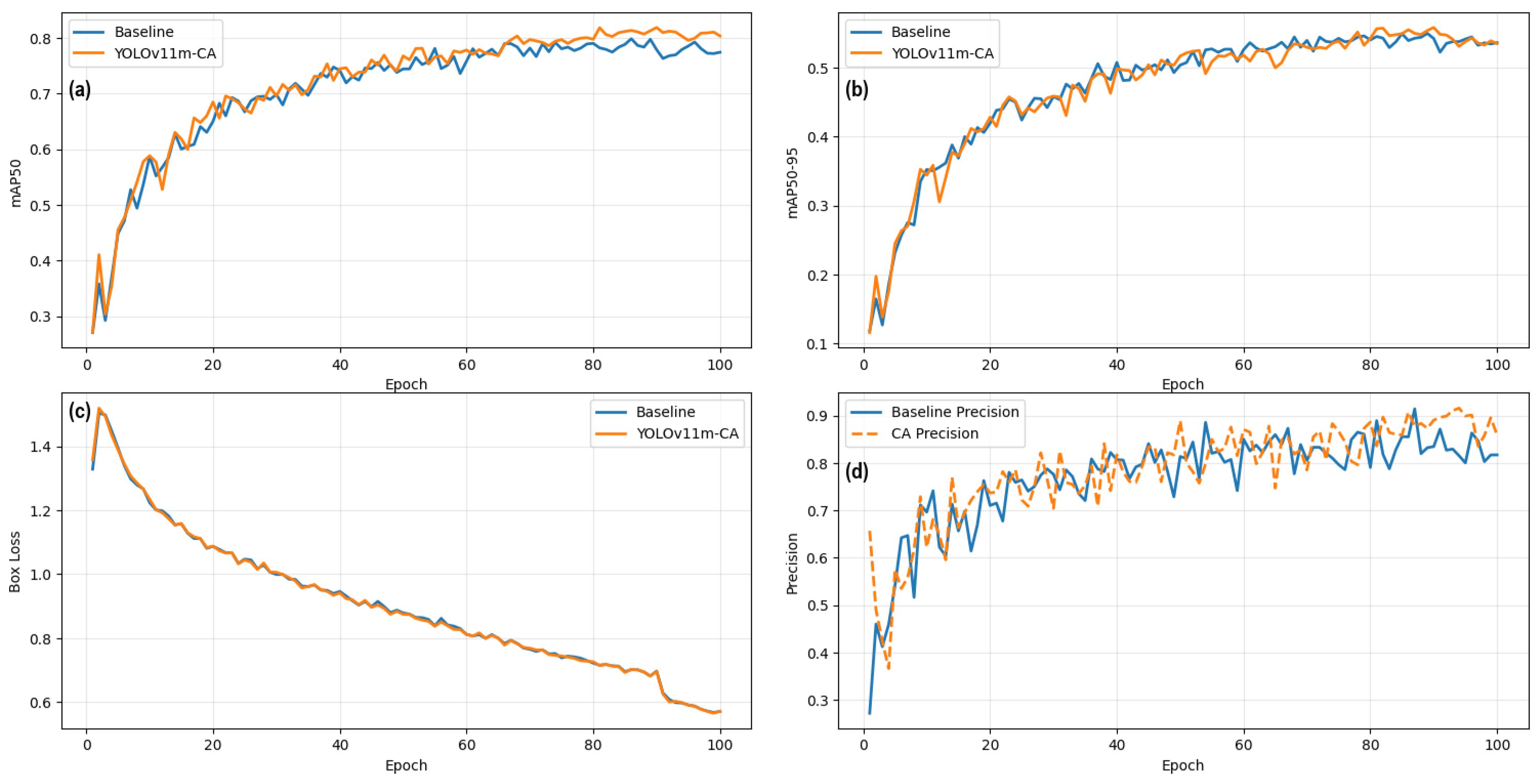
Figure 4 presents the corresponding training trajectories. These curves are used descriptively and are not treated as substitutes for run-level uncertainty estimates.
Class-conditioned metrics are not reported because the archived records do not permit aggregate and per-class results to be regenerated from one traceable evaluation source. The conclusions are therefore restricted to the aggregate results in
Table 2, and no category-specific superiority claim is made.
Diagnostic Analysis Within the COCO-Small Range
A study-specific diagnostic subdivision is used to examine the COCO-small area range. Let denote the ground-truth bounding-box area in the original VOC annotation coordinate system before resizing or letterboxing. Instances with pixels2 form the extremely small area bin, whereas instances with pixels2 form the remaining-small area bin. These conditions are based exclusively on area and do not require both w and h to be at most 16 or 32 pixels. The boundary pixels2 is not an official COCO boundary; it is a study-specific diagnostic threshold corresponding to an equivalent-square side length of 16 pixels, i.e., one half of the equivalent-square side length associated with the COCO-small upper boundary. It is used only to examine descriptively whether the observed AP difference is concentrated at the most spatially constrained end of the small-object distribution.
Table 3 reports this diagnostic comparison.
Table 3 shows observed AP differences of +6.4 points in the
bin and +3.1 points in the
bin. This descriptive pattern is consistent with the hypothesis in
Section 3.1 that instances occupying fewer pixels are more vulnerable to feature attenuation and may benefit more from coordinate-aware encoding. However, the custom bins were introduced for post hoc diagnostic analysis, and bin-specific recall, F1-score, confidence intervals, and significance tests are unavailable. The result therefore suggests, but does not establish, that the gain is concentrated among the smallest instances. A confirmatory evaluation should prespecify the bins, retain per-instance predictions, and report AP, precision, recall, and F1 for each interval.
4.3. Ablation Study
Three groups of controlled ablation experiments are conducted to evaluate the contribution of CA, identify an effective integration strategy, examine the dual-axis structure, and analyze its key hyperparameter. Unless otherwise stated, the reported values are means from five independent runs with different random seeds. The archived records preserve the five-run means and, for the primary mAP@50 comparison, the sample standard deviations, but do not preserve seed identifiers or per-run metric vectors. Accordingly, only the primary mAP@50 entries are shown as mean ± SD in
Table 2; secondary metrics and exploratory ablations are reported as descriptive archived means when run-level SDs were unavailable. No paired comparison is claimed because seed matching cannot be verified, and no metric-specific confidence intervals or multiplicity-adjusted tests are reported for secondary outcomes.
4.3.1. Component Analysis of the CA Module
A key characteristic of the CA module is its dual-axis 1D feature encoding design, which decomposes global pooling into horizontal and vertical directional aggregation so as to retain spatial coordinate cues [
3]. To examine the contribution of this dual-axis structure under the current VOC person and bicycle setting, ablation experiments compare horizontal-only attention, vertical-only attention, and the full dual-axis CA module, as shown in
Table 4.
The full dual-axis CA configuration has the highest observed mean mAP@50 (81.5%), compared with 80.5% for horizontal-only attention and 80.7% for vertical-only attention. Because configuration-specific confidence intervals and multiplicity-adjusted tests were not computed, the 0.8–1.0-point differences are interpreted as descriptive trends rather than statistically significant superiority. The observed pattern is consistent with the hypothesis that bidirectional coordinate modeling can preserve complementary spatial dependencies, but confirmation requires run-level inferential analysis.
4.3.2. Ablation on the Channel Reduction Ratio of the CA Module
The channel reduction ratio
r is a key hyperparameter of the CA module [
3], as it directly affects both feature representation capacity and computational overhead under the current integration setting. Specifically, a smaller
r retains more intermediate feature channels, which may preserve finer coordinate-related information for small person and bicycle instances, but at the cost of higher computation. Conversely, an excessively large
r may over-compress the intermediate representation and weaken the spatial information needed for localizing small instances, which runs counter to the goal of preserving useful coordinate cues.
To determine an effective channel reduction ratio
r for the evaluated VOC-based person/bicycle setting and to examine the trade-off between accuracy and efficiency, a systematic ablation study was conducted. Specifically,
r is set to 8, 16, and 32, while only this hyperparameter is varied. The quantitative results are shown in
Table 5.
Table 5 reveals a clear accuracy–efficiency trade-off. As
r increases from 8 to 32, mAP@50 decreases from 82.1% to 78.3%, and mAP@50–95 decreases from 55.2% to 52.6%, corresponding to absolute reductions of 3.8 and 2.6 percentage points. Retaining more intermediate channels therefore appears to preserve finer coordinate-related information for small person and bicycle instances. Conversely, increasing
r reduces the parameter count from 19.14M to 19.00M and increases inference speed from 89 to 91 FPS, indicating a modest efficiency gain at the expense of detection accuracy.
At , the observed mean mAP@50 is 0.6 percentage points lower than at (81.5% versus 82.1%), while the model uses 0.07M fewer parameters and operates slightly faster. This small accuracy difference is interpreted descriptively and is not evidence that the two settings differ significantly. The configuration also exceeds the observed mean mAP@50 at by 3.2 percentage points. Therefore, is selected as a pragmatic accuracy–efficiency operating point under the current experimental setting, rather than as a statistically proven optimum.
4.3.3. Ablation Study on the CA Integration Strategy
The core design examined in this study replaces the C2PSA block following SPPF in the official YOLO11m backbone with Coordinate Attention (CA) [
3]. Three configurations are compared: the official C2PSA-equipped baseline, an append-style variant that retains C2PSA and adds CA after it, and a replacement-style variant that substitutes CA for C2PSA. Except for this layer 10 integration choice, the remaining backbone, neck, Detect head, training protocol, and evaluation protocol are held constant. This controlled ablation examines whether the observed performance difference is associated with the integration strategy rather than simply with increased network depth. The results are reported in
Table 6.
Retaining C2PSA and appending CA after it (Variant 1) improves mAP@50 by only 0.9 percentage points and by 1.6 percentage points. This configuration also increases the parameter count and produces a more noticeable reduction in inference speed, thereby limiting the lightweight advantage of CA. By contrast, replacing C2PSA with CA (Variant 2) improves mAP@50 by 2.3 percentage points and by 4.3 percentage points while reducing the parameter count by 0.96M.
These results indicate that the observed improvement is more closely associated with the replacement-based CA integration than with a simple increase in network depth. Substituting CA for the baseline C2PSA block yields a more favorable observed balance between detection accuracy and model complexity under the present experimental protocol. This interpretation is consistent with computationally efficient detector-design principles [
17].
4.3.4. Run-to-Run Variability and Uncertainty Reporting
The primary comparison is summarized using the five-run sample mean and sample standard deviation. The archived record preserves the aggregate values
for the baseline and
for YOLOv11m–CA on mAP@50. These values are reported directly in
Table 2 and the accompanying analysis.
The corresponding difference between the two means is +2.30 percentage points. However, the seed identifiers and per-run paired outputs were not retained; therefore, we cannot establish whether the baseline and CA runs were seed-matched, compute a paired difference distribution, or report a valid paired confidence interval or paired p-value. To avoid implying inferential evidence that the archived records cannot support, the revised manuscript does not retain the former Welch test or its p-value.
For secondary metrics and exploratory ablations, the manuscript reports means only where run-level standard deviations were not preserved. Those results are descriptive and are not claimed to be statistically significant. The five-run summaries characterize training-run variability in the archived campaign but do not quantify dataset, domain, or seed-pairing uncertainty. Future experiments should prespecify a common seed list, retain per-run outputs, and use paired differences when configurations share seeds, together with metric-specific multiplicity control.
4.4. Evidence Boundary for Quantitative and Reference Comparisons
All numerical evidence retained to support the conclusions is restricted to configurations whose architectural operations and training conditions can be identified from the archived records. The retained comparisons include the primary YOLOv11m baseline versus YOLOv11m–CA experiment, directional-component variants, CA reduction ratios, and the explicitly defined append-versus-replace integration strategies. The former placement-position comparison is excluded because several variant operations could not be recovered, while the former attention module comparison is excluded because its rows could not be verified under one common training schedule.
The former table combining the proposed method with externally reported YOLO-family and small-object-oriented methods was removed. Complete same-protocol implementation and training records were not available for every listed external method, so retaining their values in a common numerical table would imply a degree of comparability that the evidence does not support. The removal includes all rows for which identical retraining and evaluation could not be documented. The retained directional-component, reduction ratio, and integration strategy ablations provide the internal evidence used for the bounded architectural claims made in this study; reproducing those values in another comparison table is unnecessary.
Published YOLO–CA and small-object studies are retained only as qualitative evidence of prior architectural directions. No externally reported metric is used to rank the proposed model, and no numerical superiority over an unreproduced published detector is claimed. The append-style CA configuration in
Table 6 is an internally implemented integration strategy control rather than a reproduction of a specific published YOLO–CA detector. A fair external comparison would require source-verified implementations to be retrained using the same data split, category filtering, preprocessing, augmentation, optimization schedule, evaluation code, and hardware conditions.
Mechanism Hypotheses and Evidence Boundary for Potential Category Differences
CA encodes horizontal and vertical dependencies, so aspect ratio, elongated part arrangements, fragmented contours, and pose-dependent spatial structure could plausibly affect its utility. Texture richness, occlusion pattern, surrounding context, scale distribution within the small-object range, and baseline difficulty may also alter the marginal benefit of coordinate-aware recalibration. For example, a structurally sparse bicycle can depend strongly on preserving spatial relations among thin parts, whereas a person instance may retain different contour or texture cues. These statements are mechanism-consistent hypotheses, not measured category-level explanations.
The current evidence cannot separate these factors. The scale-conditioned diagnostic pools the two categories, and
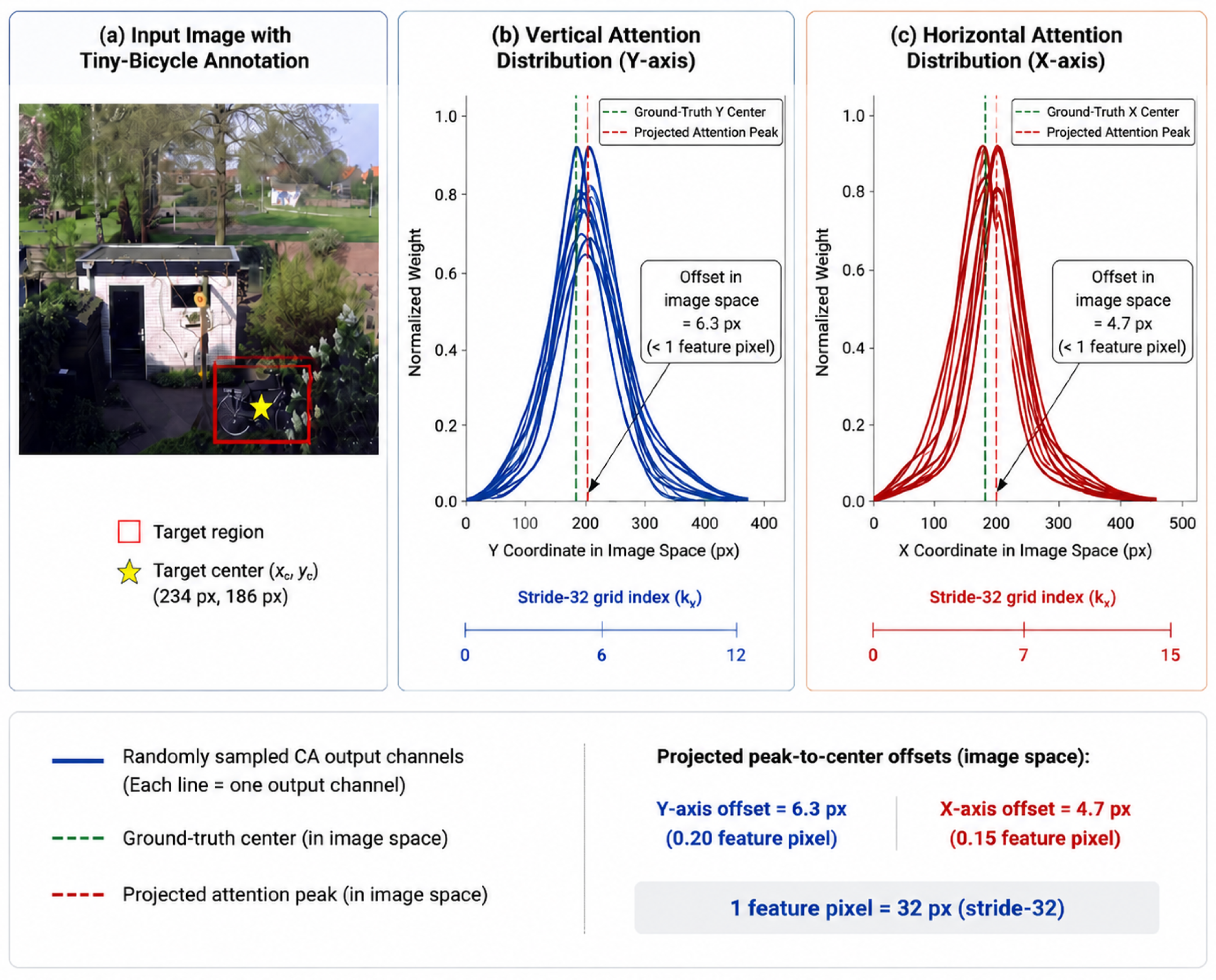
Figure 3 and
Figure 5 show representative bicycle examples rather than balanced samples.A confirmatory study should match person and bicycle instances by area, occlusion, and pose; quantify aspect ratio, foreground occupancy, contour or edge density, and texture complexity; and compare class-conditioned activation
, activation-box IoU, localization error, and feature embeddings with uncertainty estimates. Accordingly, the present manuscript treats category-dependent mechanisms as hypotheses and does not claim that shape, texture, occlusion, or scale has been established as a cause.
The available visual evidence permits only a limited examination of missed detections and feature-activation concentration.
Figure 3 presents a representative tiny-bicycle case in which the baseline produces weak and spatially dispersed activation, whereas the post-SPPF CA variant produces a more concentrated response around the annotated target.
Figure 5 includes selected bicycle and crowded-person examples in which the proposed model recovers targets missed by the baseline. However, these examples were selected for illustration rather than sampled through a balanced category-by-scale protocol. The recovery of some difficult person instances is also insufficient to establish a category-level improvement. Moreover, the available figures do not support a quantitative false-positive taxonomy, and no class-conditioned error counts, confidence-threshold curves, or matched shape statistics were retained. The visual results are therefore consistent with, but do not prove, the hypothesis that directional encoding can emphasize thin or spatially separated structures.
4.5. Qualitative Analysis
Figure 5 presents qualitative results and Grad–CAM (Gradient-weighted Class Activation Mapping) visualizations [
18] for three representative challenging cases in the validation set: long-distance dense pedestrian scenes, mixed bicycle/pedestrian scenes, and visually occluded or heavily cluttered targets.
In the selected examples, YOLOv11m–CA detects targets missed by the baseline and produces more concentrated Grad–CAM responses, including in bicycle and crowded-person cases. These visualizations are consistent with coordinate-preserving behavior but are illustrative rather than a balanced category-conditioned experiment. Because the examples were not matched by scale, aspect ratio, texture, pose, or occlusion, they cannot establish a category-specific mechanism.
4.6. Resource Efficiency and Measurement Boundaries
YOLOv11m–CA achieves 90 FPS under the reported inference protocol on an RTX 4060 Laptop GPU, with 19.07M parameters and 66.9 GFLOPs. The parameter and FLOP values characterize model-side complexity, whereas the FPS value characterizes throughput only in this single GPU environment. No inference experiment was conducted on an embedded platform, and no measurement is available for target-device latency, latency variance, peak inference memory, power, energy per inference, or thermal stability. Consequently, the RTX 4060 result cannot be converted into or used to predict on-device performance. Embedded execution may differ substantially because of memory bandwidth, operator support, kernel implementation, numerical precision, inference engine, power mode, and preprocessing and postprocessing overhead. These results identify a lower-complexity candidate and show potential for future deployment evaluation, but they do not demonstrate edge-device readiness or suitability for a specific embedded platform.
Training was performed offline on the same single GPU using the configuration reported in
Section 4.1. The original runs did not log wall-clock time, peak allocated or reserved VRAM, instantaneous or average board power, or cumulative energy; consequently, no numerical claim is made regarding training speed, memory footprint, or energy efficiency. In particular, the GPU’s 8 GB memory capacity is not treated as observed peak consumption. A complete lifecycle comparison requires rerunning the baseline and proposed model under identical conditions while recording time per epoch, total training time, peak memory, average power, and energy. The current evidence therefore supports only the narrower conclusion that the replacement strategy reduces parameter count and inference FLOPs while maintaining high inference throughput on the tested GPU.
4.7. Within-Ecosystem Validation on VOC 2007
Evaluation on VOC 2007 without fine-tuning is included as a consistency check under a related data source and annotation ecosystem. Because VOC 2007 and VOC 2012 share benchmark conventions and broadly related image characteristics, this experiment does not constitute cross-domain validation. The results are shown in
Table 7.
On the VOC 2007 subset, YOLOv11m–CA and the baseline obtain the same mAP@50 of 81.6%. The observed differences are percentage points for mAP@50–95, points for , points for precision, and points for recall. Because repeated-run confidence intervals and significance tests were not obtained for this evaluation, these differences are descriptive and do not establish statistically significant improvement.
The unchanged aggregate mAP@50 and the higher are not necessarily contradictory because they summarize different evaluation scopes. mAP@50 aggregates performance across the evaluated categories and object sizes, whereas isolates instances within the small-object range. A gain confined to small instances may therefore be diluted or offset by limited or negative changes among other sizes or category-specific cases. However, size-conditioned AP for medium and large instances and run-level predictions were not retained for VOC 2007, so the source of the unchanged aggregate mAP@50 cannot be isolated. The simultaneous increase in recall and decrease in precision at the configured operating point is consistent with recovering more difficult instances while also admitting more false-positive detections, although confidence-threshold curves were not retained to verify this interpretation directly. The result is therefore characterized as a scale-selective within-ecosystem signal rather than an overall cross-year improvement.
Because this evaluation remains within the PASCAL VOC ecosystem, it provides limited evidence of a scale-conditioned effect across related data rather than evidence of generalization to traffic monitoring, dense surveillance, aerial imagery, or other unseen domains. On VOC 2007, the identical mAP@50 of 81.6% for the baseline and YOLOv11m–CA shows that the primary accuracy advantage observed on the filtered VOC 2012 subset is not reproduced in this related split. The observed increases in mAP@50–95, , and recall, together with the decrease in precision, should therefore be interpreted as a descriptive scale-conditioned recall–precision trade-off rather than as an overall cross-year improvement. The aggregate performance advantage is consequently split-dependent. The unchanged model-side complexity and the 90-FPS throughput measured on the RTX 4060 Laptop GPU describe the tested implementation and hardware only; they do not establish embedded-device latency, energy efficiency, or deployment readiness. The proposed model should therefore be regarded as a lower-complexity candidate with potential for future deployment evaluation, not as a validated edge-deployment solution.
4.8. Discussion
The cross-year results further delimit the interpretation of the proposed method. The preserved difference suggests that the effect of coordinate-aware replacement may be concentrated in small-instance representation, but the unchanged mAP@50 shows that this effect does not translate into a uniform aggregate advantage across the two VOC subsets. The accompanying recall increase and precision decrease further indicate that the method changes the error balance rather than improving every aspect of detection simultaneously. This pattern may justify further investigation in recall-sensitive small-object settings, but it cannot support an application recommendation unless the precision cost, confidence-threshold behavior, and false-positive distribution are evaluated explicitly. Because VOC 2007 and VOC 2012 share related annotation conventions and image characteristics, dedicated cross-domain benchmarks and repeated runs remain necessary to determine whether the scale-conditioned effect generalizes beyond the PASCAL VOC ecosystem.
The principal limitation of this study is external validity. The evaluation is confined to two categories from PASCAL VOC, a general-purpose benchmark that does not represent the density, camera geometry, scale distribution, or environmental variation of dedicated traffic, surveillance, and aerial datasets. The additional VOC 2007 evaluation remains within the same benchmark ecosystem. Consequently, neither experiment establishes cross-domain generalization. Dataset bias may also affect performance [
19], and category-specific behavior cannot be assumed to recur under different viewpoints or target distributions.
Configuration provenance imposes an additional limitation. The archived records do not preserve the complete-model definitions and operator-level profiler outputs for the former mid-backbone, neck, and pre-head CA variants. Their parameter and throughput patterns cannot be reconciled with a position-only change, and the exact replaced operations cannot be reconstructed reliably. The former placement table and its associated heatmap comparison have therefore been withdrawn. This reduces the experimental breadth of the study but prevents an unverifiable and potentially confounded comparison from supporting the conclusion. The retained architecture-level evidence is restricted to configurations whose replacement or append operations are explicitly defined, including the reduction ratio variants, directional-component variants, and the C2PSA-retaining append versus C2PSA-to-CA replacement comparison.
Training protocol provenance further limits the former attention module comparison. Its baseline and CA rows reused the main-experiment results obtained with a 10-epoch backbone-freezing stage, whereas the subsection described an all-unfrozen schedule; the available archive does not verify one common schedule for the SE, ECA, and CBAM rows. The attention module table and its associated feature-statistics comparison have therefore been withdrawn. This reduces comparative breadth but avoids converting reused or protocol-ambiguous results into an unsupported attention ranking. SE, ECA, CBAM, SimAM, Shuffle Attention, and EMA are retained only as literature context pending future same-schedule reproduction.
Within this external validity constraint, the practical value of the present experiment is design screening rather than application validation. By holding the dataset, training schedule, evaluation implementation, and hardware environment constant, the study isolates whether replacing the official post-SPPF C2PSA block with CA provides a sufficiently favorable accuracy–complexity trade-off to justify more costly domain-specific evaluation. A staged external validation program should use CityPersons [
21] to examine street-view pedestrian scale variation and occlusion, CrowdHuman [
30] to examine dense human overlap, and VisDrone [
31] to examine aerial viewpoints and tiny-object variation. Such evaluation should distinguish zero-shot transfer from dataset-specific retraining and report per-class, scale-conditioned, and occlusion-conditioned metrics, repeated-run uncertainty, and latency and memory consumption on the intended deployment hardware. Until these evaluations are completed, YOLOv11m–CA should be regarded as a lower-complexity candidate architecture rather than a validated traffic-, campus-, crowd-, or aerial-monitoring solution.
Within these boundaries, the contribution remains useful but modest. The study does not introduce a new attention mechanism; it provides controlled evidence that replacing the official post-SPPF C2PSA block with CA can improve selected small-instance metrics while reducing model complexity. The finer subdivision at
in
Table 3 is exploratory and study-specific rather than an official COCO category. All size strata are assigned from original-coordinate bounding-box area rather than separate width/height limits or post-letterbox box dimensions, which is particularly important for elongated bicycle boxes. Because size-bin prediction records were not retained, bin-specific precision, recall, F1-score, confidence intervals, and significance tests remain unavailable; the corresponding AP differences are therefore descriptive. This is an incremental architecture-integration result and a testable candidate design, not a validated traffic monitoring or aerial-detection solution. Dedicated evaluation on datasets such as CityPersons, CrowdHuman, or VisDrone should prespecify scale bins and retain per-instance predictions before application-level claims are made.
Comparative breadth remains limited. No published YOLO–CA or external small-object detector was reproduced under the complete experimental protocol used here. Externally reported numerical values and the former mixed-protocol comparison tables were therefore removed rather than qualified as if they constituted controlled evidence. The remaining quantitative comparisons are confined to the baseline and architectural variants implemented within this study. The append-style configuration in
Table 6 isolates integration strategy within the present codebase and is not a surrogate for reproducing a published YOLO–CA detector. Recent detectors and unimplemented attention mechanisms are cited solely to describe the research context. Consequently, the present results do not establish superiority over external methods, a comprehensive attention ranking, or state-of-the-art performance. Future work requires source-verified implementations retrained under identical data, optimization, evaluation, and hardware conditions, with run-level uncertainty and complete complexity and latency reporting.
Hardware evidence is limited to inference throughput on an RTX 4060 Laptop GPU. Embedded latency, latency variance, inference memory, power consumption, energy per inference, thermal behavior, and operational robustness remain unmeasured. Parameter count and FLOPs are useful indicators of model-side complexity, but they are not substitutes for on-device measurements. A credible deployment study should evaluate the baseline and proposed model on at least one explicitly identified embedded platform under the same runtime, compiler, numerical precision, batch size, power mode, warm-up procedure, and synchronization method. It should report preprocessing, inference, postprocessing, and end-to-end latency; median and tail latency; throughput; peak memory; power; energy per inference; and accuracy after any quantization or graph optimization. Until such evidence is available, the proposed architecture should be described as a candidate for deployment evaluation rather than an edge-ready detector.
Training-phase telemetry is also unavailable. Wall-clock training time, peak allocated or reserved VRAM, board power, and cumulative energy were not recorded, and the GPU’s 8 GB physical capacity is not a measurement of peak training-memory consumption. Consequently, neither edge-training feasibility nor complete lifecycle resource efficiency has been demonstrated.
4.9. Potential Category Dependence: Interpretation and Limitations
The available archive does not support a self-consistent reconstruction of class-conditioned AP from one traceable evaluation source. The revised manuscript therefore does not quantify a larger gain for either category or claim category-specific superiority. Directional encoding could plausibly interact with aspect ratio, contour and texture content, pose, occlusion, surrounding context, baseline difficulty, and scale distribution within the small-object range. However, class-conditioned error counts and matched shape statistics are unavailable, so the present evidence cannot determine whether any of these factors produces a category difference.
The scale-conditioned diagnostic pools categories, and the feature visualizations are illustrative. Consequently, neither analysis establishes a category-conditioned performance association or its cause. A factorial or matched-sample analysis with class-conditioned performance and feature measurements is required to test the proposed mechanisms.
5. Conclusions
This study investigated YOLOv11m–CA as a complexity-aware replacement strategy for coordinate-sensitive enhancement in a filtered VOC person and bicycle setting. Rather than proposing a new attention mechanism, the method replaces the post-SPPF C2PSA block with CA and evaluates this explicitly defined configuration through retained directional-component, reduction ratio, and append-versus-replacement comparisons. The study does not claim a verified ranking of CA insertion positions or attention mechanisms.
Within the evaluated VOC 2012 distribution, YOLOv11m–CA shows higher observed mAP@50, mAP@50–95, and while reducing the reported parameter count. The available records do not support a category-specific superiority claim. On VOC 2007, the proposed model retains no mAP@50 advantage over the baseline, although higher observed mAP@50–95, , and recall are accompanied by lower precision. The VOC 2007 experiment therefore indicates a scale-selective recall–precision trade-off rather than uniform cross-year improvement. Consequently, the aggregate accuracy advantage observed on VOC 2012 should be regarded as split-dependent and should not be interpreted as evidence of generalization beyond the PASCAL VOC ecosystem.
These findings are confined to the evaluated data distributions and retained internal controls; they do not demonstrate state-of-the-art attention performance or effectiveness in dense surveillance, traffic monitoring, aerial, or edge-device environments. The practical significance of this study lies in identifying a lower-complexity candidate architecture and testable hypotheses about possible category differences for subsequent validation, rather than in introducing a new attention mechanism. Further validation requires complementary algorithmic, cross-dataset, and deployment evidence. CA should be compared with SimAM, Shuffle Attention, EMA, and other prespecified lightweight modules under identical training and evaluation conditions, using replacement-style and, where structurally appropriate, append-style integration with repeated runs and uncertainty estimates. External validity should be assessed using CityPersons [
21] for street-view pedestrian scale variation and occlusion, CrowdHuman [
30] for dense human overlap, and VisDrone [
31] for aerial viewpoints and tiny-object conditions. Because these benchmarks represent different application domains, their results should be reported separately by dataset, category, object scale, and occlusion level rather than combined into a single application-level claim. Deployment-oriented evaluation should test the baseline and proposed model on at least one named embedded platform and report the runtime, numerical precision, batch size, power mode, end-to-end latency distribution, throughput, peak inference memory, power, energy per inference, thermal behavior, and accuracy after device-specific optimization. Training-resource evaluation should separately report training time, peak training VRAM, average power, and cumulative energy consumption. Broader performance or deployment claims should be reserved until this evidence becomes available.