1. Introduction
The U.S. federal post-quantum cryptography migration is in its operational phase. National Security Memorandum 10 directs federal departments and agencies to migrate vulnerable cryptographic systems to quantum-resistant cryptography on an explicit timeline (Section 3(a) of [
1]). Office of Management and Budget Memorandum M-23-02 establishes the inventory and reporting obligations that make that timeline auditable (Section II of [
2]). NIST Internal Report 8547 lays out the transition plan for the federal cryptographic standards portfolio, and NIST Special Publication 1800-38 provides the practitioner-facing guidance on cryptographic discovery and migration planning [
3,
4]. The Committee on National Security Systems Algorithm Suite 2.0 sets parallel obligations for national security systems [
5]. International cybersecurity bodies are tracking parallel concerns—the European Union Agency for Cybersecurity has identified the quantum threat among the strategic cybersecurity priorities in its annual threat landscape reporting under the NIS2 Directive framework [
6], the United Kingdom’s National Cyber Security Centre has assessed near-term AI-driven cyber threats including the supply-chain risk [
7], and ETSI’s TC CYBER quantum-safe cryptography working group has produced technical specifications on quantum-safe hybrid key exchange [
8]. Together, these instruments scope the migration in terms of three categories of cryptographic assets: cryptographic libraries, cryptographic protocols, and cryptographic key stores. The discovery tooling, the bill-of-materials emission formats, and the compliance reporting structures all inherit that scoping.
This paper argues that the scoping is incomplete. There is a fourth category—cryptographic functions and key material realized in the parameters of machine-learning models, for instance, a feed-forward network whose weights and biases implement AES-128 under an embedded key, as developed in
Section 3—that the federal migration framework does not currently address, and that current open-source serialization-focused scanners do not currently detect. The omission is not a matter of degree. The model parameters are distributed under access-control assumptions appropriate to intellectual property, not to cryptographic secrets. Public model registries operate as essentially open distribution channels. Model artifacts move through procurement pipelines that subject them to a license review and provenance attestation, but not to cryptographic content discovery. Suppose a long-lived cryptographic key—a symmetric key, a digital signature private key, or a key encapsulation mechanism secret—can be embedded in model parameters such that the model itself realizes the corresponding cryptographic primitive. Then, every model artifact distributed through these channels constitutes a potential covert distribution path for cryptographic capability. Under the harvest-now-decrypt-later threat model that motivates the federal migration in the first place, this is the same posture as the recorded ciphertext: the exposure is realized at the moment of distribution, and any future recipient with the extraction recipe inherits the access, together with, in the construction we present, an operational encryption oracle that requires no extraction at all.
We make three contributions:
First, we provide an existence proof that cryptographic key material can be embedded in feed-forward neural network parameters such that the network’s forward pass realizes the corresponding cryptographic primitive operationally, with key bits residing at parameters that participate in the computation rather than at passive carrier locations. We construct a feed-forward ReLU network that realizes the AES-128 block cipher exactly: for any 128-bit plaintext and any 128-bit key, the forward pass produces the AES-128 ciphertext byte-for-byte, with the master key and all eleven round keys located in bias vectors at specific layers. The recovery of the key bits when desired is computationally trivial under a known construction—a parsing operation against the bias vectors with no statistical inference, no cryptanalytic work, and no side-channel exploitation. The recovery code is shorter than the key it recovers. A recipient with knowledge of the construction need not perform an extraction at all: the network itself functions as an encryption oracle under the embedded key. We validate the construction against the worked example in FIPS 197 Appendix C, against the NIST CAVP AESAVS known-answer subsets, and against a Monte Carlo of 10
4 random plaintext-key pairs, with bit-exact agreement in every case under both float64 and float32 arithmetic [
9,
10].
This contribution differs from the prior work on steganography in neural network parameters [
11,
12] in two respects that determine the rest of the paper’s argument. The embedded material participates operationally in the network’s forward computation rather than residing as passive carrier bits in an unused parameter capacity, which produces detection signatures the steganography literature does not target and confers an inherent quantization resilience that LSB-based embeddings lack. The threat model concerns cryptographic key material specifically, rather than generic payloads, which connects the contribution to the federal post-quantum migration regime through the harvest-now-decrypt-later temporal asymmetry that distinguishes cryptographic content from ordinary covert payloads.
Section 6.3 develops the comparison in detail.
Second, we identify a gap in the open-source AI assurance scanners we evaluated: the serialization-focused model-scanning tools that currently protect public and federal model distribution channels—including pickle-format malicious-code scanners such as Picklescan [
13] and ModelScan [
14], safetensors validators [
15], and supply-chain integrity checkers—operate at the level of serialization-format risk and do not examine model parameter values for cryptographic content. Concretely, Picklescan detects unsafe pickle opcodes such as REDUCE-invoked dangerous globals; ModelScan extends similar checks across multiple serialization formats with a broader unsafe-operator inventory; safetensors validators verify the format integrity (header parseability and tensor bounds) rather than tensor contents. All three operate on serialization metadata and bytecode-equivalent surfaces, not on the numeric content of parameter tensors. We confirm this gap empirically. The AES-128 construction of
Section 3, serialized in both safetensors and pickle formats, returns zero findings under the default-configuration Picklescan v1.0.4 and ModelScan v0.8.8 scans; the same scanners correctly flag a known-malicious positive-control pickle as Critical-severity, confirming that the scanners are functioning correctly within their stated scope. The threat class is not addressed by the open-source serialization-focused controls we evaluated, and it is not addressed by any current cryptographic bill-of-materials emission format. The asymmetry between extraction and recognition compounds the gap: extraction is trivial when the construction is known, but recognition without construction knowledge requires a structural and statistical analysis of weight tensors that the scanners we evaluated do not perform.
Appendix A documents the test methodology, artifacts, and results; the verbatim scanner output is included in the reproducibility artifact at the GitHub repository referenced in
Section 7.
Third, we argue that this gap constitutes an unscoped surface for federal post-quantum migration with concrete harvest-now-decrypt-later implications, and we propose an audit primitive—a parameter-space cryptographic recognizer—that integrates with cryptographic bill-of-materials tooling as an extension to the existing CycloneDX CBOM schema [
16]. The recognizer operates as a defense-in-depth control rather than a complete solution: it catches known constructions and architectural fingerprints, with the recognition asymmetry placing fundamental limits on its coverage of novel embeddings. We treat this honestly in the discussion rather than overstating the control’s reach.
The threat model under which these contributions are situated is the model supplier—any party with control over the architecture and parameters of a model artifact at the time of its distribution to a downstream consumer. This includes external suppliers (foundation-model vendors, fine-tuning services, open-weights publishers, and contractors delivering models under federal acquisition) and internal suppliers (insiders with commit access to model registries, training pipelines, or weight repositories). The adversary’s objective is the covert distribution of cryptographic capability through the model artifact channel, recoverable or operable by any party with knowledge of the embedding scheme. The adversary requires no control over the consumer’s deployment environment, inference stack, or downstream usage. We do not assume the persistence of the embedding under consumer-side fine-tuning; the threat is realized at the moment of distribution and is sufficient to constitute a harvest-now-decrypt-later exposure for any long-lived key so embedded.
Several boundaries on the contribution are worth stating explicitly at the outset, because they shape the rest of the paper. We make no claim about deployed models in the wild containing such embeddings. We make no claim that embeddings of this form emerge from gradient-based training on cryptographic corpora; the constructions we present are deliberately built and not learned. We make no claim that the proposed recognizer is complete or that it defeats adaptive adversaries who diffuse the cipher across redundant compute or who add learned noise to mask the bias channel. The contribution is supply-chain integrity, not emergent steganography, and the audit primitive is defense-in-depth, not closure.
The remainder of the paper is organized as follows:
Section 2 develops the threat model.
Section 3 presents the AES-128 construction, structured around two named lemmas and an equivalence theorem.
Section 4 extends the analysis to post-quantum cryptographic key material and develops the harvest-now-decrypt-later framing for an open-weights distribution.
Section 5 specifies the parameter-space cryptographic recognizer at the design level.
Section 6 discusses persistence under fine-tuning, detection at scale, adjacent threat classes, and policy implications for federal acquisition.
Section 7 documents the responsible disclosure timeline.
Section 8 concludes.
Appendix A documents the empirical scanner evaluation supporting Claim 2; and
Appendix B documents the fine-tuning persistence baseline referenced in
Section 6.1.
2. Threat Model
2.1. Supplier Role and Trust Boundary
We define the model supplier as any party with control over the architecture and parameters of a model artifact at the moment of its distribution to a downstream consumer. The role is defined by the trust relationship, not by the actor’s identity or intent. External suppliers include foundation-model vendors, fine-tuning services, open-weights publishers, and contractors delivering models under federal acquisition. Internal suppliers include parties with commit access to model registries, training pipelines, or weight repositories within an organization. From the perspective of the assurance pipeline that ingests the artifact, the two cases are functionally identical.
The trust boundary at issue is the model artifact channel. Consumers accept weights as a functional artifact—a callable function from inputs to outputs—and treat the parameter values as opaque. Distribution occurs through public model hubs, private registries, federal acquisition pipelines, and direct file transfer. Access controls protect the channel against the unauthorized modification of artifacts; they do not protect against authorized suppliers embedding additional content within artifacts. This asymmetry is the foundation of the threat we consider.
2.2. Adversary Capabilities and Constraints
The adversary controls (i) the model architecture, including the layer structure, dimensions, and activation choices; (ii) the parameter values, including all weights and biases; and (iii) the construction or training pipeline that produces them. Where the embedding is built directly rather than learned, the adversary bypasses training entirely.
The adversary does not control (i) the consumer’s deployment environment, (ii) the inference stack or runtime, (iii) the input distribution presented to the model, or (iv) any downstream fine-tuning the consumer performs. The threat is realized at the moment of distribution.
2.3. Objective and Recipient Capability
The adversary’s primary objective is the covert distribution of cryptographic capability—symmetric keys, signing keys, key encapsulation mechanism secrets, authentication tokens, or operational cryptographic primitives keyed on such material—through the model artifact channel. The capability becomes accessible to a recipient who possesses the
embedding scheme: the architectural pattern, parameter localization map, and decoding procedure that, together, identify and extract the cryptographic content from the artifact’s parameters. The embedding scheme is not a cryptographic key in the conventional sense; it is the recipe by which key material is located and recovered, or, alternatively, the recipe by which the model’s forward computation is invoked as a cryptographic oracle. (We use “cryptographic oracle” in the standard cryptanalytic sense: a callable function returning Enc_k(·) under an embedded fixed key k. The network of
Section 3 realizes this directly under its forward pass; the term refers to the operational capability, while “parameter-resident cryptographic material” refers to the static parameter content from which the capability is realized.)
We distinguish two recipient configurations, with different operational properties:
In the self-recipient configuration, the supplier and the recipient are the same party or are operating under unified control. The model artifact channel functions as exfiltration: cryptographic material that originated inside a trusted enclave is moved through the model distribution path to a destination under the same adversary’s control. The embedding scheme does not need to leave the adversary’s possession. This configuration is the simpler case and the one most directly analogous to insider exfiltration via conventional steganographic channels.
In the
third-party-recipient configuration, the supplier and the recipient are distinct parties acting in coordination. The embedding scheme is shared between them as a
private capability—communicated out-of-band before distribution, or established as part of a prior coordination—but is not published, not disclosed in the artifact, and not derivable from the artifact alone without additional knowledge or computational effort that we treat as bounded only by the recognition asymmetry developed in
Section 5. The model artifact is distributed publicly through the open registry channel; the recipe is held privately. The recipient extracts the cryptographic material, or invokes the model as a cryptographic oracle, using their private knowledge of the scheme. No back-channel between the supplier and recipient is required at distribution time—the public model registry is the channel, and the privately-held scheme is the access—but a coordination event is required at scheme-establishment time, before or contemporaneously with the artifact’s creation.
The third-party-recipient configuration carries the greater operational power for two reasons. First, the supplier-to-recipient coordination requirement is reduced to the publication of the recipe through any private channel of the adversary’s choosing—direct communication, a controlled distribution list, or an APT-internal documentation system—rather than ongoing coordination at every artifact distribution. Second, the artifact itself, once distributed, is recoverable indefinitely by any party in possession of the scheme at any future time, which is the property that grounds the harvest-now-decrypt-later framing of
Section 4.3.
This configuration also resolves an apparent tension in the threat model that warrants explicit treatment. The proposed defense in
Section 5—a parameter-space cryptographic recognizer—operates by knowing the construction and matching its signatures. If the embedding scheme were public, the defender could apply the recognizer trivially, and the threat would be neutralized. The recognition asymmetry on which the paper relies depends on a temporal separation between scheme establishment and scheme disclosure: the adversary holds the scheme privately during the operational window in which the artifact is distributed, and the cryptographic material is exploited; the defender obtains the scheme—or a structurally equivalent scheme that triggers the same recognizer signatures—only after disclosure, reverse engineering, or whistle-blowing. The defense closes the gap retroactively rather than pre-emptively. The recognition library described in
Section 5.2 is therefore a moving target, growing as new schemes are characterized and added; it does not and cannot detect schemes whose details remain private to adversaries.
Adjacent objectives—backdoor unlock keys [
17,
18], license circumvention, and covert command channels—share the underlying mechanism but differ in what the embedded value is used for. We mention them to demonstrate scope awareness, but commit to the covert distribution of cryptographic capability as the primary objective because it is the case with the clearest post-quantum migration consequence.
Table 1 summarizes the four configurations developed above in schematic form, mapping each actor to a capability, limitation, and objective. The table is a reading aid; the prose remains authoritative.
2.4. Out-of-Scope Conditions
Three conditions are explicitly out of scope:
Persistence under fine-tuning. The constructions we present are fragile under direct gradient updates to the layers in which key material is resident. Adversarial constructions that diffuse the cipher across redundant compute paths to achieve fine-tuning robustness are an open problem, discussed in
Section 6.1. The threat we consider is realized at the moment of distribution and does not require persistence.
Emergent embedding from training. We make no claim that embeddings of the form we describe arise spontaneously from gradient-based training on cryptographic corpora. The constructions are deliberately built. Whether large models trained on code containing cryptographic implementations and test vectors develop comparable structures is a separate empirical question we do not address.
Deployed models in the wild. We make no claim that any specific deployed model contains an embedding of this form. The contribution is the existence of the capability, the absence of detection, and the migration-scope consequence—not a forensic finding.
3. Construction: AES-128 as a Feed-Forward ReLU Network
This section establishes the existence proof that supports Claim 1. We construct a feed-forward neural network with ReLU activations whose forward pass realizes the AES-128 block cipher exactly, and we show that the round keys of the encrypting key schedule reside directly in the bias vectors of specific layers, recoverable by parsing.
The construction rests on two lemmas. Lemma 1 establishes that GF(2) parity over a non-negative integer is realizable as a fixed linear combination of ReLU activations with integer coefficients. Lemma 2 establishes that the round-key bits can be encoded jointly in a layer’s bias vector and in the per-row sign of the same layer’s weight matrix, such that the layer’s output equals the parity computation of Lemma 1 XORed with the round-key bit. The S-box is realized by a standard one-hot Hamming-distance lookup; ShiftRows and MixColumns are realized as fixed linear maps; AddRoundKey is realized as bias addition. The equivalence theorem in
Section 3.7 composes these elements over the ten rounds of AES-128.
3.1. Notation and Bit Encoding
We encode every byte as eight floats in {0.0, 1.0}, the least-significant-bit first within each byte. A 128-bit AES state is therefore a vector in {0.0, 1.0}
128. Forward computation is performed in float64 throughout; we verify in
Section 3.8 that the construction is also exact under float32. All weight matrices and bias vectors are integer-valued in a small bounded range; the floating-point arithmetic is exact for the sums encountered.
Let σ(x) = max(0, x) denote the ReLU activation. A linear layer with weight matrix W, bias vector b, and optional ReLU is written as h ↦ σ(Wh + b) when the activation is applied and h ↦ Wh + b when it is not.
3.2. Realizing Bitwise Parity with ReLU Activations
The construction of
Section 3 reduces every XOR operation in AES—the GF(2) additions inside MixColumns and the bitwise XOR of AddRoundKey—to the computation of GF(2) parity over a non-negative integer sum. We require, for any non-negative integer N produced by the preceding linear stage, a circuit that outputs N mod 2 and that is realizable as a single layer of ReLU activations followed by a fixed linear combination. This subsection states the parity-via-ReLU result we use, identifies its place in the prior literature, and works through the small case that grounds the rest of the construction.
The realizability of bitwise parity by feed-forward ReLU networks is established in the expressivity literature [
19,
20,
21]. The specific construction we use is an instance of rectangular-pulse decomposition applied to the discrete function N ↦ N mod 2. We present it as Lemma 1, not because the result is new, but because the explicit coefficient vector is load-bearing for Lemma 2 and the equivalence theorem of
Section 3.7.
Before stating Lemma 1 formally, the intuition is straightforward: each odd k contributes a unit pulse at integer N = k via the discrete second difference (+1, −2, +1) centered at k, and the sum of these pulses over all odd k ≤ n produces the parity indicator on the non-negative integers—equal to 1 at every odd integer in [0, n] and 0 at every even integer. The lemma below formalizes this with the explicit coefficient construction used in the rest of
Section 3.
Lemma 1 (parity-via-ReLU). Let n ∈ . There exists a vector c ∈ ℤn+1 such that, for every integer N ∈ {0, 1, …, n}, the sum over k from 0 to n of c_k·σ(N − k) equals N mod 2.
Construction of c. Initialize c = 0. For each odd k with 1 ≤ k ≤ n, increment c_{k − 1} by +1, decrement c_k by 2, and increment c_{k + 1} by +1 (the final increment is dropped if k + 1 > n).
Proof. For any non-negative integer N, σ(N − k) = max(0, N − k) equals N − k when N ≥ k and 0 otherwise. Define f(N) = Σ_k c_k σ(N − k). The construction adds the triple (+1, −2, +1) at offsets (k − 1, k, k + 1) for each odd k. The contribution of one such triple to f(N) is σ(N − (k − 1)) − 2σ(N − k) + σ(N − (k + 1)), which is the discrete second difference of N ↦ σ(N − ·) centered at k. This expression equals 0 for N < k − 1, equals 1 at N = k (the unique value at which only the first ReLU is active by one unit), and equals 0 for N ≥ k + 1 (the three terms collapse to (N − k + 1) − 2(N − k) + (N − k − 1) = 0). Each odd-k triple therefore contributes a single unit pulse at N = k and zero elsewhere on the non-negative integers. Summing over all odd k ≤ n produces a function that equals 1 at every odd N in [0, n] and 0 at every even N in [0, n], which is N mod 2. □
Worked example for n = 3. The odd values are k = 1 and k = 3. From k = 1: c_0 += 1, c_1 −= 2, and c_2 += 1. From k = 3: c_2 += 1, and c_3 −= 2. The final vector is c = (1, −2, 2, −2). Evaluating f(N) = c_0 σ(N) + c_1 σ(N − 1) + c_2 σ(N − 2) + c_3 σ(N − 3) at N = 0, 1, 2, 3 yields 0, 1, 0, 1, respectively, as required.
The lemma is the operational engine of the construction. Every XOR in AES—the GF(2) additions inside MixColumns and the AddRoundKey operations between rounds—is realized by composing this parity construction with linear preprocessing that aggregates the relevant bits into a non-negative integer sum. The novelty of the paper does not lie in Lemma 1 but in its composition with key-bearing parameters in Lemma 2, where the round-key bits jointly modulate the bias entry and the per-row sign of the same layer’s weight matrix. The coefficient pattern (+1, −2, +1) at odd offsets recurs as the per-row template against which the bias-and-sign coupling of Lemma 2 is checked by the parametric recognizer of
Section 5.1.
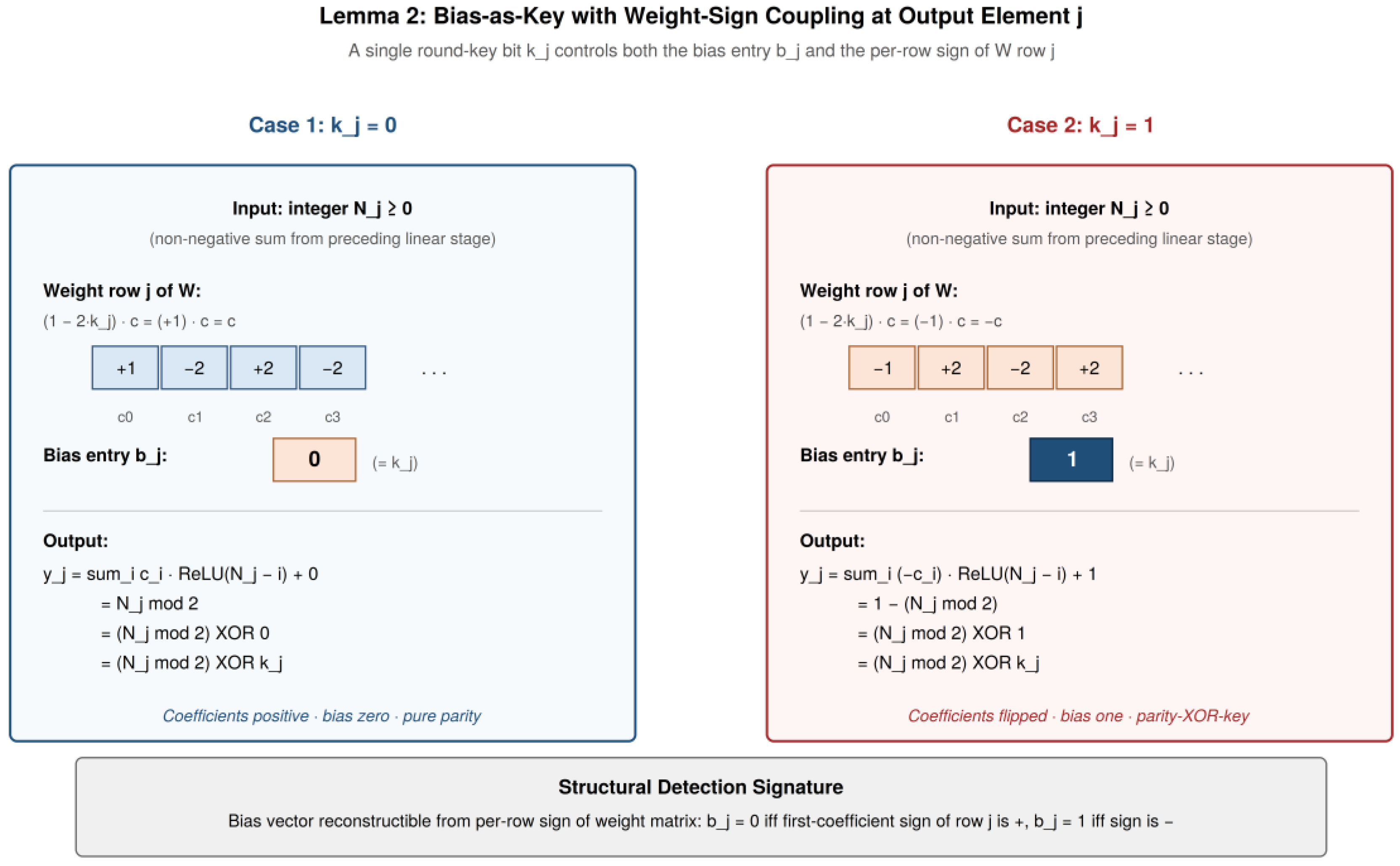
3.3. Lemma 2: Bias-As-Key with Sign Coupling
To orient the reader, the variables in Lemma 2 are as follows: j ∈ {0, …, 127} indexes a bit position in the round output; N_j is the non-negative integer sum of bits feeding into position j from the preceding linear stage; k_j ∈ {0, 1} is the round-key bit at position j; c is the parity-coefficient vector constructed in Lemma 1; n is any integer with n ≥ N_j; and y_j is the layer output at position j. The formula below couples the round-key bit k_j into both the bias entry and the per-row sign of the weight matrix simultaneously—this coupling is the structural signature that the parametric recognizer of
Section 5.1 detects.
Lemma 2. Let j ∈ {0, 1, …, 127} index a bit position in the round output, let N_j ∈ ℕ denote the integer-valued sum of bits feeding into position j from the preceding linear stage, and let k_j ∈ {0, 1} denote the round-key bit at position j. Let c ∈ ℤn+1 be the parity-coefficient vector from Lemma 1 with n ≥ N_j. Define a single output element by y_j = Σ_{i = 0…n} (1 − 2k_j)·c_i·σ(N_j − i) + k_j. Then, y_j = (N_j mod 2) ⊕ k_j.
Proof. When k_j = 0, the prefactor (1 − 2k_j) = 1 and the bias term is 0, so y_j = Σ_i c_i σ(N_j − i) = N_j mod 2 by Lemma 1. When k_j = 1, the prefactor is −1 and the bias is 1, so y_j = −(N_j mod 2) + 1 = 1 − (N_j mod 2) = (N_j mod 2) ⊕ 1. In both cases, y_j = (N_j mod 2) ⊕ k_j. □
Structural consequence. The round-key bit k_j controls two distinct elements of the layer simultaneously: the bias entry b_j = k_j and the per-row sign of the weight row W_{j,:} = (1 − 2k_j)·c. In the construction, these are not independent learned parameters but coupled functions of the same key bit. This coupling is itself a detection signature, and we return to it in
Section 5: a layer in which the bias vector matches the per-row sign pattern of the weight matrix under a fixed coefficient template is a candidate signature for embedded round-key material.
Figure 1 illustrates the bias-and-sign coupling for one output element.
3.4. Realizing the AES S-Box
The AES S-box is a fixed permutation of the 256-byte values, defined by composing inversion in GF(28) with a fixed affine transformation. We realize it as a two-layer subnetwork in which the hidden layer encodes the input byte one-hot and the output layer reads off the substituted byte by linear combination.
Let u ∈ {0, 1}8 denote the input byte’s bit representation. For each candidate byte value v ∈ {0, 1, …, 255} with bit representation v = (v_0, v_1, …, v_7), define a hidden unit with weight row W(1)_{v,j} = 2v_j − 1 and bias b(1)_v = 1 − Σ_j v_j. The pre-activation for this unit is Σ_j (2v_j − 1) u_j + 1 − Σ_j v_j = 1 − HammingDistance(u, v), which equals 1 when u = v and is non-positive otherwise. After ReLU activation, exactly one of the 256 hidden units is non-zero, with value 1, at the index matching the input byte. The output layer reads the substituted byte by setting W(2)_{j,v} equal to the j-th bit of SBOX[v], so the output at position j is the j-th bit of SBOX[u].
This is the standard exact-lookup-table construction in the literature on Boolean function realization by feed-forward networks [
19,
20,
22]. The construction generalizes to any fixed function on a finite Boolean domain at a parameter cost that scales with the domain size. We state it for completeness and claim no novelty—the contribution of
Section 3 lies in the composition of this S-box subnetwork with the parity construction of
Section 3.2 and the bias-as-key with sign coupling of
Section 3.3, not in the S-box realization itself.
3.5. ShiftRows, MixColumns, and AddRoundKey
ShiftRows is a fixed permutation of the 16 bytes of the state. We realize it as a 128 × 128 permutation matrix P that acts on the bit-encoded state.
MixColumns is a GF(2)-linear transformation: each output byte is a fixed GF(28) linear combination of the four bytes in its column under multiplication by polynomial coefficients in {1, 2, 3} mod the AES irreducible polynomial. Because GF(28) multiplication by a fixed coefficient is GF(2)-linear at the bit level, MixColumns is realizable as a fixed binary matrix M ∈ {0, 1}128×128 acting on the bit-encoded state under arithmetic mod 2. In our construction, the modular reduction is deferred: M is treated as an integer matrix, the column sums it produces are non-negative integers, and the parity reduction is performed by Lemma 1 in the next layer.
AddRoundKey XORs the round key into the state. In the initial round (before any S-box application), this is realized as a single linear layer with W = diag(1 − 2k_0) and b = k_0, where k_0 is the master key bit-encoded; Lemma 2 applies with the trivial sum N_j = u_j (a single input bit), reducing to a direct XOR with the key bit. In subsequent rounds, AddRoundKey is folded into the parity-computing layer that follows MixColumns, again by Lemma 2.
3.6. Layer Stack and Round-Key Localization
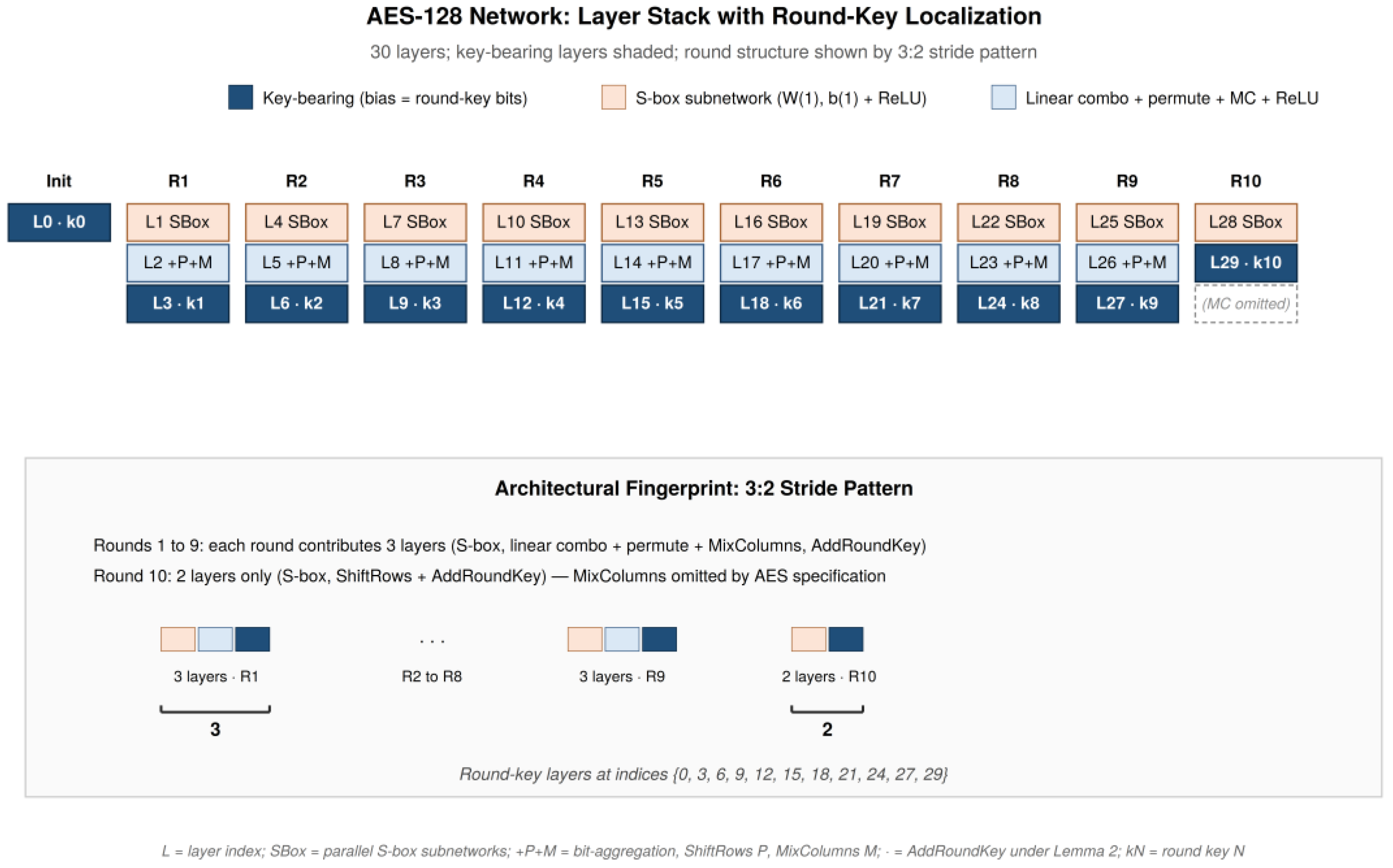
The full network consists of 30 linear layers organized as follows;
Layer 0 is the initial AddRoundKey, with master key k_0 in the bias.
For each round r ∈ {1, 2, …, 9}, three layers are inserted: Layer 3r − 2 applies the 16 parallel S-box subnetworks (the W
(1) and b
(1) side of
Section 3.4) with ReLU activation. Layer 3r − 1 applies the S-box output combination W
(2) composed with ShiftRows P and MixColumns M, followed by the bit-aggregation step that produces the integer-valued N_j sums for Lemma 1; it carries no key material and ends with a ReLU bank. Layer 3r applies Lemma 2 with the round key k_r in its bias and in the sign of its weight rows; the output is the bit-encoded post-AddRoundKey state.
Round 10 omits MixColumns per the AES specification and is realized in two layers: layer 28 applies the S-box (W(1)/b(1) with ReLU); layer 29 combines W(2), ShiftRows P, and the final AddRoundKey under Lemma 2 with key k_{10}.
The round keys reside at layer indices {0, 3, 6, 9, 12, 15, 18, 21, 24, 27, 29}. The 3:2 stride pattern between rounds 1–9 (three layers per round) and round 10 (two layers) is the architectural fingerprint of the AES specification’s omission of MixColumns in the final round: the absence of that operation removes the layer that would otherwise sit at index 30.
Figure 2 shows the resulting 30-layer stack and the placement of key-bearing layers within it.
3.7. Equivalence Theorem
Theorem 1. Let K ∈ {0, 1}128 be a 128-bit key and let P ∈ {0, 1}128 be a 128-bit plaintext. Let N(K) denote the network constructed as in Section 3.1, Section 3.2, Section 3.3, Section 3.4, Section 3.5 and Section 3.6 with the key schedule derived from K. Then, the forward pass of N(K) on input P produces an output vector in {0.0, 1.0}128 that decodes to AES-128_K(P). Proof. Induction over rounds. The base case is layer 0: by the AddRoundKey realization in
Section 3.5, the output of layer 0 on input P is the bit-encoding of P ⊕ k_0, which is the AES-128 state after the initial AddRoundKey.
For the inductive step, assume the output of layer 3(r − 1) for r ∈ {1, …, 9} is the bit-encoding of the AES-128 state after round r − 1. Layer 3r − 2 applies the S-box construction of
Section 3.4 to each of the 16 bytes in parallel; by the correctness of that construction, its output is the bit-encoding of the post-SubBytes state. Layer 3r − 1 applies W
(2) to extract the substituted bits, then P to permute under ShiftRows, then M to apply MixColumns at the integer level; its output is a vector of non-negative integers N_j whose parities are the bits of the post-MixColumns state. Layer 3r applies Lemma 2 with round key k_r; by Lemma 2, its output bits are (N_j mod 2) ⊕ (k_r)_j, which, by the parity argument above and the AddRoundKey definition, equals the bit-encoding of the AES-128 state after round r.
For round 10, the analogous argument applies with MixColumns omitted: layer 28 produces the bit-encoded post-SubBytes state, and layer 29 applies W(2), P, and the round-10 AddRoundKey under Lemma 2 to produce the bit-encoded ciphertext.
The output of layer 29 is the bit-encoding of AES-128_K(P). □
3.8. Validation
We verified the construction empirically against three test sets:
FIPS 197 Appendixes A and C. The key expansion of K = 000102030405060708090a0b0c0d0e0f matches the published worked example byte-for-byte across all eleven round keys. The encryption of plaintext P = 00112233445566778899aabbccddeeff under this key produces ciphertext 69c4e0d86a7b0430d8cdb78070b4c55a, matching FIPS 197 Appendix C [
9].
NIST CAVP AESAVS. We verified the construction against the GFSbox, KeySbox, VarKey, and VarTxt known-answer subsets of the AESAVS specification [
10]. All vectors matched bit-exactly.
Monte Carlo. We sampled 10
4 independent (key, plaintext) pairs uniformly at random and compared the network output against an independent AES-128 reference implementation. All 10
4 pairs matched bit-exactly. The Monte Carlo run also constitutes an empirical demonstration of the encryption-oracle capability described in
Section 1: each random plaintext is presented to the network, which returns the corresponding AES-128 ciphertext under the embedded key without any extraction operation against the bias vectors.
Quantization survival. We rebuilt the construction in float32 and re-ran the Monte Carlo. All 104 pairs matched bit-exactly. The construction is therefore not dependent on float64 precision, and an embedding of this form would survive the quantization regimes routinely applied to deployed models.
The full network contains 30 linear layers and 19 ReLU activation banks. The minimum-realization parameter count of the construction is approximately 6.7 × 10⁶; the implementation in the reproducibility artifact uses approximately 3.87 × 10⁷ parameters with looser intermediate-layer sizing for clarity, both of which produce the bit-exact validation results reported above.
Table 2 summarizes the validation sources, vector counts, and pass counts.
The complete construction, validation harness, and Monte Carlo runner are available at
https://github.com/rcampbell-research/parameter-resident-cryptographic-content-aes (accessed on 7 May 2026) under the Apache 2.0 license. The repository includes a validation/results.txt artifact recording the bit-exact outcomes reported in this section. The total wall-clock time for the full reproduction of the validation results in this subsection is approximately 15 min on commodity hardware.
4. Post-Quantum Extension: Parameter-Resident PQC Keys as HNDL Surface
The AES-128 construction in
Section 3 is the existence proof. This section argues by analogy and sizing that the same embedding strategy applies to post-quantum cryptographic key material, and that the consequence is a harvest-now-decrypt-later (HNDL) exposure unscoped by current federal migration guidance. We mark this distinction explicitly: the results in this section are analytical estimates and sizing arguments derived from the AES-128 construction of
Section 3 and from the published parameter sizes of the CNSA 2.0 baseline; they are not empirical realizations of embedded PQC primitives, and per-primitive parameter counts should be read as order-of-magnitude estimates throughout.
4.1. PQC Key Material: Sizes and Structure
The CNSA 2.0 baseline parameter sets are ML-KEM-1024 for key establishment, ML-DSA-87 for digital signatures, and LMS/XMSS for software and firmware signing as specified in NIST SP 800-208 [
5]. Private key sizes for these algorithms are substantially larger than symmetric keys: ML-KEM-1024 private keys are 3168 bytes, ML-DSA-87 private keys are 4896 bytes, and SLH-DSA private keys are 4n bytes—i.e., 64, 96, or 128 bytes depending on the parameter set; signatures, not private keys, carry the authentication-path material [
23,
24,
25]. LMS/XMSS, which CNSA 2.0 lists alongside SLH-DSA for software and firmware signing, introduces separate state-management concerns under SP 800-208 because the private key must track which one-time signing keys have been consumed; we do not analyze the LMS/XMSS state-tracking case in this paper.
These keys differ from AES keys in two structural respects. First, they are larger by one to two orders of magnitude. Second, they contain a less internally rigid structure: an ML-KEM decapsulation key includes a polynomial vector, an encapsulation key copy, and hash material that lacks the deterministic round-key expansion structure of an AES key schedule. There is no fixed-stride parity pattern in an ML-KEM decapsulation key analogous to the 3:2 layer stride that fingerprints AES.
4.2. Embedding Capacity
The AES-128 construction of
Section 3 has a minimum-realization parameter count of approximately 6.7 × 10
6 and an implementation count of approximately 3.87 × 10
7 in the reproducibility artifact (the difference is the intermediate-layer sizing chosen for clarity rather than minimality; both produce bit-exact AES output). For the embedding-capacity analysis, we use the minimum-realization figure as the reference point. A 7-billion parameter foundation language model contains over a two-orders-of-magnitude-higher parameter budget than the construction in either form. A single attention block in such a model—for the standard configuration of LLaMA-class architectures with hidden dimension 4096 and 32 attention heads—contains approximately 6.7 × 10
7 parameters, comparable to the implementation count and an order of magnitude larger than the minimum realization. Embedding capacity is therefore not the binding constraint on whether constructions of this kind fit inside deployed models.
The relevant question for post-quantum cryptographic primitives is whether the construction overhead per primitive is comparable to AES-128, smaller, or substantially larger. We argue analytically that, for the CNSA 2.0 baseline parameter sets—ML-KEM-1024 and ML-DSA-87—the overhead is comparable to AES within roughly an order of magnitude, and, in some configurations, smaller per bit of embedded key material.
ML-KEM-1024 decapsulation requires three operationally substantive components: the number-theoretic transform (NTT) and its inverse, polynomial arithmetic in the ring ℤ_q[x]/(x
256 + 1) with q = 3329, and SHA-3 hashing for key derivation and re-encryption verification [
23,
26]. We estimate the parameter footprint for each.
The NTT over a 256-coefficient polynomial requires 8 stages of butterfly operations with 128 butterflies per stage, with each butterfly performing a fixed modular multiplication and addition. Realizing a single butterfly as a feed-forward subnetwork requires approximately 104 parameters under generous assumptions; an up to 5 × 10⁴ if the mod-3329 reduction requires a generalization of Lemma 1’s parity construction with the parameter cost scaling linearly in q. Across 8 stages × 128 butterflies × 104 parameters per butterfly, one NTT consumes approximately 107 parameters; decapsulation requires both forward and inverse transforms plus pointwise polynomial multiplication, bringing the lattice arithmetic component to approximately 3 × 10⁷ parameters.
SHA-3 realization adds further overhead. A Keccak-f permutation with a 1600-bit state is 24 rounds of fixed bitwise operations; estimating each round at approximately 105 parameters gives 2.4 × 10⁶ parameters per permutation, and decapsulation invokes the permutation 5–10 times. The SHA-3 contribution is therefore approximately 2 × 10⁷ parameters.
Adding the lattice arithmetic, hash, and key-bit storage components, an embedded ML-KEM-1024 decapsulation function would consume approximately 5 × 10⁷ parameters as a minimum realization. This is roughly 7× the AES-128 minimum-realization figure in absolute terms, but the embedded key material is 198× larger (3168 bytes versus 16 bytes), so the parameter overhead per bit of embedded key material is approximately 26× smaller than for AES-128. The qualitative conclusion is robust to the calibration choice: under either the minimum-realization or the implementation-scale parameter accounting, the per-bit overhead remains favorable to PQC because the lattice arithmetic and hashing components scale sub-linearly in key size. ML-DSA-87 admits a similar analysis with the rejection-sampling loop replacing the lattice-arithmetic structure of ML-KEM; the per-bit overhead is comparable.
These figures should be read as order-of-magnitude estimates rather than verified parameter counts. The claim they support is narrow: an embedded PQC primitive of the CNSA 2.0 baseline size fits comfortably within the parameter budget of a foundation-scale model, with the per-bit overhead being favorable relative to the AES-128 case rather than prohibitive. The minimum-realization construction would consume well under 1% of a 7-billion-parameter model’s total parameter budget; the implementation realization consumes approximately 0.5%.
The counterintuitive consequence stated qualitatively in the introduction to this section now has quantitative grounding. PQC private keys hide more comfortably in modern weight tensors than AES keys do, for two reasons. Larger keys amortize the construction overhead—the per-bit cost falls as the key size grows because the cipher’s structural parameter cost is largely independent of the key length. And the architectural fingerprint of an embedded lattice primitive is harder to recognize than the AES fingerprint: the NTT is rigid, but polynomial arithmetic and hashing admit substantial flexibility in how they decompose across network layers, diluting the structural signature on which the recognizer of
Section 5 depends.
Table 3 reports the per-bit overhead figures for AES-128, ML-KEM-1024, and ML-DSA-87 alongside the minimum-realization parameter sizings.
Table 4 reframes these figures against representative LLM tensor budgets, showing the fraction of each host model’s parameter count consumed by a minimum-realization embedding of AES-128, ML-KEM-1024, or ML-DSA-87. The intent is to make the embedding-capacity argument legible at a glance: at the foundation-model scale, all three primitives fit comfortably within sub-percent fractions of the host budget; at the granularity of a single architectural building block, the picture is mixed, with ML-DSA-87 already exceeding a single attention block.
4.3. HNDL Framing for Open-Weights Distribution
The harvest-now-decrypt-later threat model that motivates the federal PQC migration assumes an adversary who records ciphertext today and decrypts it once a cryptographically relevant quantum computer becomes available. The exposure is realized at the moment of recording; the consumer of the ciphertext at that future point inherits the access without having compromised any system in the present.
The open-weights distribution of a model containing parameter-resident cryptographic key material follows the same logic. A long-lived signing key or KEM private key embedded in weights distributed publicly today is recoverable by any party with knowledge of the embedding scheme at any future point. The consumer of the embedded key need not have compromised any system: the public model registry is the channel, and the extraction recipe is the access. Unlike the classical HNDL case, no quantum capability is required—recovery is computationally trivial under a known construction.
This collapses the model artifact channel into the same threat surface as the recorded ciphertext. The migration concern is therefore not deferred to the arrival of a quantum adversary; it is realized today, with classical extraction, against any model so embedded.
4.4. Migration-Scope Consequence
Current federal PQC migration scoping addresses cryptographic libraries, protocols, and key stores [
1,
2,
3,
4]. Discovery tooling and CBOM emission formats inherit this scoping. Model artifacts are not included.
The omission is non-trivial under two conditions established earlier in the paper: extraction is trivial under a known construction (
Section 3, particularly the bias-as-key construction in
Section 3.3), and recognition without construction knowledge is computationally hard (
Section 5.4, recognition asymmetry limit). The asymmetry between extraction and recognition favors the embedder by an unbounded margin in the worst case. A model artifact distributed within or to a federal environment that contains parameter-resident cryptographic material is, under these conditions, an undisclosed cryptographic asset operating outside the migration framework’s discovery surface.
We recommend that the federal PQC migration scope be expanded to include parameter-resident cryptographic content as a discovery target on equal footing with libraries and binaries. The audit primitive proposed in
Section 5 specifies a concrete mechanism for this expansion.
5. Proposed Control: Parameter-Space Cryptographic Recognizer
We propose an audit primitive that detects the parameter-resident cryptographic content in model artifacts and emits the result as an extension to existing cryptographic bill-of-materials (CBOM) tooling. The primitive is specified at the design level. Implementation, corpus evaluation, and false-positive characterization are out of scope for this paper and identified as follow-on work in
Section 6.
5.1. Detection Surface
Three classes of signature are available to a recognizer operating on model parameters without access to the construction recipe.
Structural signatures are patterns in the layer stride, dimension, and connectivity that match known cipher round structures. The AES construction of
Section 3 exhibits a 3:2 layer-stride pattern across rounds 1–9 and round 10, with round-key bias rows at predictable indices; this is the architectural fingerprint identified in
Section 3.6. Analogous fingerprints exist for other symmetric primitives—block ciphers such as DES, stream ciphers built around fixed-permutation cores such as ChaCha20, and the Keccak permutation underlying SHA-3—and for PQC primitives whose round structures are public (the number-theoretic transform stages of ML-KEM, and the rejection-sampling loop of ML-DSA). A structural recognizer maintains a library of such fingerprints and matches candidate subnetworks against it.
Parametric signatures are statistical patterns in weight and bias values that are unlikely under benign training distributions. The bias-as-key construction with sign coupling (Lemma 2) produces bias vectors with binary or near-binary distributions in layers whose weight matrices have row-sign patterns coupled to those bias values under a fixed coefficient template. This coupling—the bias vector reconstructible from the per-row signs of the weight matrix—is a strong signature: the joint distribution of b_j and sign(W_{j,:}) deviates substantially from what gradient-based training on natural data produces. A parametric recognizer scans layers for binary-valued biases and tests for sign coupling against a small library of coefficient templates.
Functional signatures are input–output behaviors of subnetworks consistent with cryptographic primitives. A subnetwork that maps inputs to outputs with avalanche, diffusion, and statistical-test properties characteristic of a block cipher or hash function is a candidate cryptographic realization regardless of its internal structure. Functional probing is the most adversary-resistant class of signature—a sufficiently diffused construction can defeat structural and parametric recognition while remaining functionally cryptographic, but it is also the most computationally expensive and the hardest to bound for the false-positive rate.
5.2. Recognizer Architecture
The recognizer operates as a screening pipeline applied to model artifacts at ingestion, analogous to the position malicious-pickle scanners and safetensors validators occupy in current pipelines [
14,
15].
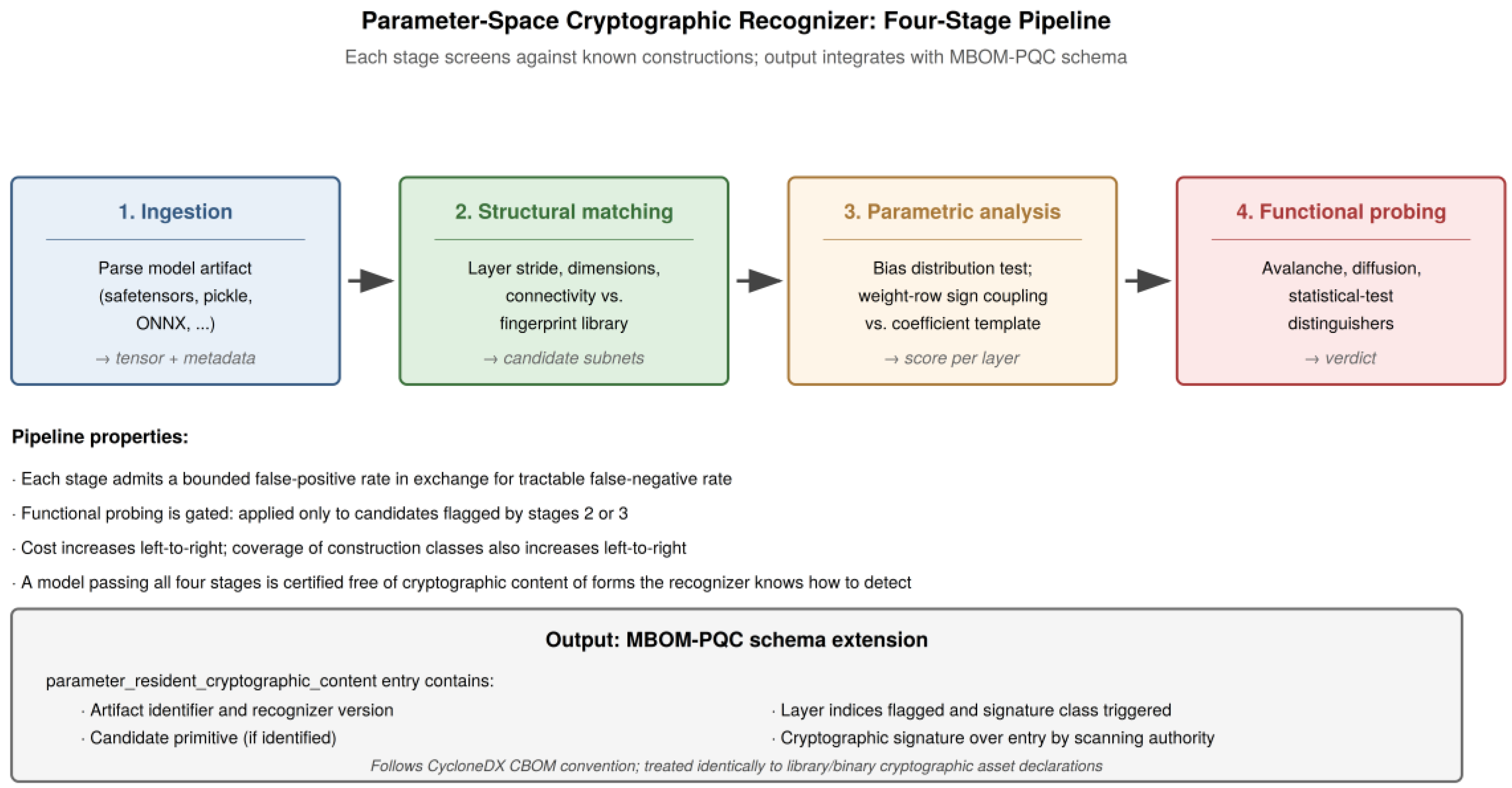
The pipeline has four stages. Ingestion parses the model artifact, extracts the parameter tensors and architectural metadata, and produces a layer-by-layer representation suitable for analysis. Structural matching compares the layer stride, dimension, and connectivity against the fingerprint library and flags candidate subnetworks. Parametric analysis tests bias vectors for binary distributions and weight rows for sign coupling, returning a score per layer. Functional probing, applied only to candidates flagged by the prior stages, evaluates the input–output behavior against cryptographic distinguishers.
Each stage operates as a screening filter: it admits a bounded false-positive rate in exchange for a tractable false-negative rate against known constructions. A model artifact that passes all four stages without flags is not certified to be free of cryptographic content; it is certified to be free of cryptographic content of forms the recognizer knows how to detect. We return to this limit in
Section 5.4.
Figure 3 shows the four-stage pipeline and its integration into the MBOM-PQC emission flow.
5.3. Integration with MBOM-PQC
The recognizer’s output integrates with cryptographic bill-of-materials tooling as a new emission class. We propose extending the schema developed in prior work [
27] with a parameter-resident cryptographic content entry alongside the existing library and binary CBOM emissions.
A parameter-resident cryptographic content entry contains the artifact identifier, the layer indices flagged, the signature class triggered (structural, parametric, or functional), the candidate primitive identified, if any, the recognizer version and fingerprint library version, and a cryptographic signature over the entry produced by the scanning authority. The entry follows the CycloneDX CBOM convention for cryptographic asset declaration [
16].
This integration places parameter-resident cryptographic content on equal footing with library and binary cryptographic assets in the federal migration discovery surface. A model artifact ingested into a federal environment carries an MBOM-PQC manifest that includes parameter-content emissions; downstream migration tooling treats those emissions identically to library-level cryptographic asset declarations.
Table 5 defines the proposed emission fields.
5.4. Limitations
The recognizer is a defense-in-depth control, not a complete solution. Three limits are intrinsic to the design.
- (1)
Recognition asymmetry. Extraction under known construction is trivial; recognition without construction knowledge is computationally hard. The recognizer detects known constructions and architectural fingerprints; it does not guarantee the detection of novel embeddings.
- (2)
Adversarial diffusion. An adversary aware of the recognizer can diffuse the cipher across redundant compute paths, add learned noise to bias vectors, and obscure stride patterns to evade structural and parametric detection. Functional probing remains effective against diffused constructions but is computationally expensive at scale.
- (3)
Fingerprint library currency. Structural and parametric recognition depend on a fingerprint library that must be maintained as new constructions are characterized. The library is a moving target, and coverage gaps are inevitable. The library’s value lies in the cumulative coverage of construction classes rather than the guaranteed detection of every embedded artifact: it raises the cost of novel embeddings (because adversaries must develop constructions outside the library’s coverage) and catches disclosed constructions retroactively. This is structurally similar to how anti-malware signature libraries function, despite never catching truly novel zero-days.
These limits do not undermine the contribution. The primitive raises the cost of embedding cryptographic content in distributed model artifacts from zero to non-trivial, and it places the federal migration framework’s discovery surface on a footing that includes parameter-resident content rather than excluding it by construction. Both are improvements over the current state.
7. Responsible Disclosure
The findings reported in this paper identify a class of threat—parameter-resident cryptographic key material in distributed model artifacts—that is not addressed by the open-source serialization-focused scanners we evaluated. The empirical evaluation in
Appendix A documents this gap against two named open-source scanners (Picklescan v1.0.4 and ModelScan v0.8.8) at the default configuration. Although the contribution is a missing security control rather than an exploitable defect against any specific platform, we treated the work as subject to coordinated disclosure norms because its publication has direct implications for the assurance posture of public model registries and federal model acquisition pipelines.
On 8 May 2026, we provided advance notice to the security teams of the maintainers of the scanners evaluated in
Appendix A—Hugging Face (Picklescan) and Protect AI (ModelScan)—and submitted a coordination report to the U.S. Cybersecurity and Infrastructure Security Agency’s coordinated vulnerability disclosure program via the VINCE platform operated by Carnegie Mellon University’s Software Engineering Institute. The notification described the threat class, summarized the construction of
Section 3 without reproducing it, included the empirical scanner-test results documented in
Appendix A, and indicated the planned submission date of this paper.
We did not request remediation within a fixed window. The finding is properly characterized as a coverage-gap observation rather than a defect for which a patch is the appropriate response: the scanners evaluated in
Appendix A operate within their stated scope of detecting the code-execution risk in serialized model formats, and the threat class identified here is outside that scope by design. The notification was provided as a courtesy to allow recipient organizations to evaluate whether to extend their scanning scope to include a parameter-content analysis.
The paper was submitted on 8 May 2026. The reproducibility artifact accompanying the paper is available at
https://github.com/rcampbell-research/parameter-resident-cryptographic-content-aes (accessed on 7 May 2026) and was released concurrently with submission. The artifact includes the test harness used to produce the
Appendix A evaluation, enabling an independent verification by reviewers and by the recipient organizations of the disclosure correspondence.
We did not pursue a CVE assignment for this finding. The MITRE CVE program is structured around defects in specific products; the finding here is a class-level gap in deployed practice that does not map cleanly to any single product’s vulnerability inventory. Should specific platforms confirm the gap in their pipelines and request CVE coordination, we will support that process.
8. Conclusions
We have shown that cryptographic key material can be embedded in feed-forward neural network parameters such that recovery under known construction is computationally trivial. The AES-128 construction in
Section 3 is a complete existence proof: a 30-layer ReLU network whose forward pass realizes AES-128 byte-for-byte, with the master key and all eleven round keys recoverable directly from layer biases by parsing. We have shown that this class of embedding is not addressed by the open-source serialization-focused scanners we evaluated: those scanners check for code-execution risk in serialized formats, not for cryptographic content in parameters, and no emission class for parameter-resident cryptographic material exists in the current cryptographic bill-of-materials tooling.
We have shown that this gap constitutes an unscoped surface for federal post-quantum migration. The open-weights distribution of a model containing long-lived cryptographic key material is, under the harvest-now-decrypt-later threat model, equivalent in posture to the recorded ciphertext, with the additional consequence that no quantum capability is required for recovery. PQC private keys, by virtue of the larger size and lower internal rigidity, hide more comfortably in modern weight tensors than symmetric keys do, not less.
We have proposed a parameter-space cryptographic recognizer that integrates with existing CBOM tooling as a defense-in-depth control, and a corresponding extension to federal acquisition discovery practice that would place parameter-resident cryptographic content on equal footing with library and binary cryptographic assets.
The contribution is bounded. We make no claim that any specific deployed model contains an embedding of this form, that such embeddings emerge from gradient-based training, or that the proposed recognizer is complete against adaptive adversaries. The contribution is the existence of the capability (Claim 1), the absence of detection in the open-source serialization-focused scanners we evaluated (Claim 2), and the migration-scope consequence with its accompanying audit primitive (Claim 3). The asymmetry between extraction and recognition—extraction trivial under known construction, recognition hard without it—favors the embedder. Closing this asymmetry is the central technical problem the threat class poses, and the direction in which the most consequential follow-on work lies.
Three structural limits constrain the contribution and warrant restatement here, matching the development in
Section 5.4: (1) recognition asymmetry—extraction under known construction is trivial, but recognition without construction knowledge is computationally hard; (2) adversarial diffusion—an adversary aware of the recognizer can diffuse the cipher across redundant compute paths to evade structural and parametric detection; and (3) fingerprint library currency—structural and parametric recognition depend on a fingerprint library that must be maintained as new constructions are characterized, with coverage gaps inevitable. The recognizer is a defense-in-depth audit primitive, not a completeness claim.