1. Introduction
The proliferation of digital learning platforms has transformed educational access, yet Deaf and Hard-of-Hearing (DHH) learners who rely on American Sign Language (ASL) remain systematically underserved by mainstream educational technology [
1,
2]. Traditional language-learning applications depend on audio-based instruction and text-centric interfaces, inadvertently creating what researchers term “digital exclusion” for visual language users [
3]. This exclusion is particularly problematic given that over 70 million deaf individuals worldwide use sign languages as their primary means of communication, with ASL serving approximately 500,000 to 2 million users in the United States and Canada alone [
4]. The mismatch between auditory-centric applications and the visual-gestural nature of ASL represents not merely a usability inconvenience but a fundamental barrier to equitable educational opportunity [
2,
5,
6].
The limitations of conventional computer-assisted language learning (CALL) systems for ASL learners stem from their underlying pedagogical assumptions. Most language-learning platforms are designed for spoken languages, implicitly privileging phonological processing and auditory feedback loops inaccessible to DHH users [
7]. Even when such platforms incorporate visual elements, they rarely leverage the spatial-manual modality that constitutes the linguistic foundation of signed languages [
8]. Consequently, ASL learners face a paradox: digital tools designed to facilitate language learning often fail to accommodate the linguistic structures that define their target language [
5].
This work addresses this critical gap by developing an interactive web application that integrates ASL recognition technology with established pedagogical game mechanics to create an accessible vocabulary learning environment. Our approach is grounded in two complementary theoretical frameworks: embodied cognition, which posits that cognitive processes are rooted in the body’s interactions with the world, and sociocultural theory, which emphasizes learning through socially mediated activities [
9]. By requiring users to physically produce signs as input, our system engages the same neural and motor pathways used in natural sign language communication, potentially enhancing retention through what cognitive scientists term “enactive encoding” [
10].
Our primary contribution is the development of an ASL Word Search Game that transforms passive vocabulary study into active, gamified practice requiring sign production. The system uniquely integrates real-time sign language recognition as its core input mechanism: users “type” words by performing corresponding ASL signs in front of a standard webcam rather than using traditional keyboard or mouse inputs. This gesture-driven interaction paradigm aligns with the visual-gestural nature of ASL, promoting a more natural learning process that respects the linguistic preferences of the DHH community [
6,
11]. Furthermore, by eliminating the need for specialized hardware, our approach democratizes access to ASL learning technology.
The pedagogical foundation of our system rests on decades of research demonstrating the efficacy of game-based learning for vocabulary acquisition across multiple languages and learner populations [
12,
13,
14]. Game mechanics such as goal-setting, immediate feedback, and progressive challenge have been shown to enhance learner motivation and improve long-term retention compared to drill-based methods [
15]. Word search puzzles, in particular, offer specific cognitive benefits: they require sustained visual attention, pattern recognition, and orthographic processing [
13,
14]. Studies with hearing learners have demonstrated that word search activities improve spelling accuracy and word recognition through repeated, contextually rich exposure [
16]. Our system extends these benefits to ASL learning by replacing text-based search with sign-based interaction, creating what we term “gesture-driven gamification”, a synthesis of embodied interaction and educational game design.
Recent technological advances have made this synthesis possible. The field of sign language recognition has evolved from laboratory-bound systems requiring specialized sensors to lightweight, real-time models deployable in standard web browsers [
5,
17]. The development of the WLASL dataset [
18] provided researchers with a standardized benchmark for isolated sign recognition, catalyzing improvements in model architecture and training methodology. Subsequent innovations, including pose-based graph convolutional networks [
19], transformer architectures adapted for sign language [
20], and spatial-temporal attention mechanisms [
21], have progressively pushed the boundaries of recognition accuracy while reducing computational requirements. Our system builds directly upon these advances, incorporating a Stacked Transformer-based Spatial-Temporal Attention Network [
22] optimized for real-time browser deployment.
The bidirectional translation system proposed by Amiruzzaman et al. [
21] demonstrated the feasibility of ASL-English conversion using machine vision and CNN-Transformer networks, achieving significant improvements in recognition accuracy while maintaining practical inference speeds. Our work extends this technological foundation into the pedagogical domain, adapting state-of-the-art recognition capabilities for educational purposes. This adaptation requires careful consideration of the distinct demands of learning applications: tolerance for recognition ambiguity (through top-5 predictions), integration with game mechanics, and responsiveness sufficient for fluid interaction.
The technical implementation of our system leverages recent breakthroughs in lightweight machine learning to deliver a complete browser-based solution requiring no proprietary hardware or specialized installation. Our Isolated Sign Language Recognition (ISLR) model, based on a Stacked Transformer architecture trained on the WLASL-100 dataset [
18], achieves competitive accuracy (88.48% Top-5) while maintaining an average model inference latency of 140.45 ms, well within the threshold for real-time interactive applications [
23]. The puzzle generation subsystem employs constraint satisfaction techniques adapted from crossword construction algorithms [
24,
25] to create challenging, interconnected grids that maximize learning opportunities through strategic word placement and inter-word intersections. The algorithm achieves 100% success rate across diverse input configurations while maintaining generation times under 0.2 s even for large grids.
The primary scientific novelty of this work lies in the architectural and pedagogical synthesis of a classic game with advanced computer vision. While word search puzzles are proven vocabulary-building tools, adapting them specifically for ASL learning is a uniquely effective approach that respects the visual-gestural nature of the language. We elevate this unique pedagogical tool by integrating it within a custom, two-tier architecture powered by a lightweight Stacked Transformer Spatial-Temporal Attention Network. By executing real-time skeletal recognition with a 139 ms inference latency directly in the browser, the system allows students to actively ‘type’ puzzle answers via physical sign production without specialized hardware. Combining this tailored puzzle format with low-latency, gesture-driven gamification transforms ASL vocabulary acquisition from passive observation into an accessible, highly interactive linguistic practice.
This paper makes three principal contributions to the fields of accessible educational technology and sign language recognition:
- 1.
Pedagogical Innovation: The design and implementation of a fully accessible web application that uses ASL signing as the primary input mechanism for a word search game, establishing a new paradigm for gesture-driven language learning that respects the visual-gestural nature of signed languages.
- 2.
Technical Advancement: A lightweight ISLR model achieving 88.48% Top-5 accuracy with 140.45 ms model inference latency, specifically optimized for real-time browser deployment through skeleton-based processing and model compression techniques, making advanced sign recognition accessible without specialized hardware.
- 3.
Algorithmic Contribution: A novel constraint-based puzzle generation algorithm achieving a very good success rate across diverse input configurations, incorporating diagonal placement capabilities and intersection-first placement strategies that produce visually rich, educationally effective puzzles while maintaining real-time performance.
Beyond these specific contributions, our work demonstrates the broader feasibility of integrating computer vision technologies with educational game design to create inclusive learning tools that serve historically marginalized populations. The positive results from our user study with 25 participants, including statistically significant gains in learner confidence (), suggest that gesture-driven gamification merits further investigation as a pedagogical approach for signed language instruction.
The remainder of this paper is organized as follows:
Section 2 provides a review of related work spanning gamified language learning, accessible technology for DHH users, sign language recognition systems, and the machine learning foundations of modern ISLR.
Section 3 details our system architecture, including the client-server implementation, webcam-based recognition pipeline, and puzzle generation algorithms.
Section 4 presents a rigorous evaluation of both the recognition model’s performance, the puzzle users’ reliability, and the findings from our user study, including analyses of usability, engagement, and learning outcomes. Finally,
Section 5 offers conclusions, acknowledges limitations, and outlines directions for future research, including vocabulary expansion, adaptive difficulty mechanisms, and integration with formal ASL curricula.
3. Method
This section describes the technical architecture and implementation of the ASL Word Search Game, including the system design, puzzle-generation algorithms, word-validation mechanisms, and the integration of real-time sign-language recognition. The goal of the system is to provide an accessible, browser-based platform where users can practice ASL vocabulary through an interactive word-search puzzle powered by lightweight machine-learning components.
3.1. System Architecture Overview
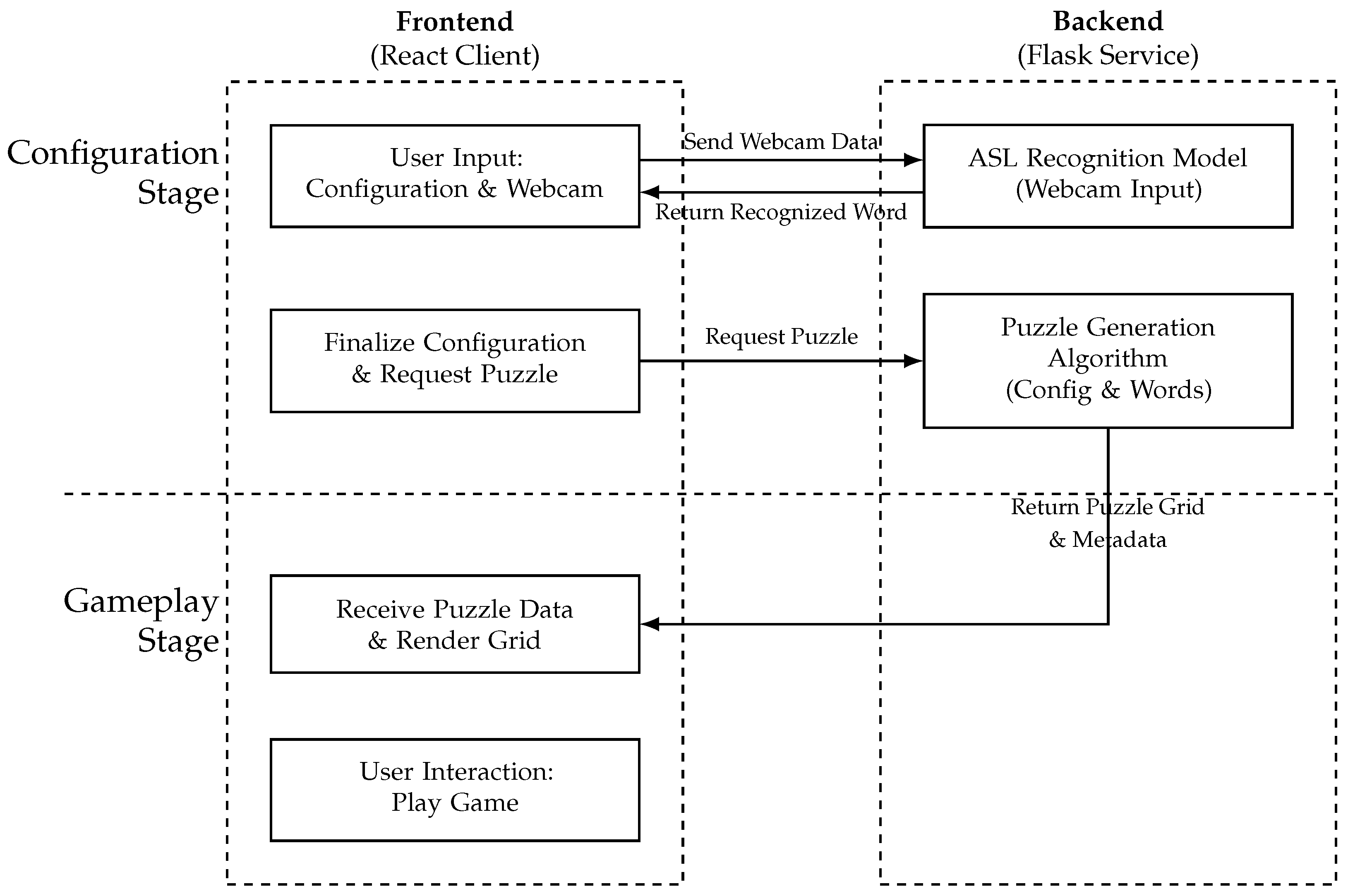
The “ASL Word Search” game is implemented via a modular, two-tier architecture comprising a React-based client application and a lightweight Flask backend service.
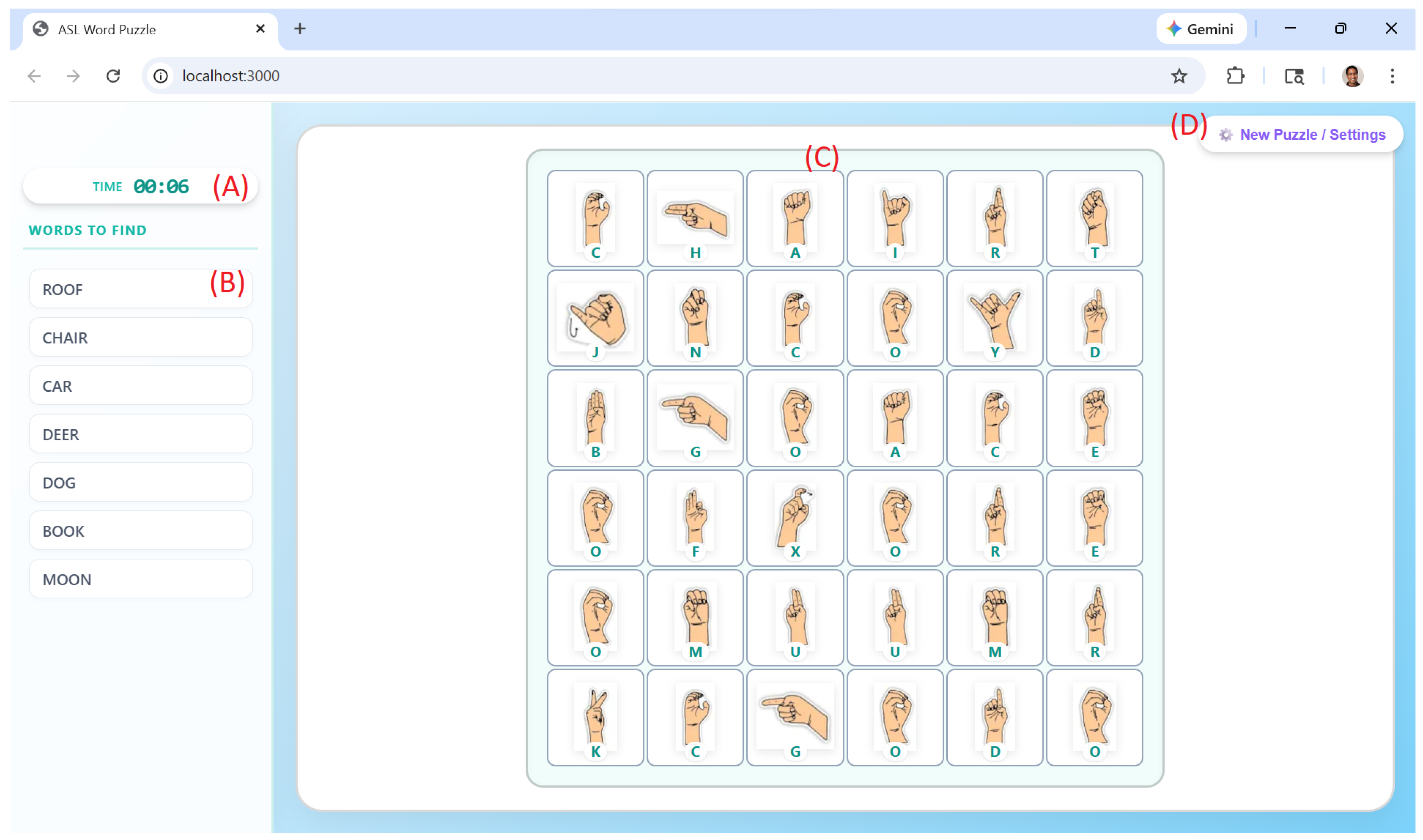
Figure 1 illustrates the high-level system design, while the initial user interface in default mode is depicted in
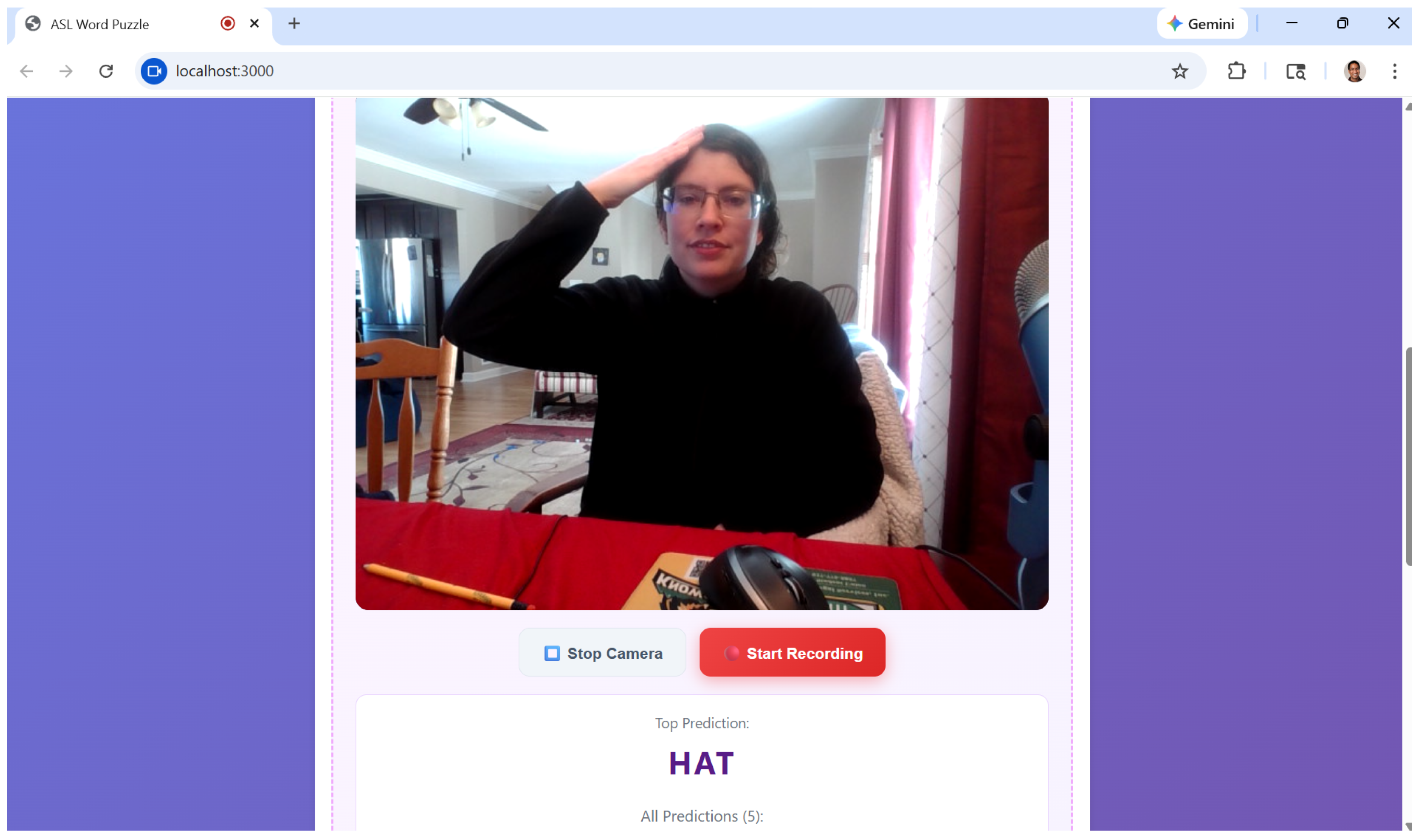
Figure 2. The system functionality is partitioned into two primary layers: the frontend and the backend. The frontend manages all user-facing interactions, including rendering the puzzle grid, capturing webcam video streams, and processing configuration inputs (see
Figure 3). Concurrently, the backend is responsible for the core computational logic, specifically the generation of word-search puzzles and the execution of real-time Sign Language recognition.
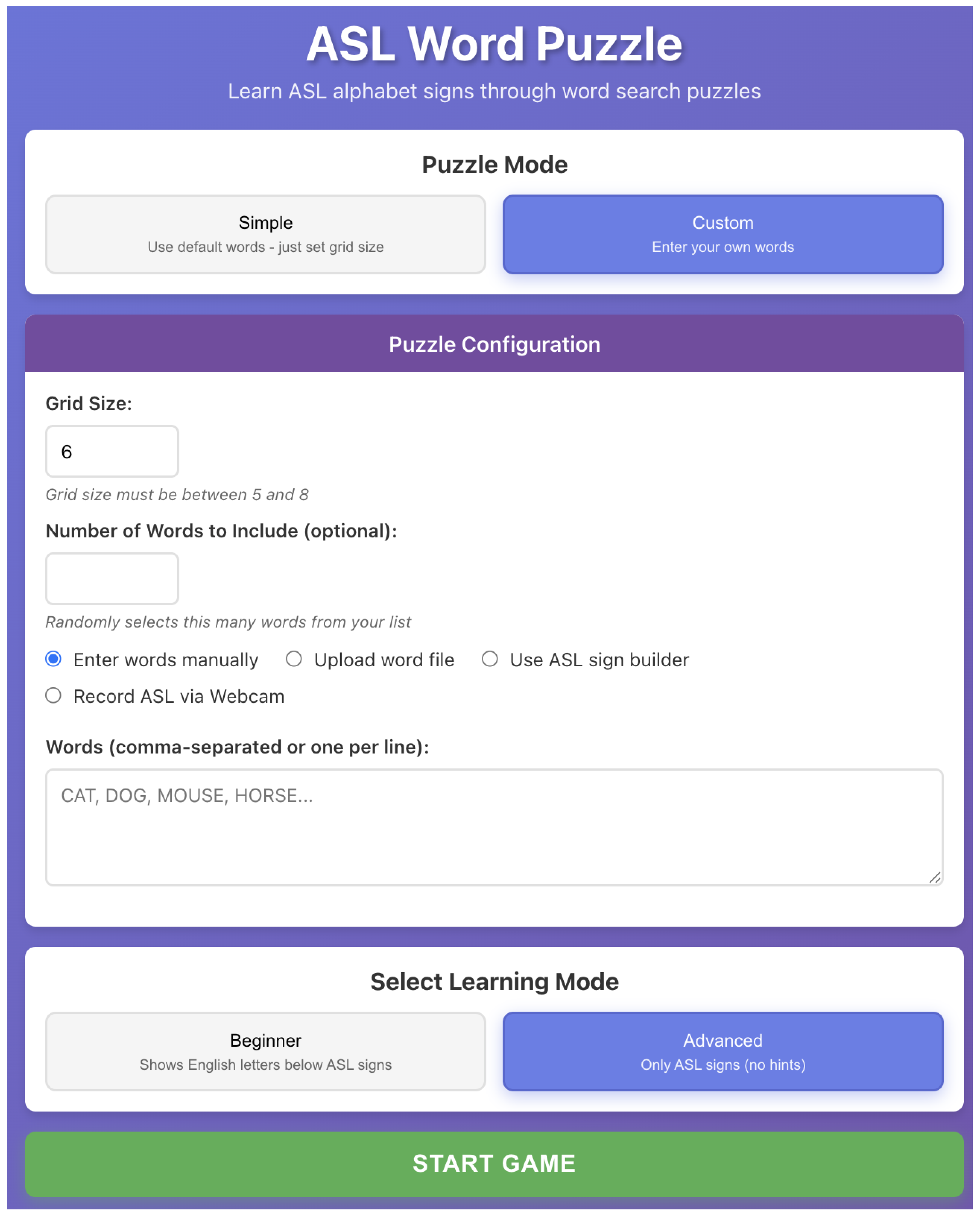
Furthermore, the frontend operates as a single-page React application that manages the overall game flow, coordinating transitions between the configuration view (SetupPage) and the interactive puzzle gameplay view (GamePage). In the configuration stage, users specify puzzle parameters such as grid size, number of words, and custom vocabulary (see
Figure 4). Once these selections are submitted, the frontend requests a new puzzle from the backend and shifts the interface from setup to gameplay. During the gameplay phase, the frontend maintains the puzzle state locally, renders the grid dynamically, and tracks the user’s word selections to provide immediate feedback and interaction.
For custom puzzles, users have multiple input methods:
- 1.
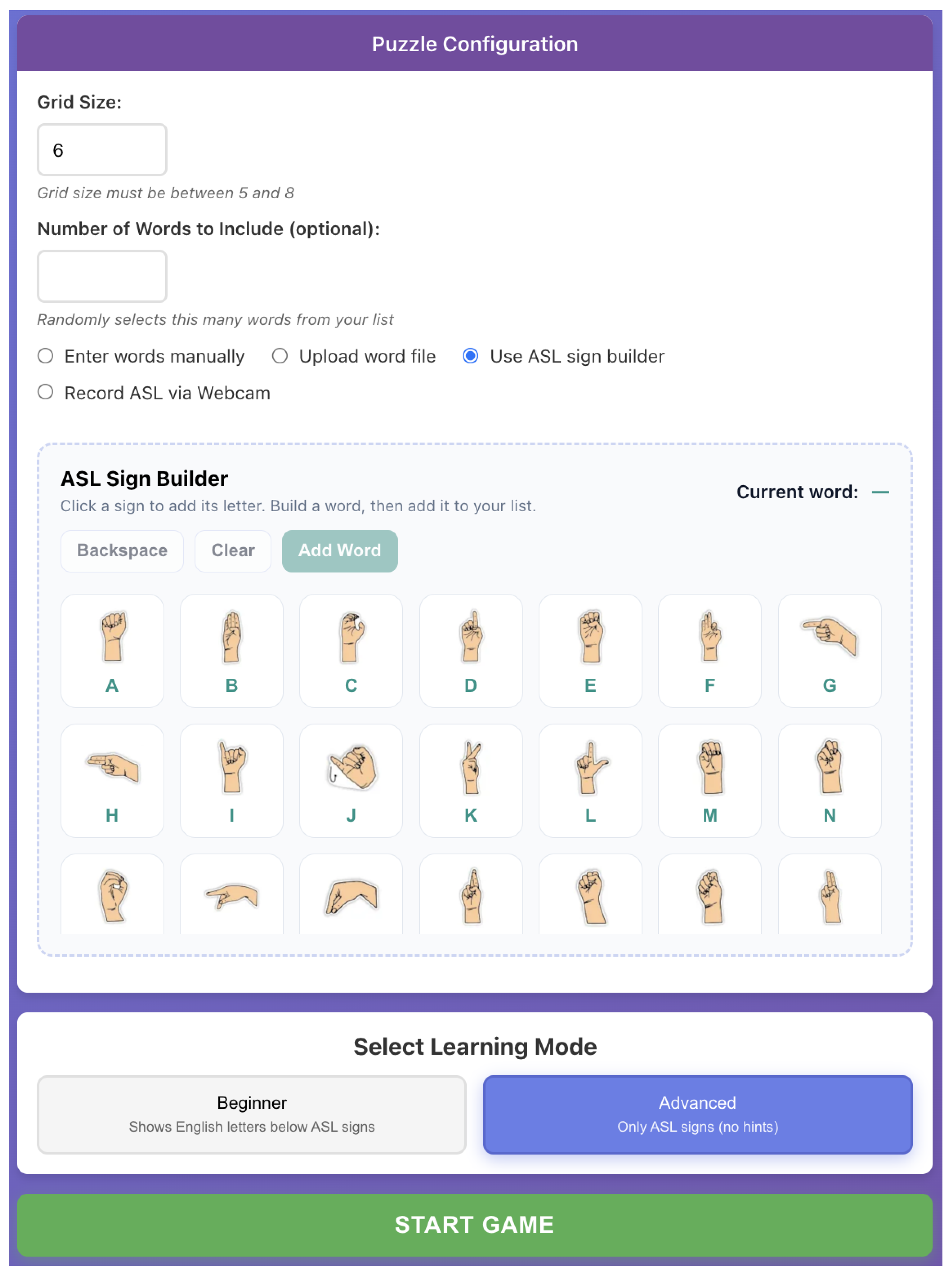
Manual text entry: Instructors can type or paste word lists into a text field. Words may be entered comma-separated or one per line; the system parses and normalizes them (e.g., trimming and uppercasing) and shows a preview of the parsed list before puzzle generation. A user can also use ASL alphabet signs (see
Figure 5).
- 2.
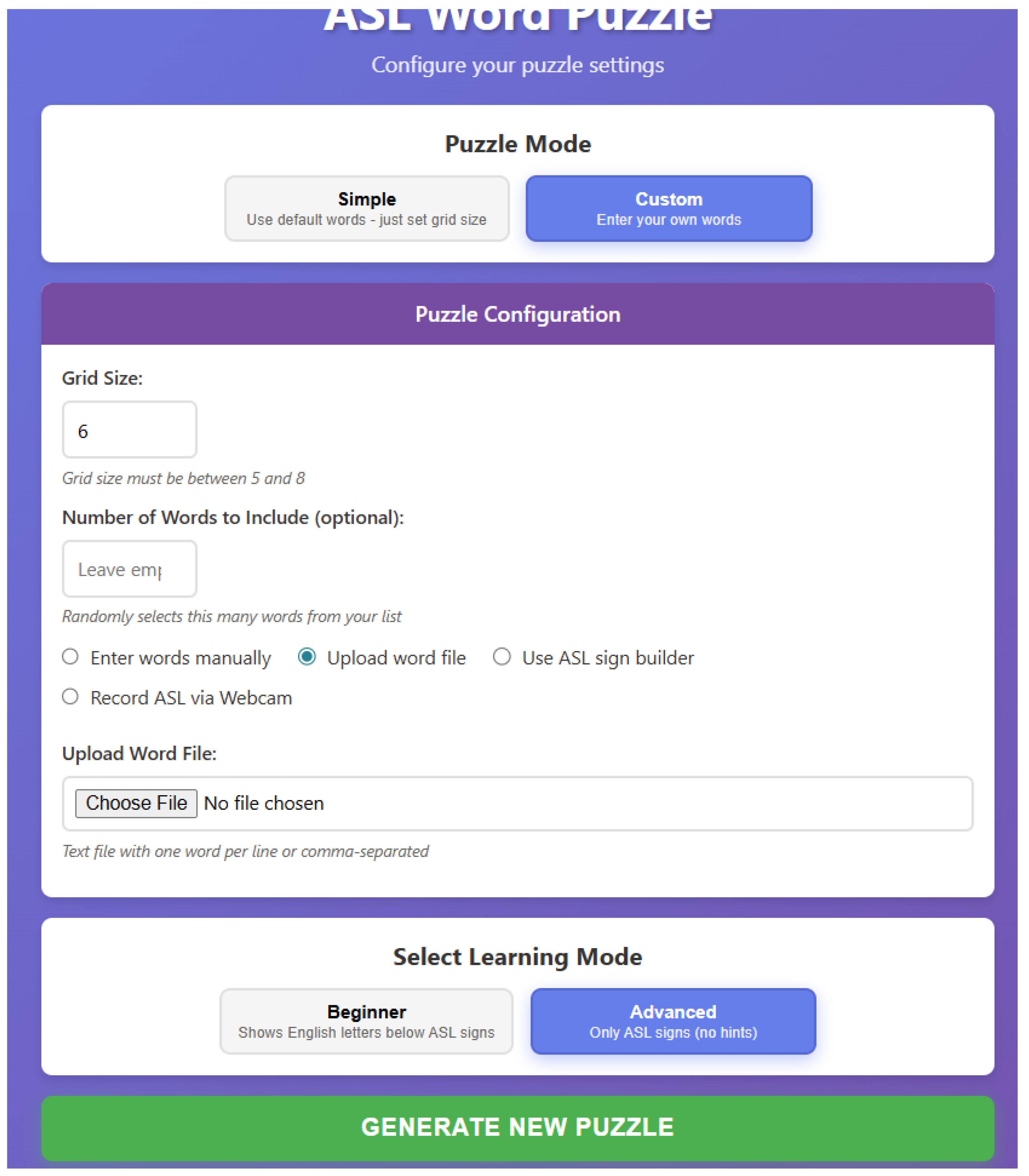
File upload: A text file (e.g.,
.txt or
.csv) can be uploaded, with one word per line or comma-separated
Figure 6. This supports reusing lists (e.g., vocabulary sets or curriculum word lists) and optionally limiting how many words are drawn from the file for a single puzzle.
- 3.
ASL sign builder: Users build words by selecting letters from an on-screen set of ASL alphabet signs (see
Figure 5). Clicking a sign appends that letter to the current word; the word can then be added to the puzzle word list. This supports vocabulary selection while reinforcing letter–sign associations.
- 4.
Webcam-based ASL recognition: Users can record themselves signing a word via the browser’s camera
Figure 3. The video is sent to a backend ASL recognition model; the top predicted word is shown and can be added to the custom word list. If recognition fails or is unavailable, manual text entry is offered as a fallback. This allows instructors or learners to define puzzle words by signing rather than typing.
Together, these options support different workflows (quick typing, bulk file upload, sign-based building, and sign recognition) and make the tool usable with or without a working ASL recognition backend.
The backend is implemented as a lightweight Flask service that supports two primary computational components: puzzle generation and real-time sign-language recognition. In the configuration stage, the backend can accept webcam-derived input from the frontend and use it to help users build a custom word list.
As illustrated in
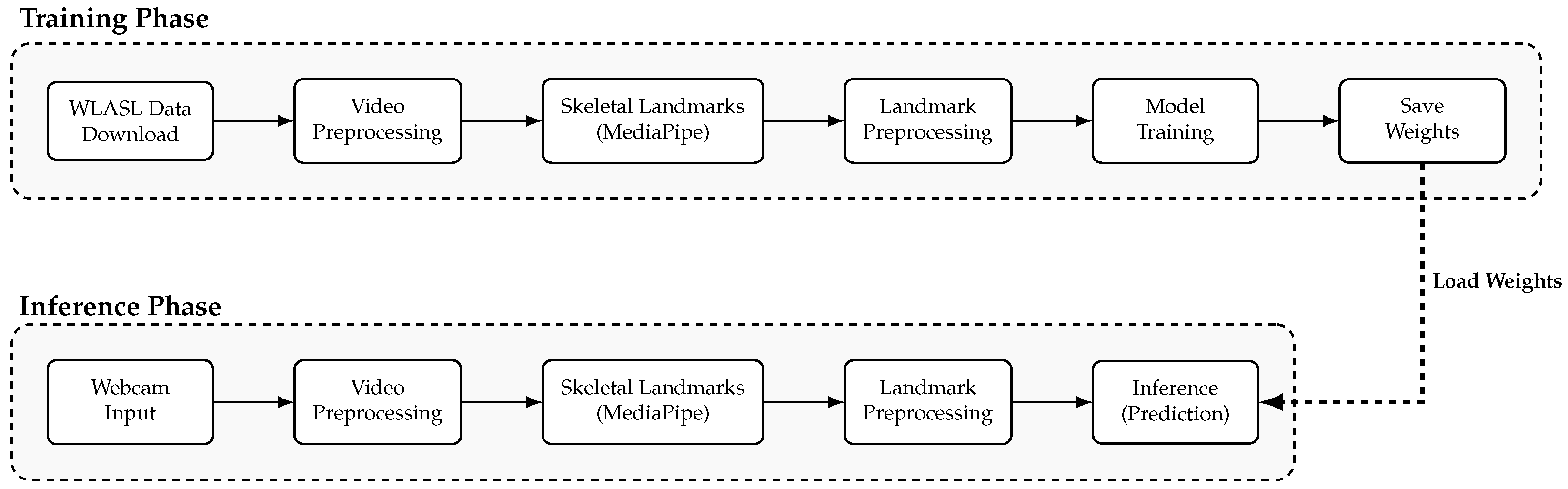
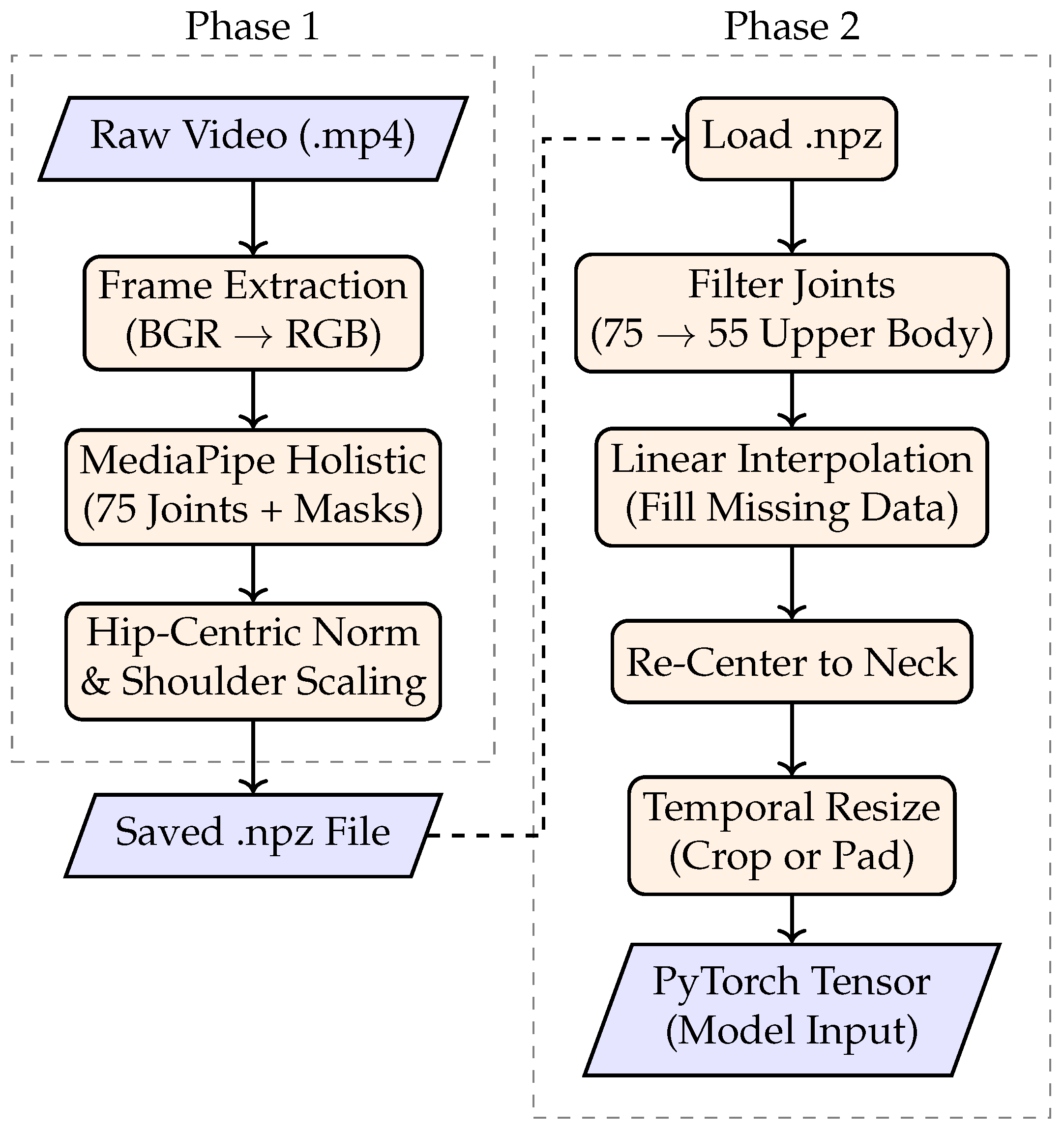
Figure 7, this ASL pipeline takes raw webcam video, extracts skeletal hand and upper-body landmarks using the MediaPipe Python package, applies preprocessing to form short temporal sequences, and feeds these sequences into a temporal transformer model trained on the WLASL-100 dataset [
18]. The model is first trained offline on WLASL-100, and the resulting learned parameters are stored in a .pth weights file. During real-time inference, these saved weights are loaded to run the transformer model efficiently, allowing it to predict the signed word from the incoming video stream. The predicted word is then returned to the frontend so that users can add it directly to their custom vocabulary.
Regarding display requirements, the application is designed to be fully responsive across both desktop and mobile devices. Leveraging React’s component-based architecture enables the frontend to dynamically scale the puzzle grid and interface to accommodate various screen sizes without sacrificing functionality. On smartphones, the system operates seamlessly via standard mobile web browsers, such as Google Chrome and Apple Safari. While larger displays (e.g., desktop monitors or tablets) offer an optimal viewing experience for larger grids and allow users to easily maintain the physical distance required for accurate upper-body capture during webcam-based word entry, this responsive mobile implementation ensures the core puzzle game remains highly accessible across everyday devices.
As shown in
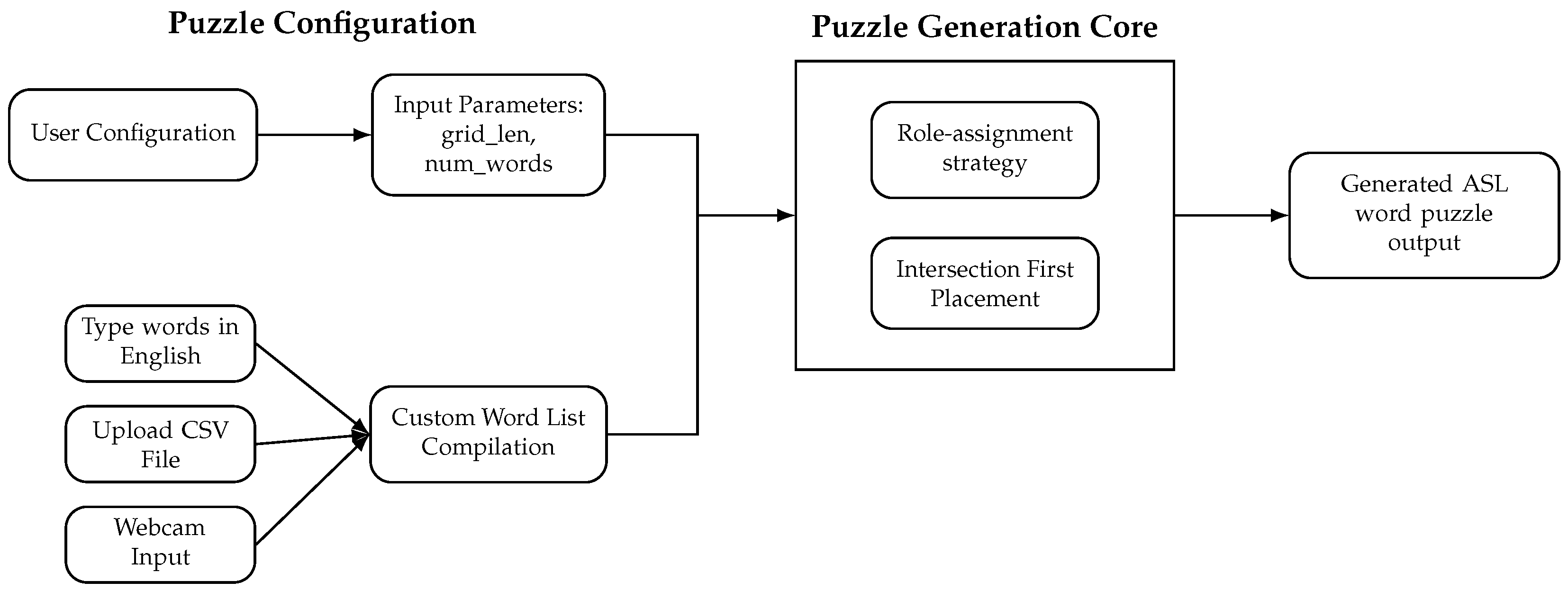
Figure 8, once the configuration is finalized (grid length, number of words, and custom words), the backend invokes a heuristic, constraint-based word search generation algorithm that uses directional role assignment (e.g., straight vs. diagonal words), intersection-first placement to maximize overlaps, and randomized fallback strategies when constraints cannot be satisfied. The result is a completed puzzle grid and associated metadata, which are sent back to the client to initialize gameplay.
3.2. Webcam-Based Word Entry via Isolated Sign Language Recognition
As described in
Section 3.1, our puzzle game supports multiple modalities for word entry. One such modality enables users to input words through webcam-based sign language recognition. Since the puzzle operates exclusively at the word level, the recognition task can be naturally formulated as Isolated Sign Language Recognition (ISLR) rather than continuous sign or fingerspelling recognition. This formulation allows each captured sign clip to be mapped directly to a single lexical unit, which aligns well with the interaction design of the game.
As discussed in
Section 2.4, the WLASL dataset is well-suited for this task, as it provides a large vocabulary of isolated American Sign Language (ASL) signs with corresponding video samples. However, WLASL contains over 2000 unique word classes, and training a highly accurate classifier over the full label space is challenging, particularly in real-time and interactive settings [
18]. Prior work similarly constrains the vocabulary to smaller subsets to achieve reliable performance. Following this practice, we limit the recognition space to a curated subset of 100 most commonly used words. To further improve usability and robustness, the system presents the top-5 predicted words instead of a single prediction, allowing users to select the intended word when ambiguity arises.
We adopt the Stacked Transformer-based Spatial–Temporal Attention Network as the backbone of our recognition model, as it represents one of the strongest architectures for skeleton-based isolated sign recognition [
35]. The model operates on pose sequences extracted from video, enabling it to capture both spatial relationships between joints and their temporal dynamics across frames. We used the model as a foundation and adapted it to support real-time inference from webcam input. This includes structuring the model to operate on short, fixed-length pose sequences and ensuring that inference latency remains low enough for interactive use. By relying on skeletal representations rather than raw RGB frames, the model remains computationally efficient and robust to background variation, lighting changes, and signer appearance.
To support real-time webcam input with low latency, we extract skeleton landmarks using MediaPipe Holistic
Figure 9 (pose + both hands) rather than OpenPose, which reduces runtime overhead and allows the pipeline to run in CPU-only settings. For each frame, we collect 33 pose and 21 × 2 hand landmarks, along with visibility/presence masks; frames without reliable detections are encoded as zeros to avoid introducing noise. We then normalize the skeleton by translating joints relative to a body reference point (mid-hip) and scaling by shoulder width for basic view/size invariance, and store sequences as .npz files (skeleton + mask).
During dataset loading, we keep all hand landmarks while using a compact subset of upper-body pose joints (reducing the representation from 75 to 55 joints), interpolate missing values over time, center around the neck (mid-shoulder), and enforce a fixed clip length (e.g., 50 frames) via random/center cropping and padding by repeating the last frame. Light geometric augmentation (small shifts/rotations) is applied during training to improve robustness under natural webcam motion.
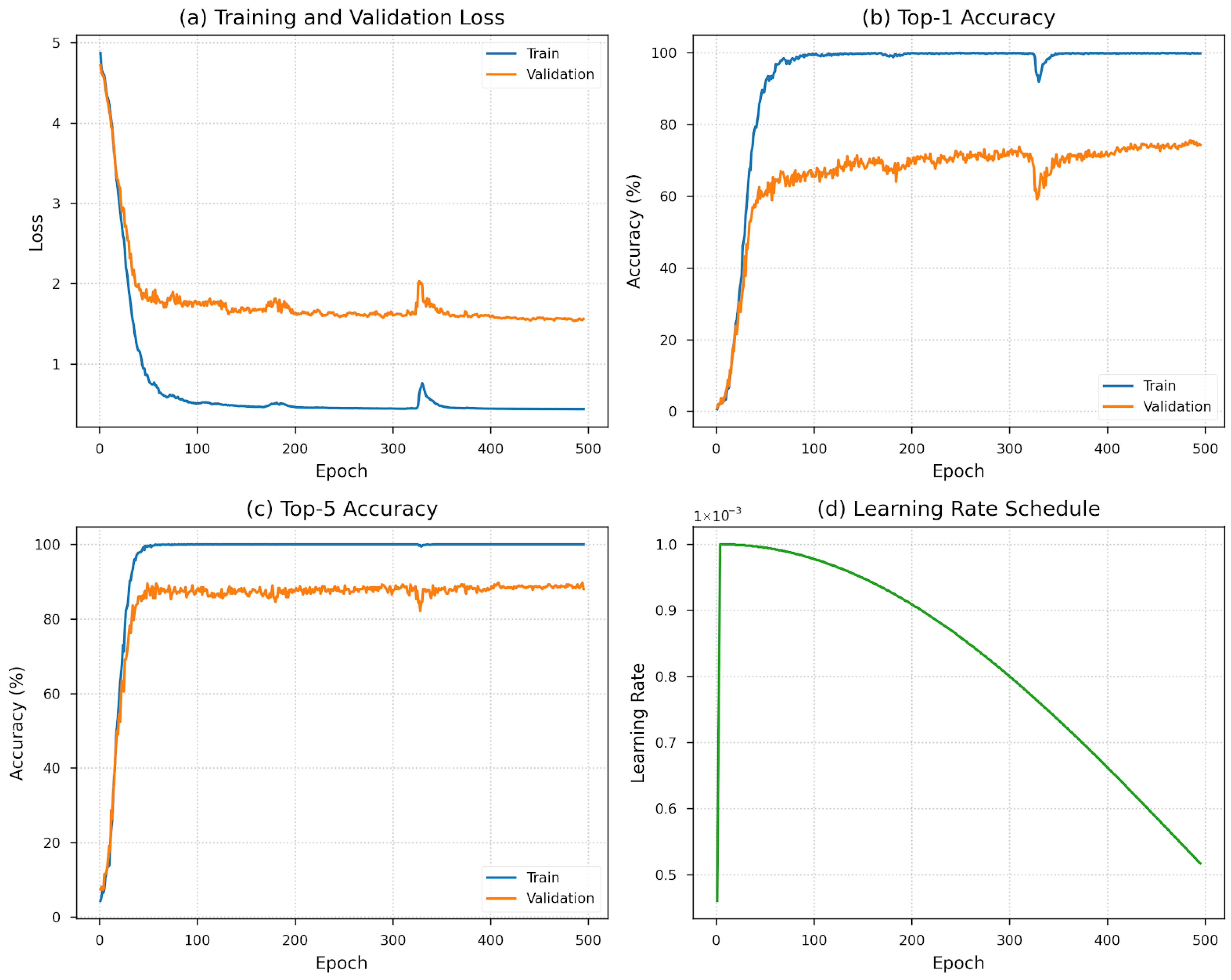
Our recognition backbone is adapted from a stacked spatial-temporal attention design, comprising 10 sequential spatial-temporal attention (SSTAN) blocks. Skeleton joint coordinates are projected into an embedding space of , processed via 8-head spatial and temporal attention mechanisms, and passed through a temporal feed-forward network of (with a 0.25 dropout rate). To capture structural and sequential order, we employ a hybrid positional encoding strategy. For the intra-frame spatial dimension, fixed sinusoidal encodings and a unified learnable class token are added to the projected embeddings. For the inter-frame temporal dimension, a learnable 1D relative position bias table is integrated directly into the attention scores, enabling the network to generalize robustly across varying sequence lengths by focusing on relative frame-to-frame distances. For classification, the CLS representation is aggregated using mask-aware temporal pooling to ignore padded frames, and a final linear head predicts the target word class. Training uses AdamW, cross-entropy with label smoothing, and a cosine learning-rate schedule with warmup.
At inference time, pose and hand landmarks are streamed from the webcam and accumulated into short, fixed-length skeleton clips using the same preprocessing pipeline as training. Each clip is passed through the trained model in a sliding-window manner, enabling near real-time prediction while maintaining temporal consistency. Instead of outputting a single class label, the model returns the top-5 word predictions ranked by confidence, allowing users to select the intended word when ambiguity occurs.
Our system intrinsically mitigates environmental variability such as lighting, background complexity, and resolution through its skeleton-based architecture. Because the spatial-temporal transformer operates exclusively on normalized skeletal landmarks rather than raw RGB pixels, downstream classification is invariant to visual noise. We delegate environmental robustness to the MediaPipe Holistic feature extractor, which is heavily optimized for diverse real-world webcam conditions. Provided the lighting allows MediaPipe to initialize the pose graph, our model maintains consistent predictive accuracy.
3.3. Puzzle Generation
The ASL Word Search generation process follows a four-stage pipeline designed to promote interlocked word placement while ensuring bounded execution.
In the planning stage, ASL-PREPARE (1) ranks input words according to their intersection potential (see Algorithm 1). Specifically, for each word, a ranking score is computed as the sum of the number of distinct letters shared with every other word in the set. Words are then sorted in descending order of this rank, with longer words prioritized in case of ties. To introduce structural constraints, a randomly selected fraction (approximately 20–50%) of words are assigned diagonal placement roles, while the remaining words are restricted to orthogonal orientations (see Algorithm 1).
The ordered list is passed to ASL-CONSTRUCT (2), which governs the primary placement loop (see Algorithm 2). Words are processed sequentially, and for each word a placement attempt is made. If placement fails, the algorithm performs bounded backtracking by removing the most recently placed word and retrying alternative configurations. This process is limited by a maximum backtracking budget B, ensuring termination and preventing combinatorial explosion (see Algorithm 2).
For each placement attempt, ASL-PLACE (3) is invoked. This subroutine first performs an intersection-first search, attempting to align the new word with matching letters already present in the grid (see Algorithm 3). If no valid intersection-based placement is found, the algorithm falls back to randomized placement attempts constrained by the word’s assigned orientation (diagonal or orthogonal).
Finally, ASL-FINALIZE (4) completes the puzzle grid by replacing all remaining empty cells with randomly generated letters, producing the final word search configuration (see Algorithm 4).
| Algorithm 1 ASL-PREPARE: Word Ranking and Role Assignment |
| 1: | Input: S (list of input words), N (grid size) |
| 2: | Output: W (sorted list of Word States), G (Initialized Grid) |
| 3: | function ASLPrepare() |
| 4: | cleaned version of S (uppercase, trimmed, length , deduplicated) |
| 5: | if then |
| 6: | return ∅, empty grid G |
| 7: | end if |
| 8: | Initialize G as filled with - | ▹ Calculate Ranking R |
| 9: | for all do |
| 10: | |
| 11: | end for |
| 12: | for all pairs , in do |
| 13: | |
| 14: | |
| 15: | end for | ▹ Sort L by rank and length |
| 16: | sorted by in descending order | ▹ Assign Roles |
| (Diagonal/Orthogonal) | |
| 17: | Sample diagonal ratio in and choose that fraction of indices as |
| 18: | |
| 19: | for to do; |
| 20: | |
| 21: | end for |
| 22: | return |
| 23: | end function |
| Algorithm 2 ASL-CONSTRUCT: Placement and Limited Backtracking |
| 1: | Input: W (sorted Word States), G (initial grid), N (grid size), B (backtracking budget) |
| 2: | Output: Partially completed grid G |
| 3: | function ASLConstruct() |
| 4: | Initialize as of zeros |
| 5: | , , | ▹ Main construction loop |
| 6: | while and do |
| 7: | |
| 8: | TryPlace |
| 9: | if then |
| 10: | if then |
| 11: | break |
| 12: | end if |
| 13: | | ▹ Move forward |
| 14: | else |
| 15: | if then |
| 16: | break | ▹ Cannot backtrack further |
| 17: | end if |
| 18: | |
| 19: | Pop |
| 20: | RemoveWord |
| 21: | ; | ▹ Backtrack one word |
| 22: | end if |
| 23: | end while |
| 24: | return G |
| 25: | end function |
| Algorithm 3 ASL-PLACE: Word Placement Attempt Strategy |
| 1: | Input: (current Word State), G (grid), , |
| 2: | Output: true if placed, false otherwise |
| 3: | function TryPlace() |
| 4: | , |
| 5: | if then |
| 6: | |
| 7: | else |
| 8: | |
| 9: | end if |
| 10: | Randomly permute D | ▹ Intersection-first search |
| 11: | for each letter index of in random order do |
| 12: | for each cell with in random order do |
| 13: | for all do |
| 14: | |
| 15: | if and CanPlace then PlaceWord(word,s,(dr,dc),G,Occupancy) Push(Stack,(word,s,(dr,dc))); |
| 16: | return true |
| 17: | end if |
| 18: | end for |
| 19: | end for |
| 20: | end for | ▹ Random placement with attempt cap (100 attempts) |
| 21: | |
| 22: | while do |
| 23: | RandomChoice random start in G |
| 24: | |
| 25: | if and CanPlace then PlaceWord(word,s,(dr,dc),G,Occupancy) Push(Stack,(word,s,(dr,dc))); |
| 26: | return true |
| 27: | end if |
| 28: | end while |
| 29: | return false |
| 30: | end function |
| Algorithm 4 ASL-FINALIZE: Grid Completion |
| 1: | Input: G (partially filled grid) |
| 2: | Output: Completed grid G |
| 3: | function ASLFinalize(G) |
| 4: | Replace remaining—in G by random letters |
| 5: | return G |
| 6: | end function |
Given an input list of words, the system first normalizes and deduplicates them, then assigns each word a “commonality” score based on how many letters it shares with other words. Words with more shared characters and greater length are placed earlier, since they are both more constrained and better candidates for intersections [
27]. A random subset of words is then designated as diagonal, while the rest must be placed horizontally or vertically. This role assignment, combined with randomized direction choices, produces varied grids where a non-trivial fraction of words appear along diagonals, making the puzzle visually richer and slightly different from standard 4-direction word searches.
Backtracking is a standard tool in puzzle generation because naive greedy placement often leads to dead ends where remaining words cannot be inserted without overlaps or boundary violations. WoSeCon adopts a local and randomized variant of backtracking rather than full recursive search. Words are processed sequentially, candidate placements are drawn from a global pool, and on failure the algorithm steps back to the previous word, restores its last placement to the pool, and retries untested locations in a randomized order. This yields a local, word-by-word backtracking process that explores many alternatives without explicitly enumerating the full combinatorial search tree [
26].
In our implementation, we adopt the same idea but introduce an explicit cap on backtracking steps, maintain per-cell occupancy to safely undo only the last word, and add an intersection-first placement bias to produce fast, intersection-rich ASL word-search grids.
5. Discussion and Conclusions
Our research presents a novel approach to American Sign Language education through the development of an interactive ASL Word Search Game that combines real-time sign language recognition with engaging educational game mechanics. The system successfully demonstrates that computer vision technologies, particularly those inspired by recent advances in bidirectional ASL-English translation systems [
21], can be effectively integrated into accessible learning platforms. The resulting application provides an intuitive and visually-oriented environment for vocabulary practice that aligns with the natural learning preferences of Deaf and Hard of Hearing users, while also serving as an effective tool for hearing individuals learning ASL.
The experimental evaluation reveals several important findings regarding the system’s performance and educational value. First, we demonstrate that lightweight isolated sign language recognition models can achieve practical accuracy levels suitable for educational applications, with our implementation reaching 88.48% Top-5 accuracy while maintaining real-time performance in web browser environments. This performance level, though not perfect, proves sufficient for vocabulary reinforcement activities where the educational context provides additional cues for sign recognition. Second, our constraint-based puzzle generation algorithm reliably produces challenging yet solvable grids that reinforce spatial relationships between signs, effectively supporting vocabulary acquisition through pattern recognition and visual search processes. Third, the implementation of multiple input modalities, including webcam-based sign recognition, manual word entry, file upload, and an interactive sign builder, significantly enhances accessibility by accommodating diverse user preferences, technological constraints, and learning styles.
The educational implications of this work extend beyond the specific game mechanics. By integrating sign recognition capabilities directly into the puzzle interface, we create a closed-loop learning system where users can both input signs through webcam recognition and then search for those same signs within the puzzle context. This bidirectional interaction mirrors the natural language learning process where production and recognition skills develop interdependently. The system’s dual learning modes, Beginner with English letter hints and Advanced with only ASL signs, provide appropriate scaffolding for learners at different proficiency levels, supporting progressive skill development.
While the current system evaluates the WLASL-100 dataset, our underlying skeletal extraction and Transformer architecture is vocabulary-agnostic and scales natively to the full WLASL-2000 dataset without structural changes. However, scaling to 2000 classes involves practical trade-offs. Training on this exponentially larger dataset requires substantial computational resources, necessitating a multi-GPU configuration to complete training in a reasonable timeframe. Additionally, we anticipate a moderate degradation in baseline Top-1 accuracy due to increased inter-class visual similarity.
Several limitations of the current implementation warrant acknowledgment and suggest directions for future research. The vocabulary size constraint of 100 words, while sufficient for proof-of-concept demonstration, limits the system’s utility for advanced learners. Additionally, the webcam recognition component remains somewhat dependent on consistent lighting conditions and camera quality, which may affect accessibility for users with limited technological resources. The current puzzle generation algorithm, while effective for small to medium grid sizes, may require optimization for larger, more complex puzzles with extensive vocabulary sets.
Future work will focus on addressing these limitations while expanding the system’s capabilities. We plan to explore transfer learning techniques to significantly expand the recognizer’s vocabulary while maintaining real-time performance. This expansion will enable the system to support more comprehensive ASL curricula and accommodate learners at advanced proficiency levels. We also intend to investigate multi-user collaborative gameplay modes, recognizing that language learning often occurs most effectively in social contexts. The development of adaptive difficulty algorithms based on real-time assessment of user performance represents another promising direction, potentially personalizing the learning experience to individual skill levels and learning trajectories. Finally, formal integration with established ASL curricula and educational standards will be essential for the system’s adoption in formal educational settings, requiring collaboration with ASL educators and curriculum developers.
Beyond these technical improvements, the system represents a significant conceptual contribution to the field of accessible educational technology. By successfully bridging computer vision, educational game design, and accessibility principles, we provide a model for future developments in inclusive learning tools. The demonstration that real-time sign recognition can be effectively deployed in browser-based environments without specialized hardware lowers barriers to access and democratizes ASL education technology. This accessibility aligns with the broader goal of making language learning resources available to diverse populations regardless of socioeconomic status or geographical location.
In conclusion, the ASL Word Search Game represents a meaningful step forward in interactive ASL education technology. By combining validated educational principles with state-of-the-art computer vision techniques [
21], we have created a system that not only teaches ASL vocabulary but does so through an engaging, visually-oriented interface that respects the visual nature of sign language. The positive user feedback and promising experimental results suggest that this approach has significant potential for enhancing ASL learning outcomes. As sign language recognition technology continues to advance, particularly through innovations in bidirectional translation systems, we anticipate increasingly sophisticated and effective educational applications that will further support ASL acquisition and promote greater understanding between Deaf and hearing communities.




 ,
,