1. Introduction
Big data analytics (BDA) and cognitive computing are increasingly embedded within core business processes—pricing, credit and fraud decisions, supply-chain operations, personalization, and compliance—where outputs are no longer mere predictions but operational commitments with economic, legal, and reputational consequences. This shift creates a growing need for integrative approaches that connect BDA, AI, and cognitive computing with business model innovation (BMI) and sustainable value creation, rather than treating them as isolated technical capabilities [
1,
2]. Recent empirical and review work further links BDA to innovation capability and firm performance [
2] and shows that digital transformation reshapes value creation, delivery, and capture through BMI [
1].
Despite these advances, most enterprise IT operations remain grounded in an implementation regime shaped by Shannon–Turing computing models [
3,
4]. In this paradigm, computation is realized as read–compute–write transformations over data structures, while governance—FCAPS (Fault, Configuration, Accounting, Performance, and Security)—is applied externally through IaaS/PaaS controls, observability tooling, and human incident processes [
5,
6,
7]. While this separation enables scalability, it is structurally limited in its ability to reduce operational complexity. Each additional layer introduced to restore reliability—retries, sidecars, controllers, policy scripts, and runbooks—adds indirection while leaving the meaning, justification, and traceability of operational commitments under-specified within the computing model itself [
5,
6,
7].
A useful way to characterize this limitation is the absence of model closure: general-purpose computers can model external systems with arbitrary precision but face logical constraints when the modeled system includes the computer itself. As noted by Cockshott and colleagues, “We can use them to deterministically model any physical system, of which they are not themselves a part.” The operational implication is significant: when governance remains external to computation, systems cannot natively represent—or reliably govern—the context, constraints, and commitments required for safe, explainable behavior under uncertainty [
8,
9].
This paper focuses on the resulting organizational liability, which we term coherence debt. Coherence debt is the accumulated liability created when operational commitments—encoded in configurations, workflows, policies, model deployments, routing rules, and automated actions—cannot be reconstructed, criticized, or safely revised because their justificatory lineage has degraded. It increases when systems fail to preserve (i) provenance (inputs, context, dependencies, versions), (ii) warrant (policy constraints and reasoning that justify actions), and (iii) repair obligations (defined pathways to restore intended system invariants under partial failure) [
10,
11]. This concern parallels hidden technical debt in machine-learning systems, where undeclared consumers, feedback loops, data dependencies, and configuration entanglement progressively erode explainability and safe changeability [
12].
Coherence debt is distinct from technical, architectural, and cognitive debt in that it concerns the governance and explainability of operational commitments rather than implementation artifacts or human knowledge limitations.
Table 1 summarizes these distinctions.
To make coherence debt more operationally useful, we define it as a multi-dimensional governance deficit rather than a purely qualitative concept. In practice, coherence debt can be evaluated along at least four dimensions: provenance completeness, decision reconstruction time, convergence latency, and policy compliance. Provenance completeness measures the proportion of system actions that are recorded with sufficient metadata to explain why they occurred. Decision reconstruction time measures the time required to reconstruct the rationale of a transaction or state change after a failure or audit event. Convergence latency measures the time required for the system to return from bounded divergence to an intended coherent state. Policy compliance measures whether execution outcomes conform to the explicit commitment policy selected for the workflow.
A practical approximation of coherence debt may therefore be expressed as a composite function:
where PC is provenance completeness, RT is reconstruction time, CL is convergence latency, PCom is policy compliance, and w1…w4 are application-dependent weights. This formulation is not presented as a universal metric, but as a practical evaluation model for comparing governance maturity across distributed workflows. Under this framing, lower coherence debt corresponds to more complete provenance, faster decision reconstruction, shorter convergence time, and higher policy compliance.
The problem becomes particularly acute in distributed data systems where partitions and partial failures are the norm. Impossibility results such as the CAP theorem [
13] do not disappear; rather, under Shannon–Turing state-of-the-art (SOTA) architectures they are typically handled implicitly through timeouts, retries, and emergent platform behavior, often leading to accidental divergence and post hoc reconciliation. As BDA and cognitive computing are embedded deeper into decision workflows, this implicit handling becomes a barrier to BMI: organizations cannot sustain explainability, accountability, or regulatory readiness if the governance of commitments is not treated as a first-class concern.
Motivated by this gap, we present an evolution of operational computing models that progressively integrates computation with regulation. In Shannon–Turing SOTA systems, computation and governance remain separated, and CAP trade-offs often emerge as incident-time surprises [
13]. The Distributed Intelligent Managed Elements (DIME) [
14] model extends this paradigm by introducing a supervised execution loop—read–check-with-oracle–compute–write—where FCAPS signaling and policy enforcement are applied closer to computation-in-progress, reducing accidental divergence. Building on this progression, the Autopoietic Management and Orchestration System (AMOS) fully decouples process executors from governance and elevates knowledge structures—encoded as Digital Genomes—into first-class operational state within a governed knowledge network, enabling explicit and auditable regulation of workflows [
15,
16].
This perspective is consistent with prior work in autonomic computing, which emphasizes policy-driven self-management, and with modern cloud-native systems such as Kubernetes and service meshes, which provide infrastructure-level orchestration and resilience [
5,
6]. Autonomic computing framed self-managing systems around high-level objectives [
17], while more recent studies of observability and service meshes show that current practice still concentrates on monitoring, traffic control, and resilience at the infrastructure layer rather than on governing the semantic commitments carried by workflows [
7,
18,
19]. Similarly, machine learning operations (MLOps) focus on lifecycle management of models, pipelines, and deployment automation but rarely address governance of operational commitments across distributed services [
12,
20]. This work extends these directions by treating commitments themselves as governed knowledge structures.
Our central claim is deliberately conservative: these models do not violate distributed impossibility results such as the CAP theorem; rather, they operationalize consistency–availability trade-offs as explicit, auditable commitments with defined degradation modes and convergence pathways. By elevating these trade-offs into governed workflow semantics, the proposed approach reduces coherence debt while improving the reliability, transparency, and governability required for AI-enabled business model innovation.
The principal technical contribution of this work lies in the architectural design and experimental evaluation presented in
Section 4, where a distributed transaction testbed demonstrates the minimum operational primitives required to govern CAP trade-offs in practice. The implementation illustrates how topology-as-data, capability-oriented proxy services, and explicit commitment policies enable auditable governance of distributed workflows.
This work makes four contributions:
Conceptual: Introduction of coherence debt as a governance deficit in distributed operational commitments.
Architectural: A model evolution from Shannon–Turing SOTA to DIME and AMOS, where governance is embedded in knowledge structures.
Operational: A framework for treating CAP trade-offs as explicit, governed commitments.
Experimental: A prototype testbed demonstrating how these mechanisms reduce coherence debt in practice.
2. Background and Model Evolution: SOTA → DIME → Mindful Machines (AMOS)
This section examines the evolution of computing structures and their impact on coherence debt in IT operations.
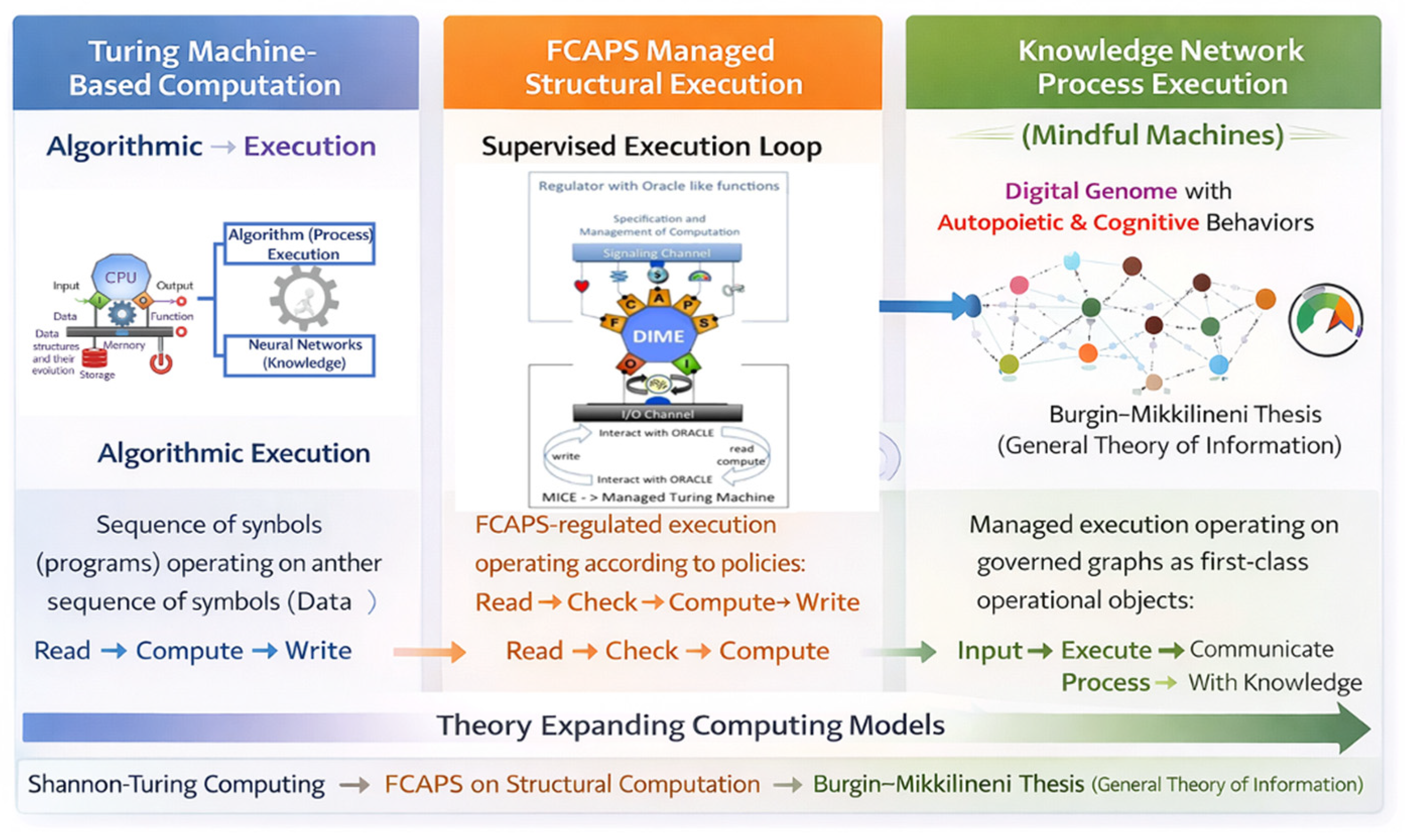
The progression from Shannon–Turing state-of-the-art (SOTA) systems to DIME and ultimately to AMOS is illustrated in
Figure 1.
As shown in
Figure 1, Shannon–Turing architectures externalize governance [
3,
4], DIME introduces supervised execution through signaling overlays [
14], and AMOS elevates governance into knowledge structures through Digital Genomes, enabling explicit and auditable control of operational commitments [
15,
16].
2.1. Shannon–Turing SOTA IT Operations: Architecture and Structural Shortfalls
Modern enterprise IT systems are largely built on the Shannon–Turing computing model, where computation is realized as read–compute–write transformations over data structures, while governance is applied externally. In contemporary cloud-native systems, this separation manifests as a control plane (desired state, scheduling, policy distribution) and a data plane (workload execution and traffic handling).
For example, Kubernetes implements reconciliation-based control loops to maintain desired system state [
5], while service meshes such as Istio introduce programmable routing and security policies through sidecar proxies [
6]. These architectures provide scalability, resilience, and infrastructure-level automation.
Shortcoming (Relevant to Complexity and Coherence Debt)
Despite these strengths, SOTA architectures externalize the governance of operational commitments—such as correctness constraints, acceptable degraded modes, justification of actions, and convergence requirements. As a result:
Governance becomes fragmented across infrastructure policies, service mesh rules, retries/timeouts, and human runbooks, often lacking composability.
Failure handling is implicit, emerging from infrastructure behavior rather than explicitly defined commitments.
Systems manage compute and connectivity but not the governed knowledge structures that define correct behavior under uncertainty.
This separation is a primary driver of coherence debt, as systems scale BDA and AI into decision workflows without preserving the meaning and justification of commitments.
2.2. DIME Computing: Historical Response to SOTA Shortfalls
The Distributed Intelligent Managed Elements (DIME) model addresses this limitation by introducing FCAPS (Fault, Configuration, Accounting, Performance, and Security) management into the execution substrate through signaling overlays and supervision mechanisms.
In DIME, each execution node remains a Turing-equivalent process but is augmented with management and signaling capabilities that operate alongside computation. This modifies the classical execution loop:
read → compute → write
into
read → check (with oracle) → compute → write
This formulation draws on Turing’s oracle-machine concept, where computation is guided by external knowledge or policy constraints [
24].
2.2.1. What DIME Solved (Relative to SOTA)
DIME reduces reliance on ad hoc external management by embedding supervision within the execution fabric. This enables:
Automated failover and recovery
Policy-driven orchestration
Reduced dependency on manual intervention
2.2.2. Why DIME Is Still Incomplete for “AI-Era Governance.”
While DIME improves managed execution, it remains fundamentally a managed-process paradigm. Governance is still applied to processes rather than elevated to shared knowledge structures. This becomes limiting in AI-enabled workflows where decisions must be explainable, auditable, and revisable as part of business model innovation (BMI). General Theory of Information, articulated by Burgin across several books [
25,
26,
27], provides the theoretical framework, and the Burgin–Mikkilineni Thesis extends that framework toward the engineering of Mindful Machines [
28,
29].
This limitation motivates the transition to Mindful Machines, where governance is shifted from process supervision to knowledge-centric structures.
2.3. From Data Structures to Knowledge Structures: GTI, BMT, PMK, and Deutsch
Mindful Machines extend DIME’s goal of embedding regulation but redefine the object of regulation—from processes to knowledge-bearing structures governing commitments under uncertainty. Related work in the Physics of Mindful Knowledge (PMK) further frames knowledge as a causal constraint on system behavior and system survival.
2.3.1. General Theory of Information and Operational Schemas
The General Theory of Information (GTI) provides the conceptual basis for treating information as structured knowledge rather than raw data. In this context, enterprise operations can be represented as schemas encoding roles, relationships, constraints, and allowable transformations [
25,
26].
2.3.2. Burgin–Mikkilineni Thesis (BMT) and Structural Machines
The Burgin–Mikkilineni Thesis (BMT) [
28] provides the theoretical foundation for implementing such systems. It posits that autopoietic and cognitive behavior requires computation over structured knowledge representations rather than symbol strings alone.
This leads to the concept of structural machines—systems that operate directly on graphs, schemas, and networks [
30]. In this work, BMT justifies the use of Digital Genomes as first-class operational structures encoding topology, policy, and provenance. Here autopoiesis refers to the capability of a system to self-produce, self-maintain, and preserve its organization through internal processes. Originally introduced by Humberto Maturana and Francisco Varela, it describes systems that continuously regenerate their components and sustain their identity despite environmental changes [
31,
32].
2.3.3. Deutsch: Discernible Explanations as the Unit of Knowledge
Deutsch’s epistemic framework emphasizes explanatory knowledge—knowledge that preserves reasoning and supports reliable intervention [
33]. This perspective explains coherence debt: when systems fail to preserve the explanatory lineage of commitments, organizations lose the ability to govern outcomes reliably.
2.4. AMOS: Practical Implementation of Mindful Machines
AMOS represents the realization of Mindful Machines by fully decoupling execution from governance. Instead of embedding supervision within executors (as in DIME), AMOS elevates governance into shared knowledge structures—Digital Genomes—within a governed knowledge network.
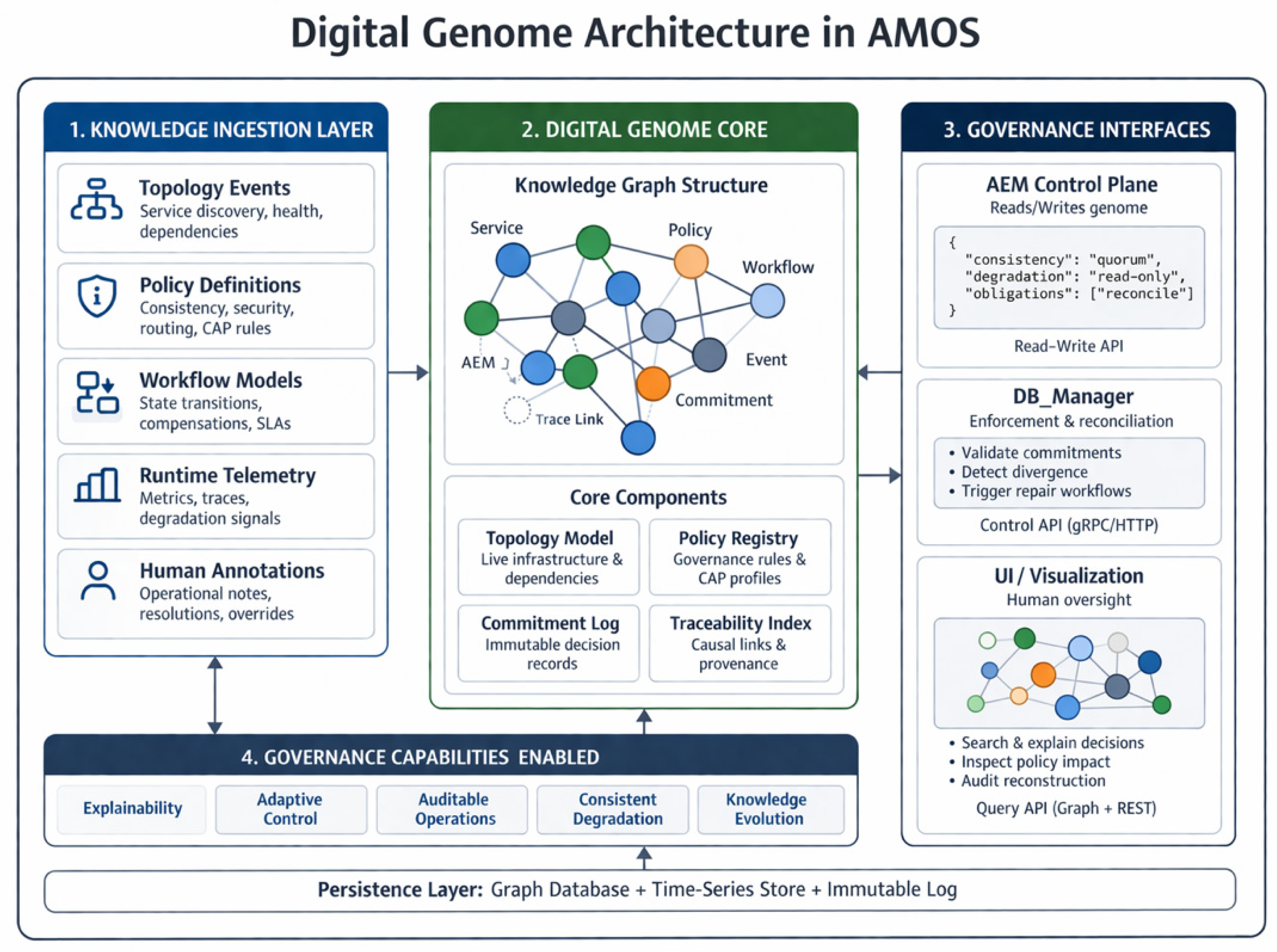
The structure of the Digital Genome is illustrated in
Figure 2.
As shown in
Figure 2, the Digital Genome integrates:
Unlike traditional configuration files, it provides a unified, dynamic representation of system state and governance constraints.
Table 2 shows the Genome components.
The Digital Genome can be represented as a graph-based structure combining topology, policy, and history, enabling structural-machine execution.
2.5. Theory-to-Architecture Mapping
The theoretical foundations map directly to architectural components as shown in
Table 3.
2.6. Evolution Summary
The evolution can be summarized as:
SOTA (Shannon–Turing): external governance; implicit trade-offs; rising coherence debt
DIME: supervised execution; reduced ad hoc management; process-centric governance
AMOS: knowledge-centric governance; explicit commitments; reduced coherence debt
Section 3 builds on this evolution to analyze distributed systems under partition. While CAP constraints remain, AMOS reframes them as explicit, governable commitments by decoupling:
This enables CAP trade-offs to be selected, audited, and enforced at the workflow level rather than emerging implicitly during system failures.
3. AMOS and the Governance of CAP Trade-Offs: Decoupling the Computer from the Computed
The CAP theorem formalizes a fundamental constraint in distributed systems: under partition, a system cannot simultaneously guarantee both consistency and availability. In practice, however, CAP is not merely a database property; it is a constraint on enterprise commitments—transactions, decisions, and policy-gated actions—executed across distributed components under partial failure. When such commitments are handled implicitly through timeouts, retries, default replication behavior, and ad hoc failover scripts, organizations accumulate coherence debt because they cannot reliably explain what happened, why it was permitted, or how the system is obligated to converge back to a coherent state.
The central claim of this section is that the key innovation in AMOS is not to circumvent CAP, but to make CAP trade-offs explicit and governable. In AMOS, these trade-offs are encoded as knowledge-bearing commitments rather than left to emerge accidentally from platform behavior during outages.
3.1. SOTA: CAP Trade-Offs as Emergent Behavior and Incident-Time Surprises
In Shannon–Turing state-of-the-art (SOTA) architectures, CAP trade-offs are typically handled implicitly. Even when teams intend a consistency-first or availability-first posture, the system’s effective behavior is often determined by a combination of: client retry patterns:
client retry strategies,
service mesh and load balancer timeouts,
leader-election and failover defaults,
cache staleness and read fallback behavior,
asynchronous replication lag,
human operational interventions.
As a result, system semantics are often discovered only during incidents and then reconstructed afterward in runbooks and postmortems. This is a direct mechanism for coherence debt accumulation: commitments are enacted without explicit governance, and their operational meaning becomes visible only after failure.
3.2. DIME: Oracle-Mediated Gating Close to Execution
DIME addresses this shortfall by embedding FCAPS-based management into the execution fabric through signaling overlays and supervised process dynamics. Rather than treating governance as something applied externally after computation, DIME introduces a regulated execution loop: read → check (oracle/supervision) → compute → write
Operationally, this means that the “check” phase can mediate execution before a state-changing action occurs. In the context of CAP, this allows DIME to: block unsafe mutations during suspected partition conditions:
block unsafe mutations during suspected partition conditions,
force explicit degraded modes,
redirect processing toward quorum-reachable components, and
accelerate runtime recovery actions through supervision closer to execution than conventional post hoc operational tooling.
DIME therefore does not invalidate CAP; rather, it reduces accidental divergence by mediating CAP trade-offs closer to the compute step.
3.3. AMOS: CAP as a Governed Commitment in a Knowledge Network
AMOS extends the DIME motivation—integrating regulation with execution—but shifts both the location and the object of governance.
In DIME, regulation is integrated into the executor’s runtime loop.
In AMOS, the regulated object becomes a knowledge structure: policies, topology, invariants, provenance, and convergence obligations encoded in Digital Genomes and enforced through workflow regulation.
This is a decisive shift from treating knowledge as an after-the-fact annotation to treating it as an organizing substrate that shapes system behavior.
3.3.1. Decoupling “Computer” vs. “Computed”
In AMOS, the computer is any process execution substrate: symbolic or sub-symbolic engines, rules engines, databases, probabilistic systems, large language models, or even human actors. The computed is not merely a data output but the governed commitment structure that defines:
which invariants must hold,
what evidence or policy justifies an action,
what degraded modes are admissible, and
what convergence workflow is required after disruption.
AMOS therefore decouples execution from governance while simultaneously reconnecting them through a shared knowledge substrate. The result is that commitments become explicit, versioned, and enforceable rather than implicit in emergent platform behavior.
3.3.2. CAP in AMOS: From “Impossibility” to “Policy-Governed Trade Space”
Under AMOS, CAP is handled as follows:
Partition tolerance is assumed (not treated as an exception).
Consistency vs. availability becomes a workflow policy choice, not an accident:
some workflows are CP-leaning (block or degrade under partition),
some are AP-leaning (continue with bounded divergence),
many are “governed hybrid” (quorum rules, bounded staleness, compensation).
Divergence is treated as governed coherence debt, meaning:
it must be recorded with provenance,
bounded by explicit rules,
and reconciled by a defined convergence workflow.
This is the precise, defensible claim: AMOS doesn’t “circumvent CAP”; it operationalizes CAP trade-offs as auditable commitments.
3.3.3. Classification of Operational Commitments
Not all operational commitments have the same governance priority. In practice, commitments can be grouped into at least two broad categories: core commitments and secondary commitments. Core commitments directly affect business correctness, regulatory exposure, financial state, or user-visible outcomes. Examples include transaction commits, policy-gated approvals, model-driven decisions with contractual impact, and workflow state transitions tied to system invariants. Secondary commitments affect execution quality and delivery behavior but do not directly define business truth. Examples include routing preferences, retry policies, cache selection, deployment strategies, and traffic shaping rules.
This distinction matters because governance requirements differ by commitment class. Core commitments generally require stronger provenance, stricter admissibility conditions, tighter convergence rules, and higher auditability. Secondary commitments may tolerate greater flexibility, bounded staleness, or adaptive optimization, provided their effects remain observable and reversible. AMOS does not treat all commitments as equal; rather, it provides a governance substrate in which commitment criticality can determine the level of policy enforcement, traceability, and recovery obligation applied at runtime.
3.4. Concrete Mechanisms: How AMOS Implements Governed CAP Trade-Offs (With Evidence)
Topology-As-Data: Governance Starts by Making Structure Explicit
AMOS implements governed CAP trade-offs by making the structure of distributed commitments explicit and machine-actionable, rather than allowing it to emerge implicitly from infrastructure behavior. In the Transactions/Application Event Manager (AEM) + proxy testbed, this begins with topology-as-data:
services ingest runtime connectivity payloads via/network-config, using typed edges (e.g., API ↔ AEM, AEM ↔ proxy),
dependencies are represented using typed edges (e.g., API ↔ AEM, AEM ↔ proxy) and
updates are applied with an idempotent guard so that repeated application preserves a consistent system state.
This matters because, under partition, reachability and quorum eligibility must be computed from governed structure rather than guessed from incidental failures.
On top of this explicit topology, the AEM encodes the CAP posture as a commitment policy:
all—CP-leaning: commit only if all targets succeed,
quorum—hybrid: commit with majority agreement and bounded availability, and
one—AP-leaning: prioritize availability while explicitly creating a stronger reconciliation obligation.
The difference from SOTA is fundamental: these trade-offs are not hidden in client retry logic or infrastructure defaults; they are explicit, inspectable, and auditable workflow rules attached to execution [
17].
The progression across models can be summarized as follows:
SOTA architectures realize CAP trade-offs as emergent behavior, causing coherence debt because commitments are not first-class governed objects.
DIME improves this by introducing oracle-mediated supervision closer to execution, reducing accidental divergence.
AMOS goes further by elevating governance into knowledge structures—Digital Genomes, topology, provenance, and policy-regulated workflows—thereby making CAP trade-offs explicit, auditable commitments with defined degraded modes and convergence pathways.
3.5. Comparing SOTA and AMOS Governed Solutions
Contemporary cloud-native platforms already incorporate substantial runtime control. Kubernetes uses controllers as control loops that watch current state and move it toward desired state, while Istio provides traffic-routing, retries, timeouts, circuit breaking, and staged traffic-management capabilities [
5,
6]. Progressive-delivery systems such as Argo Rollouts add canary, blue-green, and rollback controls for application release management. Empirical studies of service-mesh traffic management likewise show that policy choices for retries, circuit breakers, and routing materially affect both resilience and latency envelopes in microservice deployments [
19]. Modern cloud-native runtime control is usually distributed across multiple layers and specialized tools, whereas AMOS proposes a unified governance surface that coordinates routing, recovery, backend participation, topology, and commitment semantics as one operational model.
Table 4 shows a comparison between SOTA deployments and AMOS governed deployment.
4. Architectural Design and Implementation of a Capability-Oriented Distributed Orchestration Framework
The proposed system represents a shift from traditional database-centric architectures toward a capability-oriented control plane, where orchestration logic is decoupled from storage-specific implementation details. In conventional designs, orchestration components must directly manage database types, drivers, and schemas, resulting in tight coupling and limited extensibility.
By introducing generic Proxy Services, the architecture achieves a clean separation of concerns: the Application Event Manager (AEM) governs coordination and policy, while proxies encapsulate backend-specific functionality. This enables system evolution through deployment and configuration rather than modification of core orchestration logic, aligning with modern service mesh and data fabric principles.
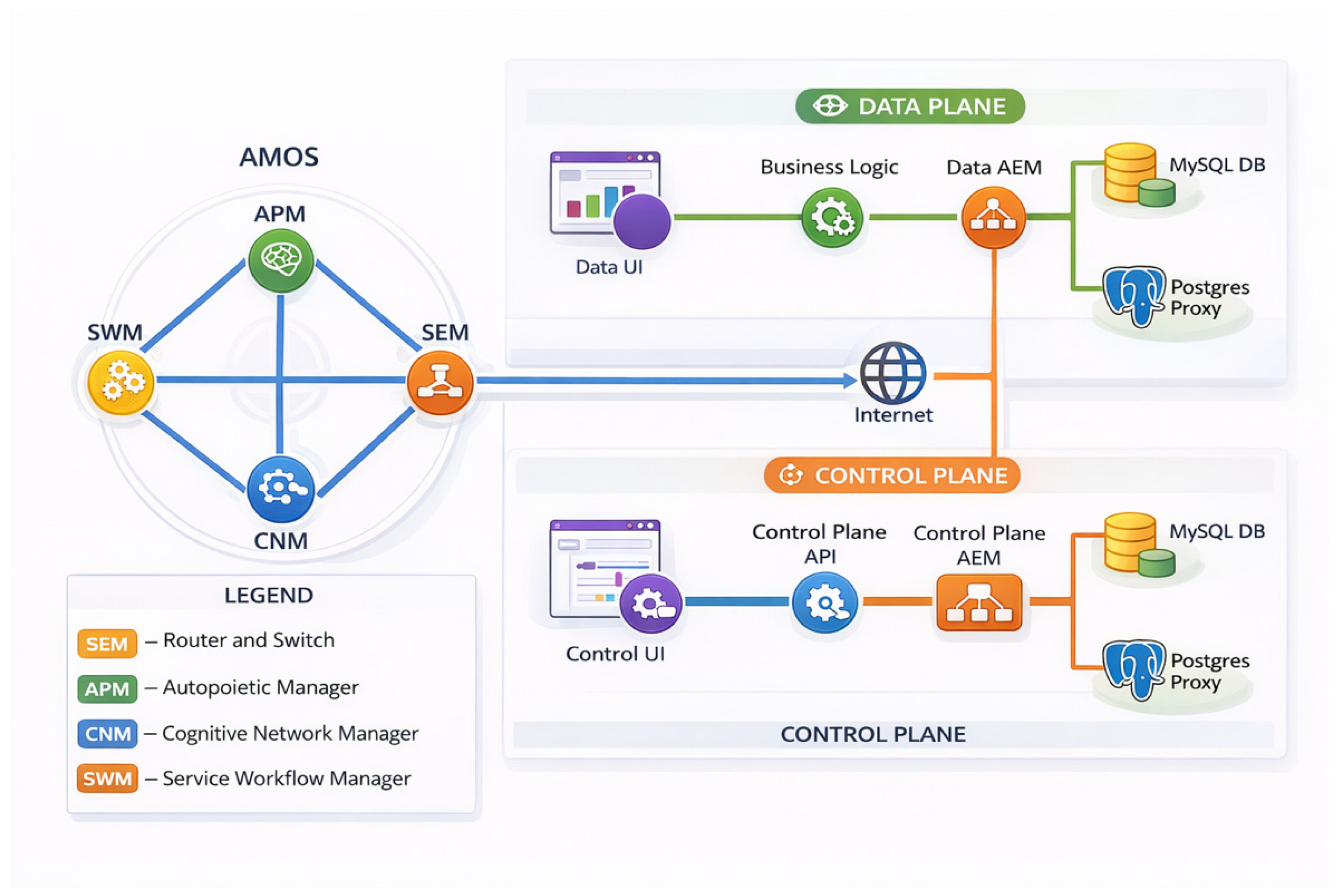
The overall system architecture is illustrated in
Figure 3.
The framework is divided into two logical layers:
A Control Plane, responsible for governance, orchestration, and policy enforcement, and
A Workload & Measurement Plane, responsible for execution, data processing, and state observation.
4.1. Database Proxy Services (MySQL and PostgreSQL)
Database proxy services provide a uniform HTTP-based interface that abstracts the heterogeneity of backend systems such as MySQL and PostgreSQL.
Key capabilities include:
Lifecycle management: Support for multiple control modes (Docker-based, system-level, and no-op modes) enabling flexible deployment and control.
State tracking: Fine-grained lifecycle states including running, stopped, starting, stopping, and degraded.
Health monitoring and schema management: Periodic validation using lightweight queries (e.g., SELECT 1) and automatic initialization of transaction tables at startup.
By encapsulating backend-specific behavior, proxies enable the orchestration layer to operate independently of storage implementation details.
4.2. Application Event Manager (AEM)
The Application Event Manager (AEM) functions as a stateless orchestration layer responsible for routing requests and enforcing execution policies.
Its core responsibilities include:
Execution strategies: Support for multiple routing policies, including broadcast (all, quorum, one), round-robin, and primary-secondary failover.
Commitment policy enforcement: Mapping CAP trade-offs into explicit execution semantics at the workflow level.
Replication coordination: Synchronization of heterogeneous backends using replication watermark tracking and incremental data transfer.
The AEM enables policy-driven execution, ensuring that system behavior reflects explicit governance decisions rather than implicit infrastructure defaults.
4.3. Database Manager (DB Manager) and User Interface
The DB Manager serves as the primary control-plane coordinator, managing system configuration, lifecycle operations, and observability.
It issues lifecycle commands to proxies and orchestrates system-wide state transitions.
It integrates with a web-based user interface that provides visualization of system state and interactive control capabilities.
For robustness, it supports direct invocation of proxy services, bypassing the AEM in the event of communication failures.
This design ensures resilience and maintains control-plane availability under partial system failures.
4.4. Dynamic Topology and Service Discovery
To avoid the limitations of static configuration, the system implements dynamic topology management using Structural Event Manager (SEM) payloads.
Key features include:
Topology-as-data: Services receive runtime configuration payloads de-scribing connectivity as typed edges (e.g., API ↔ AEM, AEM ↔ proxy), forming a graph-based representation of system structure.
Idempotent configuration updates: A config_id guard ensures that repeated application of configuration updates produces a consistent system state.
Concurrency safety: Thread-safe state management protects service registries and lifecycle transitions under concurrent updates.
This approach enables explicit representation of system structure, which is essential for governed CAP trade-offs under partition conditions.
Table 5 summarizes the primary architectural features of the orchestration framework.
The prototype is implemented as a set of containerized services exposing HTTP interfaces. Topology state is exchanged as structured runtime payloads containing service identifiers and typed edges. Policy selection is represented explicitly in the orchestration layer, and lifecycle transitions are recorded alongside health and routing state. This design allows the governance layer to reason over structure, policy, and event history without requiring modification of the underlying execution engines.
Our implementation video “AMOS Governed Distributed Databases and CAP Regulation” [
34] is a practical demo of AMOS as a governance layer for distributed database operations. It shows how AMOS sits above the application, database manager, and database proxies to make runtime behavior visible and controllable. Instead of relying on fixed failover rules hidden in infrastructure, the system exposes topology, health, routing strategy, and transaction state in real time. The demo walks through normal operation, a partial failure scenario, continued service during degradation, and recovery after the failed component returns—showing that AMOS can keep the application running while making backend divergence and re-synchronization explicit.
Key points made:
AMOS is a control plane, not just a monitoring dashboard.
It separates control/governance from transaction workload and measurement.
Topology and health are explicit runtime knowledge and visible to operators.
Routing and failover behavior can be changed live through policy.
The system can continue operating during partial failures.
Backend divergence is made visible, rather than hidden.
Recovery includes re-alignment and re-synchronization after the failed path returns.
The approach emphasizes policy-driven resilience, observability, and operational control for IT.
4.5. Experimental Evaluation Methodology
To evaluate the operational implications of the proposed governance model, a distributed transaction testbed was implemented using containerized microservices and heterogeneous database backends.
The goal of the evaluation is not to optimize throughput, but to examine how explicit commitment governance influences system behavior under partial failure conditions.
Experimental Setup
The testbed consists of:
An Application Event Manager (AEM),
A DB Manager control service, and
Multiple database proxy services representing heterogeneous storage engines.
Each component communicates via HTTP interfaces and shares topology information using runtime configuration payloads.
System behavior is assessed using governance-oriented metrics:
Decision reconstruction time: Time required to reconstruct the rationale of a transaction.
Traceability completeness: Fraction of events with complete provenance and policy metadata.
Convergence latency: Time required to reconcile divergent state after failure.
Commitment policy compliance: Degree to which execution follows defined policies (all, quorum, one).
These results demonstrate that when commitment policies are explicitly encoded, system behavior under partition becomes predictable and auditable, rather than emergent.
The evaluation is conducted in a controlled microservice environment designed to isolate governance mechanisms. While this enables precise observation, it does not fully represent large-scale, geo-distributed production systems.
The objective of this work is therefore to establish the feasibility and operational semantics of commitment governance. Extending evaluation to production-scale environments remains an important direction for future work.
A typical governed transaction in the testbed proceeds as follows. A client request is received by the application-facing interface and forwarded to the Application Event Manager (AEM). The AEM consults the active commitment policy and topology state, determines the eligible targets, and dispatches the request to the relevant proxy services. Each proxy translates the request into backend-specific operations and returns status and state information. The AEM then evaluates whether the outcome satisfies the selected commitment rule (e.g., all, quorum, or one), records the associated provenance and policy context, and returns the governed result to the caller. If the outcome implies bounded divergence, the corresponding reconciliation obligation is recorded for later convergence. This flow separates execution from governance while preserving explicit auditability of the decision pathway.
Client Request → AEM Policy Check → Target Selection → Proxy Execution → Pol-icy Evaluation → Result + Provenance Record → Optional Reconciliation
5. Lessons Learned
This section distills the engineering and conceptual lessons derived from implementing and evaluating the Transactions testbed. The focus is on how the proposed architecture reduces coherence debt and enables explicit governance of CAP trade-offs in practice.
5.1. Make Topology a First-Class Operational Artifact or You Cannot Govern Distributed Behavior
The most consequential practical shift was treating service connectivity as explicit, governed state rather than an implicit byproduct of deployment tooling. By implementing/network-config across services and applying topology payloads idempotently via config_id, the system transformed dependency relationships into inspectable and re-playable knowledge.
Lesson: If reachability and dependency are not first-class, CAP behavior emerges from incidental infrastructure effects (timeouts, retries), and incident explanations remain narrative rather than reconstructable.
5.2. The Capability/Proxy Boundary Dramatically Lowers Integration Complexity
Encapsulating each backend behind a uniform proxy interface eliminated database-specific logic from the orchestration layer. This enabled extensibility through deployment (adding new proxies) rather than modifying orchestration code.
Lesson: Capability boundaries provide a practical transition from data-structure coupling (embedding storage semantics in clients) to knowledge-structure coupling (reasoning over capabilities and policies)
5.3. Explicit Commitment Policies (All/Quorum/One) Turn CAP from Incident Behavior into Design Behavior
Implementing commitment policies (all, quorum, one) in the AEM made consistency–availability trade-offs explicit and inspectable.
Lesson: Organizations already operate with heterogeneous consistency requirements across workflows. Encoding these as explicit policies is essential for governing CAP trade-offs as commitments rather than discovering them during system failures.
5.4. Health Checks Are Necessary but Not Sufficient—Systems Need Declared Degraded States and Admissibility Rules
While health monitoring is necessary, binary “up/down” status is insufficient. Proxies track richer lifecycle states, including degraded conditions.
Lesson: Systems must encode admissibility rules—which operations are permitted under which states—and define associated obligations (e.g., reconciliation after AP-leaning operations) to reduce coherence debt.
5.5. Decoupling Application FCAPS from IaaS/PaaS FCAPS Enables Portability and Auditability
By decoupling application-level FCAPS from IaaS/PaaS-level FCAPS, the system supports portability across different infrastructure environments without changing policy logic.
Lesson: Infrastructure-level self-healing ensures availability but does not guarantee semantic correctness. Application-level governance is required to ensure that commitments remain valid under changing operational conditions.
5.6. A Stateless Coordinator Is a Strength When Coupled to an Explicit Knowledge Substrate
The stateless design of the AEM simplifies scaling and fault tolerance while enabling rich behavior through externally defined policies and topology.
Lesson: System “intelligence” should reside in governed knowledge structures (topology, policy, provenance), not in mutable coordinator state. This enables auditability, versioning, and re-playability.
5.7. Fallback Pathways Reduce Single-Point Brittleness and Improve Explainability During Incident Response
Allowing the DB Manager to invoke proxies directly when the AEM is unavailable reduces control-plane fragility.
Lesson: Systems must encode fallback control paths as part of their design. This reduces coherence debt by ensuring that operator actions during failures are supported by the system rather than relying solely on external runbooks.
5.8. Convergence Must Be Treated as a First-Class Workflow, Not a Background Hope
Replication mechanisms in the testbed (watermarks and incremental transfer) highlight that divergence is acceptable only if convergence is governed.
Lesson: Divergence creates an obligation. If convergence is not explicitly encoded as a workflow, organizations incur coherence debt through manual reconciliation, inconsistencies, and compliance risks.
5.9. User Interface Design Is Part of Governance: “Not Available” Is Better than Silent Absence
The user interface explicitly represents unavailable backend states rather than silently omitting data.
Lesson: Coherence debt often arises from misinterpretation. Systems must represent uncertainty and partial failure explicitly to preserve correct reasoning by operators.
5.10. Implication for AMOS/Mindful Machines: The Testbed Identifies the Minimum Viable “Governance Substrate”
Across experiments, a minimal set of primitives emerged as sufficient for reducing coherence debt:
topology-as-data with idempotent updates,
capability boundaries via proxy services,
explicit commitment policies (all, quorum, one),
declared degraded modes and admissibility rules, and
convergence workflows as explicit obligations.
Lesson: These primitives are sufficient to demonstrate how an AMOS-style architecture can govern CAP trade-offs as auditable commitments without requiring replacement of existing execution substrates.
5.11. Performance Implications of Governance Integration
A key concern when integrating governance into execution is the potential for increased latency, particularly in the read–check–compute–write model. Prior empirical work on service-mesh traffic management shows that additional routing and resiliency controls can change latency and throughput characteristics in nontrivial ways, which is why governance mechanisms must be evaluated together with their operational envelopes rather than treated as cost-free abstractions [
18].
In the prototype environment, the governance step was implemented as local policy evaluation and topology lookup rather than a blocking distributed consensus operation, so the added latency remained bounded by in-memory control-path processing under normal conditions.
In the Transactions testbed, the “check” phase is implemented as lightweight policy evaluation and topology lookup rather than as a blocking coordination step. As a result, overhead is bounded by in-memory operations in most cases.
Furthermore, the architecture introduces synchronous coordination only when required by policy (e.g., “all” vs. “quorum” vs. “one”), making performance trade-offs explicit and controllable.
Lesson: Governance integration introduces modest overhead, but this overhead is policy-dependent and enables significantly improved predictability and auditability under failure conditions.
5.12. Adoption and Migration Considerations
The introduction of Digital Genomes, policy-driven orchestration, and explicit commitment governance may appear to require substantial architectural changes. However, the design of AMOS is intentionally incremental.
Existing systems can be integrated through proxy services without modifying underlying execution engines. Governance is introduced as an overlay, allowing organizations to begin with high-risk workflows and expand gradually.
Lesson: The primary shift is conceptual rather than infrastructural: treating commitments as governed entities rather than implicit outcomes. While this introduces an initial learning curve, it reduces long-term operational complexity by making system behavior explicit and auditable.
6. Conclusions
This paper presents an alternative approach to improving IT operations by addressing coherence debt as a first-class concern—particularly in environments where big data analytics (BDA) and cognitive computing are embedded in mission-critical decision workflows. Rather than treating operational reliability solely as an infrastructure problem, we frame it as a governance-of-commitments problem, where correctness depends on preserving the meaning, justification, and convergence of distributed actions.
Three core contributions are made:
Model evolution:
We describe a progression from Shannon–Turing state-of-the-art (SOTA) systems—where computation and governance are separated—to DIME, which introduces oracle-like supervision closer to execution, and ultimately to AMOS/Mindful Machines, which elevate governance into knowledge structures (Digital Genomes) within a governed knowledge network.
A conservative CAP interpretation:
We demonstrate that CAP constraints are not circumvented but can be governed. AMOS enables explicit, auditable selection of consistency–availability trade-offs as workflow commitments, with defined degraded modes and convergence obligations rather than incident-time surprises.
Implementation evidence and operational primitives:
Through a distributed transaction testbed, we identify a minimal set of primitives required to reduce coherence debt, including topology-as-data, capability-oriented proxies, explicit commitment policies, declared degraded states, and convergence workflows.
Taken together, these results support the central thesis: coherence debt is a limiting factor in AI-enabled business transformation, and it grows when governance remains external to computation. DIME reduces coherence debt by moving supervision closer to execution, while AMOS addresses it more fundamentally by making governance a first-class knowledge substrate that decouples the computer (execution engines) from the computed (governed commitments, provenance, and convergence obligations).
6.1. Future Work
The directions outlined below extend beyond the minimal governance substrate demonstrated in this work and are intentionally framed as next-stage developments rather than omissions from the current implementation.
6.1.1. Formalizing Coherence Debt Metrics and Benchmarking Protocols
Future work should define standardized metrics and benchmarking protocols, including:
failure injection scenarios (e.g., partitions, partial writes),
workload classes with varying consistency requirements, and
governance maturity indicators (policy versioning, audit completeness, reconciliation determinism).
This would enable reproducible evaluation of governance effectiveness beyond traditional performance benchmarks.
6.1.2. Extending Digital Genome Expressivity for Workflow Commitments
The Digital Genome can be extended to encode richer governance semantics:
invariants and admissibility constraints,
allowable degraded modes per workflow,
convergence obligations and reconciliation strategies, and
explicit provenance and policy lineage.
This would strengthen its role as a machine-interpretable governance substrate.
6.1.3. Integrating AI/Cognitive Components as Governed Executors
An important direction is the integration of AI and cognitive components (e.g., LLMs, anomaly detection systems, forecasting models) as governed executors within the same knowledge network.
Key questions include:
how to encode confidence thresholds and validation constraints,
how to enforce explainability requirements, and
how to integrate human-in-the-loop escalation policies.
This is essential to ensure that AI-driven commitments reduce rather than amplify coherence debt.
6.1.4. Multi-Region and Multi-Cloud Experiments with Explicit CAP Policy Selection
Extending the testbed to multi-region and multi-cloud environments would allow evaluation under realistic distributed conditions, including:
asymmetric network partitions,
heterogeneous latency profiles, and
diverse replication models.
This would enable quantitative analysis of how explicit commitment policies influence system behavior at scale.
6.1.5. Security and Compliance Governance as First-Class Commitments
Future work should incorporate security and compliance policies directly into the governance model, including:
signed topology and policy artifacts,
integrity guarantees for provenance data, and
audit mechanisms aligned with regulatory requirements.
This is critical for demonstrating applicability in regulated enterprise environments.
6.1.6. Longitudinal Field Studies Linking Governance Maturity to Business Model Outcomes
Finally, longitudinal studies are needed to evaluate the relationship between governance maturity and business outcomes, including:
Reduced incident cost variability,
Improved change success rates,
Faster certification of AI-enabled workflows, and
Increased trust and transparency in operational systems.
6.2. Closing Remark
A video showing various features discussed in this paper are presented as
Supplementary Material [
34]. The long-term implication of this work is that enterprise advantage shifts from simply deploying more analytics to governing operational commitments more effectively. In this sense, AMOS/Mindful Machines represent not just an operational framework, but an evolution of the computing model itself: a transition from externally governed Shannon–Turing execution toward knowledge-centric, self-regulating systems capable of sustaining trustworthy BDA and cognitive computing at scale.