Article

Case Studies on the Logical Structure of the Algorithms Tabu Search and Threshold Accepting for Generating Solutions in Searching and Solving the Bin-Packing Problem †

by
Vanesa Landero-Nájera
1,*,
Joaquín Pérez-Ortega
2,
Laura Cruz-Reyes
3,
Claudia Guadalupe Gómez-Santillán
3,
Nelva N. Almanza-Ortega
4,
Carlos Rodríguez-Orta
5 and
Carlos Andrés Collazos-Morales
6
1
IT Nuevo León, Tecnológico Nacional de Mexico, Guadalupe 67170, Nuevo Leon, Mexico
2
Cenidet, Tecnológico Nacional de Mexico, Cuernavaca 62490, Morelos, Mexico
3
IT Cd. Madero, Madero 89460, Tamaulipas, Mexico
4
Secretaría de Ciencia, Humanidades, Tecnología e Innovación, SECIHTI, Mexico City 03940, Mexico
5
Universidad Autónoma de Nuevo Leon, San Nicolas de los Garza 66455, Nuevo Leon, Mexico
6
Universidad Manuela Beltrán, Bogota 110311, Colombia
*
Author to whom correspondence should be addressed.
This article is a revised and expanded version of a paper entitled Study Cases on Initial Solution and Searching for Tabu Search and Threshold Accepting Algorithms on Bin-Packing Problem, which was presented at International Conference on Computational Science and Its Applications (ICCSA 2025), Istanbul, Turkey, 30 June–3 July 2025.
Computers 2026, 15(5), 274; https://doi.org/10.3390/computers15050274
Submission received: 27 March 2026 / Revised: 16 April 2026 / Accepted: 20 April 2026 / Published: 24 April 2026
(This article belongs to the Special Issue Computational Science and Its Applications 2025 (ICCSA 2025))

Abstract

The logical structure of approximation algorithms has been identified by the scientific community in four principal parts: tuning parameters, generating initial solutions, generating neighbor solutions, and stopping algorithm execution. A review of the literature specifically for the algorithms Threshold Accepting (TA) and Tabu Search (TS) indicates that, in most cases, choices are performed on one or several of these logical parts, often implicitly guided by expert knowledge for improving algorithm performance. However, these design choices, particularly in the selection of initialization and neighborhood strategies, are rarely analyzed in a systematic and reproducible manner. A formal experimental framework is presented to systematically analyze logical structure design choices, which are typically based on empirical expertise, by isolating and evaluating the combined effects of methodologies in the logical parts of initialization and neighborhood under controlled conditions of TA and TS algorithms in solving the one-dimensional Bin Packing Problem (BPP). A total of 324 benchmark instances were used to assess multiple algorithmic variants. Performance was evaluated in terms of solution quality and computational effort, supported by graphical analysis and statistical methods, including Wilcoxon signed-rank tests, effect size measures, bootstrap-based confidence intervals, and linear regression. The experimental results consistently show that the simpler internal logical structure of TA and TS algorithms, specifically with a probability-guided initialization combined with a single neighborhood operator, can achieve a better balance between solution quality and computational effort compared to more complex alternatives in general instances of BPP.

1. Introduction

The main objective of the scientific community across several areas of knowledge (computational complexity theory, graph theory, machine learning, combinatorial optimization, operations research) is to find high-quality solutions within extremely large and complex search spaces, where exhaustive search for optimal solutions is computationally not feasible in a short or reasonable amount of time for problems such as decision-making, optimization, forecasting, classification, clustering, and sorting. The one-dimensional Bin Packing Problem (BPP) is a classical NP-hard combinatorial optimization problem. Some real-world applications are in logistics, manufacturing, resource optimization and hardware design; more specifically, examples include cutting operations, transportation, warehousing, supply chain coordination, management, industrial environments, healthcare systems [1,2], and logistics for truck loading and dispatching [3]. The complex task of BPP is to find the optimal distribution of objects to reduce the number of containers with fixed capacity. Due to its computational complexity, exact methods become impractical. Faced with this difficulty, metaheuristics have emerged as an efficient alternative for obtaining approximate solutions in a reasonable time. Algorithms such as Threshold Accepting (TA) and Tabu Search (TS) have been successful in solving hard combinatorial optimization problems [4,5,6,7,8,9,10] and stand out for their conceptual simplicity and their effectiveness in exploring the solution space, where a balance between solution quality and computation time is required. Nevertheless, few studies have used these algorithms or their variants to solve the BPP [11,12,13].
The performance of these metaheuristics is critically dependent on the internal logical structure, as this determines how the algorithm’s exploration is explored and exploited to find high-quality results of the solution space within a reasonable timeframe. A well-designed structure enables the metaheuristic to be efficient, avoid getting stuck in local optima, and adapt to the specific characteristics of the problem, thereby increasing the likelihood of finding high-quality solutions within a reasonable timeframe. In short, this structure is key to ensuring the method’s effectiveness and robustness. The scientific community has identified four principal parts from the logical internal structure of the solution algorithms, for developing improvements into them and giving the best solution. These logical parts are related to the methodology for parameter tuning (PT), i.e., temperature, size of Tabu list, size of population, etc.; initial solution generating (IS); neighbor solutions generating (NS); and algorithm execution stopping (SC).
A revision of the literature consulted exclusively for Threshold Accepting (TA) and Tabu Search (TS) algorithms shows that, in the particular case of parameter tuning, many studies have focused on different methodologies for adjusting control parameters [14,15,16,17,18,19,20]. In the case of the Tabu Search algorithm, methodologies with adaptive strategies outperform fixed approaches. For the Threshold Accepting algorithm, the control parameter calibrations still depend on the problem. In contrast to stopping criteria, a few studies have explored the scope of various schemes [21,22,23]. The findings suggest that convergence or stagnation-based strategies can significantly improve computational efficiency. In the case of initial solution and neighborhood generation methodologies, a scheme based on constructive heuristic, complex and stochastic strategies permits a better search of the problem space [5].
Some internal logical parts of the algorithm are often analyzed independently [14,15,16,17,18,19,20,21,22,23]. Some other studies have worked on several logical parts at the same time (e.g., control parameters and neighborhoods) [5,24,25,26]. All these related works have shown results of improved algorithm performance. The researcher’s expertise plays a vital role in enhancing these logical parts, drawing from both theoretical knowledge and practical experience. Their expertise allows the application of advanced techniques to optimize structural complexity and improve resource management. Experienced researchers can foresee the impact of modifications, ensuring that improvements do not compromise essential aspects like stability. Ultimately, their knowledge leads to significant enhancements in both solution quality and execution efficiency. Despite these advances, there is still a lack of systematic and formal analysis. Most existing studies focus on proposing new algorithmic variants and reporting performance improvements, but they do not isolate, analyze and evaluate the logical structure methodologies that drive these improvements. As a result, many design decisions remain implicit and are difficult to generalize or reproduce, and the practice of empirical expertise continues.
In this context, the need arises to more systematically analyze the effects of different methodologies applied to certain logical parts of algorithms’ internal structure and fully consider their interactions within the overall performance, so that a comprehensive understanding of its behavior can be obtained. In other words, the algorithms have been seen as a partial black-box, and are typically based on empirical expertise in the majority of cases; therefore, it is necessary and important to open the box completely and understand the logical parts relevant to the connection of the algorithm and problem during the solution process in a clear, formal and in-depth way [27], reinforcing the knowledge gained by the expertise of the scientific community. Another important aspect is to revise more thoughtfully the performance measures of quality and time in terms of regions of dominance of the algorithms. The above permits the identification of the existence of scenarios with a minimal significant difference between solution qualities from two algorithms, a1 and a2, in comparison, but with a very big significant difference between solution times. It would be wrong to affirm that one algorithm outperforms another only because the solution quality is slightly better than that of another [28]. The structural analysis of algorithms’ logical parts, considering both solution quality and time in terms of significant dominance regions, could allow the discovery of guidelines to direct the algorithm to not spend so much time finding the best solution.
A reflection on the reviewed specialized literature, consulted exclusively for TA and TS algorithms, shows that up to now, there has been no specific work that explores and performs a thorough experimental analysis on the logical aspects of generating the initial solution and neighborhoods to search the problem space. Given their very close relationship within the internal logical structure of the algorithm, it would be interesting to know how both parts impact the performance of the algorithm.
In order to be able to give small but relevant steps according to everything mentioned above, first start with a specific domain: we focus on the one-dimensional Bin Packing problem due to its application relevance described earlier and the TA and TS algorithms. A formal experimental framework is presented to analyze the logical structure and design components of these algorithms, which are typically based on empirical expertise, isolating and evaluating initialization and neighborhood design under controlled conditions. Specifically, the study focuses on two logical parts: (i) the generation of the initial solution, considering randomly guided and probability-guided initialization methodologies, and (ii) the generation of neighbor solutions, considering single-operator and multiple-operator methodologies. A total of 324 benchmark instances from well-known repositories [29,30] are used to ensure a comprehensive and reproducible evaluation, leaving out very difficult instances as future work [30,31]. The experimental design consists of different scenarios and case studies, which include multiple algorithmic variants under controlled conditions, using standardized parameter settings and a fixed stopping criterion. Performance is evaluated using both solution quality and computational effort, supported by graphical and statistical analyses, including Wilcoxon signed-rank tests, effect size estimation, and bootstrap-based confidence intervals, and revised in terms of dominance regions. Finally, a linear regression analysis was performed.
There are two main contributions of this work. First, it provides a systematic and reproducible framework for analyzing key logical parts of the internal structure of metaheuristics, formalizing empirical design practices guided by researchers’ expertise. Second, it demonstrates that a simpler logical structure, for Threshold Accepting and Tabu Search algorithms, probability-guided initialization combined with a single neighborhood operator, can consistently achieve a better balance between solution quality, stability, and computational efficiency in general instances of BPP. This work contributes to bridging the gap between empirical practice and systematic analysis in the metaheuristic internal logical structure.

2. Related Work

In this section, works related to the application of methodologies on some logical parts of the internal structure of Threshold Accepting (TA) and Tabu Search (TS) algorithms are summarized, a comparative table is shown, and a reflection is performed to assess the contributions and disadvantages of related works.
The performance effect of the Threshold Accepting algorithm in the work in Ref. [14] is compared through the application of different control rules for the threshold parameter, involving initial values and reduction rates. Several experiments were carried out on different optimization problems. The results revealed that threshold control is the most influential factor in the quality of the solutions. The conclusion is that an appropriate balance of threshold values is needed, since excessively large values lead to over-exploitation; conversely, small values cause premature convergence.
Several strategies for controlling Tabu tenure (fixed vs. dynamic) were analyzed for the Tabu Search algorithm to solve general combinatorial optimization problems in the work in Ref. [15]. More specifically, the size of the Tabu list was evaluated to verify how it affects the occurrence of cycles and the algorithm’s stalling. Dynamic adjustment based on the detection of repeated solutions demonstrated a significant improvement in the algorithm’s performance compared to considering only fixed values.
A methodology using a deterministic decreasing scheme for the threshold control parameter of the Threshold Accepting algorithm to solve the vehicle routing problem with a fixed heterogeneous fleet is proposed in the work in Ref. [16]. The methodology consists of starting with high values that allow for extensive exploration of the solution space and gradually reducing them to promote intensification. Results show that the methodology achieves a good balance between solution quality and time. The main disadvantage is that the algorithm’s performance depends on the correct initial calibration of the parameter. Sensitivity is required and there is a need for specific empirical tuning for each problem.
A comparative analysis of different Tabu tenure control strategies using a fuzzy inference system was conducted for the Tabu Search algorithm to solve instances of Exam Timetabling problem in the work in Ref. [17]. The performance of the algorithm using these strategies was compared to the performance of the algorithm using traditional fixed-size approaches. The results revealed that the use of fuzzy logic allows the dynamic adjustment of the parameter based on the algorithm’s state, improving the quality of solutions in timetabling problems. However, it was also observed that the design of the fuzzy system introduces additional complexity.
An adaptive Tabu list size adjustment methodology is proposed for the Tabu Search algorithm to solve large-scale timetabling problems in the papers in Ref. [18]. The method dynamically adjusts the Tabu tenure during the search to balance exploration and intensification. Experimental results, performed on large-scale instances, show that the proposed algorithm outperforms traditional fixed-parameter versions of Tabu Search in both solution quality and runtime. However, the approach relies on specific adjustment rules, geared towards timetabling problems, which limits its generalizability.
An experimental analysis was conducted in the work in Ref. [19] to study different Tabu tenure policies (fixed, random, and adaptive using machine learning) and evaluate their impact on the performance of the Tabu Search algorithm to solve general combinatorial optimization problems. One key finding is that adaptive policies can improve performance in certain cases, but they do not always outperform simpler strategies, demonstrating that their effectiveness depends on the problem structure.
A method for adjusting the Tabu tenure based on path metrics was proposed for Tabu tenure of the Tabu Search algorithm to solve instances of the Quadratic Unconstrained Binary Optimization problem in the work in Ref. [20]. The algorithm’s performance is compared with traditional fixed-size approaches. The results reveal that dynamic adjustment based on search behavior improves the quality of solutions and reduces the need for manual calibration. Furthermore, the impact of the parameter on different search phases is analyzed, demonstrating an adaptation of the problem through the proposed dynamic control. However, the method depends on specific metrics of the problem.
In the work in Ref. [21], different stopping criterion methodologies were analyzed for the Tabu Search algorithm to solve general combinatorial optimization problems, considering the maximum number of iterations, maximum execution time, and convergence-based criteria (lack of improvement). The results of the analysis reveal that each criterion directly impacts the balance between solution quality and computational cost, showing that iteration-based criteria are simpler but less efficient, while convergence-based criteria allow for higher-quality solutions. However, it is not possible to conclude which is best; that is, there is no universal criterion, since the effectiveness of the criterion depends on the problem and the dynamics of the algorithm.
A probabilistic stopping criterion based on Poisson processes is proposed in Ref. [22] for algorithms in general. The methodology consists of stopping the search when a desired probability of solution quality is reached, significantly reducing execution time without affecting effectiveness. The results from applying this methodology were compared with those from traditional stopping criteria, showing that the proposed methodology is more efficient than traditional approaches; however, its application depends on statistical assumptions that are not always met in real-world metaheuristics.
A stopping criterion for metaheuristics in general is proposed in the work in Ref. [23]. It is based on the detection of stagnation (number of evaluations without improvement). A comparative analysis of the proposed criterion and traditional criteria, such as a fixed number of evaluations, revealed that the adaptive approach improves the use of computational resources and avoids unnecessary executions, achieving better efficiency without loss of solution quality. However, a new parameter is introduced (stagnation threshold), which creates the problem of adjusting this parameter.
Methodologies for generating initial solutions and neighborhoods are proposed for the Tabu Search algorithm to solve the Uncapacitated Single Allocation Hub Location Problem in the work in Ref. [5]. A scheme based on a constructive heuristic is used to generate high-quality initial solutions and thus accelerate convergence. A scheme of specific neighborhood operators (opening, closing, and swapping hubs, as well as node reassignment) is also proposed to more effectively explore the solution space, along with a restricted neighborhood strategy to reduce computational cost. A fixed Tabu list size, complemented by aspiration criteria, is implemented, and a stopping criterion based on iterations and lack of improvement is used. The analysis of results reveals an advantage in solution quality and execution time compared to existing approaches. However, limitations exist regarding problem dependency and generalizability, as the algorithm does not incorporate adaptive mechanisms for parameter control.
The logical parts of the internal structure of the Threshold Accepting algorithm, specifically parameter tuning and neighbor generation, were analyzed by examining their performance in solving instances of the timetabling problem in the work in Ref. [24]. Various strategies with different initial values and decrement schemes, as well as different operators based on event elimination and insertion for generating neighbors, were implemented. The combination of more aggressive operators and well-calibrated thresholds had a significant impact on the algorithm’s performance; however, the conclusion is that there is no universal configuration because the algorithm’s performance depends on the specific problem instance.
A hybrid algorithm is proposed in the work in Ref. [25] which combines Threshold Accepting with Tabu Search. Different threshold control strategies (monotonic vs. non-monotonic) and distinct neighborhood schemes were evaluated to solve instances of the Vehicle Routing problem. Experimental comparisons between these variants were analyzed, and the quality of the solutions improves significantly with a non-monotonic adaptive threshold management methodology, along with more complexly generated neighbors.
Methodologies for threshold parameter control and neighbor generation are proposed for the Threshold Accepting algorithm to solve the 0–1 Knapsack problem in the work in Ref. [26]. One methodology employs a list-based control scheme for the threshold parameter, allowing the use of multiple threshold values instead of a single decreasing one, thus providing greater flexibility and avoiding a rigid reduction that limits exploration. The methodology for neighboring generation, on the other hand, combines insertion, deletion, and exchange moves, generating more diverse solutions with a higher probability of improvement. A comparative analysis of results compared to traditional methods reveals that this combination improves both the quality and stability of the solutions. However, the threshold list needs to be properly defined by the algorithm, and its design is specialized for the problem being addressed, which limits its general application.

A Comparative Table

Table 1 presents a revision of the literature consulted for Threshold Accepting (TA) and Tabu Search (TS) algorithms [5,14,15,16,17,18,19,20,21,22,23,24,25,26], which have been applied for solving some problems from some of the knowledge areas mentioned in Section 1. Column 1 refers to consulted work, and Columns 2–5 refer to logical parts of the algorithm’s internal structure boarded in the research for improving its performance, which are related to the methodology for control parameter tuning (PT), initial solution generating (IS), neighbor solutions generating (NS), and algorithm execution stopping (SC).
The logical part of adjusting control parameters has been addressed by most of the related works; various methodologies have been proposed for such adjustment, such as fixed, fuzzy system, adaptive, and metrics-based strategies. The experimental results revealed that these last approaches outperform a fixed scheme; however, their principal disadvantage is their dependence on the problem and the increase in model complexity when a fuzzy system or an adaptive strategy is used. In contrast, the stopping criterion has received less attention; experimental results show that methodologies based on convergence or stalling schemes can significantly improve computational efficiency. In the context of generating initial solutions, the methodology with a constructive heuristic scheme seems to be a good alternative to reach out to a rapid convergence. Conversely, for generating neighbors, approaches have evolved from simple structures to more complex and stochastic mechanisms that seem like better explorations of the search space.
As can be seen in Table 1, some internal logical parts of the algorithm are often analyzed independently; some other studies have worked on several logical parts at the same time. All of these studies have been aimed at improving the algorithm performance. The improvement proposals are traditionally based on researcher expertise. So too, the logical structure of the algorithm is often improved without analyzing the effects of different methodologies applied to these logical parts and fully considering their interaction within the overall performance of the algorithm, which limits understanding of its behavior. Finally, also in Table 1, it can be appreciated that there is no work that has analyzed the logical parts of generating the initial solution and neighborhoods for searching in the problem space. Given their very close relationship within the internal logical structure of the algorithm, it would be interesting to know how both parts impact the performance of the algorithm. Due to all the above, this research proposes to address these revealed needs.

3. Framework

3.1. Formal Nomenclature

Using Rice’s formal Nomenclature [32],
P = {x1, x2, …, xm} a problem instance set from domain P, the space for analysis.
A = {a1, a2, …, an} a set of n algorithms.
Y = the performance space, which represents the mapping of each algorithm to a set of performance metrics (quality and time).

3.2. One-Dimensional Bin-Packing Problem (Domain P)

The 1D-BPP is a classic optimization problem that is known for its applicability and complexity, and belongs to a particular class of problems called NP-hard [33], in which, given a set of items of variable size, we search to accommodate them inside fixed size containers, seeking to optimize the number of containers to be used, that is, using the least number of containers to place the largest number of items possible. This problem is formally defined as follows.
Given a set N = 1 , , k of objects to distribute in containers of the same size (capacity), let:
c = capacity of each container;
w i = weight of object i , such that 0 < w i c for 1 i k .
This problem consists of assigning each object to a container in such a way that the sum of the weights of the objects in each container does not exceed c and the number of containers z used is minimal [34]. We seek to find the least number of subsets B j , for 1 j z , of a partition of the set N .
j = 1 z B j = N
Such as:
i B j w i c           1 j z ,     i N = { 1 , , N }
Equation (1) represents the number of containers that are used to pack the set of N objects, while Equation (2) indicates that the sum of the weights of the objects contained in the subset B j does not exceed the capacity of the container.

3.2.1. Problem Instances (Set P)

The problem instances were obtained from two repositories recognized by the scientific community: Beasley’s OR-Library [29] (BOR, classes of instances 1, 2 y 3) and the Operational Research Library [30] (DOR, classes of instances 4 and 5). Table 2 presents the instance classes corresponding to these libraries. The first column indicates the class. The second indicates the filenames for instances belonging to each class. Specifically, each class has different configurations, for instance, parameter values, such as the number of objects (n), the container capacity (c), and the range of object sizes (S). Column 3 shows the labels representing each different value of these parameters. The fourth column indicates the number of instances belonging to that class.

3.2.2. Size of Set P

The size of set P was calculated with the following procedure. Five instances were randomly selected, and the Threshold Acceptance algorithm (also randomly selected) was used. The algorithm was run 16 times to solve these instances. The variance of the best solutions found by the algorithm for these instances was 0.008. The number of instances was then increased to 10, 20, 40, 80, 160, 320, and 640. The last two values had variances of 2.11 ×10⁻⁴ and 2.07 × 10⁻⁴, respectively, resulting in a percentage difference of 1.9%. Therefore, in this research, the size of set P was set at 324, as it remained small. The problem instances were selected randomly from repositories BOR and DOR. It is important to mention in this research that the main interest was to consider, as a first study, general instances that represent a small portion of all the probability distributions addressed in the BOR and DOR repositories. A similar methodology will be used in future works, but only to study the performance of the algorithms in instances with a specific probability distribution, for example in very difficult instances, such as the ones named “28 hard” [30] and the ones proposed by [31].

3.3. Algorithms (Set A)

Set A represents the algorithms studies in this work for solving the Bin-Packing problem instances described in the previous section. These algorithms are Tabu Search (TS) and Threshold Accepting (TA) algorithms.

3.3.1. Threshold Accepting Algorithm-TA

The Threshold Accepting algorithm (TA) is a variation of the Simulated Annealing (SA) algorithm [35], which consumes less computational time than the original SA method and is inspired by the simulation of the metal tempering process. The general procedure of the Threshold Accepting algorithm is described in Algorithm 1.
Algorithm 1. Threshold Accepting
1Initialization: real T, μ; integer i
2μ = cooling factor;
3Begin
4     T = some value; //Control Parameter Tuning (PT)
5     x* = a feasible solution; //Initial Solution Generating (IS)
6     x = x*;
7     Repeat
8         Repeat
9               For i = 1 to neighborhood size
10                      y = N(x)//Neighbor Solution Generating (NS)
11                      If f(y) − f(x) < T Then x = y
12                      Otherwise
13                      The solution y is rejected
14                        i = i + 1
15                 End For
16           Until thermal equilibrium is reached
17           T = μT
18     Until freezing is reached//Algorithm Execution Stopping (SC)
19End
The cooling factor and neighborhood size are fixed as 0.85 [35] and 100 [36].
The four logical parts (mentioned in previous sections) of its internal structure are marked by comments in lines 4, 5, 10 and 18. The specific configuration of variants will be described in Section 3.3.3.

3.3.2. Tabu Search Algorithm—TS

The Tabu Search algorithm (TS) is inspired by memory management for finding solutions, to avoid repeating past mistakes (Tabu), preventing setbacks and reaching the same point. From an artificial intelligence perspective, the Tabu search method stems from an extension of how the mind is represented by intelligent human behavior. Humans sometimes operate in situations where the elements present a certain level of inconsistency. The resulting tendency, in some way, deviates from the established course or goal, sometimes leading to erroneous or correct outcomes. This mechanism has been determined to be useful and fundamental to human ingenuity [37]. The general procedure of the Tabu Search algorithm is described in Algorithm 2. The four logical parts (mentioned in previous sections) of its internal structure are marked by comments in lines 3, 4, 7 and 17. The specific configuration of variants will be described in Section 3.3.3.
Algorithm 2. Tabu Search
1Initialization: LCandi = Ø; LTabu = Ø
2Begin
3tn = tabu tenure time//Control Parameter Tuning (PT)
4x* = a feasible solution; //Initial Solution Generating (IS)
5x = x*
6Repeat
7   LCandi = list of candidate solutions,
       each one generating by N(x)//Neighbor Solution Generating (NS)
8   y = the best solution from LCandi, such that y ∉ LTabu
9   LTabu = LTabu ∪ (y, tn)
10   For each eLTabu
11     the tenure tn of the forbidden move e is decreased
12     If the tenure of e has expired Then
13         LTabu = LTabu − (e, tn)
14     End For
15     If f(y) < f(x) Then x = y
16   Until the termination mechanism is reached//Execution Stopping (SC)
17End

3.3.3. Scenarios, Study Cases and Algorithms Variants (Set A)

The experimental design consists of different scenarios and case studies which include multiple algorithmic variants under controlled conditions for generating the initial solution (IS), indicated in step 5 of TA (Algorithm 1) and marked in step 4 of TS (Algorithm 2), and generating neighbor solutions (NS) during the search into the problem space, indicated in step 10 of TA (Algorithm 1) and step 7 of TS (Algorithm 2). These scenarios are prepared to analysis the algorithm performance by generating an initial solution either of either randomly guided (IS-RG) or probability-guided (IS-PG) methodologies and generating neighboring solutions from the initial solution considering single-operator methodology (NS-SO), Scenario 1 (see Table 3), or considering multiple-operator methodology (NS-MO), Scenario 2 (see Table 4).
Table 3 and Table 4 show the study cases for Scenario 1 and Scenario 2, column 1; the algorithm object of study, TA or TS, in column 2; and the set A and variants, columns 3 and 4; and more specifically, A1 = {a1, a2}, A2 = {a3, a4}, the specific configurations for each variant according to the methodology for generating an initial solution, randomly guided (IS-RG) or probability-guided (IS-PG), and neighbor solutions considering all variants of the single-operator methodology (NS-SO), in columns 5–8 of Table 3 (Scenario 1); or considering all variants the multiple-operator methodology (NS-MO), columns 5–8 of Table 4 (Scenario 2).
This study prioritizes structural analysis over parameter optimization and therefore employs fixed parameter settings across all variants to ensure fair and reproducible comparisons. The internal logical structure of all variants of scenarios is developed as follows. In the case of control parameter tuning (PT), the variants of Tabu Search algorithm were configured with the tenure time in the Tabu list, fixed as 7 [38]; the variants of the Threshold Accepting algorithm were configured with the initial temperature fixed as 1 [14], as well as the cooling factor and neighborhood size, fixed as 0.85 [35] and 100 [36]. All these values were selected as standard baseline values commonly used in the literature for exploratory configurations. It is important to mention that these values, derived from the literature, have been used and yielded good results in past experiments. In the case of algorithm execution stopping (SC), the stop criterion happens after 4000 iterations (divergence) for all variants of both algorithms. Fixing the stopping criterion as a maximum number of iterations is a widely adopted practice in metaheuristic algorithms as it ensures controlled computational effort and reproducibility [39,40]. The specific value of 4000 iterations was selected to provide a sufficient search depth while maintaining a fair and consistent computational budget across all experimental variants. This value has also yielded good results in past experiments.
In the case of initial solution generating (IS), the randomly guided (IS-RG) methodology is described by Algorithm 3, and the probability-guided (IS-PG) methodology is described by Algorithm 4.
Algorithm 3. Generate Initial Solution Randomly Guided (IS-RG)
1Begin
2   While objects exist to accommodate
3     Prepare new container, insert randomly an object into it
4        Do
5        Obtain a list of candidate objects that can enter to the container
6        If there are candidates, Then
7         Select an object randomly
8         Insert the object into the container
9       While objects exist that can be entered into a container
10End
Algorithm 4. Generate Initial Solution Probability-Guided (IS-PG)
1Begin
2While objects exist to accommodate
3   Prepare new container, insert randomly an object into it
4      Do
5    Obtain a list of candidate objects that can enter the container
6      If there are candidates, Then
7        Calculate the probability distribution of candidates
8        Choose a number r between (0, 1)
9        For each candidate object
10            If r ≤ the object’s probability, Then
11                     Choose the object
12                     Break
13        Insert selected object into the container
14   While there exist objects that can enter the container
15End
In the case of neighbor solution generating (NS), single-operator methodology (NS-SO) is described by Algorithm 5 and the multiple-operator methodology (NS-MO) is described by Algorithm 6. These approaches were proposed and described more specifically in Ref. [41].
Algorithm 5. Generate Neighbor Solution Single-Operator (NS-SO)
1Begin
2  Choice randomly a source container and a destination container
3  Intent generates a neighbor solution with operator (1, 0)
4  If Neighbor solution could not be generated, Then
5        Exchange source and destination
6        Intent generates a neighbor solution with operator (1, 0)
7        If Neighbor solution could not be generated, Then
8                A non-feasible solution is accounted
9End
Algorithm 6. Generate Neighbor Solution Multiple-Operator (NS-MO)
1Begin
2  Choice randomly a movement of: operator (1, 0), operator (1, 1),
3  operator
4  (1, 2) and Operator (2, 2)
5  Choose randomly a source container and a destination container
6  For four kinds of movements
7     //It begins with a selected movement
8      Generate a neighbor solution
9      If Neighbor solution could be generated, Then
10         Break
11  If Neighbor solution could not be generated, Then
12     Exchange source and destination
13     Intent generates a neighbor solution with operator (1, 0)
14     If Neighbor solution could not be generated, Then
15        Intent generates a neighbor solution with operator (1, 2)
16        If Neighbor solution could not be generated, Then
17         A non-feasible solution is accounted
18End

3.3.4. Number of Runs for Variants per Problem Instance

The number of runs was calculated with the following procedure. The minimum number of runs required to verify the variance of the best solutions of an algorithm is two. Therefore, the Tabu Search algorithm (chosen randomly) was run twice for one instance (chosen randomly), and the variance of the best solutions was found to be 0.02. Then, the number of runs increased to 4, 8, 16, and 32. The last two runs yielded a variance of 1.06 × 10⁻⁴ and a similar variance of 1.04 × 10⁻⁴, with a difference of 1.8%. In this research, the number of runs was set at 15, as the variance remained small.

3.3.5. Mapping Algorithm Performance (Set Y), Scenarios and Study Cases

The algorithm variants in sets A1 and A2 for scenario 1 and scenario 2 were executed 15 times to solve the problem instances of set P. For each execution, the algorithm’s performance is measured by the features time and quality, described in Equations (3) and (4), respectively. The number of feasible and non-feasible solutions is considered for time. The quality is the ratio between the best solution found by algorithm Qf (final number of containers) and the theoretical solution Qt (sum of object weights divided by container capacity c), described in Equation (5); the lower the value, the better the quality.
time = feasibles + unfeasibles
q u a l i t y = Q f Q t
Q t = i = 1 k w i c
After the execution of 15 runs of each variant on each problem instance (1, 2, …, m), the averages of performance measures time and quality are calculated and considered as the final performance of each variant for each problem instance. The sets Y for scenario 1 (Y1 for A1 and Y2 for A2) and scenario 2 (Y1 for A1 and Y2 for A2) are built, mapping these performance measures to each algorithm variant with the specific order as in Equation (6), where n = 2, and is the total of algorithms executed for each set. The values of quality11 and time11 mean the performance of algorithm variant 1 for problem instance 1; the values of quality12, time12 mean the performance of algorithm variant 2 for problem instance 1; the values of qualitym1, timem1 mean the performance of algorithm variant 1 for problem instance m; and the values of qualitym2, timem2 mean the performance of algorithm variant 2 for problem instance m. Remember that m = 324 problem instances of set P.
Y = q u a l i t y 11 , t i m e 11 , q u a l i t y 12 , t i m e 12 . . . q u a l i t y m 1 , t i m e m 1 , q u a l i t y m 2 , t i m e m 2
The function s(aq, i), described by Equation (7), considers information of each pair of sets: Y1 from variant a1 and Y2 from variant a2 of the comparison. More specifically, this function returns the performance scope of algorithm variant aq compared to another variant for problem instance i. The set Saq contains the values of scope of algorithm variant aq for all problem instances (see Equation (8)). A value of 1 means that algorithm variant aq was the best for solving the problem instance in turn, in terms of performance measures quality and time; otherwise, it has a value 0.
a q , i = 1 ,   i f   ( Y q u a l i t y i q = Y q u a l i t y i   a n d   Y t i m e i q < Y t i m e i )   o r Y q u a l i t y i q < Y q u a l i t y i ,     q ; q u a l i t y i q Y ; q u a l i t y i Y ;   0 ,   o t h e r w i s e .
S a q = s ( a q , 1 ) , s ( a q , 2 ) , , s ( a q , m )
The function s applied to the variant aq permits the variant total scope TSaq to be obtained by means of Equation (9); so too, the dominance region of the algorithm variant aq, is described by the sets C and W.
T S a q = i = 1 m s ( a q , x m )
C = {C1, C2, …, Cn}, a partition of P, where |A|=|C|;
W = {(aqA, CqC) | s(aq, x) = 1 compared to α, ∀ α ∈ (A − {aq}), ∀ xCq}, which is a set of dominance regions, ordered in pairs (aq, Cq), where each dominant algorithm aqA is associated with one element Cq of partition C, because this gives the best performance scope for partition Cq.
Each case study (see Table 5) for the scenario 1, single-operator (NS-SO) methodology, columns 1 and 2, consists of comparing two variants of algorithms, Threshold Accepting and Tabu Search, belonging to sets A1 and A2, columns 3, 4 and 5, which only are different in methodology for generating the initial solution randomly guided (IS-RG) and probability-guided (IS-PG); so too, the total scope of performance of variants is calculated, and the sets of dominance regions are also analyzed in more detail—columns 6 and 7. The same procedure is used for the case studies of scenario 2, multiple-operator (NS-MO) methodology. The variants of algorithms TA and TS for all study cases were coded using the C++ programming language, version number 5.01.

4. Results Analysis

4.1. Analysis Procedure

The experimentation was performed according to the scenarios and study cases configured on a DELL T7820 Workstation 2X Intel Xeon Gold 6126 Processor, 128 GB Memory, M5000 and Operating System Windows 10. All experiments were conducted under identical computational conditions to ensure reproducibility and fair comparison across variants. Each pair of variants of study cases for two scenarios were executed 15 times on each instance of set S containing 324 instances of BPP. The average values of the performance measures quality and time for each one of the variants of all study cases were considered in all analyses; lower values meant better results. Firstly, a general analysis was performed, which summarized the comparative analysis through scatter, boxplot, distribution visualizations and descriptive statistics. Secondly, a test statistic was performed to assess statistical significance. Since each pair of variants was evaluated on the same set S (observations are paired) and the values of performance measures (quality, time) did not assume a normal distribution, the two-side Wilcoxon signed rank test was applied. So too, beyond statistical significance, the effect size and bootstrap-based confidence interval analyses were performed to assess practical relevance. Thirdly, the statistical results of the performance measures quality and time were revised in more detail in terms of dominance regions. Outstanding study cases are identified from this reflection and a visual analysis of plotting quality and time. Finally, a regression analysis was performed to identify performance trends, examining the relationship between solution quality (independent variable) and time (dependent variable). All statistical tests were conducted using a significance level of α = 0.05. Python (version number 3.11.9) libraries and code were used and built to carry out all the graphical and statistical analyses.

4.2. General Analysis

4.2.1. Scenario 1: Analyzing Initial Solution Methodology on a Search with One Method

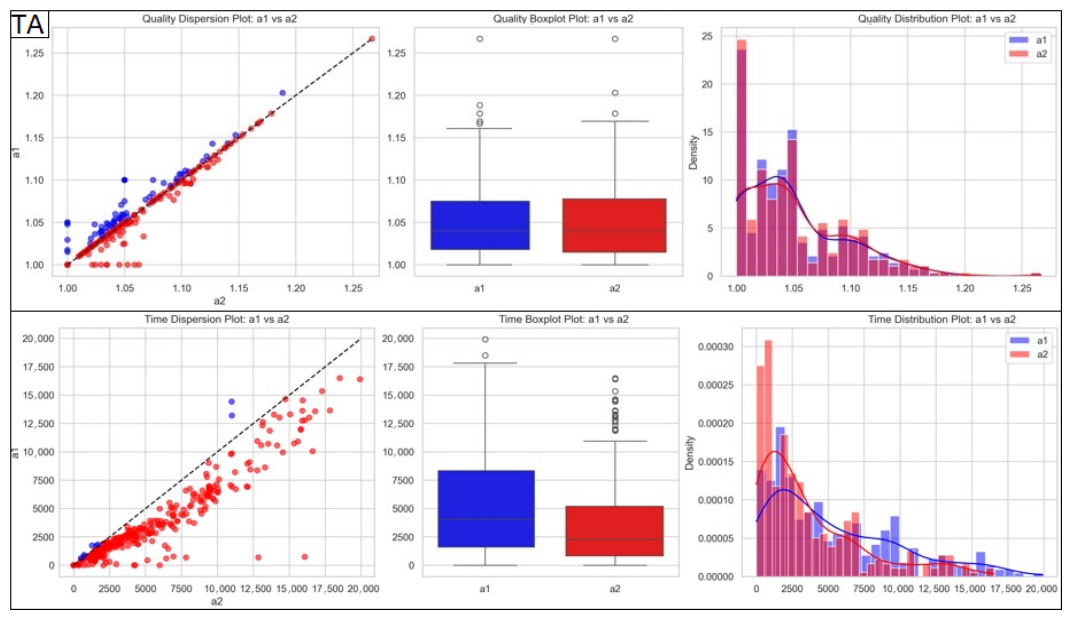
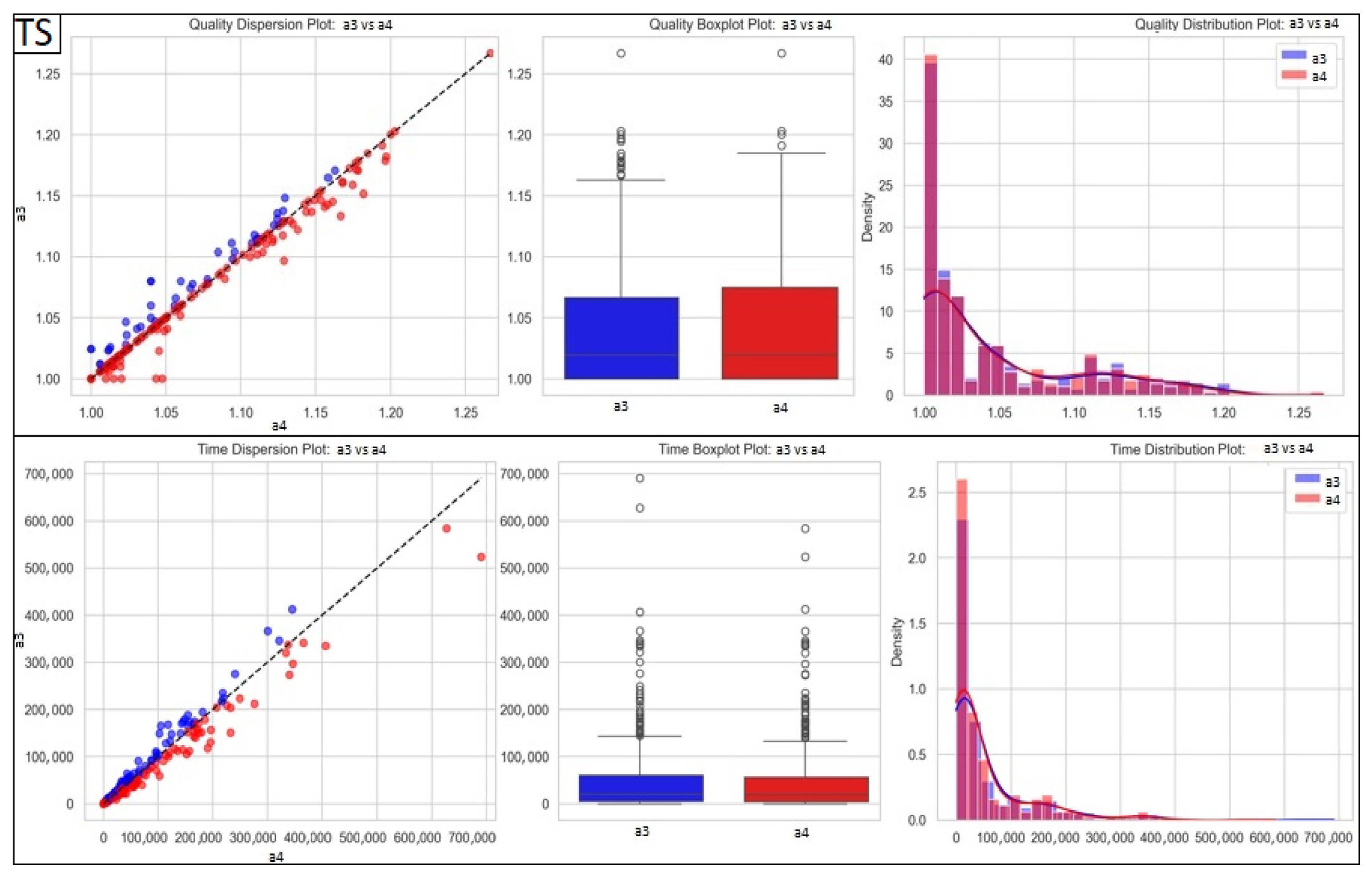
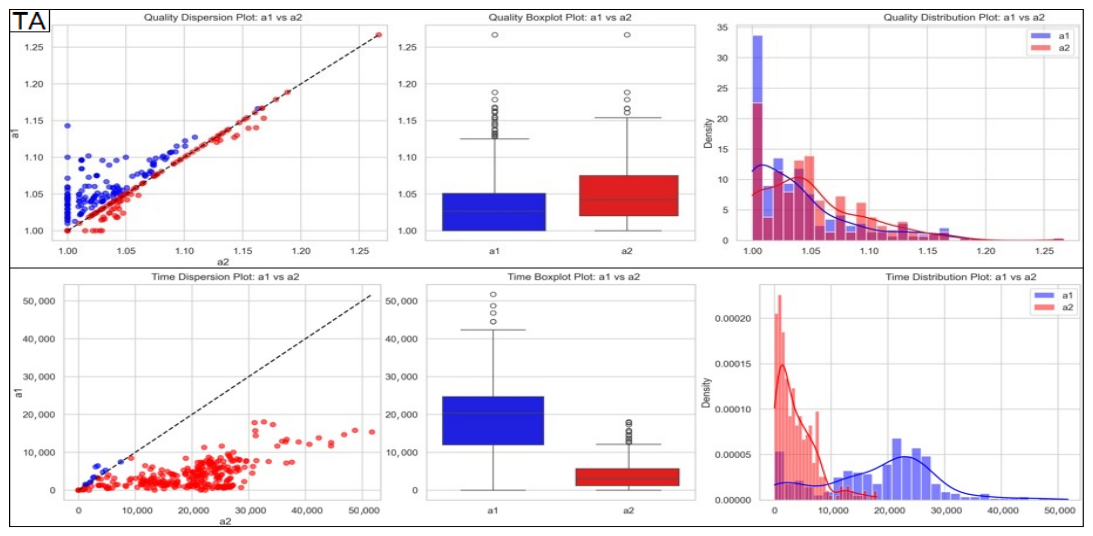
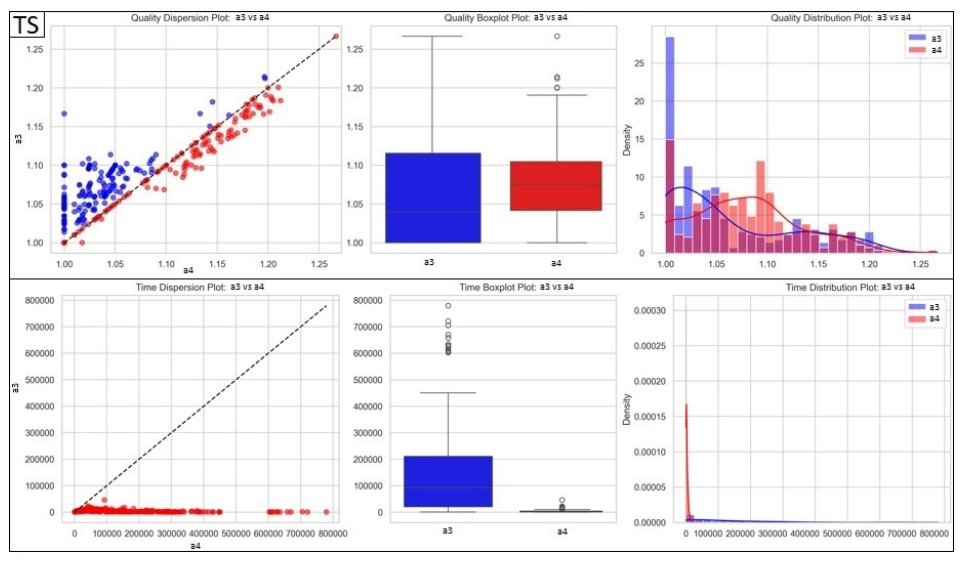
The pair of variants from case studies 1 (TA-a1, a2) and 2 (TS-a3, a4) differed by the methodology for generating an initial solution: randomly guided (IS-RG), described in Algorithm 3, or probability-guided (IS-PG), described in Algorithm 4. All variants perform the methodology single-operator (NS-SO) for generating neighbor solutions and searching in the problem space, described in Algorithm 5. Figure 1 and Figure 2 show dispersion, boxplot and distribution plots for performance measures quality (above) and time (below) for variants a1 and a2 of the Threshold Accepting algorithm (TA), and variants a3 and a4 of the Tabu Search algorithm (TS).
As can be seen, the scatter plot analysis reveals that for variants of TA, there are small differences between solution qualities and it seems to be that variant a1 outperforms variant a2; however, the presence of overlap (purple color) between the distributions highlights that the performance gap is not uniform, and there exist instances where both variants perform similarly or where variant a2 may even be preferable. So too, there are a substantial proportion of instances where variant a2 outperforms variant a1, with big differences in time. The boxplot and distribution analyses further reinforce this finding. The observed shift in the distribution toward lower execution times indicates that variant a2 not only achieves better average performance but also maintains this advantage consistently across a wide range of instances.
Some similar findings can be appreciated for variants a3 and a4 of TS, only with a greater difference between times. Table 6 summarizes the descriptive statistics for variants of study cases from Scenario 1. The median values reinforce the previous observations for quality and time performance measures. The standard deviation of times indicates that variants a1 and a3 exhibit higher variability, suggesting less stable performance across instances, and the converse for variants a2 and a4.

4.2.2. Scenario 2: Analyzing Initial Solution Methodology on a Search with Several Methods

The pair of variants from case studies 3 (TA-a1, a2) and 4 (TS-a3, a4) differ in the methodology for generating an initial solution: randomly guided (IS-RG), described in Algorithm 3, or probability-guided (IS-PG), described in Algorithm 4. All variants perform the methodology multiple-operator (NS-MO) for generating neighbor solutions and searching in the problem space, as described in Algorithm 6. Figure 3 and Figure 4 show dispersion, boxplot and distribution plots for performance measures quality (above) and time (below) for variants a1 and a2 of the Threshold Accepting algorithm (TA), and variants a3 and a4 of the Tabu Search algorithm (TS). As can be seen, for variants of TA, there are very small differences between solution qualities and times. There are some similar findings for variants of TS. Table 7 shows the general statistics, which reinforce the observations.

4.3. Statistical Analyses, Revision of Dominance Regions and Observations

Table 8 shows the study cases of scenarios 1 and 2, columns 1–2; the best variant in quality (q) and time (t), column 3; and all data of statistic and p-values from Wilcoxon statistical tests for quality and time performance measures, the null hypothesis H0 (means equal), accepted or rejected, columns 4–9. The results of the statistical test indicate that there is a significant difference (null hypothesis H0 is rejected) between solution qualities and times for study cases 1 and 2 of scenario 1, and for the time performance measure in study cases 3 and 4 of scenario 2; however, for these study cases, the hypothesis is accepted and there is not a significant difference between qualities.
So too, for further clarification of the above, beyond statistical significance, the effect size and bootstrap-based confidence interval analyses were performed. The bootstrap-based confidence interval analysis provides an additional layer of validation by quantifying the uncertainty associated with the mean difference. Table 9 shows study cases 1–4 of scenarios 1 and 2, columns 1 and 2; results of statistics Cliff’s Delta and Confidence Interval (CI), columns 3, 5, 7 and 9; the interpretation (Int) and Cliff’s Delta (Negligible-Neg, Small, Medium, Large), columns 4 and 8; and the Confidence Interval (Includes 0—Inc 0, Excludes 0—Exc 0), columns 6 and 10, for quality and time performance measures.
The effect size analysis offers insight into the practical relevance of the results. As can be seen in Table 9, in the context of the quality performance measure, the estimated Cliff’s Delta for study cases 1 and 2 suggests that the magnitude of the difference is small, indicating that the observed improvement is limited in practical terms. This distinction is crucial, as statistically significant results do not necessarily imply meaningful performance gains in real-world applications. In the context of the time performance measure, the estimated Cliff’s Delta for study cases 1 and 2 suggests that the magnitude of the difference is large and the fact that the confidence interval excludes zero indicates that the observed improvement is substantial in practical terms, further supporting the conclusion that one algorithm can consistently outperform another in time. Conversely, for the study cases 3 and 4, the observed performance differences are negligible in practical terms. According to the interpretation of statistical results, the quality and time measures are revised in more detail in terms of the dominance region of variants.
Table 10 shows study cases of scenarios 1 and 2, in columns 1–5, and specific important observations, columns 6 and 7. Although study cases 3 and 4 of scenario 2 were not statistically significant (*), they are shown in the table to better understand those situations that could be misinterpreted.
Analyzing set W, specifically for variants of study case 1—scenario1 in partition C1, a1 wins 147 in quality, and the time in these instances is bigger than for algorithm a2, the worst time. Analyzing the partition C2 (177 instances) of algorithm a2, all instances have the best time (differences are too big+) and 144 have the same quality as algorithm a1, where a2 wins due to its time, and 33 instances have the best quality and time. For the regions of dominance of variants a3, (a3, C 3 ) and a4, (a4, C 4 ) for study case 2, in more detail, a3 wins 164 in quality, partition C3 (164 instances), and the time in these instances is bigger than for algorithm a4, the worst time. Analyzing the partition C4 (160 instances) of algorithm a4, all instances have the best time (differences too big+) and 67 instances have the best quality and 93 the same quality as algorithm a3, but a4 wins due to its time. A similar reading applies to the other study cases, 3 and 4 of scenario 2.
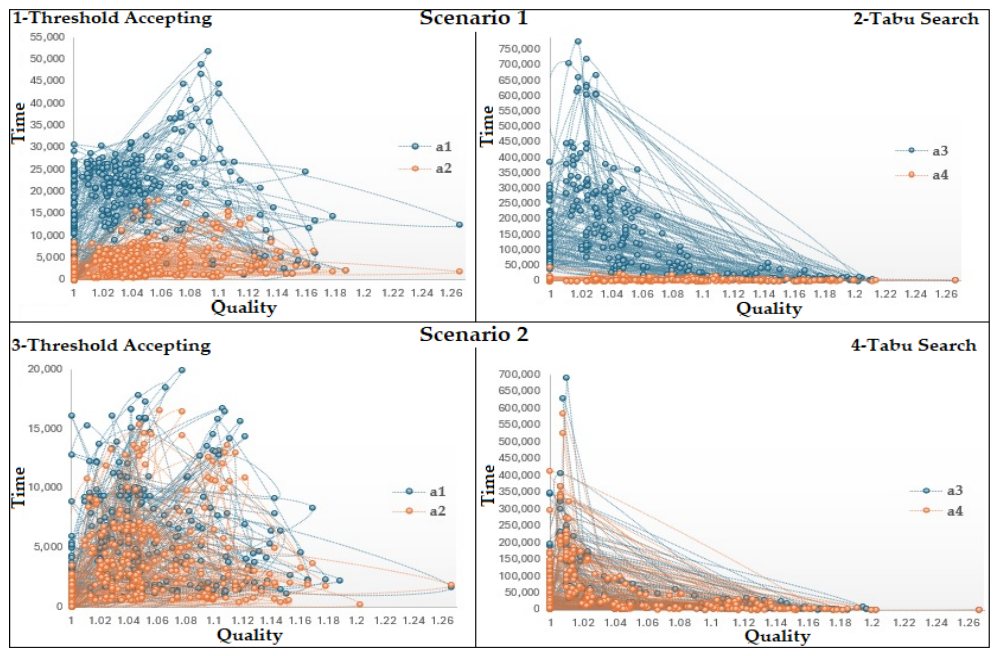
As can be seen in Table 10, a misinterpretation would be that the variants of study cases 1 and 2 of scenario 1 cannot be distinguished as being better in each case because there is almost a tie between their dominances, as well as erroneously stating that variants a2 and a4 are the best for study cases 3 and 4 of scenario 2, due to their predominant coverage in won cases. However, by analyzing the results of statistical tests in conjunction with the time and quality performance measures in terms of regions of dominance in more detail, these situations are easier to identify and avoid. Therefore, only relevant results for scenario 1, where a single-operator (NS-SO) methodology is applied for generating neighbor solutions, indicate that the dominance regions of variants a1 and a3 of algorithms TA and TS have a great cost in time, as their time is too big for winning in quality to variants a2 and a4 of algorithms TA and TS. That is to say, variants a2, a4 (methodology probability-guided (IS-PG) for generating initial solution) finish faster than those variants a1, a3 (methodology randomly guided (IS-RG) for generating initial solution), where their cost in quality (variants a2 and a4) is a mean difference 0.021 from 147 problem instances and 0.033 from 164 problem instances, respectively, which is too small. So too, the dominance region of these variants (variants a2 and a4) always wins in time (time is too small) with the best or same quality. To better understand the above, scatter plots are developed and discussed as follows. Figure 5 shows scatter plots for study cases of scenarios 1 (above) and 2 (below). The scatter plots help to reinforce what was mentioned before. That is to say, variants a2 and a4 (methodology probability-guided (IS-PG)) in scenario 1 seem to be a better alternative than variants a1 and a3 (methodology randomly guided (IS-RG)) when you are looking for the best time (time is too small) and can be reached in some cases with best quality, same quality, or worst quality with a minimal difference; conversely, for scenario 2, the better or more appropriate variant cannot be distinguished.
It is essential to highlight the significant differences between the results obtained by different algorithms, as the ability of one algorithm to cover a wider range of solutions does not necessarily imply that it is actually superior. Although an algorithm may appear more suitable due to its apparent coverage or the quality of its solutions, it is necessary to assess execution times more rigorously, particularly in contexts where time efficiency is a priority for timely decision-making. In this regard, an algorithm that delivers results in considerably less time, albeit with slightly lower quality, may be preferable due to its ability to provide practical and applicable solutions within tight deadlines, thereby ensuring a more effective and functional response in real-world scenarios. Thus, it is considered that an appropriate choice between different approaches or algorithms depends on the balance between the desired accuracy and the need to obtain results within tight deadlines. In this regard, given the priority placed on the results of the variants with the shortest execution time in scenario 1, it was decided to carry out a more detailed analysis of its performance using linear regression in the next section.

4.4. Regression Analysis for Quality and Time in Scenario 1: Analyzing Initial Solution Methodology on a Search with Single Neighborhood Operator

The linear regression analysis was conducted on the results from Scenario 1 (highlighted in the previous section) to examine the relationship between solution quality (independent variable) and time (dependent variable) for variants a1 and a2 of the Threshold Accepting algorithm and a3 and a4 of the Tabu Search algorithm. A model with a zero intercept (forced regression to the origin) was considered due to the operational definition of the performance measures (time and quality). Execution time, time, described previously in Equation (3), quantifies the computational effort of the algorithm based on the number of solutions explored, both feasible and non-feasible, while quality, described previously in Equation (4), measures the performance achieved and final number of containers (Qf) relative to the theoretical reference value (Qt), described previously in Equation (5). In this context, when the execution time is zero, no exploration has yet been performed, nor has any solution been generated; therefore, the quality must also be zero. Thus, the restriction to the origin ensures that the regression model is consistent with the logic of the analyzed process.

4.4.1. Threshold Accepting Algorithm Variants

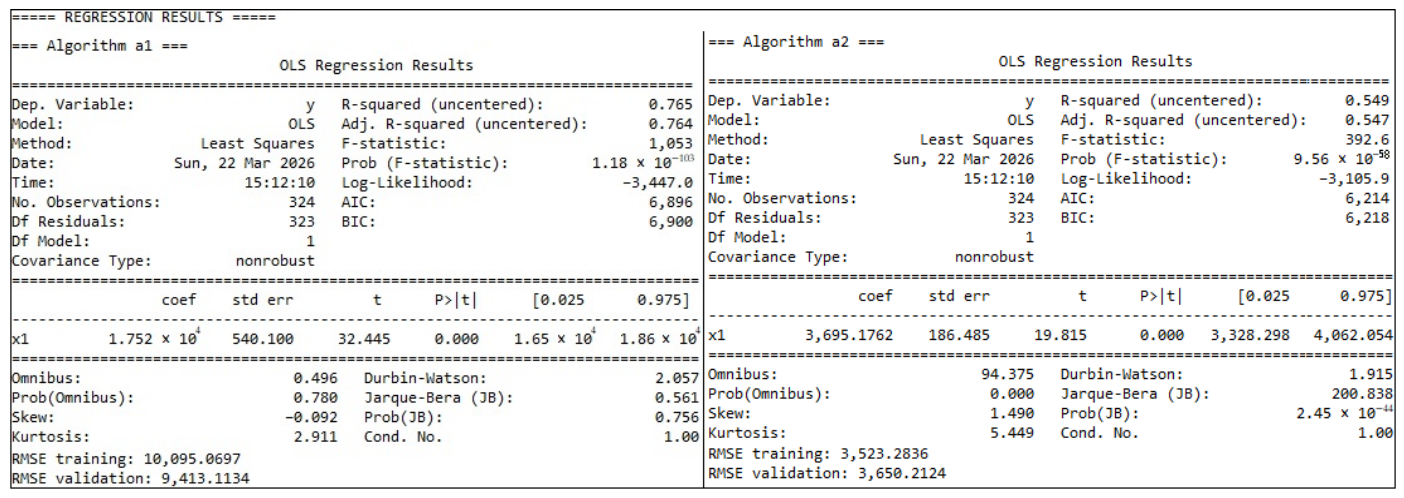
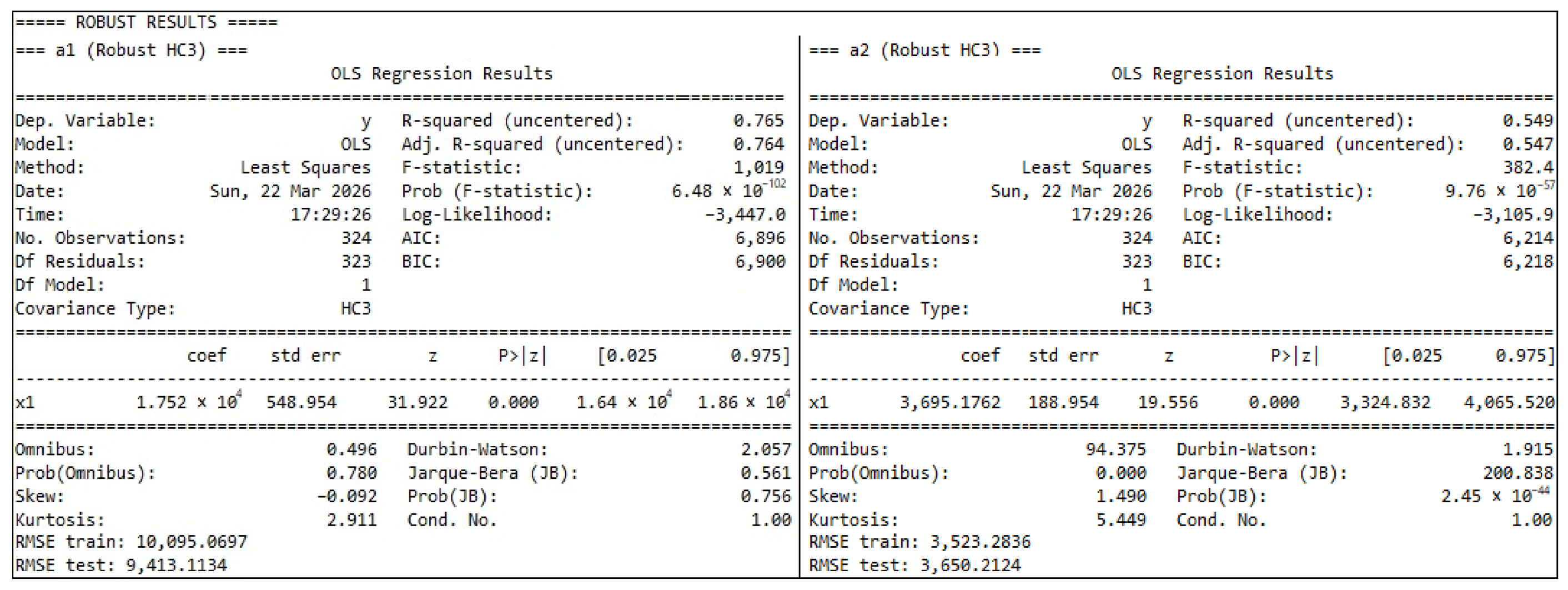
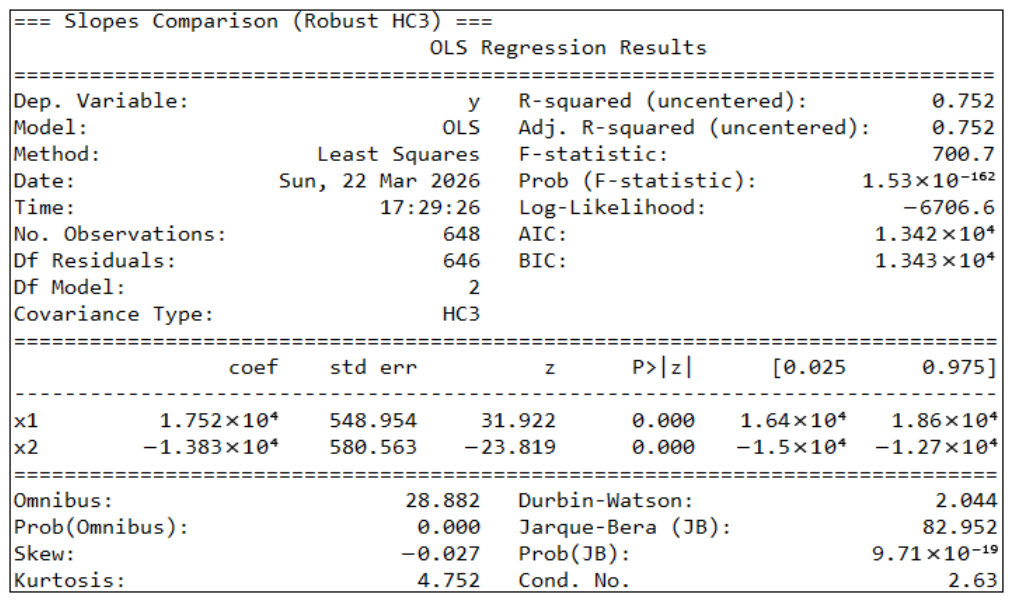
Figure 6 describes the linear regression results for variants a1 and a2 of the Threshold Accepting algorithm. As can be seen, the residuals do not follow normality in one of the models, so robust errors of type HC3 were used; Figure 7 describes these results.
The regression model results for variants a1, a2 of the Threshold Accepting algorithm—TA (A1)—are, respectively:
For variant a1, the estimated regression model was:
time = 17,520 × quality
with a coefficient of determination R2 = 0.7652.
For variant a2, the estimated regression model was:
time = 3695 × quality
with R2 = 0.5486.
A slopes comparison test (Robust HC3) with interaction was performed. Figure 8 describes the results. The results indicate that the difference between the slopes is statistically significant (p < 0.05), confirming that variant a2 exhibits significantly greater efficiency than variant a1 in terms of time per unit of quality. This difference is substantial and robust, even when using heteroscedastic standard errors (HC3). Furthermore, a2 exhibits lower prediction errors, reinforcing its superiority in practical terms. However, a1 shows a better fit (higher R2), suggesting more stable, albeit less efficient, behavior.

4.4.2. Tabu Search Variants

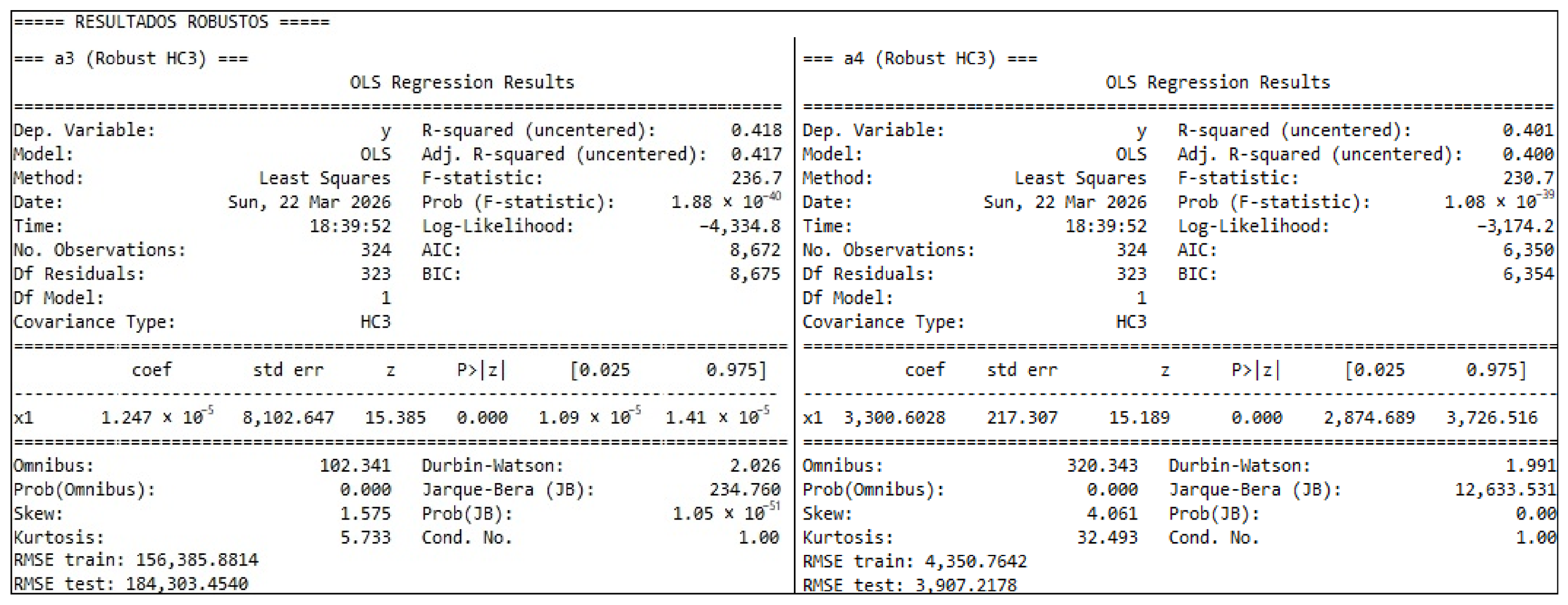
Figure 9 describes the linear regression results (Robust HC3) for variants a3 and a4 of the Tabu Search algorithm.
The regression models resulted for variants a3, a4 of the Tabu Search algorithm—TS (A2)—are, respectively:
For variant a3, the estimated regression model was:
time = 124,660 × quality
with a coefficient of determination R2 = 0.4185.
For variant a4, the estimated regression model was:
time = 3300.6 × quality
with R2 = 0.4015.
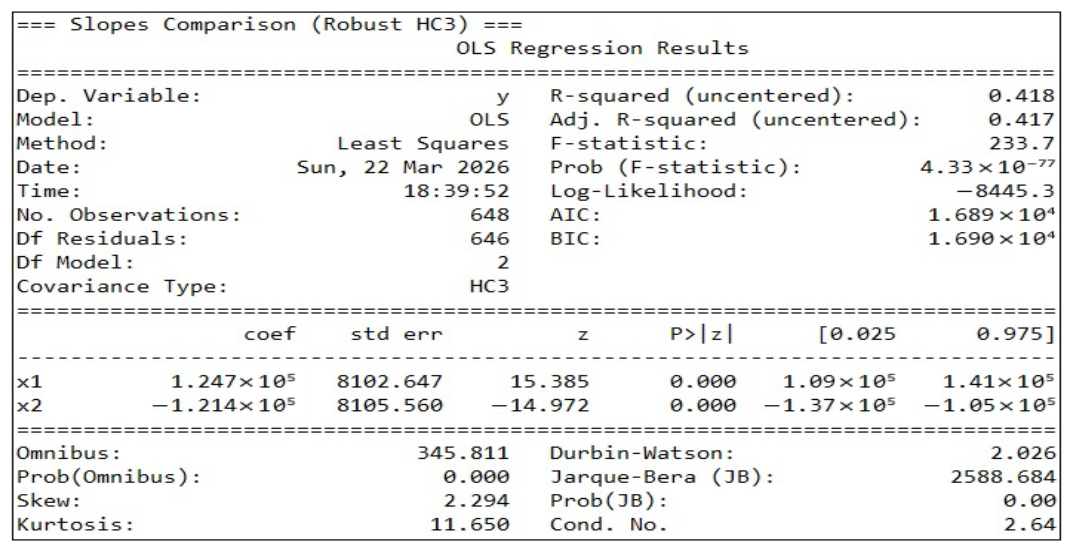
A slope comparison test (Robust HC3) with interaction was performed. Figure 10 describes the results.
The results obtained using robust HC3 regression show a statistically significant difference between the evaluated algorithms. In particular, algorithm a4 exhibits a significantly lower slope than a3 (p < 0.001), indicating greater efficiency in terms of time growth with respect to the quality variable. Algorithm a3 exhibits a much more pronounced relationship between the variables, with a slope approximately 37 times greater than a4, suggesting less scalable behavior. However, the R2 values indicate that none of the models fully explain the system’s variability, suggesting the presence of additional factors not included in the analysis or possible non-linear relationships. Overall, the results confirm a clear trade-off between efficiency and scalability, where the a4 algorithm is significantly more efficient.

5. Comparison and Discussion of Results

The findings in this research are consistent with both classical and recent literature, where the design of effective metaheuristics often relies on structured initialization strategies and carefully controlled neighborhood exploration. In bin packing and related problems, deterministic heuristics such as First-Fit Decreasing have long been recognized for generating high quality initial solutions that facilitate efficient local search [42]. More recent studies reinforce this perspective. For instance, in F. H. Awad et al. [18], the TS algorithm is improved to solve the large-scale course timetabling problem. The initial solution is generated using the least saturation degree constructive heuristic to guarantee a feasible solution with respect to the hard constraints. Their results show that such structured initialization significantly improves convergence behavior in large and complex instances. Similarly, in the context of Threshold Accepting, in L. Wu et al. [16], the algorithm is improved to solve the classic 0–1 Knapsack problem. The initial solution is generated using a mechanism that combines randomness and heuristics to make it a good feasible solution. Although some degree of randomness is present, the feasibility and structural quality is maintained from the beginning. This is similar to the findings of the present study, where probability-guided initialization consistently leads to improved stability and reduced computational effort.
In the context of generating neighbor solutions, several recent works highlight that while multiple neighborhood operators can enhance exploration, they often require additional control mechanisms to remain computationally efficient. For example, in R. Abyazi-Sani and R. Ghanbari [5], the TS algorithm is improved to solve the Uncapacitated Single Allocation Hub Location Problem (USAHLP), a problem that is widely relevant in transport and telecommunications networks. Candidate list strategies and incremental evaluation are developed to restrict the neighborhood exploration and reduce effective computational overhead while maintaining solution quality. Likewise, N. Leite et al. [43] introduce a fast Threshold Accepting algorithm. The generation of initial solutions uses constructive heuristics that generate feasible solutions from the beginning, avoiding the need for subsequent adjustments. For generating neighboring solutions, domain-specific moves are proposed, such as swapping exams between periods or reassigning an exam to another valid period. These operators are designed to maintain the feasibility of the solutions and allow for effective exploration of the search space. Strategies are implemented to select moves efficiently, selectively “freezing” variables during the search process, reducing the number of unnecessary evaluations and improving computational efficiency.
These similar studies highlight that when multiple neighborhood operators are developed, additional strategies such as candidate lists, adaptive memory, or selective evaluation are necessary to control the search process and prevent excessive computational cost. In contrast, the results of the present study show that, for general BPP instances, simpler configurations based on a single neighborhood operator can achieve comparable or better performance without requiring such control mechanisms.
In the context of the type of instances considered, another important distinction is that the previously mentioned related works and many recent studies focus on large-scale or highly constrained problem instances, where sophisticated mechanisms are necessary to ensure scalability and robustness. Conversely, the present work focuses on general benchmark instances of the BPP, deliberately excluding extremely difficult classes (e.g., hard instances such as 28-hard). The above is to enable the performance of a controlled analysis of algorithmic structure without the confounding effects of extreme instance difficulty. Nevertheless, the consistency of the results across 324 instances suggests that the identified design principles are robust within the problem class boarded from repositories recognized by scientific community. Extending this work to the analysis of harder instances is a future research direction.

6. Conclusions

This paper presented a formal systematic framework to study the internal logical structure of two widely used metaheuristics, Tabu Search and Threshold Accepting, focusing on the role of initialization strategies and neighborhood generation mechanisms in solving the one-dimensional Bin Packing Problem. The experimental results consistently show that algorithmic internal structure, specifically in the logical parts, generating an initial solution and neighbor solutions based on probability-guided initialization combined with a single neighborhood operator provide a more favorable balance between solution quality, stability, and computational efficiency. Although the improvements in solution quality are generally small, they are consistent across instances and are accompanied by reduced variability and lower computational effort. In contrast, an algorithm internal structure, specifically in the logical part of generating neighbor solutions, incorporating multiple neighborhood operators, does not necessarily lead to better performance and may introduce additional computational overhead and instability.
The main contribution of this work lies in the formalization of metaheuristic design principles that are often implicitly guided by expert knowledge. By defining a formal controlled experimental framework, this study isolates, analyzes and evaluates the combined effects of methodologies for logical parts initialization and neighborhood, providing reproducible evidence of their impact on algorithm performance. In this sense, the work contributes to bridging the gap between empirical algorithm design and the systematic analysis of algorithm internal logical structure. So too, the findings suggest that simplicity, when properly structured, can be more effective than increased algorithmic complexity (more complex logical structure), particularly for Threshold Accepting and Tabu Search algorithms when solving general instances from repositories well-known by the scientific community for the one-dimensional Bin Packing Problem. This insight has practical implications for the design of efficient metaheuristics, indicating that careful selection of core logical parts may be more beneficial than incorporating additional mechanisms.
Future work will focus on extending the proposed framework, continuing to open the black box of algorithms’ logical internal structure to more challenging problem instances, including highly constrained and hard benchmark sets, as well as exploring adaptive and hybrid strategies that dynamically adjust initialization and neighborhood selection during the search process. Additionally, further research will investigate the applicability of the proposed framework to other NP-hard combinatorial optimization problems. The results could give formal guidelines in the development of self-adapting algorithms that do not waste effort to give the best solution to complex problems, depending on specific needs in various real-life situations.

Author Contributions

Conceptualization, V.L.-N., J.P.-O. and L.C.-R.; methodology, V.L.-N., J.P.-O., L.C.-R. and C.G.G.-S.; software, V.L.-N., C.R.-O. and C.A.C.-M.; validation, V.L.-N., J.P.-O., L.C.-R. and C.G.G.-S.; formal analysis, V.L.-N., J.P.-O., L.C.-R. and C.G.G.-S.; investigation, V.L.-N., J.P.-O. and N.N.A.-O.; resources, V.L.-N., C.R.-O. and C.A.C.-M.; data curation, V.L.-N., N.N.A.-O., C.R.-O. and C.A.C.-M.; writing—original draft preparation, V.L.-N. and N.N.A.-O.; writing—review and editing, V.L.-N., N.N.A.-O., L.C.-R. and C.G.G.-S.; visualization, V.L.-N., J.P.-O. and L.C.-R.; supervision, V.L.-N.; project administration, V.L.-N. All authors have read and agreed to the published version of the manuscript.

Funding

This research received no external funding.

Data Availability Statement

The data presented in this study are openly available in OR-Library at http://people.brunel.ac.uk/~mastjjb/jeb/orlib/binpackinfo.html, accessed on 16 April 2026, reference number [19,20].

Conflicts of Interest

The authors declare no conflicts of interest.

References

  1. Munien, C.; Ezugwu, A.E. Metaheuristic algorithms for one-dimensional bin-packing problems: A survey of recent advances and applications. J. Intell. Syst. 2021, 30, 636–663. [Google Scholar] [CrossRef]
  2. Munien, C.; Mahabeer, S.; Dzitiro, E.; Singh, S.; Zungu, S.; Ezugwu, A.E.S. Metaheuristic approaches for one-dimensional bin packing problem: A comparative performance study. IEEE Access 2020, 8, 227438–227465. [Google Scholar] [CrossRef]
  3. Mezghani, S.; Haddar, B.; Chabchoub, H. An exhaustive review of the metaheuristiclem—A review of research topics, applications, and cited papers. J. Ind. Manag. Optim. 2023, 19, 3329–3361. [Google Scholar] [CrossRef]
  4. Adamczewski, K.; Suh, Y.; Mu Lee, K. Discrete tabu search for graph matching. In Proceedings of the IEEE International Conference on Computer Vision; IEEE: Piscataway, NJ, USA, 2015; pp. 109–117. [Google Scholar]
  5. Abyazi-Sani, R.; Ghanbari, R. An efficient tabu search for solving the uncapacitated single allocation hub location problem. Comput. Ind. Eng. 2016, 93, 99–109. [Google Scholar] [CrossRef]
  6. Lin, C.K.Y.; Haley, K.B.; Sparks, C. A comparative study of both standard and adaptive versions of threshold accepting and simulated annealing algorithms in three scheduling problems. Eur. J. Oper. Res. 1995, 83, 330–346. [Google Scholar] [CrossRef]
  7. Rajwar, K.; Deep, K.; Das, S. An exhaustive review of the metaheuristic algorithms for search and optimization: Taxonomy, applications, and open challenges. Artif. Intell. Rev. 2023, 56, 13187–13257. [Google Scholar] [CrossRef]
  8. Karimi-Mamaghan, M.; Mohammadi, M.; Meyer, P.; Karimi-Mamaghan, A.M.; Talbi, E.G. Machine learning at the service of meta-heuristics for solving combinatorial optimization problems: A state-of-the-art. Eur. J. Oper. Res. 2022, 296, 393–422. [Google Scholar] [CrossRef]
  9. Hussain, K.; Mohd Salleh, M.N.; Cheng, S.; Shi, Y. Metaheuristic research: A comprehensive survey. Artif. Intell. Rev. 2019, 52, 2191–2233. [Google Scholar] [CrossRef]
  10. Peres, F.; Castelli, M. Combinatorial optimization problems and metaheuristics: Review, challenges, design, and development. Appl. Sci. 2021, 11, 6449. [Google Scholar] [CrossRef]
  11. Crainic, T.G.; Perboli, G.; Tadei, R. TS2PACK: A two-level tabu search for the three-dimensional bin packing problem. Eur. J. Oper. Res. 2009, 195, 744–760. [Google Scholar] [CrossRef]
  12. Kang, Z.; Guan, Y.; Wang, J.; Chen, P. Research on Genetic Algorithm Optimization with Fusion Tabu Search Strategy and Its Application in Solving Three-Dimensional Packing Problems. Symmetry 2024, 16, 449. [Google Scholar] [CrossRef]
  13. Yuan, Y.; Tole, K.; Ni, F.; He, K.; Xiong, Z.; Liu, J. Adaptive simulated annealing with greedy search for the circle bin packing problem. Comput. Oper. Res. 2022, 144, 105826. [Google Scholar] [CrossRef]
  14. Dueck, G.; Scheuer, T. Threshold accepting: A general purpose optimization algorithm appearing superior to simulated annealing. J. Comput. Phys. 1990, 90, 161–175. [Google Scholar] [CrossRef]
  15. Battiti, R.; Tecchiolli, G. The reactive tabu search. ORSA J. Comput. 1994, 6, 126–140. [Google Scholar] [CrossRef]
  16. Tarantilis, C.D.; Kiranoudis, C.T.; Vassiliadis, V.S. A threshold accepting metaheuristic for the heterogeneous fixed fleet vehicle routing problem. Eur. J. Oper. Res. 2004, 152, 148–158. [Google Scholar] [CrossRef]
  17. Pais, T.C.; Amaral, P. Managing the tabu list length using a fuzzy inference system: An application to exams timetabling. In Proceedings of the 7th International Conference on the Practice and Theory of Automated Timetabling, Montreal, QC, Canada, 19–22 August 2008; pp. 1–6. [Google Scholar]
  18. Awad, F.H.; Al-kubaisi, A.; Mahmood, M. Large-scale timetabling problems with adaptive Tabu Search. J. Intell. Syst. 2022, 31, 168–176. [Google Scholar] [CrossRef]
  19. Konovalenko, A.; Hvattum, L.M. Exploring tabu tenure policies with machine learning. Electronics 2025, 14, 2642. [Google Scholar] [CrossRef]
  20. Sugimura, M.; Yamamura, K.; Ishikura, H.; Yoshida, A.; Kawano, K.; Parizy, M.; Fujisawa, K. Automated tabu tenure tuning by trajectory metrics for quadratic unconstrained binary optimization. J. Heuristics 2026, 32, 4. [Google Scholar] [CrossRef]
  21. Glover, F.; Laguna, M. Tabu Search; Kluwer Academic Publishers: Boston, MA, USA; Springer: Greer, SC, USA, 1997. [Google Scholar]
  22. Sneyd, A.; Stevenson, M. Modelling stopping criteria for search results using Poisson processes. arXiv 2019, arXiv:1909.06239. [Google Scholar] [CrossRef]
  23. Črepinšek, M.; Mernik, M.; Beković, M.; Pintarič, M.; Moravec, M.; Ravber, M. Overcoming Stagnation in Metaheuristic Algorithms with MsMA’s Adaptive Meta-Level Partitioning. Mathematics 2025, 13, 1803. [Google Scholar] [CrossRef]
  24. Geiger, M.J. An application of threshold accepting for curriculum-based course timetabling. arXiv 2008, arXiv:0809.0757. [Google Scholar]
  25. Avci, M.; Topaloglu, S. A hybrid metaheuristic algorithm for heterogeneous vehicle routing problem with simultaneous pickup and delivery. Expert Syst. Appl. 2016, 53, 160–175. [Google Scholar] [CrossRef]
  26. Wu, L.; Lin, K.; Lin, X.; Lin, J. List-based threshold accepting algorithm with improved neighbor operator for 0–1 Knapsack problem. Algorithms 2024, 17, 478. [Google Scholar] [CrossRef]
  27. Barr, R.; Golden, B.; Kelly, J.; Resende, M.; Stewart, W. Designing and reporting on computational experiments with Heuristic Methods. J. Heuristics 1995, 1, 9–32. [Google Scholar] [CrossRef]
  28. Weise, T.; Wu, Y.; Chiong, R.; Tang, K.; Lässig, J. Global versus local search: The impact of population sizes on evolutionary algorithm performance. J. Glob. Optim. 2016, 66, 511–534. [Google Scholar] [CrossRef]
  29. Beasley, J.E. OR-Library. Brunel University. 2006. Available online: http://people.brunel.ac.uk/~mastjjb/jeb/orlib/binpackinfo.html (accessed on 30 August 2005).
  30. Scholl, A.; Klein, R. A Bin Packing Problem Library. 2003. Available online: https://site.unibo.it/operations-research/en/research/bpplib-a-bin-packing-problem-library (accessed on 30 January 2019).
  31. Carmona-Arroyo, G.; Vázquez-Aguirre, J.B.; Quiroz-Castellanos, M. OneDimensional Bin Packing Problem: An Experimental Study of Instances Difficulty and Algorithms Performance. In Fuzzy Logic Hybrid Extensions of Neural and Optimization Algorithms: Theory and Applications. Studies in Computational Intelligence; Castillo, O., Melin, P., Eds.; Springer: Cham, Switzerland, 2021; Volume 940, pp. 171–202. [Google Scholar]
  32. Rice, J. The algorithm selection problem. Adv. Comput. 1976, 15, 65–118. [Google Scholar]
  33. Falkenauer, E.; Delchambre, A. A genetic algorithm for bin packing and line balancing. In Proceedings 1992 IEEE International Conference on Robotics and Automation; IEEE: Piscataway, NJ, USA, 1992; pp. 1186–1192. [Google Scholar]
  34. Martello, S.; Toth, P. Lower bounds and reduction procedures for the Bin Packing Problem. Discret. Appl. Math. 1990, 28, 59–70. [Google Scholar] [CrossRef]
  35. Kirkpatrick, S.; Gelatt, C.; Vecchi, M. Optimization by simulated annealing. Science 1983, 220, 671–680. [Google Scholar] [CrossRef]
  36. Pérez, J.; Romero, D.; Frausto, J.; Pazos, R.; Rodríguez, G.; Reyes, F. Dynamic allocation of vertical fragments in distributed databases using the threshold accepting algorithm. In Proceedings of the 10th IASTED International Conference on Parallel and Distributed Computing and Systems; IASTED: Las Vegas, NV, USA, 1998; pp. 210–213. [Google Scholar]
  37. Glover, F.; Laguna, M. Tabu Search; Kluwer Academic Publishers: Boston, MA, USA, 1986. [Google Scholar]
  38. Glover, F. Tabu search—Part I. ORSA J. Comput. 1989, 1, 190–206. [Google Scholar] [CrossRef]
  39. Al-Shaikhli, I.F.T.; Albuainain, A.; Al-Obaidi, S.M. A metaheuristic tabu search optimization algorithm: Applications to chemical and environmental processes. In Advanced Optimization Methods in Engineering; IntechOpen: London, UK, 2021. [Google Scholar]
  40. Krim, H.; Zufferey, N.; Potvin, J.-Y.; Benmansour, R.; Duvivier, D. Tabu search for a parallel-machine scheduling problem with periodic maintenance, job rejection and weighted sum of completion times. J. Sched. 2022, 25, 89–105. [Google Scholar] [CrossRef] [PubMed]
  41. Fleszar, K.; Hindi, K.S. New heuristics for one-dimensional bin-packing. Comput. Oper. Res. 2002, 29, 821–839. [Google Scholar] [CrossRef]
  42. Martello, S.; Toth, P. Knapsack Problems: Algorithms and Computer Implementations; Wiley: Chichester, UK, 1990. [Google Scholar]
  43. Leite, N.; Melício, F.; Rosa, A.C. A fast threshold acceptance algorithm for the examination timetabling problem. In Handbook of Operations Research and Management Science in Higher Education; International Series in Operations Research & Management Science; Springer: Berlin/Heidelberg, Germany, 2021; pp. 323–363. [Google Scholar] [CrossRef]
Figure 1. Quality (above) and time (below) performance for variants (a1 and a2) in case study 1 of Threshold Accepting algorithm (TA)—Scenario 1.
Computers 15 00274 g001
Figure 2. Quality (above) and time (below) performance for variants (a3 and a4) in case study 2 of the Tabu Search algorithm (TS)—Scenario 1.
Computers 15 00274 g002
Figure 3. Quality (above) and time (below) performance for variants (a1 and a2) in case study 3 of the Threshold Accepting algorithm (TA)—Scenario 2.
Computers 15 00274 g003
Figure 4. Quality (above) and time (below) performance for variants (a3 and a4) in case study 4 of the Tabu Search algorithm (TS)—Scenario 2.
Computers 15 00274 g004
Figure 5. Scatter plots for study cases 1 (TA) and 2 (TS) of scenarios 1—Searching with single-operator methodology (NS-SO) (above)—and 2—Searching with multiple-operator methodology (NS-MO) (below).
Computers 15 00274 g005
Figure 6. Regression analysis results for variants a1 and a2 of Threshold Accepting algorithm.
Computers 15 00274 g006
Figure 7. Regression analysis results (Robust HC3) for variants a1 and a2 of Threshold Accepting algorithm.
Computers 15 00274 g007
Figure 8. Slope comparison (Robust HC3) for variants a1 and a2 of Threshold Accepting algorithm.
Computers 15 00274 g008
Figure 9. Regression analysis results (Robust HC3) for variants a3 and a4 of Tabu Search algorithm.
Computers 15 00274 g009
Figure 10. Slope comparison (Robust HC3) for variants a3 and a4 of Tabu Search algorithm.
Computers 15 00274 g010
Table 1. Reviewed specialized literature.
WorkAlgorithm Internal Logical Structure
PTISNSSC
[14]
[15]
[16]
[17]
[18]
[19]
[20]
[21]
[22]
[23]
[5]
[24]
[25]
[26]
This paper
Table 2. Classes of problem instances from libraries BOR and DOR.
ClassNomenclatureWhereTotal
1NxCyWz_v.BPPx = 1 (n = 50), x = 2 (n = 100), x = 3 (n = 200), x = 4 (n = 500)960
y = 1 (c = 100), y = 2 (c = 120), y = 3 (c = 150)
z = 1 (Sj [1, 100]), z = 2 (Sj [20, 100]), z = 3 (Sj [30, 100]),
z = 4 (Sj [30, 100])
v = a, b, …, t, for the 20 instances of each type
2NxWyBzRv.BPPx = 1 (n = 50), x = 2 (n = 100), x = 3 (n = 200), x = 4 (n = 500)480
y = 1 (avgweigth = c/3), y = 2 (c/5), y = 3 (c/7), y = 4 (c/9)
z = 1 (delta= 20%), z = 2 (50%), z = 3 (90%)
v = 0, 1, …, 9, for the 20 instances of each type, c = 1000
3HARDv.BPPn = 200, c = 100,000, S = [20,000, 35,000], v = 0, 1, …, 910
4Ux_v.BPPx = 120 (n = 120), x = 250 (n = 250), x = 500 (n = 500), x = 1000 (n = 100), v = 0, 1, …, 19, for the 20 instances of each type, c = 150.80
5Tx_v.BPPx = 60 (n = 60), x = 120 (n = 120), x = 249 (n = 249), x = 501 (n = 501), v = 0, 1, …, 19, for the 20 instances of each type, c = 10080
Total 1610
Table 3. Scenario 1.
Study
Case
AlgorithmSet AVariantsInitial Solution Methodology (IS)Neighbor Solutions Methodology
(NS)
RGPGSOMO
1TAA1a1
a2
2TSA2a3
a4
Table 4. Scenario 2.
Study
Case
AlgorithmSet AVariantsInitial Solution Methodology (IS)Neighbor Solutions Methodology (NS)
RGPGSOMO
3TAA1a1
a2
4TSA2a3
a4
Table 5. Scenarios, study cases and variant comparison.
ScenarioStudy CaseSet AAlgorithmVariants ComparisonAlgorithms Scope TotalDominance Regions (W)
11A1TAa1 vs. a2TSa1, TSa2(a1, C1), (a2, C2)
2A2TSa3 vs. a4TSa3, TSa4(a3, C3), (a4, C4)
23A1TAa1 vs. a2TSa1, TSa2(a1, C1), (a2, C2)
4A2TSa3 vs. a4TSa3, TSa4(a3, C3), (a4, C4)
Table 6. Descriptive statistics of quality and time for case studies 1 and 2 from Scenario 1.
QualityTime
MeanMedianStd DevVarMeanMedianStd DevVar
1TAa11.0391.0270.0450.00218,221.8518,221.8510,115.31102,319,495.41
a21.051.0420.0440.0023851.213851.213565.2012,710,503.84
2TSa31.0621.040.0640.004137,744.9692,605.95152,164.1323,153,923,673.84
a41.0781.0750.0530.0033608.7221364319.8718,661,282.53
Table 7. Descriptive statistics of quality and time for case studies 3 and 4 from Scenario 2.
QualityTime
MeanMedianStd DevVarMeanMedianStd DevVar
1TAa11.0491.040.0450.0025321.844049.234538.6320,599,158.63
a21.051.040.0450.0023578.282278.403701.5913,701,768.31
2TSa31.0451.0190.0560.00356,294.5919,788.9390,114.668,120,652,797.9
a41.0441.0190.0550.00353,226.3918,627.6584,202.137,089,998,724.64
Table 8. Wilcoxon statistical test.
QualityTime
Best
Alg
Statisticp-ValueNull Hypothesis H0 (Means Equal)Statisticp-ValueNull Hypothesis H0 (Means Equal)
11-TAa1(q), a2(t)18884.72 × 10−18Rejected1485.80 × 10−51Rejected
2-TSa3(q), a4(t)4309.53.94 × 10−19Rejected97.85 × 10−55Rejected
23-TAa1(q), a2(t)25012.27 × 10−01Accepted5403.93 × 10−49Rejected
4-TSa3(q), a4(t)1609.54.33 × 10−01Accepted19,0481.61 × 10−05Rejected
Table 9. Effect size and bootstrap-based confidence interval analyses.
QualityTime
Cliff’s Delta95% CICliff’s Delta95% CI
StatisticIntStatisticIntStatisticIntstatisticInt
1:1TA: a1 vs. a2δ = −0.1916Small[−0.014, −0.009]Exc 0δ = 0.75Large[13,450.06, 15,248.04]Exc 0
1:2TS: a3 vs. a4δ = −0.2171Small[−0.019, −0.013]Exc 0δ = 0.83Large[118,110.4, 152,072.3]Exc 0
2:3TA: a1 vs. a2δ = −0.0028Neg[−0.002, 0.0008]Inc 0δ = 0.25Small[1556.47, 1933.79]Exc 0
2:4TS: a3 vs. a4δ = 0.0049Neg[−0.0005, 0.0013]Inc 0δ = 0.028Neg[1205.94, 5091.01]Exc 0
Table 10. Dominance regions and important observations.
Dominance
Region (Set W)
Observations
ScenarioStudy CaseVariantsQualityTimeSame
Quality
Worst
Time
1 1
(TA)
a1 (147)147 147 +
a2 (177) 144 +144
1 3333 +
2
(TS)
a3 (164)164 164 +
a4 (160) 93 +93
6767 +
2 3 *
(TA)
a1 (65)65 65
a2 (259) 211211
2 4848
4 *
(TS)
a3 (132) 9494
38 38
a4 (192)4620 26
146146
(+) The differences are too big (shown in Figure 1 and Figure 2). (*) 3 and 4 were not statistically significant.
Disclaimer/Publisher’s Note: The statements, opinions and data contained in all publications are solely those of the individual author(s) and contributor(s) and not of MDPI and/or the editor(s). MDPI and/or the editor(s) disclaim responsibility for any injury to people or property resulting from any ideas, methods, instructions or products referred to in the content.