
Intrusion Detection in Fog Computing: A Systematic Review of Security Advances and Challenges


 ,
,  ,
,
Abstract
1. Introduction
1.1. Research Questions
- i.
- What advances characterize intrusion detection for fog computing?
- ii.
- What are the challenges of intrusion detection systems in fog computing?
1.2. Contribution
2. Background
2.1. Fog Computing and Security Challenges
2.2. Intrusion Detection Systems: Signature vs. Anomaly Detection
2.3. Machine Learning and Hybrid IDS Approaches
3. Methods
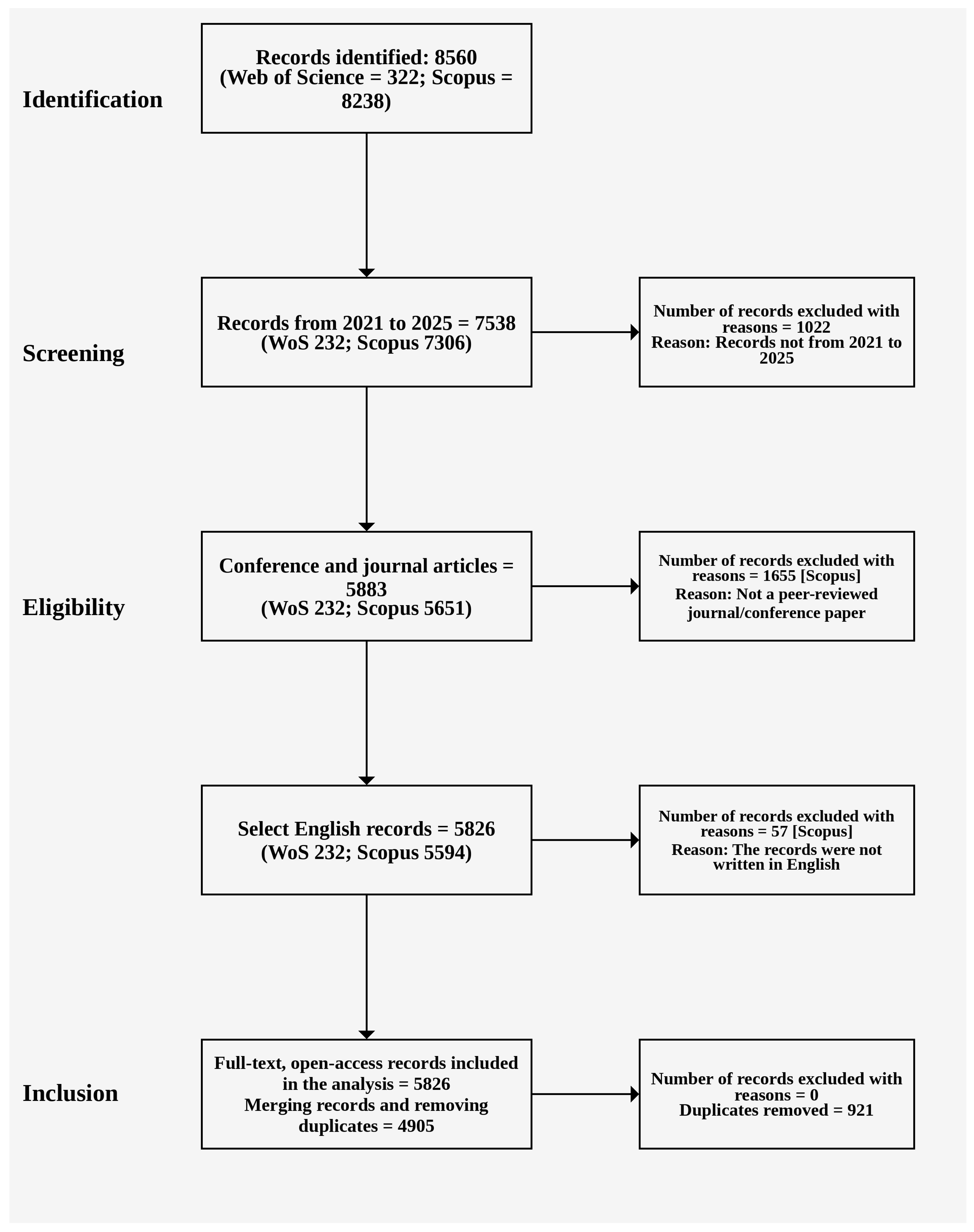
3.1. Identification
3.2. Screening
3.3. Eligibility
3.4. Inclusion
3.5. Merging and Deduplication
3.6. Data Extraction and Bibliometric Measures
3.7. Selection of Studies for Detailed Review
4. Literature Review of IDS Techniques in Fog Computing
4.1. Traditional and Signature-Based Approaches
4.2. Machine Learning-Based Intrusion Detection
4.3. Deep Learning-Based Approaches
4.4. Hybrid and Ensemble Approaches
4.5. Comparative Analysis of Reviewed IDS Approaches
5. Results
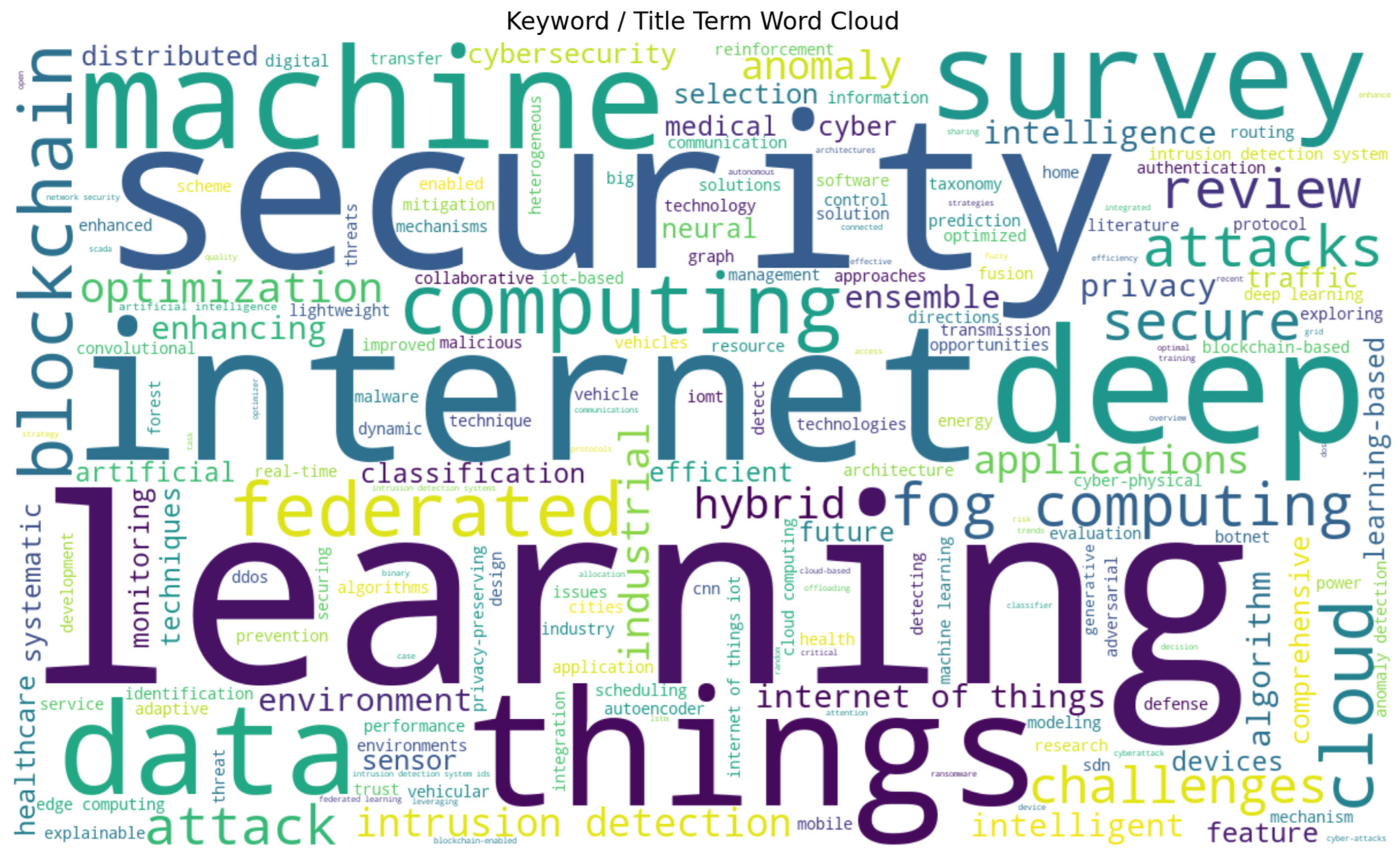
5.1. Word Cloud
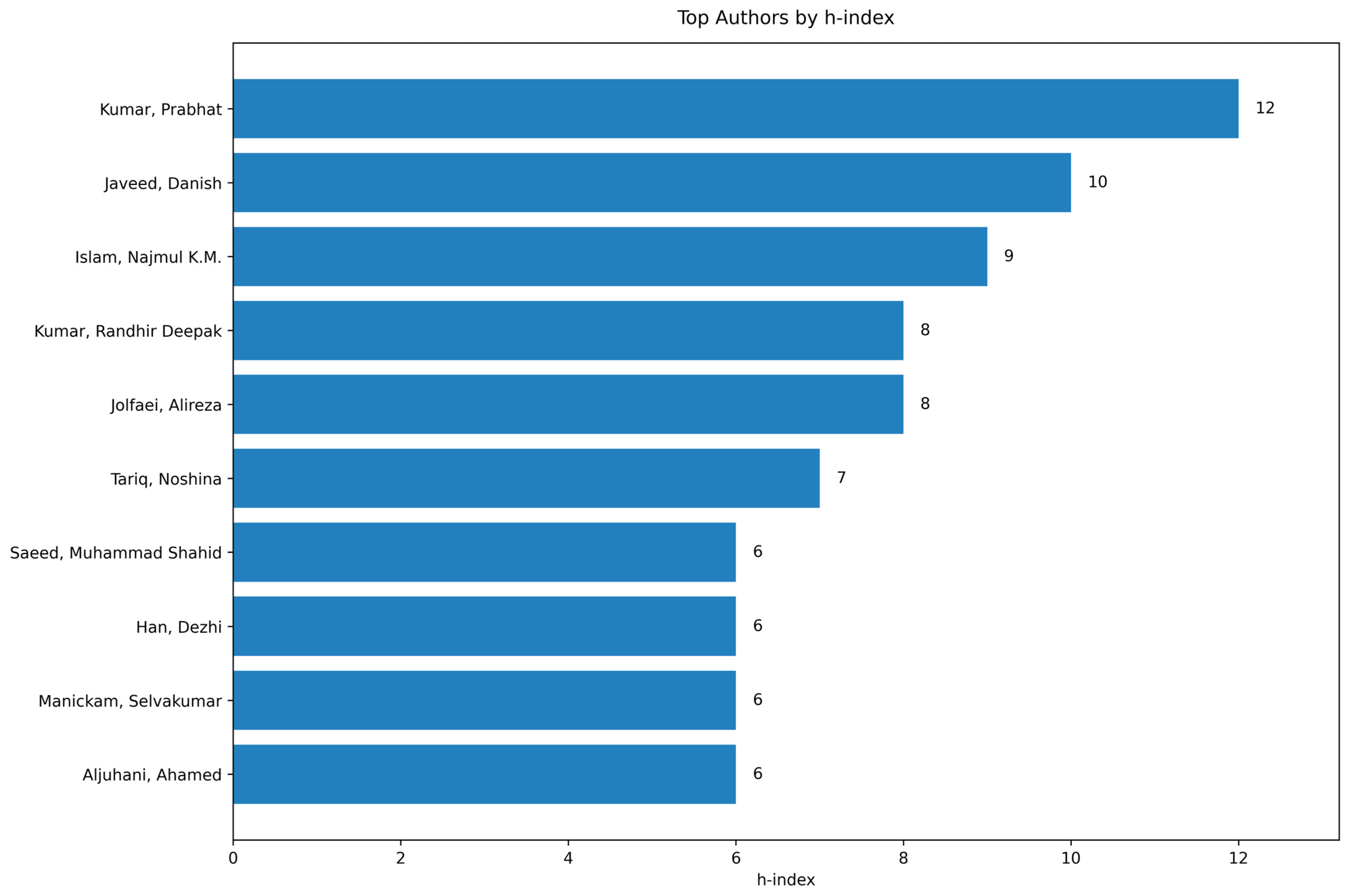
5.2. Author Impact by h-Index
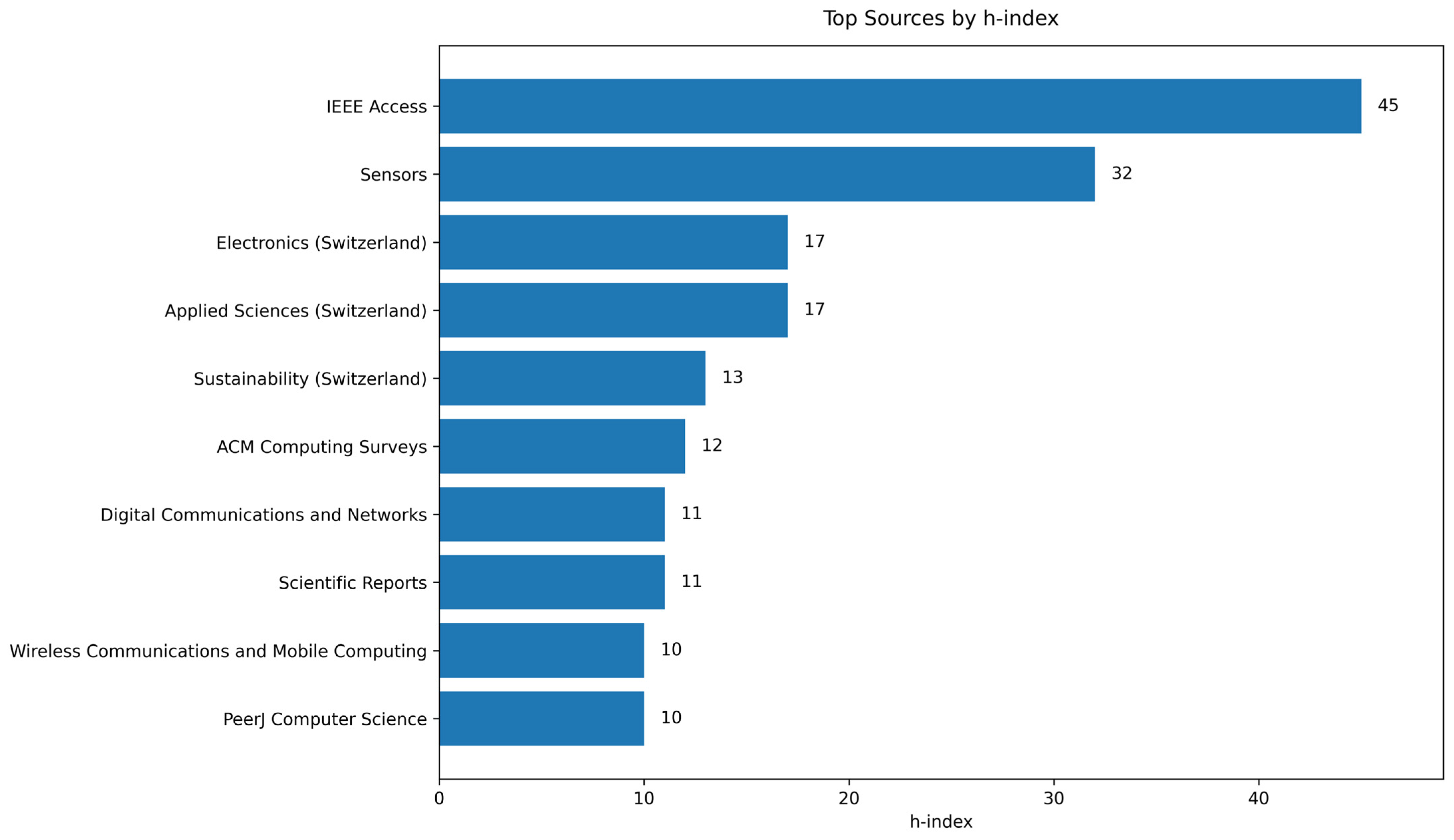
5.3. Top Sources by h-Index
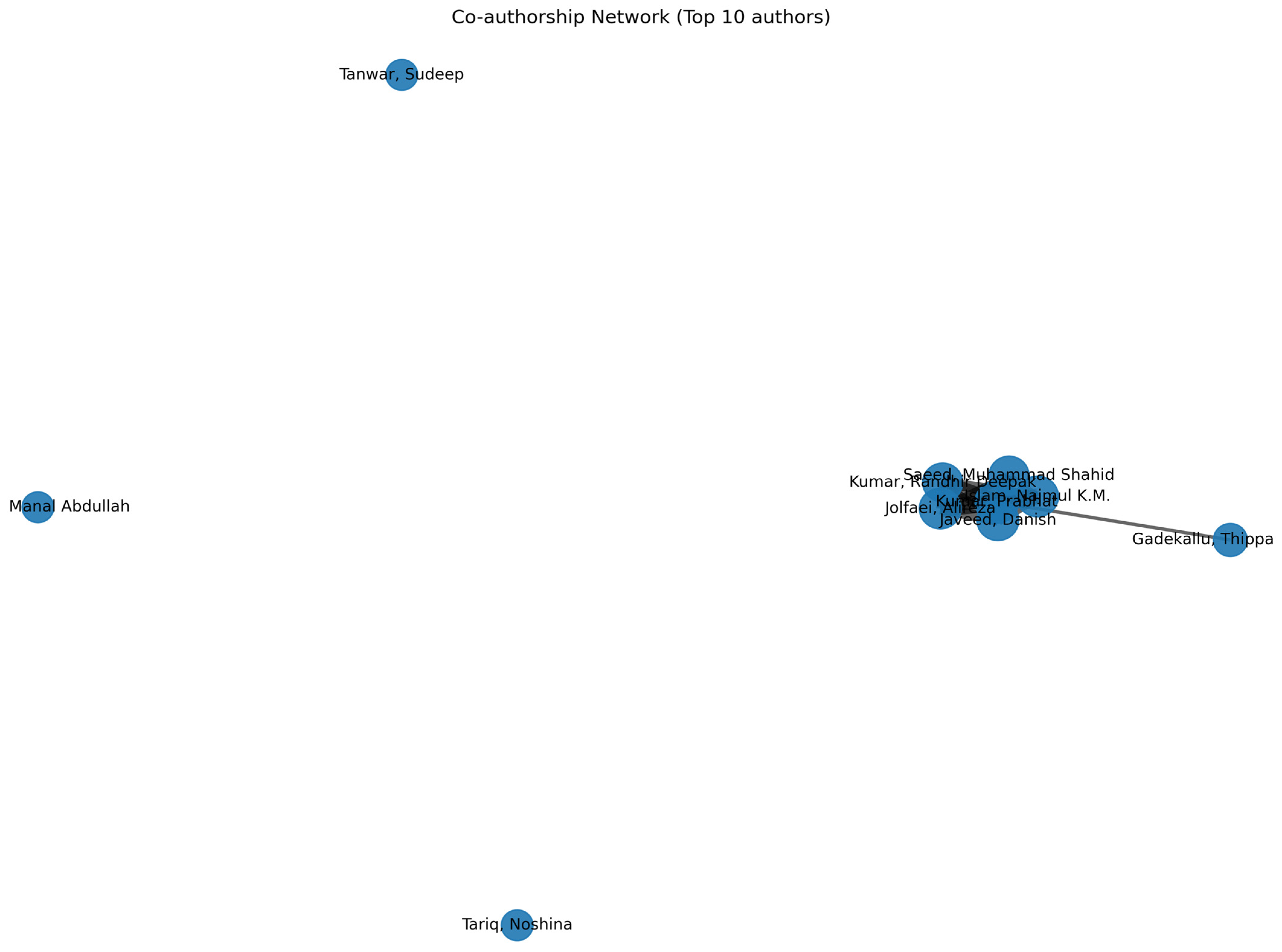
5.4. Co-Authorship Network
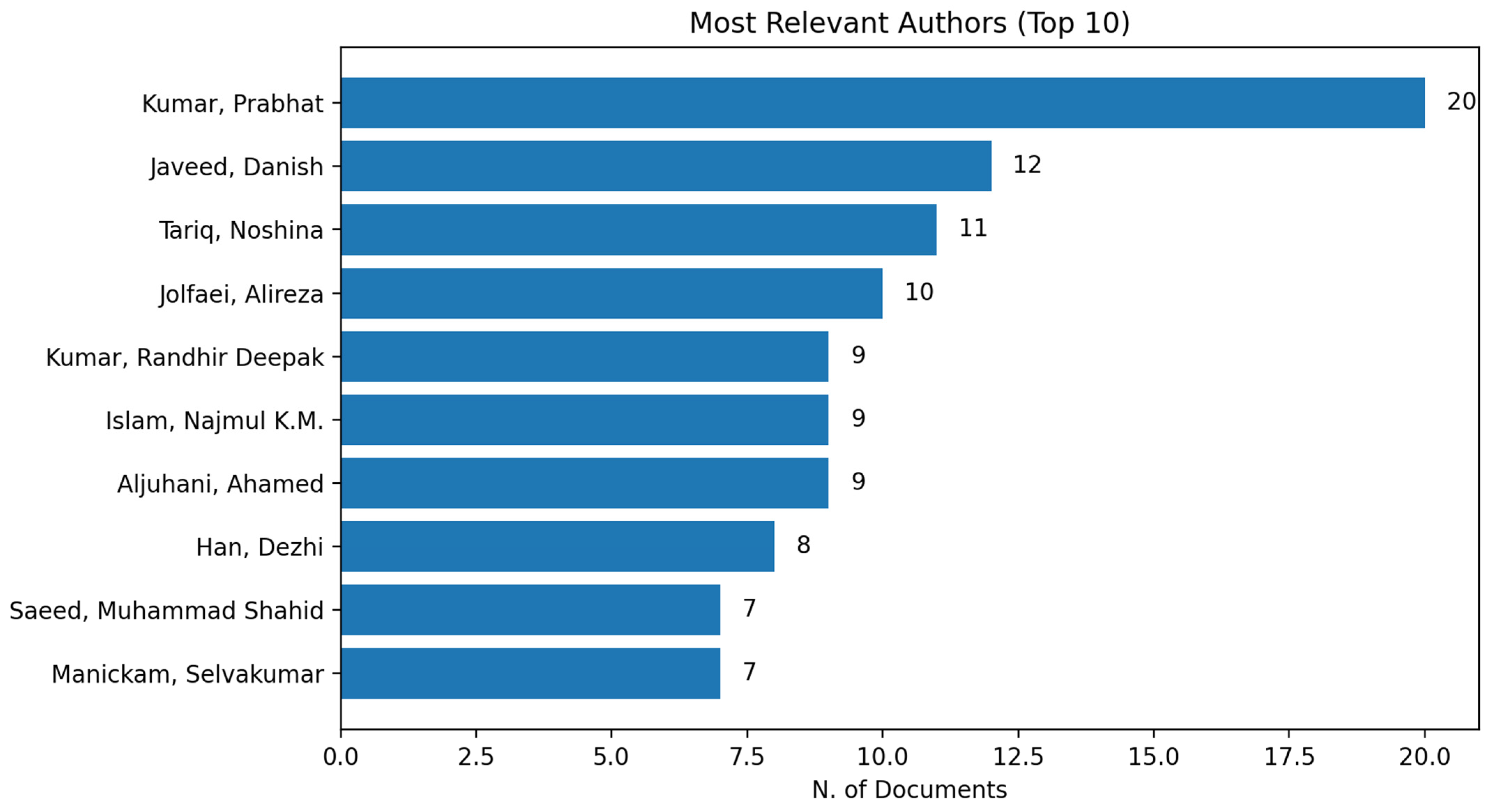
5.5. Top 10 Relevant Authors
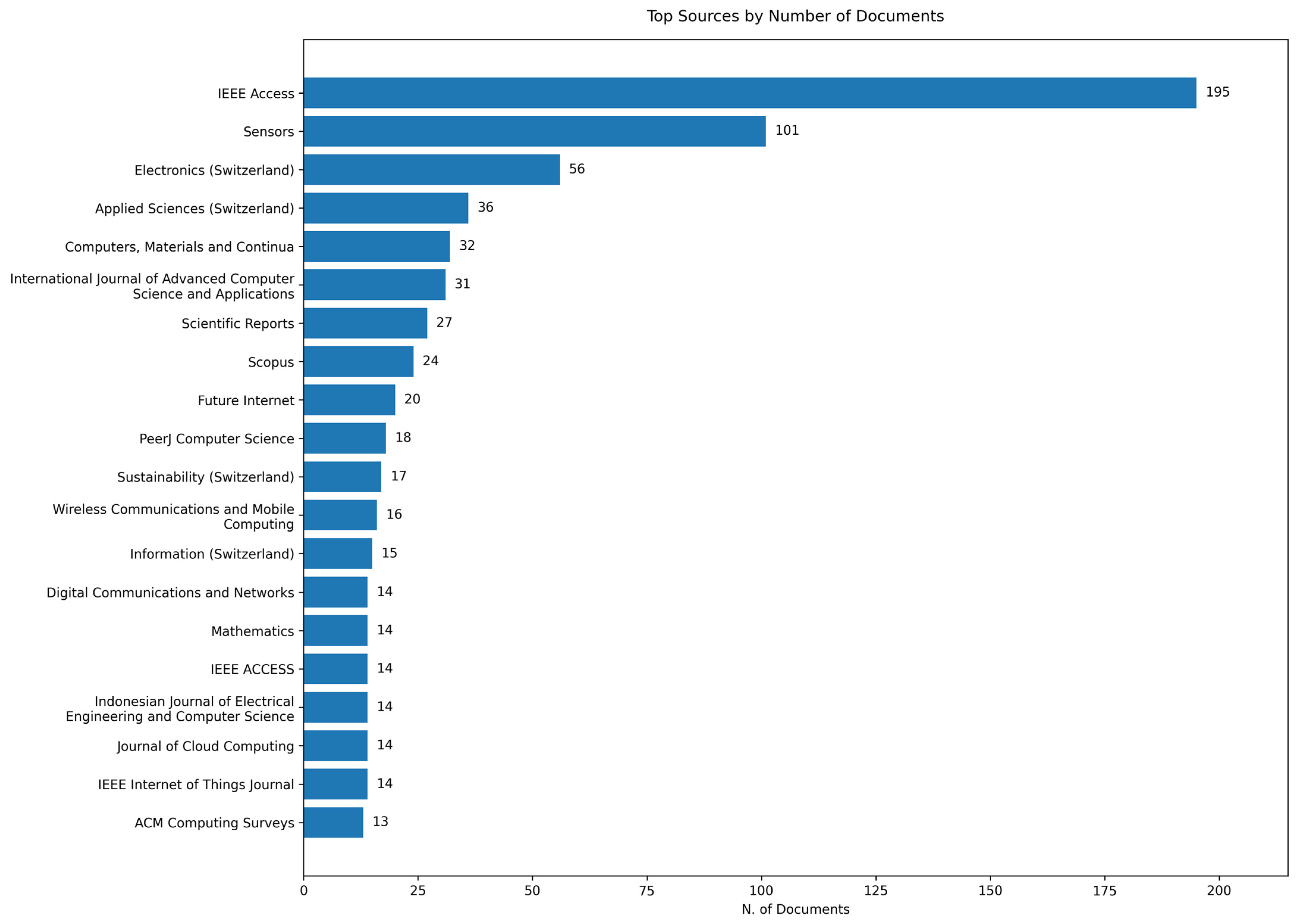
5.6. Publication Sources by Volume
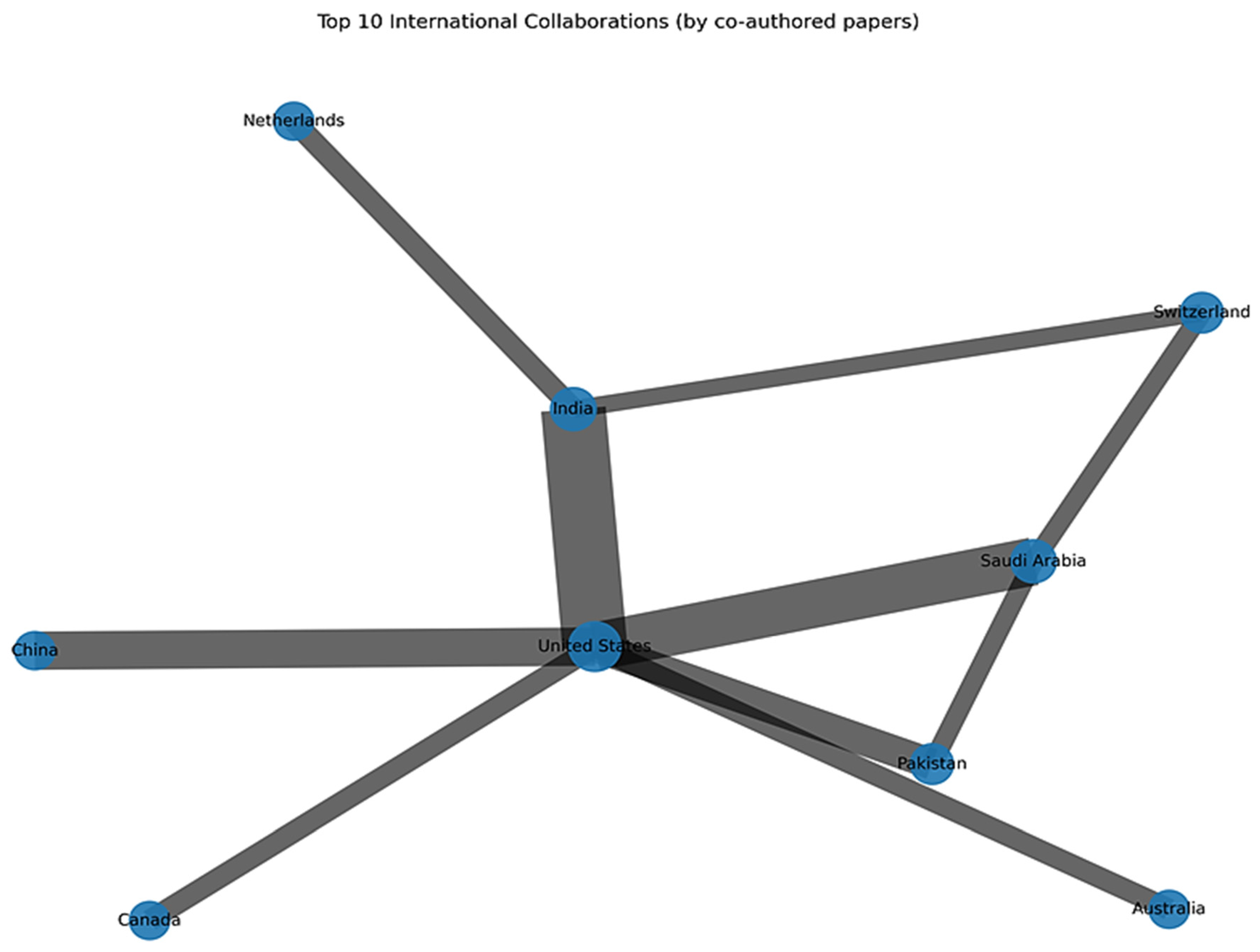
5.7. Country Collaborations
5.8. Findings from the Comparative Analysis of Various IDS Techniques
6. Discussion on Challenges and Limitations
6.1. Resource Intensity vs. Real-Time Requirements
6.2. High False Positive Rates in Anomaly Detection
6.3. Generalization to Unknown Attacks
6.4. Latency and Placement of Detection Components
6.5. Privacy and Data Sharing
6.6. Evaluation in Realistic/Real-World Environments
6.7. Integration of IDS with Explainability
6.8. Interoperability and Regulatory Constraints
7. Study’s Limitations
8. Conclusions and Future Work
Author Contributions
Funding
Data Availability Statement
Conflicts of Interest
Abbreviations
| IDS | Intrusion Detection System |
| ML | Machine Learning |
| DL | Deep Learning |
| CNN | Convolutional Neural Network |
| XAI | Explainable Artificial Intelligence |
References
- Ngabo, D.; Wang, D.; Iwendi, C.; Anajemba, J.H.; Ajao, L.A.; Biamba, C. Blockchain-based security mechanism for the medical data at the fog computing architecture of the Internet of Things. Electronics 2021, 10, 2110. [Google Scholar] [CrossRef]
- Alzahrani, H.; Sheltami, T.; Barnawi, A.; Imam, M.; Yasar, A. A lightweight intrusion detection system using convolutional neural network and long short-term memory in fog computing. Cmc-Comput. Mater. Contin. 2024, 80, 4703–4728. [Google Scholar] [CrossRef]
- Qaddoura, R.; Al-Zoubi, A.M.; Faris, H.; Almomani, I. A multi-layer classification approach for intrusion detection in IoT networks based on deep learning. Sensors 2021, 21, 2987. [Google Scholar] [CrossRef] [PubMed]
- Al-Shurbaji, T.; Anbar, M.; Manickam, S.; Hasbullah, I.H.; Alfriehate, N.; Alabsi, B.A.; Alzighaibi, A.R.; Hashim, H. Deep learning-based intrusion detection system for detecting IoT botnet attacks: A review. IEEE Access 2025, 13, 11792–11822. [Google Scholar] [CrossRef]
- Gill, S.S.; Golec, M.; Hu, J.; Xu, M.; Du, J.; Wu, H.; Walia, G.K.; Murugesan, S.S.; Ali, B.; Kumar, M.; et al. Edge AI: A taxonomy, systematic review and future directions. Clust. Comput. 2025, 28, 18. [Google Scholar] [CrossRef]
- Liu, H.; Zhang, S.; Zhang, P.; Zhou, X.; Shao, X.; Pu, G.; Zhang, Y. Blockchain and federated learning for collaborative intrusion detection in vehicular edge computing. IEEE Trans. Veh. Technol. 2021, 70, 6073–6084. [Google Scholar] [CrossRef]
- Xiong, K.; Wu, Z.; Jia, X. Deepcontainer: A deep learning-based framework for real-time anomaly detection in cloud-native container environments. J. Adv. Comput. Syst. 2025, 5, 1–17. [Google Scholar] [CrossRef]
- Alkanhel, R.; El-kenawy, E.S.M.; Abdelhamid, A.A.; Ibrahim, A.; Alohali, M.A.; Abotaleb, M.; Khafaga, D.S. Network Intrusion Detection Based on Feature Selection and Hybrid Metaheuristic Optimization. Comput. Mater. Contin. 2023, 74, 2677–2693. [Google Scholar] [CrossRef]
- Alnajim, A.M.; Habib, S.; Islam, M.; Thwin, S.M.; Alotaibi, F. A comprehensive survey of cybersecurity threats, attacks, and effective countermeasures in the industrial internet of things. Technologies 2023, 11, 161. [Google Scholar] [CrossRef]
- Mohammed, B.A.; Al-Shareeda, M.A.; Homod, R.Z.; Alkhabra, Y.A.; Al-Mekhlafi, Z.G.; Alshammari, G.; Alanazi, A. Taxonomy-Based Lightweight Cryptographic Frameworks for Secure Industrial IoT: A Survey. IEEE Internet Things J. 2025, 12, 43296–43316. [Google Scholar] [CrossRef]
- Otoum, Y.; Nayak, A. As-ids: Anomaly and signature-based IDs for the Internet of Things. J. Netw. Syst. Manag. 2021, 29, 23. [Google Scholar] [CrossRef]
- Liu, Q.; Hagenmeyer, V.; Keller, H.B. A review of rule learning-based intrusion detection systems and their prospects in smart grids. IEEE Access 2021, 9, 57542–57564. [Google Scholar] [CrossRef]
- Ahmed, U.; Nazir, M.; Sarwar, A.; Ali, T.; Aggoune, E.H.M.; Shahzad, T.; Khan, M.A. Signature-based intrusion detection using machine learning and deep learning approaches empowered with fuzzy clustering. Sci. Rep. 2025, 15, 1726. [Google Scholar] [CrossRef] [PubMed]
- Ahmad, R.; Alsmadi, I.; Alhamdani, W.; Tawalbeh, L.A. Zero-day attack detection: A systematic literature review. Artif. Intell. Rev. 2023, 56, 10733–10811. [Google Scholar] [CrossRef]
- Abdelmoumin, G.; Rawat, D.B.; Rahman, A. On the performance of machine learning models for anomaly-based intelligent intrusion detection systems for the Internet of Things. IEEE Internet Things J. 2021, 9, 4280–4290. [Google Scholar] [CrossRef]
- Mohamed, N.; Al-Jaroodi, J.; Lazarova-Molnar, S.; Jawhar, I. Applications of integrated IoT-fog-cloud systems to smart cities: A survey. Electronics 2021, 10, 2918. [Google Scholar] [CrossRef]
- Alsadie, D. Artificial intelligence techniques for securing fog computing environments: Trends, challenges, and future directions. IEEE Access 2024, 12, 151598–151648. [Google Scholar] [CrossRef]
- Alzahrani, A.I.; Al-Rasheed, A.; Ksibi, A.; Ayadi, M.; Asiri, M.M.; Zakariah, M. Anomaly detection in fog computing architectures using custom tab transformer for internet of things. Electronics 2022, 11, 4017. [Google Scholar] [CrossRef]
- Jeyaraj, R.; Balasubramaniam, A.; Ajay Kumara, M.A.; Guizani, N.; Paul, A. Resource management in cloud and cloud-influenced technologies for Internet of Things applications. ACM Comput. Surv. 2023, 55, 1–37. [Google Scholar] [CrossRef]
- Abulhassan, A.; Rashid, I.; Imam, M.; Binbeshr, F. DDoS Attack Detection in IoT: A Comparative Resource and Performance Analysis of Deep Learning and Machine Learning Models. IEEE Access 2025, 13, 116529–116547. [Google Scholar] [CrossRef]
- Gad, A.G. Particle swarm optimization algorithm and its applications: A systematic review. Arch. Comput. Methods Eng. 2022, 29, 2531–2561. [Google Scholar] [CrossRef]
- Khraisat, A.; Alazab, A.; Singh, S.; Jan, T.; Gomez, A., Jr. Survey on federated learning for intrusion detection systems: Concept, architectures, aggregation strategies, challenges, and future directions. ACM Comput. Surv. 2024, 57, 1–38. [Google Scholar] [CrossRef]
- Sharma, M.; Kaur, P. Reliable federated learning in a cloud-fog-IoT environment. J. Supercomput. 2023, 79, 15435–15458. [Google Scholar] [CrossRef]
- Page, M.J.; McKenzie, J.E.; Bossuyt, P.M.; Boutron, I.; Hoffmann, T.C.; Mulrow, C.D.; Shamseer, L.; Tetzlaff, J.M.; Akl, E.A.; Brennan, S.E.; et al. The PRISMA 2020 statement: An updated guideline for reporting systematic reviews. BMJ 2021, 372, 71. [Google Scholar] [CrossRef]
- Selçuk, A.A. A guide for systematic reviews: PRISMA. Turk. Arch. Otorhinolaryngol. 2019, 57, 57. [Google Scholar] [CrossRef]
- Alghayadh, F.Y. A Hybrid Intrusion Detection System for Smart Home Security Based on Machine Learning and User Behavior. Doctoral Dissertation, Oakland University, Rochester, MI, USA, 2021. [Google Scholar]
- Rani, D.; Kaushal, N. Supervised Machine Learning Based Network Intrusion Detection System for Internet of Things. In 11th International Conference on Computing, Communication and Networking Technologies (ICCCNT); IEEE: Piscataway, NJ, USA, 2020. [Google Scholar] [CrossRef]
- Sadaf, K.; Sultana, J. Intrusion detection based on an autoencoder and an isolation forest in fog computing. IEEE Access 2020, 8, 167059–167068. [Google Scholar] [CrossRef]
- Kumar, P.; Gupta, G.P.; Tripathi, R. An ensemble learning and fog-cloud architecture-driven cyber-attack detection framework for IoMT networks. Comput. Commun. 2021, 166, 110–124. [Google Scholar] [CrossRef]
- Alzubi, O.A.; Alzubi, J.A.; Alazab, M.; Alrabea, A.; Awajan, A.; Qiqieh, I. Optimized machine learning-based intrusion detection system for fog and edge computing environments. Electronics 2022, 11, 3007. [Google Scholar] [CrossRef]
- Tariq, N.; Alsirhani, A.; Humayun, M.; Alserhani, F.; Shaheen, M. A fog-edge-enabled intrusion detection system for smart grids. J. Cloud Comput. 2024, 13, 43. [Google Scholar] [CrossRef]
- NG, B.A.; Selvakumar, S. Anomaly detection framework for Internet of things traffic using vector convolutional deep learning approach in fog environment. Future Gener. Comput. Syst. 2020, 113, 255–265. [Google Scholar] [CrossRef]
- Imrana, Y.; Xiang, Y.; Ali, L.; Abdul-Rauf, Z. A bidirectional LSTM deep learning approach for intrusion detection. Expert Syst. Appl. 2021, 185, 115524. [Google Scholar] [CrossRef]
- Abdel-Basset, M.; Chang, V.; Hawash, H.; Chakrabortty, R.K.; Ryan, M. Deep-IFS: Intrusion Detection Approach for IIoT Traffic in Fog Environment. IEEE Trans. Ind. Inform. 2020, 17, 7704–7715. [Google Scholar] [CrossRef]
- El Houda, Z.A.; Brik, B.; Khoukhi, L. “Why should I trust your IDS?”: An Explainable Deep Learning Framework for Intrusion Detection Systems in Internet of Things Networks. IEEE Open J. Commun. Soc. 2022, 3, 1164–1176. [Google Scholar] [CrossRef]
- Attique, D.; Wang, H.; Wang, P. Fog-assisted deep-learning-empowered intrusion detection system for RPL-based resource-constrained smart industries. Sensors 2022, 22, 9416. [Google Scholar] [CrossRef]
- De Souza, C.A.; Westphall, C.B.; Machado, R.B.; Sobral, J.B.M.; dos Santos Vieira, G. Hybrid approach to intrusion detection in fog-based IoT environments. Comput. Netw. 2020, 180, 107417. [Google Scholar] [CrossRef]
- Mohamed, D.; Ismael, O. Enhancement of an IoT hybrid intrusion detection system based on fog-to-cloud computing. J. Cloud Comput. 2023, 12, 41. [Google Scholar] [CrossRef]
- Tawfik, M. Optimized intrusion detection in IoT and fog computing using ensemble learning and advanced feature selection. PLoS ONE 2024, 19, e0304082. [Google Scholar] [CrossRef]
- Sahar, N.; Mishra, R.; Kalam, S. Deep learning approach-based network intrusion detection system for fog-assisted IoT. In International Conference on Big Data, Machine Learning, and Their Applications; Springer: Berlin/Heidelberg, Germany, 2021; pp. 39–50. [Google Scholar]
- Kaliyaperumal, K.; Murugaiyan, C.; Perumal, D.; Jayaraman, G.; Samikannu, K. Combined ensemble intrusion detection model using deep learning with feature selection for fog computing environments. Acta Scientiarum. Technol. 2023, 45, e60551. [Google Scholar] [CrossRef]
- Zhao, G.; Wang, Y.; Wang, J. Lightweight Intrusion Detection Model of the Internet of Things with Hybrid Cloud-Fog Computing. Secur. Commun. Netw. 2023, 2023, 7107663. [Google Scholar] [CrossRef]
- Chen, Y.; Lin, Q.; Wei, W.; Ji, J.; Wong, K.C.; Coello, C.A.C. Intrusion detection using multi-objective evolutionary convolutional neural network for Internet of Things in Fog computing. Knowl.-Based Syst. 2022, 244, 108505. [Google Scholar] [CrossRef]
- Najafli, S.; Toroghi Haghighat, A.; Karasfi, B. A novel reinforcement learning-based hybrid intrusion detection system on fog-to-cloud computing. J. Supercomput. 2024, 80, 26088–26110. [Google Scholar] [CrossRef]
- Al Rawajbeh, M.; Maria Soosai, A.J.; Ramasamy, L.K.; Khan, F. Trustworthy Adaptive AI for Real-Time Intrusion Detection in Industrial IoT Security. IoT 2025, 6, 53. [Google Scholar] [CrossRef]



| Stage | Criteria | Web of Science Articles | Scopus Articles |
|---|---|---|---|
| 1 | Titles include “intrusion detection” AND “fog computing.” | 322 | 8238 |
| 2 | Choose the 2021–2025 articles | 232 | 7306 |
| 3 | Choose only the journal and conference articles | 232 | 5651 |
| 4 | Select articles that were written in English | 232 | 5594 |
| 5 | Open access | 232 | 5594 |
| Study | Dataset | Techniques | Findings | Limitations |
|---|---|---|---|---|
| Two-tier Smart-Home IDS [26] | CSE-CIC-IDS2018; NSL-KDD | Hybrid: misuse/signature rules and ML (RF, XGBoost, DT, kNN) | Improved detection of known and unknown attacks in smart-home fog nodes; reduced false alarms with signatures. | Rule-based requires continual expert updates; evaluated on simulated datasets, not live fog deployments. |
| Feature-lean RF IDS [27] | NSL-KDD; KDD’99 | Random Forest with manual feature selection for low compute | Reasonable attack vs. normal accuracy with minimized features suited to fog. | Training data synthetic/older; generalization to real fog traffic uncertain. |
| Auto-IF (Autoencoder and Isolation Forest) [28] | NSL-KDD | Unsupervised AE (reconstruction error) and Isolation Forest; anomaly-based | High binary intrusion detection accuracy: no labeled attacks needed for training. | Binary only (no multiple-attack classes); old datasets; not validated in real-world fog networks |
| Fog-Cloud Ensemble for IoMT [29] | NSL-KDD; real healthcare traffic | Ensemble of ML classifiers; fog prefiltering and cloud aggregation | >90% multi-attack accuracy; scalable across fog-cloud; diversity boosted TPR. | Ensemble adds latency/overhead; reliance on the cloud link can increase delay. |
| ESOML-IDS [30] | UNSW-NB15 | Effective Seeker Optimization (ESO) feature selection and ML with Denoising Autoencoder | F1 = 0.82 to 0.83 after selection vs. 0.53 to 0.67 for baselines; better accuracy/precision/recall with fewer features. | ESO search is compute-intensive; it may need offline optimization for tiny fog nodes. |
| Federated SVM for Smart Grids [31] | NSL-KDD; CICIDS2017 | Federated Learning with SVM at the edge; parameter sharing to fog aggregator | 4–6% accuracy and notable F1/recall gains over centralized; privacy preserved, better generalization. | Classical SVM may miss complex nonlinearities; Federated Learning introduces communication and synchronization overhead. |
| Vector CNN for IoT Traffic [32] | IoT traffic datasets | CNN on vectorized flow features for local pattern extraction at fog | Anomaly detection typically >90%; CNN learns spatial-temporal feature interactions. | Needs large/representative data; porting to new environments may require retraining/transfer. |
| Bi-LSTM IDS [33] | NSL-KDD | Bidirectional LSTM sequence model | Overall accuracy > 95%; markedly higher recall for rare U2R/R2L classes. | Training/inference heavy for fog; dataset dated; no online/drift evaluation. |
| Deep-IFS (Local GRUs and Multi-Head Attention) [34] | BoT-IoT | Distributed GRUs at fog; attention-based aggregation; residual links | Scaled to high IIoT volumes; outperformed centralized training on accuracy/F1/recall. | Non-trivial communications and computational overhead; best for fog with stronger processors. |
| DL with XAI [35] | NSL-KDD; UNSW-NB15 | DNN detector and XAI (RuleFit, LIME, SHAP) | Competitive detection while providing explanations to operators. | Explainable AI methods incur runtime costs; they may be too slow for strict real-time at the fog. |
| Cu-DNNGRU at Fog [36] | N-BaIoT | CUDA-optimized GRU (GPU-accelerated) | Accuracy 99.39% with high precision/recall; GPU parallelism speeds inference. | Possible overfitting to a clean dataset; many fog nodes lack GPUs/edge accelerators. |
| Hybrid DNN-kNN [37] | NSL-KDD; CICIDS2017 | Deep NN for feature learning and kNN classification | >99% accuracy with low latency at the fog layer in experiments. | Computational complexity is higher than simpler Machine Learning; tuning is required. |
| EHIDS (GA-tuned BPNN) [38] | ToN-IoT (and others) | Genetic Algorithm initializes/tunes Backprop NN; FS and normalization pipeline. | Higher accuracy with faster convergence; training time reduced by 37% and 16%. | GA adds initial optimization overhead; BPNN is less expressive than modern Deep Learning. |
| Edge AEs and Cloud Transformer-CNN-LSTM [39] | NSL-KDD; UNSW-NB15; AWID | Stacked autoencoders at fog for real-time anomaly/feature reduction; cloud ensemble for classification | Detection > 99%; balances latency/bandwidth by offloading heavy computational processing | Complex multi-component system; depends on stable connectivity; AE must retain critical features. |
| DL NIDS on Fog Nodes [40] | UNSW-NB15; NSL-KDD | Deep learning-based network IDS deployed at the fog | Accuracy 91.20% (UNSW-NB15) and 95.40% (NSL-KDD). | Performance varies by dataset; details on resource usage/latency are limited. |
| Ensemble CNN-IDS (CNN and AlexNet) [41] | UNSW-NB15 with 9 attack classes | Random-Forest-based feature selection and CNN/AlexNet ensemble | 97.5% accuracy; outperformed traditional and related IDS baselines. | Supervised training needs labels: ensemble increases training/inference complexity. |
| ConvNeXt-Sf Lightweight IDS [42] | BoT-IoT; ToN-IoT | 1D ConvNeXt with ShuffleNet V2 ideas; LE-MMN preprocessing | 1.25% of ConvNeXt params; training time reduced by 82.63%, prediction time reduced by 56.48%; increased accuracy by 6.18% accuracy, reduced 4.49% false alarm rate vs. baselines. | A supervised model that required substantial labeled data for deployment. |
| MECNN (MOEA/D-evolved CNN) [43] | AWID; CIC-IDS2017 | Multi-objective evolutionary search over CNN topologies (accuracy vs. complexity) | Accuracy reported up to 99.96%; selectable models per fog node, per constraint. | Evolutionary search/training costs are high; offline tuning is likely needed. |
| DRL at Fog and Cloud Ensemble [44] | CIC-IDS2018 | DRL agent for local binary decisions; cloud ensemble for multi-class | Botnet detection 99.99%; binary F-measure 0.9959; prediction latency = 0.52. | System complexity, stability of DRL, and dependence on the cloud for full multi-class labeling. |
| Lightweight Online-Ensemble IDS with explainable AI (XAI) [45] | ToN-IoT; BoT-IoT; Raspberry Pi 5 testbed | Adaptive online learners’ ensemble; real-time detection on fog; SHAP | Accuracy 96.4%; False-positives 2.1%; 35 ms inference; interpretable | Broader multi-platform, multi-attack trials needed. |
Disclaimer/Publisher’s Note: The statements, opinions and data contained in all publications are solely those of the individual author(s) and contributor(s) and not of MDPI and/or the editor(s). MDPI and/or the editor(s) disclaim responsibility for any injury to people or property resulting from any ideas, methods, instructions or products referred to in the content. |
© 2026 by the authors. Licensee MDPI, Basel, Switzerland. This article is an open access article distributed under the terms and conditions of the Creative Commons Attribution (CC BY) license.
Share and Cite
Tamuka, N.; Mathonsi, T.E.; Olwal, T.O.; Maswikaneng, S.; Muchenje, T.; Tshilongamulenzhe, T.M. Intrusion Detection in Fog Computing: A Systematic Review of Security Advances and Challenges. Computers 2026, 15, 169. https://doi.org/10.3390/computers15030169
Tamuka N, Mathonsi TE, Olwal TO, Maswikaneng S, Muchenje T, Tshilongamulenzhe TM. Intrusion Detection in Fog Computing: A Systematic Review of Security Advances and Challenges. Computers. 2026; 15(3):169. https://doi.org/10.3390/computers15030169
Chicago/Turabian StyleTamuka, Nyashadzashe, Topside Ehleketani Mathonsi, Thomas Otieno Olwal, Solly Maswikaneng, Tonderai Muchenje, and Tshimangadzo Mavin Tshilongamulenzhe. 2026. "Intrusion Detection in Fog Computing: A Systematic Review of Security Advances and Challenges" Computers 15, no. 3: 169. https://doi.org/10.3390/computers15030169
APA StyleTamuka, N., Mathonsi, T. E., Olwal, T. O., Maswikaneng, S., Muchenje, T., & Tshilongamulenzhe, T. M. (2026). Intrusion Detection in Fog Computing: A Systematic Review of Security Advances and Challenges. Computers, 15(3), 169. https://doi.org/10.3390/computers15030169