1. Introduction
The fragmentation of settlements currently observed across the Italian territory has made settlement systems highly energy-intensive and increasingly costly for public administrations to manage [
1,
2,
3,
4]. This configuration lacks resilience and contributes to various environmental criticalities, as demonstrated by the growing frequency of climate-related emergencies [
2,
5]. Such events increasingly highlight the intrinsic vulnerabilities of a territory already heavily affected by multiple hazard conditions. These dysfunctions concern the energy footprint of settlements, the fragmentation of natural habitats, access to social services, resilience to environmental risks, and the decline of ecosystem functions [
1,
2,
3,
4,
5,
6,
7]. Urban expansion in the Italian territory has been defined by the term “sprinkling”. It represents a type of low-density urban expansion that is poorly planned. This morphology of the urbanized territory more accurately expresses the fragmented distribution of settlements across the territory compared to sprawl, from which it differs due to the lack of coordinated planning. This physiognomy of the urban landscape has been identified in the Italian territory but is also characteristic of other regions of southern Europe [
8]. The high degree of administrative fragmentation in Italy (7893 municipalities in 2025, with an average size of 38 km
2) further amplifies the criticalities and dysfunctions that emerge in the absence of careful spatial planning and a strategic interpretation of development objectives. These criticalities affect the environmental, economic, and social spheres. Weak and “molecular” planning, such as that which has characterized the Italian territory for decades [
9,
10], has significant consequences, including excessive urbanization, loss of coordination in planning, difficulties in infrastructure management, and low efficiency in the organization of public services, resulting in disordered and energy-intensive growth [
1,
2,
3,
11]. In recent years, the process of urbanization has accelerated on a global scale, transforming cities into the main hubs of human life, with both positive and problematic implications. The United Nations (UN) and the European Union (EU) call for the protection of soil, the environment, and the landscape, and promote the achievement of net zero land take by 2050 [
12]. This objective should be aligned with demographic growth and pursued without increasing the current rate of land degradation by 2030 [
13]. In this context, territorial governance requires not only normative instruments but also computational tools capable of transforming heterogeneous geodata into actionable indicators that can support both ordinary planning and emergency preparedness. These should support sustainable land management and its appropriate uses through effective actions integrated into urban policies [
14,
15,
16,
17,
18,
19,
20,
21,
22,
23,
24,
25,
26,
27,
28,
29]. A fundamental aspect to be addressed concerns knowledge of the geography of the country’s settled areas, their demographic structure, their level of accessibility, and the risks to which they, together with connecting infrastructures, are exposed. Such knowledge becomes an essential prerequisite both in the initial phases of emergency management and in the implementation of targeted actions aimed at mitigating vulnerability to different types of risk. This paper outlines a methodology currently under development aimed at the structural characterization of settlement nodes and at assessing the degree of territorial accessibility, both at the municipal scale and at the urban/peri-urban scale. It should be clarified that the objective of this study is not to address a specific type of emergency, nor to establish a direct link between particular hazards and selected indicators. Rather, the proposed framework focuses on defining a set of baseline, transversal indicators conceived as fundamental territorial attributes, such as demographic structure, service provision, and levels of connectivity, that may be relevant across different emergency scenarios, including hydrogeological risk, wildfires, and seismic events. More highly connected areas tend to be better integrated into economic and social networks, facilitating access to public services, promoting sustainable mobility, and ensuring greater reachability even under critical conditions. Conversely, territories characterized by low connectivity experience higher levels of isolation and vulnerability, with the risk of being excluded from timely interventions in the event of adverse occurrences. These vulnerabilities are embedded within a settlement structure that, although historically stratified and morphologically heterogeneous, reveals significant structural weaknesses in terms of resilience.
2. Materials and Methods
The methodology used in this study was developed as part of the PARIDE project (Platform for Emergency Prevention and Territorial Security Support) and is fully adopted here to present an initial experimental application to a specific case study. For a more detailed description of the methodology, please refer to Felli et al. 2025, [
8] (pp. 117–128).
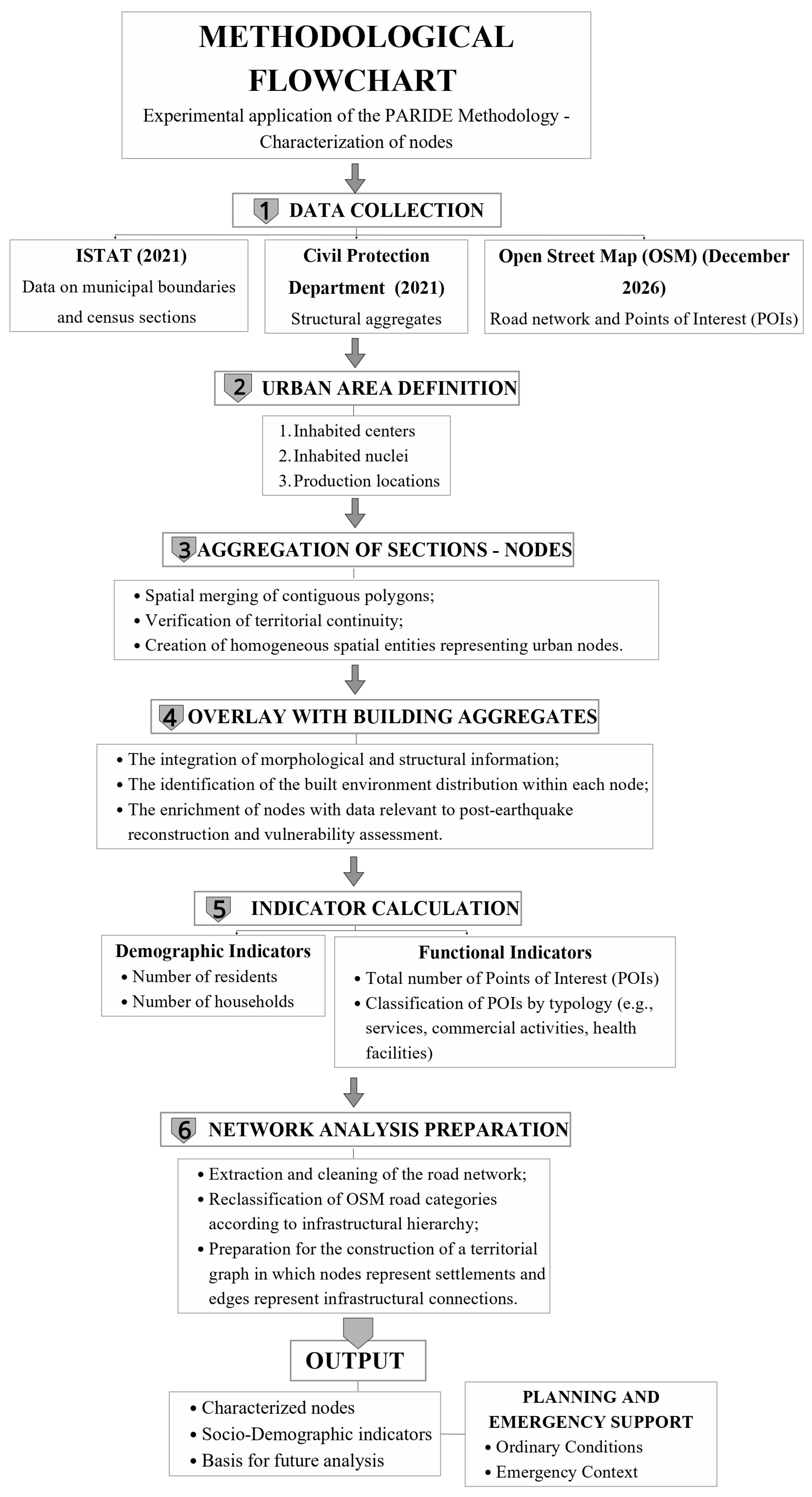
Figure 1 shows the methodological workflow adopted in this study, outlining the sequential phases from data collection to node characterization and the preparation for subsequent network-based accessibility analysis.
The methodology aims to characterize urban areas based on accessibility. In this context, accessibility is understood as the number of connections between different urban areas and the type of infrastructure linking them. The underlying principle is straightforward: the greater the number of connections a territorial entity maintains with others, the higher its level of accessibility. High accessibility is particularly crucial in emergency contexts. The methodology is grounded in network theory, through the identification and characterization of settlement nodes and the integrated analysis of the systems of connections among them [
29,
30]. The collected data and the derived information are relevant both under ordinary conditions and in emergency contexts. In the former, the approach enables the identification of areas with lower accessibility or infrastructural deficiencies, guiding targeted interventions aimed at strengthening connections and promoting territorial balance. In emergency scenarios, it allows for the integration of strategic geographical information, such as the location of the event, the potentially affected population, and the condition of the infrastructure network, providing a knowledge framework that supports timely assessments and operational decisions. Territorial configuration directly affects key elements such as route redundancy, accessibility of peripheral areas, and the risk of isolation of specific settlements. A fragmented or poorly interconnected territory may increase response times and reduce the effectiveness of interventions, whereas a more structured and hierarchical network can facilitate faster, better coordinated, and more reliable actions. In the present study, the methodology is not implemented in its entirety; rather, an initial testing phase is undertaken. The focus of this contribution is on the characterization of network nodes through a structured set of socio-economic and environmental indicators. This step represents the foundational stage of the broader methodological framework, aimed at defining the baseline attributes of settlement nodes. By operationalizing selected indicators, the study provides a first empirical application of the approach, laying the groundwork for subsequent developments and for the future integration of additional analytical components within the overall model.
The data used in this work are of different types, both tabular and geographic. For geographic data the used reference system is EPSG:32632 (WGS 84/UTM zone 32N). Specifically, data on municipal boundaries and census sections were obtained from the ISTAT portal (
https://www.istat.it/). The data used for this study refers to 2021. The latter are available in geographic format. The representation scale ranges from 1:5000 (in urban areas) to 1:25,000 (in low-density population areas). Several attributes are associated with the census sections. The attribute of interest for this study is the one identifying the type of locality, which can take the following values:
Inhabited centre: an aggregate of contiguous or neighbouring houses with interposed streets, squares and the like, or in any case brief solutions of continuity characterized by the existence of public services or establishments (school, public office, pharmacy, shop or similar) that constitute an autonomous form of social life and, generally, also a gathering place for the inhabitants of the neighbouring areas to manifest the existence of a form of social life coordinated by the centre itself. Tourist meeting places, groups of villas, hotels, and the like intended for holidays, inhabited seasonally, must be considered as temporary inhabited centers, provided that during the period of seasonal activity they present the requirements of the centre.
Inhabited nucleus: inhabited locality, without the gathering place that characterizes the inhabited centre, consisting of a group of at least fifteen contiguous and neighbouring buildings, with at least fifteen families, with interposed roads, paths, squares, farmyards, small vegetable gardens, small uncultivated areas and the like, provided that the interval between house and house does not exceed thirty meters and is in any case less than that between the nucleus itself and the nearest of the manifestly scattered houses.
Production location: an area in an extra-urban area not included in inhabited centres or nuclei in which there are more than 10 local units, or whose total number of employees is greater than 200, contiguous or close with interposed streets, squares and the like, or in any case brief solutions of continuity not exceeding 200 metres; the minimum area must correspond to 5 hectares.
Scattered houses: houses scattered in the municipal area at such a distance that they cannot even constitute an inhabited nucleus.
In our case, urban areas are defined as the combination of inhabited centers and nuclei (the sum of classes 1, 2, and 3).
The data related to structural aggregates were processed by the Civil Protection Department as part of post-earthquake reconstruction activities. This dataset is the result of a nationwide harmonization of heterogeneous data collected with the contribution of Regions, Autonomous Provinces, and the Revenue Agency, and refers to the year 2021. The geographic data, divided by macro-areas, are available on the GitHub platform. The dataset is produced through the analysis of ortho-rectified images using a combination of “feature extraction” techniques based on deep learning methodologies, along with supervised control and correction of the algorithms [
31,
32,
33].
Finally, data on road infrastructures and points of interest come from OpenStreetMap. These data can be downloaded in geographic format via the
https://download.geofabrik.de/ (accessed on 13 December 2025) portal. The dataset is produced globally through voluntary contributions. Contributors use aerial imagery, GPS devices, and even non-digital field maps to ensure that OSM remains accurate and up-to-date. The data used for this study refers to December 2025. Available data include buildings, land uses, natural features, places, points of interest, railways, and transport lines.
Table 1 shows the categories of OSM roads used in this study, along with the nomenclature.
The proposed methodology is schematic and aims to characterize urban areas on the basis of their accessibility. In this context, accessibility is understood as the number of connections between different urban areas and the type of infrastructure that links them. The fundamental principle is as follows: the higher the number of connections that a territorial entity has with others, the greater its level of accessibility. High accessibility is particularly crucial in emergency contexts. The principles underlying the methodology are based on network theory, identifying and characterizing nodes while simultaneously analyzing connection systems. This methodology aims to provide a support tool for emergency management in two distinct contexts: ordinary conditions and emergency situations. In the first case, the objective is to identify the most deficient areas, in order to improve accessibility by addressing infrastructural weaknesses. In emergency situations, on the other hand, the use of this methodology makes it possible to provide essential geographical information, such as the location of the triggering event, the population involved, and the condition of the infrastructure.
This study presents the first step in the application of this methodology, namely the characterization of nodes. A series of indicators aimed at demographic and economic characterization are calculated for these nodes. In particular, the number of residents, households, and POIs will be evaluated in order to identify areas that require particular attention, especially in emergency cases.
In the article, reference is made to several indicators. Their formulation is reported in
Table 2.
3. Study Area
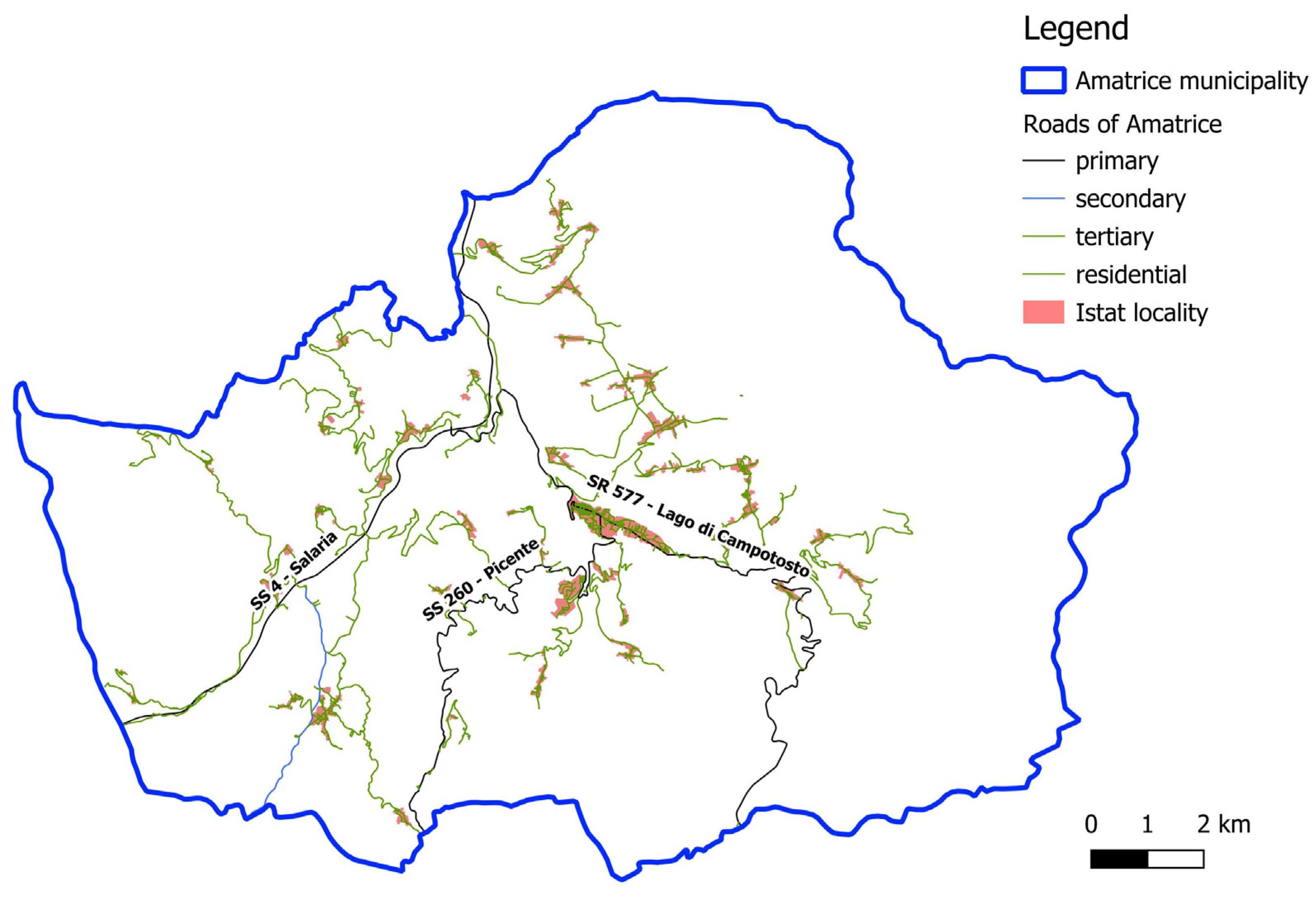
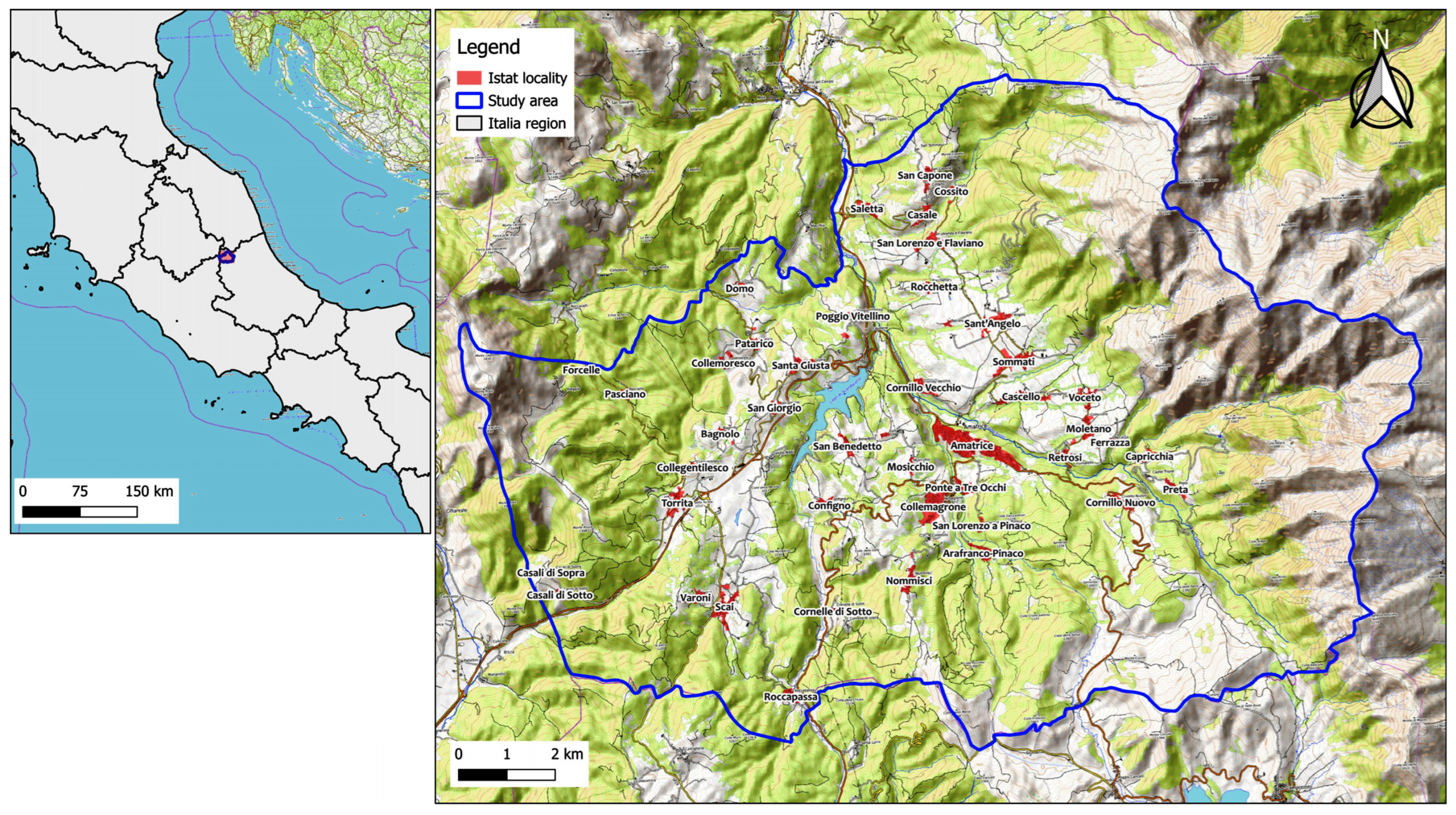
The study area corresponds to the municipality of Amatrice, an Italian municipality in the Lazio region, within the province of Rieti. The municipality covers approximately 175 km
2, with an elevation ranging from 750 m to 2400 m a.s.l. Amatrice is primarily situated on a plateau between the Laga and Sibillini mountain ranges, occupying a transitional position among the Lazio, Umbria, Marche, and Abruzzo regions (
Figure 2). As of 2025, the resident population is approximately 2100 inhabitants, resulting in a population density of about 12 inhabitants/km
2, significantly lower than both the national and regional averages, which are around 200 inhabitants/km
2.
Over the past few decades, the municipality has undergone progressive depopulation, becoming primarily a destination for summer stays, as evidenced by the large number of second homes [
34]. This depopulation trend, already underway, was further exacerbated by the Central Italy earthquakes of August and October 2016. The municipality is characterized by a very low Urban density (DU), approximately 2%, a value considerably below the national average of 7%. Urbanized areas are extremely dispersed, with a wide network of hamlets scattered throughout the municipal territory [
35,
36].
These hamlets, distributed across the entire mountainous territory, contribute to a diffuse and fragmented settlement morphology, typical of rural Apennine contexts; however, in this case, the polycentric structure is particularly pronounced.
4. Results
The descriptions provided in the Study Area section are consistent with the analysis of the ISTAT localities dataset, which was used as the spatial reference framework for the assessment of the municipal settlement system. The results, reported in
Table 3, show a settlement structure characterized by a large number of small-sized localities, mostly classified as type-2 localities (inhabited nuclei), and a limited number of type-1 localities (inhabited centers), which play a more relevant demographic and functional role. Population distribution is strongly skewed: the median locality hosts 21 residents (mean ≈ 44), and 41 out of 48 localities have fewer than 50 inhabitants. The municipal seat (Amatrice) concentrates 763 residents (≈ 36% of the total), while the five most populated hamlets account for ≈ 55% of the municipal population. These figures highlight a pronounced exposure to isolation and service-access issues, especially for micro-localities with only 1–3 inhabitants. Overall, four hamlets (Amatrice, Collemagrone, Scai and Sommati) accommodate approximately 51% of the total municipal population. The analysis does not include the eight S.A.E. (Emergency Housing Solutions), which are temporary housing units installed following the 2016 seismic events. Although these units are classified by ISTAT as inhabited nuclei, their resident population is equal to zero in all cases. It is noteworthy that the total surface area occupied by the eight S.A.E. modules exceeds 6 hectares.
Household size values are generally low. The average family size is approximately 1.8 inhabit./fam., consistent with aging and long-term depopulation trends typical of Italian inner areas. Only a few nuclei exceed 2.0 inhabitants per family (maximum 2.66 in Cascello), while several micro-localities show one-to-one ratios due to very small resident counts. The surface area of the localities is generally limited, often below 10 hectares, and no direct correlation emerges between areal extent and population size. From a morphological perspective, localities are typically compact in surface area (median ≈ 5.1 ha) and located in a mountainous belt around 950–1070 m a.s.l. (median altitude 994 m), a condition that directly influences travel impedance and the feasibility of rapid response during emergencies.
Overall, this framework highlights the high sensitivity of the municipality to issues related to accessibility, connectivity, and the maintenance of essential services, particularly during emergency conditions, when even single-road access hamlets may be temporarily cut off. This is further supported by the analysis of services and the infrastructural network as discussed below.
The mapped road hierarchy (
Figure 3 and
Table 4) suggests a strong dependence on lower-order roads: tertiary and residential segments represent about 65% of the total network length, while primary and secondary roads account for the remaining 35%. In practice, many hamlets are served by a single access road that functions as both entry and exit, often classified as a municipal or local road. This structural dependence on a limited set of links can increase systemic vulnerability, because localized failures (e.g., landslides, snow, debris) may isolate entire settlements.
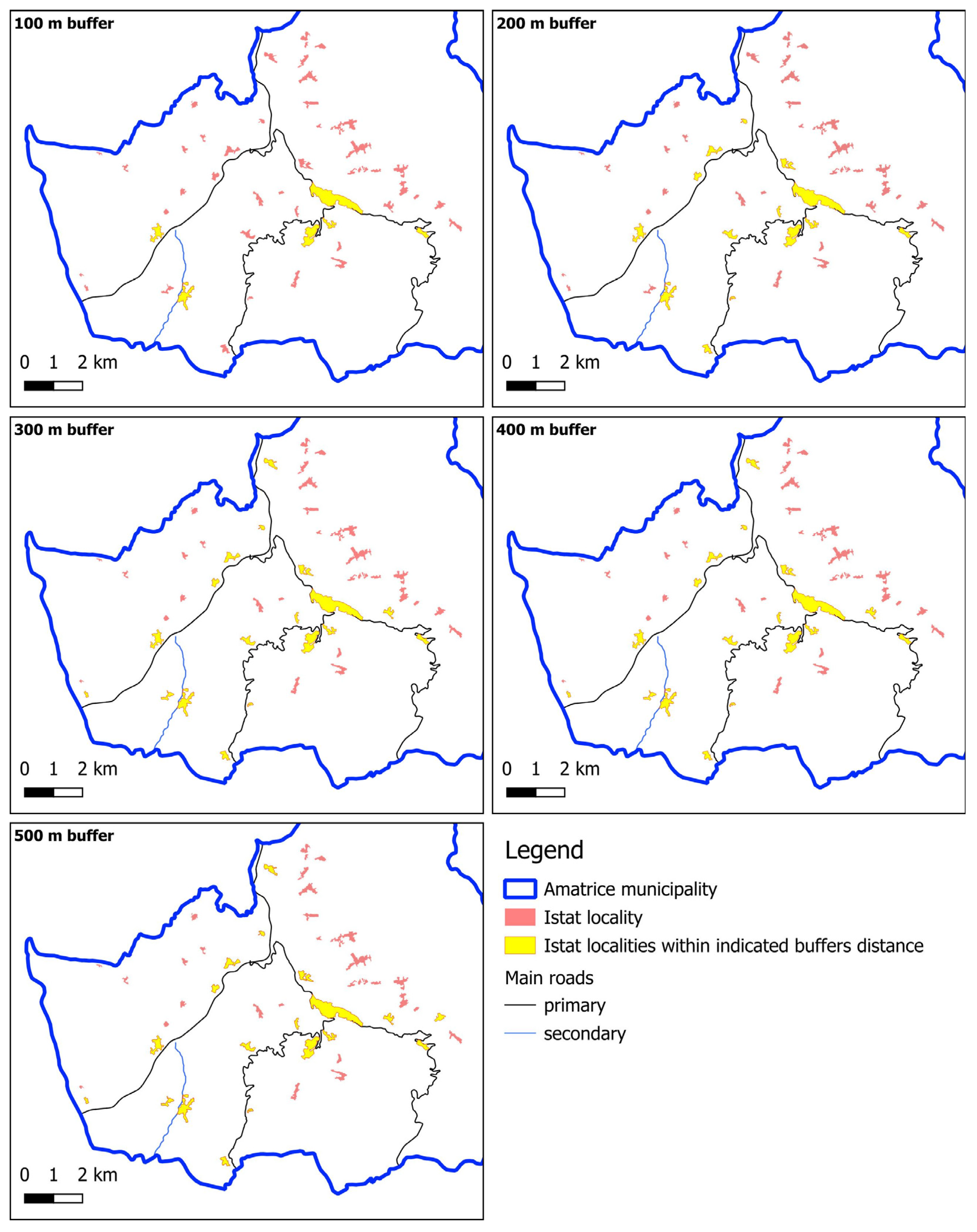
To better assess the accessibility of the considered localities, a preliminary analysis was conducted using successive buffers at a constant step of 100 m from the primary roads, with the aim of identifying peripheral or isolated areas with respect to access to the main road network. The buffers were created using the QGIS “Buffer” algorithm. For further details regarding the calculation method, please refer to the technical documentation of the algorithm available at the following link:
https://docs.qgis.org/3.40/it/docs/gentle_gis_introduction/vector_spatial_analysis_buffers.html (accessed on 13 December 2025).
Figure 4 shows the localities intersected by successive buffers at progressive distances of 100 m up to 500 m. At a distance of 100 m from the primary roads, only six localities are included; this number increases to 14 at 200 m and then remains nearly constant (18 hamlets at 300 and 400 m, and 19 hamlets at 500 m). The localities highlighted on the map therefore represent those closest to the main road infrastructure. To include almost all localities, buffer distances greater than 2000 m are required.
It should be clarified that the analysis based on successive buffers at 100 m intervals from primary roads is not intended to represent a direct measure of functional accessibility, but rather a spatial proxy of proximity to the main road hierarchy. In mountainous contexts, Euclidean proximity to a given road class does not necessarily correspond to actual accessibility, which may be influenced by morphological factors, weather and climatic conditions, or network disruptions. The 100–500 m range was selected as a preliminary analytical scale to assess the relative distribution of nodes with respect to primary roads from a comparative perspective. This choice responds to the need to construct a synthetic and replicable indicator, while acknowledging that greater distances (exceeding 2000 m) are required to capture the vast majority of settlements.
To approximate service accessibility, Points of Interest (POIs) extracted from OSM were used as a proxy for the spatial distribution of essential and complementary services. For the study area, there are a total of 34 services divided into 16 types (
Table 5). Drinking water points are the most widespread services, numbering 12, followed by fountains. There are also two hospitals; specifically, one is a hospital and the other is an emergency center. In addition, there is a minimarket, a post office, a bank, and a pharmacy. Overall, all the essential services are present except for schools. It is important to clarify that the current analysis considers only the services reported in OSM and therefore does not necessarily represent the complete set of services actually present within the study area. The use of these data is motivated by the lack of validated and systematically available institutional datasets of this nature. Consequently, an external validation against authoritative registries was not feasible.
The number of services is compatible with the number of residents in the municipality; however, the spatial distribution of these services must be evaluated. As shown in
Table 6, services are present in only five localities, almost all of them within the territory of Amatrice. Given the strong dispersion of settlement, most hamlets therefore depend on travel to the municipal center (or to a small set of secondary poles) for basic needs, which may become critical when road conditions deteriorate or when disruptions occur during emergencies.
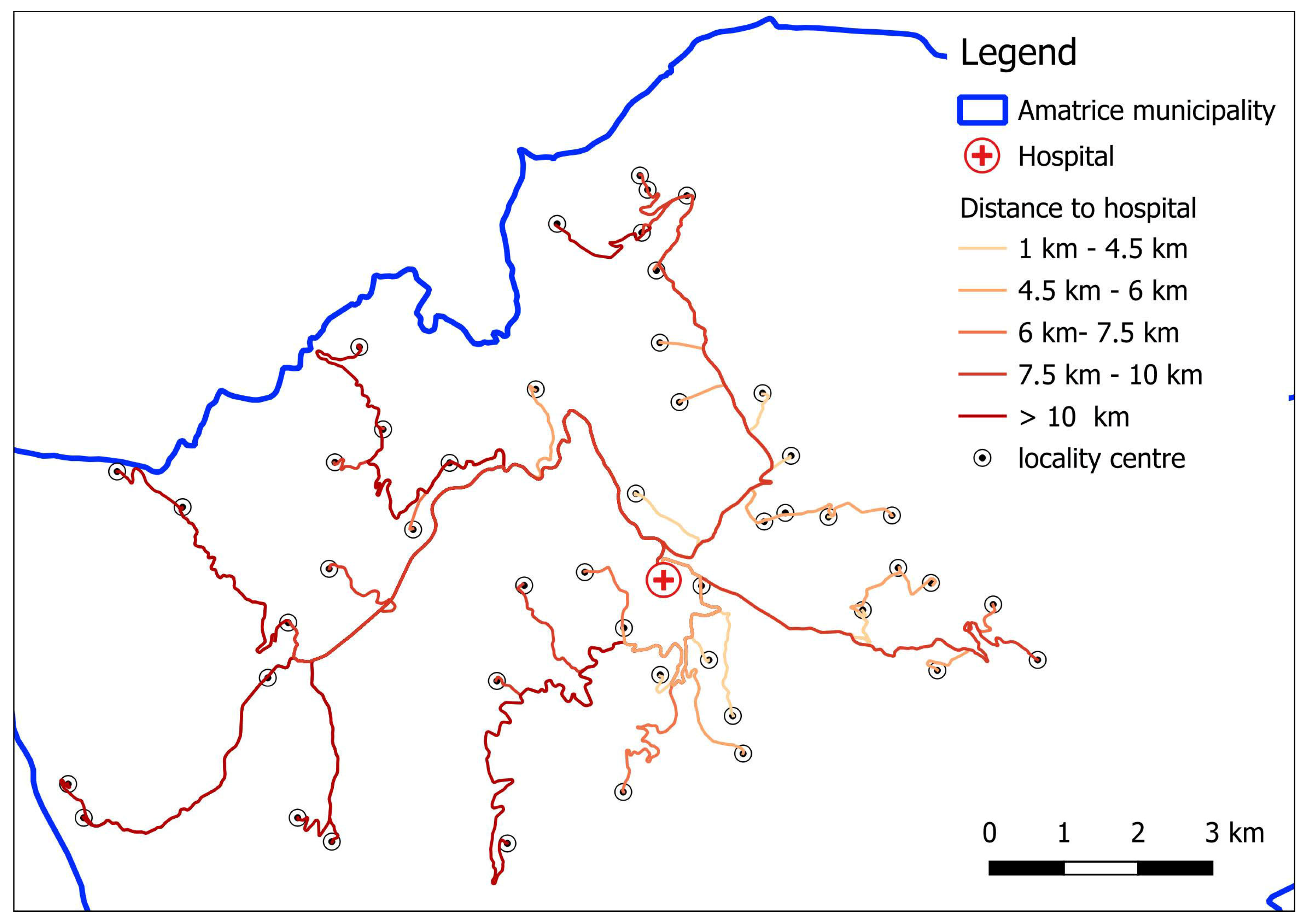
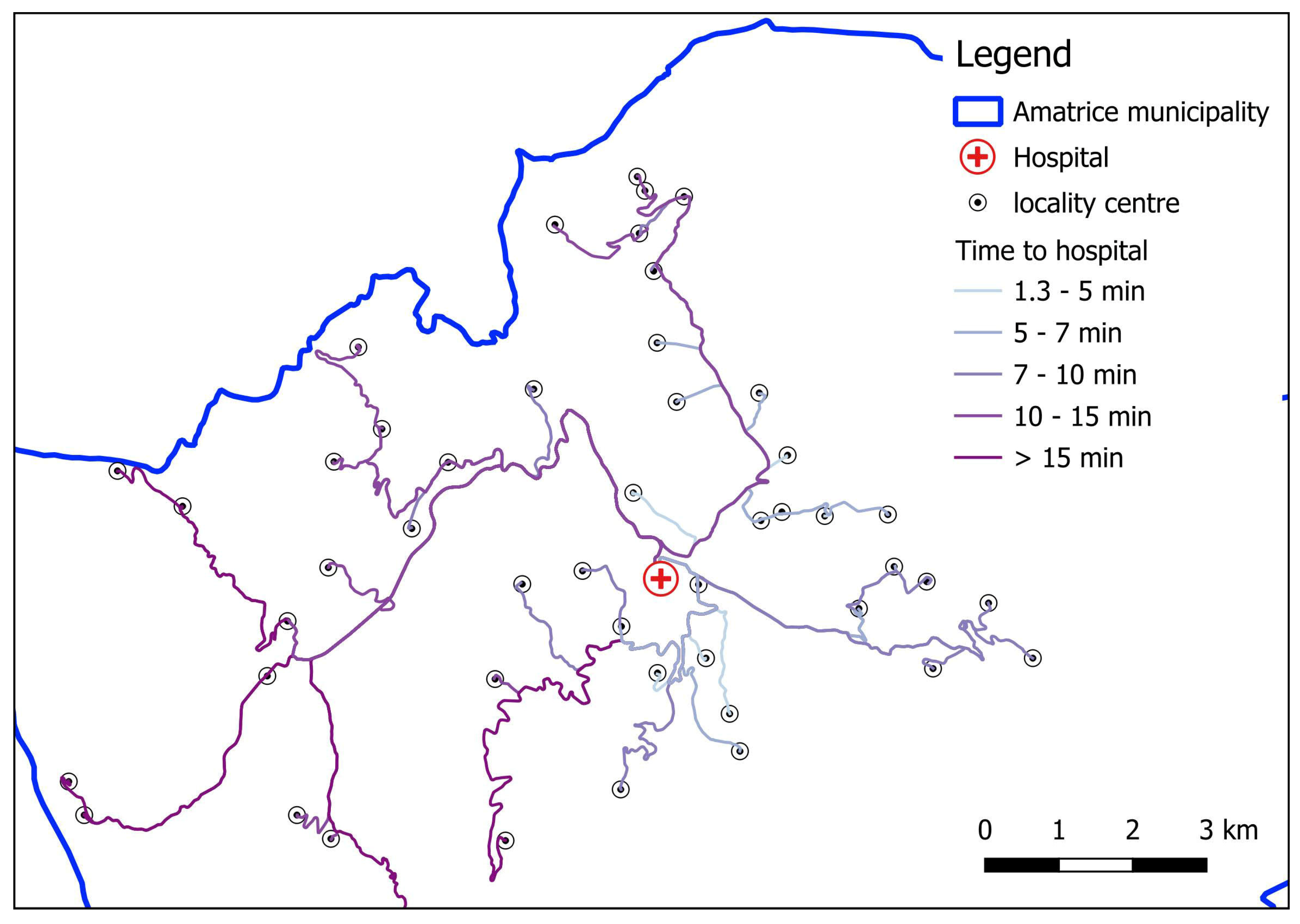
The aim of the analysis was to assess the accessibility of the hospital facility from the different localities within the study area. Specifically, optimal routes were computed in terms of both minimum distance and minimum travel time. The analysis was based on the road network, considering only roads accessible to motor vehicles; therefore, pedestrian paths and footways were excluded from the network. For the fastest-route option, a default average speed of 50 km/h was assumed. The starting points of the analysis were represented by the ISTAT localities, and in particular by their respective inaccessibility poles, defined as the points located within each urbanized area that are at the maximum distance from the boundary of the area. These points were identified using the QGIS algorithm “Pole of inaccessibility”; for further details regarding the calculation method, please refer to the technical documentation of the algorithm available at the following link:
https://docs.qgis.org/3.40/en/docs/user_manual/processing_algs/qgis/vectorgeometry.html#pole-of-inaccessibility (accessed on 13 December 2025).
In particular, the average distance required to reach the hospital is 7.5 km, with a minimum distance of 1 km for Amatrice and a maximum distance of 15 km for Roccapassa. More than half of the identified routes fall below the average value (27). With regard to travel time, the average time needed to reach the hospital facility is approximately 9 min. The minimum travel time is again observed for Amatrice, with a value of 1.5 min, whereas reaching the hospital from Roccapassa requires more than 17 min. The maps of travel to the hospital highlight a marked spatial heterogeneity in healthcare accessibility across the study area. Travel times range from less than 5 min for localities located near the municipal center of Amatrice to values exceeding 15 min for several peripheral settlements, indicating a highly uneven distribution of accessibility conditions. The shortest travel times are concentrated around Amatrice, confirming its role as the main service hub and central node of the local road network.
On the contrary, more remote and marginal localities, particularly those located in mountainous areas and along the outer boundaries of the municipality, experience longer travel times. In several cases, access to the hospital requires more than 10–15 min, revealing potential critical conditions, especially in emergency situations. These disparities are not solely related to distance, but are strongly influenced by the complex morphology of the territory and by the structure and connectivity of the road network, which result in tortuous routes and reduced travel efficiency. This spatial heterogeneity is a key input for emergency planning, because it helps identify where pre-positioning of resources, alternative routes, or temporary medical points could mitigate delays.
The final analysis for node characterization concerns buildings. As described in the methodology, the data refer to structural aggregates surveyed by the Italian Civil Protection. Overall, 4520 structural aggregates are recorded across the entire municipal territory, of which 3023 are located within built-up areas and inhabited settlements. On average, each locality consists of approximately 60 structural aggregates, with Amatrice being the locality with the highest number, accounting for about 380 aggregates. Six localities include fewer than 20 buildings, with Cornelle di Sotto recording the lowest value, with only 15 aggregates. The mean building density is 9 buildings per hectare. Casali di Sopra exhibits the highest density, with 19 buildings per hectare, while eight localities reach values higher than 15 buildings per hectare. The municipal capital, Amatrice, ranks among the lowest in terms of building density, with 6 buildings per hectare; however, these buildings have the largest mean footprint area, equal to 303 m2. Regarding land occupation, Forcelle shows the highest building coverage ratio, equal to 33%. Thirteen localities exceed a coverage ratio of 20%, whereas Ponte a Tre Occhi, Collemagrone, and Sant’Angelo remain below 10%.
Using census data provided by Istat, an additional characterization can be carried out with respect to dwelling units and their use. Overall, as reported in
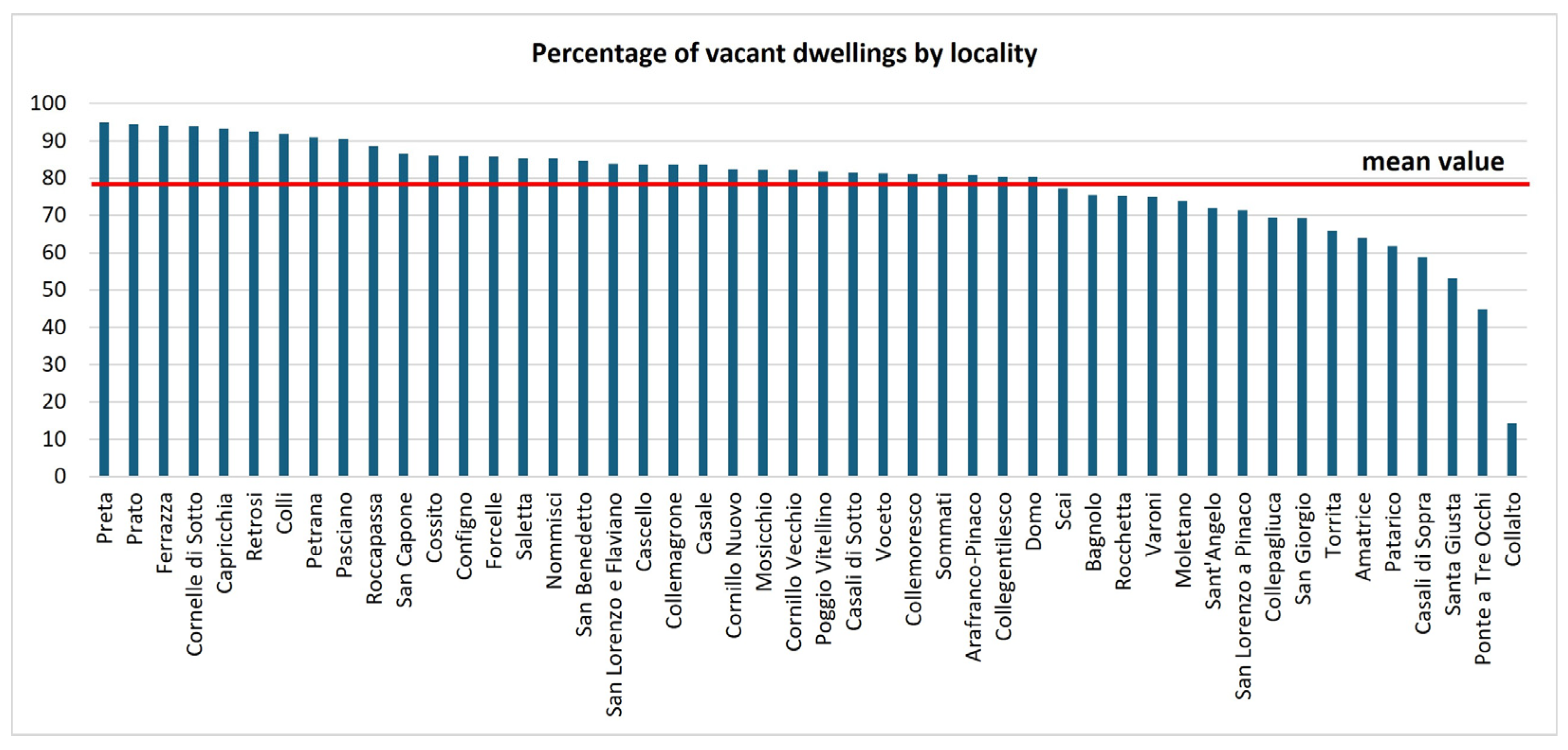
Table 7, the study area includes 5600 dwellings, of which 1198 are occupied by at least one usual resident, while the remaining 4402 are either vacant or occupied exclusively by non-residents. This distribution indicates that the analyzed municipality is predominantly characterized by second homes. Most dwellings are located within inhabited center and inhabited nuclei. Across the study area, vacant dwellings largely prevail over occupied ones (
Figure 7). In the majority of localities, the share of vacant dwellings exceeds 80%, highlighting a markedly low level of permanent residential occupancy. Particularly high vacancy rates are observed in Preta (95%), Cornelle di Sotto (94%), Ferrazza (94%), Prato (94%), and Retrosi (93%), where occupied dwellings represent only a marginal fraction of the housing stock.
Conversely, a limited number of localities exhibit comparatively lower vacancy rates, although vacant dwellings still constitute the majority of the housing stock. Collalto (14%), Ponte a Tre Occhi (45%), and Santa Giusta (53%) show the lowest percentages of vacant dwellings within the dataset, suggesting relatively higher levels of residential stability. Amatrice concentrates the highest absolute number of occupied dwellings (364). However, it still displays a substantial proportion of vacant units (64%), indicating that high vacancy levels are not confined to smaller hamlets but also characterize the main settlement.
5. Discussion
The study presented in this article represents a first step in the application of the experimental methodology introduced. This methodology is based on the conceptualization of the urban fabric as a system composed of a set of nodes, corresponding to urban areas interconnected through the infrastructure network. The initial step of the proposed approach consists of the characterization of nodes.
In this specific application, the municipality of Amatrice was selected as the case study. As shown in the results, its territorial configuration is characterized by a polycentric and highly fragmented distribution of settlements, combined with a complex yet discontinuous infrastructure network. The presence of main urban centers and smaller settlements heterogeneously distributed across the territory, and connected through a multi-level road hierarchy, suggests a network-based settlement model lacking a dominant central structure. The spatial distribution of settlements appears dispersed, while the road network is markedly fragmented and largely reliant on secondary roads. In such a context, functional connections between different poles are inherently fragile and vulnerable, particularly during emergency situations (e.g., extreme weather events or natural hazards), when access to services and the timeliness of interventions may be severely compromised.
The analyses further reveal a settlement system characterized by a marked underutilization of the housing stock. The high proportion of dwellings not permanently occupied indicates that stable residency represents a minority component, in favor of seasonal or discontinuous forms of use. This configuration is consistent with long-term processes such as demographic decline in Italian inner areas, the progressive loss of resident population, and the transformation of dwellings into a second home—phenomena that are typical of rural and mountainous contexts. This settlement structure also has relevant implications in terms of accessibility to essential services. It should be noted that the use of Euclidean buffers is a simplification, as it does not consider network-based distances or actual travel times. A more refined approach based on distance or travel time calculated along the road network would represent a methodological improvement, while maintaining the operational purpose of the analysis and reducing potential interpretative ambiguities.
The spatial distribution of the population, fragmented across numerous small-sized settlements, results in unequal access to collective infrastructures. In particular, despite the presence of a single hospital facility serving the entire municipal territory, a significant share of the population resides in locations characterized by limited accessibility, both in terms of distance and road connectivity. The data employed and the associated processing procedures enabled a detailed characterization of the selected study area. However, several limitations emerge, related both to the nature of the data sources and to the methodological choices adopted. Specifically, data concerning road infrastructure and POIs were derived from OSM and required a careful preliminary validation phase, addressing both the correct classification of infrastructures and the identification and completeness of POIs. With regard to the latter, the database does not necessarily include the full set of services actually present within the territory, potentially leading to underestimations.
Similarly, for the road network, an expert-based reclassification was required, as a substantial proportion of road segments were labelled as “unclassified” despite playing a relevant functional role in local mobility. For this reason, the data were subjected to a thematic correction process aimed at improving the functional representation of the network. Although this procedure is essential to ensure the reliability of the analysis, it entails a significant time burden. In the present case study, characterized by a relatively limited infrastructure network, this approach proved feasible; however, its systematic application in more extensive or densely infrastructured territorial contexts may be excessively demanding, requiring substantially greater temporal and operational resources.
The analysis was conducted by considering exclusively the road network accessible to motor vehicles, excluding pedestrian paths and footways. This choice was made to ensure consistency with a reference scenario focused on vehicular mobility, which represents the predominant mode of transport both for everyday travel and for emergency response operations in inner and rural contexts. The starting points of the analysis were identified in the ISTAT localities and, more specifically, in their respective inaccessibility poles, defined as the points within each urbanized area that are located at the maximum distance from its boundary. The decision to use the “Most Inaccessible Point” (QGIS algorithm) is linked to a worst-case approach. This setting allows accessibility conditions to be assessed from the potentially most disadvantaged position within each settlement, thus providing a cautious and comparable estimate across different nodes. Similarly, the decision to refer the accessibility analysis to the hospital rather than to local healthcare facilities is based on the same precautionary logic. In inner and rural contexts, such local facilities are often open only during daytime hours and do not guarantee nighttime service, whereas the hospital represents the only healthcare structure ensuring continuous availability. It is acknowledged that some of the adopted assumptions imply a simplification of the model. In particular, for the fastest-route option, a default average speed of 50 km/h was assumed, without explicitly modeling pedestrian paths, detailed road classes, curvature, or slope. This value does not represent actual travel speed; rather, it was selected as a cautious average proxy, capable of indirectly accounting for morphological constraints and road network characteristics. This conservative assumption was adopted in light of the frequent incompleteness or limited reliability of available data regarding road classification and actual road conditions.
With regard to data on dwelling use, such information is particularly relevant for territorial organization, especially in potential emergency scenarios. Nevertheless, the available data are exclusively tabular in nature: although they can be associated with individual census sections, no point-based georeferencing of housing units is available. This limitation prevents a detailed spatial representation of the phenomenon and constitutes a significant constraint for higher-resolution analyses and for the implementation of more advanced operational models. Furthermore, in the analyzed context, the seasonal population represents a quantitatively significant, if not predominant, component in most of the considered localities. Consequently, a more accurate characterization of the settlement system would require the availability of at least an estimated measure of population presence during peak seasons, in order to more realistically capture patterns of housing use and the effective pressures exerted on services and infrastructures.
The analysis of the building coverage ratio with respect to the total area provides a relevant indicator of the hydrological resilience of the territory, as soil infiltration capacity directly affects vulnerability to extreme weather events, such as flash floods. Another key analytical dimension concerns building and population density, which allows not only the intensity of urbanization to be defined but also the functional profile of the nodes to be identified, distinguishing between residential, industrial, administrative, or mixed-use areas. In the present case study, the nodes are predominantly residential in nature.
This type of analysis, which can be applied to other contexts, enables a better understanding of the relative weight of each node within the settlement network and allows for a more accurate estimation of infrastructure requirements, evacuation-related criticalities, and flow management under emergency conditions. Finally, the mapping of POIs, including healthcare facilities, schools, public offices, public transport nodes, technological networks, and strategic infrastructures, makes it possible to identify areas with higher functional intensity and to understand how population flows are distributed and concentrated over time and space. Such information is essential not only for targeted emergency planning but also for supporting ordinary territorial planning, with particular attention to territorial equity, accessibility, and safety.
The present study is affected by limitations typical of municipal-scale, open-data network analyses. First, OSM completeness and attribute quality (e.g., road categories, access restrictions) can vary spatially; second, impedance was modeled using a simplified travel-cost proxy rather than time-dependent speeds or congestion; third, accessibility indicators are static and do not capture temporary road closures, seasonal constraints, or behavioral responses during emergencies. These limitations do not invalidate the framework but should be considered when interpreting absolute values and comparing localities.
At this stage, providing a reliable estimate of the overall pipeline runtime or its scalability at larger territorial scales remains premature. This limitation is mainly related to the variability and heterogeneous quality of the underlying infrastructure data, which require substantial preprocessing, cleaning, and thematic harmonization before a stable and fully automated large-scale implementation can be achieved. The effort needed to ensure a consistent and reality-aligned road classification further affects the standardization of computational performance. These aspects have important implications for operational scalability and highlight that data validation and harmonization represent a critical step in the transition toward a structured DSS workflow.
Another important clarification concerns the nature of emergencies for which the data collected can be useful. The set of indicators adopted in this study (distance to the main road network, travel time, presence of POIs, and building stock characteristics) is intentionally general in scope. The objective is not to reproduce specific emergency scenarios, define hazard-dependent operational thresholds, or simulate network performance under particular disruptive events. Rather, the aim is to provide a structured and reproducible characterization of settlement nodes based on baseline territorial attributes. In this sense, the proposed indicators act as transversal descriptors of spatial configuration and infrastructural context, offering a common analytical framework upon which more specialized assessments can be developed. Within a future DSS perspective, these baseline metrics may be weighted, filtered, or integrated differently depending on the type of hazard considered (e.g., hydrogeological, wildfire, or seismic), thereby enabling the transition from a general territorial characterization to scenario-specific decision support.
It is important to emphasize that the analyses presented are primarily intended to demonstrate the operational potential of the approach, rather than to represent an already fully structured and automated information workflow. This aspect is closely related to the variability and heterogeneity of the available infrastructural data, whose reliability may be uneven across space and time. In particular, the development of a truly scalable system requires substantial preliminary work in terms of data cleaning, harmonization, and validation, as well as a thematic classification of infrastructures consistent with the actual conditions of the network. This process constitutes a crucial step toward the definition of a stable, standardized, and fully reproducible information pipeline within the framework of a future decision-support system.
6. Conclusions
This article represents a first application of the proposed methodology and constitutes an exploratory phase of its implementation. The objective is not to provide a definitive or exhaustive model, but rather to test the underlying theoretical framework through an initial experimentation aimed at verifying its coherence, replicability, and operational potential. In this preliminary stage, the methodology is applied to demonstrate concretely what types of information can be systematically collected and how an urban center can be characterized in terms of accessibility and its role within the territorial system.
The presented application, although still under development and subject to further validation, represents a preliminary yet meaningful step toward improving the understanding of vulnerability and resilience in territories characterized by dispersed settlements [
37,
38]. Using only openly available geodata and standard GIS tools, the methods produces a set of indicators that can support both long-term territorial planning (e.g., prioritizing infrastructural upgrades) and short-term emergency preparedness (e.g., identifying potentially isolated hamlets and estimating service reachability). Its modular design allows deployment at different spatial scales and facilitates integration with demographic, building, and multi-hazard layers.
In such territorial settings, the analytical framework must contend with a high degree of complexity, particularly with respect to the availability and suitability of data capable of representing the specific characteristics of individual localities [
39]. As demonstrated by the case study, settlement patterns are rarely homogeneous from either a functional or structural perspective. Instead, they consist of a constellation of spatially dispersed residential units that, while sharing similar infrastructural and service needs, lack a clear hierarchical organization [
3,
40]. This configuration entails high costs for routine territorial management [
41,
42,
43,
44,
45] and poses even greater challenges in emergency response scenarios [
46]. A further level of analysis could be achieved by incorporating mobility flow data, enabling a more accurate assessment of node centrality and relative importance within the network. One of the most critical issues concerns the potential impact of the loss of an infrastructural node following an emergency event, such as a landslide, flood, or earthquake. When a highly connected node is disrupted, cascading effects may propagate across the entire network, severely impairing the system’s response capacity. For this reason, evaluating the ability of the territorial system to reorganize under crisis conditions is essential to ensure timely and effective interventions [
47,
48,
49]. Addressing this challenge requires advanced analytical tools capable of simulating emergency scenarios and optimizing the allocation and deployment of available resources [
50,
51,
52]. Future developments of the proposed approach may include the integration of artificial intelligence algorithms or optimization models aimed at identifying the most efficient routes to reach affected areas, thereby reducing reliance on ad hoc interventions driven solely by emergency calls. Once damaged or compromised infrastructures are identified, the system could also estimate the number of people potentially involved, supporting more targeted, informed, and proactive response strategies.
Taken together, the results highlight the need for integrated territorial planning and mobility policies that explicitly account for both settlement dispersion and the pronounced seasonality of residential presence. Targeted interventions aimed at improving connectivity between residential clusters and major service hubs, together with flexible strategies for healthcare service provision in rural and mountainous areas, emerge as key elements for reducing inequalities in access and strengthening the overall resilience of the territorial system.
A further research direction aligned with decision support system development concerns the creation of an interactive platform capable of integrating territorial, demographic, and infrastructural data within a unified knowledge environment for emergency prevention and management. Such a platform would go beyond simple data visualization and storage, enabling the identification of node-specific risk conditions and offering a comprehensive view of settlement vulnerabilities and their functional interdependencies. The added value of this type of system lies in its ability to support complex decision-making processes, including the updating of civil protection plans, the prioritization of interventions, the design of risk mitigation strategies, and the orientation of territorial planning toward a resilience-based approach.