1. Introduction
The intersection of nutritional health and cognitive development represents one of the most critical challenges in modern pediatric education [
1]. According to the World Health Organization, the “double burden of malnutrition”, defined as the coexistence of undernutrition and micronutrient deficiencies along with overweight and obesity, is prevalent in developing economies across Latin America [
2]. In Ecuador, this phenomenon presents a unique pedagogical challenge: students often face high caloric density paired with nutritional poverty, directly affecting executive functions such as attention, memory, and academic performance [
3,
4].
Traditionally, health education has relied on what pedagogical theorists call the “Information Deficit Model” [
5]. This model assumes that simply providing information about healthy habits leads to behavioral change. However, as noted by [
6] in the context of Human-Computer Interaction (HCI), there exists a profound “Action Gap” (or intention-behavior gap). As Catellani and Carfora [
7] note, while students cognitively understand the benefits of healthy eating, often motivated by the desire for better academic results, environmental latency and lack of immediate reinforcement prevent the translation of this intent into habit.
The emergence of the Internet of Things (IoT) and ubiquitous mobile computing offers a novel pathway to bridge the previously described gap [
8,
9]. Unlike static educational interventions, IoT ecosystems can provide real-time feedback loops [
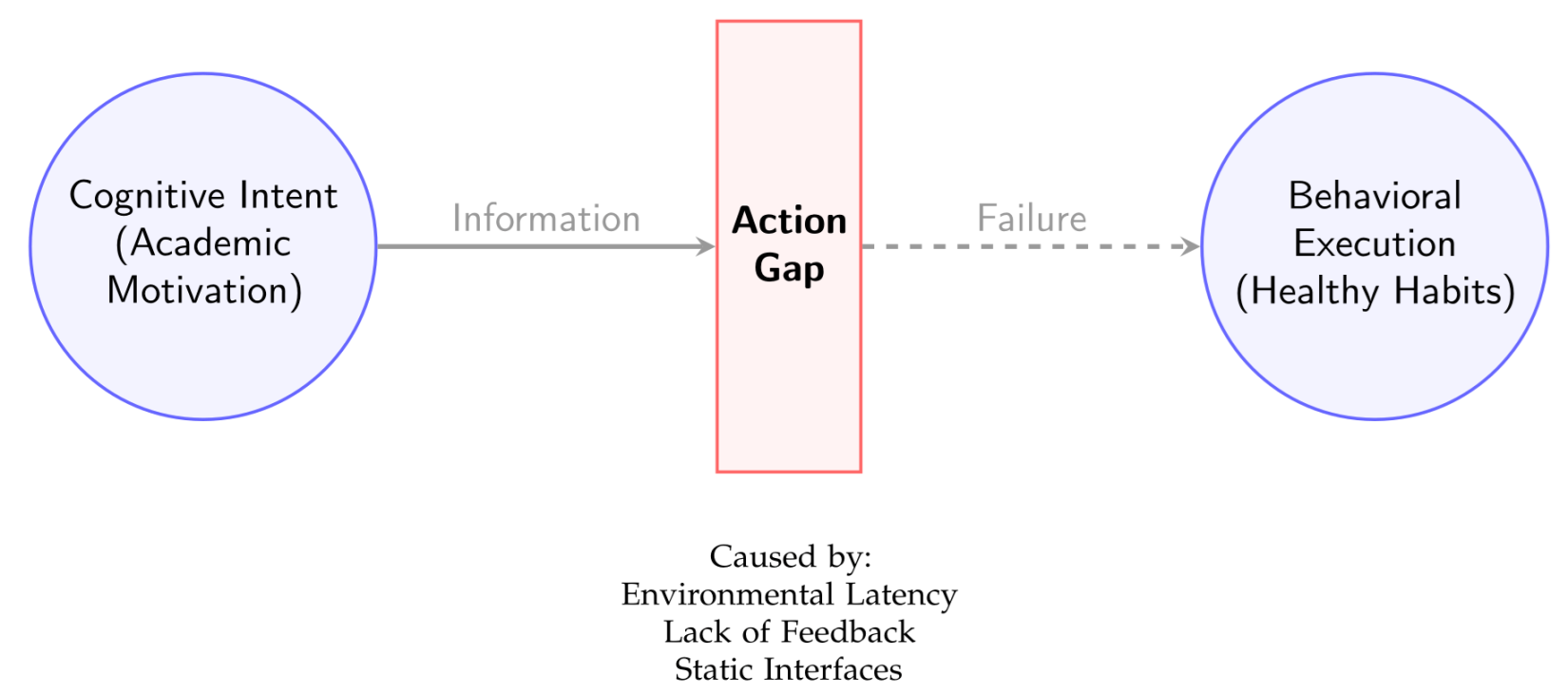
10]. This study suggests that part of the disconnect may be explained by limitations in how behavioral feedback is currently mediated through digital interfaces. As illustrated in
Figure 1, a structural barrier exists where environmental factors intercept cognitive intent before it can manifest as behavioral execution. We propose that by modeling this “Nutritional-Academic Dissonance” through data-driven profiling, we can design Gamified Interventions that do not merely inform, but actively scaffold behavioral change. Consequently, this paper introduces the “Digital Bridge Architecture,” a framework designed to transform abstract motivation into tangible health outcomes using Alternate Reality Game (ARG) logic.
Considering the structural limitations of the Information Deficit Model, the objective of this work is to characterize user requirements for an adaptive gamified system by quantifying the dissonance between nutritional knowledge and behavior. Consequently, this work establishes the hypothesis () that the target population exhibits high cognitive intent (academic ambition) yet low behavioral execution due to absent immediate feedback mechanisms. Based on this premise, we pose the following research question: to what extent can integrating academic motivation into an IoT-mediated feedback loop mitigate this ’Action Gap’ in school-aged children?
Traditional frameworks, such as the passive self-monitoring systems reviewed by [
11] or the generic points-based gamification criticized by [
12], typically address nutritional tracking and student motivation as separate domains. Unlike these isolated approaches, this study provides two distinct contributions: (1) a quantitative model of the “Nutritional-Academic Dissonance” based on empirical profiling, and (2) the architectural definition of a feedback loop that utilizes academic motivation as a direct trigger for health behaviors. Finally, we emphasize that this manuscript contributes a profiling-driven design rationale and an architectural proposal; it does not claim clinical efficacy of a deployed IoT system. Implementation feasibility is addressed through a tiered comparison of high-tech and low-tech options suited to resource-constrained school environments (
Section 5).
Gamification and Alternate Reality Games: Conceptual Distinction
Although the terms “gamification” and “Alternate Reality Game (ARG)” are sometimes used interchangeably in educational technology discourse, they refer to conceptually distinct design paradigms. Gamification, in its classical formulation, involves the incorporation of game elements (e.g., points, badges, leaderboards) into non-game contexts to increase engagement and motivation [
12]. Meta-analytic evidence suggests that while gamification can enhance short-term intrinsic motivation and perceived autonomy, its impact on sustained behavioral change is often modest when not embedded in deeper structural mechanisms [
13]. As critical reviews have noted, “shallow” implementations fail to modify the underlying decision environment and therefore struggle to address persistent behavioral gaps [
12].
In contrast, Alternate Reality Games (ARGs) extend beyond the addition of discrete game mechanics and instead construct a persistent narrative layer that overlays real-world actions with meaningful fictional consequences. Rather than rewarding isolated behaviors, ARGs embed user actions within a coherent story world, where decisions produce immediate and semantically integrated outcomes. This narrative integration aligns with persuasive design principles and behavior-trigger models [
14], as well as with contemporary research on gameful interventions that emphasize systemic interaction rather than point-based reward structures [
6]. Furthermore, ARG-based systems frequently leverage dynamic representations of user states, conceptually aligned with Digital Twin architectures in healthcare and behavior monitoring [
15]. By translating real-world data into narrative consequences within a virtual environment, these systems create a feedback loop that reduces cognitive abstraction and enhances perceived agency, an issue identified as central in digital therapeutic adherence research [
16,
17].
The Digital Bridge Architecture proposed in this study aligns more closely with the ARG paradigm than with traditional gamification. Instead of assigning abstract points for healthy choices, the system modifies the state of a digital twin avatar in real time, translating dietary decisions into narrative consequences (e.g., stamina changes, cognitive performance within the game environment). This distinction is critical for understanding the theoretical foundation of the intervention: the objective is not merely to increase engagement, but to restructure the feedback loop between intention and execution.
It is important to clarify that this study evaluates the empirical profiling and behavioral dissonance model that informs the Digital Bridge Architecture, rather than testing a deployed technological system. The architectural proposal is therefore evidence-informed but not experimentally validated in this manuscript. A longitudinal system evaluation constitutes a planned next phase of research.
The remainder of this paper is structured to provide a comprehensive analysis of this phenomenon.
Section 2 establishes the theoretical framework, integrating nutritional neurobiology with the Fogg Behavior Model and Persuasive Systems Design to characterize the behavioral barriers.
Section 3 details the methodological approach, describing the gamified data collection instruments and the stratified sampling strategy used for user profiling.
Section 4 presents the quantitative findings, empirically validating the “Nutritional-Academic Dissonance” through hypothesis testing and cluster analysis. Finally,
Section 5 proposes the “Digital Bridge Architecture” as a mechanism of “Prosthetic Willpower” to resolve this dissonance, followed by the concluding remarks in
Section 6.
2. Theoretical Framework
To scientifically ground the proposed “Digital Bridge Architecture,” this study draws upon recent findings in Nutritional Neuroscience, Behavioral Economics, and the emerging field of Digital Twins in healthcare.
2.1. Neurobiology of Ultra-Processed Foods and Academic Performance
While early literature focused on general caloric intake, recent evidence highlights the specific neurotoxicity of Ultra-Processed Foods (UPFs). A 2025 study by [
18] on adolescent populations identified a significant dose-response association between UPF consumption and lowered academic performance in mathematics and language. This is attributed to the inflammatory response in the hippocampus and prefrontal cortex caused by additive-rich diets, which impairs executive functions and working memory [
19]. Unlike occasional dietary lapses, chronic consumption of UPFs creates a systemic cognitive fog that directly counteracts pedagogical efforts.
As ref. [
20] describe, the “Nutritional-Academic Dissonance” is not merely a behavioral issue but a neurobiological hazard. Students striving for academic success are fueling their brains with substrates that biologically inhibit the cognitive processes required to achieve it [
21]. This biological paradox suggests that educational interventions focusing solely on “willpower” are destined to fail, as they do not account for the physiological downregulation of cognitive control mechanisms induced by the diet itself.
2.2. Gamification and the Fogg Behavior Model (FBM)
To address this behavioral deadlock, we employ the Fogg Behavior Model (
) [
14], interpreted through the lens of recent mHealth efficacy reviews. As noted by [
13], gamified interventions that fail to align with the user’s intrinsic motivation, specifically the psychological needs of autonomy and competence defined by Self-Determination Theory, suffer from high abandonment rates. Merely adding points or badges (known as “shallow gamification”) fails to sustain long-term engagement because it does not alter the underlying context of the behavior.
Recent research in adaptive educational systems further supports this distinction between superficial gamification and structurally integrated persuasive design. In a study published in Computers, Zourmpakis et al. demonstrated that adaptive gamified architectures grounded in behavioral modeling outperform static point-based systems in sustaining user engagement and cognitive alignment [
22]. Their findings reinforce the necessity of embedding feedback mechanisms within a coherent computational framework rather than layering extrinsic rewards onto existing processes.
In our target demographic, Motivation (
M) is notably high due to academic ambition, but Ability (
A) is constrained by the obesogenic environment. The “Digital Bridge” serves as the missing Trigger (
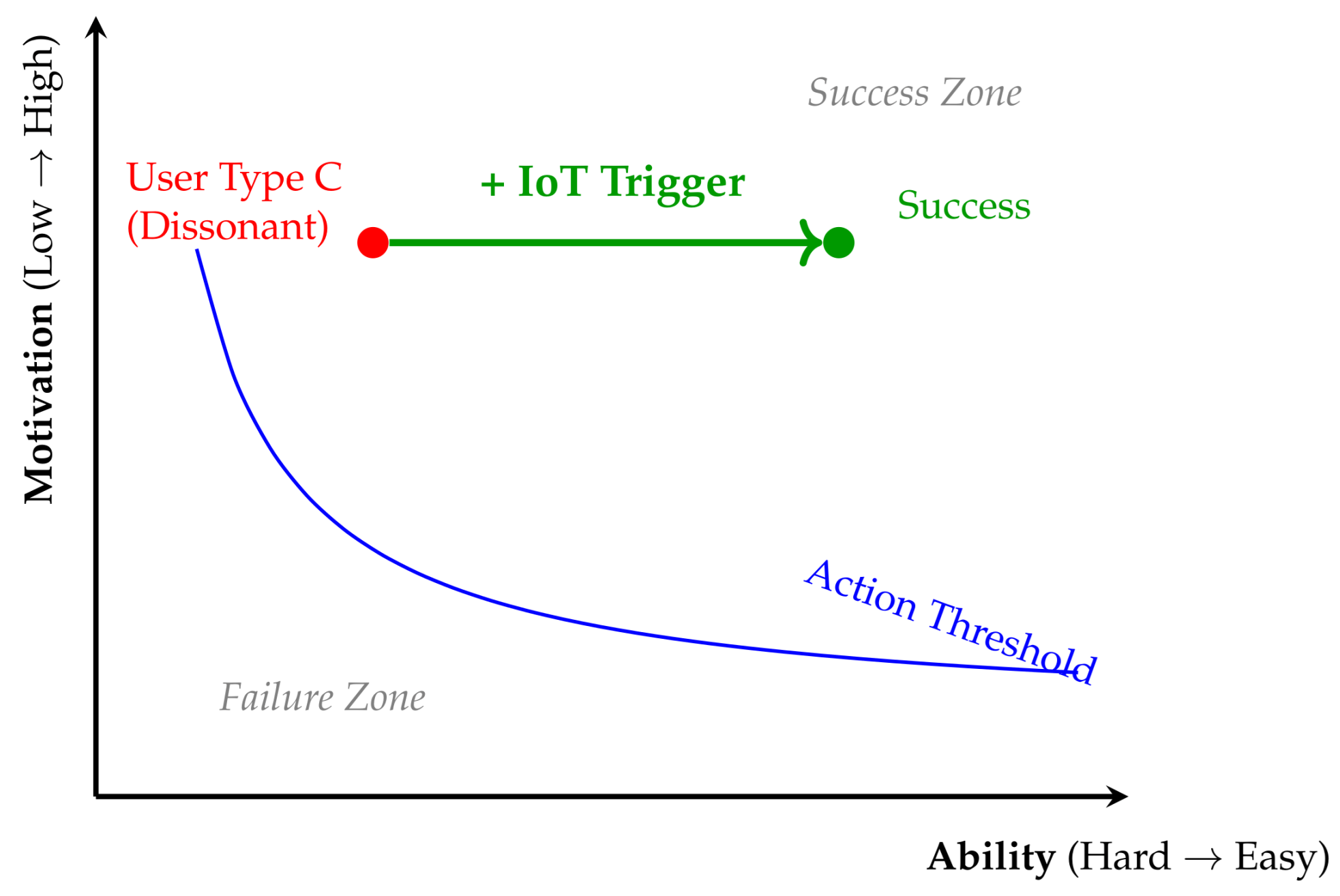
T). However, unlike simple notifications, we utilize “Context-Aware Triggers” that fire only when the IoT layer detects specific user states. As illustrated in
Figure 2, the intervention does not attempt to artificially inflate motivation; instead, it reduces the activation barrier. The figure depicts the trajectory of a “Type C” user moving from the failure zone to the success zone, not by willpower, but by the introduction of an IoT trigger that bridges the gap between intent and action.
2.3. IoT and Digital Twins as Persuasive Systems
Moving beyond standard “self-monitoring,” this architecture implements a “Digital Twin” strategy. As defined in the recent meta-review by [
15], a Health Digital Twin (HDT) creates a dynamic virtual representation of the user that reacts to real-world data. In traditional health apps, data is presented as static charts, which requires high cognitive effort to interpret. In contrast, an HDT processes this data to modify the state of a virtual avatar, creating a direct semantic link between physical action and digital consequence.
Similarly, subsequent work by Zourmpakis et al. expanded this perspective by proposing an integrated digital feedback architecture capable of dynamically adjusting intervention intensity based on user profiling metrics [
23]. This approach aligns closely with the Digital Bridge Architecture proposed in the present study, particularly in its emphasis on real-time adaptation, behavioral state modeling, and systemic reinforcement rather than isolated motivational cues.
By visualizing the student’s diet effects on a game avatar (the Twin), we leverage the “Proteus Effect,” where users modify their physical behavior to match their virtual expectations. This aligns with Persuasive Systems Design (PSD) principles tailored for IoT:
3. Materials and Methods
This study employs a quantitative, cross-sectional research design aimed at profiling the behavioral and motivational characteristics of primary education students. The methodological framework was designed to isolate and quantify the “Nutrition–Academic Dissonance” by correlating cognitive intent (academic motivation) with behavioral execution (dietary habits). Unlike traditional self-reports that suffer from recall bias, this study leveraged a gamified data collection interface to enhance user engagement and improve response quality.
3.1. Participants and Context
The study population consisted of students () enrolled in public educational institutions in the Guayas province, Ecuador. The sample was selected using a stratified random sampling technique to ensure representation across gender and academic performance levels. The inclusion criteria were: (1) students aged 10–14 years; (2) active enrollment in the 2024–2025 academic period; and (3) informed consent signed by parents or legal guardians. Students with diagnosed metabolic disorders requiring specialized clinical diets were excluded to reduce confounding factors.
Environmental latency (
L) was conceptualized as perceived environmental friction in food access. Students rated the perceived effort required to access healthy options using a Likert-scale instrument integrated into the survey module. Although objective cafeteria mapping was not performed, perceived environmental friction has been shown to correlate with execution behavior in adolescent populations [
24]. This perceptual operationalization enabled consistent measurement across participants while preserving ecological validity within the natural school setting.
As detailed in
Table 1, the final sample presents a balanced gender distribution (48.3% male, 51.7% female), with the largest age cohort in the 12–13 year range (45.8%). Baseline anthropometric data indicate that 43.3% of the sample is classified as overweight or obese, which is consistent with the “double burden of malnutrition” reported in the region.
3.2. Data Collection Instruments
To reconstruct the “Action Gap”, we used three digitized psychometric and behavioral instruments administered via tablet devices. Data were collected using tablet devices running Android OS (Google LLC, Mountain View, CA, USA;
https://www.android.com), provided by the participating schools.
For behavioral assessment, we deployed a Gamified Food Frequency Questionnaire (G-FFQ). While traditional FFQs are prone to user fatigue, validation studies show that digital, visual-based questionnaires improve reporting accuracy in pediatric populations regarding ultra-processed foods (UPFs) [
25]. Our instrument implemented a drag-and-drop interaction in which students placed food items into a virtual “weekly plate”, capturing intake frequency of neuro-protective foods versus high-glycemic options over a 30-day recall period.
Operationalization of Behavioral Execution (E)
UPF consumption was quantified using a frequency-based index derived from the G-FFQ. Each UPF category (e.g., sugar-sweetened beverages, packaged snacks, confectionery, fried fast foods) was rated on a 5-point ordinal frequency scale (0 = never, 4 = daily). A composite UPF index was computed as the arithmetic mean across UPF categories for each participant.
To align the metric with the conceptual definition of behavioral execution as “healthy performance”, the UPF index was inverted and normalized to a 0–100 scale as follows:
where
denotes the participant-level composite UPF index. Higher values of
E indicate lower UPF consumption and healthier dietary execution.
For motivation, we employed an adapted version of the Academic Motivation Scale (AMS) tailored to nutritional behavior and academic engagement. Following school-based intervention guidelines [
26], the instrument emphasized the “instrumental value” students assign to healthy habits for academic functioning (e.g., “I eat well to stay awake in class”).
3.3. Methodological Procedure
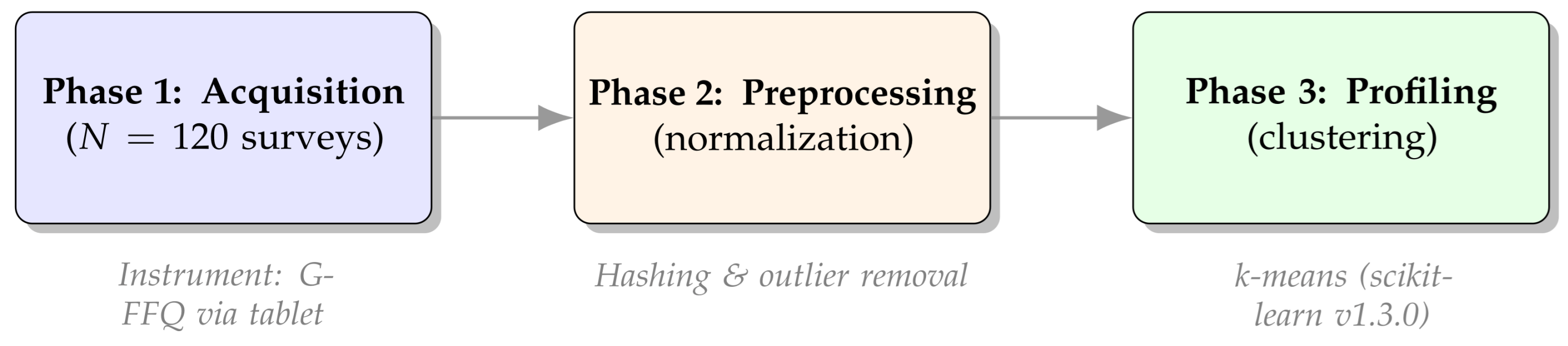
The data collection process followed a three-stage pipeline to ensure data integrity and ethical compliance (
Figure 3). Phase 1 (Acquisition) consisted of supervised in-class digital administration. Phase 2 (Preprocessing) used Python scripts to remove inattentive responses (completion time
s) and to normalize scale scores to a 0–100 range. Data processing was performed in Python v3.10 (Python Software Foundation, Wilmington, DE, USA,
https://www.python.org).
Regarding ethical considerations, the protocol adhered to the Declaration of Helsinki. Personal identifiers were hashed (SHA-256) immediately upon submission. Informed consent was obtained from legal guardians and student assent was collected in-app prior to participation.
3.4. Measurement Instruments
3.4.1. Motivation Scale and Psychometric Validation
Motivation (M) was measured using an adapted version of the Academic Motivation Scale tailored to the context of nutritional behavior and academic engagement. The instrument consisted of six Likert-type items (1 = strongly disagree to 5 = strongly agree) assessing intrinsic interest in healthy habits, perceived academic relevance, and self-determined behavioral intention. The adaptation preserved the theoretical structure of the original construct while contextualizing item phrasing to dietary decision-making.
Internal consistency of the adapted scale was assessed using Cronbach’s alpha. The scale yielded , indicating good internal reliability within the present sample.
To examine dimensional structure, an exploratory factor analysis (principal axis factoring with varimax rotation) was conducted. The Kaiser–Meyer–Olkin (KMO) measure of sampling adequacy was 0.811, supporting the suitability of the data for factor analysis. A single-factor solution was retained based on eigenvalues and scree inspection, explaining 52.6% of total variance. Factor loadings ranged from 0.61 to 0.79, confirming a coherent unidimensional structure aligned with the theoretical construct of motivation.
These psychometric results support the internal consistency and structural validity of the Motivation variable used in subsequent correlation and clustering analyses.
3.4.2. Environmental Latency Scale
Environmental Latency (L) was measured using a three-item Likert-scale instrument assessing (1) perceived effort required to access healthy options, (2) perceived time delay compared to ultra-processed alternatives, and (3) perceived availability of healthy foods in the school environment. Responses ranged from 1 (very low friction) to 5 (very high friction).
Internal consistency analysis yielded Cronbach’s , indicating acceptable reliability. The composite latency score was calculated as the arithmetic mean of the three items.
3.5. Data Processing and Analysis
The primary analytical procedure consisted of computing the dissonance index and identifying latent behavioral clusters. This perceptual operationalization enabled consistent measurement across participants while preserving ecological validity within the natural school setting. The primary analytical task consisted of computing the dissonance index and identifying behavioral clusters.
Table 2 provides the operational definitions for the key metrics used in the study. We defined the variable
D (Dissonance) as the scalar difference between the normalized Motivation Score (
) and the Behavioral Execution Score (
):
To segment the population, we applied unsupervised machine learning techniques. Specifically, we used the k-means clustering algorithm (
), implemented in scikit-learn v1.3.0 (Inria, Paris, France;
https://scikit-learn.org), a method recently validated by [
27] for identifying behavioral profiles in adolescents based on screen time and academic performance. The choice of
was determined using the Elbow Method, allowing us to categorize users into distinct profiles based on their position in the Intent–Execution matrix, separating those with coherent behaviors from those exhibiting the “Action Gap.”
4. Results
The analysis of the data collected from the 120 participants reveals a statistically significant structural disconnect between health knowledge/motivation and daily dietary practices. This section details the quantitative findings that characterize the “Nutritional-Academic Dissonance,” validating the hypothesis that cognitive intent is insufficient to drive behavioral execution without technological mediation.
4.1. Descriptive Statistics: The Divergence of Means
The aggregate analysis of the sample reveals a polarized distribution of competencies, distinguishing clearly between theoretical understanding and practical application.
Table 3 presents the descriptive statistics for the three core variables normalized to a 0–100 scale. The data indicates that the sample population possesses a high level of theoretical knowledge regarding nutrition (
) and high academic motivation linked to health (
). However, the Behavioral Execution score is remarkably lower (
).
Crucially, the Kurtosis value for Behavioral Execution (−0.82) suggests a platykurtic distribution. This indicates that poor dietary habits are widespread and consistent across the sample, rather than being limited to a few outliers. This discrepancy suggests that the educational system has succeeded in transferring information (Knowledge) but has failed in facilitating the application of that information (Execution). These findings are consistent with the extensive umbrella review published in *The BMJ* by [
19], which synthesized evidence from 45 meta-analyses (
million) and confirmed that exposure to ultra-processed foods (UPF) is the dominant environmental factor undermining metabolic health, often overriding individual knowledge.
4.2. Hypothesis Testing: Validating the Dissonance
To statistically confirm the existence of the “Action Gap,” we performed a Paired Samples t-test comparing the Motivation Score (M) and the Execution Score (E) for each student within the sample. The null hypothesis () posited that there is no significant difference between a student’s intent to be healthy and their actual behavior (). The results reject the null hypothesis with high confidence ().
The mean difference, which we operationalize as the Dissonance Index (
D), was
points. This magnitude of difference (
) indicates a very large effect size. These results indicate that the observed gap is unlikely to be attributable solely to random variation, suggesting the presence of a systematic disconnect between intent and execution. This quantitative finding empirically supports the observations of [
28] in the EHDLA study, who demonstrated that even among adolescents with adequate health literacy, high consumption of UPFs remained significantly associated with lower academic performance, suggesting an environmental decoupling of intent and result.
4.3. Cluster Analysis: Identification of User Archetypes
Beyond aggregate means, it is essential to segment the population to identify specific intervention targets. Using K-Means clustering (
) on the Intent vs. Execution axes, we mapped the distribution of the student population.
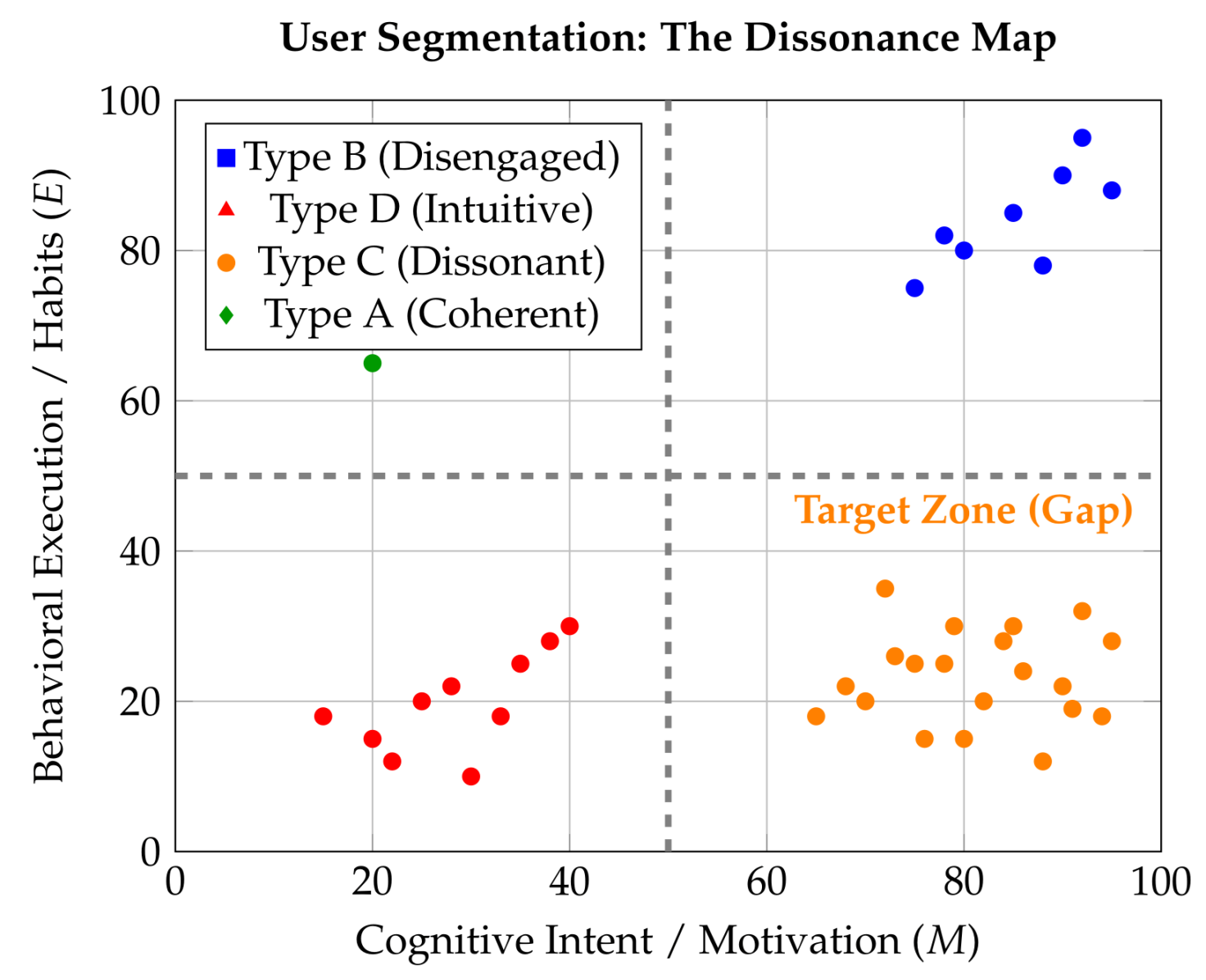
Figure 4 visualizes these clusters, plotting each student’s position relative to the ideal “success zone.” As illustrated, the clusters are defined not just by proximity but by behavioral logic:
Type A (Coherent/Ideal—15.0%): Students with High Intent and High Execution.
Type B (Disengaged—12.5%): Low Intent, Low Execution.
Type C (Dissonant—53.3%): This is the primary finding of the study. Visible in the bottom-right quadrant of the figure, this majority group has high academic motivation but fails to eat well.
Type D (Intuitive—19.2%): Low Intent, High Execution (likely parental control).
The prevalence of the “Type C” profile confirms the need for an intervention that does not “teach” (since they already know) but “triggers.” The scatter plot visualizes how the majority of the population is trapped below the execution threshold despite being high on the motivational axis, characterizing the specific “Nutritional-Academic Dissonance” we aim to solve.
Cluster Validation
To justify the selection of , cluster stability and internal validity were assessed using two complementary diagnostic criteria: the Within-Cluster Sum of Squares (WCSS) and the Silhouette Coefficient.
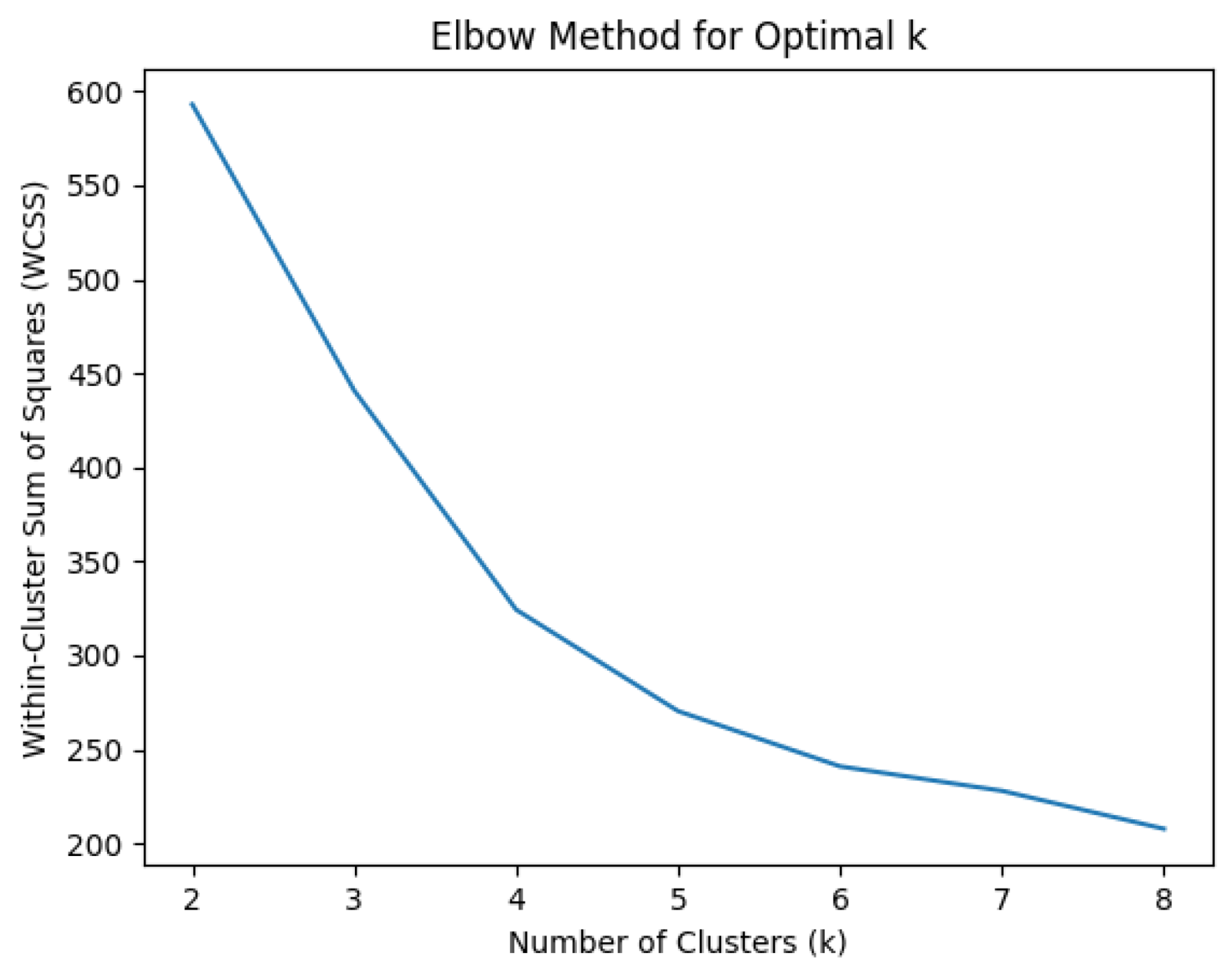
Figure 5 presents the Elbow Method results for
. The curve shows a substantial reduction in WCSS from
to
, after which the marginal decrease becomes progressively smaller. This visible inflection suggests diminishing explanatory gains beyond four clusters, indicating that additional clusters would increase model complexity without proportionate improvement in within-cluster compactness.
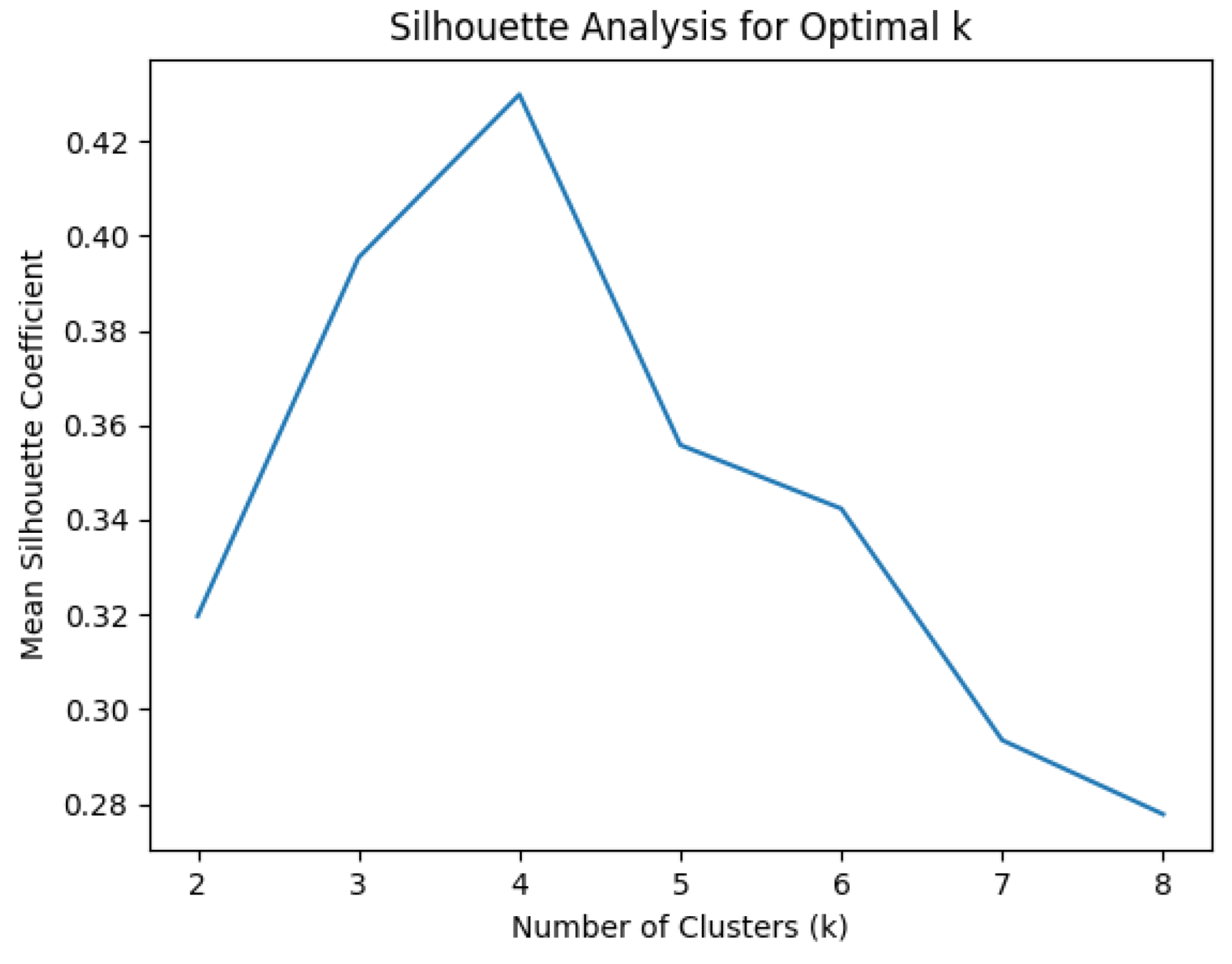
Figure 6 reports the mean silhouette coefficient across the same range of
k values. The silhouette score reaches its maximum at
(Silhouette = 0.43), indicating a moderate level of cluster separation and internal cohesion. While values above 0.5 are typically interpreted as strong separation, scores between 0.4 and 0.5 are considered indicative of meaningful but partially overlapping structures, which is consistent with behavioral datasets characterized by gradual profile transitions.
The convergence of both criteria supports the adequacy of the four-cluster solution, providing empirical justification for the selected segmentation while acknowledging the expected continuity between behavioral archetypes.
To reduce sampling bias and enhance robustness, clustering was conducted on z-score standardized numeric variables to mitigate scale heterogeneity effects across features. The K-means algorithm was executed with multiple random initializations (
) to reduce sensitivity to centroid seeding and avoid convergence to suboptimal local minima. The stability of cluster assignments and consistency of internal validation metrics were verified across runs. These procedures align with established methodological recommendations in partition-based clustering and unsupervised learning [
29,
30].
5. Discussion
Importantly, no behavioral efficacy claims are made regarding the Digital Bridge Architecture in the present study. The framework is derived from empirical profiling and theoretical integration, and its effectiveness requires longitudinal experimental validation.
The empirical findings of this study challenge the foundational assumption of current health education curricula: the belief that information transfer equates to behavioral change. The weak and non-significant correlation (
) found between nutrition knowledge and behavior execution confirms that the findings raise questions about the sufficiency of the Information Deficit Model when applied to digitally saturated food environments in the context of modern obesogenic environment. This disconnect mirrors the phenomenon described in the recent review by [
31,
32], who argue that in environments saturated with ultra-processed stimuli, cognitive control is systematically overwhelmed by environmental cues, rendering traditional health literacy insufficient.
5.1. Deconstructing the Dissonance: The Failure of Willpower
The prevalence of the “Type C” profile, comprising 53.3% of the population, indicates a phenomenon we term Environmental Overwhelming. These students possess high “Cognitive Intent”—driven significantly by the desire for academic performance—but fail to execute this intent. In the context of the Fogg Behavior Model (), our results suggest that while Motivation (M) is sufficient, the Environment acts as a friction multiplier that drastically reduces Ability (A).
As illustrated in our results, the “Action Gap” is not a failure of character but a failure of interface design in the physical world. The school kiosk offers high-sugar options with zero latency (immediate gratification), while healthy options often require planning, cost, or delay. This creates a “hostile choice architecture” where the default behavior is unhealthy. Therefore, interventions that focus solely on education (increasing Motivation) are destined to fail because they do not address the high activation energy required to overcome the environmental friction [
24].
5.2. The Digital Bridge as a Prosthetic Willpower
To counter this environmental hostility, the “Digital Bridge Architecture” proposed in this study functions as a form of “Prosthetic Willpower.” By integrating IoT sensors with an ARG narrative, the system provides the missing component identified in our theoretical framework: the Context-Aware Trigger. Unlike standard health apps (e.g., trackers, calorie counters) which rely on long-term health goals—concepts that are abstract and distant to a child, our architecture links dietary choices to immediate game consequences.
Importantly, the architectural decisions were not defined a priori but were directly informed by the empirical findings of this study. The identification of a dominant “Type C” cluster (53.3%), students with high motivation but low execution, indicated that increasing informational content would be redundant. Therefore, the system does not prioritize knowledge transmission modules. Instead, it operationalizes the statistically validated Dissonance Index (D = |M − E|) as a trigger variable to dynamically adjust feedback intensity. Similarly, the weak and non-significant correlation between knowledge and execution (r = 0.12) guided the decision to avoid quiz-based reinforcement mechanisms, which characterize many educational health apps. The strong negative correlation between environmental latency and execution (r = −0.68) motivated the introduction of context-aware triggers designed to reduce friction at the moment of choice. In this sense, each design component (real-time avatar feedback, simplified decision nodes, immediate narrative consequences) corresponds to a specific empirical pattern observed in the dataset.
Table 4 details the paradigm shift this architecture represents. As shown in the comparison, traditional approaches rely on delayed feedback loops (e.g., waiting for semester grades or physical weight loss), whereas the Digital Bridge closes the loop in real-time. This shift from “Passive Learner” to “Active Player” is critical; as noted by [
16,
17] in *Nature Medicine*, the primary cause of abandonment in digital health interventions is the lack of immediate gratification mechanisms that can compete with the dopamine reward of unhealthy foods.
To clarify the empirical-to-architectural mapping,
Table 5 summarizes how each key quantitative finding directly informed a corresponding design decision within the proposed Digital Bridge framework.
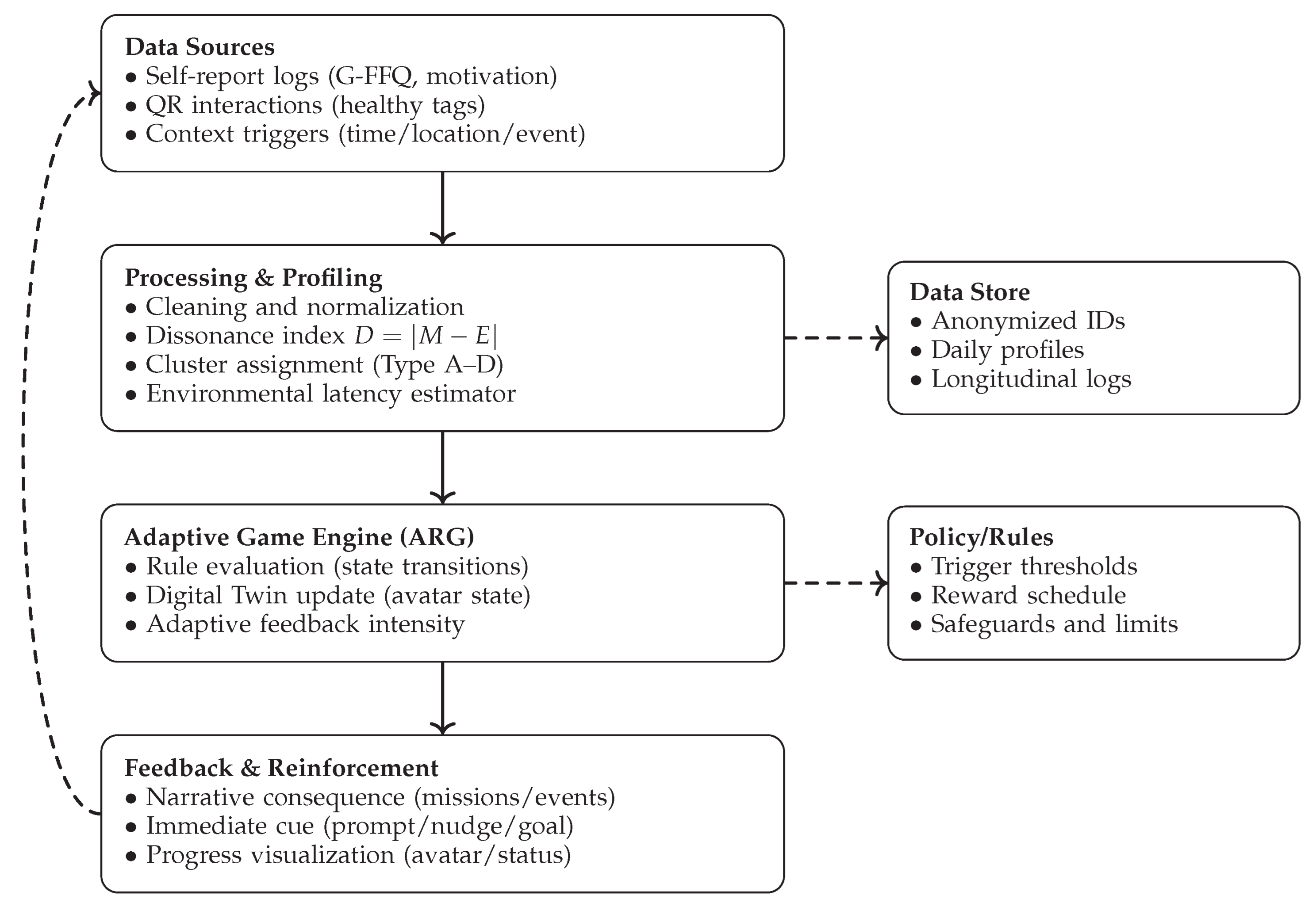
Figure 7 illustrates the technical operationalization of the proposed architecture. Data sources include structured self-report inputs, contextual triggers (e.g., cafeteria interaction), and latency variables. These are processed through a behavioral computation layer that calculates the Dissonance Index and cluster membership in real time. The adaptive game engine then updates the Digital Twin state, producing immediate narrative feedback designed to reduce friction and reinforce execution. This layered structure clarifies that the system integrates sensing, computation, and adaptive reinforcement rather than functioning as a static gamification overlay.
Compared to conventional gamified mHealth architectures, which typically rely on reward accumulation systems layered over tracking dashboards [
16,
17], the proposed framework differs in three aspects: (1) it operationalizes a psychometric dissonance variable as an adaptive control parameter; (2) it integrates environmental latency as a dynamic friction estimator; and (3) it embeds behavioral consequences within a narrative Digital Twin representation rather than abstract point systems. This combination positions the Digital Bridge closer to adaptive persuasive systems than to conventional reward-based mHealth applications.
5.3. From Dissonance to Resonance
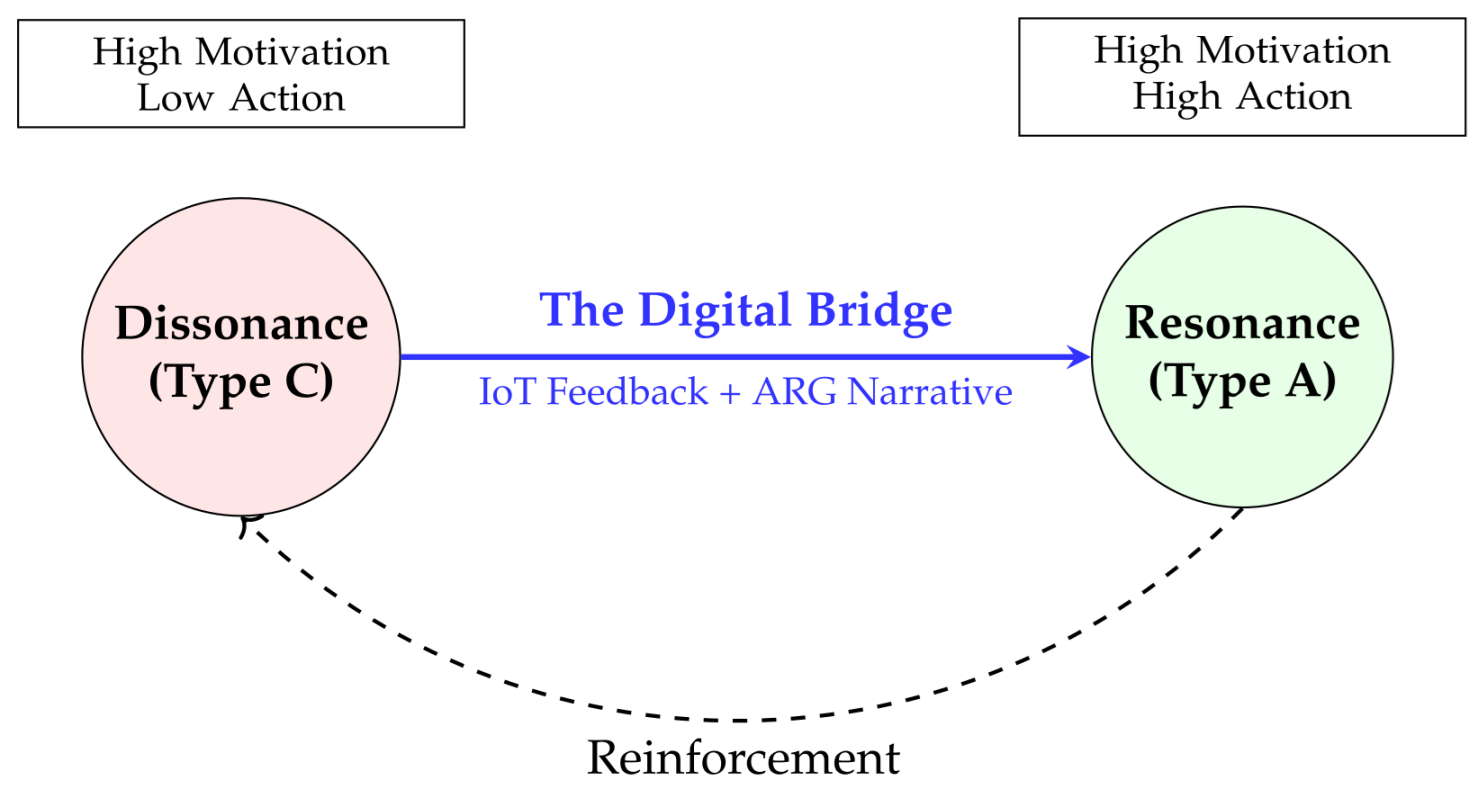
The ultimate goal of the system is to facilitate a transition from the “Dissonant” cluster (Type C) to the “Coherent” cluster (Type A). We term this process the “Resonance Effect.” Dissonance occurs when the biological reality (dietary harm) conflicts with the cognitive reality (academic ambition). The Digital Bridge resolves this by making the conflict visible. When the digital narrative aligns with the physical reality (e.g., the avatar suffers “brain fog” or “stamina drain” immediately after the user logs a high-sugar intake), the consequence becomes tangible.
Figure 8 illustrates this proposed trajectory. The diagram depicts the feedback loop as a corrective mechanism. The “Virtual Consequence” acts as an artificial nervous system that mimics biological pain signals but at a narrative level the child cares about. By reinforcing the link between “Eating Well” and “Winning,” the system utilizes the brain’s reward prediction error mechanism to rewire the habit loop, effectively transporting the user from the zone of high-motivation/low-action to the zone of execution.
5.4. Scope and Limitations
The scope of this study is explanatory and design-oriented: we quantify the Nutritional–Academic Dissonance in a specific public-school context (Guayas, Ecuador) and translate the resulting motivational–behavioral profiles into requirements for a context-aware, gamified intervention architecture. Accordingly, the contribution is not a clinical efficacy claim, but an empirically grounded HCI framing and a profiling-driven design rationale.
Several limitations should be considered when interpreting the findings. First, the cross-sectional design captures the existence and magnitude of the Action Gap, but it cannot establish whether the proposed ARG-mediated feedback loop produces sustained behavioral change over time. Second, dietary intake is measured through a gamified self-report interface; although digital and visual instruments can mitigate fatigue and improve reporting in pediatric samples [
25], self-report remains vulnerable to desirability bias. Third, while smartphone ownership was high in our sample (88%), reliance on personal devices may under-represent the most economically vulnerable students, which is a central equity concern in school-based digital interventions.
5.5. Implications for Practice and Policy
Our results carry practical implications for school health programs in developing-economy settings. The weak association between knowledge and execution (
Section 5.4) suggests that curricula centered on information transfer alone are unlikely to shift behavior in environments dominated by convenient ultra-processed options [
32,
33]. Therefore, schools may benefit from complementary strategies that modify the immediate choice architecture and reinforcement dynamics.
At the practice level, the proposed Digital Bridge highlights how immediate, meaningful feedback can compete with the short-term rewards of unhealthy foods. At the policy level, the implication is not necessarily “more technology”, but better-aligned incentives and context cues. Choice-architecture interventions (e.g., default healthy bundles, cafeteria layout changes, simplified labeling, commitment prompts) have shown broad effectiveness across behavioral domains [
24] and can operate as low-cost complements to any digital layer.
A practical concern in developing-economy contexts is whether schools can realistically sustain IoT services at scale. We therefore frame the Digital Bridge as a design space rather than a single mandatory implementation.
Table 6 presents a tiered spectrum of intervention strategies with increasing technological intensity and resource demand. At the highest tier, IoT + ARG deployments provide context-aware, real-time reinforcement but require sustained infrastructure, connectivity, and technical capacity. Mid-tech solutions (QR + mobile) preserve immediate feedback mechanisms while reducing deployment costs and enabling easier scaling. Low-tech approaches based on choice architecture rely on environmental restructuring and have demonstrated broad effectiveness without device dependence [
24]. Grassroots initiatives further emphasize peer norms and community engagement, strengthening cultural sustainability, albeit typically with slower feedback cycles. Importantly, the framework clarifies that reducing the intention–execution gap is mechanism-dependent rather than technology-dependent, allowing schools to adopt staged or hybrid pathways aligned with local institutional capacity and budget stability.
To facilitate practical translation, three adoption scenarios can be envisioned. Scenario A (low-resource schools) involves QR-based interaction without real-time sensing, using periodic synchronization and simplified reinforcement loops. Scenario B (moderate infrastructure) integrates cafeteria-based triggers and shared devices managed by school administrators. Scenario C (advanced deployment) incorporates sensor-based context detection and real-time adaptive feedback. These scenarios demonstrate that the architecture can scale according to institutional capacity while preserving its core behavioral logic.
5.6. Future Research Directions
Future work should evaluate the architecture through a longitudinal deployment (e.g., one academic term) to quantify retention, adherence, and changes in dietary proxies, ideally using mixed methods to capture implementation constraints. A second direction is to test tiered implementations (high-tech to low-tech) to identify the minimum viable mechanism that reliably reduces the Action Gap. Third, future studies should incorporate school-level covariates (canteen offerings, pricing, vendor contracts, and exposure to marketing) as moderators of execution, aligning with work on the commercial determinants of health [
34]. Finally, equity-centered designs should be prioritized, including shared devices, offline-first functionality, and non-phone alternatives (e.g., printed QR cards or low-cost tokens) to avoid amplifying digital divides.
6. Conclusions
This study addressed the “double burden of malnutrition” in Ecuadorian schoolchildren not as a purely nutritional deficit, but as a Human-Computer Interaction (HCI) challenge. By quantitatively profiling 120 students, we provide empirical evidence that challenges the sufficiency of the “Information Deficit Model”; our results show a negligible correlation () between nutritional knowledge and healthy dietary execution. Instead, we identified a pervasive “Nutritional-Academic Dissonance” affecting 53.3% of the population (Type C users), who possess high academic motivation but remain entrapped in poor dietary habits due to environmental latency.
The proposed “Digital Bridge Architecture” responds to this finding by shifting the intervention paradigm from passive instruction to active, gamified persuasion. By integrating IoT sensing with an Alternate Reality Game (ARG) logic, the system can be interpreted as a form of “prosthetic willpower,” translating the invisible, long-term biological consequences of food choices into immediate, visible game mechanics.
The findings suggest that context-aware systems represent a promising direction for future educational technologies aimed at supporting healthier decision-making processes. For educational policy, this implies that aligning health interventions with students’ existing academic ambitions, using the technology they already carry in their pockets, creates a far more potent driver for behavioral change than traditional health scares. Future work will focus on a longitudinal deployment of this architecture to measure the persistence of these behavioral modifications over a full academic year.
Author Contributions
Conceptualization, N.P.-J. and N.M.; methodology, C.V.-S. and N.M.; software, N.M.; validation, C.V.-S.; formal analysis, N.M.; investigation, N.P.-J.; resources, N.P.-J.; data curation, N.M. and C.V.-S.; writing—original draft preparation, N.P.-J. and N.M.; writing—review and editing, C.V.-S.; visualization, N.M.; supervision, C.V.-S.; project administration, N.P.-J. All authors have read and agreed to the published version of the manuscript.
Funding
This research received no external funding.
Institutional Review Board Statement
The study was conducted in accordance with the Declaration of Helsinki, and approved by the Academic Research Committee of the Universidad Estatal de Milagro (approval date: 10 September 2025).
Informed Consent Statement
Informed consent was obtained from all subjects involved in the study and their legal guardians. Explicit assent was also collected from the participating students via the digital interface.
Data Availability Statement
Conflicts of Interest
The authors declare no conflict of interest.
References
- Smolińska, K.; Szopa, A.; Sobczyński, J.; Serefko, A.; Dobrowolski, P. Nutritional Quality Implications: Exploring the Impact of a Fatty Acid-Rich Diet on Central Nervous System Development. Nutrients 2024, 16, 1093. [Google Scholar] [CrossRef] [Scilit] [PubMed]
- Hernández-Ruiz, Á.; Madrigal, C.; Soto-Méndez, M.J.; Gil, Á. Challenges and Perspectives of the Double Burden of Malnutrition in Latin America. Clín. Investig. Arterioscler. 2022, 34, 3–16. [Google Scholar] [CrossRef] [Scilit] [PubMed]
- Nairne, J.S. Adaptive Education: Learning and Remembering with a Stone-Age Brain. Educ. Psychol. Rev. 2022, 34, 2275–2296. [Google Scholar] [CrossRef] [Scilit] [PubMed]
- Amézquita, S.L.V.; Parra, P.A.S.; Hernández, K.P.A.; Villabón, J.E.T. Nutritional Factors Influencing School Performance: A Review of the Literature Between 2020–2025. TPM–Test. Psychom. Methodol. Appl. Psychol. 2025, 32, 518–534. [Google Scholar]
- Goldwater, M.B.; Hashmi, F.A.; Mondal, S.; Legare, C.H. Community Health Workers’ Counseling Is Based on a Deficit Model of Behavior Change. PLoS Glob. Public Health 2025, 5, e0004167. [Google Scholar] [CrossRef] [Scilit]
- Daiiani, M.; Sweetser, P.; Stanley, S.; Caldwell, S.; Van Rooy, D. Evaluating the Impact of Gameful Design on Pro-Environmental Attitudes: Beyond Blue as Intervention. In Proceedings of the 19th International Conference on the Foundations of Digital Games (FDG ’24), Worcester, MA, USA, 21–24 May 2024; ACM: New York, NY, USA, 2024; pp. 1–13. [Google Scholar] [CrossRef] [Scilit]
- Catellani, P.; Carfora, V. Habits and Behavior Change. In The Social Psychology of Eating; Springer: Cham, Switzerland, 2023. [Google Scholar] [CrossRef] [Scilit]
- Zhao, Q.; Li, G.; Cai, J.; Zhou, M.; Feng, L. A Tutorial on Internet of Behaviors: Concept, Architecture, Technology, Applications, and Challenges. IEEE Commun. Surv. Tutor. 2023, 25, 1227–1260. [Google Scholar] [CrossRef] [Scilit]
- Essahraui, S.; Lamaakal, I.; Maleh, Y.; El Makkaoui, K.; Filali Bouami, M.; Ouahbi, I.; Abd El-Latif, A.A.; Almousa, M.; Rodrigues, J.J.P.C. Human Behavior Analysis: A Comprehensive Survey on Techniques, Applications, Challenges, and Future Directions. IEEE Access 2025, 13, 128379–128419. [Google Scholar] [CrossRef] [Scilit]
- Fatorachian, H.; Kazemi, H.; Pawar, K. Enhancing Smart City Logistics Through IoT-Enabled Predictive Analytics: A Digital Twin and Cybernetic Feedback Approach. Smart Cities 2025, 8, 56. [Google Scholar] [CrossRef] [Scilit]
- Schoeppe, S.; Alley, S.; Van Lippevelde, W.; Bray, N.; Williams, S.; Duncan, M.; Vandelanotte, C. Efficacy of interventions that use apps to improve diet, physical activity and sedentary behaviour: A systematic review. Int. J. Behav. Nutr. Phys. Act. 2016, 13, 127. [Google Scholar] [CrossRef] [Scilit]
- Dichev, C.; Dicheva, D. Gamifying education: What is known, what is believed and what remains uncertain: A critical review. Int. J. Educ. Technol. High. Educ. 2017, 14, 9. [Google Scholar] [CrossRef] [Scilit]
- Li, L.; Hew, K.F.; Du, J. Gamification Enhances Student Intrinsic Motivation, Perceptions of Autonomy and Relatedness, but Minimal Impact on Competency: A Meta-Analysis and Systematic Review. Educ. Technol. Res. Dev. 2024, 72, 765–796. [Google Scholar] [CrossRef] [Scilit]
- Fogg, B.J. A Behavior Model for Persuasive Design. In Proceedings of the 4th International Conference on Persuasive Technology (Persuasive ’09), Claremont, CA, USA, 26–29 April 2009; ACM: New York, NY, USA, 2009; pp. 1–7. [Google Scholar] [CrossRef] [Scilit]
- Riahi, V.; Diouf, I.; Khanna, S. Advancing Health Care with Digital Twins: Meta-Review of Applications and Implementation Challenges. J. Med. Internet Res. 2025, 27, e69544. [Google Scholar] [CrossRef] [Scilit]
- Lord, S.E.; Campbell, A.N.C.; Brunette, M.F.; Cubillos, L.; Bartels, S.M.; Torrey, W.C.; Olson, A.L.; Chapman, S.H.; Batsis, J.A.; Polsky, D.; et al. Implementation Science and Digital Therapeutics for Behavioral Health. JMIR Ment. Health 2021, 8, e17662. [Google Scholar] [CrossRef] [Scilit] [PubMed]
- Wu, J.Y.; Tsai, Y.Y.; Chen, Y.J.; Hsiao, F.C.; Hsu, C.H.; Lin, Y.F.; Liao, L.D. Digital Transformation of Mental Health Therapy by Integrating Digitalized Cognitive Behavioral Therapy and Eye Movement Desensitization and Reprocessing. Med. Biol. Eng. Comput. 2025, 63, 339–354. [Google Scholar] [CrossRef] [Scilit] [PubMed]
- López-Gil, J.F.; Cisneros-Vásquez, E.; Olivares-Arancibia, J.; Yañéz-Sepúlveda, R.; Gutiérrez-Espinoza, H. Investigating the Relationship Between Ultra-Processed Food Consumption and Academic Performance in the Adolescent Population: The EHDLA Study. Nutrients 2025, 17, 524. [Google Scholar] [CrossRef] [Scilit]
- Lane, M.M.; Gamage, E.; Du, S.; Ashtree, D.N.; McGuinness, A.J.; Gauci, S.; Baker, P.; Lawrence, M.; Rebholz, C.M.; Srour, B.; et al. Ultra-processed food exposure and adverse health outcomes: Umbrella review of epidemiological meta-analyses. BMJ 2024, 384, e077310. [Google Scholar] [CrossRef] [Scilit]
- Foula, W.H.; Foad, W.M. Human Nutritional Neuroscience: Fundamental Issues. In Nutrition and Psychiatric Disorders; Mohamed, W., Kobeissy, F., Eds.; Nutritional Neurosciences; Springer: Singapore, 2024. [Google Scholar] [CrossRef] [Scilit]
- Fontanilla, R.C. Nourishing Minds: A Literature Review on the Link of Nutrition, Academic Engagement, and Student Success. Herculean J. 2023, 1. Available online: https://herculeanjournal.com/index.php/main/article/view/8 (accessed on 1 February 2026).
- Zourmpakis, A.; Kalogiannakis, M.; Papadakis, S. Adaptive Gamification in Educational Systems: A Systematic Literature Review. Computers 2023, 12, 143. [Google Scholar] [CrossRef] [Scilit]
- Zourmpakis, A.; Kalogiannakis, M.; Papadakis, S. Gamification and Adaptive Learning Systems: A Systematic Review. Computers 2024, 13, 324. [Google Scholar] [CrossRef] [Scilit]
- Mertens, S.; Herberz, M.; Hahnel, U.J.J.; Brosch, T. The Effectiveness of Nudging: A Meta-Analysis of Choice Architecture Interventions Across Behavioral Domains. Proc. Natl. Acad. Sci. USA 2022, 119, e2107346118. [Google Scholar] [CrossRef] [Scilit]
- Berger, M.; Jung, C. Gamification Preferences in Nutrition Apps: Toward Healthier Diets and Food Choices. Digital Health 2024, 10, 20552076241260482. [Google Scholar] [CrossRef] [Scilit] [PubMed]
- Kaur, S.; Kumar, R.; Kaur, M. School-Based Behaviour Change Intervention to Reduce Ultra-Processed Food Consumption Among Adolescents: Evidence from a Cluster-Randomised Controlled Trial in India. BMJ Glob. Health 2026, 11, e020799. [Google Scholar] [CrossRef] [Scilit] [PubMed]
- Aristo, D.; Srinivasan, B. Identifying Adolescent Behavioral Profiles Through K-Means Clustering Based on Smartphone Usage, Mental Health, and Academic Performance. Int. J. Inform. Inf. Syst. 2025, 8, 1–11. [Google Scholar] [CrossRef] [Scilit]
- Hermosa-Bosano, C.; López-Gil, J.F. Low Self-Perceived Cooking Skills Are Linked to Greater Ultra-Processed Food Consumption Among Adolescents: The EHDLA Study. Nutrients 2025, 17, 1168. [Google Scholar] [CrossRef] [Scilit]
- Jain, A.K. Data clustering: 50 years beyond K-means. Pattern Recognit. Lett. 2010, 31, 651–666. [Google Scholar] [CrossRef] [Scilit]
- Celebi, M.E.; Kingravi, H.A.; Vela, P.A. A comparative study of efficient initialization methods for the k-means clustering algorithm. Expert Syst. Appl. 2013, 40, 200–210. [Google Scholar] [CrossRef] [Scilit]
- Crovini, C.; Santoro, G.; Ossola, G. Rethinking risk management in entrepreneurial SMEs: Towards the integration with the decision-making process. Manag. Decis. 2021, 59, 1085–1113. [Google Scholar] [CrossRef] [Scilit]
- Goh, E.V.; Sobratee-Fajurally, N.; Allegretti, A.; Sardeshpande, M.; Mustafa, M.; Azam-Ali, S.H.; Omari, R.; Schott, J.; Chimonyo, V.G.P.; Weible, D.; et al. Transforming Food Environments: A Global Lens on Challenges and Opportunities for Achieving Healthy and Sustainable Diets for All. Front. Sustain. Food Syst. 2024, 8, 1366878. [Google Scholar] [CrossRef] [Scilit]
- van Tulleken, C. Ultra-Processed Foods and Public Health: Evidence of Harm and of Conflicts of Interest in the Food Industry to Evade Regulation. Future Healthc. J. 2025, 12, 100263. [Google Scholar] [CrossRef] [Scilit]
- Paichadze, N.; Werbick, M.; Ndebele, P.; Bari, I.; Hyder, A.A. Commercial Determinants of Health: A Proposed Research Agenda. Int. J. Public Health 2020, 65, 1147–1149. [Google Scholar] [CrossRef] [Scilit]
Figure 1.
Conceptual representation of the Action Gap as a system-level interaction problem, illustrating how environmental and interface constraints mediate the transition between cognitive intent and behavioral execution.
Figure 1.
Conceptual representation of the Action Gap as a system-level interaction problem, illustrating how environmental and interface constraints mediate the transition between cognitive intent and behavioral execution.
Figure 2.
Application of the Fogg Behavior Model. The IoT intervention reduces the activation energy required for healthy choices, moving the user across the action threshold.
Figure 2.
Application of the Fogg Behavior Model. The IoT intervention reduces the activation energy required for healthy choices, moving the user across the action threshold.
Figure 3.
Methodological pipeline from digital acquisition to preprocessing and statistical profiling.
Figure 3.
Methodological pipeline from digital acquisition to preprocessing and statistical profiling.
Figure 4.
Clustering of student profiles. The X-axis represents the motivation to be healthy for academic gain, while the Y-axis represents actual dietary quality. The majority of the population falls into the “Type C” quadrant (bottom-right), characterizing the Nutritional-Academic Dissonance.
Figure 4.
Clustering of student profiles. The X-axis represents the motivation to be healthy for academic gain, while the Y-axis represents actual dietary quality. The majority of the population falls into the “Type C” quadrant (bottom-right), characterizing the Nutritional-Academic Dissonance.
Figure 5.
Elbow Method for cluster selection. The inflection point at indicates diminishing marginal reduction in within-cluster variance beyond this value.
Figure 5.
Elbow Method for cluster selection. The inflection point at indicates diminishing marginal reduction in within-cluster variance beyond this value.
Figure 6.
Mean silhouette coefficient across candidate values of k. The maximum score (0.43) occurs at , indicating moderate cluster separation appropriate for behavioral segmentation.
Figure 6.
Mean silhouette coefficient across candidate values of k. The maximum score (0.43) occurs at , indicating moderate cluster separation appropriate for behavioral segmentation.
Figure 7.
Technical architecture of the Digital Bridge framework. Self-reports, QR interactions, and contextual triggers are processed to compute dissonance and user profiles, driving an adaptive ARG engine and a closed-loop reinforcement mechanism. Dashed links denote supporting components and feedback influence over subsequent interactions.
Figure 7.
Technical architecture of the Digital Bridge framework. Self-reports, QR interactions, and contextual triggers are processed to compute dissonance and user profiles, driving an adaptive ARG engine and a closed-loop reinforcement mechanism. Dashed links denote supporting components and feedback influence over subsequent interactions.
Figure 8.
The Trajectory of Change. The architecture serves as the vector to transport users from a state of Dissonance to Resonance by making the invisible consequences of nutrition visible.
Figure 8.
The Trajectory of Change. The architecture serves as the vector to transport users from a state of Dissonance to Resonance by making the invisible consequences of nutrition visible.
Table 1.
Demographic Distribution of Participants ().
Table 1.
Demographic Distribution of Participants ().
| Variable | Category | n | % |
|---|
| Gender | Male | 58 | 48.3% |
| Female | 62 | 51.7% |
| Age Group | 10–11 Years | 40 | 33.3% |
| 12–13 Years | 55 | 45.8% |
| 14 Years | 25 | 20.8% |
| BMI Status | Normal Weight | 68 | 56.7% |
| Overweight/Obese | 52 | 43.3% |
Table 2.
Operationalization of Study Variables.
Table 2.
Operationalization of Study Variables.
| Variable | Description | Data Type |
|---|
| Cognitive Intent (M) | Adapted Academic Motivation Scale (6 Likert items), normalized to 0–100. | Continuous (0–100) |
| Behavioral Execution (E) | Inverted and normalized UPF frequency index derived from G-FFQ. | Continuous (0–100) |
| Environmental Latency (L) | Composite Likert-scale score capturing perceived effort, time delay, and accessibility barriers at the point of food selection. | Continuous (1–5) |
| Dissonance (D) | Absolute difference between Intent and Execution (). | Continuous (absolute difference) |
| Profile Type | Cluster assignment (Type A, B, C, D). | Nominal |
Table 3.
Descriptive Statistics of Study Variables (). Scores are normalized (0–100).
Table 3.
Descriptive Statistics of Study Variables (). Scores are normalized (0–100).
| Variable | Min | Max | Mean | SD | Kurtosis |
|---|
| Nutritional Knowledge (K) | 45.0 | 98.0 | 76.4 | 12.1 | −0.45 |
| Academic Motivation (M) | 52.0 | 100.0 | 81.2 | 9.5 | 1.20 |
| Behavioral Execution (E) | 15.0 | 78.0 | 42.5 | 15.3 | −0.82 |
Table 4.
Paradigm Shift: Traditional Interventions vs. The Digital Bridge Architecture.
Table 4.
Paradigm Shift: Traditional Interventions vs. The Digital Bridge Architecture.
| Feature | Traditional Approach | Digital Bridge (Proposed) |
|---|
| Core Mechanic | Information Delivery | Contextual Interaction |
| Feedback Loop | Delayed (Semester Grades) | Real-time (Game Status) |
| Motivation Source | Health (Abstract/Long-term) | Academic/Social (Immediate) |
| User Role | Passive Learner | Active Player |
| Gap Addressed | Knowledge Gap | Action Gap |
Table 5.
Traceability between empirical findings and architectural design decisions.
Table 5.
Traceability between empirical findings and architectural design decisions.
| Empirical Finding | Design Decision |
|---|
| High prevalence of Type C profile (53.3%) | Prioritize trigger-based reinforcement rather than educational modules |
| Weak correlation between Knowledge and Execution (r = 0.12) | Avoid quiz-based or informational gamification layers |
| Strong negative correlation between Environmental Latency and Execution (r = −0.68) | Implement context-aware triggers to reduce decision friction |
| Large Dissonance Index (Mean difference = 38.7) | Operationalize Dissonance as adaptive feedback intensity variable |
Table 6.
Tiered intervention options to reduce the Action Gap in resource-constrained school settings.
Table 6.
Tiered intervention options to reduce the Action Gap in resource-constrained school settings.
| Tier | Primary Mechanism | Resource Requirements | Equity and Implementation Notes |
|---|
High-tech
(IoT + ARG) | Context-aware triggers and real-time feedback via sensors and game state | Sensors, connectivity, device management, maintenance capacity | Highest engagement potential, but requires technical support; risk of excluding students without device access |
Mid-tech
(QR + mobile) | Lightweight interaction (QR-tagged healthy items, immediate rewards/power-ups) | Printed QR labels, basic smartphone access, minimal backend | Lower cost and easier scaling; can be deployed offline-first with periodic sync |
Low-tech
(choice architecture) | Defaults, prompts, simplification, cafeteria layout, healthy bundling | Operational changes, staff training, signage | Evidence supports broad effectiveness of nudges [24]; avoids device dependence |
| Grassroots/community | Peer norms, school challenges, parent engagement, cooking skills, local food initiatives | Coordination time, community partnerships | Strengthens sustainability and cultural fit; slower feedback loop unless paired with simple tracking |
| Disclaimer/Publisher’s Note: The statements, opinions and data contained in all publications are solely those of the individual author(s) and contributor(s) and not of MDPI and/or the editor(s). MDPI and/or the editor(s) disclaim responsibility for any injury to people or property resulting from any ideas, methods, instructions or products referred to in the content. |