Review

Understanding Team Collaboration in MMOGs: A Systematic Review and Bibliometric Mapping

1
Faculty of Computer Science and Information Technology, University Putra Malaysia, Serdang 43400, Malaysia
2
Faculty of Computer Science, University Pembangunan Panca Budi, Sumatera Utara 20122, Indonesia
*
Authors to whom correspondence should be addressed.
Computers 2026, 15(2), 134; https://doi.org/10.3390/computers15020134
Submission received: 14 January 2026 / Revised: 3 February 2026 / Accepted: 12 February 2026 / Published: 20 February 2026

Abstract

In massively multiplayer online games (MMOGs), complex social environments exist in which cooperation is central not only to playing the game but also to experiencing it as an individual player. The growth of multiplayer games that emphasise cooperative activities in computer-based environments has sparked academic interest in collaboration and its role in the field, engaging scholars from domains such as human–computer interaction and digital entertainment. This paper presents a systematic literature review (SLR) and bibliometric analysis of 70 peer-reviewed journal papers published between 2015 and 2024. This data is derived from the Web of Science and Scopus databases. This literature review contributes to the understanding of collaborative factors in MMOGs, which include task interdependence, communication, trust, leadership, and player behaviour. The review is in the field using bibliometrics. To present the findings, we construct an input–process–output (IPO) model that links game features (inputs) and interaction dynamics (processes) to team performance and player experience (outputs) in MMOGs. This review maps the field’s dominant factors (task interdependence, communication, trust, leadership, and player behaviour), pinpoints methodological priorities, and sets a concrete agenda for future research on team collaboration in MMOGs.

1. Introduction

Massively multiplayer online games (MMOGs) have grown rapidly in recent years, becoming a primary global form of digital entertainment with an expanding player population [1]. This scale and activity make MMOGs a strong setting for studying team collaboration. Many leading titles rely on team missions, guild progression, and competitive modes that require real-time coordination and sustained communication [2,3]. Since frequent interaction in the game is associated with engagement and retention, MMOGs also provide an active space where virtual teams can be studied with tangible performance effects [4].
Virtual teams are structured and operate very differently from traditional teams, and MMOGs provide a typical scenario for such teams to form and collaborate across time zones and geographies. Existing studies have explored collaborative behaviours in MMOG environments from multiple perspectives. For example, in fast-paced, complex tasks, players often need to communicate effectively in very little time, and emoticons and rapid text exchanges are usually used instead of voice communication [5], highlighting the limitations of effective communication in existing games. In addition, studies have shown that shared learning and reward mechanisms between members can consistently stimulate long-term collaborative behaviours [6]. Established studies have also found that virtual team effectiveness depends more on intangible drivers than on physical conditions, such as communication efficiency [7], trust-building [8], task characteristics [9], leadership styles [10], team cohesion [11], and member responsibility [12,13]. Together, these factors shape members’ coordinated collaboration, and the quality of collaboration, in turn, influences team goal accomplishment and team effectiveness [14].
Although the research foundation is growing, the data are still distributed across psychology [15], behavioural science [15], computer science [16], and management [17]. This fragmentation has led to two significant limitations: first, research findings are often confined to disciplinary ‘islands’, making it challenging to compare concepts, measures, and conclusions across studies; second, with the rapid evolution of information and communication technologies, the emergence of new MMOG collaborative mechanisms far outpaces the ability of the literature to systematically integrate them, resulting in an uneven and fragmented knowledge structure that hinders the accumulation of theory and the design of practice. This impedes the accumulation of theories and practical design guidance [18]. In short, there is an urgent need for an integrative perspective to clarify: (i) the dominant research themes in the field; (ii) the trajectory of research over time; and (iii) the key research gaps and under-explored issues.
In the research literature on collective gaming and online coordination, related but not identical terms such as team collaboration [19], teamwork [20], and virtual teams [17] often appear, and these terms are sometimes used interchangeably. This study adopts team collaboration as the core analytical concept, referring to the behavioural patterns through which players coordinate actions, share information, and align their efforts to achieve collective goals through interaction in MMOG environments. The other terms are treated as complementary perspectives: teamwork is often used as a broad descriptor of collective task performance [20,21] and virtual teams emphasize distributed, technology-mediated interaction [8,22]. To ensure conceptual clarity, we use the term “team collaboration” consistently throughout this study, while alternative terms are used only when reflecting the terminology adopted in specific reviewed papers.
However, the literature remains fragmented and lacks an integrated synthesis. This gap motivates the present study to integrate data from the two significant databases, Web of Science (WoS) and Scopus, to form a systematic, structured examination of collaborative research in MMOGs. Therefore, this study aims to achieve two complementary objectives: (1) to identify and elucidate the primary factors and mechanisms that influence the effectiveness of team collaboration in MMOGs and (2) to track the trajectory of the research field over time by combing the journal literature for themes, hotspots, and emerging research directions.
We integrated the two research review mechanisms, bibliometric analysis (BA) [23] and systematic literature review (SLR) [24]. BA has been employed to map the field’s knowledge organisation (e.g., prominent journals, authors, and topic clusters) and monitor dynamics, while SLR draws findings together in a fully reproducible manner to classify collaborative mechanisms, outcomes, and research methods. Together, these complementary approaches contribute to a comprehensive picture of research, highlight critical themes and hotspots, and identify gaps that warrant further attention. This design enables both thematic synthesis and landscape-level mapping. The remaining sections of the paper provide an introduction to key concepts and a selection of relevant prior research, explain the protocol for the literature review and bibliometric process, and then present details of the methods and sources. Finally, we conclude with some open issues and questions raised by our findings, and suggest areas of future research that would strengthen the theoretical underpinning and practical performance of collaborative design in MMOGs.

2. Literature Review

This section reviews prior research on team collaboration in MMOGs, focusing on key concepts, influencing factors, and reported outcomes. The review provides the basis for identifying gaps and motivating the analytical approach adopted in this study.

2.1. Team Collaboration in MMOGs

MMOGs are games that support large groups of players (often more than 1000) and continuous interaction in a shared online world [25]. Players may act individually or form teams to overcome increasingly complex challenges and achieve shared objectives. MMOGs, therefore, provide a concrete and scalable context for studying team collaboration under time pressure, role specialisation, and technology-mediated interaction [26]. For example, League of Legends has been used to examine time-critical “pick-up” teamwork, including how role fit, communication constraints, and strategic coordination shape team collaboration [2]. Related research also suggests that team play can enhance communication and social bonding, which in turn supports sustained engagement [11,27]. In MMORPGs, psychosocial factors such as community feelings and identity are associated with continued participation in guilds [28].
At the same time, a key limitation in the current MMOGs literature is that “collaboration” is often operationalised primarily as participation or involvement (e.g., guild membership, prevalence of team play) rather than as collaboration processes [7,26]. This creates a persistent conceptual ambiguity: indicators of social embeddedness (e.g., persistent ties, interaction strength, group belonging) are sometimes treated as proxies for coordination quality, even though they capture different phenomena [29]. In this review, we explicitly distinguish these two dimensions. Social embeddedness describes the relational and structural connectedness that may sustain continued interaction. In contrast, coordination quality refers to task-oriented alignment mechanisms such as role differentiation, task decomposition, time alignment, and conflict resolution that directly enable team effectiveness across MMOG types and modes.
Moreover, research that directly examines communication and coordination processes in MMOG settings remains comparatively limited. Recent research emphasises the importance of broader social dynamics, such as interdependence and perceptions of power, in elucidating prosocial and disruptive behaviours [15,30]. However, these insights often lack integration with the detailed interaction processes that influence coordination at the micro-level. Communication in modern multiplayer games is also multimodal and strategic: players may use voice or chat, pings or prompts, emoticons, and performance metrics, and communication attempts can sometimes signal imminent breakdown rather than simply functional coordination [31,32,33]. Field-scale evidence further suggests non-linear and context-dependent relationships between behavioural interdependence, collaboration, and performance more coordination is not always better, and teams may face different “coordination loads” depending on skill distributions and task demands [12,34]. Overall, the field still lacks an integrative account that connects communication choices, consensus formation, collaborative action, and performance while addressing selection effects (e.g., strong teams communicating differently because they are strong, rather than becoming strong because they communicate).

2.2. Team Collaboration

Building upon established team collaboration theory, we define team collaboration as an interactive process involving information exchange, coordinated actions, and shared goals [35]. Collaboration development is shaped by structural conditions and psychological factors such as mutual assistance, trust, and perceived support [36]. Cognitive trust facilitates information exchange, reduces uncertainty, and improves collaborative efficiency, particularly in technology-mediated environments where its impact is significant [34]. Emotional bonds and connections enhance team cohesion, encourage behavioural alignment, and sustain member commitment [37]. Effective collaboration is further facilitated by a shared knowledge organisation system: teams that implement an interactive memory system (identifying “who holds what knowledge”) can streamline task allocation and enhance the integration of professional expertise [38]. Team identification often boosts goal acceptance and decision-making consistency [39]. Moreover, leadership, typically exemplified through emotion regulation and conflict resolution, plays a critical role in preserving cohesion and performance within remote or distributed teams [40,41].
These problems are particularly prominent in virtual or digital teams that lack physical coexistence. In such situations, cognitive assessment of reliability and capability may become a key element in maintaining collaboration [42]. The factors influencing the cohesion of virtual teams include communication quality, the effectiveness of technical tools, and perceived social presence [43]. Structured knowledge management can also build an interactive memory system that not only compensates for the lack of informal communication but also clarifies role division [44]. Therefore, efficient collaboration usually stems from the combined effects of cognition (such as trust and shared knowledge), emotion (such as cohesion and engagement), and management or structural elements (such as leadership and role coordination). These mechanisms provide a practical analytical perspective for integrating research on MMOGs and team collaboration in this field. Both team psychology and constraints on game interaction simultaneously shape collaborative behaviour.
In MMOGs, cooperation depends both on player behaviour and on game mechanics. Goal definition and feedback mechanisms can promote the formation of identity and stabilise the assumption of cooperative roles [34], while higher task complexity [37] and more abundant direct communication channels [38] increase the need for coordination. Resource interdependence and progress systems promote trust and unity by encouraging alignment and maintaining repetitive interactions [4]. Players can also use the game’s social features and virtual avatars to convey the team’s status and intentions, thereby strengthening the trust mechanism [45]. As a result, MMOGs have become a valuable field for studying how technological empowerment, social embeddedness, or psychological mechanisms interweave in large-scale collaboration.

2.3. Current Status of Research

While the scope of research on team collaboration in MMOGs continues to expand in line with the rapid growth of the gaming industry [46], integrating the empirical knowledge base remains challenging because evidence is dispersed across heterogeneous gaming ecologies and multiple disciplinary perspectives. Existing studies often focus on specific game genres (e.g., MOBAs, MMORPGs, and strategy games) and distinctive collaboration patterns; consequently, findings may be internally valid within a given context but difficult to compare across scenarios [47,48]. Even when the same game is examined, the assumed analytical unit and team collaboration framework can differ substantially: professional team settings emphasise stable coordination structures and networked collaborative efficiency [36], whereas groupings and random matchmaking contexts highlight transient coordination under uncertainty. The broader virtual-teaming literature further amplifies this fragmentation. Although it provides key mechanisms relevant to collaboration in virtual settings (e.g., leadership and trust formation), these mechanisms are not consistently mapped onto affordances and constraints that are distinctive to MMOGs team collaboration [22,42]. A central gap, therefore, lies in the absence of a unified terminology and an integrative framework that can aggregate evidence across game types and collaboration modes while preserving MMOGs’ specific boundary conditions.
Inconsistencies in conceptual definitions and measurement standards further hinder synthesis. Core constructs such as collaboration, coordination, cohesion, trust, and commitment are frequently operationalised using non-equivalent indicators spanning structural proxies (e.g., engagement and network features), self-reported perceptual scales, and behavioural trace data [7,17,39]. Process-oriented evidence suggests that measurement choices are consequential: communication patterns and sequential features can characterise team cohesion more reliably than communication volume alone, underscoring the importance of temporal granularity and interaction structure in interpreting collaboration [11]. Large-scale behavioural analyses also show that team collaboration mechanisms do not always yield positive utility; behavioural interdependence and collaboration intensity can relate to performance in non-linear ways, with the relationship shifting as team experience changes, revealing coordination-load trade-offs that simple linear accounts fail to capture [35]. Together, these findings indicate a persistent mechanistic gap: much of the literature emphasizes outcome metrics such as performance, experience, and loyalty, yet does not sufficiently explain how enabling or constraining game conditions translate, through team processes (e.g., coordination, role enactment, and conflict repair) and emergent states (e.g., trust, cohesion, and shared cognition) into those outcomes.
Methodologically, the evidence base remains limited in capturing dynamic adaptation and collaboration failure trajectories. Although behavioural tracking and computational inference can support in situ assessment of social interaction quality and process dynamics at scale [15,35], many studies still rely on cross-sectional self-report designs, restricting causal inference about how collaboration evolves across repeated interactions [8,17]. Work on negative and destructive dynamics exists. For example, toxic behaviour can significantly impair team performance [49], and interventions such as AI teammates or social robots may mitigate negative collaborative atmospheres [50]. However, these phenomena are rarely incorporated into coherent explanatory frameworks of successful team collaboration, leaving the transition between effective collaboration and breakdown insufficiently understood. Motivational studies further indicate that cooperation depends on game design and incentives (e.g., shifts between “we-intention” and “I-intention”), but these mechanisms are not routinely linked to team-process models or observable behavioural trajectories [14]. Overall, the field requires an integrative, time-sensitive theoretical model that can jointly explain pathways to success and mechanisms of failure in MMOG team collaboration under dynamically changing technological, social, and cultural conditions.

3. Methods

This study adopts a research design that combines a Systematic Literature Review (SLR) and a Bibliometric Analysis (BA) to analyse team collaboration research in MMOGs systematically. The choice of methodology has a clear theoretical and practical basis: existing research on team collaboration in MMOGs presents obvious interdisciplinary characteristics, research themes and theoretical perspectives are dispersed, and relevant empirical findings are distributed in different research vectors, making it difficult for a single method to comprehensively reveal the overall structure and development trend of the field. Therefore, combining SLR with BA can help address this research fragmentation problem more systematically and comprehensively. Specifically, bibliometric analyses can provide a macroscopic picture of the knowledge structure of a research field in an automated and reproducible manner, including trends in publications, core journals and authors, collaborative networks, and the evolution of research topics [51]. At the same time, systematic literature reviews critically screen and synthesise established empirical studies through explicit search strategies and inclusion criteria to distil the key factors and their mechanisms of action that influence team collaboration in MMOGs [24]. The combination of the two approaches complements each other in terms of breadth and depth: while BA provides a holistic picture at the domain level, SLR supports evidence-based nuanced interpretations and mechanism generalisations.
In addition, this study is positioned as an evidence synthesis rather than a first-hand empirical survey. The goal is to systematically integrate and interpret empirical evidence from published peer-reviewed literature rather than to generate new expert consensus or player narratives. Therefore, this paper does not introduce primary qualitative data, such as in-depth interviews or Delphi expert consultation. We believe that integrating expert opinion and adopting an interview methodology can be an important addition to subsequent studies, helping triangulate and further refine the explanatory framework proposed in this study. Overall, this multilevel analytical approach is consistent with the combination of structured review frameworks and bibliometric techniques in established studies, and contributes to the systematicity, transparency, and explanatory power of the study [23]. Based on the above methodological logic, this paper first identifies the core findings and key influencing factors in the study of team collaboration in MMOGs through a systematic literature review. Then it analyses the research trends and thematic evolution of the field during the period of 2015–2024 using thematic analysis.

3.1. Systematic Literature Review (SLR)

Studies of team collaboration in MMOGs have become more prevalent in recent years. However, there is also hardly any scientific work available on the detailed analysis of recent cooperative behaviour in MMOG worlds and on the use of novel coordination and communication means for these virtual societies. The Systematic Literature Review (SLR) process suggested by Paul and Barari is used to manage the system, as described by Paul and Barari and Van Dinter et al. [24,52], which is important in this category for the following reasons.
  • Reduces subjectivity and bias in choosing search terms and sources.
  • Summarises the findings of prior research and identifies inconsistencies and discrepancies.
  • Highlights areas for future research, gaps in the literature, conflicting information, and under-examined territory in team collaboration research.
  • Lays a foundation for future research in a fast-moving area of virtual game-based collaboration.
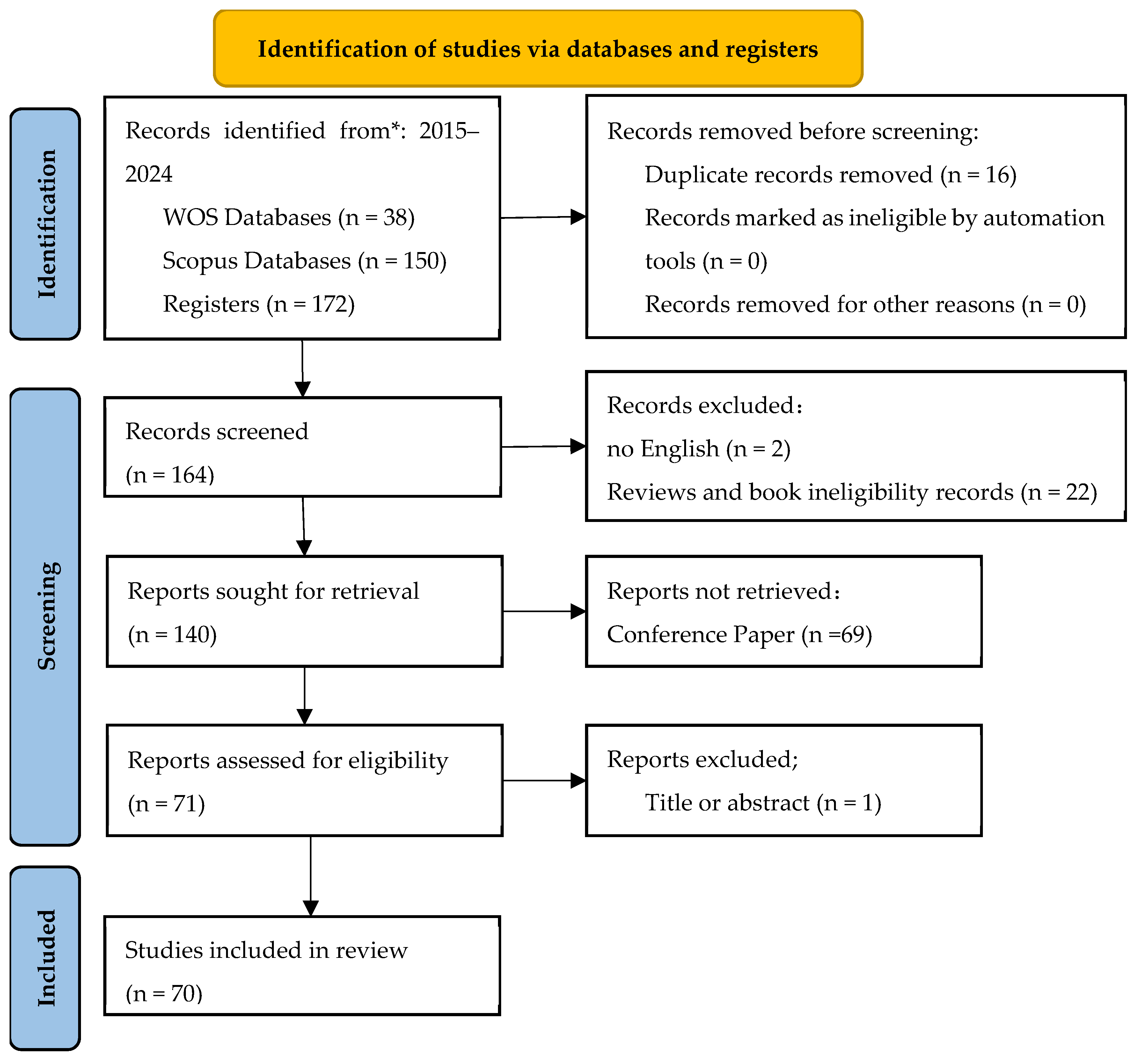
The complexity of online game environments, the various team structures and roles adopted by players, the proliferation of analysis tools, and the growth in research on the behavioural, technical, and social dimensions of online game collaboration all underscore the need for a comprehensive review. This overview will not only guide future research lines but also improve the general understanding of current knowledge on team collaboration in online gaming. The SLR performed for this work is founded on a defined process (identification → screening → eligibility → inclusion) using objective relevance criteria to minimise ambiguity and subjectivity of the authors’ selection applied (in Table 1 and Figure 1).

3.2. Research Issues

The primary purpose is to review the key literature on team collaboration in MMOGs (with WoS and Scopus databases). They then developed a model to classify and synthesize the selected papers. This framework will assist researchers, game designers, and academics studying virtual team collaboration in gaming environments by providing a framework for understanding and elevating the prominence of critical team collaboration knowledge from MMOGs. The following research questions guided the study:
  • RQ1: What are the prevalent themes and topics in the existing literature on team collaboration in MMOGs?
  • RQ2: What are the primary elements and factors examined in current research on MMOGs team collaboration?
  • RQ3: What are the potential directions for future research on team cooperation in MMOGs?

3.3. Data Sources and Selection Process

Using Scopus and WOS as sources of data ensures extensive coverage of peer-reviewed research on MMOG cooperation. A structured search strategy using Boolean combinations of terms was applied to retrieve records in the title, abstract, author keywords, and full fields, as defined by the database. Search terms included “MMOGs,” “massively multiplayer online game,” “multiplayer online games,” and “multiplayer” as well as the modifier phrases “team effectiveness,” ”team performance,” ”team collaboration,“ and “team dynamics” to incorporate MMOG game-related studies (e.g., MMORPGs, MMORTS, MMOFPSs, and MOBAs). Articles about single-player games were excluded to maintain the emphasis on team games. The detailed description of the complete search strategy, including the databases, search fields, indices, and the Boolean strings, can be found in Appendix A (Table A1). This study was limited to articles published in English-language peer-reviewed journals between 2015 and 2024 (inclusive) (indexed from 1 January 2015 to 31 December 2024). The year 2015 was chosen as a starting point because it marked the beginning of the rapid expansion of collaborative research on massively multiplayer online games and began to reflect contemporary game design, technology, and research methods. Although the Scopus and WoS databases also contain high-quality conference proceedings in the relevant fields, we limited the repository to peer-reviewed journal articles to enhance comparable reporting and methodological consistency in evidence synthesis. Journal articles often provide a more complete description of the study design, study concepts, and measurements, and this restriction also reduces ambiguities arising from the expansion of conference proceedings into journal articles and duplicates during the screening process.
The screening and eligibility assessment of this study followed the stages of the PRISMA framework: literature identification (search), screening (duplicate literature exclusion and title/abstract screening), eligibility assessment (full text assessment), and final inclusion (final repository), as shown in Figure 1. A total of 172 records were retrieved from database searches, 38 in WoS and 150 in Scopus. After removing 16 duplicate records, a total of 164 records remained to be screened. Of them, two non-English articles and 22 review papers and books were also excluded. A total of 140 papers were considered for inclusion after evaluation for potential relevance, and 69 conference papers were excluded to focus on journal articles. This decision was made to ensure consistent evidence maturity and more reliable extraction across studies, while minimising versioning effects between conference and journal publications. A total of 71 reports were eligible after full-text screening; one was excluded at the final stage due to insufficient empirical information for extraction, leaving 70 studies for inclusion. In the end, 70 studies were selected for inclusion in the review. These selected papers were carefully reviewed with a focus on empirical studies of players’ team collaboration in MMOGs. To maintain a conceptual and contextual focus, we deliberately excluded virtual collaboration studies that were not relevant to MMOGs. Articles that were predominantly concerned with cultural analysis or individual behaviour (as opposed to team collaboration and team-level outcomes) and with team performance were also excluded.
Explicit criteria set out in Table 1 were used to ensure clarity and consistency when selecting articles and to ensure relevance. These criteria can be summarized by: (i) being the context of MMOGs; (ii) involving work in a team, with at least two participants involved in the study; (iii) presence of original empirical evidence; and (iv), according to its sample the focus on players or teams as units of analysis, and based on it, (v) including at least an outcome related to the team. Table 1 provides a complete list of the screening criteria, and Appendix A (Table A1) contains the complete search strategy for replication.

3.4. Analysis Method

We used CiteSpace to conduct a bibliometric analysis to visualise and quantify the knowledge structure of collaborative research on massively multiplayer online game teams. By examining node size, link structure, and keyword co-occurrence [53], CiteSpace enables a panoramic mapping of the field and identifies emerging themes in the journal literature [54]. This process fits our dual objectives of (a) tracking the evolution of research trends and (b) informing subsequent comprehensive analyses of key collaborative factors and mechanisms.
In the bibliometric network assessment, we characterise structural properties through frequency, link strength and mediational centrality. Mediator centrality is considered an indicator of mediation, reflecting the extent to which nodes connect otherwise weakly connected parts of the network. Many CiteSpace-based bibliometric studies use a reference value of around 0.15 to highlight potential mediating nodes in the visualisation [55]. However, given the small dataset in this study (N = 70), we do not consider 0.15 a fixed or universal threshold. The value is used only as a heuristic aid for visualisation emphasis, with substantive interpretations based on relative comparisons (e.g., rank vs. percentile) and the actual distribution of network centrality values. Meanwhile, sensitivity tests using alternative reference values (0.10 and 0.20) showed that the resulting backbone structures were qualitatively similar, corroborating the robustness of the identified mediator patterns. Combined with cluster analysis and timeline visualisation, these metrics help identify key country, journal, and topic clusters and reveal the evolution of research focus over time.
This setting enables the identification of highly active authors and topics, thereby determining the actual protagonist of an interdisciplinary exchange of knowledge in the field of MMOG team collaboration research. CiteSpace provides a set of visualisation and bibliometric mapping functions that support knowledge clustering, hotspot detection, and the identification of emerging themes within the journal literature at multiple levels, including disciplinary linkages, collaboration networks, and research front topics. This helps researchers understand how disciplines are developing and outline directions for future research.
Overall, the hotspot distribution and theme evolution maps generated by CiteSpace are reproducible, providing an empirical basis for coding systematic literature reviews and innovation-oriented synthesis analyses in the subsequent results section.

3.5. Construct Definitions and Operational Variations

In combing the literature related to teamwork in MMOG, this study considers the key concepts affecting teamwork as categories of constructs. It is important to note that there are differences in naming and measurement across studies: the same concept may be referred to by different terms or operationalised by different indicators based on different data sources (questionnaires, game logs, interviews, etc.); at the same time, there may be cases where different concepts are approximated by similar indicators in some studies. To avoid conceptual confusion and enhance clarity in cross-study comparisons, this study will use the standard MMOG research tradition to define and clarify the boundaries of the relevant constructs uniformly.
In terms of methodology, the study will systematically document and categorise the operationalisation of the constructs in each study, clarifying whether the measurement logic belongs to the behavioural level (e.g., log indicators such as frequency of cooperation, teamwork behaviour, etc.) or the perceptual/attitudinal level (e.g., scale ratings such as sense of teamwork, sense of social presence, etc.), and annotating the type of indicators and dimensional structure used. In the subsequent synthesis and discussion, we will follow the principle of “Unified Definition—Recorded Differences—Operational Words “ to refine and explain the main keywords in the MMOG team study.

4. Results

This section presents results in three steps. We first map the research landscape using bibliometric indicators, then identify dominant themes and emerging emphases through network analyses, and finally synthesise the evidence into an IPO-based framework linking collaboration factors and processes to key outcomes.

4.1. Statistical Analysis

4.1.1. Annual Publication Volume

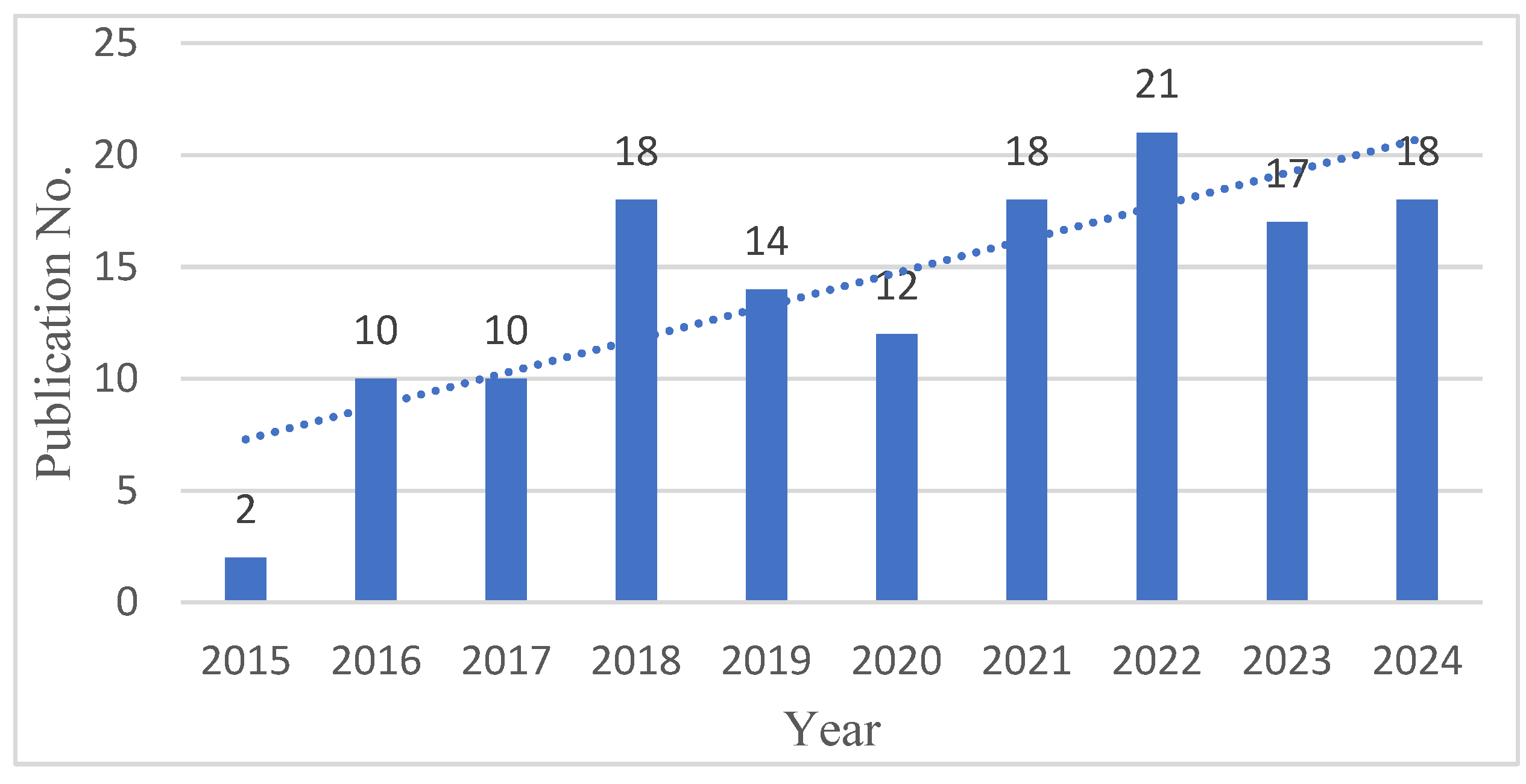
Annual publication circulation (Figure 2) is significant for understanding the study’s findings, visually highlighting collaboration patterns in MMOGs across time and possibly predicting future cooperative settings. The sum of the publication numbers indicates a continuous increase with oscillation and offers an expectation for ninefold more publications in 2024 than in 2015. Publications from 2020 to 2024 contribute 86 (57.33%) to the overall. The trend in the mean annual publication rate is also not linear (i.e., not constant). While there is a small decrease in 2020, the output for the following years (2021–2024) increases again, indicating more of an anomaly than a constant decline. In general, this upward tendency indicates an increasing attention toward the study of MMOG team collaboration.

4.1.2. Journal and Conference Publication Counts

The scattered literature on team collaboration in MMOGs requires the inclusion of journal and conference papers in the literature review to adequately cover current trends. Comparing statistics across the different resources helps identify the most common sources for research in this area and for future literature searches. Scopus yielded 140 periodical and conference articles reporting on papers on MMOG team collaboration (excluding book chapters and reviews), as shown in Table 2. The top 13 journals and conferences published 50 papers, accounting for 35.71% of the total number of articles, indicating strong research interest in this area. Most of these are from the Proceedings of the ACM Conference on Human–Computer Interaction, which accounts for 8.57%. This was followed by the Proceedings of the HCI Conference with 4.67%. They published 27 papers and 23 conference papers in these top 13 journals and conferences, which are important sources of literature in this field.
The majority of the journals are either Q1 or Q2, which demonstrates high-quality findings. While some results have been published in major journals, the publishing options remain limited. Improved manuscript quality and targeted publication in core journals can increase visibility and impact.

4.1.3. Publications by Category

Inspecting Table 3, we can see which disciplines are responsible for research on MMOG team collaboration, which aspects of the problem interest researchers, and the interdisciplinary nature of their research. The main subjects of interest are Computer Science (39.71%), Social Science (20.59%), Engineering (10.66%), Mathematics (10.66%), Business Science and Technology (10.66%), Business, Management and Accounting (5%). Almost 60% of the studies are in computer science-related fields, which is a clear indicator of the technical nature of MMOG team collaboration research. However, the fact that some engineering, mathematics, business, and management papers are also found demonstrates a trend towards increasing interdisciplinarity in this research field. Future studies could pursue an interdisciplinary approach based on individual background and interest, given the broader penetration of virtual collaboration in various practical fields such as education, management, and engineering. Guidance from MMOG group collaboration mechanisms may have some value in these areas.

4.2. Collaboration Analysis

Partnering in network analysis aims to uncover trends in author, institution, and region partnerships in MMOG team studies. The analysis of these networks may enable researchers to assess the intensity and structure of collaboration, as well as define research centres or key teams and potential partners. This analysis is important to facilitate the development of understanding for research significance and transmission paths, as well as a guidepost to follow in exploring other potential partners for academia.

4.2.1. Institution Collaboration Network

Studying institutional cooperation of other organisations in MMOGs, with a focus on some of these subjects, can reflect certain trends and show regions and continents favouring research cooperation. We see in Table 4 that the USA has the majority, with seven of the top ten collaborations in the world, followed by Europe with two and Australia with one. This distribution points to strong collaboration among US researchers in MMOG team collaboration research. Partnerships are dependent on countries’ environmental and x-related policies [23]. Publications from Europe, Asia, and other continents are few, indicating that research in this domain is developing and that many aspects have not been adequately addressed.
Institutions of cooperation have made perfect sense, but the reasons behind them are muted. Centrality measures the degree of mutual relationships between organisations and the strength of ties; a high level of centrality indicates more and stronger partnerships [56]. The statistics presented in Table 4 suggest that the literature on MMOG team collaboration shows a low level of cooperation among universities and requires further support. The low centrality is possibly being affected by national, social, and environmental issues, which impact the use and research of MMOG team collaboration. Heterogeneous regional characteristics hinder research integration, leading organisations in different regions to focus on different dimensions of MMOG team collaboration. To advance the field, researchers need to identify areas of common interest and promote cross-organisational collaboration with other organisations.
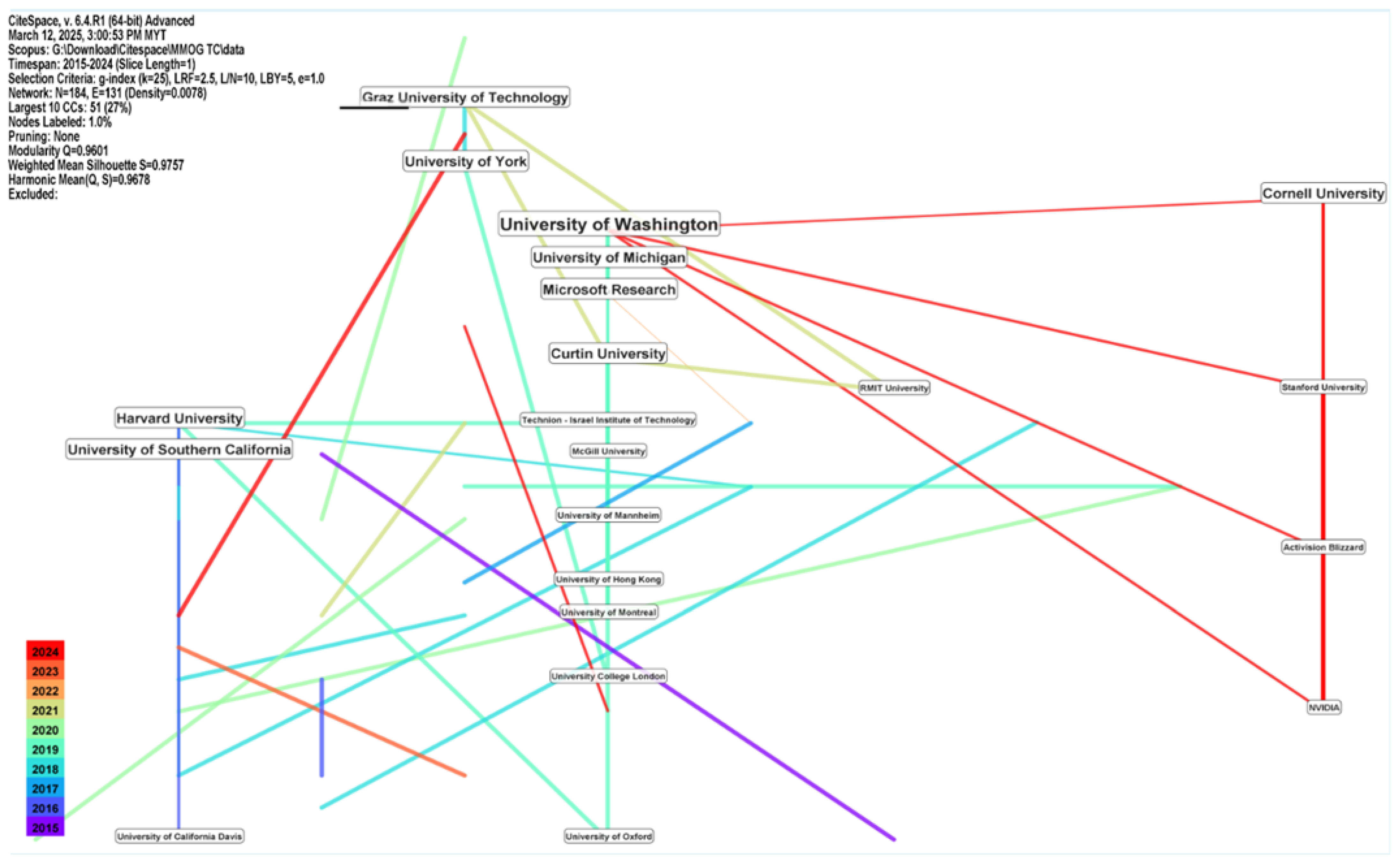
The institutional interaction network includes 183 active nodes and 133 collaborations (Figure 3). This representation shows quite little collaboration between institutes, confirming the results of Table 4. Research with different collaborative interests may also have regional differences. In this space, the University of Washington notably excels at using tabletop games to investigate team dynamics through competition [57]. Cornell University studied the effects of team dynamics, player movement patterns, and social networks in MMOGs [58,59]. Harvard University has conducted extensive research on non-verbal communication and information decoupling in team scenarios to establish a peer-to-peer communication paradigm [60,61]. Enhancing players’ real-time strategic team collaboration experience in MMOGs can be achieved through map tracking and emphasising signals [60]. The collaboration network of US organisations can help researchers identify prospective collaborators, partners, and fertile ground for broader international team collaboration in MMOGs.

4.2.2. Country Collaboration Network

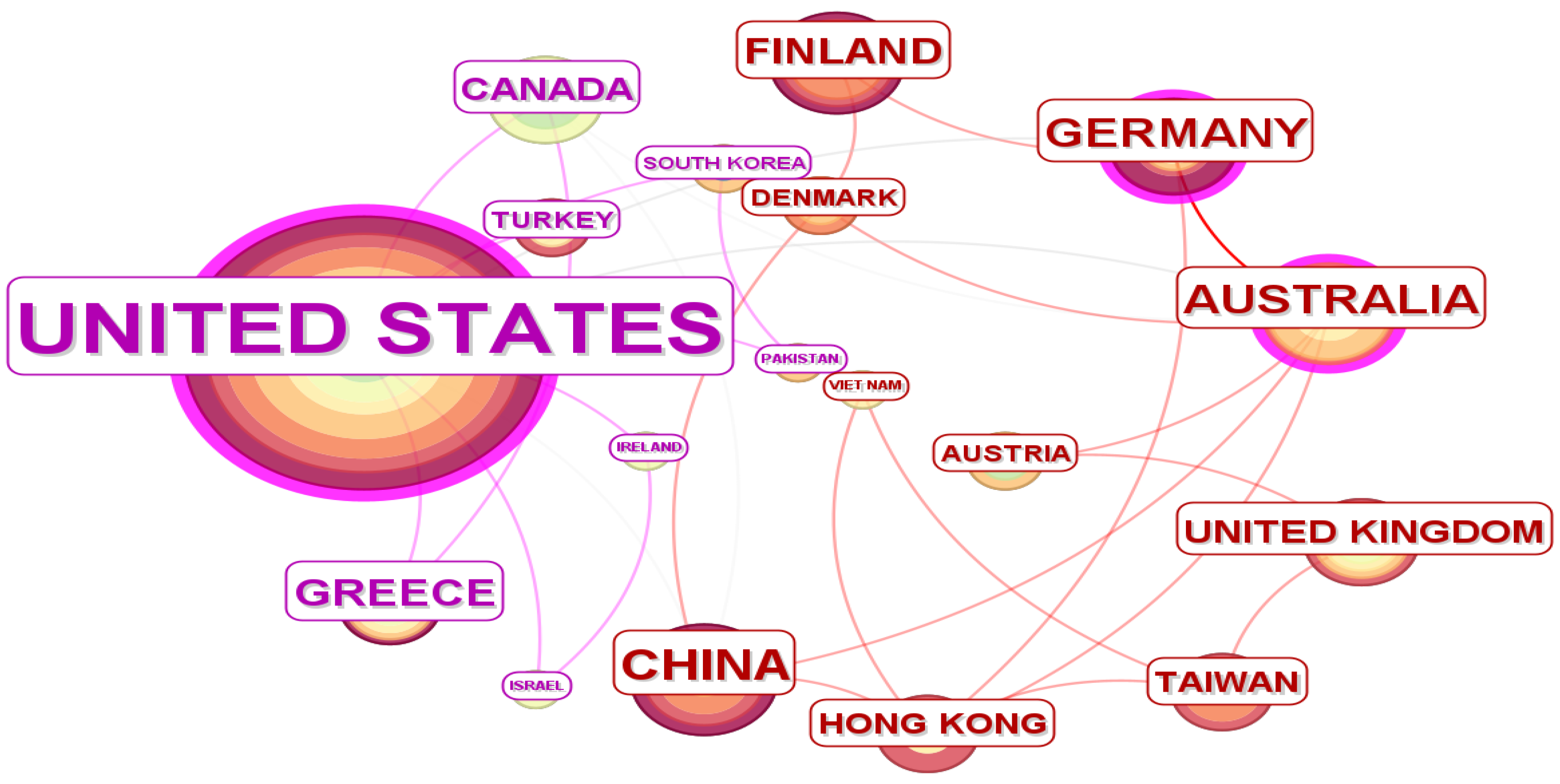
Table 5 lists the top ten cooperation regions, among which eight are developed regions and two are emerging regions (China and Hong Kong). This study aims to clarify how the development background shapes the cooperative model in the research of MMOGs. This concentration phenomenon should be regarded as a feature of the indexed corpus and co-authored structure, rather than evidence of the inherent superiority of research quality in developed regions. It is worth noting that the United States contributed 69 papers, with an intermediate centrality of 0.45. This centrality should be better understood as the medium position that connects the originally weakly associated regional groups, rather than merely “strong collaboration”. Although Greece and Finland are on the periphery (0.01), they still have the potential to produce influential results. Its marginal mediating status indicates fewer cross-group bridge connections, suggesting the existence of a cross-group cooperation space for promoting knowledge diffusion. Such differences in regional cooperation highlight the need to consider structural factors when choosing partners. Overall, the images show a core-edge tendency, and a few hubs may mediate cooperative relationships, thereby spreading the research topics and methods. Therefore, the regional cooperation association graph presents the co-authored structure of MMOG studies in the sample dataset.
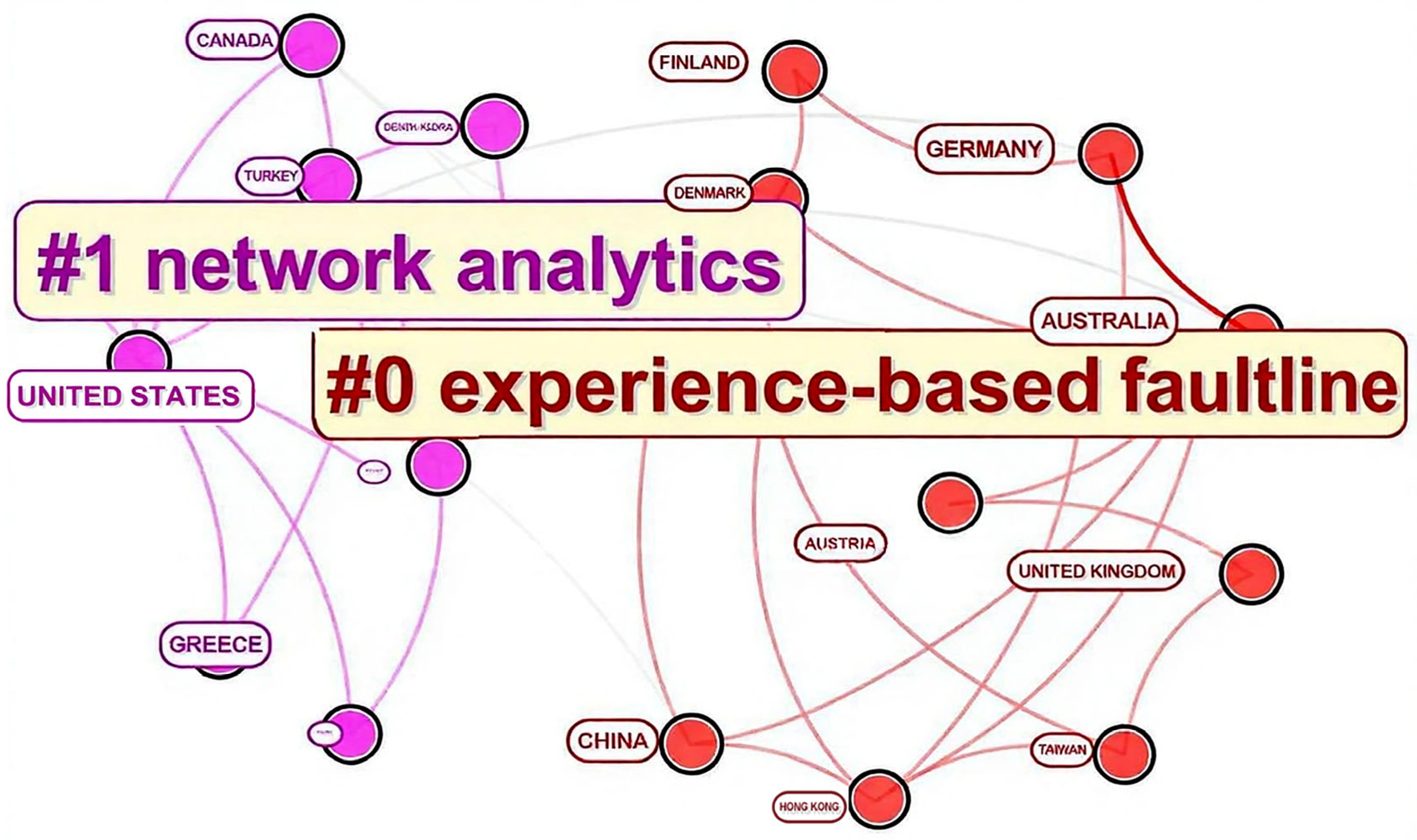
The regional cooperation network is shown in Figure 4 and Figure 5, consisting of 41 nodes and 45 collaborative links. Node size represents the publication frequency in the dataset, links represent international co-authorship relationships, and intramodality and centrality capture the intermediary role of the originally weakly associated parts in the connection network [54]. A relatively low ratio of edge nodes indicates a sparse collaborative structure, suggesting that cross-regional cooperation is mainly concentrated in a limited number of regions. The key nodes in the network include the United States, China, Australia, Finland and Germany. An in-depth analysis of these nodes helps understand the mediating role of the United States in collaborative research on MMOG teams. The US node covers a wide range of topics, from team communication strategies and mobility patterns to the impact of management on team dynamics and game collaboration behaviours. China, Australia, and Germany, on the other hand, place more emphasis on empirical research on players’ attention and its correlation with information retention. This clustering pattern suggests that the collaborative structure may be coupled with regional specialisation in issues, thereby influencing which problems and methods in the literature are more visible.
The key question is: How can leaders motivate and guide teams to achieve common goals? These motivational methods are based on multiple training courses that explore how human experience and behaviour affect team collaboration. From a network perspective, integrating leadership and motivation insights from different regions may require establishing cross-cluster bridge relationships rather than simply enhancing the internal density of a single cluster. In conclusion, different academic fields can give rise to unique and valuable cooperation models, and the selection of research partners requires careful consideration.

4.2.3. Keyword Co-Citation Collaboration Network

Table 6 summarises the keyword co-occurrence results and highlights the most frequently used terms in the MMOG team collaboration literature. “Team performance” is the most frequently occurring keyword (25 occurrences; occurrences since 2017), with a centrality of 0.11. In a keyword network, frequency reflects a term’s popularity, whereas centrality captures the bridging role the term plays between different topic clusters. Although its centrality is lower than the benchmark value of 0.15 used in a previous CiteSpace-based study [39], this does not mean that “team performance” is unimportant; rather, it suggests that the term exists primarily as a generic outcome label across studies rather than as a bridging term connecting different research areas. After “team performance”, “interactive computer graphics” came in second with 20 occurrences, followed by “online social networking” (19 occurrences) and “human–computer interaction” (16 occurrences), followed by “human resource management” and “behavioural research” with 15 occurrences each. The term “multiplayer games” appeared 11 times, with a centrality of 0.14. This pattern confirms the function of “multiplayer games” as a domain descriptor, but its bridging role across different research clusters remains relatively limited. Overall, the keyword distribution shows a stratified research focus, covering technology-oriented basic research, behavioural and organisational perspectives, and outcome-oriented evaluation.
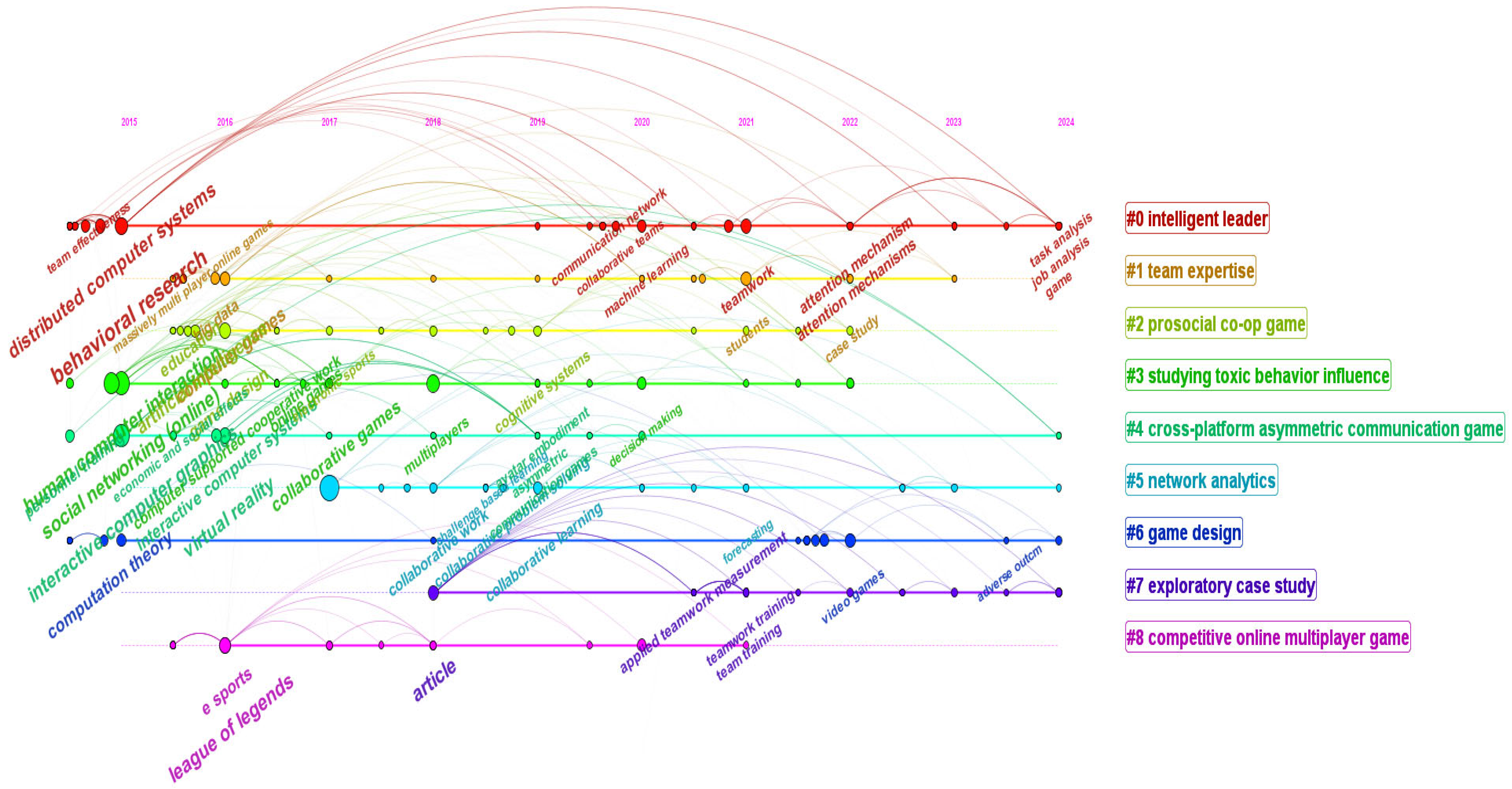
The visualisation in Figure 6 shows the evolutionary trajectory of the intersection of themes and disciplines in MMOG teamwork research. Terms with a high degree of intermediary centrality tend to indicate cross-thematic integration, and technology-oriented terms show significant bridge status. For example, “interactive computer graphics” (2015) and “human-computer interaction” (2015) have centrality scores of 0.21 and 0.24, respectively, suggesting that technically oriented research often connects multiple thematic clusters in tandem (e.g., interface design, interaction modes, and behavioural outcomes). The network structure further reveals thematic associations between technological implementations and applied game scenarios (e.g., virtual reality and League of Legends), reflecting the interaction between technological enablement and collaborative behaviour. In the social science-oriented genre, “online social networks” (2015) was both highly frequent (19 occurrences) and structurally connected (centrality = 0.21), linking “human resource management” (2019) and “global marketing” (2019). “Global marketing” suggests an interdisciplinary integration of management research and perspectives on social interaction.
In addition, the keyword timeline shows a trend of diffusion of emerging research priorities. The node “video games” (2022), although appearing less frequently (8 times), showed strong connectivity (density = 0.28), suggesting an emerging research direction linking previously independent themes. The evolution from “multiplayer games” (2018) to “competitive online multiplayer games” (2022), as analysed from a time-series of keyword co-occurrences, reflects a growing interest in the impact of competitive team contexts and their collaborative mechanisms. Taken together, the findings suggest that recent attention has focused on leadership, team knowledge, and game design features, while noting that the topics of competitive multiplayer, social collaboration, and gaming behaviour are still at a relatively early stage of exploration. Future research could focus on team-level interaction mechanisms (e.g., coordinated repair, role negotiation, and temporal adaptation) rather than on descriptive studies at the individual or macro-social levels.

4.3. Seminal Publications by Construct

4.3.1. Core Concepts in Publications

In this section, we integrate the pioneering research literature of MMOG team collaboration by classifying high-frequency tags into fifteen core concepts in Table 7. For each construct, we provide clear definitions to distinguish it from related concepts and summarise the typical operationalised definitions or measurement methods used in previous studies. This method helps avoid treating variables with different operationalisations as interchangeable, thereby supporting more consistent cross-study comparisons. The specific details are as follows:
Communication
Communication refers to the information exchange and coordination carried out by players to complete collaborative tasks, covering channels such as text, voice, and tags (such as location prompt sounds) [61]. Existing studies typically capture communication behaviour through operational indicators: for instance, counting the frequency and time points of messages and voice clips (such as the order of speech and response delay) [62], recording the choice of communication channels (voice and text) [63], and analysing whether the conversation content contains strategy instructions, confirmation messages, or feedback [4]. Another study quantified communication quality by directly asking players whether the information was clear, timely, and supportive of collaboration [11]. It should be particularly noted that the operational definitions of “communication” vary significantly among different studies: some focus on quantity (communication frequency) [61], some on structure (sequence and rhythm) [2], and others prioritise content (strategic or emotional content) [64]. Therefore, the same term may correspond to different mechanisms in different papers.
Team Performance
Team performance refers to the objective results produced by the team in the game, such as wins and losses, completion time, ranking, and task and goal achievement rates [8,35]. Operationally, research mostly uses game logs and platform data (win rate, ranking, kills, assists, target control, clearance time, and error rate), and may standardise by difficulty, opponent level, and role division [2,35,49]. There are substantial differences in how performance is operationalised: some studies use win rates, others use ranking changes, and others use target contributions or efficiency indicators [2,65]. These differences can directly affect the statistical relationships with variables such as communication [32], trust [34], and collaboration [35].
Team Collaboration
Team collaboration refers to the active cooperation among members to complete common tasks, including joint planning, mutual assistance, resource sharing, and joint problem-solving [34]. Operationally, research often employs collaboration or coordination scales, records mutual assistance behaviours (filling in, rescue, and support), joint planning and review mechanisms, and collaborative behavioural proxies in logs (assists, resource sharing, and skill connections) through observation and coding [20,66]. Operationalizations may lean toward process behaviour (mutual assistance and coordination) or toward structure and mechanism (such as interdependence) [35]. If these are not distinguished, boundaries between collaboration and task structure, as well as between collaboration [67] and communication [46] channels, can become blurred.
Social Interaction
In this study, social interaction refers to relational and social participation among players, including casual chatting, emotional support, building relationships, and a sense of belonging [15]. It does not necessarily directly serve task goals. Operationally, research measures interaction frequency (chat volume, team duration, and the number of repeated collaborations between peers), social network relationships (friend and guild connections), and code content (encouragement, humour, care, and relationship-oriented wording) [15,45,68]. Some studies also use behavioural traces to predict interaction quality [15]. Operational variability is reflected in the fact that some equate social interaction with the quantity of communication, while others emphasise interaction quality and emotional components [68]. Therefore, it is necessary to clarify whether the focus is on the amount of interaction or the type of interaction.
Player Experience
Player experience refers to the overall subjective perception shaped by both collaborative coordination and social interaction during team-based gameplay in MMOGs [68]. Previous studies typically capture team player experiences through the following operational definitions: one category involves post-game questionnaires and ratings that directly inquire about player satisfaction, enjoyment, immersion, stress or frustration, team atmosphere, and interaction quality during team play [65,69]; another category measures experiences by breaking them down into dimensions more closely aligned with team collaboration and social dynamics, such as collaborative fluency and coordination quality, team cohesion and belonging, interaction quality (support, encouragement, or conflict), and social connection and perceived social capital [39,45]. Other studies combine behavioural and content evidence (e.g., communication sequences, traces of social interaction, exposure to toxins, and team persistence) to explain why experiences improve or deteriorate [46,47]. We conceptualise team player experience as a team-process-driven subjective outcome variable [35]. The collaborative dimension is primarily influenced by communication clarity, trust, and coordination efficiency [35]. The social dimension is mainly affected by relationship quality, reciprocity and support, and the presence of malicious behaviour [15]. It should also be noted that different studies sometimes measure team experience as individual emotion or immersion, while a few measure team atmosphere or retention intent; these measurement approaches correspond to different underlying mechanisms, leading to substantial variation and, consequently, different results and findings.
Team Effectiveness
Team effectiveness refers to comprehensive performance whereby a team not only achieves its goals but also maintains good functioning and member satisfaction (process quality and sustainability) [41]. Operationally, research commonly synthesises multiple indicators: task completion status or success rate, process quality (coordination and conflict management), and member satisfaction or willingness to continue cooperation jointly constitute effectiveness [48]. Some studies also ask team members to provide an overall rating of whether the team is effective [36,41]. Operational differences across studies arise because some equate effectiveness with performance [5], while others incorporate satisfaction and sustainability [70]. Therefore, if the distinction between effectiveness and performance is not made, conclusions may be overly simplified.
Team Dynamics
Team dynamics refer to stable or repetitive patterns that emerge during interaction, such as collaborative rhythm, the balance between cohesion and conflict, responsiveness, role negotiation, and emotional contagion [66]. Operationally, studies commonly adopt cohesion, conflict, and coordination quality scales [11]. Sequence analysis and interaction coding (such as confirmation–execution–feedback chains and conflict segments), as well as communication network structure indicators (density and reciprocity), are also used [66]. It should be acknowledged that team dynamics are often treated as “process variables,” but specific measurements may target different phenomena (such as cohesion, conflict, tilt, or rhythm). Therefore, cross-study comparisons must specify which dimension of dynamics is being measured.
Collaborative Knowledge
We understand collaborative knowledge as executable knowledge and understanding shared by a team for effective coordination, including a common understanding of mechanics, strategies, role responsibilities, and teammates’ capabilities [70]. Operationally, research is typically measured through scales related to team cognition and shared understanding, and is also indirectly reflected through behavioural manifestations such as content coding of strategy discussions, correct response rates to key mechanics, reduced coordination errors, and faster adaptation to new situations [20]. Operationalisations vary substantially: some measure what is known (knowledge level), some measure consistency (degree of sharing), and others use performance outcomes to infer knowledge quality [66]. Therefore, it is necessary to state which approach is being used clearly.
Leadership
Leadership in games refers to the process by which individuals in a team influence, guide, and coordinate the actions of others to promote goal attainment (e.g., formulating strategies, assigning roles, mediating conflicts, and organising team rhythms) [37,71]. Operationally, research often measures leadership using scales that evaluate leader behaviours as perceived by players [39,72]. Studies also code communication content (instruction issuance, decision initiation, task division, and conflict management) or use structural indicators (whether someone is a team leader, group leader, or an official and communication network centrality) to identify leadership roles [37,71]. Across studies, operationalisations may emphasise transformational or transactional leadership, shared leadership, or formal roles, and these differences can affect how relationships between leadership and performance or trust are observed.
Trust
We define trust as the psychological state in which players, based on their expectations of their teammates’ reliability and ability, are willing to rely on their teammates’ actions [34]. Researchers usually measure trust by directly evaluating teammates’ credibility and duty fulfilment through questionnaires [3]. At the same time, researchers emphasise operational definitions based on “action evidence,” such as observable behaviours including resource and loot sharing, allocation of key roles or tasks, reliance on teammate decision-making in uncertain situations, and reduced supervision and redundant confirmation [21,42]. The operational definitions of trust vary significantly in different studies: some measurements focus on ability-based trust, some on goodwill or reliability, and others infer trust through behavioural proxy variables. Therefore, it is not surprising that the research results are inconsistent.
Team commitment
Team commitment refers to a player’s psychological attachment to the team or guild and their willingness to remain within the team and invest time and energy [7]. Operationally, research often uses commitment, loyalty, or retention intention scales (such as “I am willing to stay in this team” and “I have a sense of belonging to the team”), and also employs behavioural indicators such as the duration of guild retention, the frequency of participation in team activities, and the stability of continuous team formation and participation as proxies [27,42]. Operational variability across studies is reflected in the following: some equate commitment with loyalty [28], some emphasise continuous investment, and others use retention behaviour rather than attitude measurement [7]. These differences may lead to the same concept being interpreted through different pathways, such as motivation-based explanations or behavioural-constraint explanations.
Task interdependence
Task interdependence refers to the structural requirement that team members rely on one another to successfully complete tasks; that is, individual actions must complement the actions, resources, and roles of others [35]. Research typically measures this construct by evaluating statements such as “I need others” contributions to complete tasks” or “others” performance affects my performance” through scales [35]. In addition, interdependence can also be inferred through game mechanics (such as complementary roles, forced synchronous actions, shared resources, and skill coordination) or reflected through record or network metrics as cross-role dependencies and collaborative coupling [73]. Therefore, there are significant differences in operationalisation across studies: some regard it as a task design attribute (objective structure), while others measure player perceptions (subjective dependency). These methodological differences may lead to divergence in research conclusions.
Toxic behaviour
In MMOGs, toxic behaviour refers to harmful, hostile, or destructive words and deeds (such as abuse, provocation, negative play, or intentional disruption of collaboration) displayed by players during team activities or battles, ultimately damaging the quality of collaboration or the experience of others [47]. At the operational level, toxic behaviour is typically measured through the following methods: chat text or voice content (abuse, threats, discrimination, ridicule, etc.), platform records (number of reports, penalties or bans, system toxicity markers), as well as the frequency and perceived severity of encounters reported by players [74,75]. There are significant differences in the operational definitions of toxic behaviour across studies: some include negative emotional expression, while others count only violations detected by the system; some focus on verbal attacks, while others focus on destructive behaviours (such as idling, feeding, and deliberately not cooperating) [58]. Therefore, if measurement standards are not distinguished, different phenomena may be conflated.
Culture
Culture usually refers to how cultural background and cultural norms shape the ways and results of collaborative interaction (such as politeness norms, authority distance preferences, and conflict resolution habits) in games [76,77]. Some studies use demographic variables, such as nationality, region, or language, as cultural proxies, whereas others use scales, such as cultural value dimensions and cultural intelligence [8]. Some studies encode cross-cultural misunderstanding and adaptation strategies through qualitative materials [6]. In our review, we distinguish between country and language indicators and values and abilities measures, and we carefully explain whether observed differences truly stem from cultural norms [78] because when culture is reduced to demographic indicators, it may simultaneously incorporate factors such as platform ecosystems, community norms, and language barriers; if not discussed separately, cultural effects are prone to overgeneralization.
Shared Goals
Shared goals refer to whether team members have a consistent understanding of the task goals and their priorities [67]. Previous studies often use goal consistency and goal clarity scales for measurement, and also code whether communication content contains goal statements and strategic consensus, or use whether the team’s actions are advancing toward the same goal as behavioural evidence [73]. When organising, we distinguish task goal alignment from collective orientation and collective intention (We-intention), because although they are related, their theoretical meanings differ [6,9]. It needs to be acknowledged that some studies assess whether the goal is clear, while others assess whether members see themselves as a whole; if this difference is not aligned first, comparisons are likely to be similar in name but different in meaning.
Table 7. Conceptual definitions and typical measures of team constructs.
ConceptualDistinguished fromOperational Definition/Typical MeasureBest References (2)
CommunicationDistinct from Social Interaction (relational talk) and Leadership (influence or direction). Communication is the exchange process, not necessarily relational or hierarchical.Operationalised via communication quality scales (clarity or timeliness), log-based measures (message and ping frequency, channel type), sequence or turn-taking metrics, and content coding (calls, confirmations, requests).[11,63]
Team PerformanceDistinct from Team Effectiveness (process and viability) and Player Experience (subjective). Performance refers to results only.Operationalised using in-game performance metrics (win rate, completion time, rank changes, objective captures, error rates), often normalised by difficulty and role composition.[49,79]
Team CollaborationDistinct from Task Interdependence (structural necessity) and Communication (exchange mechanism). Collaboration is the active cooperative work process.Measured using collaboration or coordination scales; observational coding (joint planning, mutual assistance, back-up behaviours); behavioural indicators (assists, shared resources, coordinated ability combos).[20,35]
Social InteractionDistinct from Communication (task information exchange) and Team Collaboration (working together toward goals). Social interaction includes relational and non-task engagement.Operationalised via interaction frequency (chat volume or time together), social support or relationship scales, network ties (friend or guild connections), and coded social talk (humour, encouragement).[15,45]
Player ExperienceDistinct from Team Performance (objective results) and Social Interaction (interpersonal process). Player experience is an individual subjective state.Measured via game UX or experience scales (enjoyment/flow/immersion), diary or post-session self-reports, emotion measures; sometimes complemented by indirect telemetry (session duration and return intent).[16,68]
Team EffectivenessDistinct from Team Performance (objective outcomes only) and Player Experience (individual subjective state). Effectiveness includes process and viability.Operationalised using multi-criteria composites: success rate plus process quality plus member satisfaction/viability; often triangulating surveys with objective outcomes.[3,41]
Team DynamicsDistinct from Team Effectiveness (overall success and viability) and Social Interaction (amount of interaction). Dynamics describe how interaction unfolds.Measured via cohesion, conflict and coordination scales, conversation sequence analysis, network metrics (density or reciprocity), and observational coding of interaction episodes.[57,79]
Cooperative KnowledgeDistinct from Communication (channel/process) and Shared Goals (what to achieve). Cooperative knowledge concerns what the team knows/understands for coordination.Operationalised via team cognition or shared understanding items, knowledge checks, content coding of strategy references, and indicators such as fewer coordination breakdowns and faster adaptation.[20,66]
LeadershipDistinct from Communication (exchange) and Team Collaboration (mutual cooperative work). Leadership implies direction beyond exchange and cooperation.Measured via perceived leadership scales, coded leadership behaviours (strategy calls, conflict resolution, role assignment), and structural indicators (formal leader/officer roles; centrality).[71,77]
TrustDistinct from Team Dynamics (interaction patterns) and Leadership (influence structure). Trust is a belief state about others, not interaction style or authority.Measured via trust scales, behavioural proxies include resource sharing, delegation, reliance under uncertainty, adherence to calls, and reduced monitoring behaviours.[21,34]
Team CommitmentDistinct from Trust (belief in reliability, competence and benevolence) and Shared Goals (goal alignment). Commitment concerns staying.Typically measured with commitment, loyalty and intention-to-stay items; behavioural proxies include guild/team retention, frequency of team participation, and continued engagement in team activities.[7,27]
CulturalDistinct from Social Interaction (general engagement) and Player Experience (subjective enjoyment or immersion). “Cultural” specifically refers to culture-linked norms/values/identity.Measured via demographics (nationality, region and language), cultural values scales, linguistic diversity indices, and qualitative coding of norm clashes or culturally patterned communication.[6,28]
Task InterdependenceDistinct from Team Collaboration (the cooperative process) and Communication (information exchange). Interdependence is the structural dependence of tasks, not cooperation quality.Measured with interdependence scales adapted to team play; inferred from role complementarity or required coordination mechanics; log or network indicators of cross-role dependence.[35,61]
Toxic BehaviourDistinct from Communication (which can be neutral or positive) and Team Dynamics (broader interaction patterns). Toxicity is specifically antisocial or harm-causing behaviour.Operationalized via chat and content coding (insults, harassment, griefing and sabotage), moderation logs (reports, bans and toxicity flags), and survey-based exposure/perception scales.[47,50]
Shared GoalsDistinct from Team Commitment (desire to stay or invest) and Team Performance (results). Shared goals concern goal alignment, not persistence or outcomes.Typically measured via Likert items on goal alignment or clarity; can also be coded from communication (goal statements, strategy agreement) or inferred from coordinated objective completion.[7,67]

4.3.2. Influence and High-Frequency Collaboration Themes

Table 8 and Table 9 are constructed from the same set of 25 essential publications that form the core evidence base of this review. Table 8 provides the bibliographic profile of these studies and ranks them by citation frequency, offering an influence-oriented overview of the post-2015 literature. Using the identical publication set, Table 7 summarises the 15 most concentrated high-frequency collaboration-related labels and shows how these themes are distributed across the essential studies. Read together, the two tables connect impact with thematic emphasis: they identify which works have been most influential and, at the same time, which collaboration topics (such as communication, coordination dynamics, trust and leadership, performance-related outcomes, player experience, and toxic behaviour) most consistently characterise the field’s seminal contributions.
As shown in Table 8, the thematic kernel of this core literature revolves around a small number of closely related, high-frequency co-occurring topics. Labels related to interaction processes (e.g., communication and team dynamics) and team outcomes (e.g., team performance and team efficacy) are prominently featured throughout the group, suggesting that the research logic focuses primarily on how coordination and information-exchange mechanisms influence quantifiable team outcomes. At the same time, Table 7 shows that collaboration research discourse is not purely performance-oriented: experiential and relational labels such as player experience, social interaction, and trust are repeatedly juxtaposed with the theme of performance, reflecting the dual focus of MMOG research on both ‘effective team collaboration’ and ‘quality of the game experience’ reflecting the MMOG study’s dual focus on ‘effective team collaboration’ and ‘quality of game experience’. The presence of toxic behaviours in the high-frequency labels further highlights the fact that contemporary MMOG collaboration research increasingly views negative social dynamics as a core disruptor of coordination processes and team outcomes, rather than a marginal community issue.
Interpreting Table 8 through an input–process–output (IPO) lens helps to clarify the function of these labels in the core literature. Some of the labels correspond to inputs/conditions that shape team collaboration (e.g., shared goals, task interdependence, team commitment, and cultural context); others capture process mechanisms of collaborative implementation (e.g., communication, leadership, team dynamics, and collaborative knowledge). Finally, multiple sets of labels represent outputs, including objective outcomes (team performance and team effectiveness) and subjective outcomes (player experience and broader social interactions). This IPO-aligned structure, revealed through patterns of clustering and co-occurrence of labels across the 25 core literature, supports an integrative reading of the field: collaborative conditions shape interactive processes that collectively influence performance and experiential outcomes. At the same time, toxic behaviours may interrupt these pathways.
In particular, Table 8 presents high-frequency labels rather than strict conceptual equivalences. For example, “communication” may be operationalised through dimensions such as message frequency in behavioural logs, perceived communication quality in questionnaires, channel mode (voice vs. text) or functional content (task coordination vs. socio-emotional communication). Similar operationalised heterogeneity exists for labels such as trust, leadership, and team effectiveness. Therefore, Table 8 is primarily used to identify the centralised thematic focus and topic associations in the core literature, while the narrative synthesis examines the operational descriptions and contexts of each study to interpret the findings.
Table 8. Distribution of high-frequency collaboration-related labels across the 25 essential MMOG collaboration publications.
SourceShared GoalsToxic BehaviourTask InterdependenceCulturalTeam CommitmentTrustLeadershipCooperative KnowledgeTeam DynamicsTeam EffectivenessPlayer ExperienceSocial InteractionTeam Collaboration/TeamworkTeam PerformanceCommunication
[20] X X XXXXXX
[22] XXXXXXX XXX
[68] X XXXXX
[27]X X XX XXXXXXXX
[80] X XXX
[47] X XXX
[79] XXXXX XXXXX
[49] XXXXXXXX
[2] X X XX XX
[75] X X XXXXX
[26] XXXX
[81] XX XX XX
[66] X XXXXXXXXX XX
[30] XXX XXXX
[82] X XX XX
[83]X X X X XXXX
[33] X XX XXX
[84] XXXXXXX
[85] X XXX XXXXX
[21] XXX XX XXXXX
[19] X XXX
[86] X X XXXXX
[87] X XX XXXX
[88] X X XXX XX
[67]X X XXX XXXXX
Note: “X” indicates that the corresponding study addressed/covered the construct in that column; blank cells indicate that the construct was not addressed.
Table 9. Twenty-five essential MMOG collaboration publications (2015–2024), ranked by citation frequency.
DBYearTitleAuthorsCitations
1SCO2021“An Ideal Human”: Expectations of AI Teammates in Human-AI TeamingZhang R.; McNeese N.J.; Freeman G.; Musick G.143
2WOS2020Emotional intelligence and transformational leadership in virtual teams: lessons from MMOGsMysirlaki S.; Paraskeva F.73
3WOS2018Player experiences in a massively multi-player online game: A diary study of performance, motivation, and social interactionFox J.; Gilbert M.; Tang W.Y.58
4WOS2020How online gamers’ participation fosters their team commitment: Perspective of social identity theoryLiao G.-Y.; Pham T.T.L.; Cheng T.C.E.; Teng C.-I.57
5WOS2017Alternate Reality Games as an Informal Learning Tool for Generating STEM Engagement among Underrepresented Youth: a Qualitative Evaluation of the SourceGilliam M.; Jagoda P.; Fabiyi C.; Lyman P.; Wilson C.; Hill B.; Bouris A.45
6WOS2018Relating conversational topics and toxic behaviour effects in a MOBA gamede Mesquita Neto J.A.; Becker K.43
7SCO2018Understanding eSports Team Formation and CoordinationFreeman G.; Wohn D.Y.42
8WOS2018Individual performance in team-based online gamesSapienza A.; Zeng Y.; Bessi A.; Lerman K.; Ferrara E.40
9SCO2018Exploring player experience in ranked League of LegendsMora-Cantallops M.; Sicilia M.-Á.33
10WOS2022Effects of individual toxic behaviour on team performance in League of LegendsMonge C.K.; O’Brien T.C.33
11WOS2021Integrating Learning Analytics and Collaborative Learning for Improving Student’s Academic PerformanceRafique A.; Khan M.S.; Jamal M.H.; Tasadduq M.; Rustam F.; Lee E.; Washington P.B.; Ashraf I.28
12WOS2022Inter-brain synchronisation occurs without physical co-presence during cooperative online gaming.Wikström V.; Saarikivi K.; Falcon M.; Makkonen T.; Martikainen S.; Putkinen V.; Cowley B.U.; Tervaniemi M.21
13SCO2021Leveling Up Team collaboration in Esports: Understanding Team Cognition in a Dynamic Virtual EnvironmentMusick G.; Zhang R.; McNeese N.J.; Freeman G.; Hridi A.P.21
14SCO2017User roles and team structures in a crowdsourcing community for international development–a social network perspectiveFuger S.; Schimpf R.; Füller J.; Hutter K.20
15WOS2022Promoting Social Relationships Using a Couch Cooperative Video Game: An empirical experiment with Unacquainted PlayersGarcia M.B.; Rull V.M.A.; Gunawardana S.S.J.D.; Bias D.J.M.; Chua R.C.C.; Cruz J.E.C.; Fernando Raguro M.C.; Lobo Perez M.R.20
16SCO2018Entangled with numbers: Quantified self and others in a team-based online gameKou Y.; Gui X.19
17SCO2021Toward Facilitating Team Formation and Communication Through Avatar-Based Interaction in Desktop-Based Immersive Virtual EnvironmentsGomes de Siqueira A.; Feijóo-García P.G.; Stuart J.; Lok B.17
18SCO2023Exploring the Impact of Gamification on 21st-Century Skills: Insights from DOTA 2Samala A.D.; Bojic L.; Vergara-Rodríguez D.; Klimova B.; Ranuharja F.15
19WOS2020Understanding the interactions between the scrum master and the development team: A game-theoretic approachKarabiyik T.; Jaiswal A.; Thomas P.; Magana A.J.14
20WOS2019Understanding the Influences of Past Experience on Trust in Human-agent Team collaborationHafizoğlu F.M.; Sen S.14
21WOS2018SimCEC: A collaborative VR-based simulator for surgical team collaboration educationPaiva P.V.F.; Machado L.S.; Valença A.M.G.; Batista T.V.; Moraes R.M.13
22SCO2023What makes an ideal team? Analysis of Popular Multi-player Online Battle Arena (MOBA) gamesThavamuni S.; Khalid M.N.A.; Iida H.13
23SCO2021Association of online political participation with social media usage, perceived information quality, political interest and political knowledge among Malaysian youth: Structural equation model analysisHalim H.; Mohamad B.; Dauda S.A.; Azizan F.L.; Akanmu M.D.11
24WOS2020Reflective agents for personalisation in collaborative gamesDaylamani-Zad D.; Agius H.; Angelides M.C.11
25WOS2023Promoting collaborative learning in virtual worlds: the power of “we”Li Y.-J.; Cheung C.M.K.; Shen X.-L.; Lee M.K.O.10

4.4. Mechanisms for Forming Team Collaboration

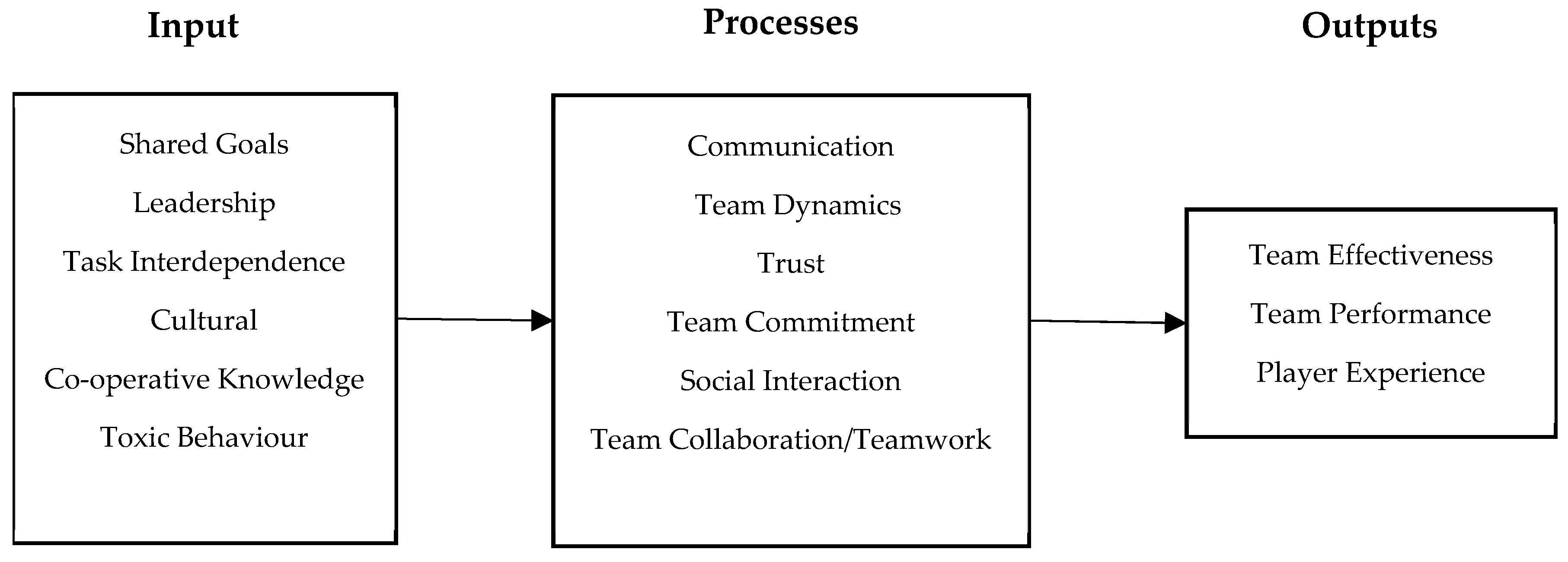
The above variables were organised to define a complete model of team collaboration mechanisms. Figure 7, therefore, serves as an IPO-based synthesis lens that consolidates the reviewed evidence by linking enabling conditions (inputs) to interaction mechanisms (processes) and their consequences (outputs). At the core of this model is the initiation of collaborative work, which consists of several borrowed input factors, such as shared goals [67], leadership [71], task interdependence [35], cultural [6], collaboration knowledge [70], and the fact that, sometimes, inside a team, toxic behaviours [75] are present. Leadership is treated as an input when operationalised as a pre-existing role or authority configuration, whereas toxic behaviour is viewed as a disruptive interactional mechanism that can undermine communication quality and trust. These input factors intermingle in a complicated way, triggering an ‘avalanche’ of team processes such as types of communication, developments within the team, constituting trust or commitment levels [42], social activity, and collaborative behaviours between the players [82]. Moreover, these interrelated processes are believed to be central in determining final team outcomes (e.g., team effectiveness, subjective gaming experience of an individual player). The model emphasises that effective team processes do not just happen by magic; rather, they are a product of the team development process, in which multiple forces are at play. It underscores the ongoing and reciprocal processes through which members of a team work together, focused on the dynamic interactions between different conditions and mechanisms that contribute to making a team perform as well as it does [88]. While the figure is shown in a linear form for clarity, collaboration in MMOGs teams is iterative and adaptive, with reciprocal influences between conditions, processes, and outcomes.
The in-game variable mapping described (shown in Table 10) serves as the basis for the interdependent path model. This diagram illustrates the complex relationships among game elements, cooperative conditions, and team outcomes. In line with this model, Musick et al. [66] identified eight specific functional types that exist in sport team contexts, which contribute to the development of some factors important for successful team functioning. For example, the presence of “shared goals” in a game environment helps support goal alignment and cooperation planning among team members [67]. This, in itself, makes a dramatic difference to team spirit and the players’ feeling of loyalty. Likewise, communication media such as “voice chat” play a role in promoting coordination and trust within the team and in expanding team members’ social relationships more effectively [63]. These examples illustrate how specific game features act as enabling or constraining inputs that activate distinct collaboration mechanisms within teams. It can be seen that different game properties in the process have the power to stimulate certain collaborative mechanisms on teams, forming different interaction mechanisms between players. These interaction dynamics then significantly affect team performance, team functioning, and overall player experience in the game world. The results further indicate that the present research focuses on investigating team effectiveness and player experience in a gaming environment. Taken together, the framework highlights that team effectiveness and player experience emerge from the interaction between structural conditions and in-game processes, rather than from isolated factors alone. This highlights the need to explore these dimensions further, in order to more fully understand how they interact in collaborative gaming contexts.
Based on the summary results of Table 11, it can be seen that the existing collaborative research of MMOG teams presents the characteristics of “multi-path parallelism but unbalanced evidence form” in terms of methods: Questionnaire research, qualitative/ethnographic research and design-oriented empirical research accounted for the highest proportion (each 17.1%), jointly constituting the main sources of explanations for subjective mechanisms such as “trust—communication experience—team cohesion” and collaborative situations. Although experimental studies can provide stronger causal identification, their number is relatively small (10.0%), and they mostly focus on changes in collaborative performance under short-term tasks or specific intervention conditions. Meanwhile, social network analysis and analytical/theoretical modelling provide a framework for structural and institutional explanations, but they remain limited in terms of sample coverage and cross-context comparability. However, the proportion of research truly centred on large-scale behavioural traces and machine learning remains relatively low (2.9% for log/behavioural trace analysis and 4.3% for machine learning or computational prediction), suggesting that this field has not fully utilized the inherent advantages of high-frequency and traceable interaction data in MMOG scenarios to depict the dynamic evolution and “fail–repair” process of collaboration. Taken together, these patterns indicate that current knowledge is strongest in describing collaboration-related perceptions and contextual explanations, whereas scalable, data-intensive approaches that capitalise on MMOG interaction traces are still emerging.

5. Discussions of Findings

The findings of this study are consistent with established theoretical frameworks on team collaboration and online collaboration across many key dimensions, such as the emphasis on communication, trust, and role division of labour, and also extend these theories in the context of MMOGs by revealing how game mechanics and interactive processes work together to affect team performance and player experience.

5.1. Publication Trends and Disciplinary Coverage

The increasing volume of papers on the subject indicates that the examination of team collaboration in the MMOG environment has evolved from a narrow domain within ‘game studies’ into a more general methodological framework for studying real-world digital-media collaboration under time pressure, high interdependence, and quantifiable (measurable) performance outcomes with players in MMOGs. Computer science (39.71% of the papers) plays a significant role, as expected, since many research approaches in MMOG team collaboration use traced interaction data, interface design, and computational modelling to enable synchronised actions. Nevertheless, there are other areas (10.92%), such as the social sciences (20.58%) and management (5.88%), that also make significant contributions, which expose further “behavioural or organisational trends” that they take into account. Team collaboration principles, such as leadership, cohesion, and commitment in the environment of the MMOGs are covered.
The findings of Mysirlaki & Paraskeva [91] and Castellano et al. [40] demonstrate that real-life organisational behaviour can be observed in MMOGs through evaluations of leadership and virtual team cohesiveness. This interdisciplinary integration is pragmatic: the potential for cooperation must be assessed not just regarding interface but also for subsequent effects (confidence, cohesiveness, effectiveness, and engagement), thereby linking MMOG development with the broader domain of virtual engagement. In addition, some of the same theoretical constructs that account for MMOG teams’ success (goal clarity, interdependency of roles, emotional intelligence, trust repairing) may apply to teams working remotely and communities learning online. Crime scripts based on the internet as a mediator of crime, with no direct physical presence between the victim and offender, also require these concepts, even though the literature has nevertheless generated indicators for them; however, the potential transferability of those concepts across contexts is not a given and needs rigorous empirical testing.

5.2. Collaboration Networks and Knowledge Hubs

American academic collaborator networks, such as those between research institutions like Rensselaer Polytechnic Institute and Cornell University, exhibit substantial interaction aggregation. Remarkably, of the top 10 collaborative global centres, seven are based in the US. This can be explained by the significant infrastructure for data-intensive research available in North America, which facilitates access to large behavioural datasets, interdisciplinary research labs and networks, and collaborative opportunities. North America, however, is a key node in technological resources and funding infrastructure and has a significant impact on research agendas and the transmission of knowledge. However, the US remains the most central in these collaboration networks, with an average score of 0.05–0.13, suggesting a slightly dispersed pattern of cooperation among the countries involved. Such fragmentation may restrict cross-national connections and thereby impede the possibility of research replication and the unification of models.
In contrast, European universities such as the University of Turku (Finland) and the University of Piraeus (Greece), which are relatively peripheral in this global network, contribute substantially to player behaviour and agility in cross-cultural team collaboration. This alleged “isolation effect” observed in the European institutions may be due to their research orientation, characterised by individual theoretical or methodological orientations. Furthermore, a lack of concordance in measurement protocols could lead to parallel evidence rather than adding up results.
The network of regional collaboration shows a clear bifurcation between high-income countries, including the US, Germany, and Australia, and developing economies such as China and Hong Kong. In this context, the US has a centrality score of 0.45 as a key actor in the knowledge domain. It is this central place that reflects the nation’s long-standing position in MMOG production, as well as its influence on landmark games such as League of Legends, and on academic publications in the field. On the other hand, China has increasingly taken part in it (0.05 of centrality score for China), which means that they are more interested in research related to MMOGs. Its network of relationships is fragmented, with weak transnational ties. This, in turn, highlights the need to encourage cross-national cooperation initiatives through the development of joint virtual laboratories or coordinated regional funding initiatives. The research dynamic reflects that agenda-setting, data availability, and publication capacity are primarily located in high-income areas. To expand the scalability, comparability, and applicability of research results across various national settings, greater emphasis on collaborative approaches is required. These could include adopting common experimental protocols and transparent governance structures for data sharing and attributing authorship to results. Such steps could help generate greater coherence in the research and stronger, more generalizable findings in this field.

5.3. Contradictions in Existing Research

The contents of Table 7 help to explain the seeming contradictions in the literature on teamwork in massively multiplayer online games and other virtual gaming scenarios. Many of these ‘contradictions’ may not be true theoretical conflicts, but rather stem from researchers measuring different things under the same label. When we align conceptual definitions with operational measurements, many of the disagreements reveal the nature of measurement mismatches rather than competing interpretations.
(a)
The Quantity–Quality Divide in Communication
The contradictions that have arisen in past research may not be theoretical conflicts, but rather the result of researchers measuring different things. For example, studies that have found that communication contributes to team performance have tended to focus on how members coordinate—concentrate on clarity and timeliness, turn structure, or coordination-related elements such as calling and acknowledging [11]. Conversely, when communication appears to be unhelpful, it is often because researchers operationalise it as information or call frequency, which reflects the amount of activity rather than what is actually conveyed [91]. This study clearly shows that each of these methods presents a distinct dimension of communication, and this mismatch alone is sufficient to yield inconsistent findings.
It is unclear whether the differences observed when studies use both “quality or content of communication” and “quantity of communication” indicators reflect real mechanism differences or are primarily driven by measurement incomparability [11,61].
(b)
Team Collaboration and Task Interdependence Differentials
The inconsistency in the conceptualisation of collaboration may also reflect the fact that researchers have measured different phenomena under the same label. Studies defining collaboration in Table 7 typically assessed collaborative work actually carried out (e.g., joint planning, mutual aid behaviours, supportive behaviours) or used the Collaboration and Coordination Scale [20,35]. Other studies, however, implicitly view collaboration as a function of task structure, inferring collaboration from metrics such as role complementarity or coordination needs, which better fit with task interdependence [34]. As we clearly distinguish between task interdependence and team collaboration, these operationalised definitions cannot be considered equivalent.
Thus, under a high interdependent task structure, existing research has not yet elucidated whether teams inevitably form high-quality collaborations or whether they diverge significantly due to differences in process variables, leading to inconsistent findings across studies [35,61].
(c)
Static to Dynamic Interaction Comparison Team Dynamics
Conflicting findings on team dynamics may not stem from differences in the importance of dynamics, but rather from differences in how the concept of ‘dynamics’ is operationalised. Some studies have measured dynamics through patterns of cohesion, conflict and coordination, or through observational coding of interaction events [57]. Others have focused on the way interactions unfold in collaborative activities and the manifestation of embodied participation in virtual contexts [79]. When team dynamics are only approximated by crude activity metrics (e.g., overall interaction volume), the measure may be reduced to mere communication volume or social interaction statistics rather than capturing temporal patterns of interaction. This apparent boundary suggests that such conceptual compression is highly susceptible to contradictory findings.
Existing evidence fails to adequately explain whether differences in team outcomes are driven by how interactions unfold, including dynamic processes such as conflict repair, mutual coordination and fit, or by static indicators of how much interaction there is [57].
(d)
Team Performance vs. Effectiveness vs. Player Experience in Output
Part of the contradiction may stem from the fact that researchers assessed different endpoint indicators when using similar terms such as “success”. Team performance is differentiated into subjective outcomes (e.g., win rate, completion time, ranking, or MMR change) [75], whereas team effectiveness additionally incorporates process quality and team survivability, which are often assessed through triangulation of subjective and objective metrics [91]. Player experience is further subdivided into individual subjective states (e.g., pleasure, mind-flow experience, immersion), which are measured through user experience scales, diaries, or post-game self-assessments [75]. When studies treat these endpoints as interchangeable, findings may be contradictory, as certain factors, while enhancing experience or team survival, may not directly improve outcome-oriented performance. Many studies ultimately focus on performance, effectiveness, or player experience. What is unclear, however, is whether the trade-offs between the different endpoints are relevant, and without a clear distinction between these concepts, it may be reported as an effective or ineffective outcome across studies.
(e)
Toxic Behaviour and High Activity Poor Communication Can Be Easily Confused
Finally, contradictory conclusions about communication and interaction may emerge when toxic behaviours are not distinguished from high levels of activity. Existing research tends to treat toxic behaviours as stand-alone constructs—antisocial and harm-causing behaviours—often operationalised through content coding (verbal abuse, harassment, vandalism, disruptive behaviours), administrative logs, or exposure and perception measures [47,75]. If the study relies primarily on communication volume metrics, high activism may stem in part from toxic communication rather than effective coordination, blurring or distorting its relationship with team effectiveness. Existing evidence fails to adequately explain how volume-based communication metrics systematically deviate from coordinated communication without explicitly separating toxicity from communication, leading to seemingly contradictory empirical findings [92].

5.4. Research Gaps and Emerging Themes

The current study found that research on team collaboration in MMOGs has expanded from early interface and interaction-centred studies to broader areas such as coordination, trust, leadership and collective efficacy. However, a core challenge remains: existing research has not yet adequately bridged the technologically enabled possibilities of collaboration with cross-situationally stable, mechanism-based explanations of the cumulative nature of collaboration. Research in immersive and avatar-mediated environments has shown that collaborative mechanisms can facilitate team building, communication, and embodied coordination [53,62,66].
The limitations of the research scope
However, empirical evidence at this stage is still mainly from specific games, genres, or community contexts, making it difficult to form a consistent judgement on the “stability” and “extrapolability” of the effects of mechanisms—whether they can consistently contribute to the quality of coordination, reinforce the implementation of role-playing, and enhance the effectiveness of collaboration in the context of a game [26,49]. There is still a lack of evidence across games and tasks on whether these mechanisms can consistently promote coordination quality, enhance role-playing, and improve team repair and resilience after collaborative disruptions. As a result, the synthesis of cross-theoretical perspectives is also limited. For example, the “virtual team” perspective has provided important insights in MMOG research [22], and studies linking emotional intelligence and leadership to team performance have emerged [48]. At the same time, a small amount of work does exist that further discusses how emotional intelligence and leadership shape MMOG team collaboration, but the overall conclusions have yet to settle into cumulative patterns. Given the structural differences in pacing, role division, interaction interfaces, and communication channels across games, the timing and pathways of emotional competence and leadership behaviours in performance remain difficult to generalise into universal propositions.
Bridging Technological Affordances and Mechanism-Based Collaboration in MMOGs
Research on team collaboration in MMOGs has expanded from early interface and interaction-centred studies to broader topics such as coordination, trust, leadership, and collective effectiveness. However, the key gap in linking technological empowerment to the cumulative interpretation of mechanism-based team collaboration remains. Research on immersive and virtual avatar environments has shown that collaboration mechanisms demonstrate great potential in team building, communication, and embodied coordination [19,33]. However, most of the evidence is still presented in terms of specific situations, making it difficult to summarise how these mechanisms can be translated into stable improvements in coordination quality, effective role-playing implementation, and recovery capabilities after collaboration disruptions. Related to this, although the “virtual team” perspective has generated beneficial insights from the MMOGs context [5], including research that links emotional intelligence and leadership to the outcomes of virtual teams [48], these concepts have not yet been systematically integrated with the constraints at the game and platform levels, resulting in fragmented interdisciplinary comprehensive research.
The mismatch between the concept of “collaboration” and the empirical measurement standards
Another long-standing gap lies in the inconsistency between the concept of “collaboration” and the measurement standards. In the existing literature, collaboration has been replaced by indicators such as participation, social integration, communication volume, and performance results, which complicates cross-research comparisons and weakens the effectiveness of evidence accumulation. Studies that emphasise cooperative motivation and the drive of game characteristics [69], as well as those that associate team engagement with social networks, communication, and commitment [42], have all revealed potential complementary paths. However, these paths often employ non-equivalent measurement methods and have overly short observation periods. At the methodological level, although MMOGs can provide an exceptionally rich process-level analysis trajectory, most studies still fail to fully exploit temporal interaction patterns to identify the collapse and repair cycles of the coordination mechanism. The mixed approach evidence regarding communication structure and team cohesion [39], non-verbal signals [50] and team performance [68], and the impact of malicious behaviour on team outcomes [75] jointly indicates that: collaborative dynamics are highly sequential and context-dependent—this highlights the necessity of focusing on interaction mechanisms (such as upgrades, coordination failures, and repair strategies) when designing models rather than merely relying on aggregation frequency metrics.
Methodological Level Differences
At the methodological level, MMOGs can provide exceptionally rich process trajectories to analyse temporal interactions, but most studies fail to fully exploit temporal patterns that can reveal cycles of coordination breakdown and repair. Mixed-methods evidence across communication structure and team cohesion [19], nonverbal signals and performance [45], and the impact of malicious behaviour on team outcomes [47] all point to the core insight that collaboration is sequential and context-dependent. This suggests that models should focus on interaction mechanisms—such as escalation, coordination failures, repair strategies, and realignment actions—rather than relying primarily on aggregation frequency metrics (e.g., total message volume). In other words, the same communicative behaviours can have different meanings and effects depending on the timing of their occurrence, the state of the team’s task, and the common practices developed by the team.
This also explains why there are contradictory findings, such as the relationship between emoji use and task performance [60]. It is impossible to directly assert whether emoticons can help a team win, and this uncertainty aligns with the expectation that emoticons work differently across contexts. In a relaxed, collaborative phase, emoticons can help maintain rapport, share emotions, and reach consensus quickly, while in fast-paced or complex moments, they can be disruptive, ambiguous, or add to the cognitive load. The pros and cons of emojis depend on team familiarity, common conventions, cultural interpretations and communication channels (and whether the interface is already too cluttered). As a result, emojis should be seen more as a context-sensitive harmonisation signal (sometimes used to repair relationships and regulate emotions) than as a consistent performance booster.
Process-Level Mechanism Gaps in MMOG Collaboration Research
Beyond the distributions themselves, Table 11 highlights a clear bottleneck in the accumulation of evidence: many studies consider macro-level outcomes such as trust, satisfaction, cohesion, and “team performance” or “quality of collaboration” as endpoints, while there are relatively few studies that directly model the process by which these outcomes are formed. There are relatively few studies that directly model the processes that lead to these outcomes, for example, how roles are stabilised, how information flows are restricted, or how teams experience breakdowns and repairs under stress. This has led to a parallelisation of evidence streams, questionnaires focusing on correlational studies, qualitative studies dissecting norms and meaning-making, and experimental studies testing limited interventions without sufficient convergence on comparable process-level explanations. A typical example is the treatment of toxicity phenomena. Despite being generally regarded as key inhibitors [75], researchers often reduce them to single labels rather than observable sequences based on interaction trajectories and sequential evidence (e.g., triggering → escalation → failure of coordination → fixing).
To break through this limitation, future research should prioritise triangulated validation designs that integrate (i) objective behavioural trajectories and interaction logs, (ii) controlled interventions or quasi-experiments, and (iii) interpretive validation (e.g., qualitative narratives, diaries, or mixed-methods corroboration), to correlate outcomes with mechanisms [68]. Moving from aggregated metrics to temporal and role-sensitive modelling can help to distinguish coordination-oriented communication from emotion/conflict-oriented communication, identify break-repair cycles, and validate mechanism claims across contexts through comparable operationalisation methods [35]. Finally, as MMOG research increasingly intersects with AI-mediated collaboration and AI teammates [50,56,88], methodological agendas should incorporate explicit ethical and governance considerations—especially fairness, accountability, and transparency, as these factors shape trust calibration and acceptance in hybrid enactive team collaboration.
Limitations of Existing Research
Previous research has often assumed that social-emotional communication has similar effects in different contexts. This lack of contextual modelling is likely to lead to conflicting results across studies. Many research designs only aggregate behavioural data within a short window of time, using frequency metrics (volume of messages, number of signals, number of interactions) as direct proxies for collaboration quality [35,82], without modelling interaction sequences (crash → fix) or team task states. The over-reliance on self-reporting and cross-sectional designs also limits causal inferences about whether communication patterns can improve coordination or merely reflect established cohesion. In addition, the wide variation in operational definitions leads to difficulties in confirming whether the same concept is even measured across studies, which further slows the cumulative construction of theory.
Several emerging themes are gaining prominence and are reshaping the research agenda. Competitive multiplayer games and eSports scenarios are emerging as valuable process arenas for studying high-speed coordination, team perceptions, and team dynamics in high-pressure environments [66], as well as for testing interventions aimed at mitigating destabilisation (e.g., emotional outbursts) and enhancing team effectiveness [20]. At the same time, human–computer collaboration is moving from the periphery to the core of research on multiplayer online game collaboration. Recent studies have explored how AI teammates and social bots affect team atmosphere and collaboration [50], how AI communication strategies shape human–computer team effectiveness [20], and how trust is formed in human–computer collaboration [34]. These studies also cover personalised approaches to collaborative game design based on a wider range of agents [88]. Finally, despite the critical importance of cross-cultural and transnational perspectives for testing the generalisability of research, the field remains relatively weak. Only a handful of studies have explicitly explored the association between cultural factors and player behaviour and outcomes [6], highlighting the need for broader comparative research to determine whether collaborative mechanisms and measurement tools can be effectively migrated across regions, game types, and platform ecosystems.

5.5. Implications

Given the fragmentation and conceptual ambiguity of research in this area, this study constructs a comprehensive frame of reference for MMOG team collaboration research by combining bibliometric mapping and systematic integration of evidence, thereby linking the thematic mechanisms to a broader body of knowledge and making the evolutionary trajectory of the journal literature easier to decipher and expand. In doing so, we strengthened conceptual coherence and enhanced cross-study comparability by establishing team collaboration as a core analytical construct and positioning adjacent terms (e.g., virtual team vs. team integration) as complementary perspectives rather than interchangeable labels.
To avoid simply replicating disciplinary fragmentation, we further unpack the evidence under scrutiny through common theoretical questions about MMOG collaboration, including what conditions activate collaboration, how coordination and governance unfold in interactions, and when these processes enhance performance and well-being. Psychological and behavioural research focuses on explaining motivation, social identity, trust, and mechanisms of conflict regulation; management research focuses on leadership, normative systems, and incentive structures; and computational science and human–computer interaction research enable collaboration through trajectory data and interface-mediated operability. These perspectives complement each other when they focus on common units of analysis (e.g., interaction contexts, role positioning, and time scales), whereas apparent contradictions often arise from misaligned conceptual definitions or measurement inequalities.
More importantly, we integrate the reviewed evidence into a comprehensive IPO (task, player, organisation) -oriented perspective, linking enabling conditions (inputs) with interaction mechanisms (processes) and outcomes (outputs), thereby clarifying the logic of mechanisms beyond the endpoint outcomes that have been the main focus of previous studies. In this framework, core collaborative elements repeatedly highlighted in the literature—such as task interdependence, communication, trust, leadership, and (disruptive) participant behaviours—are organised into interdependent pathways that collectively shape team efficacy and participant experience, whilst recognising that collaboration is iteratively adaptive rather than strictly linear.
At a practical level, the IPO perspective moves the research from abstract revelations to actionable design levers by elucidating how specific game features activate collaboration mechanisms and translate into team outcomes. The feature–mechanism–outcome mappings in Table 10 provide concrete guidelines for developers and platform designers: e.g., shared goals support goal alignment and collaborative planning; a role specialisation system creates role complementarity and interdependence; real-time voice provides high-bandwidth communication for rapid coordination and repair; progress correlation incentives reinforce motivation to collaborate and norms of contribution; low-cost signalling tools such as positional markers support cognitive low-cost signalling tools (e.g., location markers) supporting lightweight coordination under cognitive load; and ranking metrics or governance and feedback mechanisms help manage accountability pressures and reduce collaboration disruptions.
Finally, this review provides transferable analytical perspectives for other technology-mediated team scenarios (e.g., remote work and online education) by considering MMOG mechanisms as design analogues of digital collaboration features: role systems correspond to explicit role assignment and responsibility dashboards; shared goals correspond to shared objectives and key outcomes or learning objectives; lightweight in-game signalling corresponds to status or attention cues; governance or feedback tools correspond to management and accountability infrastructure. The tools correspond to the management and accountability infrastructure. Crucially, because interaction traces are naturally available in digital environments, practitioners can put the framework into practice by diagnosing coordination failures and repairing cycles through time-sensitive and role-sensitive metrics. This approach supports iterative interventions that target mechanisms rather than just outcomes.

5.6. Limitations

This study has several limitations. There are linguistic, geographical and database limitations to its evidence base, as we only included English-language peer-reviewed journal articles included in the Web of Science and Scopus databases between 2015–2024, which may have missed relevant findings in conference proceedings, other databases, and non-English language literature, and may have failed to adequately reflect the region-specific MMOGs context, thus limiting cross-cultural generalisability. In addition, as a secondary synthesis analysis, this study’s findings relied on the constructs and measures reported in the included studies, which were not complemented by primary qualitative evidence (e.g., interviews) or expert consensus processes (e.g., the Delphi method). Thus, the interpretive validation of the proposed IPO framework remains constrained, especially in subfields where evidence is sparse or inconsistent.
Future research should anchor the triangulation to specific MMOG collaboration scenarios (such as team copy pulling and regrouping, leader phase, and target capture) achieved by integrating server telemetry data, in-game communication signals, and team structure trajectories, and supplemented by a short post-battle review to correlate the results with the mechanism [68]. The analysis needs to be time-dimensional and role-aware, covering tanks, healers, damage-focused roles, and support, as well as team leaders and guild officers, to capture cycles of collaborative breakdown and repair and shifts in leadership [50]. It should also leverage causal levers inherent in MMOGs, including version updates and balance adjustments, matchmaking systems and voice features, and interface and plugin changes. Where controlled tests are needed, researchers can use sandbox or mixed-reality experiments that preserve latency and partial observability to evaluate interventions for shared awareness and responsibility attribution, including in AI-mediated teams [50,56].

6. Conclusions

The research consists of an SLR and a BA, resulting in a comprehensive understanding of the knowledge structure, evolutionary path, and gaps in MMOGs team collaboration. Consistent with our two objectives, the SLR consolidates the primary collaboration factors and interaction mechanisms reported in prior studies and links them to key outcomes (team effectiveness and player experience), while the BA maps how the field’s themes and research fronts have evolved within the journal literature. Investigation into collaboration with MMOGs has increased in the past decade. Beginning with technology-driven empirical methods such as interactive graphics and virtual reality, it has since turned to cognitive-behavioural mechanisms (e.g., emotional intelligence and team cohesion) and, more recently, to wider social phenomena, including e-sports and distributed collaboration. Even if research methodology continues to be fundamentally based on experiments and surveys, the growing usage of machine learning and graph neural networks indicates possible new ways of making inferences related to predicting behaviours.
Of the evidence reviewed, technology-oriented research continues to emphasise the optimisation of immersive interactive environments, while cognitive behavioural research focuses on interaction patterns and coordination signals (e.g., non-verbal cues and trajectories of play behaviour). At the same time, evidence coverage is uneven, and several research gaps remain unfilled. Future research should strengthen cross-cultural and longitudinal perspectives, focusing on team effectiveness and player experience, especially in AI-enabled immersive scenarios where collaborative norms and group dynamics evolve and are culturally diverse. Finally, it is important to emphasise that the field is inherently interdisciplinary: computer science drives methodological and technological advances, while sociological and managerial research provides theoretical frameworks and conceptual tools for understanding virtual team collaboration processes.

Author Contributions

Conceptualization, X.G., L.N.A., A.H.J. and N.M.N.; methodology, X.G.; software, X.G.; validation, X.G.; formal analysis, X.G.; investigation, X.G.; resources, X.G.; data curation, X.G.; writing—original draft preparation, X.G.; writing—review and editing, X.G., L.N.A., A.H.J. and N.M.N.; visualization, X.G.; supervision, L.N.A., A.H.J., N.M.N., R.F.W., Z.S. (Zulham Sitorus), Z.S. (Zulfahmi Syahputra) and K.; project administration, L.N.A. All authors have read and agreed to the published version of the manuscript.

Funding

This research received no external funding.

Data Availability Statement

The data presented in this study are in the paper.

Acknowledgments

The authors used an AI-assisted tool for language editing to improve readability. All content was reviewed and approved by the authors, who take full responsibility for the manuscript. The authors gratefully acknowledge Universitas Pembangunan Panca Budi and Universiti Putra Malaysia under the program of Adjunct Professor.

Conflicts of Interest

The authors declare no conflicts of interest.

Abbreviations

The following abbreviations are used in this manuscript:
MMOGsMassively Multiplayer Online Game
MMORPGMassively Multiplayer Online Pole-Playing Game
MMOFPSMassively Multiplayer Online First-Person Shooter Game
MOBAMultiplayer Online Battle Arena
SLRSystematic Literature Review
BABibliometric Analysis
HCIHuman–Computer Interaction

Appendix A

Table A1. Literature search strategy and filters.
ItemContent
DatabasesScopus and Web of Science Core Collection
Search FieldsTitle; Abstract; Author; Keywords; All Fields
Search String(“MMORPG” OR “MMORTS” OR “MMOFPS” OR “MOBA” OR “MMOGs” OR “massively multi-player online games.” OR “multi-player online games.” OR “multi-player games.” OR “multi-player”) AND (“team effectiveness” OR “team performance” OR “team collaboration” OR “team dynamics”) AND NOT “single-player.”
LanguageEnglish
Publication Period2015–2024 (Index date: 1 January 2015 to 31 December 2024)
Document TypeArticle

References

  1. Mahajan, K. Massive Multiplayer Online Games Market Growth at 10.5%; Market.us Scoop: New York, NJ, USA, 2025. [Google Scholar]
  2. Mora-Cantallops, M.; Sicilia, M.-Á. Team Efficiency and Network Structure: The Case of Professional League of Legends. Soc. Netw. 2019, 58, 105–115. [Google Scholar] [CrossRef]
  3. Alves, M.P.; Dimas, I.D.; Lourenço, P.R.; Rebelo, T.; Peñarroja, V.; Gamero, N. Can Virtuality Be Protective of Team Trust? Conflict and Effectiveness in Hybrid Teams. Behav. Inf. Technol. 2023, 42, 851–868. [Google Scholar] [CrossRef]
  4. Shishika, D.; Paulos, J.; Kumar, V. Cooperative Team Strategies for Multi-Player Perimeter-Defense Games. IEEE Robot. Autom. Lett. 2020, 5, 2738–2745. [Google Scholar] [CrossRef]
  5. Lee, Z.W.Y.; Cheung, C.M.K.; Chan, T.K.H. Understanding Massively Multiplayer Online Role-Playing Game Addiction: A Hedonic Management Perspective. Inf. Syst. J. 2021, 31, 33–61. [Google Scholar] [CrossRef]
  6. Chen, R.; Guo, Y.; Yu, M. Investigating the Impact of Chinese Cultural Elements on Player Loyalty in Video Games: A Cross-National Exploratory Study. In Proceedings of the 2023 3rd International Conference on Social Development and Media Communication (SDMC 2023); Qalati, S.A., Mohd Sharif, M.F., Ahmad, M.K., Ostic, D., Eds.; Advances in Social Science, Education and Humanities Research; Atlantis Press SARL: Paris, France, 2023; Volume 807, pp. 282–289. [Google Scholar]
  7. Pham, T.T.L.; Liao, G.-Y.; Shih, S.-P.; Cheng, T.C.E.; Teng, C.-I. How Gaming Team Participation Fosters Consumers’ Social Networks, Communication and Commitment. J. Retail. Consum. Serv. 2024, 81, 103962. [Google Scholar] [CrossRef]
  8. Garro-Abarca, V.; Palos-Sanchez, P.; Aguayo-Camacho, M. Virtual Teams in Times of Pandemic: Factors That Influence Performance. Front. Psychol. 2021, 12, 624637. [Google Scholar] [CrossRef]
  9. Song, K.; Kang, Y.; Liu, J.; Li, X.; Sun, C.; Liu, X. A Speaker Turn-Aware Multi-Task Adversarial Network for Joint User Satisfaction Estimation and Sentiment Analysis. Proc. AAAI Conf. Artif. Intell. 2023, 37, 13582–13590. [Google Scholar] [CrossRef]
  10. Bass, B.M.; Avolio, B.J.; Jung, D.I.; Berson, Y. Predicting Unit Performance by Assessing Transformational and Transactional Leadership. J. Appl. Psychol. 2003, 88, 207–218. [Google Scholar] [CrossRef]
  11. Tan, E.T.S.; Rogers, K.; Nacke, L.E.; Drachen, A.; Wade, A. Communication Sequences Indicate Team Cohesion: A Mixed-Methods Study of Ad Hoc League of Legends Teams. Proc. ACM Hum. Comput. Interact. 2022, 6, 225. [Google Scholar] [CrossRef]
  12. Weidmann, B.; Deming, D.J. Team Players: How Social Skills Improve Team Performance. Econometrica 2021, 89, 2637–2657. [Google Scholar] [CrossRef]
  13. Zhang, R.; McNeese, N.J.; Freeman, G.; Musick, G. “An Ideal Human”: Expectations of AI Teammates in Human-AI Teaming. Proc. ACM Hum. Comput. Interact. 2021, 4, 246. [Google Scholar] [CrossRef]
  14. Riar, M.; Morschheuser, B.; Zarnekow, R.; Hamari, J. Altruism or Egoism—How Do Game Features Motivate Cooperation? An Investigation into User We-Intention and I-Intention. Behav. Inf. Technol. 2023, 43, 1017–1041. [Google Scholar] [CrossRef]
  15. Frommel, J.; Sagl, V.; Depping, A.E.; Johanson, C.; Miller, M.K.; Mandryk, R.L. Recognizing Affiliation: Using Behavioural Traces to Predict the Quality of Social Interactions in Online Games. In Proceedings of the 2020 CHI Conference on Human Factors in Computing Systems; Association for Computing Machinery: New York, NY, USA, 2020; pp. 1–16. [Google Scholar]
  16. Agrawal, S. Work in Games: Exploring Player Experiences Caused by In-Game Activities. In Proceedings of the Extended Abstracts of the 2022 Annual Symposium on Computer-Human Interaction in Play; Association for Computing Machinery: New York, NY, USA, 2022; pp. 397–399. [Google Scholar]
  17. Christina, O.; Mullane, K.; Luethge, D. The Management and Coordination of Virtual Teams in Large Classes: Facilitating Experiential Learning. J. Manag. Educ. 2021, 45, 739–759. [Google Scholar] [CrossRef]
  18. Xue, G.; Lili, N.A.; Noris, M.N.; Azrul Hazri, J. Challenges and Issues in Team Gamer Loyalty for Massively Multiplayer Online Game. In Proceedings of the 4th International Conference on Advances in Computational Science and Engineering; Thiruchelvam, V., Alfred, R., Ismail, Z.I.B.A., Haviluddin, H., Baharum, A., Eds.; Springer Nature: Singapore, 2024; pp. 331–341. [Google Scholar]
  19. Paiva, P.V.F.; Machado, L.S.; Valença, A.M.G.; Batista, T.V.; Moraes, R.M. SimCEC: A Collaborative VR-Based Simulator for Surgical Teamwork Education. Comput. Entertain. 2018, 16, 3. [Google Scholar] [CrossRef]
  20. Zhang, R.; Duan, W.; Flathmann, C.; McNeese, N.; Freeman, G.; Williams, A. Investigating AI Teammate Communication Strategies and Their Impact in Human-AI Teams for Effective Teamwork. Proc. ACM Hum. Comput. Interact. 2023, 7, 281. [Google Scholar] [CrossRef]
  21. Hafizoğlu, F.M.; Sen, S. Understanding the Influences of Past Experience on Trust in Human-Agent Teamwork. ACM Trans. Internet Technol. 2019, 19, 45. [Google Scholar] [CrossRef]
  22. Mysirlaki, S.; Paraskeva, F. Emotional Intelligence and Transformational Leadership in Virtual Teams: Lessons from MMOGs. Leadersh. Organ. Dev. J. 2020, 41, 551–566. [Google Scholar] [CrossRef]
  23. Abarca, V.M.G.; Palos-Sanchez, P.R.; Rus-Arias, E. Working in Virtual Teams: A Systematic Literature Review and a Bibliometric Analysis. IEEE Access 2020, 8, 168923–168940. [Google Scholar] [CrossRef]
  24. Van Dinter, R.; Tekinerdogan, B.; Catal, C. Automation of Systematic Literature Reviews: A Systematic Literature Review. Inf. Softw. Technol. 2021, 136, 106589. [Google Scholar] [CrossRef]
  25. Vamvoudakis, K.G.; Modares, H.; Kiumarsi, B.; Lewis, F.L. Game Theory-Based Control System Algorithms with Real-Time Reinforcement Learning: How to Solve Multiplayer Games Online. IEEE Control Syst. Mag. 2017, 37, 33–52. [Google Scholar] [CrossRef]
  26. Rafique, A.; Khan, M.S.; Jamal, M.H.; Tasadduq, M.; Rustam, F.; Lee, E.; Washington, P.B.; Ashraf, I. Integrating Learning Analytics and Collaborative Learning for Improving Student’s Academic Performance. IEEE Access 2021, 9, 167812–167826. [Google Scholar] [CrossRef]
  27. Liao, G.-Y.; Cheng, T.C.E.; Shiau, W.-L.; Teng, C.-I. Impact of Online Gamers’ Conscientiousness on Team Function Engagement and Loyalty. Decis. Support Syst. 2021, 142, 113468. [Google Scholar] [CrossRef]
  28. Albatati, B.; Liu, F.; Wang, S.; Yu, M. Emotions and Online Gaming Experiences: An Examination of MMORPG Gamers from India and the United States. Comput. Hum. Behav. 2023, 148, 107900. [Google Scholar] [CrossRef]
  29. Huang, K.; Zhou, J.; Chen, S. Being a Solo Endeavor or Team Worker in Crowdsourcing Contests? It Is a Long-Term Decision You Need to Make. Proc. ACM Hum. Comput. Interact. 2022, 6, 494. [Google Scholar] [CrossRef]
  30. Fuger, S.; Schimpf, R.; Füller, J.; Hutter, K. User Roles and Team Structures in a Crowdsourcing Community for International Development—A Social Network Perspective. Inf. Technol. Dev. 2017, 23, 438–462. [Google Scholar] [CrossRef]
  31. Akin, M.S. Communication With the Social Environment in Multiplayer Online Games: The Turkey Case. Int. J. Game-Based Learn. 2023, 13, 1–14. [Google Scholar] [CrossRef]
  32. Eisenberg, J.; Post, C.; DiTomaso, N. Team Dispersion and Performance: The Role of Team Communication and Transformational Leadership. Small Group Res. 2019, 50, 348–380. [Google Scholar] [CrossRef]
  33. Gomes de Siqueira, A.; Feijóo-García, P.G.; Stuart, J.; Lok, B. Toward Facilitating Team Formation and Communication Through Avatar Based Interaction in Desktop-Based Immersive Virtual Environments. Front. Virtual Real. 2021, 2, 647801. [Google Scholar] [CrossRef]
  34. Nah, F.F.-H.; Schiller, S.Z.; Mennecke, B.E.; Siau, K.; Eschenbrenner, B.; Sattayanuwat, P. Collaboration in Virtual Worlds: Impact of Task Complexity on Team Trust and Satisfaction. J. Database Manag. 2017, 28, 60–78. [Google Scholar] [CrossRef]
  35. Carrasco-Farré, C.; Hakobjanyan, N. Experience Shapes Non-Linearities between Team Behavioral Interdependence, Team Collaboration, and Performance in Massively Multiplayer Online Games. Sci. Rep. 2024, 14, 7850. [Google Scholar] [CrossRef]
  36. Martono, S.; Khoiruddin, M.; Wijayanto, A.; Ridloah, S.; Wulansari, N.; Udin, U. Increasing Teamwork, Organizational Commitment and Effectiveness through the Implementation of Collaborative Resolution. J. Asian Financ. Econ. Bus. 2020, 7, 427–437. [Google Scholar] [CrossRef]
  37. Mayer, C.; Sivatheerthan, T.; Mütze-Niewöhner, S.; Nitsch, V. Sharing Leadership Behaviors in Virtual Teams: Effects of Shared Leadership Behaviors on Team Member Satisfaction and Productivity. Team Perform. Manag. Int. J. 2023, 29, 90–112. [Google Scholar] [CrossRef]
  38. Dossick, C.S.; Anderson, A.; Azari, R.; Iorio, J.; Neff, G.; Taylor, J.E. Messy Talk in Virtual Teams: Achieving Knowledge Synthesis through Shared Visualizations. J. Manag. Eng. 2015, 31, A4014003. [Google Scholar] [CrossRef]
  39. Van Der Voet, J.; Steijn, B. Team Innovation through Collaboration: How Visionary Leadership Spurs Innovation via Team Cohesion. Public Manag. Rev. 2021, 23, 1275–1294. [Google Scholar] [CrossRef]
  40. Castellano, S.; Chandavimol, K.; Khelladi, I.; Orhan, M.A. Impact of Self-Leadership and Shared Leadership on the Performance of Virtual R&D Teams. J. Bus. Res. 2021, 128, 578–586. [Google Scholar] [CrossRef]
  41. Purvanova, R.K.; Kenda, R. The Impact of Virtuality on Team Effectiveness in Organizational and Non-organizational Teams: A Meta-analysis. Appl. Psychol. 2022, 71, 1082–1131. [Google Scholar] [CrossRef]
  42. Flavián, C.; Guinalíu, M.; Jordán, P. Virtual Teams Are Here to Stay: How Personality Traits, Virtuality and Leader Gender Impact Trust in the Leader and Team Commitment. Eur. Res. Manag. Bus. Econ. 2022, 28, 100193. [Google Scholar] [CrossRef]
  43. Azadvar, A.; Canossa, A. UPEQ: Ubisoft Perceived Experience Questionnaire: A Self-Determination Evaluation Tool for Video Games. In Proceedings of the 13th International Conference on the Foundations of Digital Games; ACM: New York, NY, USA, 2018; pp. 1–7. [Google Scholar]
  44. Kaur Bagga, S.; Gera, S.; Haque, S.N. The Mediating Role of Organizational Culture: Transformational Leadership and Change Management in Virtual Teams. Asia Pac. Manag. Rev. 2023, 28, 120–131. [Google Scholar] [CrossRef]
  45. Kim, S.S.Y.; Huang-Isherwood, K.M.; Zheng, W.; Williams, D. The Art of Being Together: How Group Play Can Increase Reciprocity, Social Capital, and Social Status in a Multiplayer Online Game. Comput. Hum. Behav. 2022, 133, 107291. [Google Scholar] [CrossRef]
  46. Ghawi, R.; Müller, S.; Pfeffer, J. Improving Team Performance Prediction in MMOGs with Temporal Communication Networks. Soc. Netw. Anal. Min. 2021, 11, 65. [Google Scholar] [CrossRef]
  47. de Mesquita Neto, J.A.; Becker, K. Relating Conversational Topics and Toxic Behavior Effects in a MOBA Game. Entertain. Comput. 2018, 26, 10–29. [Google Scholar] [CrossRef]
  48. Sun, S.; Kim, J.H.; Lee, K.M.; Nan, D. Exploring the Association between the Proteus Effect and Intention to Play Massive Multiplayer Online Role-Playing Games (MMORPGs). Internet Res. 2024, 34, 58–78. [Google Scholar] [CrossRef]
  49. Sapienza, A.; Zeng, Y.; Bessi, A.; Lerman, K.; Ferrara, E. Individual Performance in Team-Based Online Games. R. Soc. Open Sci. 2018, 5, 180329. [Google Scholar] [CrossRef] [PubMed]
  50. Wang, Y.; Dai, Y.; Chen, S.; Wang, L.; Hoorn, J.F. Multiplayer Online Battle Arena (MOBA) Games: Improving Negative Atmosphere with Social Robots and AI Teammates. Systems 2023, 11, 425. [Google Scholar] [CrossRef]
  51. Donthu, N.; Kumar, S.; Mukherjee, D.; Pandey, N.; Lim, W.M. How to Conduct a Bibliometric Analysis: An Overview and Guidelines. J. Bus. Res. 2021, 133, 285–296. [Google Scholar] [CrossRef]
  52. Paul, J.; Khatri, P.; Kaur Duggal, H. Frameworks for Developing Impactful Systematic Literature Reviews and Theory Building: What, Why and How? J. Decis. Syst. 2024, 33, 537–550. [Google Scholar] [CrossRef]
  53. Geng, Y.; Zhang, N.; Zhu, R. Research Progress Analysis of Sustainable Smart Grid Based on CiteSpace. Energy Strategy Rev. 2023, 48, 101111. [Google Scholar] [CrossRef]
  54. Geng, Y.; Zhu, R.; Maimaituerxun, M. Bibliometric Review of Carbon Neutrality with CiteSpace: Evolution, Trends, and Framework. Environ. Sci. Pollut. Res 2022, 29, 76668–76686. [Google Scholar] [CrossRef]
  55. Cheng, Z.; Yang, Y.; Tan, C.; Cheng, D.; Zhuang, Y.; Cheng, A. What Makes a Good Team? A Large-Scale Study on the Effect of Team Composition in Honor of Kings. In Proceedings of the World Wide Web Conference, San Francisco, CA, USA, 13–17 May 2019. [Google Scholar]
  56. Zhang, L.; Ling, J.; Lin, M. Artificial Intelligence in Renewable Energy: A Comprehensive Bibliometric Analysis. Energy Rep. 2022, 8, 14072–14088. [Google Scholar] [CrossRef]
  57. Cho, Y.; Newman, M.; Pitt, C.; Yip, J.C.; Lee, J.H. You Are Tilted!: Leveraging Tabletop Gaming to Manage Tilt and Strengthen Team Dynamics in Esports. Proc. ACM Hum. Comput. Interact. 2024, 8, 351. [Google Scholar] [CrossRef]
  58. Durst, D.; Xie, F.; Sarukkai, V.; Shacklett, B.; Frosio, I.; Tessler, C.; Kim, J.; Taylor, C.; Bernstein, G.; Choudhury, S.; et al. Learning to Move Like Professional Counter-Strike Players. Comput. Graph. Forum 2024, 43, e15173. [Google Scholar] [CrossRef]
  59. Song, S.; Lee, J.; Hwang, I. A New Framework of Usability Evaluation for Massively Multi-Player Online Game: Case Study of “World of Warcraft” Game. In Human-Computer Interaction. HCI Applications and Services; Jacko, J.A., Ed.; Lecture Notes in Computer Science; Springer: Berlin/Heidelberg, Germany, 2007; Volume 4553, pp. 341–350. [Google Scholar]
  60. Amir, O.; Grosz, B.J.; Gajos, K.Z.; Gultchin, L. Personalized Change Awareness: Reducing Information Overload in Loosely-Coupled Teamwork. Artif. Intell. 2019, 275, 204–233. [Google Scholar] [CrossRef]
  61. Leavitt, A.; Keegan, B.C.; Clark, J. Ping to Win? Non-Verbal Communication and Team Performance in Competitive Online Multiplayer Games. In Proceedings of the 2016 CHI Conference on Human Factors in Computing Systems; Association for Computing Machinery: New York, NY, USA, 2016; pp. 4337–4350. [Google Scholar]
  62. Zellner, K.A.; Sarcevic, A.; Krensta, M.A.; Sullivan, T.M.; Burd, R.S. Understanding Delay Awareness and Mitigation Mechanisms through an Iterative Design and Evaluation of a Prototype Alert System for Complex Teamwork. Proc. ACM Hum. Comput. Interact. 2023, 7, 260. [Google Scholar] [CrossRef]
  63. Midtlyng, M.; Sato, Y. Lightweight Multi-Objective Voice Adaptation for Real-Time Speech Interaction Applied in Games. In Proceedings of the 2020 IEEE Conference on Games (CoG); IEEE: Piscataway, NJ, USA, 2020; pp. 237–244. [Google Scholar]
  64. Ayalew, M.; Ayenew, Z. Do Paradoxical Virtual Leadership and Emotional Intelligence Have Relationships? In Particular from Technology Dependence, Geographical Dispersion, and Human Capital Tensions. Int. J. Organ. Leadersh. 2022, 11, 1–25. [Google Scholar] [CrossRef]
  65. Ferreira, J.M.; Acuña, S.T.; Dieste, O.; Vegas, S.; Santos, A.; Rodríguez, F.; Juristo, N. Impact of Usability Mechanisms: An Experiment on Efficiency, Effectiveness and User Satisfaction. Inf. Softw. Technol. 2020, 117, 106195. [Google Scholar] [CrossRef]
  66. Musick, G.; Zhang, R.; McNeese, N.J.; Freeman, G.; Hridi, A.P. Leveling Up Teamwork in Esports: Understanding Team Cognition in a Dynamic Virtual Environment. Proc. ACM Hum. Comput. Interact. 2021, 5, 49. [Google Scholar] [CrossRef]
  67. Li, Y.-J.; Cheung, C.M.K.; Shen, X.-L.; Lee, M.K.O. Promoting Collaborative Learning in Virtual Worlds: The Power of “We”. Inf. Technol. People 2023, 36, 2563–2586. [Google Scholar] [CrossRef]
  68. Fox, J.; Gilbert, M.; Tang, W.Y. Player Experiences in a Massively Multiplayer Online Game: A Diary Study of Performance, Motivation, and Social Interaction. New Media Soc. 2018, 20, 4056–4073. [Google Scholar] [CrossRef]
  69. Tu, C.; Tunggal, J.; Brown, S. Character Immersion in Video Games as a Form of Acting. Psychol. Pop. Media 2023, 12, 405–413. [Google Scholar] [CrossRef]
  70. Vătămănescu, E.-M.; Dinu, E.; Stratone, M.-E.; Stăneiu, R.-M.; Vintilă, F. Adding Knowledge to Virtual Teams in the New Normal: From Leader-Team Communication towards the Satisfaction with Teamwork. Sustainability 2022, 14, 6424. [Google Scholar] [CrossRef]
  71. Brown, S.G.; Hill, N.S.; Lorinkova, N.M. Leadership and Virtual Team Performance: A Meta-Analytic Investigation. Eur. J. Work Organ. Psychol. 2021, 30, 672–685. [Google Scholar] [CrossRef]
  72. Solih, M.; Ahmed, N.; Moosa, V.; Shareefa, M.; Wider, W. Research Trends and Patterns on Emotional Intelligence in Education: A Bibliometric and Knowledge Mapping During 2012–2021. Open Educ. Stud. 2024, 6, 20240025. [Google Scholar] [CrossRef]
  73. Rejeb, A.; Abdollahi, A.; Rejeb, K.; Treiblmaier, H. Drones in Agriculture: A Review and Bibliometric Analysis. Comput. Electron. Agric. 2022, 198, 107017. [Google Scholar] [CrossRef]
  74. Rojas-Sánchez, M.A.; Palos-Sánchez, P.R.; Folgado-Fernández, J.A. Systematic Literature Review and Bibliometric Analysis on Virtual Reality and Education. Educ. Inf. Technol. 2023, 28, 155–192. [Google Scholar] [CrossRef]
  75. Monge, C.K.; O’Brien, T.C. Effects of Individual Toxic Behavior on Team Performance in League of Legends. Media Psychol. 2022, 25, 82–105. [Google Scholar] [CrossRef]
  76. Coon, J.; Etz, A.; Scontras, G.; Sarnecka, B.W. Esports as a Cultural Microcosm for Studying Psycholinguistics. Games Cult. 2024, 19, 357–372. [Google Scholar] [CrossRef]
  77. Paredes-Saavedra, M.; Vallejos, M.; Huancahuire-Vega, S.; Morales-García, W.C.; Geraldo-Campos, L.A. Work Team Effectiveness: Importance of Organizational Culture, Work Climate, Leadership, Creative Synergy, and Emotional Intelligence in University Employees. Adm. Sci. 2024, 14, 280. [Google Scholar] [CrossRef]
  78. Davaei, M.; Gunkel, M.; Taras, V. Team Climate and Performance in Global Virtual Teams: Exploring the Effects of Cultural Intelligence and Emotional Intelligence on Team Climate Satisfaction. Eur. J. Int. Manag. 2025, 26, 565–594. [Google Scholar] [CrossRef]
  79. Freeman, G.; Acena, D.; McNeese, N.J.; Schulenberg, K. Working Together Apart through Embodiment: Engaging in Everyday Collaborative Activities in Social Virtual Reality. Proc. ACM Hum. Comput. Interact. 2022, 6, 17. [Google Scholar] [CrossRef]
  80. Gilliam, M.; Jagoda, P.; Fabiyi, C.; Lyman, P.; Wilson, C.; Hill, B.; Bouris, A. Alternate Reality Games as an Informal Learning Tool for Generating STEM Engagement among Underrepresented Youth: A Qualitative Evaluation of the Source. J. Sci. Educ. Technol. 2017, 26, 295–308. [Google Scholar] [CrossRef]
  81. Wikström, V.; Saarikivi, K.; Falcon, M.; Makkonen, T.; Martikainen, S.; Putkinen, V.; Cowley, B.U.; Tervaniemi, M. Inter-Brain Synchronization Occurs without Physical Co-Presence during Cooperative Online Gaming. Neuropsychologia 2022, 174, 108316. [Google Scholar] [CrossRef] [PubMed]
  82. Garcia, M.B.; Rull, V.M.A.; Gunawardana, S.S.J.D.; Bias, D.J.M.; Chua, R.C.C.; Cruz, J.E.C.; Raguro, M.C.F.; Perez, M.R.L. Promoting Social Relationships Using a Couch Cooperative Video Game: An Empirical Experiment with Unacquainted Players. Int. J. Gaming Comput. Mediat. Simul. 2022, 14, 1–18. [Google Scholar] [CrossRef]
  83. Kou, Y.; Gui, X. Entangled with Numbers: Quantified Self and Others in a Team-Based Online Game. Proc. ACM Hum. Comput. Interact. 2018, 2, 93. [Google Scholar] [CrossRef]
  84. Samala, A.D.; Bojic, L.; Vergara-Rodríguez, D.; Klimova, B.; Ranuharja, F. Exploring the Impact of Gamification on 21st-Century Skills: Insights from DOTA 2. Int. J. Interact. Mob. Technol. 2023, 17, 33–54. [Google Scholar] [CrossRef]
  85. Karabiyik, T.; Jaiswal, A.; Thomas, P.; Magana, A.J. Understanding the Interactions between the Scrum Master and the Development Team: A Game-Theoretic Approach. Mathematics 2020, 8, 1553. [Google Scholar] [CrossRef]
  86. Thavamuni, S.; Khalid, M.N.A.; Iida, H. What Makes an Ideal Team? Analysis of Popular Multiplayer Online Battle Arena (MOBA) Games. Entertain. Comput. 2023, 44, 100523. [Google Scholar] [CrossRef]
  87. Halim, H.; Mohamad, B.; Dauda, S.A.; Azizan, F.L.; Akanmu, M.D. Association of Online Political Participation with Social Media Usage, Perceived Information Quality, Political Interest and Political Knowledge among Malaysian Youth: Structural Equation Model Analysis. Cogent Soc. Sci. 2021, 7, 1964186. [Google Scholar] [CrossRef]
  88. Daylamani-Zad, D.; Agius, H.; Angelides, M.C. Reflective Agents for Personalisation in Collaborative Games. Artif. Intell. Rev. 2020, 53, 429–474. [Google Scholar] [CrossRef]
  89. Liu, D.; Che, S.; Zhu, W. Visualizing the Knowledge Domain of Academic Mobility Research from 2010 to 2020: A Bibliometric Analysis Using CiteSpace. Sage Open 2022, 12, 21582440211068510. [Google Scholar] [CrossRef]
  90. Müller, S.; Ghawi, R.; Pfeffer, J. Reviewing the Potentials of MMOGs as Research Environments: A Case Study from the Strategy Game Travian. PLoS ONE 2023, 18, e0281114. [Google Scholar] [CrossRef]
  91. Mysirlaki, S.; Paraskeva, F. Virtual Team Effectiveness: Insights from the Virtual World Teams of Massively Multiplayer Online Games. J. Leadersh. Stud. 2019, 13, 36–55. [Google Scholar] [CrossRef]
  92. Beres, N.A.; Frommel, J.; Reid, E.; Mandryk, R.L.; Klarkowski, M. Don’t You Know That You’re Toxic: Normalization of Toxicity in Online Gaming. In Proceedings of the 2021 CHI Conference on Human Factors in Computing Systems; Association for Computing Machinery: New York, NY, USA, 2021; pp. 1–15. [Google Scholar]
Figure 1. PRISMA style flow diagram of the study selection process. Note: * 1 January 2015–31 December 2024.
Computers 15 00134 g001
Figure 2. Annual publication output. Note: The dotted line indicates the linear trend (trendline) of annual publication counts.
Computers 15 00134 g002
Figure 3. Institution collaboration.
Computers 15 00134 g003
Figure 4. Country collaboration network.
Computers 15 00134 g004
Figure 5. A set of regional collaboration network clusters.
Computers 15 00134 g005
Figure 6. Temporal evolution of keywords co-occurrence. Note: Nodes denote keywords; links denote keyword co-occurrence. Node size indicates keyword frequency; link thickness indicates co-occurrence strength. Colors represent thematic clusters. The x-axis shows publication year, and arcs track changes over time.
Computers 15 00134 g006
Figure 7. Input–Process–Output model (An interpretive synthesis framework that organises empirically reported factors in MMOG team collaboration; the linear layout is used for analytical clarity, while reciprocal and dynamic influences are discussed).
Computers 15 00134 g007
Table 1. Inclusion and exclusion standards.
ItemInclusionExclusion
ContextThe study is explicitly situated in MMOGs/MMORPG/MOBA/MMOFPS (or closely comparable multi-player online game settings) and addresses team collaboration/collaboration as a focal phenomenon (not merely incidental social interaction).General virtual teams, online communities, social media, esports culture, or digital platforms without a clear MMOG gameplay context; game studies focusing on single-player games.
Team ActivityInvolves team-based interaction with ≥2 players who must coordinate/collaborate to achieve a shared objective (e.g., raids/dungeons, guild/group tasks, ranked matches, squad/platoon operations).Solo play; individual-level behaviours without coordination demands; “co-presence” without interdependence (e.g., being in the same server/world but not collaborating).
Empirical EvidenceReports original empirical data and methods (e.g., experiments, surveys, interviews/ethnography, observation, gameplay logs/telemetry, match datasets, social network analyses grounded in game data).Purely conceptual/theoretical/opinion pieces without data; commentary/editorials; method notes without application to team collaboration phenomena.
Sample TypeParticipants are human players/teams; human–agent teams are included only if the study explicitly analyses team processes (e.g., coordination, trust, shared understanding) rather than only agent performance.Samples not related to MMOG team collaboration (e.g., developers only, spectators only) unless directly tied to team collaboration mechanisms in gameplay; purely synthetic simulations without human team processes.
OutcomesIncludes at least one team-relevant construct such as communication/coordination, trust, cohesion, leadership, role/task interdependence, conflict management, team performance/effectiveness, collective learning, or team-related player experience (e.g., perceived team collaboration quality).Cultural/narrative critique or discourse analysis with no identifiable team collaboration mechanisms/outcomes; studies focused solely on story/lore/representation unrelated to team collaboration.
Document LimitsEnglish, 2015–2024, peer-reviewed journal articles, full text available, and not retracted.Non-English; outside time window; conference proceedings, books/chapters, theses, preprints, review articles (if your protocol excludes secondary studies), and retracted papers.
Table 2. Publications by source type (journals vs. conferences).
No.Journals/ConferencesCountPercentageQuartile in Category
1Proceedings Of The ACM On Human Computer Interaction128.57%Q1
2Conference On Human Factors In Computing Systems Proceedings74.67%
3Proceedings Of The Human Factors And Ergonomics Society64.00%
4Lecture Notes In Computer Science, Including Subseries Lecture Notes In Artificial Intelligence And Lecture Notes In Bioinformatics42.67%
5ACM International Conference Proceeding Series42.67%
6Proceedings Of The European Conference On Games-Based Learning32.00%
7Proceedings Of The ACM Conference On Computer Supported Cooperative Work CSCW32.00%Q3
8IEEE Transactions On Games32.00%Q1
9New Media And Society21.33%Q1
10International Journal Of Information Management21.33%Q2
11IEEE Access21.33%Q2
12Frontiers In Psychology21.33%Q2
13Entertainment Computing21.33%Q4
14Communications In Computer And Information Science21.33%Q1
Table 3. Number of publications by subject area.
No.Subject AreaCountPercentage
1Computer Science10839.71%
2Social Sciences5620.59%
3Engineering2910.66%
4Mathematics165.88%
5Business, Management, and Accounting165.88%
6Psychology124.41%
7Decision Sciences82.94%
8Arts and Humanities62.21%
9Multidisciplinary41.47%
10Medicine41.47%
Table 4. Affiliation-based collaboration.
No.AffiliationRegionCountPercentageBeginEnd
1Rensselaer Polytechnic InstituteUS62.63%20162022
2School of EngineeringUS62.63%20162022
3Clemson UniversityUS52.19%20212024
4University of Southern CaliforniaUS52.19%20162023
5Iowa State UniversityUS41.75%20212023
6Turun yliopistoFinland41.75%20182024
7University of PiraeusGreece41.75%20152020
8Information Sciences InstituteUS41.75%20182021
9University of California, IrvineUS31.32%20182024
10Queensland University of TechnologyAustralia31.32%20152020
Table 5. Country collaboration.
No.RegionCountCentralityYear
1USA690.452016
2CHINA120.052018
3GERMANY100.102016
4AUSTRALIA100.092015
5GREECE90.012015
6UNITED KINGDOM90.072016
7CANADA80.132015
8FINLAND80.012018
9NETHERLANDS60.062017
10HONG KONG50.062019
Table 6. Rank keyword frequency between centrality first appearance.
KeywordsCountCentralityYear
1team performance250.112017
2interactive computer graphics200.212015
3social networking (online)190.212015
4human–computer interaction160.242015
5human resource management150.172019
6behavioural research110.242015
7multi-player110.142018
8team collaboration90.102021
9esports80.072016
10virtual reality80.092016
11League of Legends80.092016
12video games80.112022
Table 10. From game features to collaboration mechanisms and team outcomes.
Game FeatureCollaboration MechanismTeam OutcomeSources
Shared objectives or goalsObjective alignment; shared planning and strategy-setting. Stronger cohesion; higher commitment or loyalty.[30,63]
Real-time voiceHigh-bandwidth communication; rapid coordination and repair. Increased trust; stronger social ties.[30,45]
Role-specialization systemsTask interdependence, role complementarity, and mutual reliance. Clearer role responsibilities; higher execution efficiency.[34]
Progression-linked incentives Co-operative motivation; sustained contribution norms.Higher engagement; improved team satisfaction.[63]
High-difficulty group content Joint problem-solving; adaptive coordination under pressure. Better team performance; strategic synergy.[4]
Ranked ladders or quantified performance metrics “Competitive collaboration”; self-/peer-monitoring and accountability. Higher motivation; accountability pressures.[33,75]
Low-cost signalling tools Implicit, lightweight coordination; fast attention directing.Faster coordination (potentially); trust signalling (context-dependent).[89]
Identity and expression tools Belonging and identity expression; social signalling.Stronger social identity; longer-term cohesion.[84]
Table 11. Summary of research methods, collaboration focus, and reported outcomes in the reviewed MMOG team collaboration literature (N = 70).
Method CategoryShare (N = 70)Typical DataField of ResearchKey LimitationsExample References (2)
Survey-based studies17.1% (N = 12)Questionnaires or self-report scales (e.g., trust, cohesion, engagement); SEM or PLS modelsAssociations among constructs: predictors of perceived team functioning, experience, loyaltyCommon-method bias, limited causal inference; construct inconsistency across studies[3,27]
Design-oriented empirical studies17.1% (N = 12)Prototype, system, mechanic interventions and evaluation (user studies, field pilots, usability)Design levers (incentives, feedback, teammate support) that shape collaborationLimited replication; context-specific implementations; evaluation scope varies[19,50]
Qualitative interviews/ethnographic studies17.1% (N = 12)Interviews, observation, diary narratives; thematic, discourse analysisMechanisms, norms, meaning-making, conflict management, and role negotiation in contextSmaller samples; limited generalizability; labour-intensive; benefits from triangulation[80,83]
Controlled experiments10.0% (N = 7)Manipulated tasks, conditions in lab, field and game sessions; controlled comparisons; pre- and post- measuresCausal effects of design/constraints, interventions on coordination, affect, and performance.Short time windows; external validity; setup realism varies[34,82]
Analytical/theoretical modelling8.6% (N = 6)Formal models (e.g., game-theoretic, optimisation), conceptual frameworks, simulationsHypothesis generation; mechanism articulation; constraints/optimality analysisEmpirical grounding required; assumptions may not hold in real MMOG settings[25,85]
Social network analysis5.7% (N = 4)Interaction networks (ties from communication or co-play); centrality, density and community structureHow network structure relates to efficiency, social capital, and coordination pathwaysDirection of causality unclear; network construction choices affect results.[2,7]
Machine learning/computational prediction4.3% (N = 3)Feature-engineered or learned representations from traces; predictive models (classification, regression and RL)Detection or prediction of team collaboration states or skills; modelling complex patterns at scaleInterpretability; dataset shift; theory or model linkage needed[15,58]
Comparative game studies2.9% (N = 2)Cross-title or genre comparisons; matched samples or comparable metrics across contextsBoundary conditions: how mode, genre and platform change collaboration demandsMetric comparability; confounds across games; sampling differences[28,86]
Review/bibliometric2.9% (N = 2)Literature corpora; coding schemes; citation networks; meta-analytic effect sizesField synthesis; trend mapping; evidence strength; identifying research gapsDepending on the search, coding decisions may lag behind rapidly changing practices.[23,41]
Behavioural trace analysis (Log)2.9% (N = 2)Telemetry, chat logs, match histories, and behavioural traces from large-scale gameplay datasetsTemporal dynamics; interdependence patterns; disruption and recovery; scalable measurementConstruct validity; confounding; access, privacy constraints; needs triangulation[35,47]
Other11.4% (N = 8)Method not explicit in Scopus metadata, or hybrid designs are hard to auto-code reliably.Needs manual verification[68,90]
Disclaimer/Publisher’s Note: The statements, opinions and data contained in all publications are solely those of the individual author(s) and contributor(s) and not of MDPI and/or the editor(s). MDPI and/or the editor(s) disclaim responsibility for any injury to people or property resulting from any ideas, methods, instructions or products referred to in the content.