1. Introduction
Gamification has become an increasingly relevant strategy in medical education due to its capacity to enhance student engagement, motivation, and active learning [
1]. Evidence from recent systematic reviews indicates that incorporating game-based elements, such as competition, feedback systems, and interactive challenges, can improve knowledge acquisition, clinical reasoning, and overall learner satisfaction [
2]. The transformation of medical education over the past decade has been characterized by a progressive shift from passive knowledge transmission toward active, learner-centered pedagogies that prioritize application, experiential learning, and contextual understanding [
2,
3].
This transition has been driven by increasing recognition that meaningful learning demands interaction, reflection, and cognitive integration, which is particularly critical in early stages of training where foundational knowledge must be integrated with emerging clinical reasoning [
4]. Within this evolving landscape, gamification seeks to enhance motivation and participation through mechanisms such as feedback, challenge, competition, and progression systems [
5]. Through the implementation of simulated environments, interactive activities, and collaborative challenges, gamification facilitates the understanding and application of complex content while supporting transversal skills, including clinical reasoning and decision making under uncertainty [
2,
3,
6].
Although gamified learning has increasingly been incorporated into health professions education, its educational value cannot be inferred from engagement alone [
7,
8,
9,
10]. Across the literature, motivational and engagement outcomes appear more consistently favorable than outcomes involving knowledge acquisition or higher-order learning [
9,
10]. This discrepancy raises a more specific educational question: Under what instructional conditions does engagement within a gamified environment translate into meaningful conceptual learning?
This issue is particularly relevant in early medical education, where learners are expected to construct foundational biomedical schemas that subsequently support more complex physiological and clinical reasoning. In such contexts, a gamified environment may simultaneously increase attention and motivation while imposing additional demands on working memory and conceptual integration. The educational question is therefore not simply whether students engage with the game, but whether the surrounding instructional design provides sufficient structure for that engagement to support conceptual processing.
Theoretically, gamification is commonly grounded in Self-Determination Theory (SDT), which emphasizes the role of intrinsic motivation through the fulfillment of autonomy, competence, and relatedness needs [
11,
12], and Experiential Learning Theory (ELT), which supports active engagement in knowledge construction [
13,
14]. Gamification creates authentic learning experiences through active participation, iterative experimentation, immediate feedback, and reflective adaptation. These mechanisms closely align with Kolb’s experiential learning cycle and may facilitate deeper knowledge of construction and transfer in health profession education [
12,
15,
16,
17]. However, these frameworks do not fully account for the cognitive constraints faced by novice learners.
Cognitive Load Theory (CLT) provides a complementary perspective by highlighting that the additional requirements associated with interaction, decision making, feedback processing, and game mechanics may increase extraneous cognitive load, potentially interfering with schema construction when not supported by appropriate instructional design [
18].
Beyond motivational considerations, CLT suggests that the effectiveness of gamification should be evaluated according to its capacity to facilitate schema formation and automation in long-term memory. Recent applications of CLT in medical education indicate that novice learners benefit from structured scaffolding, including worked examples, supportive information, guided reasoning processes, and progressive increases in task complexity. Furthermore, the expertise reversal effect suggests that gamification strategies may not benefit all learners equally, emphasizing the importance of adapting instructional support to learners’ prior knowledge and developmental stage. Collaborative gamified activities may further promote learning by distributing cognitive demands across team members and reducing working-memory overload during complex clinical reasoning tasks. Collectively, these findings suggest that gamification is likely to be most effective when embedded within structured pedagogical approaches, such as blended learning environments, that strategically balance motivational engagement with cognitive support [
19].
Accordingly, this study aimed to evaluate the effectiveness of a gamified learning intervention in cell biology by comparing a gamification-only approach with a blended learning model, using a mixed-methods design to explore both learning outcomes and the underlying structural mechanisms responsible for observed differences [
20].
1.1. Theoretical Gap and Positioning of Reflective Gamified Learning
Gamification in medical education draws on several frameworks, each accounting for a different segment of the learning process. As summarized in
Table 1, existing frameworks provide complementary explanations of motivational activation, cognitive processing, reflection, and the indirect effects of game attributes; however, they provide limited specification of how these processes may interact under particular instructional conditions to support conceptual learning among novice medical learners: SDT explains motivational mobilization but not its investment in schema construction [
12]; CLT specifies working-memory constraints but treats affect as an exogenous input [
18], a boundary acknowledged in recent formulations [
21]; ELT positions reflection as a phase of the learning cycle but assumes rather than designs the conditions under which it occurs [
16]; and blended learning denotes a delivery configuration rather than a mechanism. The Theory of Gamified Learning [
22] established that game attributes act indirectly, through mediating behaviors and attitudes, but leaves open which mediator is decisive under high intrinsic load, an indeterminacy consistent with the small and heterogeneous pooled effects reported meta-analytically (g = 0.49 for cognitive outcomes) [
23].
Reflective Gamified Learning (RGL) addresses this gap. It is proposed not as a competing general theory but as a domain-specific, mid-range model, bounded to novice learners engaging high-intrinsic-load biomedical content in short instructional cycles, and articulated as four falsifiable propositions:
P1, Immersion decoupling. Gameful immersion is an entry condition, not a determinant of knowledge acquisition; its direct effect on objective outcomes is null once motivational and self-regulatory pathways are modelled.
P2, Load non-limitation. Engagement elevates perceived cognitive load without degrading performance; the binding constraint on novice learning is therefore the absence of a structured conversion phase, not working-memory overload.
P3, Regulatory conversion. Motivation and autonomy were positively associated with Perceived Learning, while structured post-play debriefing emerged as a plausible reflective-scaffolding component that may support the translation of engagement into conceptual understanding. However, because debriefing was not experimentally isolated from preparatory instruction, additional instructional time, and instructor interaction, its specific role as a “conversion site” cannot be established from the present study and should be regarded as a hypothesis for prospective experimental testing.
P4, Differential responsiveness. Responsiveness to gamification is not uniform; a minority of learners attain equivalent outcomes through non-engaged, self-regulated routes.
P1 and P2 contradict the default predictions of the parent frameworks, a negative load–performance path under CLT, a positive immersion–learning path under ELT and strong-form gamification claims, and the model is falsifiable accordingly: removing the debriefing phase while holding game exposure constant should abolish the between-condition difference in knowledge outcomes, and increasing immersive fidelity without a debriefing phase should raise gameful experience scores without raising knowledge scores.
1.2. Theoretical Framework of Gamified Learning
Gamified learning has evolved from the simple incorporation of game design elements into non-game contexts toward a theoretically grounded instructional approach that integrates motivational, cognitive, and constructivist principles to enhance learning. Although early definitions emphasized the use of points, badges, and leaderboards [
22], contemporary research argues that the educational value of gamification depends not on these mechanics themselves but on their capacity to activate psychological processes that promote meaningful engagement, self-regulation, and deep learning [
12]. Consequently, gamification should be understood as an instructional design strategy rather than a collection of isolated technological features.
Among the theoretical perspectives supporting gamified learning, Self-Determination Theory (SDT) provides the most influential explanation of how game elements foster learning. SDT proposes that high-quality motivation emerges when learning environments satisfy learners’ needs for autonomy, competence, and relatedness [
23]. Well-designed gamified activities promote these needs through meaningful choices, progressive challenges, immediate feedback, and adaptive progression, thereby encouraging intrinsic motivation, persistence, and sustained engagement.
However, motivation alone cannot fully explain learning effectiveness. Cognitive Load Theory (CLT) complements SDT by explaining how instructional design influences learners’ cognitive processing. Recent evidence indicates that reducing unnecessary cognitive load enhances not only learning efficiency but also autonomous motivation and engagement, suggesting that motivational and cognitive processes operate synergistically rather than independently [
24]. Accordingly, gamification is most effective when game elements are embedded within pedagogically structured environments that optimize cognitive resources instead of increasing unnecessary task complexity.
Additional theoretical perspectives further enrich this framework. Flow Theory emphasizes the balance between learners’ skills and instructional challenge as a prerequisite for optimal engagement, whereas Constructivism and Experiential Learning Theory explain how authentic problem solving, reflection, and active participation facilitate meaningful knowledge construction. Likewise, Self-Regulated Learning Theory highlights the role of continuous feedback, progress monitoring, and reflection in promoting learners’ ability to regulate their own learning processes. Collectively, these complementary perspectives suggest that the effectiveness of gamified learning arises from the interaction of motivational, cognitive, and self-regulatory mechanisms rather than from the implementation of game mechanics alone.
Taken together, these perspectives explain complementary dimensions of gamified learning: Self-Determination Theory helps explain why students engage, Cognitive Load Theory addresses whether engagement can be supported by effective cognitive processing, Experiential Learning Theory explains how experience may be transformed through reflection into conceptual understanding, and the Theory of Gamified Learning conceptualizes game elements as operating indirectly through psychological and behavioral processes. The unresolved issue is therefore not whether these mechanisms are theoretically plausible, but how they may interact within a structured instructional sequence in novice medical learners.
1.3. Review of Relevant Studies
Gamification has increasingly been investigated as an instructional strategy in medical and health profession education, particularly because game elements such as challenges, feedback, progression, competition, and rewards may increase students’ motivation, participation, and engagement. However, the empirical literature does not support a simple conclusion that greater engagement necessarily translates into improved learning. Systematic reviews have identified generally promising effects of gamification while also emphasizing substantial heterogeneity in intervention design, game mechanics, outcome measures, and educational contexts. van Gaalen et al. [
25], for example, found that gamification has been used across health profession education, with outcomes spanning knowledge, skills, motivation, engagement, and satisfaction, but highlighted methodological variability and the need for more theoretically grounded research.
More recent evidence reinforces this complexity. Huang et al. [
26] conducted a systematic review of empirical studies examining gamified learning in medical education through the Structure of Observed Learning Outcomes (SOLO) taxonomy. Their review identified 23 empirical studies and found that 18 (78%) primarily addressed the lowest SOLO level. This concentration suggests that existing research has disproportionately examined relatively basic cognitive outcomes, leaving less evidence concerning the conditions under which gamification may support more complex forms of knowledge organization and conceptual processing. This distinction is particularly relevant in medical education, where students must progressively move beyond factual recall toward integration, application, reasoning, and transfer.
Empirical studies in biomedical and medical education illustrate both the potential and the limitations of gamified learning. Felszeghy et al., for example, examined an online game-based platform in histology education and evaluated student performance and engagement, providing evidence for the potential of game-based platforms within foundational biomedical sciences [
27]. The study is also included in Huang et al.’s systematic review as an example of research examining motivation and engagement in medical education [
26]. Similarly, Middeke et al. [
28] compared a serious game with small-group problem-based learning for clinical reasoning, while Dankbaar et al. investigated the effects of a simulation game on students’ clinical cognitive skills and motivation [
29]. Together, these studies demonstrate that gamified and game-based approaches can be incorporated into medical education beyond simple entertainment, including domains requiring clinical reasoning and cognitive skill development.
Recent evidence also suggests that the instructional context surrounding gamification may be important. Aloum et al. evaluated three open-access web-based pharmacology games using a quasi-experimental design with medical students [
15]. Students who participated in the gaming intervention demonstrated higher post-test scores than controls, and most respondents reported that the games were enjoyable and useful for understanding pharmacological concepts. Importantly, students favored an instructional format combining lectures with games or case-based activities rather than treating gamification as an isolated instructional approach. The authors consequently characterized gamification as a complementary teaching tool rather than a replacement for conventional instruction.
This contextual dependency is consistent with broader evidence showing that gamification does not invariably produce positive educational outcomes. Hanus and Fox [
30], in a longitudinal study, found that students in a gamified course became less motivated and satisfied over time, and that the gamified condition was associated with poorer final examination performance through changes in intrinsic motivation. Such findings suggest that the educational value of gamification depends not only on whether game elements are present, but also on how those elements interact with students’ motivational processes and the instructional environment. Dichev and Dicheva similarly concluded that the evidence base was insufficient to establish definitive long-term educational benefits and emphasized the need for systematically designed studies that examine how gamification operates within specific educational contexts [
31].
The distinction between engagement and learning is therefore particularly important. Engagement represents an important condition for learning because it reflects students’ behavioral, emotional, and motivational involvement in an activity; however, engagement alone does not demonstrate that students have successfully processed, organized, and integrated the underlying knowledge. The systematic evidence in medical education supports this distinction: although motivation and engagement are frequently reported outcomes of gamified learning, most reviewed studies have focused on relatively lower-level cognitive outcomes. Consequently, an important unresolved issue is whether increased participation and enjoyment generated by gamification are sufficient to produce meaningful conceptual learning, particularly among novice medical students encountering abstract biomedical content.
One possible explanation for this engagement–learning distinction concerns the cognitive demands imposed by the learning environment. Cognitive Load Theory (CLT) proposes that working memory resources are limited and that learning can be compromised when instructional demands exceed available cognitive resources. Importantly, CLT distinguishes between intrinsic load associated with the complexity of the material and extraneous load generated by the way information and tasks are presented. In gamified environments, students must simultaneously attend to content, interpret rules, respond to challenges, navigate interfaces, and monitor progress. Thus, an activity can be highly engaging while still imposing cognitive demands that interfere with the processing of the target content if adequate instructional support is absent.
Recent work provides an important theoretical bridge between cognitive load and motivation. Evans et al. [
32], drawing explicitly on Cognitive Load Theory and Self-Determination Theory, examined the relationships among instructional strategies, cognitive load, motivation, engagement, and achievement in a large sample of 1287 students. Their findings indicated that load-reducing instructional strategies and teaching characterized by structure and autonomy support were associated with lower perceived cognitive load as well as more adaptive motivation, engagement, and achievement. Their framework is particularly relevant to gamified learning because it suggests that motivational support and cognitive support should not be conceptualized as competing explanations. Rather, instructional structure and autonomy support may help learners allocate cognitive resources more effectively while maintaining engagement.
Experiential Learning Theory (ELT) provides a complementary perspective by emphasizing learning as a cyclical process through which experience is transformed into knowledge through concrete experience, reflective observation, abstract conceptualization, and active experimentation. The literature on gamified learning has frequently drawn on experiential learning because games can provide opportunities for action, feedback, experimentation, and reflection. From this perspective, gamification may create the experience necessary for learning, but the experience itself does not guarantee conceptual reorganization. Reflection and subsequent conceptualization remain important processes through which activity can become learning.
Taken together, these findings suggest that the educational effectiveness of gamification should not be understood as a direct pathway from game elements to engagement to learning. Instead, the relationship appears to be conditional: gamification may stimulate motivation and engagement, while instructional structure, cognitive load, prior knowledge, and opportunities for reflection may influence whether that engagement is converted into effective cognitive processing and learning. This interpretation is also consistent with evidence that gamified learning in medical education has often focused on lower-order outcomes and that students may benefit most when gamification is embedded within broader instructional designs rather than implemented as a standalone intervention.
Despite this growing body of evidence, an important gap remains. Existing studies have frequently examined whether gamification increases engagement, motivation, satisfaction, or performance, but fewer studies have explicitly investigated the mechanisms linking engagement to objective learning outcomes within the same instructional context. Moreover, the literature provides limited evidence on whether the same gamified activity produces different learning outcomes depending on the amount of instructional scaffolding surrounding it. This distinction is particularly relevant for novice medical students learning abstract biomedical concepts, for whom engagement may be necessary but not sufficient for effective knowledge acquisition.
The present study addresses this gap by comparing two instructional conditions involving the same gamified learning activity, Cell Defense: The Plasma Membrane, but differing in their instructional context: a blended condition combining structured instruction with gamification and a gamification-only condition. This design makes it possible to examine whether the presence of instructional scaffolding influences the extent to which engagement with a gamified activity is associated with objective learning. By combining quantitative comparison with qualitative exploration of students’ experiences, the study further examines not only whether the instructional conditions differ in learning outcomes, but also how students experienced the cognitive, motivational, and reflective processes associated with those conditions. In this way, the study moves beyond the question of whether gamification is effective and instead investigates the conditions under which engagement may (or may not) be converted into learning.
To further clarify the sources of heterogeneity within this evidence base, selected studies were compared according to their educational context, methodological design, outcomes assessed, and principal contribution to the understanding of gamified learning. This comparison is important because the reported effects of gamification cannot be interpreted independently of the population studied, the type of intervention implemented, the comparator condition, and the outcome used to define learning.
Table 2 summarizes representative empirical and review evidence from health professions and medical education, highlighting both convergent findings and important methodological differences across studies.
The comparison presented in
Table 2 demonstrates that the apparent heterogeneity of findings in the gamification literature is partly attributable to differences in study populations, educational contexts, intervention formats, methodological designs, and outcome definitions. Systematic reviews provide broad evidence regarding the potential of gamification but necessarily aggregate interventions with different instructional characteristics, whereas individual empirical studies offer greater contextual specificity but remain bounded by their particular curricular settings. Importantly, the reviewed studies also differ in whether they assess engagement and motivation, objective knowledge, higher-order cognitive outcomes, or combinations of these domains. Thus, positive evidence for engagement should not be interpreted as equivalent to evidence of conceptual learning. This methodological variation provides an important context for interpreting the inconsistent relationship between gamified engagement and learning outcomes reported across the literature.
This distinction is particularly relevant to the present study. Although previous research has demonstrated that gamification can promote engagement, motivation, and positive learning experiences, less is known about how the instructional structure surrounding a common gamified activity influences the extent to which such engagement is associated with objective conceptual learning. This issue is especially relevant for novice medical students learning abstract biomedical content, for whom engagement may be necessary but not sufficient for effective knowledge acquisition.
One potential explanation concerns the instructional structure surrounding the gamified activity. Cognitive Load Theory proposes that learning depends partly on the effective management of limited working-memory resources, distinguishing between the intrinsic demands of the material and additional demands generated by the way instruction is designed and presented. In a gamified environment, learners may simultaneously process disciplinary content, interpret game rules, respond to challenges, monitor feedback, and make decisions. Consequently, a highly engaging activity may not necessarily result in effective conceptual processing if learners do not receive sufficient instructional structure or cognitive support.
Evidence linking cognitive load and motivational processes further supports the relevance of instructional structure. Evans et al. [
32], drawing on Cognitive Load Theory and Self-Determination Theory, examined relationships among instructional strategies, cognitive load, motivation, engagement, and achievement in a sample of 1287 students. Their findings indicated that instructional structure and load-reducing strategies were associated with lower perceived cognitive load and more adaptive motivational and engagement outcomes. These findings do not establish a gamification-specific mechanism, but they provide a relevant theoretical basis for examining whether the instructional conditions surrounding a gamified activity may influence how effectively learners process the target content.
A complementary perspective is provided by Experiential Learning Theory, which conceptualizes learning as a process through which experience is transformed through reflection, conceptualization, and subsequent experimentation. Within game-based learning, the activity itself can provide opportunities for experience, feedback, and experimentation; however, participation in an experience does not necessarily guarantee conceptual reorganization. From this perspective, structured opportunities to review, interpret, and discuss the experience may represent an important instructional condition through which game-based activity can be connected to conceptual understanding.
Taken together, the literature suggests that the educational effects of gamification should not be conceptualized as a direct pathway from game elements to engagement and subsequently to learning. Rather, the relationship may depend on the interaction between motivational processes, cognitive demands, prior knowledge, instructional structure, and opportunities for reflection. Existing studies have provided important evidence concerning engagement, motivation, and learning outcomes, but fewer studies have examined how the same gamified activity may function under different instructional architectures while simultaneously distinguishing objective knowledge performance from learners’ perceived experience of learning.
This gap is particularly relevant for novice medical students learning foundational biomedical concepts, for whom engagement with a digital activity may be insufficient to ensure the organization and integration of new conceptual knowledge. The present study therefore compares two instructional conditions involving the same gamified activity, Cell Defense: The Plasma Membrane, while differing in the instructional structure surrounding the game. The blended condition incorporated preparatory instruction, the gamified activity, and post-game debriefing, whereas the gamification-only condition involved the gamified activity without the same structured instructional sequence. This design allows the study to examine whether differences in the broader instructional architecture are associated with differences in subsequent knowledge performance, while avoiding the assumption that any observed difference can be attributed exclusively to the game itself.
A further gap concerns the limited integration of objective learning outcomes with learners’ accounts of their experiences. Quantitative comparisons can identify whether knowledge performance differs between instructional conditions, but they provide limited insight into how students experienced the gamified environment or why high engagement may coexist with variable learning outcomes. Conversely, qualitative accounts can illuminate motivation, autonomy, cognitive strategies, prior knowledge, and reflective processes, but cannot independently establish differences in objective knowledge performance. An explanatory sequential mixed-methods approach therefore provides an appropriate strategy for integrating these complementary forms of evidence. In the present study, quantitative findings were followed by qualitative exploration and integration to identify areas of convergence, complementarity, and qualification between the two strands.
Accordingly, the unresolved question is not whether gamification can be engaging, but under what instructional conditions gamified engagement may be associated with meaningful conceptual learning. The present study addresses this question by examining a common gamified learning activity under two instructional conditions, distinguishing objective knowledge performance from perceived learning, and integrating quantitative and qualitative evidence to investigate learner experiences and potential explanatory processes. Rather than assuming that gamification directly causes learning, the study examines whether a structured instructional sequence surrounding gamification is associated with different learning outcomes and explores how motivation, autonomy, cognitive load, immersion, and learner reflections may help contextualize the observed pattern.
Research Questions
RQ1. Does participation in a structured blended learning sequence that integrates preparatory instruction, gamification, and post-game debriefing result in higher conceptual knowledge performance than gamification alone?
RQ2. How are motivation, autonomy, immersion, cognitive load, and perceived learning associated within the gamified learning experience?
RQ3. What distinct learner profiles emerge based on motivation, autonomy, immersion, cognitive load, and perceived learning?
RQ4. How do students describe their experiences of the gamified learning environment, and how do these qualitative accounts help explain or contextualize the quantitative findings?
3. Results
3.1. Baseline Comparability of the Study Cohorts
Before evaluating between-condition differences, baseline academic comparability between the instructional cohorts was examined using two pre-existing institutional indicators: cumulative grade point average (GPA) and the final grade obtained in the immediately preceding Biological Foundations course. No intervention-specific pre-test of plasma membrane or cellular transport knowledge was administered. Because allocation occurred by intact academic cohort rather than through individual randomization, these indicators were used to characterize prior academic performance and not to establish statistical equivalence between groups.
No statistically significant differences were observed between the gamification-only cohort (n = 115) and the blended learning cohort (n = 124) in either cumulative GPA or the final grade in the preceding Biological Foundations course. These findings provide descriptive evidence of baseline academic comparability on the available measures but do not establish complete baseline equivalence or exclude residual differences in unmeasured cohort characteristics. Accordingly, subsequent between-condition differences should be interpreted in the context of the quasi-experimental cohort design and the potential for residual confounding.
3.2. Blended Learning Enhanced Conceptual Learning Despite Comparable Levels of Engagement
Objective knowledge performance was assessed three weeks after the intervention using two items from the routine summative course assessment; students in the blended-learning condition demonstrated a higher proportion of correct responses on the two selected knowledge items than students in the gamification-only condition (88.7% vs. 65.2%; χ2 = 18.80; p < 0.001; OR = 4.19; NNT ≈ 5).
Both groups reported generally positive gameful learning experiences, but their performance on the two curriculum-based knowledge items differed significantly.
The students allocated to the blended learning condition demonstrated a markedly higher proportion of correct responses than those exposed exclusively to gamification. This difference was statistically significant (χ2 = 18.80, df = 1, p < 0.001) and was accompanied by a large educational effect (OR = 4.19; RR = 1.36; RD = 0.235; NNT ≈ 5), indicating that learners receiving instructional scaffolding were students in the blended condition and had higher odds of meeting the predefined success criterion on the two content-specific knowledge items than students in the gamification-only condition (OR = 4.19).
Beyond statistical significance, these findings suggest an important educational distinction. The data indicate that high levels of engagement alone were insufficient to ensure meaningful conceptual learning. These findings indicate that high self-reported engagement did not necessarily coincide with higher immediate knowledge performance at the group level. The observed pattern motivated subsequent analyses examining how motivational, experiential, and self-regulatory constructs were associated with perceived learning and how students qualitatively described their learning experiences. Knowledge acquisition required complementary instructional support to facilitate conceptual organization and schema construction.
This apparent discrepancy between learner engagement and objective performance represents the central empirical observation of the present study and provided the rationale for the subsequent quantitative modeling and qualitative inquiry. To better understand the mechanisms underlying this engagement–learning paradox, additional psychometric, structural, and qualitative analyses were undertaken.
3.3. Psychometric Evidence Supporting the Measurement Model
Before examining structural associations among the measured learner-experience constructs, the psychometric properties of the GAMEFULQUEST measurement model were evaluated. Reliability and construct validity were examined before interpreting subsequent structural analyses [
23,
24,
25,
26,
27,
28,
29,
30,
31].
Internal consistency analyses supported the reliability of the three GAMEFULQUEST dimensions examined in the measurement model: Engagement, Perceived Learning, and Challenge, as assessed using Cronbach’s α and McDonald’s ω [
23,
24,
25].
Construct validity was evaluated using exploratory factor analysis (EFA) followed by confirmatory factor analysis (CFA). The CFA supported a higher-order gamified learning-experience construct represented by Engagement, Perceived Learning, and Challenge. Convergent validity was evaluated using Average Variance Extracted (AVE) and Composite Reliability (CR), whereas discriminant validity was assessed using the Fornell–Larcker criterion and the Heterotrait–Monotrait ratio (HTMT).
These validity analyses pertained to the GAMEFULQUEST measurement dimensions and should not be interpreted as validation of the exploratory Cognitive Load composite, for which only internal-consistency evidence was evaluated in the present study.
3.4. Structural Associations with Perceived Learning
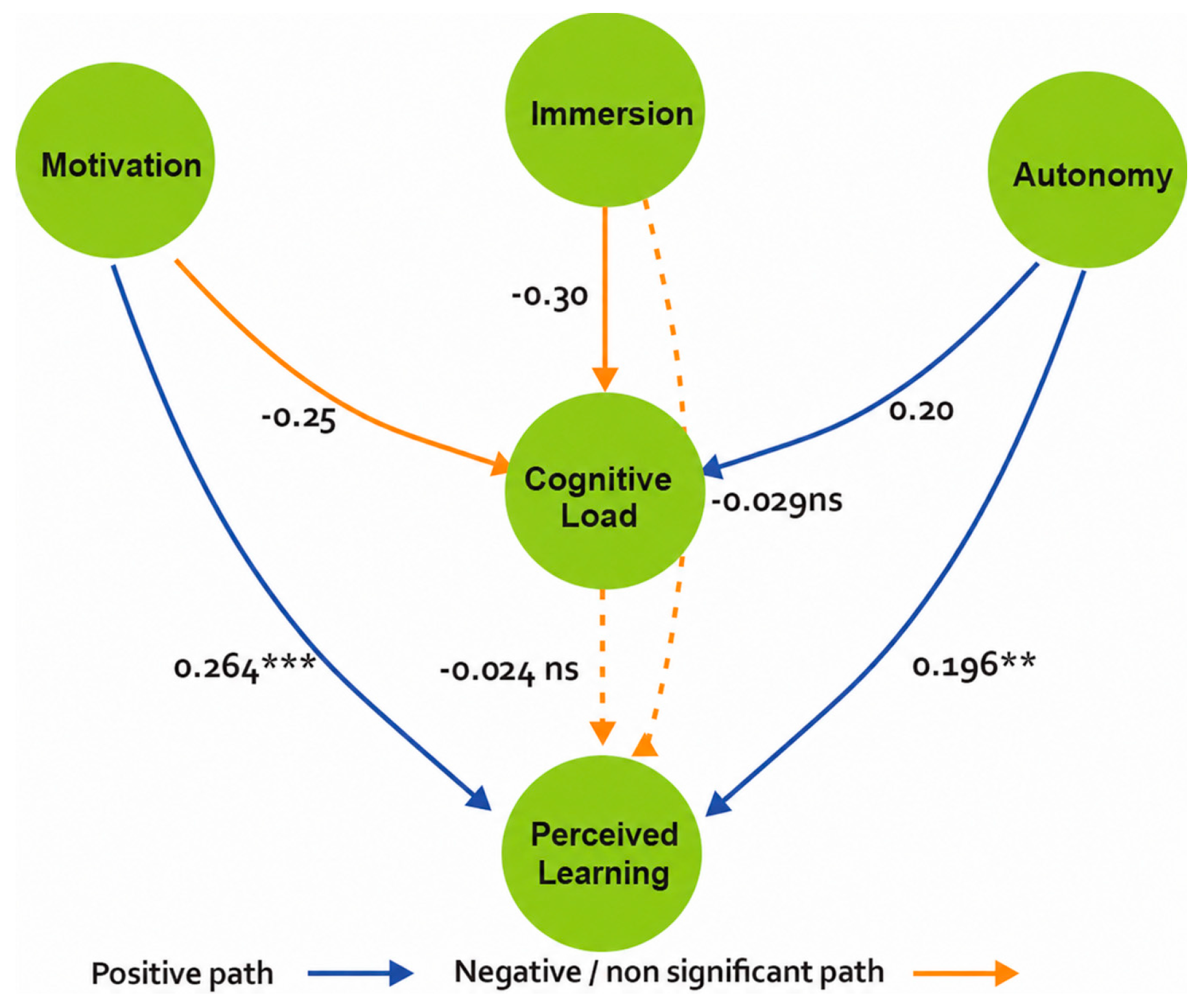
The revised structural equation model examined the independent associations of Motivation, Autonomy, Immersion, and the exploratory Cognitive Load score with Perceived Learning. Objective performance was assessed using the two multiple-choice knowledge items, whereas perceived learning was assessed using GAMEFULQUEST and examined through structural equation modeling. Accordingly, the associations estimated in the SEM refer specifically to Perceived Learning and should not be interpreted as direct associations with objective knowledge performance. In particular, the absence of a statistically significant independent association between Immersion and Perceived Learning does not establish that Immersion is unrelated to objective performance, because objective knowledge performance was assessed separately and was not modeled as the dependent variable in the SEM.
Perceived Learning was positively associated with Motivation (standardized β = 0.451; 95% CI [0.297, 0.605]; p < 0.001) and Autonomy (β = 0.351; 95% CI [0.213, 0.489]; p < 0.001). Immersion showed no statistically significant independent association with Perceived Learning (β = 0.051; 95% CI [−0.064, 0.167]; p = 0.384). Similarly, the exploratory Cognitive Load score showed no statistically significant independent association with Perceived Learning (β = −0.062; 95% CI [−0.149, 0.026]; p = 0.166).
Overall model-fit indices were χ2(3) = 11.96, p = 0.008; CFI = 0.982; TLI = 0.940; RMSEA = 0.112 (90% CI [0.051, 0.178]); and SRMR = 0.063. Given the small number of degrees of freedom, RMSEA was interpreted cautiously and model adequacy was evaluated using the full set of fit indices rather than RMSEA alone.
The non-significant coefficients for Immersion and Cognitive Load should not be interpreted as evidence that these associations are absent or equivalent to zero. Rather, the results indicate insufficient statistical evidence to establish independent associations with Perceived Learning in the estimated model.
Evidence of convergent validity was further supported through the calculation of Average Variance Extracted (AVE) and Composite Reliability (CR), while discriminant validity was initially assessed using the Fornell–Larcker criterion and subsequently confirmed using the Heterotrait–Monotrait (HTMT) ratio. Together, these complementary procedures demonstrated that engagement, perceived learning, and challenge represented empirically distinguishable yet theoretically related constructs, thereby reducing the likelihood that participants simply equated enjoyment with perceived learning [
27,
28,
29,
30].
Before estimating the structural model, the assumptions underlying Structural Equation Modeling were also evaluated. Inspection of covariance matrices, multicollinearity diagnostics, standardized residuals, and model specification supported the suitability of the data for latent variable modeling. Structural parameters were estimated using Maximum Likelihood estimation, and the overall diagnostic evaluation indicated no substantial violations that would compromise model estimation or interpretation [
23,
24,
25,
26,
27,
28,
29,
30,
31].
The revised structural equation model examined the independent associations of Motivation, Autonomy, Immersion, and the exploratory Cognitive Load score with Perceived Learning. Objective performance on the two knowledge items was analyzed separately and was not included as the dependent variable in this model. Perceived Learning was positively and independently associated with Motivation (standardized β = 0.451; 95% CI [0.297, 0.605];
p < 0.001) and Autonomy (standardized β = 0.351; 95% CI [0.213, 0.489];
p < 0.001). In contrast, Immersion showed no statistically significant independent association with Perceived Learning (β = 0.051; 95% CI [−0.064, 0.167];
p = 0.384), and the exploratory Cognitive Load score was also not significantly associated with Perceived Learning (β = −0.062; 95% CI [−0.149, 0.026];
p = 0.166) (
Figure 1). These coefficients represent structural associations and should not be interpreted as causal effects or as evidence that Motivation or Autonomy drives objective knowledge acquisition.
In the revised model, perceived learning was positively associated with motivation (standardized β = 0.451; 95% CI [0.297, 0.605]; p < 0.001) and autonomy (standardized β = 0.351; 95% CI [0.213, 0.489]; p < 0.001). Immersion showed no independent direct association with perceived learning (β = 0.051; 95% CI [−0.064, 0.167]; p = 0.384), nor was the exploratory cognitive load score independently associated with perceived learning (β = −0.062; 95% CI [−0.149, 0.026]; p = 0.166).
Although both the LMR-LRT and BLRT provided statistical support for adding a fourth profile, the four-profile solution yielded a small fourth class of 13 participants (5.4%). In contrast, the three-profile solution yielded more balanced class sizes (n = 60, 95, and 84) and high classification accuracy (entropy = 0.930). Considering statistical fit jointly with class size, stability, parsimony, and substantive interpretability, the three-profile solution was retained as the primary interpretative model, while the four-profile solution was retained as an alternative sensitivity solution. This decision should not be interpreted as evidence that the three-profile solution was statistically superior.
Because non-significant coefficients do not establish absence of an effect, equivalence testing was conducted for Immersion and Cognitive Load. Using equivalence bounds of ±0.10, equivalence was not demonstrated for Immersion (β = 0.051; approximate 90% CI [−0.046, 0.148]; TOST p = 0.203) or Cognitive Load (β = −0.062; approximate 90% CI [−0.135, 0.011]; TOST p = 0.197). Thus, although neither coefficient reached conventional statistical significance, the data were insufficient to establish that these associations were practically equivalent to zero.
Collectively, these psychometric findings provide robust evidence that the measurement model demonstrated satisfactory reliability, construct validity, convergent validity, and discriminant validity. Consequently, the latent constructs were considered sufficiently robust to support the subsequent structural analyses aimed at identifying the motivational and cognitive mechanisms underlying learning in gamified educational environments [
23,
24,
25,
26,
27,
28,
29,
30,
31].
Detailed psychometric results, including standardized factor loadings, reliability coefficients, goodness-of-fit indices, AVE, Composite Reliability, Fornell–Larcker matrices, HTMT ratios, and additional model diagnostics, are reported in
Supplementary Materials.
Importantly, although the comparative analyses demonstrated that students receiving blended instruction achieved substantially higher levels of conceptual learning than those exposed to gamification alone (
Section 3.2), these findings did not explain “why” comparable levels of engagement translated into markedly different educational outcomes. The psychometric robustness of the measurement model therefore provided the necessary foundation for examining Structural Equation Modeling (SEM) and Psychometric Network Analysis, which were undertaken to investigate the educational mechanisms underlying conceptual learning.
Accordingly, Structural Equation Modeling (SEM) and Psychometric Network Analysis were undertaken to examine the associations among motivational, experiential, and cognitive constructs within the self-reported learning experience. These analyses were intended to characterize the correlational structure associated with Perceived Learning and should not be interpreted as explaining the objective knowledge performance differences observed between instructional conditions [
23,
24,
25,
26,
27,
28,
29,
30,
31].
Structural Associations Among Learner-Experience Constructs
Having established the psychometric adequacy of the measurement model, subsequent analyses examined the associations among motivational, self-regulatory, experiential, and cognitive constructs in relation to Perceived Learning. SEM and Psychometric Network Analysis were used as complementary associational approaches to characterize these relationships. These analyses did not model objective performance on the two knowledge items and therefore cannot establish whether Motivation, Autonomy, Immersion, or Cognitive Load predicts, mediates, or causally influences objective knowledge acquisition [
23,
24,
25,
26,
27,
28,
29,
30,
31].
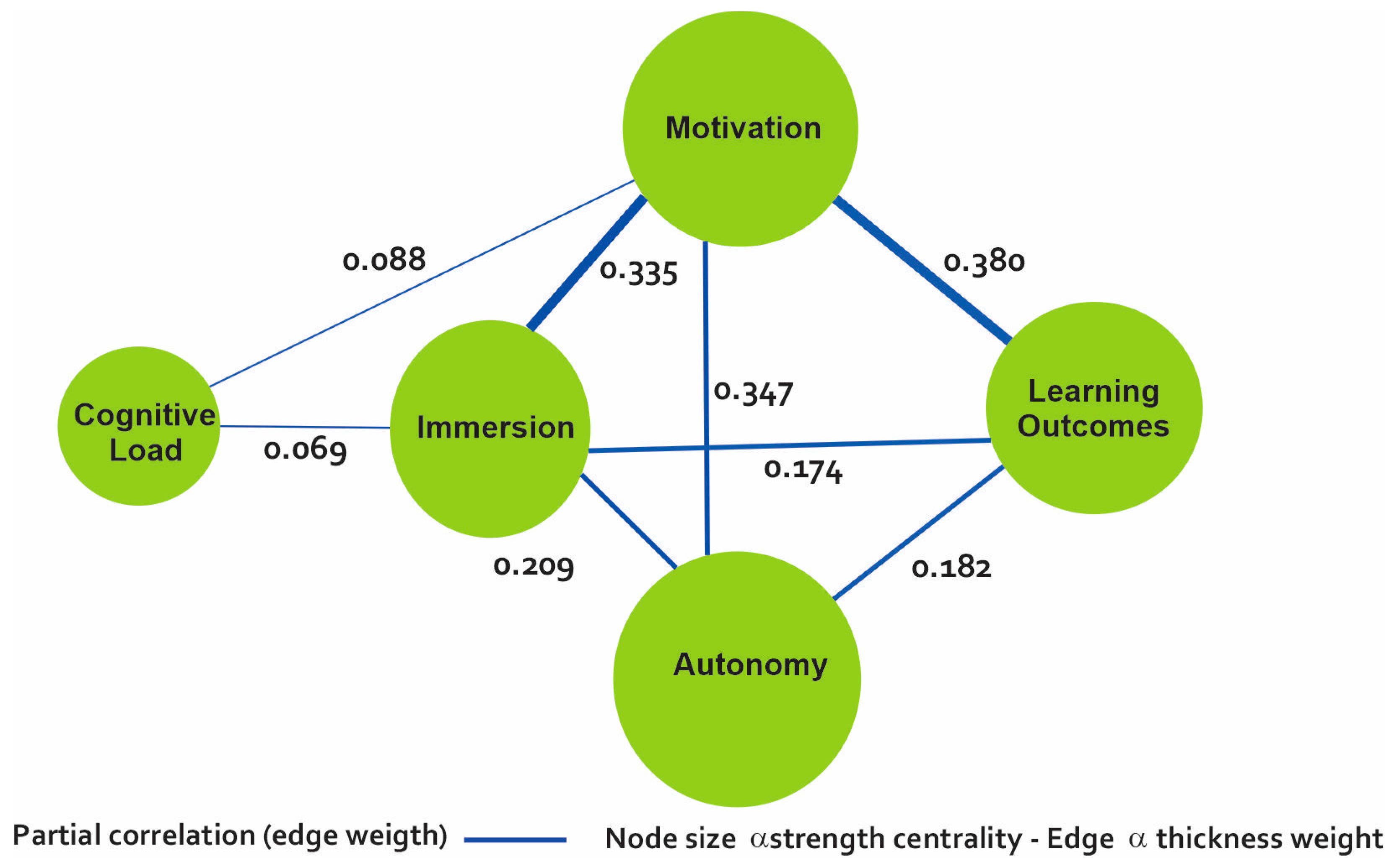
Structural Equation Modeling and Psychometric Network Analysis were used as complementary associational approaches to characterize relationships among motivational, experiential, and cognitive constructs. The EBICglasso network estimated undirected regularized partial correlations and therefore provides information about conditional associations and relative network centrality, not causal direction, mediation, or temporal ordering.
3.5. Learner Heterogeneity Revealed by Latent Profile and the Structural Relationships Among Motivational, Cognitive, and Self-Regulatory Constructs That May Account for THIS Apparent Engagement–Learning Paradox Analysis
A Latent Profile Analysis (LPA) was conducted to characterize heterogeneity in response patterns across Motivation, Immersion, Autonomy, Cognitive Load, and Perceived Learning. Prior to model estimation, each indicator was standardized across the full sample as a z-score (M = 0, SD = 1), and these standardized scores were entered into the LPA. For interpretability, profile-specific descriptive means in
Table 3 and
Table 4 are presented on the original response scales rather than as z-scores. Thus, model estimation was based on standardized indicators, whereas the reported profile means were back-transformed for descriptive presentation [
23,
24,
25,
26,
27,
28,
29,
30,
31].
Psychometric Network Analysis
The EBICglasso network characterized the regularized partial-correlation structure among Motivation, Autonomy, Immersion, Cognitive Load, and Learning Outcomes. Motivation showed the highest strength centrality and comparatively strong partial associations with Learning Outcomes (r = 0.380), Autonomy (r = 0.347), and Immersion (r = 0.335). Autonomy showed partial associations with Learning Outcomes (r = 0.182) and Immersion (r = 0.209). Cognitive Load occupied a relatively peripheral position, with weak partial associations with Motivation (r = 0.088) and Immersion (r = 0.069).
Because EBICglasso estimates an undirected partial-correlation network, these relationships represent conditional associations and should not be interpreted as causal effects, mediation, temporal ordering, or evidence that one construct “drives” another (
Figure 2).
A Latent Profile Analysis (LPA) was conducted to characterize heterogeneity in response patterns across Motivation, Immersion, Autonomy, Cognitive Load, and Perceived Learning. Prior to model estimation, each indicator was standardized across the full analytic sample as a z-score (M = 0, SD = 1), and these standardized scores were entered into the LPA. For interpretability, the profile-specific descriptive means reported in
Table 3 and
Table 4 are presented on the original response scales rather than as z-scores. Thus, model estimation was based on standardized indicators, whereas the reported profile means were back-transformed for descriptive presentation.
These model-selection criteria were not formally prespecified in a preregistered analysis plan. Accordingly, the decision to retain the three-profile solution should be regarded as an exploratory model-selection decision based on the joint consideration of statistical fit, classification quality, class size, stability, parsimony, and substantive interpretability.
Consistent with recommendations for latent profile modelling, profile selection considered statistical fit together with theoretical interpretability and educational relevance rather than relying exclusively on numerical optimization criteria [
23,
24,
25,
26,
27,
28,
29,
30,
31]. Although one profile comprised a comparatively small number of participants, it was retained because it represented a conceptually distinct response pattern that was consistently differentiated across the motivational and learning dimensions. Nevertheless, this profile should be interpreted cautiously and regarded as exploratory, an issue considered further in the Limitations section.
The resulting profiles display an ordered gradient of response to the gamified experience. Profile 1 combines lower motivation, immersion, and autonomy with higher cognitive load and lower perceived learning. Conversely, Profile 2 combines the highest levels of motivation, immersion, autonomy, and learning with the lowest cognitive load. Profile 3 occupies a moderate-to-high intermediate position (
Table 5 and
Table 6).
This pattern complements the SEM findings: motivation and autonomy appear to be the primary dimensions differentiating a highly favorable perceived learning experience, whereas elevated immersion alone should not be interpreted as a direct driver of increased learning.
Although both the LMR-LRT and BLRT statistically favored the four-profile solution over the three-profile solution, the four-profile model included a small class of 13 participants (5.4%). In contrast, the three-profile solution yielded more balanced class sizes (n = 60, 95, and 84) and high classification accuracy (entropy = 0.930). Because model-selection criteria were not formally prespecified, the three-profile solution was retained as the primary interpretative model on exploratory grounds, considering class size, stability, parsimony, and substantive interpretability alongside statistical fit. The statistically better-fitting four-profile solution is therefore reported as an alternative sensitivity solution. This decision should not be interpreted as evidence that the three-profile solution provided statistically superior fit (
Table 7 and
Table 8).
Additionally, the largest subgroup represented learners who experienced the gamified intervention as an engaging and educationally productive environment. These participants demonstrated consistently moderate-to-high levels of motivation, perceived autonomy, immersion, and learning, suggesting that the instructional experience effectively balanced motivational activation with conceptual understanding. Rather than representing exceptional performance, this profile reflects the typical educational response expected from novice medical students interacting with a structured gamified environment.
A second subgroup exhibited uniformly high scores across all psychological and educational constructs. These learners appeared to integrate motivational engagement, autonomous regulation, and conceptual learning particularly effectively, representing what may be interpreted as an optimal adaptation to the blended instructional environment. Their pattern aligns with the quantitative findings showing that motivation and autonomy were the principal predictors of learning performance, supporting the proposition that meaningful learning emerges when motivational activation is accompanied by effective self-regulation rather than by engagement alone [
5,
11,
13,
14,
15,
16,
17,
18,
19].
In contrast, a third and considerably smaller subgroup displayed an atypical response pattern characterized by relatively low motivation and immersion despite maintaining satisfactory learning performance. This finding is particularly informative because it demonstrates that successful learning is not invariably associated with strong emotional engagement or game immersion. Instead, some learners appeared capable of achieving conceptual understanding through alternative cognitive strategies, possibly relying on prior knowledge, independent study habits, or highly developed self-regulatory abilities. Although exploratory due to its limited size, this profile challenges the assumption that gamification benefits all learners through identical mechanisms and instead suggests substantial individual variability in the pathways leading to successful learning.
Taken together, these findings indicate that gamified learning environments do not produce a single educational response but rather support multiple trajectories of learner engagement and performance. While the variable-centered analyses (SEM and psychometric network analysis) identified the dominant structural relationships among motivation, autonomy, cognitive load, and learning, the person-centered LPA demonstrated that these mechanisms are expressed differently across individual learners.
Consequently, the educational effectiveness of gamification appears to depend not only on instructional design but also on how learners regulate, interpret, and engage with the learning environment.
Importantly, these heterogeneous response patterns raised a question that could not be answered by the quantitative analyses alone: why do learners experiencing comparable levels of engagement demonstrate markedly different learning outcomes? The qualitative phase of the explanatory sequential mixed-methods design was therefore undertaken to explore the cognitive, motivational, and instructional mechanisms underlying these distinct quantitative patterns, thereby providing explanatory depth beyond the statistical associations observed [
21,
32,
33].
3.6. Qualitative Findings Explaining the Quantitative Results
Consistent with the explanatory sequential mixed-methods design, the qualitative phase was undertaken not as an independent exploration of students’ perceptions, but to explain the quantitative findings generated during the first stage of the study. Reflexive Thematic Analysis (RTA) was therefore employed to identify the cognitive, motivational, and instructional mechanisms that could account for the statistical patterns observed across the comparative analyses, Structural Equation Modeling (SEM), Latent Profile Analysis (LPA), and psychometric network analysis.
Rather than producing descriptive categories, the analysis generated four interrelated interpretative themes that provided qualitative context for the quantitative findings, revealing how learners experienced the pedagogical processes underlying the quantitative outcomes. Collectively, these themes explain why comparable levels of engagement produced different learning outcomes, how instructional scaffolding transformed motivation into conceptual understanding, and why learner responses remained heterogeneous despite exposure to the same gamified environment.
In accordance with Braun and Clarke’s reflexive approach, themes were constructed interpretatively rather than as frequency-based categories and are presented in
Table 9 with representative verbatim quotes that illustrate participants’ learning experiences and provide explanatory interpretations of their commentary [
32,
33].
The relationship between each qualitative theme and the corresponding quantitative finding is subsequently synthesized through an explanatory joint display, integrating quantitative and qualitative findings, and is presented in
Table 10, allowing direct integration of both datasets and the generation of higher-order mixed-methods meta-inferences (
Section 3.7), consistent with recommendations for explanatory sequential designs [
21].
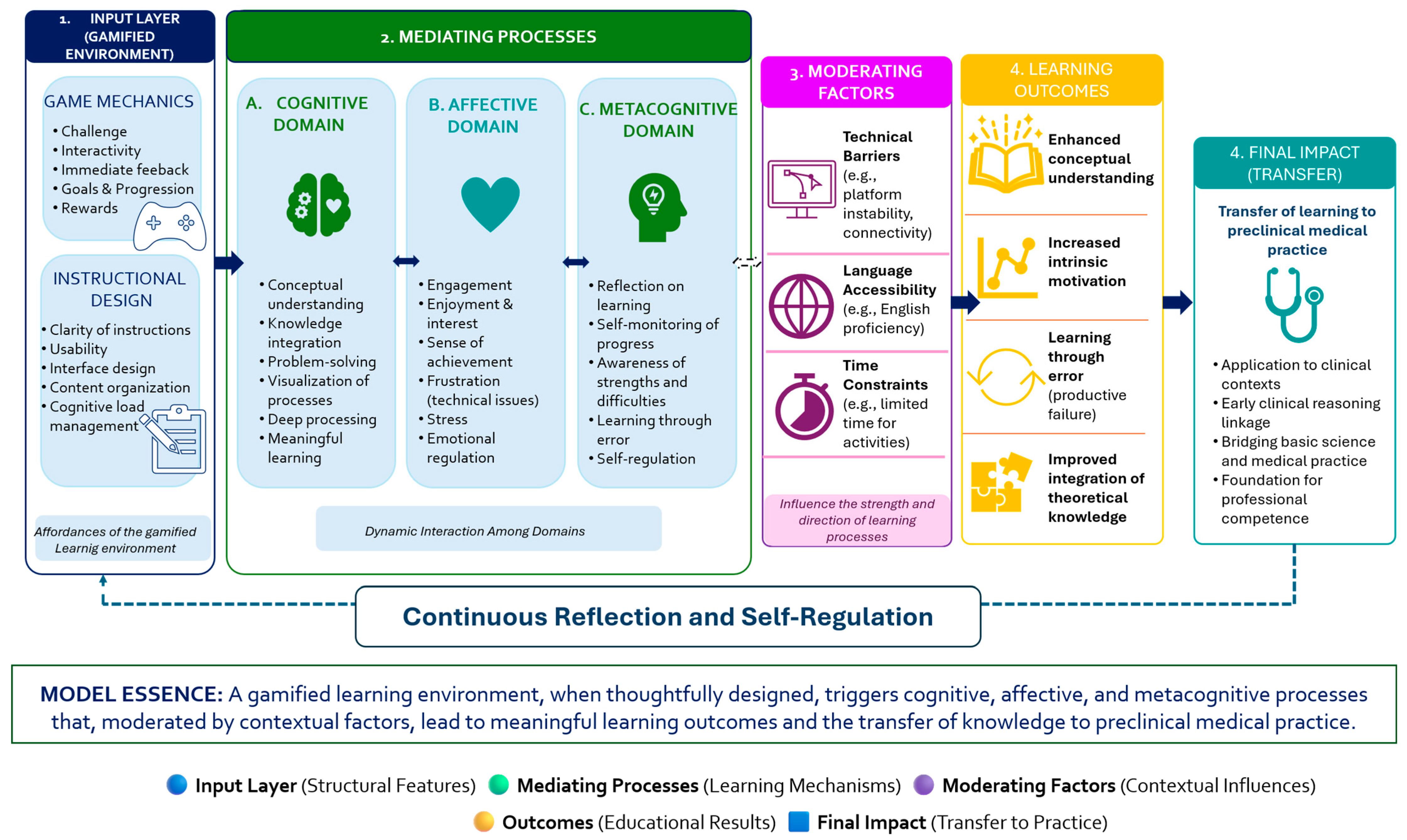
The proposed framework integrates quantitative and qualitative evidence to explain how pedagogical scaffolding transforms motivational engagement into meaningful conceptual learning. Rather than depicting gamification as an isolated motivational strategy, the framework conceptualizes learning as an interaction among cognitive regulation, instructional support, self-regulation, and reflective processing (
Figure 3).
3.6.1. Theme 1. Gamification as an Affective Catalyst with Cognitive Trade-Offs: Explaining High Engagement Despite Uneven Learning Outcomes
The first theme provides a qualitative interpretation of one of the principal quantitative patterns observed in the study: students in both instructional conditions reported high levels of engagement, whereas immediate content-specific knowledge performance differed between conditions. Participants consistently described the gamified environment as enjoyable, stimulating, and capable of sustaining attention throughout the learning activity, providing qualitative convergence with the elevated engagement scores obtained with the GAMEFULQUEST instrument. As one participant explained,
“The game kept me interested the entire time because every challenge made me want to continue, even when I made mistakes.”
Similarly, another student stated,
“It never became boring because there was always something new happening, and I wanted to see what came next.”
These accounts illustrate the capacity of the gamified activity to support sustained attention, enjoyment, and motivational involvement. However, participants also described situations in which the richness of the interactive environment became cognitively demanding. Multiple visual stimuli, concurrent tasks, and repeated decisions sometimes competed with attention to the underlying biological concepts.
However, participants simultaneously described moments in which the richness of the interactive environment became cognitively demanding. Rather than facilitating conceptual understanding automatically, several students perceived that the multiplicity of visual stimuli, tasks, and decisions occasionally exceeded their capacity to process essential biological concepts.
One participant reflected,
“There was so much happening that sometimes I focused more on completing the mission than on understanding why the transport mechanism actually worked.”
Another similarly commented,
“I enjoyed playing, but I realised afterwards that I remembered the game better than the physiological concepts.”
These narratives help contextualize the engagement–learning pattern observed quantitatively. Although the gamified environment was associated with high levels of self-reported engagement, this engagement did not necessarily coincide with equivalent immediate knowledge performance across instructional conditions. The findings therefore suggest that engagement and content-specific knowledge performance should be considered related but distinct educational outcomes rather than assuming that increased engagement automatically produces greater learning.
The qualitative findings also provide important context for the exploratory Cognitive Load results. In the SEM, the exploratory Cognitive Load score showed no statistically significant independent association with Perceived Learning (β = −0.062; 95% CI [−0.149, 0.026]; p = 0.166). However, several participants described situational experiences of cognitive overload, competing attentional demands, and difficulty maintaining conceptual focus during gameplay. This divergence between the aggregate quantitative result and individual qualitative accounts should not be interpreted as contradictory evidence; rather, it suggests that the exploratory composite score may not fully capture transient or learner-specific experiences of cognitive demand.
A similar distinction is necessary when interpreting Immersion. In the SEM, Immersion showed no statistically significant independent association with Perceived Learning (β = 0.051; 95% CI [−0.064, 0.167]; p = 0.384), whereas Motivation and Autonomy showed positive independent associations with Perceived Learning. Because the dependent variable in this model was Perceived Learning rather than objective performance on the two knowledge items, these findings do not establish that immersion has no effect on objective knowledge performance.
The psychometric network provides an additional, but non-causal, perspective on these relationships. Motivation occupied a relatively central position in the EBICglasso network, whereas Cognitive Load showed comparatively weak connectivity and a more peripheral network position. Because the EBICglasso network is undirected, these findings represent conditional associations among constructs and should not be interpreted as evidence that Motivation causally “drives” learning or that Cognitive Load is merely a downstream side-effect.
Taken together, Theme 1 suggests that gamification may function as an affective and attentional catalyst while simultaneously introducing cognitive demands that some learners experience as competing with conceptual processing. The integrated findings therefore support a distinction between motivational engagement, perceived learning, and immediate objective knowledge performance. They do not establish that engagement is either necessary or sufficient for learning, but they do indicate that high engagement alone should not be interpreted as evidence of greater conceptual understanding [
18,
19,
32,
33].
3.6.2. Theme 2. Emergent Metacognitive Regulation: Contextualizing the Associations of Motivation and Autonomy with Perceived Learning
The second theme provides an explanatory interpretation for one of the central findings of the Structural Equation Model. While the quantitative analysis demonstrated that Motivation and Autonomy were positively associated with Perceived Learning, because objective performance on the two MCQs was analyzed separately and was not modeled in the SEM, these associations should not be interpreted as evidence that Motivation or Autonomy drive objective knowledge acquisition. Their potential role in objective learning therefore remains hypothesis-generating and requires prospective testing.
Across participants’ narratives, successful learning was consistently described not as the consequence of simply completing the game, but as the result of actively reflecting on mistakes, monitoring personal understanding, and progressively adapting learning strategies throughout gameplay. Rather than perceiving errors as indicators of failure, students frequently interpreted them as opportunities to reorganize their conceptual understanding and regulate subsequent decisions.
One participant explained:
“Every mistake made me stop and think about why I had answered incorrectly before trying again.”
Another student reflected:
“I realised that I had to understand the concept first; otherwise I kept making the same mistake even if I completed the mission.”
Similarly, another participant stated:
“The feedback was useful because it helped me recognise what I didn’t know instead of simply telling me whether I was right or wrong.”
These narratives suggest that learning occurred through iterative cycles of self-monitoring, feedback interpretation, and conceptual refinement rather than through exposure to game mechanics alone. Importantly, participants who described these reflective processes also demonstrated greater awareness of their own cognitive limitations and reported intentionally modifying their learning strategies as the activity progressed.
From an interpretative qualitative perspective, participants’ accounts suggest that Motivation may support sustained engagement and that Autonomy may be relevant to self-regulatory processes. These interpretations are hypothesis-generating and should not be attributed to the directionality of the EBICglasso network, which estimates only undirected conditional association.
This interpretation closely mirrors the structural relationships observed in the SEM. Motivation and Autonomy showed statistically significant positive independent associations with Perceived Learning, whereas immersion failed to demonstrate a comparable association. Rather than suggesting that immersion lacks educational value, the integrated findings indicate that immersive experiences become pedagogically meaningful only when learners actively regulate their own cognitive processes. In this sense, participants’ narratives are consistent with the possibility that motivation supports sustained participation, while autonomy may facilitate reflective self-regulation. These interpretations should be considered hypothesis-generating rather than demonstrated causal mechanisms.
The findings therefore reinforce the emerging interpretation that the educational effectiveness of gamification depends less on technological sophistication than on the learner’s capacity for reflective self-regulation. Within the proposed Reflective Gamified Learning framework, metacognitive regulation represents the principal mechanism through which motivational engagement is converted into meaningful knowledge construction, thereby explaining why motivation and autonomy (but not immersion) predicted objective learning outcomes in the quantitative analyses [
18,
19,
21,
32,
33].
3.6.3. Theme 3. Instructional Scaffolding as the Mechanism Explaining the Superior Performance of the Blended Learning Condition
The third theme provides qualitative context for the principal between-condition quantitative finding: students in the blended condition demonstrated higher immediate content-specific knowledge performance than those in the gamification-only condition. Participants’ accounts consistently highlighted the perceived value of combining the gamified activity with prior conceptual instruction and subsequent guided discussion. Rather than describing the game as a substitute for formal instruction, participants portrayed it as more understandable and educationally useful when embedded within a structured instructional sequence.
Participants repeatedly described formal instruction as helping them interpret, organize, and integrate the information encountered during gameplay. Preparatory instruction appeared, from the learners’ perspective, to provide a conceptual reference for interpreting the tasks presented in the game.
As one participant noted,
“The lecture helped me understand what I was seeing during the game, so everything made much more sense.”
Another explained,
“Playing first would probably have been confusing because I didn’t yet understand the transport mechanisms.”
Similarly, another participant commented,
“Discussing the answers afterwards helped me connect what happened in the game with the biological concepts.”
These narratives suggest that participants perceived both preparatory instruction and post-game discussion as useful for organizing and interpreting the biological concepts encountered during gameplay. The lecture was described as providing an initial conceptual reference, whereas the post-game discussion was perceived as an opportunity to revisit game experiences, clarify understanding, and connect those experiences with the underlying biological concepts.
From an interpretative perspective, these accounts are consistent with the possibility that the educational value of the gamified activity may depend partly on the instructional context in which it is embedded. In fact, the present findings do not permit the independent contribution of conceptual preparation, additional instructional time, instructor interaction, and the post-game analysis session to be isolated. Accordingly, the observed effect should be interpreted as an association between the structured instructional sequence surrounding the gamified activity and the observed performance, rather than as evidence of an independent effect of the debriefing session.
Participants did not attribute their understanding solely to interaction with the game; instead, they emphasized the complementary roles of explanation, clarification, and guided reflection. These findings support instructional scaffolding as a plausible explanatory factor, but they do not establish it as the causal mechanism responsible for the observed difference in knowledge performance.
The qualitative findings therefore complement the quantitative between-condition comparison. Students in the blended condition showed higher immediate content-specific knowledge performance, while participants’ narratives provide possible explanations for how preparatory instruction and post-game discussion may have supported interpretation and conceptual organization of the game experience. However, because the blended condition combined several instructional components, including preparatory instruction, gameplay, additional instructor interaction, and structured debriefing, the contribution of any individual component cannot be isolated from the present design.
This distinction is particularly important for the interpretation of debriefing. Participants’ accounts indicate that post-game discussion was perceived as helpful for connecting gameplay with biological concepts; however, the present findings do not demonstrate that debriefing itself constituted a causal “conversion site” through which engagement was transformed into learning. Instead, structured debriefing should be considered a plausible reflective-scaffolding mechanism that warrants direct prospective evaluation.
Moreover, the blended and gamification-only conditions differed in total instructional exposure (90 versus 45 min). Consequently, the higher immediate knowledge performance observed in the blended cohort cannot be attributed specifically to scaffolding or debriefing independently of instructional time, prior conceptual preparation, instructor interaction, or other cohort-related factors. These factors represent alternative or complementary explanations that should be considered when interpreting the between-condition difference.
Taken together, Theme 3 suggests that embedding gamified activities within a structured sequence of conceptual preparation, gameplay, and guided reflection may facilitate learners’ interpretation and integration of content. Within the preliminary Reflective Gamified Learning (RGL) framework, instructional scaffolding and debriefing are therefore proposed as hypothesis-generating mechanisms rather than established causal pathways. Future studies should experimentally manipulate these components while holding instructional time and other contextual factors constant to determine their independent contributions to learning [
18,
19,
21,
32,
33].
3.6.4. Theme 4. Learner Heterogeneity and Adaptive Knowledge Construction: Explaining the Latent Profiles and Supporting the Reflective Gamified Learning Framework
The fourth theme provides qualitative context for the learner heterogeneity identified through Latent Profile Analysis (LPA). Rather than indicating a single, uniform response to the gamified learning environment, participants’ accounts described variation in how they interpreted feedback, regulated their effort, drew on prior knowledge, and engaged with the learning activity. These narratives are consistent with the general heterogeneity observed quantitatively, although they should not be interpreted as evidence that the latent profiles represent stable learner types or distinct causal learning pathways.
Some participants described a highly reflective learning process characterized by deliberate self-monitoring and continuous adaptation.
As one learner explained,
“Whenever I made a mistake, I tried to understand what I was missing before continuing.”
Others emphasized conceptual integration.
“The game helped me connect different ideas that had seemed unrelated during class.”
In contrast, several participants acknowledged relying primarily on previous knowledge rather than on the game itself.
“I already understood most of the concepts, so the game mainly helped me review them.”
Finally, a smaller number of students reported difficulty engaging with the gamified format despite ultimately achieving satisfactory performance.
“The game wasn’t really my preferred way of learning, but I still understood the material because I focused on the physiology.”
Taken together, these accounts illustrate meaningful variation in students’ reported approaches to the same gamified learning environment. Some participants emphasized reflective error monitoring, others described conceptual integration, some relied substantially on prior knowledge, and others reported limited affinity with the gamified format while still perceiving that they understood the content. This qualitative variability complements the person-centered LPA by showing that similar instructional exposure can be experienced and interpreted differently across learners.
However, the relationship between the qualitative accounts and the latent profiles should be interpreted cautiously. The LPA identified statistical patterns of co-occurring Motivation, Immersion, Autonomy, Cognitive Load, and Perceived Learning within the present sample; it did not establish fixed psychological phenotypes or stable learner categories. Moreover, because statistical criteria also provided support for an alternative four-profile solution, the exact number and composition of the profiles remain exploratory. The qualitative findings therefore support the broader conclusion of learner heterogeneity rather than validating any specific three-profile taxonomy.
The narratives also suggest several possible sources of this heterogeneity, including prior knowledge, preferred learning strategies, self-monitoring, and differential engagement with the gamified format. These factors were described by participants and may help contextualize the observed profile differences, but the present study does not establish that they causally determine profile membership or learning outcomes. Accordingly, the findings should be viewed as hypothesis-generating rather than as evidence of distinct cognitive pathways through which learning necessarily occurs.
This distinction is also important when integrating the qualitative findings with the psychometric network analysis. The network identified Motivation as the construct with the highest strength centrality, but because EBICglasso is an undirected partial-correlation network, this finding should not be interpreted as evidence that Motivation causally organizes or initiates the learning process. Instead, the network and qualitative findings together suggest that motivational, self-regulatory, experiential, and cognitive processes are interconnected in ways that may differ across learners.
Within the proposed Reflective Gamified Learning framework, Theme 4 therefore contributes preliminary evidence that learner responses to gamified instruction are heterogeneous. This heterogeneity is consistent with the possibility of differential responsiveness, but the present findings do not establish stable response phenotypes, reproducible learner subtypes, or distinct causal trajectories. The observed profiles and qualitative patterns should instead be considered exploratory and sample-specific, requiring replication in independent cohorts and longitudinal evaluation before stronger conclusions regarding learner responsiveness can be made. Future research should also prospectively examine whether these exploratory learner profiles are stable across cohorts and whether profile membership moderates responses to different gamified instructional conditions.
Accordingly, Theme 4 informs (rather than validates) the preliminary Reflective Gamified Learning framework. The findings suggest that any future model of gamified learning should accommodate variability in learners’ motivational, self-regulatory, and experiential responses rather than assume a uniform educational effect. RGL is therefore used here as a preliminary, mid-range, hypothesis-generating framework for organizing these patterns and proposing questions for future prospective testing [
18,
19,
21,
32,
33].
3.7. Explanatory Mixed-Methods Integration: From Statistical Associations to Educational Mechanisms
The explanatory sequential mixed-methods design enabled the integration of quantitative and qualitative findings beyond simple corroboration, generating a set of interpretative meta-inferences regarding the motivational, cognitive, and instructional processes associated with gamified learning in undergraduate medical education. Rather than functioning as parallel sources of evidence, the qualitative findings were used to contextualize, extend, and interrogate the statistical patterns identified during the quantitative phase. This integration allowed areas of convergence, complementarity, and discordance to be identified and retained as analytically informative, thereby providing a more nuanced interpretation of the relationships observed across the quantitative and qualitative strands [
21,
32,
33].
Integration was classified as convergence when quantitative and qualitative findings addressed the same phenomenon in compatible ways; as complementarity when qualitative findings elaborated or explained quantitative patterns; and as discordance or qualification when qualitative accounts introduced exceptions or qualified a straightforward quantitative interpretation. The integrated findings suggest that motivation may support sustained engagement, but that engagement alone does not guarantee higher knowledge performance.
To facilitate methodological transparency,
Table 11 presents an explanatory joint display that systematically links each principal quantitative finding with the corresponding qualitative explanation, theoretical interpretation, and resulting meta-inference. This integration follows established recommendations for explanatory sequential mixed-methods research, in which qualitative evidence is intentionally used to explain, refine, and contextualize quantitative results through the generation of integrated interpretations rather than isolated conclusions [
21].
The first meta-inference emerged from the convergence between the consistently high GAMEFULQUEST engagement scores observed across both instructional conditions and participants’ descriptions of enjoyment, curiosity, and sustained attention during gameplay. While these findings confirm that gamification effectively promotes motivational activation, qualitative narratives simultaneously revealed that emotional engagement did not invariably translate into conceptual understanding. Students frequently described becoming absorbed by game progression while struggling to organize or interpret the underlying physiological concepts, thereby providing an explanatory mechanism for the engagement–learning paradox identified quantitatively. Collectively, these findings indicate that learner engagement should be interpreted as a necessary, but not independently sufficient, condition for meaningful biomedical learning.
An important discordant pattern emerged for Cognitive Load. Quantitatively, the exploratory Cognitive Load score showed no statistically significant independent association with Perceived Learning in the SEM and occupied a relatively peripheral position in the EBICglasso network. Qualitatively, however, several students described episodes of overload, excessive stimulation, competing attentional demands, and difficulty maintaining conceptual focus during gameplay. Rather than interpreting the non-significant quantitative association as evidence that cognitive load was not relevant to learning, this discordance suggests that the exploratory aggregate self-report score may not have fully captured transient, contextual, or learner-specific experiences of cognitive demand. Accordingly, the qualitative and quantitative findings should be considered complementary but partially discordant sources of evidence regarding the role of cognitive load in the gamified learning experience.
A second meta-inference explains the structural relationships identified in the SEM analysis. Quantitatively, motivation and autonomy emerged as the only significant predictors of learning performance, whereas immersion demonstrated no direct association with objective knowledge acquisition. The qualitative findings clarify this apparent discrepancy by showing that students who reported the greatest educational benefit consistently described engaging in reflective self-monitoring, interpretation of feedback, and iterative conceptual refinement throughout gameplay. Consequently, the integrated findings suggest that Motivation and Autonomy may be relevant to sustained engagement and self-regulatory learning processes. However, the EBICglasso network does not establish directionality, temporal ordering, or causal pathways, and these interpretations should therefore be regarded as hypothesis-generating. Immersion, although essential for maintaining participation, did not independently generate conceptual understanding in the absence of reflective regulation.
The third meta-inference concerns the superior educational performance observed in the blended learning condition. Although quantitative analyses demonstrated substantially greater knowledge acquisition among students receiving pedagogical scaffolding before and after gameplay, the qualitative findings explain why this advantage occurred. Participants consistently described lectures as providing an initial conceptual framework that facilitated interpretation of game mechanics, while instructor-led debriefing promoted clarification of misconceptions and integration of theoretical concepts with gameplay experiences. These accounts indicate that instructional scaffolding functioned not merely as additional teaching, but as the pedagogical mechanism that reduced unnecessary cognitive demands and supported schema construction during experiential learning.
The fourth meta-inference emerged from the integration of Latent Profile Analysis and participants’ narratives describing diverse approaches to learning within the same educational environment. The quantitative identification of distinct learner profiles was mirrored qualitatively by substantial variability in how students regulated attention, interpreted feedback, applied prior knowledge, and transferred conceptual understanding beyond gameplay. Rather than representing inconsistent responses to the intervention, this heterogeneity suggests that gamified learning operates through multiple adaptive cognitive pathways that are influenced by learners’ previous knowledge, self-regulatory capacity, and instructional support. These findings reinforce the interpretation that gamification should not be conceptualized as a universally effective instructional strategy, but rather as a flexible educational environment whose effectiveness depends upon interactions among learner characteristics, pedagogical design, and cognitive regulation. Taken together, these integrated findings provide preliminary empirical support for the propositions underlying the Reflective Gamified Learning Framework, and are presented in
Table 12. This table represents the highest level of methodological integration achieved in the explanatory sequential mixed-methods design. Each meta-inference emerged through the convergence of statistical analyses, qualitative interpretation, and educational theory, providing the empirical basis for the proposed theoretical framework. Rather than constituting a validated theoretical model, the framework synthesizes empirical evidence from both methodological strands into a preliminary, hypothesis-generating explanatory framework that synthesizes empirical evidence from both methodological strands into a higher-order explanatory model describing how meaningful learning emerges within gamified educational environments.
The integrated evidence indicates that motivation initiates engagement, instructional scaffolding organizes cognitive processing, reflective self-regulation transforms experience into conceptual understanding, and learner characteristics shape individual learning trajectories. Within this framework, technological immersion represents only one component of a broader pedagogical architecture in which educational effectiveness depends on the dynamic interaction between motivational activation, cognitive regulation, and structured instructional support.
Importantly, the explanatory strength of this framework lies in its capacity to account simultaneously for the principal findings generated across all analytical approaches employed in the study (including comparative analyses, Structural Equation Modeling, Latent Profile Analysis, psychometric network analysis, and Reflexive Thematic Analysis) through a single coherent interpretative model. By integrating independent forms of evidence into shared meta-inferences, the present mixed-methods analysis moves beyond describing whether gamification is effective and instead explains the educational processes through which meaningful learning is facilitated or constrained. This explanatory integration represents the principal theoretical contribution of the study and provides the empirical foundation for the proposed Reflective Gamified Learning Framework as an instructional model for novice learners in medical education [
21,
32,
33].
4. Discussion
The discussion that follows is organized according to the explanatory logic of the mixed-methods design, whereby qualitative findings are used to explain, refine, and contextualize the quantitative results through integrated meta-inferences rather than through parallel interpretation.
4.1. Principal Findings: Beyond Engagement Toward Meaningful Learning
The present explanatory mixed-methods study demonstrates that the educational value of gamification extends beyond its ability to enhance learner engagement. The timing of the knowledge assessment also warrants consideration. Although the assessment was administered three weeks after the intervention, the study included only a single post-intervention measurement.
Therefore, the findings provide evidence of knowledge performance at a three-week post-intervention time point but do not establish long-term retention. Likewise, although the selected items required application of membrane structure and transport concepts to curricular situations, they were not specifically designed to assess transfer to novel or clinical contexts. Future studies should incorporate repeated assessments and purpose-designed transfer measures to determine whether the observed learning effects persist and generalize beyond the immediate instructional context.
These findings indicate that motivation and engagement, while essential for initiating learning, were insufficient to produce meaningful conceptual change unless accompanied by instructional scaffolding, reflective processing, and structured conceptual guidance. Rather than functioning as an autonomous teaching strategy, gamification appears to derive its educational value from the pedagogical architecture within which it is implemented.
This interpretation reflects an important shift within contemporary educational technology research. Recent theoretical syntheses by Krath, Lee, and Sailer argue that the field should move beyond asking whether gamification works toward understanding the mechanisms through which it influences learning. Consistent with this perspective, our findings suggest that game mechanics primarily create motivational conditions that encourage active participation, whereas conceptual learning depends on subsequent instructional processes that support knowledge organization, cognitive integration, and reflection. These observations align with Kolb’s Experiential Learning Theory, Schön’s concept of reflective practice, and Al Amri’s pedagogical view that gamification becomes educationally effective only when embedded within a deliberately designed instructional sequence. From a cognitive perspective, this interpretation is also compatible with Cognitive Load Theory, which predicts that meaningful learning depends on instructional conditions that support efficient cognitive processing rather than engagement alone.
A major strength of the present study lies in the integration of complementary methodological approaches. Structural equation modelling, psychometric network analysis, latent profile analysis, and Reflexive Thematic Analysis each illuminated different dimensions of the same educational phenomenon. Quantitative analyses identified the psychological factors associated with successful learning, whereas qualitative findings, interpreted through Braun and Clarke’s reflexive approach, explained how learners experienced, regulated, and transformed these processes during gameplay. Consequently, the present study contributes not only evidence that blended gamification is educationally effective, but also an empirically grounded explanation of why meaningful learning emerged only when motivational engagement was supported by coherent instructional design. This distinction between engagement and learning provides the conceptual foundation for the following sections.
Importantly, these findings should be interpreted within the context of a constructively aligned instructional design. Consistent with Biggs and Tang’s framework, the blended intervention intentionally aligned learning objectives, preparatory instruction, gamified activities, guided reflection, feedback, and assessment. This pedagogical coherence likely explains why learner engagement translated into meaningful conceptual understanding, reinforcing that the educational value of gamification depends less on game mechanics than on their integration within a deliberately designed instructional sequence.
4.2. Why Engagement Alone Does Not Guarantee Learning
One of the most important findings of this study is that learner engagement should not be interpreted as evidence of meaningful learning. Although students consistently described the game as enjoyable, motivating, and immersive, these positive experiences did not necessarily translate into superior conceptual understanding. Participants exposed only to gamification frequently reported high levels of enjoyment while simultaneously expressing uncertainty about the physiological concepts underlying the game challenges. These findings suggest that engagement represents an essential, but educationally incomplete, stage within the learning process.
This interpretation is strongly supported by the contemporary literature. Systematic reviews and meta-analyses consistently demonstrate that gamification enhances motivation, participation, and learner satisfaction across health profession education. However, Sailer and Homner, van Gaalen, and more recently Lee have shown that its effects on knowledge acquisition and higher-order learning remain considerably more variable. Rather than questioning the effectiveness of gamification itself, these authors increasingly attribute such heterogeneity to differences in instructional design, curricular integration, theoretical grounding, and learner characteristics. Because the same serious game was implemented in both study conditions, our findings provide direct empirical support for this interpretation: differences in educational outcomes were explained by the instructional environment rather than by the game mechanics themselves.
Immersion showed no statistically significant independent association with Perceived Learning after accounting for the other constructs included in the model (β = 0.051; 95% CI [−0.064, 0.167]; p = 0.384). Importantly, this non-significant result should not be interpreted as evidence that the association is absent. In a post hoc equivalence sensitivity analysis using bounds of ±0.10 standardized units, equivalence was not demonstrated for Immersion (approximate 90% CI [−0.046, 0.148]; TOST p = 0.203). Thus, the present data provide neither conventional evidence for an independent association nor sufficient evidence that the association is practically equivalent to zero. Moreover, because the SEM outcome was Perceived Learning rather than objective knowledge performance, these findings cannot establish whether Immersion is associated with objective learning.
A similar inferential distinction applies to Cognitive Load. Its structural coefficient was not statistically significant (β = −0.062; 95% CI [−0.149, 0.026]; p = 0.166), but post hoc equivalence testing also failed to demonstrate practical equivalence within the ±0.10 bounds (approximate 90% CI [−0.135, 0.011]; TOST p = 0.197). Therefore, the appropriate interpretation is not that Cognitive Load was “non-limiting” or unrelated to Perceived Learning, but that the available evidence was inconclusive with respect to both a conventionally detectable association and practical equivalence to zero.
These findings also contribute to an emerging theoretical distinction between motivational engagement and conceptual learning. Sailer, Lee, and Al Amri argue that engagement represents the beginning rather than the endpoint of learning, while Krath similarly concludes that gamification primarily influences motivational and behavioral processes instead of directly producing conceptual understanding. Our qualitative findings extend these perspectives by providing contextual and hypothesis-generating explanations for the observed associations. Students who achieved stronger academic performance consistently engaged in reflective activities beyond gameplay, including analyzing incorrect responses, discussing misconceptions with peers, integrating instructor feedback, and reorganizing their conceptual understanding. In contrast, students who focused primarily on gameplay often remained engaged without developing equally robust conceptual knowledge.
Collectively, these findings suggest that engagement should be viewed as a necessary but insufficient condition for meaningful learning. Rather than evaluating gamified interventions solely according to motivational outcomes, future research should examine how engagement interacts with instructional guidance, cognitive regulation, and reflective practice to support conceptual change. This interpretation is consistent with the explanatory purpose of mixed-methods research described by Fetters, Plano Clark, and Creswell, whereby qualitative findings clarify the mechanisms underlying quantitative outcomes. It also provides the conceptual bridge to the following section, which examines why the blended instructional design was more effective than gamification alone.
4.3. Why Blended Learning Outperformed Gamification Alone: The Synergistic Role of Instructional Design, Cognitive Regulation, and Experiential Learning
The superior educational outcomes observed in the blended learning group cannot be explained simply by additional instructional time. Rather, they appear to result from the deliberate integration of complementary pedagogical processes that enabled learners to organize, interpret, and regulate increasingly complex biomedical information. This interpretation aligns with recent systematic reviews by Lee and Al Amri, which suggest that the effectiveness of gamification depends less on game mechanics than on the instructional context in which they are embedded. Likewise, contemporary models of blended learning proposed by Garrison and Vaughan, Hrastinski, and supported by evidence from Means, Cook, Liu, and Vallée consistently demonstrate that blended learning outperforms isolated instructional modalities when digital activities are intentionally integrated with conceptual preparation, active learning, and guided reflection. Our findings extend this evidence by showing that gameplay became educationally effective only when embedded within a coherent instructional sequence that prepared students to interpret and apply increasingly complex physiological concepts.
A complementary explanation is provided by Cognitive Load Theory. Sweller proposed that learning depends on the efficient use of limited working-memory resources, while subsequent work by Paas, Mayer, and Kalyuga demonstrated that instructional guidance becomes particularly important when novice learners face conceptually demanding tasks. Plasma membrane physiology requires the integration of multiple biological processes, and gameplay simultaneously introduces additional cognitive demands through visual information, decision making, collaboration, and continuous feedback. Although these elements increased engagement, students without prior conceptual preparation frequently described feeling cognitively overwhelmed despite enjoying the experience. Consistent with the Expertise Reversal Effect described by Kalyuga, our findings suggest that novice learners benefited from explicit instructional support that reduced unnecessary cognitive load while preserving the intellectual challenge required for schema construction.
The instructional support provided within the blended intervention functioned as an effective form of instructional scaffolding. Grounded in Vygotsky’s concept of the Zone of Proximal Development and later formalized by Wood, Bruner, and Ross, scaffolding enables learners to perform tasks initially beyond their independent capabilities through adaptive instructional guidance. Bruner’s theory of guided discovery further emphasizes that structured support enhances rather than limits learner autonomy. In our study, preparatory instruction, conceptual organizers, guided questioning, collaborative discussion, and instructor feedback established the cognitive structures necessary for students to interpret physiological relationships, monitor their reasoning, and progressively reorganize conceptual knowledge throughout gameplay. These findings reinforce Al Amri’s argument that gamification becomes educationally effective only when embedded within an intentionally designed pedagogical sequence.
The qualitative findings suggest that conceptual preparation and guided reflection may represent pedagogically relevant conditions for transforming gamified engagement into conceptual processing. However, because these components were not independently manipulated and the blended conditions also differed in instructional exposure, this interpretation should be regarded as a hypothesis-generating proposition rather than evidence of a demonstrated causal mechanism.
The learning processes observed also closely reflected Experiential Learning Theory. Kolb proposed that meaningful learning emerges through the continuous interaction of concrete experience, reflective observation, abstract conceptualization, and active experimentation rather than through experience alone. Schön further argued that professional expertise develops through reflection during and after action, whereas Chi demonstrated that conceptual change occurs when learners actively explain, question, and reorganize their knowledge. Consistent with these perspectives, students who achieved superior academic performance repeatedly described revisiting incorrect responses, discussing physiological mechanisms with peers, integrating instructor feedback, and refining their reasoning throughout gameplay.
Taken together, these findings suggest that the educational advantage of blended learning does not arise from any single instructional component but from the coordinated interaction of motivation, cognitive regulation, instructional scaffolding, reflection, and feedback. While Self-Determination Theory (Ryan & Deci) explains how game mechanics stimulate autonomous motivation, Cognitive Load Theory explains how instructional guidance regulates cognitive processing, Experiential Learning Theory explains how experience becomes conceptual knowledge, and Biggs and Tang’s Constructive Alignment emphasizes the importance of coherently aligning objectives, instructional activities, feedback, and assessment. By integrating these complementary theoretical perspectives, the present study moves beyond demonstrating that blended gamification is effective and provides an empirically grounded explanation of why it works. This integrative interpretation provides the conceptual foundation for the Reflective Gamified Learning Framework, presented in the following section.
An important consideration when interpreting these findings is that the present study compared a gamification-only intervention with a blended instructional approach rather than conventional instruction alone. Consequently, the results should not be interpreted as evidence that gamification is superior to traditional teaching, but rather that gamification appears to be more educationally effective when embedded within a structured instructional sequence than when implemented without pedagogical scaffolding. Because an instruction-only comparison group was not included, the independent contribution of gameplay relative to conventional teaching cannot be determined. Future studies incorporating three-arm designs (instruction alone, gamification alone, and blended learning) would help clarify the unique and complementary contributions of these instructional components.
4.4. From Engagement to Meaningful Learning: The Reflective Gamified Learning Framework
Perhaps the principal contribution of the present study lies not in demonstrating that blended gamification improves learning, but in explaining the mechanisms through which meaningful learning emerges. Although systematic reviews consistently show that gamification enhances learner motivation and engagement, Lee, Sailer, and Krath have highlighted the limited theoretical integration within the field, where motivational outcomes are often reported without explaining how they translate into conceptual learning. Responding to this gap, the Reflective Gamified Learning (RGL) Framework offers an empirically grounded explanatory model derived from the convergence of quantitative and qualitative findings rather than from the simple combination of existing theories.
The framework appeared to emerge from complementary methodological evidence. Structural equation modelling and psychometric network analysis identified autonomous motivation as the central psychological driver of learning, supporting Ryan and Deci’s Self-Determination Theory, while simultaneously reinforcing Sailer’s proposition that game mechanics primarily function as motivational affordances rather than direct determinants of learning. However, latent profile analysis demonstrated that learners with similarly high motivation achieved markedly different conceptual outcomes, consistent with the observations of Lee and Krath that engagement alone cannot explain academic performance. Using Braun and Clarke’s Reflexive Thematic Analysis, qualitative findings clarified this discrepancy by showing that students transformed engagement into conceptual understanding through reflection, conceptual reorganization, collaborative dialogue, and instructor feedback.
Within the proposed framework, reflection emerged as the central explanatory mechanism identified through the integration of quantitative and qualitative evidence linking engagement with meaningful learning.
Qualitative accounts both supported and qualified the proposed RGL framework. Although several students described gamified engagement as contributing to their learning experience, others reported satisfactory learning despite limited affinity for the gamified format or limited reliance on the game, while some attributed aspects of their performance to prior knowledge. These accounts suggest that gamified engagement should not be conceptualized as a necessary or uniform pathway to learning. Rather, learners may engage with the intervention through different cognitive and self-regulatory pathways, with prior knowledge and individual learning strategies potentially shaping the extent to which gamification contributes to learning. These findings provide an important qualification to the RGL framework and support its interpretation as a preliminary, hypothesis-generating model rather than a deterministic account of learning through gamification.
In this revised formulation, the discrepant qualitative findings are not treated as exceptions to the framework; they are part of the evidence that defines its limits and informs its refinement. We believe this provides a more theoretically defensible and empirically balanced interpretation of the mixed-methods findings. This interpretation is grounded in Kolb’s Experiential Learning Theory, which describes learning as a cyclical process of concrete experience, reflective observation, abstract conceptualization, and active experimentation. Schön further explains how reflection during and after action supports professional learning, whereas Chi’s theory of self-explanation demonstrates that deep understanding develops when learners actively reorganize existing knowledge and resolve conceptual inconsistencies. Consistent with these perspectives, students with the highest conceptual performance described analyzing incorrect responses, discussing physiological mechanisms, integrating instructor feedback, and progressively refining their reasoning throughout gameplay.
Reflection, however, became educationally effective only when supported by appropriate instructional guidance. Sweller’s Cognitive Load Theory, together with subsequent developments by Paas, Mayer, and Kalyuga, explains that meaningful learning depends on regulating working-memory demands while promoting schema construction, particularly among novice learners facing complex biomedical content. From a complementary sociocultural perspective, Vygotsky’s Zone of Proximal Development provides the theoretical foundation for guided learning, whereas Wood, Bruner, and Ross conceptualized instructional scaffolding as temporary support that enables progressively independent performance. Bruner’s theory of guided discovery further suggests that structured guidance enhances, rather than restricts, learner autonomy. Consistent with these principles, preparatory instruction, conceptual organizers, collaborative discussion, and guided questioning enabled students to allocate cognitive resources toward physiological reasoning instead of managing game mechanics, thereby transforming gameplay into a cognitively productive learning experience. These findings also reinforce Al Amri’s view that gamification becomes educationally effective only when embedded within a deliberately designed pedagogical sequence rather than implemented as an isolated instructional strategy.
The framework additionally identifies feedback as the mechanism that sustains conceptual refinement throughout the learning process.
Importantly, the Reflective Gamified Learning Framework should not be interpreted as a new educational theory or as a conceptual synthesis of existing frameworks. Instead, it represents an empirically grounded explanatory model describing how complementary theoretical mechanisms interact within gamified learning environments. Existing theories explain important but largely independent dimensions of learning. Self-Determination Theory explains why learners become motivated to engage; Cognitive Load Theory explains how instructional support regulates cognitive processing; Experiential Learning Theory explains how experience becomes knowledge through reflection; and Constructive Alignment explains how learning activities, assessment, and educational objectives should be coherently organized. However, none of these theories explicitly describes how these mechanisms operate together to transform motivational engagement into meaningful conceptual learning within gamified instructional environments. The Reflective Gamified Learning Framework extends the existing literature by explicitly modelling these dynamic interactions as an integrated sequence of educational processes supported by convergent quantitative and qualitative evidence.
More broadly, the proposed framework contributes to the ongoing evolution of educational technology research from determining whether gamification works to explaining why it works under specific pedagogical conditions. By integrating the complementary contributions of Lee, Sailer, Krath, Ryan and Deci, Al Amri, Kolb, Schön, Chi, Sweller, Paas, Mayer, Kalyuga, Vygotsky, Wood, Bruner and Ross, Bruner, Ericsson, Hattie and Timperley, Biggs and Tang, and Braun and Clarke, the present study provides one of the first empirically grounded explanatory models describing how motivational activation, cognitive regulation, instructional scaffolding, reflection, and feedback interact to transform engagement into meaningful biomedical learning. This theoretical integration represents the principal conceptual contribution of the study and offers a robust foundation for future theory-informed gamification research in health profession education.
Although the proposed framework describes theoretically coherent relationships among motivation, instructional support, reflection, and conceptual learning, these pathways should be interpreted as explanatory propositions generated from the present mixed-methods findings rather than as definitively established causal mechanisms. Future randomized and longitudinal studies are required to test these relationships prospectively.
Future research should therefore move from theory generation toward prospective theory testing, including independent replication, longitudinal designs, and experimental evaluation of the proposed pathways and boundary conditions.
4.5. Advancing Gamification Research Through Explanatory Mixed-Methods Integration
A major contribution of the present study lies in its methodological design. Despite the rapid growth of gamification research in medical education, much of the literature continues to rely on quasi-experimental comparisons or self-reported learner perceptions, providing limited insight into the mechanisms underlying educational outcomes. By adopting an explanatory sequential mixed-methods design, the present study moved beyond outcome evaluation to explain how and why gamified learning influenced conceptual understanding. This approach is consistent with the methodological recommendations of Creswell and Plano Clark and Fetters, who argue that the principal value of mixed-methods research lies in generating explanatory meta-inferences rather than simply combining qualitative and quantitative findings.
The integration of complementary analytical approaches strengthened both interpretation and theory development. Structural equation modelling, psychometric network analysis, and latent profile analysis identified the psychological and behavioral factors associated with learning, whereas Braun and Clarke’s Reflexive Thematic Analysis explained how learners regulated cognitive effort, interpreted feedback, and reorganized biomedical concepts during gameplay. Rather than corroborating quantitative findings, qualitative analysis extended their explanatory meaning, allowing the identification of mechanisms that would have remained inaccessible through either methodological approach alone.
This methodological convergence also increases confidence in the proposed Reflective Gamified Learning Framework. Because its theoretical propositions are supported by independent quantitative and qualitative evidence, the framework represents an empirically grounded explanatory model rather than a purely conceptual synthesis. Importantly, explanatory models derived from mixed-methods integration should not be interpreted as establishing causality but rather as generating theoretically informed explanations that warrant subsequent empirical testing. More broadly, the study illustrates how explanatory mixed-methods research can advance educational theory by addressing not only whether gamification works, but also why, for whom, and under which instructional conditions it supports meaningful learning.
More broadly, these findings contribute to the ongoing maturation of gamification research in health profession education. Rather than simply demonstrating that gamification can improve educational outcomes, the present study advances a theory-informed explanation of the mechanisms through which meaningful learning emerges. By shifting the focus from whether gamification works to how, for whom, and under which instructional conditions it is most effective, the proposed Reflective Gamified Learning Framework provides a conceptual foundation for future theory-driven research and instructional design.
This integration was operationalized through explanatory joint displays and narrative weaving, allowing each qualitative theme to explain a specific quantitative result. Consequently, the final meta-inferences emerged from the convergence of independent forms of evidence rather than from either dataset in isolation.
4.6. Educational Implications: Designing Gamification as Pedagogy Rather than Technology
The present findings have important implications for curriculum design, faculty development, and the evaluation of educational innovation. First, they reinforce the growing consensus that the effectiveness of gamification depends more on instructional design than on technological sophistication. Consistent with Biggs and Tang’s principle of constructive alignment and Al Amri’s pedagogical perspective on gamification, game-based activities should be embedded within coherent learning sequences that integrate conceptual preparation, active application, structured reflection, feedback, and assessment. Under these conditions, gameplay becomes an instructional strategy for consolidating knowledge rather than an isolated motivational activity.
The findings also redefine the educator’s role within gamified learning environments. Rather than acting primarily as content experts or technology users, faculty should function as instructional designers capable of balancing learner autonomy with appropriate cognitive support. This perspective is consistent with Vygotsky’s sociocultural theory, Wood, Bruner, and Ross’s concept of instructional scaffolding, and Hattie and Timperley’s model of effective feedback, all of which emphasize that meaningful learning depends on guided participation, adaptive support, and continuous feedback rather than independent exploration alone. Faculty development should therefore prioritize instructional design, educational theory, and reflective facilitation alongside digital competence.
The study also has important implications for educational evaluation. Although learner engagement and satisfaction remain valuable indicators of motivational quality, they should not be interpreted as proxies for meaningful learning. Future evaluations should combine objective measures of conceptual understanding, knowledge transfer, clinical reasoning, and metacognitive development with analyses of the instructional processes that shape these outcomes. Such multidimensional evaluation strategies would provide a more accurate assessment of educational effectiveness and facilitate theory-informed curriculum improvement.
An additional implication concerns the distinction between educational effectiveness and instructional efficiency. While the present findings demonstrate that the blended intervention produced superior conceptual learning, they do not establish whether these educational gains justified the instructional time invested or whether comparable outcomes could have been achieved through alternative teaching strategies requiring equivalent curricular time. As competency-based medical education increasingly emphasizes the efficient use of limited educational resources, future evaluations of gamified curricula should complement measures of learning effectiveness with indicators of instructional efficiency, including time-on-task, learner workload, cognitive effort, opportunity cost, and perceived educational value. Such an approach would provide a more comprehensive basis for curriculum design by considering not only how much students learn, but also how efficiently meaningful learning is achieved.
More broadly, the present findings suggest that the future of gamification in medical education will depend less on increasingly sophisticated technologies than on the thoughtful integration of motivation, instructional guidance, reflection, and cognitive support within coherent learning environments. Viewed from this perspective, gamification is not the educational innovation itself, but a pedagogical catalyst whose effectiveness is determined by the quality of the instructional design in which it is embedded. This interpretation provides a natural transition to the study limitations and future research agenda.
Taken together, these educational implications extend beyond the specific intervention evaluated in this study. Rather than advocating a particular gamified platform, the findings support a theory-informed approach to instructional design in which gamification functions as one component of a broader pedagogical ecosystem. The future of gamification in medical education will therefore depend less on increasingly sophisticated technologies than on the thoughtful integration of motivation, instructional guidance, reflection, cognitive regulation, and constructive alignment within coherent learning environments. Viewed from this perspective, the Reflective Gamified Learning Framework offers a transferable conceptual model to guide the design and evaluation of future gamified educational interventions, while recognizing that its empirical applicability should continue to be examined across diverse educational contexts.
Although the present study was conducted within a single medical school and focused on first-year students learning plasma membrane physiology, the educational mechanisms identified are grounded in well-established theories of learning rather than in discipline-specific content. The interaction between autonomous motivation, instructional scaffolding, cognitive regulation, reflection, feedback, and constructive alignment represents fundamental educational processes that are likely to operate across a broad range of biomedical sciences and health profession education. Nevertheless, the transferability of the Reflective Gamified Learning Framework should currently be regarded as theoretical rather than empirical. Future multi-institutional studies involving diverse learner populations, curricular contexts, and clinical disciplines are required to establish the robustness, adaptability, and boundary conditions of the proposed framework across different educational settings.
Although the educational principles identified in this study are theoretically compatible with contemporary models of health profession education, their effectiveness should not be assumed to extend automatically to all instructional contexts. The present findings were generated within a single institutional setting involving novice medical students studying a foundational biomedical topic. Consequently, the proposed Reflective Gamified Learning Framework should be interpreted as an explanatory model requiring further validation across different institutions, curricular phases, disciplinary domains, learner populations, and cultural contexts before broader educational generalizations can be made.
4.7. Limitations
The findings should be interpreted in light of several methodological and contextual considerations that define the boundaries of their applicability and causal interpretation. First, the study was conducted among first-year medical students at a single medical school and focused on one foundational biomedical topic, namely plasma membrane physiology. Although this relatively homogeneous context enhances internal consistency by reducing variation in curricular content, learner stage, and instructional conditions, it also limits the direct generalizability of the findings to other institutions, curricular stages, health professions, disciplinary domains, and cultural contexts. The present results therefore should not be interpreted as supporting universal claims regarding gamification in medical education. Rather, they provide context-specific evidence regarding how a blended gamified approach may support conceptual learning among novice learners engaged with conceptually demanding biomedical content. Replication across diverse educational settings is needed to determine the boundary conditions and broader applicability of the Reflective Gamified Learning Framework. In this sense, the present study primarily supports theoretical transferability rather than universal generalizability.
A second consideration concerns causal inference. The quasi-experimental design relied on naturally occurring academic cohorts rather than individual randomization. Although the cohorts demonstrated comparable baseline academic performance and received identical curricular content from the same teaching team, residual selection effects cannot be completely excluded. Several potentially influential learner characteristics, including prior gaming experience, digital literacy, intrinsic motivation, metacognitive ability, self-regulated learning, age, and gender, were not prospectively measured and therefore could not be controlled analytically. These unmeasured characteristics may have contributed to individual variation in engagement and learning outcomes. Accordingly, the mechanisms proposed within the Reflective Gamified Learning Framework should be interpreted as theoretically informed explanatory relationships supported by convergent evidence rather than as definitive causal pathways. Future randomized and multicenter studies incorporating relevant learner characteristics as prespecified covariates would strengthen causal inference and provide a more rigorous test of the framework.
Potential performance and assessment bias also warrants consideration. Participant blinding was not feasible because the instructional conditions differed in their constituent learning activities, and students were therefore aware of the instructional experience they received. Consequently, expectancy or reactivity effects cannot be completely excluded. In addition, the available study documentation does not establish that personnel responsible for scoring or processing the knowledge assessment were blinded to instructional condition; therefore, assessor blinding is not claimed. Nevertheless, the knowledge outcome was based on objectively scored multiple-choice questions with predetermined answer keys, which substantially limits the potential for subjective scoring bias. Thus, while the measurement procedure reduced opportunities for assessor-related subjectivity, participant awareness and the absence of documented assessor blinding remain relevant considerations when interpreting the magnitude of the observed effects.
The comparative structure of the intervention represents a further boundary on interpretation. The study was intentionally designed to compare a gamification-only condition with a blended strategy integrating instructor-led preparation, gamification, and structured debriefing. It was not designed to isolate the independent contribution of instructor-led instruction or to determine whether the effects of these components were additive or synergistic. Consequently, although the results demonstrate an educational advantage of the blended condition over gamification alone, they do not establish which specific component, or interaction among components, accounted for the observed difference. A future randomized three-arm design incorporating conventional instruction alone, gamification alone, and blended instruction would allow a more rigorous estimation of the independent and combined effects of these modalities and would strengthen the causal evaluation of the proposed framework.
The study also did not directly evaluate instructional efficiency or opportunity cost. The intervention required approximately 90 min, including instructor-guided preparation, gameplay, and structured debriefing. Although the greater knowledge performance observed in the blended condition suggests that this curricular investment may be educationally worthwhile for novice learners studying conceptually demanding biomedical content, the study did not compare learning gains with alternative uses of equivalent instructional time. Nor were students specifically asked whether the educational benefits justified the time and effort invested. This distinction is particularly relevant in contemporary medical education, where curricular time and educational resources are constrained and innovations must be evaluated not only in terms of effectiveness but also in terms of efficiency. Future research should therefore examine learning gains per unit of instructional time alongside perceived educational value, value for time invested, learner workload, cognitive effort, time-on-task, and opportunity cost. Such measures, incorporated into comparative instructional designs, would provide a more comprehensive assessment of the educational value of gamified learning.
The temporal and measurement characteristics of the knowledge outcome further constrain interpretation. Knowledge performance was assessed at a single post-intervention time point using two curriculum-based multiple-choice questions drawn from the routine summative course assessment. Although the items were directly aligned with the intervention learning objectives and provided an authentic measure of curricular performance, their limited number precluded comprehensive psychometric evaluation, including reliable estimates of internal consistency and item-level performance. Moreover, the single assessment point does not permit conclusions regarding long-term knowledge retention, durable conceptual change, or transfer to novel or clinical contexts. The outcome should therefore be understood as an indicator of post-intervention curricular knowledge performance rather than a longitudinal measure of retention or clinical transfer. Future studies should incorporate dedicated and validated research assessments, delayed retention testing, repeated follow-up assessments, and, where appropriate, authentic measures of clinical reasoning or performance.
The potential influence of instructor-related factors should also be acknowledged. Although both cohorts received the same curricular content from the same teaching team according to a standardized instructional protocol, subtle differences in facilitation style, classroom interaction, responsiveness to learner questions, and instructional dialogue cannot be completely excluded. Such educator-related influences are inherent to authentic educational environments and may be particularly relevant in blended interventions in which instructor guidance constitutes an explicit component of the learning design. Future multicenter studies involving multiple instructors, standardized faculty development, and implementation-fidelity measures would help determine whether the observed patterns are robust across educators and instructional contexts rather than being partly attributable to instructor-specific effects.
The interpretation of psychological constructs is likewise subject to the limitations inherent in self-report measurement. Although GAMEFULQUEST demonstrated satisfactory psychometric properties, constructs such as motivation, autonomy, engagement, and cognitive load remain subjective and may be influenced by individual response styles and contextual factors. Self-reported perceptions should therefore be interpreted as complementary evidence rather than as direct behavioral or cognitive indicators. Future research could strengthen construct validity through multimethod designs incorporating learning analytics, behavioral process data, interaction measures, and longitudinal indicators of self-regulated learning. Such triangulation would provide a more comprehensive account of how learners interact with gamified environments and how these processes relate to subsequent learning.
The qualitative findings require a different but equally important interpretive consideration. The study employed Braun and Clarke’s Reflexive Thematic Analysis, in which analytic depth, reflexivity, and interpretive coherence are prioritized rather than thematic saturation or statistical representativeness. Accordingly, the resulting themes should not be interpreted as objective or universally representative descriptions of medical students’ experiences. Rather, they constitute interpretive constructions emerging from the interaction among participants’ accounts, researcher reflexivity, and the theoretical framework informing the analysis. The qualitative findings are therefore best understood as explanatory evidence that complements the quantitative results by illuminating learners’ experiences and providing insight into plausible mechanisms underlying meaningful gamified learning. This interpretive positioning does not weaken the qualitative contribution; rather, it clarifies its epistemological role within the mixed-methods design.
Taken together, these limitations do not diminish the contribution of the study but establish the appropriate boundaries for interpreting its findings. They underscore the complexity of evaluating educational innovations within authentic medical curricula, where observed effects may reflect the interplay of learner characteristics, instructional design, educator factors, assessment processes, and contextual conditions. The present findings consequently support theory-informed rather than universal claims regarding Reflective Gamified Learning. Future research should move toward multicenter randomized designs incorporating conventional instruction, gamification, and blended approaches; longitudinal assessments of retention and transfer; validated multidimensional outcome measures; explicit indicators of instructional efficiency; and systematic evaluation of implementation fidelity. Such work will be essential to determine the robustness, boundary conditions, and theoretical explanatory power of the Reflective Gamified Learning Framework across diverse settings in medical and health profession education.
4.8. Future Research Directions
The present findings suggest that the next generation of gamification research should move beyond evaluating whether gamification works towards explaining how, for whom, and under which instructional conditions it supports meaningful learning.
Although substantial evidence demonstrates positive effects on learner motivation and engagement, considerably less is known about the interaction between motivation, instructional design, cognitive regulation, and reflective learning. The Reflective Gamified Learning Framework proposed in this study provides a testable theoretical model that now requires validation across diverse educational contexts.
While the present study demonstrated meaningful improvements in conceptual learning, it was designed to evaluate educational effectiveness rather than instructional efficiency. The blended intervention was implemented within the standard curricular time allocated to the course, but the study did not examine whether learners perceived the gamified approach as the most educationally efficient use of that time or how its instructional value compared with alternative teaching strategies of similar duration. As competency-based medical curricula increasingly emphasize the efficient use of limited instructional time, future research should extend beyond learning outcomes to evaluate the educational return on instructional investment. Incorporating measures such as time-on-task, perceived educational value, cognitive effort, learning efficiency, and opportunity cost would provide a more comprehensive understanding of whether the educational benefits of gamified learning justify the curricular resources required for its implementation. Such evidence would support more informed decisions regarding the integration and scalability of gamified instructional designs within undergraduate medical education.
Future research should prioritize multicenter studies involving different institutions, curricular models, and biomedical disciplines to determine the transferability and contextual robustness of the Reflective Gamified Learning Framework and better understand the contextual factors underlying the heterogeneity consistently reported in recent systematic reviews and meta-analyses. Longitudinal designs are equally important to determine whether the mechanisms identified in this study support durable knowledge retention, transfer of learning, adaptive expertise, and clinical reasoning beyond the immediate instructional context.
Educators should design gamified activities that foster learner autonomy and intrinsic motivation rather than relying solely on immersive mechanics. Immersion serves as a supportive engagement vehicle rather than a direct driver of learning.
Another priority is to better understand learner heterogeneity. The latent profile analysis demonstrated that students responded differently to the same gamified intervention, suggesting that individual characteristics, including prior knowledge, metacognitive ability, self-regulated learning, digital literacy, academic motivation, and gaming experience, may influence educational outcomes. Identifying these moderators could facilitate the development of adaptive gamified learning environments capable of tailoring instructional support to learners’ evolving needs.
Methodologically, future investigations should continue adopting explanatory mixed-methods designs that combine advanced quantitative modelling with qualitative inquiry. As recommended by Creswell and Plano Clark and Fetters, integrating statistical modelling with rich qualitative explanation can generate robust meta-inferences that clarify the mechanisms underlying complex educational interventions. The incorporation of learning analytics, multimodal educational data, longitudinal qualitative follow-up, and joint displays may further strengthen theory development.
There is also a need for future studies to incorporate measures of time-on-task, learner-perceived educational value, workload, and opportunity cost.
Finally, the Reflective Gamified Learning Framework should be considered a testable explanatory model rather than a definitive theory. Future studies should examine its structural validity across independent datasets, different cultural contexts, and multiple stages of health profession education, including undergraduate programs, clinical simulation, residency training, interprofessional education, and continuing professional development. Such theory-driven research will be essential to determine whether the sequential interaction among motivational activation, instructional scaffolding, cognitive regulation, reflection, and feedback represents a generalizable mechanism of effective gamified learning.
Ultimately, the future of gamification research will depend less on increasingly sophisticated technologies than on the development and validation of robust theoretical models capable of explaining how instructional design transforms engaging experiences into meaningful, transferable, and enduring learning.





 ,
,