

Enterprise Migration to Post-Quantum Cryptography: Timeline Analysis and Strategic Frameworks

Abstract
1. Introduction
1.1. The Store Now, Decrypt Later Threat
1.2. Quantum Computing Timeline Projections
Timeline Selection Methodology
2. Background and Related Work
2.1. Post-Quantum Cryptography Standards
2.2. Performance and Implementation Characteristics
2.3. Historical Cryptographic Migrations
2.4. Dependencies Shaping PQC Migration
2.4.1. Infrastructure Upgrades
- Bandwidth-constrained networks: Satellite links, cellular networks in remote areas, and tactical military communications where larger handshakes fragment across multiple network packets, increasing vulnerability to packet loss and amplifying performance degradation in high-latency networks.
- Packet fragmentation: Fragmentation increases packet-loss vulnerability and introduces reassembly overhead that compounds latency in lossy environments.
- Middlebox compatibility: Enterprise firewalls, DPI systems, and load balancers with fixed buffer sizes may drop these fragments as anomalies, potentially causing connection failures. Remediation may require network transport layer re-architecture, not merely software updates [15].
2.4.2. Personnel and Expertise
- Algorithm-specific training for cryptographic engineers on lattice problems, rejection sampling, and side-channel countermeasures
- PKI modernization training for certificate authority operators on hybrid certificates and parameter negotiation
- Developer training on API changes and hybrid cryptographic libraries
- Security operations training on monitoring PQC implementations and detecting quantum-capable threats
- Executive and management training on risk assessment and resource allocation for migration programs
Regional Variation in Expertise Availability
2.4.3. Inter-Enterprise Coordination
2.4.4. Budget and Planning
- Hardware replacement: HSMs, cryptographic accelerators, non-upgradeable embedded devices
- Software licensing: upgraded applications, operating systems, security tools with PQC support
- Network infrastructure: middlebox upgrades, bandwidth expansion, testing equipment
- Personnel costs: training, consulting, additional staffing for migration programs
- Opportunity costs: deferred projects, slower feature development during migration
2.5. Zero Trust Architecture Implications
2.5.1. Identity and Authentication
- Certificate enrollment: Increased bandwidth and processing for certificate issuance at scale
- Certificate storage: Limited storage on smart cards, HSMs, and embedded authenticators
- Certificate validation: OCSP and CRL bandwidth requirements scale with certificate size
- Certificate renewal: Automated renewal systems must handle larger payloads
2.5.2. Access Control and Policy Enforcement
- API gateway performance: Per-request signature verification becomes a bottleneck
- Microsegmentation: Increased latency between microservices
- Real-time systems: Latency-sensitive applications may violate performance requirements
2.5.3. Secure Communication Channels
- Classical TLS for legacy systems unable to upgrade
- Hybrid TLS for systems in transition
- Pure PQC TLS for fully migrated systems
2.5.4. Monitoring and Audit
2.5.5. Partner Trust and Federated Identity
2.5.6. Zero Trust Timeline Extension
2.6. Methodology and Analytical Framework
- NIST standards and technical specifications (FIPS 203, 204, 205) providing algorithm performance characteristics and parameter sizes
- Vendor roadmaps and product documentation from major HSM manufacturers, cloud providers, and cryptographic library maintainers
- Government guidance documents from CISA, NSA, NIST, BSI, and NCSA providing official migration timeline recommendations
- Historical migration case studies (AES, SHA-2, TLS 1.3) providing empirical precedent for cryptographic transition timelines
- Industry working group participation, including Cloud Security Alliance PQC Working Group and NIST NCCoE Migration Project engagement
- Professional experience in federal and enterprise PQC migration planning, providing a practitioner perspective
3. Migration Timeline Analysis
3.1. Enterprise Size Definitions
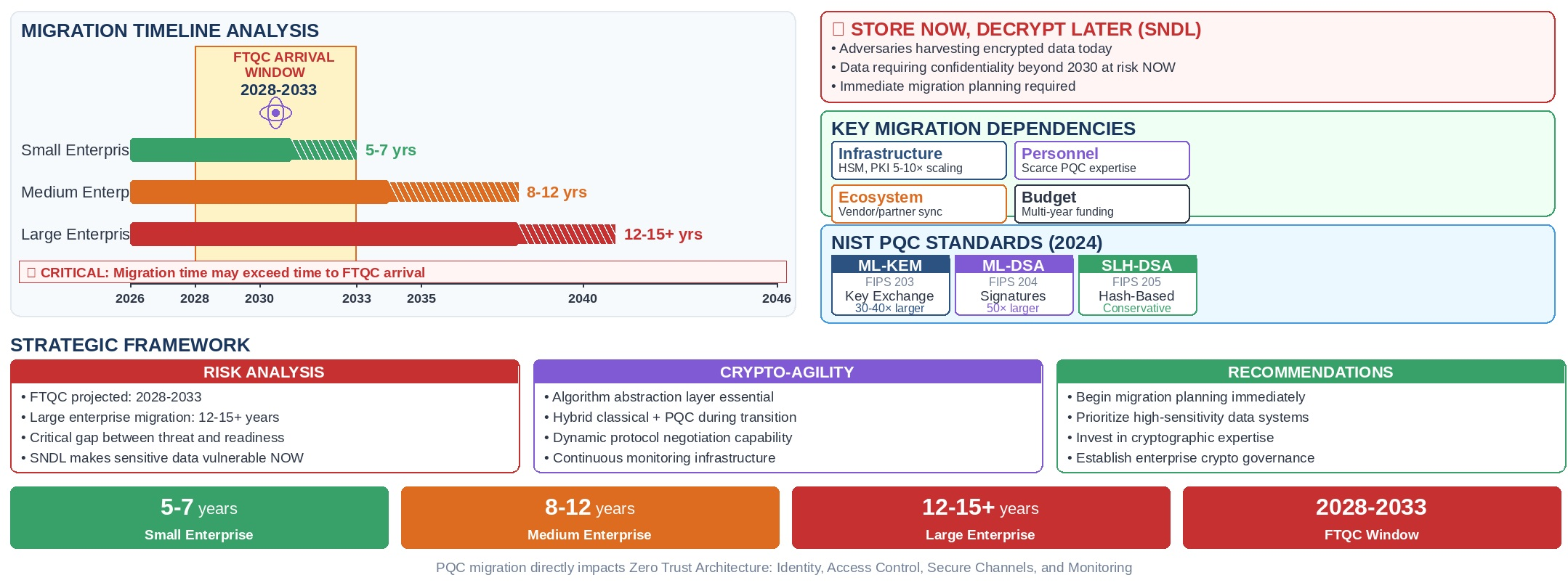
3.2. Timeline Estimates by Enterprise Size
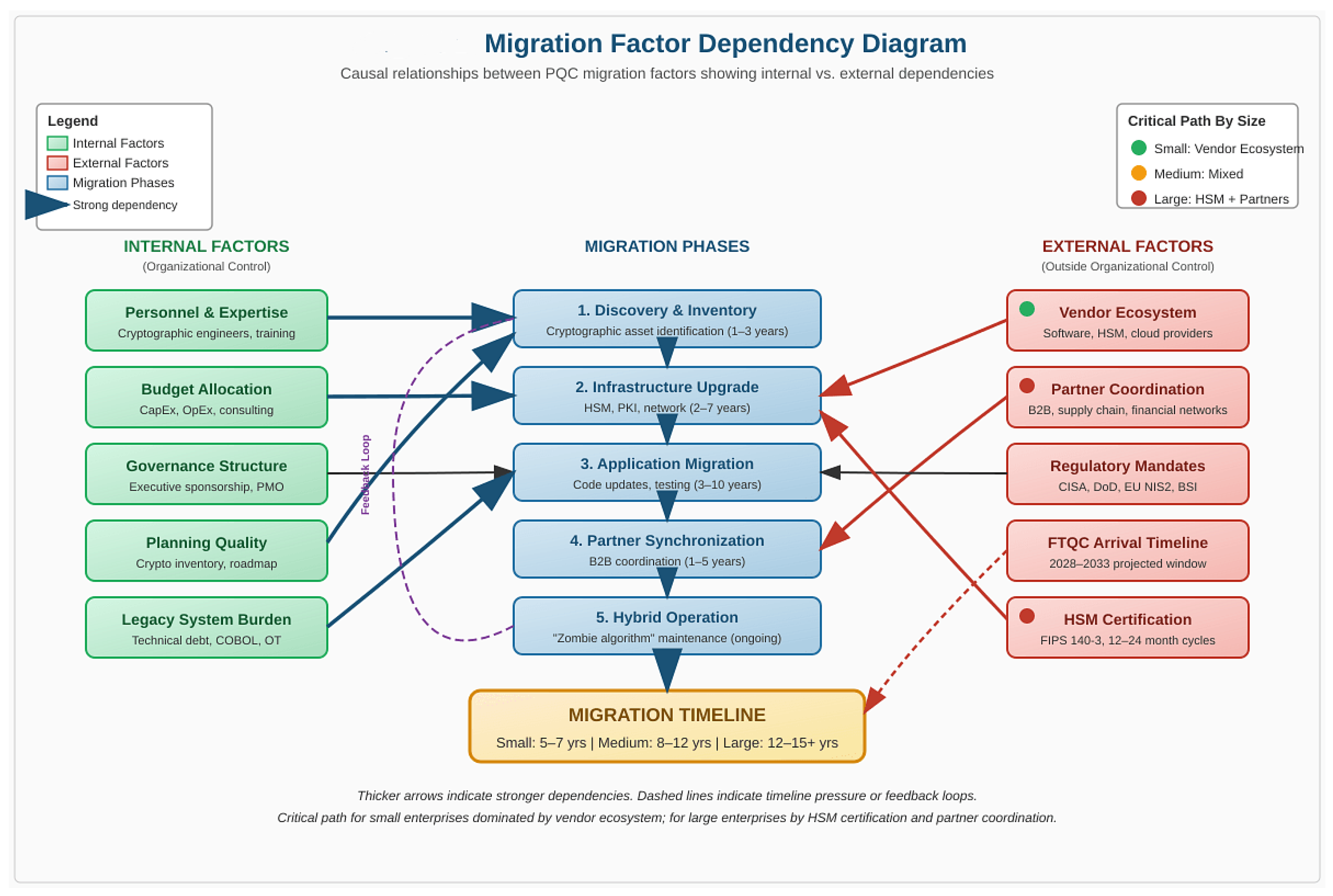
- Personnel → Discovery → Planning: Insufficient cryptographic expertise extends the discovery phase, which delays infrastructure planning, which compresses application migration timelines, which increases execution risk.
- HSM → Certificates → Applications: HSM replacement delays block certificate migration, which stalls application upgrades dependent on PKI, which extends hybrid operation costs.
- Vendor → Procurement → Deployment: Vendor PQC support delays trigger procurement delays, which defer deployment, which may cause regulatory compliance gaps if mandates arrive before migration completes.
3.2.1. Small Enterprise Migration Scenarios
3.2.2. Medium Enterprise Migration Scenarios
3.2.3. Large Enterprise Migration Scenarios
3.3. Comparative Analysis
4. Risk Mitigation and Strategic Frameworks
4.1. Risk Analysis and Mitigation Strategies
4.1.1. Quantum Threat Risk Assessment
4.1.2. Phased Migration Strategies
4.1.3. Contingency Planning
4.2. Crypto-Agility Framework
4.2.1. Principles of Crypto-Agility
4.2.2. Implementation Strategies
4.2.3. Organizational Capabilities
4.3. Policy and Regulatory Considerations
4.3.1. Emerging Regulatory Mandates
4.3.2. Compliance Timeline Challenges
4.4. Limitations and Uncertainty Analysis
- FTQC Arrival Timing: The 2028–2033 window represents a range, not a point prediction, with substantial tail risk in both directions. Unexpected breakthroughs in quantum error correction could accelerate arrival; unforeseen technical barriers could delay it. Our timeline estimates assume FTQC arrives within this window; earlier arrival compresses the available migration window, while later arrival provides additional margin.
- Vendor Ecosystem Development: Timelines assume major vendors deliver PQC-capable products within 2–4 years of standardization, which may prove optimistic if implementation challenges emerge or pessimistic if competitive pressure accelerates development.
- Regulatory Mandate Timing: Emerging government requirements could accelerate organizational timelines through mandate pressure or extend them if compliance demonstration requirements prove burdensome.
- Cryptanalytic Developments: Potential vulnerabilities discovered in NIST-standardized PQC algorithms could necessitate re-migration, significantly extending overall timelines. While NIST’s extensive review process reduces this risk, it cannot be eliminated.
- Estimates are derived from structured expert judgment rather than empirical measurement of completed migrations, which are not yet available.
- Historical migration analogies (AES, SHA-1, TLS 1.3) have limited applicability given PQC’s unique characteristics—larger parameters, hybrid requirements, and broader ecosystem scope.
- The analysis is weighted toward U.S. and European enterprise contexts given the author’s experience and source availability; generalization to other regions requires adjustment for local vendor ecosystem maturity, regulatory environment, and expertise availability.
- The rapidly evolving technology and policy landscape may render specific timeline estimates obsolete as conditions change; the analytical framework and dependency relationships are more durable than point estimates.
5. Conclusions and Future Directions
5.1. Future Research Directions
5.2. Concluding Remarks
Funding
Data Availability Statement
Acknowledgments
Conflicts of Interest
References
- Gheorghiu, V.; Mosca, M. Benchmarking the Quantum Cryptanalysis of Symmetric, Public-Key and Hash-Based Cryptographic Schemes. arXiv 2019, arXiv:1902.02332. Available online: https://arxiv.org/abs/1902.02332 (accessed on 13 December 2025).
- Stebila, D. Standardizing Post-Quantum Cryptography at the IETF. PKIC 2023. 2023. Available online: https://d1kjwivbowugqa.cloudfront.net/files/research/presentations/20230326-RWPQC.pdf (accessed on 13 December 2025).
- Mosca, M.; Piani, M. Quantum Threat Timeline Report 2023; Global Risk Institute: Toronto, ON, Canada, 2023; Available online: https://globalriskinstitute.org/publication/2023-quantum-threat-timeline-report/ (accessed on 13 December 2025).
- CISA; NSA; NIST. Quantum-Readiness: Migration to Post-Quantum Cryptography. Joint Factsheet. August 2023. Available online: https://media.defense.gov/2023/Aug/21/2003284212/-1/-1/0/CSI-QUANTUM-READINESS.PDF (accessed on 13 December 2025).
- Quantinuum. Quantinuum Accelerates the Path to Universal Fully Fault-Tolerant Quantum Computing. November 2024. Available online: https://www.quantinuum.com/blog/quantinuum-accelerates-the-path-to-universal-fault-tolerant-quantum-computing-supports-microsofts-ai-and-quantum-powered-compute-platform-and-the-path-to-a-quantum-supercomputer (accessed on 13 December 2025).
- IonQ. IonQ Roadmap toward Cryptographically Relevant Quantum Computer by 2028. June 2024. Available online: https://postquantum.com/industry-news/ionqroadmap-crqc/ (accessed on 13 December 2025).
- IBM. IBM Lays Out Clear Path to Fault-Tolerant Quantum Computing. IBM Quantum Blog. June 2024. Available online: https://www.ibm.com/quantum/blog/large-scale-ftqc (accessed on 13 December 2025).
- National Institute of Standards and Technology. NIST Announces First Post-Quantum Cryptography Standards (FIPS 203, 204, 205). August 2024. Available online: https://www.nist.gov/news-events/news/2024/08/nist-releases-first-3-finalized-post-quantum-encryption-standards (accessed on 13 December 2025).
- National Institute of Standards and Technology. Getting Ready for Post-Quantum Cryptography. NIST Cybersecurity White Paper. 2021. Available online: https://nvlpubs.nist.gov/nistpubs/CSWP/NIST.CSWP.04282021.pdf (accessed on 13 December 2025).
- National Institute of Standards and Technology. Announcing the Advanced Encryption Standard (AES). FIPS PUB 197. November 2001. Available online: https://csrc.nist.gov/publications/detail/fips/197/final (accessed on 13 December 2025).
- Microsoft. SHA-1 Signed Content Retired. Microsoft Learn. 2017. Available online: https://learn.microsoft.com/en-us/lifecycle/announcements/sha-1-signed-content-retired (accessed on 13 December 2025).
- Rescorla, E. The Transport Layer Security (TLS) Protocol Version 1.3. RFC 8446. August 2018. Available online: https://www.rfc-editor.org/rfc/rfc8446 (accessed on 13 December 2025).
- National Institute of Standards and Technology. Transitioning the Use of Cryptographic Algorithms and Key Lengths. SP 800-131A Rev. 2. 2019. Available online: https://csrc.nist.gov/publications/detail/sp/800-131a/rev-2/final (accessed on 13 December 2025).
- Cloud Security Alliance. Preparing Enterprises for Post-Quantum Cryptography. 2022. Available online: https://cloudsecurityalliance.org/research/post-quantum-cryptography (accessed on 13 December 2025).
- IETF. Post-Quantum Cryptography Recommendations for TLS and Related Protocols (draft-ietf-pqc-tls). 2023. Available online: https://datatracker.ietf.org/doc/draft-ietf-uta-pqc-app/ (accessed on 13 December 2025).
- National Institute of Standards and Technology. Post-Quantum Cryptography Standardization Project. 2022. Available online: https://csrc.nist.gov/projects/post-quantum-cryptography (accessed on 13 December 2025).
- DARPA. Quantum Benchmarking Initiative (QBI). November 2024. Available online: https://www.darpa.mil/program/quantum-benchmarking-initiative (accessed on 13 December 2025).
- Netherlands National Communications Security Agency. The PQC Migration Handbook. March 2023. Available online: https://english.aivd.nl/publications/publications/2023/04/04/the-pqc-migration-handbook (accessed on 13 December 2025).
- Encryption Consulting. How to Start Your Enterprise PQC Migration Plan. 2023. Available online: https://www.encryptionconsulting.com/how-to-start-your-enterprise-post-quantum-cryptography-migration-plan/ (accessed on 13 December 2025).
- BSI. BSI TR-02102-1. Cryptographic Mechanisms: Recommendations and Key Lengths. 2023. Available online: https://www.bsi.bund.de/SharedDocs/Downloads/EN/BSI/Publications/TechGuidelines/TG02102/BSI-TR-02102-1.pdf (accessed on 13 December 2025).
- NIST National Cybersecurity Center of Excellence. Migration to Post-Quantum Cryptography. 2021. Available online: https://www.nccoe.nist.gov/crypto-agility-considerations-migrating-post-quantum-cryptographic-algorithms (accessed on 13 December 2025).
- Tetlock, P.E.; Gardner, D. Superforecasting: The Art and Science of Prediction; Crown Publishers: New York, NY, USA, 2015. [Google Scholar]
- U.S. Small Business Administration. Table of Size Standards. 2025. Available online: https://www.sba.gov/document/support-table-size-standards (accessed on 13 December 2025).
- Reserve Bank of India. MSME FAQs. 2025. Available online: https://www.rbi.org.in/commonman/Upload/English/FAQs/PDFs/MICRO30072025E.pdf (accessed on 13 December 2025).
- IndiaFilings. MSME Definition: Revised Investment & Turnover Limits. 2025. Available online: https://www.indiafilings.com/learn/msme-new-definition/ (accessed on 13 December 2025).
- Economic Times. Firms up to Rs 500 Crore Are Now Medium; MSMEs Get a New Definition. 2025. Available online: https://economictimes.indiatimes.com/small-biz/sme-sector/firms-up-to-rs-500-crore-are-now-medium-msmes-get-a-new-definition/articleshow/117823447.cms (accessed on 13 December 2025).
- Huston, G. IPv6 Transition Costs and Operational Overhead. APNIC Blog. 2022. Available online: https://blog.apnic.net/2025/08/25/the-ipv6-divide/ (accessed on 13 December 2025).
- National Institute of Standards and Technology. Transition to Post-Quantum Cryptography Standards. NIST IR 8547. November 2024. Available online: https://csrc.nist.gov/pubs/ir/8547/ipd (accessed on 13 December 2025).


| Sector | Device Type | Unit Cost Range | Fleet Scale Impact |
|---|---|---|---|
| Utilities | Smart meters | $150–$400/unit | $150 M–$4 B (1–10 M units) |
| Manufacturing | Industrial robots | $5 K–$15 K/unit | $250 M–$750 M (50 K units) |
| Healthcare | Medical devices | Varies by FDA class | FDA guidance-driven |
| Logistics | Vehicle telematics | $200–$800/unit | $20 M–$80 M (100 K units) |
| Alternative | Network segmentation | $50 K–$500 K | Per deployment scope |
| Alternative | Crypto gateways | $100 K–$1 M | Enterprise deployment |
| Enterprise Size | Optimistic | Baseline | Pessimistic | Key Assumptions |
|---|---|---|---|---|
| Small | 3–4 years | 5–7 years | 8–10 years | Vendor readiness, SaaS reliance, budget |
| Medium | 6–8 years | 8–12 years | 12–15 years | Hybrid cloud, legacy systems, partners |
| Large | 9–12 years | 12–15 years | 15–20+ years | Global ops, IoT/OT, regulation, supply chain |
| Factor | Small | Medium | Large |
|---|---|---|---|
| Infrastructure Impact | Low | Moderate | High |
| Personnel Availability | Limited | Moderate | Extensive but siloed |
| Geographic Expertise | Region-dependent | Region-dependent | Multi-region |
| Governance | Minimal | Structured | Heavy, regulated |
| Vendor Dependence | High | Medium | Very high |
| Legacy System Burden | Low | Moderate | Severe |
| Migration Speed | Fast but risky | Balanced | Slow but thorough |
| Budget Flexibility | Constrained | Moderate | Available, allocated |
| Compliance Overhead | Minimal | Moderate | Extensive |
Disclaimer/Publisher’s Note: The statements, opinions and data contained in all publications are solely those of the individual author(s) and contributor(s) and not of MDPI and/or the editor(s). MDPI and/or the editor(s) disclaim responsibility for any injury to people or property resulting from any ideas, methods, instructions or products referred to in the content. |
© 2025 by the author. Licensee MDPI, Basel, Switzerland. This article is an open access article distributed under the terms and conditions of the Creative Commons Attribution (CC BY) license.
Share and Cite
Campbell, R. Enterprise Migration to Post-Quantum Cryptography: Timeline Analysis and Strategic Frameworks. Computers 2026, 15, 9. https://doi.org/10.3390/computers15010009
Campbell R. Enterprise Migration to Post-Quantum Cryptography: Timeline Analysis and Strategic Frameworks. Computers. 2026; 15(1):9. https://doi.org/10.3390/computers15010009
Chicago/Turabian StyleCampbell, Robert. 2026. "Enterprise Migration to Post-Quantum Cryptography: Timeline Analysis and Strategic Frameworks" Computers 15, no. 1: 9. https://doi.org/10.3390/computers15010009
APA StyleCampbell, R. (2026). Enterprise Migration to Post-Quantum Cryptography: Timeline Analysis and Strategic Frameworks. Computers, 15(1), 9. https://doi.org/10.3390/computers15010009