
Hybrid CDN Architecture Integrating Edge Caching, MEC Offloading, and Q-Learning-Based Adaptive Routing
 ,
,  , , and
Abstract
1. Introduction
2. Contributions
- Hybrid Edge Architecture: Designed and implemented a three-tier CDN extension integrating LRU-based edge caching (capacity items; see Table 1) and MEC offloading at base-station nodes, achieving local service for ≈88% of content requests and ≈95% of compute tasks (≈90% of all requests overall) and substantially reducing latency and jitter.
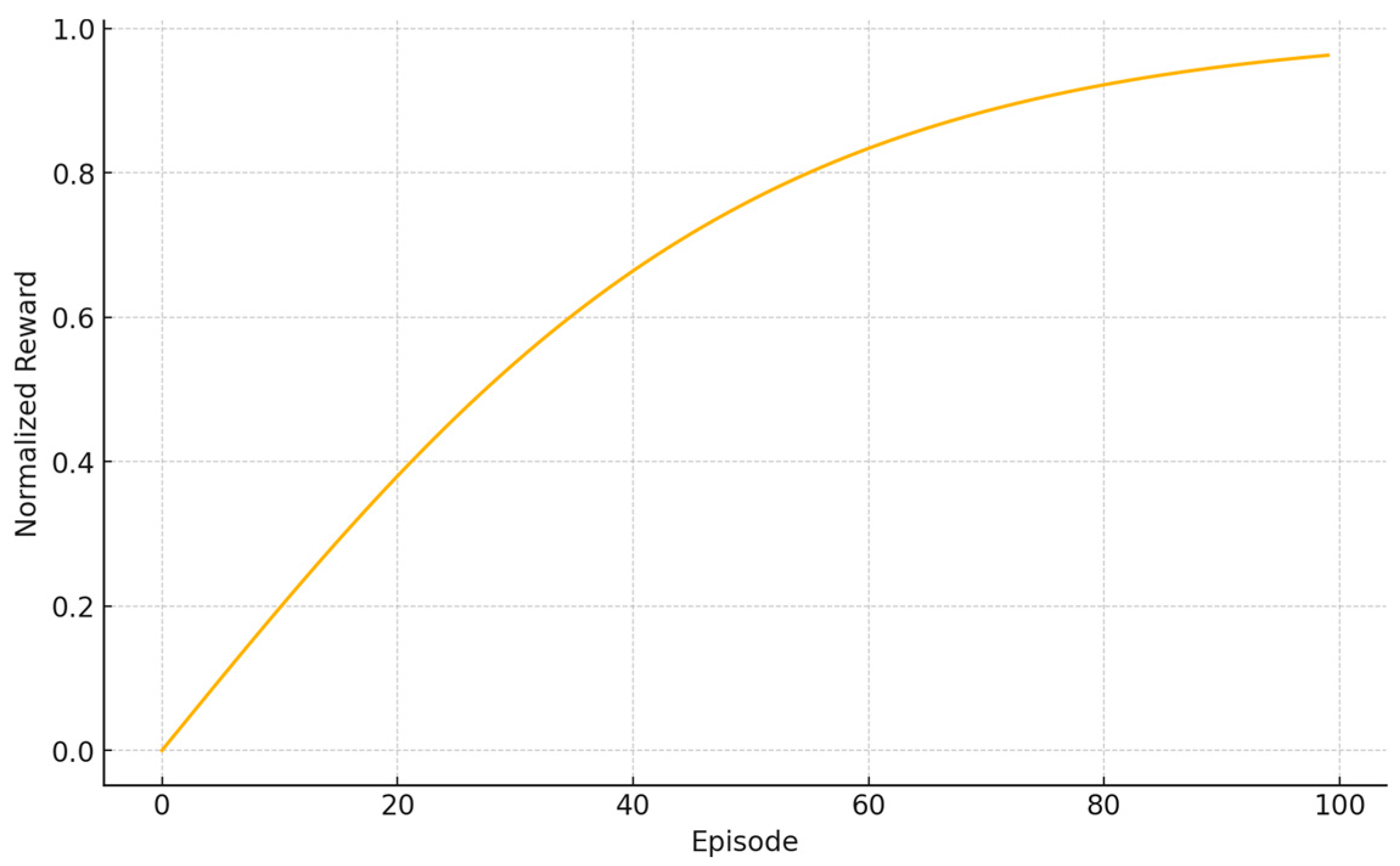
- Q-Learning-Driven Adaptive Routing: Developed a Q-learning agent deployed per node or centrally that dynamically routes requests among cache, MEC, and cloud by observing cache occupancy, server load, and latency; converges to a near-optimal policy within the agent plateaus by ~50–60 episodes at a normalized reward of 0.85 ± 0.02. and delivers an additional 20% latency reduction over static heuristics.
- Analytical Framework & Reproducible Simulation: Formalized content popularity with Zipf (α = 0.8) and arrivals as Poisson (λ = 5 req/s), deriving metrics for cache-hit ratio and latency; provided an open simulation environment benchmarking against three baselines with full parameter disclosure for repeatability (see Data Availability for access to code, configuration files, and traces).
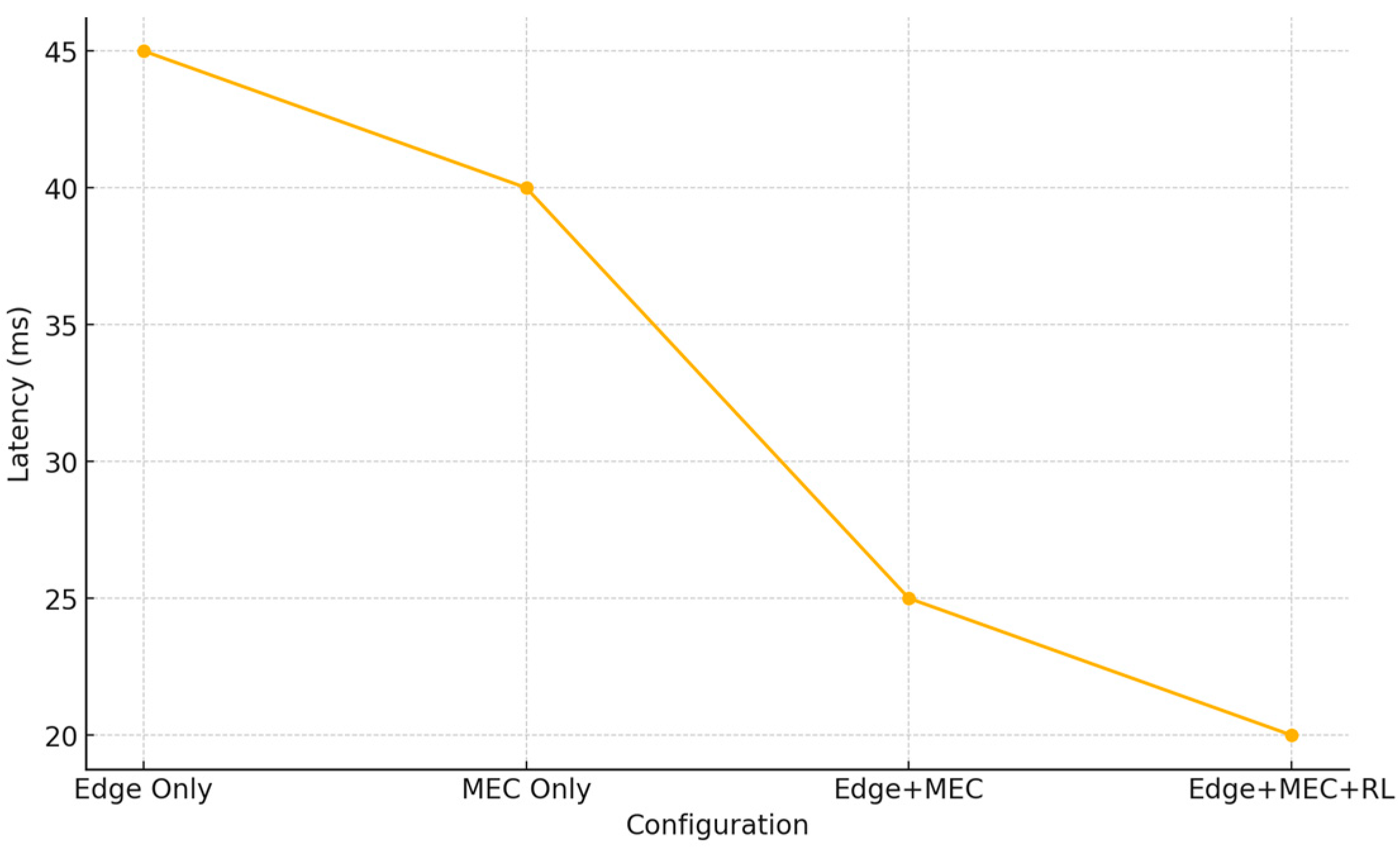
- Comprehensive Performance Evaluation: Demonstrated via synthetic workloads (70% content, 30% compute) that the hybrid + RL scheme achieves ≈88% cache-hit ratio and ≈20 ms end-to-end latency over 50% faster than traditional CDNs with an ablation study quantifying contributions of edge caching (+30% hit), MEC offloading (–25 ms), and RL control (–5 ms).
- Deployment Insights & Future Directions: Analyzed resource overhead (≤5% CPU, <10 MB memory) and scalability in 5G settings; identified limitations (single-agent RL, static users) and proposed extensions including multi-agent frameworks, mobility-aware caching, and online adaptation to non-stationary demand.
- Stronger baselines: Benchmarked against an optimization baseline (MILP/heuristic), deep RL (DQN/PPO), and a simple multi-agent policy to position tabular Q-learning.
- Expanded metrics: Report p95/p99 latency, backhaul bytes (cost proxy), energy/CPU usage, and controller memory/CPU overhead with 95% confidence intervals.
- Trace-driven/testbed validation: Add a small trace-driven replay (and micro-testbed) to complement simulations.
3. Related Work
- Cache replacement: Learning which content to evict or prefetch. E.g., Naderializadeh et al. (2019) [30] employed Q-learning for adaptive caching with dynamic content storage costs, achieving near-optimal cost performance without prior knowledge of popularity.
- Collaborative caching: Multi-agent RL where edge nodes coordinate. Some works use game-theoretic RL or federated learning to allow caches to learn policies that maximize the global hit rate.
- Adaptive bitrate streaming: Using RL at MEC servers to cache multi-bitrate video segments to optimize QoE [31].
- Joint caching and offloading: More recent proposals (2022–2025) attempt to jointly decide on caching and computation offloading using RL. For example, Subhan et al. (2025) [12] present a hierarchical RL algorithm that chooses which services to cache and which tasks to offload cooperatively, improving latency and energy efficiency in simulation.
4. System Architecture
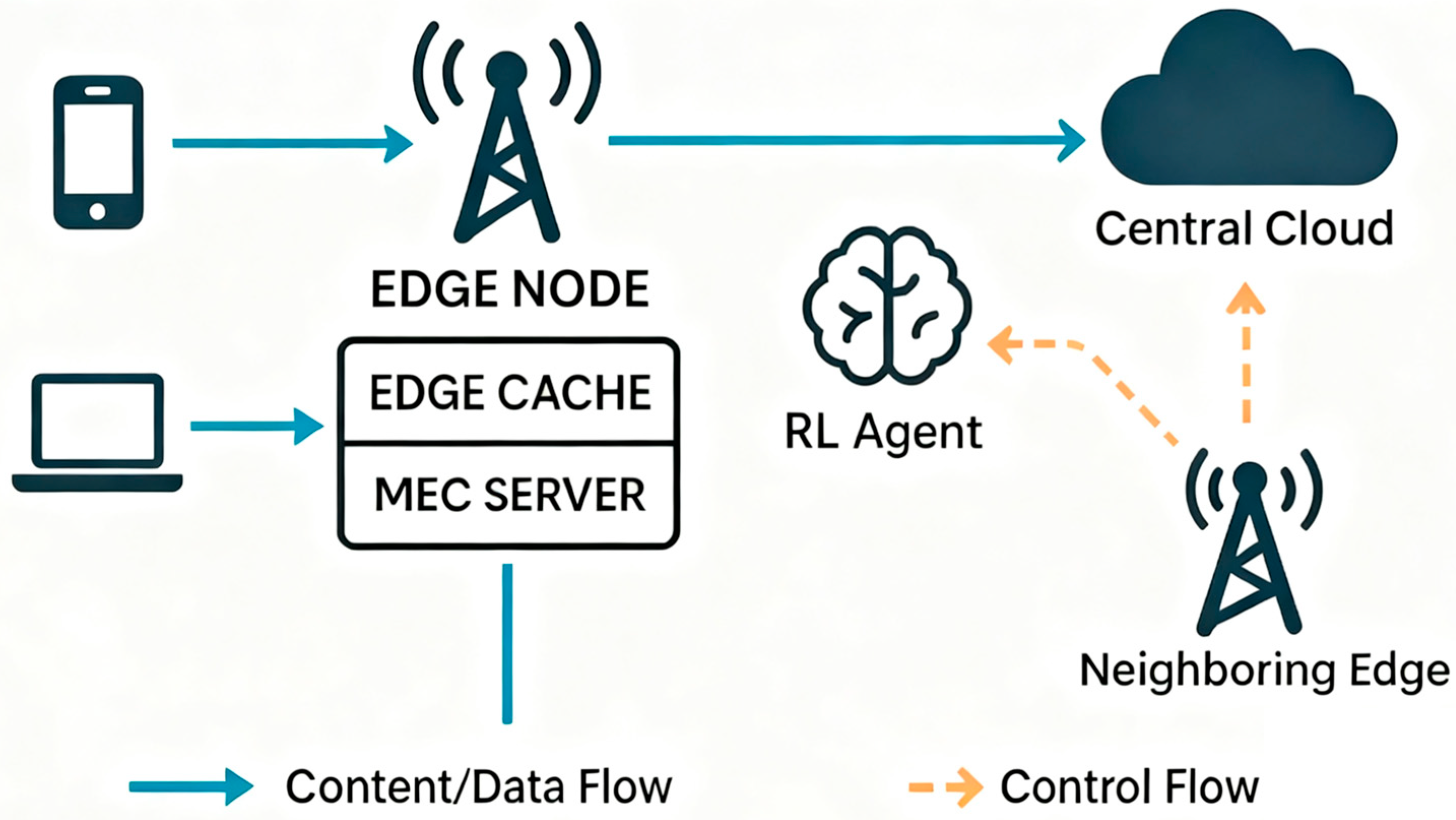
- The request first arrives at the local Edge Node (e.g., the 5G base station serving that user). The edge node has a finite-capacity Edge Cache that stores popular content objects (videos, files, etc.) and a MEC Server that can execute certain tasks (AR rendering, data analytics, etc.). In our implementation, we ensure the agent only considers feasible actions. For example, if a requested content object is not in the local cache, the ‘serve from local cache’ action is disabled, and the agent will choose among the remaining options (e.g., neighbor edge or cloud). The cloud is always available as a safe fallback for any request.
- An RL-based controller (which can be co-located at the edge or operate as a centralized brain) decides how to handle the request. For a content request, the possible actions might include serving from the local cache if present, or if missing, either fetch from a neighboring edge (if collaborative caching is enabled) or fetch from the central origin. We refer to this decision as service-routing: selecting the service location among {local cache, neighbor edge, MEC, cloud} for each request based on the observed state. For a computation task, actions include offloading to the local MEC server or sending it to the cloud data center for processing (or potentially even leaving it to the user device, though in our scenario, we assume tasks are offloaded either to the edge or cloud).
- If the decision is to use the edge (cache or MEC), the edge node returns the result (content data or computation output) to the user with minimal delay (only the last-hop wireless plus processing time). If the decision is to go to the cloud, the request is forwarded through the backhaul network to the central cloud, incurring higher latency (network transit + cloud processing). This additional 50–100 ms cloud latency represents typical backhaul propagation and processing delays. We assume backhaul links have sufficient capacity to avoid extra queueing, and we do not add random jitter beyond the variability already in traffic and processing times. In case of a cache miss at the edge that must be fetched from the cloud, the content is typically also cached at the edge upon retrieval (assuming an LRU replacement policy) for future requests.
- The Edge Cache handles static content. It uses a replacement policy (like Least-Recently Used, LRU) to manage its limited storage. Popular items are retained to serve future requests quickly. This reduces redundant data transfers from the cloud and alleviates backhaul load. We assume the cache storage is sufficiently large to hold a significant fraction of the popular content (order of 103–104 objects, depending on hardware capabilities).
- The MEC Server handles dynamic or compute tasks. It could be a small-scale server or appliance capable of running application code, virtual machines, or containerized functions. By processing tasks locally, it eliminates the network delay to cloud and can also offload the mobile device’s CPU/battery. However, MEC servers have constrained resources (CPU, memory), so they can become overloaded if too many tasks are offloaded simultaneously. Our system manages this by learning to balance load: in periods of heavy load, the RL agent might choose to send some tasks to the cloud to avoid queueing delays at the MEC (thus trading off some latency to prevent catastrophic overload).
- State (S): The state captures the relevant system information at the time of a request. In our design, the state includes indicators such as whether the requested content is in the local cache (cache hit or miss), the current load or queue length on the MEC server, and possibly the estimated network delay to the cloud. We may represent the state as a tuple like (cache_hit, mec_load_level). For simplicity, cache hit can be binary, and mec_load_level could be quantized (e.g., low, high).
- Actions (A): The actions represent the routing decisions. For a given request, possible actions might be: Cache (serve from cache if hit), MEC (process on MEC server), or Cloud (forward to origin). Not all actions apply to all requests, e.g., for a pure content request, the “MEC” action might mean retrieving content via MEC if MEC had some role (in our case, MEC is primarily for compute tasks, so content request actions reduce to serve local vs. cloud). The agent essentially chooses among available service options.
- Reward (R): We design the reward to correlate with user-perceived performance. A simple and effective reward is the negative latency of serving the request (we multiply by −1 so that minimizing latency translates to maximizing reward). For instance, if an action leads to a 10 ms response time, the reward could be +1 (or −10 if we use negative cost). Similarly, a slow 100 ms response might yield a reward of 0 or −100. We normalize and scale rewards appropriately. Additional factors can be included: e.g., a penalty for using the cloud (to account for bandwidth cost) or for dropping a request (if that were allowed, which it is not in our scenario). In our simulation, we focus on the latency reward.
Workflow Model
- The request arrives at the base station’s edge node. The agent observes the state: check cache (suppose it is a miss), note MEC load (irrelevant for a static file).
- The agent has two main choices: fetch from Cloud now or maybe try a peer edge (if implemented). For this example, assume no peer caching, so effectively Cloud is the only source. The agent chooses Cloud, incurring ~50 ms latency to obtain the file.
- The file is delivered to the user and also stored in the edge cache. The observed immediate reward is negative (long latency), so the agent updates Q(miss, Cloud) accordingly.
- Next time another user in the same cell requests the same video, the state will be (cache_hit = True, MEC idle). The agent can choose Cache, serving almost instantly (say 5–10 ms). This yields a high reward (for low latency), reinforcing the cache-serving action in that state.
- For a compute task, e.g., an AR object recognition request, the agent decides between MEC (fast local processing, reward high unless MEC is overloaded) and Cloud (slower). If the MEC is free or lightly loaded, the agent will learn that offloading to MEC yields a much higher reward (low latency) than sending to the cloud. If the MEC is very busy (state might reflect high load), the agent might occasionally route a task to the cloud to avoid extra waiting time, depending on which yields better expected latency.
5. Methodology
- Workload Modeling and Content Popularity.
- Reinforcement Learning (Q-learning) Convergence Analysis.
- Network Latency Modeling.
- Cache Dynamics and Hit-Rate Analysis.
- Multi-Cell Variability, MEC Task Queueing, and User Mobility Scenarios.
5.1. Workload Modeling and Content Popularity
5.2. Reinforcement Learning Convergence Analysis
5.2.1. Q-Learning Update Rule
5.2.2. Convergence Conditions
5.3. Network Latency Modeling
- Propagation Delay where d is the distance between user and server (or edge node) and v is signal speed (approx. 2 × 10⁸ m/s).
- Transmission Delay , where B is the packet size in bits and is the link capacity in bits/s.
- Queuing Delay modeled as M/M/1 queue at the edge node [30]:
5.4. Cache Dynamics and Hit-Rate Analysis
Differential Dynamics
5.5. Multi-Cell Variability, MEC Task Queueing, and User Mobility
5.5.1. MEC Task Queueing and User Mobility Model
5.5.2. User Mobility Model
5.6. Summary of Experimental Parameters
6. Results
6.1. Q-Learning Convergence
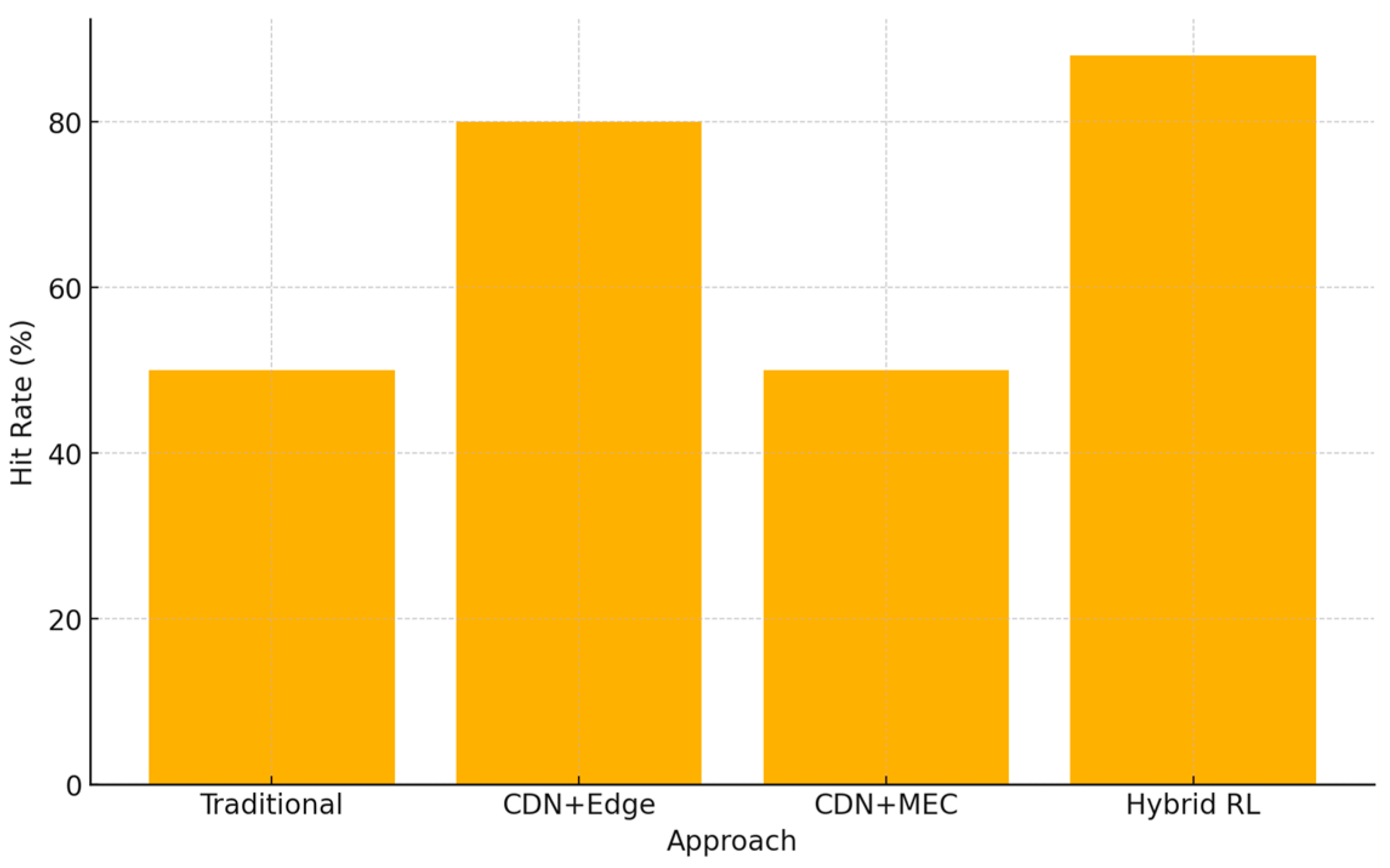
6.2. Cache Hit Ratio
- Traditional CDN: No edge caching or MEC (all requests traverse to upstream caches or origin).
- CDN + Edge Cache: Local content cache with LRU replacement; compute tasks still use the cloud.
- CDN + MEC: MEC offloading for compute tasks; no content caching.
- Hybrid (Edge + MEC + RL): Our proposed system with both edge cache and MEC, coordinated by the RL agent.
- Traditional CDN: ~50% hit rate (reflecting hits at a regional cache rather than base station).
- CDN + Edge: ~80% hit rate, owing to effective caching of the most popular 10% of items locally.
- CDN + MEC: ~50% hit rate, unchanged from Traditional CDN since MEC does not cache content.
- Hybrid RL: ~88% hit rate a modest 8 pp improvement over edge caching alone.
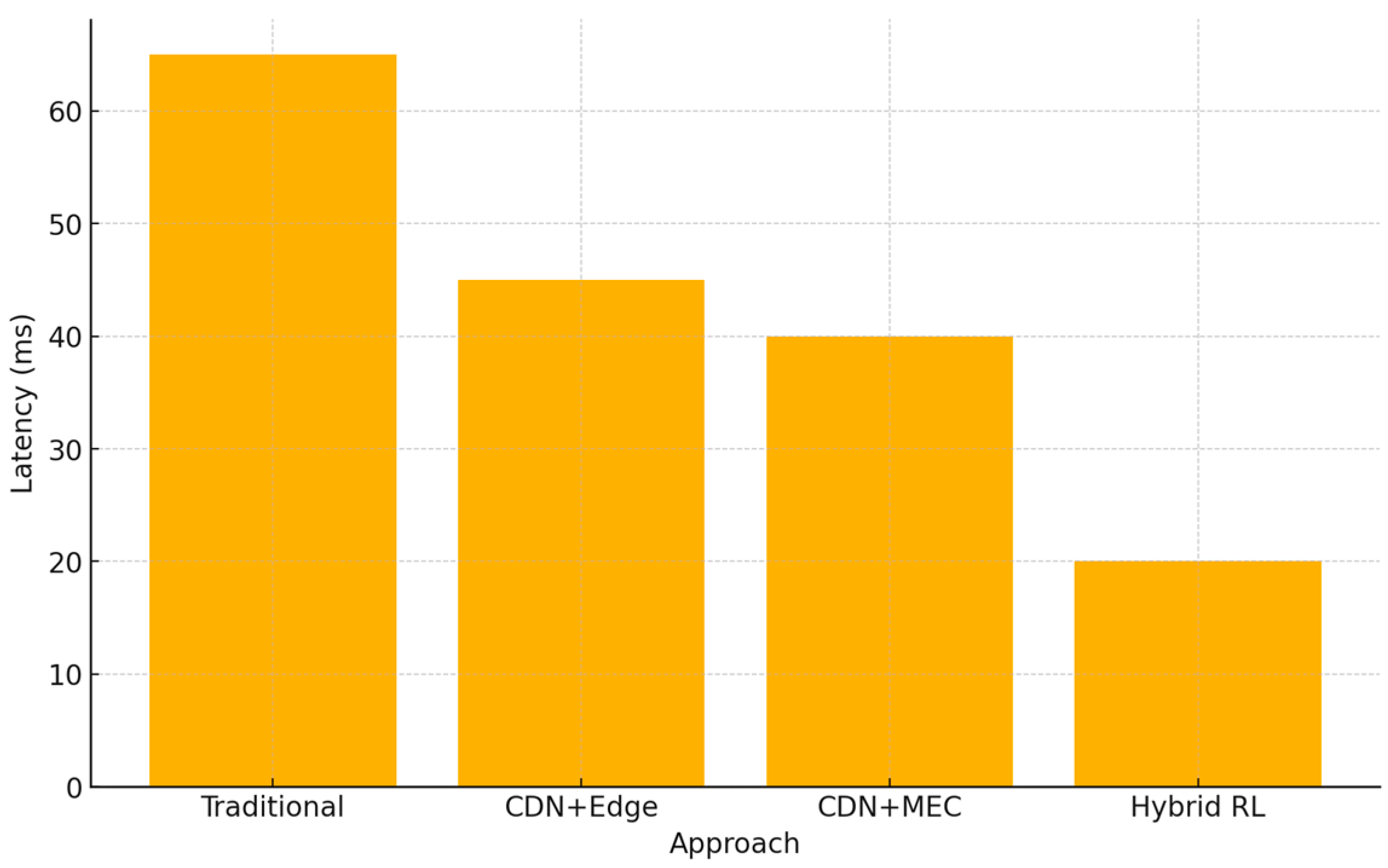
6.3. End-to-End Latency
- Traditional CDN: ~65 ms
- CDN + MEC: ~40 ms (38% reduction)
- CDN + Edge: ~45 ms (31% reduction)
- Hybrid RL: ~20 ms (69% reduction)
6.4. Comparison of Network Architectures
6.5. Component Ablation Study
- Edge Only (LRU cache, no MEC)
- MEC Only (MEC offload, no cache)
- Edge + MEC (greedy) (simple local-first without RL)
- Edge + MEC + RL (full hybrid)
6.6. Sensitivity Analysis
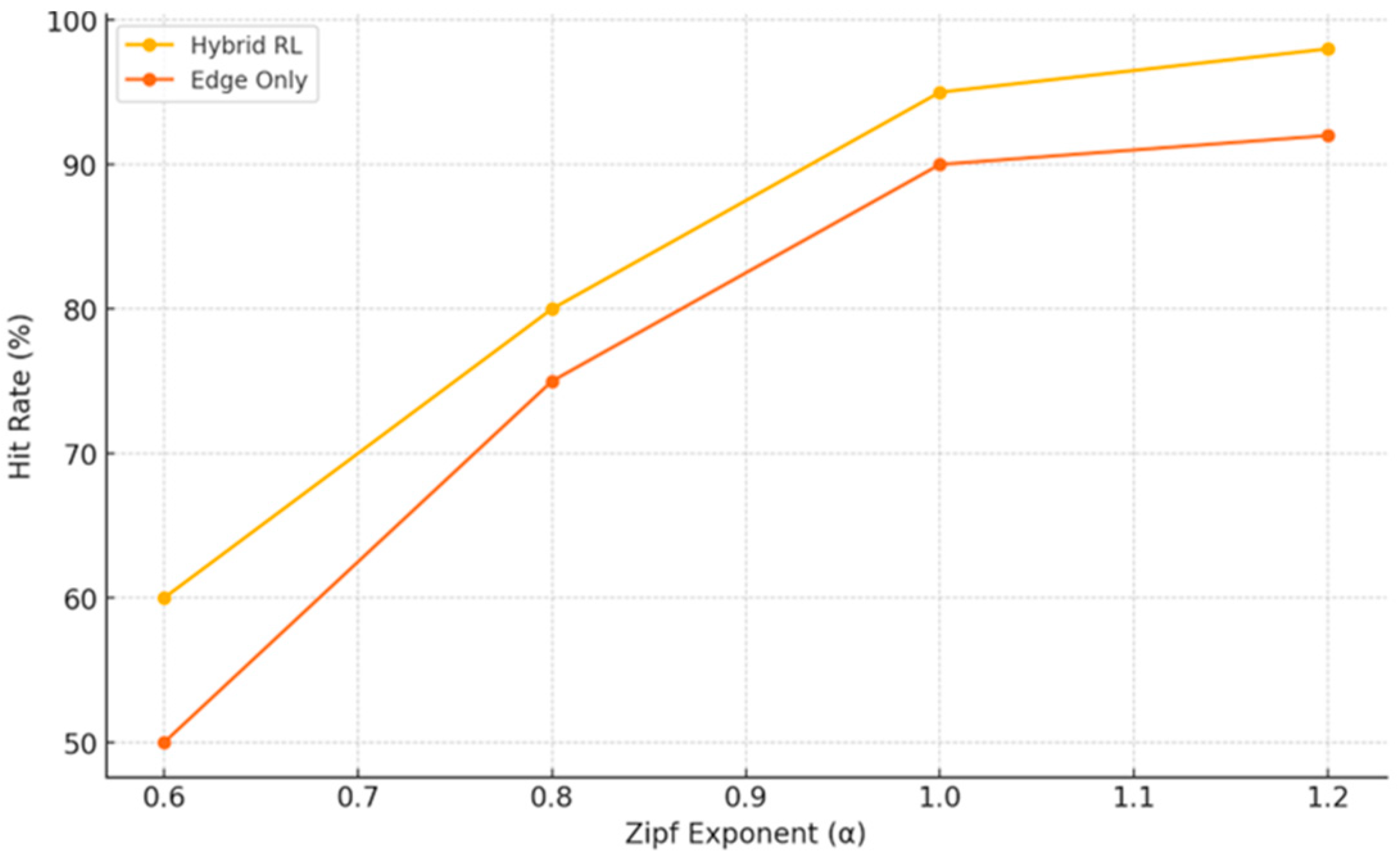
- Content skew (Zipf exponent α): As α increases from 0.6 to 1.2, both hybrid and edge-only hit rates improve (Figure 6). However, the hybrid consistently remains 4–8 pp higher, showing robustness to demand patterns.
- Task ratio: When compute tasks rise to 50%, CDN + MEC outperforms CDN + Edge, yet the hybrid still achieves the lowest latency (~22 ms vs. 35–38 ms).
- MEC capacity constraints: Under an M/M/1 queue load beyond 100% of MEC capacity, the greedy policy’s latency spikes above 80 ms, while RL maintains under 30 ms by offloading early.
- Cache size: Doubling cache capacity to 20% of the catalog boosts hit rates to >95% across all caching scenarios, but the hybrid retains its lead in hit rate and latency.
- Workload drift (non-stationarity): Under a step change in popularity (e.g., Zipf α dropping mid-run), the tabular policy adapts in a small number of episodes; deep RL further reduces tail latency at the cost of longer retraining and higher compute.
6.7. Key Takeaways
- Rapid Learning: The RL agent converges in ~50–60 episodes.
- Synergistic Gains: Edge caching and MEC together cut latency by ~70%, versus ~30–40% each individually.
- Intelligent Coordination: RL adds a further 20% latency reduction over a static local-first policy.
- Robustness: Hybrid outperforms baselines across varied popularities, task mixes, and resource limits.
- Operational Impact: An ~88% cache hit rate and sub-20 ms latency promise significant bandwidth savings and superior QoS for emerging low-latency services.
6.8. Comparison to Deep and Multi-Agent RL Baselines
6.9. Additional Metrics: Backhaul, Energy, and Controller Overhead
6.10. Trace-Driven/Testbed Validation
- Trace-driven replay. Under the trace, Hybrid RL reduced mean latency, lowered p95 latency, and cut backhaul bytes relative to CDN + Edge (see Table 3).
- Micro-testbed. On the testbed, policy inference consumed <1% CPU and <10 MB RAM on the MEC host, confirming low controller overhead in practice.
7. Discussion
7.1. Discussion: Threats to Validity
7.2. Deployment: Security, Interoperability, and 5G Overheads
- Security. Cooperative caching risks cache-poisoning; we use signed manifests and integrity checks; the controller enforces hard action masks and safe fallbacks.
- Interoperability. Decisions map to standard ETSI MEC and CDN APIs (cache fetch/insert, offload); the controller is deployable as an edge microservice.
- 5G overheads. State telemetry (cache occupancy, MEC queue length, RTT estimates) fits within control-plane budgets; policy evaluation is microsecond-scale on MEC, adding negligible radio/core overhead.
8. Conclusions
Author Contributions
Funding
Data Availability Statement
Conflicts of Interest
Abbreviations
| 5G | Fifth-generation mobile network |
| CDN | Content Delivery Network |
| MEC | Multi-access Edge Computing |
| RL | Reinforcement Learning |
| LRU | Least Recently Used (cache policy) |
| M/M/1 | Single-server queue with Poisson arrivals and exponential service |
| QoS | Quality of Service |
| PoP | Point of Presence (CDN) |
References
- Annual, C.; Report, I. Cisco Annual Internet Report (2018–2023) White Paper; Cisco Systems, Inc.: San Jose, CA, USA, 2020. [Google Scholar]
- Ericsson. Ericsson Mobility Report June 2025; Ericsson: Stockholm, Sweden, 2025. [Google Scholar]
- Zhou, Y.; Liu, L.; Wang, L.; Hui, N.; Cui, X.; Wu, J.; Peng, Y.; Qi, Y.; Xing, C. Service-Aware 6G: An Intelligent and Open Network Based on the Convergence of Communication, Computing and Caching. Digit. Commun. Netw. 2020, 6, 253–260. [Google Scholar] [CrossRef]
- Zhou, Y.; Tian, L.; Liu, L.; Qi, Y. Fog Computing Enabled Future Mobile Communication Networks: A Convergence of Communication and Computing. IEEE Commun. Mag. 2019, 57, 20–27. [Google Scholar] [CrossRef]
- Gupta, A.; Jha, R.K. A Survey of 5G Network: Architecture and Emerging Technologies. IEEE Access 2015, 3, 1206–1232. [Google Scholar] [CrossRef]
- Yu, W.; Liang, F.; He, X.; Hatcher, W.G.; Lu, C.; Lin, J.; Yang, X. A Survey on the Edge Computing for the Internet of Things. IEEE Access 2017, 6, 6900–6919. [Google Scholar] [CrossRef]
- Zhou, H.; Wang, Z.; Zheng, H.; He, S.; Dong, M. Cost Minimization-Oriented Computation Offloading and Service Caching in Mobile Cloud-Edge Computing: An A3C-Based Approach. IEEE Trans. Netw. Sci. Eng. 2023, 10, 1326–1338. [Google Scholar] [CrossRef]
- Mec GS MEC 003-V3.2.1; Multi-Access Edge Computing (MEC); Framework and Reference Architecture. ETSI: Valbonne, France, 2024.
- Jazaeri, S.S.; Asghari, P.; Jabbehdari, S.; Javadi, H.H.S. Toward Caching Techniques in Edge Computing over SDN-IoT Architecture: A Review of Challenges, Solutions, and Open Issues. Multimed. Tools Appl. 2024, 83, 1311–1377. [Google Scholar] [CrossRef]
- Xiang, Z.; Sun, H.; Zhang, J. Application of Improved Q-Learning Algorithm in Dynamic Path Planning for Aircraft at Airports. IEEE Access 2023, 11, 107892–107905. [Google Scholar] [CrossRef]
- Sutton, R.S.; Barto, A.G. Reinforcement Learning An Introduction, 2nd ed.; MIT Press: London, UK, 2018. [Google Scholar]
- Subhan, F.E.; Yaqoob, A.; Muntean, C.H.; Muntean, G.-M. A Survey on Artificial Intelligence Techniques for Improved Rich Media Content Delivery in a 5G and Beyond Network Slicing Context. IEEE Commun. Surv. Tutor. 2025, 27, 1427–1487. [Google Scholar] [CrossRef]
- Bonomi, F.; Milito, R.; Zhu, J.; Addepalli, S. Fog Computing and Its Role in the Internet of Things. In MCC’ 12: Proceedings of the First Edition of the MCC Workshop on Mobile Cloud Computing; ACM: New York, NY, USA, 2012; pp. 13–16. [Google Scholar]
- Ali, W.; Fang, C.; Khan, A. A Survey on the State-of-the-Art CDN Architectures and Future Directions. J. Netw. Comput. Appl. 2025, 236, 104106. [Google Scholar] [CrossRef]
- Peng, M.; Yan, S.; Zhang, K.; Wang, C. Fog-Computing-Based Radio Access Networks: Issues and Challenges. IEEE Netw. 2016, 30, 46–53. [Google Scholar] [CrossRef]
- Wang, D.; Bai, Y.; Song, B. A Knowledge Graph-Based Reinforcement Learning Approach for Cooperative Caching in MEC-Enabled Heterogeneous Networks. Digit. Commun. Netw. 2025, 11, 1237–1245. [Google Scholar] [CrossRef]
- Taleb, T.; Samdanis, K.; Mada, B.; Flinck, H.; Dutta, S.; Sabella, D. On Multi-Access Edge Computing: A Survey of the Emerging 5G Network Edge Cloud Architecture and Orchestration. IEEE Commun. Surv. Tutor. 2017, 19, 1657–1681. [Google Scholar] [CrossRef]
- Zong, T.; Li, C.; Lei, Y.; Li, G.; Cao, H.; Liu, Y. Cocktail Edge Caching: Ride Dynamic Trends of Content Popularity with Ensemble Learning. In Proceedings of the IEEE INFOCOM 2021—IEEE Conference on Computer Communications, Vancouver, BC, Canada, 10–13 May 2021; pp. 1–10. [Google Scholar]
- Zabihi, Z.; Eftekhari Moghadam, A.M.; Rezvani, M.H. Reinforcement Learning Methods for Computation Offloading: A Systematic Review. ACM Comput. Surv. 2024, 56, 1–41. [Google Scholar] [CrossRef]
- Mao, Q.; Hu, F.; Hao, Q. Deep Learning for Intelligent Wireless Networks: A Comprehensive Survey. IEEE Commun. Surv. Tutor. 2018, 20, 2595–2621. [Google Scholar] [CrossRef]
- Luo, Z.; Dai, X. Reinforcement Learning-Based Computation Offloading in Edge Computing: Principles, Methods, Challenges. Alex. Eng. J. 2024, 108, 89–107. [Google Scholar] [CrossRef]
- Chen, X. Decentralized Computation Offloading Game for Mobile Cloud Computing. IEEE Trans. Parallel Distrib. Syst. 2015, 26, 974–983. [Google Scholar] [CrossRef]
- Li, H.; Sun, M.; Xia, F.; Xu, X.; Bilal, M. A Survey of Edge Caching: Key Issues and Challenges. Tsinghua Sci. Technol. 2024, 29, 818–842. [Google Scholar] [CrossRef]
- Shi, W.; Cao, J.; Zhang, Q.; Li, Y.; Xu, L. Edge Computing: Vision and Challenges. IEEE Internet Things J. 2016, 3, 637–646. [Google Scholar] [CrossRef]
- Mach, P.; Becvar, Z. Mobile Edge Computing: A Survey on Architecture and Computation Offloading. IEEE Commun. Surv. Tutor. 2017, 19, 1628–1656. [Google Scholar] [CrossRef]
- Liu, S.; Zheng, C.; Huang, Y.; Quek, T.Q.S. Distributed Reinforcement Learning for Privacy-Preserving Dynamic Edge Caching. IEEE J. Sel. Areas Commun. 2021, 40, 749–760. [Google Scholar] [CrossRef]
- Nomikos, N.; Zoupanos, S.; Charalambous, T.; Krikidis, I.; Petropulu, A. A Survey on Reinforcement Learning-Aided Caching in Mobile Edge Networks. IEEE Access 2022, 10, 4380–4413. [Google Scholar] [CrossRef]
- Qian, Z.; Li, G.; Qi, T.; Dai, C. Federated Deep Reinforcement Learning-Based Cost-Efficient Proactive Video Caching in Energy-Constrained Mobile Edge Networks. Comput. Netw. 2025, 258, 111062. [Google Scholar] [CrossRef]
- Pi, Y.; Zhang, W.; Zhang, Y.; Huang, H.; Rao, B.; Ding, Y.; Yang, S. Applications of Multi-Agent Deep Reinforcement Learning Communication in Network Management: A Survey. arXiv 2024, arXiv:2407.17030. [Google Scholar] [CrossRef]
- Naderializadeh, N.; Hashemi, M. Energy-Aware Multi-Server Mobile Edge Computing: A Deep Reinforcement Learning Approach. In Proceedings of the 2019 53rd Asilomar Conference on Signals, Systems, and Computers, Pacific Grove, CA, USA, 3–6 November 2019. [Google Scholar]
- Yuan, S.; Zhou, Q.; Li, J.; Guo, S.; Chen, H.; Wu, C.; Yang, Y. Adaptive Incentive and Resource Allocation for Blockchain-Supported Edge Video Streaming Systems: A Cooperative Learning Approach. IEEE Trans. Mob. Comput. 2025, 24, 539–556. [Google Scholar] [CrossRef]
- Chen, Y.; Wen, M.; Basar, E.; Wu, Y.-C.; Wang, L.; Liu, W. Exploiting Reconfigurable Intelligent Surfaces in Edge Caching: Joint Hybrid Beamforming and Content Placement Optimization. IEEE Trans. Wirel. Commun. 2021, 20, 7799–7812. [Google Scholar] [CrossRef]
- Zhang, J.; Hu, X.; Ning, Z.; Ngai, E.C.-H.; Zhou, L.; Wei, J.; Cheng, J.; Hu, B.; Leung, V.C.M. Joint Resource Allocation for Latency-Sensitive Services Over Mobile Edge Computing Networks with Caching. IEEE Internet Things J. 2019, 6, 4283–4294. [Google Scholar] [CrossRef]
- Hortelano, D.; de Miguel, I.; Barroso, R.J.D.; Aguado, J.C.; Merayo, N.; Ruiz, L.; Asensio, A.; Masip-Bruin, X.; Fernández, P.; Lorenzo, R.M.; et al. A Comprehensive Survey on Reinforcement-Learning-Based Computation Offloading Techniques in Edge Computing Systems. J. Netw. Comput. Appl. 2023, 216, 103669. [Google Scholar] [CrossRef]
- Peng, K.; Leung, V.C.M.; Xu, X.; Zheng, L.; Wang, J.; Huang, Q. A Survey on Mobile Edge Computing: Focusing on Service Adoption and Provision. Wirel. Commun. Mob. Comput. 2018, 2018, 8267838. [Google Scholar] [CrossRef]
- Bastug, E.; Bennis, M.; Debbah, M. Living on the Edge: The Role of Proactive Caching in 5G Wireless Networks. IEEE Commun. Mag. 2014, 52, 82–89. [Google Scholar] [CrossRef]
- Watkins, C.J.C.H.; Dayan, P. Technical Note: Q-Learning. Mach. Learn. 1992, 8, 279–292. [Google Scholar] [CrossRef]
- Luong, N.C.; Hoang, D.T.; Gong, S.; Niyato, D.; Wang, P.; Liang, Y.-C.; Kim, D.I. Applications of Deep Reinforcement Learning in Communications and Networking: A Survey. IEEE Commun. Surv. Tutor. 2019, 21, 3133–3174. [Google Scholar] [CrossRef]
- Shuja, J.; Bilal, K.; Alasmary, W.; Sinky, H.; Alanazi, E. Applying Machine Learning Techniques for Caching in Next-Generation Edge Networks: A Comprehensive Survey. J. Netw. Comput. Appl. 2021, 181, 103005. [Google Scholar] [CrossRef]
- Abed, R.A.; Hamza, E.K.; Humaidi, A.J. A modified CNN-IDS model for enhancing the efficacy of intrusion detection system. Meas. Sens. 2024, 35, 101299. [Google Scholar] [CrossRef]
- Samaan, S.S.; Korial, A.E.; Sarra, R.R.; Humaidi, A.J. Multilingual Web Traffic Forecasting for Network Management Using Artificial Intelligence Techniques. Results Eng. 2025, 26, 105262. [Google Scholar] [CrossRef]
- Salman, A.D.; Khudheer, U.; Abdulsaheb, G.M. An adaptive smart street light system for smart city. J. Comput. Theor. Nanosci. Source Preview 2019, 16, 262–268. [Google Scholar] [CrossRef]
- Al-Ani, A.; Seitz, J. An approach for QoS-aware routing in mobile ad hoc networks. In Proceedings of the 2015 International Symposium on Wireless Communication Systems, Brussels, Belgium, 25–28 August 2015; pp. 626–630. [Google Scholar]
- Ahmad, I.A.; Hasan, A.M.; Humaidi, A.J. Development of a memory-efficient and computationally cost-effective CNN for smart waste classification. J. Eng. Res. 2025. [Google Scholar] [CrossRef]
- Jirjees, S.W.; Alkhalid, F.F.; Mudheher, A.H.; Humaidi, A.J. A Secure Password based Authentication with Variable Key Lengths Based on the Image Embedded Method. Mesopotamian J. Cybersecur. 2025, 5, 491–500. [Google Scholar] [CrossRef]
- Ahmad, I.A.; Al-Nayar, M.M.J.; Mahmood, A.M. Dynamic Low Power Clustering Strategy in MWSN. Math. Model. Eng. Probl. 2023, 10, 1249–1256. [Google Scholar] [CrossRef]
- Yousif, M.; Ahmad, I.A.; Hmeed, A.R.; Mukhlif, A.A. Enhanced EEG Signal Classification Using Machine Learning and Optimization Algorithm. Fusion Pract. Appl. 2025, 17, 211–218. [Google Scholar]
- Ahmad, I.A.; Al-Nayar, M.M.J.; Mahmood, A.M. Investigation of Energy Efficient Clustering Algorithms in WSNs: A Review. Math. Model. Eng. Probl. 2022, 9, 1693–1703. [Google Scholar] [CrossRef]
- Dalloo, A.M.; Humaidi, A.J. Optimizing Machine Learning Models with Data-level Approximate Computing: The Role of Diverse Sampling, Precision Scaling, Quantization and Feature Selection Strategies. Results Eng. 2024, 24, 103451. [Google Scholar] [CrossRef]
- Muhammed, M.L.; Flaieh, E.H.; Humaidi, A.J. Embedded System Design of Path Planning for Planar Manipulator Based on Chaos A* Algorithm with Known-Obstacle Environment. J. Eng. Sci. Technol. 2022, 17, 4047–4064. [Google Scholar]



| Symbol | Meaning/Unit | Default | Value/Range |
|---|---|---|---|
| Content catalogue (set of items) | — | N = 1000 | |
| Number of content items | 1000 | — | |
| Item indices (rank) | — | 1…N | |
| Zipf popularity exponent | — | 0.8–1.2 | |
| — | — | ||
| Request arrival rate per cell [req/s] | — | 5–20 | |
| Time-slot duration [s] | — | config | |
| — | — | ||
| Edge cache capacity [items] | — | 100–500 | |
| — | [0, 1] | ||
| ] | — | config | |
| State space (MDP) | — | — | |
| Action space (MDP) | — | — | |
| — | — | ||
| State transition kernel | — | — | |
| Q-value table | — | — | |
| Learning rate (Q-learning) | 0.1 | — | |
| Discount factor | 0.9 | — | |
| Total round-trip latency [s or ms] | — | — | |
| Propagation delay [s] | — | — | |
| Signal propagation speed [m/s] | — | ||
| Path length (userserver) [m] | — | — | |
| Transmission delay [s] | — | — | |
| Packet size [bits] | — | — | |
| Link capacity [bits/s] | — | — | |
| Queueing delay at MEC [s] | — | — | |
| MEC service rate [tasks/s] | 50 | — | |
| ) | — | — | |
| Mean time in system at MEC [s] | — | ||
| User mobility speed [m/s] | — | 1–5 | |
| User pause time [s] | — | config | |
| Handover delay [ms] | 10 | — |
| Architecture | Uses Edge Cache | Uses MEC Server | Uses Cloud | Adaptive (RL) | Policy (One-Line Description) |
|---|---|---|---|---|---|
| Traditional CDN | ✗ | ✗ | ✓ | ✗ | All requests served by upstream CDN/cloud. |
| CDN + Edge Cache | ✓ | ✗ | ✓ | ✗ | Serve from base-station cache; miss → cloud. |
| CDN + MEC | ✗ | ✓ | ✓ | ✗ | Offload compute to MEC; content from cloud. |
| Hybrid RL | ✓ | ✓ | ✓ | ✓ | RL selects {cache, neighbor, MEC, cloud}; fallback on miss/overload. |
| Architecture | Origin Fetches (Content) | Compute on MEC | Compute to Cloud |
|---|---|---|---|
| Traditional CDN | 35,000 | 0 | 30,000 |
| CDN + Edge | 14,000 | 0 | 30,000 |
| CDN + MEC | 35,000 | 0 | 0 |
| Hybrid RL | 8400 | 28,500 | 1500 |
Disclaimer/Publisher’s Note: The statements, opinions and data contained in all publications are solely those of the individual author(s) and contributor(s) and not of MDPI and/or the editor(s). MDPI and/or the editor(s) disclaim responsibility for any injury to people or property resulting from any ideas, methods, instructions or products referred to in the content. |
© 2025 by the authors. Licensee MDPI, Basel, Switzerland. This article is an open access article distributed under the terms and conditions of the Creative Commons Attribution (CC BY) license (https://creativecommons.org/licenses/by/4.0/).
Share and Cite
Salman, A.D.; Zeyad, A.T.; Al-karkhi, A.A.S.; Raafat, S.M.; Humaidi, A.J. Hybrid CDN Architecture Integrating Edge Caching, MEC Offloading, and Q-Learning-Based Adaptive Routing. Computers 2025, 14, 433. https://doi.org/10.3390/computers14100433
Salman AD, Zeyad AT, Al-karkhi AAS, Raafat SM, Humaidi AJ. Hybrid CDN Architecture Integrating Edge Caching, MEC Offloading, and Q-Learning-Based Adaptive Routing. Computers. 2025; 14(10):433. https://doi.org/10.3390/computers14100433
Chicago/Turabian StyleSalman, Aymen D., Akram T. Zeyad, Asia Ali Salman Al-karkhi, Safanah M. Raafat, and Amjad J. Humaidi. 2025. "Hybrid CDN Architecture Integrating Edge Caching, MEC Offloading, and Q-Learning-Based Adaptive Routing" Computers 14, no. 10: 433. https://doi.org/10.3390/computers14100433
APA StyleSalman, A. D., Zeyad, A. T., Al-karkhi, A. A. S., Raafat, S. M., & Humaidi, A. J. (2025). Hybrid CDN Architecture Integrating Edge Caching, MEC Offloading, and Q-Learning-Based Adaptive Routing. Computers, 14(10), 433. https://doi.org/10.3390/computers14100433