Body Mass Index and Outcomes in HR+/HER2− Metastatic Breast Cancer Treated with Palbociclib: Insights from a National Real-World Study

 ,
,  , , and
Simple Summary
Abstract
1. Introduction
2. Materials and Methods
2.1. Study Design
2.2. Data Collection
2.3. Objectives and Endpoints
2.4. Statistical Analysis
3. Results
3.1. Patient Characteristics
3.2. Tumor Response to Palbociclib According to BMI
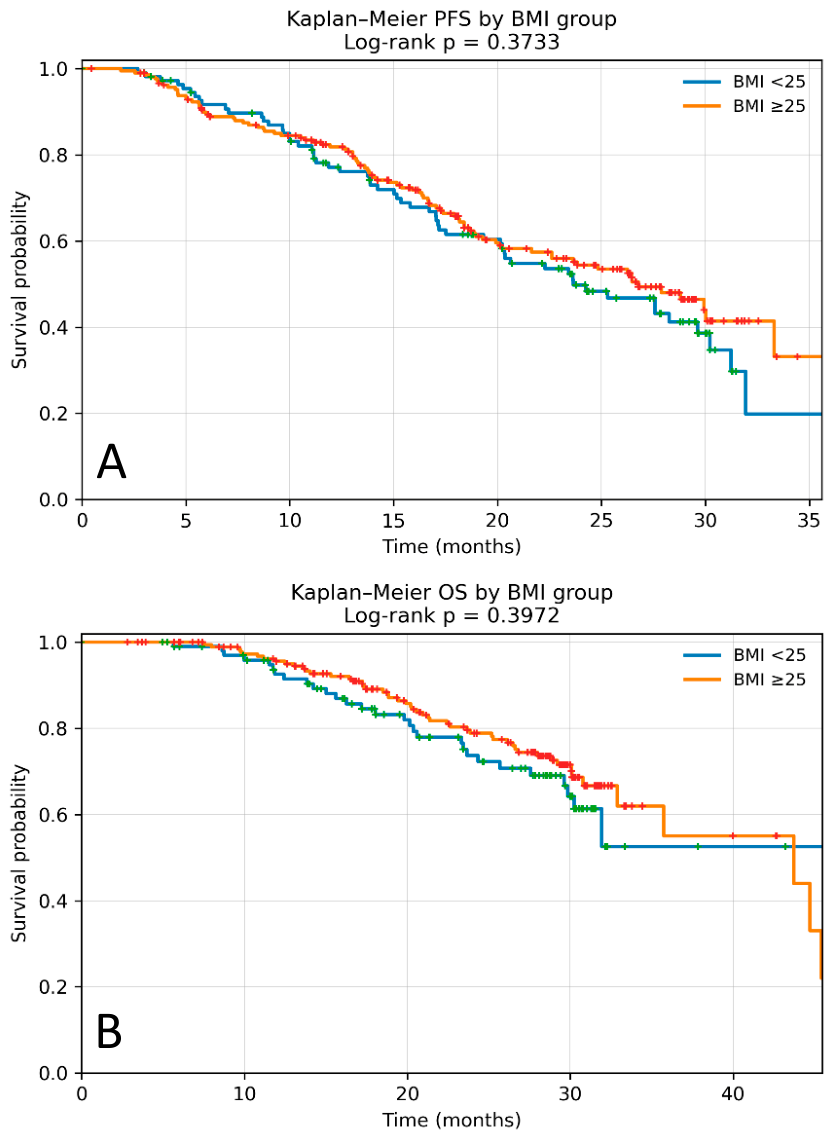
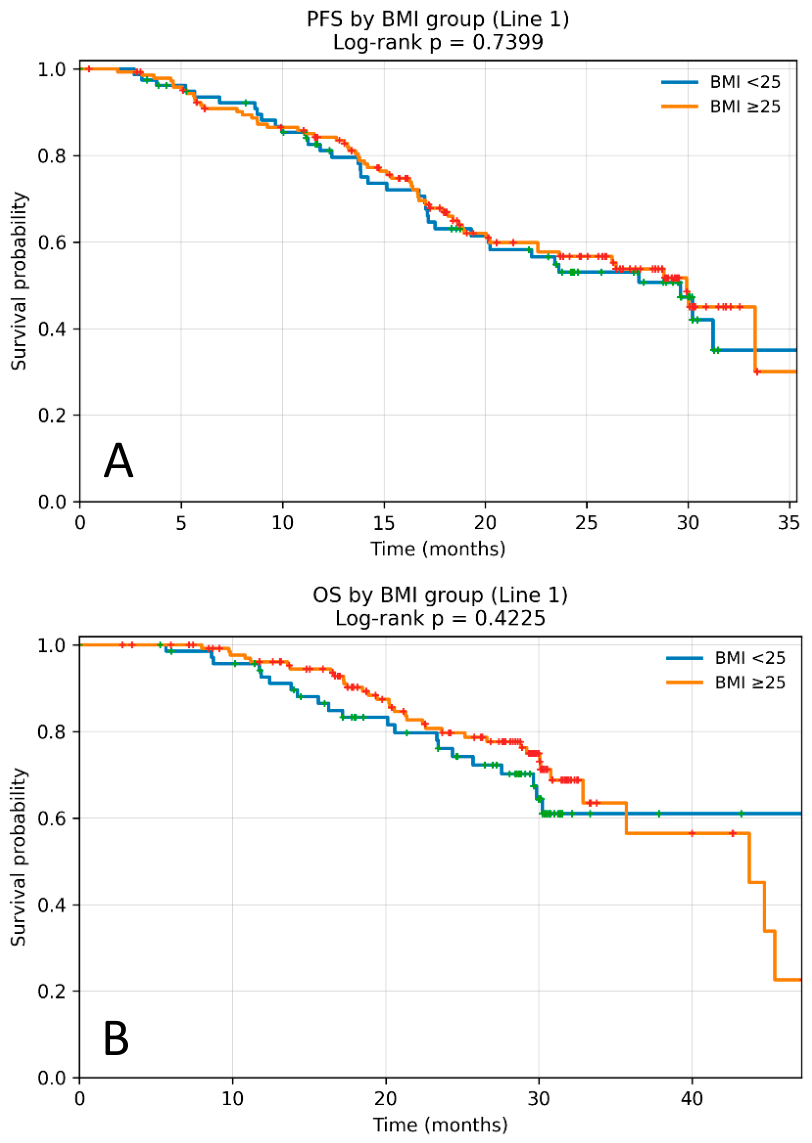
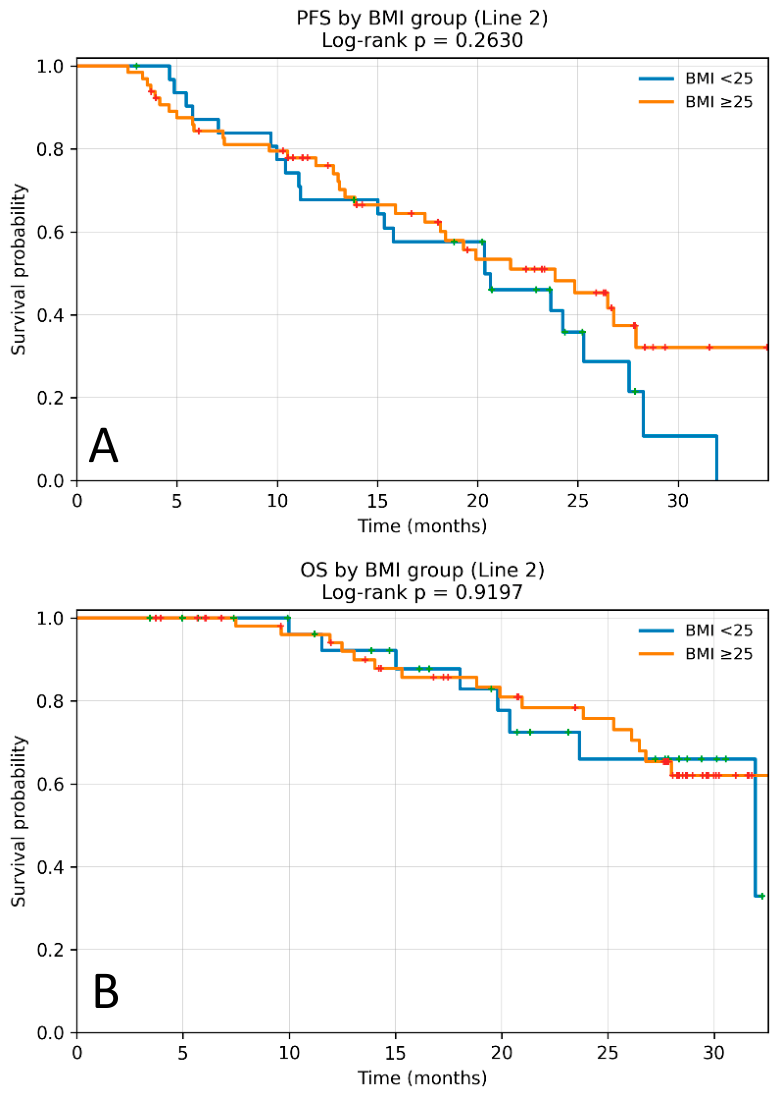
3.3. Progression-Free Survival Outcome
3.4. Overall Survival Outcome
4. Discussion
5. Conclusions
Author Contributions
Funding
Institutional Review Board Statement
Informed Consent Statement
Data Availability Statement
Acknowledgments
Conflicts of Interest
Abbreviations
| BMI | Body mass index |
| WHO | World Health Organization |
| BC | Breast cancer |
| EBC | Early breast cancer |
| HR+ | Hormone receptor-positive |
| NCCN | National Comprehensive Cancer Network |
| MBC | Metastatic breast cancer |
| HER2− | Human epidermal growth factor receptor 2–negative |
| FISH | Fluorescence in situ hybridization |
| ISH | In situ hybridization |
| ORR | Objective response rate |
| CBR | Clinical benefit rate |
| CR | Complete response |
| PR | Partial response |
| SD | Stable disease |
| RECIST | Response Evaluation Criteria in Solid Tumors |
| CT | Computed tomography |
| HR | Hazard ratio |
| CI | Confidence interval |
| OR | Odds ratio |
| AI | Aromatase inhibitor |
| TME | Tumor microenvironment |
| PPAR-γ | Peroxisome proliferator-activated receptor γ |
| CAAs | Cancer-associated adipocytes |
| CAAT | Cancer-associated adipose tissue |
| IGFBP2 | Insulin-like growth factor binding protein 2 |
| VAT | Visceral adipose tissue |
References
- Yu, L.; Yuan, J.; Meng, M.; Pan, H.; Ge, L.; Wang, L.; Li, X. Unravelling the Obesity Paradox in Cancer: An Umbrella Review of Protective Associations and Evidence Credibility across 13 Malignancies. Metab.-Clin. Exp. 2026, 175, 156461. [Google Scholar] [CrossRef]
- Rubino, F.; Cummings, D.E.; Eckel, R.H.; Cohen, R.V.; Wilding, J.P.H.; Brown, W.A.; Stanford, F.C.; Batterham, R.L.; Farooqi, I.S.; Farpour-Lambert, N.J.; et al. Definition and Diagnostic Criteria of Clinical Obesity. Lancet Diabetes Endocrinol. 2025, 13, 221–262. [Google Scholar] [CrossRef]
- World Health Organization. Obesity and Overweight. Available online: https://www.who.int/news-room/fact-sheets/detail/obesity-and-overweight (accessed on 14 February 2026).
- Phelps, N.H.; Singleton, R.K.; Zhou, B.; Heap, R.A.; Mishra, A.; Bennett, J.E.; Paciorek, C.J.; Lhoste, V.P.; Carrillo-Larco, R.M.; Stevens, G.A.; et al. Worldwide Trends in Underweight and Obesity from 1990 to 2022: A Pooled Analysis of 3663 Population-Representative Studies with 222 Million Children, Adolescents, and Adults. Lancet 2024, 403, 1027–1050. [Google Scholar] [CrossRef]
- Ecancer. Breast Cancer Incidence Is Rising Globally, but Mortality Disproportionately Affects the Global South. Available online: http://ecancer.org/en/news/26289-breast-cancer-incidence-is-rising-globally-but-mortality-disproportionately-affects-the-global-south (accessed on 14 February 2026).
- Wen, H.; Deng, G.; Shi, X.; Liu, Z.; Lin, A.; Cheng, Q.; Zhang, J.; Luo, P. Body Mass Index, Weight Change, and Cancer Prognosis: A Meta-Analysis and Systematic Review of 73 Cohort Studies. ESMO Open 2024, 9, 102241. [Google Scholar] [CrossRef]
- Dauccia, C.; Bruzzone, M.; Arecco, L.; Blondeaux, E.; Sirico, M.; Gerosa, R.; Franzoi, M.A.; Brandão, M.; Perrone, L.; Pedrazzoli, P.; et al. Association between Body Mass Index and Risk of Breast Cancer According to Breast Cancer Subtypes: A Systematic Review and Meta-Analysis. Breast 2026, 86, 104710. [Google Scholar] [CrossRef]
- Chan, D.S.M.; Vieira, A.R.; Aune, D.; Bandera, E.V.; Greenwood, D.C.; McTiernan, A.; Navarro Rosenblatt, D.; Thune, I.; Vieira, R.; Norat, T. Body Mass Index and Survival in Women with Breast Cancer—Systematic Literature Review and Meta-Analysis of 82 Follow-up Studies. Ann. Oncol. 2014, 25, 1901–1914. [Google Scholar] [CrossRef]
- Brown, K.A. Metabolic Pathways in Obesity-Related Breast Cancer. Nat. Rev. Endocrinol. 2021, 17, 350–363. [Google Scholar] [CrossRef] [PubMed]
- Guidelines Detail. Available online: https://www.nccn.org/guidelines/guidelines-detail?category=1&id=1419 (accessed on 14 February 2026).
- Gevorgyan, A.; Bregni, G.; Galli, G.; Ganzinelli, M.; Martinetti, A.; Lo Vullo, S.; Mariani, L.; Festinese, F.; Sottotetti, E.; de Braud, F.; et al. Body Mass Index and Clinical Benefit of Fulvestrant in Postmenopausal Women with Advanced Breast Cancer. Tumori J. 2016, 102, e11–e14. [Google Scholar] [CrossRef] [PubMed]
- Martel, S.; Poletto, E.; Ferreira, A.R.; Lambertini, M.; Sottotetti, F.; Bertolini, I.; Montemurro, F.; Bernardo, A.; Risi, E.; Zanardi, E.; et al. Impact of Body Mass Index on the Clinical Outcomes of Patients with HER2-Positive Metastatic Breast Cancer. Breast 2018, 37, 142–147. [Google Scholar] [CrossRef] [PubMed]
- Lammers, S.W.M.; Thurisch, H.; Vriens, I.J.H.; Meegdes, M.; Engelen, S.M.E.; Erdkamp, F.L.G.; Dercksen, M.W.; Vriens, B.E.P.J.; Aaldering, K.N.A.; Pepels, M.J.A.E.; et al. The Prognostic Impact of BMI in Patients with HR+/HER2− Advanced Breast Cancer: A Study of the SONABRE Registry. Breast Cancer Res. Treat. 2024, 203, 339–349. [Google Scholar] [CrossRef]
- Zewenghiel, L.; Lindman, H.; Valachis, A. Impact of Body Mass Index on the Efficacy of Endocrine Therapy in Patients with Metastatic Breast Cancer—A Retrospective Two-Center Cohort Study. Breast 2018, 40, 136–140. [Google Scholar] [CrossRef] [PubMed]
- Petrelli, F.; Cortellini, A.; Indini, A.; Tomasello, G.; Ghidini, M.; Nigro, O.; Salati, M.; Dottorini, L.; Iaculli, A.; Varricchio, A.; et al. Association of Obesity with Survival Outcomes in Patients with Cancer. JAMA Netw. Open 2021, 4, e213520. [Google Scholar] [CrossRef] [PubMed]
- Jung, Y.B.; Ahn, H.K.; Shin, H.-Y.; Hong, J.H.; Rim, C.H. The Impact of Obesity on Treatment Outcomes in Patients with Hormone Receptor–Positive HER2-Negative Metastatic Breast Cancer Receiving CDK 4/6 Inhibitors. Cancer Res. Treat. 2026, 58, 198–207. [Google Scholar] [CrossRef]
- Female Breast Cancer Subtypes—Cancer Stat Facts. Available online: https://seer.cancer.gov/statfacts/html/breast-subtypes.html (accessed on 14 February 2026).
- Morrison, L.; Loibl, S.; Turner, N.C. The CDK4/6 Inhibitor Revolution—A Game-Changing Era for Breast Cancer Treatment. Nat. Rev. Clin. Oncol. 2024, 21, 89–105. [Google Scholar] [CrossRef] [PubMed]
- Franzoi, M.A.; Eiger, D.; Ameye, L.; Ponde, N.; Caparica, R.; De Angelis, C.; Brandão, M.; Desmedt, C.; Di Cosimo, S.; Kotecki, N.; et al. Clinical Implications of Body Mass Index in Metastatic Breast Cancer Patients Treated with Abemaciclib and Endocrine Therapy. JNCI J. Natl. Cancer Inst. 2021, 113, 462–470. [Google Scholar] [CrossRef] [PubMed]
- Çağlayan, D.; Koçak, M.Z.; Geredeli, Ç.; Atcı, M.M.; Tatlı, A.M.; Göksu, S.S.; Eryılmaz, M.K.; Araz, M.; Artaç, M. The Impact of Body Mass Index on the Progression-Free Survival of CDK 4/6 Inhibitors in Metastatic Breast Cancer Patients. Future Oncol. 2024, 20, 3099–3105. [Google Scholar] [CrossRef]
- Fasching, P.A.; Decker, T.; Hartkopf, A.; Nusch, A.; Heinrich, B.J.; Kurbacher, C.; Fuchs, R.; Tesch, H.; Krabisch, P.; Huober, J.; et al. Efficacy, Safety, and Prognosis Prediction in Patients Treated with Ribociclib in Combination with Letrozole: Final Results of Phase 3b RIBECCA Study in Hormone Receptor Positive, Human Epidermal Growth Factor Receptor-2 Negative, Locally Advanced or Metastatic Breast Cancer. Eur. J. Cancer 2024, 198, 113480. [Google Scholar] [CrossRef]
- Knudsen, E.S.; Schultz, E.; Hamilton, D.; Attwood, K.; Edge, S.; O’Connor, T.; Levine, E.; Witkiewicz, A.K. Real-World Experience with CDK4/6 Inhibitors for Metastatic HR+/HER2− Breast Cancer at a Single Cancer Center. Oncologist 2022, 27, 646–654. [Google Scholar] [CrossRef]
- Lopez-Mejia, I.C.; Castillo-Armengol, J.; Lagarrigue, S.; Fajas, L. Role of Cell Cycle Regulators in Adipose Tissue and Whole Body Energy Homeostasis. Cell. Mol. Life Sci. 2017, 75, 975–987. [Google Scholar] [CrossRef]
- Oprean, C.M.; Badau, L.M.; Petrita, R.; Median, M.D.; Dema, A. Real-World, National Study of Palbociclib in HR+/HER2− Metastatic Breast Cancer: A 2.5-Year Follow-Up PALBO01/2021. Diagnostics 2025, 15, 1173. [Google Scholar] [CrossRef]
- World Health Organization. Obesity. Available online: https://www.who.int/health-topics/obesity (accessed on 27 December 2025).
- Zhang, F.; Mesias, J.A. Abstract PO3-05-09: The Impact of Body Mass Index on CDK4/6 Inhibitor Treatment Survival Outcomes in Metastatic Breast Cancer. Cancer Res. 2024, 84, PO3-05-09. [Google Scholar] [CrossRef]
- Karahan, L.; Akyildiz, A.; Sahin, T.K.; Batu, M.A.; Ersan, C.; Onur, M.R.; Aksoy, S.; Guven, D.C. Prognostic Value of Baseline Sarcopenia and Adipose Tissue Indices in HR+/HER2− Metastatic Breast Cancer Treated with CDK4/6 Inhibitors: A Retrospective Cohort Study. J. Clin. Med. 2026, 15, 1623. [Google Scholar] [CrossRef] [PubMed]
- Chen, B.-F.; Tsai, Y.-F.; Chao, T.-C.; Lien, P.-J.; Lin, Y.-S.; Feng, C.-J.; Chen, Y.-J.; Cheng, H.-F.; Liu, C.-Y.; Lai, J.-I.; et al. Real-World Experience with CDK4/6 Inhibitors in Hormone Receptor-Positive Metastatic and Recurrent Breast Cancer: Findings from an Asian Population. Clin. Exp. Med. 2024, 24, 185. [Google Scholar] [CrossRef]
- Badau, L.M.; Oprean, C.M.; Ciocoiu, A.D.; Epure, P.; Vlaicu, B. The Prognostic and Predictive Value of Body Mass Index in Patients with HR+/HER2− Breast Cancer Treated with CDK4/6 Inhibitors: A Systematic Literature Review. Cancers 2026, 18, 81. [Google Scholar] [CrossRef] [PubMed]
- Roncato, R.; Peruzzi, E.; Gerratana, L.; Posocco, B.; Nuzzo, S.; Montico, M.; Orleni, M.; Corsetti, S.; Bartoletti, M.; Gagno, S.; et al. Clinical Impact of Body Mass Index on Palbociclib Treatment Outcomes and Effect on Exposure. Biomed. Pharmacother. 2023, 164, 114906. [Google Scholar] [CrossRef]
- Roncato, R.; Angelini, J.; Pani, A.; Cecchin, E.; Sartore-Bianchi, A.; Siena, S.; De Mattia, E.; Scaglione, F.; Toffoli, G. CDK4/6 Inhibitors in Breast Cancer Treatment: Potential Interactions with Drug, Gene, and Pathophysiological Conditions. Int. J. Mol. Sci. 2020, 21, 6350. [Google Scholar] [CrossRef]
- Iwata, H.; Im, S.-A.; Masuda, N.; Im, Y.-H.; Inoue, K.; Rai, Y.; Nakamura, R.; Kim, J.H.; Hoffman, J.T.; Zhang, K.; et al. PALOMA-3: Phase III Trial of Fulvestrant with or Without Palbociclib in Premenopausal and Postmenopausal Women with Hormone Receptor-Positive, Human Epidermal Growth Factor Receptor 2-Negative Metastatic Breast Cancer That Progressed on Prior Endocrine Therapy-Safety and Efficacy in Asian Patients. J. Glob. Oncol. 2017, 3, 289–303. [Google Scholar] [CrossRef]
- Yücel, K.B.; Aydos, U.; Sütcüoglu, O.; Kılıç, A.C.K.; Özdemir, N.; Özet, A.; Yazıcı, O. Visceral Obesity and Sarcopenia as Predictors of Efficacy and Hematological Toxicity in Patients with Metastatic Breast Cancer Treated with CDK 4/6 Inhibitors. Cancer Chemother. Pharmacol. 2024, 93, 497–507. [Google Scholar] [CrossRef]
- Kripa, E.; Rizzo, V.; Galati, F.; Moffa, G.; Cicciarelli, F.; Catalano, C.; Pediconi, F. Do Body Composition Parameters Correlate with Response to Targeted Therapy in ER+/HER2− Metastatic Breast Cancer Patients? Role of Sarcopenia and Obesity. Front. Oncol. 2022, 12, 987012. [Google Scholar] [CrossRef]
- Franzoi, M.A.; Vandeputte, C.; Eiger, D.; Caparica, R.; Brandão, M.; De Angelis, C.; Hendlisz, A.; Awada, A.; Piccart, M.; de Azambuja, E. Computed Tomography-Based Analyses of Baseline Body Composition Parameters and Changes in Breast Cancer Patients under Treatment with CDK 4/6 Inhibitors. Breast Cancer Res. Treat. 2020, 181, 199–209. [Google Scholar] [CrossRef] [PubMed]
- Marra, A.; Curigliano, G. Are All Cyclin-Dependent Kinases 4/6 Inhibitors Created Equal? npj Breast Cancer 2019, 5, 27. [Google Scholar] [CrossRef]
- Braal, C.L.; Jongbloed, E.M.; Wilting, S.M.; Mathijssen, R.H.J.; Koolen, S.L.W.; Jager, A. Inhibiting CDK4/6 in Breast Cancer with Palbociclib, Ribociclib, and Abemaciclib: Similarities and Differences. Drugs 2021, 81, 317–331. [Google Scholar] [CrossRef]
- Mukherjee, A.; Bilecz, A.J.; Lengyel, E. The Adipocyte Microenvironment and Cancer. Cancer Metastasis Rev. 2022, 41, 575–587. [Google Scholar] [CrossRef]
- Pellarin, I.; Dall’Acqua, A.; Favero, A.; Segatto, I.; Rossi, V.; Crestan, N.; Karimbayli, J.; Belletti, B.; Baldassarre, G. Cyclin-Dependent Protein Kinases and Cell Cycle Regulation in Biology and Disease. Signal Transduct. Target. Ther. 2025, 10, 11. [Google Scholar] [CrossRef] [PubMed]
- Hou, X.; Zhang, Y.; Li, W.; Hu, A.J.; Luo, C.; Zhou, W.; Hu, J.K.; Daniele, S.G.; Wang, J.; Sheng, J.; et al. CDK6 Inhibits White to Beige Fat Transition by Suppressing RUNX1. Nat. Commun. 2018, 9, 1023. [Google Scholar] [CrossRef] [PubMed]
- Hu, A.J.; Li, W.; Pathak, A.; Hu, G.-F.; Hou, X.; Farmer, S.R.; Hu, M.G. CDK6 Is Essential for Mesenchymal Stem Cell Proliferation and Adipocyte Differentiation. Front. Mol. Biosci. 2023, 10, 1146047. [Google Scholar] [CrossRef]
- Hu, A.J.; Li, W.; Dinh, C.; Zhang, Y.; Hu, J.K.; Daniele, S.G.; Hou, X.; Yang, Z.; Asara, J.M.; Hu, G.-F.; et al. CDK6 Inhibits de Novo Lipogenesis in White Adipose Tissues but Not in the Liver. Nat. Commun. 2024, 15, 1091. [Google Scholar] [CrossRef]
- Lore, L.; An, H.; Evelyne, L.; Mieke, V.B.; Jo, V.; Dawn, M.; Geert, B.; Rudy, V.D.B.; Cathérine, M.; Marc, B.; et al. Secretome Analysis of Breast Cancer-Associated Adipose Tissue to Identify Paracrine Regulators of Breast Cancer Growth. Oncotarget 2017, 8, 47239–47249. [Google Scholar] [CrossRef] [PubMed][Green Version]
- Lappano, R.; Rigiracciolo, D.C.; Belfiore, A.; Maggiolini, M.; De Francesco, E.M. Cancer Associated Fibroblasts: Role in Breast Cancer and Potential as Therapeutic Targets. Expert Opin. Ther. Targets 2020, 24, 559–572. [Google Scholar] [CrossRef]
- Hu, D.; Li, Z.; Zheng, B.; Lin, X.; Pan, Y.; Gong, P.; Zhuo, W.; Hu, Y.; Chen, C.; Chen, L.; et al. Cancer-associated Fibroblasts in Breast Cancer: Challenges and Opportunities. Cancer Commun. 2022, 42, 401–434. [Google Scholar] [CrossRef]
- Scordamaglia, D.; Talia, M.; Zicarelli, A.; Mondino, A.A.; De Rosis, S.; Di Dio, M.; Silvestri, F.; Meliti, C.; Cirillo, F.; De Francesco, E.M.; et al. Alternate Actions of CDK4/6 Inhibitors beyond Cell Cycle Blockade: Unexplored Roles in Therapy Resistance. Cancer Metastasis Rev. 2025, 44, 90. [Google Scholar] [CrossRef] [PubMed]
- Alarfi, H.; Salamoon, M.; Kadri, M.; Alammar, M.; Haykal, M.A.; Alseoudi, A.; Youssef, L.A. The Impact of Baseline Body Mass Index on Clinical Outcomes in Metastatic Breast Cancer: A Prospective Study. BMC Res. Notes 2017, 10, 550. [Google Scholar] [CrossRef] [PubMed]
- Gallo, M.; Adinolfi, V.; Barucca, V.; Prinzi, N.; Renzelli, V.; Barrea, L.; Di Giacinto, P.; Ruggeri, R.M.; Sesti, F.; Arvat, E.; et al. Expected and Paradoxical Effects of Obesity on Cancer Treatment Response. Rev. Endocr. Metab. Disord. 2021, 22, 681–702. [Google Scholar] [CrossRef]
- Wu, Y.; Li, D.; Vermund, S.H. Advantages and Limitations of the Body Mass Index (BMI) to Assess Adult Obesity. Int. J. Environ. Res. Public Health 2024, 21, 757. [Google Scholar] [CrossRef] [PubMed]



| Characteristic | Total (N = 326) | BMI < 25 N = 109 (33.44%) | BMI ≥ 25 N = 217 (66.56%) | p-Value |
|---|---|---|---|---|
| Age at diagnosis Median (IQR) | 60.0 (49.0–67.0) | 54.0 (46.0–66.0) | 61.0 (50.0–67.0) | 0.039 |
| Menopausal status Premenopausal Postmenopausal | 58 (17.79%) 268 (82.21%) | 25 (22.94%) 84 (77.06%) | 33 (15.21%) 184 (84.79%) | 0.085 |
| Hypertension Yes No | 122 (37.42%) 204 (62.58%) | 30 (27.52%) 79 (72.48%) | 92 (42.40%) 125 (57.60%) | 0.009 |
| Diabetes Yes No | 40 (12.27%) 286 (87.73%) | 10 (9.17%) 99 (90.83%) | 30 (13.82%) 187 (86.18%) | 0.227 |
| BMI Median (IQR) | 26.65 (23.70–30.40) | 22.60 (21.40–23.70) | 28.90 (26.70–32.00) | |
| Histologic type Ductal Lobular Others | 188 (57.67%) 60 (18.40%) 78 (23.93%) | 66 (60.55%) 19 (17.43%) 24 (22.02%) | 122 (56.22%) 41 (18.89%) 54 (24.88%) | 0.752 |
| Nuclear grade G1 G2 G3 | 56 (17.18%) 224 (68.71%) 46 (14.11%) | 17 (15.60%) 81 (74.31%) 11 (10.09%) | 39 (17.97%) 143 (65.90%) 35 (16.13%) | 0.239 |
| Luminal subtype Luminal A Luminal B | 128 (39.26%) 198 (60.74%) | 40 (36.70%) 69 (63.30%) | 88 (40.55%) 129 (59.45%) | 0.501 |
| Ki-67 status <20% ≥20% | 116 (37.18%) 196 (62.82%) | 41 (39.42%) 63 (60.58%) | 75 (36.06%) 133 (63.94%) | 0.562 |
| HER2 receptor status Negative Low | 173 (52.92%) 153 (47.08%) | 59 (54.13%) 50 (45.87%) | 114 (52.31%) 103 (47.69%) | 0.757 |
| Prior neo/adjuvant endocrine therapy Anastrozol Exemestan Letrozol Tamoxifen Sequential Tamoxifen—AI None | 29 (8.90%) 6 (1.84%) 45 (13.80%) 43 (13.19%) 16 (4.91%) 187 (57.36%) | 12 (11.01%) 3 (2.75%) 17 (15.60%) 15 (13.76%) 5 (4.59%) 57 (52.29%) | 17 (7.83%) 3 (1.38%) 28 (12.90%) 28 (12.90%) 11 (5.07%) 130 (59.91%) | 0.909 |
| Prior neo/adjuvant chemotherapy Yes No None | 108 (33.13%) 28 (8.59%) 190 (58.28%) | 39 (35.78%) 10 (9.17%) 60 (55.05%) | 69 (31.80%) 18 (8.29%) 130 (59.91%) | 0.969 |
| Pattern of metastatic Presentation De novo Recurrent | 184 (56.44%) 142 (43.56%) | 57 (52.29%) 52 (47.71%) | 127 (58.53%) 90 (41.47%) | 0.284 |
| Bone metastases Yes No | 215 (65.95%) 111 (34.05%) | 70 (64.22%) 39 (35.78%) | 145 (66.82%) 72 (33.18%) | 0.640 |
| Brain metastases Yes No | 12 (3.68%) 314 (96.32%) | 3 (2.75%) 106 (97.25%) | 9 (4.15%) 208 (95.85%) | 0.757 |
| Liver metastases Yes No | 62 (19.02%) 264 (80.98%) | 24 (22.02%) 85 (77.98%) | 38 (17.51%) 179 (82.49%) | 0.328 |
| Lung metastases Yes No | 123 (37.73%) 203 (62.27%) | 38 (34.86%) 71 (65.14%) | 85 (39.17%) 132 (60.83%) | 0.449 |
| Others metastasis Yes No | 153 (46.93%) 173 (53.07%) | 51 (46.79%) 58 (53.21%) | 102 (47.00%) 115 (53.00%) | 0.971 |
| Number of metastatic sites 1 2 3 | 140 (42.94%) 87(26.69%) 99(30.37%) | 44 (40.37%) 32 (29.36%) 33 (30.28%) | 96 (44.24%) 55 (25.35%) 66 (30.41%) | 0.708 |
| Visceral sites Yes No | 177 (54.29%) 149 (45.71%) | 61 (55.96%) 48 (44.04%) | 116 (53.46%) 101 (46.54%) | 0.668 |
| Treatment line of palbociclib I II | 229 (70.25%) 97 (29.75%) | 77 (70.64%) 32 (29.36%) | 152 (70.05%) 65 (29.95%) | 0.871 |
| Concurrent endocrine therapy AI Fulvestrant | 232 (71.17%) 94 (28.83%) | 79 (72.48%) 30 (27.52%) | 153 (70.51%) 64 (29.49%) | 0.711 |
| BMI < 25 | BMI ≥ 25 | p-Value | |
|---|---|---|---|
| Objective response rate (ORR), n (%) OR (95% CI) | 25 (29.07) | 52 (28.89) | 1.000 |
| Ref | 1.031 (0.580–1.862) | 0.918 | |
| Best objective response, n (%) Complete response Partial response Stable disease Progressive disease | 1 (1.16) 24 (27.91) 53 (61.63) | 3 (1.67) 49 (27.22) 107 (59.44) | 1.000 1.000 0.790 |
| 8 (9.30) | 21 (11.67) | 0.676 | |
| Clinical benefit rate (CBR), n (%) OR (95% CI) | 78 (90.70) | 159 (88.33) | 0.676 |
| Ref | 0.765 (0.301–1.786) | 0.551 | |
| Evaluable for response, n (%) | 86 (78.9%) | 180 (83.0%) |
| Characteristic | Univariate Analysis | Multivariate Analysis | ||
|---|---|---|---|---|
| HR (95% CI) | p | HR (95% CI) | p | |
| Age | 1.00 (0.99–1.01) | 0.656 | - | - |
| Menopausal status Premenopausal Postmenopausal | 1.03 (0.77–1.39) | 0.840 | - | - |
| Hypertension Yes No | 0.93 (0.74–1.17) | 0.552 | - | - |
| Diabetes Yes No | 1.30 (0.92–1.83) | 0.139 | - | - |
| BMI | 0.86 (0.62–1.20) | 0.373 | - | - |
| Histologic type Ductal Lobular Others | - 0.75 (0.55–1.02) 1.20 (0.92–1.58) | - 0.063 0.183 | - - - | - - - |
| Nuclear grade G1 G2 G3 | - 1.25 (0.93–1.70) 1.35 (0.91–2.02) | - 0.144 0.138 | 1.09 (0.78–1.52) 1.21 (0.79–1.85) | 0.617 0.374 |
| Luminal subtype Luminal A Luminal B | - 1.31 (1.04–1.65) | - 0.021 | - - | - - |
| Ki-67 status <20% ≥20% | 0.77 (0.61–0.97) - | 0.025 - | 0.80 (0.62–1.03) - | 0.084 |
| HER2 receptor status Negative Low | - 1.09 (0.87–1.36) | - 0.461 | - - | - - |
| Pattern of metastatic presentation De novo Recurrent | - 1.07 (0.85–1.34) | - 0.575 | - - | - - |
| Bone metastases Yes No | 1.13 (0.89–1.43) - | 0.319 - | - - | - - |
| Brain metastases Yes No | 1.39 (0.78–2.47) - | 0.270 - | 1.45 (0.81–2.60) - | 0.211 - |
| Lung metastases Yes No | 1.08 (0.86–1.36) - | 0.513 - | - | - |
| Liver metastases Yes No | 1.56 (1.17–2.09) - | 0.002 - | 1.59 (1.19–2.14) - | 0.002 - |
| Others metastasis Yes No | 0.98 (0.78–1.22) - | 0.839 - | - | - |
| Number of metastatic sites 1 2 3 | - 1.40 (1.06–1.85) 1.35 (1.03–1.76) | - 0.019 0.029 | - - | - - |
| Visceral sites Yes No | 1.30 (1.04–1.64) - | 0.022 - | - | - |
| Treatment line of palbociclib I II | - 1.52 (1.19–1.95) | - 0.001 | - - | - - |
| Characteristic | Univariate Analysis | Multivariate Analysis | ||
|---|---|---|---|---|
| HR (95% CI) | p | HR (95% CI) | p | |
| Age | 1.00 (0.98–1.02) | 0.731 | - | - |
| Menopausal status Premenopausal Postmenopausal | 0.70 (0.35–1.40) | 0.307 | - | - |
| - | - | |||
| Hypertension Yes No | 1.19 (0.76–1.85) | 0.447 | - | - |
| Diabetes Yes No | 1.23 (0.65–2.34) | 0.519 | - | - |
| BMI | 0.82 (0.52–1.30) | 0.398 | - | - |
| Histologic type Ductal Lobular Others | - 0.66 (0.36–1.20) 0.49 (0.24–0.98) | - 0.172 0.044 | - - - - | - - - |
| Nuclear grade G1 G2 G3 | - 2.38 (1.09–5.21) 3.26 (1.33–8.03) | - 0.030 0.010 | 1.74 (0.76–3.99) 1.21 (0.79–1.85) | 0.190 0.087 |
| Luminal subtype Luminal A Luminal B | - 2.09 (1.28–3.42) | - 0.003 | - - | - - |
| Ki-67 status <20% ≥20% | 0.49 (0.29–0.81) - | 0.006 - | 0.59 (0.34–1.00) - | 0.051 - |
| HER2 receptor status Negative Low | - 1.16 (0.75–1.81) | - 0.505 | - - | - - |
| Pattern of metastatic presentation De novo Recurrent | - 1.00 (0.64–1.56) | - 0.989 | - - | - - |
| Bone metastases Yes No | 1.25 (0.78–2.00) - | 0.364 - | - - | - - |
| Brain metastases Yes No | 2.64 (1.15–6.09) - | 0.023 - | 2.78 (1.16–6.66) - | 0.022 - |
| Lung metastases Yes No | 1.18 (0.75–1.84) - | 0.477 - | - | - |
| Liver metastases Yes No | 2.18 (1.33–3.58) - | 0.002 - | 2.33 (1.40–3.88) - | 0.001 - |
| Others metastasis Yes No | 1.12 (0.72–1.74) - | 0.611 - | - | - |
| Number of metastatic sites 1 2 3 | - 1.61 (0.93–2.80) 1.71 (1.02–2.89) | - 0.089 0.043 | - - | - - |
| Visceral sites Yes No | 1.95 (1.22–3.10) - | 0.005 - | - | - |
| Treatment line of palbociclib I II | - 1.40 (0.86–2.28) | - 0.173 | - - | - - |
Disclaimer/Publisher’s Note: The statements, opinions and data contained in all publications are solely those of the individual author(s) and contributor(s) and not of MDPI and/or the editor(s). MDPI and/or the editor(s) disclaim responsibility for any injury to people or property resulting from any ideas, methods, instructions or products referred to in the content. |
© 2026 by the authors. Licensee MDPI, Basel, Switzerland. This article is an open access article distributed under the terms and conditions of the Creative Commons Attribution (CC BY) license.
Share and Cite
Badau, L.M.; Epure, P.; Margan, M.-M.; Margan, R.; Ciocoiu, A.D.; Oprean, C.M.; Vlaicu, B. Body Mass Index and Outcomes in HR+/HER2− Metastatic Breast Cancer Treated with Palbociclib: Insights from a National Real-World Study. Cancers 2026, 18, 1379. https://doi.org/10.3390/cancers18091379
Badau LM, Epure P, Margan M-M, Margan R, Ciocoiu AD, Oprean CM, Vlaicu B. Body Mass Index and Outcomes in HR+/HER2− Metastatic Breast Cancer Treated with Palbociclib: Insights from a National Real-World Study. Cancers. 2026; 18(9):1379. https://doi.org/10.3390/cancers18091379
Chicago/Turabian StyleBadau, Larisa Maria, Paul Epure, Madalin-Marius Margan, Roxana Margan, Andrei Dorin Ciocoiu, Cristina Marinela Oprean, and Brigitha Vlaicu. 2026. "Body Mass Index and Outcomes in HR+/HER2− Metastatic Breast Cancer Treated with Palbociclib: Insights from a National Real-World Study" Cancers 18, no. 9: 1379. https://doi.org/10.3390/cancers18091379
APA StyleBadau, L. M., Epure, P., Margan, M.-M., Margan, R., Ciocoiu, A. D., Oprean, C. M., & Vlaicu, B. (2026). Body Mass Index and Outcomes in HR+/HER2− Metastatic Breast Cancer Treated with Palbociclib: Insights from a National Real-World Study. Cancers, 18(9), 1379. https://doi.org/10.3390/cancers18091379