Article

Total Neoadjuvant Approach for Borderline Resectable and Locally Advanced Pancreatic Adenocarcinoma—UK Tertiary Cancer Centre Experience

1
Royal Marsden Hospital, London SW3 6JJ, UK
2
The Institute of Cancer Research, London SW7 3RP, UK
3
Surgery & Cancer, Imperial College London, London SW7 2AZ, UK
*
Author to whom correspondence should be addressed.
Joint First Authors.
Joint Senior Authors.
Cancers 2026, 18(10), 1597; https://doi.org/10.3390/cancers18101597
Submission received: 30 March 2026 / Revised: 8 May 2026 / Accepted: 11 May 2026 / Published: 14 May 2026
(This article belongs to the Special Issue Feature Papers in the Section “Cancer Therapy” in 2025-2026)

Simple Summary

This single-centre retrospective study evaluated outcomes in patients with borderline resectable (BR) and locally advanced (LA) pancreatic ductal adenocarcinoma treated with total neoadjuvant therapy, including systemic chemotherapy with or without chemoradiotherapy, followed by possible surgical resection. Survival outcomes were similar between the BR and LA groups despite differences in anatomical staging at diagnosis. Nearly half of the BR patients and a smaller proportion of the LA patients became suitable for surgery after treatment. In unresected patients, the addition of chemoradiotherapy to systemic treatment was associated with encouraging survival outcomes. Among patients who underwent surgery, achieving a margin-negative (R0) resection was the strongest predictor of improved survival, regardless of initial disease classification.

Abstract

Introduction: Pancreatic ductal adenocarcinoma (PDAC) remains a leading cause of cancer-related mortality. Radiological distinctions between borderline resectable (BR) and locally advanced disease (LA) are increasingly recognised as imperfect when considered without dynamic assessment. Neoadjuvant therapy (NAT) improves outcomes through tumour downstaging and early treatment of occult metastatic disease, but the optimal NAT strategy, particularly in BR disease, remains uncertain. Published data evaluating combined systemic anti-cancer therapies (SACT) with or without chemoradiation (CRT) are limited and heterogeneous. Methods: This is a single-centre retrospective analysis of 44 patients with BR PDAC and a comparator cohort of 121 patients with LA PDAC treated with a total neoadjuvant approach of SACT with or without CRT and surgical resection between June 2017 and September 2022. Results: Median overall survival (OS) did not differ significantly between BR and LA disease (18 vs. 16 months, p = 0.14). Following NAT, 47.7% of BR and 18.1% of LA patients were anatomically suitable for surgical resection. Among unresected BR and LA patients, those treated with CRT in addition to SACT had a median OS of 18 and 21 months respectively. In the resected subgroup, resection margin status was the primary factor associated with survival; with R0 resection conferring a substantial OS advantage over R1, irrespective of initial BR/LA classification as diagnosis (47 vs. 22 months, p < 0.001). Conclusions: Despite anatomical differences at diagnosis, BR and LA PDAC demonstrated comparable survival outcomes when treated with total neoadjuvant strategies in this cohort. These findings challenge traditional radiological staging-based treatment paradigms and confirm that a margin-negative surgical resection offered the greatest opportunity for long-term survival for BR/LA PDAC patients.

1. Introduction

Pancreatic ductal adenocarcinoma (PDAC) is one of the leading causes of cancer-related mortality globally [1]. Its incidence continues to rise [2,3], particularly in younger women [4], whilst the 5-year survival has marginally improved from 2.4% to 7.2% over the last five decades in the United Kingdom. Non-metastatic PDAC can be categorised into three categories based on radiological appearances: resectable, borderline resectable (BR), locally advanced (LA) [5]. These categorisations have been used to help inform pre-operative decision-making about resectability and treatment sequencing. The incorporation of biological markers and patient performance status could result in a more comprehensive and clinically relevant categorisation in the future [6].
The overall survival (OS) benefit of adjuvant systemic anti-cancer therapy (SACT) is well established for resected PDAC [7,8,9], although real-world evidence suggests up to a third of patients are not able to start or complete a therapeutic course of adjuvant SACT [10]. Specifically in the United Kingdom, only 62% of patients receive any form of adjuvant treatment following Whipple’s procedure [11], which is similar to the PRODIGE 24 trial [8]. Neoadjuvant therapy (NAT) or a total neoadjuvant (TNT) approach, where all treatment is given prior to surgical resection, potentially offers several advantages: improved tolerability, downstaging to increase rates of resectability, disease control and eradication of micro metastatic disease, all of which may lead to an improvement in OS. It also has the benefit of sparing patients with biologically aggressive disease from futile major surgical resection if their PDAC progresses during NAT.
NAT has been associated with improved OS when compared to upfront resection in resectable [12] and BR PDAC [13,14] although the optimal NAT strategy for BR PDAC remains unclear [15]. Conflicting evidence exists, including the phase II NORPACT-1 trial, which did not demonstrate a survival benefit for neoadjuvant SACT in resectable PDAC [16]. The ESPAC5 [14] study demonstrated a survival advantage for NAT over upfront surgery but was not sufficiently powered to demonstrate which modality was superior. In BR PDAC, neoadjuvant chemoradiation (CRT) followed by surgery and adjuvant Gemcitabine demonstrated a survival advantage compared to upfront surgery followed by adjuvant Gemcitabine [17]. There is currently no established evidence supporting stereotactic body radiotherapy (SBRT) in BR PDAC [18] although further evaluation of its use is ongoing [19]. Finally, the recently published PREOPANC-2 trial reported no difference in OS between neoadjuvant Folinic acid, Fluorouracil, Irinotecan and Oxaliplatin (FOLFIRINOX) and Gemcitabine-based chemoradiotherapy for patients with resectable and BR PDAC [20].
In the UK, during the outbreak of the COVID-19 pandemic, the associated increased peri-operative risk and reduced surgical capacity led to more patients being treated with a greater number and longer duration of NATs. This included an increased use of additional cycles of neoadjuvant SACT and a national consensus-agreed hypofractionated CRT regimen following induction SACT for BR and LA PDAC [21]. To date, few published studies [22,23,24,25] report a TNT approach combining SACT +/− CRT, where all treatment is given prior to surgical resection in the treatment of BR and LA PDAC. The available data are limited by small sample sizes and significant heterogeneity in radiotherapy techniques, as well as SACT dosing and treatment regimens.
Here, we present our single-centre retrospective analysis of all patients with BR PDAC who have received total neoadjuvant treatment, with or without subsequent CRT and radical resection, alongside all patients with LA PDAC who serve as a comparator group. We acknowledge the inherent limitations in radiological differentiation between BR and LA disease; therefore, analysing both groups together allows a more pragmatic assessment of outcomes following the TNT approach across this spectrum of non-metastatic PDAC.

2. Methods

This retrospective study was approved by the Royal Marsden NHS Foundation Trust Service Evaluation Board (SE1414). It includes all patients who were diagnosed with BR or LA PDAC between June 2017 and September 2022, treated at the Royal Marsden Hospital. Patients were followed up until death or otherwise remained under active follow-up at the time of statistical analysis in December 2025. Except for four patients who did not have a recorded death and were lost to follow-up.
The brief treatment protocol is as follows: patients diagnosed with PDAC in our designated catchment area are referred to the Royal Marsden Hospital central multidisciplinary team meeting (MDM). All patients undergo staging with CT ± MRI and PET-CT. All patients had histological confirmation prior to commencing SACT. Serum tumour markers are measured to facilitate assessment of response to treatment.
Patients were treated with 12 cycles of neoadjuvant FOLFIRINOX unless contraindicated by comorbidity, toxicity, or allergy. Radiological reassessment was performed mid-treatment and on completion of SACT. Cases were then re-discussed at the MDM with reference to radiological findings and tumour marker trends. Patients with radiologically threatened margins involvement (potential R1 resection) are then considered for chemoradiotherapy (CRT). Patients who were not down-staged adequately to enable trial of surgical resection, decline or are unfit for surgery are treated with definitive doses of CRT or SBRT, although during the time period of this study, SBRT was not routinely available. Patients who developed metastatic disease during NAT were not offered CRT. Surgical trial dissection +/− resection is offered 6–8 weeks after completing NAT to those demonstrating radiological likelihood of successful margin-negative resection, sustained fall in Ca19-9 (in secretors), and a sustained metabolic response on PET. There are no strict Ca19-9 criteria.
Radiotherapy was planned on a contrast CT scan with 4D CT for motion management. The tumour and involved nodes were targeted without elective nodal irradiation. The dose fractionation delivered was 50.4–54 Gy/28–30# prior to the COVID-19 pandemic. From 2020, this was altered to a hypofractionated regimen of 45 Gy/15#, or 40 Gy/15# if there were concerns over risk of increased toxicity, with the option of 36 Gy/15# for borderline resectable disease. Radiotherapy was given with concurrent Capecitabine 1600 mg/m2 in two divided doses given on days of radiotherapy only.
The primary outcome of the study was to assess the difference in OS between BR and LA PDAC groups in this cohort. Secondary outcomes include the assessment of the potential therapeutic effect of chemoradiation and factors that influence OS between groups. OS was calculated from the first day of SACT to allow meaningful comparison between non-surgical and surgical groups.

Statistical Analysis

All statistical analysis and graphics were produced using RStudio (Posit software, Boston, MA, USA, Version 2025.05.1+513). Categorical data are presented with absolute numbers and percentages. Continuous data are presented as medians with interquartile range. Kaplan–Meier curves were utilised to compare and analyse OS. Univariate and Multivariate Cox Proportional Analyses were performed where appropriate. Missing data fields, which were minimal in this database, were omitted during analysis. The log-rank test was used to compare study groups. Statistical significance was defined by p ≤ 0.05. Power calculation was not undertaken due to the retrospective nature of the study.

3. Results

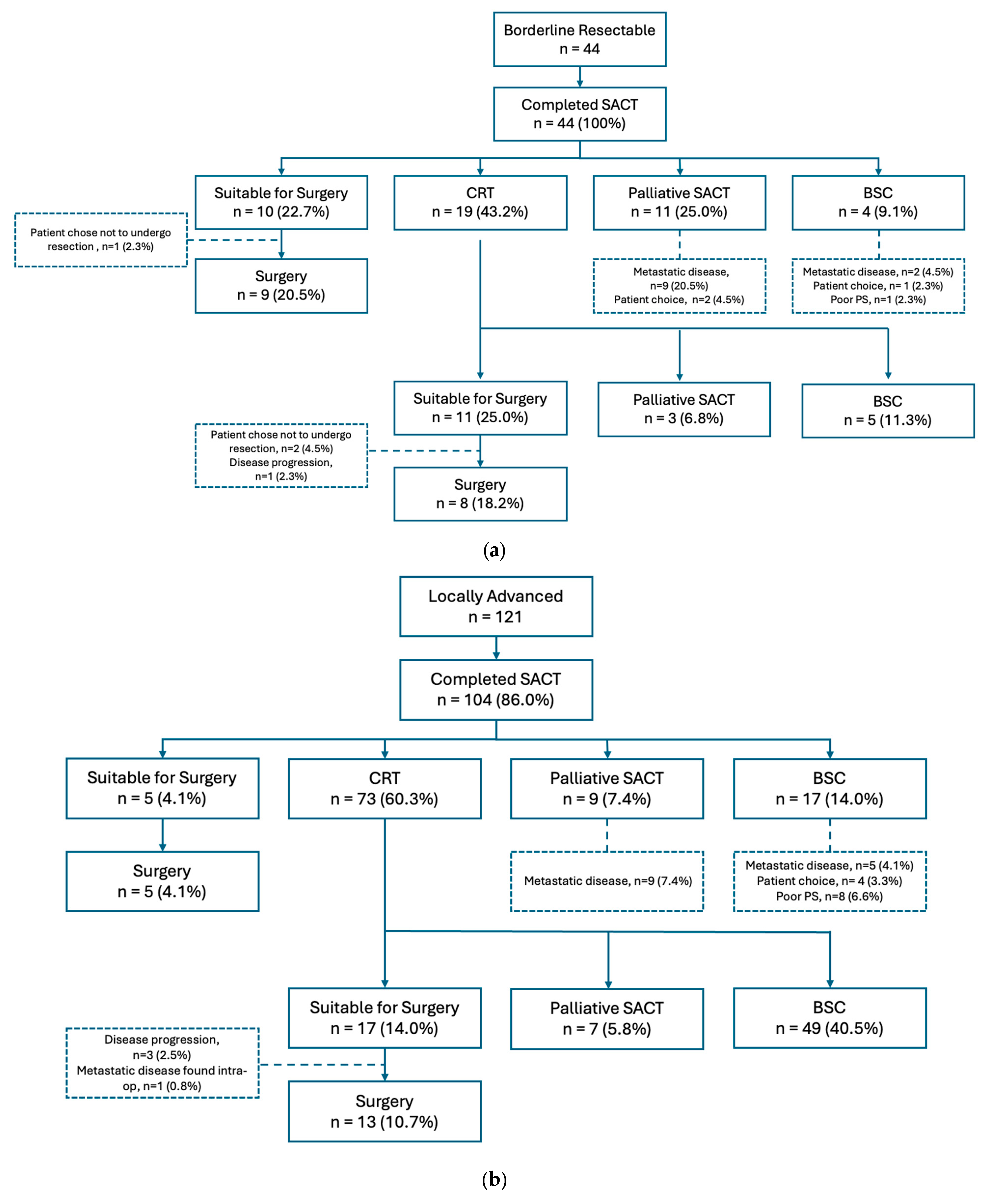
A total of 44 BR patients were compared to 121 LA patients in this retrospective cohort study. There were no significant differences in Age, BMI, ECOG Performance status and baseline median serum Ca19-9 levels. As expected, BR patients had a significantly lower burden of T4 disease at the point of diagnosis (Table 1, p < 0.001). FOLFIRINOX was the most common SACT regimen, followed by Gemcitabine/Capecitabine in both groups. Figure 1a,b illustrates the outcomes of patients following neoadjuvant SACT +/− CRT. Following neoadjuvant treatment, 47.7% of BR and 18.1% of LA patients were anatomically suitable for trial of surgical dissection. Eventually, 38.7% of BR and 14.8% of LA patients underwent successful resection.
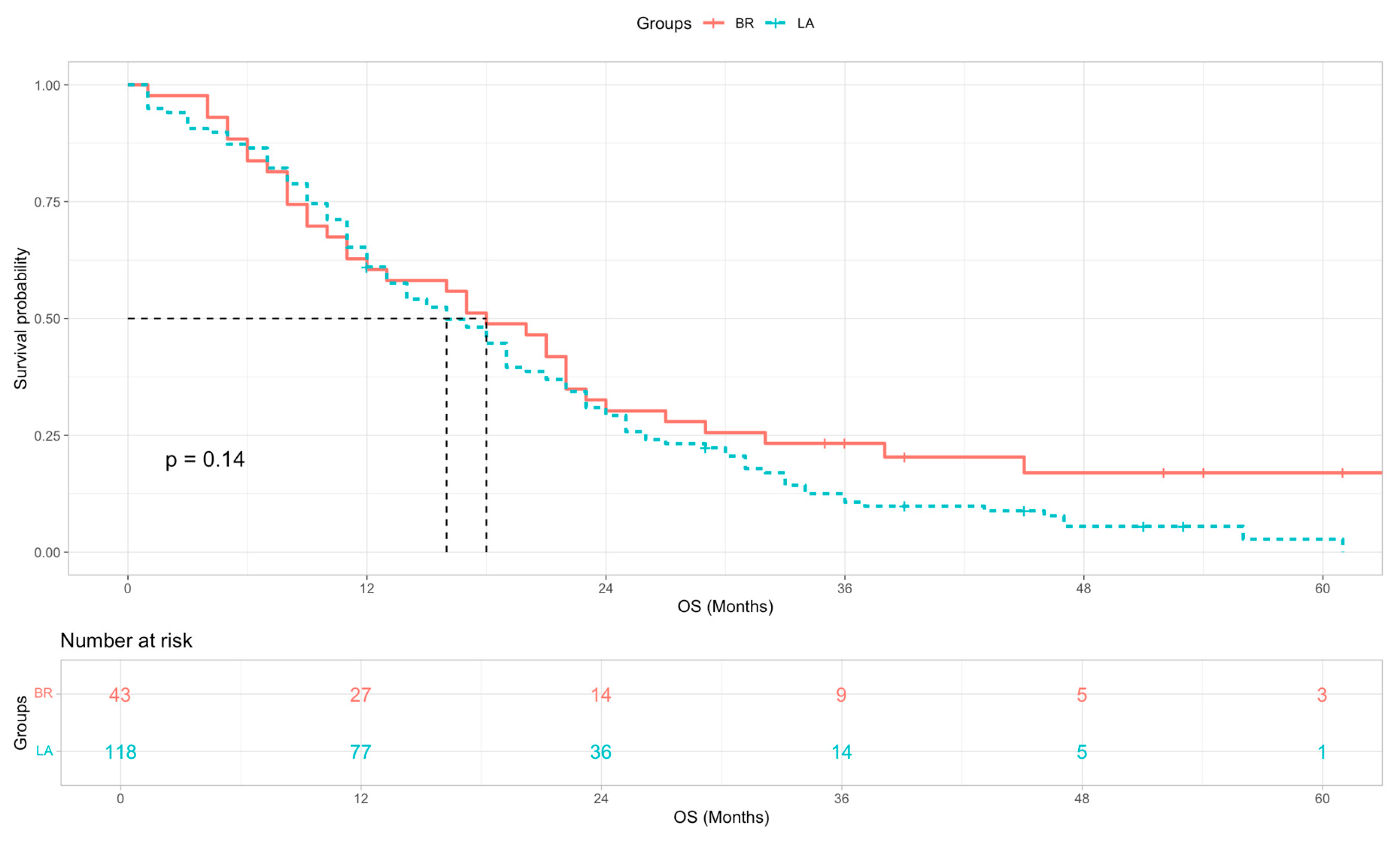
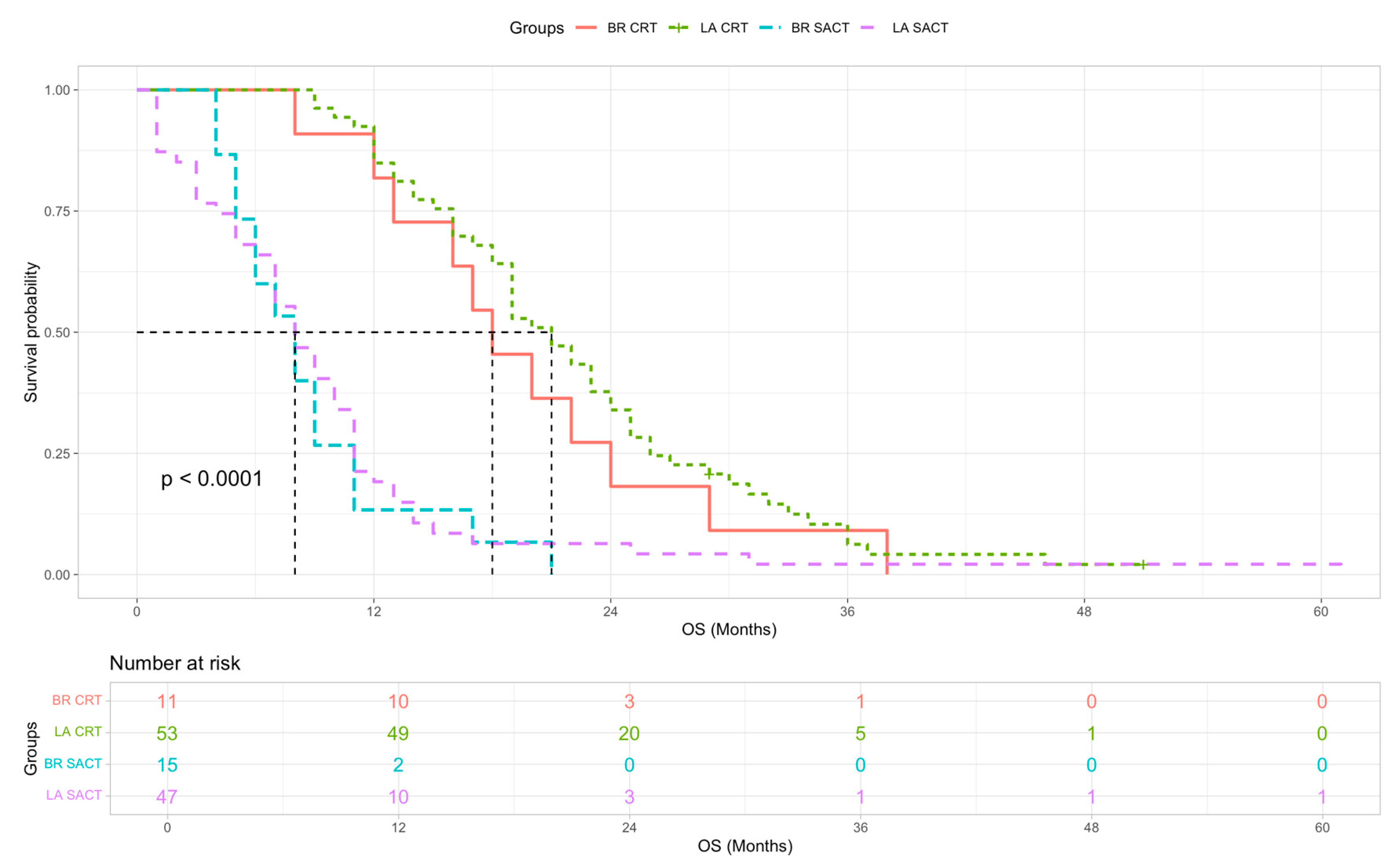
The median survival of all BR and LA patients in this study was not significantly different at 18 vs. 16 months respectively (Figure 2, log-rank χ2 = 2.19, p = 0.14 and Cox HR = 1.33 (95% CI 0.90–1.95, p = 0.148). In patients who did not undergo surgical resection, both BR and LA patients who only received SACT had a median OS of 8 months. The main reason these patients did not receive CRT was the development of metastatic disease. BR and LA patients who were suitable and treated with further CRT had a median OS of 18 and 21 months respectively (Figure 3).
On univariate analysis, performance status, initial Ca19-9, N2 disease at diagnosis, treatment with FOLFIRINOX, as well as treatment with CRT and surgery were associated with OS (Table 2). On multivariate analysis, only treatment with CRT HR = 0.27 (95% CI 0.18–0.40), p < 0.001 and surgery HR = 0.15 (95% CI 0.09–0.27), p < 0.001 remained independent predictors of better OS.
Patients who underwent resection were further explored as a subgroup. BR and LA cohorts were similar with respect to age, BMI, sex distribution, ECOG performance status, and CA19-9 at diagnosis. Neoadjuvant SACT strategies were comparable, with 94.1% BR and 83.3% LA patients receiving FOLFIRINOX with similar rates of treatment completion and grade 3 SACT toxicity (see Table 3). As expected, tumour stage at diagnosis differed significantly between groups, with BR patients having T2–T3 disease and LA patients predominantly T4 (Table 3, p < 0.001). LA patients also demonstrated a higher nodal burden (Table 3, p = 0.008). Despite these differences, the operative approach and complexity were similar, including comparable rates of venous resection and R1 resection. Postoperative histological staging, morbidity, including pancreatic fistula, delayed gastric emptying, major complications (Clavien–Dindo ≥ 3) and 30-day readmissions did not differ significantly between groups. There were also no significant differences in postoperative morbidity and 30-day readmissions when comparing patients who were treated with neoadjuvant SACT to patients treated with neoadjuvant SACT and CRT (Supplementary Table S1). There were no type C postoperative pancreatic fistulas and no 90-day mortalities within the surgical subgroup.
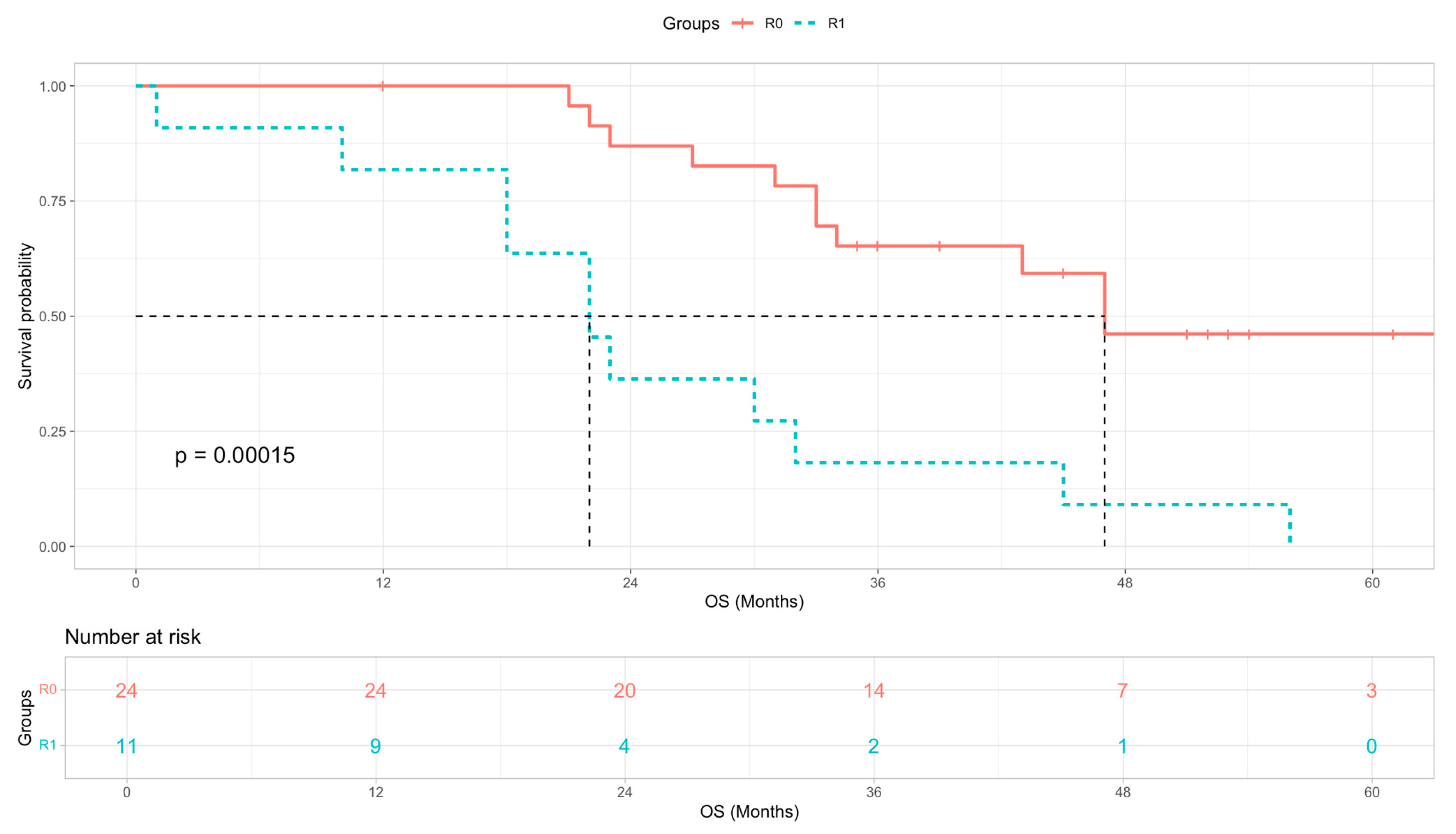
In this subgroup, survival did not differ significantly between resected patients with BR- and LA-disease, with median OS of 45 and 34 months respectively (Table 4, log-rank χ2 = 0.55, p = 0.458 and Cox HR = 1.37 (95% CI 0.58–1.37, p = 0.467)). Similarly, no statistically significant difference in survival was observed between patients treated with neoadjuvant SACT and CRT versus neoadjuvant SACT alone, despite a numerically longer median survival in the CRT group (33 vs. 22 months; Table 4, log-rank χ2 = 1.89, p = 0.168 and Cox HR = 0.56 (95% CI 0.24–1.31, p = 0.181)). In contrast, resection margin status was strongly associated with OS. Patients achieving an R0 resection had a significantly longer median OS compared with those with R1 resections, 47 vs. 22 months. (Figure 4, log-rank χ2 = 14.34, p = 0.00015 and Cox HR = 4.50 (95% CI 1.91–10.61, p < 0.001)). Multivariate analysis in this subgroup was not performed as only 22 out of 35 patients had passed away at the time of analysis. Resected R1 patients were also compared to non-surgery patients treated with SACT and CRT. The respective median OS were 22 vs. 20 months (Table 4, log-rank χ2 = 1.12, p = 0.289 and Cox HR = 0.70 (95% CI 0.36–1.38, p = 0.306)).
Recurrence rates were similar between BR and LA patients who underwent resection, occurring in 64.7% and 66.7% of patients respectively. Median time to recurrence did not significantly differ between groups (9 months in both cohorts, Table 5, p = 0.692), nor did the proportion of patients receiving palliative treatment following recurrence. R1 patients had a higher rate of recurrence but this was not statistically significant (Table 5, 90.8% vs. 54.1, p = 0.055). However, the pattern of recurrence differed significantly, with LA patients more likely to develop isolated locoregional recurrence (Table 5, 41.7% vs. 0%, p = 0.031), whereas BR patients more frequently developed combined locoregional and distant recurrence. When stratified by treatment modality, recurrence occurred more frequently in patients who received neoadjuvant SACT only, although this difference did not reach statistical significance (85.7% vs. 52.4%; Table 5, p = 0.095). Distribution of recurrence (locoregional, distant, or combined), time to recurrence, and subsequent palliative treatment were similar between SACT and CRT groups (see Table 5).

4. Discussion

In this study, we compared outcomes between BR- and LA-PDAC patients treated with a total neoadjuvant approach. We acknowledge the difference in patient numbers between BR/LA cohorts. However, the characteristics of BR and LA patients were otherwise well matched at baseline. LA patients had a substantially higher burden of T4 disease at diagnosis; however, the two groups were not associated with a difference in OS either in the full cohort or among those who ultimately underwent surgical resection. Postoperative histological staging was also not significantly different between BR and LA cases. These findings challenge the traditional dichotomisation of radiologically defined BR and LA disease as prognostically distinct entities and suggest that tumour biology and treatment response may be more relevant determinants of outcome than initial anatomical staging alone [26]. Moreover, BR patients are often grouped with upfront resectable disease in the literature, yet our data suggest their biology and prognosis may more closely resemble that of LA disease. Following NAT, 47.7% of BR and 18.1% of LA patients were anatomically suitable for trial of surgical dissection, which is consistent with other contemporary series [27,28]. BR patients were more likely to be anatomically suitable for surgical exploration and ultimately undergo resection compared with LA patients. Within the BR group, three (7%) of patients chose not to undergo major surgery, contributing to a lower rate of eventual resection at 38.6%.
There is a growing body of evidence supporting a NAT in BR and LA pancreatic cancer. Both SACT choices [29] and duration [30] appear to be important. In this study, the majority of patients who underwent resection received a median of ten to eleven cycles of FOLFIRINOX, in keeping with prior studies demonstrating superior response and resection rates compared with Gemcitabine-based regimens [27]. Although treatment-related toxicity remains a concern—grade 3 toxicity occurred in 48–53% of patients treated with FOLFIRINOX—yet more than half of patients were able to complete the intended SACT course, supporting the feasibility of TNT in selected patients. Notably, many published trials have incorporated shorter neoadjuvant regimens. The Alliance A021501 trial treated patients with seven to eight cycles of neoadjuvant FOLFIRINOX [31], as did the PREOPANC-2 trial [17] with eight cycles of neoadjuvant FOLFIRINOX, and in ESPAC 5, only four cycles in the FOLFIRINOX arm [14]. A recent meta-analysis demonstrated that the therapeutic efficacy of neoadjuvant CRT becomes significant only in patients treated with five or more cycles of induction SACT [32], therefore strengthening the rationale for a TNT approach.
Within this study, resected BR and LA patients remained comparable across peri-operative and oncological metrics. Rates of venous reconstruction, margin positivity, postoperative morbidity, and readmission were similar between groups. Following CRT, surgical resection may be technically challenging due to extensive oedema, desmoplastic reaction and fibrosis. In our experience, the optimal time for surgery is 6–8 weeks following completion of CRT. CRT patients who underwent resection did not experience excess operative risk or inferior postoperative outcomes, reinforcing the safety and feasibility of surgery in line with reported trials involving neoadjuvant radiotherapy [23], including the Alliance A021501 trial [33].
Importantly, median OS following resection did not differ significantly between BR and LA disease, underscoring that once resection is achieved, initial resectability status has limited prognostic value. In patients who did undergo surgical resection, margin status was still the most powerful determinant of survival. Patients with R0 resections had more than double the median OS compared with R1 resections (47 vs. 22 months), regardless of whether BR or LA at baseline. These findings highlight the importance of achieving clear margins, although R0 rates were not statistically different between groups in this study. Reliable preoperative prediction of margin status remains a challenge. In our cohort, R1-resected patients achieved a median OS that was indistinguishable from non-surgical patients treated with SACT and CRT (22 vs. 20 months). Acknowledging the inherent selection bias of a retrospective comparison, this finding suggests that patients destined for an R1 resection may gain very limited additional benefit from surgery and underscores the need for improved preoperative tools for margin prediction.
The CONKO 007 trial used modern intensity modulated radiotherapy and SACT regimens, FOLFIRINOX or Gemcitabine. It had similar resection rates of 35.5 to 36.5% in both arms and demonstrated increased R0 resection rates and complete pathological response in the chemotherapy-chemoradiation arm. Negative resection margins were associated with improved OS but this did not translate to an OS benefit for the entire cohort [34]. However, a recent meta-analysis of over 1500 patients reported neoadjuvant CRT to be associated with significantly improved R0 rates [32], highlighting its potential role in optimising local disease control. When stratified by treatment modality, recurrence following surgery was numerically lower in patients who received CRT compared with SACT alone (52% vs. 85%, p = 0.095), this did not reach statistical significance, possibly due to limited sample size.
Among patients who did not proceed to surgery, the addition of CRT following SACT led to meaningful OS and was the only factor to impact OS other than surgery following multivariate analysis. While this analysis is non-randomised and subject to treatment selection bias, the observed association with survival suggests that CRT may confer a meaningful benefit in patients with non-resected disease, potentially through improved locoregional disease control. Multimodality therapy, combining SACT with subsequent radiotherapy, has been studied in LA PDAC with varying results. The LAP-07 study assessed the addition of CRT following Gemcitabine +/− Erlotinib and found a progression-free survival benefit but no OS benefit [35].
The contribution of CRT in the treatment of BR PDAC remains an area of debate [36] but amongst resected BR and LA patients, those who received CRT in addition to SACT had numerically longer survival than those who proceeded to surgery after SACT alone (33 months vs. 22 months, p = 0.168). The authors hypothesise a potential synergistic effect of CRT in optimising surgical candidates, possibly by enhancing margin negativity and controlling microlocal disease [37]. The mechanisms driving this clinical benefit require further investigation but may stem from CRT’s effect on PDAC’s immunosuppressive tumour microenvironment [38] or from its beneficial effect on the tumour’s characteristic perineural invasion [39], as previously reported by our group [40]. Whilst Alliance 021501 closed early for futility in the SBRT arm, further research into the optimal radiation strategy to use in a NAT setting is warranted. Adaptive magnetic resonance guided radiotherapy (MRgRT) has been demonstrated to be feasible and safe in delivering dose-escalated radiation to a biologically effective dose ≥ 100 Gy. Ongoing trials are evaluating whether fractionated chemoradiation or SBRT is preferred as part of a TNT approach [41].
In summary, while BR and LA pancreatic cancer differ in anatomical staging at diagnosis, this study suggests that they may share comparable survival outcomes when treated with modern neoadjuvant strategies. The key distinguishing factor between groups was resectability rate and margin status rather than diagnostic staging or perioperative outcomes. With these results, the authors propose a treatment paradigm in which BR and LA patients are managed along a treatment continuum, with resectability determined dynamically by treatment response rather than fixed anatomical criteria at presentation. The difference in rates of resection between the BR and LA groups also highlights the ongoing challenge of rendering patients with LA disease to a state of resectability despite a total neoadjuvant approach.

4.1. Clinical Implications

Taken together, the authors suggest a two-tiered therapeutic strategy. First, all patients with BR/LA PDAC should receive multi-agent SACT, ideally FOLFIRINOX, as this regimen was strongly associated with higher rates of conversion to surgery. Second, for patients with stable or responsive disease but not resectable due to anatomical relationships, consolidation with CRT may prolong survival and improve local disease control. In surgical candidates, CRT following SACT in margin-threatened patients prior to surgery appears to be a safe treatment. In addition, surgical selection should be driven by response to neoadjuvant therapy rather than baseline radiological classification.

4.2. Strengths and Limitations

The strengths of this study include its relatively large cohort size, homogeneous treatment protocol within a high-volume UK tertiary centre over long-term follow-up, and modern relevance given the widespread adoption of FOLFIRINOX. However, several limitations should be acknowledged, primarily associated with the retrospective nature of the analysis. There is an imbalance in cohort size between the BR/LA groups, and smaller surgical subgroups analysis may be underpowered, increasing the risk of type II errors, and therefore negative findings should be interpreted with caution. With cohort studies, there is inherent selection bias between the treatment groups. Surgical patients selected after SACT +/− CRT were a self-selected cohort with better performance status, lower disease burden and proven less aggressive biology. Resected CRT patients would have also demonstrated better biology prior to resection, which in part may account for their superior survival. We also recognise that the analysis is susceptible to immortal time bias, as patients must survive before they undergo resection and future studies should include time-dependent methods to mitigate this bias. In addition, due to the unavailability of Gemcitabine plus nab-paclitaxel in BR/LA PDAC, we were unable to assess whether this regimen would have a similar or better outcome compared to FOLFIRINOX/GEM-CAP in our cohort. Despite these limitations, the observed consistency of survival differences with stepwise improvement across treatments suggests a strong association. These findings are hypothesis-generating and support further prospective evaluation of a TNT approach in selected BR/LA patients.

4.3. Future Directions

Our findings support ongoing international efforts to refine neoadjuvant strategies in PDAC. The potential role of radiation in conjunction with systemic treatment in a TNT approach for both BR and LA patients in optimising surgical outcomes and prolonging survival in non-resected patients warrants prospective evaluation in randomised clinical trials. We also await outcomes of phase III neoadjuvant clinical trials in resectable PDAC [42,43]. Future work should also focus on biomarkers of response to guide treatment sequencing, and on novel systemic agents such as RAS inhibitors to address the high rates of distant failure despite optimal local therapy. Circulating DNA may have a role in personalising treatment sequences [44]. Prediction of margin involvement (R1) remains a challenge; in the future, technologies including radiomics will play a role in this domain. There is also a clear need to redefine the definition of resectability, which should not be solely based on radiological findings but must also take into account tumour biology and the dynamic assessment of treatment response [45]. The type of neoadjuvant treatment may also influence radiographic and pathological interpretation following treatment [46], which needs to be further evaluated.

5. Conclusions

This single-centre UK series demonstrates that despite anatomical differences at diagnosis, borderline resectable and locally advanced pancreatic cancer may share comparable survival outcomes when treated with contemporary total neoadjuvant strategies. These findings challenge traditional radiological staging-based treatment paradigms and support a hypothesis in which a continuum-based approach, where resectability is dynamically defined by response to therapy. Ultimately, a margin-negative surgical resection offered the only chance of long-term survival for patients with BR/LA PDAC in our study.

Supplementary Materials

The following supporting information can be downloaded at: https://www.mdpi.com/article/10.3390/cancers18101597/s1, Table S1: Surgical outcomes comparing resected patients treated with neoadjuvant SACT and CRT.

Author Contributions

Conceptualization, K.T.D.Y., S.G., D.C., S.R., I.C. (Ian Chau), N.S., C.F., A.A., D.T., I.C. (Irene Chong), A.H., M.T.D., S.K., L.R.J., R.H.B. and K.A.; data curation, K.T.D.Y., S.G., W.H. and P.J.; formal analysis, K.T.D.Y.; investigation, K.T.D.Y., S.G., W.H., P.J., R.H.B. and K.A.; methodology, K.T.D.Y., S.G., A.A., M.T.D., R.H.B. and K.A.; project administration, K.T.D.Y. and S.G.; supervision, D.C., S.R., I.C. (Ian Chau), N.S., C.F., D.T., I.C. (Irene Chong), A.H., S.K., L.R.J., R.H.B. and K.A.; visualisation, K.T.D.Y.; writing—original draft, K.T.D.Y., S.G., A.A., M.T.D., R.H.B. and K.A.; writing—review and editing, K.T.D.Y., S.G., W.H., P.J., D.C., S.R., I.C. (Ian Chau), N.S., C.F., A.A., D.T., I.C. (Irene Chong), A.H., M.T.D., S.K., L.R.J., R.H.B. and K.A. All authors have read and agreed to the published version of the manuscript.

Funding

This research did not receive any specific grant from funding agencies in the public, commercial, or not-for-profit sectors.

Institutional Review Board Statement

The study was conducted in accordance with the Declaration of Helsinki and approved by the Royal Marsden NHS Foundation Trust Service Evaluation Board (SE1414, approval date: 2 September 2024).

Informed Consent Statement

All patients provided electronically signed informed consent for treatment at the beginning of SACT, CRT and at the time of surgery (if applicable). The manuscript contains no patient-identifiable data. Specific consent for this retrospective study was not required.

Data Availability Statement

Data presented are contained within the article. The authors can be contacted for data requests; requests will only be considered for academic collaboration purposes.

Acknowledgments

All authors acknowledge that this work was supported by the National Institute for Health Research (NIHR) Biomedical Research Centre at The Royal Marsden NHS Foundation Trust and the Institute of Cancer Research, London. The views expressed in the manuscript are those of the authors and not necessarily those of the NIHR or Department of Health and Social Care.

Conflicts of Interest

DC: Clovis, Eli Lilly, 4SC, Celgene, Leap and Roch; IC: Advisory Board: Bristol Meyers Squibb, Astra-Zeneca, Astella, GSK, Daiichi-Sankyo, Taiho, BioNTech, Novartis, Takeda, Elevation Oncology, Beigene, Jazz Pharmaceuticals, Gilead, Revolution Medicines, Merck Serono. Research funding: Eli-Lilly. Honorarium: Eli-Lilly, Eisai, Servier, Roche, BMS, Jazz Pharmaceuticals, Astella, Astra-Zeneca; AA: Honorarium: Astra Zeneca, Astellas, BMS, Servier; KA: Honoraria: Elekta. All other authors declare no conflicts of interest.

References

  1. Our World in Data. 2025. Available online: https://ourworldindata.org/grapher/total-cancer-deaths-by-type (accessed on 25 September 2025).
  2. Siegel, R.L.; Miller, K.D.; Fuchs, H.E.; Jemal, A. Cancer statistics, 2022. CA Cancer J. Clin. 2022, 72, 7–33. [Google Scholar] [CrossRef] [Scilit] [PubMed]
  3. Siegel, R.L.; Kratzer, T.B.; Giaquinto, A.N.; Sung, H.; Jemal, A. Cancer statistics, 2025. CA Cancer J. Clin. 2025, 75, 10–45. [Google Scholar] [CrossRef] [Scilit] [PubMed]
  4. Abboud, Y.; Samaan, J.S.; Oh, J.; Jiang, Y.; Randhawa, N.; Lew, D.; Ghaith, J.; Pala, P.; Leyson, C.; Watson, R.; et al. Increasing Pancreatic Cancer Incidence in Young Women in the United States: A Population-Based Time-Trend Analysis, 2001–2018. Gastroenterology 2023, 164, 978–989.e6. [Google Scholar] [CrossRef] [Scilit]
  5. Tempero, M.A. NCCN Guidelines Updates: Pancreatic Cancer. J. Natl. Compr. Cancer Netw. 2019, 17, 603–605. [Google Scholar]
  6. Dekker, E.N.; van Dam, J.L.; Janssen, Q.P.; Besselink, M.G.; DeSilva, A.; Doppenberg, D.; Eijck, C.H.J.v.; Nasar, N.; O’Reilly, E.M.; Paniccia, A.; et al. Improved Clinical Staging System for Localized Pancreatic Cancer Using the ABC Factors: A TAPS Consortium Study. J. Clin. Oncol. 2024, 42, 1357–1367. [Google Scholar] [CrossRef] [Scilit]
  7. Oettle, H.; Neuhaus, P.; Hochhaus, A.; Hartmann, J.T.; Gellert, K.; Ridwelski, K.; Niedergethmann, M.; Zülke, C.; Fahlke, J.; Arning, M.B.; et al. Adjuvant chemotherapy with gemcitabine and long-term outcomes among patients with resected pancreatic cancer: The CONKO-001 randomized trial. Jama 2013, 310, 1473–1481. [Google Scholar] [CrossRef] [Scilit]
  8. Conroy, T.; Hammel, P.; Hebbar, M.; Ben Abdelghani, M.; Wei, A.C.; Raoul, J.L.; Choné, L.; Francois, E.; Artru, P.; Biagi, J.J.; et al. FOLFIRINOX or Gemcitabine as Adjuvant Therapy for Pancreatic Cancer. N. Engl. J. Med. 2018, 379, 2395–2406. [Google Scholar] [CrossRef] [Scilit]
  9. Neoptolemos, J.P.; Palmer, D.H.; Ghaneh, P.; Psarelli, E.E.; Valle, J.W.; Halloran, C.M.; Faluyi, O.; O’Reilly, D.A.; Cunningham, D.; Wadsley, J.; et al. Comparison of adjuvant gemcitabine and capecitabine with gemcitabine monotherapy in patients with resected pancreatic cancer (ESPAC-4): A multicentre, open-label, randomised, phase 3 trial. Lancet 2017, 389, 1011–1024. [Google Scholar] [CrossRef] [Scilit]
  10. Bakens, M.J.; van der Geest, L.G.; van Putten, M.; van Laarhoven, H.W.; Creemers, G.J.; Besselink, M.G.; Lemmens, V.E.; de Hingh, I.H. The use of adjuvant chemotherapy for pancreatic cancer varies widely between hospitals: A nationwide population-based analysis. Cancer Med. 2016, 5, 2825–2831. [Google Scholar] [CrossRef] [Scilit] [PubMed]
  11. National Cancer Audit Collaborating Centre. National Pancreatic Cancer Audit State of the Nation Report 2025. 2025. Available online: https://www.natcan.org.uk/reports/npaca-state-of-the-nation-report-2025/ (accessed on 25 September 2025).
  12. Unno, M.; Motoi, F.; Matsuyama, Y.; Satoi, S.; Toyama, H.; Matsumoto, I.; Aosasa, S.; Shirakawa, H.; Wada, K.; Fujii, T.; et al. Neoadjuvant Chemotherapy with Gemcitabine and S-1 versus Upfront Surgery for Resectable Pancreatic Cancer: Results of the Randomized Phase II/III Prep-02/JSAP05 Trial. Ann. Surg. 2026, 283, 57–64. [Google Scholar] [CrossRef] [Scilit]
  13. Versteijne, E.; Vogel, J.A.; Besselink, M.G.; Busch, O.R.C.; Wilmink, J.W.; Daams, J.G.; van Eijck, C.H.J.; Groot Koerkamp, B.; Rasch, C.R.N.; van Tienhoven, G.; et al. Meta-analysis comparing upfront surgery with neoadjuvant treatment in patients with resectable or borderline resectable pancreatic cancer. Br. J. Surg. 2018, 105, 946–958. [Google Scholar] [CrossRef] [Scilit]
  14. Ghaneh, P.; Palmer, D.; Cicconi, S.; Jackson, R.; Halloran, C.M.; Rawcliffe, C.; Sripadam, R.; Mukherjee, S.; Soonawalla, Z.; Wadsley, J.; et al. Immediate surgery compared with short-course neoadjuvant gemcitabine plus capecitabine, FOLFIRINOX, or chemoradiotherapy in patients with borderline resectable pancreatic cancer (ESPAC5): A four-arm, multicentre, randomised, phase 2 trial. Lancet Gastroenterol. Hepatol. 2023, 8, 157–168. [Google Scholar] [CrossRef] [Scilit]
  15. Conroy, T.; Pfeiffer, P.; Vilgrain, V.; Lamarca, A.; Seufferlein, T.; O’Reilly, E.M.; Hackert, T.; Golan, T.; Prager, G.; Haustermans, K.; et al. Pancreatic cancer: ESMO Clinical Practice Guideline for diagnosis, treatment and follow-up. Ann. Oncol. 2023, 34, 987–1002. [Google Scholar] [CrossRef] [Scilit]
  16. Labori, K.J.; Bratlie, S.O.; Andersson, B.; Angelsen, J.H.; Biörserud, C.; Björnsson, B.; Bringeland, E.A.; Elander, N.; Garresori, H.; Grønbech, J.E.; et al. Neoadjuvant FOLFIRINOX versus upfront surgery for resectable pancreatic head cancer (NORPACT-1): A multicentre, randomised, phase 2 trial. Lancet Gastroenterol. Hepatol. 2024, 9, 205–217. [Google Scholar] [CrossRef] [Scilit] [PubMed]
  17. Versteijne, E.; van Dam, J.L.; Suker, M.; Janssen, Q.P.; Groothuis, K.; Akkermans-Vogelaar, J.M.; Besselink, M.G.; Bonsing, B.A.; Buijsen, J.; Busch, O.R.; et al. Neoadjuvant Chemoradiotherapy Versus Upfront Surgery for Resectable and Borderline Resectable Pancreatic Cancer: Long-Term Results of the Dutch Randomized PREOPANC Trial. J. Clin. Oncol. 2022, 40, 1220–1230. [Google Scholar] [CrossRef] [Scilit] [PubMed]
  18. Katz, M.H.G.; Shi, Q.; Meyers, J.; Herman, J.M.; Chuong, M.; Wolpin, B.M.; Ahmad, S.; Marsh, R.; Schwartz, L.; Behr, S.; et al. Efficacy of Preoperative mFOLFIRINOX vs. mFOLFIRINOX Plus Hypofractionated Radiotherapy for Borderline Resectable Adenocarcinoma of the Pancreas: The A021501 Phase 2 Randomized Clinical Trial. JAMA Oncol. 2022, 8, 1263–1270. [Google Scholar] [CrossRef] [Scilit]
  19. Oar, A.; Lee, M.; Le, H.; Wilson, K.; Aiken, C.; Chantrill, L.; Simes, J.; Nguyen, N.; Barbour, A.; Samra, J.; et al. AGITG MASTERPLAN: A randomised phase II study of modified FOLFIRINOX alone or in combination with stereotactic body radiotherapy for patients with high-risk and locally advanced pancreatic cancer. BMC Cancer 2021, 21, 936. [Google Scholar] [CrossRef] [Scilit] [PubMed]
  20. Janssen, Q.P.; van Dam, J.L.; van Bekkum, M.L.; Bonsing, B.A.; Bos, H.; Bosscha, K.P.; Bouwense, S.A.W.; Brouwer-Hol, L.; Bruynzeel, A.M.E.; Busch, O.R.; et al. Neoadjuvant FOLFIRINOX versus neoadjuvant gemcitabine-based chemoradiotherapy in resectable and borderline resectable pancreatic cancer (PREOPANC-2): A multicentre, open-label, phase 3 randomised trial. Lancet Oncol. 2025, 26, 1346–1356. [Google Scholar] [CrossRef] [Scilit]
  21. Jones, C.M.; Radhakrishna, G.; Aitken, K.; Bridgewater, J.; Corrie, P.; Eatock, M.; Goody, R.; Ghaneh, P.; Good, J.; Grose, D.; et al. Considerations for the treatment of pancreatic cancer during the COVID-19 pandemic: The UK consensus position. Br. J. Cancer 2020, 123, 709–713. [Google Scholar] [CrossRef] [Scilit]
  22. Murphy, J.E.; Wo, J.Y.; Ryan, D.P.; Clark, J.W.; Jiang, W.; Yeap, B.Y.; Drapek, L.C.; Ly, L.; Baglini, C.V.; Blaszkowsky, L.S.; et al. Total Neoadjuvant Therapy With FOLFIRINOX in Combination With Losartan Followed by Chemoradiotherapy for Locally Advanced Pancreatic Cancer: A Phase 2 Clinical Trial. JAMA Oncol. 2019, 5, 1020–1027. [Google Scholar] [CrossRef] [Scilit]
  23. Chen, E.Y.; Kardosh, A.; Nabavizadeh, N.; Foster, B.; Mayo, S.C.; Billingsley, K.G.; Gilbert, E.W.; Lanciault, C.; Grossberg, A.; Bensch, K.G.; et al. Phase 2 study of preoperative chemotherapy with nab-paclitaxel and gemcitabine followed by chemoradiation for borderline resectable or node-positive pancreatic ductal adenocarcinoma. Cancer Med. 2023, 12, 12986–12995. [Google Scholar] [CrossRef] [Scilit]
  24. Sohal, D.P.S.; Duong, M.; Ahmad, S.A.; Gandhi, N.S.; Beg, M.S.; Wang-Gillam, A.; Wade, J.L., III; Chiorean, E.G.; Guthrie, K.A.; Lowy, A.M.; et al. Efficacy of Perioperative Chemotherapy for Resectable Pancreatic Adenocarcinoma: A Phase 2 Randomized Clinical Trial. JAMA Oncol. 2021, 7, 421–427. [Google Scholar] [CrossRef] [Scilit]
  25. Thakur, V.; Khosla, D.; Singh, G.; Kapoor, R.; Gupta, R.; Kumar, M.; Kumar, D.; Rana, S.S.; Singh, H.; Shah, J.; et al. A Randomized Controlled Trial of Stereotactic Body Radiation Therapy Versus Chemoradiation Following Induction Chemotherapy in Borderline Resectable and Locally Advanced Pancreatic Cancer. J. Gastrointest. Cancer 2025, 56, 208. [Google Scholar] [CrossRef] [Scilit]
  26. Murata, Y.; Mizuno, S.; Kishiwada, M.; Hayasaki, A.; Nagata, M.; Noguchi, D.; Gyoten, K.; Ito, T.; Fujii, T.; Iizawa, Y.; et al. Prognostic impacts of biological and conditional factors in patients with anatomically resectable pancreatic adenocarcinoma treated with preoperative chemoradiotherapy. Medicine 2025, 104, e42441. [Google Scholar] [CrossRef] [Scilit]
  27. Suker, M.; Beumer, B.R.; Sadot, E.; Marthey, L.; Faris, J.E.; Mellon, E.A.; El-Rayes, B.F.; Wang-Gillam, A.; Lacy, J.; Hosein, P.J.; et al. FOLFIRINOX for locally advanced pancreatic cancer: A systematic review and patient-level meta-analysis. Lancet Oncol. 2016, 17, 801–810. [Google Scholar] [CrossRef] [Scilit] [PubMed]
  28. Versteijne, E.; Suker, M.; Groothuis, K.; Akkermans-Vogelaar, J.M.; Besselink, M.G.; Bonsing, B.A.; Buijsen, J.; Busch, O.R.; Creemers, G.M.; van Dam, R.M.; et al. Preoperative Chemoradiotherapy Versus Immediate Surgery for Resectable and Borderline Resectable Pancreatic Cancer: Results of the Dutch Randomized Phase III PREOPANC Trial. J. Clin. Oncol. 2020, 38, 1763–1773. [Google Scholar] [CrossRef] [Scilit] [PubMed]
  29. Janssen, Q.P.; Buettner, S.; Suker, M.; Beumer, B.R.; Addeo, P.; Bachellier, P.; Bahary, N.; Bekaii-Saab, T.; Bali, M.A.; Besselink, M.G.; et al. Neoadjuvant FOLFIRINOX in Patients with Borderline Resectable Pancreatic Cancer: A Systematic Review and Patient-Level Meta-Analysis. JNCI J. Natl. Cancer Inst. 2019, 111, 782–794. [Google Scholar] [CrossRef] [Scilit]
  30. Miller, P.N.; Romero-Hernandez, F.; Calthorpe, L.; Wang, J.J.; Kim, S.S.; Corvera, C.U.; Hirose, K.; Kirkwood, K.S.; Hirose, R.; Maker, A.V.; et al. Long-Duration Neoadjuvant Therapy with FOLFIRINOX Yields Favorable Outcomes for Patients Who Undergo Surgery for Pancreatic Cancer. Ann. Surg. Oncol. 2024, 31, 6147–6156. [Google Scholar] [CrossRef] [Scilit] [PubMed]
  31. Katz, M.H.G.; Shi, Q.; Meyers, J.P.; Herman, J.M.; Choung, M.; Wolpin, B.M.; Ahmad, S.; Marsh, R.d.W.; Schwartz, L.H.; Behr, S.; et al. Alliance A021501: Preoperative mFOLFIRINOX or mFOLFIRINOX plus hypofractionated radiation therapy (RT) for borderline resectable (BR) adenocarcinoma of the pancreas. J. Clin. Oncol. 2021, 39, 377. [Google Scholar] [CrossRef] [Scilit]
  32. Wu, H.-Y.; Tsou, H.-H.; Lu, L.-S.; Lee, H.-L.; Chiou, J.F.; Ch’ang, H.-J. Role of Neoadjuvant Chemoradiation Therapy for Resectable and Borderline Resectable Pancreatic Adenocarcinoma—A Systematic Review and Meta-Analysis. Int. J. Radiat. Oncol. Biol. Phys. 2025, 122, 1257–1271. [Google Scholar] [CrossRef] [Scilit]
  33. Snyder, R.A.; Zemla, T.J.; Shi, Q.; Segovia, D.; Ahmad, S.A.; O’Reilly, E.M.; Herman, J.M.; Katz, M.H.G. Postoperative Adverse Events Following Neoadjuvant Therapy and Surgery for Borderline Resectable Pancreatic Cancer in a Phase 2 Clinical Trial (Alliance A021501). Ann. Surg. Oncol. 2024, 31, 7033–7042. [Google Scholar] [CrossRef] [Scilit]
  34. Fietkau, R.; Ghadimi, M.; Grützmann, R.; Wittel, U.A.; Jacobasch, L.; Uhl, W.; Croner, R.S.; Bechstein, W.O.; Neumann, U.P.; Waldschmidt, D.; et al. Benefit of Chemoradiotherapy Versus Chemotherapy After Induction Therapy for Conversion of Unresectable Into Resectable Pancreatic Cancer: The Randomized CONKO-007 Trial. J. Clin. Oncol. 2025, 43, 3266–3278. [Google Scholar] [CrossRef] [Scilit] [PubMed]
  35. Hammel, P.; Huguet, F.; van Laethem, J.L.; Goldstein, D.; Glimelius, B.; Artru, P.; Borbath, I.; Bouché, O.; Shannon, J.; André, T.; et al. Effect of Chemoradiotherapy vs. Chemotherapy on Survival in Patients With Locally Advanced Pancreatic Cancer Controlled After 4 Months of Gemcitabine With or Without Erlotinib: The LAP07 Randomized Clinical Trial. Jama 2016, 315, 1844–1853. [Google Scholar] [CrossRef] [Scilit] [PubMed]
  36. Haggstrom, L.; Chan, W.Y.; Nagrial, A.; Chantrill, L.A.; Sim, H.W.; Yip, D.; Chin, V. Chemotherapy and radiotherapy for advanced pancreatic cancer. Cochrane Database Syst. Rev. 2024, 12, Cd011044. [Google Scholar] [PubMed]
  37. Akita, H.; Kobayashi, S.; Yamada, D.; Tomimaru, Y.; Sasaki, K.; Hasegawa, S.; Noda, T.; Takeda, Y.; Doki, Y.; Eguchi, H. Prognostic significance of neoadjuvant gemcitabine and S-1 chemotherapy with or without concurrent radiation in patients with resectable and borderline resectable pancreatic cancer: A post hoc analysis of 2 phase II trials. Surgery 2025, 190, 109864. [Google Scholar] [CrossRef] [Scilit]
  38. Kanai, M. Challenges and Opportunities for the Clinical Application of the Combination of Immune-Checkpoint Inhibitors and Radiation Therapy in the Treatment of Advanced Pancreatic Cancer. Cancers 2025, 17, 606. [Google Scholar] [CrossRef] [Scilit]
  39. Xu, J.; Yao, H.; Wang, J.; Jin, Y.; Chang, W.; Li, L.; Zou, L. Perineural invasion and the “cold” tumor microenvironment in pancreatic cancer: Mechanisms of crosstalk and therapeutic opportunities. Front. Immunol. 2025, 16, 1650117. [Google Scholar] [CrossRef] [Scilit]
  40. Yeung, K.T.D.; Kumar, S.; Cunningham, D.; Jiao, L.R.; Bhogal, R.H. Surgical Outcomes Following Neoadjuvant Treatment for Locally Advanced and Borderline Resectable Pancreatic Ductal Adenocarcinoma. Ann. Surg. Open 2024, 5, e486. [Google Scholar] [CrossRef] [Scilit]
  41. Saif, A.; Verbus, E.; Erickson, B.; Kamgar, M.; Tsai, S.; Evans, D.; Hernandez, J.M.; Hall, W.A. A Randomized, Phase II Clinical Trial of Preoperative Fractionated Radiation Therapy Versus Stereotactic Body Radiation Therapy for Resectable or Borderline Resectable, or Locally Advanced Type A Pancreatic Adenocarcinoma. Ann. Surg. Oncol. 2023, 30, 688–690. [Google Scholar] [CrossRef] [Scilit]
  42. van Dam, J.L.; Verkolf, E.M.M.; Dekker, E.N.; Bonsing, B.A.; Bratlie, S.O.; Brosens, L.A.A.; Busch, O.R.; van Driel, L.M.J.W.; van Eijck, C.H.J.; Feshtali, S.; et al. Perioperative or adjuvant mFOLFIRINOX for resectable pancreatic cancer (PREOPANC-3): Study protocol for a multicenter randomized controlled trial. BMC Cancer 2023, 23, 728. [Google Scholar] [CrossRef] [Scilit]
  43. Eade, A.V.; Friedman, L.R.; Larrain, C.; Rainey, A.; Hernandez, J.M.; Chawla, A.; Ferrone, C.R. ALLIANCE A021806: A Phase III Trial of Perioperative Versus Adjuvant Chemotherapy for Resectable Pancreatic Cancer. Ann. Surg. Oncol. 2024, 31, 6373–6374. [Google Scholar] [CrossRef] [Scilit]
  44. Cecchini, M.; Salem, R.R.; Robert, M.; Czerniak, S.; Blaha, O.; Zelterman, D.; Rajaei, M.; Townsend, J.P.; Cai, G.; Chowdhury, S.; et al. Perioperative Modified FOLFIRINOX for Resectable Pancreatic Cancer: A Nonrandomized Controlled Trial. JAMA Oncol. 2024, 10, 1027–1035. [Google Scholar] [CrossRef] [Scilit]
  45. Stoop, T.F.; Theijse, R.T.; Seelen, L.W.F.; Groot Koerkamp, B.; van Eijck, C.H.J.; Wolfgang, C.L.; van Tienhoven, G.; van Santvoort, H.C.; Molenaar, I.Q.; Wilmink, J.W.; et al. Preoperative chemotherapy, radiotherapy and surgical decision-making in patients with borderline resectable and locally advanced pancreatic cancer. Nat. Rev. Gastroenterol. Hepatol. 2023, 21, 101–124. [Google Scholar] [CrossRef] [Scilit]
  46. Miyahara, S.; Takahashi, H.; Tomimaru, Y.; Kobayashi, S.; Yamada, D.; Akita, H.; Noda, T.; Doki, Y.; Eguchi, H. Discrepancy Between Radiographic and Pathological Response Assessment in Neoadjuvant Treatment for Pancreatic Cancer: A Comparison Between Neoadjuvant Chemotherapy and Neoadjuvant Chemoradiotherapy. Ann. Gastroenterol. Surg. 2025, 9, 1312–1321. [Google Scholar] [CrossRef] [Scilit]
Figure 1. (a). Flow diagram demonstrating treatment pathway and outcomes of patients with borderline resectable disease. PS = performance status. (b) Flow diagram demonstrating treatment pathway and outcomes of patients with locally advanced disease. PS = performance status.
Cancers 18 01597 g001
Figure 2. Kaplan–Meier OS curves for BR (red) and LA (blue) PDAC patients. Univariate Cox HR = 1.33 (95% CI 0.90–1.95, p = 0.148). Survival was compared using the log-rank test (χ2 = 2.19, p = 0.14).
Cancers 18 01597 g002
Figure 3. Kaplan–Meier OS curves for patients who did not undergo surgical resection—BR CRT (red), LA CRT (green), BR SACT (blue) and LA SACT (purple). Univariate Cox HR derived with LA SACT as reference group: BR CRT HR = 0.34 (95% CI 0.17–0.66, p = 0.002); LA CRT HR = 0.28 (95% CI 0.18–0.42, p < 0.001); BR SACT HR = 1.35 (95% CI 0.75–2.44, p = 0.322). Survival was compared using a multi-group log-rank test (χ2 = 55.5, df = 3, p < 0.0001).
Cancers 18 01597 g003
Figure 4. Kaplan–Meier OS curves for R0 (red) and R1 (blue) resected PDAC patients. Univariate Cox HR = 4.50 (95% CI 01.91–10.61, p < 0.001). Survival was compared using the log-rank test (χ2 = 14.34, p = 0.00015).
Cancers 18 01597 g004
Table 1. Baseline characteristics of the study population comparing the BR and LA groups.
BRLAp Value
n44121
Age, median years (IQR)70.0 (55.5–75.0)68.0 (58.0–75.0)0.925
BMI, median kg/m2 (IQR)24.8 (22.9–27.5)25.9 (21.0–27.3)0.804
Female:male, n (%)19 (43):25 (57)58 (48):63 (52)0.715
ECOG PS, n (%)
020 (45.5)43 (35.8)0.533
120 (45.5)64 (53.3)
24 (9.1)13 (10.8)
T stage, n (%)
T222 (50.0)0 (0.0)<0.001
T319 (43.2)11 (9.1)
T43 (6.8)110 (90.9)
N stage, n (%)
N027 (61.4)53 (43.8)0.111
N116 (36.4)60 (49.6)
N21 (2.3)8 (6.6)
Ca19-9 at diagnosis, median U/mL (IQR)299.0
(52.0–1272.5)
338.0
(48.0–1700.0)
0.995
SACT, n (%)
FOLFIRINOX29 (65.9)69 (57.0)0.470
Gemcitabine and Capecitabine (GEM-CAP)14 (31.8)38 (31.4)
Gemcitabine1 (2.3)12 (9.9)
Other0 (0.0)1 (0.8)
SACT Cycles and Treatment Toxicity, n (%)
FOLFIRINOX, median cycles (IQR)7.0 (5.0–12.0)11.0 (6.0–12.0)0.185
Completed 12 cycles of FOLFIRINOX19 (65.5)36 (52.2)0.357
FOLFIRINOX grade 3 toxicity14 (48.3)37 (53.6)0.359
GEM-CAP, median cycles (IQR)5.0 (4.0–6.0)5.5 (3.0–6.0)0.865
Completed 6 cycles of Gem-Cape10 (71.4)23 (60.5)0.689
GEM-CAP grade 3 toxicity1 (7.2)3 (7.9)1.0
Table 2. Univariate and multivariate analysis of factors that affect OS in this study.
VariableUnivariateMultivariate
ComparisonHR (95% CI)p ValueComparisonHR (95% CI)p Value
Age(Per year)1.01 (1.00–1.03)0.098
SexMale vs. female1.01 (0.72–1.40)0.972
Performance status(Per unit)1.35 (1.04–1.74)0.024(Per unit)1.28 (0.99–1.66)0.060
BR/LALA vs. BR1.33 (0.90–1.95)0.148
Initial Ca19-9Per log10 unit1.19 (1.03–1.38)0.022Per log10 unit1.17 (1.00–1.39)0.057
T-stageT3 vs. T20.68 (0.37–1.26)0.217
T4 vs. T21.11 (0.67–1.83)0.686
N-stageN1 vs. N01.25 (0.89–1.74)0.192N1 vs. N00.89 (0.62–1.27)0.525
N2 vs. N02.24 (1.07–4.69)0.032N2 vs. N00.72 (0.33–1.59)0.420
SACT typeGem-Cape vs. FOLFIRINOX1.98 (1.37–2.86)<0.001Gem-Cape vs. FOLFIRINOX1.10 (0.74–1.62)0.648
Gem vs. FOLFIRINOX2.46 (1.35–4.47)0.003Gem vs. FOLFIRINOX0.66 (0.33–1.32)0.242
Other vs. FOLFIRINOX0.66 (0.16–2.67)0.555Other vs. FOLFIRINOX0.36 (0.09–1.53)0.167
CRTCRT vs. none0.42 (0.30–0.58)<0.001CRT vs. none0.27 (0.18–0.40)<0.001
SurgerySurgery vs. none0.22 (0.14–0.35)<0.001Surgery vs. none0.15 (0.09–0.27)<0.001
Table 3. Baseline characteristics and surgical outcomes of resected patients.
BRLAp Value
n, (%)1718
Age, median years (IQR)67.0 (58.0–71.0)61.0 (56.0–69.5)0.390
BMI, median kg/m2 (IQR)24.0 (21.0–26.0)21.0 (19.25–26.75)0.456
Female:male, n (%)7 (41):10 (59)9 (50):9 (50)0.854
ECOG PS, n (%)
011 (64.7)7 (38.9)0.533
16 (35.5)11 (61.1)
20 (0.0)0 (0.0)
T Stage at Diagnosis, n (%)
T29 (52.9)0 (0.0)<0.001
T38 (47.1)3 (16.7)
T40 (0.0) 15 (83.3)
N stage at diagnosis, n (%)
N015 (88.2)7 (38.9)0.008
N12 (11.8)11 (61.1)
N20 (0.0)0 (0.0)
Ca19-9 at diagnosis,
Median U/mL (IQR)
298.0 (83.5–936.5)310 (12.25–1396.25)0.777
SACT, n (%)
FOLFIRINOX16 (94.1)15 (83.3)0.512
Gemcitabine and Capecitabine (GEM-CAP)1 (5.9)2 (11.1)
Other0 (0.0)1 (5.6)
Cycles
Median cycles (IQR)
10.0 (6.0–12.0)11.0 (8.0–12.0)0.512
Completed planned SACT8 (47.1)9 (50.0)1.0
Grade 3 SACT toxicity8 (47.1)12 (66.7)0.394
CRT 8 (47.1)13 (72.2)0.241
Operation, n (%)
Pancreaticoduodenectomy14 (82.3)14 (77.8)0.710
Distal pancreatectomy and splenectomy1 (5.9)1 (5.6)
Total pancreatectomy2 (11.8)2 (11.1)
Other0 (0.0)1 (5.6)
Histological T Staging, n (%)
ypT40 (0.0)1 (5.6)0.648
ypT31 (5.9)1 (5.6)
ypT28 (47.1)5 (27.8)
ypT14 (23.5)7 (38.9)
ypT04 (23.5)4 (22.2)
Histological N Staging, n (%)
ypN14 (23.5)4 (22.2)1.0
ypN013 (76.5)14 (77.8)
Operative Outcomes, n (%)
Venous resection8 (47.1)8 (44.4)1.0
R15 (29.4)6 (33.3)1.0
Postoperative pancreatic fistula Grade A1 (5.9)1 (5.5)0.959
Postoperative pancreatic fistula Grade B1 (5.9)0 (0.0)
Delayed gastric emptying2 (11.8)3 (16.7)1.0
Clavien–Dindo 3+3 (17.6)4 (22.2)1.0
30-day readmission5 (29.4)3 (16.7)0.62
Adjuvant treatment 3 (17.6)4 (22.2)1.0
Table 4. Summary of log rank test and univariate Cox HR (95% CI) in the surgical cohort with respective stratifications.
GroupsMedian OS
(Months)
Log Rank X2p ValueUnivariate Cox HR
(95% CI)
p Value
BR v LA45 v 340.550.4581.37 (0.58–3.24)0.467
R1 v R022 v 4714.340.000154.50 (1.91–10.61)<0.001
SACT and CRT v SACT33 v 221.890.1680.56 (0.24–1.31)0.181
Surgery R1 vs. SACT and CRT (non-surgical)22 v 201.120.2890.70 (0.36–1.38)0.306
Table 5. Summary of recurrence in the surgical cohort with respective stratifications.
BRLAp
Recurrence11 (64.7)12 (66.7)1.0
Distribution
Locoregional0 (0.0)5 (41.7)0.031
Distant5 (45.5)5 (41.7)
Both6 (54.5)2 (16.7)
Time to recurrence, median months (IQR) 9.0 (7.0–10.5)9.0 (4.0–13.5)0.692
Palliative treatment7 (41.2)6 (33.3)0.897
SACTCRT
Recurrence12 (85.7)11 (52.4)0.095
Distribution
Locoregional2 (16.7)3 (27.3)0.720
Distant5 (45.5)5 (45.5)
Both3 (27.3)3 (27.3)
Time to recurrence, median months (IQR)9.5 (6.5–14.3)8.5 (6.0–9.0)0.371
Palliative treatment6 (42.9)7 (33.3)0.830
R0R1
Recurrence13 (54.1)10 (90.9)0.055
Distribution
Locoregional4 (30.7)1 (10.0)0.309
Distant4 (30.7)6 (60.0)
Both5 (38.5)3 (30.0)
Time to recurrence, median months (IQR)9.0 (7.0–13.5)7.0 (5.2–10.5)0.208
Palliative treatment8 (61.5)5 (50.0)0.708
Disclaimer/Publisher’s Note: The statements, opinions and data contained in all publications are solely those of the individual author(s) and contributor(s) and not of MDPI and/or the editor(s). MDPI and/or the editor(s) disclaim responsibility for any injury to people or property resulting from any ideas, methods, instructions or products referred to in the content.