Clinical Validation of the Belay Ascent™ Test to Report on Chromosomal Arm-Level Aneuploidy and Gene-Level Copy Number Variants in Cerebrospinal Fluid Using Low-Pass Whole-Genome Sequencing
 , , , , , ,
Simple Summary
Abstract
1. Introduction
2. Materials and Methods
2.1. Specimen Cohort
2.2. Analysis of Sequencing Data from Ascent™
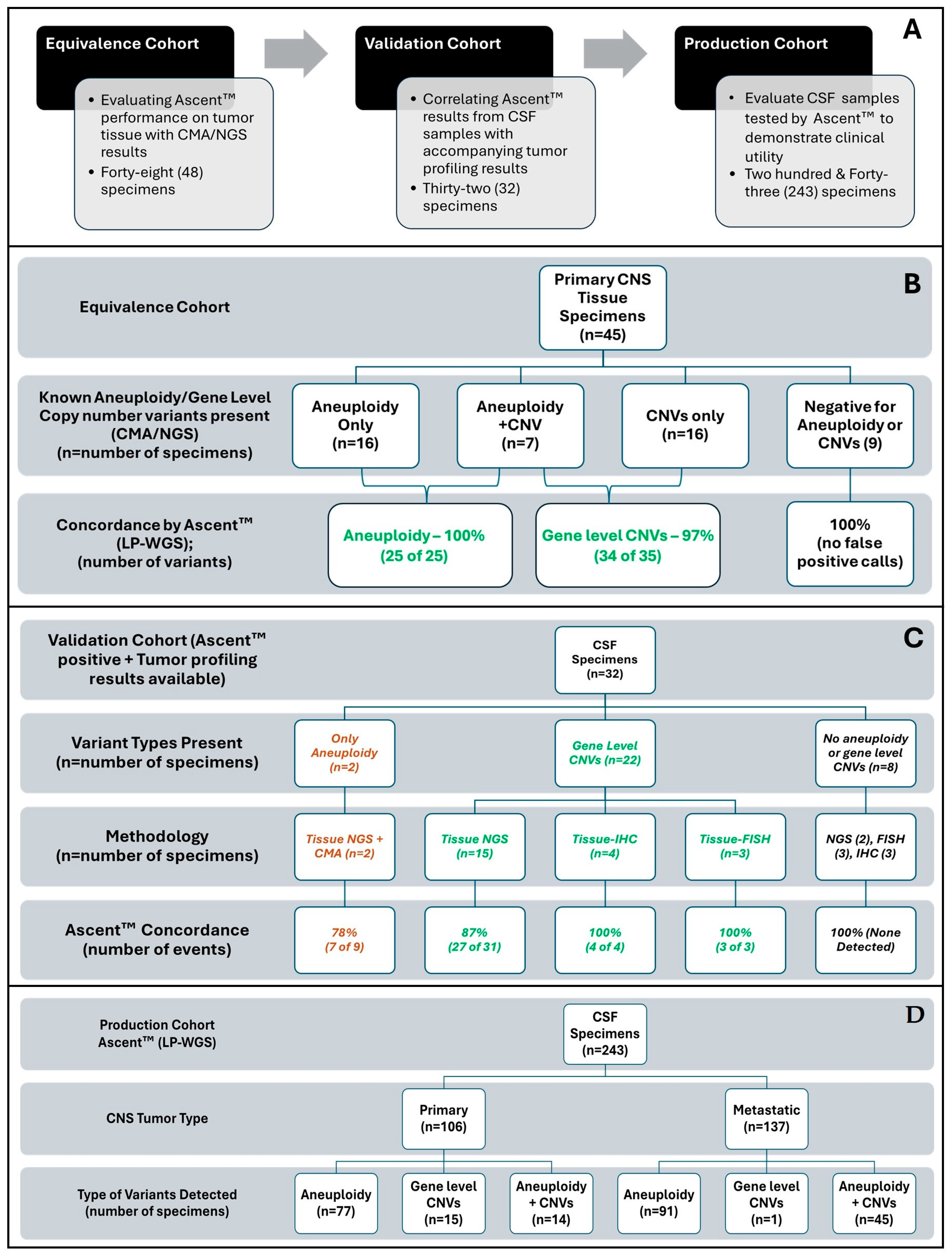
2.3. Equivalence of Ascent™ to CMA/NGS for the Detection of Chromosome Arm-Level Aneuploidy and Gene-Level CNVs in Tissue
2.4. Validation of Ascent™ to Detect Chromosome Arm-Level Aneuploidy and Gene-Level CNVs in CSF
2.5. Demonstrating Clinical Impact of Ascent™ to Detect Chromosome Arm-Level Aneuploidy and Gene-Level CNVs in CSF
3. Results
3.1. Ascent™ Performance Is Equivalent to CMA/NGS in the Detection of Chromosome Arm-Level Aneuploidy and Gene-Level CNVs in Tissue
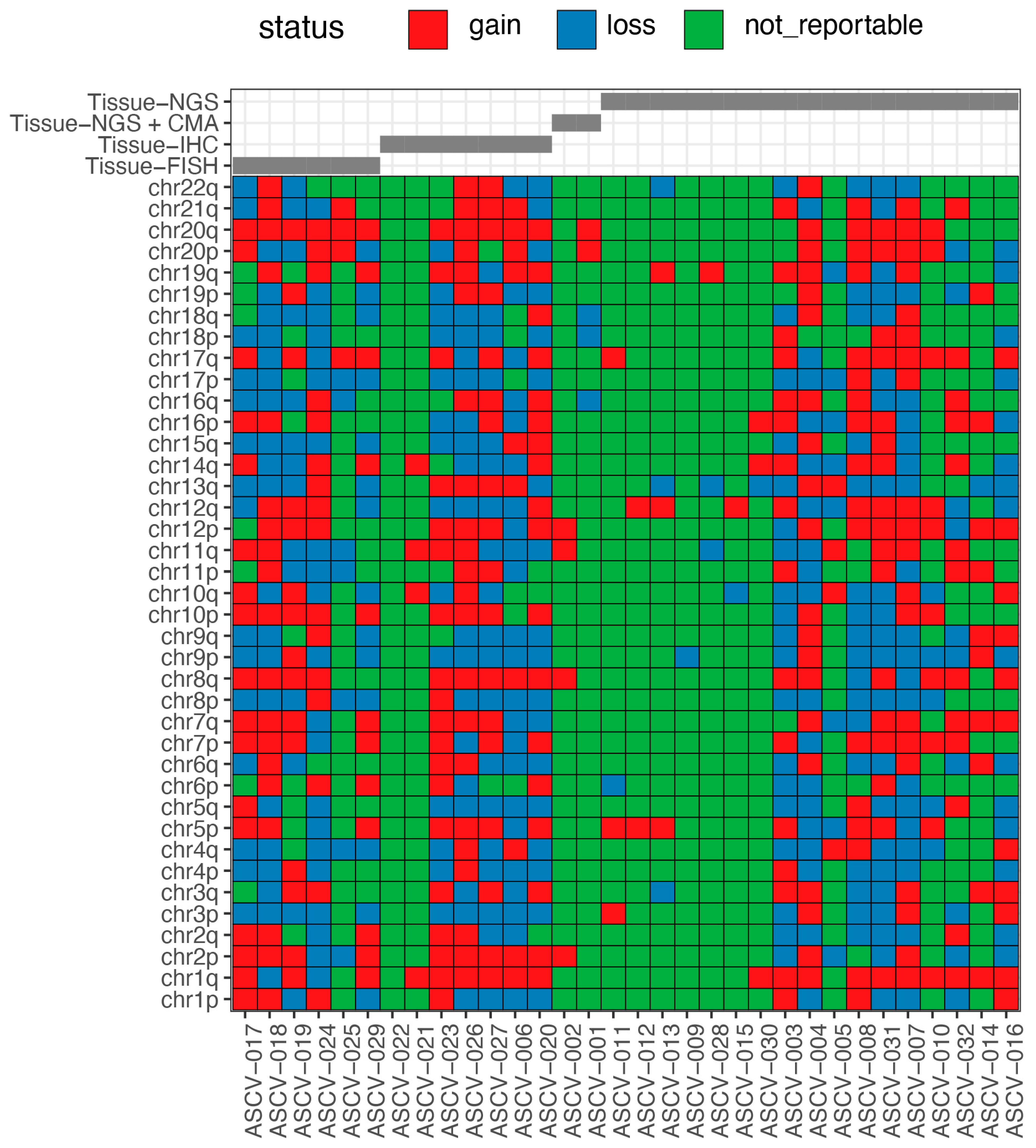
3.2. Ascent™ Calls in CSF Demonstrate High PPA and NPA to Tissue-Based Tumor Profiling Results
3.3. Ascent™ Informs Clinical Decision-Making as Demonstrated by the Detection of Chromosome Arm-Level Aneuploidy and Gene-Level CNVs Outlined in NCCN Guidelines
4. Discussion
5. Conclusions
Author Contributions
Funding
Institutional Review Board Statement
Informed Consent Statement
Data Availability Statement
Conflicts of Interest
References
- Mandrioli, D.; Belpoggi, F.; Silbergeld, E.K.; Perry, M.J. Aneuploidy: A common and early evidence-based biomarker for carcinogens and reproductive toxicants. Environ. Health 2016, 15, 97. [Google Scholar] [CrossRef]
- Torres, E.M.; Williams, B.R.; Tang, Y.C.; Amon, A. Thoughts on aneuploidy. Cold Spring Harb. Symp. Quant. Biol. 2010, 75, 445–451. [Google Scholar] [CrossRef]
- Cao, J.; Liang, C.; Yu, H. Aneuploidy as a cancer vulnerability. Curr. Opin. Cell Biol. 2025, 94, 102490. [Google Scholar] [CrossRef] [PubMed]
- Taylor, A.M.; Shih, J.; Ha, G.; Gao, G.F.; Zhang, X.; Berger, A.C.; Schumacher, S.E.; Wang, C.; Hu, H.; Liu, J.; et al. Genomic and Functional Approaches to Understanding Cancer Aneuploidy. Cancer Cell 2018, 33, 676–689.e673. [Google Scholar] [CrossRef]
- Smith, H.L.; Wadhwani, N.; Horbinski, C. Major Features of the 2021 WHO Classification of CNS Tumors. Neurotherapeutics 2022, 19, 1691–1704. [Google Scholar] [CrossRef]
- Cocito, C.; Martin, B.; Giantini-Larsen, A.M.; Valcarce-Aspegren, M.; Souweidane, M.M.; Szalontay, L.; Dahmane, N.; Greenfield, J.P. Leptomeningeal dissemination in pediatric brain tumors. Neoplasia 2023, 39, 100898. [Google Scholar] [CrossRef]
- Angus, L.; Deger, T.; Jager, A.; Martens, J.W.M.; de Weerd, V.; van Heuvel, I.; van den Bent, M.J.; Sillevis Smitt, P.A.E.; Kros, J.M.; Bindels, E.M.J.; et al. Detection of Aneuploidy in Cerebrospinal Fluid from Patients with Breast Cancer Can Improve Diagnosis of Leptomeningeal Metastases. Clin. Cancer Res. 2021, 27, 2798–2806. [Google Scholar] [CrossRef]
- Gao, B.; Yang, F.; Han, M.; Bao, H.; Shen, Y.; Cao, R.; Wu, X.; Shao, Y.; Liu, C.; Zhang, Z. Genomic landscape and evolution of arm aneuploidy in lung adenocarcinoma. Neoplasia 2021, 23, 870–878. [Google Scholar] [CrossRef]
- Charifa, A.; Agersborg, S.; Mohtashamian, A.; Ip, A.; Goy, A.; Albitar, M. Liquid biopsy for evaluating mutations and chromosomal aberrations in cerebrospinal fluid from patients with primary or metastatic CNS tumors. J. Liq. Biopsy 2024, 6, 100281. [Google Scholar] [CrossRef] [PubMed]
- Pellerino, A.; Brastianos, P.K.; Ruda, R.; Soffietti, R. Leptomeningeal Metastases from Solid Tumors: Recent Advances in Diagnosis and Molecular Approaches. Cancers 2021, 13, 2888. [Google Scholar] [CrossRef] [PubMed]
- Disharoon, A.O.; Delaney, J.R. Half the Chromosome It Used to Be: Identifying Cancer Treatments Targeting Aneuploid Losses. Genes 2025, 16, 708. [Google Scholar] [CrossRef]
- Singh, A.P.; Shum, E.; Rajdev, L.; Cheng, H.; Goel, S.; Perez-Soler, R.; Halmos, B. Impact and Diagnostic Gaps of Comprehensive Genomic Profiling in Real-World Clinical Practice. Cancers 2020, 12, 1156. [Google Scholar] [CrossRef]
- Vandekerkhove, G.; Giri, V.N.; Halabi, S.; McNair, C.; Hamade, K.; Bitting, R.L.; Wyatt, A.W. Toward Informed Selection and Interpretation of Clinical Genomic Tests in Prostate Cancer. JCO Precis. Oncol. 2024, 8, e2300654. [Google Scholar] [CrossRef]
- Horbinski, C.; Nabors, L.B.; Portnow, J.; Baehring, J.; Bhatia, A.; Bloch, O.; Brem, S.; Butowski, N.; Cannon, D.M.; Chao, S.; et al. NCCN Guidelines(R) Insights: Central Nervous System Cancers, Version 2.2022. J. Natl. Compr. Canc Netw. 2023, 21, 12–20. [Google Scholar] [CrossRef]
- Nabors, L.B.; Hattangadi-Gluth, J.; Horbinski, C.; Portnow, J. NCCN CNS Tumor Guidelines Update for 2024. Neuro-Oncology 2024, 27, 595–596. [Google Scholar] [CrossRef]
- Hanlon, M.B.; Shohet, J.M.; Wolfe, S.A. Selective targeting of genome amplifications and repeat elements by CRISPR-Cas9 nickases to promote cancer cell death. Nat. Commun. 2025, 16, 5126. [Google Scholar] [CrossRef]
- van Leen, E.; Bruckner, L.; Henssen, A.G. The genomic and spatial mobility of extrachromosomal DNA and its implications for cancer therapy. Nat. Genet. 2022, 54, 107–114. [Google Scholar] [CrossRef]
- Nitta, H.; Kelly, B. Chromogenic Tissue-Based Methods for Detection of Gene Amplifications (or Rearrangements) Combined with Protein Overexpression in Clinical Samples. Methods Mol. Biol. 2019, 1953, 301–314. [Google Scholar] [CrossRef] [PubMed]
- Saxby, A.J.; Nielsen, A.; Scarlett, C.J.; Clarkson, A.; Morey, A.; Gill, A.; Smith, R.C. Assessment of HER-2 status in pancreatic adenocarcinoma: Correlation of immunohistochemistry, quantitative real-time RT-PCR, and FISH with aneuploidy and survival. Am. J. Surg. Pathol. 2005, 29, 1125–1134. [Google Scholar] [CrossRef] [PubMed]
- Backlund, L.M.; Nilsson, B.R.; Goike, H.M.; Schmidt, E.E.; Liu, L.; Ichimura, K.; Collins, V.P. Short postoperative survival for glioblastoma patients with a dysfunctional Rb1 pathway in combination with no wild-type PTEN. Clin. Cancer Res. 2003, 9, 4151–4158. [Google Scholar] [PubMed]
- Seldon, C.S.; Meiyappan, K.; Hoffman, H.; Guo, J.A.; Goel, N.; Hwang, W.L.; Nguyen, P.L.; Mahal, B.A.; Alshalalfa, M. Genomic alterations predictive of poor clinical outcomes in pan-cancer. Oncotarget 2022, 13, 1069–1077. [Google Scholar] [CrossRef]
- Velez, M.G.; Kosiorek, H.E.; Egan, J.B.; McNatty, A.L.; Riaz, I.B.; Hwang, S.R.; Stewart, G.A.; Ho, T.H.; Moore, C.N.; Singh, P.; et al. Differential impact of tumor suppressor gene (TP53, PTEN, RB1) alterations and treatment outcomes in metastatic, hormone-sensitive prostate cancer. Prostate Cancer Prostatic Dis. 2022, 25, 479–483. [Google Scholar] [CrossRef]
- Kim, Y.Z.; Kim, C.Y.; Lim, D.H. The Overview of Practical Guidelines for Gliomas by KSNO, NCCN, and EANO. Brain Tumor Res. Treat. 2022, 10, 83–93. [Google Scholar] [CrossRef]
- Hickman, R.A.; Miller, A.M.; Arcila, M.E. Cerebrospinal fluid: A unique source of circulating tumor DNA with broad clinical applications. Transl. Oncol. 2023, 33, 101688. [Google Scholar] [CrossRef] [PubMed]
- Al-Hamed, M.H.; Maddirevula, S.; Moghrabi, N.; Aldahmesh, M.A.; Alfalah, A.H.; Khouj, E.; Altuwaijri, N.; Alhossiny, M.; Imtiaz, F.; Alfares, A. Detection of Chromosomal Aneuploidy Using Exome Sequencing. Genes 2025, 16, 992. [Google Scholar] [CrossRef] [PubMed]
- Qian, G.; Cai, L.; Yao, H.; Dong, X. Chromosome microarray analysis combined with karyotype analysis is a powerful tool for the detection in pregnant women with high-risk indicators. BMC Pregnancy Childbirth 2023, 23, 784. [Google Scholar] [CrossRef]
- Godek, K.M.; Compton, D.A. Quantitative methods to measure aneuploidy and chromosomal instability. Methods Cell Biol. 2018, 144, 15–32. [Google Scholar] [CrossRef]
- Yang, Y.; Jiang, X. Comparison of chromosomal microarray and karyotyping in prenatal diagnosis using 491 amniotic fluid samples. Medicine 2024, 103, e40822. [Google Scholar] [CrossRef] [PubMed]
- Ball, M.K.; Kollmeyer, T.M.; Praska, C.E.; McKenna, M.L.; Giannini, C.; Raghunathan, A.; Jentoft, M.E.; Lachance, D.H.; Kipp, B.R.; Jenkins, R.B.; et al. Frequency of false-positive FISH 1p/19q codeletion in adult diffuse astrocytic gliomas. Neurooncol. Adv. 2020, 2, vdaa109. [Google Scholar] [CrossRef]
- Fuller, C.E.; Perry, A. Fluorescence in situ hybridization (FISH) in diagnostic and investigative neuropathology. Brain Pathol. 2002, 12, 67–86. [Google Scholar] [CrossRef]
- Wang, H.; Dong, Z.; Zhang, R.; Chau, M.H.K.; Yang, Z.; Tsang, K.Y.C.; Wong, H.K.; Gui, B.; Meng, Z.; Xiao, K.; et al. Low-pass genome sequencing versus chromosomal microarray analysis: Implementation in prenatal diagnosis. Genet. Med. 2020, 22, 500–510. [Google Scholar] [CrossRef] [PubMed]
- Liu, X.; Liu, S.; Wang, H.; Hu, T. Potentials and challenges of chromosomal microarray analysis in prenatal diagnosis. Front. Genet. 2022, 13, 938183. [Google Scholar] [CrossRef] [PubMed]
- Song, P.; Wu, L.R.; Yan, Y.H.; Zhang, J.X.; Chu, T.; Kwong, L.N.; Patel, A.A.; Zhang, D.Y. Limitations and opportunities of technologies for the analysis of cell-free DNA in cancer diagnostics. Nat. Biomed. Eng. 2022, 6, 232–245. [Google Scholar] [CrossRef]
- Ross, D.S.; Zehir, A.; Cheng, D.T.; Benayed, R.; Nafa, K.; Hechtman, J.F.; Janjigian, Y.Y.; Weigelt, B.; Razavi, P.; Hyman, D.M.; et al. Next-Generation Assessment of Human Epidermal Growth Factor Receptor 2 (ERBB2) Amplification Status: Clinical Validation in the Context of a Hybrid Capture-Based, Comprehensive Solid Tumor Genomic Profiling Assay. J. Mol. Diagn. 2017, 19, 244–254. [Google Scholar] [CrossRef] [PubMed]
- Boldrin, E.; Mazza, M.; Piano, M.A.; Alfieri, R.; Montagner, I.M.; Magni, G.; Scaini, M.C.; Vassallo, L.; Rosato, A.; Pilati, P.; et al. Putative Clinical Potential of ERBB2 Amplification Assessment by ddPCR in FFPE-DNA and cfDNA of Gastroesophageal Adenocarcinoma Patients. Cancers 2022, 14, 2180. [Google Scholar] [CrossRef]
- Douville, C.; Springer, S.; Kinde, I.; Cohen, J.D.; Hruban, R.H.; Lennon, A.M.; Papadopoulos, N.; Kinzler, K.W.; Vogelstein, B.; Karchin, R. Detection of aneuploidy in patients with cancer through amplification of long interspersed nucleotide elements (LINEs). Proc. Natl. Acad. Sci. USA 2018, 115, 1871–1876. [Google Scholar] [CrossRef]
- Kinde, I.; Papadopoulos, N.; Kinzler, K.W.; Vogelstein, B. FAST-SeqS: A simple and efficient method for the detection of aneuploidy by massively parallel sequencing. PLoS ONE 2012, 7, e41162. [Google Scholar] [CrossRef]
- Douville, C.; Cohen, J.D.; Ptak, J.; Popoli, M.; Schaefer, J.; Silliman, N.; Dobbyn, L.; Schoen, R.E.; Tie, J.; Gibbs, P.; et al. Assessing aneuploidy with repetitive element sequencing. Proc. Natl. Acad. Sci. USA 2020, 117, 4858–4863. [Google Scholar] [CrossRef]
- Grasso, C.; Butler, T.; Rhodes, K.; Quist, M.; Neff, T.L.; Moore, S.; Tomlins, S.A.; Reinig, E.; Beadling, C.; Andersen, M.; et al. Assessing copy number alterations in targeted, amplicon-based next-generation sequencing data. J. Mol. Diagn. 2015, 17, 53–63. [Google Scholar] [CrossRef]
- Tan, C.; Chen, X.; Wang, F.; Wang, D.; Cao, Z.; Zhu, X.; Lu, C.; Yang, W.; Gao, N.; Gao, H.; et al. A multiplex droplet digital PCR assay for non-invasive prenatal testing of fetal aneuploidies. Analyst 2019, 144, 2239–2247. [Google Scholar] [CrossRef]
- Crotty, E.E.; Paulson, V.A.; Ronsley, R.; Vitanza, N.A.; Lee, A.; Hauptman, J.; Goldstein, H.E.; Lockwood, C.M.; Leary, S.E.S.; Cole, B.L. Cerebrospinal fluid liquid biopsy by low-pass whole genome sequencing for clinical disease monitoring in pediatric embryonal tumors. Neurooncol. Adv. 2024, 6, vdae126. [Google Scholar] [CrossRef]
- Mazzonetto, P.C.; Villela, D.; Krepischi, A.C.V.; Pierry, P.M.; Bonaldi, A.; Almeida, L.G.D.; Paula, M.G.; Burger, M.C.; de Oliveira, A.G.; Fonseca, G.G.G.; et al. Low-pass whole genome sequencing as a cost-effective alternative to chromosomal microarray analysis for low- and middle-income countries. Am. J. Med. Genet. A 2024, 194, e63802. [Google Scholar] [CrossRef]
- Mattox, A.K.; Yan, H.; Bettegowda, C. The potential of cerebrospinal fluid-based liquid biopsy approaches in CNS tumors. Neuro Oncol. 2019, 21, 1509–1518. [Google Scholar] [CrossRef]
- Douville, C.; Curtis, S.; Summers, M.; Azad, T.D.; Rincon-Torroella, J.; Wang, Y.; Mattox, A.; Avigdor, B.; Dudley, J.; Materi, J.; et al. Seq-ing the SINEs of central nervous system tumors in cerebrospinal fluid. Cell Rep. Med. 2023, 4, 101148. [Google Scholar] [CrossRef] [PubMed]
- Khurana, S.; Keo, V.; Larson, A.; Udhane, V.; Adams, J.N.; Acevedo, A.; Peltier, T.; Sanchez, D.; Domagala, B.A.; Vo, S.A.; et al. Analytical Validation and Clinical Sensitivity of the Belay Summit™ 2.0 Cerebrospinal Fluid Liquid Biopsy Test—An Expanded Comprehensive Genomic Profiling Platform for Central Nervous System Malignancies. Cancers 2026, 18, 256. [Google Scholar] [CrossRef]
- Nie, Q.; Schilter, K.F.; Hernandez, K.M.; Adams, J.N.; Jagadish, R.; Acevedo, A.; Larson, A.; Domagala, B.A.; Vo, S.A.; Khurana, S.; et al. Analytical Validation and Clinical Sensitivity of the Belay Summit Assay for the Detection of DNA Variants in Cerebrospinal Fluid of Primary and Metastatic Central Nervous System Cancer. J. Mol. Diagn. 2025, 27, 615–629. [Google Scholar] [CrossRef]
- Schilter, K.F.; Nie, Q.; Adams, J.N.; Jagadish, R.; Acevedo, A.; Larson, A.; Vo, S.A.; Domagala, B.A.; Hernandez, K.M.; Douville, C.; et al. Analytical validation of the Belay Vantage assay for evaluation of MGMT promoter methylation using enzymatically converted tumorDNA from cerebrospinal fluid. Cancer Genet. 2025, 294–295, 94–98. [Google Scholar] [CrossRef]
- Wang, Y.; Douville, C.; Cohen, J.D.; Mattox, A.; Curtis, S.; Silliman, N.; Popoli, M.; Ptak, J.; Dobbyn, L.; Nehme, N.; et al. Detection of rare mutations, copy number alterations, and methylation in the same template DNA molecules. Proc. Natl. Acad. Sci. USA 2023, 120, e2220704120. [Google Scholar] [CrossRef]
- Duncavage, E.J.; Bagg, A.; Hasserjian, R.P.; DiNardo, C.D.; Godley, L.A.; Iacobucci, I.; Jaiswal, S.; Malcovati, L.; Vannucchi, A.M.; Patel, K.P.; et al. Genomic profiling for clinical decision making in myeloid neoplasms and acute leukemia. Blood 2022, 140, 2228–2247. [Google Scholar] [CrossRef] [PubMed]
- Saito, Y.; Horie, S.; Kogure, Y.; Mizuno, K.; Ito, Y.; Mizukami, Y.; Kim, H.; Tamura, Z.; Koya, J.; Funakoshi, T.; et al. Real-world clinical utility of comprehensive genomic profiling in advanced solid tumors. Nat. Med. 2026, 32, 690–701. [Google Scholar] [CrossRef] [PubMed]
- Sansregret, L.; Swanton, C. The Role of Aneuploidy in Cancer Evolution. Cold Spring Harb. Perspect. Med. 2017, 7, a028373. [Google Scholar] [CrossRef]
- Steele, C.D.; Abbasi, A.; Islam, S.M.A.; Bowes, A.L.; Khandekar, A.; Haase, K.; Hames-Fathi, S.; Ajayi, D.; Verfaillie, A.; Dhami, P.; et al. Signatures of copy number alterations in human cancer. Nature 2022, 606, 984–991. [Google Scholar] [CrossRef]
- Garcia-Alvarez, A.; Papakonstantinou, A.; Oliveira, M. Brain Metastases in HER2-Positive Breast Cancer: Current and Novel Treatment Strategies. Cancers 2021, 13, 2927. [Google Scholar] [CrossRef]
- Mukherjee, S.; Sathanoori, M.; Ma, Z.; Andreatta, M.; Lennon, P.A.; Wheeler, S.R.; Prescott, J.L.; Coldren, C.; Casey, T.; Rietz, H.; et al. Addition of chromosomal microarray and next generation sequencing to FISH and classical cytogenetics enhances genomic profiling of myeloid malignancies. Cancer Genet. 2017, 216–217, 128–141. [Google Scholar] [CrossRef] [PubMed]
- Berzero, G.; Pieri, V.; Mortini, P.; Filippi, M.; Finocchiaro, G. The coming of age of liquid biopsy in neuro-oncology. Brain 2023, 146, 4015–4024. [Google Scholar] [CrossRef] [PubMed]
- Lara-Almunia, M.; Hernandez-Vicente, J. Related factors with diagnostic yield and intracranial hemorrhagic complications in frame-based stereotactic biopsy. Review. Neurocirugia 2021, 32, 285–294. [Google Scholar] [CrossRef]
- Porte, M.; Massard, C. New therapies for brain metastases: An update. Curr. Opin. Oncol. 2025, 37, 611–617. [Google Scholar] [CrossRef]
- Chen, X.; Chang, C.W.; Spoerke, J.M.; Yoh, K.E.; Kapoor, V.; Baudo, C.; Aimi, J.; Yu, M.; Liang-Chu, M.M.Y.; Suttmann, R.; et al. Low-pass Whole-genome Sequencing of Circulating Cell-free DNA Demonstrates Dynamic Changes in Genomic Copy Number in a Squamous Lung Cancer Clinical Cohort. Clin. Cancer Res. 2019, 25, 2254–2263. [Google Scholar] [CrossRef] [PubMed]
- Shen, X.; Dai, J.; Guo, L.; Liu, Z.; Yang, L.; Gu, D.; Xie, Y.; Wang, Z.; Li, Z.; Xu, H.; et al. Single-cell low-pass whole genome sequencing accurately detects circulating tumor cells for liquid biopsy-based multi-cancer diagnosis. NPJ Precis. Oncol. 2024, 8, 30. [Google Scholar] [CrossRef] [PubMed]
- Bakhoum, S.F.; Landau, D.A. Chromosomal Instability as a Driver of Tumor Heterogeneity and Evolution. Cold Spring Harb. Perspect. Med. 2017, 7, a029611. [Google Scholar] [CrossRef]
- Kim, E.; Lee, B.; Lee, J.W.; Sung, K.W.; Kim, J.S. Comparison of Next-Generation Sequencing and Fluorescence In Situ Hybridization for Detection of Segmental Chromosomal Aberrations in Neuroblastoma. Diagnostics 2021, 11, 1702. [Google Scholar] [CrossRef]
- Wang, Q.; Liang, Q.; Wei, W.; Niu, W.; Liang, C.; Wang, X.; Wang, X.; Pan, H. Concordance analysis of cerebrospinal fluid with the tumor tissue for integrated diagnosis in gliomas based on next-generation sequencing. Pathol. Oncol. Res. 2023, 29, 1611391. [Google Scholar] [CrossRef]
- Bobillo, S.; Crespo, M.; Escudero, L.; Mayor, R.; Raheja, P.; Carpio, C.; Rubio-Perez, C.; Tazon-Vega, B.; Palacio, C.; Carabia, J.; et al. Cell free circulating tumor DNA in cerebrospinal fluid detects and monitors central nervous system involvement of B-cell lymphomas. Haematologica 2021, 106, 513–521. [Google Scholar] [CrossRef]
- Ramkissoon, L.A.; Pegram, W.; Haberberger, J.; Danziger, N.; Lesser, G.; Strowd, R.; Dahiya, S.; Cummings, T.J.; Bi, W.L.; Abedalthagafi, M.; et al. Genomic Profiling of Circulating Tumor DNA From Cerebrospinal Fluid to Guide Clinical Decision Making for Patients With Primary and Metastatic Brain Tumors. Front. Neurol. 2020, 11, 544680. [Google Scholar] [CrossRef]
- White, M.D.; Klein, R.H.; Shaw, B.; Kim, A.; Subramanian, M.; Mora, J.L.; Giobbie-Hurder, A.; Nagabhushan, D.; Jain, A.; Singh, M.; et al. Detection of Leptomeningeal Disease Using Cell-Free DNA From Cerebrospinal Fluid. JAMA Netw. Open 2021, 4, e2120040. [Google Scholar] [CrossRef]
- Cheng, P.; Singh, K.; Reeves, R.H.; Davoli, T. The Hallmarks of Aneuploidy in Cancer and Congenital Syndromes. Annu. Rev. Genom. Hum. Genet. 2025, 26, 103–138. [Google Scholar] [CrossRef]
- Holland, A.J.; Cleveland, D.W. Losing balance: The origin and impact of aneuploidy in cancer. EMBO Rep. 2012, 13, 501–514. [Google Scholar] [CrossRef]
- Pollack, A.; Zagars, G.K.; El-Naggar, A.K.; Gauwitz, M.D.; Terry, N.H. Near-diploidy: A new prognostic factor for clinically localized prostate cancer treated with external beam radiation therapy. Cancer 1994, 73, 1895–1903. [Google Scholar] [CrossRef] [PubMed]
- Ross, J.S. DNA ploidy and cell cycle analysis in cancer diagnosis and prognosis. Oncology 1996, 10, 867–882, 887; discussion 887–890. [Google Scholar]
- Zhakula-Kostadinova, N.; Taylor, A.M. Patterns of Aneuploidy and Signaling Consequences in Cancer. Cancer Res. 2024, 84, 2575–2587. [Google Scholar] [CrossRef] [PubMed]
- Youssef, M.; Larson, A.; Udhane, V.; Jiang, Z.; Lim, D.; Adams, J.N.; Jagadish, R.; Acevedo, A.; Domagala, B.A.; Vo, S.A.; et al. Clinical Utility of Belay Summit™ Cerebrospinal Fluid Test to Inform Diagnosis and Management of Central Nervous System Cancer—A Single Institution Case Series. Cancers 2026, 18, 1094. [Google Scholar] [CrossRef]
- Diaz, M.; Chudsky, S.; Pentsova, E.; Miller, A.M. Clinical applications of cerebrospinal fluid liquid biopsies in central nervous system tumors. Transl. Oncol. 2024, 41, 101881. [Google Scholar] [CrossRef]
- Adalsteinsson, V.A.; Ha, G.; Freeman, S.S.; Choudhury, A.D.; Stover, D.G.; Parsons, H.A.; Gydush, G.; Reed, S.C.; Rotem, D.; Rhoades, J.; et al. Scalable whole-exome sequencing of cell-free DNA reveals high concordance with metastatic tumors. Nat. Commun. 2017, 8, 1324. [Google Scholar] [CrossRef] [PubMed]
- O’Halloran, K.; Yellapantula, V.; Christodoulou, E.; Ostrow, D.; Bootwalla, M.; Ji, J.; Cotter, J.; Chapman, N.; Chu, J.; Margol, A.; et al. Low-pass whole-genome and targeted sequencing of cell-free DNA from cerebrospinal fluid in pediatric patients with central nervous system tumors. Neurooncol. Adv. 2023, 5, vdad077. [Google Scholar] [CrossRef] [PubMed]
- Lehner, K.R.; Jiang, K.; Rincon-Torroella, J.; Perera, R.; Bettegowda, C. Cerebrospinal Fluid biomarkers in pediatric brain tumors: A systematic review. Neoplasia 2023, 35, 100852. [Google Scholar] [CrossRef]
- Izhar, M.; Ahmad, Z.; Moazzam, M.; Jader, A. Targeted liquid biopsy for brain tumors. J. Liq. Biopsy 2024, 6, 100170. [Google Scholar] [CrossRef]
- Bagley, S.J.; Nabavizadeh, S.A.; Mays, J.J.; Till, J.E.; Ware, J.B.; Levy, S.; Sarchiapone, W.; Hussain, J.; Prior, T.; Guiry, S.; et al. Clinical Utility of Plasma Cell-Free DNA in Adult Patients with Newly Diagnosed Glioblastoma: A Pilot Prospective Study. Clin. Cancer Res. 2020, 26, 397–407. [Google Scholar] [CrossRef]
- Miller, A.M.; Shah, R.H.; Pentsova, E.I.; Pourmaleki, M.; Briggs, S.; Distefano, N.; Zheng, Y.; Skakodub, A.; Mehta, S.A.; Campos, C.; et al. Tracking tumour evolution in glioma through liquid biopsies of cerebrospinal fluid. Nature 2019, 565, 654–658. [Google Scholar] [CrossRef]
- Carpenter, E.L.; Till, J.E.; Ballinger, D.; Macia, C.; Leche, C.; Yin, M.; Desai, A.S.; Prior, T.; Mansour, M.; McCoy, E.; et al. Next-Generation Sequencing of Intraoperatively Acquired Cerebrospinal Fluid and Matched Tumor Tissue in Patients Undergoing Surgical Resection for Glioblastoma. JCO Precis. Oncol. 2025, 9, e2500456. [Google Scholar] [CrossRef]
- Bettegowda, C.; Sausen, M.; Leary, R.J.; Kinde, I.; Wang, Y.; Agrawal, N.; Bartlett, B.R.; Wang, H.; Luber, B.; Alani, R.M.; et al. Detection of circulating tumor DNA in early- and late-stage human malignancies. Sci. Transl. Med. 2014, 6, 224ra224. [Google Scholar] [CrossRef] [PubMed]
- Mair, R.; Mouliere, F. Cell-free DNA technologies for the analysis of brain cancer. Br. J. Cancer 2022, 126, 371–378. [Google Scholar] [CrossRef] [PubMed]
- Bagley, S.J.; Beaubier, N.; Balaj, L.; Bettegowda, C.; Carpenter, E.; Carter, B.S.; Corner, A.; Dittamore, R.; Grossman, R.L.; Hickman, R.A.; et al. Minimum Technical Preanalytical, Patient, and Clinical Context Data Elements for Cerebrospinal Fluid Liquid Biopsy: Recommendations for Public Database Submissions. JCO Precis. Oncol. 2025, 9, e2400921. [Google Scholar] [CrossRef] [PubMed]



| Methodology | Specimen Type | Biomarker/Target Evaluated | Merits | Demerits |
|---|---|---|---|---|
| Karyotyping | Tissue, cells | Chromosome aneuploidy | Visualization of structural changes | Restricted to chromosome aneuploidy |
| Immunohistochemistry (IHC) | Tissue | Targeted protein expression | Cost-effective, quick detection of key biomarkers | Limited specificity as gene expression does not directly indicate CNV |
| Fluorescence in situ hybridization (FISH) | Tissue | Rearrangements, targeted CNV evaluation | Reliable detection of key biomarkers | Targeted testing provides a limited molecular profile |
| Chromosomal microarray (CMA) | Tissue, blood | Chromosome aneuploidy | High-resolution, genome-wide CNV profiling | Low sensitivity in CSF due to high input DNA requirements |
| Next-generation sequencing (WGS) | Tissue, plasma | Chromosome aneuploidy | Genome-wide CNV profiling | Low sensitivity for gene-level CNV |
| Belay Ascent™ (low-pass whole-genome sequencing, LP-WGS) | CSF | Chromosome aneuploidy and gene-level CNVs | Low input DNA (<20 ng) | Longer turnaround times compared to IHC and FISH |
| Study ID | Methodology | Known Results (Aneuploidy Reported) | Ascent (Aneuploidy Detected) | Known Results (CNVs Present) | Ascent (CNV Detected) |
|---|---|---|---|---|---|
| ASEV-001 | CMA/NGS | None | None | None | None |
| ASEV-002 | CMA/NGS | 1p/19q Codeletion | 1p/19q Codeletion | None | None |
| ASEV-003 | CMA/NGS | None | None | EGFR amp, MDM4 amp, MYCN amp | EGFR (log2: 2.9), MDM4 (log2: 1.6), MYCN arm level (Log2: 0.13) |
| ASEV-004 | CMA/NGS | None | None | None | None |
| ASEV-005 | CMA/NGS | None | None | None | None |
| ASEV-006 | CMA/NGS | 1p/19q Codeletion | 1p/19q Codeletion | None | None |
| ASEV-007 | CMA/NGS | 1p/19q Codeletion | 1p/19q Codeletion | None | None |
| ASEV-008 | CMA/NGS | 1p/19q Codeletion | 1p/19q Codeletion | CDKN2A/B (p16) (Loss) | chr9p21.3 (log: −0.7): CDKN2A, CDKN2B |
| ASEV-009 | CMA/NGS | Gain of 7, loss of 10, 9pdel | Gain of 7, loss of 10, 9pdel | WT1 amp | Chr11p15.5-p11.1 (log2: 2.88): WT1 amp (p11.13) |
| ASEV-010 | CMA/NGS | Gain of 7, loss of 10 | Gain of 7, loss of 10 | 4q amp | 4q amp (log2: 1.09) |
| ASEV-011 | CMA/NGS | None | None | BRAF amp, MET amp, CDKN2A/B (p16) (Loss) | BRAF amp (log2: 0.4), MET amp (log2: 0.4), CKDN2A/B del (log2: −1.57) |
| ASEV-012 | CMA/NGS | 1p/19q Codeletion | 1p/19q Codeletion | None | None |
| ASEV-013 | CMA/NGS | 1p/19q Codeletion | 1p/19q Codeletion | None | None |
| ASEV-016 | CMA/NGS | None | None | None | None |
| ASEV-017 | CMA/NGS | None | None | CDKN2A/B (p16) (Loss) | chr9p21.3 (log: −0.9): CDKN2A, CDKN2B |
| ASEV-018 | CMA/NGS | None | None | CDKN2A/B (p16) (Loss) | chr9p21.3 (log: −0.4): CDKN2A, CDKN2B |
| ASEV-019 | CMA/NGS | None | None | CDKN2A/B (p16) (Loss) | chr9p21.3 (log: −0.611): CDKN2A, CDKN2B |
| ASEV-020 | CMA/NGS | None | None | CDKN2A/B (p16) (Loss) | chr9p21.3 (log: −0.755): CDKN2A, CDKN2B |
| ASEV-021 | CMA/NGS | None | None | None | None |
| ASEV-022 | CMA/NGS | 1p/19q Codeletion | 1p/19q Codeletion | None | None |
| ASEV-023 | CMA/NGS | None | None | CDKN2A/B (p16) (Loss) | chr9p21.3 (log: −0.643): CDKN2A, CDKN2B |
| ASEV-024 | CMA/NGS | 1p/19q Codeletion | 1p/19q Codeletion | None | None |
| ASEV-025 | CMA/NGS | None | None | CDKN2A/B (p16) (Loss) | chr9p21.3 (log: −0.513): CDKN2A, CDKN2B |
| ASEV-026 | CMA/NGS | None | None | None | None |
| ASEV-027 | CMA/NGS | 1p/19q Codeletion | 1p/19q Codeletion | None | None |
| ASEV-028 | CMA/NGS | None | None | CDKN2A/B (p16) (Loss) | chr9p21.3 (log: −0.317): CDKN2A, CDKN2B |
| ASEV-029 | CMA/NGS | None | None | None | None |
| ASEV-030 | CMA/NGS | None | None | None | None |
| ASEV-031 | CMA/NGS | None | None | CDKN2A/B (p16) (Loss) | chr9p21.3 (log: −2.19): CDKN2A, CDKN2B |
| ASEV-032 | CMA/NGS | None | None | CDKN2A/B (p16) (Loss) | chr9p21.3 (log: −2.8): CDKN2A, CDKN2B |
| ASEV-033 | CMA/NGS | 1p/19q Codeletion | 1p/19q Codeletion | None | None |
| ASEV-034 | CMA/NGS | None | None | CDKN2A/B (p16) (Loss) | chr9p21.3 (log: −1.08): CDKN2A, CDKN2B |
| ASEV-035 | CMA/NGS | None | None | None | None |
| ASEV-036 | CMA/NGS | None | None | CDKN2A/B (p16) (Loss) | chr9p21.3 (log: −1.6): CDKN2A, CDKN2B |
| ASEV-037 | CMA/NGS | 1p/19q Codeletion | 1p/19q Codeletion | None | None |
| ASEV-038 | CMA/NGS | None | None | CDKN2A/B (p16) (Loss) | chr9p21.3 (log: −1.3): CDKN2A, CDKN2B |
| ASEV-039 | CMA/NGS | 1p/19q Codeletion | 1p/19q Codeletion | CDKN2A/B (p16) (Loss) | CDKN2A, CDKN2B:Not detected (log2: −0.02) |
| ASEV-040 | CMA/NGS | Gain of 7, loss of 10 | Gain of 7, loss of 10 | CDK4 amp, EGFR amp, KIT amp, MDM2 amp, PDGFRA amp | CDK4 amp (arm-level log2: −0.60 FC: 19.66), EGFR amp (FC: 7.59, Log2: 2.53), KIT amp (FC: 8.87, Log2: 1.02), MDM2 amp (arm-level log2: −0.60 FC: 24.61), PDGFRA amp (FC: 7.73, Log2: 1.02) |
| ASEV-041 | CMA/NGS | None | None | None | None |
| ASEV-042 | CMA/NGS | None | None | BRAF amp, MET amp, CKDN2A/B del | BRAF amp (arm-level log2: 0.48, FC: 2.32), MET amp (FC: 2.2, Log2: 0.44), CKDN2A/B del (log2: −0.825) |
| ASEV-043 | CMA/NGS | 1p/19q Codeletion | 1p/19q Codeletion | None | None |
| ASEV-044 | CMA/NGS | Gain of 7, loss of 10 | Gain of 7, loss of 10 | CDKN2A/B (p16) (Loss) | chr9p21.3 (log: −0.214): CDKN2A, CDKN2B |
| ASEV-045 | CMA/NGS | None | None | MYCN amp | MYCN amp (arm-level log2: 0.2 FC: 1.32) |
| ASEV-046 | CMA/NGS | 1p/19q Codeletion | 1p/19q Codeletion | None | None |
| ASEV-047 | CMA/NGS | Gain of 7, loss of 10 | Gain of 7, loss of 10 | CDK4 amp, EGFR amp, MDM2 amp | CDK4 amp (FC: 38.69; log2: 0.07), EGFR amp (FC: 39.59; log2: 2.85), MDM2 amp (61.13; log2: 0.07) |
| ASEV-014 | CMA | Complex genotype, very high chromosomal instability | 1q−, 21q+, 5p+, 5q+, 7q+, 9p+, 9q+, 11p+, 11q+, 12p−, 12q−, 15q+, 16q−, 17p−, 17q−, 19p+, 19q+ | None | None |
| ASEV-015 | CMA | Complex genotype, very high chromosomal instability | 1p+ 3p− 3q+ 4p− 4q− 5p+ 5q− 6p+ 6q+− 7p, 7q+ 8q+ 9p+ 9q+ 11p+ 11q+ 12p+ 12q+ 13q− 14q− 15q+ 17p− 18q + 19p+ 19q+ 1q+ 20p+ 20q+ 21q+ 22q− | None | None |
| ASEV-048 | CMA | Complex genotype, very high chromosomal instability | 2p+ 2q− 3p− 3q− 4p− 4q− 5p+ 5q+ 6p+ 6q+ 7p+ 7q+ 8p− 8q− 9p− 19q− 10p− 10q− 11p− 11q− 12p+ 12q+13q− 14q− 15q− 16p− 16q− 17p+ 17q+ 18p− 19p− 19q− 1p+ 1q+ 20p− 20q− 21q− | None | None |
| Study ID | Primary/Metastatic | Tissue of Origin | Methodology | Aneuploidy/CNVs Reported in Tumor Profiling Results | Aneuploidy/CNVs Detected by Ascent |
|---|---|---|---|---|---|
| ASCV-002 | Primary | Brain | Tissue-NGS + CMA | 12+, 21+, 22q−, 2p+, 4+, 5p−, 8q+ | 2p+, 8q+, 11q+, 12p+ |
| ASCV-001 | Primary | Brain | Tissue-NGS + CMA | chr16q loss, chr20 gain, | chr16q loss, chr18p Loss chr18q Loss chr20p Gain chr20q Gain |
| ASCV-017 | Metastatic | Breast | Tissue-FISH | ERBB2 Amp | chr17q12 gain (ERBB2, Log2: 0.34) |
| ASCV-018 | Metastatic | Breast | Tissue-FISH | ERBB2 amp | chr17q12 loss (ERBB2 Log2: −0.37) |
| ASCV-019 | Metastatic | Lung | Tissue-FISH | MET Positive | chr7q31 (MET Log2: 0.40) |
| ASCV-024 | Metastatic | Esophagus | Tissue-FISH | No CNVs | No CNVs |
| ASCV-025 | Metastatic | Breast | Tissue-FISH | No CNVs | No CNVs |
| ASCV-029 | Metastatic | Lung | Tissue-FISH | No CNVs | No CNVs |
| ASCV-022 | Metastatic | Breast | Tissue-IHC | ERBB2 amp | chr17q12 Gain (ERBB2) |
| ASCV-021 | Metastatic | Breast | Tissue-IHC | ERBB2 amp | chr17q12 Gain (ERBB2) |
| ASCV-023 | Metastatic | Breast | Tissue-IHC | Her2 Positive | chr17q12 Gain (ERBB2) |
| ASCV-020 | Metastatic | Breast | Tissue-IHC | ERBB2 Amp | chr17q12 gain (ERBB2) |
| ASCV-026 | Metastatic | Breast | Tissue-IHC | No CNVs | No CNVs |
| ASCV-027 | Metastatic | Breast | Tissue-IHC | No CNVs | No CNVs |
| ASCV-006 | Metastatic | Breast | Tissue-IHC | IHC-HER2 normal. | No CNVs |
| ASCV-011 | Metastatic | Breast | Tissue-NGS | FGFR1 amplification | chr8p11.23 gain (FGFR1) |
| ASCV-012 | Metastatic | Lung | Tissue-NGS | MDM2 amp | chr12q Gain (MDM2 arm-level gain) |
| ASCV-009 | Primary | Brain | Tissue-NGS | EGFR amplification, CDKN2A/2B deletion | chr7p11.2 Gain (EGFR), chr9p21.3 Loss (CDKN2A/2B) |
| ASCV-015 | Metastatic | Lung/Breast | Tissue-NGS | PTEN loss | chr10q Loss (PTEN) |
| ASCV-028 | Metastatic | Breast | Tissue-NGS | No CNVs | No CNVs |
| ASCV-030 | Metastatic | Breast | Tissue-NGS | No CNVs | No CNVs |
| ASCV-013 | Metastatic | Lung | Tissue-NGS | MDM2 amp | chr12q (MDM2 arm-level gain) |
| ASCV-003 | Metastatic | Lung | Tissue-NGS | APC Loss; CDNKA Loss; MTAP Loss | chr17q12 gain (ERBB2), chr7p11.2 (EGFR), chr9p21.3 loss (CDKN2A/B, MTAP) |
| ASCV-004 | Metastatic | Breast | Tissue-NGS | AURKA Gain, GNAS Gain | chr20q gain (GNAS, AURKA) chr7p11.2 Gain (EGFR) |
| ASCV-005 | Metastatic | Lung | Tissue-NGS | CCND1 amp, MDM2 amp, FGF19 amp, FGF3 amp, FGF4 amp, | chr11q gain (CCND1, FGF19, FGF3, FGF4 arm-level gain) |
| ASCV-008 | Metastatic | Lung | Tissue-NGS | CDK4 amp, MDM2 amp | chr17q12 gain (ERBB2), chr7p11.2 gain (EGFR), chr12q gain (CDK4, MDM2 arm-level gain) |
| ASCV-031 | Metastatic | Lung | Tissue-NGS | CDKN2A & CDKN2B deletion | chr9p21.3 loss (CDKN2A/B, MTAP) |
| ASCV-007 | Metastatic | Sarcoma | Tissue-NGS | CDKN2A/2B loss (NGS), SMARCA2 loss (IHC) | chr17q12 gain (ERBB2), chr9p21.3 loss (CDKN2A/B) |
| ASCV-010 | Metastatic | Breast | Tissue-NGS | ERBB2 amp, RAD21 amp | chr7p11.2 Gain (EGFR), chr17q12 Gain (ERBB2) |
| ASCV-032 | Metastatic | Lung | Tissue-NGS | MYC copy number gain | Chr8q24.21 (MYC gain) |
| ASCV-014 | Metastatic | Breast | Tissue-NGS | PTEN loss | chr10q23.31 Loss (PTEN) |
| ASCV-016 | Primary | Brain | Tissue-NGS | PTEN Loss, PDGFRA Gain, KIT Gain, | chr4q12 gain (PDGFR, KIT) chr10q23.31 loss (PTEN) |
Disclaimer/Publisher’s Note: The statements, opinions and data contained in all publications are solely those of the individual author(s) and contributor(s) and not of MDPI and/or the editor(s). MDPI and/or the editor(s) disclaim responsibility for any injury to people or property resulting from any ideas, methods, instructions or products referred to in the content. |
© 2026 by the authors. Licensee MDPI, Basel, Switzerland. This article is an open access article distributed under the terms and conditions of the Creative Commons Attribution (CC BY) license.
Share and Cite
Nie, Q.; Schilter, K.F.; Larson, A.; Udhane, V.; Keo, V.; Khurana, S.; Adams, J.N.; Acevedo, A.; Sanchez, D.; Peltier, T.; et al. Clinical Validation of the Belay Ascent™ Test to Report on Chromosomal Arm-Level Aneuploidy and Gene-Level Copy Number Variants in Cerebrospinal Fluid Using Low-Pass Whole-Genome Sequencing. Cancers 2026, 18, 1277. https://doi.org/10.3390/cancers18081277
Nie Q, Schilter KF, Larson A, Udhane V, Keo V, Khurana S, Adams JN, Acevedo A, Sanchez D, Peltier T, et al. Clinical Validation of the Belay Ascent™ Test to Report on Chromosomal Arm-Level Aneuploidy and Gene-Level Copy Number Variants in Cerebrospinal Fluid Using Low-Pass Whole-Genome Sequencing. Cancers. 2026; 18(8):1277. https://doi.org/10.3390/cancers18081277
Chicago/Turabian StyleNie, Qian, Kala F. Schilter, Alexandra Larson, Vindhya Udhane, Viriya Keo, Sakshi Khurana, Jennifer N. Adams, Anthony Acevedo, Daniel Sanchez, Tarin Peltier, and et al. 2026. "Clinical Validation of the Belay Ascent™ Test to Report on Chromosomal Arm-Level Aneuploidy and Gene-Level Copy Number Variants in Cerebrospinal Fluid Using Low-Pass Whole-Genome Sequencing" Cancers 18, no. 8: 1277. https://doi.org/10.3390/cancers18081277
APA StyleNie, Q., Schilter, K. F., Larson, A., Udhane, V., Keo, V., Khurana, S., Adams, J. N., Acevedo, A., Sanchez, D., Peltier, T., Mitchell, K., Robinson, D., Hernandez, K. M., Douville, C., Bettegowda, C., & Reddi, H. V. (2026). Clinical Validation of the Belay Ascent™ Test to Report on Chromosomal Arm-Level Aneuploidy and Gene-Level Copy Number Variants in Cerebrospinal Fluid Using Low-Pass Whole-Genome Sequencing. Cancers, 18(8), 1277. https://doi.org/10.3390/cancers18081277