1. Introduction
Endometrial cancer (EC) remains the most frequently diagnosed gynecological malignancy in developed countries, and its incidence continues to increase steadily [
1,
2]. Most cases are detected at an early stage due to the presence of abnormal uterine bleeding—particularly postmenopausal bleeding—although this symptom lacks specificity and is observed in a wide range of benign endometrial conditions [
3,
4]. A well-established constellation of risk factors for EC includes obesity, diabetes, metabolic syndrome, prolonged exposure to unopposed estrogens, early menarche, late menopause, infertility, and chronic anovulation [
5,
6]. Genetic predispositions such as Lynch syndrome and Cowden syndrome further elevate risk [
7,
8]. While the historical Bokhman classification divided EC into estrogen-dependent (type I) and estrogen-independent (type II) tumors, modern molecular taxonomies, including the TCGA system, have shifted clinical practice toward biologically defined subgroups [
9,
10,
11]. Despite these advances, reliable biomarkers for early diagnosis and risk stratification remain lacking.
Ovarian cancer (OC), although less common, is the most lethal gynecological cancer due to its asymptomatic onset, extensive intra-abdominal spread at diagnosis, and limited screening strategies [
12,
13,
14]. Its multifactorial pathogenesis encompasses genetic, hormonal, environmental, and metabolic influences [
15,
16]. Understanding modifiable environmental contributors to both EC and OC is therefore of major clinical relevance.
Among environmental factors implicated in carcinogenesis, exposure to essential and toxic elements has received growing attention [
17,
18,
19,
20]. Essential elements such as sodium (Na), potassium (K), calcium (Ca), phosphorus (P), magnesium (Mg), manganese (Mn), copper (Cu), and zinc (Zn) play crucial roles in enzymatic activity, redox balance, DNA stability, and cellular signaling. Their concentrations in tissues are tightly regulated, and even subtle disturbances may influence oxidative stress, cell proliferation, and inflammatory responses [
21,
22,
23]. Conversely, toxic elements—including lead (Pb), arsenic (As), chromium (Cr), beryllium (Be), thallium (Tl), titanium (Ti), and molybdenum (Mo)—may disrupt cellular homeostasis and contribute to carcinogenic processes [
24,
25,
26,
27]. Several of these elements have been classified as carcinogenic or potentially carcinogenic to humans by the International Agency for Research on Cancer (IARC) [
28].
Toxic elements may exert their effects through multiple mechanisms, including induction of oxidative stress, interference with DNA repair systems, disruption of apoptosis, and modulation of signaling pathways [
29,
30]. In addition, certain metals can act as metalloestrogens, binding to and activating estrogen receptors, thereby mimicking estrogenic signaling—a mechanism particularly relevant in hormonally driven malignancies such as EC and OC [
31,
32].
Environmental exposure to such elements varies depending on geography, diet, and industrial or occupational factors. Importantly, tissue-based measurements provide a more accurate reflection of local metal accumulation compared to circulating biomarkers, which often represent only recent exposure [
33,
34]. Cancer tissues may accumulate or redistribute elements differently than adjacent non-cancerous tissues due to altered metabolism, increased proliferation, angiogenesis, and hypoxic conditions [
35]. Therefore, direct elemental profiling of tumor tissue represents a valuable approach to understanding the role of metal dyshomeostasis in carcinogenesis. Disturbances in essential element homeostasis may also contribute to tumor development and progression. Elements such as Zn and Cu are involved in antioxidant defense mechanisms, including the activity of Cu/Zn superoxide dismutase [
36]. However, imbalances in these and other elements may enhance reactive oxygen species (ROS) generation and promote oxidative damage to cellular structures [
37]. Furthermore, interactions between toxic and essential elements may disrupt physiological processes, including enzyme function and DNA repair mechanisms, thereby facilitating malignant transformation [
38].
Despite increasing interest in the role of elemental imbalance in cancer biology, data regarding gynecological malignancies remain limited and sometimes inconsistent. Previous studies have suggested that alterations in selected essential and toxic elements may be associated with the risk and progression of EC and OC; however, comprehensive comparative analyses of tumor and non-tumor tissues are still lacking [
28,
36,
39].
Therefore, the aim of this study was to assess the tissue concentrations of selected essential elements (Na, K, Ca, P, Mg, Mn, Cu, Zn) and selected trace/toxic elements (Be, As, Cr, Mo, Ti, Tl, Pb) in malignant and non-malignant endometrial and ovarian tissues using ICP-OES. Particular emphasis was placed on identifying patterns of elemental imbalance associated with tumor progression, including histological grading in endometrial cancer and clinically defined treatment groups in ovarian cancer. In addition, we evaluated the relationships between elemental profiles and key clinical and metabolic factors, such as age, body mass index (BMI), menopausal status, and type 2 diabetes. Given the observational and tissue-based nature of this study, the objective was not to provide an exhaustive characterization of all measured analytes, but rather to identify biologically and clinically relevant trends in metal dyshomeostasis associated with gynecological malignancies.
3. Results
3.1. Results of Element Concentrations in Endometrioid Endometrial Cancer Tissues and Control Tissues
A progressive alteration in elemental composition was observed across the analyzed groups (C, G1, G2, G3), with several elements demonstrating statistically significant trends.
Among essential macroelements, Na and K concentrations showed a consistent and significant decrease from the control group to G3 (Na: 1840.00 ± 44.18 vs. 1647.14 ± 42.35 µmol/kg, p = 0.004; K: 518.62 ± 11.26 vs. 478.86 ± 10.59 µmol/kg, p = 0.006). Similarly, Mg and Mn levels decreased progressively across groups (Mg: p = 0.010; Mn: p = 0.012), as did Cu (p = 0.015).
In contrast, Ca concentrations exhibited a significant increasing trend, reaching the highest levels in G3 (114.97 ± 6.64 µmol/kg vs. 95.02 ± 3.58 µmol/kg in controls, p = 0.002). Phosphorus (P) demonstrated a modest but statistically significant decline across groups (p = 0.049).
Notably, Zn levels did not differ significantly between groups (p = 0.210), despite a slight downward tendency, and were therefore not considered differentially expressed.
Among toxic or trace elements, Cr showed a significant decrease across groups (p = 0.034), while Be and As exhibited statistically significant but minimal absolute variation (p = 0.009 and p = 0.041, respectively), suggesting limited biological relevance despite statistical significance.
For several elements, including Mo, Ti, Tl, and Pb, no statistically significant differences were observed (
p-values not significant), although Pb and Tl displayed a slight increasing trend, whereas Mo showed a gradual decrease across groups. All values and statistical comparisons are presented in
Table 3.
To enhance data transparency and account for the wide range of concentration values, individual-level boxplots were included in the
Supplementary Materials. For the endometrial cancer cohort (C, G1, G2, G3), macronutrient elements (Na, K, Ca, P, Mg) are presented in
Supplementary Figure S1, while trace and toxic elements (Mn, Cu, Zn, Cr, Mo, Ti, Tl, Pb, Be, As) are shown in
Supplementary Figure S2.
3.2. Age-Related Variations in Tissue Elemental Composition in Endometrial Cancer Tissue
Elemental analysis revealed distinct patterns in mineral composition across study groups and age categories.
In the control group (C), Na concentrations remained relatively stable across age groups, with slightly higher values observed in individuals aged 50–60 and >60 compared to those <50 years. K and P levels showed minimal variation with age. In contrast, Ca demonstrated a gradual increase with age, with significantly higher values observed in individuals > 60 compared to <50. Mg and Mn levels remained relatively consistent across age categories.
In the G1 group, a trend toward lower Na levels compared to C was observed, particularly in individuals < 50. Ca levels were elevated in younger individuals (<50) and showed a decreasing tendency with age. Mg concentrations were significantly lower in the <50 group compared to older subgroups, indicating age-dependent alterations. Trace elements such as Cu and Zn were consistently lower in G1 compared to C, regardless of age.
In the G2 group, Na levels were generally lower compared to both C and G1 across all age categories. Ca concentrations were higher in individuals > 60, with significant differences observed between the 50–60 and >60 subgroups. Mg levels remained relatively stable, while Mn showed moderate variability. Due to the limited sample size in the <50 subgroup (n = 1), this category was excluded from inferential statistical analysis; therefore, statistical comparisons were performed only between the 50–60 and >60 subgroups.
In the G3 group, the lowest Na levels among all groups were observed, particularly in older individuals. Ca concentrations were markedly elevated compared to other groups, especially in individuals > 60. P levels showed a decreasing trend with age, while Mg and Mn remained relatively stable. Trace elements such as Cr and Mo tended to be lower in G3 compared to other groups.
Across all groups, Pb and Tl did not show substantial age-dependent variation, although slightly higher Pb levels were observed in G2 and G3 compared to C. As concentrations remained low and relatively stable across all groups and age categories. These age-related differences are shown in
Table 4.
3.3. BMI-Related Differences in Endometrial Cancer Tissue Elemental Composition
Stratification of elemental concentrations according to BMI revealed relatively limited but element-specific differences within individual clinical groups.
In the control group (C), most elements did not show significant variation across BMI categories. However, Na levels differed significantly between normal and overweight individuals (p < 0.05), with lower concentrations observed in the overweight group. Similarly, Ca levels were significantly higher in individuals with normal BMI compared to overweight subjects. Other macroelements, including K, P, and Mg, as well as trace elements (Cu, Zn, Mn, Cr, Mo), remained stable across BMI categories. Pb levels showed a decreasing tendency in obese individuals, although this reached statistical significance only in selected pairwise comparisons.
In the G1 group, BMI-related differences were modest. Na concentrations were significantly lower in obese individuals compared to those with normal BMI (p < 0.05), while K levels differed between overweight and obese subgroups. No significant BMI-dependent differences were observed for Ca, P, Mg, or Mn. Similarly, trace elements (Cu, Zn, Be, As, Cr, Mo, Ti, Tl, Pb) remained relatively unchanged across BMI categories, indicating limited metabolic influence of BMI within this group.
In the G2 group, variability was observed for selected elements; however, the pattern differed from that described in other groups. Significant differences were detected primarily between normal and overweight subgroups, including Na, K, Ca, and P (
p < 0.05), as indicated in
Table 5. No consistent differences were observed between overweight and obese individuals. Due to the small sample size in the normal BMI subgroup (
n = 2), these findings should be interpreted with caution.
In the G3 group, the normal BMI subgroup (n = 1) was excluded from inferential statistical analysis. Therefore, comparisons were performed only between overweight and obese individuals using Student’s t-test. Significant differences were observed between these two subgroups for selected macroelements, including Ca and P (p < 0.05), with the overweight group showing higher Ca and lower P levels compared to obese individuals. Na also demonstrated variability between subgroups, although no consistent pattern was observed. Other elements, including Mg, Mn, and trace metals, did not show significant BMI-dependent differences.
Across all groups, the majority of trace elements (Cu, Zn, Be, As, Cr, Mo, Ti, Tl) remained relatively stable irrespective of BMI. All BMI-related findings are summarized in
Table 5.
3.4. Menopause-Related Variations in Elemental Composition in Endometrial Cancer Tissue
Elemental concentrations stratified by menopausal status demonstrated generally limited differences between premenopausal (No) and postmenopausal (Yes) patients across the analyzed clinical groups.
In the control group (C), postmenopausal women exhibited significantly higher levels of Na and K compared to premenopausal individuals (p < 0.05). In contrast, Ca, P, Mg, and Mn levels remained comparable between subgroups. Trace elements, including Cu, Zn, Be, As, Cr, Mo, Ti, Tl, and Pb, showed minimal variation, indicating that menopausal status had a limited impact on elemental distribution in the control cohort.
In the G1 group, statistically significant differences were observed only for K, with higher concentrations in postmenopausal individuals compared to premenopausal patients (p < 0.05). Other macroelements (Na, Ca, P, Mg) and trace elements (Cu, Zn, Be, As, Cr, Mo, Ti, Tl, Pb) remained stable across menopausal status, suggesting limited influence of hormonal changes on elemental profiles in this group.
In the G2 group, statistical comparisons between menopausal subgroups were not performed due to the insufficient number of premenopausal patients (n = 1). Although descriptive differences were observed, including higher Na and P and lower Ca levels in postmenopausal individuals, these findings should be interpreted with caution and were not subjected to inferential statistical analysis.
The G3 group was excluded from menopausal status comparisons, as all patients in this subgroup were postmenopausal, precluding any comparative analysis. The complete results for menopausal status are detailed in
Table 6.
3.5. Influence of Type 2 Diabetes on Elemental Profiles in Endometrial Cancer Tissue
Elemental concentrations stratified according to diabetes status revealed generally limited but statistically significant differences for selected elements within individual clinical groups.
In the control group (C), Na levels differed significantly between diabetic and non-diabetic individuals (p < 0.05), with higher values observed in the diabetic subgroup. Despite this difference, other macroelements, including K, Ca, P, Mg, and Mn, remained comparable between subgroups. Similarly, trace elements (Cu, Zn, Be, As, Cr, Mo, Ti, Tl, Pb) did not show significant variation, indicating a minimal overall impact of diabetes on elemental homeostasis in the control cohort.
In the G1 group, a statistically significant difference was observed for Na (p < 0.05), with lower concentrations in diabetic patients compared to non-diabetic individuals. No significant differences were detected for K, Ca, P, Mg, or Mn. Additionally, trace elements, including Cu, Zn, Be, As, Cr, Mo, Ti, Tl, and Pb, remained stable across diabetes status, suggesting limited metabolic influence of diabetes within this group.
In the G2 group, Na levels were significantly lower in diabetic individuals compared to non-diabetic subjects (p < 0.05). Although slight variations were observed for Ca and P, these differences were not statistically significant. Other analyzed elements, including Mg, Mn, and trace metals, showed no meaningful differences between subgroups.
In the G3 group, Na concentrations were significantly higher in diabetic patients compared to non-diabetic individuals (
p < 0.05). However, other macroelements (Ca, P, Mg) and trace elements (Cu, Zn, Be, As, Cr, Mo, Ti, Tl, Pb) did not differ significantly between subgroups, and no consistent diabetes-dependent pattern was observed. All diabetes-related comparisons are presented in
Table 7.
3.6. Influence of Cigarette Smoking on Elemental Composition in Endometrium Cancer Cohort
Elemental concentrations stratified according to smoking status revealed generally limited differences between smokers and non-smokers, with statistically significant differences observed primarily for Na and K in selected groups.
In the control group (C), smokers exhibited significantly lower Na and K concentrations compared to non-smokers (p < 0.05). In contrast, other macroelements, including Ca, P, Mg, and Mn, remained comparable between subgroups. Similarly, trace elements (Cu, Zn, Be, As, Cr, Mo, Ti, Tl, Pb) showed no significant differences, indicating that smoking had a selective rather than global effect on elemental composition in the control group.
In the G1 group, a statistically significant difference was observed for Na (p < 0.05), with slightly lower concentrations in smokers compared to non-smokers. No significant differences were detected for K, Ca, P, Mg, or Mn. Additionally, trace elements remained stable across smoking status, suggesting minimal influence of smoking on elemental homeostasis in this group.
In the G2 group, no statistically significant differences were observed between smokers and non-smokers for any of the analyzed elements. Although minor variations were noted for Ca and P, these differences were not significant, and trace element concentrations remained largely unchanged.
In the G3 group, smokers exhibited significantly lower Na levels compared to non-smokers (p < 0.05). However, other macroelements (Ca, P, Mg) and trace elements did not differ significantly between subgroups, and no consistent smoking-related pattern was observed.
Overall, smoking status was associated with statistically significant differences primarily in Na concentrations across multiple groups and in K within the control group. All smoking related comparisons are presented in
Table 8.
3.7. Correlation Analysis of Macro- and Microelements in Endometrial Cancer Tissue
Correlation analysis demonstrated multiple statistically significant associations between the analyzed elements (
Table 9).
Significant positive correlations (p < 0.05) were identified among Na, K, Mg, Mn, Cu, Zn, and Cr. The strongest correlations were observed for Na–Cr (r = 0.77), Na–Mn (r = 0.75), Na–K (r = 0.71), and K–Cr (r = 0.68). Additional significant positive relationships included Mg–Cu (r = 0.63), Cu–Zn (r = 0.62), and Mg–Mn (r = 0.61).
Significant negative correlations were noted between Ca and multiple elements, including K (r = −0.66), Cr (r = −0.63), and Na (r = −0.61). Negative associations were also observed between Ca and Mg, Mn, Cu, and Zn (all p < 0.05).
P showed significant positive correlations with Na (r = 0.55), K (r = 0.52), Mg (r = 0.36), and Mn (r = 0.45), as well as a negative correlation with Ca (r = −0.55).
Among trace elements, Ti demonstrated significant positive correlations with Ca (r = 0.48), Tl (r = 0.31), and Pb (r = 0.25), and negative correlations with Na, Mn, and Cr (all p < 0.05). A positive correlation was also observed between Tl and Pb (r = 0.32, p < 0.05).
As showed significant negative correlations with Na (r = −0.37), K (r = −0.29), Mg (r = −0.32), Mn (r = −0.36), Cu (r = −0.33), Zn (r = −0.31), and Cr (r = −0.35), as well as a positive correlation with Ca (r = 0.29). Be demonstrated limited associations, with only a weak positive correlation with P (r = 0.26, p < 0.05).
3.8. Regression Analyses of Elemental Profiles in Endometrioid Endometrial Cancer Tissue
Regression analyses were performed to identify clinical and lifestyle factors associated with tissue elemental composition in the endometrial cancer cohort. Univariate models included each predictor separately, whereas multivariate models simultaneously incorporated histological grade, age, BMI, menopausal status, type 2 diabetes, and smoking status.
In univariate analyses (
Table 10), histological grade emerged as the most consistent determinant across the majority of analytes, showing strong inverse associations with Na, K, Mg, Mn, Cu, Zn, and Cr, and positive associations with Ca, Ti, Tl, and Pb. By contrast, age and BMI demonstrated more limited and element-specific effects. Age was associated mainly with increased Ca and Ti levels, whereas BMI reached significance only for selected analytes, including Na and Mn. Smoking status was not significantly associated with elemental concentrations in the univariate models.
Multivariate regression analyses incorporating histological grade, age, BMI, menopausal status, type 2 diabetes, and smoking status demonstrated that histological grade was the strongest and most consistent independent predictor of elemental composition in endometrial cancer tissue (
Table 11). Increasing tumor grade was associated with significant decreases in Na (B = −62.69, 95% CI: −77.06 to −48.32), K (B = −12.71, 95% CI: −17.24 to −8.18), P (B = −4.16, 95% CI: −6.46 to −1.86), Mg (B = −1.77, 95% CI: −2.50 to −1.03), Mn (B = −4.02, 95% CI: −5.02 to −3.02), Cu (B = −0.140, 95% CI: −0.209 to −0.071), and Cr (B = −2.65, 95% CI: −3.48 to −1.82). Conversely, positive associations with tumor grade were observed for Ca (B = 7.41, 95% CI: 4.87 to 9.96), Ti (B = 2.04, 95% CI: 1.53 to 2.55), Tl (B = 0.064, 95% CI: 0.033 to 0.096), and Pb (B = 0.158, 95% CI: 0.068 to 0.247). These associations were characterized by relatively narrow confidence intervals, supporting the robustness of the grade-dependent shifts in elemental homeostasis.
Among the remaining predictors, age showed a limited and element-specific effect, reaching borderline significance only for Mg (B = 0.77, 95% CI: 0.00 to 1.54), while confidence intervals for most other elements crossed zero. BMI did not demonstrate independent associations with elemental concentrations after adjustment, with all confidence intervals including zero.
Menopausal status was significantly associated only with selected elements, most notably Mn (B = 2.25, 95% CI: 0.03 to 4.47) and Cr (B = 2.46, 95% CI: 0.62 to 4.30), suggesting a potential hormonal contribution to trace element regulation. Other variables, including type 2 diabetes, showed no consistent independent effects across analytes.
Interestingly, smoking status exhibited a selective association with Cu (B = 0.118, 95% CI: 0.015 to 0.220) and a weak inverse association with As (B = −0.0014, 95% CI: −0.0027 to −0.0001), while remaining non-significant for most elements.
The explanatory power of the models varied considerably, with R2 values ranging from 0.04 (Be) to 0.73 (Na), indicating substantial heterogeneity in the extent to which elemental variability was explained by the included clinical parameters. The highest model fits were observed for Na, Ti, Mn, and Cr, further underscoring the dominant role of tumor grade in shaping elemental profiles.
3.9. Results of Element Concentrations in Ovarian Cancer Tissue and Control Tissue
Elemental analysis across ovarian cancer subgroups (Group A, Group B, Group C) revealed several statistically significant differences, although the magnitude and consistency of these changes varied between elements.
Among essential macroelements, Na and K concentrations showed a gradual increase from Group A to Group C (Na: 1750.00 ± 42.00 vs. 1820.00 ± 45.00 µmol/kg, p = 0.038; K: 495.00 ± 11.00 vs. 510.00 ± 12.00 µmol/kg, p = 0.041). Similarly, Mn and Cu levels increased significantly across groups (Mn: p = 0.031; Cu: p = 0.039), suggesting a trend toward higher concentrations in less advanced or differently treated cases.
In contrast, Ca demonstrated a decreasing pattern, with the highest levels observed in Group A and the lowest in Group C (p = 0.014). Ti also showed a statistically significant decrease across groups (p = 0.028).
Phosphorus (P) exhibited an increasing tendency; however, no statistically significant difference was reported. Likewise, Mg and Zn showed upward trends, but these did not reach statistical significance (p = 0.071 and p = 0.083, respectively).
Among trace and toxic elements, no significant differences were observed for Cr, Tl, or Pb, although Pb demonstrated a slight decreasing tendency across groups. Similarly, Be, As, and Mo showed minimal variation without statistical significance, indicating relative stability across ovarian cancer subgroups. These findings are presented in
Table 12.
To enhance data transparency and account for the wide range of concentration values, individual-level boxplots were included in the
Supplementary Materials. For the ovarian cancer cohort (A, B, C), macronutrient elements (Na, K, Ca, P, Mg) are presented in
Supplementary Figure S3, while trace and toxic elements (Mn, Cu, Zn, Cr, Mo, Ti, Tl, Pb, Be, As) are shown in
Supplementary Figure S4.
3.10. Age-Related Variations in Tissue Elemental Composition in Ovarian Cancer Tissue
Across all groups, age-related trends were consistent and more pronounced than intergroup differences.
Na and K decreased with age in all groups. The highest values were observed in the <50 subgroup, while the lowest occurred in >60, with several significant differences, particularly between <50 and >60 (e.g., K in A and C).
Ca and Mg also declined progressively with age across A, B, and C. These changes were statistically significant in multiple comparisons, especially between younger (<50) and older (>60) subgroups.
P showed a mild downward trend with age, but without clear statistical significance.
Mn and Cu followed a decreasing pattern with advancing age in all groups, although changes were modest. Zn similarly declined, with significant differences mainly between <50 and >60 subgroups.
Cr also decreased with age, reaching significance in several comparisons (notably in A and B). Mo showed a slight reduction, though without consistent significance.
In contrast, As and Tl exhibited a slight increase with age, although these changes were small and not statistically significant. Pb tended to increase with age, with some significant differences observed (e.g., in B and C between younger and older subgroups).
Ti did not follow a consistent age-related pattern and remained relatively stable across subgroups.
Overall, younger patients (<50) were characterized by higher Na, K, Ca, Mg, Zn, and Cr levels, whereas older individuals (>60) showed reduced concentrations of these elements and a tendency toward higher Pb. These results are shown in
Table 13.
3.11. BMI-Related Differences in Ovarian Tissue Elemental Composition
Across all groups, BMI-related differences showed a consistent pattern.
Na and K decreased with increasing BMI in A, B, and C. The highest values were observed in normal BMI, while obese patients exhibited the lowest levels, with several significant differences (particularly normal vs. obese).
Ca, P, and Mg followed a similar downward trend with increasing BMI. These reductions were most evident in obese subgroups and reached statistical significance in multiple comparisons.
Mn and Zn also decreased with higher BMI, with the lowest values consistently observed in obese individuals. Cu showed a mild decline, although changes were less pronounced.
Cr demonstrated a gradual reduction with increasing BMI, while Mo showed a slight decrease without consistent significance.
In contrast, As and Tl tended to increase with BMI, though these changes were small and not statistically significant. Pb showed a consistent increase from normal to obese across all groups, with higher levels in obese patients.
Ti remained relatively stable, with no clear BMI-dependent trend.
Overall, normal BMI was associated with higher Na, K, Ca, Mg, Mn, and Zn, whereas obesity was linked to reduced concentrations of these elements and a tendency toward increased Pb. The complete results are presented in
Table 14.
3.12. Menopause-Related Variations in Elemental Composition in Ovarian Cancer Tissue
Menopause status was associated with clear and consistent differences across all groups.
Na and K were higher in premenopausal patients (No) compared to postmenopausal (Yes) in A, B, and C, with multiple significant differences. A similar pattern was observed for Ca, P, and Mg, all showing reduced levels after menopause.
Mn, Cu, and Zn were also consistently lower in postmenopausal individuals, with several statistically significant differences, particularly in Groups A and C.
Cr and Mo decreased after menopause, with significant differences noted mainly in A and C. Ti showed a slight increase in postmenopausal patients, though without a consistent pattern.
In contrast, As and Tl tended to be higher in postmenopausal groups, although these changes were generally not significant.
Pb showed an increasing trend after menopause, with higher values in postmenopausal patients, reaching significance in some comparisons (notably in A and C).
Overall, premenopausal status was associated with higher Na, K, Ca, Mg, Mn, Cu, Zn, Cr, and Mo, whereas postmenopausal patients exhibited reduced levels of these elements and a tendency toward higher Pb. These results are detailed in
Table 15.
3.13. Influence of Type 2 Diabetes on Elemental Profiles in Ovarian Tissue
Diabetes status was associated with consistent and directionally similar changes across all groups.
Na and K were lower in diabetic patients (Yes) compared to non-diabetic (No) in A, B, and C, with statistically significant differences. Mg showed a similar decrease in diabetic individuals across all groups.
In contrast, Ca was higher in diabetic patients in all groups, showing a consistent opposite trend compared to Na and K. P generally decreased in diabetes, particularly in A and C.
Cu and Zn were reduced in diabetic patients, with significant differences observed across most groups. Cr and Mo also showed lower values in the diabetic subgroup, although changes were less pronounced.
Mn did not show a consistent pattern and remained relatively stable between diabetic and non-diabetic patients.
Ti and Tl tended to be higher in diabetic individuals, with several significant differences, especially in A and C.
Pb showed a clear increase in diabetic patients across all groups, with consistently higher values compared to non-diabetic individuals.
Overall, diabetes was associated with lower Na, K, Mg, Cu, Zn, Cr, and Mo, alongside higher Ca, Ti, Tl, and Pb, while Mn remained relatively unchanged. All results are presented in
Table 16.
3.14. Influence of Cigarette Smoking on Elemental Composition in Ovarian Cancer Cohort
Smoking status showed relatively minor and inconsistent effects compared to other variables.
Na and K did not demonstrate a clear or consistent pattern between smokers and non-smokers across groups. Differences were small and generally not significant.
Ca showed opposite tendencies depending on the group: in B, higher values were observed in smokers, whereas in C a slight decrease was noted. In A, values remained nearly unchanged.
P and Mg exhibited minimal variation between smokers and non-smokers, without a consistent directional trend.
Mn and Cu also showed only subtle differences, with no clear smoking-related pattern.
Zn tended to be slightly higher in smokers, particularly in C, where the difference reached significance.
Cr showed a decrease in smokers in B, with significant differences, while remaining relatively stable in A and C.
Mo and Ti did not demonstrate meaningful variation with smoking status.
Be, As, Tl, and Pb remained largely unchanged between smokers and non-smokers across all groups.
Overall, smoking had a limited impact on elemental concentrations, with only isolated differences (notably Zn and Cr), and no consistent systemic trend across groups. All results are presented in
Table 17.
3.15. Correlation Analysis of Macro- and Microelements in Ovarian Cancer Tissue
Correlation analysis revealed two clearly opposing clusters of elements.
Na, K, Mg, Zn, Cu, Cr, Mo, and P formed a strong positively correlated group. The strongest relationships were observed between Zn and Ca (negative, r = −0.95), Mg and Ca (r = −0.92), and Na with Zn (r = 0.83). Within this cluster, Zn, Mg, and Na showed particularly strong positive intercorrelations, indicating a tightly linked metabolic profile.
Ca exhibited strong negative correlations with most elements from this group, including Mg (r = −0.92), Zn (r = −0.95), Na (r = −0.79), and K (r = −0.75), suggesting an inverse regulatory relationship.
Pb, Tl, and Ti showed a pattern similar to Ca, with predominantly negative correlations with Na, K, Mg, and Zn, and positive associations with Ca (e.g., Pb–Ca: r = 0.67). Pb demonstrated strong negative correlations with Zn (r = −0.70) and Na (r = −0.69).
As behaved oppositely to the main cluster, showing positive correlations with Ca (r = 0.54) and Pb (r = 0.47), and negative correlations with Zn (r = −0.52), Cu (r = −0.56), and Mg (r = −0.47).
Mn showed weaker and less consistent relationships, with moderate positive correlations with Cr (r = 0.56) and Zn (r = 0.48), but generally low association with other elements.
Be demonstrated mostly weak correlations, with only modest positive relationships with Mg (r = 0.43) and Zn (r = 0.38).
Overall, the data indicate a dominant axis characterized by positive intercorrelations among Na–K–Mg–Zn–Cu–Cr–Mo–P, opposed by Ca and Pb (and partially Tl and Ti), suggesting two biologically distinct elemental profiles. All results are presented in
Table 18.
3.16. Regression Analyses of Elemental Profiles in Ovarian Cancer Tissue
Univariate regression analysis demonstrated strong associations between treatment and elemental concentrations, along with notable effects of BMI and selected age-related influences.
Treatment (B vs. A) showed significant negative associations with Na, K, P, Mg, Mn, Cu, Zn, Cr, and Mo, indicating reduced levels in Group B. In contrast, Ca, As, Ti, Tl, and Pb were positively associated with treatment, with the strongest effects observed for Ca (β = +0.68) and Ti (β = +0.51).
Age showed a pronounced negative association with Zn (β = −0.85), representing the strongest age-related effect. Additionally, Ca (β = +0.27) and Ti (β = +0.38) increased with age, while Na (β = −0.21) and Mo (β = −0.29) decreased.
BMI was strongly associated with multiple elements. Negative relationships were observed for Na (β = −0.74), Mg (β = −0.82), K (β = −0.42), Mn (β = −0.35), and Cu (β = −0.39). In contrast, Ca showed a very strong positive association with BMI (β = +0.94), representing the most pronounced effect in the model.
Menopause, diabetes, and smoking did not demonstrate meaningful associations with most elements, with only minor trends observed.
Overall, treatment and BMI emerged as the dominant factors influencing elemental composition, with age exerting selective effects, particularly on Zn, Ca, Ti, Na, and Mo (
Table 19).
Multivariate regression analyses adjusted for group, age, BMI, menopausal status, type 2 diabetes, and smoking status demonstrated that group classification was the primary determinant of elemental composition in ovarian cancer tissue (
Table 20).
Group status was significantly associated with reduced concentrations of Na (B = −47.55, 95% CI: −64.41 to −30.68), K (B = −11.28, 95% CI: −15.89 to −6.68), P (B = −4.01, 95% CI: −5.74 to −2.28), Mg (B = −1.70, 95% CI: −2.13 to −1.27), Mn (B = −2.76, 95% CI: −3.52 to −1.99), Cu (B = −0.18, 95% CI: −0.24 to −0.12), Zn (B = −0.12, 95% CI: −0.15 to −0.10), Cr (B = −2.83, 95% CI: −3.57 to −2.08), and Mo (B = −0.08, 95% CI: −0.12 to −0.04). In contrast, positive associations were observed for Ca (B = 5.76, 95% CI: 4.83 to 6.68), Ti (B = 0.58, 95% CI: 0.01 to 1.15), Tl (B = 0.05, 95% CI: 0.01 to 0.08), and Pb (B = 0.17, 95% CI: 0.10 to 0.24). These findings indicate a consistent group-dependent shift in elemental homeostasis, with relatively narrow confidence intervals supporting the robustness of these effects.
Among the remaining predictors, age and BMI showed minimal independent influence, with confidence intervals for most elements including zero, indicating a lack of statistically significant associations after adjustment.
Menopausal status demonstrated selective associations, particularly with Mn (B = 1.13, 95% CI: 0.03 to 2.23) and Cr (B = 1.31, 95% CI: 0.32 to 2.29), suggesting a potential hormonal contribution to trace element variability.
Type 2 diabetes exhibited element-specific effects, including positive associations with Mn (B = 3.47, 95% CI: 2.27 to 4.67), Cr (B = 1.53, 95% CI: 0.37 to 2.69), Ca (B = 6.26, 95% CI: 4.81 to 7.70), and Pb (B = 0.16, 95% CI: 0.04 to 0.27), as well as an inverse association with Mg (B = −1.56, 95% CI: −2.23 to −0.89).
Smoking status did not show consistent independent associations, with most confidence intervals crossing zero.
The explanatory power of the models varied across analytes, with R2 values ranging from 0.23 (Be) to 0.92 (Ca). The highest model fits were observed for Ca, Mg, and Zn, indicating that the included clinical variables—particularly group status—substantially explained variability in these elemental concentrations.
4. Discussion
The present study provides a comprehensive evaluation of macro- and trace element profiles in endometrial cancer, demonstrating that elemental alterations are predominantly associated with tumor progression rather than systemic metabolic or lifestyle-related factors. The observed increase in Ca, P, Mg, and Mn in higher-grade tumors may reflect enhanced tumor metabolic activity and proliferation, as these elements are involved in key cellular and enzymatic processes. In contrast, most trace elements, including Zn, Ti, Tl, and Pb, did not show significant differences across tumor grades, suggesting a limited role in endometrial cancer progression. Stratified analyses further demonstrated that clinical and metabolic factors, such as age, BMI, menopausal status, diabetes, and smoking, had only minor and inconsistent effects on elemental concentrations, without a clear biological pattern. Multivariate analysis confirmed histological grade as the primary determinant of elemental variability, while other factors contributed only marginally, highlighting the dominant influence of tumor-driven mechanisms.
The observed decrease in Na and K concentrations across tumor grades, accompanied by strong positive correlations between these ions, suggests coordinated alterations in ionic homeostasis. Na
+/K
+-ATPase activity has been implicated in processes such as proliferation, apoptosis, and epithelial–mesenchymal transition [
40]. However, in the present study, reduced Na and K levels are more likely to reflect altered tissue architecture, hypoxia, cellular density, and disrupted transmembrane transport, rather than direct mechanistic drivers of malignant transformation [
41,
42]. The additional associations with age and BMI further suggest that systemic metabolic status may be mirrored at the tissue level, although these relationships remain observational and potentially confounded [
43].
In contrast, Ca concentrations increased with disease advancement and adverse metabolic profiles. Given the established role of Ca
2+ as a second messenger in proliferation, migration, and apoptosis resistance [
44,
45], These findings are biologically plausible. Nonetheless, elevated Ca levels in tumor tissue may also arise from non-specific processes, including microcalcification, stromal remodeling, necrosis, or altered extracellular matrix composition, rather than direct functional involvement in tumor progression [
46,
47,
48,
49]. Therefore, Ca enrichment should be interpreted cautiously as a potential feature of the tumor microenvironment rather than a direct pathogenic factor. Phosphorus exhibited relatively stable levels across groups, despite its central role in cellular energetics and membrane structure. This relative stability may reflect tight homeostatic regulation required to sustain proliferative activity, while its correlations with other elements suggest participation in broader metabolic networks rather than independent behavior [
50,
51,
52,
53].
Among essential trace elements, Mg showed one of the most consistent reductions in advanced disease and in patients with adverse metabolic characteristics. Given its role in ATP-dependent reactions, DNA repair, and enzymatic function, decreased Mg levels may reflect increased metabolic demand, intracellular redistribution, or altered transport within tumor tissues, rather than systemic deficiency per se [
54,
55].
Similarly, reductions in Zn and Cu may be associated with disruptions in redox balance and antioxidant defense systems, including Cu/Zn superoxide dismutase activity [
56,
57].
However, these interpretations are based on established biological functions and should not be considered direct evidence of mechanistic involvement in the present cohort [
58,
59,
60,
61,
62,
63,
64,
65,
66,
67].
Cr concentrations were also lower in more advanced disease and in metabolically burdened patients. As Cr is involved in glucose metabolism and insulin signaling [
68,
69], its reduction may be associated with broader metabolic dysregulation. Notably, its correlations with other elements suggest that Cr alterations occur as part of a coordinated metabolic network, rather than as an isolated phenomenon [
70].
Mo showed relatively limited variation across groups, suggesting a more stable role within enzymatic systems. Its correlations with other elements may indicate involvement in shared redox pathways, although its discriminatory value in this context appears limited [
34]. Its relatively stable levels indicate limited discriminatory value in this cohort.
Among toxic elements, Pb and Tl demonstrated the most consistent increases with tumor progression and adverse clinical features. Pb has been described as a metalloestrogen and a potential inducer of oxidative stress [
39,
71,
72]; however, the present findings do not allow determination of its role in tumor initiation or progression. Instead, its accumulation may reflect altered tissue retention, environmental exposure, or changes in vascularization and stromal composition. Tl exhibited a similar pattern, although its biological relevance in cancer remains less well defined. Ti increases may also reflect environmental exposure or deposition in structurally altered tissue [
73].
In contrast, Be and As showed minimal variation, suggesting limited relevance within the analyzed disease stages or cohort [
17,
74].
Other important observation is that elemental alterations were more strongly associated with tumor-related variables than with systemic clinical factors. While age and BMI showed some associations, menopause and diabetes exerted relatively modest and inconsistent effects. This suggests that the observed elemental patterns are more closely linked to tumor biology and microenvironmental conditions than to systemic exposures alone, although residual confounding cannot be excluded [
75,
76,
77].
Correlation analyses further demonstrated that elemental changes occur in coordinated clusters rather than independently. This supports the concept that elemental dyshomeostasis represents an integrated network-level phenomenon, reflecting alterations in transport systems, metabolic pathways, and the tumor microenvironment, rather than isolated disturbances in individual metals [
17,
39,
78].
Several important limitations should be considered when interpreting the results of this study.
First, the cross-sectional and tissue-based design precludes any inference regarding causality or temporal relationships. The observed associations cannot distinguish whether elemental alterations contribute to tumor development or arise as a consequence of tumor-related metabolic and microenvironmental changes.
Second, the sample size was relatively modest, particularly in specific subgroups, including patients with G3 endometrial cancer and those with ovarian cancer treated with surgery alone. These smaller subgroup sizes may limit statistical power and increase the risk of both type I and type II errors.
Third, no correction for multiple testing was applied despite the large number of analyzed elements and comparisons. This increases the likelihood of false-positive findings and necessitates cautious interpretation of statistically significant results.
Fourth, although efforts were made to standardize sample handling, pre-analytical variability cannot be fully excluded. Factors such as tissue collection, processing, storage, and mineralization may influence elemental concentrations. In addition, while analytical quality control measures were implemented, detailed assay validation specific to all analyzed elements in this exact tissue matrix remains limited, which may affect measurement accuracy.
Fifth, the use of ICP-OES, while well-established, is subject to potential matrix effects and contamination risks, particularly in trace element analysis. Despite strict contamination-control procedures, exogenous contamination or matrix-related signal interference cannot be entirely ruled out.
Sixth, the ovarian cancer cohort was heterogeneous, and grouping based on treatment strategy does not fully account for differences in tumor stage, histological subtype, or molecular classification. The lack of stage-adjusted and histotype-adjusted analyses represents an important limitation that may confound interpretation of the observed associations.
Seventh, although multiple clinical variables were included, residual confounding remains possible, particularly with respect to environmental exposure, dietary factors, and unmeasured metabolic variables.
Finally, the study lacks external validation in independent cohorts, which limits the generalizability of the findings. Replication in larger, well-characterized populations and integration with longitudinal and functional studies are necessary to confirm the robustness and biological relevance of the observed elemental patterns.
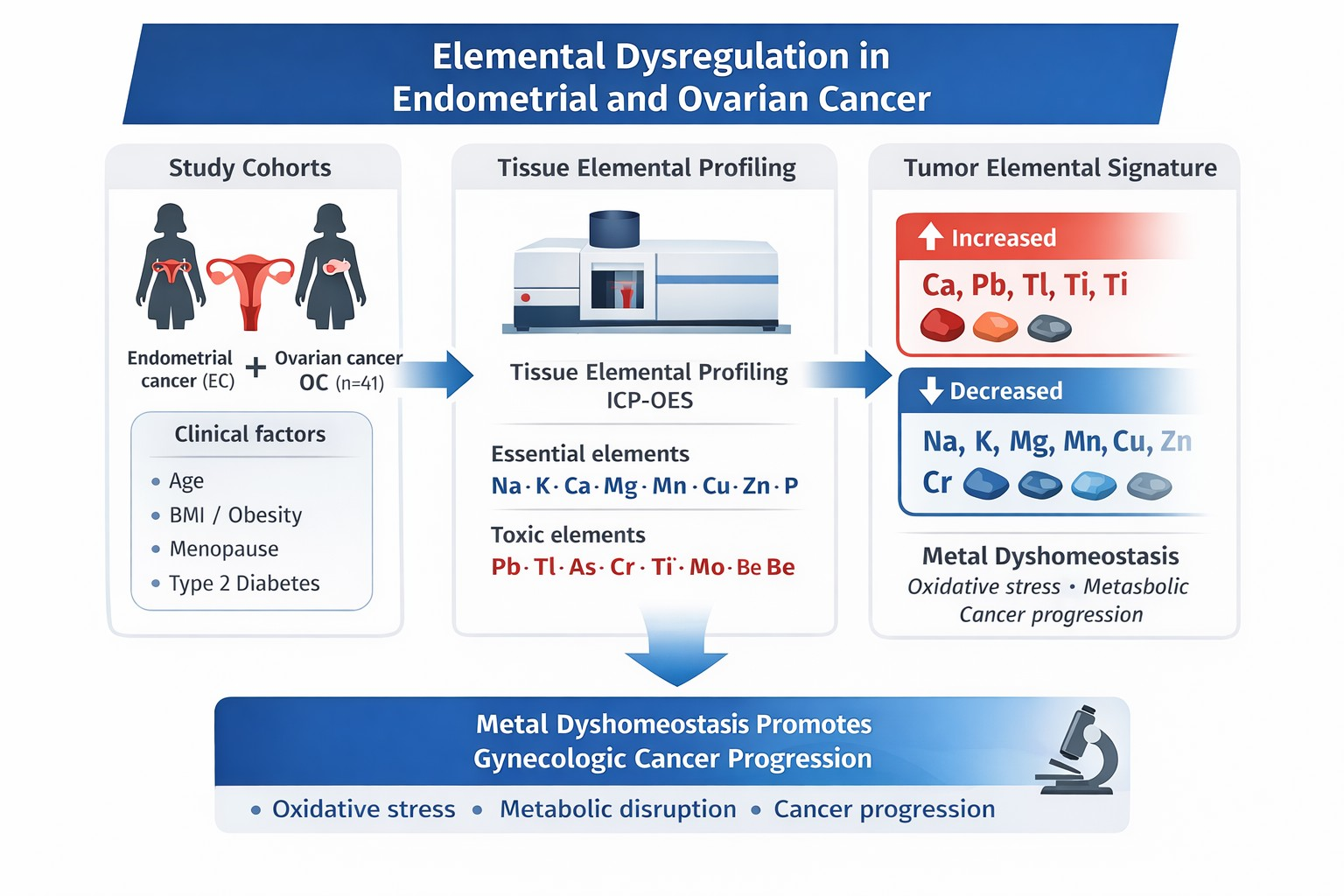
Taken together, the identified pattern—characterized by relatively higher Ca and Pb and lower Mg, Zn, Cu, and Cr—may represent a composite tissue signature associated with tumor presence and progression. However, its biological and clinical significance remains to be established. The similarities observed between endometrial and ovarian cancers suggest shared metabolic or microenvironmental features, although differences in magnitude may reflect underlying epidemiological and metabolic distinctions, particularly the stronger association of endometrial cancer with obesity and metabolic dysfunction.
From a clinical perspective, these findings should be considered exploratory. While selected elements may serve as potential tissue-level indicators associated with disease characteristics, the current data are insufficient to support their use as diagnostic biomarkers or therapeutic targets. Further validation in independent cohorts, as well as integration with molecular and functional analyses, is required to determine their clinical relevance.



 ,
,