Clinical Evidence on Particle Radiation, DNA Damage Response Inhibitors, and Immunotherapy for Mismatch Repair-Proficient Rectal Cancer

 ,
,  , , ,
, , , 


Simple Summary
Abstract
1. Introduction
2. Materials and Methods
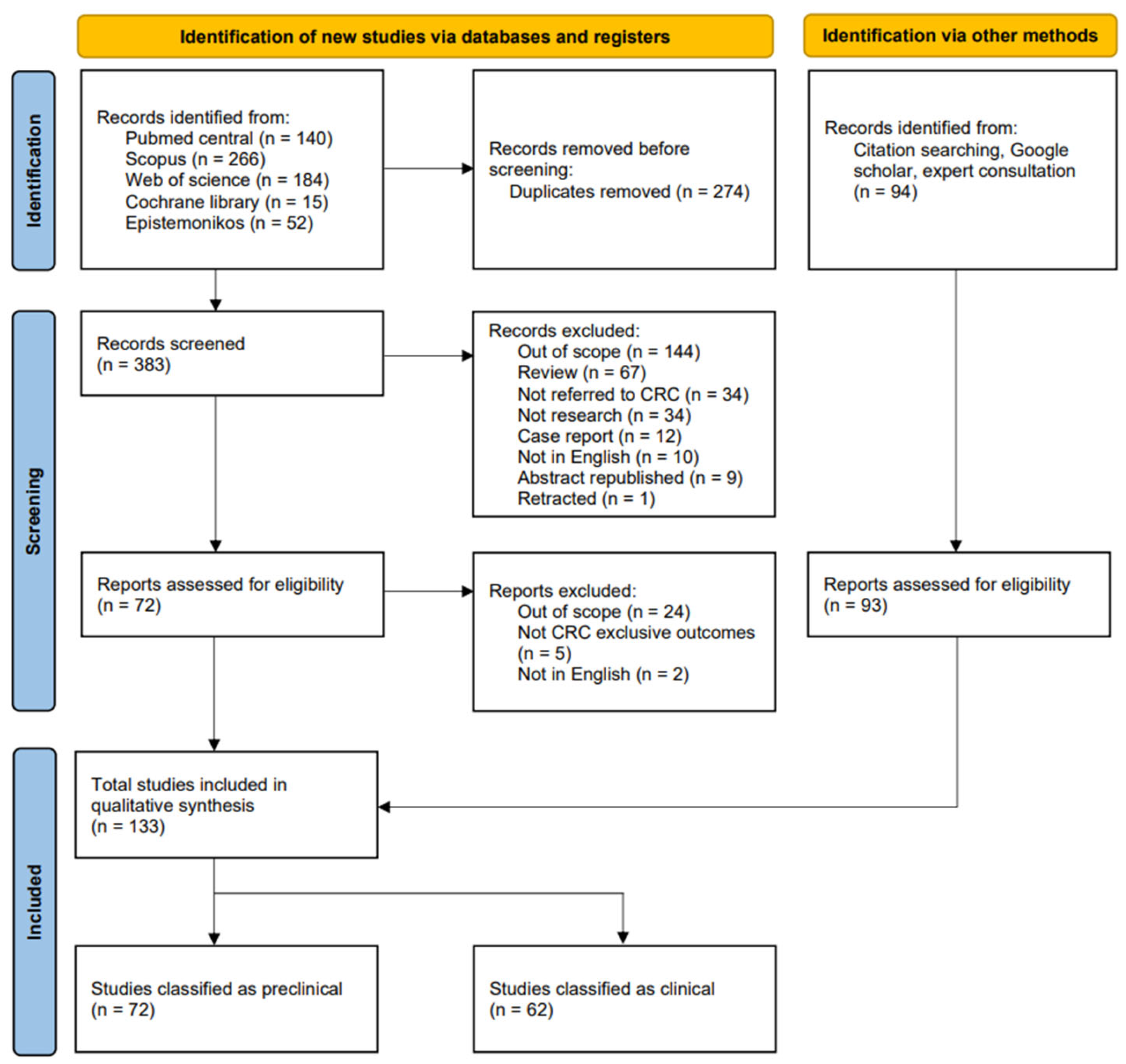
2.1. Literature Search
2.2. Review and 4
3. Results
3.1. Clinical Evidence
3.1.1. PBT/CIRT Radiotherapy for Oligometastatic Disease
3.1.2. Combinations with DDRi and/or ICI
IR + DDRi
IR + ICI
IR + DDRi + ICI
4. Discussion
5. Conclusions
Supplementary Materials
Author Contributions
Funding
Institutional Review Board Statement
Data Availability Statement
Conflicts of Interest
References
- Bray, F.; Laversanne, M.; Sung, H.; Ferlay, J.; Siegel, R.L.; Soerjomataram, I.; Jemal, A. Global cancer statistics 2022: GLOBOCAN estimates of incidence and mortality worldwide for 36 cancers in 185 countries. CA Cancer J. Clin. 2024, 74, 229–263. [Google Scholar] [CrossRef] [Scilit]
- Du, M.; Drew, D.A.; Goncalves, M.D.; Cao, Y.; Chan, A.T. Early-onset colorectal cancer as an emerging disease of metabolic dysregulation. Nat. Rev. Endocrinol. 2025, 21, 686–702. [Google Scholar] [CrossRef] [Scilit]
- van Geffen, E.G.M.; Hogewoning, C.R.C.; Hazen, S.J.A.; Sluckin, T.C.; Lange, M.M.; Snaebjornsson, P.; Beets-Tan, R.G.H.; Marijnen, C.A.M.; Verhoef, C.; Chalabi, M.; et al. Incidence and Outcomes of Patients With Mismatch Repair Deficient Rectal Cancer Operated in 2016: A Nationwide Cohort From The Netherlands. Clin. Color. Cancer 2025, 24, 188–197.e181. [Google Scholar] [CrossRef] [Scilit]
- Williams, C.J.M.; Peddle, A.M.; Kasi, P.M.; Seligmann, J.F.; Roxburgh, C.S.; Middleton, G.W.; Tejpar, S. Neoadjuvant immunotherapy for dMMR and pMMR colorectal cancers: Therapeutic strategies and putative biomarkers of response. Nat. Rev. Clin. Oncol. 2024, 21, 839–851. [Google Scholar] [CrossRef] [Scilit]
- NCCN. NCCNClinical Practice Guidelines in Oncology (NCCN Guidelines) for Rectal Cancer V.3.2025 NCCN.Org: National Comprehensive Cancer Network. Inc 2025. Available online: https://www.nccn.org/guidelines/guidelines-detail?id=1461 (accessed on 15 August 2025).
- Anker, C.J.; Tchelebi, L.T.; Selfridge, J.E.; Jabbour, S.K.; Akselrod, D.; Cataldo, P.; Abood, G.; Berlin, J.; Hallemeier, C.L.; Jethwa, K.R.; et al. Executive Summary of the American Radium Society on Appropriate Use Criteria for Nonoperative Management of Rectal Adenocarcinoma: Systematic Review and Guidelines. Int. J. Radiat. Oncol. Biol. Phys. 2024, 120, 946–977. [Google Scholar] [CrossRef] [Scilit]
- Rummel, K.A.; Sutton, E.A.; Hallemeier, C.L.; Merrell, K.W.; Callaghan, C.M.; Haddock, M.G.; Waddle, M.R.; Jethwa, K.R. Non-Operative Management of Rectal or Anal Canal Adenocarcinoma: National Cancer Database Analysis of the Impact of Disease, Treatment, and Social Determinants of Health on Overall Survival. Int. J. Radiat. Oncol. Biol. Phys. 2023, 117, e336. [Google Scholar] [CrossRef] [Scilit]
- O’Connor, M.J. Targeting the DNA Damage Response in Cancer. Mol. Cell 2015, 60, 547–560. [Google Scholar] [CrossRef] [Scilit]
- Amodio, V.; Vitiello, P.P.; Bardelli, A.; Germano, G. DNA repair-dependent immunogenic liabilities in colorectal cancer: Opportunities from errors. Br. J. Cancer 2024, 131, 1576–1590. [Google Scholar] [CrossRef] [Scilit]
- Le, D.T.; Uram, J.N.; Wang, H.; Bartlett, B.R.; Kemberling, H.; Eyring, A.D.; Skora, A.D.; Luber, B.S.; Azad, N.S.; Laheru, D.; et al. PD-1 Blockade in Tumors with Mismatch-Repair Deficiency. N. Engl. J. Med. 2015, 372, 2509–2520. [Google Scholar] [CrossRef] [Scilit]
- Cercek, A.; Bachet, J.B.; Capdevila, J.; Starling, N.; Chen, E.; Salvatore, L.; Bando, H.; O’Donnell, S.; Harfst, L.; Szijgyarto, Z.; et al. A Phase Two, Single-Arm, Open-Label Study With Dostarlimab Monotherapy in Participants With Untreated Stage II/III dMMR/MSI-H Locally Advanced Rectal Cancer (AZUR-1). Clin. Color. Cancer 2025, 24, 325–330. [Google Scholar] [CrossRef] [Scilit]
- Concannon, K.; Morris, B.B.; Gay, C.M.; Byers, L.A. Combining targeted DNA repair inhibition and immune-oncology approaches for enhanced tumor control. Mol. Cell 2023, 83, 660–680. [Google Scholar] [CrossRef] [Scilit]
- Zhang, Q.; Jiang, L.; Wang, W.; Huber, A.K.; Valvo, V.M.; Jungles, K.M.; Holcomb, E.A.; Pearson, A.N.; The, S.; Wang, Z.; et al. Potentiating the radiation-induced type I interferon antitumoral immune response by ATM inhibition in pancreatic cancer. JCI Insight 2024, 9, e168824. [Google Scholar] [CrossRef] [Scilit]
- Nikitaki, Z.; Velalopoulou, A.; Zanni, V.; Tremi, I.; Havaki, S.; Kokkoris, M.; Gorgoulis, V.G.; Koumenis, C.; Georgakilas, A.G. Key biological mechanisms involved in high-LET radiation therapies with a focus on DNA damage and repair. Expert. Rev. Mol. Med. 2022, 24, e15. [Google Scholar] [CrossRef] [Scilit]
- Zhang, J.; Si, J.; Gan, L.; Zhou, R.; Guo, M.; Zhang, H. Harnessing the targeting potential of differential radiobiological effects of photon versus particle radiation for cancer treatment. J. Cell. Physiol. 2021, 236, 1695–1711. [Google Scholar] [CrossRef] [Scilit]
- Zhou, Q.; Howard, M.E.; Tu, X.; Zhu, Q.; Denbeigh, J.M.; Remmes, N.B.; Herman, M.G.; Beltran, C.J.; Yuan, J.; Greipp, P.T.; et al. Inhibition of ATM Induces Hypersensitivity to Proton Irradiation by Upregulating Toxic End Joining. Cancer Res. 2021, 81, 3333–3346. [Google Scholar] [CrossRef] [Scilit]
- Huang, R.-X.; Zhou, P.-K. DNA damage response signaling pathways and targets for radiotherapy sensitization in cancer. Signal Transduct. Target. Ther. 2020, 5, 60. [Google Scholar] [CrossRef] [Scilit]
- Bright, S.J.; Flint, D.B.; Martinus, D.K.J.; Turner, B.X.; Manandhar, M.; Ben Kacem, M.; McFadden, C.H.; Yap, T.A.; Shaitelman, S.F.; Sawakuchi, G.O. Targeted Inhibition of DNA-PKcs, ATM, ATR, PARP, and Rad51 Modulate Response to X Rays and Protons. Radiat. Res. 2022, 198, 336–346. [Google Scholar] [CrossRef] [Scilit]
- Du, J.; Kageyama, S.I.; Hirata, H.; Motegi, A.; Nakamura, M.; Hirano, Y.; Okumura, M.; Yamashita, R.; Tsuchihara, K.; Hojo, H.; et al. Comparative analysis of the immune responses in cancer cells irradiated with X-ray, proton and carbon-ion beams. Biochem. Biophys. Res. Commun. 2021, 585, 55–60. [Google Scholar] [CrossRef] [Scilit]
- Jeans, E.B.; Jethwa, K.R.; Harmsen, W.S.; Neben-Wittich, M.; Ashman, J.B.; Merrell, K.W.; Giffey, B.; Ito, S.; Kazemba, B.; Beltran, C.; et al. Clinical Implementation of Preoperative Short-Course Pencil Beam Scanning Proton Therapy for Patients With Rectal Cancer. Adv. Radiat. Oncol. 2020, 5, 865–870. [Google Scholar] [CrossRef] [Scilit]
- Berman, A.T.; Both, S.; Sharkoski, T.; Goldrath, K.; Tochner, Z.; Apisarnthanarax, S.; Metz, J.M.; Plastaras, J.P. Proton Reirradiation of Recurrent Rectal Cancer: Dosimetric Comparison, Toxicities, and Preliminary Outcomes. Int. J. Part. Ther. 2014, 1, 2–13. [Google Scholar] [CrossRef] [Scilit]
- Ma, J.; Dragojevic, S.; Remmes, N.; Mendelson, N.; Kloeber, J.; Ebner, D.; Wu, Z.; Gunn, H.; Merrell, K.; Hallemeier, C.; et al. Linear energy transfer optimized proton therapy for rectal cancer. Radiother. Oncol. 2025, 207, 110850. [Google Scholar] [CrossRef] [Scilit]
- Valdman, A.; Marsk, R.; Karimi, M.; Asklid, D.; Brattstrom, D.; Ostling Palme, J.; Martling, A.; Nilsson, P.J. Surgical outcomes following total neoadjuvant therapy in rectal cancer with short-course radiotherapy using protons or photons: Initial safety data from the PRORECT randomized trial. Br. J. Surg. 2024, 111, znae241. [Google Scholar] [CrossRef] [Scilit]
- Lin, Y.H.; Hsu, H.C.; Huang, E.Y. Prognostic Value of Pretreatment Carcinoembryonic Antigen (CEA) in Rectal Cancer Treated with Preoperative Short-Course Radiotherapy with Delayed Surgery or Long-Course Radiotherapy. Onco Targets Ther. 2025, 18, 73–86. [Google Scholar] [CrossRef] [Scilit]
- Moningi, S.; Ludmir, E.B.; Polamraju, P.; Williamson, T.; Melkun, M.M.; Herman, J.D.; Krishnan, S.; Koay, E.J.; Koong, A.C.; Minsky, B.D.; et al. Definitive hyperfractionated, accelerated proton reirradiation for patients with pelvic malignancies. Clin. Transl. Radiat. Oncol. 2019, 19, 59–65. [Google Scholar] [CrossRef] [Scilit]
- Koroulakis, A.; Molitoris, J.; Kaiser, A.; Hanna, N.; Bafford, A.; Jiang, Y.; Bentzen, S.; Regine, W.F. Reirradiation for Rectal Cancer Using Pencil Beam Scanning Proton Therapy: A Single Institutional Experience. Adv. Radiat. Oncol. 2021, 6, 100595. [Google Scholar] [CrossRef] [Scilit]
- Hiroshima, Y.; Ishikawa, H.; Murakami, M.; Nakamura, M.; Shimizu, S.; Enomoto, T.; Oda, T.; Mizumoto, M.; Nakai, K.; Okumura, T.; et al. Proton Beam Therapy for Local Recurrence of Rectal Cancer. Anticancer. Res. 2021, 41, 3589–3595. [Google Scholar] [CrossRef] [Scilit]
- Takagawa, Y.; Suzuki, M.; Yamaguchi, H.; Seto, I.; Azami, Y.; Machida, M.; Takayama, K.; Tominaga, T.; Murakami, M. Outcomes and Prognostic Factors for Locally Recurrent Rectal Cancer Treated With Proton Beam Therapy. Adv. Radiat. Oncol. 2023, 8, 101192. [Google Scholar] [CrossRef] [Scilit]
- Takagawa, Y.; Suzuki, M.; Seto, I.; Azami, Y.; Machida, M.; Takayama, K.; Sulaiman, N.S.; Nakasato, T.; Kikuchi, Y.; Murakami, M.; et al. Proton beam reirradiation for locally recurrent rectal cancer patients with prior pelvic irradiation. J. Radiat. Res. 2024, 65, 379–386. [Google Scholar] [CrossRef] [Scilit]
- Habermehl, D.; Wagner, M.; Ellerbrock, M.; Buchler, M.W.; Jakel, O.; Debus, J.; Combs, S.E. Reirradiation Using Carbon Ions in Patients with Locally Recurrent Rectal Cancer at HIT: First Results. Ann. Surg. Oncol. 2015, 22, 2068–2074. [Google Scholar] [CrossRef] [Scilit]
- Combs, S.; Kieser, M.; Habermehl, D.; Weitz, J.; Jäger, D.; Fossati, P.; Orrechia, R.; Engenhart-Cabillic, R.; Pötter, R.; Dosanjh, M.; et al. Phase I/II trial evaluating carbon ion radiotherapy for the treatment of recurrent rectal cancer: The PANDORA-01 trial. BMC Cancer 2012, 12, 137. [Google Scholar] [CrossRef] [Scilit]
- Yamada, S.; Kamada, T.; Ebner, D.K.; Shinoto, M.; Terashima, K.; Isozaki, Y.; Yasuda, S.; Makishima, H.; Tsuji, H.; Tsujii, H.; et al. Carbon-Ion Radiation Therapy for Pelvic Recurrence of Rectal Cancer. Int. J. Radiat. Oncol. Biol. Phys. 2016, 96, 93–101. [Google Scholar] [CrossRef] [Scilit]
- Shinoto, M.; Yamada, S.; Okamoto, M.; Shioyama, Y.; Ohno, T.; Nakano, T.; Nemoto, K.; Isozaki, Y.; Kawashiro, S.; Tsuji, H.; et al. Carbon-ion radiotherapy for locally recurrent rectal cancer: Japan Carbon-ion Radiation Oncology Study Group (J-CROS) Study 1404 Rectum. Radiother. Oncol. 2019, 132, 236–240. [Google Scholar] [CrossRef] [Scilit]
- Cai, X.; Du, Y.Y.; Wang, Z.; Li, P.; Yu, Z.; Zhang, Q.; Zhang, Z. The role of carbon ion radiotherapy for unresectable locally recurrent rectal cancer: A single institutional experience. Radiat. Oncol. 2020, 15, 209. [Google Scholar] [CrossRef] [Scilit]
- Barcellini, A.; Vitolo, V.; Cobianchi, L.; Peloso, A.; Vanoli, A.; Mirandola, A.; Facoetti, A.; Fiore, M.R.; Iannalfi, A.; Vischioni, B.; et al. Re-irradiation With Carbon Ion Radiotherapy for Pelvic Rectal Cancer Recurrences in Patients Previously Irradiated to the Pelvis. In Vivo 2020, 34, 1547–1553. [Google Scholar] [CrossRef] [Scilit]
- Yamada, S.; Takiyama, H.; Isozaki, Y.; Shinoto, M.; Ebner, D.K.; Koto, M.; Tsuji, H.; Miyauchi, H.; Sekimoto, M.; Ueno, H.; et al. Carbon Ion Radiotherapy for Locally Recurrent Rectal Cancer of Patients with Prior Pelvic Irradiation. Ann. Surg. Oncol. 2022, 29, 99–106. [Google Scholar] [CrossRef] [Scilit]
- Shiba, S.; Okamoto, M.; Shibuya, K.; Okazaki, S.; Kobayashi, D.; Miyasaka, Y.; Ohno, T. Safety and Efficacy of Re-irradiation With Carbon-ion Radiotherapy for Pelvic Recurrence of Rectal Cancer After Preoperative Chemoradiotherapy: A Retrospective Analysis. In Vivo 2022, 36, 2473–2480. [Google Scholar] [CrossRef] [Scilit]
- Cai, X.; Li, P.; Zhao, J.F.; Wang, W.W.; Cheng, J.Y.; Zhang, G.Y.; Cai, S.J.; Zhang, Z.; Jiang, G.L.; Zhang, Q.; et al. Definitive carbon ion re-irradiation with pencil beam scanning in the treatment of unresectable locally recurrent rectal cancer. J. Radiat. Res. 2023, 64, 933–939. [Google Scholar] [CrossRef] [Scilit]
- Shiba, S.; Okamoto, M.; Shibuya, K.; Kobayashi, D.; Miyasaka, Y.; Ohno, T. Five-year outcomes in carbon-ion radiotherapy for postoperative pelvic recurrence of rectal cancer: A prospective clinical trial (GUNMA 0801). Clin. Transl. Radiat Oncol. 2024, 44, 100701. [Google Scholar] [CrossRef] [Scilit]
- Shiba, S.; Okamoto, M.; Kiyohara, H.; Ohno, T.; Kaminuma, T.; Asao, T.; Ojima, H.; Shirabe, K.; Kuwano, H.; Nakano, T. Prospective Observational Study of High-Dose Carbon-Ion Radiotherapy for Pelvic Recurrence of Rectal Cancer (GUNMA 0801). Front. Oncol. 2019, 9, 702. [Google Scholar] [CrossRef] [Scilit]
- Takiyama, H.; Yamada, S.; Isozaki, T.; Ikawa, H.; Shinoto, M.; Imai, R.; Koto, M. Carbon-Ion Radiation Therapy for Unresectable Locally Recurrent Colorectal Cancer: A Promising Curative Treatment for Both Radiation Therapy: Naive Cases and Reirradiation Cases. Int. J. Radiat. Oncol. Biol. Phys. 2024, 118, 734–742. [Google Scholar] [CrossRef] [Scilit]
- Kimura, K.; Takiyama, H.; Yamada, S.; Ito, K.; Koba, M.; Imada, A.; Song, J.; Kataoka, K.; Kihara, T.; Matsuda, I.; et al. A Novel Treatment Strategy for Unresectable Locally Recurrent Rectal Cancer-Upfront Carbon-Ion Radiotherapy Followed by Surgical Resection of the Irradiated Intestines. Cancers 2025, 17, 2230. [Google Scholar] [CrossRef] [Scilit]
- Jeans, E.B.; Ebner, D.K.; Takiyama, H.; Qualls, K.; Cunningham, D.A.; Waddle, M.R.; Jethwa, K.R.; Harmsen, W.S.; Hubbard, J.M.; Dozois, E.J.; et al. Comparing Oncologic Outcomes and Toxicity for Combined Modality Therapy vs. Carbon-Ion Radiotherapy for Previously Irradiated Locally Recurrent Rectal Cancer. Cancers 2023, 15, 3057. [Google Scholar] [CrossRef] [Scilit]
- Chung, S.Y.; Takiyama, H.; Kang, J.H.; Chang, J.S.; Min, B.S.; Tsuji, H.; Yamada, S.; Koom, W.S. Comparison of clinical outcomes between carbon ion radiotherapy and X-ray radiotherapy for reirradiation in locoregional recurrence of rectal cancer. Sci. Rep. 2022, 12, 1845. [Google Scholar] [CrossRef] [Scilit]
- Isozaki, Y.; Yamada, S.; Kawashiro, S.; Yasuda, S.; Okada, N.; Ebner, D.; Tsuji, H.; Kamada, T.; Matsubara, H. Carbon-ion radiotherapy for isolated para-aortic lymph node recurrence from colorectal cancer. J. Surg. Oncol. 2017, 116, 932–938. [Google Scholar] [CrossRef] [Scilit]
- Matsuyama, T.; Yamauchi, S.; Masuda, T.; Kikuchi, A.; Tokunaga, M.; Sugihara, K.; Kinugasa, Y. Treatment and subsequent prognosis in locally recurrent rectal cancer: A multicenter retrospective study of 498 patients. Int. J. Color. Dis. 2021, 36, 1243–1250. [Google Scholar] [CrossRef] [Scilit]
- Murayama, S.; Yamada, S.; Hiroshima, Y.; Takiyama, H.; Taguchi, H.; Kimoto, T.; Anzai, M.; Hagiwara, Y.; Yasui, K.; Mori, K.; et al. Particle beam therapy for pelvic recurrence of colorectal cancer: A registry data analysis in Japan and a systematic review. J. Radiat. Res. 2023, 64, i25–i33. [Google Scholar] [CrossRef] [Scilit]
- Yamada, S.; Kamada, T.; Kawashiro, S.; Isozaki, Y.; Ebner, D.K. Update on Carbon-Ion Radiation Therapy for Patients With Pelvic Recurrence of Rectal Cancer. Int. J. Radiat. Oncol. Biol. Phys. 2017, 99, E201. [Google Scholar] [CrossRef] [Scilit]
- Shirai, K.; Ohno, T.; Saitoh, J.; Okamoto, M.; Katoh, H.; Murata, K.; Kawamura, H.; Musha, A.; Abe, T.; Mizukami, T.; et al. Prospective Study of Isolated Recurrent Tumor Re-irradiation With Carbon-Ion Beams. Front. Oncol. 2019, 9, 181. [Google Scholar] [CrossRef] [Scilit]
- Hong, T.S.; Wo, J.Y.; Borger, D.R.; Yeap, B.Y.; McDonnell, E.I.; Willers, H.; Blaszkowsky, L.S.; Kwak, E.L.; Allen, J.N.; Clark, J.W.; et al. Phase II Study of Proton-Based Stereotactic Body Radiation Therapy for Liver Metastases: Importance of Tumor Genotype. J. Natl. Cancer Inst. 2017, 109, djx031. [Google Scholar] [CrossRef] [Scilit]
- Kang, J.I.; Sufficool, D.C.; Hsueh, C.T.; Wroe, A.J.; Patyal, B.; Reeves, M.E.; Slater, J.D.; Yang, G.Y. A phase I trial of Proton stereotactic body radiation therapy for liver metastases. J. Gastrointest. Oncol. 2019, 10, 112–117. [Google Scholar] [CrossRef] [Scilit]
- Kim, K.; Yu, J.I.; Park, H.C.; Yoo, G.S.; Lim, D.; Noh, J.M.; Jeong, W.K. A phase II trial of hypofractionated high-dose proton beam therapy for unresectable liver metastases. Radiother. Oncol. 2022, 176, 9–16. [Google Scholar] [CrossRef] [Scilit]
- Yamaguchi, H.; Kato, T.; Honda, M.; Hamada, K.; Todate, Y.; Ishikawa, Y.; Seto, I.; Tominaga, T.; Machida, M.; Takagawa, Y.; et al. Clinical outcomes and factors involved in the local control of proton beam therapy for oligometastatic liver tumors in patients with colorectal cancer. Strahlenther. Onkol. 2023, 199, 304–312. [Google Scholar] [CrossRef] [Scilit]
- Makishima, H.; Yasuda, S.; Isozaki, Y.; Kasuya, G.; Okada, N.; Miyazaki, M.; Mohamad, O.; Matsufuji, N.; Yamada, S.; Tsuji, H.; et al. Single fraction carbon ion radiotherapy for colorectal cancer liver metastasis: A dose escalation study. Cancer Sci. 2019, 110, 303–309. [Google Scholar] [CrossRef] [Scilit]
- Shiba, S.; Wakatsuki, M.; Toyama, S.; Terashima, K.; Uchida, H.; Katoh, H.; Shibuya, K.; Okazaki, S.; Miyasaka, Y.; Ohno, T.; et al. Carbon-ion radiotherapy for oligometastatic liver disease: A national multicentric study by the Japan Carbon-Ion Radiation Oncology Study Group (J-CROS). Cancer Sci. 2023, 114, 3679–3686. [Google Scholar] [CrossRef] [Scilit]
- Shiba, S.; Shibuya, K.; Okamoto, M.; Okano, N.; Kubo, N.; Kaminuma, T.; Sato, H.; Okazaki, S.; Miyasaka, Y.; Kawamura, H.; et al. Carbon-ion Radiotherapy for Oligometastatic Colorectal Cancer in the Liver or Lung. Anticancer. Res. 2021, 41, 1997–2005. [Google Scholar] [CrossRef] [Scilit]
- Aibe, N.; Ogino, H.; Teramukai, S.; Yamazaki, H.; Iwata, H.; Matsuo, Y.; Okimoto, T.; Murakami, M.; Suzuki, M.; Arimura, T.; et al. Multi-Institutional Retrospective Analysis of the Outcomes of Proton Beam Therapy for Patients With 1 to 3 Pulmonary Oligometastases From Various Primary Cancers. Adv. Radiat. Oncol. 2021, 6, 100690. [Google Scholar] [CrossRef] [Scilit]
- Takahashi, W.; Nakajima, M.; Yamamoto, N.; Yamada, S.; Yamashita, H.; Nakagawa, K.; Tsuji, H.; Kamada, T. Carbon ion radiotherapy for oligo-recurrent lung metastases from colorectal cancer: A feasibility study. Radiat. Oncol. 2014, 9, 68. [Google Scholar] [CrossRef] [Scilit]
- Okonogi, N.; Kaminuma, T.; Okimoto, T.; Shinoto, M.; Yamamoto, N.; Yamada, S.; Murata, K.; Ohno, T.; Shioyama, Y.; Tsuji, H.; et al. Carbon-ion radiotherapy for lymph node oligo-recurrence: A multi-institutional study by the Japan Carbon-Ion Radiation Oncology Study Group (J-CROS). Int. J. Clin. Oncol. 2019, 24, 1143–1150. [Google Scholar] [CrossRef] [Scilit]
- Lee, J.J.B.; Isozaki, T.; Choi, S.H.; Takiyama, H.; Lee, J.; Chang, J.S.; Yamada, S.; Koom, W.S. Outcomes of Carbon-Ion Radiation Therapy Versus Photon Therapy for Isolated Paraortic Lymph Node Recurrence From Colorectal Cancer. Int. J. Radiat. Oncol. Biol. Phys. 2025, 123, 1080–1089. [Google Scholar] [CrossRef] [Scilit]
- Aibe, N.; Ogino, H.; Wakatsuki, M.; Fujikawa, K.; Teramukai, S.; Fukumitsu, N.; Shiba, S.; Yamamoto, N.; Nomoto, A.; Ono, T.; et al. Comprehensive analysis of Japanese nationwide cohort data of particle beam therapy for pulmonary, liver and lymph node oligometastases: Particle beam therapy versus high-precision X-ray radiotherapy. J. Radiat. Res. 2023, 64, i69–i83. [Google Scholar] [CrossRef] [Scilit]
- Fukumitsu, N.; Shiba, S.; Shibuya, K.; Kobayashi, D.; Miyasaka, Y.; Yamaguchi, H.; Numajiri, H.; Wakatsuki, M.; Ogino, H.; Katoh, N.; et al. Comprehensive analysis of data from a nationwide Japanese cohort on particle therapy for metastatic liver tumors. Int. J. Radiat. Oncol. Biol. Phys. 2025, 123, 1316–1322. [Google Scholar] [CrossRef] [Scilit]
- Czito, B.; Deming, D.; Jameson, G.; Mulcahy, M.; Vaghefi, H.; Dudley, M.; Holen, K.; DeLuca, A.; Mittapalli, R.; Munasinghe, W.; et al. Safety and tolerability of veliparib combined with capecitabine plus radiotherapy in patients with locally advanced rectal cancer: A phase 1b study. Lancet Gastroenterol. Hepatol. 2017, 2, 418–426. [Google Scholar] [CrossRef] [Scilit] [PubMed]
- Perez, B.; Aljumaily, R.; Marron, T.; Shafique, M.; Burris, H.; Iams, W.; Chmura, S.; Luke, J.; Edenfield, W.; Sohal, D.; et al. Phase I study of peposertib and avelumab with or without palliative radiotherapy in patients with advanced solid tumors. ESMO Open 2024, 9, 102217. [Google Scholar] [CrossRef] [Scilit] [PubMed]
- Parikh, A.R.; Szabolcs, A.; Allen, J.N.; Clark, J.W.; Wo, J.Y.; Raabe, M.; Thel, H.; Hoyos, D.; Mehta, A.; Arshad, S.; et al. Radiation therapy enhances immunotherapy response in microsatellite stable colorectal and pancreatic adenocarcinoma in a phase II trial. Nat. Cancer 2021, 2, 1124–1135. [Google Scholar] [CrossRef] [Scilit] [PubMed]
- Xia, F.; Wang, Y.; Wang, H.; Shen, L.; Xiang, Z.; Zhao, Y.; Zhang, H.; Wan, J.; Zhang, H.; Wang, Y.; et al. Randomized Phase II Trial of Immunotherapy-Based Total Neoadjuvant Therapy for Proficient Mismatch Repair or Microsatellite Stable Locally Advanced Rectal Cancer (TORCH). J. Clin. Oncol. 2024, 42, 3308–3318. [Google Scholar] [CrossRef] [Scilit]
- Roxburgh, C.; Hanna, C.; Graham, J.; Saunders, M.; Samuel, L.; MacLeod, N.; Devlin, L.; Edwards, J.; Hillson, L.; McMahon, R.; et al. Durvalumab (MEDI 4736) with extended neoadjuvant regimens in rectal cancer: A randomised phase II trial (PRIME-RT). J. Clin. Oncol. 2023, 41, TPS282. [Google Scholar] [CrossRef] [Scilit]
- Roxburgh, C.; Hanna, C.; Saunders, M.; Arthur, C.; Samuel, L.; Wells, L.; Muirhead, R.; MacLeod, N.; Graham, J.; Devlin, L.; et al. 1116 PRIME-RT: Durvalumab with extended neoadjuvant regimens in locally advanced rectal cancer (LARC): A randomised phase II trial. Radiother. Oncol. 2025, 206, S1163–S1164. [Google Scholar] [CrossRef] [Scilit]
- Lin, Z.Y.; Zhang, P.; Chi, P.; Xiao, Y.; Xu, X.M.; Zhang, A.M.; Qiu, X.F.; Wu, J.X.; Yuan, Y.; Wang, Z.N.; et al. Neoadjuvant short-course radiotherapy followed by camrelizumab and chemotherapy in locally advanced rectal cancer (UNION): Early outcomes of a multicenter randomized phase III trial. Ann. Oncol. 2024, 35, 882–891. [Google Scholar] [CrossRef] [Scilit]
- Zhang, W.; Tang, Y.; Wei, L.; Liu, S.; Wang, W.; Chi, Y.; Wang, Y.; Kang, W.; Huang, W.; Deng, F.; et al. Preoperative short-course radiotherapy followed by chemotherapy and PD-1 inhibitor administration for locally advanced rectal cancer: A study protocol of a randomized phase II/III trial (STELLAR II study). Color. Dis. 2024, 26, 1732–1740. [Google Scholar] [CrossRef] [Scilit]
- Tian, F.; Dai, H.; Sha, D.; Jing, H.; Li, L.; Jing, C. Short-course radiotherapy followed by sintilimab and CAPOX as total neoadjuvant treatment in locally advanced rectal cancer: A prospective, randomized controlled trial (SPRING-01). J. Clin. Oncol. 2025, 43, 3519. [Google Scholar] [CrossRef] [Scilit]
- Shamseddine, A.; Zeidan, Y.; El Husseini, Z.; Kreidieh, M.; Al Darazi, M.; Turfa, R.; Kattan, J.; Khalifeh, I.; Mukherji, D.; Temraz, S.; et al. Efficacy and safety-in analysis of short-course radiation followed by mFOLFOX-6 plus avelumab for locally advanced rectal adenocarcinoma. Radiat. Oncol. 2020, 15, 233. [Google Scholar] [CrossRef] [Scilit]
- Wang, F.; Lai, C.; Lv, Y.; Zhang, F.; Shi, L.; Wang, Y.; Shen, Y.; Xu, L.; Hu, P.; Tang, W.; et al. Efficacy and safety of combining short-course neoadjuvant chemoradiotherapy with envafolimab in locally advanced rectal cancer patients with microsatellite stability: A phase II PRECAM experimental study. Int. J. Surg. 2025, 111, 334–345. [Google Scholar] [CrossRef] [Scilit]
- Rahma, O.; Yothers, G.; Hong, T.; Russell, M.; You, Y.N.; Parker, W.; Jacobs, S.; Colangelo, L.; Lucas, P.; Gollub, M.; et al. Use of Total Neoadjuvant Therapy for Locally Advanced Rectal Cancer. JAMA Oncol. 2021, 7, 1225. [Google Scholar] [CrossRef] [Scilit] [PubMed]
- Bando, H.; Tsukada, Y.; Inamori, K.; Togashi, Y.; Koyama, S.; Kotani, D.; Fukuoka, S.; Yuki, S.; Komatsu, Y.; Homma, S.; et al. Preoperative Chemoradiotherapy plus Nivolumab before Surgery in Patients with Microsatellite Stable and Microsatellite Instability-High Locally Advanced Rectal Cancer. Clin. Cancer Res. 2022, 28, 1136–1146. [Google Scholar] [CrossRef] [Scilit] [PubMed]
- Grassi, E.; Zingaretti, C.; Petracci, E.; Corbelli, J.; Papiani, G.; Banchelli, I.; Valli, I.; Frassineti, G.L.; Passardi, A.; Di Bartolomeo, M.; et al. Phase II study of capecitabine-based concomitant chemoradiation followed by durvalumab as a neoadjuvant strategy in locally advanced rectal cancer: The PANDORA trial. ESMO Open Cancer Horiz. 2023, 8, 101824. [Google Scholar] [CrossRef] [Scilit] [PubMed]
- Li, Y.; Pan, C.; Gao, Y.; Zhang, L.; Ji, D.; Cui, X.; Zhang, X.; Cai, Y.; Zhang, Y.; Yao, Y.; et al. Total Neoadjuvant Therapy With PD-1 Blockade for High-Risk Proficient Mismatch Repair Rectal Cancer. JAMA Surg. 2024, 159, 529. [Google Scholar] [CrossRef] [Scilit]
- Yang, Z.; Gao, J.; Zheng, J.; Han, J.; Li, A.; Liu, G.; Sun, Y.; Zhang, J.; Chen, G.; Xu, R.; et al. Efficacy and safety of PD-1 blockade plus long-course chemoradiotherapy in locally advanced rectal cancer (NECTAR): A multi-center phase 2 study. Signal Transduct. Target. Ther. 2024, 9, 56. [Google Scholar] [CrossRef] [Scilit]
- Xiao, W.-W.; Chen, G.; Gao, Y.-H.; Lin, J.-Z.; Wu, X.-J.; Luo, H.-L.; Lu, Z.-H.; Wang, Q.-X.; Sun, R.; Cai, P.-Q.; et al. Effect of neoadjuvant chemoradiotherapy with or without PD-1 antibody sintilimab in pMMR locally advanced rectal cancer: A randomized clinical trial. Cancer Cell 2024, 42, 1570–1581.e1574. [Google Scholar] [CrossRef] [Scilit]
- Yang, Y.; Pang, K.; Lin, G.; Liu, X.; Gao, J.; Zhou, J.; Xu, L.; Gao, Z.; Wu, Y.; Li, A.; et al. Neoadjuvant chemoradiation with or without PD-1 blockade in locally advanced rectal cancer: A randomized phase 2 trial. Nat. Med. 2025, 31, 449–456. [Google Scholar] [CrossRef] [Scilit]
- Romesser, P.B.; Capdevila, J.; Garcia-Carbonero, R.; Philip, T.; Fernandez Martos, C.; Tuli, R.; Rodriguez-Gutierrez, A.; Kuipers, M.; Becker, A.; Coenen-Stass, A.; et al. A Phase Ib Study of the DNA-PK Inhibitor Peposertib Combined with Neoadjuvant Chemoradiation in Patients with Locally Advanced Rectal Cancer. Clin. Cancer Res. 2024, 30, 695–702. [Google Scholar] [CrossRef] [Scilit]
- Tian, F.; Dai, H.; Sha, D.; Yu, Y.; Jing, H.; Sun, C.; Shang, L.; Liu, Y.; Feng, R.; Li, J.; et al. Total neoadjuvant treatment with short-course radiotherapy followed by sintilimab plus capecitabine–oxaliplatin versus short-course radiotherapy followed by capecitabine–oxaliplatin in patients with locally advanced rectal cancer (SPRING-01): A single-centre, open-label, phase 2, randomised controlled trial. Lancet Oncol. 2025, 26, 1043–1054. [Google Scholar] [CrossRef] [Scilit]
- Tang, Y.; Li, H.-Y.; Wei, L.-C.; Li, N.; Zhang, W.-J.; Lu, Y.-F.; Deng, F.-Y.; Xu, T.-Z.; Shuai, J.-C.; Lei, Z.-F.; et al. Short-course-based TNT with or without PD-1 inhibitor for pMMR locally advanced rectal cancer: Phase 2 results of a randomized trial (STELLAR II). Med 2025, 6, 100807. [Google Scholar] [CrossRef] [Scilit]


| Study | Design, Disease (N) | Dose (GyE/fx) | Other Treatments/Arms (%) | Outcomes (% for Rates) | Toxicity (% G3+) |
|---|---|---|---|---|---|
| PRORECT trial NCT04525989 [23] | Phase 2, MC, primary LARC pts randomized to PBT or XRT short course RT, RAPIDO inclusion criteria (N = 20 total, 10 PBT and 10 XRT) | 25 Gy/5 fx | Randomized to PBT or XRT short course →CAPOX x4 →surgery or WW | pCR: 20 PBT; 10 XRT | Surgical Complications (Clavien–Dindo). Early: CD3a: PBT 30; XRT 20. CD3b: PBT 20; XRT 10 |
| [24] | Retrospective of LCCRT→delayed Surgery vs. SC→chemo→surgery. LCCRT was all XRT, but SC were treated with PBT or XRT (N = 122 total, 18 with PBT, 14.8%) | 25 Gy/5 fx | RT⟶Chemo [FOLFOX, XELOX, TEGAFOX, 5FU, tegafur-uracil, FOLFIRI, cape]⟶surgery +- adj ch | pCR/npCR: ≥16 wk RT-surgery Interval: 30/40; <16 wk: 0/25 | Unspecified |
| Study | Design, Disease (N) | Dose (GyE/fx) | Other Treatments/Arms (%) | Outcomes (% for Rates) | Toxicity (% G3+) |
|---|---|---|---|---|---|
| [21] | Prospective, LRRC (N = 7 pelvic recurrences) | Varied, all 1.8 Gy/fx PBT plans with IMRT comparisons | 86 concurrent ch [5FU, Xeloda], 29 surgery | PBT improved OAR sparing over XRT plans. Mortality: 43. Local failure 43. Distant metastasis: 14. M-FU: 14mo. CR = 1/7. PR = 3/7 | Early: G3: GI 43. Late: G4: GI 29 |
| [25] | Retrospective SC, LRRC (N = 6 rectal) | 39–45 Gy total at 1.5 Gy/fx delivered BID | 100 concurrent ch [5FU or cape], no surgery | OS 1Y/2Y/M: 68/68/39mo. PFS 1Y/2Y/M: 59/47/15mo | Early: G3: lymphopenia 17. Late: 0 |
| [26] | Retrospective, LRRC (N = 28) | Variable, median re-RT dose of 44.4 Gy with 75% treated BID | Neo: 29 Systemic, 7 surgery. 86 concurrent ch. Adj: 21 Surgery | OS 1Y/M: 82/29mo. LC 1Y/M: 66/23mo. PFS 1Y/M: 45/12mo | Early: 11; G3: GI 7, skin 4. Late: 14; G3: GI 7, infection 4; G5: GI 4 (intra-abdominal hemorrhage) |
| [27] | Retrospective SC, LRRC (N = 13) | Variable patterns of 50–79.2 Gy/18–38 fx (BED10 of 62.5–105.3, 4 fx per week, +/− concurrent ch) | 46 concurrent ch [S-1] | OS 3Y/M: 71/67mo. LC 3Y: 80. PFS 3Y: 12 | 0 |
| [28] | Retrospective, LRRC without prior RT (N = 23) | Variable, 60–87 Gy/25–35 fx QD | 4 concurrent ch [Folfox+Bev], 4 concHyperT | OS 3Y/5Y/M: 72/45/54mo. LC 3Y/5Y: 55/47. PFS 3Y/5Y: 38/38. CR = 1/23. PR = 4/23 | Early: 0. Late: G4: GI 13 |
| [29] | Retrospective, LRRC with prior RT (N = 10) | Variable, 56–77 Gy/24–37 fx QD | 20 concurrent ch [iri+S-1, S-1] | OS 1Y/2Y/M: 100/60/26mo. LC 1Y/2Y: 70/58. PFS 1Y/2Y: 20/10 | Early: 0. Late: G4: GI 10 |
| Study | Design, Disease (N) | Dose (GyE/fx) | Other Treatments/Arms (%) | Outcomes (% for Rates) | Toxicity (% G3+) |
|---|---|---|---|---|---|
| PANDORA-01 NCT01528683 [30,31] | Phase 1/2 single arm study of CIRT at escalating doses for LRRCSC, LRRC (N = 19) | 36–51 Gy/12–17 fx (all at 3 Gy/fx) | No surgery | Mortality: 16%. Local failure: 21%. Distant metastasis: 16%. M-FU: 8mo | 0 |
| [32,48] | Phase 1/2, SC, study of escalating CIRT doses for LRRC with no prior RT (N = 235. 2016: N = 180, phase 1/2: 37/phase 2: 143) | 67.2–73.6 Gy/16 fx, 4 fx per week | No surgery, no ch < 4 wk | OS 3Y/5Y: 67/46. LC 3Y/5Y: 90/88. FORMERLY (2016): OS 3Y/5Y: 67.2 Gy: 20/20; 70.4 GyE: 52/26; 73.6 Gy: 78/59 (phase 1/2 + 2). LC 5Y (competing risks): 67.2 GyE: 80; 70.4 Gy: 90; 73.6 Gy: 95. p = 0.02 (phases 1/2 + 2). CR = 20/186. PR = 59/186 (lesion) | Early: G3: 0.4 GI. Late: G3: 1 skin, 0.4 GI 2016: Phase 1: 0. Phase 2: Late: G3: skin 1, GI 1 |
| [33] | Retrospective (but included 143 pts from [32]) MC, LRRC (N = 224). Excluded for recurrent tumor abutting bowel/bladder, active infection. Spacers used | 70.4 or 73.6 Gy/16 fx, 4 fx per week | Ch allowed prior to or after CIRT. 4 pts had prior RT history | OS 3Y/5Y: 73/51. LC 3Y/5Y: 93/88. RC 3Y/5Y: 63/49. PFS 3Y/5Y: 40/27 | Early: G3: GI 0.4, infection 1. Late: G3: skin 1, GI 1, infection 3, neuropathy 0.4 |
| UMIN000014513 [49] | Phase 2, SC, CIRT for any isolated recurrent tumor with prior irradiation, excluded for bowel or blood vessel invasion, active infection, or recurrence in <3 months (N = 22 total including other disease sites, 5 were LRRC) | 57.6–73.6 Gy/12–16 fx | No concurrent treatment | OS 2Y: 100, LC 2Y: 50 (rectal) | Early: 0 Late: G3: GU 0–50 |
| [34] | Retrospective SC, unresectable LRRC (N = 25). 17 pts had prior RT | 48–75.6 Gy/16–21 fx, 5 fx per week. 7 pts got concurrent cape | 28 neo ch, 12 adj ch, 4 adj surgery [5FU based] | OS 1Y/2Y: 83/65. LC 1Y/2Y: 90/72. cPR 6/25, cCR 1/25 pCR 2/25 | Early: 0 Late: G3: GI 4, neuropathy 4, infection 4 |
| [35] | Retrospective SC, unresectable with prior RT, LRRC (N = 14) | 35–76.8 Gy/15–20 fx | 0 surgery | OS 1Y/2Y: 100/76. LC 1Y/2Y: 78/52. DMFS 1Y/2Y/M: 64/43/14mo | 0 |
| [36] | Retrospective SC, LRRC with prior RT history. Recurrent tumor > 3 mm from luminal organs (N = 77) | 70.4 Gy/16 fx, 4 days per week | No surgery, no ch < 4 wk prior to CIRT | OS 3Y/5Y: 61/38/47mo. LC 3Y/5Y: 69/62. RC 3Y/5Y: 85/81. PFS 3Y/5Y: 33/25 | Early: G3: infection 6, general 3, neuropathy 1. Late: G3: infection 17, GI 12, skin 1, general 3, neuropathy 5 |
| [37] | Retrospective SC, LRRC after pre-operative RT for initial treatment (N = 7) | 57.6–73.6 Gy/12–16 fx, 4 fx per week | Neo: 43 ch [FOLFOX, FOLFIRI], 29 Bev. Adj: 57 ch,43 Bev, 14 XRT [sox, XELOX, cape] | OS 2Y: 100 LC 2Y: 83 PFS 2Y: 29 | Early: 0 Late: G3: GI 14, GU 14 |
| [38] | Retrospective SC, unresectable LRRC with prior RT (N = 24) No invasion of GI tract or bladder allowed | 67.5 Gy/15 fx, (45.8%) 72 Gy/20 fx (41.7%) or 75.6 Gy/21 fx (12.5%) | Ch: 1 neo, adj 29, both 42. 0 surgery | OS 1Y/2Y/M: 87/81/41mo. LC 1Y/2Y: 100/93. PFS 1Y/2Y: 71/45. CR = 1/24. PR = 4/24 | Early: 0. Late: G3: GI 4, skin 4, infection 4 |
| GUNMA0801 [39,40] | Phase 2, SC, LRRC no prior RT, no direct invasion of GI tract or bladder (N = 28) | 73.6 Gy/16 fx, 4 fx per week | No surgery, no ch < 4 wks prior to CIRT or adj | OS 3Y/5Y/M: 89/50/76mo. LC 3Y/5Y: 88/83. PFS 3Y/5Y/M: 30/23/12mo | Early: 0. Late: G3: infection 7 |
| [41] | Retrospective SC, LRRC for pts without prior RT (nRT, N = 390) vs. with prior RT history (reRT, N = 83). Electivd nodal coverage was allowed for nRT only | nRT 73.6 Gy/16 fx. reRT 70.4 Gy/16 fx, 4 fx per week | Neo: 71 Ch, 18 surgery. No concurrent ch. Spacer placement prior to CIRT or resection of involved bowel (1–2 months after CIRT) allowed | OS 3Y/5Y: nRT: 73/50; reRT: 76/50 LC 3Y/5Y: nRT: 80/72; reRT: 80/69 PC 3Y/5Y: nRT: 54/40/; reRT: 41/36 All 5Y differences ns, OS, and LC no difference ch v no ch | Early: nRT: 1; G3: GI 1. reRT: 7; infection 6, neuropathy 1. Late: nRT: 6; G3: skin 1, 0.3 GU, GI 1, infection 2, neuropathy 1; G4: GI 0.3, infection 1. reRT: 27; G3: skin 2, GI 7, infection 11, neuropathy 6; G4: infection 2. reRT higher G3+ incidence (p < 0.05) |
| [42] | Prospective feasibility SC, unresectable LRRC with or without prior RT with recurrence < 3 mm from bowel (N = 12) | nRT 73.6 Gy/16 fx reRT 70.4 Gy/16 fx, 4 fx per week | CIRT followed by planned resection of the normal bowel <3 mm from recurrent disease (LAR or small bowel resection) | OS 3Y: 90. RFS 3Y: 57; IF:90, OOF: 72. 12/12 ypT0 | Early: 0. Late: CIRT: G3: 8 neuropathy. Surgery: CD3a: 8 |
| [43] | Retrospective MC, previously irradiated LRRC comparing CIRT alone at one institution vs. Combined Modality Therapy (CMT) of XRT re-irradiation, immediate resection+ intraoperative electron radiotherapy (IOERT) boost (N = 85 CIRT/86 CMT) | CIRT 70.4 Gy/16fx, 4 fx per week CMT 30 Gy/15 fx. XRT + IOERT 12.5–15 Gy | -CIRT w/o concurrent ch. -Neo ch, RT, immediate surgery + IOERT | OS 2Y/5Y/M: CIRT 83/47/4.5Y. HR vs. CMT 0.5, p < 0.01 PC 2Y/5Y/M: CIRT 58/46/3.6Y. HR vs. CMT 1.4, ns DMFS 2Y/5Y/M: CIRT 46/38/1.8Y. HR vs. CMT 1.2, ns PC 2Y/5Y/M: CIRT 31/23/1.1Y. HR vs. CMT 1.3, ns | CIRT: G3–4: GI 13. Early G3–4 (OR CMT vs. CIRT, p < 0.05): GI: 22, GU 3, skin 3 Late G3–4 (HR CMT vs. CIRT, p < 0.05): GU 33 |
| [44] | Retrospective MC, LRRC with prior RT (N = 35 CIRT/31 XRT) CIRT and XRT performed at different institutions | CIRT 70.4 Gy/16 fx XRT: 50 Gy (range 25–62.5 Gy) with a median of 25 fx (range 3–33) | -CIRT: 40 neo/adj ch -XRT ± concurrent ch (68%)/surgery (36%) | OS 1Y/3Y: CIRT 97/8. HR CIRT vs. XRT 0.30, p = 0.004 LC 1Y/3Y: CIRT 94/87. HR CIRT vs. XRT 0.17, p = 0.002 | Early: G2+: GI 3, GU 9. Late: CIRT: G3+: GI 6. GU+GI adjusted HR (CIRT vs. XRT, p < 0.05): 0.15. Skin G1+: 11 |
| [46] | Retrospective MC, LRRC mostly comparing surgery vs. particle RT, not much data presented on the CIRT/PBT (N = 14 PBT/CIRT) | Unspecified | CIRT/PBT, surgery, chRT, Palliative care | OS 3Y/5Y/M: 76/44/47mo. DSS 3Y/5Y: 76/56 OS, DSS similar to surgery, CIRT/PBT better than palliative care | Unspecified |
| [47] | Retrospective SC, Pelvic recurrence of CRC (N = 114 CIRT, 33 PBT, N = 147 total rectal) | PBT: 60–75 Gy/18–35 fx CIRT: 57.6–73.6 Gy/12–16 fx | No | OS 2Y/3Y: CIRT 94/88; PBT 87/63. LC 1Y/2Y/3Y: (both CIRT and PBT, not reported separately) 91/81/76 | Early: 0. Late: CIRT 4, PBT 9. G3: neuropathy 2, infection 1, GI 1, skin 1; G4: GI 1 |
| Study | Design, Disease (N) | Dose (GyE/fx) | Other Treatments/Arms (%) | Outcomes | |
|---|---|---|---|---|---|
| PBT | NCT01239381 [50] | Phase II, SC. PBT SBRT for 1–4 liver metastases L-OM (N = 34 CRC) | 30–50 Gy/5 fx | Not excluded | No G3 tox. LC 1yr: 58.8% (CRC) |
| [51] | Phase I, SC. Dose escalation for PBT SBRT for1–3 liver metastases (N = 5 CRC, 2 rectal) | 36, 48, 60 Gy/3 fx | No other arms | No G3+ tox | |
| NCT04456621 [52] | Phase II, SC. PBT SBRT1–4 liver metastases. (N = 48 total pts, 30 CRC) | 60 Gy/5 fx | 8 ch < 6mo | No G3 tox. OS 6mo: 90. LC 6mo/1Y: 100/89 (CRC). ch vs. no ch (1Y): 94 vs. 76, p ns. (overall). PFS 6mo: Intrahepatic: 63; Extrahepatic: 59 | |
| [53] | Retrospective, SC. PBT with conventional, hypofractionated, or SBRT of 1–3 liver oligometastases (N = 63 lesions treated, 41 CRC pts, 12 pts rectal) | 74–76 Gy/37–38 fx if adjacent to OARs, 72.6 Gy/ 22 fx in hilar region, 64 Gy/8 fx if away from hilum/OARs | Prior ch: 30. Concurrent: 3 | No G3 tox. 2yrLC for conventional, hypofractionated, and SBRT of 35, 43.9, and 71.1%, respectively. Median LC times for conventional, hypofractionated, and SBRT of 16.4, 21.4, and 47.3 months, respectively | |
| [57] | Retrospective, MC. PBT SBRT 1–3 lung oligometastases, (N = 118 total pts, 50 CRC, 27 rectal) | 64 Gy/10 fx | 33 neo ch, 18 adj ch, 1 surgery | 1 G3 dermatitis. Local progression-free survival 1.2 years: 72.7 and 65.8%. CRC primary identified as poor prognostic indicator of LC | |
| CIRT | UMIN000032911 [54] | Phase I, SC. Dose escalation of single fx CIRT for unresectable liver metastases >5 mm from bowel with no other sites of disease. CRC (N = 31 CRC pts, 14 rectal) | Escalated from 36 to 58 Gy/1 fx. | No surgery, no ch < 4 wk | No acute G3+ tox, 2/8 pts at 53 Gy dose level with hilar disease had late biliary obstruction. 3yrLC was 82% for 53 and 58 Gy dose levels, and 28% for lower doses |
| [55] | Retrospective, MC. CIRT for liver oligometastatic disease from any site. (N = 102 total pts, 60 CRC) | Variable, most commonly 60 Gy/12 fx (68/121 lesions) | No surgery | No acute G3+ tox. For the CRC cohort, 1 and 2yrLC of 86.5 and 73.8%, respectively | |
| [56] | Retrospective, SC. SBRT or hypofractionated CIRT for CRC liver or lung metastases. CRC (N = 19 CRC pts, 8 rectal, 23 lesions treated) | 60 Gy/4 fx 60 Gy/12 fx (if close to bowel) 64.8 Gy/12 fx (if tumor > 5 cm) | 42 neo ch, 11 adj ch | No acute G3+ tox. 2yrLC 67% for all lesions; 83% for lung (all 9 received 60 Gy/4 fx) and 61% for liver (4/14 pts had local failure in the liver; 2/4 pts after 64.8 Gy/12 fx and 2/9 pts after 60 Gy/4 fx) | |
| [58] | Retrospective, SC. CIRT SBRT for 1–4 pulmonary metastases. (N = 34 CRC pts, 19 rectal. 44 lesions) | Various but >70% received 60 Gy/4 fx | No surgery, no ch < 1mo | No G3+ tox. 3yrLC rate of 85.4% | |
| [59] | Retrospective, MC. Hypofractionated CIRT for any disease site with LN oligorecurrence. (N = 323 pts total, 77 CRC) | Variable, most commonly 48–52.8 Gy/12 fx, 4 fx per week | Not excluded | 2yrLC 80.6% for CRC pts. No acute G3+ tox for CRC pts but 2/77 had G2 duodenitis | |
| [45] | Retrospective, SC. Hypofractionated CIRT for isolated PA lymph node recurrence. (N = 34 total, 20 rectal) | Variable, but >85% received 52.8 Gy/12 fx, 4 fx per week | 29 adj ch, 41 neo ch | No G3+ tox. 2, 3, and 5yrLC 70.1%. Complete response, partial response, and stable disease rates of 38.2, 17.6, and 26.5%. Of the pts that passed away, 12/13 died of distant failure. | |
| CIRT vs. PBT and/or XRT | [60] | Retrospective, MC. Oligorecurrence of CRC in only the PA lymph nodes comparing CIRT to XRT (N = 116, 63 XRT, 53 CIRT. 45% rectal) | CIRT: 48–55.2 Gy/12 fx, 4 fx per week. No concurrent ch, possible elective coverage. XRT: Variable, 22/63 pts had conventional fractionation, 39/63 hypofractionated, and 2 pts had SBRT. 6/63 had concurrent ch | CIRT (40 neo ch, 4 adj ch [FOLFOX, FOLFIRI, CAPOX, etc]) vs. XRT (70 ch) | 3.2% G3 tox (diarrhea) in XRT. 2 and 5yrLC for CIRT of 78.9 and 62%, respectively; 63.3 and 37.5% for XRT. |
| [61] | Retrospective, MC. CIRT/PBT vs. XRT (conventional or SBRT) for pulmonary/liver oligometastases or PALN recurrence from any primary site (N = 132 total pts, 48 CRC; 85 PBT, 47 CIRT, Arms: Lung: 48, Liver: 102, LN: 43) | Very variable, ranged from single fx to conventional fractionation with potentially more SBRT/hypofractionation in CIRT > PBT > XRT | Not excluded | G3 tox < 3.5%. 3yrLC CIRT/PBT: 72.8–83.2% for all sites. For the CRC cohort, the incidence rate ratio of local failure showed improved LC for CIRT/PBT in the liver, with a non-significant trend towards less local failure in lungs and lymph nodes compared to XRT SBRT. Non-significant trend towards improved LC with CIRT compared to PBT in liver | |
| [62] | Retrospective, MC. CIRT or PBT for 1–3 liver oligometastases from any primary site (N = 322 total, 51.9% CRC. N = 234 PBT, 88 CIRT) | Variable, ranging from 58 Gy/1 fx for CIRT to conventionally fractionated for PBT | 14 concurrent systemic (overall) [S-1, etc] | 2 and 5yrLC of 74.3 and 66.4% for all primary sites. CIRT and PBT not compared for LC. Trend towards better survival in CRC cohort with single lesions < 5 cm |
| Study, MMR/MSS Status # of Patients, (% Total) | Design, Disease (N) | Dose (GyE/fx) | ICI/DDRi (Timing) | Outcomes & Toxicity | |
|---|---|---|---|---|---|
| PBT or XRT +DDRi | NCT01589419 [63] MSS = 32 (100%) | Phase 1b dose-escalation study of the PARP inhibitor veliparib concurrent with LCCRT in LARC followed by surgery (N = 32) | 50.4 Gy/28 fx | Concurrent with LCCRT | pCR rate of 29%. 9% G3 diarrhea |
| XRT+DDRi+ICI | NCT03724890 [64] MSS NR | Phase 1 dose-escalation study of peposertib (DNA-PKi) for advanced/metastatic solid tumors (N = 6 CRC, 1 rectal). Avelumab (aPD-L1) without (part A) or with palliative XRT (part B) RT was to ≤ 3 sites | 30 Gy/10 fx | Avelumab (q2w) + Peposertib (BID or QD). In part B, peposertib was given concurrently with RT but not continued afterwards | MTD for peposertib with avelumab and RT was 250 mg QD. No objective responses were observed. G3–4 tox: DDRi 0–17%, ICI 0–67%, and 0–17% attributed to XRT |
| PBT/XRT+ICI | NCT03104439 [65] MSS = 40 (100%) | Phase 2 single arm, Metastatic MSS CRC treated with cycles of Ipi (q2w)/Nivo(q6w) (aCTLA4/aPD-1) and SBRT (CRC N = 40, 2 rectal; 27 received SBRT). XRT and PBT not compared | 24 Gy/3 fx with cycle #2 of Ipi/nivo | Ipi/Nivo → Nivo → SBRT+Ipi/Nivo | Intention to treat disease control rate (DCR): 25%. Per-protocol DCR: 37%. Ipi/Nivo toxicity: G3 53%, G4 15%, G5 3%. RT toxicity: G4 15%; G4 7% |
| XRT+ICI | TORCH NCT04518280 [66] MSS = 121 (100%) | LARC who were treated with either short course RT (SCRT) followed by CAPEOX x6 cycles with toripalimab (aPD-1) (group A, N = 62) or the same regimen, but SCRT was delivered in between cycles 2 and 3 of CAPEOX+toripalimab (group B, N = 59) | 25 Gy/5 fx | Concurrent with CAPOX | 54–57% CR in both arms (with CR including cCR + pCR of pts that went to surgery). G3–G4 acute adverse effects 45% in group A, 42% group B |
| XRT+ICI | PRIME RT NCT04621370 [67,68] MSS = 39 (93%) | Phase II randomized trial of SCRT (Arm A, N = 21) or LCCRT (Arm B, N = 21) followed by FOLFOX with concurrent durvalumab (aPD-L1) during both RT and ch | 25 Gy/5 fx or 50 Gy/25 fx | Durvalumab (aPD-L1) concurrent with both RT and ch | 6-months combined cCR+pCR rate of 67% (SCRT, arm A) vs. 48% (LCCRT, arm B). 1-year post-treatment pCR+sustained cCR rates of 61 vs. 38%, respectively 10% G3 tox per arm |
| XRT+ICI | UNION NCT04928807 [69] MSS = 231 (100%) | PHASE III randomized trial of SCRT followed by CAPEOX+camrelizumab (aPD-1) (N = 113) or LCCRT followed by CAPEOX x2 cycles (N = 118). All pts underwent surgery and adj systemic therapy | 25 Gy/5 fx or 50.4 Gy/28 fx | Concurrent with CAPEOX in the SCRT arm only | pCR rate of 39.8% in the SCRT → CAPEOX+camrelizumab arm vs. 15.3% in the LCCRT → CAPEOX arm. G3+ tox was 29.2% and 27.2%, respectively |
| XRT+ICI | STELLAR II NCT05484024 [70] MSS = 218 (100%) | Phase 2 RCT of SCRT followed by CAPEOX x4 or FOLFOX x6 with (iTNT, N = 110) or without (TNT, N = 108) sintilimab (aPD-1), followed by TME or NOM depending on cCR | 25 Gy/5 fx | Concurrent with CAPEOX or FOLFOX for 4 cycles. Only 1/204 pts received FOLFOX, all others received CAPEOX | CR (cCR+pCR) rates of 45.5 vs. 25.0% after iTNT and TNT cohorts respectively (p = 0.003). G3–4 treatment-related AE rates of 34.5% of the iTNT group vs. 19.4% of the TNT group |
| XRT+ICI | SPRING-01 ChiCTR2100052288 [71] MSS = 84 (86%) | Randomized phase 2 trial of LARC pts treated with SCRT followed by CAPEOX x6 with or without sintilimab (aPD-1) followed by surgery for all pts. 84–88% were pMMR, 2% dMMR and 10–14% unknown status (N = 98, 49 each arm) | 25 Gy/5 fx | Concurrent with CAPEOX | CR (cCR+pCR) rate of 61.2% with sintilimab vs. 32.7% with CAPEOX alone (p = 0.009). G3–4 treatment-related AE of 33% in both arms. G5 rate of 2% in the CAPEOX alone arm |
| XRT+ICI | AVERECTAL NCT03503630 [72] MSS NR | Single arm phase 2 trial of SCRT followed by FOLFOX+avelumab (aPD-L1) x6 followed by surgery (N = 44) | 25 Gy/5 fx | Concurrent with FOLFOX | 25% with pCR and an additional 25% with near-pCR. G3, G4 and G5 treatment-related AE rates of 58.1%, 11.6% and 2.3%, respectively. 35% related to TME, 0% related to avelumab |
| XRT+ICI | PRECAM NCT05216653 [73] MSS = 34 (100%) | Single arm phase 2 of MSS LARC treated with SCRT followed by CAPEOX+Envafolimab (aPD-L1) and then TME at 2 wks after chemoimmunotherapy (N = 34) | 25 Gy/5 fx | Envafolimab was given weekly concurrent with 2 cycles of CAPEOX | pCR 62.5%. G3 treatment-related AE rate of 6.3% |
| XRT+ICI | NRG-GI002 NCT02921256 [74] MSS NR | Randomized phase 2 trial comparing FOLFOX x6 followed by LCCRT with (N = 90) or without (N = 95) pembrolizumab (aPD-1) starting the first day of LCCRT and continuing for up to 6 cycles (q3w). Resection was 8–12 wks after LCCRT. Pts were higher risk/potentially more advanced than typical LARC cohorts with inclusion criteria of cN2, cT4 or distal cT3, bulky or <3 mm from MRF, or not a candidate for sphincter-sparing surgery | 50.4 Gy/28 fx | Concurrent with and after LCCRT | Similar rates of pCR, cCR, and NAR scores were similar between arms (29–32%, 13.6–13.9%, and score of 11.5–14 out of 100, respectively). G3–4 tox of 48.2% with aPD-1 vs. 37.3% without |
| XRT+ICI | VOLTAGE NCT02948348 [75] MSS = 39 (89%) | Phase 1 study of LCCRT followed by nivolumab (aPD-1) x5 followed by TME 10–12 wks after the completion of LCCRT (N = 44) | 50.4 Gy/28 fx | Nivolumab started within 14 days after completion of LCCRT | In MSS pts, 3yrRFS 79.5%, 3yrOS 97.4%. cCR 20.5%, pCR 28.9%. Serious adverse events in 8 pts, 2 immune-related G3 |
| XRT+ICI | PANDORA NCT04083365 [76] MSS = 46 (84%) | Single arm phase 2 study of LCCRT followed by durvalumab (aPD-L1) x3 and finally surgery 10–12 wks after completion of LCCRT (N = 55) | 50.4 Gy/25–28 fx | Durvalumab started 1 week after completion of LCCRT | pCR 34.5%, G3 immune-related AE in 7.3% |
| XRT+ICI | NCT04340401 [77] pMMR = 25 (100%) | Phase 2 study of CAPEOX+camrelizumab (aPD-1) x3 followed by LCCRT and then an additional 2 cycles of CAPEOX alone (N = 25) | 50.6 Gy/22 fx | Concurrent with initial CAPEOX | pCR 33.3%(with an additional 38% with major pathologic response) cCR 48%, G3 tox in 25%, 0% immune-related |
| XRT+ICI | NECTAR NCT04911517 [78] MSS = 50 (100%) | Single arm phase 2 study of pts treated with LCCRT with capecitabine + tislelizumab (aPD-1) for 3 cycles q3w(2 concurrent and 1 after LCCRT), with TME 6–12 wks after completion of LCCRT (N = 50) | 50 Gy/25 fx | 2 cycles concurrent with LCCRT and 1 after with capecitabine (q3w) | pCR 40%. 4% G3 treatment-related AE, 2% immune-related |
| XRT+ICI | NCT04304209 [79] MSS = 134 (100%) | Phase 2 randomized trial examining CAPOX x4 with (N = 67) or without (N = 67) concurrent sintilimab (aPD-1) followed by LCCRT and then surgery or NOM | 50 Gy/25 fx | Concurrent with CAPEOX | CR (cCR+pCR) rate of 26.9 and 44.8% in the control and sintilimab arms, respectively G3–4 immune-related AE in aPD-1 were 6–14%, similar toxicity profile in control. |
| XRT+ICI | POLARSTAR NCT05245474 [80] MSS = 151 (88%) | Phase 2 randomized trial with three arms examining LCCRT followed by surgery with tislelizumab x3 concurrently with LCCRT (group A, N = 59), after LCCRT (group B, N = 55), or not at all (control arm, N-57). Surgery was 6–12 wks after LCCRT for the control groups and 8–12 wks after LCCRT for groups A and B | 45–50.4 Gy/25–28 fx | Tislelizumab was started 1 week after initiation of LCCRT (group A) or 2 wks after the end of LCCRT (group B) | pCR rates were 27.1, 32.7, and 14.0% for groups A, B, and control, respectively. G3–4 AEs were 3%, 5%, and 0%, and grade 3–4 surgical complication rates were 5%, 5%, and 4%, respectively |
Disclaimer/Publisher’s Note: The statements, opinions and data contained in all publications are solely those of the individual author(s) and contributor(s) and not of MDPI and/or the editor(s). MDPI and/or the editor(s) disclaim responsibility for any injury to people or property resulting from any ideas, methods, instructions or products referred to in the content. |
© 2026 by the authors. Licensee MDPI, Basel, Switzerland. This article is an open access article distributed under the terms and conditions of the Creative Commons Attribution (CC BY) license.
Share and Cite
Salazar-Vilches, C.J.; Ebner, D.K.; Kloeber, J.A.; Dragojevic, S.; Singh, J.; Haddock, M.; Sharifzadeh, Y.; Sherry, A.D.; Jethwa, K.R.; Hallemeier, C.L.; et al. Clinical Evidence on Particle Radiation, DNA Damage Response Inhibitors, and Immunotherapy for Mismatch Repair-Proficient Rectal Cancer. Cancers 2026, 18, 652. https://doi.org/10.3390/cancers18040652
Salazar-Vilches CJ, Ebner DK, Kloeber JA, Dragojevic S, Singh J, Haddock M, Sharifzadeh Y, Sherry AD, Jethwa KR, Hallemeier CL, et al. Clinical Evidence on Particle Radiation, DNA Damage Response Inhibitors, and Immunotherapy for Mismatch Repair-Proficient Rectal Cancer. Cancers. 2026; 18(4):652. https://doi.org/10.3390/cancers18040652
Chicago/Turabian StyleSalazar-Vilches, Cristian J., Daniel K. Ebner, Jake A. Kloeber, Sonja Dragojevic, Jasvinder Singh, Michael Haddock, Yasamin Sharifzadeh, Alexander D. Sherry, Krishan R. Jethwa, Christopher L. Hallemeier, and et al. 2026. "Clinical Evidence on Particle Radiation, DNA Damage Response Inhibitors, and Immunotherapy for Mismatch Repair-Proficient Rectal Cancer" Cancers 18, no. 4: 652. https://doi.org/10.3390/cancers18040652
APA StyleSalazar-Vilches, C. J., Ebner, D. K., Kloeber, J. A., Dragojevic, S., Singh, J., Haddock, M., Sharifzadeh, Y., Sherry, A. D., Jethwa, K. R., Hallemeier, C. L., Merrell, K., Mutter, R. W., Lou, Z., & Callaghan, C. M. (2026). Clinical Evidence on Particle Radiation, DNA Damage Response Inhibitors, and Immunotherapy for Mismatch Repair-Proficient Rectal Cancer. Cancers, 18(4), 652. https://doi.org/10.3390/cancers18040652