Prognostic Scores for Liver Resection in Colorectal Metastases: Performance, Limitations, and Methodological Pitfalls—A Systematic Review and Meta-Analysis



Simple Summary
Abstract
1. Introduction
2. Materials and Methods
2.1. Literature Search
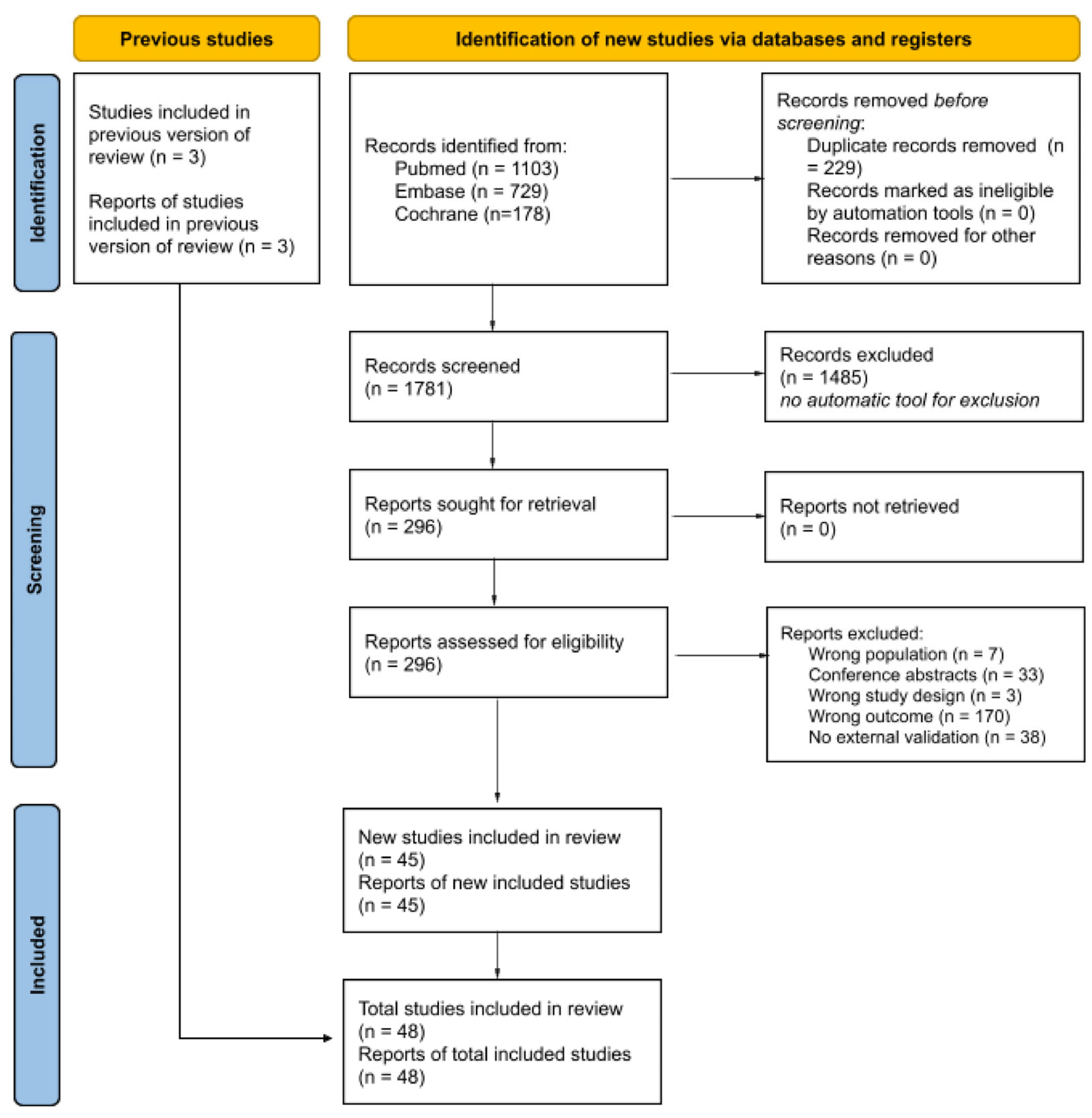
- English-language articles;
- Studies reporting at least one long-term outcome (i.e., overall survival, cancer-specific survival, recurrence-free survival, or recurrence rate at a specified time point);
- Studies analyzing the performance of prognostic scores (including scores, formulae, and nomograms);
- Studies reporting external validation of at least one prognostic score (either previously published scores validated in the study population or newly developed scores that were externally validated within the same study);
- Studies providing at least one measure of the statistical performance of the score.
- Exclusion criteria included:
- Studies involving patients undergoing palliative resection;
- Studies including patients with recurrent CRLM;
- Case reports, book chapters, reviews, meta-analyses, consensus statements, editorials, and conference abstracts.
2.2. Search Strategy
2.3. Study Selection
2.4. Data Extraction
2.5. Quality Assessment
2.6. Statistical Analysis
3. Results
3.1. Overall Survival
3.2. Recurrence-Free Survival
3.3. Other Outcomes
3.4. Variables Included in the Models
3.5. Publication Bias
4. Discussion
5. Conclusions
Supplementary Materials
Author Contributions
Funding
Data Availability Statement
Conflicts of Interest
Abbreviations
| CRLM | Colorectal liver metastases |
| RAS-mut CRS | RAS mutation Clinical Risk Score |
| OS | Overall survival |
| RFS | Regression-free survival |
| SE | Standard error |
| REML | Restricted maximum likelihood |
| HKSJ | Hartung–Knapp–Sidik–Jonkman |
| 95%CI | 95% confidence interval |
| 95%PI | 95% prediction interval |
| IQR | Interquartile range |
References
- Morgan, E.; Arnold, M.; Gini, A.; Lorenzoni, V.; Cabasag, C.J.; Laversanne, M.; Vignat, J.; Ferlay, J.; Murphy, N.; Bray, F. Global burden of colorectal cancer in 2020 and 2040: Incidence and mortality estimates from GLOBOCAN. Gut 2023, 72, 338–344. [Google Scholar] [CrossRef] [PubMed]
- Bray, F.; Laversanne, M.; Sung, H.; Ferlay, J.; Siegel, R.L.; Soerjomataram, I.; Jemal, A. Global cancer statistics 2022: GLOBOCAN estimates of incidence and mortality worldwide for 36 cancers in 185 countries. CA Cancer J. Clin. 2024, 74, 229–263. [Google Scholar] [CrossRef]
- Cervantes, A.; Adam, R.; Roselló, S.; Arnold, D.; Normanno, N.; Taïeb, J.; Seligmann, J.; De Baere, T.; Osterlund, P.; Yoshino, T.; et al. Metastatic colorectal cancer: ESMO Clinical Practice Guideline for diagnosis, treatment and follow-up. Ann. Oncol. 2023, 34, 10–32. [Google Scholar] [CrossRef]
- Viganò, L.; Jayakody Arachchige, V.S.; Fiz, F. Is precision medicine for colorectal liver metastases still a utopia? New perspectives by modern biomarkers, radiomics, and artificial intelligence. World J. Gastroenterol. 2022, 28, 608–623. [Google Scholar] [CrossRef]
- Adam, R.; de Gramont, A.; Figueras, J.; Kokudo, N.; Kunstlinger, F.; Loyer, E.; Poston, G.; Rougier, P.; Rubbia-Brandt, L.; Sobrero, A.; et al. Managing synchronous liver metastases from colorectal cancer: A multidisciplinary international consensus. Cancer Treat. Rev. 2015, 41, 729–741. [Google Scholar] [CrossRef]
- Kawaguchi, Y.; Kopetz, S.; Panettieri, E.; Hwang, H.; Wang, X.; Cao, H.S.T.; Tzeng, C.D.; Chun, Y.S.; Aloia, T.A.; Vauthey, J.N. Improved Survival over Time After Resection of Colorectal Liver Metastases and Clinical Impact of Multigene Alteration Testing in Patients with Metastatic Colorectal Cancer. J. Gastrointest. Surg. 2022, 26, 583–593. [Google Scholar] [CrossRef] [PubMed]
- Adam, R.; Pascal, G.; Castaing, D.; Azoulay, D.; Delvart, V.; Paule, B.; Levi, F.; Bismuth, H. Tumor progression while on chemotherapy: A contraindication to liver resection for multiple colorectal metastases? Ann. Surg. 2004, 240, 1052–1061, discussion 1061. [Google Scholar] [CrossRef] [PubMed]
- Viganò, L.; Terrone, A.; Costa, G.; Franchi, E.; Cimino, M.; Procopio, F.; Del Fabbro, D.; Torzilli, G. Effect of chemotherapy on tumour-vessel relationship in colorectal liver metastases. Br. J. Surg. 2022, 109, 401–404. [Google Scholar] [CrossRef]
- Mason, M.C.; Krasnodebski, M.; Hester, C.A.; Kothari, A.N.; Barker, C.; Nishioka, Y.; Chiang, Y.J.; Newhook, T.E.; Tzeng, C.D.; Chun, Y.S.; et al. Outcomes of Mixed Pathologic Response in Patients with Multiple Colorectal Liver Metastases Treated with Neoadjuvant Chemotherapy and Liver Resection. Ann. Surg. Oncol. 2022, 29, 5156–5164. [Google Scholar] [CrossRef]
- Tian, Y.; Wang, Y.; Wen, N.; Wang, S.; Li, B.; Liu, G. Prognostic factors associated with early recurrence following liver resection for colorectal liver metastases: A systematic review and meta-analysis. BMC Cancer 2024, 24, 426. [Google Scholar] [CrossRef]
- Viganò, L.; Gentile, D.; Galvanin, J.; Corleone, P.; Costa, G.; Cimino, M.; Procopio, F.; Torzilli, G. Very early recurrence after liver resection for colorectal metastases: Incidence, risk factors, and prognostic impact. J. Gastrointest. Surg. 2022, 26, 570–582. [Google Scholar] [CrossRef]
- Hirokawa, F.; Ueno, M.; Nakai, T.; Kaibori, M.; Nomi, T.; Iida, H.; Tanaka, S.; Komeda, K.; Hayami, S.; Kosaka, H.; et al. Neoadjuvant Chemotherapy Versus Upfront Surgery for Resectable Liver Metastases from Colorectal Cancer: A Multicenter, Propensity Score-Matched Cohort Study. J. Gastrointest. Surg. 2022, 26, 772–781. [Google Scholar] [CrossRef]
- Bonney, G.K.; Chew, C.A.; Lodge, P.; Hubbard, J.; Halazun, K.J.; Trunecka, P.; Muiesan, P.; Mirza, D.F.; Isaac, J.; Laing, R.W.; et al. Liver transplantation for non-resectable colorectal liver metastases: The International Hepato-Pancreato-Biliary Association consensus guidelines. Lancet Gastroenterol. Hepatol. 2021, 6, 933–946. [Google Scholar] [CrossRef] [PubMed]
- van der Lei, S.; Puijk, R.S.; Dijkstra, M.; Schulz, H.H.; Vos, D.J.W.; De Vries, J.J.J.; Scheffer, H.J.; Lissenberg-Witte, B.I.; Aldrighetti, L.; Arntz, M.; et al. Thermal ablation versus surgical resection of small-size colorectal liver metastases (COLLISION): An international, randomised, controlled, phase 3 non-inferiority trial. Lancet Oncol. 2025, 26, 187–199. [Google Scholar] [CrossRef] [PubMed]
- Fong, Y.; Fortner, J.; Sun, R.L.; Brennan, M.F.; Blumgart, L.H. Clinical score for predicting recurrence after hepatic resection for metastatic colorectal cancer: Analysis of 1001 consecutive cases. Ann. Surg. 1999, 230, 309–318, discussion 318. [Google Scholar] [CrossRef]
- Brudvik, K.W.; Jones, R.P.; Giuliante, F.; Shindoh, J.; Passot, G.; Chung, M.H.; Song, J.; Li, L.; Dagenborg, V.J.; Fretland, Å.A.; et al. RAS mutation clinical risk score to predict survival after resection of colorectal liver metastases. Ann. Surg. 2019, 269, 120–126. [Google Scholar] [CrossRef]
- Margonis, G.A.; Sasaki, K.; Gholami, S.; Kim, Y.; Andreatos, N.; Rezaee, N.; Deshwar, A.; Buettner, S.; Allen, P.J.; Kingham, T.P.; et al. Genetic And Morphological Evaluation (GAME) score for patients with colorectal liver metastases. Br. J. Surg. 2018, 105, 1210–1220. [Google Scholar] [CrossRef]
- Page, M.J.; McKenzie, J.E.; Bossuyt, P.M.; Boutron, I.; Hoffmann, T.C.; Mulrow, C.D.; Shamseer, L.; Tetzlaff, J.M.; Akl, E.A.; Brennan, S.E.; et al. The PRISMA 2020 statement: An updated guideline for reporting systematic reviews. BMJ 2021, 372, n71. [Google Scholar] [CrossRef] [PubMed]
- He, Y.; Ong, Y.; Li, X.; Din, F.V.; Brown, E.; Timofeeva, M.; Wang, Z.; Farrington, S.M.; Campbell, H.; Dunlop, M.G.; et al. Performance of prediction models on survival outcomes of colorectal cancer with surgical resection: A systematic review and meta-analysis. Surg. Oncol. 2019, 29, 196–202. [Google Scholar] [CrossRef]
- Ouzzani, M.; Hammady, H.; Fedorowicz, Z.; Elmagarmid, A. Rayyan-a web and mobile app for systematic reviews. Syst. Rev. 2016, 5, 210. [Google Scholar] [CrossRef]
- Wolff, R.F.; Moons, K.G.M.; Riley, R.D.; Whiting, P.F.; Westwood, M.; Collins, G.S.; Reitsma, J.B.; Kleijnen, J.; Mallett, S.; PROBAST Group. PROBAST: A tool to assess the risk of bias and applicability of prediction model studies. Ann. Intern. Med. 2019, 170, 51–58. [Google Scholar] [CrossRef]
- Luo, D.; Wan, X.; Liu, J.; Tong, T. Optimally estimating the sample mean from the sample size, median, mid-range, and/or mid-quartile range. Stat. Methods Med. Res. 2018, 27, 1785–1805. [Google Scholar] [CrossRef]
- Wan, X.; Wang, W.; Liu, J.; Tong, T. Estimating the sample mean and standard deviation from the sample size, median, range and/or interquartile range. BMC Med. Res. Methodol. 2014, 14, 135. [Google Scholar] [CrossRef] [PubMed]
- Harrell, F.E.; Califf, R.M.; Pryor, D.B.; Lee, K.L.; Rosati, R.A. Evaluating the yield of medical tests. JAMA 1982, 247, 2543–2546. [Google Scholar] [CrossRef]
- Guo, C.; So, Y.; Jang, W. Evaluating Predictive Accuracy of Survival Models with PROC PHREG; Paper SAS462-2017; SAS Institute Inc.: Cary, NC, USA, 2017. [Google Scholar]
- Altman, D.G.; Bland, J.M. Standard deviations and standard errors. BMJ 2005, 331, 903. [Google Scholar] [CrossRef]
- Debray, T.P.; Damen, J.A.; Snell, K.I.; Ensor, J.; Hooft, L.; Reitsma, J.B.; Riley, R.D.; Moons, K.G. A guide to systematic review and meta-analysis of prediction model performance. BMJ 2017, 356, i6460. [Google Scholar] [CrossRef] [PubMed]
- IntHout, J.; Ioannidis, J.P.A.; Borm, G.F. The Hartung-Knapp-Sidik-Jonkman method for random effects meta-analysis is straightforward and considerably outperforms the standard DerSimonian-Laird method. BMC Med. Res. Methodol. 2014, 14, 25. [Google Scholar] [CrossRef]
- Higgins, J.P.T.; Thompson, S.G. Quantifying heterogeneity in a meta-analysis. Stat. Med. 2002, 21, 1539–1558. [Google Scholar] [CrossRef] [PubMed]
- Egger, M.; Smith, G.D.; Phillips, A.N. Meta-analysis: Principles and procedures. BMJ 1997, 315, 1533–1537. [Google Scholar] [CrossRef]
- Hosmer, D.W.; Lemeshow, S.; Sturdivant, R.X. Applied Logistic Regression; Wiley: Hoboken, NJ, USA, 2013. [Google Scholar]
- Skipenko, O.G.; Bedzhanyan, A.L.; Polishchuk, L.O. The role of prognostic models in metastatic colorectal liver cancer surgery. Khirurgiia 2015, 12, 56–71. [Google Scholar] [CrossRef]
- Sasaki, K.; Morioka, D.; Conci, S.; Margonis, G.A.; Sawada, Y.; Ruzzenente, A.; Kumamoto, T.; Iacono, C.; Andreatos, N.; Guglielmi, A.; et al. The Tumor Burden Score: A New “Metro-ticket” Prognostic Tool For Colorectal Liver Metastases Based on Tumor Size and Number of Tumors. Ann. Surg. 2018, 267, 132–141. [Google Scholar] [CrossRef] [PubMed]
- Wang, Y.; Lin, H.C.; Huang, M.Y.; Shao, Q.; Wang, Z.Q.; Wang, F.H.; Yuan, Y.F.; Li, B.K.; Wang, D.S.; Ding, P.R.; et al. The Immunoscore system predicts prognosis after liver metastasectomy in colorectal cancer liver metastases. Cancer Immunol. Immunother. 2018, 67, 435–444. [Google Scholar] [CrossRef] [PubMed]
- Ding, Y.; Han, X.; Zhao, S.; Wang, S.; Guo, J.; Leng, C.; Li, X.; Wang, K.; Qiu, W.; Qi, W. Constructing a prognostic model for colorectal cancer with synchronous liver metastases after preoperative chemotherapy: A study based on SEER and an external validation cohort. Clin. Transl. Oncol. 2024, 26, 3169–3190. [Google Scholar] [CrossRef]
- Chen, Q.; Chen, J.; Deng, Y.; Bi, X.; Zhao, J.; Zhou, J.; Huang, Z.; Cai, J.; Xing, B.; Li, Y.; et al. Personalized prediction of postoperative complication and survival among Colorectal Liver Metastases Patients Receiving Simultaneous Resection using machine learning approaches: A multi-center study. Cancer Lett. 2024, 593, 216967. [Google Scholar] [CrossRef] [PubMed]
- Jiang, C.; Liu, W.; Jin, Z.; Lan, L.; Xu, L.; Du, A.; Peng, S.; Zeng, Y.; Wang, H.; Liao, M.; et al. Construction and validation of “WCH-nomogram” for predicting the prognosis after resection of colorectal liver metastases. Cancer Med. 2024, 13, e7222. [Google Scholar] [CrossRef]
- Martín-Cullell, B.; Virgili, A.C.; Riera, P.; Fumagalli, C.; Mirallas, O.; Pelegrín, F.J.; Sánchez-Cabús, S.; Molina, V.; Szafranska, J.; Páez, D. Histopathological, Clinical, And Molecular (HICAM) score for patients with colorectal liver metastases. Br. J. Surg. 2024, 111, znae017. [Google Scholar] [CrossRef]
- Takematsu, T.; Mima, K.; Hayashi, H.; Kitano, Y.; Nakagawa, S.; Hiyoshi, Y.; Okabe, H.; Imai, K.; Miyamoto, Y.; Baba, H. RAS mutation status in combination with the JSHBPS nomogram may be useful for preoperative identification of colorectal liver metastases with high risk of recurrence and mortality after hepatectomy. J. Hepatobiliary Pancreat. Sci. 2024, 31, 69–79. [Google Scholar] [CrossRef]
- Qi, L.; Liang, J.Y.; Li, Z.W.; Xi, S.Y.; Lai, Y.N.; Gao, F.; Zhang, X.R.; Wang, D.S.; Hu, M.T.; Cao, Y.; et al. Deep learning-derived spatial organization features on histology images predicts prognosis in colorectal liver metastasis patients after hepatectomy. iScience 2023, 26, 107702. [Google Scholar] [CrossRef]
- Lam, C.S.N.; Bharwani, A.A.; Chan, E.H.Y.; Chan, V.H.Y.; Au, H.L.H.; Ho, M.K.; Rashed, S.; Kwong, B.M.H.; Fang, W.; Ma, K.W.; et al. A machine learning model for colorectal liver metastasis post-hepatectomy prognostications. Hepatobiliary Surg. Nutr. 2023, 12, 495–506. [Google Scholar] [CrossRef]
- Katipally, R.R.; Martinez, C.A.; Pugh, S.A.; Bridgewater, J.A.; Primrose, J.N.; Domingo, E.; Maughan, T.S.; Talamonti, M.S.; Posner, M.C.; Weichselbaum, R.R.; et al. Integrated Clinical-Molecular Classification of Colorectal Liver Metastases: A Biomarker Analysis of the Phase 3 New EPOC Randomized Clinical Trial. JAMA Oncol. 2023, 9, 1245–1254. [Google Scholar] [CrossRef]
- Li, T.; Liang, Y.; Wang, D.; Zhou, Z.; Shi, H.; Li, M.; Liao, H.; Li, T.; Lei, X. Development and validation of a clinical survival model for young-onset colorectal cancer with synchronous liver-only metastases: A SEER population-based study and external validation. Front. Oncol. 2023, 13, 1161742. [Google Scholar] [CrossRef]
- Reijonen, P.; Nordin, A.; Savikko, J.; Poussa, T.; Arola, J.; Isoniemi, H. Histopathological Helsinki score of colorectal liver metastases predicts survival after liver resection. APMIS 2023, 131, 249–261. [Google Scholar] [CrossRef]
- Chen, J.; Cheung, H.M.C.; Karanicolas, P.J.; Coburn, N.G.; Martel, G.; Lee, A.; Patel, C.; Milot, L.; Martel, A.L. A radiomic biomarker for prognosis of resected colorectal cancer liver metastases generalizes across MRI contrast agents. Front. Oncol. 2023, 13, 898854. [Google Scholar] [CrossRef]
- Zhang, C.; Wang, X.Y.; Zuo, J.L.; Wang, X.F.; Feng, X.W.; Zhang, B.; Li, Y.T.; Yi, C.H.; Zhang, P.; Ma, X.C.; et al. Localization and density of tertiary lymphoid structures associate with molecular subtype and clinical outcome in colorectal cancer liver metastases. J. Immunother. Cancer 2023, 11, e006137. [Google Scholar] [CrossRef]
- Beppu, T.; Yamamura, K.; Sakamoto, K.; Honda, G.; Kobayashi, S.; Endo, I.; Hasegawa, K.; Kotake, K.; Itabashi, M.; Hashiguchi, Y.; et al. Validation study of the JSHBPS nomogram for patients with colorectal liver metastases who underwent hepatic resection in the recent era—A nationwide survey in Japan. J. Hepatobiliary Pancreat. Sci. 2023, 30, 591–601. [Google Scholar] [CrossRef]
- Chen, Q.; Li, M.; Chen, J.; Huang, Z.; Chen, X.; Zhao, H.; Cai, J. AST·MLR index and operation injury condition are novel prognostic predictor for the prediction of survival in patients with colorectal cancer liver metastases undergoing surgical resection. BMC Cancer 2022, 22, 921. [Google Scholar] [CrossRef] [PubMed]
- Bao, X.; Wang, K.; Liu, M.; Li, B.; Wang, H.; Jin, K.; Yan, X.; Zhang, H.; Bao, Q.; Xu, D.; et al. Characterization of genomic alterations in colorectal liver metastasis and their prognostic value. Front. Cell Dev. Biol. 2021, 9, 760618. [Google Scholar] [CrossRef]
- Chen, F.L.; Wang, Y.Y.; Liu, W.; Xing, B.C. Prognostic factors in colorectal liver metastases patients with various tumor numbers treated by liver resection: A single-center, retrospective study. World J. Surg. Oncol. 2022, 20, 237. [Google Scholar] [CrossRef] [PubMed]
- Villard, C.; Abdelrafee, A.; Habib, M.; Ndegwa, N.; Jorns, C.; Sparrelid, E.; Allard, M.A.; Adam, R. Prediction of survival in patients with colorectal liver metastases- development and validation of a prognostic score model. Eur. J. Surg. Oncol. 2022, 48, 2432–2439. [Google Scholar] [CrossRef] [PubMed]
- Zhou, Z.; Han, X.; Sun, D.; Liang, Z.; Wu, W.; Ju, H. A comprehensive prognostic model for colorectal cancer liver metastasis recurrence after neoadjuvant chemotherapy. Front. Oncol. 2022, 12, 855915. [Google Scholar] [CrossRef]
- Filippini Velázquez, G.; Schiele, S.; Gerken, M.; Neumaier, S.; Hackl, C.; Mayr, P.; Klinkhammer-Schalke, M.; Illerhaus, G.; Schlitt, H.J.; Anthuber, M.; et al. Predictive preoperative clinical score for patients with liver-only oligometastatic colorectal cancer. ESMO Open 2022, 7, 100470. [Google Scholar] [CrossRef]
- Buisman, F.E.; Giardiello, D.; Kemeny, N.E.; Steyerberg, E.W.; Höppener, D.J.; Galjart, B.; Nierop, P.M.H.; Balachandran, V.P.; Cercek, A.; Drebin, J.A.; et al. Predicting 10-year survival after resection of colorectal liver metastases; an international study including biomarkers and perioperative treatment. Eur. J. Cancer 2022, 168, 25–33. [Google Scholar] [CrossRef]
- Paro, A.; Hyer, M.J.; Tsilimigras, D.I.; Guglielmi, A.; Ruzzenente, A.; Alexandrescu, S.; Poultsides, G.; Aucejo, F.; Cloyd, J.M.; Pawlik, T.M. Machine Learning Approach to Stratifying Prognosis Relative to Tumor Burden after Resection of Colorectal Liver Metastases: An International Cohort Analysis. J. Am. Coll. Surg. 2022, 234, 504–513. [Google Scholar] [CrossRef]
- Bai, L.; Yan, X.L.; Lu, Y.X.; Meng, Q.; Rong, Y.M.; Ye, L.F.; Pan, Z.Z.; Xing, B.C.; Wang, D.S. Circulating Lipid- and Inflammation-Based Risk (CLIR) Score: A Promising New Model for Predicting Outcomes in Complete Colorectal Liver Metastases Resection. Ann. Surg. Oncol. 2022, 29, 4308–4323. [Google Scholar] [CrossRef] [PubMed]
- Sasaki, K.; Margonis, G.A.; Moro, A.; Wang, J.; Wagner, D.; Gagnière, J.; Shin, J.K.; D’Silva, M.; Sahara, K.; Miyata, T.; et al. Nontumor related risk score: A new tool to improve prediction of prognosis after hepatectomy for colorectal liver metastases. Surgery 2022, 171, 1580–1587. [Google Scholar] [CrossRef] [PubMed]
- Furukawa, K.; Onda, S.; Yanagaki, M.; Taniai, T.; Hamura, R.; Haruki, K.; Shirai, Y.; Tsunematsu, M.; Sakamoto, T.; Ikegami, T. Significance of intra/post-operative prognostic scoring system in hepatectomy for colorectal liver metastases. Ann. Gastroenterol. Surg. 2022, 6, 159–168. [Google Scholar] [CrossRef]
- Wong, G.Y.M.; Bhimani, N.; Mol, B.; Diakos, C.; de Reuver, P.; Molloy, M.P.; Hugh, T.J. Performance of prognostic models incorporating KRAS mutation status to predict survival after resection of colorectal liver metastases. HPB 2022, 24, 1316–1325. [Google Scholar] [CrossRef]
- Zhai, Y.; Bai, W.; Zhou, J.; Dong, Q.; Zhang, J. Effect of tumour size ratio on liver recurrence-free survival of patients undergoing hepatic resection for colorectal liver metastases. BMC Cancer 2022, 22, 103. [Google Scholar] [CrossRef]
- Wada, Y.; Shimada, M.; Morine, Y.; Ikemoto, T.; Saito, Y.; Baba, H.; Mori, M.; Goel, A. A transcriptomic signature that predicts cancer recurrence after hepatectomy in patients with colorectal liver metastases. Eur. J. Cancer 2022, 163, 66–76. [Google Scholar] [CrossRef]
- Frühling, P.; Urdzik, J.; Strömberg, C.; Isaksson, B. Composite Score: Prognostic tool to predict survival in patients undergoing surgery for colorectal liver metastases. BJS Open 2021, 5, znab276. [Google Scholar] [CrossRef] [PubMed]
- Guo, X.; Liu, Y.; Liu, L.J.; Li, J.; Zhao, L.; Jin, X.R.; Yan, W.; Lin, B.Q.; Shi, S.; Li, Z.Y.; et al. Development and validation of survival nomograms in colorectal cancer patients with synchronous liver metastases underwent simultaneous surgical treatment of primary and metastatic lesions. Am. J. Cancer Res. 2021, 11, 2654–2669. [Google Scholar]
- Liu, W.; Zhang, W.; Xu, Y.; Li, Y.H.; Xing, B.C. A Prognostic Scoring System to Predict Survival Outcome of Resectable Colorectal Liver Metastases in this Modern Era. Ann. Surg. Oncol. 2021, 28, 7709–7718. [Google Scholar] [CrossRef]
- Takeda, Y.; Mise, Y.; Matsumura, M.; Hasegawa, K.; Yoshimoto, J.; Imamura, H.; Noro, T.; Yamamoto, J.; Ishizuka, N.; Inoue, Y.; et al. Accuracy of modern clinical risk score including RAS status changes based on whether patients received perioperative chemotherapy for colorectal liver metastases. World J. Surg. 2021, 45, 2176–2184. [Google Scholar] [CrossRef]
- Kawaguchi, Y.; Kopetz, S.; Tran Cao, H.S.; Panettieri, E.; De Bellis, M.; Nishioka, Y.; Hwang, H.; Wang, X.; Tzeng, C.D.; Chun, Y.S.; et al. Contour prognostic model for predicting survival after resection of colorectal liver metastases: Development and multicentre validation study using largest diameter and number of metastases with RAS mutation status. Br. J. Surg. 2021, 108, 968–975. [Google Scholar] [CrossRef]
- Sasaki, K.; Gagnière, J.; Dupré, A.; Ardiles, V.; O’Connor, J.M.; Wang, J.; Moro, A.; Morioka, D.; Buettner, S.; Gau, L.; et al. Performance of two prognostic scores that incorporate genetic information to predict long-term outcomes following resection of colorectal cancer liver metastases: An external validation of the MD Anderson and JHH-MSK scores. J. Hepatobiliary Pancreat. Sci. 2021, 28, 581–592. [Google Scholar] [CrossRef] [PubMed]
- Chen, Y.; Chang, W.; Ren, L.; Chen, J.; Tang, W.; Liu, T.; Jian, M.; Liu, Y.; Wei, Y.; Xu, J. Comprehensive evaluation of relapse risk (CERR) score for colorectal liver metastases: Development and validation. Oncologist 2020, 25, e1031–e1041. [Google Scholar] [CrossRef]
- Kim, W.J.; Lim, T.W.; Kang, S.H.; Park, P.J.; Choi, S.B.; Lee, S.I.; Min, B.W.; Kim, W.B. Development and validation of novel scoring system for the prediction of disease recurrence following resection of colorectal liver metastasis. Asian J. Surg. 2020, 43, 438–446. [Google Scholar] [CrossRef] [PubMed]
- Liu, W.; Wang, K.; Han, Y.; Liang, J.Y.; Li, Y.H.; Xing, B.C. Nomogram predicted disease free survival for colorectal liver metastasis patients with preoperative chemotherapy followed by hepatic resection. Eur. J. Surg. Oncol. 2019, 45, 2070–2077. [Google Scholar] [CrossRef]
- Dupré, A.; Berhane, S.; Chan, A.W.H.; Rivoire, M.; Chong, C.C.N.; Lai, P.B.S.; Cucchetti, A.; Poston, G.J.; Malik, H.Z.; Johnson, P.J. Multicentre validation of a clinical prognostic score integrating the systemic inflammatory response to the host for patients treated with curative-intent for colorectal liver metastases: The Liverpool score. Eur. J. Surg. Oncol. 2019, 45, 999–1004. [Google Scholar] [CrossRef] [PubMed]
- Bolhuis, K.; Wensink, G.E.; Elferink, M.A.G.; Bond, M.J.G.; Dijksterhuis, W.P.M.; Fijneman, R.J.A.; Kranenburg, O.W.; Rinkes, I.H.M.B.; Koopman, M.; Swijnenburg, R.J.; et al. External Validation of Two Established Clinical Risk Scores Predicting Outcome after Local Treatment of Colorectal Liver Metastases in a Nationwide Cohort. Cancers 2022, 14, 2356. [Google Scholar] [CrossRef]
- Bai, L.; Lin, Z.Y.; Lu, Y.X.; Chen, Q.; Zhou, H.; Meng, Q.; Lin, C.P.; Huang, W.L.; Wan, Y.L.; Pan, Z.Z.; et al. The prognostic value of preoperative serum lactate dehydrogenase levels in patients underwent curative-intent hepatectomy for colorectal liver metastases: A two-center cohort study. Cancer Med. 2021, 10, 8005–8019. [Google Scholar] [CrossRef] [PubMed]
- Meng, Q.; Zheng, N.; Wen, R.; Sui, J.; Zhang, W. Preoperative nomogram to predict survival following colorectal cancer liver metastasis simultaneous resection. J. Gastrointest. Oncol. 2021, 12, 556–567. [Google Scholar] [CrossRef] [PubMed]
- Paredes, A.Z.; Hyer, J.M.; Tsilimigras, D.I.; Moro, A.; Bagante, F.; Guglielmi, A.; Ruzzenente, A.; Alexandrescu, S.; Makris, E.A.; Poultsides, G.A.; et al. A Novel Machine-Learning Approach to Predict Recurrence After Resection of Colorectal Liver Metastases. Ann. Surg. Oncol. 2020, 27, 5139–5147. [Google Scholar] [CrossRef]
- Gasser, E.; Braunwarth, E.; Riedmann, M.; Cardini, B.; Fadinger, N.; Presl, J.; Klieser, E.; Ellmerer, P.; Dupré, A.; Imai, K.; et al. Primary tumour location affects survival after resection of colorectal liver metastases: A two-institutional cohort study with international validation, systematic meta-analysis and a clinical risk score. PLoS ONE 2019, 14, e0217411. [Google Scholar] [CrossRef]
- Dai, S.; Ye, Y.; Kong, X.; Li, J.; Ding, K. A predictive model for early recurrence of colorectal-cancer liver metastases based on clinical parameters. Gastroenterol. Rep. 2021, 9, 241–251. [Google Scholar] [CrossRef]
- Gregoire, E.; Hoti, E.; Gorden, D.L.; de la Serna, S.; Pascal, G.; Azoulay, D. Utility or futility of prognostic scoring systems for colorectal liver metastases in an era of advanced multimodal therapy. Eur. J. Surg. Oncol. 2010, 36, 568–574. [Google Scholar] [CrossRef]
- Schadde, E.; Grunhagen, D.J.; Verhoef, C.; Krzywon, L.; Metrakos, P. Limitations in resectability of colorectal liver metastases 2020—A systematic approach for clinicians and patients. Semin. Cancer Biol. 2021, 71, 10–20. [Google Scholar] [CrossRef]
- Viganò, L.; Darwish, S.S.; Rimassa, L.; Cimino, M.; Carnaghi, C.; Donadon, M.; Procopio, F.; Personeni, N.; Del Fabbro, D.; Santoro, A.; et al. Progression of Colorectal Liver Metastases from the End of Chemotherapy to Resection: A New Contraindication to Surgery? Ann. Surg. Oncol. 2018, 25, 1676–1685. [Google Scholar] [CrossRef]
- Haddad, A.; Lendoire, M.; Uppal, A.; Maki, H.; Folkert, I.; Wang, Y.; Ayabe, R.I.; Newhook, T.E.; Chun, Y.S.; Tzeng, C.D.; et al. CEA Rebound After Discontinuation of Pre-Hepatectomy Chemotherapy Predicts Worse Outcomes After Resection of Colorectal Cancer Liver Metastases. Ann. Surg. Oncol. 2025, 32, 1021–1032. [Google Scholar] [CrossRef]
- Ayez, N.; van der Stok, E.P.; de Wilt, H.; Radema, S.A.; van Hillegersberg, R.; Roumen, R.M.; Vreugdenhil, G.; Tanis, P.J.; Punt, C.J.; Dejong, C.H.; et al. Neo-adjuvant chemotherapy followed by surgery versus surgery alone in high-risk patients with resectable colorectal liver metastases: The CHARISMA randomized multicenter clinical trial. BMC Cancer 2015, 15, 180. [Google Scholar] [CrossRef] [PubMed]
- Creasy, J.M.; Sadot, E.; Koerkamp, B.G.; Chou, J.F.; Gonen, M.; Kemeny, N.E.; Balachandran, V.P.; Kingham, T.P.; DeMatteo, R.P.; Allen, P.J.; et al. Actual 10-year survival after hepatic resection of colorectal liver metastases: What factors preclude cure? Surgery 2018, 163, 1238–1244. [Google Scholar] [CrossRef]
- Dueland, S.; Smedman, T.M.; Syversveen, T.; Grut, H.; Hagness, M.; Line, P.D. Long-Term Survival, Prognostic Factors, and Selection of Patients With Colorectal Cancer for Liver Transplant: A Nonrandomized Controlled Trial. JAMA Surg. 2023, 158, e232932. [Google Scholar] [CrossRef]
- van de Geest, T.W.; van Amerongen, M.J.; Nierop, P.M.H.; Höppener, D.J.; Grünhagen, D.J.; Moelker, A.; Fütterer, J.J.; Verhoef, C.; de Wilt, J.H.W. Propensity score matching demonstrates similar results for radiofrequency ablation compared to surgical resection in colorectal liver metastases. Eur. J. Surg. Oncol. 2022, 48, 1368–1374. [Google Scholar] [CrossRef]
- Nakai, T.; Ishikawa, H.; Tokoro, T.; Okuno, K. The clinical risk score predicts the effectiveness of adjuvant chemotherapy for colorectal liver metastasis. World J. Surg. 2015, 39, 1527–1536. [Google Scholar] [CrossRef]
- Giuliante, F.; Viganò, L.; De Rose, A.M.; Mirza, D.F.; Lapointe, R.; Kaiser, G.; Barroso, E.; Ferrero, A.; Isoniemi, H.; Lopez-Ben, S.; et al. Liver-First Approach for Synchronous Colorectal Metastases: Analysis of 7360 Patients from the LiverMetSurvey Registry. Ann. Surg. Oncol. 2021, 28, 8198–8208. [Google Scholar] [CrossRef]
- Viganò, L.; Capussotti, L.; De Rosa, G.; De Saussure, W.O.; Mentha, G.; Rubbia-Brandt, L. Liver resection for colorectal metastases after chemotherapy: Impact of chemotherapy-related liver injuries, pathological tumor response, and micrometastases on long-term survival. Ann. Surg. 2013, 258, 731–740, discussion 741. [Google Scholar] [CrossRef]
- Görgec, B.; Verpalen, I.M.; Sijberden, J.P.; Abu Hilal, M.; Bipat, S.; Verhoef, C.; Swijnenburg, R.J.; Besselink, M.G.; Stoker, J. Added Value of Liver MRI in Patients Eligible for Surgical Resection or Ablation of Colorectal Liver Metastases Based on CT: A Systematic Review and Meta-Analysis. Ann. Surg. Open 2024, 5, e401. [Google Scholar] [CrossRef]
- Mlecnik, B.; Van den Eynde, M.; Bindea, G.; Church, S.E.; Vasaturo, A.; Fredriksen, T.; Lafontaine, L.; Haicheur, N.; Marliot, F.; Debetancourt, D.; et al. Comprehensive intrametastatic immune quantification and major impact of immunoscore on survival. J. Natl. Cancer Inst. 2018, 110, djx123. [Google Scholar] [CrossRef]
- Lambin, P.; Leijenaar, R.T.H.; Deist, T.M.; Peerlings, J.; de Jong, E.E.C.; van Timmeren, J.; Sanduleanu, S.; Larue, R.T.H.M.; Even, A.J.G.; Jochems, A.; et al. Radiomics: The bridge between medical imaging and personalized medicine. Nat. Rev. Clin. Oncol. 2017, 14, 749–762. [Google Scholar] [CrossRef] [PubMed]
- Viganò, L.; Ammirabile, A.; Zwanenburg, A. Radiomics in liver surgery: Defining the path toward clinical application. Updates Surg. 2023, 75, 1387–1390. [Google Scholar] [CrossRef] [PubMed]
- Fiz, F.; Viganò, L.; Gennaro, N.; Costa, G.; La Bella, L.; Boichuk, A.; Cavinato, L.; Sollini, M.; Politi, L.S.; Chiti, A.; et al. Radiomics of Liver Metastases: A Systematic Review. Cancers 2020, 12, 2881. [Google Scholar] [CrossRef]
- Giuliante, F.; Ardito, F.; Vellone, M.; Ranucci, G.; Federico, B.; Giovannini, I.; Nuzzo, G. Role of the surgeon as a variable in long-term survival after liver resection for colorectal metastases. J. Surg. Oncol. 2009, 100, 538–545. [Google Scholar] [CrossRef] [PubMed]
- Dorcaratto, D.; Mazzinari, G.; Fernandez, M.; Muñoz, E.; Garcés-Albir, M.; Ortega, J.; Sabater, L. Impact of Postoperative Complications on Survival and Recurrence After Resection of Colorectal Liver Metastases: Systematic Review and Meta-analysis. Ann. Surg. 2019, 270, 1018–1027. [Google Scholar] [CrossRef]
- Viganò, L.; Procopio, F.; Cimino, M.M.; Donadon, M.; Gatti, A.; Costa, G.; Del Fabbro, D.; Torzilli, G. Is Tumor Detachment from Vascular Structures Equivalent to R0 Resection in Surgery for Colorectal Liver Metastases? An Observational Cohort. Ann. Surg. Oncol. 2016, 23, 1352–1360. [Google Scholar] [CrossRef] [PubMed]
- Rubbia-Brandt, L.; Giostra, E.; Brezault, C.; Roth, A.D.; Andres, A.; Audard, V.; Sartoretti, P.; Dousset, B.; Majno, P.E.; Soubrane, O.; et al. Importance of histological tumor response assessment in predicting the outcome in patients with colorectal liver metastases treated with neo-adjuvant chemotherapy followed by liver surgery. Ann. Oncol. 2007, 18, 299–304. [Google Scholar] [CrossRef]
- Viganò, L.; Branciforte, B.; Laurenti, V.; Costa, G.; Procopio, F.; Cimino, M.; Del Fabbro, D.; Di Tommaso, L.; Torzilli, G. The histopathological growth pattern of colorectal liver metastases impacts local recurrence risk and the adequate width of the surgical margin. Ann. Surg. Oncol. 2022, 29, 5515–5524. [Google Scholar] [CrossRef] [PubMed]
- Yamashita, S.; Chun, Y.S.; Kopetz, S.E.; Vauthey, J.N. Biomarkers in colorectal liver metastases. Br. J. Surg. 2018, 105, 618–627. [Google Scholar] [CrossRef]
- Lang, H.; Baumgart, J.; Heinrich, S.; Tripke, V.; Passalaqua, M.; Maderer, A.; Galle, P.R.; Roth, W.; Kloth, M.; Moehler, M. Extended molecular profiling improves stratification and prediction of survival after resection of colorectal liver metastases. Ann. Surg. 2019, 270, 799–805. [Google Scholar] [CrossRef]
- Yamashita, S.; Chun, Y.S.; Kopetz, S.E.; Maru, D.; Conrad, C.; Aloia, T.A.; Vauthey, J.N. APC and PIK3CA mutational cooperativity predicts pathologic response and survival in patients undergoing resection for colorectal liver metastases. Ann. Surg. 2020, 272, 1080–1085. [Google Scholar] [CrossRef]





| Author | Year | Country | Study Design | Period (Validation) | Patients (Validation) | Outcome | Selection Criteria | |
|---|---|---|---|---|---|---|---|---|
| Skipenko [32] | 2015 | Russia | R | Mono | 1991–2014 | 312 | OS | / |
| Sasaki [33] | 2018 | US, Japan, Italy | R | Multi | 2000–2015 | 430/198 | OS | / |
| Wang [34] | 2018 | China | R | Mono | 2002–2015 | 249 | RFS | No EH |
| Margonis [17] | 2018 | US | R | Multi | 2000–2015 | 747/502 | OS | / |
| Liu W [70] | 2019 | China | R | Multi | 2013–2017 | 117 | RFS | Preoperative CTx |
| Duprè [71] | 2019 | US, China, France | R | Multi | 2010–2015 | 219 | OS | / |
| Brudvik [16] | 2019 | US, EU, Japan | R | Multi | 2005–2013 | 608/564 | OS, RFS | / |
| Gasser [76] | 2019 | Japan, EU | R | Multi | 2005–2016 | 527 | OS, RFS | / |
| Chen Y [68] | 2020 | China | R | Mono | 2010–2018 | 787/162 | RFS | / |
| Kim WJ [69] | 2020 | Korea | R | Mono | 2002–2015 | 295 | RFS | No EH, No non-cancer-related death |
| Paredes [75] | 2020 | US, EU | R | Multi | 2001–2018 | 703/703 | RFS | / |
| Bao X [49] | 2021 | China, US | R | Multi | 8 years | 312/144 | OS | / |
| Fruhling [62] | 2021 | Sweden | R | Multi | 2005–2015 | 1212 | OS | / |
| Guo X [63] | 2021 | US, China | R | Multi | 2010–2017 | 112 | OS, DSS | Synchronous CRLM, Simultaneous res. |
| Liu W [64] | 2021 | China | R | Multi | 2009–2018 | 237/532 | RFS | No EH |
| Takeda [65] | 2021 | Japan | R | Multi | 2010–2016 | 309 | OS | / |
| Kawaguchi Y [66] | 2021 | US, Japan, Italy | R | Multi | 2006–2018 | 254/419 | OS | / |
| Sasaki [67] | 2021 | US, Argentina, EU, Japan | R | Multi | 2000–2018 | 2376 | OS | / |
| Bai L [73] | 2021 | China | R | Multi | 2000–2019 | 580 | OS | / |
| Meng Q [74] | 2021 | China | R | Mono | 2010–2019 | 174/60 | OS | Synchronous CRLM, Simultaneous res. No EH, Adjuvant CTx |
| Dai S [77] | 2021 | China | R | Mono | 2012–2019 | 202 | Early rec | / |
| Chen Q [48] | 2022 | China | R | Mono | 2012–2018 | 389 | OS, RFS | / |
| Chen FL [50] | 2022 | China | R | Mono | 2000–2020 | 375 + 424 + 296 | OS | No EH |
| Villard [51] | 2022 | EU | R | Multi | 2007–2018 | 391/1013 | OS | / |
| Zhou Z [52] | 2022 | China | R | Mono | 2009–2019 | 118 | RFS | No EH, Preoperative CTx |
| Filippini Velazquez [53] | 2022 | Germany | R | Multi | 2006–2016 | 230 | OS | / |
| Buisman [54] | 2022 | The Neth., US | R | Multi | 1992–2019 | 3064/1048/4112 | OS | / |
| Paro [55] | 2022 | US, EU | R | Multi | 2001–2018 | 672 | OS | / |
| Bai L [56] | 2022 | China | R | Multi | 2001–2016 | 325/341 | OS, RFS | R0 resection |
| Sasaki [57] | 2022 | US, Korea, Japan, EU | R | Multi | 2004–2019 | 1307/1058 and 2365/1205 | OS | / |
| Furukawa [58] | 2022 | Japan | R | Mono | 2002–2018 | 149 | OS, RFS | / |
| Wong GYM [59] | 2022 | Australia | R | Mono | 2007–2017 | 103 | OS, RFS | / |
| Zhai Y [60] | 2022 | China | R | Mono | 2010–2016 | 147 | RFS | No preoperative CTx |
| Wada Y [61] | 2022 | Japan | R | Multi | 2001–2016 | 151 | OS, RFS, Recurrence | / |
| Bolhuis [72] | 2022 | The Neth. | R | Multi | 2015–2016 | 1105 | OS, RFS | No EH |
| Qi [40] | 2023 | China | R | Multi | 2010–2019 | 433/404 | OS | No EH |
| Lam [41] | 2023 | China | R | Multi | 2009–2018 | 172 | OS | / |
| Katipally [42] | 2023 | US, UK | R | Multi | 2007–2012 | 147 | OS, RFS | No EH, Perioperative CTx |
| Li [43] | 2023 | China | R | Multi | 2012–2020 | 122 | OS | Synchronous CRLM, No EH, Young onset |
| Reijonen [44] | 2023 | Finland | R | Mono | 2000–2019 | 816 | OS | / |
| Chen J [45] | 2023 | Canada | R | Multi | 2006–2012 | 28 | OS | Preoperative CTx |
| Zhang C [46] | 2023 | China | R | Multi | 2014–2019 | 106/95 | OS, RFS | / |
| Beppu [47] | 2023 | Japan | R | Multi | 2005–2007 | 1756/469 | OS, RFS | / |
| Ding [35] | 2024 | US, China | R | Multi | 2010–2022 | 102 | OS | Synchronous CRLM, Preoperative CTx |
| Chen [36] | 2024 | China | R | Multi | NA | 230 | OS, RFS | Synchronous CRLM, Simultaneous res. |
| Jiang [37] | 2024 | China | R | Mono | 2009–2019 | 371 | OS | No EH |
| Martin-Cullell [38] | 2024 | Spain | R | Mono | 2004–2020 | 176 | OS, RFS | / |
| Takematsu [39] | 2024 | Japan | R | Mono | 2004–2020 | 218 | OS, RFS | / |
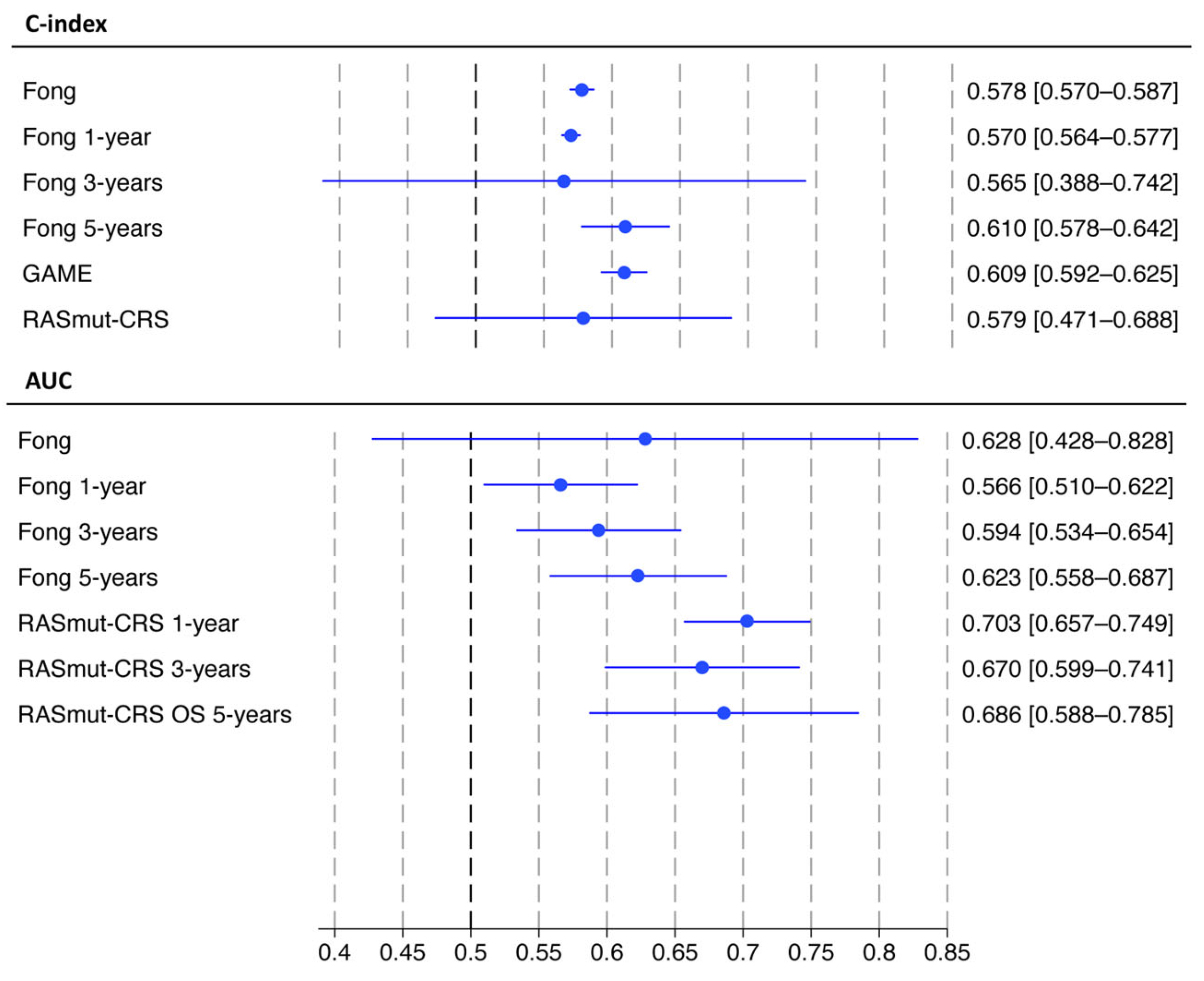
| Score | Metric | Articles | Populations | Patients | Pooled Result | CI 95% | I2 | PI 95% |
|---|---|---|---|---|---|---|---|---|
| Overall Survival | ||||||||
| C-index | ||||||||
| Fong | C-index | 8 | 9 | 6376 | 0.578 | 0.570–0.587 | <0.01% | 0.570–0.587 |
| 1-year C-index | 2 | 2 | 1277 | 0.570 | 0.564–0.577 | <0.01% | - | |
| 3-year C-index | 2 | 2 | 1417 | 0.565 | 0.388–0.742 | 47.67% | - | |
| 5-year C-index | 5 | 6 | 2835 | 0.610 | 0.578–0.642 | 64.05% | 0.536–0.684 | |
| GAME | C-index | 5 | 6 | 7078 | 0.609 | 0.592–0.625 | 0.00% | 0.591–0.627 |
| RASmut-CRS | C-index | 3 | 3 | 2850 | 0.579 | 0.471–0.688 | 79.59% | - |
| AUC | ||||||||
| Fong | AUC | 2 | 2 | 4361 | 0.628 | 0.428–0.828 | 17.19% | - |
| 1-year AUC | 4 | 6 | 1999 | 0.566 | 0.510–0.622 | 13.53% | 0.483–0.648 | |
| 3-year AUC | 4 | 6 | 1999 | 0.594 | 0.534–0.654 | 65.75% | 0.454–0.735 | |
| 5-year AUC | 4 | 6 | 2288 | 0.623 | 0.558–0.687 | 74.91% | 0.457–0.788 | |
| RASmut-CRS | 1-year AUC | 2 | 4 | 1466 | 0.703 | 0.657–0.749 | 0.02% | 0.640–0.765 |
| 3-year AUC | 2 | 4 | 1466 | 0.670 | 0.599–0.741 | 58.59% | 0.494–0.845 | |
| 5-year AUC | 2 | 4 | 1466 | 0.686 | 0.588–0.785 | 78.09% | 0.417–0.956 | |
| Recurrence-free Survival | ||||||||
| C-index | ||||||||
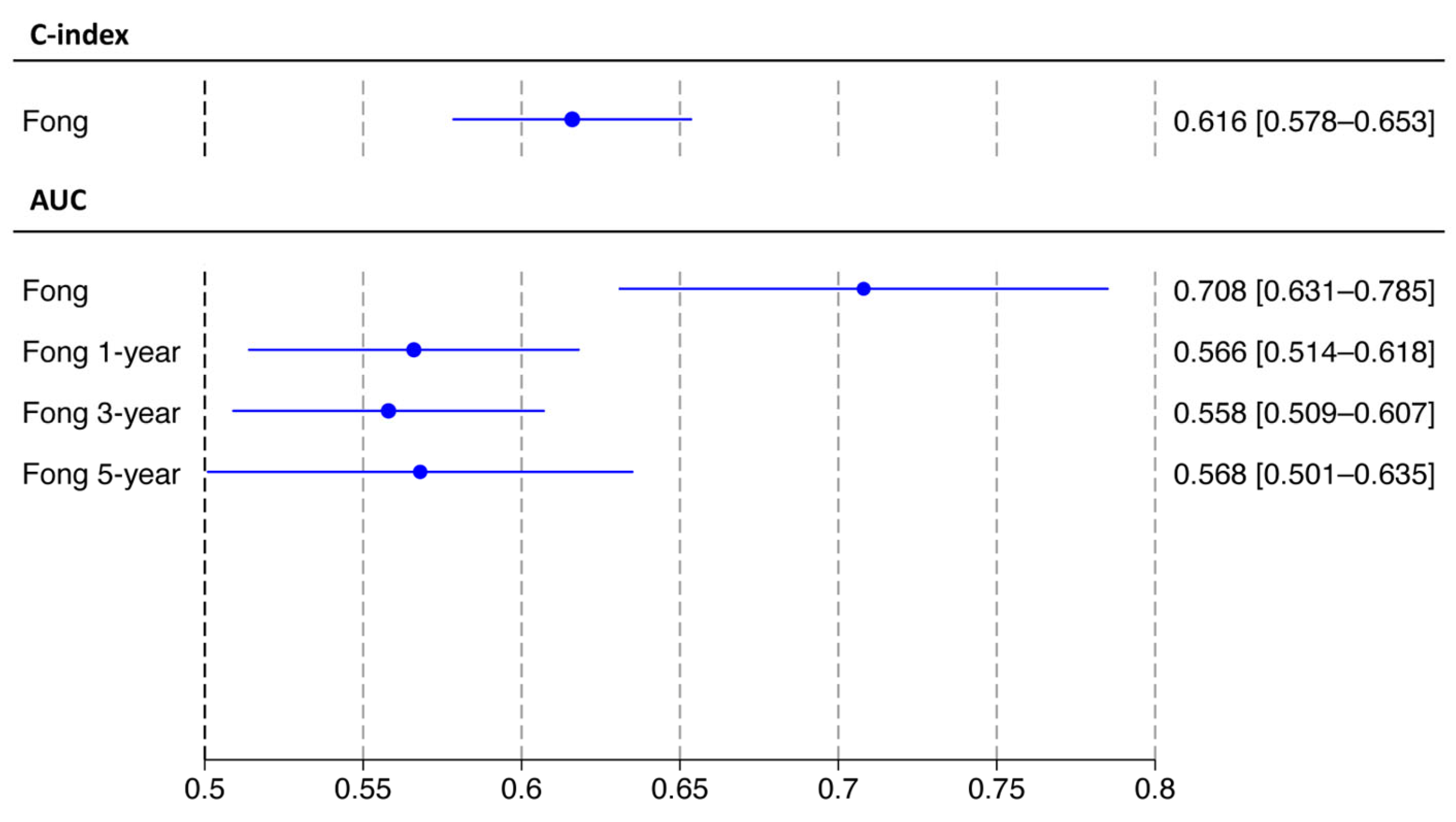
| Fong | C-index | 4 | 5 | 2434 | 0.616 | 0.578–0.653 | 10.9% | 0.561–0.671 |
| AUC | ||||||||
| Fong | AUC | 3 | 3 | 662 | 0.708 | 0.631–0.785 | 0.02% | 0.480–0.936 |
| 1-year AUC | 4 | 8 | 4387 | 0.566 | 0.514–0.618 | 97.54% | 0.424–0.708 | |
| 3-year AUC | 3 | 6 | 3438 | 0.558 | 0.509–0.607 | 97.07% | 0.439–0.677 | |
| 5-year AUC | 3 | 6 | 3438 | 0.568 | 0.501–0.635 | 98.80% | 0.389–0.748 | |
Disclaimer/Publisher’s Note: The statements, opinions and data contained in all publications are solely those of the individual author(s) and contributor(s) and not of MDPI and/or the editor(s). MDPI and/or the editor(s) disclaim responsibility for any injury to people or property resulting from any ideas, methods, instructions or products referred to in the content. |
© 2026 by the authors. Licensee MDPI, Basel, Switzerland. This article is an open access article distributed under the terms and conditions of the Creative Commons Attribution (CC BY) license.
Share and Cite
Viganò, L.; Risi, L.; Ragaini, E.; Ieva, F.; Desiato, E. Prognostic Scores for Liver Resection in Colorectal Metastases: Performance, Limitations, and Methodological Pitfalls—A Systematic Review and Meta-Analysis. Cancers 2026, 18, 625. https://doi.org/10.3390/cancers18040625
Viganò L, Risi L, Ragaini E, Ieva F, Desiato E. Prognostic Scores for Liver Resection in Colorectal Metastases: Performance, Limitations, and Methodological Pitfalls—A Systematic Review and Meta-Analysis. Cancers. 2026; 18(4):625. https://doi.org/10.3390/cancers18040625
Chicago/Turabian StyleViganò, Luca, Luca Risi, Elisa Ragaini, Francesca Ieva, and Elena Desiato. 2026. "Prognostic Scores for Liver Resection in Colorectal Metastases: Performance, Limitations, and Methodological Pitfalls—A Systematic Review and Meta-Analysis" Cancers 18, no. 4: 625. https://doi.org/10.3390/cancers18040625
APA StyleViganò, L., Risi, L., Ragaini, E., Ieva, F., & Desiato, E. (2026). Prognostic Scores for Liver Resection in Colorectal Metastases: Performance, Limitations, and Methodological Pitfalls—A Systematic Review and Meta-Analysis. Cancers, 18(4), 625. https://doi.org/10.3390/cancers18040625