FibroidX: Vision Transformer-Powered Prognosis and Recurrence Prediction for Uterine Fibroids Using Ultrasound Images
by
 ,
,
Fatma M. Talaat
1,*, 
Yathreb Bayan Mohamed
2 ,
,
Amira Abdulrahman
1,
Mohamed Salem
1 and
Mohamed Shehata
3,*
1
Faculty of Artificial Intelligence, Kafr Elsheikh University, Kafr Elsheikh 33516, Egypt
2
School of Public Health and Information Science, University of Louisville, Louisville, KY 40208, USA
3
Computer Science Program, James C. Bowling School of Business, Midway University, Midway, KY 40347, USA
*
Authors to whom correspondence should be addressed.
Cancers 2026, 18(4), 605; https://doi.org/10.3390/cancers18040605
Submission received: 30 November 2025
/
Revised: 5 February 2026
/
Accepted: 10 February 2026
/
Published: 12 February 2026
(This article belongs to the Special Issue AI-Driven Oncology: Advancing Cancer Detection, Diagnosis, and Personalized Treatment)
Simple Summary
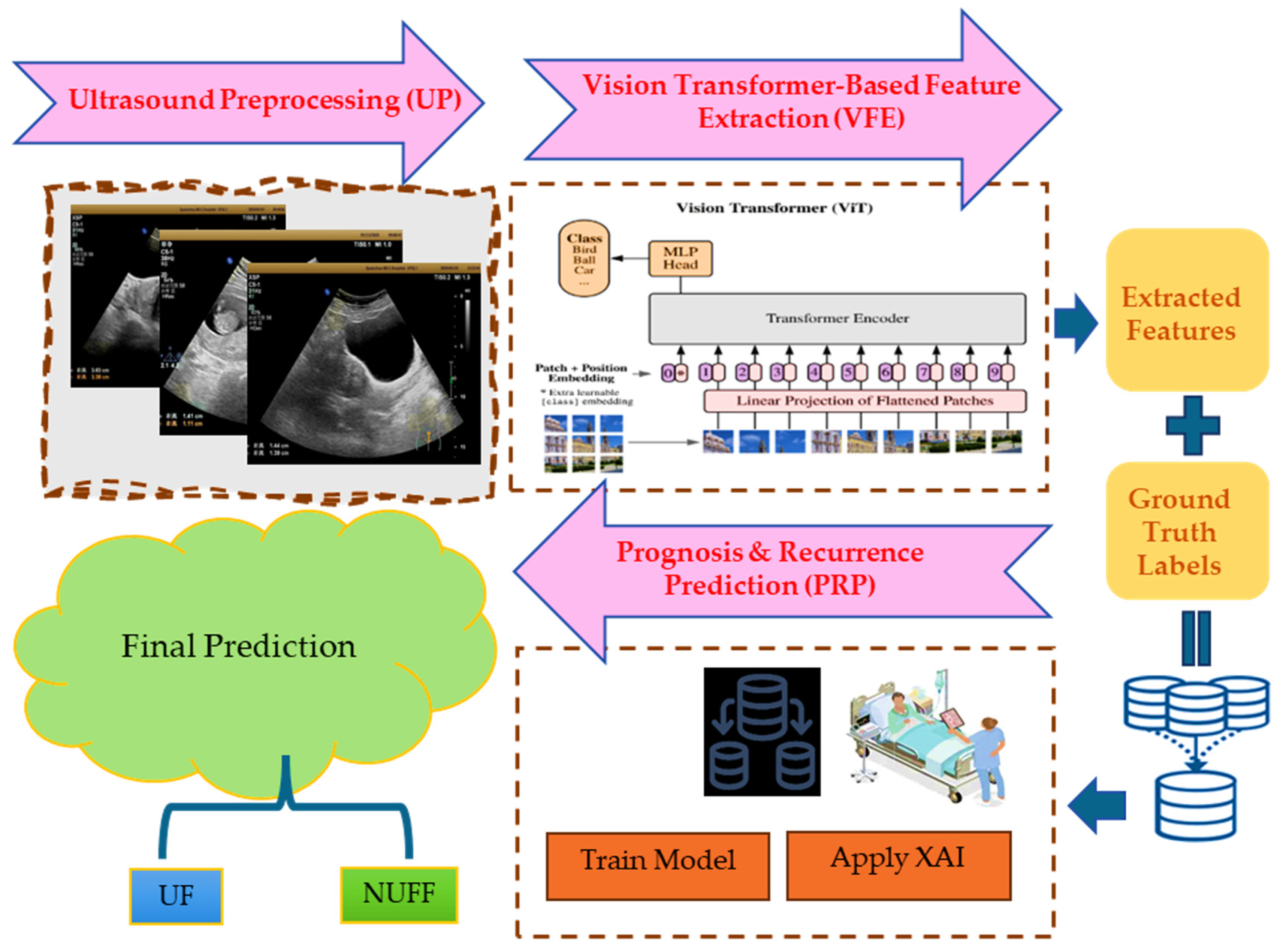
This study introduces FibroidX, a vision transformer-based framework for the automated detection and recurrence prognosis of uterine fibroids from ultrasound images. Here, prognosis refers to predicted symptom progression and treatment efficacy, while recurrence prediction targets regrowth after interventions (e.g., myomectomy, uterine artery embolization) or new fibroid formation during follow-up. By combining robust ultrasound preprocessing, ViT feature extraction, and explainable AI (XAI) techniques, FibroidX achieves improved diagnostic performance and offers clinicians interpretable risk assessments for personalized treatment planning. The model was evaluated on a dataset of 1990 ultrasound images and demonstrated strong performance, suggesting potential for clinical decision support.
Abstract
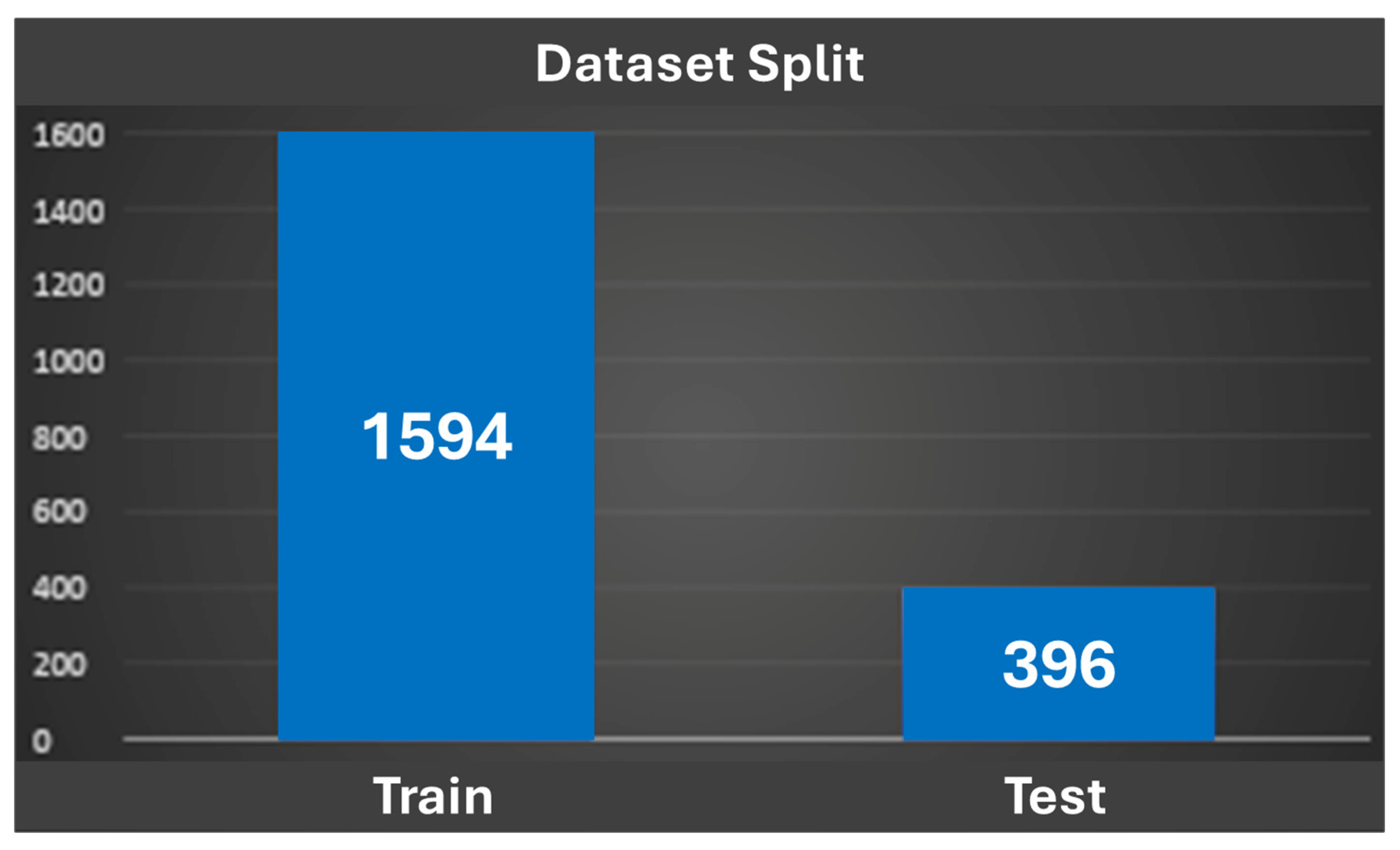
Background/Objectives: One of the common gynecological issues that can have a major effect on women’s reproductive health and quality of life is uterine fibroids (UFs). For personalized treatment planning and a reduction in long-term consequences, early fibroid prognosis and recurrence prediction are essential. In this context, prognosis refers to anticipated symptom progression and treatment response, while recurrence prediction estimates the likelihood of regrowth after interventions such as myomectomy, uterine artery embolization (UAE), or new fibroid formation during follow-up. Conventional techniques for predicting the prognosis and recurrence of UFs depend on imaging, clinical evaluations, and statistical models; nevertheless, they frequently have limited accuracy and are subjective. Methods: Therefore, we introduce FibroidX, which utilizes vision transformers and self-attention processes to improve forecast accuracy, automate feature extraction, and offer customized risk evaluations to overcome these obstacles. Prognosis encompasses overall disease progression, symptom severity, and response to therapy, whereas recurrence prediction focuses on post-treatment regrowth or new fibroid formation. Results: The dataset comprises 1990 ultrasound images split into training-test sets (80-20). With an accuracy of 98.4%, the suggested model outperformed baseline models like Model A (92.3%) and Model B (94.1%), exhibiting exceptional performance. A significant percentage of accurately anticipated cases was ensured by the precision and recall values, which were 97.8% and 96.9%, respectively. The model’s balanced precision-recall trade-off is highlighted by its F1-score of 97.3%, and its exceptional class distinction is confirmed by its AUC-ROC score of 0.99. Conclusions: The model was suitable for real-time applications, with an average inference time of 0.02 s per sample. The proposed method showed its effectiveness and reliability in prediction tasks. It achieved a 15% increase in accuracy and a 12% reduction in the false positive rate compared to traditional machine learning techniques.