Outcomes After Robot-Assisted Versus Open Pancreatoduodenectomy: A Propensity Score-Matching Analysis in a High-Volume Center (TAKUMI-7)
 , , ,
, , ,
Simple Summary
Abstract
1. Introduction
2. Materials and Methods
2.1. Study Design
2.2. Data Collection
2.3. Definition of Postoperative Complications
2.4. Surgical Protocol and Selection Criteria
2.5. Statistical Analysis
3. Results
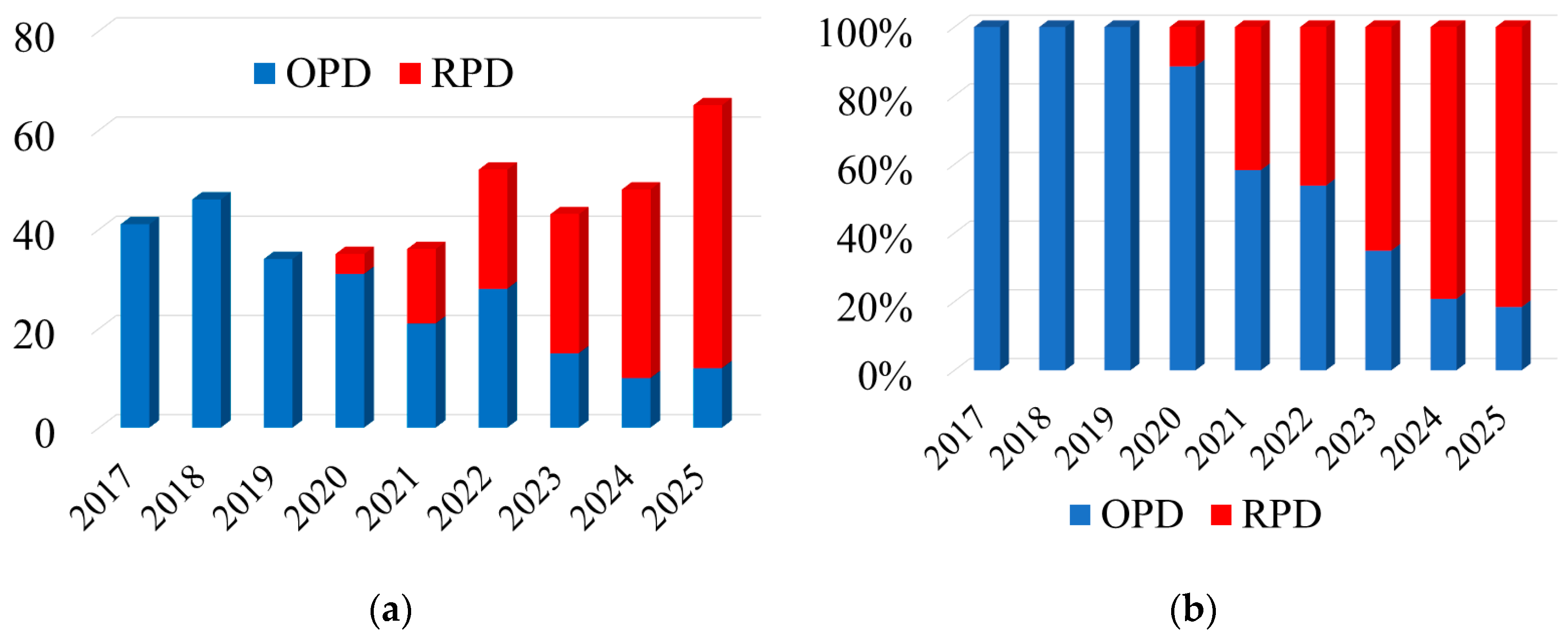
3.1. Implementation of RPD
3.2. Patient Characteristics
3.3. Outcomes of RPD Versus OPD
3.4. Predictive Factors for TO
3.5. Outcomes of RPD Compared to Benchmark Study
4. Discussion
5. Conclusions
Author Contributions
Funding
Institutional Review Board Statement
Informed Consent Statement
Data Availability Statement
Conflicts of Interest
Abbreviations
| RPD | Robot-assisted pancreatoduodenectomy |
| OPD | Open pancreatoduodenectomy |
| PD | Pancreatoduodenectomy |
| TO | Textbook outcome |
| PSM | Propensity score matching |
| BMI | Body mass index |
| ASA | American Society of Anesthesiologists |
| AST | Aspartate aminotransferase |
| ALT | Alanine aminotransferase |
| CR-POPF | Clinically relevant postoperative pancreatic fistula |
| PPH | Post-pancreatectomy hemorrhage |
| CI | Confidence interval |
| OR | Odds ratio |
| MPD | Main pancreatic duct |
References
- Whipple, A.O.; Parsons, W.B.; Mullins, C.R. Treatment of Carcinoma of the Ampulla of Vater. Ann. Surg. 1935, 102, 763–779. [Google Scholar] [CrossRef]
- Kimura, W.; Miyata, H.; Gotoh, M.; Hirai, I.; Kenjo, A.; Kitagawa, Y.; Shimada, M.; Baba, H.; Tomita, N.; Nakagoe, T.; et al. A pancreaticoduodenectomy risk model derived from 8575 cases from a national single-race population (Japanese) using a web-based data entry system: The 30-day and in-hospital mortality rates for pancreaticoduodenectomy. Ann. Surg. 2014, 259, 773–780. [Google Scholar] [CrossRef]
- Cameron, J.L.; He, J. Two thousand consecutive pancreaticoduodenectomies. J. Am. Coll. Surg. 2015, 220, 530–536. [Google Scholar] [CrossRef]
- Lefor, A.K. Robotic and laparoscopic surgery of the pancreas: An historical review. BMC Biomed. Eng. 2019, 1, 2. [Google Scholar] [CrossRef]
- Asbun, H.J.; Moekotte, A.L.; Vissers, F.L.; Kunzler, F.; Cipriani, F.; Alseidi, A.; D’Angelica, M.I.; Balduzzi, A.; Bassi, C.; Björnsson, B.; et al. The Miami International Evidence-based Guidelines on Minimally Invasive Pancreas Resection. Ann. Surg. 2020, 271, 1–14. [Google Scholar] [CrossRef] [PubMed]
- Abu Hilal, M.; van Ramshorst, T.M.E.; Boggi, U.; Dokmak, S.; Edwin, B.; Keck, T.; Khatkov, I.; Ahmad, J.; Al Saati, H.; Alseidi, A.; et al. The Brescia Internationally Validated European Guidelines on Minimally Invasive Pancreatic Surgery (EGUMIPS). Ann. Surg. 2024, 279, 45–57. [Google Scholar] [CrossRef] [PubMed]
- Zhang, W.; Huang, Z.; Zhang, J.; Che, X. Safety and efficacy of robot-assisted versus open pancreaticoduodenectomy: A meta-analysis of multiple worldwide centers. Updates Surg. 2021, 73, 893–907. [Google Scholar] [CrossRef]
- Zhao, W.; Liu, C.; Li, S.; Geng, D.; Feng, Y.; Sun, M. Safety and efficacy for robot-assisted versus open pancreaticoduodenectomy and distal pancreatectomy: A systematic review and meta-analysis. Surg. Oncol. 2018, 27, 468–478. [Google Scholar] [CrossRef]
- Uijterwijk, B.A.; Wei, K.; Kasai, M.; Ielpo, B.; Hilst, J.V.; Chinnusamy, P.; Lemmers, D.H.L.; Burdio, F.; Senthilnathan, P.; Besselink, M.G.; et al. Minimally invasive versus open pancreatoduodenectomy for pancreatic ductal adenocarcinoma: Individual patient data meta-analysis of randomized trials. Eur. J. Surg. Oncol. 2023, 49, 1351–1361. [Google Scholar] [CrossRef]
- Abdelwahab, S.I.; Taha, M.M.E.; Farasani, A.; Moshi, J.M.; Assiri, A.; Alshahrani, S.; Sahli, K.A.; Shubaily, H.M.; Qadri, M.; Khardali, A.; et al. Robot-assisted pancreaticoduodenectomy: A bibliometric analysis of trends, key contributors, and collaborations. J. Robot. Surg. 2025, 20, 91. [Google Scholar] [CrossRef] [PubMed]
- van Roessel, S.; Mackay, T.M.; van Dieren, S.; van der Schelling, G.P.; Nieuwenhuijs, V.B.; Bosscha, K.; van der Harst, E.; van Dam, R.M.; Liem, M.S.L.; Festen, S.; et al. Textbook Outcome: Nationwide Analysis of a Novel Quality Measure in Pancreatic Surgery. Ann. Surg. 2020, 271, 155–162. [Google Scholar] [CrossRef]
- Otsubo, T.; Kobayashi, S.; Sano, K.; Misawa, T.; Ota, T.; Katagiri, S.; Yanaga, K.; Yamaue, H.; Kokudo, N.; Unno, M.; et al. Safety-related outcomes of the Japanese Society of Hepato-Biliary-Pancreatic Surgery board certification system for expert surgeons. J. Hepatobiliary Pancreat. Sci. 2017, 24, 252–261. [Google Scholar] [CrossRef] [PubMed]
- Clavien, P.A.; Barkun, J.; de Oliveira, M.L.; Vauthey, J.N.; Dindo, D.; Schulick, R.D.; de Santibañes, E.; Pekolj, J.; Slankamenac, K.; Bassi, C.; et al. The Clavien-Dindo classification of surgical complications: Five-year experience. Ann. Surg. 2009, 250, 187–196. [Google Scholar] [CrossRef] [PubMed]
- Bassi, C.; Marchegiani, G.; Dervenis, C.; Sarr, M.; Abu Hilal, M.; Adham, M.; Allen, P.; Andersson, R.; Asbun, H.J.; Besselink, M.G.; et al. The 2016 update of the International Study Group (ISGPS) definition and grading of postoperative pancreatic fistula: 11 Years After. Surgery 2017, 161, 584–591. [Google Scholar] [CrossRef]
- Koch, M.; Garden, O.J.; Padbury, R.; Rahbari, N.N.; Adam, R.; Capussotti, L.; Fan, S.T.; Yokoyama, Y.; Crawford, M.; Makuuchi, M.; et al. Bile leakage after hepatobiliary and pancreatic surgery: A definition and grading of severity by the International Study Group of Liver Surgery. Surgery 2011, 149, 680–688. [Google Scholar] [CrossRef]
- Takagi, K.; Yoshida, R.; Yagi, T.; Umeda, Y.; Nobuoka, D.; Kuise, T.; Fujiwara, T. Radiographic sarcopenia predicts postoperative infectious complications in patients undergoing pancreaticoduodenectomy. BMC Surg. 2017, 17, 64. [Google Scholar] [CrossRef]
- Takagi, K.; Umeda, Y.; Yoshida, R.; Yagi, T.; Fujiwara, T.; Zureikat, A.H.; Hogg, M.E.; Koerkamp, B.G. Surgical training model and safe implementation of robotic pancreatoduodenectomy in Japan: A technical note. World J. Surg. Oncol. 2021, 19, 55. [Google Scholar] [CrossRef] [PubMed]
- Takagi, K.; Umeda, Y.; Yoshida, R.; Fuji, T.; Yasui, K.; Kimura, J.; Hata, N.; Mishima, K.; Yagi, T.; Fujiwara, T. Surgical Strategies to Dissect around the Superior Mesenteric Artery in Robotic Pancreatoduodenectomy. J. Clin. Med. 2022, 11, 7112. [Google Scholar] [CrossRef]
- Child, C.G. Pancreaticojejunostomy and Other Problems Associated With the Surgical Management of Carcinoma Involving the Head of the Pancreas: Report of Five Additional Cases of Radical Pancreaticoduodenectomy. Ann. Surg. 1944, 119, 845–855. [Google Scholar] [CrossRef]
- Takagi, K.; Yoshida, R.; Yagi, T.; Umeda, Y.; Nobuoka, D.; Kuise, T.; Hinotsu, S.; Matsusaki, T.; Morimatsu, H.; Eguchi, J.; et al. Effect of an enhanced recovery after surgery protocol in patients undergoing pancreaticoduodenectomy: A randomized controlled trial. Clin. Nutr. 2019, 38, 174–181. [Google Scholar] [CrossRef]
- Zwart, M.J.W.; Nota, C.L.M.; de Rooij, T.; van Hilst, J.; Te Riele, W.W.; van Santvoort, H.C.; Hagendoorn, J.; Borei Rinkes, I.H.M.; van Dam, J.L.; Latenstein, A.E.J.; et al. Outcomes of a Multicenter Training Program in Robotic Pancreatoduodenectomy (LAELAPS-3). Ann. Surg. 2022, 276, e886–e895. [Google Scholar] [CrossRef]
- Zwart, M.J.W.; van den Broek, B.; de Graaf, N.; Suurmeijer, J.A.; Augustinus, S.; Te Riele, W.W.; van Santvoort, H.C.; Hagendoorn, J.; Borel Rinkes, I.H.M.; van Dam, J.L.; et al. The Feasibility, Proficiency, and Mastery Learning Curves in 635 Robotic Pancreatoduodenectomies Following a Multicenter Training Program: “Standing on the Shoulders of Giants”. Ann. Surg. 2023, 278, e1232–e1241. [Google Scholar] [CrossRef]
- Zureikat, A.H.; Beane, J.D.; Zenati, M.S.; Al Abbas, A.I.; Boone, B.A.; Moser, A.J.; Bartlett, D.L.; Hogg, M.E.; Zeh, H.J., 3rd. 500 Minimally Invasive Robotic Pancreatoduodenectomies: One Decade of Optimizing Performance. Ann. Surg. 2021, 273, 966–972. [Google Scholar] [CrossRef]
- Lee, M.; Chae, Y.S.; Park, S.; Yun, W.G.; Jung, H.S.; Han, Y.; Kwon, W.; Park, J.S.; Jang, J.Y. Current trends in types of pancreatoduodenectomy: Focus on the advancement of robot-assisted pancreatoduodenectomy with 630 consecutive cases. J. Hepatobiliary Pancreat. Sci. 2024, 32, 82–89. [Google Scholar] [CrossRef]
- Vining, C.C.; Kuchta, K.; Berger, Y.; Paterakos, P.; Schuitevoerder, D.; Roggin, K.K.; Talamonti, M.S.; Hogg, M.E. Robotic pancreaticoduodenectomy decreases the risk of clinically relevant post-operative pancreatic fistula: A propensity score matched NSQIP analysis. HPB 2021, 23, 367–378. [Google Scholar] [CrossRef]
- Liu, Q.; Zhao, Z.; Zhang, X.; Wang, W.; Han, B.; Chen, X.; Tan, X.; Xu, S.; Zhao, G.; Gao, Y.; et al. Perioperative and Oncological Outcomes of Robotic Versus Open Pancreaticoduodenectomy in Low-Risk Surgical Candidates: A Multicenter Propensity Score-Matched Study. Ann. Surg. 2023, 277, e864–e871. [Google Scholar] [CrossRef] [PubMed]
- Nakamura, S.; Nakata, K.; Nagakawa, Y.; Kozono, S.; Wakabayashi, G.; Wakabayashi, T.; Uyama, I.; Takahara, T.; Takeda, Y.; Ohmura, Y.; et al. The safety and feasibility of robotic pancreaticoduodenectomy: A multicenter retrospective assessment of 425 patients in Japan. J. Hepatobiliary Pancreat. Sci. 2025, 32, 124–131. [Google Scholar] [CrossRef] [PubMed]
- Caringi, S.; Delvecchio, A.; Casella, A.; De Palma, C.; Ferraro, V.; Filippo, R.; Stasi, M.; Tralli, N.; Manzia, T.M.; Memeo, R.; et al. Robotic Pancreaticoduodenectomy: Current Evidence and Future Perspectives. J. Clin. Med. 2025, 14, 8372. [Google Scholar] [CrossRef] [PubMed]
- Fung, G.; Sha, M.; Kunduzi, B.; Froghi, F.; Rehman, S.; Froghi, S. Learning curves in minimally invasive pancreatic surgery: A systematic review. Langenbeck’s Arch. Surg. 2022, 407, 2217–2232. [Google Scholar] [CrossRef]
- Schuh, F.; Mihaljevic, A.L.; Probst, P.; Trudeau, M.T.; Müller, P.C.; Marchegiani, G.; Besselink, M.G.; Uzunoglu, F.; Izbicki, J.R.; Falconi, M.; et al. A Simple Classification of Pancreatic Duct Size and Texture Predicts Postoperative Pancreatic Fistula: A classification of the International Study Group of Pancreatic Surgery. Ann. Surg. 2023, 277, e597–e608. [Google Scholar] [CrossRef]
- Fu, Y.; Qiu, J.; Yu, Y.; Wu, D.; Zhang, T. Meta-analysis of robotic versus open pancreaticoduodenectomy in all patients and pancreatic cancer patients. Front. Surg. 2022, 9, 989065. [Google Scholar] [CrossRef] [PubMed]
- Waseem, M.H.; Abideen, Z.U.; Durrani, R.; Dilawar, E.; Kamran, M.S.; Butt, H.T.; Khan, H.J.; Ahad, A.; Shakoor, P.; Jeswani, H.K.; et al. Comparing Operative Outcomes and Resection Quality in Robotic vs Open Pancreaticoduodenectomy: A Meta-analysis of 54,000 Patients. J. Gastrointest. Cancer 2025, 56, 57. [Google Scholar] [CrossRef]
- Lee, B.; Han, H.S.; Yoon, Y.S.; Lee, J.S. Textbook Outcomes of Totally Robotic Versus Totally Laparoscopic Pancreaticoduodenectomy for Periampullary Neoplasm: A Propensity Score-Matched Cohort Study. J. Clin. Med. 2025, 14, 6687. [Google Scholar] [CrossRef] [PubMed]
- Yuan, J.; Du, C.; Wu, H.; Zhong, T.; Zhai, Q.; Peng, J.; Liu, N.; Li, J. Risk factors of failure to achieve textbook outcome in patients after pancreatoduodenectomy: A systematic review and meta-analysis. Int. J. Surg. 2025, 111, 3093–3106. [Google Scholar] [CrossRef] [PubMed]
- Wang, H.; Hu, X.; Yin, C.; Zhou, D.; Li, Z.; Ma, Z.; Zhang, H. Association of textbook outcomes with improved survival in pancreatic ductal adenocarcinoma following pancreaticoduodenectomy: A retrospective study. Transl. Gastroenterol. Hepatol. 2024, 9, 38. [Google Scholar] [CrossRef]
- Yasui, K.; Takagi, K.; Fuji, T.; Nishiyama, T.; Nagai, Y.; Matsumoto, K.; Horiguchi, S.; Fujii, Y.; Otsuka, M.; Fujiwara, T. Impact of Neoadjuvant Chemotherapy with Gemcitabine Plus S-1 in Patients with Resectable Pancreatic Ductal Adenocarcinoma. Cancers 2025, 17, 3287. [Google Scholar] [CrossRef]
- Fuji, T.; Takagi, K.; Umeda, Y.; Yasui, K.; Yamada, M.; Nagai, Y.; Fujiwara, T. Impact of Robotic Surgery on Postoperative Pancreatic Fistula for High-Risk Pancreaticojejunostomy after Pancreatoduodenectomy. Dig. Surg. 2025, 42, 49–58. [Google Scholar] [CrossRef]


| Before PSM | After PSM | ||||||
|---|---|---|---|---|---|---|---|
| Variables | Total | RPD | OPD | p-Value | RPD | OPD | p-Value |
| No. of patients | 400 | 162 | 238 | 117 | 117 | ||
| Sex | |||||||
| Men | 229 (57.2) | 93 (57.4) | 136 (57.1) | 0.958 | 68 (58.1) | 71 (60.7) | 0.690 |
| Women | 171 (42.8) | 69 (42.6) | 102 (42.9) | 49 (41.9) | 46 (39.3) | ||
| Age, years | 72 (64–77) | 72 (64–77) | 71 (64–77) | 0.930 | 73 (66–77) | 71 (64–77) | 0.538 |
| BMI, kg/m2 | 22.2 (20.3–24.1) | 22.1 (20.6–24.0) | 22.3 (20.2–24.2) | 0.671 | 22.1 (20.6–23.6) | 22.7 (20.4–24.3) | 0.380 |
| ASA score | |||||||
| 1–2 | 330 (82.5) | 131 (80.9) | 199 (83.6) | 0.479 | 91 (77.8) | 99 (84.6) | 0.180 |
| 3–4 | 70 (17.5) | 31 (19.1) | 39 (16.4) | 26 (22.2) | 18 (15.4) | ||
| Comorbidity | |||||||
| Hypertension | 165 (41.3) | 64 (39.5) | 101 (42.4) | 0.559 | 48 (41.0) | 45 (38.5) | 0.689 |
| Diabetes | 102 (25.5) | 41 (25.3) | 61 (25.6) | 0.942 | 33 (28.2) | 29 (24.8) | 0.553 |
| Preoperative biliary drainage | 157 (39.3) | 46 (28.4) | 111 (46.6) | <0.001 | 43 (36.8) | 47 (40.2) | 0.591 |
| Neoadjuvant chemotherapy | 126 (31.5) | 26 (16.1) | 100 (42.0) | <0.001 | 25 (21.4) | 30 (25.6) | 0.441 |
| Laboratory value | |||||||
| Total bilirubin, mg/dL | 0.6 (0.5–0.9) | 0.6 (0.5–0.8) | 0.6 (0.5–0.9) | WNL | 0.6 (0.5–0.8) | 0.6 (0.5–0.9) | WNL |
| Albumin, g/dL | 3.9 (3.6–4.2) | 4.0 (3.7–4.3) | 4.0 (3.6–4.2) | WNL | 3.9 (3.6–4.2) | 3.9 (3.6–4.1) | WNL |
| AST, U/L | 21 (17–28) | 20 (16–25) | 22 (18–31) | WNL | 21 (17–28) | 24 (18–32) | WNL |
| ALT, U/L | 19 (13–30) | 17 (12–26) | 20 (13–31) | WNL | 17 (12–31) | 21 (15–35) | WNL |
| Primary diseases | |||||||
| Pancreatic cancer | 184 (46.0) | 47 (29.0) | 137 (57.6) | <0.001 | 41 (35.0) | 49 (41.9) | 0.712 |
| Bile duct cancer | 52 (13.0) | 24 (14.8) | 28 (11.8) | 22 (18.8) | 22 (18.8) | ||
| Ampullary adenocarcinoma | 36 (9.0) | 14 (8.6) | 22 (9.2) | 14 (12.0) | 13 (11.1) | ||
| Duodenal carcinoma | 21 (5.3) | 13 (8.0) | 8 (3.4) | 11 (9.4) | 6 (5.1) | ||
| Benign tumors | 86 (21.5) | 60 (37.0) | 26 (10.9) | 25 (21.4) | 25 (21.4) | ||
| Others | 21 (5.3) | 4 (2.5) | 17 (7.1) | 4 (3.4) | 3 (1.7) | ||
| Before PSM | After PSM | ||||||
|---|---|---|---|---|---|---|---|
| Variables | Total | RPD | OPD | p-Value | RPD | OPD | p-Value |
| No. of patients | 400 | 162 | 238 | 117 | 117 | ||
| Operative factors | |||||||
| Operative time, min | 425 (378–489) | 403 (355–446) | 454 (396–511) | <0.001 | 402 (359–454) | 444 (393–500) | <0.001 |
| Blood loss, mL | 183 (71–390) | 75 (18–150) | 325 (150–510) | <0.001 | 75 (20–165) | 270 (130–445) | <0.001 |
| Surgeon type | |||||||
| Board-certified surgeon | 330 (82.5) | 162 (100) | 168 (70.6) | <0.001 | 117 (100) | 43 (36.8) | <0.001 |
| Surgical trainee | 70 (17.5) | 0 (0) | 70 (29.4) | 0 (0) | 74 (63.2) | ||
| Conversion to open surgery | 5 | 5 (3.1) | - | - | 5 (4.3) | - | - |
| Vascular reconstruction | 78 (19.5) | 1 (0.6) | 77 (32.4) | <0.001 | 1 (0.9) | 1 (0.9) | 1.00 |
| Pancreatic texture | |||||||
| Soft | 232 (58.0) | 122 (75.3) | 110 (46.2) | <0.001 | 79 (67.5) | 80 (68.4) | 0.915 |
| Hard | 145 (36.3) | 36 (22.2) | 109 (45.8) | 34 (29.1) | 32 (27.4) | ||
| Unavailable | 23 (5.7) | 4 (2.5) | 19 (8.0) | 4 (3.4) | 5 (4.3) | ||
| MPD diameter, mm | 3 (2–5) | 3 (2–4) | 3 (2–5) | 0.048 | 3 (2–4) | 3 (2–4) | 0.248 |
| Postoperative factors | |||||||
| Postoperative hospital stay, days | 18 (13–24) | 13 (9–16) | 22 (17–29) | <0.001 | 13 (10–16) | 22 (18–30) | <0.001 |
| Mortality | 0 (0) | 0 (0) | 0 (0) | - | 0 (0) | 0 (0) | - |
| Reoperation | 15 (3.8) | 7 (4.3) | 8 (3.4) | 0.622 | 4 (3.4) | 4 (3.4) | 1.00 |
| Major complications | 128 (32.0) | 33 (20.4) | 95 (39.9) | <0.001 | 20 (17.1) | 52 (44.4) | <0.001 |
| Grade 3a | 110 (85.9) | 26 | 84 | 16 | 47 | ||
| Grade 3b | 14 (10.9) | 6 | 8 | 4 | 4 | ||
| Grade 4 | 4 (3.1) | 1 | 3 | 0 | 1 | ||
| CR-POPF (≥grade B) | 60 (15.0) | 6 (3.7) | 54 (22.7) | <0.001 | 3 (2.6) | 33 (28.2) | <0.001 |
| Grade B | 58 (96.7) | 5 | 53 | 3 | 32 | ||
| Grade C | 2 (3.3) | 1 | 1 | 0 | 1 | ||
| PPH | 13 (3.3) | 3 (1.9) | 10 (4.2) | 0.18 | 2 (1.7) | 7 (6.0) | 0.08 |
| Bile leakage | 11 (2.8) | 2 (1.2) | 9 (3.8) | 0.107 | 2 (1.7) | 7 (6.0) | 0.081 |
| Readmission | 28 (7.0) | 16 (9.9) | 12 (5.0) | 0.066 | 12 (10.3) | 4 (3.4) | 0.034 |
| Textbook outcome | 255 (63.8) | 122 (75.3) | 132 (55.9) | <0.001 | 90 (76.9) | 61 (52.1) | 0.001 |
| Variables | Univariate Analysis | Multivariable Analysis (Unadjusted) | Multivariable Analysis (Adjusted) | ||||||
|---|---|---|---|---|---|---|---|---|---|
| OR | 95% CI | p-Value | OR | 95% CI | p-Value | OR | 95% CI | p-Value | |
| Age: ≥75 years (vs. <75) | 1.24 | 0.81–1.91 | 0.322 | ||||||
| Sex: women (vs. men) | 1.56 | 1.03–2.39 | 0.035 | 1.53 | 0.97–2.42 | 0.067 | 1.41 | 0.79–2.58 | 0.248 |
| BMI: <25 (vs. ≥25) | 2.13 | 1.24–3.67 | 0.006 | 2.18 | 1.23–3.86 | 0.008 | 1.86 | 0.86–4.07 | 0.116 |
| ASA: 1–2 (vs. 3–4) | 1.21 | 0.71–2.05 | 0.475 | ||||||
| Preoperative biliary drainage: absence (vs. presence) | 1.38 | 0.91–2.09 | 0.132 | ||||||
| Neoadjuvant chemotherapy: presence (vs. absence) | 1.27 | 0.82–1.99 | 0.293 | ||||||
| Hypertension: absence (vs. presence) | 1.15 | 0.76–1.74 | 0.501 | ||||||
| Diabetes: presence (vs. absence) | 1.51 | 0.94–2.48 | 0.093 | ||||||
| Benign diseases (vs. malignant) | 1.51 | 0.93–2.50 | 0.093 | ||||||
| Hard pancreas (vs. soft pancreas) | 1.58 | 1.02–2.48 | 0.041 | 2.00 | 1.23–3.28 | 0.005 | 2.05 | 1.06–4.12 | 0.034 |
| Robotic surgery (vs. open surgery) | 2.41 | 1.56–3.76 | <0.001 | 2.86 | 1.77–4.70 | <0.001 | 3.04 | 1.73–5.48 | <0.001 |
| Authors | Our Study | Zwart et al. [22] | Zureikat et al. [23] | Lee et al. [24] | Vining et al. [25] | Liu et al. [26] | Nakamura et al. [27] |
|---|---|---|---|---|---|---|---|
| Study design | Single-center (OUH) | Multicenter (LAELAPS-3) | Single-center (UPMC) | Single-center (SNUH) | Multicenter | Multicenter | Multicenter |
| Country | Japan | The Netherlands | USA | Republic of Korea | USA | China | Japan |
| Year | 2026 | 2023 | 2021 | 2024 | 2021 | 2023 | 2025 |
| Sample size | 162 | 635 | 500 | 630 | 495 | 1032 | 425 |
| Operative time, min | 403 (355–446) | 395 (341−465) | 415 ± 107 | 329 ± 81 | 430 ± 122 | 265 (240–304) | 617 (456–834) * |
| Blood loss, mL | 75 (18–150) | 200 (100–450) | 250 (150–400) | 493 ± 665 | - | 190 (150–240) | 160 (30–558) * |
| Conversion | 3.1% | 6.6% | 5.2% | 6.7% | 13.5% | 3.1% | 3.8% |
| CR-POPF | 3.7% | 26.9% | 7.8% | 10.6% | 11.9% | 10.2% | 22.1% |
| Bile leakage | 1.2% | 8.0% | - | - | 6.1% | - | |
| Postoperative hospital stay, days | 13 (9–16) | 11 (7–19) | 8 (6–11) | 11.2 ± 17.6 | 7 (6–9) | 12 (9–16) | 20 (12–41) * |
| Mortality | 0% | 3.5% | 3.0% (90 d) | 1.4% (90 d) | 1.6% (30 d) | 3.0% (90 d) | 0.5% (90 d) |
| Readmission | 9.9% (30 d) | 22.8% (30 d) | 35.5% (90 d) | 6.5% (30 d) | 24.2% (30 d) | 6.6% (90 d) | - |
| Textbook outcome | 75.3% | 68.3% | - | - | - | - | - |
Disclaimer/Publisher’s Note: The statements, opinions and data contained in all publications are solely those of the individual author(s) and contributor(s) and not of MDPI and/or the editor(s). MDPI and/or the editor(s) disclaim responsibility for any injury to people or property resulting from any ideas, methods, instructions or products referred to in the content. |
© 2026 by the authors. Licensee MDPI, Basel, Switzerland. This article is an open access article distributed under the terms and conditions of the Creative Commons Attribution (CC BY) license.
Share and Cite
Takagi, K.; Fuji, T.; Yasui, K.; Umeda, Y.; Yoshida, R.; Yamada, M.; Nishiyama, T.; Nagai, Y.; Ito, A.; Okada, N.; et al. Outcomes After Robot-Assisted Versus Open Pancreatoduodenectomy: A Propensity Score-Matching Analysis in a High-Volume Center (TAKUMI-7). Cancers 2026, 18, 602. https://doi.org/10.3390/cancers18040602
Takagi K, Fuji T, Yasui K, Umeda Y, Yoshida R, Yamada M, Nishiyama T, Nagai Y, Ito A, Okada N, et al. Outcomes After Robot-Assisted Versus Open Pancreatoduodenectomy: A Propensity Score-Matching Analysis in a High-Volume Center (TAKUMI-7). Cancers. 2026; 18(4):602. https://doi.org/10.3390/cancers18040602
Chicago/Turabian StyleTakagi, Kosei, Tomokazu Fuji, Kazuya Yasui, Yuzo Umeda, Ryuichi Yoshida, Motohiko Yamada, Takeyoshi Nishiyama, Yasuo Nagai, Atene Ito, Naohiro Okada, and et al. 2026. "Outcomes After Robot-Assisted Versus Open Pancreatoduodenectomy: A Propensity Score-Matching Analysis in a High-Volume Center (TAKUMI-7)" Cancers 18, no. 4: 602. https://doi.org/10.3390/cancers18040602
APA StyleTakagi, K., Fuji, T., Yasui, K., Umeda, Y., Yoshida, R., Yamada, M., Nishiyama, T., Nagai, Y., Ito, A., Okada, N., Yokoyama, S., & Fujiwara, T. (2026). Outcomes After Robot-Assisted Versus Open Pancreatoduodenectomy: A Propensity Score-Matching Analysis in a High-Volume Center (TAKUMI-7). Cancers, 18(4), 602. https://doi.org/10.3390/cancers18040602