Robotic Gastrectomy and Delivery of Adjuvant Systemic Therapy in Locally Advanced Gastric Adenocarcinoma: An NCDB Propensity Score-Matched Analysis

 , , and
Simple Summary
Abstract
1. Introduction
2. Materials and Methods
2.1. Study Design and Patients
2.2. Outcomes
2.3. Statistical Analysis
3. Results
3.1. Total Cohort
3.2. Propensity Score-Matched Cohorts
3.2.1. Patient, Tumor and Treatment Characteristics
3.2.2. RG vs. LG Outcomes
3.2.3. RG vs. OG Outcomes
4. Discussion
5. Conclusions
Author Contributions
Funding
Institutional Review Board Statement
Informed Consent Statement
Data Availability Statement
Acknowledgments
Conflicts of Interest
Abbreviations
| NCDB | National Cancer Database |
| NOS | Not otherwise specified |
| ASTx | Adjuvant systemic therapy |
| ASTx < 8w | Adjuvant systemic therapy started <8 weeks after surgery |
| RLNE | Regional lymph nodes examined |
References
- Sung, H.; Ferlay, J.; Siegel, R.L.; Laversanne, M.; Soerjomataram, I.; Jemal, A.; Bray, F. Global Cancer Statistics 2020: GLOBOCAN Estimates of Incidence and Mortality Worldwide for 36 Cancers in 185 Countries. CA Cancer J. Clin. 2021, 71, 209–249. [Google Scholar] [CrossRef] [PubMed]
- Siegel, R.L.; Kratzer, T.B.; Giaquinto, A.N.; Sung, H.; Jemal, A. Cancer statistics, 2025. CA Cancer J. Clin. 2025, 75, 10–45. [Google Scholar] [CrossRef]
- Patel, A.K.; Sethi, N.S.; Park, H. Gastric Cancer. JAMA 2026, 335, 439–450. [Google Scholar] [CrossRef]
- Sundar, R.; Nakayama, I.; Markar, S.R.; Shitara, K.; van Laarhoven, H.W.M.; Janjigian, Y.Y.; Smyth, E.C. Gastric cancer. Lancet 2025, 405, 2087–2102. [Google Scholar] [CrossRef]
- Sakuramoto, S.; Sasako, M.; Yamaguchi, T.; Kinoshita, T.; Fujii, M.; Nashimoto, A.; Furukawa, H.; Nakajima, T.; Ohashi, Y.; Imamura, H.; et al. Adjuvant chemotherapy for gastric cancer with S-1, an oral fluoropyrimidine. N. Engl. J. Med. 2007, 357, 1810–1820. [Google Scholar] [CrossRef]
- Bang, Y.J.; Kim, Y.W.; Yang, H.K.; Chung, H.C.; Park, Y.K.; Lee, K.H.; Lee, K.W.; Kim, Y.H.; Noh, S.I.; Cho, J.Y.; et al. Adjuvant capecitabine and oxaliplatin for gastric cancer after D2 gastrectomy (CLASSIC): A phase 3 open-label, randomised controlled trial. Lancet 2012, 379, 315–321. [Google Scholar] [CrossRef]
- Macdonald, J.S.; Smalley, S.R.; Benedetti, J.; Hundahl, S.A.; Estes, N.C.; Stemmermann, G.N.; Haller, D.G.; Ajani, J.A.; Gunderson, L.L.; Jessup, J.M.; et al. Chemoradiotherapy after surgery compared with surgery alone for adenocarcinoma of the stomach or gastroesophageal junction. N. Engl. J. Med. 2001, 345, 725–730. [Google Scholar] [CrossRef] [PubMed]
- Koo, A.; Mavani, P.T.; Sok, C.; Goyal, S.; Concors, S.; Mason, M.C.; Winer, J.H.; Russell, M.C.; Cardona, K.; Lin, E.; et al. Effect of Minimally Invasive Gastrectomy on Return to Intended Oncologic Therapy for Gastric Cancer. Ann. Surg. Oncol. 2024, 32, 230–239. [Google Scholar] [CrossRef] [PubMed]
- Cunningham, D.; Allum, W.H.; Stenning, S.P.; Thompson, J.N.; Van de Velde, C.J.; Nicolson, M.; Scarffe, J.H.; Lofts, F.J.; Falk, S.J.; Iveson, T.J.; et al. Perioperative chemotherapy versus surgery alone for resectable gastroesophageal cancer. N. Engl. J. Med. 2006, 355, 11–20. [Google Scholar] [CrossRef]
- Ychou, M.; Boige, V.; Pignon, J.-P.; Conroy, T.; Bouché, O.; Lebreton, G.; Ducourtieux, M.; Bedenne, L.; Fabre, J.-M.; Saint-Aubert, B.; et al. Perioperative Chemotherapy Compared with Surgery Alone for Resectable Gastroesophageal Adenocarcinoma: An FNCLCC and FFCD Multicenter Phase III Trial. J. Clin. Oncol. 2011, 29, 1715–1721. [Google Scholar] [CrossRef]
- Al-Batran, S.-E.; Homann, N.; Pauligk, C.; Goetze, T.O.; Meiler, J.; Kasper, S.; Kopp, H.-G.; Mayer, F.; Haag, G.M.; Luley, K.; et al. Perioperative chemotherapy with fluorouracil plus leucovorin, oxaliplatin, and docetaxel versus fluorouracil or capecitabine plus cisplatin and epirubicin for locally advanced, resectable gastric or gastro-oesophageal junction adenocarcinoma (FLOT4): A randomised, phase 2/3 trial. Lancet 2019, 393, 1948–1957. [Google Scholar] [CrossRef]
- Park, H.S.; Jung, M.; Kim, H.S.; Kim, H.-I.; An, J.Y.; Cheong, J.-H.; Hyung, W.J.; Noh, S.H.; Kim, Y.I.; Chung, H.C.; et al. Proper timing of adjuvant chemotherapy affects survival in patients with stage 2 and 3 gastric cancer. Ann. Surg. Oncol. 2015, 22, 224–231. [Google Scholar] [CrossRef] [PubMed]
- Zhao, B.; Lv, W.; Lin, J. Delaying adjuvant chemotherapy in advanced gastric cancer patients: Risk factors and its impact on survival outcome. Curr. Probl. Cancer 2020, 44, 100577. [Google Scholar] [CrossRef] [PubMed]
- Brenkman, H.J.F.; van Putten, M.; Visser, E.; Verhoeven, R.H.A.; Nieuwenhuijzen, G.A.P.; Slingerland, M.; van Hillegersberg, R.; Lemmens, V.E.P.P.; Ruurda, J.P. Timing of postoperative chemotherapy in patients undergoing perioperative chemotherapy and gastrectomy for gastric cancer. Surg. Oncol. 2018, 27, 421–427. [Google Scholar] [CrossRef] [PubMed]
- Huang, S.-M.; Chen, Y.-C.; Chen, W.-Y.; Yang, L.-Y.; Tsan, D.-L.; Tsang, N.-M.; Yap, W.-K.; Tsai, C.-S.; Leung, W.-M.; Hong, J.-H.; et al. Optimal Timing for Postsurgical Adjuvant Therapy in Patients with Gastric Cancer: A Propensity Score Matching Study. J. Cancer 2019, 10, 332–340. [Google Scholar] [CrossRef]
- Zhang, C.; Jin, L.; Wang, J.; Wu, Z.; Chen, Y.; Ding, Y.; Xiao, X.; Dong, Z.; Xu, Q.; Liu, K.; et al. Timing of Adjuvant Chemotherapy After Gastrectomy in Patients with Stage II to III Gastric Cancer: A Target Trial Emulation Study. JCO Precis. Oncol. 2025, 9, e2500664. [Google Scholar] [CrossRef]
- Bencivenga, M.; Keywani, K.; Torroni, L.; Filippini, F.; Giacopuzzi, S.; Verlato, G.; Hoelscher, A.; D’uGo, D.; Piessen, G.; Wijnhoven, B.; et al. Perioperative Outcomes in Open Versus Minimally Invasive Gastrectomy For Gastric Cancer: A European Multicenter Study Based on the GASTRODATA Registry. Ann. Surg. 2025; Epub ahead of printing. [CrossRef]
- Leung, K.; Sun, Z.; Nussbaum, D.P.; Adam, M.A.; Worni, M.; Blazer, D.G. Minimally invasive gastrectomy for gastric cancer: A national perspective on oncologic outcomes and overall survival. Surg. Oncol. 2017, 26, 324–330. [Google Scholar] [CrossRef]
- Aiolfi, A.; Lombardo, F.; Matsushima, K.; Sozzi, A.; Cavalli, M.; Panizzo, V.; Bonitta, G.; Bona, D. Systematic review and updated network meta-analysis of randomized controlled trials comparing open, laparoscopic-assisted, and robotic distal gastrectomy for early and locally advanced gastric cancer. Surgery 2021, 170, 942–951. [Google Scholar] [CrossRef]
- Gurau, A.; Monton, O.; Greer, J.B.; Johnston, F.M. Comparing the Effectiveness of Open, Laparoscopic, and Robotic Gastrectomy in the United States: A Retrospective Analysis of Perioperative, Oncologic, and Survival Outcomes. J. Surg. Res. 2024, 304, 196–206. [Google Scholar] [CrossRef]
- Solaini, L.; Bazzocchi, F.; Pellegrini, S.; Avanzolini, A.; Perenze, B.; Curti, R.; Morgagni, P.; Ercolani, G. Robotic vs open gastrectomy for gastric cancer: A propensity score-matched analysis on short- and long-term outcomes. Int. J. Med Robot. Comput. Assist. Surg. 2019, 15, e2019. [Google Scholar] [CrossRef]
- Aloia, T.A.; Zimmitti, G.; Conrad, C.; Gottumukalla, V.; Kopetz, S.; Vauthey, J.-N. Return to intended oncologic treatment (RIOT): A novel metric for evaluating the quality of oncosurgical therapy for malignancy. J. Surg. Oncol. 2014, 110, 107–114. [Google Scholar] [CrossRef]
- Lee, L.; Wong-Chong, N.; Kelly, J.J.; Nassif, G.J.; Albert, M.R.; Monson, J.R.T. Minimally invasive surgery for stage III colon adenocarcinoma is associated with less delay to initiation of adjuvant systemic therapy and improved survival. Surg. Endosc. 2019, 33, 460–470. [Google Scholar] [CrossRef]
- Pointer, D.T.; Felder, S.I.; Powers, B.D.; Dessureault, S.; Sanchez, J.A.; Imanirad, I.; Sahin, I.; Xie, H.; Naffouje, S.A. Return to intended oncologic therapy after colectomy for stage III colon adenocarcinoma: Does surgical approach matter? Color. Dis. 2023, 25, 1760–1770. [Google Scholar] [CrossRef]
- von Holzen, J.; Siegenthaler, F.; Locher, N.; Baumgartner, C.; Imboden, S.; Mueller, M.D.; Saner, F.A.M. Outcome After Laparoscopic Compared to Open Interval Debulking Surgery for Advanced Stage Ovarian Cancer: A Systematic Review and Meta-Analysis. Cancers 2025, 17, 3858. [Google Scholar] [CrossRef]
- Wang, H.; Espat, N.J.; Calvino, A.S.; Somasundar, P.; Kwon, S. Disparities in use and outcomes of robotic surgery for gastric cancer: An evaluation of a large national cohort. Surgery 2025, 190, 109933. [Google Scholar] [CrossRef]
- Bilimoria, K.Y.; Stewart, A.K.; Winchester, D.P.; Ko, C.Y. The National Cancer Data Base: A Powerful Initiative to Improve Cancer Care in the United States. Ann. Surg. Oncol. 2008, 15, 683–690. [Google Scholar] [CrossRef]
- Mallin, K. ASO Author Reflections: The National Cancer Database as a Tool to Advance the Quality of Cancer Care Delivery in the US. Ann. Surg. Oncol. 2019, 26, 623–624. [Google Scholar] [CrossRef] [PubMed]
- Vitello, D.J.; Zaza, N.N.; Bates, K.R.; Janczewski, L.M.; Rodriguez, G.; Bentrem, D.J. Current National Treatment Trends for Gastric Adenocarcinoma in the United States. J. Surg. Oncol. 2024, 130, 1563–1572. [Google Scholar] [CrossRef] [PubMed]
- Ajani, J.A.; D’AMico, T.A.; Almhanna, K.; Bentrem, D.J.; Chao, J.; Das, P.; Denlinger, C.S.; Fanta, P.; Farjah, F.; Fuchs, C.S.; et al. Gastric cancer, version 3.2016, NCCN clinical practice guidelines in oncology. J. Natl. Compr. Cancer Netw. 2016, 14, 1286–1312. [Google Scholar] [CrossRef] [PubMed]
- Okamura, A.; Watanabe, M.; Okui, J.; Matsuda, S.; Takemura, R.; Kawakubo, H.; Takeuchi, H.; Muto, M.; Kakeji, Y.; Kitagawa, Y.; et al. Neoadjuvant Chemotherapy or Neoadjuvant Chemoradiotherapy for Patients with Esophageal Squamous Cell Carcinoma: Real-World Data Comparison from A Japanese Nationwide Study. Ann. Surg. Oncol. 2023, 30, 5885–5894. [Google Scholar] [CrossRef] [PubMed]
- Matsuda, S.; Kitagawa, Y.; Takemura, R.; Okui, J.; Okamura, A.; Kawakubo, H.; Muto, M.; Kakeji, Y.; Takeuchi, H.; Watanabe, M.; et al. Real-world Evaluation of the Efficacy of Neoadjuvant DCF Over CF in Esophageal Squamous Cell Carcinoma: Propensity Score-matched Analysis From 85 Authorized Institutes for Esophageal Cancer in Japan. Ann. Surg. 2022, 278, e35–e42. [Google Scholar] [CrossRef] [PubMed]
- Chen, J.-S.; Hung, C.-Y.; Liu, K.-H.; Tsai, C.-Y.; Kuo, Y.-C.; Hsu, J.-T.; Chou, W.-C. Factors related to patient propensity to receive adjuvant chemotherapy and outcomes in stage III gastric cancer cases after D2 surgery. Asian J. Surg. 2019, 42, 604–612. [Google Scholar] [CrossRef] [PubMed]
- Farrow, N.E.; Freischlag, K.W.; Adam, M.A.; Blazer, D.G. Impact of Minimally Invasive Gastrectomy on Use of and Time to Adjuvant Chemotherapy for Gastric Adenocarcinoma. J. Surg. Oncol. 2020, 121, 486–493. [Google Scholar] [CrossRef]
- Ramos, M.F.K.P.; de Castria, T.B.; Pereira, M.A.; Dias, A.R.; Antonacio, F.F.; Zilberstein, B.; Hoff, P.M.G.; Ribeiro, U.; Cecconello, I. Return to Intended Oncologic Treatment (RIOT) in Resected Gastric Cancer Patients. J. Gastrointest. Surg. 2019, 24, 19–27. [Google Scholar] [CrossRef]
- Kaito, A.; Kinoshita, T.; Shitara, K.; Shibasaki, H.; Nishida, T. Timing of initiation of adjuvant chemotherapy for gastric cancer: A case-matched comparison study of laparoscopic vs. open surgery. Eur. J. Surg. Oncol. 2017, 43, 801–807. [Google Scholar] [CrossRef]
- Lu, J.; Zheng, C.-H.; Xu, B.-B.; Xie, J.-W.; Wang, J.-B.; Lin, J.-X.; Chen, Q.-Y.; Cao, L.-L.; Lin, M.; Tu, R.-H.; et al. Assessment of Robotic Versus Laparoscopic Distal Gastrectomy for Gastric Cancer: A Randomized Controlled Trial. Ann. Surg. 2020, 273, 858–867. [Google Scholar] [CrossRef]
- Zheng, Z.-W.; Lin, M.; Zheng, H.-L.; Chen, Q.-Y.; Lin, J.-X.; Xue, Z.; Xu, B.-B.; Li, J.-T.; Wei, L.-H.; Zheng, H.-H.; et al. Comparison of Short-Term Outcomes After Robotic Versus Laparoscopic Radical Gastrectomy for Advanced Gastric Cancer in Elderly Individuals: A Propensity Score-Matching Study. Ann. Surg. Oncol. 2023, 31, 2679–2688. [Google Scholar] [CrossRef]
- Esparham, A.; Whittington, J.; Agriantonis, G.; Shafaee, Z. Trends in Clinicopathologic and Treatment Outcomes in Patients with Gastric Adenocarcinoma in the United States Between 2004 and 2021. Ann. Surg. Oncol. 2025; Epub ahead of printing. [CrossRef]
- Li, Z.-Y.; Zhou, Y.-B.; Li, T.-Y.; Li, J.-P.; Zhou, Z.-W.; She, J.-J.; Hu, J.-K.; Qian, F.; Shi, Y.; Tian, Y.-L.; et al. Robotic Gastrectomy Versus Laparoscopic Gastrectomy for Gastric Cancer: A Multicenter Cohort Study of 5402 Patients in China. Ann. Surg. 2021, 277, e87–e95. [Google Scholar] [CrossRef]
- Janjigian, Y.Y.; Al-Batran, S.-E.; Wainberg, Z.A.; Muro, K.; Molena, D.; Van Cutsem, E.; Hyung, W.J.; Wyrwicz, L.; Oh, D.-Y.; Omori, T.; et al. Perioperative Durvalumab in Gastric and Gastroesophageal Junction Cancer. N. Engl. J. Med. 2025, 393, 217–230. [Google Scholar] [CrossRef]
- Desiderio, J.; Trastulli, S.; D’andrea, V.; Parisi, A. Enhanced recovery after surgery for gastric cancer (ERAS-GC): Optimizing patient outcome. Transl. Gastroenterol. Hepatol. 2020, 5, 11. [Google Scholar] [CrossRef]
- Ginesi, M.C.; Bliggenstorfer, J.T.; Kwesiga, D.M.; Xu, S.H.; Jodeh, D.; Selfridge, J.E.; Stein, S.L.; Steinhagen, E.F. Factors Associated with Receipt of Adjuvant Chemotherapy in Stage II Colon Cancer. Ann. Surg. Oncol. 2023, 30, 5511–5518. [Google Scholar] [CrossRef]
- Sanford, N.N.; Aguilera, T.A.; Folkert, M.R.; Ahn, C.; Mahal, B.A.; Zeh, H.; Beg, M.S.; Mansour, J.; Sher, D.J. Sociodemographic Disparities in the Receipt of Adjuvant Chemotherapy Among Patients With Resected Stage I–III Pancreatic Adenocarcinoma. J. Natl. Compr. Cancer Netw. 2019, 17, 1292–1300. [Google Scholar] [CrossRef]
- Lee, S.Y.; Yeom, S.-S.; Kim, C.H.; Kim, H.R. Nutritional risk screening score is associated with omission of adjuvant chemotherapy for stage III colon cancer. Am. J. Surg. 2020, 220, 993–998. [Google Scholar] [CrossRef]
- Hsieh, M.; Thompson, T.; Wu, X.; Styles, T.; O’FLarity, M.B.; Morris, C.R.; Chen, V.W. The effect of comorbidity on the use of adjuvant chemotherapy and type of regimen for curatively resected stage III colon cancer patients. Cancer Med. 2016, 5, 871–880. [Google Scholar] [CrossRef] [PubMed]
- Kim, I.Y.; Kim, B.R.; Kim, Y.W. Factors Affecting Use and Delay (≥8 Weeks) of Adjuvant Chemotherapy after Colorectal Cancer Surgery and the Impact of Chemotherapy-Use and Delay on Oncologic Outcomes. PLoS ONE 2015, 10, e0138720. [Google Scholar] [CrossRef]
- Bekki, T.; Shimomura, M.; Saito, Y.; Nakahara, M.; Adachi, T.; Ikeda, S.; Shimizu, Y.; Kochi, M.; Ishizaki, Y.; Yoshimitsu, M.; et al. Association between social background and implementation of postoperative adjuvant chemotherapy for older patients undergoing curative resection of colorectal cancers, sub-analysis of the HiSCO-04 study. Int. J. Color. Dis. 2023, 39, 11. [Google Scholar] [CrossRef]
- Merkow, R.P.; Bilimoria, K.Y.; Tomlinson, J.S.; Paruch, J.L.; Fleming, J.B.; Talamonti, M.S.; Ko, C.Y.; Bentrem, D.J. Postoperative complications reduce adjuvant chemotherapy use in resectable pancreatic cancer. Ann. Surg. 2014, 260, 372–377. [Google Scholar] [CrossRef]
- Salvador-Rosés, H.; Escartín, A.; Muriel, P.; Santamaría, M.; González, M.; Jara, J.; Vela, F.; Olsina, J.-J. Robotic versus open approach in total gastrectomy for gastric cancer: A comparative single-center study of perioperative outcomes. J. Robot. Surg. 2023, 17, 1735–1741. [Google Scholar] [CrossRef]
- Ryan, S.; Tameron, A.; Murphy, A.; Hussain, L.; Dunki-Jacobs, E.; Lee, D.Y. Robotic Versus Laparoscopic Gastrectomy for Gastric Adenocarcinoma: Propensity-Matched Analysis. Surg. Innov. 2019, 27, 26–31. [Google Scholar] [CrossRef] [PubMed]
- Deng, Y.; He, L.J.; Li, X. Robotic versus laparoscopic gastrectomy for gastric cancer in asia: A meta-analysis of short-term outcomes from six randomized controlled trials. Eur. J. Surg. Oncol. 2025, 51, 110298. [Google Scholar] [CrossRef] [PubMed]
- Pan, H.F.; Wang, G.; Liu, J.; Liu, X.X.; Zhao, K.; Tang, X.F.; Jiang, Z.W. Robotic Versus Laparoscopic Gastrectomy for Locally Advanced Gastric Cancer. Surg. Laparosc. Endosc. Percutaneous Tech. 2017, 27, 428–433. [Google Scholar] [CrossRef]
- Takahashi, C.; Glasser, J.; Schuster, C.; Huston, J.; Shridhar, R.; Meredith, K. Comparative outcomes of laparoscopic and robotic approaches to gastrectomy: A National Cancer Database study. Surg. Endosc. 2023, 37, 7530–7537. [Google Scholar] [CrossRef]
- Maegawa, F.B.; Patel, A.D.; Patel, S.G.; Stetler, J.L.; Patel, D.C.; Ashouri, Y.; Sarmiento, J.M.; Konstantinidis, I.T.; Lin, E. Robotic versus laparoscopic gastrectomy for adenocarcinoma in the US: A propensity score-matching analysis of 11,173 patients on oncological adequacy. Surg. Endosc. 2023, 37, 9643–9650. [Google Scholar] [CrossRef]
- Roh, C.K.; Lee, S.; Son, S.-Y.; Hur, H.; Han, S.-U. Textbook outcome and survival of robotic versus laparoscopic total gastrectomy for gastric cancer: A propensity score matched cohort study. Sci. Rep. 2021, 11, 15394. [Google Scholar] [CrossRef]
- Neuner, J.M.; See, W.A.; Pezzin, L.E.; Tarima, S.; Nattinger, A.B. The Association of Robotic Surgical Technology and Hospital Prostatectomy volumes. Cancer 2011, 118, 371–377. [Google Scholar] [CrossRef]
- Rogers, M.P.; Janjua, H.; Eguia, E.; Lozonschi, L.; Toloza, E.M.; Kuo, P.C. Adopting robotic thoracic surgery impacts hospital overall lung resection case volume. Am. J. Surg. 2022, 223, 571–575. [Google Scholar] [CrossRef] [PubMed]
- Marano, L.; Cwalinski, T.; Girnyi, S.; Skokowski, J.; Goyal, A.; Malerba, S.; Prete, F.P.; Mocarski, P.; Kania, M.K.; Świerblewski, M.; et al. Evaluating the Role of Robotic Surgery Gastric Cancer Treatment: A Comprehensive Review by the Robotic Global Surgical Society (TROGSS) and European Federation International Society for Digestive Surgery (EFISDS) Joint Working Group. Curr. Oncol. 2025, 32, 83. [Google Scholar] [CrossRef]



| Total | Laparoscopic | Open | Robotic | p | |
|---|---|---|---|---|---|
| Surgical approach, no. (%) | 5853 | 1709 (29.2) | 3104 (53.0) | 1040 (17.8) | |
| Age (mean (SD)) | 64.96 (12.21) | 65.33 (12.24) | 64.98 (12.12) | 64.31 (12.41) | 0.103 |
| Sex—male, no. (%) | 3710 (63.4) | 1094 (64.0) | 1977 (63.7) | 639 (61.4) | 0.348 |
| Race, no. (%) | <0.001 | ||||
| Hispanic | 908 (15.6) | 271 (15.9) | 465 (15.1) | 172 (16.7) | |
| Non-Hispanic Asian | 793 (13.6) | 286 (16.8) | 335 (10.9) | 172 (16.7) | |
| Non-Hispanic Black | 1011 (17.4) | 247 (14.5) | 622 (20.2) | 142 (13.8) | |
| Non-Hispanic White | 2970 (51.1) | 858 (50.4) | 1586 (51.5) | 526 (51.0) | |
| Other | 132 (2.3) | 41 (2.4) | 71 (2.3) | 20 (1.9) | |
| Year of diagnosis, no. (%) | <0.001 | ||||
| 2016 | 1012 (17.3) | 324 (19.0) | 589 (19.0) | 99 (9.5) | |
| 2017 | 1010 (17.3) | 304 (17.8) | 577 (18.6) | 129 (12.4) | |
| 2018 | 1009 (17.2) | 263 (15.4) | 562 (18.1) | 184 (17.7) | |
| 2019 | 1038 (17.7) | 296 (17.3) | 544 (17.5) | 198 (19.0) | |
| 2020 | 855 (14.6) | 256 (15.0) | 437 (14.1) | 162 (15.6) | |
| 2021 | 929 (15.9) | 266 (15.6) | 395 (12.7) | 268 (25.8) | |
| Charlson Comorbidity Index Score, no. (%) | 0.177 | ||||
| 0 | 3935 (67.2) | 1167 (68.3) | 2069 (66.7) | 699 (67.2) | |
| 1 | 1163 (19.9) | 326 (9.1) | 618 (19.9) | 219 (21.1) | |
| 2 | 390 (6.7) | 100 (5.9) | 231 (7.4) | 59 (5.7) | |
| 3 | 365 (6.2) | 116 (6.8) | 186 (6.0) | 63 (6.1) | |
| Insurance status, no. (%) | 0.003 | ||||
| Government | 3636 (62.8) | 1088 (64.4) | 1915 (62.5) | 633 (61.3) | |
| No insurance | 174 (3.0) | 30 (1.8) | 114 (3.7) | 30 (2.9) | |
| Private | 1977 (34.2) | 571 (33.8) | 1037 (33.8) | 369 (35.8) | |
| Treatment facility type, no. (%) | <0.001 | ||||
| Academic program | 3067 (54.4) | 930 (56.3) | 1594 (53.2) | 543 (54.6) | |
| Community cancer program | 1620 (28.7) | 472 (28.6) | 910 (30.4) | 238 (23.9) | |
| Integrated network cancer program | 956 (16.9) | 250 (15.1) | 492 (16.4) | 214 (21.5) | |
| Median income quartile, no. (%) * | 0.002 | ||||
| 1st quartile | 941 (19.4) | 253 (17.8) | 539 (20.9) | 149 (17.1) | |
| 2nd quartile | 959 (19.7) | 250 (17.6) | 535 (20.8) | 174 (20.0) | |
| 3rd quartile | 1079 (22.2) | 313 (22.1) | 561 (21.8) | 205 (23.6) | |
| 4th quartile | 1884 (38.7) | 602 (42.5) | 941 (36.5) | 341 (39.2) | |
| Educational attainment, no. (%) ** | 0.263 | ||||
| 1st quartile | 888 (18.2) | 278 (19.6) | 454 (17.6) | 156 (17.9) | |
| 2nd quartile | 1283 (26.3) | 357 (25.1) | 715 (27.7) | 211 (24.3) | |
| 3rd quartile | 1303 (26.7) | 371 (26.1) | 684 (26.5) | 248 (28.5) | |
| 4th quartile | 1400 (28.7) | 414 (29.2) | 731 (28.3) | 255 (29.3) | |
| Urban/rural, no. (%) | 0.001 | ||||
| Metro | 5034 (89.5) | 1502 (91.1) | 2620 (88.0) | 912 (91.7) | |
| Rural | 70 (1.2) | 16 (1.0) | 48 (1.6) | 6 (0.6) | |
| Urban | 518 (9.2) | 131 (7.9) | 310 (10.4) | 77 (7.7) |
| Total | Laparoscopic | Open | Robotic | p | |
|---|---|---|---|---|---|
| Tumor size, mean (SD) | 47.02 (37.76) | 46.13 (32.62) | 52.14 (44.31) | 34.49 (17.11) | <0.001 |
| Clinical T staging, no. (%) | 0.232 | ||||
| T1 | 869 (14.8) | 259 (15.2) | 460 (14.8) | 150 (14.4) | |
| T2 | 1609 (27.5) | 484 (28.3) | 818 (26.4) | 307 (29.5) | |
| T3 | 2977 (50.9) | 861 (50.4) | 1595 (51.4) | 521 (50.1) | |
| T4 | 398 (6.8) | 105 (6.1) | 231 (7.4) | 62 (6.0) | |
| Clinical N staging, no. (%) | 0.017 | ||||
| N0 | 3591 (61.4) | 1059 (62.0) | 1900 (61.2) | 632 (60.8) | |
| N1 | 1614 (27.6) | 464 (27.2) | 834 (26.9) | 316 (30.4) | |
| N2 | 545 (9.3) | 156 (9.1) | 304 (9.8) | 85 (8.2) | |
| N3 | 103 (1.8) | 30 (1.8) | 66 (2.1) | 7 (0.7) | |
| Clinical stage, no. (%) | 0.065 | ||||
| 1 | 1747 (30.2) | 534 (31.7) | 890 (29.0) | 323 (31.4) | |
| 2 | 2463 (42.6) | 697 (41.4) | 1356 (44.3) | 410 (39.8) | |
| 3 | 1569 (27.2) | 454 (26.9) | 818 (26.7) | 297 (28.8) | |
| Location of primary tumor, no. (%) | 0.001 | ||||
| Antrum/pylorus | 1661 (28.4) | 488 (28.6) | 889 (28.6) | 284 (27.3) | |
| Cardia | 1362 (23.3) | 439 (25.7) | 674 (21.7) | 249 (23.9) | |
| Fundus/body | 1823 (31.1) | 515 (30.1) | 950 (30.6) | 358 (34.4) | |
| Overlap | 531 (9.1) | 139 (8.1) | 311 (10.0) | 81 (7.8) | |
| Stomach NOS | 476 (8.1) | 128 (7.5) | 280 (9.0) | 68 (6.5) | |
| Adenocarcinoma type, no. (%) | 0.764 | ||||
| Adenocarcinoma, NOS | 3161 (54.0) | 914 (53.5) | 1668 (53.7) | 579 (55.7) | |
| Diffuse | 1537 (26.3) | 454 (26.6) | 819 (26.4) | 264 (25.4) | |
| Intestinal | 874 (14.9) | 261 (15.3) | 464 (14.9) | 149 (14.3) | |
| Mixed | 192 (3.3) | 57 (3.3) | 98 (3.2) | 37 (3.6) | |
| Mucinous | 89 (1.5) | 23 (1.3) | 55 (1.8) | 11 (1.1) | |
| Gastrectomy type, no. (%) | <0.001 | ||||
| Partial gastrectomy | 3333 (56.9) | 1002 (58.6) | 1737 (56.0) | 594 (57.1) | |
| Total or near total | 1287 (22.0) | 316 (18.5) | 752 (24.2) | 219 (21.1) | |
| Gastrectomy with a portion of esophagus | 1233 (21.1) | 391 (22.9) | 615 (19.8) | 227 (21.8) | |
| Neoadjuvant chemo, no. (%) | 3824 (65.3) | 1093 (64.0) | 1996 (64.3) | 735 (70.7) | <0.001 |
| Robotic | Laparoscopic | p | Robotic | Open | p | |
|---|---|---|---|---|---|---|
| n | 933 | 933 | 961 | 961 | ||
| Age (mean (SD)) | 65.95 (10.83) | 65.98 (11.24) | 0.955 | 65.79 (10.91) | 65.54 (11.10) | 0.622 |
| Sex—male, no. (%) | 584 (62.6) | 569 (61.0) | 0.505 | 596 (62.0) | 605 (63.0) | 0.706 |
| Race, no. (%) | 0.797 | 0.847 | ||||
| Hispanic | 145 (15.5) | 159 (17.0) | 156 (16.2) | 166 (17.3) | ||
| Non-Hispanic Asian | 158 (16.9) | 148 (15.9) | 150 (15.6) | 160 (16.6) | ||
| Non-Hispanic Black | 132 (14.1) | 140 (15.0) | 134 (13.9) | 121 (12.6) | ||
| Non-Hispanic White | 479 (51.3) | 464 (49.7) | 502 (52.2) | 494 (51.4) | ||
| Other | 19 (2.0) | 22 (2.4) | 19 (2.0) | 20 (2.1) | ||
| Year of diagnosis, no. (%) | 0.998 | 0.881 | ||||
| 2016 | 93 (10.0) | 91 (9.8) | 93 (9.7) | 100 (10.4) | ||
| 2017 | 125 (13.4) | 132 (14.1) | 125 (13.0) | 133 (13.8) | ||
| 2018 | 170 (18.2) | 170 (18.2) | 171 (17.8) | 175 (18.2) | ||
| 2019 | 179 (19.2) | 181 (19.4) | 183 (19.0) | 184 (19.1) | ||
| 2020 | 152 (16.3) | 149 (16.0) | 154 (16.0) | 157 (16.3) | ||
| 2021 | 214 (22.9) | 210 (22.5) | 235 (24.5) | 212 (22.1) | ||
| Charlson Comorbidity Index Score, no. (%) | 0.992 | 0.83 | ||||
| 0 | 621 (66.6) | 623 (66.8) | 637 (66.3) | 635 (66.1) | ||
| 1 | 195 (20.9) | 195 (20.9) | 203 (21.1) | 198 (20.6) | ||
| 2 | 55 (5.9) | 52 (5.6) | 58 (6.0) | 55 (5.7) | ||
| 3 | 62 (6.6) | 63 (6.8) | 63 (6.6) | 73 (7.6) | ||
| Insurance status, no. (%) | 0.841 | 0.971 | ||||
| Government | 593 (63.6) | 604 (64.7) | 606 (63.1) | 601 (62.5) | ||
| No insurance | 18 (1.9) | 16 (1.7) | 24 (2.5) | 24 (2.5) | ||
| Private | 322 (34.5) | 313 (33.5) | 331 (34.4) | 336 (35.0) | ||
| Treatment facility type, no. (%) | 0.782 | 0.851 | ||||
| Academic or research program | 520 (55.7) | 510 (54.7) | 527 (54.8) | 522 (54.3) | ||
| Community cancer program | 233 (25.0) | 231 (24.8) | 234 (24.3) | 229 (23.8) | ||
| Integrated network cancer program | 180 (19.3) | 192 (20.6) | 200 (20.8) | 210 (21.9) | ||
| Median income quartile, no. (%) * | 0.105 | 0.196 | ||||
| 1st quartile | 135 (17.3) | 150 (19.8) | 143 (17.7) | 168 (21.0) | ||
| 2nd quartile | 155 (19.8) | 119 (15.7) | 160 (19.8) | 172 (21.5) | ||
| 3rd quartile | 188 (24.1) | 173 (22.8) | 189 (23.4) | 165 (20.6) | ||
| 4th quartile | 303 (38.8) | 317 (41.8) | 316 (39.1) | 296 (37.0) | ||
| Educational attainment, no. (%) ** | 0.2 | 0.22 | ||||
| 1st quartile | 138 (17.6) | 151 (19.9) | 144 (17.8) | 141 (17.6) | ||
| 2nd quartile | 185 (23.7) | 195 (25.7) | 192 (23.7) | 220 (27.4) | ||
| 3rd quartile | 227 (29.0) | 186 (24.5) | 235 (29.0) | 202 (25.2) | ||
| 4th quartile | 232 (29.7) | 228 (30.0) | 238 (29.4) | 240 (29.9) | ||
| Urban/rural, no. (%) | 0.863 | 0.026 | ||||
| Metro | 812 (91.1) | 822 (91.6) | 839 (91.3) | 803 (87.8) | ||
| Rural | 6 (0.7) | 7 (0.8) | 6 (0.7) | 14 (1.5) | ||
| Urban | 73 (8.2) | 68 (7.6) | 74 (8.1) | 98 (10.7) |
| Robotic | Laparoscopic | p | Robotic | Open | p | |
|---|---|---|---|---|---|---|
| Tumor size, mean (SD) | 35.00 (17.49) | 49.84 (38.29) | 0.002 | 34.85 (17.44) | 43.32 (21.33) | 0.006 |
| Clinical T staging, no. (%) | 0.981 | 0.911 | ||||
| T1 | 134 (14.4) | 133 (14.3) | 139 (14.5) | 148 (15.4) | ||
| T2 | 270 (28.9) | 272 (29.2) | 276 (28.7) | 277 (28.8) | ||
| T3 | 473 (50.7) | 468 (50.2) | 487 (50.7) | 474 (49.3) | ||
| T4 | 56 (6.0) | 60 (6.4) | 59 (6.1) | 62 (6.5) | ||
| Clinical N staging, no. (%) | 0.988 | 0.979 | ||||
| N0 | 574 (61.5) | 571 (61.2) | 592 (61.6) | 584 (60.8) | ||
| N1 | 278 (29.8) | 282 (30.2) | 284 (29.6) | 289 (30.1) | ||
| N2 | 74 (7.9) | 72 (7.7) | 78 (8.1) | 80 (8.3) | ||
| N3 | 7 (0.8) | 8 (0.9) | 7 (0.7) | 8 (0.8) | ||
| Clinical stage, no. (%) | 0.716 | 0.381 | ||||
| 1 | 289 (31.3) | 284 (30.9) | 299 (31.4) | 277 (29.2) | ||
| 2 | 367 (39.8) | 381 (41.5) | 379 (39.9) | 407 (42.8) | ||
| 3 | 267 (28.9) | 253 (27.6) | 273 (28.7) | 266 (28.0) | ||
| Location of primary tumor, no. (%) | 0.911 | 0.952 | ||||
| Antrum/pylorus | 259 (27.8) | 259 (27.8) | 267 (27.8) | 253 (26.3) | ||
| Cardia | 228 (24.4) | 217 (23.3) | 229 (23.8) | 240 (25.0) | ||
| Fundus/body | 304 (32.6) | 304 (32.6) | 322 (33.5) | 326 (33.9) | ||
| Overlap | 77 (8.3) | 78 (8.4) | 78 (8.1) | 76 (7.9) | ||
| Stomach NOS | 65 (7.0) | 75 (8.0) | 65 (6.8) | 66 (6.9) | ||
| Adenocarcinoma type, no. (%) | 0.968 | 0.848 | ||||
| Adenocarcinoma, NOS | 524 (56.2) | 515 (55.2) | 537 (55.9) | 544 (56.6) | ||
| Diffuse | 232 (24.9) | 238 (25.5) | 239 (24.9) | 239 (24.9) | ||
| Intestinal | 136 (14.6) | 134 (14.4) | 140 (14.6) | 127 (13.2) | ||
| Mixed | 30 (3.2) | 35 (3.8) | 34 (3.5) | 41 (4.3) | ||
| Mucinous | 11 (1.2) | 11 (1.2) | 11 (1.1) | 10 (1.0) | ||
| Gastrectomy type, no. (%) | 0.671 | 0.441 | ||||
| Partial gastrectomy | 533 (57.1) | 549 (58.8) | 548 (57.0) | 524 (54.5) | ||
| Total or near total | 191 (20.5) | 190 (20.4) | 202 (21.0) | 204 (21.2) | ||
| Gastrectomy with a portion of esophagus | 209 (22.4) | 194 (20.8) | 211 (22.0) | 233 (24.2) | ||
| Neoadjuvant chemo, no. (%) | 647 (69.3) | 648 (69.5) | 1 | 670 (69.7) | 680 (70.8) | 0.653 |
| Robotic | Laparoscopic | p | Robotic | Open | p | |
|---|---|---|---|---|---|---|
| Pathological T staging, no. (%) | 0.405 | 0.034 | ||||
| T0 | 19 (4.6) | 25 (5.9) | 19 (4.5) | 18 (4.0) | ||
| T1 | 88 (21.3) | 95 (22.6) | 91 (21.6) | 68 (15.2) | ||
| T2 | 69 (16.7) | 52 (12.4) | 70 (16.6) | 65 (14.5) | ||
| T3 | 158 (38.3) | 160 (38.0) | 160 (38.0) | 180 (40.2) | ||
| T4 | 79 (19.1) | 89 (21.1) | 81 (19.2) | 117 (26.1) | ||
| Pathological N staging, no. (%) | 0.932 | 0.222 | ||||
| N0 | 157 (37.9) | 164 (39.3) | 159 (37.7) | 161 (36.0) | ||
| N1 | 114 (27.5) | 108 (25.9) | 119 (28.2) | 105 (23.5) | ||
| N2 | 72 (17.4) | 76 (18.2) | 73 (17.3) | 91 (20.4) | ||
| N3 | 71 (17.1) | 69 (16.5) | 71 (16.8) | 90 (20.1) | ||
| Pathological N stage positivity (N+/N0, no. (%)) | 257/157 (62.1/37.9) | 253/164 (60.7/39.3) | 0.73 | 263/159 (62.3/37.7) | 286/161 (64.0/36.0) | 0.662 |
| Pathological stage, no. (%) | 0.582 | 0.095 | ||||
| 1 | 64 (16.3) | 74 (18.8) | 66 (16.5) | 61 (14.3) | ||
| 2 | 181 (46.1) | 170 (43.1) | 185 (46.1) | 174 (40.8) | ||
| 3 | 148 (37.7) | 150 (38.1) | 150 (37.4) | 191 (44.8) | ||
| ASTx use, no. (%) | 406 (43.6) | 408 (43.9) | 0.946 | 427 (44.5) | 458 (48.0) | 0.144 |
| Days from surgery to ASTx, mean (SD) | 57.13 (23.43) | 60.44 (32.74) | 0.353 | 56.59 (23.45) | 58.35 (26.10) | 0.558 |
| ASTx < 8 weeks from surgery, no. (%) | 78 (60.0) | 76 (60.8) | 0.998 | 81 (60.9) | 77 (55.4) | 0.425 |
| LOS, mean (SD) | 8.42 (8.91) | 8.37 (7.79) | 0.919 | 8.28 (8.73) | 9.20 (8.03) | 0.019 |
| Unplanned 30 d hospital readmission, no. (%) | 62 (6.7) | 41 (4.4) | 0.041 | 66 (6.9) | 54 (5.6) | 0.294 |
| Negative resection margin (R0/R+, no. (%)) | 864/59 (93.6/6.4) | 827/103 (88.9/11.1) | <0.001 | 887/64 (93.3/6.7) | 854/101 (89.4/10.6) | 0.004 |
| RLNE, no. (%) | 24.68 (13.78) | 24.77 (14.39) | 0.9 | 24.68 (13.74) | 22.91 (12.66) | 0.004 |
| 30 d mortality, no. (%) | 11 (1.5) | 15 (2.1) | 0.565 | 11 (1.5) | 15 (2.0) | 0.615 |
| 90 d mortality, no. (%) | 23 (3.2) | 38 (5.4) | 0.068 | 23 (3.2) | 43 (5.8) | 0.025 |
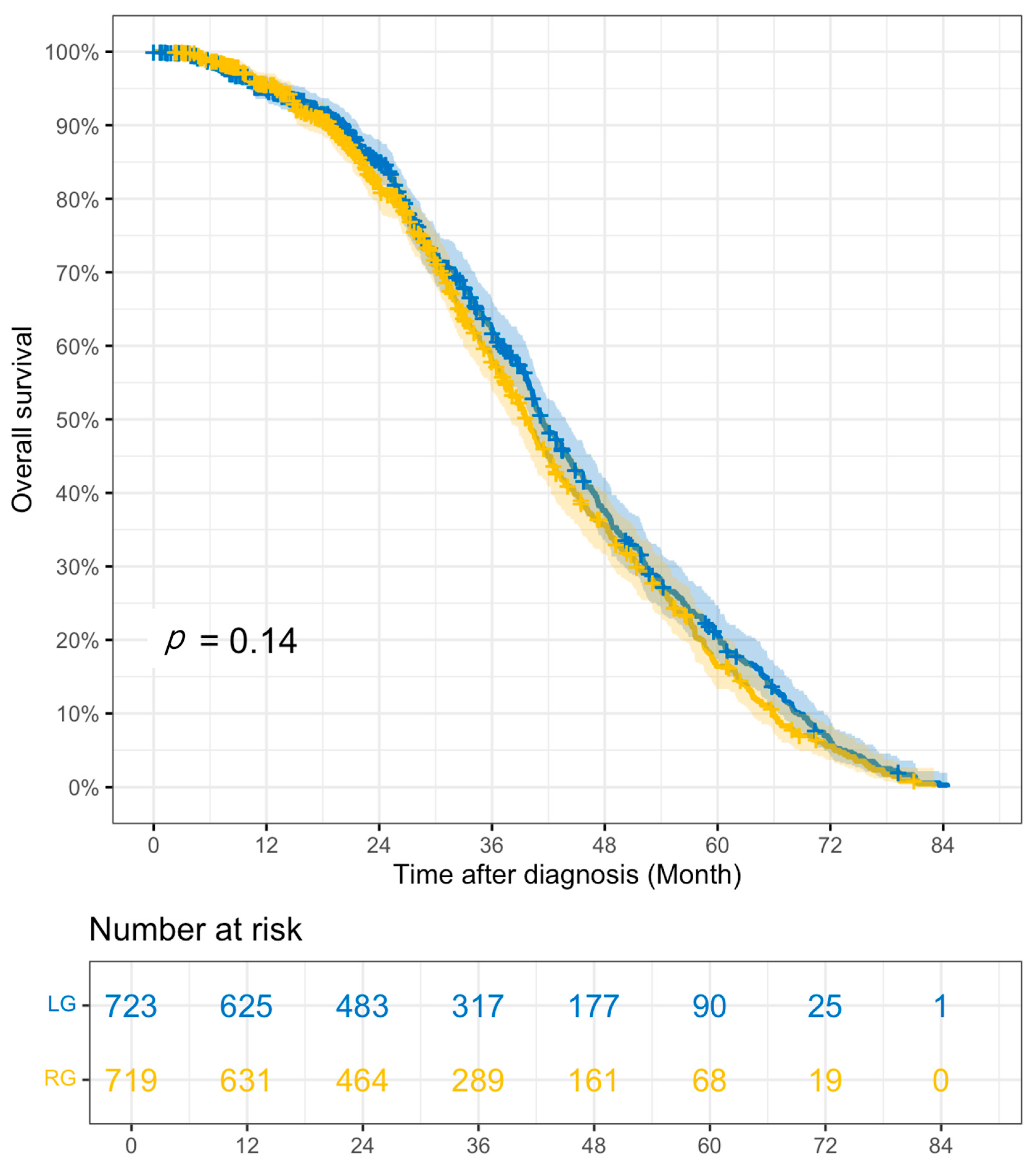
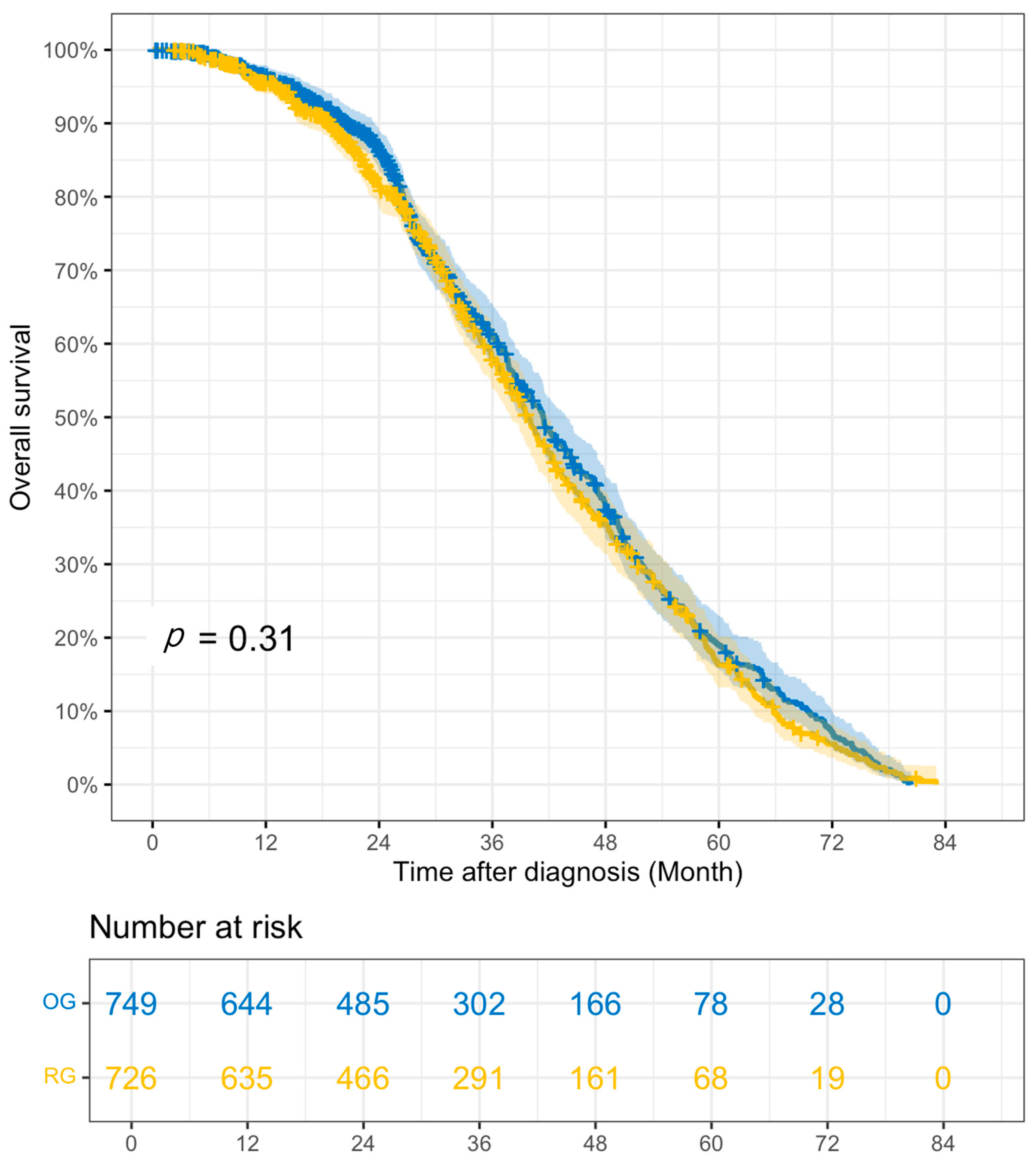
| 3 yr overall survival, % (95% CI) * | 57.8% (53.8–62.1) | 62.1% (58.2–66.3) | 0.14 | 57.9% (53.9–62.1) | 61.3% (57.4–65.5) | 0.31 |
| Clinical Stage 1 | 56.1% (95% CI, 49.3–63.8%) | 60.1% (95% CI, 53.2–68.0%) | 0.91 | 56.0% (95% CI, 49.3–63.7%) | 58.0% (95% CI, 51.0–65.9%) | 0.67 |
| Clinical Stage 2 | 60.7% (95% CI, 54.4–67.6%) | 62.2% (95% CI, 56.4–68.6%) | 0.30 | 60.9% (95% CI, 54.7–67.8%) | 65.9% (95% CI, 60.2–72.2%) | 0.35 |
| Clinical Stage 3 | 56.4% (95% CI, 49.0–64.9%) | 64.1% (95% CI, 56.5–72.7%) | 0.28 | 56.4% (95% CI, 49.0–64.9%) | 57.4% (95% CI, 49.6–66.4%) | 0.25 |
Disclaimer/Publisher’s Note: The statements, opinions and data contained in all publications are solely those of the individual author(s) and contributor(s) and not of MDPI and/or the editor(s). MDPI and/or the editor(s) disclaim responsibility for any injury to people or property resulting from any ideas, methods, instructions or products referred to in the content. |
© 2026 by the authors. Licensee MDPI, Basel, Switzerland. This article is an open access article distributed under the terms and conditions of the Creative Commons Attribution (CC BY) license.
Share and Cite
Broderick, J.; Okui, J.; Mansfield, P.; Tran Cao, H.S.; Badgwell, B.D.; Ikoma, N. Robotic Gastrectomy and Delivery of Adjuvant Systemic Therapy in Locally Advanced Gastric Adenocarcinoma: An NCDB Propensity Score-Matched Analysis. Cancers 2026, 18, 1073. https://doi.org/10.3390/cancers18071073
Broderick J, Okui J, Mansfield P, Tran Cao HS, Badgwell BD, Ikoma N. Robotic Gastrectomy and Delivery of Adjuvant Systemic Therapy in Locally Advanced Gastric Adenocarcinoma: An NCDB Propensity Score-Matched Analysis. Cancers. 2026; 18(7):1073. https://doi.org/10.3390/cancers18071073
Chicago/Turabian StyleBroderick, Joseph, Jun Okui, Paul Mansfield, Hop S. Tran Cao, Brian D. Badgwell, and Naruhiko Ikoma. 2026. "Robotic Gastrectomy and Delivery of Adjuvant Systemic Therapy in Locally Advanced Gastric Adenocarcinoma: An NCDB Propensity Score-Matched Analysis" Cancers 18, no. 7: 1073. https://doi.org/10.3390/cancers18071073
APA StyleBroderick, J., Okui, J., Mansfield, P., Tran Cao, H. S., Badgwell, B. D., & Ikoma, N. (2026). Robotic Gastrectomy and Delivery of Adjuvant Systemic Therapy in Locally Advanced Gastric Adenocarcinoma: An NCDB Propensity Score-Matched Analysis. Cancers, 18(7), 1073. https://doi.org/10.3390/cancers18071073