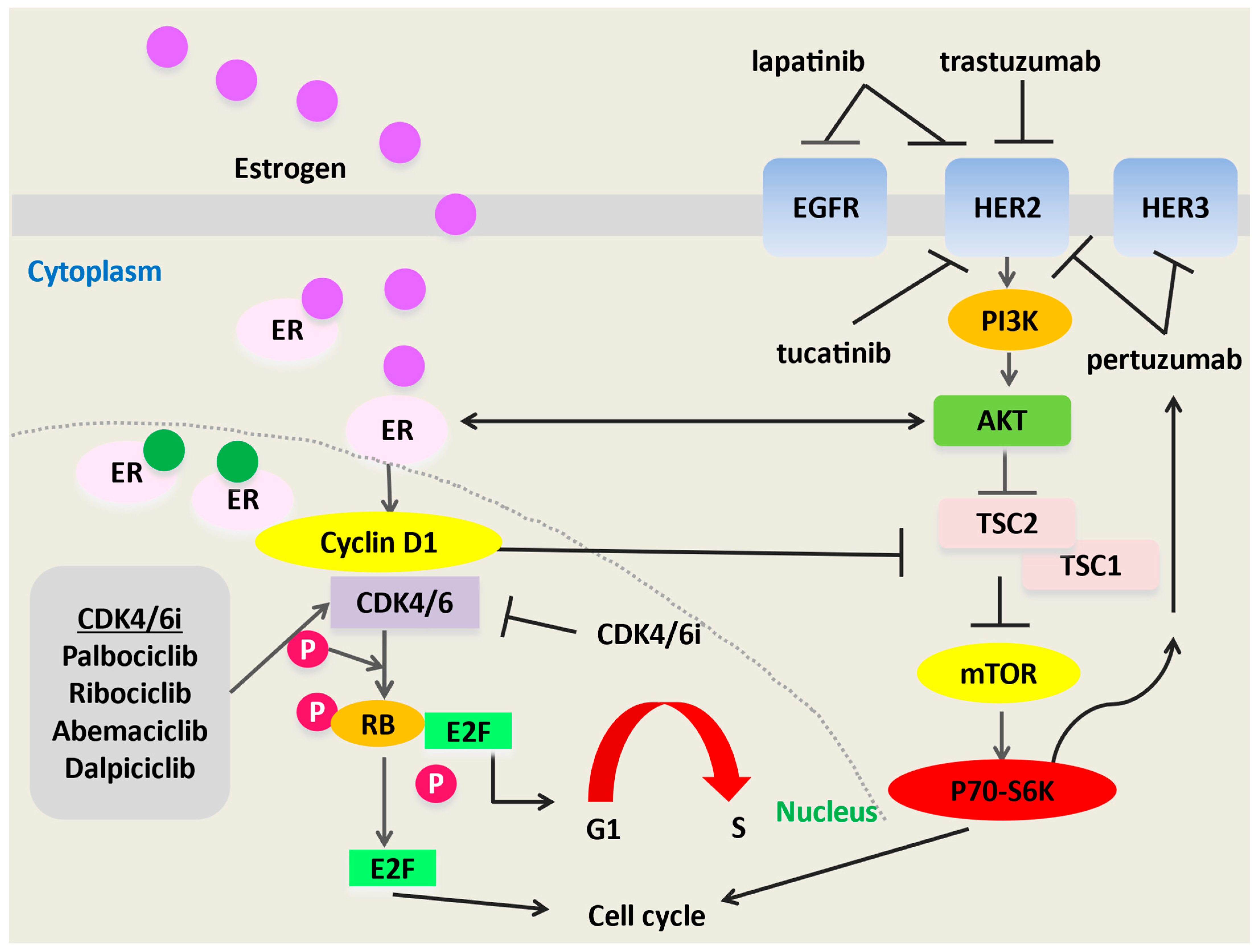
Cyclin-Dependent 4/6 Kinase Inhibitors for Treatment of HER2-Positive Breast Cancer: 2026 Update

Simple Summary
Abstract
1. Introduction
2. HR+ HER2+ MBC: A Heterogenous Treatment Landscape
3. HER2+ MBC—Current Treatment Paradigms
4. CDK4/6i—Mechanism of Action and Clinical Development in HER2- BC
5. CDK4/6i in HER2+ BC
6. CDK4/6i in HER2+ BC: Preclinical Data
7. Resistance/Response to HER2-Directed Therapies and the Cyclin D1/CDK4/6/pRb Axis
8. CDK4/6i in HER2+EBC: Results from Selected [Neo]Adjuvant Trials
8.1. CDK4/6i in HER2+ MBC: Selected Trials
8.2. Phase I
8.3. Phase II
8.4. Phase III
8.5. HER2+ Brain Metastases [BM] and CDK4/6i
9. Ongoing Challenges and Future Directions
10. Summary and Conclusions
Funding
Conflicts of Interest
References
- Kim, J.; Harper, A.; McCormack, V.; Sung, H.; Houssami, N.; Morgan, E.; Mutebi, M.; Garvey, G.; Soerjomataram, I.; Fidler-Benaoudia, M.M. Global patterns and trends in breast cancer incidence and mortality across 185 countries. Nat. Med. 2025, 31, 1154–1162. [Google Scholar] [CrossRef]
- National Comprehensive Cancer Network. NCCN Clinical Practice Guidelines in Oncology: Breast Cancer v4.2025. Available online: https://www.nccn.org/professionals/physician_gls/pdf/breast_blocks.pdf (accessed on 5 September 2025).
- Dillon, D.A. Molecular markers in the diagnosis and staging of breast cancer. Semin. Radiat. Oncol. 2002, 12, 305–318. [Google Scholar] [CrossRef]
- Perou, C.M.; Sorlie, T.; Eisen, M.B.; van de Rijn, M.; Jeffrey, S.S.; Rees, C.A.; Pollack, J.R.; Ross, D.T.; Johnsen, H.; Akslen, L.A.; et al. Molecular portraits of human breast tumours. Nature 2000, 406, 747–752. [Google Scholar] [CrossRef] [PubMed]
- Prat, A.; Pineda, E.; Adamo, B.; Galvan, P.; Fernandez, A.; Gaba, L.; Diez, M.; Viladot, M.; Arance, A.; Munoz, M. Clinical implications of the intrinsic molecular subtypes of breast cancer. Breast 2015, 24, S26–S35. [Google Scholar] [CrossRef] [PubMed]
- Slamon, D.J.; Leyland-Jones, B.; Shak, S.; Fuchs, H.; Paton, V.; Bajamonde, A.; Fleming, T.; Eiermann, W.; Wolter, J.; Pegram, M.; et al. Use of chemotherapy plus a monoclonal antibody against HER2 for metastatic breast cancer that overexpresses HER2. N. Engl. J. Med. 2001, 344, 783–792. [Google Scholar] [CrossRef] [PubMed]
- Slamon, D.; Eiermann, W.; Robert, N.; Pienkowski, T.; Martin, M.; Press, M.; Mackey, J.; Glaspy, J.; Chan, A.; Pawlicki, M.; et al. Adjuvant trastuzumab in HER2-positive breast cancer. N. Engl. J. Med. 2011, 365, 1273–1283. [Google Scholar] [CrossRef]
- Premji, S.K.; O’Sullivan, C.C. Standard-of-Care Treatment for HER2+ Metastatic Breast Cancer and Emerging Therapeutic Options. Breast Cancer 2024, 18, 11782234241234418. [Google Scholar] [CrossRef]
- Wolff, A.C.; Somerfield, M.R.; Dowsett, M.; Hammond, M.E.H.; Hayes, D.F.; McShane, L.M.; Saphner, T.J.; Spears, P.A.; Allison, K.H. Human Epidermal Growth Factor Receptor 2 Testing in Breast Cancer: ASCO-College of American Pathologists Guideline Update. J. Clin. Oncol. 2023, 41, 3867–3872. [Google Scholar] [CrossRef]
- Marra, A.; Chandarlapaty, S.; Modi, S. Management of patients with advanced-stage HER2-positive breast cancer: Current evidence and future perspectives. Nat. Rev. Clin. Oncol. 2024, 21, 185–202, Correction in Nat. Rev. Clin. Oncol. 2024, 21, 701. [Google Scholar] [CrossRef]
- Stavrou, E.; Winer, E.P.; Lin, N.U. How we treat HER2-positive brain metastases. ESMO Open 2021, 6, 100256. [Google Scholar] [CrossRef]
- Bates, S.E. Central nervous system metastasis from breast cancer. Oncologist 2015, 20, 3–4. [Google Scholar] [CrossRef] [PubMed][Green Version]
- Dvir, K.; Giordano, S.; Leone, J.P. Immunotherapy in Breast Cancer. Int. J. Mol. Sci. 2024, 25, 7517. [Google Scholar] [CrossRef] [PubMed]
- Luen, S.J.; Salgado, R.; Fox, S.; Savas, P.; Eng-Wong, J.; Clark, E.; Kiermaier, A.; Swain, S.M.; Baselga, J.; Michiels, S.; et al. Tumour-infiltrating lymphocytes in advanced HER2-positive breast cancer treated with pertuzumab or placebo in addition to trastuzumab and docetaxel: A retrospective analysis of the CLEOPATRA study. Lancet Oncol. 2017, 18, 52–62, Correction in Lancet Oncol. 2018, 19, e667. [Google Scholar] [CrossRef] [PubMed]
- Sobral-Leite, M.; Salomon, I.; Opdam, M.; Kruger, D.T.; Beelen, K.J.; van der Noort, V.; van Vlierberghe, R.L.P.; Blok, E.J.; Giardiello, D.; Sanders, J.; et al. Cancer-immune interactions in ER-positive breast cancers: PI3K pathway alterations and tumor-infiltrating lymphocytes. Breast Cancer Res. 2019, 21, 90. [Google Scholar] [CrossRef]
- Pegram, M.; Pietras, R.; Dang, C.T.; Murthy, R.; Bachelot, T.; Janni, W.; Sharma, P.; Hamilton, E.; Saura, C. Evolving perspectives on the treatment of HR+/HER2+ metastatic breast cancer. Ther. Adv. Med. Oncol. 2023, 15, 17588359231187201. [Google Scholar] [CrossRef]
- Ellis, M.J. HER2-positive breast cancer, intrinsic subtypes, and tailoring therapy. J. Natl. Cancer Inst. 2014, 106, dju212. [Google Scholar] [CrossRef][Green Version]
- Pegram, M.; Jackisch, C.; Johnston, S.R.D. Estrogen/HER2 receptor crosstalk in breast cancer: Combination therapies to improve outcomes for patients with hormone receptor-positive/HER2-positive breast cancer. NPJ Breast Cancer. 2023, 9, 45. [Google Scholar] [CrossRef]
- Liang, Y.; Liu, X.; Yun, Z.; Li, K.; Li, H. Endocrine therapy plus HER2-targeted therapy, another favorable option for HR+/HER2+ advanced breast cancer patients. Ther. Adv. Med. Oncol. 2024, 16, 17588359231220501. [Google Scholar] [CrossRef]
- Swain, S.M.; Baselga, J.; Kim, S.B.; Ro, J.; Semiglazov, V.; Campone, M.; Ciruelos, E.; Ferrero, J.M.; Schneeweiss, A.; Heeson, S.; et al. Pertuzumab, trastuzumab, and docetaxel in HER2-positive metastatic breast cancer. N. Engl. J. Med. 2015, 372, 724–734. [Google Scholar] [CrossRef]
- Modi, S.; Saura, C.; Yamashita, T.; Park, Y.H.; Kim, S.-B.; Tamura, K.; Andre, F.; Iwata, H.; Ito, Y.; Tsurutani, J.; et al. Trastuzumab Deruxtecan in Previously Treated HER2-Positive Breast Cancer. N. Engl. J. Med. 2019, 382, 610–621. [Google Scholar] [CrossRef]
- Murthy, R.; Borges, V.F.; Conlin, A.; Chaves, J.; Chamberlain, M.; Gray, T.; Vo, A.; Hamilton, E. Tucatinib with capecitabine and trastuzumab in advanced HER2-positive metastatic breast cancer with and without brain metastases: A non-randomised, open-label, phase 1b study. Lancet Oncol. 2018, 19, 880–888. [Google Scholar] [CrossRef] [PubMed]
- Tolaney, S.M.; Jiang, Z.; Zhang, Q.; Barroso-Sousa, R.; Park, Y.H.; Rimawi, M.F.; Manich, C.S.; Schneeweiss, A.; Toi, M.; Chae, Y.S.; et al. Trastuzumab deruxtecan (T-DXd) + pertuzumab (P) vs taxane + trastuzumab + pertuzumab (THP) for first-line (1L) treatment of patients (pts) with human epidermal growth factor receptor 2–positive (HER2+) advanced/metastatic breast cancer (a/mBC): Interim results from DESTINY-Breast09. J. Clin. Oncol. 2025, 43, LBA1008-LBA. [Google Scholar]
- Dieras, V.; Curigliano, G.; Martin, M.; Lerebours, F.; Tsurutani, J.; Savard, M.F.; Jerzak, K.J.; Hu, X.; Martins de Aquino Pimentel, L.C.; O’Sullivan, C.C.; et al. HER2CLIMB-05: A Phase 3 Study of Tucatinib Versus Placebo in Combination with Trastuzumab and Pertuzumab as First-line Maintenance Therapy for HER2+ Metastatic Breast Cancer. J. Clin. Oncol. Off. J. Am. Soc. Clin. Oncol. 2025. online ahead of print. [Google Scholar] [CrossRef] [PubMed]
- Metzger, O.; Mandrekar, S.; DeMichele, A.; Gianni, L.; Gligorov, J.; Lim, E.; Ciruelos, E.; Loibl, S.; Dockter, T.; Farré, X.G.; et al. AFT-38 PATINA: A Randomized, Open Label, Phase III Trial to Evaluate the Efficacy and Safety of Palbociclib + Anti-HER2 Therapy + Endocrine Therapy vs. Anti-HER2 Therapy + Endocrine Therapy after Induction Treatment for Hormone Receptor-Positive (HR+)/HER2-Positive Metastatic Breast Cancer. GS2-12. In Proceedings of the 2024 San Antonio Breast Cancer Symposium, San Antonio, TX, USA, 10–14 December 2024. [Google Scholar]
- O’Sullivan, C.C.; Clarke, R.; Goetz, M.P.; Robertson, J. Cyclin-Dependent Kinase 4/6 Inhibitors for Treatment of Hormone Receptor-Positive, ERBB2-Negative Breast Cancer: A Review. JAMA Oncol. 2023, 9, 1273–1282. [Google Scholar] [CrossRef]
- Finn, R.S.; Dering, J.; Conklin, D.; Kalous, O.; Cohen, D.J.; Desai, A.J.; Ginther, C.; Atefi, M.; Chen, I.; Fowst, C.; et al. PD 0332991, a selective cyclin D kinase 4/6 inhibitor, preferentially inhibits proliferation of luminal estrogen receptor-positive human breast cancer cell lines in vitro. Breast Cancer Res. 2009, 11, R77. [Google Scholar] [CrossRef]
- Piezzo, M.; Cocco, S.; Caputo, R.; Cianniello, D.; Gioia, G.D.; Lauro, V.D.; Fusco, G.; Martinelli, C.; Nuzzo, F.; Pensabene, M.; et al. Targeting Cell Cycle in Breast Cancer: CDK4/6 Inhibitors. Int. J. Mol. Sci. 2020, 21, 6479. [Google Scholar] [CrossRef]
- Shrestha, M.; Wang, D.Y.; Ben-David, Y.; Zacksenhaus, E. CDK4/6 inhibitors and the pRB-E2F1 axis suppress PVR and PD-L1 expression in triple-negative breast cancer. Oncogenesis 2023, 12, 29. [Google Scholar] [CrossRef]
- Goel, S.; DeCristo, M.J.; Watt, A.C.; BrinJones, H.; Sceneay, J.; Li, B.B.; Khan, N.; Ubellacker, J.M.; Xie, S.; Metzger-Filho, O.; et al. CDK4/6 inhibition triggers anti-tumour immunity. Nature 2017, 548, 471–475. [Google Scholar] [CrossRef]
- Deng, J.; Wang, E.S.; Jenkins, R.W.; Li, S.; Dries, R.; Yates, K.; Chhabra, S.; Huang, W.; Liu, H.; Aref, A.R.; et al. CDK4/6 Inhibition Augments Antitumor Immunity by Enhancing T-cell Activation. Cancer Discov. 2018, 8, 216–233. [Google Scholar] [CrossRef]
- FDA Approval of Palbociclib and Letrozole for First Line Treatment in Postmenopausal Women with HR-Positive, HER2-Negative Advanced Breast Cancer. Available online: https://www.fda.gov/drugs/resources-information-approved-drugs/palbociclib-ibrance (accessed on 21 January 2026).
- FDA Approval Palbociclib and Fulvestrant in Women with HR-Positive, HER2-Negative Metastatic Breast Cancer. Available online: http://www.fda.gov/Drugs/InformationOnDrugs/ApprovedDrugs/ucm487080.htm (accessed on 21 January 2026).
- FDA Approves Abemaciclib for HR-Positive, HER2-Negative Breast Cancer. Available online: https://www.fda.gov/drugs/resources-information-approved-drugs/fda-approves-abemaciclib-hr-positive-her2-negative-breast-cancer (accessed on 21 January 2026).
- FDA Approves Abemaciclib and Fulvestrant for HR-Positive, HER2-Negative Breast Cancer with Disease Progression Following Endocrine Therapy. Available online: https://www.astrazeneca.com/media-centre/press-releases/2017/faslodex-receives-us-fda-approval-for-the-treatment-of-advanced-breast-cancer-in-combination-with-abemaciclib-15112017.html# (accessed on 21 January 2026).
- FDA Approves Abemaciclib as Initial Therapy for HR-Positive, HER2-Negative Metastatic Breast Cancer. Available online: https://www.google.com/search?q=36.+FDA+Approves+Abemaciclib+as+Initial+Therapy+for+HR-Positive%2C+HER2-Negative+Metastatic+Breast+Cancer&rlz=1C1GCEA_enUS1048US1048&oq=36.%09FDA+Approves+Abemaciclib+as+Initial+Therapy+for+HR-Positive%2C+HER2-Negative+Metastatic+Breast+Cancer&gs_lcrp=EgZjaHJvbWUyBggAEEUYOTIHCAEQIRiPAjIHCAIQIRiPAtIBCTE3MzkyajBqNKgCALACAA&sourceid=chrome&ie=UTF-8 (accessed on 21 January 2026).
- Shah, A.; Bloomquist, E.; Tang, S.; Fu, W.; Bi, Y.; Liu, Q.; Yu, J.; Zhao, P.; Palmby, T.R.; Goldberg, K.B.; et al. FDA Approval: Ribociclib for the Treatment of Postmenopausal Women with Hormone Receptor-Positive, HER2-Negative Advanced or Metastatic Breast Cancer. Clin. Cancer Res. Off. J. Am. Assoc. Cancer Res. 2018, 24, 2999–3004. [Google Scholar] [CrossRef]
- Hortobagyi, G.N.; Stemmer, S.M.; Burris, H.A.; Yap, Y.S.; Sonke, G.S.; Hart, L.; Campone, M.; Petrakova, K.; Winer, E.P.; Janni, W.; et al. Overall Survival with Ribociclib plus Letrozole in Advanced Breast Cancer. N. Engl. J. Med. 2022, 386, 942–950. [Google Scholar] [CrossRef] [PubMed]
- Xu, B. Dalpiciclib in advanced breast cancer: Introducing CDK4/6 inhibitors as a first-line treatment might not be the best strategy—Author’s reply. Lancet Oncol. 2023, 24, e357. [Google Scholar] [CrossRef] [PubMed]
- Finn, R.S.; Martin, M.; Rugo, H.S.; Jones, S.E.; Im, S.-A.; Gelmon, K.A.; Harbeck, N.; Lipatov, O.N.; Walshe, J.M.; Moulder, S.L.; et al. PALOMA-2: Primary results from a phase III trial of palbociclib (P) with letrozole (L) compared with letrozole alone in postmenopausal women with ER+/HER2– advanced breast cancer (ABC). J. Clin. Oncol. 2016, 34, 507. [Google Scholar] [CrossRef]
- Cristofanilli, M.; Turner, N.C.; Bondarenko, I.; Ro, J.; Im, S.-A.; Masuda, N.; Colleoni, M.; DeMichele, A.; Loi, S.; Verma, S.; et al. Fulvestrant plus palbociclib versus fulvestrant plus placebo for treatment of hormone-receptor-positive, HER2-negative metastatic breast cancer that progressed on previous endocrine therapy (PALOMA-3): Final analysis of the multicentre, double-blind, phase 3 randomised controlled trial. Lancet Oncol. 2016, 17, 425–439, Correction in Lancet Oncol. 2016, 17, e136. [Google Scholar] [PubMed]
- O’Shaughnessy, J.; Petrakova, K.; Sonke, G.S.; Conte, P.; Arteaga, C.L.; Cameron, D.A.; Hart, L.L.; Villanueva, C.; Jakobsen, E.; Beck, J.T.; et al. Ribociclib plus letrozole versus letrozole alone in patients with de novo HR+, HER2- advanced breast cancer in the randomized MONALEESA-2 trial. Breast Cancer Res. Treat. 2018, 168, 127–134. [Google Scholar] [CrossRef]
- Sledge, G.W., Jr.; Toi, M.; Neven, P.; Sohn, J.; Inoue, K.; Pivot, X.; Burdaeva, O.; Okera, M.; Masuda, N.; Kaufman, P.A.; et al. MONARCH 2: Abemaciclib in Combination With Fulvestrant in Women With HR+/HER2- Advanced Breast Cancer Who Had Progressed While Receiving Endocrine Therapy. J. Clin. Oncol. 2017, 35, 2875–2884. [Google Scholar] [CrossRef]
- Goetz, M.P.; Toi, M.; Campone, M.; Sohn, J.; Paluch-Shimon, S.; Huober, J.; Park, I.H.; Trédan, O.; Chen, S.-C.; Manso, L.; et al. MONARCH 3: Abemaciclib As Initial Therapy for Advanced Breast Cancer. J. Clin. Oncol. 2017, 35, 3638–3646. [Google Scholar] [CrossRef]
- Johnston, S.; Martin, M.; O’Shaughnessy, J.; Hegg, R.; Tolaney, S.M.; Guarneri, V.; Del Mastro, L.; Campone, M.; Sohn, J.; Boyle, F.; et al. Overall survival with abemaciclib in early breast cancer. Ann. Oncol. 2025, 37, 155–165. [Google Scholar] [CrossRef]
- Johnston, S.R.D.; Toi, M.; O’Shaughnessy, J.; Rastogi, P.; Campone, M.; Neven, P.; Huang, C.S.; Huober, J.; Jaliffe, G.G.; Cicin, I.; et al. Abemaciclib plus endocrine therapy for hormone receptor-positive, HER2-negative, node-positive, high-risk early breast cancer (monarchE): Results from a preplanned interim analysis of a randomised, open-label, phase 3 trial. Lancet Oncol. 2023, 24, 77–90. [Google Scholar] [CrossRef]
- O’Sullivan, C.C.; Suman, V.J.; Goetz, M.P. The emerging role of CDK4/6i in HER2-positive breast cancer. Ther. Adv. Med. Oncol. 2019, 11, 1758835919887665. [Google Scholar] [CrossRef]
- Lee, R.J.; Albanese, C.; Fu, M.; D’Amico, M.; Lin, B.; Watanabe, G.; Haines, G.K., 3rd; Siegel, P.M.; Hung, M.C.; Yarden, Y.; et al. Cyclin D1 is required for transformation by activated Neu and is induced through an E2F-dependent signaling pathway. Mol. Cell Biol. 2000, 20, 672–683. [Google Scholar] [CrossRef]
- Nikolai, B.C.; Lanz, R.B.; York, B.; Dasgupta, S.; Mitsiades, N.; Creighton, C.J.; Tsimelzon, A.; Hilsenbeck, S.G.; Lonard, D.M.; Smith, C.L.; et al. HER2 Signaling Drives DNA Anabolism and Proliferation through SRC-3 Phosphorylation and E2F1-Regulated Genes. Cancer Res. 2016, 76, 1463–1475. [Google Scholar] [CrossRef] [PubMed]
- Roberts, P.J.; Bisi, J.E.; Strum, J.C.; Combest, A.J.; Darr, D.B.; Usary, J.E.; Zamboni, W.C.; Wong, K.K.; Perou, C.M.; Sharpless, N.E. Multiple roles of cyclin-dependent kinase 4/6 inhibitors in cancer therapy. J. Natl. Cancer Inst. 2012, 104, 476–487. [Google Scholar] [CrossRef] [PubMed]
- Dean, J.L.; McClendon, A.K.; Hickey, T.E.; Butler, L.M.; Tilley, W.D.; Witkiewicz, A.K.; Knudsen, E.S. Therapeutic response to CDK4/6 inhibition in breast cancer defined by ex vivo analyses of human tumors. Cell Cycle 2012, 11, 2756–2761. [Google Scholar] [CrossRef] [PubMed]
- ElChaarani, B.; Stires, H.; Pohlmann, P.R.; Riggins, R. Pre-clinical analysis of the CDK4/6 inhibitor palbociclib in HER2-positive breast cancer. J. Clin. Oncol. 2017, 35, e12520. [Google Scholar] [CrossRef]
- Raub, T.J.; Wishart, G.N.; Kulanthaivel, P.; Staton, B.A.; Ajamie, R.T.; Sawada, G.A.; Gelbert, L.M.; Shannon, H.E.; Sanchez-Martinez, C.; De Dios, A. Brain Exposure of Two Selective Dual CDK4 and CDK6 Inhibitors and the Antitumor Activity of CDK4 and CDK6 Inhibition in Combination with Temozolomide in an Intracranial Glioblastoma Xenograft. Drug Metab. Dispos. 2015, 43, 1360–1371. [Google Scholar] [CrossRef]
- Yin, L.; Li, H.; Liu, W.; Yao, Z.; Cheng, Z.; Zhang, H.; Zou, H. A highly potent CDK4/6 inhibitor was rationally designed to overcome blood brain barrier in gliobastoma therapy. Eur. J. Med. Chem. 2017, 144, 1–28. [Google Scholar] [CrossRef]
- Shagisultanova, E.; Crump, L.S.; Borakove, M.; Hall, J.K.; Rasti, A.R.; Harrison, B.A.; Kabos, P.; Lyons, T.R.; Borges, V.F. Triple Targeting of Breast Tumors Driven by Hormonal Receptors and HER2. Mol. Cancer Ther. 2022, 21, 48–57. [Google Scholar] [CrossRef]
- Schlam, I.; Tarantino, P.; Tolaney, S.M. Overcoming Resistance to HER2-Directed Therapies in Breast Cancer. Cancers 2022, 14, 3996. [Google Scholar] [CrossRef]
- Vernieri, C.; Milano, M.; Brambilla, M.; Mennitto, A.; Maggi, C.; Cona, M.S.; Prisciandaro, M.; Fabbroni, C.; Celio, L.; Mariani, G.; et al. Resistance mechanisms to anti-HER2 therapies in HER2-positive breast cancer: Current knowledge, new research directions and therapeutic perspectives. Crit. Rev. Oncol. Hematol. 2019, 139, 53–66. [Google Scholar] [CrossRef]
- Corona, S.P.; Ravelli, A.; Cretella, D.; Cappelletti, M.R.; Zanotti, L.; Dester, M.; Gobbi, A.; Petronini, P.G.; Generali, D. CDK4/6 inhibitors in HER2-positive breast cancer. Crit. Rev. Oncol. Hematol. 2017, 112, 208–214. [Google Scholar] [CrossRef]
- Axelrod, M.J.; Gordon, V.; Mendez, R.E.; Leimgruber, S.S.; Conaway, M.R.; Sharlow, E.R.; Jameson, M.J.; Gioeli, D.G.; Weber, M.J. p70S6 kinase is a critical node that integrates HER-family and PI3 kinase signaling networks. Cell Signal 2014, 26, 1627–1635. [Google Scholar] [CrossRef]
- McCartney, A.; Migliaccio, I.; Bonechi, M.; Biagioni, C.; Romagnoli, D.; De Luca, F.; Galardi, F.; Risi, E.; De Santo, I.; Benelli, M.; et al. Mechanisms of Resistance to CDK4/6 Inhibitors: Potential Implications and Biomarkers for Clinical Practice. Front. Oncol. 2019, 9, 666. [Google Scholar] [CrossRef] [PubMed]
- Zhang, C.; Zhou, F.; Zou, J.; Fang, Y.; Liu, Y.; Li, L.; Hou, J.; Wang, G.; Wang, H.; Lai, X.; et al. Clinical considerations of CDK4/6 inhibitors in HER2 positive breast cancer. Front. Oncol. 2023, 13, 1322078. [Google Scholar] [CrossRef] [PubMed]
- Garrido-Castro, A.C.; Goel, S. CDK4/6 Inhibition in Breast Cancer: Mechanisms of Response and Treatment Failure. Curr. Breast Cancer Rep. 2017, 9, 26–33. [Google Scholar] [CrossRef] [PubMed]
- Finn, R.S.; Aleshin, A.; Slamon, D.J. Targeting the cyclin-dependent kinases (CDK) 4/6 in estrogen receptor-positive breast cancers. Breast Cancer Res. 2016, 18, 17. [Google Scholar] [CrossRef]
- DeMichele, A.; Clark, A.S.; Tan, K.S.; Heitjan, D.F.; Gramlich, K.; Gallagher, M.; Lal, P.; Feldman, M.; Zhang, P.; Colameco, C.; et al. CDK 4/6 inhibitor palbociclib (PD0332991) in Rb+ advanced breast cancer: Phase II activity, safety, and predictive biomarker assessment. Clin. Cancer Res. 2015, 21, 995–1001. [Google Scholar] [CrossRef]
- Spring, L.; Bardia, A.; Modi, S. Targeting the cyclin D-cyclin-dependent kinase (CDK) 4/6-retinoblastoma pathway with selective CDK 4/6 inhibitors in hormone receptor-positive breast cancer: Rationale, current status, and future directions. Discov. Med. 2016, 21, 65–74. [Google Scholar]
- Condorelli, R.; Spring, L.; O’Shaughnessy, J.; Lacroix, L.; Bailleux, C.; Scott, V.; Dubois, J.; Nagy, R.J.; Lanman, R.B.; Iafrate, A.J.; et al. Polyclonal RB1 mutations and acquired resistance to CDK 4/6 inhibitors in patients with metastatic breast cancer. Ann. Oncol. 2018, 29, 640–645. [Google Scholar] [CrossRef]
- Costa, C.; Wang, Y.; Ly, A.; Hosono, Y.; Murchie, E.; Walmsley, C.S.; Huynh, T.; Healy, C.; Peterson, R.; Yanase, S.; et al. PTEN Loss Mediates Clinical Cross-Resistance to CDK4/6 and PI3Kα Inhibitors in Breast Cancer. Cancer Discov. 2020, 10, 72–85. [Google Scholar] [CrossRef]
- Lloyd, M.R.; Spring, L.M.; Bardia, A.; Wander, S.A. Mechanisms of Resistance to CDK4/6 Blockade in Advanced Hormone Receptor-positive, HER2-negative Breast Cancer and Emerging Therapeutic Opportunities. Clin. Cancer Res. 2022, 28, 821–830. [Google Scholar] [CrossRef]
- Dieci, M.V.; Miglietta, F.; Griguolo, G.; Guarneri, V. Biomarkers for HER2-positive metastatic breast cancer: Beyond hormone receptors. Cancer Treat Rev. 2020, 88, 102064. [Google Scholar] [CrossRef] [PubMed]
- Klocker, E.V.; Suppan, C. Biomarkers in Her2- Positive Disease. Breast Care 2020, 15, 586–593. [Google Scholar] [CrossRef] [PubMed]
- Gianni, L.; Bisagni, G.; Colleoni, M.; Del Mastro, L.; Zamagni, C.; Mansutti, M.; Zambetti, M.; Frassoldati, A.; De Fato, R.; Valagussa, P.; et al. Neoadjuvant treatment with trastuzumab and pertuzumab plus palbociclib and fulvestrant in HER2-positive, ER-positive breast cancer (NA-PHER2): An exploratory, open-label, phase 2 study. Lancet Oncol. 2018, 19, 249–256. [Google Scholar] [CrossRef] [PubMed]
- Ademuyiwa, F.O.; Northfelt, D.W.; O’Connor, T.; Levine, E.; Luo, J.; Tao, Y.; Hoog, J.; Laury, M.L.; Summa, T.; Hammerschmidt, T.; et al. A phase II study of palbociclib plus letrozole plus trastuzumab as neoadjuvant treatment for clinical stages II and III ER+ HER2+ breast cancer (PALTAN). NPJ Breast Cancer 2023, 9, 1. [Google Scholar] [CrossRef]
- Spring, L.M.; Fell, G.; Arfe, A.; Sharma, C.; Greenup, R.; Reynolds, K.L.; Smith, B.L.; Alexander, B.; Moy, B.; Isakoff, S.J.; et al. Pathologic Complete Response after Neoadjuvant Chemotherapy and Impact on Breast Cancer Recurrence and Survival: A Comprehensive Meta-analysis. Clin. Cancer Res. 2020, 26, 2838–2848. [Google Scholar] [CrossRef]
- Ciruelos, E.; Villagrasa, P.; Pascual, T.; Oliveira, M.; Pernas, S.; Pare, L.; Escrivá-de-Romani, S.; Manso, L.; Adamo, B.; Martinez, E.; et al. Palbociclib and Trastuzumab in HER2-Positive Advanced Breast Cancer: Results from the Phase II SOLTI-1303 PATRICIA Trial. Clin. Cancer Res. 2020, 26, 5820–5829. [Google Scholar] [CrossRef]
- Haley, B.; Batra, K.; Sahoo, S.; Froehlich, T.; Klemow, D.; Unni, N.; Ahn, C.; Rodriguez, M.; Hullings, M.; Frankel, A.E. A Phase I/Ib Trial of PD 0332991 (Palbociclib) and T-DM1 in HER2-Positive Advanced Breast Cancer After Trastuzumab and Taxane Therapy. Clin. Breast Cancer 2021, 21, 417–424. [Google Scholar] [CrossRef]
- Shagisultanova, E.; Gradishar, W.; Brown-Glaberman, U.; Chalasani, P.; Brenner, A.J.; Stopeck, A.; Parris, H.; Gao, D.; McSpadden, T.; Mayordomo, J.; et al. Safety and Efficacy of Tucatinib, Letrozole, and Palbociclib in Patients with Previously Treated HR+/HER2+ Breast Cancer. Clin. Cancer Res. 2023, 29, 5021–5030. [Google Scholar] [CrossRef]
- Escrivá-de-Romani, S.; Cejalvo, J.M.; Alba, E.; Friedmann, J.; Rodríguez-Lescure, Á.; Savard, M.F.; Pezo, R.C.; Gion, M.; Ruiz-Borrego, M.; Hamilton, E.; et al. Zanidatamab plus palbociclib and fulvestrant in previously treated patients with hormone receptor-positive, HER2-positive metastatic breast cancer: Primary results from a two-part, multicentre, single-arm, phase 2a study. Lancet Oncol. 2025, 26, 745–758. [Google Scholar] [CrossRef]
- Patel, R.; Cascetta, K.; Klein, P.; Moshier, E.; Kwa, M.; Fasano, J.; Goel, A.; Accordino, M.; Shapiro, C.; Vaccaro, R.; et al. Abstract RF02-01: A Multicenter, Phase I/II Trial of Anastrozole, Palbociclib, Trastuzumab, and Pertuzumab in Hormone Receptor (HR)-Positive, HER2-Positive Metastatic Breast Cancer (ASPIRE). Cancer Res. 2024, 84, RF02-01. [Google Scholar] [CrossRef]
- Tolaney, S.M.; Wardley, A.M.; Zambelli, S.; Hilton, J.F.; Troso-Sandoval, T.A.; Ricci, F.; Im, S.A.; Kim, S.B.; Johnston, S.R.; Chan, A.; et al. Abemaciclib plus trastuzumab with or without fulvestrant versus trastuzumab plus standard-of-care chemotherapy in women with hormone receptor-positive, HER2-positive advanced breast cancer (monarcHER): A randomised, open-label, phase 2 trial. Lancet Oncol. 2020, 21, 763–775. [Google Scholar] [CrossRef] [PubMed]
- Spring, L.M.; Clark, S.L.; Li, T.; Goel, S.; Tayob, N.; Viscosi, E.; Abraham, E.; Juric, D.; Isakoff, S.J.; Mayer, E.; et al. Phase 1b clinical trial of ado-trastuzumab emtansine and ribociclib for HER2-positive metastatic breast cancer. npj Breast Cancer 2021, 7, 103. [Google Scholar] [CrossRef] [PubMed]
- Janni, W.; Fehm, T.; Muller, V.; Blohmer, J.; De Gregorio, A.; Decker, T.; Hartkopf, A.; Ditsch, N.; Schmidt, M.; Wimberger, P.; et al. Efficacy Analysis of the Randomized Phase III DETECT V trial: Treatment De-escalation by Omission of Chemotherapy and the Effect of Adding Ribociclib in HER2-positive and Hormone-receptor Positive Metastatic Breast Cancer. RF4-02. In Proceedings of the San Antonio Breast Cancer Symposium, San Antonio, TX, USA, 9–12 December 2025. [Google Scholar]
- Zhang, J.; Meng, Y.; Wang, B.; Wu, X.; Zheng, H.; Hu, J.; Liu, W.; Chen, W.; Wang, L.; Cao, J.; et al. Dalpiciclib combined with pyrotinib and endocrine therapy in women with ER-positive, HER2-positive advanced breast cancer: A prospective, multicenter, single-arm, phase 2 trial. PLoS Med. 2025, 22, e1004669. [Google Scholar] [CrossRef]
- Patnaik, A.; Rosen, L.S.; Tolaney, S.M.; Tolcher, A.W.; Goldman, J.W.; Gandhi, L.; Papadopoulos, K.P.; Beeram, M.; Rasco, D.W.; Hilton, J.F.; et al. Efficacy and Safety of Abemaciclib, an Inhibitor of CDK4 and CDK6, for Patients with Breast Cancer, Non-Small Cell Lung Cancer, and Other Solid Tumors. Cancer Discov. 2016, 6, 740–753. [Google Scholar] [CrossRef]
- Ciruelos, E.; Pascual, T.; Villacampa Javierre, G.; Pernas, S.; Bayona, R.; Ponce-Lorenzo, J.; Cantos, B.; Escrivá-de-Romaní, S.; Perello, A.; Montaño, A.; et al. Primary results from PATRICIA cohort C (SOLTI-1303), a randomized phase II study evaluating palbociclib with trastuzumab and endocrine therapy in pretreated HER2-positive and PAM50 luminal advanced breast cancer. J. Clin. Oncol. 2024, 42, 1008. [Google Scholar] [CrossRef]
- Xu, B.; Zhang, Q.; Zhang, P.; Hu, X.; Li, W.; Tong, Z.; Sun, T.; Teng, Y.; Wu, X.; Ouyang, Q.; et al. Dalpiciclib or placebo plus fulvestrant in hormone receptor-positive and HER2-negative advanced breast cancer: A randomized, phase 3 trial. Nat. Med. 2021, 27, 1904–1909. [Google Scholar] [CrossRef]
- Janni, W.; Fehm, T.N.; Mueller, V.; de Gregorio, A.M.B.; Decker, T.; Hartkopf, A.D.; Just, M.; Sagasser, J.; Schmidt, M.; Wimberger, P.; et al. 350MO Omission of chemotherapy and addition of the CDK4/6 inhibitor ribociclib in HER2-positive and hormone-receptor positive metastatic breast cancer—Second interim efficacy analysis of the randomized phase III DETECT V trial. Ann. Oncol. 2024, 35, S362. [Google Scholar] [CrossRef]
- Lin, N.U.; Amiri-Kordestani, L.; Palmieri, D.; Liewehr, D.J.; Steeg, P.S. CNS metastases in breast cancer: Old challenge, new frontiers. Clin. Cancer Res. 2013, 19, 6404–6418. [Google Scholar] [CrossRef]
- Lin, N.U.; Lueftner, D.; Brufsky, A.M.; Tolaney, S.M.; Melisko, M.E.; Holmes, F.A.; Awada, A. Abstract P2-13-05: Central nervous system metastases as a site of first recurrence in adjuvant therapy trials of HER2+ early breast cancer (EBC). Cancer Res. 2022, 82, P2-13-05–P2-13-05. [Google Scholar] [CrossRef]
- Shah, A.N.; Santa-Maria, C.A.; Mukhija, D.; Shah, N.; Kang, A.K.; Kumthekar, P.; Burdett, K.; Chandra, S.; Chang, J.; Tsarwhas, D.; et al. A Phase II Single-arm Study of Palbociclib in Patients With HER2-positive Breast Cancer With Brain Metastases and Analysis of ctDNA in Patients With Active Brain Metastases. Clin. Breast Cancer. 2023, 23, 324–329. [Google Scholar] [CrossRef]
- Tolaney, S.M.; Sahebjam, S.; Le Rhun, E.; Bachelot, T.; Kabos, P.; Awada, A.; Yardley, D.; Chan, A.; Conte, P.; Diéras, V.; et al. A Phase II Study of Abemaciclib in Patients with Brain Metastases Secondary to Hormone Receptor–Positive Breast Cancer. Clin. Cancer Res. 2020, 26, 5310–5319. [Google Scholar] [CrossRef]
- Chew, S.M.; Ferraro, E.; Safonov, A.; Chen, Y.; Kelly, D.; Razavi, P.; Robson, M.; Seidman, A.D. Impact of cyclin dependent kinase 4/6 inhibitors on breast cancer brain metastasis outcomes. Eur. J. Cancer. 2024, 207, 114175. [Google Scholar] [CrossRef]
- Metzger, O. Central Nervous System Outcomes from the Phase III PATINA Trial (AFT-38). In Proceedings of the San Antonio Breast Cancer Symposium, San Antonio, TX, USA, 9–12 December 2025. [Google Scholar]
- Weisser, N.E.; Sanches, M.; Escobar-Cabrera, E.; O’Toole, J.; Whalen, E.; Chan, P.W.Y.; Wickman, G.; Abraham, L.; Choi, K.; Harbourne, B.; et al. An anti-HER2 biparatopic antibody that induces unique HER2 clustering and complement-dependent cytotoxicity. Nat. Commun. 2023, 14, 1394. [Google Scholar] [CrossRef]


| Agent | Trial | Phase | Prior Lines of HER2+ Treatment | Treatment Regimen[s] | Results | Comments |
|---|---|---|---|---|---|---|
| Palbociclib | PATRICIA SOLTI-1303, NCT02448420 N = 71 [74] | II | 2–4 | palbociclib + H ± ET: | PFS6: Cohort B1: 42.8% Cohort B2: 46.4% | B1 + B2: ER+ |
| Palbociclib | NCT03530696 N = 18 [75] | I/Ib | Prior H+ taxane | palbociclib+T-DM1 | MTD: not reached ORR: 33% (95% CI, 13–59) mPFS 6 mos. (95% CI, 18.4–57.2) | D1 T-DM1 and days 5–18 palbociclib Most common G3 toxicity: hematologic (>10%) |
| Palbociclib | NCT03054363 N = 42 [76] | Ib/II | 3L+ | palbociclib + tucatinib + letrozole | ORR: 44.5% mPFS: 8.4 mos. | CNS cohort: 26.6% on study for ≥1 year G3 neutropenia: most frequent AE (64.3%) |
| Palbociclib | NCT04224272 N = 51 [77] | IIa | 1+ | palbociclib + fulvestrant + zanidatamab | PFS6: 67% mPFS: 12 mos. | Median 4L prior therapy |
| Palbociclib | NCT03304080 ASPIRE N = 30 [78] | I/II | 0 | palbociclib + H + P + anastrozole | CBR: 97% (p < 0.0001) ORR: 73% (95% CI, 54–88%) mPFS: 21.2 mos. [95% CI, 18.4–57.2] mOS: not reached | G3/4 AE: neutropenia (46%) leukopenia (23%) anemia (17%) |
| Palbociclib | PATINA AFT-38, NCT02947685 N~518 [25] | III | None for MBC [1L] | Post induction THP: Palbociclib + H(P) + ET vs. Placebo + H(P) + ET | mPFS: palbociclib arm: 44.3 mos. (95% CI: 32.4–60.9) vs. 29.1 mos. in H ± P + ET alone arm | G3 neutropenia most frequent AE: 63.2% (palbociclib) vs. 2.0% (H ± P + ET alone) |
| Abemaciclib | MonarchHER NCT02675231 N = 237 [79] | III | 2+ | abemaciclib + H ± fulvestrant (Arm A) abemaciclib + H (Arm B) TPC (chemo + H) (Arm C) | Arm A improved mPFS and mOS (numeric) vs. Arm C 8.3 vs. 5.7 mos.; p = 0.051 | mOS: 31.1 mos. [Arm A] 29.2 mos. [Arm B] 20.7 mos. [Arm C] |
| Ribociclib | NCT02657343 N = 13 [80] | Ib/II | 2L+ | 3 cohorts A: Ribociclib D5-18; DE 300–600mg + T-DM1 D1 q21 D B: Ribociclib 400mg D1-21 + H q21 D C: Ribociclib D1-28 + H q 21d + fulvestrant | No DLTs 1 pt: 8.3% SD > 24 weeks ORR: 0% mPFS: 1.3 mos. (95% CI, 0.92–2.57) | 67% HR+ HER2+ MBC Median 5 lines prior treatment No new safety concerns at 400 mg dose G3 AEs (33.3%) Neutropenia: n = 2 Fatigue: n = 1 Pain: n = 1 |
| Ribociclib | DETECT V NCT02344472 N = 262 [81] | III | HR+ HER2+ MBC 1L+ | Evaluating induction THP Randomization: ET + HP ± chemo Ribociclib added to both arms after 120 pts enrolled | OS + PFS: similar with chemo vs. non chemo Adding ribociclib to HP + ET (chemo free): mPFS: 27.2 vs. 15.6 mos., HR 0.61, 95% CI 0.38–0.98, p = 0.040 mOS: Not reached vs. 38.7 mos., HR 0.48, 95% CI 0.24–0.94, p = 0.033 | No new safety concerns Chemo-free treatment for HR+ HER2+ MBC is a 1L option Adding ribociclib may improve OS |
| Dalpiciclib | DAP-HER-01 N = 41 [82] | II | ≤1 | dalpiciclib + pyrotinib | cORR 70%, mPFS: 11 mos. | Baseline BM: mPFS = 11 mos. |
| Agent | NCT | Phase | Target Population | Agents in Regimen[s] | Primary Outcome Measure | Start Date and Projected Completion Date |
|---|---|---|---|---|---|---|
| Palbociclib | NCT05969184 | I/II | HR+HER2+ MBC 1L | Letrozole/exemestane + H + P + palbociclib | PFS | 12/2022 Unknown |
| Ribociclib | NCT06481956 | Ib/II | HR+HER2+ MBC 1L postmenopausal | IB: letrozole + H + ribociclib (DE 200–600 mg) II: letrozole + H+ ribociclib RP2D | RP2D PFS | 06/2019 10/2027 |
| Ribociclib | NCT05319873 Phase Ib, DE study → phase II study | Ib/II | HER2+ EBC 1L II: HR + pts randomized to arm A/B II: HR-pts randomized to arm B/C | IB: ribociciclib D1-21+ tucatinib+ H (weekly) II: Arm A: ribociciclib D1-21+ tucatinib+ H+ fulvestrant X 6 Arm B: docetaxel, carboplatin, H+ P X 6 Arm C: ribociciclib D1-21+ tucatinib+ H X 6 | Safety RP2D pCR | 04/2022 04/2027 |
| Dalpiciclib | NCT05574881 | I/II | HR+HER2+ MBC 1L | dalpiciclib + fulvestrant + H + P | PFS [6 weeks] | 09/2022 01/2025 |
| Dalpiciclib | NCT03772353 | I/II | HR+HER2+ MBC 1-2L | dalpiciclib + pyrotinib + ET | AEs, ORR | 05/2019 Unknown |
| Dalpiciclib | NCT05328440 DAP-HER-02 | II | HER2+ MBC (H-sensitive) 1L | dalpiciclib + pyrotinib + fulvestrant (ER+) OR inetetamab (ER-) | PFS | 03/2022 01/2026 |
Disclaimer/Publisher’s Note: The statements, opinions and data contained in all publications are solely those of the individual author(s) and contributor(s) and not of MDPI and/or the editor(s). MDPI and/or the editor(s) disclaim responsibility for any injury to people or property resulting from any ideas, methods, instructions or products referred to in the content. |
© 2026 by the author. Licensee MDPI, Basel, Switzerland. This article is an open access article distributed under the terms and conditions of the Creative Commons Attribution (CC BY) license.
Share and Cite
O’Sullivan, C.C. Cyclin-Dependent 4/6 Kinase Inhibitors for Treatment of HER2-Positive Breast Cancer: 2026 Update. Cancers 2026, 18, 533. https://doi.org/10.3390/cancers18030533
O’Sullivan CC. Cyclin-Dependent 4/6 Kinase Inhibitors for Treatment of HER2-Positive Breast Cancer: 2026 Update. Cancers. 2026; 18(3):533. https://doi.org/10.3390/cancers18030533
Chicago/Turabian StyleO’Sullivan, Ciara C. 2026. "Cyclin-Dependent 4/6 Kinase Inhibitors for Treatment of HER2-Positive Breast Cancer: 2026 Update" Cancers 18, no. 3: 533. https://doi.org/10.3390/cancers18030533
APA StyleO’Sullivan, C. C. (2026). Cyclin-Dependent 4/6 Kinase Inhibitors for Treatment of HER2-Positive Breast Cancer: 2026 Update. Cancers, 18(3), 533. https://doi.org/10.3390/cancers18030533