


FGFR2-Rearranged Biliary Tract Cancer: Biology, Resistance Mechanisms, and Emerging Therapeutic Strategies


Simple Summary
Abstract
1. Introduction
2. Molecular Biology and Clinical Significance of FGFR2 Alterations
2.1. Structure and Function of FGFR2
2.2. Prevalence and Oncogenic Drivers in BTC
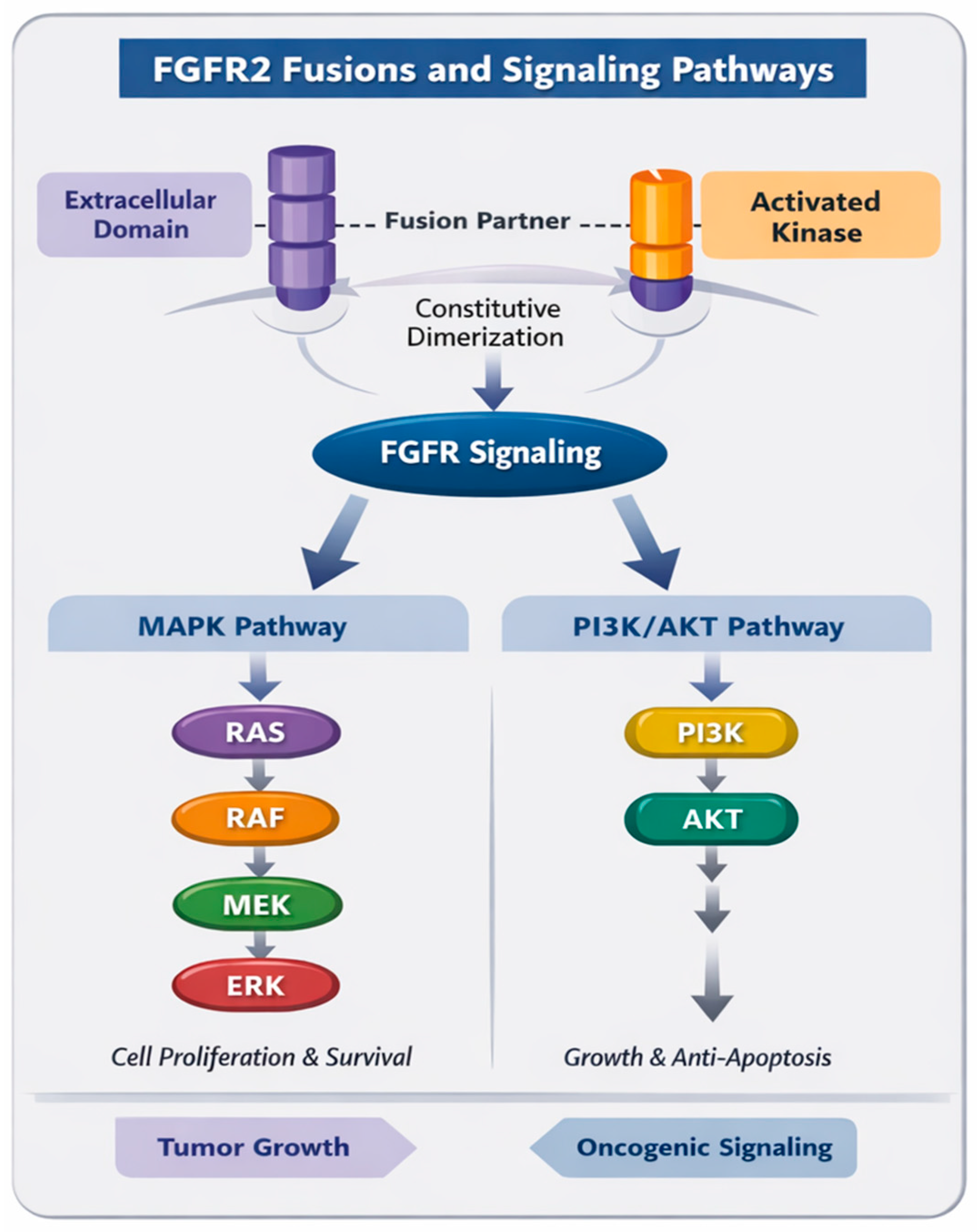
2.3. Downstream Signaling and Biological Effects
2.4. Clinical Significance
3. Clinical Development of FGFR Inhibitors in Biliary Tract Cancer
3.1. Overview of FGFR-Targeted Agents
3.2. Key Clinical Trials
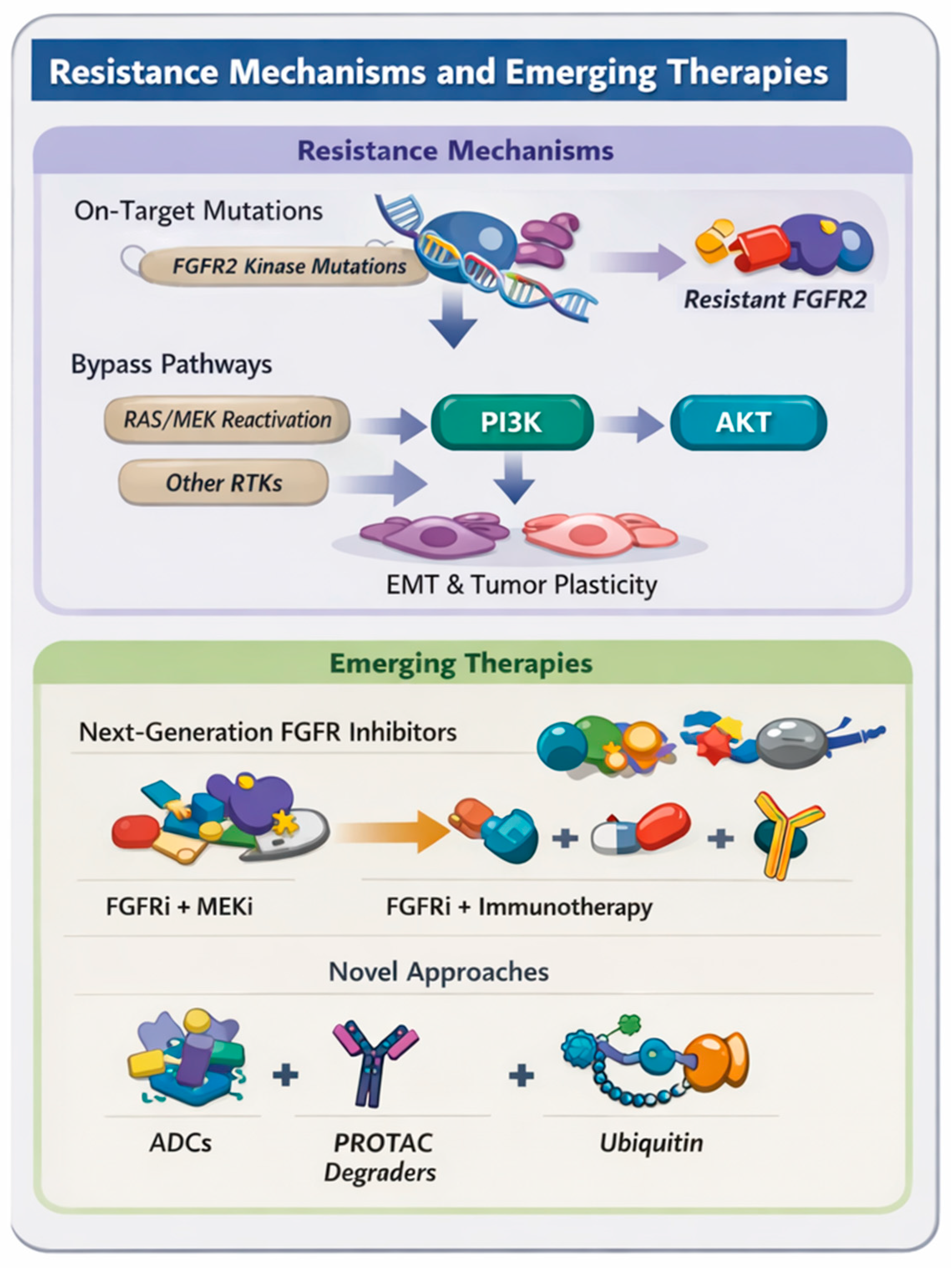
4. Mechanisms of Resistance to FGFR Inhibition
4.1. Overview
4.2. On-Target Resistance Mechanisms
4.3. Off-Target and Bypass Signaling Mechanisms
4.4. Role of Circulating Tumor DNA in Resistance Detection
5. Strategies to Overcome Resistance and Future Directions
5.1. Sequential and Next-Generation FGFR Inhibitors
5.2. Combination Strategies Targeting Bypass Pathways
5.3. Role of Antibody-Based and Non-TKI Strategies
5.4. Integration of ctDNA-Guided Precision Oncology
5.5. Clinical Implications and Treatment Sequencing Considerations
5.6. Adaptive Clinical Trial Designs
6. Conclusions
Author Contributions
Funding
Institutional Review Board Statement
Informed Consent Statement
Data Availability Statement
Acknowledgments
Conflicts of Interest
Abbreviations
| BTC | Biliary tract cancer |
| iCCA | Intrahepatic cholangiocarcinoma |
| OS | Overall survival |
| mOS | Median overall survival |
| ICI | Immune checkpoint inhibitor |
| FGFR | Fibroblast growth factor receptor |
| IDH1 | isocitrate dehydrogenase 1 |
| BRAF | B-Raf proto-oncogene |
| HER2 | human epidermal growth factor receptor 2 |
| FGF | Fibroblast growth factor |
| RAS | Rat sarcoma |
| MAPK | mitogen-activated protein kinase |
| PI3K | phosphoinositide 3-kinase |
| AKT | protein kinase B |
| STAT | signal transducer and activator of transcription |
| FRS2 | fibroblast growth factor receptor substrate 2 |
| GRB2 | growth factor receptor-bound protein 2 |
| RAF | rapidly accelerated fibrosarcoma kinase |
| MEK | mitogen-activated protein kinase |
| ERK | extracellular signal-regulated kinase |
| mTOR | mechanistic target of rapamycin |
| PLCγ | phospholipase C γ |
| JAK | Janus kinase |
| eCCA | Extrahepatic cholangiocarcinoma |
| GBC | Gallbladder cancer |
| NTRK | neurotrophic tyrosine receptor kinase |
| ALK | anaplastic lymphoma kinase |
| ROS1 | c-ros oncogene 1 |
| ERBB2 | erb-b2 receptor tyrosine kinase 2 |
| IHC | Immunohistochemistry |
| ISH | In situ hybridization |
| NGS | Next-generation sequencing |
| TME | Tumor microenvironment |
| EGFR | epidermal growth factor receptor |
| EMT | Epithelial–mesenchymal transition |
| ORR | Objective response rate |
| PFS | Progression-free survival |
| mPFS | Median progression-free survival |
| TKI | Tyrosine kinase inhibitor |
| CCA | Cholangiocarcinoma |
| DOR | Duration of response |
| TEAE | Treatment emergent adverse event |
| mo | Month |
| FDA | The U.S. Food and Drug Administration |
| ctDNA | Circulating tumor DNA |
| RTK | Receptor tyrosine kinase |
| PROTAC | Proteolysis-targeting chimera |
| ADC | Antibody-drug conjugate |
References
- Rodon, J.; Damian, S.; Furqan, M.; Garcia-Donas, J.; Imai, H.; Italiano, A.; Spanggaard, I.; Ueno, M.; Yokota, T.; Veronese, M.L.; et al. Pemigatinib in previously treated solid tumors with activating FGFR1-FGFR3 alterations: Phase 2 FIGHT-207 basket trial. Nat. Med. 2024, 30, 1645–1654, Erratum in Nat. Med. 2024, 30, 2377. https://doi.org/10.1038/s41591-024-03072-w. [Google Scholar] [CrossRef] [PubMed]
- Lamarca, A.; Barriuso, J.; McNamara, M.G.; Valle, J.W. Biliary Tract Cancer: State of the Art and potential role of DNA Damage Repair. Cancer Treat. Rev. 2018, 70, 168–177. [Google Scholar] [CrossRef]
- Valle, J.; Wasan, H.; Palmer, D.H.; Cunningham, D.; Anthoney, A.; Maraveyas, A.; Madhusudan, S.; Iveson, T.; Hughes, S.; Pereira, S.P.; et al. Cisplatin plus gemcitabine versus gemcitabine for biliary tract cancer. N. Engl. J. Med. 2010, 362, 1273–1281. [Google Scholar] [CrossRef]
- Oh, D.Y.; Ruth He, A.; Qin, S.; Chen, L.T.; Okusaka, T.; Vogel, A.; Kim, J.W.; Suksombooncharoen, T.; Ah Lee, M.; Kitano, M.; et al. Durvalumab plus Gemcitabine and Cisplatin in Advanced Biliary Tract Cancer. NEJM Evid. 2022, 1, EVIDoa2200015. [Google Scholar] [CrossRef]
- Oh, D.Y.; He, A.R.; Qin, S.; Chen, L.T.; Okusaka, T.; Kim, J.W.; Suksombooncharoen, T.; Lee, M.A.; Kitano, M.; Burris, H.A.; et al. Durvalumab plus chemotherapy in advanced biliary tract cancer: 3-year overall survival update from the phase III TOPAZ-1 study. J. Hepatol. 2025, 83, 1092–1101. [Google Scholar] [CrossRef] [PubMed]
- Kelley, R.K.; Ueno, M.; Yoo, C.; Finn, R.S.; Furuse, J.; Ren, Z.; Yau, T.; Klumpen, H.J.; Chan, S.L.; Ozaka, M.; et al. Pembrolizumab in combination with gemcitabine and cisplatin compared with gemcitabine and cisplatin alone for patients with advanced biliary tract cancer (KEYNOTE-966): A randomised, double-blind, placebo-controlled, phase 3 trial. Lancet 2023, 401, 1853–1865, Erratum in Lancet 2023, 402, 964. https://doi.org/10.1016/S0140-6736(23)01904-9; Erratum in Lancet 2024, 403, 1140. https://doi.org/10.1016/S0140-6736(24)00545-2. [Google Scholar] [CrossRef]
- Farshidfar, F.; Zheng, S.; Gingras, M.C.; Newton, Y.; Shih, J.; Robertson, A.G.; Hinoue, T.; Hoadley, K.A.; Gibb, E.A.; Roszik, J.; et al. Integrative Genomic Analysis of Cholangiocarcinoma Identifies Distinct IDH-Mutant Molecular Profiles. Cell Rep. 2017, 18, 2780–2794. [Google Scholar] [CrossRef]
- Jusakul, A.; Cutcutache, I.; Yong, C.H.; Lim, J.Q.; Huang, M.N.; Padmanabhan, N.; Nellore, V.; Kongpetch, S.; Ng, A.W.T.; Ng, L.M.; et al. Whole-Genome and Epigenomic Landscapes of Etiologically Distinct Subtypes of Cholangiocarcinoma. Cancer Discov. 2017, 7, 1116–1135. [Google Scholar] [CrossRef]
- Nakamura, H.; Arai, Y.; Totoki, Y.; Shirota, T.; Elzawahry, A.; Kato, M.; Hama, N.; Hosoda, F.; Urushidate, T.; Ohashi, S.; et al. Genomic spectra of biliary tract cancer. Nat. Genet. 2015, 47, 1003–1010. [Google Scholar] [CrossRef]
- Javle, M.; Lowery, M.; Shroff, R.T.; Weiss, K.H.; Springfeld, C.; Borad, M.J.; Ramanathan, R.K.; Goyal, L.; Sadeghi, S.; Macarulla, T.; et al. Phase II Study of BGJ398 in Patients With FGFR-Altered Advanced Cholangiocarcinoma. J. Clin. Oncol. 2018, 36, 276–282. [Google Scholar] [CrossRef] [PubMed]
- Churi, C.R.; Shroff, R.; Wang, Y.; Rashid, A.; Kang, H.C.; Weatherly, J.; Zuo, M.; Zinner, R.; Hong, D.; Meric-Bernstam, F.; et al. Mutation profiling in cholangiocarcinoma: Prognostic and therapeutic implications. PLoS ONE 2014, 9, e115383. [Google Scholar] [CrossRef]
- Turner, N.; Grose, R. Fibroblast growth factor signalling: From development to cancer. Nat. Rev. Cancer 2010, 10, 116–129. [Google Scholar] [CrossRef] [PubMed]
- Arai, Y.; Totoki, Y.; Hosoda, F.; Shirota, T.; Hama, N.; Nakamura, H.; Ojima, H.; Furuta, K.; Shimada, K.; Okusaka, T.; et al. Fibroblast growth factor receptor 2 tyrosine kinase fusions define a unique molecular subtype of cholangiocarcinoma. Hepatology 2014, 59, 1427–1434. [Google Scholar] [CrossRef] [PubMed]
- Wu, Y.M.; Su, F.; Kalyana-Sundaram, S.; Khazanov, N.; Ateeq, B.; Cao, X.; Lonigro, R.J.; Vats, P.; Wang, R.; Lin, S.F.; et al. Identification of targetable FGFR gene fusions in diverse cancers. Cancer Discov. 2013, 3, 636–647. [Google Scholar] [CrossRef]
- Abou-Alfa, G.K.; Sahai, V.; Hollebecque, A.; Vaccaro, G.; Melisi, D.; Al-Rajabi, R.; Paulson, A.S.; Borad, M.J.; Gallinson, D.; Murphy, A.G.; et al. Pemigatinib for previously treated, locally advanced or metastatic cholangiocarcinoma: A multicentre, open-label, phase 2 study. Lancet Oncol. 2020, 21, 671–684, Erratum in Lancet Oncol. 2023, 25, e3. https://doi.org/10.1016/S1470-2045(23)00642-3. [Google Scholar] [CrossRef] [PubMed]
- Goyal, L.; Meric-Bernstam, F.; Hollebecque, A.; Valle, J.W.; Morizane, C.; Karasic, T.B.; Abrams, T.A.; Furuse, J.; Kelley, R.K.; Cassier, P.A.; et al. Futibatinib for FGFR2-Rearranged Intrahepatic Cholangiocarcinoma. N. Engl. J. Med. 2023, 388, 228–239. [Google Scholar] [CrossRef]
- Wu, Q.; Ellis, H.; Siravegna, G.; Michel, A.G.; Norden, B.L.; Fece de la Cruz, F.; Balasooriya, E.R.; Zhen, Y.; Silveira, V.S.; Che, J.; et al. Landscape of Clinical Resistance Mechanisms to FGFR Inhibitors in FGFR2-Altered Cholangiocarcinoma. Clin. Cancer Res. 2024, 30, 198–208. [Google Scholar] [CrossRef]
- Facchinetti, F.; Loriot, Y.; Braye, F.; Vasseur, D.; Bahleda, R.; Bigot, L.; Barbe, R.; Nobre, C.; Combarel, D.; Michiels, S.; et al. Understanding and Overcoming Resistance to Selective FGFR Inhibitors across FGFR2-Driven Malignancies. Clin. Cancer Res. 2024, 30, 4943–4956. [Google Scholar] [CrossRef]
- Brooks, A.N.; Kilgour, E.; Smith, P.D. Molecular pathways: Fibroblast growth factor signaling: A new therapeutic opportunity in cancer. Clin. Cancer Res. 2012, 18, 1855–1862. [Google Scholar] [CrossRef]
- Dienstmann, R.; Rodon, J.; Prat, A.; Perez-Garcia, J.; Adamo, B.; Felip, E.; Cortes, J.; Iafrate, A.J.; Nuciforo, P.; Tabernero, J. Genomic aberrations in the FGFR pathway: Opportunities for targeted therapies in solid tumors. Ann. Oncol. 2014, 25, 552–563. [Google Scholar] [CrossRef]
- Ornitz, D.M.; Itoh, N. The Fibroblast Growth Factor signaling pathway. Wiley Interdiscip. Rev. Dev. Biol. 2015, 4, 215–266. [Google Scholar] [CrossRef]
- Katoh, M. Therapeutics Targeting FGF Signaling Network in Human Diseases. Trends Pharmacol. Sci. 2016, 37, 1081–1096. [Google Scholar] [CrossRef]
- Lowery, M.A.; Ptashkin, R.; Jordan, E.; Berger, M.F.; Zehir, A.; Capanu, M.; Kemeny, N.E.; O’Reilly, E.M.; El-Dika, I.; Jarnagin, W.R.; et al. Comprehensive Molecular Profiling of Intrahepatic and Extrahepatic Cholangiocarcinomas: Potential Targets for Intervention. Clin. Cancer Res. 2018, 24, 4154–4161. [Google Scholar] [CrossRef]
- Graham, R.P.; Barr Fritcher, E.G.; Pestova, E.; Schulz, J.; Sitailo, L.A.; Vasmatzis, G.; Murphy, S.J.; McWilliams, R.R.; Hart, S.N.; Halling, K.C.; et al. Fibroblast growth factor receptor 2 translocations in intrahepatic cholangiocarcinoma. Hum. Pathol. 2014, 45, 1630–1638. [Google Scholar] [CrossRef]
- Andersen, J.B.; Spee, B.; Blechacz, B.R.; Avital, I.; Komuta, M.; Barbour, A.; Conner, E.A.; Gillen, M.C.; Roskams, T.; Roberts, L.R.; et al. Genomic and genetic characterization of cholangiocarcinoma identifies therapeutic targets for tyrosine kinase inhibitors. Gastroenterology 2012, 142, 1021–1031.e15. [Google Scholar] [CrossRef] [PubMed]
- Jain, A.; Borad, M.J.; Kelley, R.K.; Wang, Y.; Abdel-Wahab, R.; Meric-Bernstam, F.; Baggerly, K.A.; Kaseb, A.O.; Al-Shamsi, H.O.; Ahn, D.H.; et al. Cholangiocarcinoma With FGFR Genetic Aberrations: A Unique Clinical Phenotype. JCO Precis. Oncol. 2018, 2, 1–12. [Google Scholar] [CrossRef] [PubMed]
- Droz Dit Busset, M.; Shaib, W.L.; Mody, K.; Personeni, N.; Damjanov, N.; Harris, W.P.; Bergamo, F.; Brandi, G.; Masi, G.; Halfdanarson, T.R.; et al. 47P Derazantinib for patients with intrahepatic cholangiocarcinoma harboring FGFR2 fusions/rearrangements: Primary results from the phase II study FIDES-01. Ann. Oncol. 2021, 32, S376. [Google Scholar] [CrossRef]
- Borad, M.J.; Champion, M.D.; Egan, J.B.; Liang, W.S.; Fonseca, R.; Bryce, A.H.; McCullough, A.E.; Barrett, M.T.; Hunt, K.; Patel, M.D.; et al. Integrated genomic characterization reveals novel, therapeutically relevant drug targets in FGFR and EGFR pathways in sporadic intrahepatic cholangiocarcinoma. PLoS Genet. 2014, 10, e1004135. [Google Scholar] [CrossRef] [PubMed]
- Touat, M.; Ileana, E.; Postel-Vinay, S.; Andre, F.; Soria, J.C. Targeting FGFR Signaling in Cancer. Clin. Cancer Res. 2015, 21, 2684–2694. [Google Scholar] [CrossRef]
- Babina, I.S.; Turner, N.C. Advances and challenges in targeting FGFR signalling in cancer. Nat. Rev. Cancer 2017, 17, 318–332. [Google Scholar] [CrossRef]
- Katoh, M. Fibroblast growth factor receptors as treatment targets in clinical oncology. Nat. Rev. Clin. Oncol. 2019, 16, 105–122. [Google Scholar] [CrossRef]
- Sia, D.; Hoshida, Y.; Villanueva, A.; Roayaie, S.; Ferrer, J.; Tabak, B.; Peix, J.; Sole, M.; Tovar, V.; Alsinet, C.; et al. Integrative molecular analysis of intrahepatic cholangiocarcinoma reveals 2 classes that have different outcomes. Gastroenterology 2013, 144, 829–840. [Google Scholar] [CrossRef]
- Sridharan, V.; Neyaz, A.; Chogule, A.; Baiev, I.; Reyes, S.; Barr Fritcher, E.G.; Lennerz, J.K.; Sukov, W.; Kipp, B.; Ting, D.T.; et al. FGFR mRNA Expression in Cholangiocarcinoma and Its Correlation with FGFR2 Fusion Status and Immune Signatures. Clin. Cancer Res. 2022, 28, 5431–5439. [Google Scholar] [CrossRef]
- Javle, M.; Roychowdhury, S.; Kelley, R.K.; Sadeghi, S.; Macarulla, T.; Weiss, K.H.; Waldschmidt, D.T.; Goyal, L.; Borbath, I.; El-Khoueiry, A.; et al. Infigratinib (BGJ398) in previously treated patients with advanced or metastatic cholangiocarcinoma with FGFR2 fusions or rearrangements: Mature results from a multicentre, open-label, single-arm, phase 2 study. Lancet Gastroenterol. Hepatol. 2021, 6, 803–815. [Google Scholar] [CrossRef]
- Kommalapati, A.; Tella, S.H.; Borad, M.; Javle, M.; Mahipal, A. FGFR Inhibitors in Oncology: Insight on the Management of Toxicities in Clinical Practice. Cancers 2021, 13, 2968. [Google Scholar] [CrossRef]
- Benson, A.B., 3rd; D’Angelica, M.I.; Abrams, T.; Ahmed, A.; Akce, M.; Anaya, D.A.; Anders, R.; Are, C.; Aye, L.; Bachini, M.; et al. Biliary Tract Cancers, Version 2.2025, NCCN Clinical Practice Guidelines In Oncology. J. Natl. Compr. Canc. Netw. 2025, 23, 403–418. [Google Scholar] [CrossRef]
- Chmiel, P.; Geca, K.; Rawicz-Pruszynski, K.; Polkowski, W.P.; Skorzewska, M. FGFR Inhibitors in Cholangiocarcinoma-A Novel Yet Primary Approach: Where Do We Stand Now and Where to Head Next in Targeting This Axis? Cells 2022, 11, 3929. [Google Scholar] [CrossRef] [PubMed]
- Vogel, A.; Sahai, V.; Hollebecque, A.; Vaccaro, G.M.; Melisi, D.; Al Rajabi, R.M.; Paulson, A.S.; Borad, M.J.; Gallinson, D.; Murphy, A.G.; et al. An open-label study of pemigatinib in cholangiocarcinoma: Final results from FIGHT-202. ESMO Open 2024, 9, 103488. [Google Scholar] [CrossRef] [PubMed]
- Mazzaferro, V.; El-Rayes, B.F.; Droz Dit Busset, M.; Cotsoglou, C.; Harris, W.P.; Damjanov, N.; Masi, G.; Rimassa, L.; Personeni, N.; Braiteh, F.; et al. Derazantinib (ARQ 087) in advanced or inoperable FGFR2 gene fusion-positive intrahepatic cholangiocarcinoma. Br. J. Cancer 2019, 120, 165–171. [Google Scholar] [CrossRef] [PubMed]
- Goyal, L.; Meric-Bernstam, F.; Hollebecque, A.; Valle, J.W.; Morizane, C.; Karasic, T.B.; Abrams, T.A.; Furuse, J.; Kelley, R.K.; Cassier, P.A.; et al. Plain language summary of the FOENIX-CCA2 study: Futibatinib for people with advanced bile duct cancer. Future Oncol. 2024, 20, 2811–2822. [Google Scholar] [CrossRef]
- Pant, S.; Schuler, M.H.; Iyer, G.; Doi, T.; Qin, S.; Tabernero, J.; Arnold, D.; Gutierrez, M.; Prenen, H.; Folprecht, G.; et al. Efficacy and safety of erdafitinib in adults with cholangiocarcinoma (CCA) with prespecified fibroblast growth factor receptor alterations (FGFRalt) in the phase 2 open-label, single-arm RAGNAR trial: Expansion cohort results. J. Clin. Oncol. 2023, 41, 610. [Google Scholar] [CrossRef]
- Bekaii-Saab, T.S.; Valle, J.W.; Van Cutsem, E.; Rimassa, L.; Furuse, J.; Ioka, T.; Melisi, D.; Macarulla, T.; Bridgewater, J.; Wasan, H.; et al. FIGHT-302: First-line pemigatinib vs gemcitabine plus cisplatin for advanced cholangiocarcinoma with FGFR2 rearrangements. Future Oncol. 2020, 16, 2385–2399. [Google Scholar] [CrossRef]
- Necchi, A.; Ramlau, R.; Falcon Gonzalez, A.; Chaudhry, A.; Todenhofer, T.; Tahbaz, R.; Fontana, E.; Giannatempo, P.; Deville, J.L.; Pouessel, D.; et al. Derazantinib alone and with atezolizumab in metastatic urothelial carcinoma with activating FGFR aberrations. JNCI Cancer Spectr. 2024, 8, pkae030. [Google Scholar] [CrossRef]
- Meric-Bernstam, F.; Bahleda, R.; Hierro, C.; Sanson, M.; Bridgewater, J.; Arkenau, H.T.; Tran, B.; Kelley, R.K.; Park, J.O.; Javle, M.; et al. Futibatinib, an Irreversible FGFR1-4 Inhibitor, in Patients with Advanced Solid Tumors Harboring FGF/FGFR Aberrations: A Phase I Dose-Expansion Study. Cancer Discov. 2022, 12, 402–415. [Google Scholar] [CrossRef]
- Goyal, L.; Shi, L.; Liu, L.Y.; Fece de la Cruz, F.; Lennerz, J.K.; Raghavan, S.; Leschiner, I.; Elagina, L.; Siravegna, G.; Ng, R.W.S.; et al. TAS-120 Overcomes Resistance to ATP-Competitive FGFR Inhibitors in Patients with FGFR2 Fusion-Positive Intrahepatic Cholangiocarcinoma. Cancer Discov. 2019, 9, 1064–1079. [Google Scholar] [CrossRef] [PubMed]
- Pant, S.; Schuler, M.; Iyer, G.; Witt, O.; Doi, T.; Qin, S.; Tabernero, J.; Reardon, D.A.; Massard, C.; Minchom, A.; et al. Erdafitinib in patients with advanced solid tumours with FGFR alterations (RAGNAR): An international, single-arm, phase 2 study. Lancet Oncol. 2023, 24, 925–935. [Google Scholar] [CrossRef] [PubMed]
- Walden, D.; Eslinger, C.; Bekaii-Saab, T. Pemigatinib for adults with previously treated, locally advanced or metastatic cholangiocarcinoma with FGFR2 fusions/rearrangements. Ther. Adv. Gastroenterol. 2022, 15, 17562848221115317. [Google Scholar] [CrossRef] [PubMed]
- Goyal, L.; Saha, S.K.; Liu, L.Y.; Siravegna, G.; Leshchiner, I.; Ahronian, L.G.; Lennerz, J.K.; Vu, P.; Deshpande, V.; Kambadakone, A.; et al. Polyclonal Secondary FGFR2 Mutations Drive Acquired Resistance to FGFR Inhibition in Patients with FGFR2 Fusion-Positive Cholangiocarcinoma. Cancer Discov. 2017, 7, 252–263. [Google Scholar] [CrossRef]
- Goyal, L.; DiToro, D.; Facchinetti, F.; Martin, E.E.; Peng, P.; Baiev, I.; Iyer, R.; Maurer, J.; Reyes, S.; Zhang, K.; et al. A model for decoding resistance in precision oncology: Acquired resistance to FGFR inhibitors in cholangiocarcinoma. Ann. Oncol. 2025, 36, 426–443. [Google Scholar] [CrossRef]
- Lin, Q.; Chen, X.; Qu, L.; Guo, M.; Wei, H.; Dai, S.; Jiang, L.; Chen, Y. Characterization of the cholangiocarcinoma drug pemigatinib against FGFR gatekeeper mutants. Commun. Chem. 2022, 5, 100. [Google Scholar] [CrossRef]
- Silverman, I.M.; Hollebecque, A.; Friboulet, L.; Owens, S.; Newton, R.C.; Zhen, H.; Feliz, L.; Zecchetto, C.; Melisi, D.; Burn, T.C. Clinicogenomic Analysis of FGFR2-Rearranged Cholangiocarcinoma Identifies Correlates of Response and Mechanisms of Resistance to Pemigatinib. Cancer Discov. 2021, 11, 326–339. [Google Scholar] [CrossRef] [PubMed]
- Varghese, A.M.; Patel, J.; Janjigian, Y.Y.; Meng, F.; Selcuklu, S.D.; Iyer, G.; Houck-Loomis, B.; Harding, J.J.; O’Reilly, E.M.; Abou-Alfa, G.K.; et al. Noninvasive Detection of Polyclonal Acquired Resistance to FGFR Inhibition in Patients With Cholangiocarcinoma Harboring FGFR2 Alterations. JCO Precis. Oncol. 2021, 5, 44–50. [Google Scholar] [CrossRef]
- DiPeri, T.P.; Zhao, M.; Evans, K.W.; Varadarajan, K.; Moss, T.; Scott, S.; Kahle, M.P.; Byrnes, C.C.; Chen, H.; Lee, S.S.; et al. Convergent MAPK pathway alterations mediate acquired resistance to FGFR inhibitors in FGFR2 fusion-positive cholangiocarcinoma. J. Hepatol. 2024, 80, 322–334. [Google Scholar] [CrossRef]
- Krook, M.A.; Lenyo, A.; Wilberding, M.; Barker, H.; Dantuono, M.; Bailey, K.M.; Chen, H.Z.; Reeser, J.W.; Wing, M.R.; Miya, J.; et al. Efficacy of FGFR Inhibitors and Combination Therapies for Acquired Resistance in FGFR2-Fusion Cholangiocarcinoma. Mol. Cancer Ther. 2020, 19, 847–857. [Google Scholar] [CrossRef]
- Lim, M.; Lynch, P.T.; Bai, X.; Hsiehchen, D. Oncogenic RAS Drives Resistance to Pemigatinib in Cholangiocarcinoma Harboring a FGFR2 Delins Disrupting Ligand Binding. JCO Precis. Oncol. 2023, 7, e2200340. [Google Scholar] [CrossRef]
- Kitowska, K.; Gorska-Arcisz, M.; Antoun, D.; Zarczynska, I.; Czaplinska, D.; Szczepaniak, A.; Skladanowski, A.C.; Wieczorek, M.; Stanczak, A.; Skupinska, M.; et al. MET-Pyk2 Axis Mediates Acquired Resistance to FGFR Inhibition in Cancer Cells. Front. Oncol. 2021, 11, 633410. [Google Scholar] [CrossRef] [PubMed]
- Wu, Q.; Zhen, Y.; Shi, L.; Vu, P.; Greninger, P.; Adil, R.; Merritt, J.; Egan, R.; Wu, M.J.; Yin, X.; et al. EGFR Inhibition Potentiates FGFR Inhibitor Therapy and Overcomes Resistance in FGFR2 Fusion-Positive Cholangiocarcinoma. Cancer Discov. 2022, 12, 1378–1395. [Google Scholar] [CrossRef] [PubMed]
- Vaquero, J.; Guedj, N.; Claperon, A.; Nguyen Ho-Bouldoires, T.H.; Paradis, V.; Fouassier, L. Epithelial-mesenchymal transition in cholangiocarcinoma: From clinical evidence to regulatory networks. J. Hepatol. 2017, 66, 424–441. [Google Scholar] [CrossRef]
- Seo, J.; Ha, J.; Kang, E.; Cho, S. The role of epithelial-mesenchymal transition-regulating transcription factors in anti-cancer drug resistance. Arch. Pharm. Res. 2021, 44, 281–292. [Google Scholar] [CrossRef]
- Katoh, M.; Loriot, Y.; Brandi, G.; Tavolari, S.; Wainberg, Z.A.; Katoh, M. FGFR-targeted therapeutics: Clinical activity, mechanisms of resistance and new directions. Nat. Rev. Clin. Oncol. 2024, 21, 312–329. [Google Scholar] [CrossRef]
- Gonzalez-Medina, A.; Vila-Casadesus, M.; Gomez-Rey, M.; Fabregat-Franco, C.; Sierra, A.; Tian, T.V.; Castet, F.; Castillo, G.; Matito, J.; Martinez, P.; et al. Clinical Value of Liquid Biopsy in Patients with FGFR2 Fusion-Positive Cholangiocarcinoma During Targeted Therapy. Clin. Cancer Res. 2024, 30, 4491–4504. [Google Scholar] [CrossRef]
- Sootome, H.; Fujita, H.; Ito, K.; Ochiiwa, H.; Fujioka, Y.; Ito, K.; Miura, A.; Sagara, T.; Ito, S.; Ohsawa, H.; et al. Futibatinib Is a Novel Irreversible FGFR 1-4 Inhibitor That Shows Selective Antitumor Activity against FGFR-Deregulated Tumors. Cancer Res. 2020, 80, 4986–4997. [Google Scholar] [CrossRef]
- Chen, L. Next-generation isoform-selective fibroblast growth factor receptor inhibitors. Trends Pharmacol. Sci. 2025, 46, 1091–1104. [Google Scholar] [CrossRef]
- Yue, H.; Wang, Y.; Zhang, N.; Xing, J.; Wang, T.; Bao, Y.; Hou, Y.; Zhao, Y. Small-molecule FGFR-targeted medicinal chemistry: Advances since 2020 and future perspectives. Eur. J. Med. Chem. 2025, 300, 118117. [Google Scholar] [CrossRef] [PubMed]
- Kawano, S.; Kawada, M.I.; Fukushima, S.; Arai, Y.; Shibata, T.; Miyano, S.W. Antitumor Activity of Tasurgratinib as an Orally Available FGFR1-3 Inhibitor in Cholangiocarcinoma Models With FGFR2-fusion. Anticancer. Res. 2024, 44, 2393–2406. [Google Scholar] [CrossRef] [PubMed]
- Balasooriya, E.R.; Wu, Q.; Ellis, H.; Zhen, Y.; Norden, B.L.; Corcoran, R.B.; Mohan, A.; Martin, E.; Franovic, A.; Tyhonas, J.; et al. The Irreversible FGFR Inhibitor KIN-3248 Overcomes FGFR2 Kinase Domain Mutations. Clin. Cancer Res. 2024, 30, 2181–2192. [Google Scholar] [CrossRef] [PubMed]
- Schonherr, H.; Ayaz, P.; Taylor, A.M.; Casaletto, J.B.; Toure, B.B.; Moustakas, D.T.; Hudson, B.M.; Valverde, R.; Zhao, S.; O’Hearn, P.J.; et al. Discovery of lirafugratinib (RLY-4008), a highly selective irreversible small-molecule inhibitor of FGFR2. Proc. Natl. Acad. Sci. USA 2024, 121, e2317756121. [Google Scholar] [CrossRef]
- Rodon Ahnert, J.; Roychowdhury, S.; Ellis, H.; Blanco, F.F.; Burn, T.; Davis, J.M.; Balcer, A.; Zalutskaya, A.; Kelley, R.K. A multicenter, open-label, first-in-human study of TYRA-200 in advanced intrahepatic cholangiocarcinoma and other solid tumors with activating FGFR2 gene alterations (SURF201). J. Clin. Oncol. 2025, 43, TPS646. [Google Scholar] [CrossRef]
- Nguyen, M.H.; Ye, H.F.; Xu, Y.; Truong, L.; Horsey, A.; Zhao, P.; Styduhar, E.D.; Frascella, M.; Leffet, L.; Federowicz, K.; et al. Discovery of Orally Bioavailable FGFR2/FGFR3 Dual Inhibitors via Structure-Guided Scaffold Repurposing Approach. ACS Med. Chem. Lett. 2023, 14, 312–318. [Google Scholar] [CrossRef]
- Sasanuma, H.; Yamaguchi, H. Sequential Fibroblast Growth Factor Receptor Inhibition in Intrahepatic Cholangiocarcinoma: Navigating an Evolving Landscape of Resistance and Opportunity-A Case Report and Current Opinion. Oncol. Ther. 2025, 13, 1243–1253. [Google Scholar] [CrossRef]
- Piha-Paul, S.A.; Xu, B.; Dumbrava, E.E.; Fu, S.; Karp, D.D.; Meric-Bernstam, F.; Hong, D.S.; Rodon, J.A.; Tsimberidou, A.M.; Raghav, K.; et al. First-In-Human Phase I Study of Tinengotinib (TT-00420), a Multiple Kinase Inhibitor, as a Single Agent in Patients With Advanced Solid Tumors. Oncologist 2024, 29, e514–e525. [Google Scholar] [CrossRef]
- Javle, M.; Fountzilas, C.; Liao, C.Y.; Pelster, M.; Li, D.; Deming, D.; Sahai, V.; Fonkoua, L.K.; Cohn, A.; Mantry, P.; et al. Tinengotinib for adults with advanced or metastatic cholangiocarcinoma: A multicentre, open-label, phase 2 trial. Lancet Gastroenterol. Hepatol. 2025, 11, 137–149. [Google Scholar] [CrossRef] [PubMed]
- Hollebecque, A.; Borad, M.J.; Lu, P.; Meng, X.; Ryan, K.; Alexander, L.; Liu, J.; Oh, D.-Y.; Kim, R.D. Efficacy and safety of lirafugratinib in FGFRi-naïve cholangiocarcinoma (CCA) patients harboring FGFR2 fusions/rearrangements (FGFR2 f/r). J. Clin. Oncol. 2026, 44, 476. [Google Scholar] [CrossRef]
- Borad, M.J.; Schram, A.M.; Kim, R.D.; Kamath, S.D.; Sahai, V.; Dotan, E.; Kelley, R.K.; Ponz-Sarvise, M.; Oh, D.-Y.; Yachnin, J.; et al. Updated dose escalation results for ReFocus, a first-in-human study of highly selective FGFR2 inhibitor RLY-4008 in cholangiocarcinoma and other solid tumors. J. Clin. Oncol. 2023, 41, 4009. [Google Scholar] [CrossRef]
- Morizane, C.; Ueno, M.; Ioka, T.; Tajika, M.; Ikeda, M.; Yamaguchi, K.; Hara, H.; Yabusaki, H.; Miyamoto, A.; Iwasa, S.; et al. Tasurgratinib in patients with cholangiocarcinoma or gastric cancer: Expansion part of the first-in-human phase I study. Cancer Sci. 2025, 116, 192–203. [Google Scholar] [CrossRef]
- Mahaamnad, N.; Pocasap, P.; Kukongviriyapan, V.; Senggunprai, L.; Prawan, A.; Kongpetch, S. Dual blockage of PI3K-mTOR and FGFR induced autophagic cell death in cholangiocarcinoma cells. Heliyon 2024, 10, e31112. [Google Scholar] [CrossRef] [PubMed]
- Kong, Y.; Zhao, X.; Wang, Z.; Yuan, S.; Chen, S.; Lou, S.; Ma, S.; Li, Y.; Wang, X.; Ge, Y.; et al. A Selective FGFR1/2 PROTAC Degrader with Antitumor Activity. Mol. Cancer Ther. 2024, 23, 1084–1094. [Google Scholar] [CrossRef]
- Hu, Z.; Zhang, Q.; Li, Z.; Yang, H.; Chen, X.; Zhang, Q.; Yang, T.; He, X.; Feng, Q.; He, J.; et al. Design, synthesis and antitumor activity of a novel FGFR2-selective degrader to overcome resistance of the FGFR2(V564F) gatekeeper mutation based on a pan-FGFR inhibitor. Eur. J. Med. Chem. 2024, 275, 116612. [Google Scholar] [CrossRef]
- Burslem, G.M.; Crews, C.M. Proteolysis-Targeting Chimeras as Therapeutics and Tools for Biological Discovery. Cell 2020, 181, 102–114. [Google Scholar] [CrossRef]
- Kim, S.B.; Meric-Bernstam, F.; Kalyan, A.; Babich, A.; Liu, R.; Tanigawa, T.; Sommer, A.; Osada, M.; Reetz, F.; Laurent, D.; et al. First-in-Human Phase I Study of Aprutumab Ixadotin, a Fibroblast Growth Factor Receptor 2 Antibody-Drug Conjugate (BAY 1187982) in Patients with Advanced Cancer. Target. Oncol. 2019, 14, 591–601. [Google Scholar] [CrossRef]
- Teng, F.; Guo, H.; Li, H.; Qin, L.; Yao, X.; Shi, L.; Gu, Y.; Qian, X. Abstract 4769: Characterization of novel humanized FGFR2b antibody-based ADCs site-specifically conjugated with topoisomerase I inhibitor payload in preclinical tumor models. Cancer Res. 2025, 85, 4769. [Google Scholar] [CrossRef]
- Chen, B.; Zheng, X.; Wu, J.; Chen, G.; Yu, J.; Xu, Y.; Wu, W.K.K.; Tse, G.M.K.; To, K.F.; Kang, W. Antibody-drug conjugates in cancer therapy: Current landscape, challenges, and future directions. Mol. Cancer 2025, 24, 279. [Google Scholar] [CrossRef]
- Chaturantabut, S.; Oliver, S.; Frederick, D.T.; Kim, J.J.; Robinson, F.P.; Sinopoli, A.; Song, T.Y.; He, Y.; Chang, Y.C.; Rodriguez, D.J.; et al. Identification of potent biparatopic antibodies targeting FGFR2 fusion-driven cholangiocarcinoma. J. Clin. Investig. 2025, 135, e182417. [Google Scholar] [CrossRef] [PubMed]
- Szymczyk, J.; Sochacka, M.; Biadun, M.; Sluzalska, K.D.; Witkowska, D.; Zakrzewska, M. Overcoming drug resistance of cancer cells by targeting the FGF1/FGFR1 axis with honokiol or FGF ligand trap. Front. Pharmacol. 2024, 15, 1459820. [Google Scholar] [CrossRef] [PubMed]
- Yang, Y.; Suhasini, A.N.; Jiang, Z.; Liu, N.; Rosconi, M.; Zhang, B.; Li, Y.; Dudgeon, D.; Seong, C.; Kim, S.; et al. A Tetravalent Bispecific Antibody Selectively Inhibits Diverse FGFR3 Oncogenic Variants. Cancer Res. 2024, 84, 2169–2180. [Google Scholar] [CrossRef]
- Lin, K.; Xia, B.; Wang, X.; He, X.; Zhou, M.; Lin, Y.; Qiao, Y.; Li, R.; Chen, Q.; Li, Y.; et al. Development of nanobodies targeting hepatocellular carcinoma and application of nanobody-based CAR-T technology. J. Transl. Med. 2024, 22, 349. [Google Scholar] [CrossRef]
- Gujarathi, R.; Peshin, S.; Zhang, X.; Bachini, M.; Meeks, M.N.; Shroff, R.T.; Pillai, A. Intrahepatic cholangiocarcinoma: Insights on molecular testing, targeted therapies, and future directions from a multidisciplinary panel. Hepatol. Commun. 2025, 9, e0743. [Google Scholar] [CrossRef] [PubMed]
- Cowzer, D.; Darmofal, M.; Seier, K.; Thummalapalli, R.; Walch, H.; El Dika, I.; Khalil, D.N.; Park, W.; Dhyani, A.; Yaqubie, A.; et al. Clinical Utility and Prognostic Implications of Circulating Cell-Free DNA in Biliary Tract Cancer. JCO Precis. Oncol. 2025, 9, e2500355. [Google Scholar] [CrossRef]
- Hu, C.; Dignam, J.J. Biomarker-Driven Oncology Clinical Trials: Key Design Elements, Types, Features, and Practical Considerations. JCO Precis. Oncol. 2019, 3, 1–12. [Google Scholar] [CrossRef]
- Sanz-Garcia, E.; Zhao, E.; Bratman, S.V.; Siu, L.L. Monitoring and adapting cancer treatment using circulating tumor DNA kinetics: Current research, opportunities, and challenges. Sci. Adv. 2022, 8, eabi8618. [Google Scholar] [CrossRef]



| Molecular Alteration (Biomarker) | Predominant BTC Subtype(s) | Approx. Prevalence (by Subtype) | Representative Targeted Therapy Options | Highest Level of Clinical Evidence |
|---|---|---|---|---|
| FGFR2 fusion/rearrangement | iCCA | iCCA: ~10–15%|eCCA/GBC: rare | Pemigatinib, futibatinib | Phase II trials |
| IDH1 mutation | iCCA | iCCA: up to ~20%|eCCA/GBC: uncommon | Ivosidenib | Phase III trial |
| HER2 (ERBB2) overexpression/amplification * | eCCA, GBC (also seen in a subset of iCCA) | eCCA: ~17% HER2 overexpression|iCCA: ~5%|GBC: variable; higher than CCA in many series | Zanidatamab-hrii (HER2 bispecific antibody); trastuzumab-based regimens (context-dependent) | Phase II trials |
| BRAF V600E mutation | Pan-BTC (rare) | BTC overall: ~1–5% (reported in BTC; varies by cohort) | Dabrafenib + trametinib | Phase II trial |
| NTRK gene fusion | Tumor-agnostic (very rare in BTC) | BTC/GBC/CCA: <1% | Larotrectinib, entrectinib, repotrectinib | Phase II basket trials |
| MSI-H/dMMR | Tumor-agnostic (rare) | BTC overall MSI-H: ~1–3% (range across studies) | Pembrolizumab | Phase II trials |
| Agent | Type/Selectivity | Mechanism of Inhibition | Key Clinical Trials | Population | Outcomes * | Regulatory Status in US | Reference |
|---|---|---|---|---|---|---|---|
| Pemigatinib | FGFR1-3 selective | Reversible ATP-competitive | FIGHT-202 [NCT02924376] | Previously treated CCA | ORR: 37.0% mPFS: 7.0 mo mOS: 17.5 mo | FDA accelerated approval in 2020 | [15,38] |
| Infigratinib | FGFR1-3 selective | Reversible ATP-competitive | NCT02150967 | Previously treated CCA with FGFR2 fusion/rearrangement | ORR: 23.1% mPFS: 7.3 mo mOS: 12.2 mo | FDA accelerated approval in 2021, withdrawal in 2024 | [34] |
| Derazantinib | FGFR1-3, multikinase | Reversible ATP-competitive | FIDES-01 [NCT03230318] | Previously treated iCCA with FGFR2 fusion/rearrangement | ORR: 21.4% mPFS: 7.8 mo mOS: 15.5 mo | No further development | [27,39] |
| Futibatinib | FGFR1-4 pan-selective | Irreversible (covalent) | FOENIX-CCA2 [NCT02052778] | Previously treated iCCA with FGFR2 fusion/rearrangement | ORR: 42% mPFS: 9.0 mo mOS: 21.7 mo | FDA accelerated approval in 2022 | [16,40] |
| Erdafitinib | FGFR1-4 pan-selective | Reversible ATP-competitive | RAGNAR [NCT04083976] | Previously treated FGFR-altered non-urothelial solid tumors | In CCA ORR: 60.0% mPFS: 8.4 mo mOS: 18.7 mo | [41] |
| Resistance Category | Representative Alterations | Effect on Drug Sensitivity | Therapeutic Implications |
|---|---|---|---|
| On-target FGFR2 kinase-domain mutations | N550D/K/H, E566A, V565F/L/I, K659M, C492R | Reduced binding of reversible TKIs; partial retention with irreversible futibatinib for some variants | Switch from reversible to irreversible FGFR inhibitor; consider trial of next-generation allele-specific agent |
| Polyclonal FGFR2 mutations | Multiple distinct FGFR2 mutations in same patient | Co-existence of sensitive and resistant clones | Combination therapy or next-generation TKI with broader coverage |
| Bypass signaling activation | KRAS/NRAS/BRAF mutations, MET/EGFR/ERBB2 amplifications | Reactivation of MAPK pathway independent of FGFR2 | Combine FGFR and MAPK/receptor tyrosine kinase (RTK) inhibitors in trial setting |
| Phenotypic transition (EMT) | Upregulation of TWIST1, SNAIL, ZEB1; loss of E-cadherin | Decreased FGFR dependency | Investigational epigenetic or EMT-targeting strategies |
| Histologic transformation/clonal evolution | Acquisition of non-epithelial features | Resistance to FGFR blockade and chemotherapy | Re-biopsy to guide treatment choice |
Disclaimer/Publisher’s Note: The statements, opinions and data contained in all publications are solely those of the individual author(s) and contributor(s) and not of MDPI and/or the editor(s). MDPI and/or the editor(s) disclaim responsibility for any injury to people or property resulting from any ideas, methods, instructions or products referred to in the content. |
© 2026 by the authors. Licensee MDPI, Basel, Switzerland. This article is an open access article distributed under the terms and conditions of the Creative Commons Attribution (CC BY) license.
Share and Cite
Xin, X.; Miao, R. FGFR2-Rearranged Biliary Tract Cancer: Biology, Resistance Mechanisms, and Emerging Therapeutic Strategies. Cancers 2026, 18, 531. https://doi.org/10.3390/cancers18030531
Xin X, Miao R. FGFR2-Rearranged Biliary Tract Cancer: Biology, Resistance Mechanisms, and Emerging Therapeutic Strategies. Cancers. 2026; 18(3):531. https://doi.org/10.3390/cancers18030531
Chicago/Turabian StyleXin, Xin, and Ruoyu Miao. 2026. "FGFR2-Rearranged Biliary Tract Cancer: Biology, Resistance Mechanisms, and Emerging Therapeutic Strategies" Cancers 18, no. 3: 531. https://doi.org/10.3390/cancers18030531
APA StyleXin, X., & Miao, R. (2026). FGFR2-Rearranged Biliary Tract Cancer: Biology, Resistance Mechanisms, and Emerging Therapeutic Strategies. Cancers, 18(3), 531. https://doi.org/10.3390/cancers18030531