Naloxegol, an Oral Peripherally Acting Opioid Receptor Antagonist, Administered Concurrently with First-Line Systemic Therapy for Advanced Lung Adenocarcinoma (Alliance A221504): A Feasibility and Safety Study

 , , , ,
  ,
,
Simple Summary
Abstract
1. Introduction
2. Materials and Methods
3. Results
4. Discussion
5. Conclusions
Supplementary Materials
Author Contributions
Funding
Institutional Review Board Statement
Informed Consent Statement
Data Availability Statement
Acknowledgments
Conflicts of Interest
Abbreviations
| ASCO | American Society of Clinical Oncology |
| CNS | Central Nervous System |
| DCP | Division of Cancer Prevention (of the National Cancer Institute) |
| ECOG | Eastern Cooperative Oncology Group |
| EML4-ALK | Echinoderm Microtubule-Associated Protein-Like 4-Anaplastic Lymphoma Kinase Fusion Gene |
| EGFR | Epidermal Growth Factor Receptor |
| EWB | Emotional Well-Being |
| FACT-G | Functional Assessment of Cancer Therapy-General |
| FACT-L | Functional Assessment of Cancer Therapy-Lung |
| FDA | Food and Drug Administration |
| FWB | Functional Well-Being |
| HRQoL | Health-Related Quality of Life |
| IQR | Inter-Quartile Range |
| LCS | Lung Cancer Subscale |
| MOR | Mu Opioid Receptor |
| NCI | National Cancer Institute |
| NCORP | NCI Community Oncology Research Program |
| NE | Not Evaluable |
| NSCLC | Non-Small Cell Lung Cancer |
| OIC | Opioid-Induced Constipation |
| OR | Opioid Receptor |
| OS | Overall Survival |
| PAMORA | Peripherally Acting Mu Opioid Receptor Antagonist |
| PFS | Progression-Free Survival |
| PRO-CTCAE | Patient Reported Outcomes-Common Terminology Criteria for Adverse Events |
| PWB | Physical Well-Being |
| SFWB | Social/Family Well-Being |
| TOI | Trial Outcome Index |
| 95% CI | 95% Confidence Interval |
Appendix A
- (i)
- the rate of accrual remaining ≥ 80% of the expected,
- (ii)
- ≥80% of patients who remain alive at 6 months continuing the study medication and completing the HRQoL and other forms, for at least 6 months, and
- (iii)
- the study continuing without meeting toxicity stopping criteria as specified below.
- If 5 or more patients in the first 20 treated patients (or 25% of all patients after 20 are accrued) experienced a grade 4 or higher non-hematologic adverse event and there was a higher rate in the highest dose active treatment arm as opposed to the placebo arm.
- The study team reviewed grade 4 and 5 adverse events deemed “unrelated” or “unlikely to be related” to verify their attribution and to monitor the emergence of a previously unrecognized treatment-related adverse event.
- (i)
- the change from baseline to 6 months in Trial Outcome Index (TOI), function subscales, and Lung Cancer Subscale (LCS) of the Functional Assessment of Cancer Therapy-Lung (FACT-L),
- (ii)
- patient-reported outcomes assessed by PRO-CTCAEs and urinary retention,
- (iii)
- opioid-induced constipation rating,
- (iv)
- pain and analgesic use,
- (v)
- clinical outcomes unexpected for the systemic therapy given,
- (vi)
- progression-free survival (PFS), and
- (vii)
- overall survival (OS).
- (i)
- The observed accrual rate was calculated as the total number of patients accrued to the study over two years divided by 184, the total expected accrual of patients evaluable for the primary endpoint.
- (ii)
- The proportion of patients alive at 6 months who continued the study drug and completed the HRQoL and other forms for at least 6 months was calculated by arm and compared to the anticipated success rate of 60% of all patients enrolled (the equivalent threshold for success in terms of the patients enrolled on the trial; that is, 80% of the patients remaining alive at 6 months continuing on study medication and completing the HRQoL and other forms, and the expectation that 75% of the patients enrolled on the study were alive at 6 months. Therefore, 80% × 75% = 60%).
- (iii)
- The frequency of adverse events was summarized by arm and differences were compared between each treatment arm vs. the placebo arm using Fisher’s exact test or a Kruskal–Wallis test.
References
- Sung, H.; Ferlay, J.; Siegel, R.L.; Laversanne, M.; Soerjomataram, I.; Jemal, A.; Bray, F. Global Cancer Statistics 2020: GLOBOCAN Estimates of Incidence and Mortality Worldwide for 36 Cancers in 185 Countries. CA Cancer J. Clin. 2021, 71, 209–249. [Google Scholar] [CrossRef] [PubMed]
- van den Beuken-van Everdingen, M.H.; de Rijke, J.M.; Kessels, A.G.; Schouten, H.C.; van Kleef, M.; Patijn, J. Prevalence of pain in patients with cancer: A systematic review of the past 40 years. Ann. Oncol. 2007, 18, 1437–1449. [Google Scholar] [CrossRef]
- Farooqui, M.; Li, Y.; Rogers, T.; Poonawala, T.; Griffin, R.J.; Song, C.W.; Gupta, K. COX-2 inhibitor celecoxib prevents chronic morphine-induced promotion of angiogenesis, tumour growth, metastasis and mortality, without compromising analgesia. Br. J. Cancer 2007, 97, 1523–1531. [Google Scholar] [CrossRef]
- Gupta, K.; Kshirsagar, S.; Chang, L.; Schwartz, R.; Law, P.Y.; Yee, D.; Hebbel, R.P. Morphine stimulates angiogenesis by activating proangiogenic and survival-promoting signaling and promotes breast tumor growth. Cancer Res. 2002, 62, 4491–4498. Available online: https://aacrjournals.org/cancerres/article/62/15/4491/509076/Morphine-Stimulates-Angiogenesis-by-Activating (accessed on 4 August 2025). [PubMed]
- Singleton, P.A.; Lingen, M.W.; Fekete, M.J.; Garcia, J.G.; Moss, J. Methylnaltrexone inhibits opiate and VEGF-induced angiogenesis: Role of receptor transactivation. Microvasc. Res. 2006, 72, 3–11. [Google Scholar] [CrossRef] [PubMed]
- Fujioka, N.; Nguyen, J.; Chen, C.; Li, Y.; Pasrija, T.; Niehans, G.; Johnson, K.N.; Gupta, V.; Kratzke, R.A.; Gupta, K. Morphine-induced epidermal growth factor pathway activation in non-small cell lung cancer. Anesth. Analg. 2011, 113, 1353–1364. [Google Scholar] [CrossRef]
- Madar, I.; Bencherif, B.; Lever, J.; Heitmiller, R.F.; Yang, S.C.; Brock, M.; Brahmer, J.; Ravert, H.; Dannals, R.; Frost, J.J. Imaging delta- and mu-opioid receptors by PET in lung carcinoma patients. J. Nucl. Med. 2007, 48, 207–213. [Google Scholar] [PubMed]
- Mathew, B.; Lennon, F.E.; Siegler, J.; Mirzapoiazova, T.; Mambetsariev, N.; Sammani, S.; Gerhold, L.M.; LaRiviere, P.J.; Chen, C.T.; Garcia, J.G.; et al. The novel role of the mu opioid receptor in lung cancer progression: A laboratory investigation. Anesth. Analg. 2011, 112, 558–567. [Google Scholar] [CrossRef]
- Zylla, D.; Gourley, B.L.; Vang, D.; Jackson, S.; Boatman, S.; Lindgren, B.; Kuskowski, M.A.; Le, C.; Gupta, K.; Gupta, P. Opioid requirement, opioid receptor expression, and clinical outcomes in patients with advanced prostate cancer. Cancer 2013, 119, 4103–4110. [Google Scholar] [CrossRef]
- Akin, S.; Can, G.; Aydiner, A.; Ozdilli, K.; Durna, Z. Quality of life, symptom experience and distress of lung cancer patients undergoing chemotherapy. Eur. J. Oncol. Nurs. 2010, 14, 400–409. [Google Scholar] [CrossRef]
- Argoff, C.E. Opioid-induced Constipation: A Review of Health-related Quality of Life, Patient Burden, Practical Clinical Considerations, and the Impact of Peripherally Acting mu-Opioid Receptor Antagonists. Clin. J. Pain 2020, 36, 716–722. [Google Scholar] [CrossRef]
- Nguyen, J.; Luk, K.; Vang, D.; Soto, W.; Vincent, L.; Robiner, S.; Saavedra, R.; Li, Y.; Gupta, P.; Gupta, K. Morphine stimulates cancer progression and mast cell activation and impairs survival in transgenic mice with breast cancer. Br. J. Anaesth. 2014, 113, i4–i13. [Google Scholar] [CrossRef] [PubMed]
- Cata, J.P.; Keerty, V.; Keerty, D.; Feng, L.; Norman, P.H.; Gottumukkala, V.; Mehran, J.R.; Engle, M. A retrospective analysis of the effect of intraoperative opioid dose on cancer recurrence after non-small cell lung cancer resection. Cancer Med. 2014, 3, 900–908. [Google Scholar] [CrossRef]
- Halabi, S.; Lin, C.Y.; Kelly, W.K.; Fizazi, K.S.; Moul, J.W.; Kaplan, E.B.; Morris, M.J.; Small, E.J. Updated prognostic model for predicting overall survival in first-line chemotherapy for patients with metastatic castration-resistant prostate cancer. J. Clin. Oncol. 2014, 32, 671–677, Erratum in J. Clin. Oncol. 2014, 32, 1387. https://doi.org/10.1200/JCO.2014.56.5366. [Google Scholar] [CrossRef] [PubMed]
- Lillemoe, K.D.; Cameron, J.L.; Kaufman, H.S.; Yeo, C.J.; Pitt, H.A.; Sauter, P.K. Chemical splanchnicectomy in patients with unresectable pancreatic cancer. A prospective randomized trial. Ann. Surg. 1993, 217, 447–457. [Google Scholar] [CrossRef]
- Maher, D.P.; Wong, W.; White, P.F.; McKenna, R., Jr.; Rosner, H.; Shamloo, B.; Louy, C.; Wender, R.; Yumul, R.; Zhang, V. Association of increased postoperative opioid administration with non-small-cell lung cancer recurrence: A retrospective analysis. Br. J. Anaesth. 2014, 113, i88–i94. [Google Scholar] [CrossRef] [PubMed]
- Novy, D.M.; Nelson, D.V.; Koyyalagunta, D.; Cata, J.P.; Gupta, P.; Gupta, K. Pain, opioid therapy, and survival: A needed discussion. Pain 2020, 161, 496–501. [Google Scholar] [CrossRef]
- Ramirez, M.F.; Gorur, A.; Cata, J.P. Opioids and cancer prognosis: A summary of the clinical evidence. Neurosci. Lett. 2021, 746, 135661. [Google Scholar] [CrossRef]
- Smith, T.J.; Staats, P.S.; Deer, T.; Stearns, L.J.; Rauck, R.L.; Boortz-Marx, R.L.; Buchser, E.; Catala, E.; Bryce, D.A.; Coyne, P.J.; et al. Randomized clinical trial of an implantable drug delivery system compared with comprehensive medical management for refractory cancer pain: Impact on pain, drug-related toxicity, and survival. J. Clin. Oncol. 2002, 20, 4040–4049. [Google Scholar] [CrossRef]
- Zylla, D.; Kuskowski, M.A.; Gupta, K.; Gupta, P. Association of opioid requirement and cancer pain with survival in advanced non-small cell lung cancer. Br. J. Anaesth. 2014, 113, ii109–ii116. [Google Scholar] [CrossRef]
- Zylla, D.M.; Richter, S.; Shapiro, A.; Gupta, P. Impact of opioid use on survival in patients with newly diagnosed stage IV non-hematologic malignancies. J. Clin. Oncol. 2015, 33, abstr188. [Google Scholar] [CrossRef]
- Lennon, F.E.; Mirzapoiazova, T.; Mambetsariev, B.; Salgia, R.; Moss, J.; Singleton, P.A. Overexpression of the mu-opioid receptor in human non-small cell lung cancer promotes Akt and mTOR activation, tumor growth, and metastasis. Anesthesiology 2012, 116, 857–867. [Google Scholar] [CrossRef]
- Singleton, P.A.; Mirzapoiazova, T.; Hasina, R.; Salgia, R.; Moss, J. Increased mu-opioid receptor expression in metastatic lung cancer. Br. J. Anaesth. 2014, 113, i103–i108. [Google Scholar] [CrossRef]
- Singleton, P.A.; Mirzapoiazova, T.; Salgia, R.; Moss, J. Morphine increases multidrug resistance in human lung cancer through regulation of ABCC3 in caveolin-enriched microdomains. Am. J. Respir. Crit. Care Med. 2015, 191, A2424. Available online: https://www.atsjournals.org/doi/abs/10.1164/ajrccm-conference.2015.191.1_MeetingAbstracts.A2424 (accessed on 4 August 2025).
- Taniguchi, Y.; Tamiya, A.; Matsuda, Y.; Adachi, Y.; Enomoto, T.; Azuma, K.; Kouno, S.; Tokoro, A.; Atagi, S. Opioids impair Nivolumab outcomes: A retrospective propensity score analysis in non-small-cell lung cancer. BMJ Support. Palliat. Care 2023, 13, e185–e189. [Google Scholar] [CrossRef] [PubMed]
- Candy, B.; Jones, L.; Vickerstaff, V.; Larkin, P.J.; Stone, P. Mu-opioid antagonists for opioid-induced bowel dysfunction in people with cancer and people receiving palliative care. Cochrane Database Syst. Rev. 2022, 9, CD006332. [Google Scholar] [CrossRef] [PubMed]
- Horrigan, J.; Bhumi, S.; Miller, D.; Jafri, M.; Tadros, M. Management of Opioid-induced Constipation in Older Adults. J. Clin. Gastroenterol. 2023, 57, 39–47. [Google Scholar] [CrossRef]
- Braun, U.K.; Jackson, L.K.; Garcia, M.A.; Imam, S.N. A Systematic Review of Naldemedine and Naloxegol for the Treatment of Opioid-Induced Constipation in Cancer Patients. Pharmacy 2024, 12, 48. [Google Scholar] [CrossRef]
- Cobo Dols, M.; Beato Zambrano, C.; Cabezon Gutierrez, L.; Chicas Sett, R.; Blancas Lopez-Barajas, M.I.; Garcia Navalon, F.; Firvida Perez, J.L.; Serrano Bermudez, G.; Togores Torres, P.; Delgado Mingorance, I.; et al. Efficacy of naloxegol on symptoms and quality of life related to opioid-induced constipation in patients with cancer: A 3-month follow-up analysis. BMJ Support. Palliat. Care 2021, 11, 25–31. [Google Scholar] [CrossRef]
- Cobo Dols, M.; Beato Zambrano, C.; Cabezon-Gutierrez, L.; Chicas-Sett, R.; Blancas Lopez-Barajas, M.I.; Garcia Navalon, F.J.; Firvida Perez, J.L.; Serrano Bermudez, G.; Togores Torres, P.; Delgado Mingorance, I.; et al. One-year efficacy and safety of naloxegol on symptoms and quality of life related to opioid-induced constipation in patients with cancer: KYONAL study. BMJ Support. Palliat. Care 2023, 13, e318–e326. [Google Scholar] [CrossRef]
- ASCO. Outcomes of cancer treatment for technology assessment and cancer treatment guidelines. J. Clin. Oncol. 1996, 14, 671–679. [Google Scholar] [CrossRef]
- Beitz, J.; Gnecco, C.; Justice, R. Quality of life endpoints in cancer clinical trials: The U.S. Food and Drug Administration perspective. J. Natl. Cancer Inst. 1996, 20, 7–9. [Google Scholar] [PubMed]
- Galetta, D.; Cinieri, S.; Pisconti, S.; Gebbia, V.; Morabito, A.; Borsellino, N.; Maiello, E.; Febbraro, A.; Catino, A.; Rizzo, P.; et al. Cisplatin/Pemetrexed Followed by Maintenance Pemetrexed Versus Carboplatin/Paclitaxel/Bevacizumab Followed by Maintenance Bevacizumab in Advanced Nonsquamous Lung Cancer: The GOIM (Gruppo Oncologico Italia Meridionale) ERACLE Phase III Randomized Trial. Clin. Lung Cancer 2015, 16, 262–273. [Google Scholar] [CrossRef] [PubMed]
- Gronberg, B.H.; Bremnes, R.M.; Flotten, O.; Amundsen, T.; Brunsvig, P.F.; Hjelde, H.H.; Kaasa, S.; von Plessen, C.; Stornes, F.; Tollali, T.; et al. Phase III study by the Norwegian lung cancer study group: Pemetrexed plus carboplatin compared with gemcitabine plus carboplatin as first-line chemotherapy in advanced non-small-cell lung cancer. J. Clin. Oncol. 2009, 27, 3217–3224. [Google Scholar] [CrossRef] [PubMed]
- Chey, W.D.; Webster, L.; Sostek, M.; Lappalainen, J.; Barker, P.N.; Tack, J. Naloxegol for opioid-induced constipation in patients with noncancer pain. N. Engl. J. Med. 2014, 370, 2387–2396. [Google Scholar] [CrossRef]
- Davies, A.; Cinieri, S.; Dupoiron, D.; Espana Fernandez, S.; Leclerc, J.; Montesarchio, V.; Mystakidou, K.; Serna, J.; Tack, J.; on behalf of the NACASY Study Group. A Prospective, Real-World, Multinational Study of Naloxegol for Patients with Cancer Pain Diagnosed with Opioid-Induced Constipation-The NACASY Study. Cancers 2022, 14, 1128. [Google Scholar] [CrossRef]
- Garnock-Jones, K.P. Naloxegol: A review of its use in patients with opioid-induced constipation. Drugs 2015, 75, 419–425. [Google Scholar] [CrossRef]
- Lemaire, A.; Pointreau, Y.; Narciso, B.; Piloquet, F.X.; Braniste, V.; Sabate, J.M. Effectiveness of naloxegol in patients with cancer pain suffering from opioid-induced constipation. Support. Care Cancer 2021, 29, 7577–7586, Erratum in Support. Care Cancer 2021, 29, 7587–7589. https://doi.org/10.1007/s00520-021-06455-8. [Google Scholar] [CrossRef]
- Ostan, R.; Gambino, G.; Malavasi, I.; Ronga, G.; Solipaca, M.; Spunghi, M.; Varani, S.; Pannuti, R.; Ruggeri, E. Can Naloxegol Therapy Improve Quality of Life in Patients with Advanced Cancer? Cancers 2021, 13, 5736. [Google Scholar] [CrossRef]
- Webster, L.; Chey, W.D.; Tack, J.; Lappalainen, J.; Diva, U.; Sostek, M. Randomised clinical trial: The long-term safety and tolerability of naloxegol in patients with pain and opioid-induced constipation. Aliment. Pharmacol. Ther. 2014, 40, 771–779. [Google Scholar] [CrossRef]
- Drug Enforcement Administration, Department of Justice. Schedules of controlled substances: Removal of naloxegol from control. Final rule. Fed. Regist. 2015, 80, 3468–3470. [Google Scholar] [PubMed]
- Streicher, J.M.; Bilsky, E.J. Peripherally Acting mu-Opioid Receptor Antagonists for the Treatment of Opioid-Related Side Effects: Mechanism of Action and Clinical Implications. J. Pharm. Pract. 2018, 31, 658–669. [Google Scholar] [CrossRef] [PubMed]
- Costanzini, A.; Ruzza, C.; Neto, J.A.; Sturaro, C.; Malfacini, D.; Sternini, C.; De Giorgio, R.; Calo, G. Pharmacological characterization of naloxegol: In vitro and in vivo studies. Eur. J. Pharmacol. 2021, 903, 174132. [Google Scholar] [CrossRef]
- Kanemasa, T.; Koike, K.; Takase, K.; Arai, T.; Nakamura, A.; Morioka, Y.; Hasegawa, M. Pharmacological Profile of Naldemedine, a Peripherally Acting mu-Opioid Receptor Antagonist: Comparison with Naloxone and Naloxegol. J. Pharmacol. Exp. Ther. 2020, 373, 438–444. [Google Scholar] [CrossRef] [PubMed]
- Janku, F.; Johnson, L.K.; Karp, D.D.; Atkins, J.T.; Singleton, P.A.; Moss, J. Treatment with methylnaltrexone is associated with increased survival in patients with advanced cancer. Ann. Oncol. 2016, 27, 2032–2038. [Google Scholar] [CrossRef]
- Cella, D.F.; Bonomi, A.E.; Lloyd, S.R.; Tulsky, D.S.; Kaplan, E.; Bonomi, P. Reliability and validity of the Functional Assessment of Cancer Therapy-Lung (FACT-L) quality of life instrument. Lung Cancer 1995, 12, 199–220. [Google Scholar] [CrossRef]
- Cella, D.F.; Tulsky, D.S.; Gray, G.; Sarafian, B.; Linn, E.; Bonomi, A.; Silberman, M.; Yellen, S.B.; Winicour, P.; Brannon, J.; et al. The Functional Assessment of Cancer Therapy scale: Development and validation of the general measure. J. Clin. Oncol. 1993, 11, 570–579. [Google Scholar] [CrossRef]
- Camilleri, M.; Rothman, M.; Ho, K.F.; Etropolski, M. Validation of a bowel function diary for assessing opioid-induced constipation. Am. J. Gastroenterol. 2011, 106, 497–506. [Google Scholar] [CrossRef]


| Placebo (N = 13) | Naloxegol (N = 30) | Total (N = 43) | |
|---|---|---|---|
| Age (In Years) | |||
| Mean (SD) | 63.2 (7.54) | 66.7 (7.87) | 65.6 (7.86) |
| Median (IQR) | 62.0 (60.0, 67.0) | 66.5 (62.0, 73.0) | 66.0 (60.0, 71.0) |
| Race | |||
| White | 12 (92.3%) | 23 (76.7%) | 35 (81.4%) |
| Black or African American | 1 (7.7%) | 4 (13.3%) | 5 (11.6%) |
| American Indian or Alaskan Native | 0 (0.0%) | 1 (3.3%) | 1 (2.3%) |
| Asian | 0 (0.0%) | 1 (3.3%) | 1 (2.3%) |
| Unknown: Patient unsure | 0 (0.0%) | 1 (3.3%) | 1 (2.3%) |
| Sex | |||
| Female | 4 (30.8%) | 12 (40.0%) | 16 (37.2%) |
| Male | 9 (69.2%) | 18 (60.0%) | 27 (62.8%) |
| Ethnicity | |||
| Not Hispanic or Latino | 12 (92.3%) | 29 (96.7%) | 41 (95.3%) |
| Hispanic or Latino | 0 (0.0%) | 1 (3.3%) | 1 (2.3%) |
| Not reported | 1 (7.7%) | 0 (0.0%) | 1 (2.3%) |
| Planned use of Bevacizumab | |||
| No | 13 (100.0%) | 28 (93.3%) | 41 (95.3%) |
| Yes | 0 (0.0%) | 2 (6.7%) | 2 (4.7%) |
| ECOG Performance Score | |||
| 0–1 | 11 (84.6%) | 22 (73.3%) | 33 (76.7%) |
| 2 | 2 (15.4%) | 8 (26.7%) | 10 (23.3%) |
| Smoking Status | |||
| Current smoker | 8 (61.5%) | 10 (33.3%) | 18 (41.9%) |
| Former smoker (no smoking for ≥1 year) | 4 (30.8%) | 19 (63.3%) | 23 (53.5%) |
| Never smoked (<100 cigarettes in lifetime) | 1 (7.7%) | 1 (3.3%) | 2 (4.7%) |
| Placebo (N = 17) | Naloxegol (N = 33) | Total (N = 50) | |
|---|---|---|---|
| Treatment Completed Per Protocol | 1 (5.9%) | 3 (9.1%) | 4 (8.0%) |
| Patient Withdrawal/Refusal After Beginning Treatment | 5 (29.4%) | 8 (24.2%) | 13 (26.0%) |
| Adverse Events/Side Effects/Complications | 1 (5.9%) | 2 (6.1%) | 3 (6.0%) |
| Off Treatment For Other Complicating Diseases | 0 (0.0%) | 1 (3.0%) | 1 (2.0%) |
| Death On Study | 4 (23.5%) | 8 (24.2%) | 12 (24.0%) |
| Other | 3 (17.6%) | 9 (27.3%) | 12 (24.0%) |
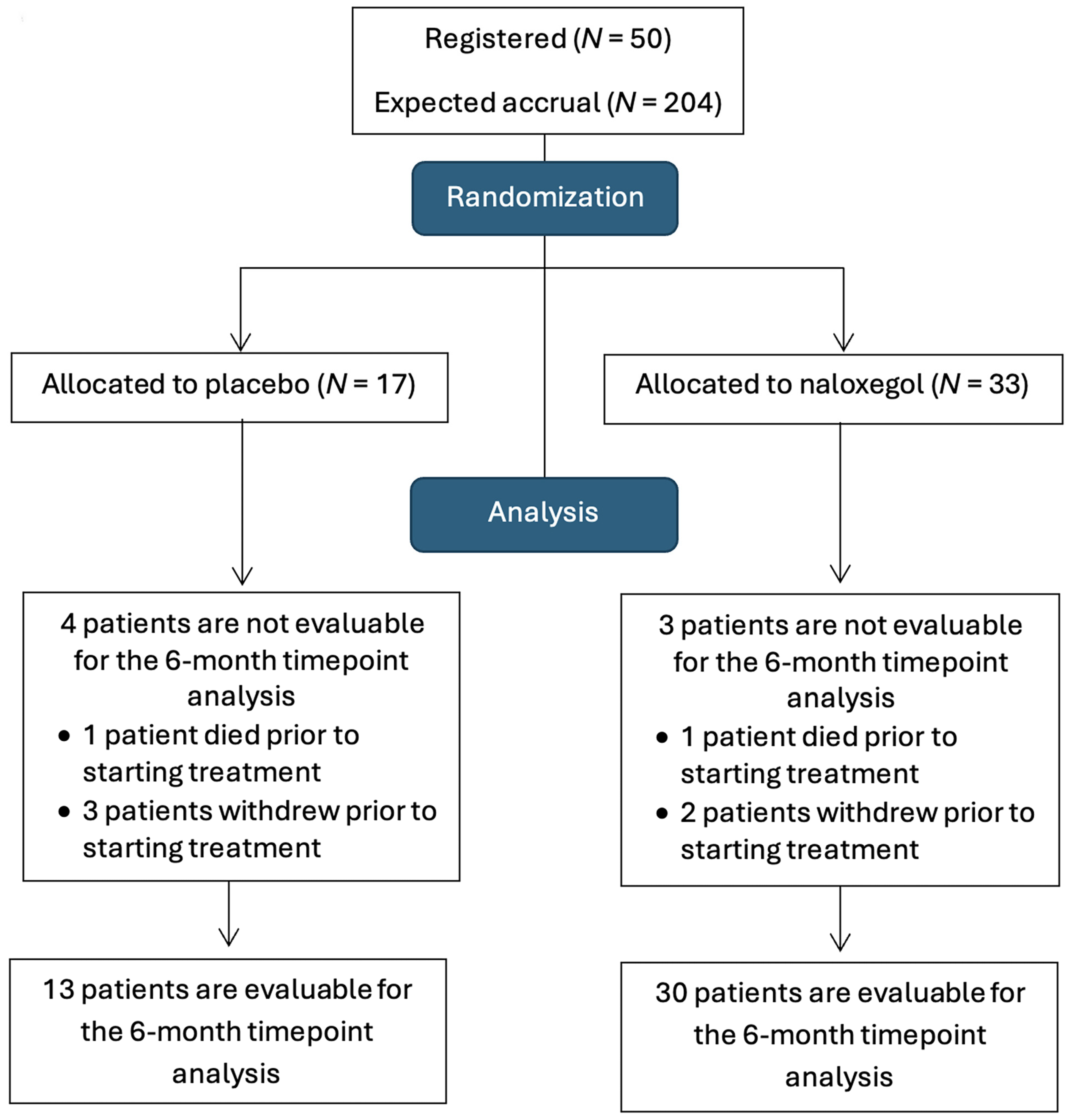
| Patient Withdrawal/Refusal Prior To Beginning Treatment | 3 (17.6%) | 2 (6.1%) | 5 (10.0%) |
| Placebo vs. Naloxegol Combined | Placebo (N = 13) | Naloxegol Combined (N = 30) | Total (N = 43) | p-Value |
|---|---|---|---|---|
| Hematologic (grade) | 0.2430 1 | |||
| 0 | 13 (100.0%) | 27 (90.0%) | 40 (93.0%) | |
| 1 | 0 (0.0%) | 1 (3.3%) | 1 (2.3%) | |
| 2 | 0 (0.0%) | 1 (3.3%) | 1 (2.3%) | |
| 3 | 0 (0.0%) | 1 (3.3%) | 1 (2.3%) | |
| Non-Hematologic (grade) | 0.4581 1 | |||
| 0 | 7 (53.8%) | 14 (46.7%) | 21 (48.8%) | |
| 1 | 4 (30.8%) | 8 (26.7%) | 12 (27.9%) | |
| 2 | 2 (15.4%) | 4 (13.3%) | 6 (14.0%) | |
| 3 | 0 (0.0%) | 4 (13.3%) | 4 (9.3%) |
| Placebo (N = 5) | Naloxegol (N = 14) | Total (N = 19) | p-Value | |
|---|---|---|---|---|
| Trial Outcome Index | 0.0505 1 | |||
| N | 5 | 12 | 17 | |
| Median (IQR) | 53.0 (40.0, 60.0) | 65.0 (58.0, 69.5) | 64.0 (54.0, 66.0) | |
| Range | 38.0, 65.0 | 43.0, 82.0 | 38.0, 82.0 | |
| Physical Well-Being | 0.0628 1 | |||
| N | 5 | 12 | 17 | |
| Median (IQR) | 22.0 (15.2, 25.7) | 28.0 (22.5, 28.0) | 25.7 (21.0, 28.0) | |
| Range | 14.0, 25.7 | 14.0, 28.0 | 14.0, 28.0 | |
| Social Function Well-Being | 0.1006 1 | |||
| N | 5 | 12 | 17 | |
| Median (IQR) | 18.0 (15.0, 18.0) | 23.0 (21.0, 26.0) | 22.0 (18.0, 24.0) | |
| Range | 8.0, 24.0 | 14.0, 28.0 | 8.0, 28.0 | |
| Emotional Well-Being | 0.0113 1 | |||
| N | 5 | 13 | 18 | |
| Median (IQR) | 17.0 (13.0, 18.0) | 23.0 (21.0, 24.0) | 21.5 (17.0, 23.0) | |
| Range | 11.0, 19.0 | 12.0, 24.0 | 11.0, 24.0 | |
| Functional Well-Being | 0.1250 1 | |||
| N | 5 | 13 | 18 | |
| Median (IQR) | 16.0 (14.0, 18.0) | 21.0 (17.0, 24.0) | 19.5 (15.0, 24.0) | |
| Range | 11.0, 22.0 | 13.0, 28.0 | 11.0, 28.0 | |
| Lung Cancer Subscale | 0.2747 1 | |||
| N | 5 | 13 | 18 | |
| Median (IQR) | 19.0 (16.0, 21.0) | 21.0 (19.0, 26.0) | 20.5 (16.0, 24.0) | |
| Range | 12.0, 24.0 | 15.0, 28.0 | 12.0, 28.0 |
| Placebo (N = 5) | Naloxegol (N = 14) | Total (N = 19) | p-Value | |
|---|---|---|---|---|
| During this bowel movement, how would you describe the shape and consistency of your stool? | 0.7833 1 | |||
| Like a sausage or snake, smooth and soft | 3 (60.0%) | 5 (35.7%) | 8 (42.1%) | |
| Like sausage but with cracks on its surface | 0 (0.0%) | 3 (21.4%) | 3 (15.8%) | |
| Sausage-like but lumpy | 2 (40.0%) | 3 (21.4%) | 5 (26.3%) | |
| Separate hard lumps, like nuts (hard to pass) | 0 (0.0%) | 1 (7.1%) | 1 (5.3%) | |
| Soft blobs with clear-cut edges (passed easily) | 0 (0.0%) | 2 (14.3%) | 2 (10.5%) | |
| How much did you have to strain during this bowel movement? | 0.1219 2 | |||
| N | 5 | 14 | 19 | |
| Median (IQR) | 2.0 (2.0, 3.0) | 1.0 (1.0, 2.0) | 2.0 (1.0, 2.0) | |
| Range | 1.0, 4.0 | 1.0, 3.0 | 1.0, 4.0 | |
| During this bowel movement, how much did you feel that you were able to fully empty your bowels? | 0.0223 2 | |||
| N | 5 | 14 | 19 | |
| Median (IQR) | 3.0 (3.0, 4.0) | 5.0 (4.0, 5.0) | 4.0 (3.0, 5.0) | |
| Range | 3.0, 4.0 | 1.0, 5.0 | 1.0, 5.0 | |
| How much pain did you have around your rectum during this bowel movement? | 0.0075 2 | |||
| N | 5 | 14 | 19 | |
| Median (IQR) | 2.0 (2.0, 2.0) | 1.0 (1.0, 1.0) | 1.0 (1.0, 2.0) | |
| Range | 1.0, 3.0 | 1.0, 2.0 | 1.0, 3.0 | |
| In the past 24 h, how often were you unable to have a bowel movement even though you felt like you had to? | 0.5097 2 | |||
| N | 5 | 14 | 19 | |
| Median (IQR) | 1.0 (1.0, 2.0) | 1.0 (1.0, 1.0) | 1.0 (1.0, 2.0) | |
| Range | 1.0, 3.0 | 1.0, 3.0 | 1.0, 3.0 | |
| In the past 24 h, how much bloating did you feel because of constipation? | 0.3376 2 | |||
| N | 5 | 14 | 19 | |
| Median (IQR) | 1.0 (1.0, 4.0) | 1.0 (1.0, 1.0) | 1.0 (1.0, 2.0) | |
| Range | 1.0, 4.0 | 1.0, 4.0 | 1.0, 4.0 | |
| In the past 24 h, how much pain did you feel in your abdomen because of constipation? | 0.0113 2 | |||
| N | 5 | 14 | 19 | |
| Median (IQR) | 3.0 (1.0, 4.0) | 1.0 (1.0, 1.0) | 1.0 (1.0, 1.0) | |
| Range | 1.0, 4.0 | 1.0, 2.0 | 1.0, 4.0 | |
| In the past 24 h, how much were you bothered by gas? | 0.3966 2 | |||
| N | 5 | 14 | 19 | |
| Median (IQR) | 1.0 (1.0, 3.0) | 1.0 (1.0, 2.0) | 1.0 (1.0, 2.0) | |
| Range | 1.0, 3.0 | 1.0, 2.0 | 1.0, 3.0 | |
| In the past 24 h, how much were you bothered by a lack of appetite because of constipation? | 0.2691 2 | |||
| N | 5 | 14 | 19 | |
| Median (IQR) | 1.0 (1.0, 2.0) | 1.0 (1.0, 1.0) | 1.0 (1.0, 1.0) | |
| Range | 1.0, 3.0 | 1.0, 3.0 | 1.0, 3.0 |
Disclaimer/Publisher’s Note: The statements, opinions and data contained in all publications are solely those of the individual author(s) and contributor(s) and not of MDPI and/or the editor(s). MDPI and/or the editor(s) disclaim responsibility for any injury to people or property resulting from any ideas, methods, instructions or products referred to in the content. |
© 2026 by the authors. Licensee MDPI, Basel, Switzerland. This article is an open access article distributed under the terms and conditions of the Creative Commons Attribution (CC BY) license.
Share and Cite
Gupta, P.; Gupta, K.; Dockter, T.; Harlos, E.; Chow, S.; Subbiah, N.; Ruddy, K.J.; Bazhenova, L.; Terstriep, S.; Huang, C.H.; et al. Naloxegol, an Oral Peripherally Acting Opioid Receptor Antagonist, Administered Concurrently with First-Line Systemic Therapy for Advanced Lung Adenocarcinoma (Alliance A221504): A Feasibility and Safety Study. Cancers 2026, 18, 373. https://doi.org/10.3390/cancers18030373
Gupta P, Gupta K, Dockter T, Harlos E, Chow S, Subbiah N, Ruddy KJ, Bazhenova L, Terstriep S, Huang CH, et al. Naloxegol, an Oral Peripherally Acting Opioid Receptor Antagonist, Administered Concurrently with First-Line Systemic Therapy for Advanced Lung Adenocarcinoma (Alliance A221504): A Feasibility and Safety Study. Cancers. 2026; 18(3):373. https://doi.org/10.3390/cancers18030373
Chicago/Turabian StyleGupta, Pankaj, Kalpna Gupta, Travis Dockter, Elizabeth Harlos, Selina Chow, Niveditha Subbiah, Kathryn J. Ruddy, Lyudmila Bazhenova, Shelby Terstriep, Chao H. Huang, and et al. 2026. "Naloxegol, an Oral Peripherally Acting Opioid Receptor Antagonist, Administered Concurrently with First-Line Systemic Therapy for Advanced Lung Adenocarcinoma (Alliance A221504): A Feasibility and Safety Study" Cancers 18, no. 3: 373. https://doi.org/10.3390/cancers18030373
APA StyleGupta, P., Gupta, K., Dockter, T., Harlos, E., Chow, S., Subbiah, N., Ruddy, K. J., Bazhenova, L., Terstriep, S., Huang, C. H., Kratzke, R. A., Vokes, E. E., & Loprinzi, C. L. (2026). Naloxegol, an Oral Peripherally Acting Opioid Receptor Antagonist, Administered Concurrently with First-Line Systemic Therapy for Advanced Lung Adenocarcinoma (Alliance A221504): A Feasibility and Safety Study. Cancers, 18(3), 373. https://doi.org/10.3390/cancers18030373