The Evolving Role of Bispecific Antibodies in Oncogene-Driven NSCLC


Simple Summary
Abstract
1. Introduction
2. Molecular Basis of Bispecific Antibody Technology
2.1. Structural Designs of Bispecific Antibodies
2.2. Biological Rationale for Dual Receptor Targeting
2.3. Selectivity, Binding Affinity, and Tumor Microenvironment Considerations
3. Clinical Development of Bispecific Antibodies in Oncogene-Driven NSCLC
3.1. EGFR/MET Bispecific Antibody: Amivantamab
3.2. HER2/HER3 Bispecific Antibody: Zenocutuzumab
3.3. Other Bispecific Antibodies Under Development
3.4. Comparison with Antibody–Drug Conjugates (ADCs)
4. Positioning Bispecific Antibodies in the Treatment Landscape
4.1. Advantages of Bispecific Antibodies over TKIs
4.2. Limitations Compared with TKIs
4.3. Bispecific Antibodies in the Post-TKI Resistance Setting
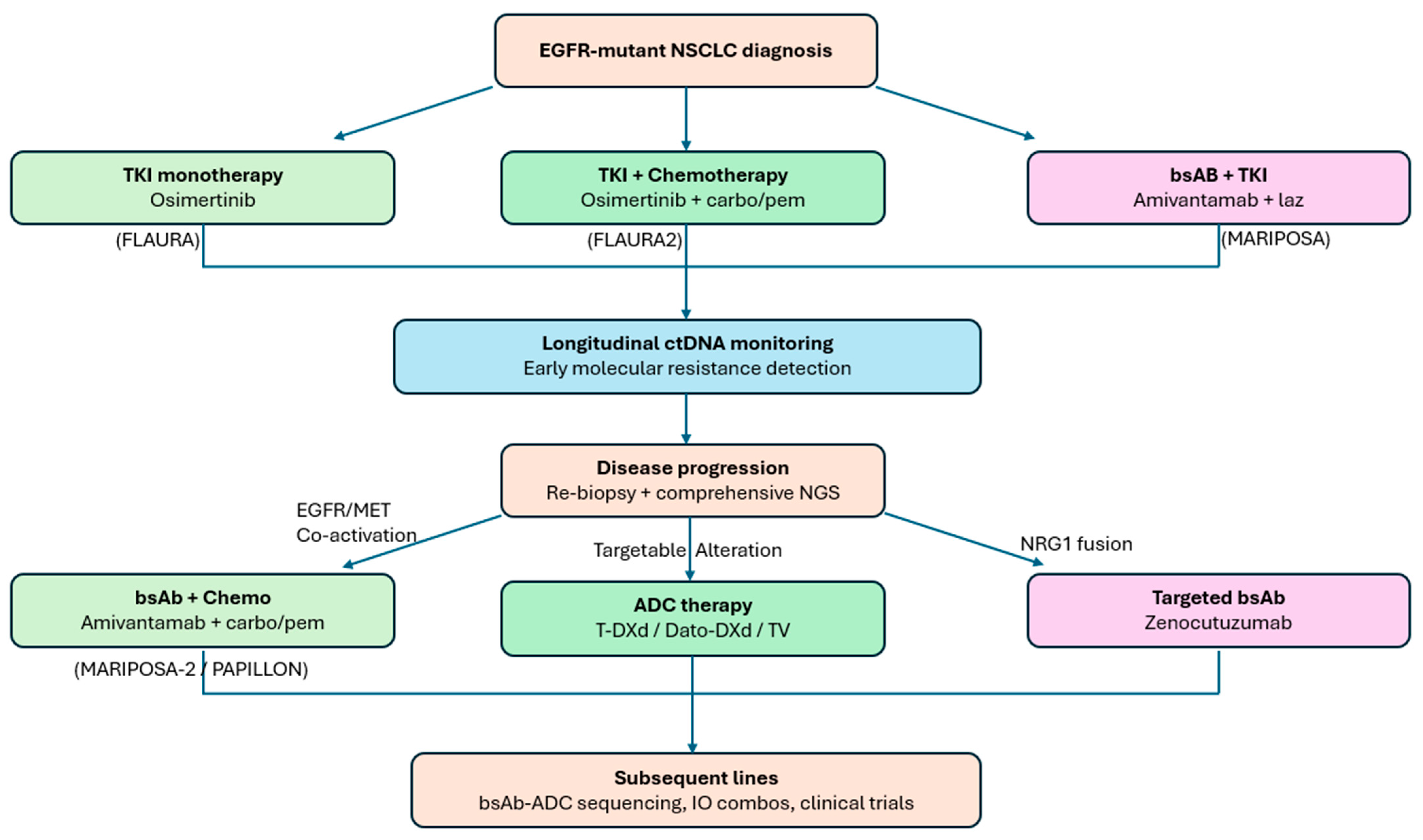
4.4. Pivotal Trials: FLAURA vs. FLAURA 2 vs. MARIPOSA
5. Mechanisms of Response and Resistance to Bispecific Antibodies
5.1. Predictors of Response
5.2. Resistance Mechanisms Unique to Bispecific Antibodies
5.3. Overcoming Resistance to Bispecific Antibodies
6. Will Bispecific Antibodies Displace TKIs or Complement Them?
7. Future Directions
8. Conclusions
Author Contributions
Funding
Data Availability Statement
Conflicts of Interest
Abbreviations
References
- Sung, H.; Ferlay, J.; Siegel, R.L.; Laversanne, M.; Soerjomataram, I.; Jemal, A.; Bray, F. Global cancer statistics 2020: GLOBOCAN estimates of incidence and mortality worldwide for 36 cancers in 185 countries. CA Cancer J. Clin. 2021, 71, 209–249. [Google Scholar] [CrossRef] [PubMed]
- Duma, N.; Santana-Dávila, R.; Molina, J.R. Non-small cell lung cancer: Epidemiology, screening, diagnosis, and treatment. Mayo Clin. Proc. 2019, 94, 1623–1640. [Google Scholar] [PubMed]
- Hendriks, L.E.; Kerr, K.M.; Menis, J.; Mok, T.S.; Nestle, U.; Passaro, A.; Peters, S.; Planchard, D.; Smit, E.F.; Solomon, B.J.; et al. Oncogene-addicted metastatic non-small-cell lung cancer: ESMO Clinical Practice Guideline for diagnosis, treatment and follow-up. Ann. Oncol. 2023, 34, 339–357. [Google Scholar] [PubMed]
- Wang, Z.; Xing, Y.; Li, B.; Li, X.; Liu, B.; Wang, Y. Molecular pathways, resistance mechanisms and targeted interventions in non-small-cell lung cancer. Mol. Biomed. 2022, 3, 42. [Google Scholar] [PubMed]
- Cardarella, S.; Ogino, A.; Nishino, M.; Butaney, M.; Shen, J.; Lydon, C.; Yeap, B.Y.; Sholl, L.M.; Johnson, B.E.; Jänne, P.A. Clinical, pathologic, and biologic features associated with BRAF mutations in non-small cell lung cancer. Clin. Cancer Res. 2013, 19, 4532–4540. [Google Scholar] [PubMed]
- Herrera-Juárez, M.; Serrano-Gómez, C.; Bote-de-Cabo, H.; Paz-Ares, L. Targeted therapy for lung cancer: Beyond EGFR and ALK. Cancer 2023, 129, 1803–1820. [Google Scholar] [CrossRef] [PubMed]
- Soria, J.-C.; Ohe, Y.; Vansteenkiste, J.; Reungwetwattana, T.; Chewaskulyong, B.; Lee, K.H.; Dechaphunkul, A.; Imamura, F.; Nogami, N.; Kurata, T.; et al. Osimertinib in untreated EGFR-mutated advanced non-small-cell lung cancer. N. Engl. J. Med. 2018, 378, 113–125. [Google Scholar] [PubMed]
- Planchard, D.; Jänne, P.A.; Cheng, Y.; Yang, J.C.-H.; Yanagitani, N.; Kim, S.-W.; Sugawara, S.; Yu, Y.; Fan, Y.; Geater, S.L.; et al. Osimertinib with or without chemotherapy in EGFR-mutated advanced NSCLC. N. Engl. J. Med. 2023, 389, 1935–1948. [Google Scholar] [PubMed]
- Mok, T.S.; Wu, Y.-L.; Thongprasert, S.; Yang, C.-H.; Chu, D.-T.; Saijo, N.; Sunpaweravong, P.; Han, B.; Margono, B.; Ichinose, Y.; et al. Gefitinib or carboplatin-paclitaxel in pulmonary adenocarcinoma. N. Engl. J. Med. 2009, 361, 947–957. [Google Scholar] [CrossRef] [PubMed]
- Rosell, R.; Carcereny, E.; Gervais, R.; Vergnenegre, A.; Massuti, B.; Felip, E.; Palmero, R.; Garcia-Gomez, R.; Pallares, C.; Sanchez, J.M.; et al. Erlotinib versus standard chemotherapy as first-line treatment for European patients with advanced EGFR mutation-positive non-small-cell lung cancer (EURTAC): A multicentre, open-label, randomised phase 3 trial. Lancet Oncol. 2012, 13, 239–246. [Google Scholar] [PubMed]
- Mok, T.S.; Cheng, Y.; Zhou, X.; Lee, K.H.; Nakagawa, K.; Niho, S.; Lee, M.; Linke, R.; Rosell, R.; Corral, J.; et al. Improvement in overall survival in a randomized study that compared dacomitinib with gefitinib in patients with advanced non-small-cell lung cancer and EGFR-activating mutations. J. Clin. Oncol. 2018, 36, 2244–2250. [Google Scholar] [PubMed]
- Sequist, L.V.; Yang, J.C.-H.; Yamamoto, N.; O’Byrne, K.; Hirsh, V.; Mok, T.; Geater, S.L.; Orlov, S.; Tsai, C.-M.; Boyer, M.; et al. Phase III study of afatinib or cisplatin plus pemetrexed in patients with metastatic lung adenocarcinoma with EGFR mutations. J. Clin. Oncol. 2013, 31, 3327–3334. [Google Scholar] [CrossRef] [PubMed]
- Cho, B.C.; Lu, S.; Felip, E.; Spira, A.I.; Girard, N.; Lee, J.-S.; Lee, S.-H.; Ostapenko, Y.; Danchaivijitr, P.; Liu, B.; et al. Amivantamab plus lazertinib in previously untreated EGFR-mutated advanced NSCLC. N. Engl. J. Med. 2024, 391, 1486–1498. [Google Scholar] [CrossRef] [PubMed]
- Yang, J.C.-H.; Lu, S.; Hayashi, H.; Felip, E.; Spira, A.I.; Girard, N.; Kim, Y.J.; Lee, S.-H.; Ostapenko, Y.; Danchaivijitr, P.; et al. Overall survival with amivantamab-lazertinib in EGFR-mutated advanced NSCLC. N. Engl. J. Med. 2025, 393, 1681–1693. [Google Scholar] [PubMed]
- Khosla, A.A.; Jatwani, K.; Singh, R.; Reddy, A.; Jaiyesimi, I.; Desai, A. Bispecific antibodies in lung cancer: A state-of-the-art review. Pharmaceuticals 2023, 16, 1461. [Google Scholar] [PubMed]
- Zhou, C.; Tang, K.-J.; Cho, B.C.; Liu, B.; Paz-Ares, L.; Cheng, S.; Kitazono, S.; Thiagarajan, M.; Goldman, J.W.; Sabari, J.K.; et al. Amivantamab plus chemotherapy in NSCLC with EGFR exon 20 insertions. N. Engl. J. Med. 2023, 389, 2039–2051. [Google Scholar] [CrossRef] [PubMed]
- Peters, S.; Camidge, D.R.; Shaw, A.T.; Gadgeel, S.; Ahn, J.S.; Kim, D.-W.; Ou, S.-H.I.; Pérol, M.; Dziadziuszko, R.; Rosell, R.; et al. Alectinib versus crizotinib in untreated ALK-positive non-small-cell lung cancer. N. Engl. J. Med. 2017, 377, 829–838. [Google Scholar] [CrossRef] [PubMed]
- Soria, J.-C.; Tan, D.S.W.; Chiari, R.; Wu, Y.-L.; Paz-Ares, L.; Wolf, J.; Geater, S.L.; Orlov, S.; Cortinovis, D.; Yu, C.-J.; et al. First-line ceritinib versus platinum-based chemotherapy in advanced ALK-rearranged non-small-cell lung cancer (ASCEND-4): A randomised, open-label, phase 3 study. Lancet 2017, 389, 917–929. [Google Scholar] [CrossRef] [PubMed]
- Horn, L.; Wang, Z.; Wu, G.; Poddubskaya, E.; Mok, T.; Reck, M.; Wakelee, H.; Chiappori, A.A.; Lee, D.H.; Breder, V.; et al. Ensartinib vs crizotinib for patients with anaplastic lymphoma kinase-positive non-small cell lung cancer: A randomized clinical trial. JAMA Oncol. 2021, 7, 1617–1625. [Google Scholar] [PubMed]
- Camidge, D.R.; Kim, H.R.; Ahn, M.-J.; Yang, J.C.-H.; Han, J.-Y.; Lee, J.-S.; Hochmair, M.J.; Li, J.Y.-C.; Chang, G.-C.; Lee, K.H.; et al. Brigatinib versus crizotinib in ALK-positive non-small-cell lung cancer. N. Engl. J. Med. 2018, 379, 2027–2039. [Google Scholar] [CrossRef] [PubMed]
- Shaw, A.T.; Bauer, T.M.; de Marinis, F.; Felip, E.; Goto, Y.; Liu, G.; Mazieres, J.; Kim, D.-W.; Mok, T.; Polli, A.; et al. First-line lorlatinib or crizotinib in advanced ALK-positive lung cancer. N. Engl. J. Med. 2020, 383, 2018–2029. [Google Scholar] [CrossRef] [PubMed]
- Solomon, B.J.; Mok, T.; Kim, D.-W.; Wu, Y.-L.; Nakagawa, K.; Mekhail, T.; Felip, E.; Cappuzzo, F.; Paolini, J.; Usari, T.; et al. First-line crizotinib versus chemotherapy in ALK-positive lung cancer. N. Engl. J. Med. 2014, 371, 2167–2177. [Google Scholar] [PubMed]
- Shaw, A.T.; Ou, S.-H.I.; Bang, Y.-J.; Camidge, D.R.; Solomon, B.J.; Salgia, R.; Riely, G.J.; Varella-Garcia, M.; Shapiro, G.I.; Costa, D.B.; et al. Crizotinib in ROS1-rearranged non-small-cell lung cancer. N. Engl. J. Med. 2014, 371, 1963–1971. [Google Scholar] [PubMed]
- Drilon, A.; Camidge, D.R.; Lin, J.J.; Kim, S.-W.; Solomon, B.J.; Dziadziuszko, R.; Besse, B.; Goto, K.; de Langen, A.J.; Wolf, J.; et al. Repotrectinib in ROS1 fusion-positive non-small-cell lung cancer. N. Engl. J. Med. 2024, 390, 118–131. [Google Scholar] [CrossRef] [PubMed]
- Li, W.; Xiong, A.; Yang, N.; Fan, H.; Yu, Q.; Zhao, Y.; Wang, Y.; Meng, X.; Wu, J.; Wang, Z.; et al. Efficacy and safety of taletrectinib in Chinese patients with ROS1-positive non-small cell lung cancer: The phase II TRUST-I study. J. Clin. Oncol. 2024, 42, 2660–2670. [Google Scholar] [CrossRef] [PubMed]
- Heymach, J.V.; Yamamoto, N.; Girard, N.; Ruiter, G.; Smit, E.F.; Planchard, D.; Nadal, E.; Wu, Y.-L.; Zugazagoitia, J.; Tu, H.-Y.; et al. First-line zongertinib in advanced HER2-mutant non-small-cell lung cancer. N. Engl. J. Med. 2026, 394, 1675–1684. [Google Scholar] [CrossRef] [PubMed]
- Le, X.; Kim, T.M.; Loong, H.H.; Prelaj, A.; Goh, B.C.; Li, L.; Fang, Y.; Lu, S.; Dong, X.; Wu, L.; et al. Sevabertinib in advanced HER2-mutant non-small-cell lung cancer. N. Engl. J. Med. 2025, 393, 1819–1832. [Google Scholar] [CrossRef] [PubMed]
- Goto, K.; Goto, Y.; Kubo, T.; Ninomiya, K.; Kim, S.-W.; Planchard, D.; Ahn, M.-J.; Smit, E.F.; de Langen, A.J.; Pérol, M.; et al. Trastuzumab deruxtecan in patients with HER2-mutant metastatic non-small-cell lung cancer: Primary results from the randomized, phase II DESTINY-Lung02 trial. J. Clin. Oncol. 2023, 41, 4852–4863. [Google Scholar] [CrossRef] [PubMed]
- Planchard, D.; Kim, T.M.; Mazieres, J.; Quoix, E.; Riely, G.; Barlesi, F.; Souquet, P.-J.; Smit, E.F.; Groen, H.J.M.; Kelly, R.J.; et al. Dabrafenib in patients with BRAF(V600E)-positive advanced non-small-cell lung cancer: A single-arm, multicentre, open-label, phase 2 trial. Lancet Oncol. 2016, 17, 642–650. [Google Scholar] [CrossRef] [PubMed]
- Riely, G.J.; Smit, E.F.; Ahn, M.-J.; Felip, E.; Ramalingam, S.S.; Tsao, A.S.; Johnson, M.L.; Gelsomino, F.; Esper, R.M.; Nadal, E.; et al. Phase II, open-label study of encorafenib plus binimetinib in patients with BRAF V600E-mutant metastatic non-small-cell lung cancer. J. Clin. Oncol. 2023, 41, 3700–3711. [Google Scholar] [CrossRef] [PubMed]
- Drilon, A.; Laetsch, T.W.; Kummar, S.; DuBois, S.G.; Lassen, U.N.; Demetri, G.D.; Nathenson, M.; Doebele, R.C.; Farago, A.F.; Pappo, A.S.; et al. Efficacy of larotrectinib in TRK fusion-positive cancers in adults and children. N. Engl. J. Med. 2018, 378, 731–739. [Google Scholar] [CrossRef] [PubMed]
- Leonetti, A.; Sharma, S.; Minari, R.; Perego, P.; Giovannetti, E.; Tiseo, M. Resistance mechanisms to osimertinib in EGFR-mutated non-small cell lung cancer. Br. J. Cancer 2019, 121, 725–737. [Google Scholar] [CrossRef] [PubMed]
- Wang, R.; Chen, Y.; Li, L.; Zhang, L.; Zhang, S. Osimertinib acquired resistance among patients with EGFR-mutated NSCLC: From molecular mechanisms to clinical therapeutic strategies. Cancer Drug Resist. 2025, 8, 61. [Google Scholar] [PubMed]
- Wen, J.; Cui, W.; Yin, X.; Chen, Y.; Liu, A.; Wang, Q.; Meng, X. Application and future prospects of bispecific antibodies in the treatment of non-small cell lung cancer. Cancer Biol. Med. 2025, 22, 348–375. [Google Scholar] [CrossRef] [PubMed]
- Ou, X.; Gao, G.; Habaz, I.A.; Wang, Y. Mechanisms of resistance to tyrosine kinase inhibitor-targeted therapy and overcoming strategies. MedComm 2024, 5, e694. [Google Scholar] [CrossRef] [PubMed]
- Liu, X.; Deng, J.; Zhang, R.; Xing, J.; Wu, Y.; Chen, W.; Liang, B.; Xing, D.; Xu, J.; Zhang, M. The clinical development of antibody-drug conjugates for non-small cell lung cancer therapy. Front. Immunol. 2023, 14, 1335252. [Google Scholar] [CrossRef] [PubMed]
- Yu, H.A.; Arcila, M.E.; Rekhtman, N.; Sima, C.S.; Zakowski, M.F.; Pao, W.; Kris, M.G.; Miller, V.A.; Ladanyi, M.; Riely, G.J. Analysis of tumor specimens at the time of acquired resistance to EGFR-TKI therapy in 155 patients with EGFR-mutant lung cancers. Clin. Cancer Res. 2013, 19, 2240–2247. [Google Scholar] [CrossRef] [PubMed]
- Thress, K.S.; Paweletz, C.P.; Felip, E.; Cho, B.C.; Stetson, D.; Dougherty, B.; Lai, Z.; Markovets, A.; Vivancos, A.; Kuang, Y.; et al. Acquired EGFR C797S mutation mediates resistance to AZD9291 in non-small cell lung cancer harbouring EGFR T790M. Nat. Med. 2015, 21, 560–562. [Google Scholar] [CrossRef] [PubMed]
- Guo, R.; Luo, J.; Chang, J.; Rekhtman, N.; Arcila, M.; Drilon, A. MET-dependent solid tumours: Molecular diagnosis and targeted therapy. Nat. Rev. Clin. Oncol. 2020, 17, 569–587. [Google Scholar] [CrossRef] [PubMed]
- Herrera, M.; Pretelli, G.; Desai, J.; Garralda, E.; Siu, L.L.; Steiner, T.M.; Au, L. Bispecific antibodies: Advancing precision oncology. Trends Cancer 2024, 10, 893–919. [Google Scholar] [CrossRef] [PubMed]
- Goebeler, M.-E.; Stuhler, G.; Bargou, R. Bispecific and multispecific antibodies in oncology: Opportunities and challenges. Nat. Rev. Clin. Oncol. 2024, 21, 539–560. [Google Scholar] [CrossRef] [PubMed]
- Schram, A.M.; Goto, K.; Kim, D.-W.; Macarulla, T.; Hollebecque, A.; O’Reilly, E.M.; Ou, S.-H.I.; Rodon, J.; Rha, S.Y.; Nishino, K.; et al. Efficacy of zenocutuzumab in NRG1 fusion-positive cancer. N. Engl. J. Med. 2025, 392, 566–576. [Google Scholar] [CrossRef] [PubMed]
- Wang, Q.; Chen, Y.; Park, J.; Liu, X.; Hu, Y.; Wang, T.; McFarland, K.; Betenbaugh, M.J. Design and production of bispecific antibodies. Antibodies 2019, 8, 43. [Google Scholar] [CrossRef] [PubMed]
- Madsen, A.V.; Pedersen, L.E.; Kristensen, P.; Goletz, S. Design and engineering of bispecific antibodies. Front. Bioeng. Biotechnol. 2024, 12, 1352014. [Google Scholar] [CrossRef] [PubMed]
- Chen, W.; Zhou, A.; Zhou, Y. Bispecific antibody for lung cancer: Mechanisms and clinical insights. Front. Immunol. 2025, 16, 1572802. [Google Scholar] [CrossRef] [PubMed]
- Besse, B.; Goto, K.; Wang, Y.; Lee, S.H.; Marmarelis, M.E.; Ohe, Y.; Bernabe Caro, R.; Kim, D.-W.; Lee, J.S.; Cousin, S.; et al. Amivantamab plus lazertinib in patients with EGFR-mutant NSCLC after progression on osimertinib and platinum-based chemotherapy: Results from CHRYSALIS-2 cohort A. J. Thorac. Oncol. 2025, 20, 651–664. [Google Scholar] [CrossRef]
- Passaro, A.; Wang, J.; Wang, Y.; Lee, S.-H.; Melosky, B.; Shih, J.-Y.; Wang, J.; Azuma, K.; Juan-Vidal, O.; Cobo, M.; et al. Amivantamab plus chemotherapy with and without lazertinib in EGFR-mutant advanced NSCLC after disease progression on osimertinib: Primary results from the phase III MARIPOSA-2 study. Ann. Oncol. 2024, 35, 77–90. [Google Scholar] [CrossRef] [PubMed]
- Li, B.T.; Smit, E.F.; Goto, Y.; Nakagawa, K.; Udagawa, H.; Mazières, J.; Nagasaka, M.; Bazhenova, L.; Saltos, A.N.; Felip, E.; et al. Trastuzumab deruxtecan in HER2-mutant non-small-cell lung cancer. N. Engl. J. Med. 2022, 386, 241–251. [Google Scholar] [CrossRef] [PubMed]
- Ahn, M.-J.; Tanaka, K.; Paz-Ares, L.; Cornelissen, R.; Girard, N.; Pons-Tostivint, E.; Vicente Baz, D.; Sugawara, S.; Cobo, M.; Pérol, M.; et al. Datopotamab deruxtecan versus docetaxel for previously treated advanced or metastatic non-small cell lung cancer: The randomized, open-label phase III TROPION-Lung01 study. J. Clin. Oncol. 2025, 43, 260–272. [Google Scholar] [CrossRef] [PubMed]
- Camidge, D.R.; Bar, J.; Horinouchi, H.; Goldman, J.W.; Moiseenko, F.V.; Filippova, E.; Cicin, I.; Ciuleanu, T.E.; Daaboul, N.; Liu, C.; et al. Telisotuzumab vedotin monotherapy in patients with previously treated c-Met protein-overexpressing advanced nonsquamous EGFR-wildtype non-small cell lung cancer in the phase II LUMINOSITY trial. J. Clin. Oncol. 2024, 42, 3000–3011. [Google Scholar] [CrossRef] [PubMed]
- Khan, S.R.; Breadner, D. Unveiling the synergistic potential: Bispecific antibodies in conjunction with chemotherapy for advanced non-small-cell lung cancer treatment. Curr. Oncol. 2025, 32, 206. [Google Scholar] [CrossRef] [PubMed]
- Ramalingam, S.S.; Vansteenkiste, J.; Planchard, D.; Cho, B.C.; Gray, J.E.; Ohe, Y.; Zhou, C.; Reungwetwattana, T.; Cheng, Y.; Chewaskulyong, B.; et al. Overall survival with osimertinib in untreated, EGFR-mutated advanced NSCLC. N. Engl. J. Med. 2020, 382, 41–50. [Google Scholar] [CrossRef] [PubMed]


| (A) | ||||||
| Driver | Prevalence | Typical Population | Agent | Clinical Trial (Phase) | Median PFS | Ref. |
| EGFR Exon 19 deletion/L858R | ~18–51% (global) | Female, never-smoker, Asian | Osimertinib | FLAURA (III) | 18.9 mo | [7] |
| Osimertinib + carbo/pem | FLAURA2 (III) | 25.5 mo | [8] | |||
| Gefitinib | IPASS (III) | 5.7 mo | [9] | |||
| Erlotinib | EURTAC (III) | 9.7 mo | [10] | |||
| Dacomitinib | ARCHER 1050 (III) | 14.7 mo | [11] | |||
| Afatinib | LUX-Lung 3 (III) | 11.1 mo | [12] | |||
| Amivantamab + Lazertinib | MARIPOSA (III) | 23.7 mo | [13,14] | |||
| EGFR Ex20 insertion | 2–3% of EGFR mutations | Female, never-smoker | Amivantamab (bsAb) | CHRYSALIS (I) | 8.3 mo | [15] |
| Amivantamab + chemo | PAPILLON (III) | 11.4 mo | [16] | |||
| ALK rearrangement | 3–7% | Young, never-smoker | Alectinib | ALEX (III) | 34.8 mo | [17] |
| Ceritinib | ASCEND-4 (III) | 16.6 mo | [18] | |||
| Ensartinib | eXALT3 (III) | 25.8 mo | [19] | |||
| Brigatinib | ALTA-1L (III) | 24.0 mo | [20] | |||
| Lorlatinib | CROWN (III) | 33.2+ mo (NR) | [21] | |||
| Crizotinib | PROFILE 1014 (III) | 10.9 mo | [22] | |||
| ROS1 rearrangement | 1–2% | Young, female, never-smoker | Crizotinib | PROFILE 1001 ROS1 cohort (I) | 19.2 mo | [23] |
| Repotrectinib | TRIDENT-1 (I/II) | 35.7 mo (treatment-naïve) | [24] | |||
| Taletrectinib | TRUST-I (II) | 49.6 mo (treatment-naïve) | [25] | |||
| Entrectinib | STARTRK-2 (II) | 15.7 mo | [6] | |||
| RET rearrangement | 1–2% | Young, never-smoker | Selpercatinib | LIBRETTO-001 (I/II) | 22.0 mo | [3] |
| Pralsetinib | ARROW (I/II) | 13.0 mo | [3] | |||
| METex14 skipping | 3–4% | Older, mixed smoking | Tepotinib | VISION (II) | 12.0 mo | [3] |
| Capmatinib | GEOMETRY-mono-1 (II) | 12.4 mo | [3] | |||
| KRAS G12C | ~13% Western; lower Asian | Smokers, Caucasian | Sotorasib | CodeBreak 200 (III) | 6.0 mo | [3] |
| Adagrasib | KRYSTAL-12 (III) | 5.4 mo | [3] | |||
| HER2 mutation/amplification | 1.5–3% | Female, never-smoker | Zongertinib | Beamion LUNG-1 (Ia/Ib) | 14.4 mo (treatment-naïve) | [26] |
| Sevabertinib | SOHO-1 (I/II) | 13.5 mo (treatment-naïve) | [27] | |||
| T-DXd | DESTINY-Lung02 (II) | 9.9 mo | [28] | |||
| BRAF V600E | ~1–3% | Female, never/light smoker | Dabrafenib + Trametinib | BRF113928 (II) | 10.2 mo | [29] |
| Encorafenib + Binimetinib | PHAROS (II) | 30.2 mo (treatment-naïve) | [30] | |||
| NTRK1/2/3 fusion | <1% | Young; No sex/smoking predominance | Larotrectinib | Pooled Phase I/II | 28.3 mo | [31] |
| Entrectinib | STARTRK pooled (I/II) | 15.7 mo | [6] | |||
| (B) | ||||||
| Driver | On-Target (Secondary Kinase Mutations) | Off-Target Bypass Activation | Downstream Signaling Alterations | Phenotypic/Epigenetic | Ref. | |
| EGFR Exon 19 deletion/L858R | C797S, L718Q/V, G796R/S; compound mutations C797S + T790M | MET amplification (3–19%), HER2 amplification, AXL/GAS6 overexpression, FGFR amplification, PIK3CA mut, RET fusions, YAP1/TEAD activation | KRAS G12C/V, NRAS mut, BRAF class II fusions, MEK1/2 mutations, NF1 loss, CDKN2A loss | EMT, SCLC transformation (~5%), cancer stem cell phenotype, SWI/SNF mutations | [4,32,33] | |
| EGFR Ex20 insertion | Secondary EGFR mutations (rare); amivantamab: antigen escape (EGFR/MET downregulation) | Bypass via HER3, FGFR, AXL; MET-independent bypass activation | KRAS/BRAF/PI3K downstream reactivation | Partial EMT | [15,34] | |
| ALK rearrangement | ALK G1202R (lorlatinib), L1196M, G1269A, I1171N/T, compound mutations | MET amplification, EGFR activation, KRAS mutation, SRC upregulation | KRAS/NRAS, NF1 loss, MAPK reactivation | EMT, tumor heterogeneity | [4,35] | |
| ROS1 rearrangement | G2032R (solvent-front), L2026M, D2033N, S1986Y/F | MET amplification, KRAS activation, BRAF co-mutation | KRAS/MAPK downstream reactivation | EMT | [4,35] | |
| RET rearrangement | G810R/S/C (solvent-front), V738A, L730V | KRAS mut, MET amplification, EMT-driven bypass | MAPK/PI3K reactivation | EMT | [35] | |
| METex14 skipping | Secondary MET kinase mutations (D1228N/H/V, Y1230H/S/C) | EGFR activation, HER2/HER3 bypass, KRAS mut | PI3K/AKT/mTOR, MAPK reactivation | EMT | [4,33] | |
| KRAS G12C | KRAS Y96D, H95R/Q (covalent binding site) | MET amplification, HER2/EGFR bypass, FGFR3 activation, SHP2 reactivation | MAPK reactivation, PI3K activation, CDK4/6-RB bypass | STK11/KEAP1 co-mutations, SCLC transformation | [4,35] | |
| HER2 mutation/amplification | No classic secondary resistance kinase mutations described | HER3 upregulation, PI3K/AKT activation, EGFR bypass | PIK3CA mutations, PTEN loss, downstream PI3K/AKT | EMT, clonal selection under payload pressure | [33,36] | |
| BRAF V600E | BRAF class switch (to class I homodimer) | EGFR reactivation, RAS mutations (NRAS, KRAS) | MEK/ERK reactivation, PI3K/AKT bypass | EMT, histological transformation | [4,35] | |
| NTRK fusion | G595R, G667C, F589L (solvent-front) | RAS/MAPK bypass, MET amplification | MAPK reactivation, PI3K/AKT activation | EMT | [4,35] | |
| Format Class | Representative Example(s) | Structural Features | Fc-Mediated Effector Function |
|---|---|---|---|
| IgG-like Asymmetric (DuoBody) | Amivantamab | Dual Fab arms, intact IgG1 Fc; heterodimeric HC via controlled Fab-arm exchange | Full ADCC, ADCP, FcRn recycling |
| IgG-like Asymmetric (CrossMab) | Zenocutuzumab | Fab domain exchange to prevent LC mispairing; intact IgG1 Fc; glycoengineered | ADCC enhanced by glycoengineering |
| Fc-silent IgG-like | Various investigational agents | Engineered Fc with FcγR -silencing mutations | Minimal ADCC/CDC; reduced cytokine release |
| Fragment-based Non-IgG (BiTE) | AMG 596 (EGFRvIII/CD3, NSCLC Phase I); Tarlatamab (DLL3/CD3) * | Two scFv linked via flexible glycine-serine peptide; no Fc region | No Fc effectors; direct T-cell engagement via CD3; CRS risk |
| Non-IgG (DART) | Various preclinical NSCLC constructs | Disulfide-stabilized diabody; dual-affinity re-targeting | No Fc; direct immune cell recruitment |
| (A) | ||||||
| Trial [Ref.] | Agent(s) | Phase | Population | ORR | Median PFS/DOR | Key Safety |
| CHRYSALIS [15] | Amivantamab mono | I | EGFR Ex20ins, post-platinum (n = 81) | 40% | PFS 8.3 mo; DOR 11.1 mo | Rash 89%, IRR 67%, paronychia |
| CHRYSALIS-2 Cohort A [46] | Amivantamab + lazertinib | I/Ib | EGFR classic mut, post-osimertinib + chemo (n = 45) | 28–35% | DOR 8.3 mo | Rash, paronychia; manageable |
| AFM24 Phase I/IIa [34] | AFM24 (EGFR/CD16A) | I/IIa | EGFR-mutant NSCLC, heavily pretreated | DCR 50% | NR | IRR, rash; manageable |
| BL-B01D1 Phase I [34] | BL-B01D1 (EGFR/HER3 bsAb-ADC) | I | EGFR-mutant NSCLC, TKI-resistant (3rd-gen) | 52.5% | mPFS 11.1 mo | Grade ≥3 TRAEs 67%; leukopenia |
| MCLA-129 Phase I/II [34] | MCLA-129 (cMET/EGFR) | I/II | METex14 skipping NSCLC | 43.5% | Ongoing | IRR, peripheral edema |
| (B) | ||||||
| Trial [Ref.] | Agent(s) | Phase | Population | ORR | mPFS (HR; p-Value) | Key Safety |
| PAPILLON [16] | Amivantamab + carbo/pem vs. chemo | III | EGFR Ex20ins, 1st-line (n = 308) | 73% vs. 47% | 11.4 vs. 6.7 mo (HR 0.40; p < 0.001) | Grade ≥3 AEs 75%; IRR 46% |
| MARIPOSA [13] | Amivantamab + lazertinib vs. osimertinib | III | EGFR Exon 19 deletion/L858R, 1st-line (n = 1074) | 86% vs. 85% | 23.7 vs. 16.6 mo (HR 0.70; p < 0.001); OS HR 0.75 [14] | Grade ≥3 AEs 75% vs. 43%; IRR 63%; VTE 37% |
| MARIPOSA-2 [47] | Amivantamab + carbo/pem ( + -laz) vs. chemo | III | EGFR Exon 19 deletion/L858R, post-osimertinib (n = 657) | 64% vs. 36% | 6.3 vs. 4.2 mo (HR 0.48; p < 0.001) | VTE 36%; Grade ≥3 AEs 72% |
| eNRGy [42] | Zenocutuzumab | I/II | NRG1 fusion+ NSCLC & pancreatic (n = 111 NSCLC) | 34% (investigator); 29% (BICR) NSCLC | DOR 12.9 mo; mPFS 11.0 mo | Grade 1–2 predominant; Grade ≥3: 3% |
| (A) | ||||||
| Trial [Ref.] | Agent | Phase | Population | ORR | Median PFS/OS | Key Safety |
| DESTINY-Lung01 [48] | T-DXd (HER2) | II | HER2-mutant NSCLC, >=1 prior Tx (n = 91) | 55% | mPFS 8.2 mo; mOS 17.8 mo | ILD 26% (Grade ≥3: 5%); nausea 74% |
| DESTINY-Lung02 [28] | T-DXd (HER2) | II | HER2-mutant NSCLC, >=1 prior Tx (n = 102) | 49% | mPFS 9.9 mo; mOS 19.5 mo | ILD 12.5% (Grade ≥3: 1.6%); nausea 66% |
| TROPION-Lung01 [49] | Dato-DXd (TROP2) vs. docetaxel | III | Pretreated advanced NSCLC (n = 603) | 26.4% vs. 12.8% | PFS 4.4 vs. 3.7 mo (HR 0.75; p = 0.004) | ILD 8.8% (Grade ≥3: 1.3%); stomatitis 42% |
| LUMINOSITY [50] | Telisotuzumab vedotin (c-MET) | II | c-MET overexpressing non-sq NSCLC (n = 148) | 35% | mPFS 5.4 mo; mOS 14.5 mo | Periph neuropathy Grade ≥3: 7%; fatigue |
| (B) | ||||||
| Trial [Ref.] | Agent | Phase | Population | ORR | Median PFS/OS | Key Safety |
| HERTHENA-Lung01 [36] | Patritumab deruxtecan (HER3-DXd) | I/II | EGFR-mutant NSCLC, post-osimertinib (n = 225) | 39% | mPFS 8.2 mo; mOS 15.1 mo | ILD 13% (Grade ≥3: 5%); cytopenias |
| SAFFRON-Lung02 [34] | BL-B01D1 (EGFR/HER3 bispecific ADC) | I | EGFR-mutant NSCLC, TKI-resistant 3rd-gen (n = 40) | 52.5% | mPFS 11.1 mo | Grade ≥3 TRAEs 67%; leukopenia, anemia |
| Feature | Bispecific Antibodies (bsAbs) | Antibody–Drug Conjugates (ADCs) |
|---|---|---|
| Structure | Two antigen-binding arms ± Fc region; no cytotoxic payload [43,44] | Monoclonal antibody + chemical linker + cytotoxic payload (e.g., DXd, MMAE) [36] |
| Mechanism of action | Dual receptor blockade + immune cell recruitment (ADCC, ADCP); no direct cytotoxic payload delivery [15,41] | Targeted intracellular delivery of cytotoxin; bystander effect via membrane-permeable payloads [36] |
| Immune effects | Fc-dependent ADCC/ADCP; T-cell/NK-cell redirection (if CD3/CD16 arm) [41] | Limited direct immune effector recruitment compared with Fc-active bsAbs [36] |
| Key toxicities | IRRs, VTE, dermatologic AEs, hematologic toxicities (with chemo combo) [13,47] | ILD (payload-dependent), cytopenias, nausea, peripheral neuropathy (vedotin-based) [15,48,49,50] |
| Resistance mechanisms | Antigen escape, Fc receptor polymorphisms, compensatory RTK upregulation, downstream MAPK reactivation [15,41] | Antigen loss, impaired internalization, lysosomal dysfunction, drug efflux (MDR1/ABCB1) [36] |
| Approved NSCLC agents | Amivantamab (EGFR/MET); zenocutuzumab (HER2/HER3, NRG1 fusion) [15,42] | T-DXd (HER2-mut); telisotuzumab vedotin (c-MET high); Dato-DXd (EGFR-mut post-TKI) [15,48,49,50] |
| Combination strategy | bsAb + TKI (MARIPOSA); bsAb + chemo (PAPILLON); bsAb + IO: emerging [13,16,51] | ADC + IO; ADC + TKI; sequential ADC strategies; ADC + ADC emerging [36] |
| Novel hybrid class | Bispecific ADC (BL-B01D1: EGFR/HER3 bsAb + DXd payload) merging both modalities [34] | |
| Domain | Bispecific Antibodies (bsAbs) | TKI Monotherapy |
|---|---|---|
| Mechanism | Dual receptor blockade (e.g., EGFR + MET); immune effector recruitment (ADCC, ADCP, trogocytosis) [15,41] | ATP-competitive inhibition of mutant kinase active site; blocks downstream RAS-MAPK and PI3K-AKT signaling [4,32] |
| Administration/PK | IV infusion q1–2 weeks; long half-life (~14 days for amivantamab); slower pharmacodynamic onset [15] | Oral daily dosing; rapid systemic absorption and biochemical response; short half-life [3] |
| CNS penetration | Theoretically limited by antibody size (~150 kDa), but comparable intracranial clinical response in trials [13,47] | Brain-penetrant 3rd-gen TKIs (osimertinib, lorlatinib) achieve high CNS exposure [3,6] |
| Resistance landscape | Less vulnerable to kinase-domain mutations; can overcome MET-driven TKI resistance; susceptible to antigen loss/downregulation [15,41] | Resistance via secondary EGFR mutations (T790M, C797S), MET/HER2 amplification, bypass activation, EMT, SCLC transformation [32,33,35] |
| Toxicity profile | IRRs (63%), VTE (37%), paronychia, dermatitis, edema; unique immune-mediated AEs [13,47] | Diarrhea, rash, hepatotoxicity; class-specific QTc prolongation or ILD with some agents [3] |
| Tumor heterogeneity | Can simultaneously address clones expressing multiple oncogene combinations [34,41] | Single-target; clonal heterogeneity can drive rapid resistance emergence [4,32] |
| Combination potential | Synergistic with TKIs (MARIPOSA), chemotherapy (PAPILLON, MARIPOSA-2); IO partnerships emerging [13,15,47] | Combine with anti-angiogenics, chemotherapy, CDK4/6 inhibitors; emerging TKI–TKI doublets [3] |
| Current approved role | Post-TKI resistance; EGFR Ex20ins (approved); 1st-line EGFR-mutant + lazertinib (MARIPOSA); NRG1 fusion (zenocutuzumab) [13,16,42] | 1st-line SOC for EGFR, ALK, ROS1, RET, KRAS G12C, METex14, BRAF V600E, NTRK mutations [3,6] |
| Cost/accessibility | High; IV infusion requires clinic attendance; access challenges in resource-limited settings [15] | Oral; generally accessible; generics emerging for older TKI generations [3] |
| Parameter | FLAURA [7] | FLAURA2 [8] | MARIPOSA [13,14] |
|---|---|---|---|
| Sponsor/Setting | Phase III; AstraZeneca; global | Phase III; AstraZeneca; global | Phase III; Janssen/J&J; global |
| Population | EGFR Exon 19 deletion/L858R, 1st-line, unselected (n = 556) | EGFR Exon 19 deletion/L858R, 1st-line, unselected (n = 557) | EGFR Exon 19 deletion/L858R, 1st-line, unselected (n = 1074) |
| Experimental arm | Osimertinib 80 mg QD | Osimertinib 80 mg QD + carboplatin/pemetrexed (4 cycles) -> osi + pem maintenance | Amivantamab IV + lazertinib 240 mg QD |
| Control arm | Gefitinib or erlotinib (physician choice) | Osimertinib 80 mg QD | Osimertinib 80 mg QD |
| Primary endpoint | PFS (investigator-assessed) | PFS (investigator-assessed) | PFS (blinded independent central review) |
| Median PFS—Experimental | 18.9 months | 25.5 months | 23.7 months |
| Median PFS—Control | 10.2 months | 16.7 months | 16.6 months |
| HR (PFS); p-value | HR 0.46; p < 0.001 | HR 0.62; p < 0.001 | HR 0.70; p < 0.001 |
| OS—Experimental | 38.6 months | Not yet mature | NR (ongoing) |
| OS—Control | 31.8 months | Not yet mature | NR |
| OS HR; p-value | HR 0.80; p = 0.046 [52] | NR (interim) | HR 0.75; p = 0.005 [14] |
| Intracranial PFS/iORR | Strong CNS activity (osimertinib historically considered highly CNS-active) | Strong CNS activity; pronounced benefit in patients with baseline brain metastases | Comparable iORR (~77% both arms); superior 36-mo intracranial PFS for amivantamab–lazertinib (36–38% vs. 18%; HR 0.69–0.79) [13] |
| Grade ≥3 AEs (exp. arm) | ~35% | ~64% (chemo phase) | ~75% |
| Discontinuation for AE | ~7% | ~12% | ~16% (amivantamab) |
| Key toxicities | Rash, diarrhea, paronychia, stomatitis | Myelosuppression, nausea, fatigue, alopecia | IRR 63%, VTE 37%, paronychia, rash, peripheral edema |
| Mechanism of benefit | Single-target TKI kinase inhibition | TKI kinase inhibition + cytotoxic chemo | Dual receptor (EGFR + MET) blockade + ADCC/ADCP immune engagement + TKI kinase inhibition |
| Resistance implications | Fails via C797S, MET amp, bypass | Delays bypass via chemotherapy elimination of resistant clones | Addresses MET bypass at baseline; novel resistance via antigen escape |
| Key clinical implication | Standard 1st-line EGFR SOC (3rd gen TKI) | First-line intensification with chemo for high-risk patients | First-line biological dual-targeting for EGFR classic mutations; FDA approved 2024 |
Disclaimer/Publisher’s Note: The statements, opinions and data contained in all publications are solely those of the individual author(s) and contributor(s) and not of MDPI and/or the editor(s). MDPI and/or the editor(s) disclaim responsibility for any injury to people or property resulting from any ideas, methods, instructions or products referred to in the content. |
© 2026 by the authors. Licensee MDPI, Basel, Switzerland. This article is an open access article distributed under the terms and conditions of the Creative Commons Attribution (CC BY) license.
Share and Cite
Wang, J.C.; Rosas, D.; Raez, L.E. The Evolving Role of Bispecific Antibodies in Oncogene-Driven NSCLC. Cancers 2026, 18, 2197. https://doi.org/10.3390/cancers18142197
Wang JC, Rosas D, Raez LE. The Evolving Role of Bispecific Antibodies in Oncogene-Driven NSCLC. Cancers. 2026; 18(14):2197. https://doi.org/10.3390/cancers18142197
Chicago/Turabian StyleWang, Jun Chih, Daniel Rosas, and Luis E. Raez. 2026. "The Evolving Role of Bispecific Antibodies in Oncogene-Driven NSCLC" Cancers 18, no. 14: 2197. https://doi.org/10.3390/cancers18142197
APA StyleWang, J. C., Rosas, D., & Raez, L. E. (2026). The Evolving Role of Bispecific Antibodies in Oncogene-Driven NSCLC. Cancers, 18(14), 2197. https://doi.org/10.3390/cancers18142197