Article

Perioperative Nivolumab and Ipilimumab with Chemotherapy and Chemoradiation for Resectable Gastric and Gastroesophageal Junction Adenocarcinoma: A Phase 1/2 Non-Randomized Clinical Trial

by
Mariela A. Blum Murphy
1,*,
Lianchun Xiao
2,
Matheus Sewastjanow-Silva
1,
Xumei Wang
2,
Brian D. Badgwell
3,
Paul F. Mansfield
3,
Naruhiko Ikoma
3,
Cindy M. Pabon
1,
Jeffrey H. Lee
4,
Manoop S. Bhutani
4,
Brian Weston
4,
Emmanuel Coronel
4,
Grace L. Smith
5,
Emma B. Holliday
5,
Jessie Tian
1,
Anas M. Barabrah
1,
Prajnan Das
5,
Bruce D. Minsky
5,
Rebecca E. Waters
6,
Jeannelyn S. Estrella
6,
Jenny J. Li
1 and
Jaffer A. Ajani
1
add Show full author list remove Hide full author list
1
Departments of Gastrointestinal Medical Oncology, The University of Texas MD Anderson Cancer Center, 1515 Holcombe Blvd, Houston, TX 77030, USA
2
Departments of Biostatistics, The University of Texas MD Anderson Cancer Center, 1515 Holcombe Blvd, Houston, TX 77030, USA
3
Departments of Surgical Oncology, The University of Texas MD Anderson Cancer Center, 1515 Holcombe Blvd, Houston, TX 77030, USA
4
Departments of Gastroenterology, Hepatology and Nutrition, The University of Texas MD Anderson Cancer Center, 1515 Holcombe Blvd, Houston, TX 77030, USA
5
Departments of Gastrointestinal Radiation Oncology, The University of Texas MD Anderson Cancer Center, 1515 Holcombe Blvd, Houston, TX 77030, USA
6
Departments of Anatomical Pathology, The University of Texas MD Anderson Cancer Center, 1515 Holcombe Blvd, Houston, TX 77030, USA
*
Author to whom correspondence should be addressed.
Cancers 2026, 18(14), 2198; https://doi.org/10.3390/cancers18142198
Submission received: 26 May 2026 / Revised: 17 June 2026 / Accepted: 3 July 2026 / Published: 8 July 2026
(This article belongs to the Section Clinical Research in Cancer)

Simple Summary

Patients with localized gastric and gastroesophageal junction cancers often require chemotherapy both before and after surgery. Recent advances in immunotherapy have improved survival outcomes, and studies in advanced disease suggest that combining immunotherapy with chemotherapy and radiation may further enhance the immune response against cancer. In this study, we evaluated the safety and effectiveness of adding immunotherapy to an intensive treatment approach that included chemotherapy, radiation, and surgery for patients with localized gastric and gastroesophageal junction adenocarcinomas. We also assessed the tumor response and the duration of disease-free survival following treatment. Our findings showed that this combined treatment strategy was manageable for most patients and resulted in a higher rate of complete tumor eradication at the time of surgery. These results suggest that incorporating immunotherapy into standard treatment may improve patient outcomes and support further investigation in larger clinical studies.

Abstract

Background/Objectives: Immunotherapy (IO) has demonstrated survival benefits in metastatic gastroesophageal cancers, and current data supports perioperative IO in localized adenocarcinomas. Radiation may further enhance IO response through immunologic priming. This study evaluates the feasibility, safety, and preliminary efficacy of incorporating IO into a chemoradiation-based perioperative strategy for resectable gastric and gastroesophageal junction (GEJ) adenocarcinoma. Methods: This single-arm, phase I/II study enrolled adults with untreated, locally advanced, resectable gastric or GEJ adenocarcinoma between February 2019 and June 2023. The treatment protocol consisted of induction chemotherapy (oxaliplatin + 5-fluorouracil), induction IO (nivolumab + ipilimumab), concurrent immune-chemoradiation (nivolumab, 5-fluorouracil, and 45 Gy IMRT/VMAT), surgical resection, and adjuvant nivolumab for residual disease. Primary endpoints were safety and feasibility; secondary endpoints included the pathologic complete response (pCR), R0 resection rate, disease-free survival (DFS), overall survival (OS), and biomarker analysis. Results: In total, 30 patients were enrolled, and 23 underwent resection. Grade 4 treatment-related toxicities occurred in three patients (10%), including acute kidney injury, myocarditis/myositis/myasthenia gravis overlap syndrome, and neutropenia. Among surgical patients, the pCR rate was 39.1% (95% CI: 19.7–61.5%), and the intention-to-treat pCR rate was 30% (95% CI: 14.7–49.4%). R0 resection was achieved in 87% of cases. Median DFS among resected patients was 40.2 months (95% CI: 21.6–NE). Median OS was 43.7 months (95% CI: 30.7–NE), with 2-, 3-, and 5-year OS rates of 73.3%, 57.5%, and 47.9%, respectively. Conclusions: This multimodality approach incorporating IO with chemotherapy and chemoradiation demonstrated a manageable safety profile and an encouraging pCR rate, supporting further evaluation.

1. Introduction

Despite a steady decline in the incidence of gastric cancer (GC) over recent decades, its management remains a major global challenge. GC accounts for approximately 7.7% of all cancer-related deaths and stands as the fourth-leading cause of cancer mortality worldwide [1,2]. In the United States, data from the Surveillance, Epidemiology, and End Results (SEER) program indicate that only about 32% of patients present with localized disease [3], for whom curative-intent surgery is a potential option.
Accurate staging is essential for determining optimal management [4]. In localized GC, treatment strategies vary globally. In the United States, standard approaches include postoperative chemoradiation or perioperative chemotherapy with the FLOT regimen (5-fluorouracil, oxaliplatin, docetaxel) ± durvalumab [5,6], whereas Asian approaches commonly use adjuvant S-1/docetaxel or capecitabine-oxaliplatin [7,8].
The introduction of immunotherapy (IO) has transformed the treatment landscape of metastatic gastroesophageal cancers, with multiple studies demonstrating survival benefits when IO is combined with chemotherapy [9,10,11,12,13]. Chemotherapy agents such as oxaliplatin may further enhance IO efficacy by promoting an immunogenic tumor microenvironment and enhancing T-cell infiltration [14]. The Checkmate 577 trial further supported the role of IO by showing improved disease-free survival (DFS) with adjuvant nivolumab in patients with esophageal or gastroesophageal junction (GEJ) cancers who had residual disease following neoadjuvant chemoradiotherapy and surgery [15]. Radiation itself also enhances tumor immunogenicity through immunogenic cell death, antigen release, dendritic cell activation, and T-cell priming, providing a strong rationale for combining IO with chemoradiation [16].
Based on the established activity of immune checkpoint inhibitors in advanced gastroesophageal cancers and the potential for radiation-induce immune priming, we hypothesized that integrating IO into our institutional chemotherapy and chemoradiation platform could enhance tumor regression while maintaining acceptable safety. Therefore, we conducted a single-arm phase I/II study evaluating perioperative nivolumab and ipilimumab combined with chemotherapy, chemoradiation, surgery, and adjuvant nivolumab in patients with resectable gastric and gastroesophageal junction adenocarcinoma. Primary objectives were safety and feasibility, with secondary objectives including the pathologic complete response (pCR), R0 resection rate, DFS, and biomarker analysis at predefined treatment intervals.

2. Materials and Methods

2.1. Study Design and Participants

This was a non-randomized, single-arm phase I/II study conducted at The University of Texas MD Anderson Cancer Center in Houston, Texas. Eligible patients were aged ≥18 years, with previously untreated, locally advanced, resectable gastric or GEJ adenocarcinoma (Figure 1). Comprehensive staging including cross-sectional imaging, endoscopic ultrasound and diagnostic laparoscopy with negative peritoneal cytology was required to confirm resectability. Additional eligibility criteria included an Eastern Cooperative Oncology Group performance status (ECOG-PS) of 0–1, adequate organ function, and no contraindications to the planned multimodality treatment. Participants of reproductive potential were required to use effective contraception throughout this study and for 5–7 months following completion of adjuvant therapy. All enrolled patients agreed to provide tumor tissue samples for further assessment. Microsatellite status and programmed death-ligand 1 (PD-L1) expression were obtained but not used to determine eligibility.
Patients with active autoimmune disease were excluded, with the exception of well-controlled type I diabetes, hypothyroidism requiring only hormone supplementation, and autoimmune skin disorders not requiring systemic therapy. Individuals requiring prolonged corticosteroid or other immunosuppressive therapies for active disease(s) were ineligible. Additional exclusion criteria include known human immunodeficiency virus (HIV) infection, hepatitis B virus (HBV), or untreated hepatitis C virus (HCV). Patients with a prior malignancy within the preceding years were excluded unless the condition was considered locally curable (e.g., squamous cell skin cancer, carcinoma in situ of the prostate, cervix, or breast). Prior exposure to checkpoint inhibitors or other immune-based therapies targeting T-cell co-stimulatory pathways also precluded enrollment.
The study protocol and all amendments were approved by the institutional review board. This study was conducted in accordance with the Declaration of Helsinki (as revised in 2013), and all patients provided written informed consent.

2.2. Treatment Protocol

Step 1: Induction Chemotherapy (Weeks 1–8)
Patients received induction chemotherapy in 14-day cycles (weeks 1, 3, 5, and 7) for a maximum of 4 cycles. Treatment included the following:
  • Oxaliplatin 85 mg/m2 administered intravenously (IV) over 2 h on Day 1.
  • 5-fluorouracil 2.4 g/m2 delivered as a continuous 48 h intravenous infusion beginning on Day 1.
Step 2: Immunotherapy (Weeks 9–14)
Following induction chemotherapy, patients proceeded with immunotherapy:
  • Nivolumab 240 mg IV infused over 30 min on Day 1 every 2 weeks for a total of three doses (Weeks 9, 11, and 13).
  • Ipilimumab 1 mg/kg IV infused over 30 min, administered once on Day 1 of Week 9 concurrently with nivolumab.
Step 3: Concurrent Immuno-Chemoradiation (Weeks 15–19)
Patients then received five weeks of concurrent immunotherapy, chemotherapy, and radiation:
  • Nivolumab 240 mg IV every 2 weeks for three doses (Weeks 15, 17, and 19).
  • 5-fluorouracil 250 mg/m2 IV daily, Monday through Friday, for a total of 25 treatments days across Weeks 15–19.
  • Radiation therapy with a total dose of 45 Gray (Gy) delivered in 25 fractions using intensity-modulated radiation therapy (IMRT) or volumetric modulated arc therapy (VMAT). Three-dimensional conformal radiation therapy was allowed at the discretion of the treating physician. Radiation fields were defined according to pretreatment imaging, endoscopic findings and involved nodal basins. The clinical treatment volume (CTV) included the gross tumor volume (GTV), 3 cm mucosal margin around the GTV, involved nodes, and elective nodal regions at risk, all expanded by 1 cm in all directions. The planning target volume (PTV) included the CTV expanded by 0.5 cm in all directions.
Step 4: Surgical Resection
Surgery was scheduled approximately 5–7 weeks after completion of radiation therapy (RT). The surgical approach included either partial or total gastrectomy and D2 lymphadenectomy based on tumor location and multidisciplinary surgical assessment.
Step 5: Adjuvant Immunotherapy
Patients with residual disease on surgical pathology specimens, irrespective of PDL-1 status, received adjuvant nivolumab:
  • Nivolumab 240 mg IV every 2 weeks for 8 doses (approximately 16 weeks) followed by Nivolumab 480 mg IV every 4 weeks for 2 additional doses, beginning 2 weeks after completion of the initial eight infusions.
Adjuvant IO commenced 8–12 weeks after surgery and continued for a total of approximately 6 months.

2.3. Nutritional Support Considerations

Patients presenting with significant impairment in oral intake (<600 Kcal/day, limited to liquids) were advised to undergo placement of a feeding jejunostomy tube, either laparoscopically or percutaneously. Nutritional support and hydration were closely monitored throughout the treatment, with heightened attention during Step 3, when radiation-related toxicities may further impair oral intake. If enteral access was not required before surgery, a feeding jejunostomy was placed at the time of surgery (Step 4) to support postoperative nutritional needs.

2.4. Outcomes

Following induction chemotherapy, and prior to immuno-chemoradiation, patients underwent endoscopy for tissue banking and biomarker assessment. After neoadjuvant therapy completion, clinical response was evaluated by endoscopic biopsy and cross-sectional imaging.
Definitive treatment response was determined by histopathologic evaluation of the surgical specimen. Pathologic response was categorized into three groups:
  • Pathologic complete response (pCR): no residual carcinoma detected either in primary tumor or in any lymph node.
  • Partial response: <50% of residual viable tumor cells.
  • Limited response: ≥50% of residual viable tumor cells in the specimen.
All patients who received at least one cycle of chemotherapy were considered for safety evaluations, which included documentation of treatment-related deaths, premature treatment discontinuation due to toxicity, adverse events (AEs), and serious adverse events (SAEs), graded according to NCI-CTCAE version 5.0. Patients were monitored for a minimum of 100 days after the final dose of study drug, and followed until AEs were resolved, returned to baseline, or were deemed irreversible.
Long term survival follow-up was planned for up to three years following completion of therapy for the last patient enrolled.

2.5. Statistical Analysis

The primary objective of this study was to evaluate the safety and toxicity profile of IV nivolumab in combination with ipilimumab following induction chemotherapy and subsequently with fluoropyrimidine-based RT, in patients with localized GEJ and/or gastric adenocarcinoma. Secondary objectives included assessment of treatment efficacy, estimation of DFS, and evaluation of changes in tumor stroma composition before and after immunotherapy and radiation.
Toxicity monitoring followed the Bayesian method of Thall, Simon, and Estey [17]. The trial incorporated a predefined early stopping rule: enrollment would be halted early if Prob (p > 0.30 data) > 0.85, where p denotes the probability of treatment-related toxicity. This rule was evaluated in cohorts of six patients. Assuming a beta (0.6, 1.4) priori for p, early termination would occur if, among the first 12 patients enrolled, six or more patients experience treatment-related toxicities. If the study proceeded without early termination, a sample size of 30 evaluable patients was estimated to yield a Bayesian 90% posterior credible interval of approximately 0.176–0.438, under a true toxicity rate of 30%.
Continuous variables were summarized using descriptive statistics (e.g., median and range), and categorical variables using frequency and percentages. The pCR rate was estimated along with a corresponding exact 95% confidence interval (CI).
Time-to-events outcomes, including overall survival (OS) and DFS, were analyzed using the Kaplan–Meier method.
  • OS was defined as the time from diagnosis to death or last follow-up (for patients alive).
  • DFS was defined as the time from surgery to recurrence/progression, death or last follow-up, whichever occurred first.
Safety data were summarized separately for the neoadjuvant and adjuvant phases by organ system, grade, and attribution. Preliminary efficacy measures, including clinical and pathological response rates, were estimated with exact 95% CI. Changes in tumor stroma composition and tumor biomarkers before and after treatment were summarized using descriptive statistics and evaluated statistically using the Wilcoxon signed rank test.
A p-value of less than 0.05 was considered statistically significant in this study. All statistical analyses were conducted using IBM (Armonk, NY, USA) SPSS Statistics v29.

2.6. Role of Funding Source

This was an investigator-initiated trial (CA209-9KL) supported by Bristol Myers Squibb (BMS) (Princeton, NJ, USA). The sponsor had no role in study design, data collection, analysis, interpretation, or manuscript preparation.

3. Results

From February 2019 to June 2023, 36 patients were enrolled. Six patients were ineligible or pursued alternative treatment strategies, resulting in a final evaluable cohort of 30 patients. Baseline characteristics are outlined in Table 1. The median age was 58 years old, with a balanced cohort of male (57%) and female (43%) participants. Most participants were Caucasian (73%), and not Hispanic or Latino (67%). Most tumors were centered in the stomach (77%) rather than the GEJ (23%), and most patients had at least stage III disease (60%) with diffuse (63%) and poorly differentiated (67%) histology. Among patients with available microsatellite testing, only two (11%) had microsatellite instability-high (MSI-H) tumors. Most patients with available Combined Positive Score (CPS) values had a CPS ≥ 1 (77%). All patients underwent laparoscopic evaluation before treatment initiation and had no evidence of peritoneal malignancy.

3.1. Safety

Table 2 summarizes toxicity data.
No grade 5 treatment-related AEs occurred. Grade 4 AEs were observed in three patients (10%), including acute kidney injury [18], neutropenia, and myocarditis/myositis/myasthenia gravis (overlap syndrome) requiring pacemaker placement. This patient’s cardiac function is currently stable as well as his myasthenic symptoms, which are managed with daily pyridostigmine. Two patients (those with overlap syndrome and acute kidney injury) discontinued study treatment to manage these toxicities; both remain alive. Most common grade 3 AEs were nausea (10%, n = 3), fatigue (10%, n = 3) and abdominal pain (7%, n = 2). Among the 13 patients with grade ≥ 3 AEs, only one patient who had acute kidney injury did not proceed to surgery due to poor medical condition. Furthermore, a patient developed grade 2 adrenal insufficiency prior to surgery, resulting in significant surgical challenges; the patient required lifelong steroid replacement and subsequently died of progressive peritoneal disease four months after surgery. A second patient who also had grade 2 adrenal insufficiency prior to surgery remains on lifelong steroid replacement and is alive with no evidence of disease. Neither grade ≥ 3 AEs nor immunotherapy-related AEs were observed past the neoadjuvant setting.

3.2. Pathologic Outcomes

Table 3 summarizes surgical pathology results.
Seven patients did not undergo surgery; five of them were due to progression of disease (three of them after chemoradiation) and two due to clinical deterioration.
Among the 23 patients who underwent resection, 9 achieved pCR (39.1%; 95% CI: 19.7–61.5%) and 15 had TNM downstaging. Two patients had MSI-H tumors, one of whom achieved pCR. Among patients with MSS tumors, 2 of 16 achieved pCR. In the intention-to-treat analysis (ITT) population (n = 30), the pCR rate was 30% (95% CI: 14.7–49.4%).
Twelve patients (52.2%; 95% CI: 30.6–73.2%) had ≤1% residual tumor, corresponding to 40% of the ITT cohort (95% CI: 22.7–59.4%). R0 resection was achieved in 20 of 23 surgical patients (87%; 95% CI: 66.4–97.2%) and in 66.7% of the ITT cohort (95% CI: 47.2–82.3%).

3.3. Overall Survival

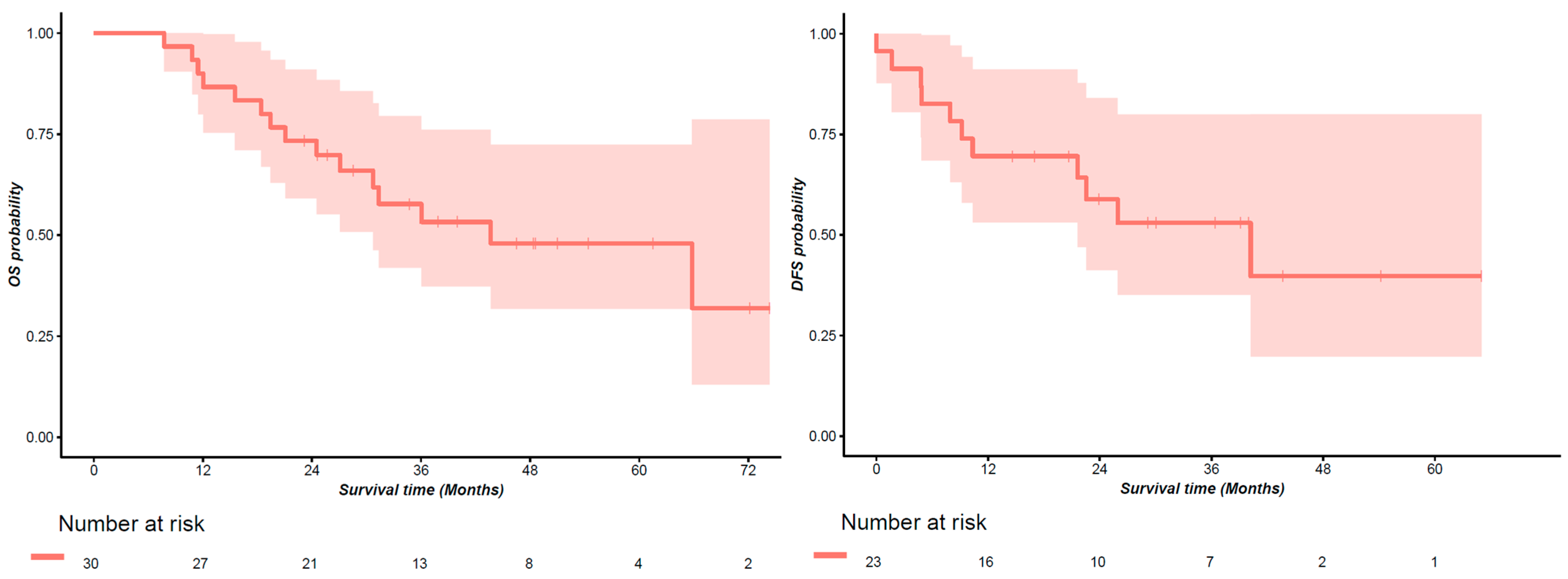
At the time of analysis, 15 of the 30 patients had died. The estimated median OS (Figure 2) was 43.7 months (95% CI: 30.7–not estimable). Estimated survival probabilities were a 2-year OS 73.3% (95% CI: 0.591–0.91), 3-year OS 57.5% (95% CI: 0.419–0.795), and 5-year OS 47.9% (95% CI: 0.318–0.724). The estimated median follow-up was 48.4 months (95% CI: 40–not estimable).

3.4. Disease-Free Survival

DFS was assessed in 23 patients who underwent resection. Eleven patients experienced disease recurrence or death. The estimated median DFS (Figure 2) was 40.2 months (95% CI: 21.6–not estimable). Estimated DFS at 1 and 2 years were 69.6% (95% CI: 0.531–0.912) and 58.9% (95% CI: 0.351–0.8), respectively.
Higher progression/recurrence rates were associated with SRC component (p = 0.009) but not with baseline staging and histological grade.

3.5. Pathological Response and Survival

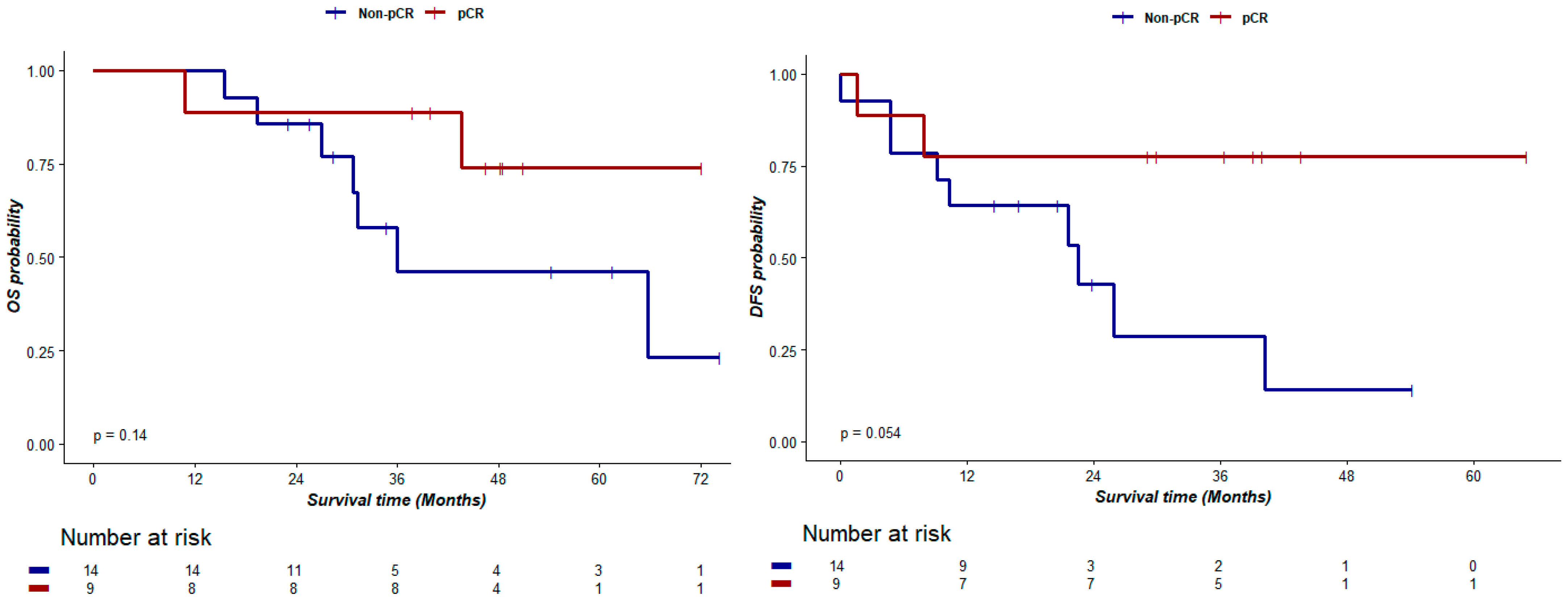
Median OS and DFS were analyzed in the resection cohort to assess differences in survival when pCR is achieved (Figure 3).
Among the nine patients with pCR, there were no disease recurrences but two deaths. Median OS and DFS were not reached, the 2-year OS probability was 88.9% (95% CI: 0.706–1) and the 2-year DFS probability was 77.8% (95% CI: 0.549–1).
Among 14 patients without pCR, there were 2 disease recurrences and 7 deaths. Median OS was 36 months (95% CI: 0.307–not estimable), and the 2-year OS probability was 85.7% (95% CI: 0.692–1). Median DFS was 22.5 months (95% CI: 10.3–not estimable), and the 2-year DFS probability was 42.9% (95% CI: 0.216–0.852).
Although outcomes trended more favorably in the pCR group, the differences were not statistically significant for OS and DFS (log rank test p = 0.14 and 0.054, respectively).

3.6. Biomarkers

Biomarker correlatives analyses are ongoing. Tissue was collected before and after treatment to support evaluation of the tumor immune microenvironment, immune activation, and stromal remodeling. The results will be reported in a separate manuscript.

4. Discussion

To our knowledge, this study is among the first prospective evaluations on safety and pathologic regression outcomes of a perioperative dual IO strategy combined with standard chemotherapy, chemoradiation, and surgery for localized gastric adenocarcinoma. Our study demonstrated encouraging tumor regression and manageable toxicity with incorporation of immunotherapy into a chemoradiation-based perioperative strategy.
Direct comparison with DANTE and METTERHORN should be interpreted cautiously because these studies evaluated perioperative chemotherapy plus immunotherapy without radiation [19,20,21], whereas our study incorporated chemoradiation as a central component of treatment. Consequently, differences in pCR rates likely reflect differences in treatment platforms rather than isolated effects of immunotherapy. These studies nevertheless support the broader movement toward incorporating immunotherapy into perioperative treatment strategies.
The EA2174 trial represents the largest prospective study evaluating incorporation of dual-checkpoint inhibition into a chemoradiation platform for localized gastroesophageal adenocarcinoma. Although pCR rates were higher with nivolumab/ipilimumab plus chemoradiation than with chemoradiation alone, differences were not statistically significant [22]. Nonetheless, EA2174 confirmed the feasibility of incorporating immunotherapy into multimodality treatment and highlighted the need for improved patient selection and optimization of treatment sequencing. A complementary benchmark is CALGB 80803, a randomized phase II PET-directed study in which patients received induction chemotherapy, followed by PET-adapted chemoradiation and surgery. PET responders treated with induction FOLFOX achieved a pCR rate of 40.3% and a median OS of 48.8 months [23]. The pCR rate of 39.1% and median OS of 43.7 months observed in our cohort were similar to outcomes reported in CALGB 80803. This comparison suggests that the pathological response observed in our study cannot be attributed solely to the incorporation of immunotherapy and highlights the complexity of cross-study comparisons.
It is important to note that, in this trial, 23.3% of the patients did not undergo surgery, either due to progression or clinical decline. This rate is comparable to those observed in EA2174 (19%). Patients who failed to undergo surgery were offered the standard of care. Perioperative mortality and morbidity rates among gastric cancer patients undergoing D2 gastrectomy are around 3% and 20%, respectively. Most common complications are respiratory (up to 13%), pancreatic fistula (up to 10%), bleeding (up to 4%) and anastomotic leak (up to 3.5%) [24,25,26]. In this cohort, no adverse events related to surgical procedures were observed. Grade 3 and 4 adverse events were observed in 43.3% of patients, while these rates were 69% in DANTE and 71.6% in MATTERHORN. Adrenal insufficiency and overlap syndrome have been previously reported in nivolumab plus ipilimumab regimens and thus require careful surveillance [27,28,29].
A notable characteristic of our cohort was the high prevalence of diffuse histology (63%) and signet ring cell features (43%), which are generally associated with infiltrative growth patterns and poorer responses to multimodality therapy. Although diffuse tumors may exhibit microscopic extension beyond radiographically apparent disease, recurrence patterns in our study were predominantly distant rather than local (93% versus 7%), suggesting that disease biology rather than inadequate local treatment volume is a major contributor to progression events. Nonetheless, MSI-H and higher PD-L1 CPS expression levels predict IO benefit in gastroesophageal adenocarcinomas, while claudin 18.2 expression may exert some adverse impact [30,31].
As treatment paradigms continue to evolve toward universal incorporation of IO, our results highlight the ongoing relevance of understanding how radiation may synergize with immune checkpoint blockade to enhance local and systemic tumor control. Comparative studies will be needed to clarify how immune-chemoradiation approaches may best integrate with or differ from emerging FLOT-IO standards.

Limitations

A key limitation of this study is the relatively small sample size, underscoring the need for validation in a larger, multi-center, multi-arm trial. In addition, as biomarker analyses are still ongoing, our ability to assess differences in treatment response and tolerability across molecular subgroups remains limited, but may become more informative as additional data emerge. Safety was a central focus, and while most AEs mirrored those expected with standard therapies, immune-related toxicities such as myocarditis and adrenal insufficiency were observed. These events required long-term medical management and emphasize the importance of continued clinical and laboratory monitoring, not only during neoadjuvant and adjuvant treatment but also throughout surveillance.

5. Conclusions

Overall, our neoadjuvant approach incorporating IO plus chemotherapy followed by immune-chemoradiation, surgical resection, and adjuvant immunotherapy demonstrated promising tumor regression and supports the continued investigation of radiation-enhanced immunotherapy for localized gastric and GEJ adenocarcinoma. Longer follow-up is necessary to determine whether the improved pCR rates translate into survival benefit. Ongoing analysis of serial tumor samples may further elucidate how IO, chemotherapy and radiation collectively remodel the tumor immune microenvironment and may guide future personalization of perioperative treatment.

Author Contributions

Conceptualization, M.A.B.M. and J.A.A.; Methodology, M.A.B.M., L.X. and X.W.; Software, L.X. and X.W.; Validation, M.A.B.M., L.X. and X.W.; Formal Analysis, L.X. and X.W.; Investigation, M.A.B.M., M.S.-S., C.M.P., A.M.B. and J.J.L.; Resources, B.D.B., P.F.M., N.I., J.H.L., M.S.B., B.W., E.C., G.L.S., E.B.H., P.D., B.D.M., R.E.W. and J.S.E.; Data Curation, J.T. and M.S.-S.; Writing—Original Draft Preparation, M.A.B.M. and M.S.-S.; Writing—Review and Editing, all authors; Visualization, L.X. and X.W.; Supervision, J.A.A. and M.A.B.M.; Project Administration, J.T. and M.A.B.M.; Funding Acquisition, J.A.A. All authors have read and agreed to the published version of the manuscript.

Funding

This was an investigator-initiated trial supported by Bristol Myers Squibb (BMS). The sponsor had no role in study design, data collection, analysis, interpretation, or manuscript preparation.

Institutional Review Board Statement

This study was conducted in accordance with the Declaration of Helsinki and approved by the Institutional Review Board of The University of Texas MD Anderson Cancer Center (protocol code CA209-9KL and Official IRB Approval Date: 6 June 2018). This study was registered at ClinicalTrials.gov (Identifier: NCT03776487) on 13 December 2018.

Informed Consent Statement

Informed consent was obtained from all subjects involved in this study.

Data Availability Statement

The data generated and analyzed in this study are not publicly available due to patient privacy and institutional regulatory restrictions. De-identified datasets may be made available from the corresponding author upon reasonable request and with appropriate institutional approvals.

Acknowledgments

We acknowledge the Holly Clegg Gastric Cancer Research Fund. The fund provided assistance with manuscript preparation and submission. The authors retain full responsibility for the study design, data collection, analysis, interpretation, and the final content of the manuscript.

Conflicts of Interest

The authors declare no conflicts of interest. Cindy Pabon is a Sylvester K12 Scholar. The Sylvester K12 program is supported by the National Cancer Institute of the National Institutes of Health under Award Number K12CA226330. The content is solely the responsibility of the authors and does not necessarily represent the official views of the National Institutes of Health.

References

  1. Ilic, M.; Ilic, I. Epidemiology of Stomach Cancer. World J. Gastroenterol. 2022, 28, 1187–1203. [Google Scholar] [CrossRef] [PubMed]
  2. Sung, H.; Ferlay, J.; Siegel, R.L.; Laversanne, M.; Soerjomataram, I.; Jemal, A.; Bray, F. Global Cancer Statistics 2020: GLOBOCAN Estimates of Incidence and Mortality Worldwide for 36 Cancers in 185 Countries. CA Cancer J. Clin. 2021, 71, 209–249. [Google Scholar] [CrossRef] [PubMed]
  3. U.S. Department of Health and Human Services; National Cancer Institute. Surveillance, Epidemiology, and End Results Program. Cancer Stat Facts: Stomach Cancer. 2026. Available online: https://seer.cancer.gov/statfacts/html/stomach.html (accessed on 25 May 2026).
  4. Ajani, J.A.; D’Amico, T.A.; Almhanna, K.; Bentrem, D.J.; Chao, J.; Das, P.; Denlinger, C.S.; Fanta, P.; Farjah, F.; Fuchs, C.S.; et al. Gastric Cancer, Version 3.2016, NCCN Clinical Practice Guidelines in Oncology. J. Natl. Compr. Cancer Netw. 2016, 14, 1286–1312. [Google Scholar] [CrossRef] [PubMed]
  5. Macdonald, J.S.; Smalley, S.R.; Benedetti, J.; Hundahl, S.A.; Estes, N.C.; Stemmermann, G.N.; Haller, D.G.; Ajani, J.A.; Gunderson, L.L.; Jessup, J.M.; et al. Chemoradiotherapy after Surgery Compared with Surgery Alone for Adenocarcinoma of the Stomach or Gastroesophageal Junction. N. Engl. J. Med. 2001, 345, 725–730. [Google Scholar] [CrossRef] [PubMed]
  6. Al-Batran, S.-E.; Homann, N.; Pauligk, C.; Goetze, T.O.; Meiler, J.; Kasper, S.; Kopp, H.-G.; Mayer, F.; Haag, G.M.; Luley, K.; et al. Perioperative Chemotherapy with Fluorouracil plus Leucovorin, Oxaliplatin, and Docetaxel versus Fluorouracil or Capecitabine plus Cisplatin and Epirubicin for Locally Advanced, Resectable Gastric or Gastro-Oesophageal Junction Adenocarcinoma (FLOT4): A Randomised, Phase 2/3 Trial. Lancet 2019, 393, 1948–1957. [Google Scholar] [CrossRef] [PubMed]
  7. Sakuramoto, S.; Sasako, M.; Yamaguchi, T.; Kinoshita, T.; Fujii, M.; Nashimoto, A.; Furukawa, H.; Nakajima, T.; Ohashi, Y.; Imamura, H.; et al. Adjuvant Chemotherapy for Gastric Cancer with S-1, an Oral Fluoropyrimidine. N. Engl. J. Med. 2007, 357, 1810–1820, Erratum in N Engl J Med. 2008, 358, 1977. [Google Scholar] [CrossRef] [PubMed]
  8. Bang, Y.-J.; Kim, Y.-W.; Yang, H.-K.; Chung, H.C.; Park, Y.-K.; Lee, K.H.; Lee, K.-W.; Kim, Y.H.; Noh, S.-I.; Cho, J.Y.; et al. Adjuvant Capecitabine and Oxaliplatin for Gastric Cancer after D2 Gastrectomy (CLASSIC): A Phase 3 Open-Label, Randomised Controlled Trial. Lancet 2012, 379, 315–321. [Google Scholar] [CrossRef] [PubMed]
  9. Janjigian, Y.Y.; Shitara, K.; Moehler, M.; Garrido, M.; Salman, P.; Shen, L.; Wyrwicz, L.; Yamaguchi, K.; Skoczylas, T.; Campos Bragagnoli, A.; et al. First-Line Nivolumab plus Chemotherapy versus Chemotherapy Alone for Advanced Gastric, Gastro-Oesophageal Junction, and Oesophageal Adenocarcinoma (CheckMate 649): A Randomised, Open-Label, Phase 3 Trial. Lancet 2021, 398, 27–40. [Google Scholar] [CrossRef] [PubMed]
  10. Kato, K.; Doki, Y.; Ogata, T.; Motoyama, S.; Kawakami, H.; Ueno, M.; Kojima, T.; Shirakawa, Y.; Okada, M.; Ishihara, R.; et al. First-Line Nivolumab plus Ipilimumab or Chemotherapy versus Chemotherapy Alone in Advanced Esophageal Squamous Cell Carcinoma: A Japanese Subgroup Analysis of Open-Label, Phase 3 Trial (CheckMate 648/ONO-4538-50). Esophagus 2023, 20, 291–301. [Google Scholar] [CrossRef] [PubMed]
  11. Bang, Y.-J.; Van Cutsem, E.; Fuchs, C.S.; Ohtsu, A.; Tabernero, J.; Ilson, D.H.; Hyung, W.J.; Strong, V.E.; Goetze, T.O.; Yoshikawa, T.; et al. KEYNOTE-585: Phase III Study of Perioperative Chemotherapy with or Without Pembrolizumab for Gastric Cancer. Future Oncol. 2019, 15, 943–952. [Google Scholar] [CrossRef] [PubMed]
  12. Janjigian, Y.Y.; Kawazoe, A.; Yañez, P.; Li, N.; Lonardi, S.; Kolesnik, O.; Barajas, O.; Bai, Y.; Shen, L.; Tang, Y.; et al. The KEYNOTE-811 Trial of Dual PD-1 and HER2 Blockade in HER2-Positive Gastric Cancer. Nature 2021, 600, 727–730. [Google Scholar] [CrossRef] [PubMed]
  13. Sewastjanow-Silva, M.; Yamashita, K.; Vicentini, E.R.; Hirschmann, M.; Pizzi, M.P.; Trail, A.M.; Waters, R.E.; Rogers, J.E.; Ajani, J.A. Nivolumab with or without chemotherapy for metastatic gastroesophageal cancers and future perspectives. Expert Rev. Anticancer Ther. 2022, 22, 1177–1181. [Google Scholar] [CrossRef] [PubMed]
  14. Pfirschke, C.; Engblom, C.; Rickelt, S.; Cortez-Retamozo, V.; Garris, C.; Pucci, F.; Yamazaki, T.; Poirier-Colame, V.; Newton, A.; Redouane, Y.; et al. Immunogenic Chemotherapy Sensitizes Tumors to Checkpoint Blockade Therapy. Immunity 2016, 44, 343–354. [Google Scholar] [CrossRef] [PubMed]
  15. Kelly, R.J.; Ajani, J.A.; Kuzdzal, J.; Zander, T.; Van Cutsem, E.; Piessen, G.; Mendez, G.; Feliciano, J.; Motoyama, S.; Lièvre, A.; et al. Adjuvant Nivolumab in Resected Esophageal or Gastroesophageal Junction Cancer. N. Engl. J. Med. 2021, 384, 1191–1203, Erratum in N Engl J Med. 2023, 388, 672. https://doi.org/10.1056/NEJMx220014. [Google Scholar] [CrossRef] [PubMed]
  16. DuPage, M.; Mazumdar, C.; Schmidt, L.M.; Cheung, A.F.; Jacks, T. Expression of Tumour-Specific Antigens Underlies Cancer Immunoediting. Nature 2012, 482, 405–409. [Google Scholar] [CrossRef] [PubMed]
  17. Thall, P.F.; Simon, R.M.; Estey, E.H. New Statistical Strategy for Monitoring Safety and Efficacy in Single-Arm Clinical Trials. J. Clin. Oncol. 1996, 14, 296–303. [Google Scholar] [CrossRef] [PubMed]
  18. Weng, J.; Ajani, J.A.; Murphy, M.B.; Badgwell, B.D.; Tchakarov, A.S.; Mamlouk, O.; Das, P. Immunotherapy Recall: Chemoradiation-Induced Reactivation of Immune Checkpoint Inhibitor Nephritis. JCO Precis. Oncol. 2022. [Google Scholar] [CrossRef] [PubMed]
  19. Lorenzen, S.; Götze, T.O.; Thuss-Patience, P.; Biebl, M.; Homann, N.; Schenk, M.; Lindig, U.; Heuer, V.; Kretzschmar, A.; Goekkurt, E.; et al. Perioperative Atezolizumab Plus Fluorouracil, Leucovorin, Oxaliplatin, and Docetaxel for Resectable Esophagogastric Cancer: Interim Results From the Randomized, Multicenter, Phase II/III DANTE/IKF-S633 Trial. J. Clin. Oncol. 2024, 42, 410–420. [Google Scholar] [CrossRef] [PubMed]
  20. Janjigian, Y.Y.; Al-Batran, S.-E.; Wainberg, Z.A.; Muro, K.; Molena, D.; Van Cutsem, E.; Hyung, W.J.; Wyrwicz, L.; Oh, D.-Y.; Omori, T.; et al. Perioperative Durvalumab in Gastric and Gastroesophageal Junction Cancer. N. Engl. J. Med. 2025, 393, 217–230. [Google Scholar] [CrossRef] [PubMed]
  21. Janjigian, Y.Y.; Al-Batran, S.-E.; Wainberg, Z.A.; Van Cutsem, E.; Molena, D.; Muro, K.; Hyung, W.J.; Wyrwicz, L.S.; Oh, D.-Y.; Omori, T.; et al. Pathological Complete Response (PCR) to 5-Fluorouracil, Leucovorin, Oxaliplatin and Docetaxel (FLOT) with or without Durvalumab (D) in Resectable Gastric and Gastroesophageal Junction Cancer (GC/GEJC): Subgroup Analysis by Region from the Phase 3, Randomized, Double-Blind MATTERHORN Study. J. Clin. Oncol. 2024, 42, LBA246. [Google Scholar] [CrossRef]
  22. Eads, J.R.; Graham, N.; Gibson, M.K.; Rajdev, L.; Chakravarthy, A.B.; Khullar, O.V.; Lin, S.H.; Wistuba, I.I.; Agarwal, R.; Blazar, M.; et al. A Phase II/III Study of Peri-Operative Nivolumab (Nivo) and Ipilimumab (Ipi) in Patients (Pts) with Locoregional Esophageal (E) and Gastroesophageal Junction (GEJ) Adenocarcinoma: Results of the Neoadjuvant Pathologic Complete Response (PCR) Rate (ECOG-ACRIN EA2174). J. Clin. Oncol. 2024, 42, 4000. [Google Scholar] [CrossRef]
  23. Goodman, K.A.; Ou, F.-S.; Hall, N.C.; Bekaii-Saab, T.; Fruth, B.; Twohy, E.; Meyers, M.O.; Boffa, D.J.; Mitchell, K.; Frankel, W.L.; et al. Randomized Phase II Study of PET Response–Adapted Combined Modality Therapy for Esophageal Cancer: Mature Results of the CALGB 80803 (Alliance) Trial. J. Clin. Oncol. 2021, 39, 2803–2815. [Google Scholar] [CrossRef] [PubMed]
  24. Brisinda, G.; Chiarello, M.M.; Crocco, A.; Adams, N.J.; Fransvea, P.; Vanella, S. Postoperative mortality and morbidity after D2 lymphadenectomy for gastric cancer: A retrospective cohort study. World J. Gastroenterol. 2022, 28, 381–398. [Google Scholar] [CrossRef] [PubMed]
  25. Paredes-Torres, O.; García-Ruiz, L.; Luna-Abanto, J.; Meza-García, K.; Passiuri, I.C.; Berrospi-Espinoza, F.; Vásquez, C.L.-V.; Ruiz-Figueroa, E.; Payet-Meza, E. Risk factors associated with postoperative morbidity and mortality in D2 radical gastrectomy for gastric cancer. Rev. Gastroenterol. México (Engl. Ed.) 2022, 87, 149–158. [Google Scholar] [CrossRef] [PubMed]
  26. Li, Z.; Bai, B.; Zhao, Y.; Yu, D.; Lian, B.; Liu, Y.; Zhao, Q. Severity of complications and long-term survival after laparoscopic total gastrectomy with D2 lymph node dissection for advanced gastric cancer: A propensity score-matched, case–control study. Int. J. Surg. 2018, 54, 62–69. [Google Scholar] [CrossRef] [PubMed]
  27. Pathak, R.; Katel, A.; Massarelli, E.; Villaflor, V.M.; Sun, V.; Salgia, R. Immune Checkpoint Inhibitor–Induced Myocarditis with Myositis/Myasthenia Gravis Overlap Syndrome: A Systematic Review of Cases. Oncologist 2021, 26, 1052–1061. [Google Scholar] [CrossRef] [PubMed]
  28. Cui, K.; Wang, Z.; Zhang, Q.; Zhang, X. Immune checkpoint inhibitors and adrenal insufficiency: A large-sample case series study. Ann. Transl. Med. 2022, 10, 251. [Google Scholar] [CrossRef] [PubMed]
  29. Martins, F.; Sofiya, L.; Sykiotis, G.P.; Lamine, F.; Maillard, M.; Fraga, M.; Shabafrouz, K.; Ribi, C.; Cairoli, A.; Guex-Crosier, Y.; et al. Adverse effects of immune-checkpoint inhibitors: Epidemiology, management and surveillance. Nat. Rev. Clin. Oncol. 2019, 16, 563–580. [Google Scholar] [CrossRef] [PubMed]
  30. Formica, V.; Morelli, C.; Fornaro, L.; Riondino, S.; Rofei, M.; Fontana, E.; Smyth, E.; Roselli, M.; Arkenau, H.-T. PD-L1 thresholds predict efficacy of immune checkpoint inhibition in first-line treatment of advanced gastroesophageal adenocarcinoma. A systematic review and meta-analysis of seven phase III randomized trials. ESMO Open 2024, 9, 103967. [Google Scholar] [CrossRef] [PubMed]
  31. Qi, C.; Chong, X.; Zhou, T.; Ma, M.; Gong, J.; Zhang, M.; Li, J.; Xiao, J.; Peng, X.; Liu, Z.; et al. Clinicopathological significance and immunotherapeutic outcome of claudin 18.2 expression in advanced gastric cancer: A retrospective study. Chin. J. Cancer Res. 2024, 36, 78–89. [Google Scholar] [CrossRef] [PubMed]
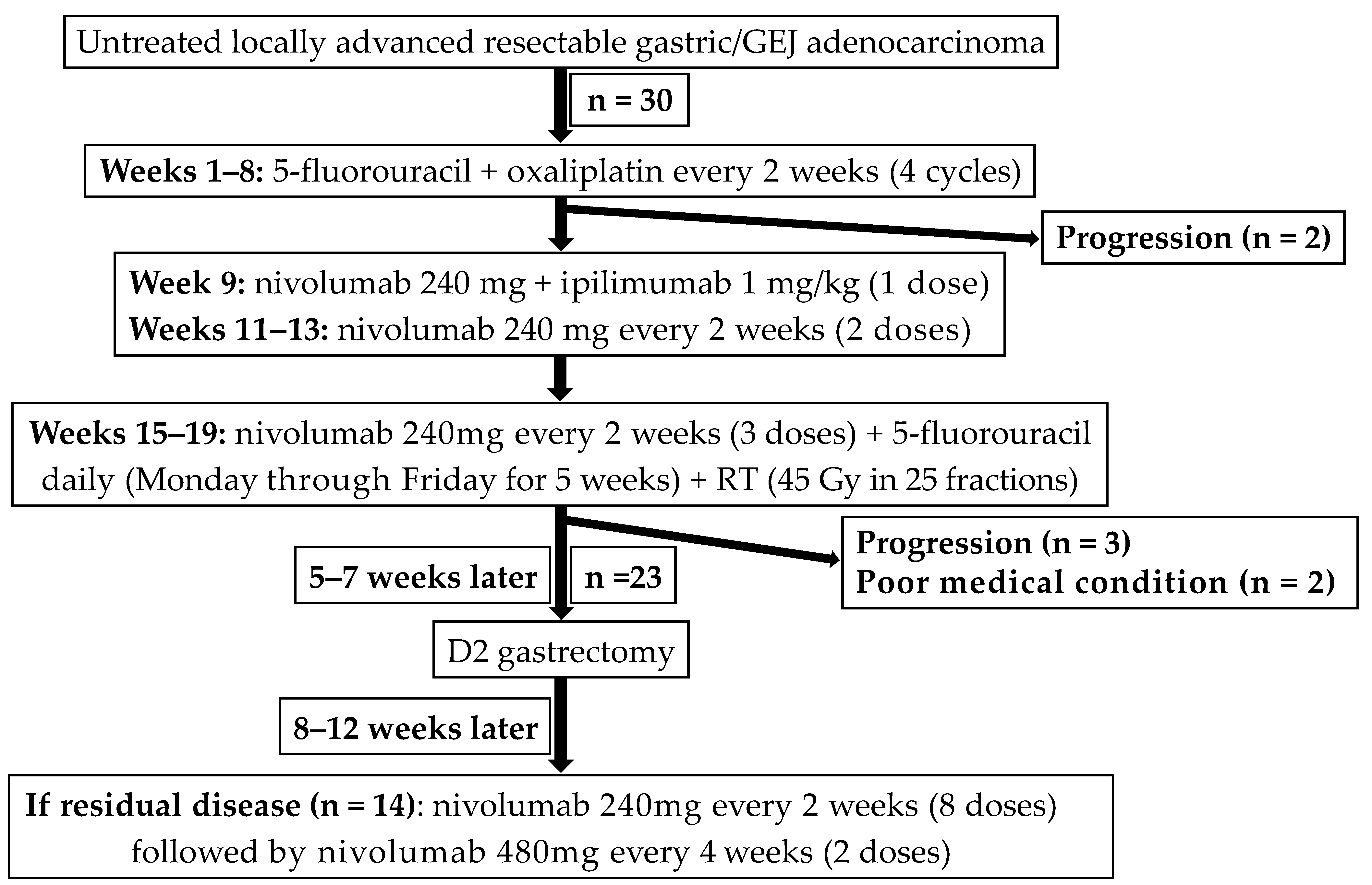
Figure 1. Study diagram.
Cancers 18 02198 g001
Figure 2. Overall survival and disease-free survival Kaplan–Meier curves. Each vertical line indicate censored patients/last follow-up. Shadows refer to 95% confidence interval.
Cancers 18 02198 g002
Figure 3. Overall survival and disease-free survival Kaplan–Meier curves by pathological response.
Cancers 18 02198 g003
Table 1. Baseline clinical characteristics.
Characteristicn = 30
Age, median (min, max)58 (41, 80)
Racen (%)
White22 (73)
Black or African American2 (7)
Native American1 (3)
Asian1 (3)
Other race4 (13)
Ethnicityn (%)
Not Hispanic or Latino20 (67)
Hispanic or Latino10 (33)
Gendern (%)
Male17 (57)
Female13 (43)
BMI, median (min, max)29 (19, 52)
ECOG-PSn (%)
016 (53)
114 (47)
Alcohol usen (%)
Not currently10 (33)
Never8 (27)
Frequent6 (20)
Occasional6 (20)
Smoking historyn (%)
Nonsmoker15 (50)
Nonsmoker-quit14 (47)
Smoker1 (3)
Past or synchronous malignancyn (%)
None23 (77)
Prostate cancer2 (7)
Basal cell carcinoma of skin1 (3)
Melanoma1 (3)
Sarcoma1 (3)
Skin cancer1 (3)
Thyroid1 (3)
History of systemic or radiation therapyn (%)
None28 (93)
Chemotherapy1 (3)
Radiation and hormone ablation for prostate cancer1 (3)
Tumor locationn (%)
Antrum8 (27)
Fundus7 (23)
Body6 (20)
GEJ6 (20)
Cardia2 (7)
Pylorus1 (3)
Site/Siewert classificationn (%)
GEJ Siewert 11 (3)
GEJ Siewert 25 (17)
GEJ Siewert 31 (3)
Gastric23 (77)
Baseline Tn (%)
T23 (10)
T322 (73)
T41 (3)
T4A3 (10)
T4B1 (3)
Baseline Nn (%)
N013 (43)
N113 (43)
N23 (10)
N31 (3)
Baseline Mn (%)
M030 (100)
cStagen (%)
I2 (7)
IIB10 (33)
III17 (57)
IVA1 (3)
Adenocarcinoma subtypen (%)
NOS—not otherwise specified16 (53)
SRC—signet ring cell14 (47)
Tumor graden (%)
G3—Poorly differentiated20 (67)
G2—Moderately differentiated8 (27)
Moderate to poorly differentiated2 (7)
Histological type (Lauren)n (%)
Diffuse19 (63)
Intestinal6 (20)
N/S5 (17)
HER2n (%)
Negative18 (60)
Equivocal (2+)1 (3)
N/S11 (37)
PD-L1n (%)
Positive10 (33)
Negative3 (10)
N/S17 (57)
CPSn (%)
<13 (10)
≥110 (33)
N/S17 (57)
Microsatellite instabilityn (%)
MSS/MSI-L16 (53)
MSI-H2 (7)
N/S12 (40)
Helicobacter pylorin (%)
Negative26 (87)
Positive1 (3)
N/S3 (10)
BMI: body mass index; ECOG-PS: Eastern Cooperative Oncology Group performance status; GEJ: gastroesophageal junction; MSI-H: high microsatellite instability; MSI-L: low microsatellite instability; MSS: microsatellite stable; N/S: not specified.
Table 2. Serious adverse event summary and adverse events occurring in 10% of patients or more, by grade.
Adverse EventGrade, No. (%) of Patients
1 or 234
Neutropenia2 (7)1 (3)1 (3)
Acute kidney injury1 (3)1 (3)1 (3)
Overlap syndrome001 (3)
Nausea27 (90)3 (10)0
Vomiting19 (63)3 (10)0
Abdominal pain19 (63)2 (7)0
Fatigue24 (80)1 (3)0
Anorexia21 (70)1 (3)0
Anemia10 (33)1 (3)0
Hypokalemia8 (27)1 (3)0
ALT increased4 (13)1 (3)0
Dehydration4 (13)1 (3)0
aPTT increased1 (3)1 (3)0
Hypotension1 (3)1 (3)0
Atrial fibrillation01 (3)0
Gastritis01 (3)0
Hypertension01 (3)0
Hyponatremia01 (3)0
Syncope01 (3)0
Diarrhea24 (80)00
Constipation23 (77)00
Dysphagia17 (57)00
Dizziness13 (43)00
Headache13 (43)00
Insomnia13 (43)00
Peripheral sensory neuropathy13 (43)00
Dyspnea12 (40)00
Oral mucositis12 (40)00
Peripheral motor neuropathy12 (40)00
Cough11 (37)00
Anxiety10 (33)00
Gastroesophageal reflux10 (33)00
Arthralgia8 (27)00
Blurred vision8 (27)00
Fever7 (23)00
Abdominal distension6 (20)00
Back pain6 (20)00
Rash acneiform6 (20)00
Papulopustular rash4 (13)00
Anal hemorrhage3 (10)00
Arthritis3 (10)00
Creatinine increased3 (10)00
Depression3 (10)00
Edema limbs3 (10)00
Hypothyroidism3 (10)00
Myalgia3 (10)00
Stomach pain3 (10)00
ALT: alanine aminotransferase; aPTT: activated partial thromboplastin time.
Table 3. Summary of pathological outcomes, response and relapse.
Characteristic n = 30
(n = 23 Surgery)
Primary Tumor, No. (%)
pT09 (39)
pT1a1 (4)
pT1b1 (4)
pT23 (13)
pT36 (26)
pT4A3 (13)
Regional LN, No. (%)
pN011 (48)
pN16 (26)
pN23 (13)
pN32 (9)
pN3A1 (4)
Distant Metastasis, No. (%)
pM022 (96)
pM11 (4)
Surgical Stage, No. (%)
09 (39)
I2 (9)
II6 (26)
III4 (17)
IIIB1 (4)
IVB1 (4)
Histologic Grade, No. (%)
G2—Moderately Differentiated3 (21)
G3—Poorly Differentiated11 (79)
Pathologic Response, No. (%)
P09 (39)
P19 (39)
P25 (22)
Residual Cancer, No. (%)
09 (39)
<12 (9)
11 (4)
31 (4)
101 (4)
301 (4)
401 (4)
501 (4)
901 (4)
1003 (13)
N/S (>0)2 (9)
Tumor Regression Grade (0–3), No. (%)
09 (39)
14 (17)
26 (26)
34 (17)
Treatment Response, No. (%)
* cCR1 (3)
* Non cCR1 (3)
Non pCR14 (47)
pCR9 (30)
Progression—no surgery5 (17)
Curative or cCR, No. (%)
No11 (38)
Yes18 (62)
Residual Disease, No. (%)
R020 (87)
R1 (proximal margin)1 (4)
R1 (radial margin)2 (9)
LVI, No. (%)
No17 (74)
Yes6 (26)
Positive LN, Median (Min, Max)n = 231 (0, 38)
Total LN, Median (Min, Max)n = 2328 (8, 64)
Relapse/Progression, No. (%)
No16 (53)
Yes14 (47)
Site of Relapse, No. (%)
Distant14 (93)
Local1 (7)
First Site of Relapse, No. (%)
Adrenal1 (7)
Colon1 (7)
Esophageal anastomosis1 (7)
Left cervical LN1 (7)
Left supraclavicular LN1 (7)
Liver3 (20)
Pericardial1 (7)
Peritoneal5 (33)
Subcarinal LN1 (7)
cCR: clinical complete response; pCR: pathologic complete response; LN: lymph node; LVI: lymphovascular invasion. *: patients who did not undergo surgery due to poor medical condition, precluding pathological response assessment.
Disclaimer/Publisher’s Note: The statements, opinions and data contained in all publications are solely those of the individual author(s) and contributor(s) and not of MDPI and/or the editor(s). MDPI and/or the editor(s) disclaim responsibility for any injury to people or property resulting from any ideas, methods, instructions or products referred to in the content.