Diagnostic Challenges of Tumor Tissue and Circulating Microsatellite Status Assessment in Metastatic Colorectal Cancer and Their Impact on Access to Immunotherapy: A Real-World Retrospective Study

 ,
, 
Simple Summary
Abstract
1. Introduction
2. Materials and Methods
2.1. Study Objectives
2.2. Study Design and Population
2.3. Diagnostic Modalities
2.4. Diagnostic Rules and Classification
2.5. Data Collection
2.6. Statistical Analysis
3. Results
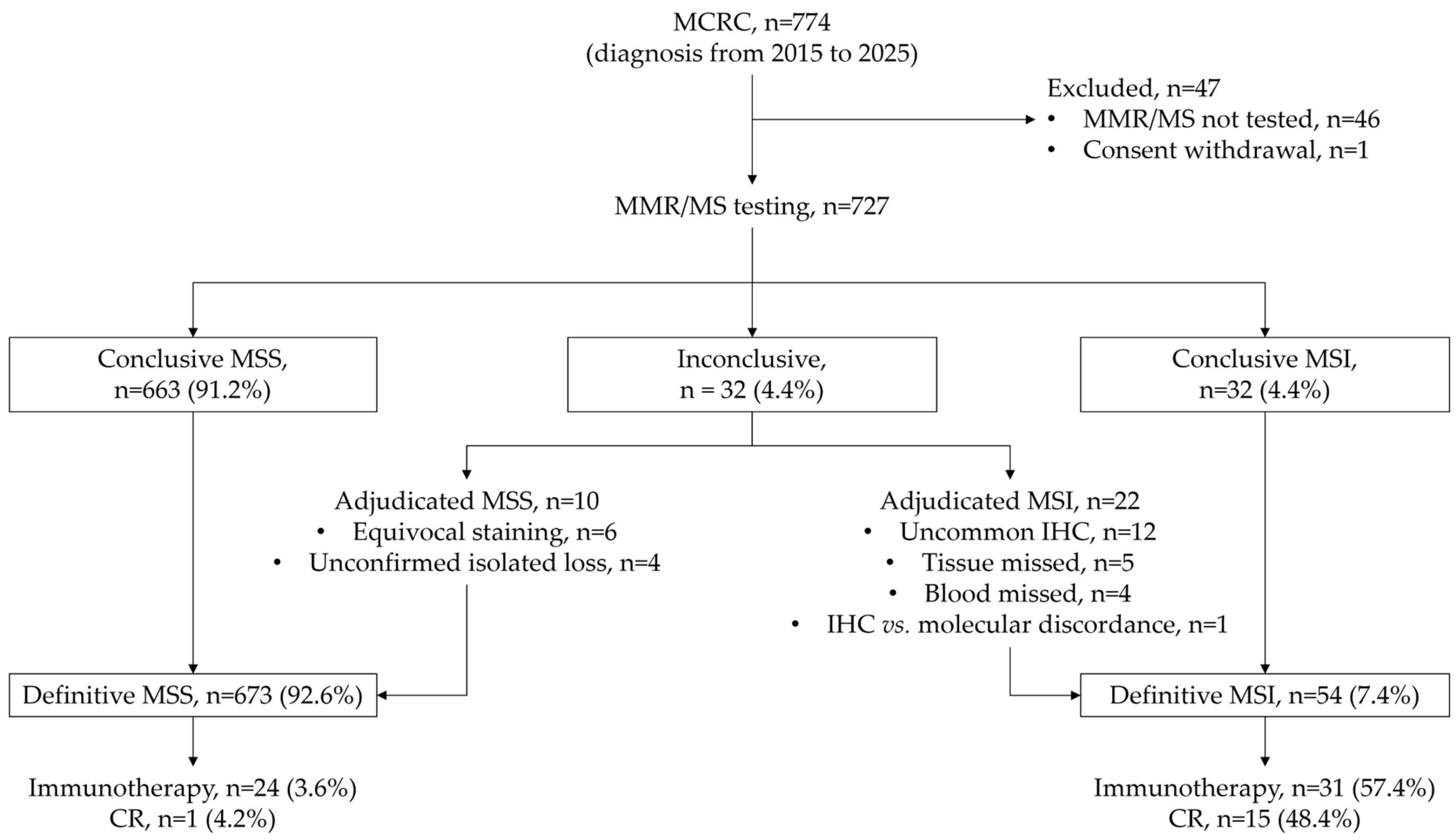
3.1. Study Population
3.2. Patient Characteristics
3.3. MSI/MMR Testing
3.3.1. Testing Modalities
3.3.2. Testing Results
3.4. Access to Immunotherapy and Clinical Outcomes
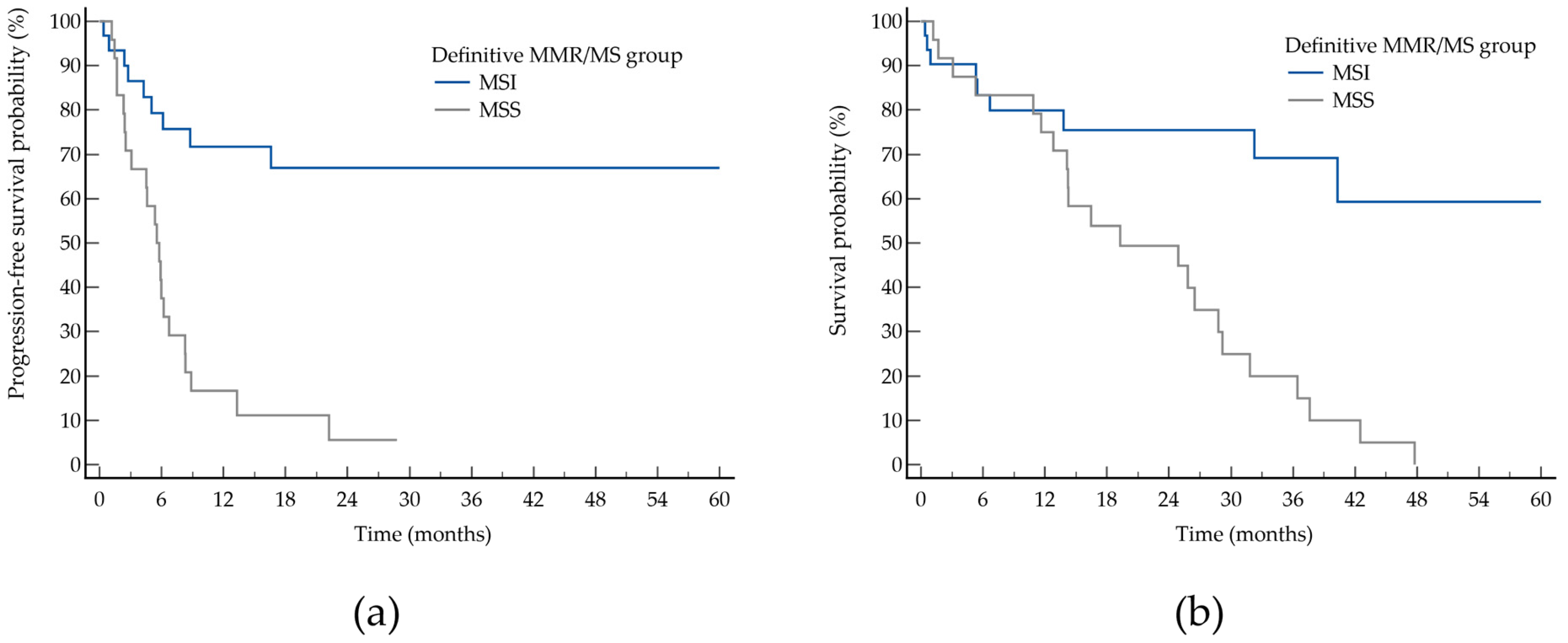
3.4.1. Definitive MSI vs. Definitive MSS Groups
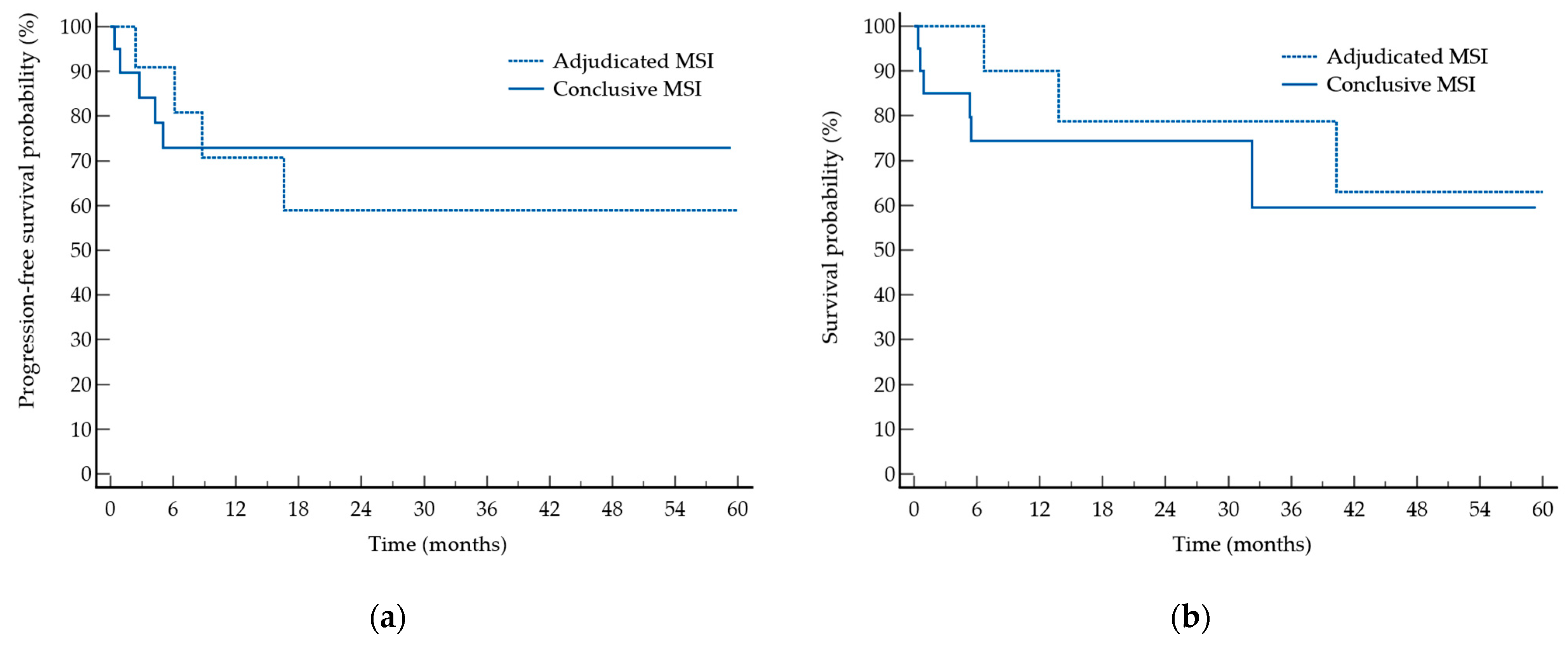
3.4.2. Conclusive MSI vs. Adjudicated MSI
3.4.3. Adjudicated MSS Tumors
4. Discussion
5. Conclusions
Author Contributions
Funding
Institutional Review Board Statement
Informed Consent Statement
Data Availability Statement
Acknowledgments
Conflicts of Interest
Abbreviations
| MSI | Microsatellite instability |
| MMR | Mismatch repair |
| dMMR | MMR deficient |
| pMMR | MMR proficient |
| CRC | Colorectal cancer |
| mCRC | Metastatic colorectal cancer |
| ICI | Immune checkpoint inhibitor |
| MS | Microsatellite |
| MSS | Microsatellite stable |
| IHC | Immunohistochemistry |
| PCR | Polymerase chain reaction |
| NGS | Next generation sequencing |
| ct | Circulating tumor |
| ctDNA | Circulating tumor DNA |
| MLH1 | MutL Homologue 1 |
| MSH2 | MutS Homologue 2 |
| MSH3 | MutS Homologue 3 |
| MSH6 | MutS Homologue 6 |
| PMS2 | Postmeiotic Segregation Increased 2 |
| KRAS | V-Ki-ras2 Kirsten rat sarcoma viral oncogene homolog |
| NRAS | Neuroblastoma RAS viral oncogene homolog |
| BRAF | v-Raf murine sarcoma viral oncogene homolog B1 |
| IQR | Interquartile range |
| OS | Overall survival |
| PFS | Progression-free survival |
| CR | Complete response |
| PR | Partial response |
| SD | Stable disease |
| PD | Progressive disease |
| NE | Not evaluable |
| ORR | Overall response rate |
| DCR | Disease control rate |
| VAF | Variant allele frequency |
| bTMB | Blood tumor mutational burden |
| TF | Tumor fraction |
| CI | Confidence interval |
| HR | Hazard ratio |
| SD | Standard deviation |
| CGP | Comprehensive genomic profiling |
Appendix A. Discordant Cases and Access and Response to Immunotherapy, n = 32
| ID | Issue Type | IHC | Molecular | ctMSI | ctCGP | Germline Pathogenic MMR Variant | Status | ICI | ICI Response |
| Tissue testing discordance | |||||||||
| 1 | IHC vs. molecular assay | pMMR | MSI-high | Not tested | Not tested | Not tested | MSI | Yes | CR |
| 2 | Uncommon IHC (equivocal staining and uncommon pairing) | Equivocal-MSH2/PMS2 (not confirmed) | Not tested | Not tested | Not tested | Not tested | MSS | No | |
| 3 | Uncommon IHC (equivocal staining) | Equivocal-MSH2 (not confirmed) | Not tested | ctMSS | None | Not tested | MSS | No | |
| 4 | Uncommon IHC (equivocal staining) | Equivocal-PMS2 | MSS | ctMSS | Not tested | None | MSS | No | |
| 5 | Uncommon IHC (equivocal staining) | Equivocal-PMS2 (not confirmed) | Not tested | Not tested | Not tested | Not tested | MSS | No | |
| 6 | Uncommon IHC (equivocal staining) | Heterogenous MLH1 | MSS | ctMSS | Not tested | Not tested | MSS | No | |
| 7 | Uncommon IHC (isolated loss and spatial heterogeneity) | dMMR-MSH6 (primary, not confirmed) pMMR (meta) | MSS | Not tested | Not tested | None | MSS | No | |
| 8 | Uncommon IHC (isolated loss and spatial heterogeneity) | pMMR (primary) dMMR-MSH6 (meta) | MSI-high | Not tested | Not tested | MSH6 | MSI | Yes | CR |
| 9 | Uncommon IHC (isolated loss and spatial heterogeneity) | pMMR (primary) dMMR-PMS2 (meta) | MSI-high | ctMSS | None | Not tested | MSI | Yes | PR |
| 10 | Uncommon IHC (isolated loss) | dMMR-MLH1 | Not tested | Not tested | Not tested | Not tested | MSI | No | |
| 11 | Uncommon IHC (isolated loss) | dMMR-MLH1 | Not tested | Not tested | Not tested | Not tested | MSI | Yes | SD |
| 12 | Uncommon IHC (isolated loss) | dMMR-MSH6 | MSI-high | Non-informative | Non-informative | MSH6 | MSI | Yes | CR |
| 13 | Uncommon IHC (isolated loss) | dMMR-MSH6 | MSI-high | Not tested | Not tested | None | MSI | Yes | CR |
| 14 | Uncommon IHC (isolated loss) | dMMR-MSH6 | MSI-high | Not tested | Not tested | Not tested | MSI | No | |
| 15 | Uncommon IHC (isolated loss) | dMMR-MSH6 (not confirmed) | MSS | ctMSS | None | None | MSS | No | |
| 16 | Uncommon IHC (isolated loss) | dMMR-PMS2 | MSI-high | ctMSI-high | None | Not tested | MSI | Yes | CR |
| 17 | Uncommon IHC (isolated loss) | dMMR-PMS2 | MSI-high | ctMSS | PMS2 c.137G>T (VAF 46%) | PMS2 | MSI | Yes | CR |
| 18 | Uncommon IHC (isolated loss) | dMMR-PMS2 | MSI-high | Not tested | Not tested | Not tested | MSI | Yes | CR |
| 19 | Uncommon IHC (isolated loss) | dMMR-PMS2 | MSI-low | Not tested | Not tested | Not tested | MSS | Yes | PD |
| 20 | Uncommon IHC (isolated loss) | dMMR-PMS2 | MSS | ctMSS | None | Not tested | MSS | No | |
| 21 | Uncommon IHC (isolated loss) | dMMR-PMS2 | MSS (Idylla) MSI-high (Pentaplex) | Not tested | Not tested | Not tested | MSI | No | |
| 22 | Uncommon IHC (spatial heterogeneity) | Equivocal-MLH1/PMS2 (primary) pMMR (meta) | Primary not tested Meta MSS | ctMSS | None | None | MSS | Yes | PD |
| 23 | Uncommon IHC (uncommon pairing) | dMMR-MLH1/MSH6 | Not tested | Not tested | Not tested | Not tested | MSI | No | |
| Tissue vs. blood discordance | |||||||||
| 24 | Blood missed | dMMR-MLH1/PMS2 | MSI-high | ctMSS | None | None | MSI | No | |
| 25 | Blood missed | dMMR-MLH1/PMS2 | MSI-high | ctMSS | None | None | MSI | Yes | SD |
| 26 | Blood missed | dMMR-MLH1/PMS2 | MSI-high | ctMSS | None | Not tested | MSI | Yes | PD |
| 27 | Tissue missed | pMMR | Not tested | ctMSS | PMS2 W841* (VAF 29.9%) | Not tested | MSI | No | |
| 28 | Tissue missed | pMMR | MSS | ctMSI-high | Not tested | Not tested | MSI | No | |
| 29 | Tissue missed | pMMR | Not tested | ctMSS | MSH6 splice site 3801+1G>T (VAF 0.99%) | Not tested | MSI | No | |
| 30 | Tissue missed | pMMR | Not tested | ctMSS | None | MSH6 | MSI | No | |
| 31 | Tissue missed | pMMR | Not tested | ctMSS | MLH1 S131* (VAF 1.4%) | Not tested | MSI | No | |
| 32 | Tissue missed | pMMR | Not tested | Not tested | Not tested | PMS2 | MSI | No |
References
- Le, D.T.; Durham, J.N.; Smith, K.N.; Wang, H.; Bartlett, B.R.; Aulakh, L.K.; Lu, S.; Kemberling, H.; Wilt, C.; Luber, B.S.; et al. Mismatch Repair Deficiency Predicts Response of Solid Tumors to PD-1 Blockade. Science 2017, 357, 409–413. [Google Scholar] [CrossRef]
- Cohen, R.; Colle, R.; Pudlarz, T.; Svrcek, M.; Pellat, A.; Lopez-Trabada, D.; André, T. Immune Checkpoint Inhibition in Metastatic Colorectal Cancer Harboring Microsatellite Instability or Mismatch Repair Deficiency. Cancers 2021, 13, 1149. [Google Scholar] [CrossRef]
- U.S. Food and Drug Administration (FDA). FDA Grants Accelerated Approval to Pembrolizumab for First Tissue-Agnostic Indication. FDA Approval Summary. 2017. Available online: https://www.fda.gov/media/109762/download (accessed on 13 June 2026).
- European Medicines Agency (EMA). Keytruda—EPAR Product Information: Extension of Indication to MSI-H/dMMR Solid Tumors. EMA/CHMP. 2021. Available online: https://www.ema.europa.eu/en/medicines/human/EPAR/keytruda (accessed on 11 May 2026).
- U.S. Food and Drug Administration (FDA). FDA Grants Accelerated Approval to Nivolumab for MSI-H or dMMR Metastatic Colorectal Cancer. FDA Approval Summary. 2017. Available online: https://www.fda.gov/drugs/resources-information-approved-drugs/fda-approves-nivolumab-ipilimumab-unresectable-or-metastatic-msi-h-or-dmmr-colorectal-cancer (accessed on 13 June 2026).
- European Medicines Agency (EMA). Opdivo—EPAR Product Information: Approval for MSI-H/dMMR Metastatic Colorectal Cancer. EMA/CHMP 2018. Available online: https://www.ema.europa.eu/en/medicines/human/EPAR/opdivo (accessed on 11 May 2026).
- Ali-Fehmi, R.; Krause, H.B.; Morris, R.T.; Wallbillich, J.J.; Corey, L.; Bandyopadhyay, S.; Kheil, M.; Elbashir, L.; Zaiem, F.; Quddus, M.R.; et al. Analysis of Concordance Between Next-Generation Sequencing Assessment of Microsatellite Instability and Immunohistochemistry-Mismatch Repair from Solid Tumors. JCO Precis. Oncol. 2024, 8, e2300648. [Google Scholar] [CrossRef] [PubMed]
- Evrard, C.; Tachon, G.; Randrian, V.; Karayan-Tapon, L.; Tougeron, D. Microsatellite Instability: Diagnosis, Heterogeneity, Discordance, and Clinical Impact in Colorectal Cancer. Cancers 2019, 11, 1567. [Google Scholar] [CrossRef]
- Gilson, P.; Merlin, J.L.; Harlé, A. Detection of Microsatellite Instability: State of the Art and Future Applications in Circulating Tumour DNA (ctDNA). Cancers 2021, 13, 1491. [Google Scholar] [CrossRef]
- Huang, J.; Xu, L.; Cai, Y.; Tan, X.; Lin, H.; Chen, Z.; Wang, C.; Deng, W.; Fu, X. Certain pMMR colorectal cancer patients should undergo additional MSI-PCR testing to reduce the risk of misdiagnosing MSI-H and Lynch syndrome. BMC Cancer 2025, 25, 1103. [Google Scholar] [CrossRef]
- Bai, H.; Wang, R.; Cheng, W.; Shen, Y.; Li, H.; Xia, W.; Ding, Z.; Zhang, Y. Evaluation of Concordance Between Deficient Mismatch Repair and Microsatellite Instability Testing and Their Association with Clinicopathological Features in Colorectal Cancer. Cancer Manag. Res. 2020, 12, 2863–2873. [Google Scholar] [CrossRef] [PubMed]
- Guyot D’Asnières De Salins, A.; Tachon, G.; Cohen, R.; Karayan-Tapon, L.; Junca, A.; Frouin, E.; Fléjou, J.F.; Cervera, P.; Tougeron, D. Discordance between Immunochemistry of Mismatch Repair Proteins and Molecular Testing of Microsatellite Instability in Colorectal Cancer. ESMO Open 2021, 6, 100120. [Google Scholar] [CrossRef] [PubMed]
- College of American Pathologists (CAP). Mismatches in Mismatch Repair: Navigating Discordant MMR/MSI Test Results; CAP Publications. 2023. Available online: https://www.cap.org (accessed on 11 May 2026).
- Chen, J.; Yan, Q.; Sun, J.; Wang, Q.; Tao, Y.; Xiao, D.; Xie, B. Microsatellite Status Detection of Colorectal Cancer: Evaluation of Inconsistency between PCR and IHC. J. Cancer 2023, 14, 1132–1140. [Google Scholar] [CrossRef]
- Moreno, E.; Rosa-Rosa, J.M.; Caniego-Casas, T.; Ruz-Caracuel, I.; Perna, C.; Guillén, C.; Palacios, J. Next generation sequencing to decipher concurrent loss of PMS2 and MSH6 in colorectal cancer. Diagn. Pathol. 2020, 15, 84. [Google Scholar] [CrossRef]
- Hechtman, J.F.; Rana, S.; Middha, S.; Stadler, Z.K.; Latham, A.; Benayed, R.; Soslow, R.; Ladanyi, M.; Yaeger, R.; Zehir, A.; et al. Retained mismatch repair protein expression occurs in approximately 6% of microsatellite instability-high cancers and is associated with missense mutations in mismatch repair genes. Mod. Pathol. 2020, 33, 871–879. [Google Scholar] [CrossRef]
- Miolo, G.; Marus, W.; Buonadonna, A.; Da Ros, L.; Della Puppa, L.; Corona, G. Null Mismatch Repair Proteins Expression Reveals the Temporal Molecular Events in Lynch Syndrome-Related Cancers. Diagnostics 2024, 14, 888. [Google Scholar] [CrossRef]
- Savio, A.J.; Mrkonjic, M.; Lemire, M.; Gallinger, S.; Knight, J.A.; Bapat, B. The dynamic DNA methylation landscape of the mutL homolog 1 shore is altered by MLH1-93G>A polymorphism in normal tissues and colorectal cancer. Clin. Epigenet. 2017, 9, 26. [Google Scholar] [CrossRef]
- Westwood, A.; Glover, A.; Hutchins, G.; Young, C.; Brockmoeller, S.; Robinson, R.; Worrilow, L.; Wallace, D.; Rankeillor, K.; Adlard, J.; et al. Additional loss of MSH2 and MSH6 expression in sporadic deficient mismatch repair colorectal cancer due to MLH1 promoter hypermethylation. J. Clin. Pathol. 2019, 72, 443–447. [Google Scholar] [CrossRef] [PubMed]
- Joo, J.E.; Mahmood, K.; Walker, R.; Georgeson, P.; Candiloro, I.; Clendenning, M.; Como, J.; Joseland, S.; Preston, S.; Graversen, L.; et al. Identifying primary and secondary MLH1 epimutation carriers displaying low-level constitutional MLH1 methylation using droplet digital PCR and genome-wide DNA methylation profiling of colorectal cancers. Clin. Epigenet. 2023, 15, 95. [Google Scholar] [CrossRef]
- Ceccon, C.; Borga, C.; Angerilli, V.; Bergamo, F.; Munari, G.; Sabbadin, M.; Gasparello, J.; Schiavi, F.; Zovato, S.; Scarpa, M.; et al. MLH1 gene promoter methylation status partially overlaps with CpG methylator phenotype (CIMP) in colorectal adenocarcinoma. Pathol. Res. Pract. 2025, 266, 155786. [Google Scholar] [CrossRef] [PubMed]
- Shia, J. Immunohistochemistry versus microsatellite instability testing for screening colorectal cancer patients at risk for hereditary nonpolyposis colorectal cancer syndrome. Part I. The utility of immunohistochemistry. J. Mol. Diagn. 2008, 10, 293–300. [Google Scholar] [CrossRef]
- Zhang, L. Immunohistochemistry versus microsatellite instability testing for screening colorectal cancer patients at risk for hereditary nonpolyposis colorectal cancer syndrome. Part II. The utility of microsatellite instability testing. J. Mol. Diagn. 2008, 10, 301–307. [Google Scholar] [CrossRef]
- Sepulveda, A.R.; Hamilton, S.R.; Allegra, C.J.; Grody, W.; Cushman-Vokoun, A.M.; Funkhouser, W.K.; Kopetz, S.E.; Lieu, C.; Lindor, N.M.; Minsky, B.D.; et al. Molecular Biomarkers for the Evaluation of Colorectal Cancer: Guideline from the American Society for Clinical Pathology, College of American Pathologists, Association for Molecular Pathology, and the American Society of Clinical Oncology. J. Clin. Oncol. 2017, 35, 1453–1486. [Google Scholar] [CrossRef]
- McCarthy, A.J.; Capo-Chichi, J.M.; Spence, T.; Grenier, S.; Stockley, T.; Kamel-Reid, S.; Serra, S.; Sabatini, P.; Chetty, R. Heterogenous loss of mismatch repair (MMR) protein expression: A challenge for immunohistochemical interpretation and microsatellite instability (MSI) evaluation. J. Pathol. Clin. Res. 2019, 5, 115–129. [Google Scholar] [CrossRef]
- Chapusot, C.; Martin, L.; Bouvier, A.M.; Bonithon-Kopp, C.; Ecarnot-Laubriet, A.; Rageot, D.; Ponnelle, T.; Laurent-Puig, P.; Faivre, J.; Piard, F. Microsatellite instability and intratumoural heterogeneity in 100 right-sided sporadic colon carcinomas. Br. J. Cancer 2002, 87, 400–404. [Google Scholar] [CrossRef]
- Greenson, J.K.; Huang, S.C.; Herron, C.; Moreno, V.; Bonner, J.D.; Tomsho, L.P.; Ben-Izhak, O.; Cohen, H.I.; Trougouboff, P.; Bejhar, J.; et al. Pathologic predictors of microsatellite instability in colorectal cancer. Am. J. Surg. Pathol. 2009, 33, 126–133. [Google Scholar] [CrossRef] [PubMed]
- Bosch, D.E.; Yeh, M.M.; Salipante, S.J.; Jacobson, A.; Cohen, S.A.; Konnick, E.Q.; Paulson, V.A. Isolated MLH1 Loss by Immunohistochemistry Because of Benign Germline MLH1 Polymorphisms. JCO Precis. Oncol. 2022, 6, e2200227. [Google Scholar] [CrossRef]
- Salipante, S.J.; Scroggins, S.M.; Hampel, H.L.; Turner, E.H.; Pritchard, C.C. Microsatellite instability detection by next generation sequencing. Clin. Chem. 2014, 60, 1192–1199. [Google Scholar] [CrossRef]
- Hempelmann, J.A.; Scroggins, S.M.; Pritchard, C.C.; Salipante, S.J. MSIplus for Integrated Colorectal Cancer Molecular Testing by Next-Generation Sequencing. J. Mol. Diagn. 2015, 17, 705–714. [Google Scholar] [CrossRef] [PubMed]
- Bonneville, R.; Krook, M.A.; Kautto, E.A.; Miya, J.; Wing, M.R.; Chen, H.Z.; Reeser, J.W.; Yu, L.; Roychowdhury, S. Landscape of Microsatellite Instability Across 39 Cancer Types. JCO Precis. Oncol. 2017, 1, 1–15. [Google Scholar] [CrossRef]
- Willis, J.; Lefterova, M.I.; Artyomenko, A.; Kasi, P.M.; Nakamura, Y.; Mody, K.; Catenacci, D.V.T.; Fakih, M.; Barbacioru, C.; Zhao, J.; et al. Validation of Microsatellite Instability Detection Using a Comprehensive Plasma-Based Genotyping Panel. Clin. Cancer Res. 2019, 25, 7035–7045. [Google Scholar] [CrossRef]
- André, T.; Shiu, K.K.; Kim, T.W.; Jensen, B.V.; Jensen, L.H.; Punt, C.; Smith, D.; Garcia-Carbonero, R.; Benavides, M.; Gibbs, P.; et al. Pembrolizumab in Microsatellite-Instability-High Advanced Colorectal Cancer. N. Engl. J. Med. 2020, 383, 2207–2218. [Google Scholar] [CrossRef]
- Diaz, L.A., Jr.; Shiu, K.K.; Kim, T.W.; Jensen, B.V.; Jensen, L.H.; Punt, C.; Smith, D.; Garcia-Carbonero, R.; Benavides, M.; Gibbs, P.; et al. Pembrolizumab versus chemotherapy for microsatellite instability-high or mismatch repair-deficient metastatic colorectal cancer (KEYNOTE-177): Final analysis of a randomised, open-label, phase 3 study. Lancet Oncol. 2022, 23, 659–670. [Google Scholar] [CrossRef]
- Andre, T.; Elez, E.; Van Cutsem, E.; Jensen, L.H.; Bennouna, J.; Mendez, G.; Schenker, M.; de la Fouchardiere, C.; Limon, M.L.; Yoshino, T.; et al. Nivolumab plus Ipilimumab in Microsatellite-Instability-High Metastatic Colorectal Cancer. N. Engl. J. Med. 2024, 391, 2014–2026. [Google Scholar] [CrossRef] [PubMed]
- André, T.; Shiu, K.K.; Kim, T.W.; Jensen, B.V.; Jensen, L.H.; Punt, C.J.A.; Smith, D.; Garcia-Carbonero, R.; Alcaide-Garcia, J.; Gibbs, P.; et al. Pembrolizumab versus chemotherapy in microsatellite instability-high or mismatch repair-deficient metastatic colorectal cancer: 5-year follow-up from the randomized phase III KEYNOTE-177 study. Ann. Oncol. 2025, 36, 277–284. [Google Scholar] [CrossRef] [PubMed]
- André, T.; Elez, E.; Lenz, H.J.; Jensen, L.H.; Touchefeu, Y.; Van Cutsem, E.; Garcia-Carbonero, R.; Tougeron, D.; Mendez, G.A.; Schenker, M.; et al. Nivolumab plus ipilimumab versus nivolumab in microsatellite instability-high metastatic colorectal cancer (CheckMate 8HW): A randomised, open-label, phase 3 trial. Lancet 2025, 405, 383–395, Erratum in Lancet 2025, 405, 700. https://doi.org/10.1016/S0140-6736(25)00352-6. [Google Scholar] [CrossRef] [PubMed]



| Covariate | Class | All | Definitive MSS | Definitive MSI | p-Value |
|---|---|---|---|---|---|
| Age | <70 | 444 (61.1) | 417 (62.0) | 27 (50.0) | 0.083 |
| ≥70 | 283 (38.9) | 256 (38.0) | 27 (50.0) | ||
| Sex | Female | 355 (48.8) | 320 (47.5) | 35 (64.8) | 0.015 |
| Male | 372 (51.2) | 353 (52.5) | 19 (35.2) | ||
| Primary tumor sidedness | Left-sided | 477 (65.6) | 458 (68.1) | 19 (35.2) | <0.001 |
| Right-sided | 243 (33.4) | 208 (30.9) | 35 (64.8) | ||
| Both | 7 (1.0) | 7 (1.0) | 0 | ||
| Grading | Low | 540 (74.3) | 510 (75.8) | 30 (55.6) | <0.001 |
| High | 84 (11.6) | 65 (9.7) | 19 (35.2) | ||
| Missing | 103 (14.2) | 98 (14.6) | 5 (9.3) | ||
| Initial stage | Non-metastatic | 252 (34.7) | 228 (33.9) | 24 (44.4) | 0.117 |
| Metastatic | 475 (65.3) | 445 (66.1) | 30 (55.6) | ||
| No of metastatic sites | 1 | 476 (65.5) | 436 (64.8) | 40 (74.1) | 0.167 |
| >1 | 251 (34.5) | 237 (35.2) | 14 (25.9) | ||
| Organ involvement | Liver | 467 (64.2) | 447 (66.4) | 20 (37.0) | <0.001 |
| Lung | 195 (26.8) | 185 (27.5) | 10 (18.5) | 0.153 | |
| Node | 126 (17.3) | 103 (15.3) | 23 (42.6) | <0.001 | |
| Peritoneum | 200 (27.5) | 185 (27.5) | 15 (27.8) | 0.964 | |
| RAS/BRAF 1 status | Wild-type | 208 (28.6) | 191 (28.4) | 17 (31.5) | <0.001 |
| RAS mutant | 403 (55.4) | 388 (57.7) | 15 (27.8) | ||
| BRAF mutant | 65 (8.9) | 48 (7.1) | 17 (31.5) | ||
| Missing | 51 (7.0) | 46 (6.8) | 5 (9.3) |
| Type of Discordance | No of Cases | Adjudicated MSI | Adjudication Process |
|---|---|---|---|
| All types | 32 | 22 | |
| Tissue discordance | |||
| Isolated loss of MMR protein | 15 | 11 | |
| MLH1 | 2 | 2 | Adjudicated MSI: considered as dMMR-IHC with no further test |
| MSH2 | 0 | N/A | |
| MSH6 | 6 | 4 | Adjudicated MSS: unconfirmed loss of MSH6 expression after IHC second review or retesting Adjudicated MSI: molecular MSI-high (including 2 cases of Lynch syndrome) |
| PMS2 | 7 | 5 | Adjudicated MSS: MSS or MSI-low Adjudicated MSI: molecular MSI-high |
| Equivocal or heterogeneous staining (IHC) | 6 | 0 | Adjudicated MSS: unconfirmed staining after IHC second review or retesting (n = 3), molecular MSS or ctMSS (n = 3) |
| Uncommon IHC pairing | 1 | 1 | Adjudicated MSI: considered as dMMR-IHC with no further test |
| pMMR/MSI-high | 1 | 1 | Adjudicated MSI: molecular MSI-high (Pentaplex 5/5) |
| Discordance between tissue and blood | |||
| Blood missed (tissue dMMR and MSI-high/ctMSS) | 3 | 3 | Adjudicated MSI: concordant tissue testing (IHC and molecular), interval between tissue testing and liquid biopsy (temporal heterogeneity) |
| Tissue missed (tissue pMMR/ctMSI-high) | 6 | 6 | Adjudicated MSI: circulating MSI signature positive (n = 1), MMR mutated gene using circulating CGP (n = 3), germline MMR gene mutation (n = 2) |
| Clinical Outcome | Definitive MSI | Conclusive MSI | Adjudicated MSI | Definitive MSS | Conclusive MSS | Adjudicated MSS |
|---|---|---|---|---|---|---|
| N | 54 | 32 | 22 | 673 | 663 | 10 |
| Immunotherapy | 31 (57.4) | 20 (62.5) | 11 (50.0) | 24 (3.6) | 22 (3.3) | 2 (20.0) |
| CR | 15 | 8 | 7 | 0 | 0 | 0 |
| PR | 7 | 6 | 1 | 7 | 7 | 0 |
| SD | 4 | 2 | 2 | 9 | 9 | 0 |
| PD | 4 | 3 | 1 | 8 | 6 | 2 |
| NE | 1 | 1 | 0 | 0 | 0 | 0 |
| ORR (CR+PR) | 22 (71.0) | 14 (70.0) | 8 (72.7) | 7 (29.2) | 7 (31.8) | 0 (0.0) |
| DCR (CR+PR+SD) | 26 (83.9) | 16 (80.0) | 10 (90.9) | 16 (66.7) | 16 (80.0) | 0 (0.0) |
Disclaimer/Publisher’s Note: The statements, opinions and data contained in all publications are solely those of the individual author(s) and contributor(s) and not of MDPI and/or the editor(s). MDPI and/or the editor(s) disclaim responsibility for any injury to people or property resulting from any ideas, methods, instructions or products referred to in the content. |
© 2026 by the authors. Licensee MDPI, Basel, Switzerland. This article is an open access article distributed under the terms and conditions of the Creative Commons Attribution (CC BY) license.
Share and Cite
Chibaudel, B.; Dainese, L.; Carola, E.; Goyer, P.; Richa, H.; Saget, A.; Oberlin, O.; Marijon, H.; Perez-Staub, N.; de Gramont, A.; et al. Diagnostic Challenges of Tumor Tissue and Circulating Microsatellite Status Assessment in Metastatic Colorectal Cancer and Their Impact on Access to Immunotherapy: A Real-World Retrospective Study. Cancers 2026, 18, 2006. https://doi.org/10.3390/cancers18122006
Chibaudel B, Dainese L, Carola E, Goyer P, Richa H, Saget A, Oberlin O, Marijon H, Perez-Staub N, de Gramont A, et al. Diagnostic Challenges of Tumor Tissue and Circulating Microsatellite Status Assessment in Metastatic Colorectal Cancer and Their Impact on Access to Immunotherapy: A Real-World Retrospective Study. Cancers. 2026; 18(12):2006. https://doi.org/10.3390/cancers18122006
Chicago/Turabian StyleChibaudel, Benoist, Linda Dainese, Elisabeth Carola, Perrine Goyer, Hubert Richa, Arnaud Saget, Olivier Oberlin, Hélène Marijon, Nathalie Perez-Staub, Aimery de Gramont, and et al. 2026. "Diagnostic Challenges of Tumor Tissue and Circulating Microsatellite Status Assessment in Metastatic Colorectal Cancer and Their Impact on Access to Immunotherapy: A Real-World Retrospective Study" Cancers 18, no. 12: 2006. https://doi.org/10.3390/cancers18122006
APA StyleChibaudel, B., Dainese, L., Carola, E., Goyer, P., Richa, H., Saget, A., Oberlin, O., Marijon, H., Perez-Staub, N., de Gramont, A., Toledano, A., & Pujol, P. (2026). Diagnostic Challenges of Tumor Tissue and Circulating Microsatellite Status Assessment in Metastatic Colorectal Cancer and Their Impact on Access to Immunotherapy: A Real-World Retrospective Study. Cancers, 18(12), 2006. https://doi.org/10.3390/cancers18122006