Review

The Evolving Landscape of Immune Regulation and Immunotherapy in Cholangiocarcinoma and Biliary Tract Cancer


Beth Israel Deaconess Medical Center, Harvard Medical School, Boston, MA 02215, USA
*
Author to whom correspondence should be addressed.
Cancers 2026, 18(12), 2001; https://doi.org/10.3390/cancers18122001 (registering DOI)
Submission received: 24 April 2026 / Revised: 11 June 2026 / Accepted: 12 June 2026 / Published: 20 June 2026
(This article belongs to the Section Cancer Immunology and Immunotherapy)

Simple Summary

Cholangiocarcinoma (CCA) is an aggressive malignancy defined by a profoundly immunosuppressive tumor microenvironment (TME) and substantial molecular heterogeneity. Chemoimmunotherapy has recently been established as standard of care in the first line setting, but durable clinical benefit remains confined to a minority of patients. In this review, we examine the cellular and molecular underpinnings of immunotherapy response in CCA, integrating tumor-intrinsic genomic features, TME architecture, and emerging therapeutic strategies including adoptive cell therapies and cancer vaccines, thus positioning CCA as a paradigm for understanding the interactions between tumor genotype, microenvironment, and immunotherapy sensitivity.

Abstract

Cholangiocarcinoma (CCA) is an aggressive and molecularly heterogeneous malignancy characterized by a profoundly immunosuppressive tumor microenvironment (TME) and historically limited therapeutic options. Recent advances have redefined the treatment paradigm, with phase III trials establishing chemoimmunotherapy as a standard of care and multi-omic profiling elucidating the interplay between tumor genomics, stromal architecture, and immune regulation. Despite these gains, durable clinical benefit remains confined to a minority of patients, reflecting convergent mechanisms of primary and acquired resistance—including immune exclusion, myeloid-dominant suppression, and genotype-driven “cold” tumor states. In this review, we synthesize emerging insights into the immune landscape of CCA, integrating data from single-cell, spatial, and translational studies to define the cellular and molecular circuits governing immune evasion. Beyond canonical biomarkers such as mismatch repair and microsatellite status, we highlight how spatial organization of immunity—in particular, tertiary lymphoid structures, dynamic myeloid and stromal interactions, and pathway-level features—shape immunotherapy responsiveness. We also examine how tumor-intrinsic alterations, including IDH1 mutation, FGFR2 fusions, KRAS activation, and MTAP loss, define distinct immunologic phenotypes with direct implications for immunotherapeutic response and biomarker-driven patient selection. We evaluate the expanding clinical trial landscape of immunotherapy in CCA and more broadly in BTC, including adoptive cell therapies and cancer vaccines. Together, these advances position CCA as a paradigm of how tumor genotype and microenvironment co-evolve to define immunotherapy sensitivity and resistance.

1. Introduction

Cholangiocarcinoma (CCA) represents a diverse group of aggressive epithelial malignancies originating from the biliary tree or hepatic progenitor cells, accounting for approximately 3% of all gastrointestinal cancers and representing the second most common primary hepatic malignancy after hepatocellular carcinoma [1]. The global incidence of CCA has been steadily increasing over the past several decades, with significant geographic variation reflecting differences in risk factors, including liver fluke infections in Southeast Asia, primary sclerosing cholangitis in Western countries, and hepatitis B and C infections worldwide [2,3,4,5].
CCA is anatomically classified into intrahepatic cholangiocarcinoma (iCCA), perihilar cholangiocarcinoma (pCCA), and distal cholangiocarcinoma (dCCA), each presenting distinct molecular profiles, tumor microenvironment, clinical behaviors, and therapeutic challenges [6,7]. The majority of patients present with advanced, unresectable disease at diagnosis, contributing to the dismal overall survival rates, with a 5-year survival of less than 10% for advanced-stage disease [8]. Previous standard first-line systemic therapy has relied on cytotoxic chemotherapy, with gemcitabine plus cisplatin providing only modest benefit and yielding a median overall survival of approximately 11 to 12 months [9,10]. Immune checkpoint inhibitors with PD-L1 in addition to chemotherapy has been shown to improve the outcomes in patients in the two phase III international clinical trials [11,12]. However, the improvement is modest with 10–20% of patients with prolonged response to therapy [13,14]. This is likely, in part, driven by the complex and heterogeneous immunological landscape of CCA characterized by an immunosuppressive tumor microenvironment (TME) that presents significant barriers to effective immune-mediated tumor clearance [6]. Understanding the intricate interplay between tumor cells, immune cells, and stromal components within the CCA microenvironment is crucial for understanding resistance mechanisms and developing rational immunotherapeutic strategies and combination therapies.
This review provides a comprehensive overview of immune regulation in CCA, examines current clinical evidence for immunotherapy, discusses emerging therapeutic approaches, and identifies future research directions aimed at improving outcomes for patients with this challenging malignancy.

2. The Immunological Landscape of Cholangiocarcinoma

2.1. Tumor Microenvironment Subtype Classification

The tumor microenvironment (TME) of CCA is profoundly heterogenous, and its systematic characterization has emerged as a central framework for understanding disease biology and prognosis. The most comprehensive TME-based classification to date was established in a cohort of 511 iCCA where unsupervised clustering was performed on immune and stromal metagene signatures derived from computational cellular deconvolution (MCP-counter), a deliberate methodological choice that prioritizes microenvironmental architecture over tumor-intrinsic transcriptional noise [15]. This approach resolved four reproducible subtypes: immune-desert (~45%), immunogenic (~10%), myeloid-enriched (~20%), and mesenchymal-like (~25%), the latter defined by fibroblast and hepatic stellate cell enrichment [15]. Survival tracked predictably with immune activation: the immunogenic subtype carried the most favorable prognosis, while the mesenchymal subtype conferred the worst survival [15].
A critical question raised by these population-level classifications is whether immune contexture is stable within individual tumors or merely reflects averaged tissue composition. A multi-omic study of 16 patients with multifocal iCCA—integrating whole-exome sequencing, bulk and single-cell RNA sequencing, methylation profiling, and multiplexed immunostaining across 66 tumor foci—found that immunophenotypes remained consistent within individual patients despite substantial genomic, transcriptional, and epigenomic divergence across foci [16]. This patient-level immunophenotypic coherence has direct implications for biopsy strategy and treatment selection in the multifocal setting. Complementary spatial resolution was provided by a multi-region study applying RNA-seq and multiplexed immunofluorescence across 207 subregions from 45 iCCA patients, which classified tumors into sparsely infiltrated (~27%), heterogeneously infiltrated (~58%), and highly infiltrated (~16%) subgroups—each with distinct immunogenomic features and immune evasion mechanisms [17]. Notably, over half of iCCAs displayed intratumoral heterogeneity of immune infiltration, underscoring the limitations of single-region sampling and urgent need for a spatially informed biomarker strategy [17].
In broader transcriptomic classifications that incorporate tumor cell intrinsic features, mesenchymal and immune modules emerge consistently and correlate with survival outcomes, though their relative proportions are attenuated, as tumor-intrinsic characteristics dominate these classifications [18,19,20,21]. In one study, an unsupervised clustering analysis of the global tumor transcriptome in extrahepatic CCA (n = 189)—performed without prior immune or stromal deconvolution—identified four classes: metabolic (~20%), proliferative (~20%), mesenchymal (~50%), and immune (~10%) [20]. Proteomic clustering of 221 intrahepatic CCA samples from China similarly confirmed that mesenchymal- and immune-related protein signatures define distinct subgroups, with the mesenchymal subtype associated with worse survival [22,23]. Complementary evidence from 454 patients in a real-world cohort of all three BTC subtypes using mutation-based clustering similarly resolved four genomically defined clusters with distinct immune biomarker profiles, reinforcing the concept that molecular drivers—rather than anatomical subtype alone—are key determinants of immune contexture in BTC [24].

2.2. Drivers of Intertumoral Heterogeneity

Several intersecting factors underlie intertumoral TME heterogeneity in CCA, including disease etiology, carcinogenic exposure history, and tumor genotype. These influences are not merely coincidental—they appear to shape distinct epigenomic programs that in turn determine immune contexture.
Liver fluke infection (Opisthorchis viverrini and Clonorchis sinensis) is the most extensively characterized etiological driver of TME divergence. Fluke-associated CCA harbors a distinct mutational and epigenetic architecture, characterized by promoter CpG island hypermethylation, elevated APOBEC mutational burden, enrichment of ARID1A, BRCA1/2, and TP53 mutations, and widespread gene expression silencing—including marked downregulation of immune-related genes and reduced immune cell infiltration [25,26]. Integrative enhancer profiling has further mechanistically linked fluke-positive CCA to aberrant activation of estrogen signaling, with fluke-positive tumors forming a coherent epigenomic cluster (ESTRO) distinct from immunogenic and oxidative phosphorylation-enriched subtypes—and demonstrating the lowest immune cell infiltration of the three groups, potentially via TNF-mediated immune evasion [26]. Importantly, the immunosuppressive landscape of fluke-positive CCA may not be driven solely by immune exclusion but rather by a carcinogen-induced epigenetic remodeling that fundamentally reprograms enhancer activity and downstream immune signaling.
In contrast to these immune-cold etiologies, PSC-associated CCA displays a more heterogeneous immune landscape, encompassing both inflamed and immune-cold phenotypes [27]. The pathophysiology underlying this diversity remains incompletely understood, though gut dysbiosis-mediated hepatic immunosuppression—operating through TLR4-dependent CXCL1 induction and subsequent CXCR2+ polymorphonuclear MDSC accumulation—has been identified as one potential mechanism linking PSC-related microbiome alterations to a protumorigenic hepatic immune environment [28].
IDH1-mutant CCA is a biologically distinct subtype with an indolent clinical course and eligibility for targeted therapy but is characterized by low infiltration of cytotoxic immune effectors including T cells, B cells, and NK cells and lower PD-L1 expression [24,29,30,31]. Mechanistically, the IDH1 neomorphic product 2-hydroxyglutarate (2-HG) suppresses T cell antitumor immunity through multiple complementary pathways including direct impairment of T cell IFN-γ expression through TET2 inactivation and—as recently demonstrated—selective hypermethylation and silencing of CGAS, which disables innate immune sensing, suppressing the cGAS-STING pathway, and contributes to the immunologically cold tumor microenvironment [29,32]. In addition, IDH1 mutated CCA produced CCL2 to increase M2-like TAMs [30]. Critically, mIDH1 inhibition with ivosidenib reverses these defects in a coordinated sequence: TET2 reactivation and genome-wide DNA demethylation restore IFN-γ responsiveness in tumor cells; derepression of CGAS and transposable element–encoded reverse transcriptase activity generate endogenous dsDNA that activates cGAS-STING via a viral mimicry mechanism, triggering type I interferon signaling and CD8+ T cell recruitment [29,32]. In preclinical models, the antitumor effect of ivosidenib was completely abrogated by CD8+ T cell depletion [29]. Acquired resistance to mIDH1 inhibition is accompanied by the emergence of MAPK pathway mutations, which blunt IFN-γ-driven gene expression, thereby attenuating the immunologic response that underlies ivosidenib’s efficacy [33]. These findings provide strong mechanistic rationale for combining IDH1 inhibition with immune checkpoint blockade, and early-phase clinical data are beginning to test this strategy.
FGFR2 fusions and mutations consistently associate with reduced CD4+, CD8+, and macrophage infiltration, lower TMB, diminished PD-L1 expression, and downregulated immune pathways across transcriptomic, proteomic, and spatial immunophenotyping studies [17,22,24,34,35]. A causal basis for this immune-cold phenotype was established by the finding that the FGFR2::BICC1 fusion directly suppresses CD4+, CD8+, and macrophage infiltration in vivo [22]. Paradoxically, however, the FGFR2::BICC1 fusion junction itself may generate immunogenic neopeptides capable of priming neoantigen-specific T cell responses, raising the possibility that FGFR2-rearranged tumors harbor latent immunogenic potential that is actively suppressed rather than absent [22,36].
In contrast to the immune-cold programs driven by IDH1 and FGFR2 alterations, KRAS mutation is associated with a qualitatively distinct immune contexture characterized by elevated myeloid infiltration—particularly macrophage enrichment—upregulation of inflammatory signaling pathways including the MAPK cascade, and enrichment within immune-inflamed transcriptomic subgroups [17,22]. Proteomic subgroup analyses have confirmed that KRAS-mutated iCCA is enriched in a chronic inflammation molecular subtype with high macrophage activation scores [37]. However, the functional consequences for antitumor immunity are complex: KRAS-driven myeloid reprogramming frequently favors immunosuppressive macrophage polarization in other tumor contexts, and the net effect on T cell-mediated antitumor immunity in CCA remains incompletely characterized.
MTAP deletion, occurring as part of the recurrent 9p21.3 chromosomal loss that co-deletes CDKN2A/B, affects approximately 15% of iCCA and constitutes one of the most frequent genomic alterations in this disease [38]. In iCCA specifically, MTAP loss is consistently associated with a cold immune phenotype: MTAP-loss tumors display significantly lower rates of PD-L1 positivity, lower MSI-high frequency, lower survival, and a trend toward reduced TMB compared to MTAP-intact tumors [38,39]. These iCCA-specific observations are consistent with pan-cancer immunogenomic analyses demonstrating that 9p21 loss—characterized by concomitant deletion of CDKN2A and MTAP—confers a globally “cold” immune phenotype with reduced abundance of tumor-infiltrating T, B, and NK cells, altered spatial TIL distribution, diminished immune cell trafficking and activation signals, and decreased PD-L1 positivity across multiple solid tumor types [40]. Importantly, the immunosuppressive consequences of 9p21 loss were shown to be driven specifically by MTAP loss rather than CDKN2A loss [41]. Mechanistically, MTAP loss abolishes enzymatic catabolism of methylthioadenosine (MTA) in the methionine salvage pathway, causing both intracellular and extracellular MTA accumulation within the TME. Extracellular MTA profoundly impairs T cell proliferation, viability, IFN-γ and IL-2 production, and granzyme B expression through two convergent pathways: selective inhibition of PRMT5—an arginine methyltransferase required for cytokine signaling and T cell activation—and agonism of adenosine receptors, which further suppresses effector T cell responses and promotes immunosuppressive macrophage polarization [41,42]. Additionally, MTAP deficiency reprograms tumor-intrinsic cytokine profiles toward a pro-tumoral milieu—suppressing antitumor cytokines including GM-CSF, IL-1α, IL-12, and IFN-γ while enriching immunosuppressive signals—and is associated with tumor cell-intrinsic upregulation of PD-L1, compounding immune exclusion at multiple levels [43]. Together, these mechanisms position MTAP deletion as a metabolic driver of immune exclusion in iCCA.
Collectively, these findings demonstrate that individual driver alterations sculpt mechanistically distinct immune contextures that extend well beyond a simple “hot versus cold” binary—each subtype presenting a unique combination of exclusion mechanisms, checkpoint expression patterns, and latent immunogenic vulnerabilities with direct implications for rational, genotype-informed combination immunotherapy strategies.

2.3. Cellular Orchestrators of Immunosuppression and Evasion in Cholangiocarcinoma—Insights from Single-Cell Studies

Single-cell and spatial transcriptomic studies of CCA have converged on a consistent picture of immune exclusion, while revealing important nuances in cellular composition across molecular subtypes. A unifying finding across studies is the dominance of immunosuppressive myeloid cells over cytotoxic lymphocytes within the tumor core. The first comprehensive scRNA-seq atlas of human iCCA and a subsequent spatial multi-omics atlas of 155 iCCA patients both demonstrate that macrophages are the most abundantly infiltrating immune cell type, with T cells largely excluded from the tumor parenchyma and confined to peritumoral margins [44,45]. This spatial pattern was also independently reported through functional ex vivo checkpoint targeting studies [46]. In contrast, multimodal single-cell profiling studies emphasize complementary but distinct suppressive axes operating independently of subtype, with one study identifying hyperactivated MEOX1-driven FOXP3+ Tregs as the dominant lymphoid suppressor of tumor-reactive CD39+CD8+ T cells [47]. and another study demonstrating that TAMs drive PD-L1-mediated immune evasion while their depletion paradoxically triggers compensatory granulocytic MDSC [48]. These single-cell and spatial findings are further supported by translational studies demonstrating that intratumoral CD8+ T cell density independently predicts overall survival and that PD-L1 is expressed in 20–70% of CCA cases with TAMs representing its primary cellular source [48,49]. Complementing these findings, elevated intratumoral FOXP3+ Treg density is independently associated with poor prognosis in iCCA, while a higher CD8+/Treg ratio consistently correlated with improved survival, reflecting the prognostic importance of the balance between effector and suppressive T cell populations [45,47].

2.4. Contribution of the Myeloid Compartment

Macrophages are the dominant immune population in the CCA microenvironment, and their contribution was initially framed through the M1/M2 paradigm. In iCCA, alternatively activated (M2) TAMs accumulate preferentially at the tumor margin and promote tumor growth, invasion, and epithelial–mesenchymal transition via STAT3 signaling [50], and both macrophage density and expression of the macrophage growth factor CSF1 (M-CSF) independently predict poorer postoperative survival [51]. This binary framework, however, only partially captures TAM biology: single-cell studies have resolved the compartment into discrete transcriptional states with distinct functions—immunosuppressive C1Q+, CCL18+, and SPP1+ macrophages predominating in more aggressive tumors [52]. The recruitment and polarization of these populations are governed by several chemokine and growth-factor circuits, many demonstrated in CCA. Monocytes are recruited and skewed toward an M2 phenotype through the CCL2–CCR2 axis, with IDH1-mutant tumors and FAP+ CAFs serving as dominant CCL2 sources driving monocyte and MDSC influx [30,53]. CSF1–CSF1R signaling sustains TAM survival and M2 identity, and CSF1R inhibition reduces M2-TAM infiltration and tumor burden in preclinical iCCA models [54]. Large-scale single-cell profiling of primary liver cancer has further delineated five distinct tumor immune microenvironment subtypes—including an immune-suppressive myeloid subtype enriched in ICC and characterized by pro-tumorigenic tumor-associated neutrophil populations that recruit macrophages via CCL4 and suppress CD8+ T cell cytotoxicity through PD-L1, while TAN–TAM co-infiltration activates STAT3 signaling to drive ICC progression and independently predicts poor prognosis [55,56]. MDSC accumulation, driven by tumor-derived GM-CSF and G-CSF, further compounds T cell suppression and represents an additional therapeutic vulnerability [48]. A distinct and underexplored axis in CCA is the macrophage phagocytosis checkpoint: in iCCA, CD47–SIRPα signaling on CD68+ TAMs independently predicts poor prognosis, and CD47 blockade restores macrophage phagocytosis in preclinical models [57].

2.5. MAITs

Innate-like lymphocytes represent a complementary axis countering the immunosuppressive CCA microenvironment. Mucosal-associated invariant T (MAIT) cells, an abundant unconventional T cell population in the healthy liver, are depleted from the tumor core in CCA, and their preservation is consistently associated with favorable outcome [58,59]. In a multicenter cohort of 70 patients with iCCA and pCCA, higher density of MAIT cells in tumor-adjacent liver tissue and the presence of intratumoral MAITs were both independently associated with longer survival, and intratumoral MAIT infiltration tracked with a broader antitumor immune signature within the TME [58]. This spatial pattern parallels CD8+ T cell exclusion and highlights MAIT cells as a distinct prognostic dimension beyond conventional T cell contexture. In parallel, NK cell biology offers a therapeutically relevant pathway in the context of frequent HLA class I downregulation [60] and may contribute to immune escape. Elevated MICA expression in iCCA and restoration of NK-cell cytotoxicity via blockade of MICA/B shedding demonstrate that the NK–NKG2D axis remains functionally actionable despite impaired CD8+ recognition [60,61]. Together, these data support incorporating innate-like lymphocytes into TME classification frameworks, which currently focus predominantly on adaptive and myeloid compartments.

2.6. T Cells Exhaustion

Beyond the numerical balance of effector and regulatory T cells, the functional state of intratumoral CD8+ T cells—progressive exhaustion marked by co-expression of inhibitory receptors beyond PD-1 such as LAG-3, TIM-3, TIGIT and B7-H3— constitutes a distinct layer of the lymphoid suppressive axis, although the depth of CCA-specific evidence differs markedly across receptors [62]. LAG-3 is the most extensively characterized of these in CCA: PD-1/LAG-3 co-expression marks the exhausted CD8+ T cell pool enriched within TLS-rich tumors and LAG-3 expression by immunohistochemistry correlates with PD-L1 positivity and CD8+ T cell density [63]. TIGIT, which competes with the costimulatory receptor CD226 for the shared ligand CD155 (PVR), is similarly upregulated on dysfunctional CD8+ and NK cells and on Tregs [62]. Single-cell profiling of extrahepatic CCA localizes TIGIT to TOX+ exhausted CD8+ T cells; high TIGIT expression on a tissue microarray independently associates with shorter survival; TIGIT+CD8+ cells exhibit reduced IFN-γ, TNF-α, and TCF-1 with reciprocal upregulation of PD-1 and TIM-3; and anti-TIGIT blockade restores CD8+ effector function and tumor control in patient-derived xenografts [64]. Evidence for the other well-established checkpoint molecules such as TIM-3 (HAVCR2), B7-H3, or VISTA receptors is well established in other tumors but less studied in CCA. TIM-3 (HAVCR2), expressed on exhausted CD8+ T cells, regulatory T cells, and innate immune populations, engages ligands including galectin-9, phosphatidylserine, HMGB1, and CEACAM-1 to attenuate T cell and NK cell effector function, marking a terminally exhausted, frequently PD-1-co-expressing T cell state associated with adverse prognosis and checkpoint-inhibitor resistance across tumor types [65]. B7-H3 (CD276), a B7-family member broadly overexpressed on tumor cells and stroma, suppresses T cell activation while exerting T cell-independent protumoral effects on angiogenesis and tumor metabolism, with high expression correlating with reduced immune infiltration and poor outcome in numerous solid tumors [66]. VISTA (PD-1H), expressed predominantly on myeloid cells and, to a lesser extent, T cells, acts as a negative checkpoint regulator that restrains T cell activation and proliferation and reinforces myeloid-mediated immunosuppression within the tumor microenvironment [67]. Direct study of these receptors in CCA is limited but emerging: in intrahepatic CCA, high tumor-cell TIM-3 expression is present in approximately half of cases, where it correlates with poorer differentiation and with CD4+ and CD8+ tumor-infiltrating lymphocyte density and is associated with shorter disease-free and overall survival [68,69]. B7-H3 has similarly been reported in intrahepatic CCA, where its expression correlates with tumor angiogenesis and adverse clinicopathologic features [70], whereas VISTA remains the least characterized in this setting. Even so, the broader functional roles, prognostic relevance, and therapeutic tractability of these receptors in CCA remain incompletely defined, and further mechanistic and biomarker studies in CCA and BTC will be required to establish whether the immunoregulatory programs characterized in other malignancies fully extend to the biliary tumor microenvironment. Collectively, the co-expression of these receptors defines a functional dimension of the lymphoid axis that compounds Treg- and MDSC-mediated suppression and provides the mechanistic foundation for the combinatorial and next-generation checkpoint strategies discussed later in this review.

2.7. B Cells and Tertiary Lymphoid Structures

Notably, B cells and tertiary lymphoid structures (TLSs) represent an important counterweight to this immunosuppressive landscape, though their role in CCA is spatially nuanced. In a large study of iCCA TLS (962 patients across three centers), intratumoral TLS density correlated strongly with favorable prognosis, whereas high peritumoral TLS density was paradoxically associated with worse survival [71]. Multiplex immunohistochemistry revealed different immune compositions, with intratumoral TLS enriched for T follicular helper cells supporting germinal center B cell responses, while peritumoral TLS showed relative Treg enrichment [71]. This opposing spatial prognostic impact was further validated in a separate CCA cohort, where TLS-positive patients showed significantly improved objective response and disease control rates to immunotherapy compared to TLS-negative patients [63]. Within the TLS-rich tumors, there was higher CD8+ T cell exhaustion signatures and PD-1/LAG-3 co-expression—suggesting that TLS may paradoxically prime tumors for checkpoint blockade responsiveness precisely because they foster a pre-exhausted but re-invigorable T cell pool [63].
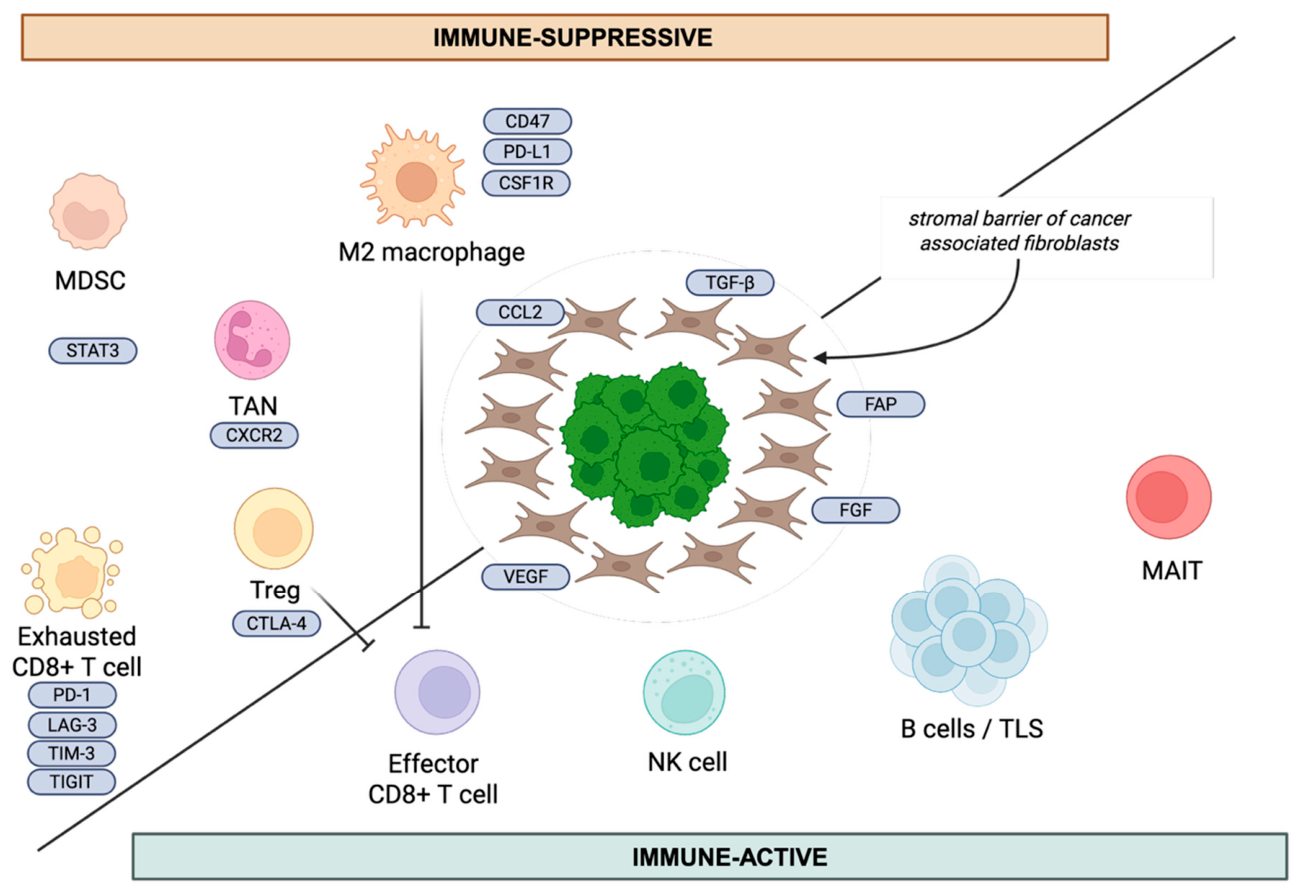
Collectively, these studies establish that CCA immune evasion is orchestrated through multiple parallel and partially overlapping axes: a lymphoid axis driven by Treg-mediated CD8+ suppression, a myeloid axis driven by TAM and MDSC co-dominance, and B cell/TLS axis (Figure 1). This redundancy may in part explain the limited efficacy of single-agent checkpoint blockade in CCA and argues strongly for combination strategies targeting both compartments simultaneously.

2.8. Cancer-Associated Fibroblasts in Antitumor Immunity

CCA is among the most desmoplastic of all malignancies, and cancer-associated fibroblasts are the numerically dominant stromal cell type in CCA, representing a critical driver of direct tumor promotion, physical barrier, and immune exclusion. Comprehensive scRNA-seq characterization of CAF heterogeneity in human iCCA identified six transcriptionally distinct subpopulations, of which CD146+ vascular CAFs (vCAFs) were the most abundant, localized in the tumor core, and uniquely positioned to sustain tumor-promoting IL-6/IL-6R signaling that drives EZH2-mediated epigenetic reprogramming of malignant cells [44]. A second study complemented this by demonstrating through genetic lineage tracing and scRNA-seq that hepatic stellate cells are the primary CAF source in iCCA, further resolving CAFs into myofibroblastic CAFs (myCAFs)—which promote tumor growth via hyaluronan synthase 2—and inflammatory CAFs (iCAFs)—which fuel tumor proliferation via HGF–MET signaling [72]. Beyond direct tumor promotion, CAFs also actively orchestrate immune evasion through both myeloid and lymphoid mechanisms. FAP+ CAFs in iCCA are the primary source of CCL2, driving MDSC recruitment via STAT3 activation; FAP knockdown significantly impaired MDSC infiltration and tumor growth, an effect fully rescued by exogenous CCL2, mechanistically linking CAF identity to myeloid immunosuppression [53]. An additional mechanism of stromal niche formation involves TWEAK/Fn14 signaling, which promotes CAF proliferation and immunosuppressive macrophage recruitment in CCA, with inhibition of this pathway shown to restrict tumor growth in preclinical models [73]. Clinically, the prognostic significance of CAFs in CCA has been demonstrated across multiple independent cohorts: high intratumoral FAP expression is independently associated with worse overall and recurrence-free survival in resected iCCA, while high α-SMA expression in CAFs correlates significantly with larger tumor size and shorter survival [74,75]. Indiscriminate CAF depletion has repeatedly failed in desmoplastic cancers—and may paradoxically accelerate progression by removing tumor-restraining CAF subsets—underscoring the need for subtype-selective therapeutic strategies rather than global CAF ablation [72,76]. Therapeutic targeting of CAFs includes depleting CAF subpopulations, inhibiting CAF activation pathways (such as TGF-β or hedgehog signaling), normalizing the extracellular matrix through enzymatic degradation, or reprogramming CAFs toward a less immunosuppressive phenotype.

3. Clinical Evidence for Immune Checkpoint Inhibitors in Cholangiocarcinoma

Immune checkpoint blockade in combination has become an established component of cholangiocarcinoma (CCA) management, driven by positive phase III studies in combination with chemotherapy in advanced disease and as monotherapy in biomarker-directed indications in selected patient populations. Current research is focused on enhancing the efficacy of immunotherapy through novel combination strategies with antiangiogenic agents and tyrosine kinase inhibitors, extending its use into earlier-stage disease. To date, the most promising clinical activity has been observed with the lenvatinib-based GOLP regimen in both advanced and neoadjuvant settings, although these findings remain largely limited to Chinese cohorts and require international validation. The sections below summarize the major completed and ongoing studies in these areas (Table 1).

3.1. Immune Checkpoint Inhibitors with Chemotherapy (Chemoimmunotherapy)

The landmark phase III TOPAZ-1 trial, conducted across 17 countries spanning Asia, Europe, and America, randomized 685 patients with previously untreated, unresectable, or metastatic biliary tract cancer (BTC)—including intrahepatic and extrahepatic cholangiocarcinoma and gallbladder cancer—to durvalumab or placebo in combination with gemcitabine and cisplatin [11]. Durvalumab significantly improved median overall survival (OS, 12.8 vs. 11.5 months, p < 0.05), progression free survival (PFS, 7.2 vs. 5.7 months, p < 0.05), and investigator-assessed objective response rates (ORR, 26.7% vs. 18.7%, p < 0.05). Updated analysis after 2 and 3 years of randomization confirmed doubling of long-term survival benefit, with two-year OS of 24.9% versus 10.4% and three-year OS of 14.6% versus 6.9% in favor of durvalumab [13,14]. Importantly, subgroup analyses from TOPAZ-1 suggested consistent benefit across most patient subgroups, including different anatomical subtypes, although the magnitude of benefit varied. Prolonged survival benefit was conserved across clinically relevant subgroups, with no specific subgroup driving long-term survival outcome. The results of TOPAZ-1 were independently confirmed by similar findings in the phase 3 KEYNOTE-966 trial, which assessed pembrolizumab plus chemotherapy in patients with previously untreated, advanced BTC. The trial showed improved OS in the pembrolizumab plus chemotherapy group but did not show statistical differences in PFS and ORR [12]. The key difference between TOPAZ-1 and KEYNOTE-966 is the ability to continue chemotherapy after 8 cycles. Based on these results, the FDA granted approval for durvalumab and pembrolizumab in combination with gemcitabine and cisplatin for advanced biliary tract cancer, establishing a new standard of care [77]. Nivolumab, a PD-1 inhibitor, has also been assessed in combination to gemcitabine and cisplatin in two phase II studies and demonstrated favorable ORR, PFS, and OS in the chemotherapy-naïve population, similar to TOPAZ-1 and KEYNOTE-966, indicating that this is likely a class effect [78,79].
TOPAZ-1 findings have now been confirmed with real-world outcomes. A 2025 study by Rimini et al., building on a prior cohort, examined outcomes for 1358 patients with advanced BTC who received the combination of durvalumab plus cisplatin and gemcitabine [80,81]. The study found that response to treatment was consistent with that in the TOPAZ-1 trial. Many additional studies from around the world have similarly confirmed the real-world safety and effectiveness of the combination regimen reported in TOPAZ-1 [82,83,84].

3.2. Immune Checkpoint Inhibitors Monotherapy

A particularly compelling rationale for biomarker-directed immunotherapy in CCA derives from the activity of PD-1 blockade in tumors harboring microsatellite instability-high (MSI-H) or mismatch repair-deficient (dMMR) status. Although MSI-H/dMMR is rare in CCA—occurring in fewer than 3% of cases in most series—it confers markedly enhanced immunogenicity through the accumulation of frameshift-derived neoantigens, rendering affected tumors highly responsive to checkpoint inhibition. In the phase II KEYNOTE-158 basket trial, pembrolizumab monotherapy in patients with previously treated MSI-H/dMMR solid tumors achieved an ORR of 40.9% among 22 patients with cholangiocarcinoma or biliary tract cancer, with a median duration of response of 30.6 months, median OS of 19.4 months, and a 3-year OS rate of approximately 30%—outcomes that stand in striking contrast to the modest benefits observed in biomarker-unselected populations [85]. These results were consistent across the broader cohort of MSI-H/dMMR solid tumors, forming the basis for tissue-agnostic FDA approval of pembrolizumab in this molecular subgroup. Collectively, these data underscore the importance of prospective MSI/MMR testing in all patients with advanced CCA and more broadly illustrate the principle that molecular biomarker selection, rather than tumor histology alone, should guide immunotherapy decision-making in this disease.
Conversely, in unselected populations, checkpoint inhibitor monotherapy yielded disappointing results. Analysis of patients with advanced CCA who had progressed on prior chemotherapy, irrespective of MSI or PD-L1 status, and were treated with pembrolizumab monotherapy in the KEYNOTE-158 trial demonstrated an ORR of 5.8% with a median OS of 7.4 months [86,87]. Median progression-free survival (PFS) was 2.0 months. While the overall response rate was modest, responders exhibited durable responses, with all responses lasting 6 months or greater [87]. The phase Ib KEYNOTE-028 trial assessed the safety and antitumor activity of pembrolizumab monotherapy in 24 patients with previously treated advanced CCA and PD-L1 positive tumors, with positivity defined as membranous PD-L1 expression in ≥1% of tumors and associated inflammatory cells or positive staining in stroma. Objective response rate (ORR) was 13.0%, with a median PFS of 1.8 months and median OS of 5.7 months [87]. Other PD-1 inhibitors including nivolumab and tislelizumab have also been evaluated in CCA with similar modest efficacy in unselected populations. Nivolumab monotherapy demonstrated an ORR of 10–22% in small phase II studies, with higher response rates observed in patients with high PD-L1 expression [88].
Taken together, patients with MSI-H/dMMR tumors can derive an exceptional response to PD-1 inhibition, while the remainder of patients with advanced BTCs have insufficient response to checkpoint inhibitor monotherapy.

3.3. Dual Checkpoint Blockade

Combination therapy with anti-PD-1/PD-L1 and anti-CTLA-4 antibodies, which has demonstrated synergistic efficacy in other tumor types such as melanoma and renal cell carcinoma, has been explored in CCA [89,90,91]. The Australian phase II study CA209-538 examined the combination of nivolumab plus ipilimumab in patients with rare cancers, among which were advanced biliary tract cancers (BTCs). Subsequent subgroup analyses found an ORR of 23% among patients with advanced BTC treated with ipilimumab and nivolumab. Median PFS was 2.9 months, and median OS was 5.7 months [92], suggesting a favorable response to combination treatment in the refractory setting. Similar studies have also examined combination durvalumab (anti-PD-L1) and tremelimumab (anti-CTLA-4) in BTC, finding the combination to be modestly effective and with a manageable toxicity profile [93,94]. The randomized phase II CheckMate 848 trial lent broader support, showing higher responses with nivolumab plus ipilimumab than with monotherapy in TMB-high solid tumors (tissue-defined ORR 38.6% vs. 29.8%), albeit in a pan-tumor population that did not specifically include CCA [95]. Together with the activity seen in refractory BTC, these data underpin the inclusion of ipilimumab plus nivolumab as a subsequent-line option for advanced CCA with TMB-high tumors in the 2025 NCCN guidelines [96].
Importantly, while the dual checkpoint blockade approach does generally show improved response rates compared to single-agent PD-1 inhibition, the benefit must be weighed against known increased risk of immune-related adverse events, which has been described across multiple types of cancer [89,97,98,99]. Optimal dosing regimens and patient selection strategies are under investigation to maximize efficacy while minimizing toxicity.

3.4. Quadruplet Combination with TKIs

The modest but meaningful survival gains established by TOPAZ-1 and KEYNOTE-966 have prompted investigation of more intensive combination strategies, adding antiangiogenic agents, with multi-targeted receptor tyrosine kinase inhibitors (TKIs), vascular endothelial growth factor inhibitors (VEGFi), or CTLA-4 inhibitors to the PD-1/PD-L1 plus chemotherapy backbone. These approaches are grounded in the mechanistic premise that VEGF signaling, tyrosine kinase receptor activity, and co-inhibitory immune checkpoints each contribute orthogonal axes of immunosuppression within the CCA tumor microenvironment.
Early efforts to target these pathways with dual therapy—combining multi-kinase inhibitors such as lenvatinib with checkpoint inhibitors—have demonstrated encouraging but ultimately insufficient activity. In the phase II LEAP-005 study, lenvatinib plus pembrolizumab in previously treated BTC achieved a median OS of 8.6 months and PFS of 6.1 months, with subsequent updates showing an ORR of 17.6%, median OS of 7.9 months, and PFS of 4.1 months [100,101]. Although these results suggested clinical activity and led to an initial NCCN recommendation in the refractory setting, the benefit proved insufficient and the recommendation was later withdrawn [102]. Together, these data suggest that dual-pathway inhibition alone is unlikely to overcome the complexity of immune resistance, reinforcing the need for more intensive, chemotherapy-containing regimens.
The most compelling evidence has emerged with the GOLP regimen in the neoadjuvant setting—a pattern consistent with the broader oncological observation that regimens with high response rates exert their greatest impact earlier in the disease course where the tumor microenvironment is less immunologically exhausted [103]. The GOLP regimen utilized a quadruplet combination of Gemcitabine (1000 mg/m2) on day 1 and 8, Oxaliplatin (85 mg/m2) on day 1, with the TKIs Lenvatinib (8 mg orally, once daily) and anti-PD-1 antibody tislelizumab 300 mg or toripalimab 240 mg on day 1. This regimen has been tested in 4 published clinical trials in China [103,104,105,106]. The initial single-arm phase 2 trial of toripalimab plus lenvatinib and GEMOX in 30 patients with advanced intrahepatic CCA demonstrated a striking ORR of 80%, a median OS of 22.5 months, and a median PFS of 10.2 months, substantially exceeding the efficacy of doublet combinations or standard chemoimmunotherapy in this population [106]. Building on this signal, the ZSAB-TransGOLP study evaluated the GOLP regimen with tislelizumab as a conversion strategy in 41 patients with unresectable locally advanced biliary tract cancer—predominantly iCCA—enrolled across two high-volume hepatobiliary centers in China [104]. The trial met its primary endpoint, achieving an R0 resection rate of 63%, with 68% of patients ultimately undergoing surgery. Median OS in the full analysis set was 30.8 months, and among surgical patients was significantly longer than in those who did not proceed to surgery (30.8 versus 13.4 months; p < 0.001), underscoring the impact of conversion surgery as a therapeutic goal [104].
These findings informed the design of the phase 2–3 ZSAB-neoGOLP trial, which randomized 178 patients with resectable but high-risk iCCA—defined by at least one of tumor diameter greater than 5 cm, vascular invasion, multifocal disease, hepatic portal lymph-node metastasis, or elevated CA 19-9 > 37 U/mL—at 11 hospitals in China to either three cycles of neoadjuvant GOLP with tislelizumab followed by surgery or upfront surgery alone, with adjuvant capecitabine (2500 mg/m2 per day on days 1–14 of a 21-day cycle for eight cycles) administered to both groups postoperatively. Treatment adherence was high: 94% of patients in the neoadjuvant group completed all planned cycles, and rates of surgical resection (97% vs. 99%) and R0 resection (95% vs. 93%) were similar between neoadjuvant and surgery alone groups. At a pre-specified interim analysis with a median follow-up of 16.9 months, event-free survival was significantly longer in the neoadjuvant group (18.0 versus 8.7 months; p < 0.001), crossing the pre-specified efficacy boundary. Radiographic response was achieved in 55% of patients in the neoadjuvant group, with 19% demonstrating major pathological response and 5% achieving pathological complete response in resected specimens. Although OS appeared to favor the neoadjuvant group (median not reached versus 31.4 months; HR 0.43; 95% CI 0.23–0.79; p = 0.005), this did not meet the pre-specified significance threshold of 0.0019, as adjusted by the Lan–DeMets O’Brien–Fleming spending function, and data maturity remains insufficient for definitive conclusions. The final OS analysis, planned at 60% data maturity, is eagerly anticipated. Collectively, these data provide compelling evidence that lenvatinib-containing quadruplet therapy confers clinically meaningful benefit in the neoadjuvant setting for intrahepatic CCA and raises the important hypothesis that TKI-mediated vascular normalization and immune modulation may be especially relevant in iCCA.
In sum, integrating lenvatinib-containing quadruplet regimens reflects a growing consensus that overcoming immune resistance in CCA requires simultaneous targeting of angiogenic, kinase, and checkpoint axes alongside chemotherapy. The GOLP conversion and neoadjuvant data offer the strongest signal yet that such intensification benefits intrahepatic disease, though whether these gains extend beyond Chinese cohorts and yield durable survival benefit awaits mature data and Western validation before this can become a new standard of care.

3.5. Quadruplet Combination with CTLA-4 Inhibitors

The addition of the CTLA-4 inhibitor tremelimumab to durvalumab plus gemcitabine and cisplatin was explored in a Korean phase II study enrolling 77 patients with advanced BTC, in which tremelimumab was administered at varying schedules alongside the standard chemoimmunotherapy doublet. No incremental benefit was observed with the addition of tremelimumab: PFS (12.3 versus 11.8 months) and OS (18.7 versus 20.2 months) were numerically similar or marginally inferior in the tremelimumab-containing arm compared with durvalumab plus chemotherapy alone, with no apparent improvement in response rate or duration of response [107]. This contrasts with the demonstrated additive activity of tremelimumab combined with durvalumab in hepatocellular carcinoma and raises the possibility that dual checkpoint blockade may preferentially benefit tumor types or microenvironmental contexts characterized by higher baseline immune infiltration—a hypothesis particularly relevant to combined HCC-CCA, where CTLA-4 inhibition may yet prove active. Whether intrahepatic CCA, which harbors a more immune-permissive microenvironment, or whether specific genomic subtype, such as IDH1 mutated tumors, may respond differently to dual checkpoint blockade remains an important unanswered question. For now, the addition of CTLA-4 blockade to chemoimmunotherapy is not used routinely in CCA and remains investigational pending data that may identify the subtypes most likely to benefit.

3.6. Quadruplet Combination with VEGF Inhibitors

Anti-VEGF strategies, informed by established activity in non-small cell lung cancer and cervical cancer, were evaluated in the global, randomized, double-blind, proof-of-concept phase II IMbrave151 trial, which assigned 162 patients with previously untreated advanced BTC 1:1 to atezolizumab (1200 mg) plus bevacizumab (15 mg/kg) or placebo, both combined with gemcitabine and cisplatin [108]. The addition of bevacizumab yielded a modest but consistent improvement in PFS (8.3 versus 7.9 months; HR 0.67; 95% CI 0.46–0.95) and significantly prolonged median duration of confirmed response (10.3 versus 6.2 months), with 12-month ongoing response rates of 47.8% versus 9.6%. However, ORR was identical between arms (26.6% versus 26.5%), and OS did not differ (14.9 versus 14.6 months), precluding a practice-changing conclusion [108]. Notably, exploratory transcriptomic analysis in 95 biomarker-evaluable patients identified high VEGFA gene expression as a candidate predictive biomarker of PFS benefit in the bevacizumab arm (HR 0.44; 95% CI 0.23–0.83), while the broader angiogenesis gene signature did not differentiate benefit [108]. Intriguingly, VEGFA expression was highest in intrahepatic CCA and gallbladder cancer relative to extrahepatic CCA, and deconvolution analysis identified hepatocyte enrichment as an additional correlate of bevacizumab benefit, consistent with the hepatic cellular context of intrahepatic CCA [108]. Taken together with the established efficacy of bevacizumab combined with atezolizumab in hepatocellular carcinoma and the pronounced activity of the GOLP regimen in intrahepatic CCA, these observations converge on the hypothesis that angiogenesis is a particularly tractable therapeutic target in intrahepatic rather than extrahepatic biliary malignancies—a distinction with important implications for future biomarker-stratified trial design. At present, the addition of bevacizumab to chemoimmunotherapy is not routinely used in CCA and remains investigational.

3.7. Bispecific Antibody

Beyond chemoimmunotherapy doublets, the next frontier involves bispecific antibody constructs designed to simultaneously engage multiple immune checkpoints. GEMINI-Hepatobiliary substudy 2 is a phase II clinical trial testing the use of CTLA-4/anti-PD-1 bispecific antibodies (volrustomig) or anti-PD-1/TIGIT bispecific antibodies (rilvegostomig) in combination with chemotherapy (gemcitabine and cisplatin) in patients with locally advanced or metastatic BTC [109]. The preliminary results of 30 patients treated with rilvegostomig showed an efficacy signal with OOR of 31% and median PFS of 8.3 months [110]. ARTEMIDE-Biliary 02 is also underway and investigating efficacy of rilvegostomig in combination with chemotherapy compared to durvalumab with chemotherapy in BTC [111]. Given the high recurrence rates following CCA resection, adjuvant immunotherapy represents an important unmet need, and the role of rilvegostomig is also being explored in the ARTEMIDE-Biliary01—a global phase III randomized placebo controlled study in combination with capecitabine or gemcitabine/cisplatin in BTC. This trial has completed accrual, and we eagerly await the results. Initial studies evaluating the use of adjuvant immunotherapy in resected CCA have shown promising survival activity [112,113]. Several ongoing clinical trials are currently underway, with eagerly anticipated results [114,115]. Importantly, selection of appropriate patient populations, treatment duration, and biomarker-guided approaches will be key considerations for adjuvant therapy development. With the emergence of PD1-VEGF bispecific antibodies such as ivonescimab and pumitamig, the benefit of targeting VEGF in CCA also remains a possibility. Collectively, these bispecific and PD-1/VEGF approaches span early- and late-phase development but all remain investigational and do not yet impact routine clinical practice.

3.8. Immunotherapy and Targeted Therapy

The molecular heterogeneity of CCA, with actionable alterations in FGFR2, IDH1, BRAF, HER2, and other genes in 20–30% of patients, has prompted investigation of immunotherapy combined with molecularly targeted agents. The rationale for such combinations includes potential synergistic antitumor effects and modification of the immunosuppressive tumor microenvironment by targeted agents.
Preclinical studies across tumor models show that FGFR inhibition reshapes the immunosuppressive microenvironment through multiple mechanisms: boosting T cell activation and recruitment, reducing MDSCs and Tregs, reversing M2 macrophage polarization, inactivating CAFs to relieve T cell exclusion, and increasing tumor MHC I/II expression via MAPK/ERK blockade; however, FGFR2:BICC1 fusion junctions themselves can generate neopeptides capable of eliciting neoantigen-specific T cell responses [22,36,116,117]. These findings provide a strong rationale for combination with immune checkpoint inhibitors. Early clinical data in CCA are consistent with this rationale but remain limited. In the combination dose-finding and dose-expansion cohorts of FIGHT-101, pemigatinib plus pembrolizumab produced an objective response rate (ORR) of 26.9% in 26 patients with FGF/FGFR-altered advanced malignancies, with pharmacokinetic and safety profiles consistent with monotherapy exposure [118]. Case reports in advanced iCCA with FGFR2::BICC1 fusions have documented durable first-line responses to pemigatinib combined with pembrolizumab and platinum-based chemotherapy [119]. Reflecting the strength of the mechanistic rationale, an ongoing phase I/II study (NCT06439485) is evaluating the triplet of pemigatinib, atezolizumab, and bevacizumab in pretreated advanced CCA with FGFR2 fusions or rearrangements [120]. In parallel, a separate phase II study (NCT05174650) is evaluating the combination of derazantinib, an FGFR1-3, CSF1R, and VEGFR2 inhibitor, with atezolizumab in advanced iCCA with FGFR2 fusions or rearrangements [36]. Further combination trials are underway in China and Europe evaluating pemigatinib with the PD-1 inhibitor sintilimab (NCT05913661) and with durvalumab (NCT06530823) in BTC [121,122]. Whether the striking preclinical synergy and early-phase results translate into clinical benefit and eventual integration of FGFR inhibitor plus immune checkpoint inhibitor combination routine practice will depend on the results of these ongoing biomarker-stratified studies.
Combinations of IDH1 inhibitors with immune checkpoint inhibitors in CCA are supported by a strong mechanistic rationale as previously described, although clinical evidence to date has been mixed. In the phase II basket trial (NCT04056910), ivosidenib plus nivolumab yielded limited activity (ORR 6.7%, median PFS 1.94 months) in a heavily pretreated cohort, with all iCCA patients achieving stable disease but no objective responses [123]. While pharmacodynamic effects—including reduction in plasma 2-HG and evidence of immune modulation—were observed, efficacy was comparable to IDH1 inhibition alone, suggesting that PD-1 blockade may not optimally align with the underlying biology. This has prompted ongoing evaluation of alternative combinations in CCA, including triplet regimens incorporating CTLA-4 inhibition (NCT05921760), which more closely mirror preclinical synergy [124]. Moving forward, biomarker-driven trials with paired tissue analyses will be critical to confirm target engagement (e.g., cGAS–STING reactivation, ERV induction) and to identify the subset of patients in whom this strategy translates into meaningful clinical benefit. While the combinations under investigation remain early-phase and have not yet entered routine practice, they represent a promising and biologically rational strategy with the potential to reshape the treatment landscape.

3.9. Radiation Therapy with Chemoimmunotherapy

Radiation therapy has well-documented immunomodulatory effects including upregulation of MHC molecules and checkpoint ligands, alteration of the cytokine milieu, and generation of abscopal effects whereby treatment of one tumor site produces immune-mediated regression of distant, unirradiated tumors [125,126,127]. Combination of radiation with immune checkpoint inhibitors have been postulated to enhance this effect but the optimal radiation dose, fractionation, and sequencing with immunotherapy are the subject of further investigation.
Previous studies combining chemotherapy with locoregional therapies in the oligo-metastatic setting established the safety of this approach but yielded mixed efficacy results. The MISPHEC trial was a phase II single arm study, evaluating the combination of yttrium-90 (Y90) selective internal radiation therapy (SIRT) concurrent with cisplatin/gemcitabine in unresectable intrahepatic cholangiocarcinoma and reported encouraging outcome with a median OS of 22 months and median PFS of 14 months [128]. This outcome is superior to mOS and mPFS from patients who received chemotherapy alone from a historic clinical trial such as the ABC-02. However, ABC-07, a randomized phase II trial in which patients with locally advanced biliary tract cancer who had not progressed after induction cisplatin/gemcitabine were randomized to consolidative stereotactic body radiotherapy (SBRT) or continued chemotherapy alone, did not show an improvement in progression free survival [128]. Several design differences likely account for these discordant results. SIRT delivers a high, ablative intratumoral dose transarterially to liver-confined disease—capable of downstaging to resection—whereas SBRT delivers a lower, focal dose limited by adjacent normal-tissue tolerance. The two trials also differed in timing and population: MISPHEC gave SIRT upfront with first-line chemotherapy in intrahepatic-only disease, whereas ABC-07 delivered SBRT only as consolidation in non-progressors and enrolled broader locally advanced BTC, including extrahepatic subtypes in which extrahepatic progression may outpace any local-control benefit.
These insights are now informing the design of ongoing trials that incorporate immunotherapy into this approach, including a single-arm phase II trial (NCT05655949) assessing the safety and efficacy of Y90—administered early in the treatment course—combined with durvalumab, gemcitabine, and cisplatin in biliary tract cancer with liver involvement, with eagerly anticipated results [129]. Extrapolating the data from these studies, many institutions are actively utilize the combination of radiation therapy with chemoimmunotherapy particularly in patients with unresectable BTCs with liver only disease or in the oligometastatic setting.

4. Biomarkers for Response Prediction and Resistance Mechanism

Despite promising developments, several challenges complicate the interpretation and implementation of immunotherapy in CCA. Patient heterogeneity, including variations in anatomical subtype, etiology, molecular features, and prior treatments, contributes to inconsistent trial outcomes. Standardization of patient selection criteria and stratification factors in clinical trials is needed to better identify responders.
Biomarker development and validation remain critical unmet needs. While PD-L1 expression, MSI-H/dMMR status, and TMB have shown predictive value in some studies, their utility is limited by methodological variability, incomplete correlation with response, and applicability to only a subset of patients. Development of more robust predictive biomarkers, potentially incorporating multiple parameters including immune profiling, molecular features, and radiographic characteristics, is essential.

4.1. Conventional Markers of Response

Biomarker development in CCA has lagged behind the clinical deployment of chemoimmunotherapy, and MSI-high/mismatch-repair-deficient status remains the only tumor-agnostic biomarker with validated predictive value in BTC, supporting pembrolizumab monotherapy for the ~2% of patients with these alterations [130]. In contrast, PD-L1 immunohistochemistry has performed inconsistently. Both TOPAZ-1 and KEYNOTE-966 demonstrated that durvalumab and pembrolizumab provide comparable survival benefit irrespective of PD-L1 expression levels, but interpretation is further confounded by marked variability among antibody clones (22C3, 28-8, SP142, SP263), differing scoring frameworks (TPS vs. CPS), and the absence of a CCA-specific cutoff [131]. Tumor mutational burden shows modest enrichment of responders in pan-tumor analyses, but the generally low-to-intermediate TMB of CCA, non-standardized assay platforms, and lack of a validated threshold limit its stand-alone utility; its 2025 NCCN-endorsed role in CCA is restricted to identifying candidates for ipilimumab–nivolumab in TMB-high refractory disease [96,132,133].

4.2. Immune Gene Signatures, Immune Profiling, and Genotype

A second generation of biomarker strategies with multiparametric immune profiling of the tumor microenvironment has increasingly refined patient selection for chemoimmunotherapy in CCA. Transcriptomic signatures capturing T cell inflammation, IFN-γ response, and immune-exclusion phenotypes have predicted ICI benefit across tumor types and correlate with TME subtype in CCA [15,19,20,134]. Within this framework, TLSs have emerged as a central determinant of therapeutic sensitivity: intratumoral TLSs—quantified by four gene-expression signatures—are associated with prolonged PFS and OS in a 100-patient CCA cohort receiving adjuvant chemoimmunotherapy, whereas peri-tumoral TLS correlate with inferior outcomes, similar to prior study in the resected context, underscoring the importance of spatial context [135]. Chung and colleagues subsequently confirmed in 16 resection tumor samples from a phase II trial of nivolumab plus modified gemcitabine/S-1 as first line systemic treatment that TLS-positive tumors had significantly higher ORR, DCR, PFS, and OS than TLS-negative tumors and identified distinct T cell transcriptional programs in TILs and TLS that distinguish responders [63]. Ji and colleagues further integrated radiomic and transcriptomic features into a three-gene immune-response signature (PLAUR, CD40LG, FGFR4) that stratified ICI benefit with AUC 0.84 in a CCA validation cohort [136].
A complementary prospective study by Xu and colleagues of 66 advanced iCCA patients receiving GC plus durvalumab supports the relevance of TME remodeling: responders showed 135 differentially expressed genes enriched in immune-regulatory and mesenchymal pathways, and post-treatment biopsies demonstrated increased PD-L1 expression, expanded CD8+ T cell infiltration, γδ T cell involvement, and reduced α-SMA stromal marking, with 15.2% of patients ultimately achieving R0 conversion resection [137]. Tang and colleagues extended the tissue-based immune-checkpoint repertoire beyond PD-L1 by demonstrating that LAG-3 expression by immunohistochemistry in 44 advanced BTC samples from the T1219 trial predicted chemoimmunotherapy response in a dose-dependent manner (ORR 33%, 58%, and 100% for LAG-3 expression of <1%, 1–9%, and ≥10%, respectively; p = 0.018) and correlated with PD-L1 positivity and CD8+ T cell enrichment [138]. LAG-3 expression also correlated with PD-L1 positivity and CD8+ T cell enrichment, suggesting its potential role as a more consistent checkpoint biomarker in this setting. Milardi and colleagues extend this framework by linking B cell biology directly to chemoimmunotherapy responsiveness in iCCA [139]. Single-cell profiling showed that intratumoral B cells are sparse, immature, and functionally suppressed by IL-6 and TGF-β-mediated signaling, whereas mature tertiary lymphoid structures in adjacent tissue track with favorable outcomes [139]. Critically, in patients treated with first-line chemoimmunotherapy, circulating BAFFR+ B cells, higher BAFF levels, and early expansion of treatment-emergent B cell clonotypes were enriched in responders and associated with improved PFS and OS, nominating B cell activation state as a dynamic biomarker of therapeutic efficacy [139]. Mechanistically, dual IL-6/TGF-β blockade restored B cell activation and differentiation ex vivo, supporting this axis as both a predictive biomarker and a rational target to enhance chemoimmunotherapy response [139].
Beyond immune composition, integration of clinical features with H&E images with computational approaches further refine prediction. Cao and colleagues reported a pathomics-based machine-learning signature (PS-ICC) derived from H&E digital images of 189 unresectable iCCA patients on chemoimmunotherapy; PS-ICC was strongly associated with OS (training-cohort HR 0.09; validation-cohort HR 0.20), outperformed RECIST 1.1 as a surrogate for 1-year survival (AUC 0.868 vs. 0.701), and low PS-ICC scores correlated with reduced M0 macrophage infiltration and enrichment of PD-L1/PD-1 checkpoint pathways [140].
Multiple genomic and pathway-level analyses also represent an important axis, although results are not uniformly concordant. Pirrone and colleagues showed that HRD/BRCAness-pathway alterations were associated with improved OS (23.3 vs. 13.8 months, HR 0.51) and PFS (13.2 vs. 8.1 months, HR 0.53) and that TGF-β pathway alterations independently predicted longer PFS (16.0 vs. 8.1 months, HR 0.53) [141]. In a parallel multi-omics study of 125 advanced BTC patients receiving first-line chemoimmunotherapy, Ni and colleagues combined targeted DNA sequencing with bulk RNA sequencing to show that mutations in TP53, BRCA2, and cytokine-pathway genes, together with high TMB, tracked with response, whereas KRAS G12D and ARID1A mutations portended poor survival. In a smaller multicenter Japanese cohort of 19 unresectable iCCA patients receiving gemcitabine/cisplatin/durvalumab, TP53 mutation was also identified as the only independent predictor of shorter PFS on multivariate analysis (HR 4.20), with spatial transcriptomic profiling revealing that TP53-mutant tumors displayed a distinct immunosuppressive phenotype characterized by poor CD8+ T cell infiltration, enrichment of CD109+ tumor-associated macrophages, and downregulation of the antigen-presentation genes TAP1 and TAP2 [142]. These findings are further contextualized by transcriptomic TME classifications (Job, Martin-Serrano, Carapeto, and Bao for iCCA; Montal for eCCA, defining an “Immune” class in ~11.5% of tumors) and by driver-stratified approaches suggesting that FGFR2- and IDH1-altered tumors tend toward immunologically cold phenotypes while ERBB2-, KRAS-, and TP53-altered tumors have more immune infiltration in the microenvironments as previously described in the review. Collectively, these data underscore that genomic correlates of chemoimmunotherapy response in BTC are complex, context-dependent, and not uniformly concordant across studies. Importantly, most available datasets remain limited by modest sample sizes, heterogeneity in disease subtype and treatment exposure, and variable depth of molecular profiling, which constrain the stability and generalizability of individual biomarker associations. As such, the effect of specific alterations—particularly targetable genomic events—should not be interpreted in isolation but rather within their broader genomic and tumor microenvironment context. These nuances have direct implications for trial design: rational combination strategies will require mutation-specific frameworks that account for co-alterations, immune phenotype, and functional biology rather than assuming uniform behavior across genomic subgroups.

4.3. Circulating Biomarkers

Given the heterogeneity of CCA and the invasive nature of repeat biopsy, dynamic circulating and peripheral biomarkers offer a third, complementary layer. Liquid biopsies, including assessment of circulating tumor DNA (ctDNA), circulating tumor cells (CTCs), and immune-related peripheral blood markers offer potential advantages in accessibility, serial monitoring, and capturing tumor heterogeneity. Plasma ctDNA monitoring has shown early utility in tracking ICI response in BTC, with early declines in variant allele frequency correlating with radiographic benefit [143]. In addition, a study of patients with resectable extrahepatic CCA who underwent longitudinal ctDNA monitoring found that ctDNA positivity at any time after surgery (either prior to or during adjuvant therapy) was associated with significantly inferior disease-free survival [144]. Immune-related peripheral blood markers, including cytokine profiles, may also be potentially useful biomarkers for CCA given success in other cancer types [145,146]. Peripheral markers of inflammation, such as elevated neutrophil-to-lymphocyte ratio, have already been shown to have prognostic value in cholangiocarcinoma; additional studies are needed to determine if these markers may also be predictive of response to immunotherapy [147,148]. Milardi and colleagues found that elevated frequencies of circulating BAFFR+ B cells and hyperexpanded B cell clonotypes were associated with improved chemoimmunotherapy response, providing a peripheral readout of the tissue-level B cell dysfunction described above [139]. Peripheral immune profiling offers a complementary, readily deployable readout. Keenan and colleagues applied CITE-seq to PBMCs from advanced BTC patients on anti-PD-1 and identified a circulating CD14+ monocyte state (CD14_CTX) that expanded in non-responders; the derived gene signature predicted shorter survival in the TCGA cholangiocarcinoma cohort (21.1 months vs. not reached; p = 0.02) [149]. The state is defined by two surface markers, Tim-3 and CD29, assayable by routine clinical flow cytometry—offering a practical path to a blood-based assay for patient selection and on-treatment monitoring. Fan and colleagues evaluated the CALLY index (CRP–albumin–lymphocyte composite) in a 110-patient propensity-score-matched CCA cohort on chemoimmunotherapy, showing that high CALLY (>1.42) was associated with longer median OS (13.0 vs. 11.5 months, HR 0.68) and PFS (7.5 vs. 6.0 months, HR 0.70), with time-dependent AUCs of 0.74–0.90 and slower deterioration of health-related quality of life [150]. Memory T cells have also been shown to act as positive predictive biomarkers for response to immune checkpoint inhibition [151,152].
Taken together, these data suggest that biomarker development for ICI use in CCA is best conceptualized as a layered continuum rather than a single defining feature. Established markers such as MSI/dMMR status and actionable driver alterations provide a useful foundation, while a growing body of work illustrates how tissue-based characteristics—including tumor microenvironment subtypes, spatial immune organization (e.g., TLS and B cell biology), checkpoint expression beyond PD-L1, and pathway-level features such as HRD/BRCAness or TGF-β signaling—can further refine the likelihood of response. Complementary studies also highlight the potential role of dynamic peripheral markers, such as ctDNA kinetics, composite inflammatory indices (e.g., CALLY), and circulating immune cell profiles, in capturing treatment response overtime and may be important for treatment de-escalation. Collectively, these examples underscore that no single biomarker is sufficient in isolation; rather, integrating signals across genomic, tissue, and peripheral compartments will likely be necessary to more accurately guide patient selection. Prospective validation of such integrated approaches within ongoing chemoimmunotherapy and targeted–ICI combination studies will be critical to determine their clinical utility.

5. Immunotherapy Resistance Mechanisms and Strategies to Overcome Them

5.1. Primary Resistance Mechanisms

Primary resistance to immunotherapy, evidenced by lack of initial response, occurs in the majority of CCA patients treated with checkpoint inhibitors. Multiple mechanisms contribute to primary resistance, including intrinsic features of the tumor and its microenvironment.
Lack of tumor immunogenicity due to low mutational burden and paucity of neoantigens represents a fundamental barrier to effective antitumor immunity in many CCA cases [153]. Tumors with few recognizable neoantigens fail to elicit robust T cell responses even when checkpoint inhibition removes inhibitory signals. Immune exclusion, whereby T cells are present in the tumor periphery but fail to infiltrate the tumor parenchyma, is also frequently observed in CCA [7]. The dense desmoplastic stroma characteristic of CCA creates physical barriers to T cell infiltration. Additionally, aberrant tumor vasculature and lack of appropriate chemokine gradients impair T cell trafficking to tumor sites [154]. Finally, immunosuppressive cellular populations, including Tregs, MDSCs, and M2-polarized TAMs, are abundant in many CCA tumors and actively suppress antitumor immune responses [15,155]. High ratios of immunosuppressive to effector immune cells within the TME are known to predict poor immunotherapy responses.
Major histocompatibility complex (MHC) class I molecules, encoded by human leukocyte antigen (HLA) genes, present intracellular peptides to CD8+ T cells, enabling immune recognition of tumor cells. Loss or downregulation of HLA expression represents a potent mechanism of immune evasion, as defects in antigen presentation machinery render tumor cells invisible to T cells despite checkpoint inhibition. HLA loss has been documented in a subset of CCA cases, occurring through various mechanisms including chromosomal deletions, loss of heterozygosity, transcriptional downregulation, or mutations in genes involved in antigen processing and presentation machinery, and has been found to be associated with a “non-inflamed” tumor microenvironment [156,157]. Defects in antigen presentation cannot be overcome by T cell-mediated checkpoint inhibition alone and may require alternative immunotherapeutic approaches such as NK cell-based therapies or interventions to restore HLA expression [157]. Further studies aimed at understanding the patterns and mechanisms of HLA alterations in CCA will be crucial for predicting immunotherapy resistance and developing complementary therapeutic strategies.
Driver genotype including IDH1, FGFR2, KRAS and 9p21 co-deletion of MTAP/CDKN2A imposes a metabolic immunosuppressive program and provide an additional layer of primary-resistance biology that has been detailed in Section 2. The implication for trial design is that genotype-informed combination strategies—IDH1 or FGFR2 inhibition, MTA-depleting enzymes in MTAP-null tumors with checkpoint blockade or other immunotherapeutics—offer more mechanistically coherent approaches than biomarker-agnostic PD-1 blockade.

5.2. Acquired Resistance Mechanisms

Acquired resistance develops in patients who initially respond to immunotherapy but subsequently progress. Understanding mechanisms of acquired resistance is crucial for developing strategies to maintain durable responses.
Loss of neoantigen expression through immunoediting represents a well-described mechanism of acquired resistance. Under selective pressure from antitumor immunity, tumor cells with loss or downregulation of immunogenic neoantigens gain survival advantage and eventually dominate the tumor population [158]. This process can occur through deletion of chromosomal regions encoding neoantigens, transcriptional silencing, or selection of pre-existing subclones lacking the targeted antigens.
Acquired defects in interferon signaling pathways, including mutations in JAK1/JAK2 or alterations of interferon-gamma receptor genes, have been identified in tumors developing resistance to checkpoint inhibitors [159,160]. These defects impair tumor cell responsiveness to interferon-gamma produced by activated T cells, thus preventing downstream induction of antigen presentation machinery and allowing immune evasion.
Upregulation of alternative immune checkpoint molecules represents an adaptive resistance mechanism wherein tumors compensate for blockade of one checkpoint pathway by increasing expression of others [160]. For example, tumors treated with PD-1 inhibitors may upregulate TIM-3, LAG-3, or other checkpoints, suggesting potential benefit from sequential or combinatorial checkpoint blockade targeting multiple pathways [161,162].
Epithelial–mesenchymal transition (EMT) in tumor cells represents another mechanism of acquired resistance to immunotherapies. EMT has been associated with immunotherapy resistance through multiple mechanisms including induction of an immune suppressive tumor microenvironment, increased expression of immunosuppressive ligands such as PD-L1, and altered metabolic properties [160].
Additional studies are needed to explore these mechanisms in the context of CCA to develop strategies to better address acquired resistance to immunotherapy in CCA.

5.3. Strategies to Overcome Resistance

Combination approaches targeting multiple resistance mechanisms simultaneously represent the most promising strategy for improving immunotherapy outcomes in CCA. Rational combinations should be determined based on an understanding of the specific mechanisms driving each patient’s resistance.
Combination of checkpoint inhibitors with agents that enhance tumor immunogenicity, such as chemotherapy, radiation therapy, or oncolytic viruses, may convert immunologically cold tumors into hot tumors. These treatments induce immunogenic cell death, releasing tumor antigens and danger signals that activate antitumor immune responses. The success of chemotherapy–immunotherapy combinations in the TOPAZ-1 trial validates this approach [14].
Beyond PD-1/PD-L1 and CTLA-4, numerous additional immune checkpoint and co-stimulatory molecules are being investigated as therapeutic targets. Next-generation checkpoint inhibitors targeting LAG-3, TIM-3, TIGIT, VISTA, B7-H3, and others are in clinical development, either as monotherapy or in combination with PD-1/PD-L1 blockade [163,164,165,166].
Agonistic antibodies targeting co-stimulatory molecules such as OX40, 4-1BB (CD137), GITR, or CD40 represent an alternative approach to enhance antitumor immunity. These agents activate and expand effector T cells rather than simply removing inhibitory signals. Combination of co-stimulatory agonists with checkpoint inhibitors may produce synergistic effects, although careful attention to dosing and sequencing is required to avoid excessive toxicity [167,168].
Bi-specific and multi-specific antibodies that simultaneously engage multiple immune checkpoints or combine checkpoint blockade with co-stimulation represent innovative approaches currently entering clinical evaluation [111,165,169,170,171]. These molecules may offer pharmacological advantages including simplified dosing regimens and enhanced potency compared to combination of separate antibodies.
Targeting the immunosuppressive tumor microenvironment through inhibition of pathways such as TGF-β, adenosine, or IDO can synergize with checkpoint blockade [171,172]. Multiple early-phase clinical trials are evaluating these combinations, with promising preliminary results in some studies [173,174,175]. Targeting the adenosine pathway through inhibition of CD73 or adenosine receptors represents another approach to reverse immunosuppression. CD73 inhibitors are being evaluated in combination with checkpoint inhibitors in multiple solid tumor types including biliary tract cancers.
Modulation of the stromal compartment, particularly targeting CAFs, or modifying the extracellular matrix to enhance immune cell infiltration and drug delivery, represents an important complementary strategy [176]. Preclinical studies have demonstrated that combining CAF-targeting agents with checkpoint inhibitors can overcome resistance and improve outcomes [177,178,179].

6. Emerging Immunotherapeutic Strategies

6.1. Adoptive Cell Therapy

Adoptive cell therapy (ACT) involves the collection, ex vivo manipulation, and reinfusion of immune cells to mediate antitumor responses. Several ACT approaches are being investigated in CCA, including tumor-infiltrating lymphocyte (TIL) therapy, engineered T cell receptor (TCR) therapy, and chimeric antigen receptor (CAR) T cell therapy. Thus far, these have been mostly investigated in preclinical and case report settings, and extensive clinical trial efforts are ongoing in this space (Table 2).
TIL therapy is based on the premise that tumor-resident T cells include clones capable of recognizing patient-specific neoantigens. The modern framework for TIL therapy in CCA dates to the landmark case report from the NIH in 2014 in which whole-exome sequencing of a metastatic iCCA identified a mutation in ERBB2IP (E805G) recognized by tumor-derived CD4+ T-helper-1 cells [180]. Adoptive transfer of approximately 42 billion TIL containing ~25% mutation-specific CD4+ cells produced regression of lung and liver metastases; upon progression, retreatment with a >95% pure population of ERBB2IP-reactive CD4+ cells induced a second, durable response for more than 10 years [180]. This case provided the first direct evidence that a CD4+ T cell response against a patient-specific neoantigen could mediate regression of metastatic epithelial cancer and catalyzed subsequent development programs in gastrointestinal tumors. This approach has shown remarkable efficacy in melanoma [181,182]. A dedicated phase II study of autologous TIL and high-dose aldesleukin in locally advanced, recurrent, or metastatic BTC (NCT03801083) [183] is currently enrolling at the University of Pittsburgh, and a parallel phase I/II study of TIL genetically engineered with additional checkpoint modulation in metastatic gastrointestinal epithelial cancers includes BTC patients (NCT04426669) [184].
CAR T cell therapy, which has revolutionized treatment of B cell malignancies and multiple myeloma, faces considerable challenges in solid tumors including CCA owing to the absence of truly tumor-restricted surface antigens, poor T cell trafficking into densely desmoplastic stroma, and the immunosuppressive tumor microenvironment as previously described. Published CCA-specific experience to date comes from three small Chinese studies. Feng and colleagues reported a 52-year-old woman with chemorefractory unresectable CCA who received a sequential cocktail of CART-EGFR and CART-CD133 cells, achieving an 8.5-month partial response after EGFR-targeted infusion and an additional 4.5-month partial response after CD133-targeted infusion [185]. Guo and colleagues subsequently extended this experience in a phase I trial of CART-EGFR in 19 patients with EGFR-positive (>50%) advanced BTC (14 cholangiocarcinoma, 5 gallbladder carcinomas): among 17 evaluable patients, 1 achieved complete response and 10 achieved stable disease, with median progression-free survival of 4 months (range 2.5–22) [186]. Enrichment of central memory T cells in the infused product predicted clinical response, foreshadowing the contemporary emphasis on product quality attributes [186]. Feng and colleagues also reported a phase I trial of CART-HER2 in 11 HER2-positive advanced BTC/pancreatic cancer patients, with 1 partial response (4.5 months) and 5 stable disease, median PFS 4.8 months [187]. Ongoing CAR-T programs relevant to CCA span multiple tumor-associated antigens: mesothelin (conventional CAR-T; NCT06256055 [188]), Killer-cell Immunoglobulin-like Receptor (KIR-CAR); NCT05568680 [189]), CEA (NCT06043466 [190]), CDH17 (NCT06937567 [191]), and MUC1 (NCT03633773 [192], specifically in iCCA). A conceptually distinct approach—chimeric antigen receptor macrophages—is being evaluated in HER2-overexpressing solid tumors including BTC (CT-0508, NCT04660929 [193]), and an autologous central-memory T cell product is under investigation specifically in iCCA (NCT03820310 [194]). Early-generation cytokine-induced killer (CIK) cell therapy for CCA is being explored at Siriraj Hospital in Thailand (NCT01868490 [195]).
TCR-engineered T cells, which combine the antigen specificity of TCRs with the ability to recognize intracellular antigens presented by HLA molecules, represent another promising approach [196]. Identification of tumor-specific neoantigens or cancer-testis antigens in CCA could enable development of neoantigen-specific TCR therapies. Ongoing TCR-T programs relevant to CCA include NCT05349890 [197] in incurable epithelial cancers and NCT03907852 [198] (mesothelin-targeting TCR-fusion construct) with additional neoantigen-directed TCR-T platforms in advanced development.
NK cell therapy represents a complementary ACT platform, leveraging innate cytotoxicity without HLA restriction and with a favorable safety profile relative to T cell products. Leem and colleagues reported a multicenter open-label phase 1/2a trial of allogeneic NK cells combined with pembrolizumab in chemotherapy-refractory BTC, demonstrating feasibility and preliminary activity [199]. Engineered NK products, including CAR-NK and cytokine-armored NK platforms, are in earlier-phase development and may be attractive for desmoplastic tumors such as CCA where T cell trafficking is limited.

6.2. Myeloid Targeted Therapies

Pharmacologic targeting of the myeloid axis is now being explored clinically in CCA, predominantly through early-phase combination trials. Derazantinib, a multikinase FGFR/CSF1R/VEGFR2 inhibitor, is under evaluation with atezolizumab in FGFR2-altered iCCA [200], and a HER2-directed chimeric antigen receptor macrophage (CT-0508) is in early testing in HER2-expressing solid tumors including BTC [193]. Because single-axis targeting can provoke compensatory escape and TAMs are the principal source of PD-L1 in CCA, effective regimens will likely need to pair a myeloid-directed agent with checkpoint blockade. For example, the CD40 agonist CDX-1140—building on murine iCCA data showing that CD40-mediated myeloid and dendritic-cell activation enhances response to anti-PD-1—is being evaluated with capecitabine/oxaliplatin and pembrolizumab in a dedicated phase I/II biliary tract cancer trial [201,202]. Agents directed at the remaining nodes—CD47–SIRPα phagocytosis-checkpoint blockade (magrolimab, evorpacept) and CCL2/CCR2 or CXCR2 inhibitors (AZD5069)—have advanced predominantly in other solid tumors [203,204,205]. Although no myeloid-targeted agent has yet entered routine CCA practice, this remains a promising area of investigation with the potential to produce more durable antitumor immune responses.

6.3. Cancer Vaccines

Cancer vaccines aim to stimulate antitumor immune responses by presenting tumor antigens—delivered as peptides, nucleic acids, dendritic cells loaded with antigen, or whole tumor-cell preparations—to the immune system. CCA was one of the earliest solid tumors in which therapeutic cancer vaccination was formally tested, and the field has recently been reinvigorated by improvements in neoantigen prediction, adjuvant selection, and the ability to combine vaccination with immune checkpoint blockade. Herein, we summarize the development and ongoing clinical trials of cancer vaccines in CCA in this section and in Table 3.
Early peptide-based programs in BTC focused on shared tumor-associated antigens, particularly Wilms’ tumor 1 (WT1) and mucin-1 (MUC1), both frequently overexpressed in cholangiocarcinoma and gallbladder cancer. Yamamoto and colleagues and Lepisto and colleagues reported early-phase studies of a 100-amino-acid MUC1 peptide administered either with incomplete Freund’s adjuvant or pulsed onto autologous dendritic cells, respectively; both demonstrated safety but only sporadic clinical activity [206,207]. Kobayashi and colleagues subsequently reported a retrospective series of 65 patients with nonresectable, recurrent, or metastatic BTC treated with autologous dendritic cells pulsed with WT1 and/or MUC1 peptides, with a median survival of 18.5 months from diagnosis and 7.2 months from first vaccination and independent prognostic significance of combined chemotherapy, baseline albumin and CRP, and post-vaccination fever—an early indication that host inflammatory context modulates vaccine efficacy [208]. Shimizu and colleagues delivered a complementary adjuvant-setting signal in 36 patients with resected iCCA treated with postoperative autologous tumor-lysate-pulsed DC vaccination combined with ex vivo CD3-activated T cell transfer, reporting median progression-free survival of 18.3 months versus 7.7 months and median overall survival of 31.9 months versus 17.4 months for surgery alone [209]. Aruga and colleagues extended the antigen repertoire beyond WT1/MUC1 by administering a four-peptide vaccine derived from cancer-testis antigens (LY6K, TTK, IMP3, DEPDC1) in 9 patients with chemotherapy-refractory advanced BTC, showing peptide-specific CTL induction and an association of Type-1-dominant host immune setup with improved outcomes [210].
An important recent case report by Maia and colleagues, published in Journal for ImmunoTherapy of Cancer in 2025, provides striking follow-up data on a patient with metastatic iCCA who underwent repeated surgery combined with two successive rounds of personalized peptide vaccination and remained tumor-free for more than 8 years at the time of reporting [211,212]. In-depth functional immune analyses demonstrated a dominant CD4+ T cell response against the vaccine antigens with infiltration of the tumor site, immune responses persisting for years after the last vaccine administration, and spontaneous detection of neoantigen-specific CD4+ and CD8+ T cells, all of which the authors argue may have contributed to the exceptional outcome [211,212]. While anecdotal, this case is among the most durable responses reported to any form of immunotherapy in CCA and parallels the Tran ERBB2IP TIL case in highlighting the potential of CD4+ neoantigen-directed immunity in this disease.
A contemporary proof-of-concept for off-the-shelf driver-mutation vaccination comes from the KRAS-directed amphiphile vaccine ELI-002, which pairs lipid-conjugated mutant-KRAS peptides (G12D and G12R in the 2-peptide formulation) with an amphiphile-modified CpG-7909 adjuvant that co-traffics to draining lymph nodes to enhance T cell priming. In the phase 1 AMPLIFY-201 trial (NCT04853017), 25 minimal-residual-disease-positive patients (20 PDAC and 5 CRC) after locoregional therapy received ELI-002; 84% mounted ex vivo mutant-KRAS-specific T cell responses (59% with concurrent CD4+ and CD8+), 84% had tumor biomarker reductions, and 24% achieved complete biomarker clearance [213]. In the final analysis at 19.7 months of follow-up, patients whose T cell induction exceeded a 9.17-fold threshold had median radiographic relapse-free survival not reached versus 3.02 months (HR 0.12; p = 0.0002) and median overall survival not reached versus 15.98 months (HR 0.23; p = 0.0099), with antigen spreading to non-vaccine neoantigens in 67% of patients [214]. Although AMPLIFY-201 did not enroll CCA, the platform is directly relevant to the 10–25% of biliary tract cancers harboring oncogenic KRAS—particularly G12D, the dominant allele in iCCA—and the 7-peptide formulation in the ongoing phase 2 AMPLIFY-7P trial (NCT05726864 [215]) covers the full spectrum of common KRAS codon-12/13 mutations seen in BTC.
Current CCA/BTC vaccine programs increasingly target driver mutations and shared tumor antigens alongside or instead of broad tumor-lysate preparations. The mBTCvax program at Johns Hopkins (NCT06564623 [216]) combines a peptide vaccine targeting driver oncogenes with dual checkpoint blockade (durvalumab plus tremelimumab) in BTC and represents the most clinically mature of the next-generation CCA vaccine trials. The Globo H-directed conjugate vaccine OBI-833 with immunostimulant OBI-821 (NCT06490198) is planned as maintenance therapy for Globo H-positive BTC after gemcitabine/cisplatin [217]. The flexibility and rapid-production advantages of mRNA vaccine platforms—now validated clinically in melanoma and pancreatic cancer—are particularly attractive for CCA given the disease’s heterogeneity and the scarcity of broadly shared tumor antigens; preclinical work has begun to integrate CCA antigen identification with transcriptomic immune subtyping to guide patient selection [218].

7. Conclusions and Perspectives

CCA has transitioned from chemotherapy alone to a biomarker-informed, chemoimmunotherapy-based standard. Phase III trials (TOPAZ-1, KEYNOTE-966) established gemcitabine/cisplatin plus PD-1/PD-L1 blockade, with durable survival gains confirmed in real-world cohorts, while perioperative strategies (e.g., GOLP; emerging adjuvant data) are extending this paradigm into earlier-stage disease. In parallel, deeper interrogation of the tumor microenvironment has shown that limited response rates are driven by convergent resistance biology—low neoantigen burden, stromal exclusion, and myeloid-dominant immunosuppression, often reinforced by genotype-specific “cold” states—whereas acquired resistance reflects antigen loss, HLA downregulation, and adaptive checkpoint reprogramming.
Despite these advances, major gaps persist. No single biomarker reliably stratifies the large majority of pMMR/MSI-stable patients, and anatomical and genomic subtypes remain only loosely integrated into treatment selection. Conflicting biomarker signals across cohorts underscore the need for paired, longitudinal sampling to resolve context-dependent effects, while the optimal sequencing and integration of immunotherapy with locoregional approaches remains undefined. Addressing these challenges will require a shift in trial design and therapeutic strategy. Prospective studies must embed multi-compartment biomarker collection, integrating tissue, spatial, and peripheral readouts to capture the full complexity of the disease. At the same time, combination strategies should move beyond established targets to include genotype-defined subsets such as KRAS, MTAP, and BRAF, while dynamic monitoring with ctDNA and circulating immune indices offers a path toward real-time treatment adaptation. Finally, prioritizing myeloid and stromal targets—central mediators of immune resistance—may unlock broader responsiveness. Together, these efforts will be essential to transition the field from empiric combinations to mechanism-driven, biomarker-guided therapy. Realizing this shift will be essential to deliver durable, broadly applicable benefit and move CCA toward truly personalized, curative-intent care.

Author Contributions

Conceptualization, E.R. and S.O.; writing—original draft preparation, E.R., P.F., S.O.; writing—review and editing, E.R., P.F., S.O.; visualization, E.R., S.O. All authors have read and agreed to the published version of the manuscript.

Funding

This research received no direct external funding. The author (S.O.) acknowledges grant supported by a Research Fellowship the Cholangiocarcinoma Foundation (CCF) and the Young Investigator Award from the American Society of Clinical Oncology (ASCO), which were unrelated to the present work.

Data Availability Statement

No new data were created or analyzed in this study. Data sharing is not applicable to this article.

Conflicts of Interest

The authors declare no conflicts of interest.

References

  1. Banales, J.M.; Rodrigues, P.M.; Affò, S.; Andersen, J.B.; Aspichueta, P.; Boulter, L.; Bridgewater, J.; Calvisi, D.F.; Cardenas, A.; Cardinale, V.; et al. Cholangiocarcinoma 2026: Status Quo, Unmet Needs and Priorities. Nat. Rev. Gastroenterol. Hepatol. 2026, 23, 65–96. [Google Scholar] [CrossRef] [PubMed]
  2. Rimassa, L.; Khan, S.; Koerkamp, B.G.; Roessler, S.; Andersen, J.B.; Raggi, C.; Lleo, A.; Nault, J.-C.; Calderaro, J.; Gabbi, C.; et al. Mapping the Landscape of Biliary Tract Cancer in Europe: Challenges and Controversies. Lancet Reg. Health–Eur. 2025, 50, 101171. [Google Scholar] [CrossRef] [PubMed]
  3. Javle, M.; Lee, S.; Azad, N.S.; Borad, M.J.; Kate Kelley, R.; Sivaraman, S.; Teschemaker, A.; Chopra, I.; Janjan, N.; Parasuraman, S.; et al. Temporal Changes in Cholangiocarcinoma Incidence and Mortality in the United States from 2001 to 2017. Oncologist 2022, 27, 874–883. [Google Scholar] [CrossRef] [PubMed]
  4. Khan, S.A.; Genus, T.; Morement, H.; Murphy, A.; Rous, B.; Tataru, D. Global Trends in Mortality from Intrahepatic and Extrahepatic Cholangiocarcinoma. J. Hepatol. 2019, 71, 1261–1262. [Google Scholar] [CrossRef] [PubMed]
  5. Sithithaworn, P.; Yongvanit, P.; Duenngai, K.; Kiatsopit, N.; Pairojkul, C. Roles of Liver Fluke Infection as Risk Factor for Cholangiocarcinoma. J. Hepato-Biliary-Pancreat. Sci. 2014, 21, 301–308. [Google Scholar] [CrossRef] [PubMed]
  6. Greten, T.F.; Schwabe, R.; Bardeesy, N.; Ma, L.; Goyal, L.; Kelley, R.K.; Wang, X.W. Immunology and Immunotherapy of Cholangiocarcinoma. Nat. Rev. Gastroenterol. Hepatol. 2023, 20, 349–365. [Google Scholar] [CrossRef] [PubMed]
  7. Tomlinson, J.L.; Valle, J.W.; Ilyas, S.I. Immunobiology of Cholangiocarcinoma. J. Hepatol. 2023, 79, 867–875. [Google Scholar] [CrossRef] [PubMed]
  8. Jamil, A.; Aziz, N.; Saeed, Z.; Ahad, A.; Ashrafi, M.M.; Ahmad, O.; Wasim, E.; Qadri, L.; Farid, A.A.M.; Mushtaq, M.A.; et al. Demographic and Regional Trends in Mortality Related to Cholangiocarcinoma in the United States: 1999 to 2020. Am. J. Clin. Oncol. 2026, 49, 163–170. [Google Scholar] [CrossRef] [PubMed]
  9. Valle, J.W.; Wasan, H.; Johnson, P.; Jones, E.; Dixon, L.; Swindell, R.; Baka, S.; Maraveyas, A.; Corrie, P.; Falk, S.; et al. Gemcitabine Alone or in Combination with Cisplatin in Patients with Advanced or Metastatic Cholangiocarcinomas or Other Biliary Tract Tumours: A Multicentre Randomised Phase II Study—The UK ABC-01 Study. Br. J. Cancer 2009, 101, 621–627. [Google Scholar] [CrossRef] [PubMed]
  10. Valle, J.; Wasan, H.; Palmer, D.H.; Cunningham, D.; Anthoney, A.; Maraveyas, A.; Madhusudan, S.; Iveson, T.; Hughes, S.; Pereira, S.P.; et al. Cisplatin plus Gemcitabine versus Gemcitabine for Biliary Tract Cancer. N. Engl. J. Med. 2010, 362, 1273–1281. [Google Scholar] [CrossRef] [PubMed]
  11. Oh, D.-Y.; Ruth He, A.; Qin, S.; Chen, L.-T.; Okusaka, T.; Vogel, A.; Kim, J.W.; Suksombooncharoen, T.; Ah Lee, M.; Kitano, M.; et al. Durvalumab plus Gemcitabine and Cisplatin in Advanced Biliary Tract Cancer. NEJM Evid. 2022, 1, EVIDoa2200015. [Google Scholar] [CrossRef] [PubMed]
  12. Kelley, R.K.; Ueno, M.; Yoo, C.; Finn, R.S.; Furuse, J.; Ren, Z.; Yau, T.; Klümpen, H.-J.; Chan, S.L.; Ozaka, M.; et al. Pembrolizumab in Combination with Gemcitabine and Cisplatin Compared with Gemcitabine and Cisplatin Alone for Patients with Advanced Biliary Tract Cancer (KEYNOTE-966): A Randomised, Double-Blind, Placebo-Controlled, Phase 3 Trial. Lancet 2023, 401, 1853–1865. [Google Scholar] [CrossRef] [PubMed]
  13. Oh, D.-Y.; He, A.R.; Qin, S.; Chen, L.-T.; Okusaka, T.; Kim, J.W.; Suksombooncharoen, T.; Lee, M.A.; Kitano, M.; Burris, H.A.; et al. Durvalumab plus Chemotherapy in Advanced Biliary Tract Cancer: 3-Year Overall Survival Update from the Phase III TOPAZ-1 Study. J. Hepatol. 2025, 83, 1092–1101. [Google Scholar] [CrossRef] [PubMed]
  14. Oh, D.-Y.; He, A.R.; Bouattour, M.; Okusaka, T.; Qin, S.; Chen, L.-T.; Kitano, M.; Lee, C.-K.; Kim, J.W.; Chen, M.-H.; et al. Durvalumab or Placebo plus Gemcitabine and Cisplatin in Participants with Advanced Biliary Tract Cancer (TOPAZ-1): Updated Overall Survival from a Randomised Phase 3 Study. Lancet Gastroenterol. Hepatol. 2024, 9, 694–704. [Google Scholar] [CrossRef] [PubMed]
  15. Job, S.; Rapoud, D.; Dos Santos, A.; Gonzalez, P.; Desterke, C.; Pascal, G.; Elarouci, N.; Ayadi, M.; Adam, R.; Azoulay, D.; et al. Identification of Four Immune Subtypes Characterized by Distinct Composition and Functions of Tumor Microenvironment in Intrahepatic Cholangiocarcinoma. Hepatology 2020, 72, 965–981. [Google Scholar] [CrossRef] [PubMed]
  16. Chen, S.; Xie, Y.; Cai, Y.; Hu, H.; He, M.; Liu, L.; Liao, C.; Wang, Y.; Wang, J.; Ren, X.; et al. Multiomic Analysis Reveals Comprehensive Tumor Heterogeneity and Distinct Immune Subtypes in Multifocal Intrahepatic Cholangiocarcinoma. Clin. Cancer Res. 2022, 28, 1896–1910. [Google Scholar] [CrossRef] [PubMed]
  17. Lin, Y.; Peng, L.; Dong, L.; Liu, D.; Ma, J.; Lin, J.; Chen, X.; Lin, P.; Song, G.; Zhang, M.; et al. Geospatial Immune Heterogeneity Reflects the Diverse Tumor–Immune Interactions in Intrahepatic Cholangiocarcinoma. Cancer Discov. 2022, 12, 2350–2371. [Google Scholar] [CrossRef] [PubMed]
  18. Fan, Z.; Zou, X.; Wang, G.; Liu, Y.; Jiang, Y.; Wang, H.; Zhang, P.; Wei, F.; Du, X.; Wang, M.; et al. A Transcriptome Based Molecular Classification Scheme for Cholangiocarcinoma and Subtype-Derived Prognostic Biomarker. Nat. Commun. 2024, 15, 484. [Google Scholar] [CrossRef] [PubMed]
  19. Martin-Serrano, M.A.; Kepecs, B.; Torres-Martin, M.; Bramel, E.R.; Haber, P.K.; Merritt, E.; Rialdi, A.; Param, N.J.; Maeda, M.; Lindblad, K.E.; et al. Novel Microenvironment-Based Classification of Intrahepatic Cholangiocarcinoma with Therapeutic Implications. Gut 2023, 72, 736–748. [Google Scholar] [CrossRef] [PubMed]
  20. Montal, R.; Sia, D.; Montironi, C.; Leow, W.Q.; Esteban-Fabró, R.; Pinyol, R.; Torres-Martin, M.; Bassaganyas, L.; Moeini, A.; Peix, J.; et al. Molecular Classification and Therapeutic Targets in Extrahepatic Cholangiocarcinoma. J. Hepatol. 2020, 73, 315–327. [Google Scholar] [CrossRef] [PubMed]
  21. Sia, D.; Hoshida, Y.; Villanueva, A.; Roayaie, S.; Ferrer, J.; Tabak, B.; Peix, J.; Sole, M.; Tovar, V.; Alsinet, C.; et al. Integrative Molecular Analysis of Intrahepatic Cholangiocarcinoma Reveals 2 Classes That Have Different Outcomes. Gastroenterology 2013, 144, 829–840. [Google Scholar] [CrossRef] [PubMed]
  22. Dong, L.; Lu, D.; Chen, R.; Lin, Y.; Zhu, H.; Zhang, Z.; Cai, S.; Cui, P.; Song, G.; Rao, D.; et al. Proteogenomic Characterization Identifies Clinically Relevant Subgroups of Intrahepatic Cholangiocarcinoma. Cancer Cell 2022, 40, 70–87.e15. [Google Scholar] [CrossRef] [PubMed]
  23. Deng, M.; Ran, P.; Chen, L.; Wang, Y.; Yu, Z.; Cai, K.; Feng, J.; Qin, Z.; Yin, Y.; Tan, S.; et al. Proteogenomic Characterization of Cholangiocarcinoma. Hepatology 2023, 77, 411–429. [Google Scholar] [CrossRef] [PubMed]
  24. Mody, K.; Jain, P.; El-Refai, S.M.; Azad, N.S.; Zabransky, D.J.; Baretti, M.; Shroff, R.T.; Kelley, R.K.; El-Khouiery, A.B.; Hockenberry, A.J.; et al. Clinical, Genomic, and Transcriptomic Data Profiling of Biliary Tract Cancer Reveals Subtype-Specific Immune Signatures. JCO Precis. Oncol. 2022, 6, e2100510. [Google Scholar] [CrossRef] [PubMed]
  25. Jusakul, A.; Cutcutache, I.; Yong, C.H.; Lim, J.Q.; Huang, M.N.; Padmanabhan, N.; Nellore, V.; Kongpetch, S.; Ng, A.W.T.; Ng, L.M.; et al. Whole-Genome and Epigenomic Landscapes of Etiologically Distinct Subtypes of Cholangiocarcinoma. Cancer Discov. 2017, 7, 1116–1135. [Google Scholar] [CrossRef] [PubMed]
  26. Hong, J.H.; Yong, C.H.; Heng, H.L.; Chan, J.Y.; Lau, M.C.; Chen, J.; Lee, J.Y.; Lim, A.H.; Li, Z.; Guan, P.; et al. Integrative Multiomics Enhancer Activity Profiling Identifies Therapeutic Vulnerabilities in Cholangiocarcinoma of Different Etiologies. Gut 2024, 73, 966–984. [Google Scholar] [CrossRef] [PubMed]
  27. Wang, X.; Haro-Silerio, J.I.; Beaudry, F.E.G.; Borgida, A.; Abbas-Aghababazadeh, F.; Sahebi, N.B.; Wang, M.; Fox, D.A.; Nuh, M.; Hsiang, M.; et al. Clinicogenomic Characterization of Primary Sclerosing Cholangitis–Associated Biliary Tract Cancers. Clin. Cancer Res. 2026, 32, 363–374. [Google Scholar] [CrossRef] [PubMed]
  28. Zhang, Q.; Ma, C.; Duan, Y.; Heinrich, B.; Rosato, U.; Diggs, L.P.; Ma, L.; Roy, S.; Fu, Q.; Brown, Z.J.; et al. Gut Microbiome Directs Hepatocytes to Recruit MDSC and Promote Cholangiocarcinoma. Cancer Discov. 2021, 11, 1248–1267. [Google Scholar] [CrossRef] [PubMed]
  29. Wu, M.-J.; Shi, L.; Dubrot, J.; Merritt, J.; Vijay, V.; Wei, T.-Y.; Kessler, E.; Olander, K.E.; Adil, R.; Pankaj, A.; et al. Mutant IDH Inhibits IFNγ–TET2 Signaling to Promote Immunoevasion and Tumor Maintenance in Cholangiocarcinoma. Cancer Discov. 2022, 12, 812–835. [Google Scholar] [CrossRef] [PubMed]
  30. Zabransky, D.J.; Kartalia, E.; Lee, J.W.; Leatherman, J.M.; Charmsaz, S.; Young, S.E.; Chhabra, Y.; Franch-Exposito, S.; Kang, M.; Maru, S.; et al. Tumor-Derived CCL2 Drives Tumor Growth and Immunosuppression in IDH1-Mutant Cholangiocarcinoma. Hepatology 2025, 82, 599–611. [Google Scholar] [CrossRef] [PubMed]
  31. Makawita, S.; Lee, S.; Kong, E.; Kwong, L.N.; Abouelfetouh, Z.; Danner De Armas, A.; Xiao, L.; Murugesan, K.; Danziger, N.; Pavlick, D.; et al. Comprehensive Immunogenomic Profiling of IDH1-/2 -Altered Cholangiocarcinoma. JCO Precis. Oncol. 2024, 8, e2300544. [Google Scholar] [CrossRef] [PubMed]
  32. Wu, M.-J.; Kondo, H.; Kammula, A.V.; Shi, L.; Xiao, Y.; Dhiab, S.; Xu, Q.; Slater, C.J.; Avila, O.I.; Merritt, J.; et al. Mutant IDH1 Inhibition Induces dsDNA Sensing to Activate Tumor Immunity. Science 2024, 385, eadl6173. [Google Scholar] [CrossRef] [PubMed]
  33. Wan, J.; Saatcioglu, H.D.; Ellis, H.; Aguado-Fraile, E.; Xu, Q.; Kondo, H.; Manguso, R.T.; Gritti, I.; Norden, B.L.; Noble, C.; et al. MAPK Pathway Mutations Emerge in Mutant IDH1 Inhibitor-Resistant Cholangiocarcinoma and Attenuate the IFN Response. Clin. Cancer Res. 2026, 32, 925–937. [Google Scholar] [CrossRef] [PubMed]
  34. Baretti, M.; Shekhar, S.; Sahai, V.; Shu, D.; Howe, K.; Gunchick, V.; Assarzadegan, N.; Kartalia, E.; Zhu, Q.; Hallab, E.; et al. Deep Immune Profiling of Intrahepatic Cholangiocarcinoma with CODEX Multiplexed Imaging. Hepatol. Commun. 2025, 9, e0632. [Google Scholar] [CrossRef] [PubMed]
  35. Sridharan, V.; Neyaz, A.; Chogule, A.; Baiev, I.; Reyes, S.; Barr Fritcher, E.G.; Lennerz, J.K.; Sukov, W.; Kipp, B.; Ting, D.T.; et al. FGFR mRNA Expression in Cholangiocarcinoma and Its Correlation with FGFR2 Fusion Status and Immune Signatures. Clin. Cancer Res. 2022, 28, 5431–5439. [Google Scholar] [CrossRef] [PubMed]
  36. White, B.S.; Sindiri, S.; Hill, V.; Gasmi, B.; Nah, S.; Gartner, J.J.; Prickett, T.D.; Li, Y.; Gurusamy, D.; Robbins, P.; et al. Specific Recognition of an FGFR2 Fusion by Tumor Infiltrating Lymphocytes from a Patient with Metastatic Cholangiocarcinoma. J. Immunother. Cancer 2023, 11, e006303. [Google Scholar] [CrossRef] [PubMed]
  37. Moffat, G.T.; Hu, Z.I.; Meric-Bernstam, F.; Kong, E.K.; Pavlick, D.; Ross, J.S.; Murugesan, K.; Kwong, L.; De Armas, A.D.; Korkut, A.; et al. KRAS Allelic Variants in Biliary Tract Cancers. JAMA Netw. Open 2024, 7, e249840. [Google Scholar] [CrossRef] [PubMed]
  38. Ngoi, N.Y.L.; Tang, T.-Y.; Gaspar, C.F.; Pavlick, D.C.; Buchold, G.M.; Scholefield, E.L.; Parimi, V.; Huang, R.S.P.; Janovitz, T.; Danziger, N.; et al. Methylthioadenosine Phosphorylase Genomic Loss in Advanced Gastrointestinal Cancers. Oncologist 2024, 29, 493–503. [Google Scholar] [CrossRef] [PubMed]
  39. Lyon, J.; Osataphan, S.; Birda, V.; Russell, B.; Edmiston, C.; Paredes, R.; Rattani, A.; Peters, M.L. Prognostic Role of MTAP Loss in Cholangiocarcinoma. JCO Precis. Oncol. 2025, 9, e2400842. [Google Scholar] [CrossRef] [PubMed]
  40. Han, G.; Yang, G.; Hao, D.; Lu, Y.; Thein, K.; Simpson, B.S.; Chen, J.; Sun, R.; Alhalabi, O.; Wang, R.; et al. 9p21 Loss Confers a Cold Tumor Immune Microenvironment and Primary Resistance to Immune Checkpoint Therapy. Nat. Commun. 2021, 12, 5606. [Google Scholar] [CrossRef] [PubMed]
  41. Gjuka, D.; Adib, E.; Garrison, K.; Chen, J.; Zhang, Y.; Li, W.; Boutz, D.; Lamb, C.; Tanno, Y.; Nassar, A.; et al. Enzyme-Mediated Depletion of Methylthioadenosine Restores T Cell Function in MTAP-Deficient Tumors and Reverses Immunotherapy Resistance. Cancer Cell 2023, 41, 1774–1787.e9. [Google Scholar] [CrossRef] [PubMed]
  42. Elurbide, J.; Colyn, L.; Latasa, M.U.; Uriarte, I.; Mariani, S.; Lopez-Pascual, A.; Valbuena, E.; Castello-Uribe, B.; Arnes-Benito, R.; Adan-Villaescusa, E.; et al. Identification of PRMT5 as a Therapeutic Target in Cholangiocarcinoma. Gut 2024, 74, 116–127. [Google Scholar] [CrossRef] [PubMed]
  43. Chang, W.-H.; Hsu, S.-W.; Zhang, J.; Li, J.-M.; Yang, D.D.; Chu, C.-W.; Yoo, E.E.; Zhang, W.; Yu, S.-L.; Chen, C.-H. MTAP Deficiency Contributes to Immune Landscape Remodelling and Tumour Evasion. Immunology 2023, 168, 331–345. [Google Scholar] [CrossRef] [PubMed]
  44. Zhang, M.; Yang, H.; Wan, L.; Wang, Z.; Wang, H.; Ge, C.; Liu, Y.; Hao, Y.; Zhang, D.; Shi, G.; et al. Single-Cell Transcriptomic Architecture and Intercellular Crosstalk of Human Intrahepatic Cholangiocarcinoma. J. Hepatol. 2020, 73, 1118–1130. [Google Scholar] [CrossRef] [PubMed]
  45. Hong, L.; Mei, J.; Sun, X.; Wu, Y.; Dong, Z.; Jin, Y.; Gao, L.; Cheng, J.; Tian, W.; Liu, C.; et al. Spatial Single-Cell Proteomics Landscape Decodes the Tumor Microenvironmental Ecosystem of Intrahepatic Cholangiocarcinoma. Hepatology 2026, 83, 57–74. [Google Scholar] [CrossRef] [PubMed]
  46. Zhou, G.; Sprengers, D.; Mancham, S.; Erkens, R.; Boor, P.P.C.; van Beek, A.A.; Doukas, M.; Noordam, L.; Campos Carrascosa, L.; de Ruiter, V.; et al. Reduction of Immunosuppressive Tumor Microenvironment in Cholangiocarcinoma by Ex Vivo Targeting Immune Checkpoint Molecules. J. Hepatol. 2019, 71, 753–762. [Google Scholar] [CrossRef] [PubMed]
  47. Alvisi, G.; Termanini, A.; Soldani, C.; Portale, F.; Carriero, R.; Pilipow, K.; Costa, G.; Polidoro, M.; Franceschini, B.; Malenica, I.; et al. Multimodal Single-Cell Profiling of Intrahepatic Cholangiocarcinoma Defines Hyperactivated Tregs as a Potential Therapeutic Target. J. Hepatol. 2022, 77, 1359–1372. [Google Scholar] [CrossRef] [PubMed]
  48. Loeuillard, E.; Yang, J.; Buckarma, E.; Wang, J.; Liu, Y.; Conboy, C.; Pavelko, K.D.; Li, Y.; O’Brien, D.; Wang, C.; et al. Targeting Tumor-Associated Macrophages and Granulocytic Myeloid-Derived Suppressor Cells Augments PD-1 Blockade in Cholangiocarcinoma. J. Clin. Investig. 2020, 130, 5380–5396. [Google Scholar] [CrossRef] [PubMed]
  49. Wirta, E.-V.; Szeto, S.; Koppatz, H.; Nordin, A.; Mäkisalo, H.; Arola, J.; Sirén, J.; Ahtiainen, M.; Böhm, J.; Mecklin, J.-P.; et al. High Immune Cell Infiltration Predicts Improved Survival in Cholangiocarcinoma. Front. Oncol. 2024, 14, 1333926. [Google Scholar] [CrossRef] [PubMed]
  50. Yuan, H.; Lin, Z.; Liu, Y.; Jiang, Y.; Liu, K.; Tu, M.; Yao, N.; Qu, C.; Hong, J. Intrahepatic Cholangiocarcinoma Induced M2-Polarized Tumor-Associated Macrophages Facilitate Tumor Growth and Invasiveness. Cancer Cell Int. 2020, 20, 586. [Google Scholar] [CrossRef] [PubMed]
  51. Oishi, K.; Sakaguchi, T.; Baba, S.; Suzuki, S.; Konno, H. Macrophage Density and Macrophage Colony-Stimulating Factor Expression Predict the Postoperative Prognosis in Patients with Intrahepatic Cholangiocarcinoma. Surg. Today 2015, 45, 715–722. [Google Scholar] [CrossRef] [PubMed]
  52. Fu, Y.; Li, M.; Wu, S.; Wang, J.; Wang, S. Decoding the CAF–TAM Axis: Multi-Omics Dissection and Therapeutic Targeting of Stromal–Immune Crosstalk in the Tumor Microenvironment. Cell Death Dis. 2026, 17, 515. [Google Scholar] [CrossRef] [PubMed]
  53. Yang, X.; Lin, Y.; Shi, Y.; Li, B.; Liu, W.; Yin, W.; Dang, Y.; Chu, Y.; Fan, J.; He, R. FAP Promotes Immunosuppression by Cancer-Associated Fibroblasts in the Tumor Microenvironment via STAT3-CCL2 Signaling. Cancer Res. 2016, 76, 4124–4135. [Google Scholar] [CrossRef] [PubMed]
  54. Chen, J.; Tang, Y.; Qin, D.; Yu, X.; Tong, H.; Tang, C.; Tang, Z. ALOX5 Acts as a Key Role in Regulating the Immune Microenvironment in Intrahepatic Cholangiocarcinoma, Recruiting Tumor-Associated Macrophages through PI3K Pathway. J. Transl. Med. 2023, 21, 923. [Google Scholar] [CrossRef] [PubMed]
  55. Zhou, Z.; Wang, P.; Sun, R.; Li, J.; Hu, Z.; Xin, H.; Luo, C.; Zhou, J.; Fan, J.; Zhou, S. Tumor-Associated Neutrophils and Macrophages Interaction Contributes to Intrahepatic Cholangiocarcinoma Progression by Activating STAT3. J. Immunother. Cancer 2021, 9, e001946. [Google Scholar] [CrossRef] [PubMed]
  56. Xue, R.; Zhang, Q.; Cao, Q.; Kong, R.; Xiang, X.; Liu, H.; Feng, M.; Wang, F.; Cheng, J.; Li, Z.; et al. Liver Tumour Immune Microenvironment Subtypes and Neutrophil Heterogeneity. Nature 2022, 612, 141–147. [Google Scholar] [CrossRef] [PubMed]
  57. Vaeteewoottacharn, K.; Waraasawapati, S.; Pothipan, P.; Kariya, R.; Saisomboon, S.; Bunthot, S.; Pairojkul, C.; Sawanyawisuth, K.; Kuwahara, K.; Wongkham, S.; et al. Facilitating Cholangiocarcinoma Inhibition by Targeting CD47. Exp. Mol. Pathol. 2024, 140, 104935. [Google Scholar] [CrossRef] [PubMed]
  58. Zimmer, C.L.; Filipovic, I.; Cornillet, M.; O’Rourke, C.J.; Berglin, L.; Jansson, H.; Sun, D.; Strauss, O.; Hertwig, L.; Johansson, H.; et al. Mucosal-Associated Invariant T-Cell Tumor Infiltration Predicts Long-Term Survival in Cholangiocarcinoma. Hepatology 2022, 75, 1154–1168. [Google Scholar] [CrossRef] [PubMed]
  59. Ruf, B.; Bruhns, M.; Babaei, S.; Kedei, N.; Ma, L.; Revsine, M.; Benmebarek, M.-R.; Ma, C.; Heinrich, B.; Subramanyam, V.; et al. Tumor-Associated Macrophages Trigger MAIT Cell Dysfunction at the HCC Invasive Margin. Cell 2023, 186, 3686–3705.e32. [Google Scholar] [CrossRef] [PubMed]
  60. Sabbatino, F.; Villani, V.; Yearley, J.H.; Deshpande, V.; Cai, L.; Konstantinidis, I.T.; Moon, C.; Nota, S.; Wang, Y.; Al-Sukaini, A.; et al. PD-L1 and HLA Class I Antigen Expression and Clinical Course of the Disease in Intrahepatic Cholangiocarcinoma. Clin. Cancer Res. 2016, 22, 470–478. [Google Scholar] [CrossRef] [PubMed]
  61. Oliviero, B.; Varchetta, S.; Mele, D.; Pessino, G.; Maiello, R.; Falleni, M.; Tosi, D.; Donadon, M.; Soldani, C.; Franceschini, B.; et al. MICA/B-Targeted Antibody Promotes NK Cell-Driven Tumor Immunity in Patients with Intrahepatic Cholangiocarcinoma. Oncoimmunology 2022, 11, 2035919. [Google Scholar] [CrossRef] [PubMed]
  62. Morad, G.; Helmink, B.A.; Sharma, P.; Wargo, J.A. Hallmarks of Response, Resistance, and Toxicity to Immune Checkpoint Blockade. Cell 2021, 184, 5309–5337. [Google Scholar] [CrossRef] [PubMed]
  63. Chung, S.-Y.; Yeh, Y.-C.; Huang, C.-J.; Chiang, N.-J.; Hsu, D.S.-S.; Chan, M.-H.; Lu, M.-L.; Hsu, T.-S.; Hung, Y.-P.; Yeh, C.-N.; et al. Comparative Impact of Tertiary Lymphoid Structures and Tumor-Infiltrating Lymphocytes in Cholangiocarcinoma. J. Immunother. Cancer 2025, 13, e010173. [Google Scholar] [CrossRef] [PubMed]
  64. Tang, T.; Wang, W.; Gan, L.; Bai, J.; Tan, D.; Jiang, Y.; Zheng, P.; Zhang, W.; He, Y.; Zuo, Q.; et al. TIGIT Expression in Extrahepatic Cholangiocarcinoma and Its Impact on CD8 + T Cell Exhaustion: Implications for Immunotherapy. Cell Death Dis. 2025, 16, 90. [Google Scholar] [CrossRef] [PubMed]
  65. Wolf, Y.; Anderson, A.C.; Kuchroo, V.K. TIM3 Comes of Age as an Inhibitory Receptor. Nat. Rev. Immunol. 2020, 20, 173–185. [Google Scholar] [CrossRef] [PubMed]
  66. Huang, B.; Chen, L. B7-H3 as a Universal Target for Solid Tumor Therapy: Clinical Promise and Biological Complexity. J. Clin. Oncol. 2026, 44, 335–337. [Google Scholar] [CrossRef] [PubMed]
  67. Yuan, L.; Tatineni, J.; Mahoney, K.M.; Freeman, G.J. VISTA: A Mediator of Quiescence and a Promising Target in Cancer Immunotherapy. Trends Immunol. 2021, 42, 209–227. [Google Scholar] [CrossRef] [PubMed]
  68. Heij, L.; Bednarsch, J.; Tan, X.; Rosin, M.; Appinger, S.; Reichel, K.; Pecina, D.; Doukas, M.; van Dam, R.M.; Garcia Vallejo, J.; et al. Expression of Checkpoint Molecules in the Tumor Microenvironment of Intrahepatic Cholangiocarcinoma: Implications for Immune Checkpoint Blockade Therapy. Cells 2023, 12, 851. [Google Scholar] [CrossRef] [PubMed]
  69. Yin, Z.; Li, J.; Liu, L.; Zhang, L.; Zhang, W.; Ma, B. The Expression Status and Clinical Value of TIM-3 in Intrahepatic Cholangiocarcinoma. BMC Cancer 2026. [Google Scholar] [CrossRef] [PubMed]
  70. Cheng, R.; Chen, Y.; Zhou, H.; Wang, B.; Du, Q.; Chen, Y. B7-H3 Expression and Its Correlation with Clinicopathologic Features, Angiogenesis, and Prognosis in Intrahepatic Cholangiocarcinoma. APMIS 2018, 126, 396–402. [Google Scholar] [CrossRef] [PubMed]
  71. Ding, G.-Y.; Ma, J.-Q.; Yun, J.-P.; Chen, X.; Ling, Y.; Zhang, S.; Shi, J.-Y.; Chang, Y.-Q.; Ji, Y.; Wang, X.-Y.; et al. Distribution and Density of Tertiary Lymphoid Structures Predict Clinical Outcome in Intrahepatic Cholangiocarcinoma. J. Hepatol. 2022, 76, 608–618. [Google Scholar] [CrossRef] [PubMed]
  72. Affo, S.; Nair, A.; Brundu, F.; Ravichandra, A.; Bhattacharjee, S.; Matsuda, M.; Chin, L.; Filliol, A.; Wen, W.; Song, X.; et al. Promotion of Cholangiocarcinoma Growth by Diverse Cancer-Associated Fibroblast Subpopulations. Cancer Cell 2021, 39, 866–882.e11. [Google Scholar] [CrossRef] [PubMed]
  73. Dwyer, B.J.; Jarman, E.J.; Gogoi-Tiwari, J.; Ferreira-Gonzalez, S.; Boulter, L.; Guest, R.V.; Kendall, T.J.; Kurian, D.; Kilpatrick, A.M.; Robson, A.J.; et al. TWEAK/Fn14 Signalling Promotes Cholangiocarcinoma Niche Formation and Progression. J. Hepatol. 2021, 74, 860–872. [Google Scholar] [CrossRef] [PubMed]
  74. Waki, Y.; Morine, Y.; Noma, T.; Takasu, C.; Teraoku, H.; Yamada, S.; Saito, Y.; Ikemoto, T.; Shimada, M. Association between High Expression of Intratumoral Fibroblast Activation Protein and Survival in Patients with Intrahepatic Cholangiocarcinoma. BMC Gastroenterol. 2023, 23, 415. [Google Scholar] [CrossRef] [PubMed]
  75. Chuaysri, C.; Thuwajit, P.; Paupairoj, A.; Chau-In, S.; Suthiphongchai, T.; Thuwajit, C. Alpha-Smooth Muscle Actin-Positive Fibroblasts Promote Biliary Cell Proliferation and Correlate with Poor Survival in Cholangiocarcinoma. Oncol. Rep. 2009, 21, 957–969. [Google Scholar] [CrossRef] [PubMed]
  76. Mertens, J.C.; Fingas, C.D.; Christensen, J.D.; Smoot, R.L.; Bronk, S.F.; Werneburg, N.W.; Gustafson, M.P.; Dietz, A.B.; Roberts, L.R.; Sirica, A.E.; et al. Therapeutic Effects of Deleting Cancer-Associated Fibroblasts in Cholangiocarcinoma. Cancer Res. 2013, 73, 897–907. [Google Scholar] [CrossRef] [PubMed]
  77. Research, C. for D.E. and FDA Approves Durvalumab for Locally Advanced or Metastatic Biliary Tract Cancer. Available online: https://www.fda.gov/drugs/resources-information-approved-drugs/fda-approves-durvalumab-locally-advanced-or-metastatic-biliary-tract-cancer (accessed on 6 January 2026).
  78. Ueno, M.; Ikeda, M.; Morizane, C.; Kobayashi, S.; Ohno, I.; Kondo, S.; Okano, N.; Kimura, K.; Asada, S.; Namba, Y.; et al. Nivolumab Alone or in Combination with Cisplatin plus Gemcitabine in Japanese Patients with Unresectable or Recurrent Biliary Tract Cancer: A Non-Randomised, Multicentre, Open-Label, Phase 1 Study. Lancet Gastroenterol. Hepatol. 2019, 4, 611–621. [Google Scholar] [CrossRef] [PubMed]
  79. Feng, K.; Liu, Y.; Zhao, Y.; Yang, Q.; Dong, L.; Liu, J.; Li, X.; Zhao, Z.; Mei, Q.; Han, W. Efficacy and Biomarker Analysis of Nivolumab plus Gemcitabine and Cisplatin in Patients with Unresectable or Metastatic Biliary Tract Cancers: Results from a Phase II Study. J. Immunother. Cancer 2020, 8, e000367. [Google Scholar] [CrossRef] [PubMed]
  80. Rimini, M.; Fornaro, L.; Ikeda, M.; Abidoye, O.; Lucchetti, J.; Antonuzzo, L.; Kim, J.W.; Nichetti, F.; Saborowski, A.; Pressiani, T.; et al. Durvalumab in Advanced Biliary Tract Cancer: Real-World Data From a Large Cohort of Patients Across Multiple International Centers. Liver Int. 2025, 45, e70428. [Google Scholar] [CrossRef] [PubMed]
  81. Rimini, M.; Fornaro, L.; Rizzato, M.D.; Antonuzzo, L.; Rossari, F.; Satake, T.; Vandeputte, H.; Vivaldi, C.; Pressiani, T.; Lucchetti, J.; et al. Durvalumab plus Gemcitabine and Cisplatin in Advanced Biliary Tract Cancer: A Large Real-Life Worldwide Population. Eur. J. Cancer 2024, 208, 114199. [Google Scholar] [CrossRef] [PubMed]
  82. Huang, W.-K.; Tang, Y.-J.; Wu, C.-E.; Hou, M.-M.; Hsu, H.-C.; Su, P.-J.; Chiang, N.-J.; Chen, S.-C.; Yeh, C.-N.; Chen, J.-S.; et al. Real-World Effectiveness and Prognostic Factors of Durvalumab plus Chemotherapy in a Multicentric Cohort with Advanced Biliary Tract Cancer. Oncologist 2025, 30, oyae306. [Google Scholar] [CrossRef] [PubMed]
  83. Lo Prinzi, F.; Salani, F.; Rimini, M.; Rizzato, M.D.; Antonuzzo, L.; Camera, S.; Satake, T.; Vandeputte, H.; Vivaldi, C.; Pressiani, T.; et al. Efficacy of Cisplatin-Gemcitabine-Durvalumab in Patients with Advanced Biliary Tract Cancer Experiencing Early vs Late Disease Relapse after Surgery: A Large Real-Life Worldwide Population. Oncologist 2025, 30, oyae256. [Google Scholar] [CrossRef]
  84. Muddu, V.K.; Shah, A.; John, A.; Raj, A.; Bahl, A.; Rajappa, S.J.; Raja, T.; Ghosh, J.; Lavingia, V.; Vora, A.; et al. Gemcitabine Cisplatin and Durvalumab Experience in Advanced Biliary Tract Cancers: A Real-World, Multicentric Data From India. JCO Glob. Oncol. 2024, 10, e2400216. [Google Scholar] [CrossRef]
  85. Staff, T.A.P. FDA Grants Full Approval to Pembrolizumab for Certain Adult and Pediatric Patients with Advanced MSI-H or dMMR Solid Tumors. Available online: https://ascopost.com/news/march-2023/fda-grants-full-approval-to-pembrolizumab-for-certain-adult-and-pediatric-patients-with-advanced-msi-h-or-dmmr-solid-tumors/ (accessed on 5 January 2026).
  86. Ueno, M.; Chung, H.C.; Nagrial, A.; Marabelle, A.; Kelley, R.K.; Xu, L.; Mahoney, J.; Pruitt, S.K.; Oh, D.-Y. Pembrolizumab for Advanced Biliary Adenocarcinoma: Results from the Multicohort, Phase II KEYNOTE-158 Study. Ann. Oncol. 2018, 29, viii210. [Google Scholar] [CrossRef]
  87. Piha-Paul, S.A.; Oh, D.-Y.; Ueno, M.; Malka, D.; Chung, H.C.; Nagrial, A.; Kelley, R.K.; Ros, W.; Italiano, A.; Nakagawa, K.; et al. Efficacy and Safety of Pembrolizumab for the Treatment of Advanced Biliary Cancer: Results from the KEYNOTE-158 and KEYNOTE-028 Studies. Int. J. Cancer 2020, 147, 2190–2198. [Google Scholar] [CrossRef] [PubMed]
  88. Kim, R.D.; Chung, V.; Alese, O.B.; El-Rayes, B.F.; Li, D.; Al-Toubah, T.E.; Schell, M.J.; Zhou, J.-M.; Mahipal, A.; Kim, B.H.; et al. A Phase 2 Multi-Institutional Study of Nivolumab for Patients with Advanced Refractory Biliary Tract Cancer. JAMA Oncol. 2020, 6, 888–894. [Google Scholar] [CrossRef] [PubMed]
  89. Hodi, F.S.; Chiarion-Sileni, V.; Gonzalez, R.; Grob, J.-J.; Rutkowski, P.; Cowey, C.L.; Lao, C.D.; Schadendorf, D.; Wagstaff, J.; Dummer, R.; et al. Nivolumab plus Ipilimumab or Nivolumab Alone versus Ipilimumab Alone in Advanced Melanoma (CheckMate 067): 4-Year Outcomes of a Multicentre, Randomised, Phase 3 Trial. Lancet Oncol. 2018, 19, 1480–1492. [Google Scholar] [CrossRef] [PubMed]
  90. Overman, M.J.; Lonardi, S.; Wong, K.Y.M.; Lenz, H.-J.; Gelsomino, F.; Aglietta, M.; Morse, M.A.; Van Cutsem, E.; McDermott, R.; Hill, A.; et al. Durable Clinical Benefit with Nivolumab Plus Ipilimumab in DNA Mismatch Repair–Deficient/Microsatellite Instability–High Metastatic Colorectal Cancer. J. Clin. Oncol. 2018, 36, 773–779. [Google Scholar] [CrossRef]
  91. Motzer, R.J.; Tannir, N.M.; McDermott, D.F.; Arén Frontera, O.; Melichar, B.; Choueiri, T.K.; Plimack, E.R.; Barthélémy, P.; Porta, C.; George, S.; et al. Nivolumab plus Ipilimumab versus Sunitinib in Advanced Renal-Cell Carcinoma. N. Engl. J. Med. 2018, 378, 1277–1290. [Google Scholar] [CrossRef] [PubMed]
  92. Klein, O.; Kee, D.; Nagrial, A.; Markman, B.; Underhill, C.; Michael, M.; Jackett, L.; Lum, C.; Behren, A.; Palmer, J.; et al. Evaluation of Combination Nivolumab and Ipilimumab Immunotherapy in Patients with Advanced Biliary Tract Cancers: Subgroup Analysis of a Phase 2 Nonrandomized Clinical Trial. JAMA Oncol. 2020, 6, 1405–1409. [Google Scholar] [CrossRef] [PubMed]
  93. Doki, Y.; Ueno, M.; Hsu, C.-H.; Oh, D.-Y.; Park, K.; Yamamoto, N.; Ioka, T.; Hara, H.; Hayama, M.; Nii, M.; et al. Tolerability and Efficacy of Durvalumab, Either as Monotherapy or in Combination with Tremelimumab, in Patients from Asia with Advanced Biliary Tract, Esophageal, or Head-and-Neck Cancer. Cancer Med. 2022, 11, 2550–2560. [Google Scholar] [CrossRef]
  94. Monge, C.; Xie, C.; Myojin, Y.; Coffman-D’Annibale, K.L.; Hrones, D.; Brar, G.; Wang, S.; Budhu, A.; Figg, W.D.; Cam, M.; et al. Combined Immune Checkpoint Inhibition with Durvalumab and Tremelimumab with and without Radiofrequency Ablation in Patients with Advanced Biliary Tract Carcinoma. Cancer Med. 2024, 13, e6912. [Google Scholar] [CrossRef] [PubMed]
  95. Schenker, M.; Burotto, M.; Richardet, M.; Ciuleanu, T.-E.; Gonçalves, A.; Steeghs, N.; Schoffski, P.; Ascierto, P.A.; Maio, M.; Lugowska, I.; et al. Randomized, Open-Label, Phase 2 Study of Nivolumab plus Ipilimumab or Nivolumab Monotherapy in Patients with Advanced or Metastatic Solid Tumors of High Tumor Mutational Burden. J. Immunother. Cancer 2024, 12, e008872. [Google Scholar] [CrossRef] [PubMed]
  96. NCCN Clinical Practice Guidelines in Oncology: Biliary Tract Cancers Version 2.2025 2025. Available online: https://jnccn.org/view/journals/jnccn/23/9/article-p403.xml (accessed on 6 January 2026).
  97. Kamat, S.; Patel, J.; Brown, B.R.; Vyas, A. Adverse Events Induced by Nivolumab Plus Ipilimumab Nivolumab Monotherapy among Cancer Patients: A Systematic Review and Meta-Analysis. Cancer Investig. 2022, 40, 777–788. [Google Scholar] [CrossRef] [PubMed]
  98. Wolchok, J.D.; Chiarion-Sileni, V.; Rutkowski, P.; Cowey, C.L.; Schadendorf, D.; Wagstaff, J.; Queirolo, P.; Dummer, R.; Butler, M.O.; Hill, A.G.; et al. Final, 10-Year Outcomes with Nivolumab plus Ipilimumab in Advanced Melanoma. N. Engl. J. Med. 2025, 392, 11–22. [Google Scholar] [CrossRef] [PubMed]
  99. Wolchok, J.D.; Chiarion-Sileni, V.; Gonzalez, R.; Rutkowski, P.; Grob, J.-J.; Cowey, C.L.; Lao, C.D.; Wagstaff, J.; Schadendorf, D.; Ferrucci, P.F.; et al. Overall Survival with Combined Nivolumab and Ipilimumab in Advanced Melanoma. N. Engl. J. Med. 2017, 377, 1345–1356. [Google Scholar] [CrossRef] [PubMed]
  100. Villanueva, L.; Lwin, Z.; Chung, H.C.; Gomez-Roca, C.; Longo, F.; Yanez, E.; Senellart, H.; Doherty, M.; García-Corbacho, J.; Hendifar, A.E.; et al. Lenvatinib plus Pembrolizumab for Patients with Previously Treated Biliary Tract Cancers in the Multicohort Phase II LEAP-005 Study. J. Clin. Oncol. 2021, 39, 321. [Google Scholar] [CrossRef]
  101. Ponz-Sarvisé, M.; Rha, S.Y.; Gomez-Roca, C.A.; Ortega Morán, L.; Gill, S.; Tortora, G.; Geva, R.; Saada-Bouzid, E.; Santoro, A.; Kim, T.W.; et al. Lenvatinib Plus Pembrolizumab for Patients with Previously Treated Advanced Gastric, Biliary Tract, or Pancreatic Cancer: Results From the Phase 2 LEAP-005 Study. Cancer Res. Commun. 2026, 6, 673–686. [Google Scholar] [CrossRef] [PubMed]
  102. Grewal, K.; Pant, S.; Hu, I.; Eluri, M.; An, A.; Higbie, V.; Huey, R.; Kasab, A.; Javle, M.; Lee, S. CLO25-099: Lenvatinib with Pembrolizumab in Advanced Biliary Tract Cancer. J. Natl. Compr. Cancer Netw. 2025, 23, CLO25-099. [Google Scholar] [CrossRef]
  103. Shi, G.-M.; Huang, X.-Y.; Liang, F.; Liang, X.; Dong, R.; Ye, Q.-H.; Gao, Q.; Ji, Y.; Yu, Z.-P.; Zhai, W.-L.; et al. Neoadjuvant GOLP in Resectable High-Risk Intrahepatic Cholangiocarcinoma. N. Engl. J. Med. 2026, 394, 983–995. [Google Scholar] [CrossRef] [PubMed]
  104. Shi, G.; Huang, X.; Li, X.; Liang, F.; Gao, Q.; Zhang, D.; Lu, J.; Ji, Y.; Hu, Z.; Chen, Y.; et al. Conversion Therapy of Tislelizumab plus Lenvatinib and GEMOX in Unresectable Locally Advanced Biliary Tract Cancer (ZSAB-TransGOLP): A Multicentre, Prospective, Phase 2 Study. Lancet Oncol. 2025, 26, 1334–1345. [Google Scholar] [CrossRef] [PubMed]
  105. Huang, X.-Y.; Shi, G.-M.; Zheng, Z.-T.; Sun, H.-C.; Liang, F.; Ji, Y.; Chen, Y.; Yang, G.-H.; Hu, Z.-Q.; Lu, J.-C.; et al. Anti-PD1 Antibody Toripalimab Combined with Lenvatinib, or GEMOX Chemotherapy Combined with Lenvatinib as First-Line Therapy in Patients with Advanced Intrahepatic Cholangiocarcinoma: A Randomized, Open, Two-Cohort Phase 2 Study. BMC Med. 2025, 23, 573. [Google Scholar] [CrossRef] [PubMed]
  106. Shi, G.-M.; Huang, X.-Y.; Wu, D.; Sun, H.-C.; Liang, F.; Ji, Y.; Chen, Y.; Yang, G.-H.; Lu, J.-C.; Meng, X.-L.; et al. Toripalimab Combined with Lenvatinib and GEMOX Is a Promising Regimen as First-Line Treatment for Advanced Intrahepatic Cholangiocarcinoma: A Single-Center, Single-Arm, Phase 2 Study. Sig Transduct. Target. Ther. 2023, 8, 106. [Google Scholar] [CrossRef] [PubMed]
  107. Oh, D.-Y.; Lee, K.-H.; Lee, D.-W.; Yoon, J.; Kim, T.-Y.; Bang, J.-H.; Nam, A.-R.; Oh, K.-S.; Kim, J.-M.; Lee, Y.; et al. Gemcitabine and Cisplatin plus Durvalumab with or without Tremelimumab in Chemotherapy-Naive Patients with Advanced Biliary Tract Cancer: An Open-Label, Single-Centre, Phase 2 Study. Lancet Gastroenterol. Hepatol. 2022, 7, 522–532. [Google Scholar] [CrossRef] [PubMed]
  108. Macarulla, T.; Ren, Z.; Chon, H.J.; Park, J.O.; Kim, J.W.; Pressiani, T.; Li, D.; Zhukova, L.; Zhu, A.X.; Chen, M.-H.; et al. Atezolizumab Plus Chemotherapy with or Without Bevacizumab in Advanced Biliary Tract Cancer: Clinical and Biomarker Data From the Randomized Phase II IMbrave151 Trial. J. Clin. Oncol. 2024. [Google Scholar] [CrossRef]
  109. Zhou, J.; Cheng, A.-L.; Ikeda, M.; Lim, H.Y.; Akce, M.; Qin, S.; Oh, D.-Y.; Chan, S.L.; Xiang, J.; Qu, X.; et al. GEMINI-Hepatobiliary: A Phase 2 Study of Novel First-Line Immuno-Oncology-Based Treatments in Patients with Advanced Hepatobiliary Cancers. J. Clin. Oncol. 2024, 42, TPS4187. [Google Scholar] [CrossRef]
  110. Zhou, J.; Choi, H.J.; Ikeda, M.; Lamarca, A.; Oh, D.-Y.; Pressiani, T.; Lim, H.Y.; Chon, H.J.; Kim, H.-D.; Casadei Gardini, A.; et al. First-Line Rilvegostomig (Rilve) plus Chemotherapy (CTx) in Advanced Biliary Tract Cancer (BTC): Primary Analysis of GEMINI-Hepatobiliary Substudy 2 Cohort A. J. Clin. Oncol. 2025, 43, 4080. [Google Scholar] [CrossRef]
  111. AstraZeneca Phase III, Randomized, Open-Label, Global, Multicenter Study of Rilvegostomig or Durvalumab in Combination with Chemotherapy as a First-Line Treatment for Patients with Advanced Biliary Tract Cancer (ARTEMIDE-Biliary02). Available online: https://clinicaltrials.gov/study/NCT07221253 (accessed on 15 April 2026).
  112. Wang, Z.; Li, L.; Huang, P.; Tu, H.; Zhang, X.; Yu, L.; Liang, F.; Huang, C.; Qiu, S.; Ye, Q.; et al. Adjuvant Camrelizumab Combined with Capecitabine in Patients with Intrahepatic Cholangiocarcinoma after Surgical Resection in China (ACC): A Single-Arm, Single-Centre, Open-Label, Phase 2 Trial. Lancet Gastroenterol. Hepatol. 2025, 124–136. [Google Scholar] [CrossRef] [PubMed]
  113. Xiao, H.; Ji, J.; Li, S.; Lai, J.; Wei, G.; Wu, J.; Chen, W.; Xie, W.; Wang, S.; Qiao, L.; et al. Adjuvant Chemoradiation and Immunotherapy for Extrahepatic Cholangiocarcinoma and Gallbladder Cancer: A Randomized Clinical Trial. JAMA Oncol. 2025, 11, 1021–1029. [Google Scholar] [CrossRef] [PubMed]
  114. The First Affiliated Hospital with Nanjing Medical University A Phase 2, Randomized, Controlled, Multicenter Study of Adjuvant Adebrelimab Combined with Capecitabine in Resected Cholangiocarcinoma with High-Risk Factors: ACHIEVE. Available online: https://clinicaltrials.gov/study/NCT06607276 (accessed on 9 January 2026).
  115. Institut für Klinische Krebsforschung IKF GmbH at Krankenhaus Nordwest A Phase II Study of Immunotherapy with Durvalumab and Tremelimumab in Combination with Capecitabine or Without Capecitabine in Adjuvant Situation for Biliary Tract Cancer. Available online: https://clinicaltrials.gov/study/NCT05239169 (accessed on 9 January 2026).
  116. Kono, M.; Komatsuda, H.; Yamaki, H.; Kumai, T.; Hayashi, R.; Wakisaka, R.; Nagato, T.; Ohkuri, T.; Kosaka, A.; Ohara, K.; et al. Immunomodulation via FGFR Inhibition Augments FGFR1 Targeting T-Cell Based Antitumor Immunotherapy for Head and Neck Squamous Cell Carcinoma. Oncoimmunology 2022, 11, 2021619. [Google Scholar] [CrossRef] [PubMed]
  117. Palakurthi, S.; Kuraguchi, M.; Zacharek, S.J.; Zudaire, E.; Huang, W.; Bonal, D.M.; Liu, J.; Dhaneshwar, A.; DePeaux, K.; Gowaski, M.R.; et al. The Combined Effect of FGFR Inhibition and PD-1 Blockade Promotes Tumor-Intrinsic Induction of Antitumor Immunity. Cancer Immunol. Res. 2019, 7, 1457–1471. [Google Scholar] [CrossRef] [PubMed]
  118. Saleh, M.; Barve, M.; Subbiah, V.; Papadopoulos, K.P.; Morgensztern, D.; Mettu, N.B.; Roychowdhury, S.; Spanggaard, I.; Veronese, M.L.; Tian, C.; et al. Open-Label, Dose-Escalation FIGHT-101 Study of Pemigatinib Combined with Targeted Therapy, Chemotherapy, or Immunotherapy in Patients with Advanced Malignancies. ESMO Open 2024, 9, 103625. [Google Scholar] [CrossRef] [PubMed]
  119. Zhang, Z.; Wang, G.; Du, L.; Zhao, J.; Pan, L.; Zhang, G.; Wang, F.; Liu, R. Case Report: Persistent Response to Combination Therapy of Pemigatinib, Chemotherapy, and Immune Checkpoint Inhibitor in a Patient with Advanced Intrahepatic Cholangiocarcinoma. Front. Immunol. 2023, 14, 1124482. [Google Scholar] [CrossRef] [PubMed]
  120. Pemigatinib and Atezolizumab with or Without Bevacizumab for Treatment of Patients with Advanced or Metastatic Cholangiocarcinoma with FGFR2 Fusion—NCI. Available online: https://www.cancer.gov/research/participate/clinical-trials-search/v?id=NCI-2024-04693 (accessed on 18 April 2026).
  121. Sun Yat-Sen Memorial Hospital of Sun Yat-Sen University Prospective, Single-Arm, Multicenter Phase II Study of Evaluation of the Efficacy and Safety of Pemigatinib Combined with PD-1 Inhibitor in First-Line Treatment of Unresectable or Metastatic Intrahepatic Cholangiocarcinoma. Available online: https://clinicaltrials.gov/study/NCT05913661 (accessed on 18 April 2026).
  122. Feng, S. Pemigatinib Combined with Durvalumab for the Safety and Efficacy in Second-Line Treatment of Biliary Tract Cancer: A Single-Arm, Multicenter Phase II Clinical Trial. Available online: https://clinicaltrials.gov/study/NCT06530823 (accessed on 18 April 2026).
  123. Nguyen, M.K.; Jelinek, M.; Singh, A.; Isett, B.; Myers, E.S.; Mullett, S.J.; Eisele, Y.; Beumer, J.H.; Parise, R.A.; Urban, J.; et al. Clinical and Translational Study of Ivosidenib plus Nivolumab in Advanced Solid Tumors Harboring IDH1 Mutations. Oncologist 2025, 30, oyaf362. [Google Scholar] [CrossRef] [PubMed]
  124. Kelley, R.K.; Cleary, J.M.; Sahai, V.; Baretti, M.; Bridgewater, J.A.; Hua, Z.; Gliser, C.; Bian, Y.; Abou-Alfa, G.K. A Phase 1/2, Safety Lead-in and Dose Expansion, Open-Label, Multicenter Trial Investigating the Safety, Tolerability, and Preliminary Activity of Ivosidenib in Combination with Nivolumab and Ipilimumab in Previously Treated Subjects with IDH1-Mutated Nonresectable or Metastatic Cholangiocarcinoma. J. Clin. Oncol. 2024, 42, TPS4197. [Google Scholar] [CrossRef]
  125. Karapetyan, L.; Iheagwara, U.K.; Olson, A.C.; Chmura, S.J.; Skinner, H.K.; Luke, J.J. Radiation Dose, Schedule, and Novel Systemic Targets for Radio-Immunotherapy Combinations. J. Natl. Cancer Inst. 2023, 115, 1278–1293. [Google Scholar] [CrossRef] [PubMed]
  126. Deng, L.; Liang, H.; Burnette, B.; Beckett, M.; Darga, T.; Weichselbaum, R.R.; Fu, Y.-X. Irradiation and Anti–PD-L1 Treatment Synergistically Promote Antitumor Immunity in Mice. J. Clin. Investig. 2014, 124, 687–695. [Google Scholar] [CrossRef] [PubMed]
  127. Lynch, C.; Pitroda, S.P.; Weichselbaum, R.R. Radiotherapy, Immunity, and Immune Checkpoint Inhibitors. Lancet Oncol. 2024, 25, e352–e362. [Google Scholar] [CrossRef] [PubMed]
  128. Edeline, J.; Touchefeu, Y.; Guiu, B.; Farge, O.; Tougeron, D.; Baumgaertner, I.; Ayav, A.; Campillo-Gimenez, B.; Beuzit, L.; Pracht, M.; et al. Radioembolization Plus Chemotherapy for First-Line Treatment of Locally Advanced Intrahepatic Cholangiocarcinoma: A Phase 2 Clinical Trial. JAMA Oncol. 2020, 6, 51–59. [Google Scholar] [CrossRef] [PubMed]
  129. Bullock, A. A Single Arm Phase 2 Study of Y-90 SIRT in Combination with Durvalumab (MEDI 4736) and Gemcitabine/Cisplatin in Locally Advanced, Unresectable or Metastatic Intrahepatic Cholangiocarcinoma. Available online: https://clinicaltrials.gov/study/NCT05655949 (accessed on 27 February 2026).
  130. Maio, M.; Ascierto, P.A.; Manzyuk, L.; Motola-Kuba, D.; Penel, N.; Cassier, P.A.; Bariani, G.M.; De Jesus Acosta, A.; Doi, T.; Longo, F.; et al. Pembrolizumab in Microsatellite Instability High or Mismatch Repair Deficient Cancers: Updated Analysis from the Phase II KEYNOTE-158 Study. Ann. Oncol. 2022, 33, 929–938. [Google Scholar] [CrossRef] [PubMed]
  131. Juarez-Vignon Whaley, J.J.; Osataphan, S.; Ponvilawan, B.; Charoenngam, N.; Peters, M.L. PD-L1 Expression in Biliary Tract Cancer: Comparison Across Antibody Clones and Role as a Predictor of Response to Chemoimmunotherapy: A Meta-Analysis. JCO Precis. Oncol. 2025, 9, e2400475. [Google Scholar] [CrossRef] [PubMed]
  132. Liddell, S.S.; Chakrabarti, S.; Wintheiser, G.A.; Zemla, T.J.; Shi, Q.; Tella, S.H.; Jin, Z.; Wookey, V.B.; Hassan, H.; Tran, N.H.; et al. Tumor Mutational Burden Is a Potential Predictive Biomarker for Response to Immune Checkpoint Inhibitors in Patients with Advanced Biliary Tract Cancer. JCO Precis. Oncol. 2022, e2200003. [Google Scholar] [CrossRef] [PubMed]
  133. Yarchoan, M.; Hopkins, A.; Jaffee, E.M. Tumor Mutational Burden and Response Rate to PD-1 Inhibition. N. Engl. J. Med. 2017, 377, 2500–2501. [Google Scholar] [CrossRef] [PubMed]
  134. Ayers, M.; Lunceford, J.; Nebozhyn, M.; Murphy, E.; Loboda, A.; Kaufman, D.R.; Albright, A.; Cheng, J.D.; Kang, S.P.; Shankaran, V.; et al. IFN-γ-Related mRNA Profile Predicts Clinical Response to PD-1 Blockade. J. Clin. Investig. 2017, 127, 2930–2940. [Google Scholar] [CrossRef] [PubMed]
  135. Shang, T.; Jiang, T.; Lu, T.; Wang, H.; Cui, X.; Pan, Y.; Xu, M.; Pei, M.; Ding, Z.; Feng, X.; et al. Tertiary Lymphoid Structures Predict the Prognosis and Immunotherapy Response of Cholangiocarcinoma. Front. Immunol. 2023, 14, 1166497. [Google Scholar] [CrossRef] [PubMed]
  136. Ji, G.-W.; Xu, Z.-G.; Liu, S.-C.; Cao, S.-Y.; Jiao, C.-Y.; Lu, M.; Zhang, B.; Yang, Y.; Xu, Q.; Wu, X.-F.; et al. Radiogenomics of Intrahepatic Cholangiocarcinoma Predicts Immunochemotherapy Response and Identifies Therapeutic Target. Clin. Mol. Hepatol. 2025, 31, 935–959. [Google Scholar] [CrossRef] [PubMed]
  137. Xu, J.; Ji, Y.; Feng, M.; Zhang, Z.; Yu, D. Gemcitabine-Cisplatin plus Durvalumab in Advanced Intrahepatic Cholangiocarcinoma: Effectiveness Outcomes and Characterization of the Tumor Microenvironment. Hepatol. Int. 2026. [Google Scholar] [CrossRef] [PubMed]
  138. Tang, C.-Y.; Lin, Y.-T.; Yeh, Y.-C.; Chung, S.-Y.; Chang, Y.-C.; Hung, Y.-P.; Chen, S.-C.; Chen, M.-H.; Chiang, N.-J. The Correlation between LAG-3 Expression and the Efficacy of Chemoimmunotherapy in Advanced Biliary Tract Cancer. Cancer Immunol. Immunother. 2025, 74, 41. [Google Scholar] [CrossRef] [PubMed]
  139. Milardi, G.; Franceschini, B.; Camisaschi, C.; Puccio, S.; Costa, G.; Soldani, C.; Uva, P.; Cangelosi, D.; Carriero, R.; Lambroia, L.; et al. Immunosuppressive Contribution of Tumour-Infiltrating B Cells in Human Intrahepatic Cholangiocarcinoma and Their Role in Chemoimmunotherapy Outcome. Gut 2025, 75, 1097–1109. [Google Scholar] [CrossRef] [PubMed]
  140. Cao, Q.-H.; Li, H.; Sun, P.-F.; Lu, D.-H.; Tian, B.-W.; Jiao, K.-F.; Tian, J.-C.; Wang, Y.-X.; Jia, J.-S.; Zhang, Z.-H.; et al. A Pathomics-Integrated Multimodal Model to Evaluate Chemoimmunotherapy Efficacy in Unresectable Intrahepatic Cholangiocarcinoma. JHEP Rep. 2025, 7, 101557. [Google Scholar] [CrossRef] [PubMed]
  141. Pirrone, C.; Malapelle, U.; Pepe, F.; Lo Prinzi, F.; Nichetti, F.; Saborowski, A.; Antonuzzo, L.; Camera, S.; Satake, T.; Peeters, F.; et al. Genomic Pathway Alterations and Their Prognostic Impact in Biliary Tract Cancer: Insights from a Multinational Cohort Treated with Cisplatin, Gemcitabine, and Durvalumab. Eur. J. Cancer 2025, 230, 116035. [Google Scholar] [CrossRef] [PubMed]
  142. Inada, H.; Kurano, S.; Miyamoto, H.; Onishi, M.; Suzuki, Y.; Narahara, S.; Otsuka, F.; Iio, E.; Watanabe, T.; Setoyama, H.; et al. TP53 Mutation Predicts Resistance to Immune Checkpoint Inhibitor-Based Therapy in Intrahepatic Cholangiocarcinoma. J. Gastroenterol. 2026, 61, 325–333. [Google Scholar] [CrossRef] [PubMed]
  143. Berchuck, J.E.; Facchinetti, F.; DiToro, D.F.; Baiev, I.; Majeed, U.; Reyes, S.; Chen, C.; Zhang, K.; Sharman, R.; Uson Junior, P.L.S.; et al. The Clinical Landscape of Cell-Free DNA Alterations in 1671 Patients with Advanced Biliary Tract Cancer. Ann. Oncol. 2022, 33, 1269–1283. [Google Scholar] [CrossRef] [PubMed]
  144. Yoo, C.; Jeong, H.; Jeong, J.H.; Kim, K.-P.; Lee, S.; Ryoo, B.-Y.; Hwang, D.W.; Lee, J.H.; Moon, D.-B.; Kim, K.-H.; et al. Circulating Tumor DNA Status and Dynamics Predict Recurrence in Patients with Resected Extrahepatic Cholangiocarcinoma. J. Hepatol. 2025, 82, 861–870. [Google Scholar] [CrossRef] [PubMed]
  145. Boute, M.; Senechal, V.; Gerstenberg, A.; Ramos, C. Intracellular Cytokine Profiling and Specific Immune Cell Characterization Using CyTOF in Whole Blood for Antibody-Based Cancer Immunotherapies. J. Immunother. Cancer 2024, 12. [Google Scholar] [CrossRef]
  146. An, H.J.; Chon, H.J.; Kim, C. Peripheral Blood-Based Biomarkers for Immune Checkpoint Inhibitors. Int. J. Mol. Sci. 2021, 22, 9414. [Google Scholar] [CrossRef] [PubMed]
  147. Tan, D.-W.; Fu, Y.; Su, Q.; Guan, M.-J.; Kong, P.; Wang, S.-Q.; Wang, H.-L. Prognostic Significance of Neutrophil to Lymphocyte Ratio in Oncologic Outcomes of Cholangiocarcinoma: A Meta-Analysis. Sci. Rep. 2016, 6, 33789. [Google Scholar] [CrossRef] [PubMed]
  148. Liu, D.; Heij, L.R.; Czigany, Z.; Dahl, E.; den Dulk, M.; Lang, S.A.; Ulmer, T.F.; Neumann, U.P.; Bednarsch, J. The Prognostic Value of Neutrophil-to-Lymphocyte Ratio in Cholangiocarcinoma: A Systematic Review and Meta-Analysis. Sci. Rep. 2022, 12, 12691. [Google Scholar] [CrossRef] [PubMed]
  149. Keenan, B.P.; McCarthy, E.E.; Ilano, A.; Yang, H.; Zhang, L.; Allaire, K.; Fan, Z.; Li, T.; Lee, D.S.; Sun, Y.; et al. Circulating Monocytes Associated with Anti-PD-1 Resistance in Human Biliary Cancer Induce T Cell Paralysis. Cell Rep. 2022, 40, 111384. [Google Scholar] [CrossRef] [PubMed]
  150. Fan, R.; Lv, Z.; Wang, T.; Chen, W.; Han, W.; Mei, Q. A Compass in the Challenge: The CALLY Index as a Prognostic Biomarker in Advanced Cholangiocarcinoma Treated with Chemoimmunotherapy: A Retrospective Propensity Score-Matched Cohort Study. Front. Immunol. 2026, 17, 1713495. [Google Scholar] [CrossRef] [PubMed]
  151. Damei, I.; Trickovic, T.; Mami-Chouaib, F.; Corgnac, S. Tumor-Resident Memory T Cells as a Biomarker of the Response to Cancer Immunotherapy. Front. Immunol. 2023, 14, 1205984. [Google Scholar] [CrossRef] [PubMed]
  152. Inomata, M.; Matsumoto, M.; Takata, N.; Hayashi, K.; Seto, Z.; Hirai, T.; Tokui, K.; Taka, C.; Okazawa, S.; Kambara, K.; et al. Peripheral CD4 Memory T Cells Predict the Efficacy of Immune Checkpoint Inhibitor Therapy in Patients with Non-Small Cell Lung Cancer. Sci. Rep. 2023, 13, 10807. [Google Scholar] [CrossRef] [PubMed]
  153. Rizzo, A.; Ricci, A.D.; Brandi, G. PD-L1, TMB, MSI, and Other Predictors of Response to Immune Checkpoint Inhibitors in Biliary Tract Cancer. Cancers 2021, 13, 558. [Google Scholar] [CrossRef] [PubMed]
  154. Gehl, V.; O’Rourke, C.J.; Andersen, J.B. Immunogenomics of Cholangiocarcinoma. Hepatology 2025, 82, 522. [Google Scholar] [CrossRef] [PubMed]
  155. Yu, X.; Zhu, L.; Wang, T.; Chen, J. Immune Microenvironment of Cholangiocarcinoma: Biological Concepts and Treatment Strategies. Front. Immunol. 2023, 14, 1037945. [Google Scholar] [CrossRef] [PubMed]
  156. Nishida, N.; Aoki, T.; Morita, M.; Chishina, H.; Takita, M.; Ida, H.; Hagiwara, S.; Minami, Y.; Ueshima, K.; Kudo, M. Non-Inflamed Tumor Microenvironment and Methylation/Downregulation of Antigen-Presenting Machineries in Cholangiocarcinoma. Cancers 2023, 15, 2379. [Google Scholar] [CrossRef] [PubMed]
  157. Lin, J.; Dai, Y.; Sang, C.; Song, G.; Xiang, B.; Zhang, M.; Dong, L.; Xia, X.; Ma, J.; Shen, X.; et al. Multimodule Characterization of Immune Subgroups in Intrahepatic Cholangiocarcinoma Reveals Distinct Therapeutic Vulnerabilities. J. Immunother. Cancer 2022, 10, e004892. [Google Scholar] [CrossRef] [PubMed]
  158. Gubin, M.M.; Vesely, M.D. Cancer Immunoediting in the Era of Immuno-Oncology. Clin. Cancer Res. 2022, 8, 3917–3928. [Google Scholar] [CrossRef] [PubMed]
  159. Zaretsky, J.M.; Garcia-Diaz, A.; Shin, D.S.; Escuin-Ordinas, H.; Hugo, W.; Hu-Lieskovan, S.; Torrejon, D.Y.; Abril-Rodriguez, G.; Sandoval, S.; Barthly, L.; et al. Mutations Associated with Acquired Resistance to PD-1 Blockade in Melanoma. N. Engl. J. Med. 2016, 375, 819–829. [Google Scholar] [CrossRef] [PubMed]
  160. Alsaafeen, B.H.; Ali, B.R.; Elkord, E. Resistance Mechanisms to Immune Checkpoint Inhibitors: Updated Insights. Mol. Cancer 2025, 24, 20. [Google Scholar] [CrossRef] [PubMed]
  161. Gettinger, S.; Choi, J.; Hastings, K.; Truini, A.; Datar, I.; Sowell, R.; Wurtz, A.; Dong, W.; Cai, G.; Melnick, M.A.; et al. Impaired HLA Class I Antigen Processing and Presentation as a Mechanism of Acquired Resistance to Immune Checkpoint Inhibitors in Lung Cancer. Cancer Discov. 2017, 7, 1420–1435. [Google Scholar] [CrossRef] [PubMed]
  162. Koyama, S.; Akbay, E.A.; Li, Y.Y.; Herter-Sprie, G.S.; Buczkowski, K.A.; Richards, W.G.; Gandhi, L.; Redig, A.J.; Rodig, S.J.; Asahina, H.; et al. Adaptive Resistance to Therapeutic PD-1 Blockade Is Associated with Upregulation of Alternative Immune Checkpoints. Nat. Commun. 2016, 7, 10501. [Google Scholar] [CrossRef] [PubMed]
  163. Tawbi, H.A.; Schadendorf, D.; Lipson, E.J.; Ascierto, P.A.; Matamala, L.; Gutiérrez, E.C.; Rutkowski, P.; Gogas, H.J.; Lao, C.D.; Menezes, J.J.D.; et al. Relatlimab and Nivolumab versus Nivolumab in Untreated Advanced Melanoma. N. Engl. J. Med. 2022, 386, 24–34. [Google Scholar] [CrossRef] [PubMed]
  164. Mozga, K.; Synowiecka, O.; Rydzyk, I.; Marek, A.; Wieczorek, E.; Petniak, A.; Gil-Kulik, P. The Frontier of Melanoma Treatment: Defeating Immunotherapy Resistance-A Systematic Review. Oncol. Res. 2026, 34, 4. [Google Scholar] [CrossRef] [PubMed]
  165. Yan, Z.; Wang, C.; Wu, J.; Wang, J.; Ma, T. TIM-3 Teams up with PD-1 in Cancer Immunotherapy: Mechanisms and Perspectives. Mol. Biomed. 2025, 6, 27. [Google Scholar] [CrossRef] [PubMed]
  166. Rousseau, A.; Parisi, C.; Barlesi, F. Anti-TIGIT Therapies for Solid Tumors: A Systematic Review. ESMO Open 2023, 8, 101184. [Google Scholar] [CrossRef] [PubMed]
  167. Kraehenbuehl, L.; Weng, C.-H.; Eghbali, S.; Wolchok, J.D.; Merghoub, T. Enhancing Immunotherapy in Cancer by Targeting Emerging Immunomodulatory Pathways. Nat. Rev. Clin. Oncol. 2022, 19, 37–50. [Google Scholar] [CrossRef] [PubMed]
  168. McVey, J.C.; Beatty, G.L. Facts and Hopes of CD40 Agonists in Cancer Immunotherapy. Clin. Cancer Res. 2025, 31, 2079–2087. [Google Scholar] [CrossRef] [PubMed]
  169. Xiong, A.; Wang, L.; Chen, J.; Wu, L.; Liu, B.; Yao, J.; Zhong, H.; Li, J.; Cheng, Y.; Sun, Y.; et al. Ivonescimab versus Pembrolizumab for PD-L1-Positive Non-Small Cell Lung Cancer (HARMONi-2): A Randomised, Double-Blind, Phase 3 Study in China. Lancet 2025, 405, 839–849. [Google Scholar] [CrossRef] [PubMed]
  170. Yang, C.; Guo, S.; Ye, K.; Ding, Y.; Zhao, X.; Yang, Y.T.; Sun, B.; Qian, S.; Cai, M.-C.; Liu, L.; et al. A Trispecific Antibody Engaging T Cells with Tumour and Myeloid Cells Augments Antitumour Immunity. Nat. Biomed. Eng. 2025, 10, 732–752. [Google Scholar] [CrossRef] [PubMed]
  171. Mariathasan, S.; Turley, S.J.; Nickles, D.; Castiglioni, A.; Yuen, K.; Wang, Y.; Kadel, E.E.; Koeppen, H.; Astarita, J.L.; Cubas, R.; et al. TGFβ Attenuates Tumour Response to PD-L1 Blockade by Contributing to Exclusion of T Cells. Nature 2018, 554, 544–548. [Google Scholar] [CrossRef] [PubMed]
  172. Tauriello, D.V.F.; Palomo-Ponce, S.; Stork, D.; Berenguer-Llergo, A.; Badia-Ramentol, J.; Iglesias, M.; Sevillano, M.; Ibiza, S.; Cañellas, A.; Hernando-Momblona, X.; et al. TGFβ Drives Immune Evasion in Genetically Reconstituted Colon Cancer Metastasis. Nature 2018, 554, 538–543. [Google Scholar] [CrossRef] [PubMed]
  173. Bendell, J.; LoRusso, P.; Overman, M.; Noonan, A.M.; Kim, D.-W.; Strickler, J.H.; Kim, S.-W.; Clarke, S.; George, T.J.; Grimison, P.S.; et al. First-in-Human Study of Oleclumab, a Potent, Selective Anti-CD73 Monoclonal Antibody, Alone or in Combination with Durvalumab in Patients with Advanced Solid Tumors. Cancer Immunol. Immunother. 2023, 72, 2443–2458. [Google Scholar] [CrossRef] [PubMed]
  174. Barlesi, F.; Cho, B.C.; Goldberg, S.B.; Yoh, K.; Zimmer Gelatti, A.C.; Mann, H.; Gopinathan, A.; Bielecka, Z.F.; Newton, M.; Aggarwal, C. PACIFIC-9: Phase III Trial of Durvalumab + Oleclumab or Monalizumab in Unresectable Stage III Non-Small-Cell Lung Cancer. Future Oncol. 2024, 20, 2137–2147. [Google Scholar] [CrossRef] [PubMed]
  175. Aggarwal, C.; Martinez-Marti, A.; Majem, M.; Barlesi, F.; Carcereny, E.; Chu, Q.; Monnet, I.; Sánchez-Hernández, A.; Dakhil, S.; Camidge, D.R.; et al. Durvalumab Alone or Combined with Novel Agents for Unresectable Stage III Non-Small Cell Lung Cancer: Update From the COAST Randomized Clinical Trial. JAMA Netw. Open 2025, 8, e2518440. [Google Scholar] [CrossRef] [PubMed]
  176. Jenkins, L.; Jungwirth, U.; Avgustinova, A.; Iravani, M.; Mills, A.; Haider, S.; Harper, J.; Isacke, C.M. Cancer-Associated Fibroblasts Suppress CD8+ T-Cell Infiltration and Confer Resistance to Immune-Checkpoint Blockade. Cancer Res. 2022, 82, 2904–2917. [Google Scholar] [CrossRef] [PubMed]
  177. Koikawa, K.; Kibe, S.; Suizu, F.; Sekino, N.; Kim, N.; Manz, T.D.; Pinch, B.J.; Akshinthala, D.; Verma, A.; Gaglia, G.; et al. Targeting Pin1 Renders Pancreatic Cancer Eradicable by Synergizing with Immunochemotherapy. Cell 2021, 184, 4753–4771.e27. [Google Scholar] [CrossRef] [PubMed]
  178. Cui, C.; Zhang, H.; Yang, C.; Yin, M.; Teng, X.; Yang, M.; Kong, D.; Zhang, J.; Peng, W.; Chu, Z.; et al. Inhibition of JNK Signaling Overcomes Cancer-Associated Fibroblast-Mediated Immunosuppression and Enhances the Efficacy of Immunotherapy in Bladder Cancer. Cancer Res. 2024, 84, 4199–4213. [Google Scholar] [CrossRef] [PubMed]
  179. Ford, K.; Hanley, C.J.; Mellone, M.; Szyndralewiez, C.; Heitz, F.; Wiesel, P.; Wood, O.; Machado, M.; Lopez, M.-A.; Ganesan, A.-P.; et al. NOX4 Inhibition Potentiates Immunotherapy by Overcoming Cancer-Associated Fibroblast-Mediated CD8 T-Cell Exclusion from Tumors. Cancer Res. 2020, 80, 1846–1860. [Google Scholar] [CrossRef] [PubMed]
  180. Tran, E.; Turcotte, S.; Gros, A.; Robbins, P.F.; Lu, Y.-C.; Dudley, M.E.; Wunderlich, J.R.; Somerville, R.P.; Hogan, K.; Hinrichs, C.S.; et al. Cancer Immunotherapy Based on Mutation-Specific CD4+ T Cells in a Patient with Epithelial Cancer. Science 2014, 344, 641–645. [Google Scholar] [CrossRef] [PubMed]
  181. Chesney, J.; Lewis, K.D.; Kluger, H.; Hamid, O.; Whitman, E.; Thomas, S.; Wermke, M.; Cusnir, M.; Domingo-Musibay, E.; Phan, G.Q.; et al. Efficacy and Safety of Lifileucel, a One-Time Autologous Tumor-Infiltrating Lymphocyte (TIL) Cell Therapy, in Patients with Advanced Melanoma after Progression on Immune Checkpoint Inhibitors and Targeted Therapies: Pooled Analysis of Consecutive Cohorts of the C-144-01 Study. J. Immunother. Cancer 2022, 10, e005755. [Google Scholar] [CrossRef] [PubMed]
  182. Woodford, R.; Lorigan, P.; Oudit, D.; Abdulgawad, A.; Thistlethwaite, F.; Lim, K.H.J. Tumour-Infiltrating Lymphocyte Therapy in Melanoma: Ready for Prime Time? Br. J. Cancer 2026, 1501–1509. [Google Scholar] [CrossRef] [PubMed]
  183. Kammula, U. A Phase 2 Study to Evaluate the Efficacy and Safety of Adoptive Transfer of Autologous Tumor Infiltrating Lymphocytes in Patients with Locally Advanced, Recurrent, or Metastatic Biliary Tract Cancers. Available online: https://clinicaltrials.gov/study/NCT03801083 (accessed on 27 February 2026).
  184. Intima Bioscience, Inc. A Phase I/II Trial in Patients with Metastatic Gastrointestinal Epithelial Cancer Administering Tumor-Infiltrating Lymphocytes in Which the Gene Encoding CISH Was Inactivated Using the CRISPR/Cas9 System. Available online: https://clinicaltrials.gov/study/NCT04426669 (accessed on 22 April 2026).
  185. Feng, K.-C.; Guo, Y.-L.; Liu, Y.; Dai, H.-R.; Wang, Y.; Lv, H.-Y.; Huang, J.-H.; Yang, Q.-M.; Han, W.-D. Cocktail Treatment with EGFR-Specific and CD133-Specific Chimeric Antigen Receptor-Modified T Cells in a Patient with Advanced Cholangiocarcinoma. J. Hematol. Oncol. 2017, 10, 4. [Google Scholar] [CrossRef] [PubMed]
  186. Guo, Y.; Feng, K.; Liu, Y.; Wu, Z.; Dai, H.; Yang, Q.; Wang, Y.; Jia, H.; Han, W. Phase I Study of Chimeric Antigen Receptor–Modified T Cells in Patients with EGFR-Positive Advanced Biliary Tract Cancers. Clin. Cancer Res. 2018, 24, 1277–1286. [Google Scholar] [CrossRef] [PubMed]
  187. Feng, K.; Liu, Y.; Guo, Y.; Qiu, J.; Wu, Z.; Dai, H.; Yang, Q.; Wang, Y.; Han, W. Phase I Study of Chimeric Antigen Receptor Modified T Cells in Treating HER2-Positive Advanced Biliary Tract Cancers and Pancreatic Cancers. Protein Cell 2018, 9, 838–847. [Google Scholar] [CrossRef] [PubMed]
  188. UTC Therapeutics Inc. A First-In-Human, Single Arm, Open-Label, Phase 1 Dose-Escalation Study of UCMYM802 Injection in Mesothelin-Positive Advanced Malignant Solid Tumors. Available online: https://clinicaltrials.gov/study/NCT06256055 (accessed on 27 February 2026).
  189. Verismo Therapeutics A Phase 1 Study of SynKIR-110, Autologous T Cells Transduced with Mesothelin KIR-CAR, in Subjects with Mesothelin-Expressing Advanced Ovarian Cancer, Cholangiocarcinoma, or Mesothelioma. Available online: https://clinicaltrials.gov/study/NCT05568680 (accessed on 22 April 2026).
  190. Chongqing Precision Biotech Co., Ltd. Phase I Clinical Study of Chimeric Antigen Receptor T Cells (C-13-60) in the Treatment of Carcinoembryonic Antigen (CEA) Positive Advanced Malignant Solid Tumors. Available online: https://clinicaltrials.gov/study/NCT06043466 (accessed on 22 April 2026).
  191. Fang, W. Exploratory Study on the Safety and Preliminary Efficacy of UCLH80-1 Cells in Patients with CDH17-Positive Advanced Malignant Solid Tumors. Available online: https://clinicaltrials.gov/study/NCT06937567 (accessed on 22 April 2026).
  192. Second Affiliated Hospital, School of Medicine, Zhejiang University Safety and Efficacy Evaluation of MUC-1 CART in the Treatment of Intrahepatic Cholangiocarcinoma. Available online: https://clinicaltrials.gov/study/NCT03633773 (accessed on 22 April 2026).
  193. Carisma Therapeutics Inc A Phase 1, First in Human Study of Adenovirally Transduced Autologous Macrophages Engineered to Contain an Anti-HER2 Chimeric Antigen Receptor in Subjects with HER2 Overexpressing Solid Tumors. Available online: https://clinicaltrials.gov/study/NCT04660929 (accessed on 22 April 2026).
  194. Newish Technology (Beijing) Co., Ltd. Clinical Trial of Autologous Tcm Cellular Immunotherapy Combined with Traditional Therapy in Intrahepatic Cholangiocarcinoma Patients After Radical Resection. Available online: https://clinicaltrials.gov/study/NCT03820310 (accessed on 22 April 2026).
  195. Wongkajornsilp, A. Phase 1 Study of The Adoptive Immunotherapy for Solid Tumors Using Modified Autologous Cytokine-Induced Killer Cells. Available online: https://clinicaltrials.gov/study/NCT01868490 (accessed on 22 April 2026).
  196. Zheng, X.; Zhao, Y.; Liu, Z. Neoantigen Identification and TCR-T Therapy Development for Solid Tumors: Current Advances and Future Perspectives. J. Natl. Cancer Cent. 2025, 5, 429–440. [Google Scholar] [CrossRef] [PubMed]
  197. Providence Health & Services A Phase I/Ib Study of Adoptively Transferred T-Cell Receptor Gene-Engineered T Cells (TCR-T) Targeting Patient-Unique Tumor-Specific Neoantigens, with in Vivo CD40 Activation and PD-1 Blockade, for Patients with Incurable Cancers. Available online: https://clinicaltrials.gov/study/NCT05349890 (accessed on 27 February 2026).
  198. Hassan, R.; Butler, M.; O’Cearbhaill, R.E.; Oh, D.Y.; Johnson, M.; Zikaras, K.; Smalley, M.; Ross, M.; Tanyi, J.L.; Ghafoor, A.; et al. Mesothelin-Targeting T Cell Receptor Fusion Construct Cell Therapy in Refractory Solid Tumors: Phase 1/2 Trial Interim Results. Nat. Med. 2023, 29, 2099–2109. [Google Scholar] [CrossRef] [PubMed]
  199. Leem, G.; Jang, S.-I.; Cho, J.-H.; Jo, J.H.; Lee, H.S.; Chung, M.J.; Park, J.Y.; Bang, S.; Yoo, D.-K.; Cheon, H.-C.; et al. Safety and Efficacy of Allogeneic Natural Killer Cells in Combination with Pembrolizumab in Patients with Chemotherapy-Refractory Biliary Tract Cancer: A Multicenter Open-Label Phase 1/2a Trial. Cancers 2022, 14, 4229. [Google Scholar] [CrossRef] [PubMed]
  200. Institut für Klinische Krebsforschung IKF GmbH at Krankenhaus Nordwest A Phase II Single-Arm, Open-Label Study of Atezolizumab and Derazantinib for Patients with Advanced Intrahepatic Cholangiocarcinoma with FGFR2. Available online: https://clinicaltrials.gov/study/NCT05174650 (accessed on 18 April 2026).
  201. Diggs, L.P.; Ruf, B.; Ma, C.; Heinrich, B.; Cui, L.; Zhang, Q.; McVey, J.C.; Wabitsch, S.; Heinrich, S.; Rosato, U.; et al. CD40-Mediated Immune Cell Activation Enhances Response to Anti-PD-1 in Murine Intrahepatic Cholangiocarcinoma. J. Hepatol. 2021, 74, 1145–1154. [Google Scholar] [CrossRef] [PubMed]
  202. A Study of CDX-1140, a CD40 Agonist, in Combination with Capecitabine and Oxaliplatin (CAPOX) and Keytruda in Subjects with Biliary Tract Carcinoma (BTC)—NCI. Available online: https://www.cancer.gov/research/participate/clinical-trials-search/v?id=NCI-2023-03936 (accessed on 10 June 2026).
  203. Eng, C.; Lakhani, N.J.; Philip, P.A.; Schneider, C.; Johnson, B.; Kardosh, A.; Chao, M.P.; Patnaik, A.; Shihadeh, F.; Lee, Y.; et al. A Phase 1b/2 Study of the Anti-CD47 Antibody Magrolimab with Cetuximab in Patients with Colorectal Cancer and Other Solid Tumors. Target. Oncol. 2025, 20, 519–530. [Google Scholar] [CrossRef] [PubMed]
  204. Lakhani, N.J.; Chow, L.Q.M.; Gainor, J.F.; LoRusso, P.; Lee, K.-W.; Chung, H.C.; Lee, J.; Bang, Y.-J.; Hodi, F.S.; Kim, W.S.; et al. Evorpacept Alone and in Combination with Pembrolizumab or Trastuzumab in Patients with Advanced Solid Tumours (ASPEN-01): A First-in-Human, Open-Label, Multicentre, Phase 1 Dose-Escalation and Dose-Expansion Study. Lancet Oncol. 2021, 22, 1740–1751. [Google Scholar] [CrossRef] [PubMed]
  205. Evans, T.R.J.; Basu, B.; Hubner, R.; Ma, Y.T.; Meyer, T.; Palmer, D.H.; Pinato, D.J.J.; Plummer, E.R.; Ross, P.J.; Samson, A.; et al. A Phase I/II Study of the CXCR2 Inhibitor, AZD5069, in Combination with Durvalumab, in Patients (Pts) with Advanced Hepatocellular Carcinoma (HCC). J. Clin. Oncol. 2023, 41, TPS631. [Google Scholar] [CrossRef]
  206. Lepisto, A.J.; Moser, A.J.; Zeh, H.; Lee, K.; Bartlett, D.; McKolanis, J.R.; Geller, B.A.; Schmotzer, A.; Potter, D.P.; Whiteside, T.; et al. A Phase I/II Study of a MUC1 Peptide Pulsed Autologous Dendritic Cell Vaccine as Adjuvant Therapy in Patients with Resected Pancreatic and Biliary Tumors. Cancer Ther. 2008, 6, 955–964. [Google Scholar] [PubMed]
  207. Yamamoto, K.; Ueno, T.; Kawaoka, T.; Hazama, S.; Fukui, M.; Suehiro, Y.; Hamanaka, Y.; Ikematsu, Y.; Imai, K.; Oka, M.; et al. MUC1 Peptide Vaccination in Patients with Advanced Pancreas or Biliary Tract Cancer. Anticancer. Res. 2005, 25, 3575–3579. [Google Scholar] [PubMed]
  208. Kobayashi, M.; Sakabe, T.; Abe, H.; Tanii, M.; Takahashi, H.; Chiba, A.; Yanagida, E.; Shibamoto, Y.; Ogasawara, M.; Tsujitani, S.; et al. Dendritic Cell-Based Immunotherapy Targeting Synthesized Peptides for Advanced Biliary Tract Cancer. J. Gastrointest. Surg. 2013, 17, 1609–1617. [Google Scholar] [CrossRef] [PubMed]
  209. Shimizu, K.; Kotera, Y.; Aruga, A.; Takeshita, N.; Takasaki, K.; Yamamoto, M. Clinical Utilization of Postoperative Dendritic Cell Vaccine plus Activated T-Cell Transfer in Patients with Intrahepatic Cholangiocarcinoma. J. Hepatobiliary Pancreat. Sci. 2012, 19, 171–178. [Google Scholar] [CrossRef] [PubMed]
  210. Aruga, A.; Takeshita, N.; Kotera, Y.; Okuyama, R.; Matsushita, N.; Ohta, T.; Takeda, K.; Yamamoto, M. Long-Term Vaccination with Multiple Peptides Derived from Cancer-Testis Antigens Can Maintain a Specific T-Cell Response and Achieve Disease Stability in Advanced Biliary Tract Cancer. Clin. Cancer Res. 2013, 19, 2224–2231. [Google Scholar] [CrossRef] [PubMed]
  211. Maia, A.; Schuhmacher, J.; Nadalin, S.; Königsrainer, A.; Thiel, K.; Nelde, A.; Zinser, R.S.; Schroeder, C.; Mattern, S.; Singer, S.; et al. Exceptional Tumor-Free Survival of a Patient with Metastatic Intrahepatic Cholangiocarcinoma after Surgery and Personalized Peptide Vaccination: Revisiting a Striking Case. J. Immunother. Cancer 2025, 13, e012107. [Google Scholar] [CrossRef] [PubMed]
  212. Löffler, M.W.; Chandran, P.A.; Laske, K.; Schroeder, C.; Bonzheim, I.; Walzer, M.; Hilke, F.J.; Trautwein, N.; Kowalewski, D.J.; Schuster, H.; et al. Personalized Peptide Vaccine-Induced Immune Response Associated with Long-Term Survival of a Metastatic Cholangiocarcinoma Patient. J. Hepatol. 2016, 65, 849–855. [Google Scholar] [CrossRef] [PubMed]
  213. Pant, S.; Wainberg, Z.A.; Weekes, C.D.; Furqan, M.; Kasi, P.M.; Devoe, C.E.; Leal, A.D.; Chung, V.; Basturk, O.; VanWyk, H.; et al. Lymph-Node-Targeted, mKRAS-Specific Amphiphile Vaccine in Pancreatic and Colorectal Cancer: The Phase 1 AMPLIFY-201 Trial. Nat. Med. 2024, 30, 531–542. [Google Scholar] [CrossRef] [PubMed]
  214. Wainberg, Z.A.; Weekes, C.D.; Furqan, M.; Kasi, P.M.; Devoe, C.E.; Leal, A.D.; Chung, V.; Perry, J.R.; Kheoh, T.; McNeil, L.K.; et al. Lymph Node-Targeted, mKRAS-Specific Amphiphile Vaccine in Pancreatic and Colorectal Cancer: Phase 1 AMPLIFY-201 Trial Final Results. Nat. Med. 2025, 31, 3648–3653. [Google Scholar] [CrossRef] [PubMed]
  215. Elicio Therapeutics First in Human Phase 1/2 Trial of ELI-002 7P Immunotherapy as Treatment for Subjects with Kirsten Rat Sarcoma (KRAS)/Neuroblastoma RAS Viral Oncogene Homolog (NRAS) Mutated Pancreatic Ductal Adenocarcinoma (PDAC) and Other Solid Tumors. Available online: https://clinicaltrials.gov/study/NCT05726864 (accessed on 22 April 2026).
  216. Sidney Kimmel Comprehensive Cancer Center at Johns Hopkins A Pilot Study of Targeting Driver Oncogenes with a Peptide Vaccine Plus Durvalumab and Tremelimumab for Patients with Biliary Tract Cancers. Available online: https://clinicaltrials.gov/study/NCT06564623 (accessed on 22 April 2026).
  217. Chun-Nan, Y. A Single-Arm, Phase 2 Study to Evaluate OBI-833/OBI-821 Maintenance Therapy in Patients with Globo H-Positive Advanced Biliary Tract Cancer Not Progresseding Under First-Line Gemcitabine and Cisplatin. Available online: https://clinicaltrials.gov/study/NCT06490198 (accessed on 22 April 2026).
  218. Huang, X.; Tang, T.; Zhang, G.; Liang, T. Identification of Tumor Antigens and Immune Subtypes of Cholangiocarcinoma for mRNA Vaccine Development. Mol. Cancer 2021, 20, 50. [Google Scholar] [CrossRef] [PubMed]
Figure 1. The immunological landscape of cholangiocarcinoma. Schematic representation of the cholangiocarcinoma (CCA) tumor microenvironment, organized along a spectrum from an immune-suppressive (top) to an immune-active (bottom) state. Abbreviations: CCL2, C-C motif chemokine ligand 2; CD47, cluster of differentiation 47; CSF1R, colony-stimulating factor 1 receptor; CTLA-4, cytotoxic T-lymphocyte–associated protein 4; CXCR2, C-X-C motif chemokine receptor 2; FAP, fibroblast activation protein; FGF, fibroblast growth factor; LAG-3, lymphocyte-activation gene 3; MAIT, mucosal-associated invariant T cell; MDSC, myeloid-derived suppressor cell; NK, natural killer cell; PD-1, programmed cell death protein 1; PD-L1, programmed death-ligand 1; SIRPα, signal regulatory protein alpha; STAT3, signal transducer and activator of transcription 3; TAM, tumor-associated macrophage; TAN, tumor-associated neutrophil; TGF-β, transforming growth factor beta; TIGIT, T cell immunoreceptor with Ig and ITIM domains; TIM-3, T cell immunoglobulin and mucin-domain containing-3; TLS, tertiary lymphoid structure; Treg, regulatory T cell; VEGF, vascular endothelial growth factor. Figure created on biorender.com.
Cancers 18 02001 g001
Table 1. Key clinical trials of immune checkpoint inhibitor-based regimens in cholangiocarcinoma and biliary tract cancer from approved standards of care to early-phase studies.
Trial/StudyPhaseSetting/PopulationRegimenKey Outcome
Standard of Care (Approved and Guideline-Recommended)
TOPAZ-1IIIAdvanced BTC, 1LDurvalumab + Gem/Cis vs. Gem/CismOS 12.8 vs. 11.5 mo; FDA-approved
KEYNOTE-966IIIAdvanced BTC, 1LPembrolizumab + Gem/Cis vs. Gem/CismOS 12.7 vs. 10.9 mo; FDA-approved
KEYNOTE-158IIMSI-H/dMMR BTC/CCAPembrolizumab monotherapyORR 40.9%; mOS 19.4 mo; tissue-agnostic approval
CA209-538IIAdvanced BTC, refractoryNivolumab + IpilimumabORR 23%; NCCN-listed for TMB-high (later line)
Promising Combination
ZSAB-neoGOLPII–IIIResectable high-risk iCCA, neoadjuvantTislelizumab + Lenvatinib + GEMOX
Vs. Surgery alone
EFS 18.0 vs. 8.7 mo
ZSAB-TransGOLPIIUnresectable LA BTC conversionTislelizumab + Lenvatinib + GEMOX R0 63%; mOS 30.8 mo
GOLP (initial)IIAdvanced iCCA, 1LToripalimab + Lenvatinib + GEMOXORR 80%; OS 22.5 mo; PFS 10.2 mo
Strategies without demonstrated benefit
LEAP-005IIPreviously treated BTCPembrolizumab + LenvatinibORR 17.6%; OS 7.9 mo; NCCN rec withdrawn
IMbrave151IIAdvanced BTC, 1LAtezolizumab + Bevacizumab + gem/cisPFS 8.3 vs. 7.9 mo; OS no difference
NCT03046862IIAdvanced BTC, 1LTremelimumab + durvalumab + GemCis vs. durvalumab + GemCisPFS 12.3 vs. 11.8 mos; OS 18.7 vs. 20.2 mos
NCT04056910IIIDH1-mutant CCANivolumab +IvosidenibORR 6.7%; PFS 1.94 mo
Ongoing Studies
GEMINI-HepatobiliaryIILA/metastatic BTCVolrustomig or Rilvegostomig + Gem/CisRilvegostomig ORR 31%; PFS 8.3 mo
ARTEMIDE-Biliary 02IIIAdvanced BTC, 1LRilvegostomig + Gem/Cis vs. Durvalumab + Gem/CisOngoing
ARTEMIDE-Biliary 01IIIBTC, adjuvantRilvegostomig + Chemo vs. ChemoOngoing
NCT06439485I/IIFGFR2-altered CCAPemigatinib + atezolizumab + bevacizumabOngoing
NCT05174650IIFGFR2-altered iCCADerazantinib + atezolizumabOngoing
NCT05921760IIIDH1-mutant CCANivolumab + Ipilimumab + IvosidenibOngoing
NCT05655949IIBTCY90 + durvalumab + gem/cisOngoing
Abbreviations: BTC, biliary tract cancer; DoR, duration of response; EFS, event-free survival; gem/cis, gemcitabine/cisplatin; iCCA, intrahepatic cholangiocarcinoma; LA, locally advanced; 1L, first-line; ORR, objective response rate; OS, overall survival; PFS, progression-free survival; SIRT, selective internal radiation therapy.
Table 2. Selected ongoing adoptive cell therapy trials relevant to cholangiocarcinoma.
PlatformAgent/TargetPhaseTrialIndication
TILAutologous TIL + aldesleukinIINCT03801083Locally advanced, recurrent, or metastatic BTC
TIL (engineered)TIL with novel checkpoint modulationI/IINCT04426669Metastatic GI epithelial cancers
Central-memory T cellsAutologous TcmNCT03820310Intrahepatic cholangiocarcinoma
CIK cellsModified autologous CIKNCT01868490Cholangiocarcinoma
CAR-TMUC1I/IINCT03633773Intrahepatic cholangiocarcinoma
CAR-TCEAINCT06043466CEA-positive advanced solid tumors (incl. BTC)
CAR-TCDH17INCT06937567CDH17-positive advanced solid tumors
CAR-THER2INCT07334119Advanced HER2-expressing solid tumors
CAR-TMesothelinINCT06256055Mesothelin-positive advanced solid tumors
CAR-T (KIR variant)Mesothelin KIR-CARINCT05568680Ovarian, CCA, or mesothelioma
TCR-fusionMesothelinI/IINCT03907852Advanced mesothelin-expressing cancers
TCR-TNeoantigen/shared antigenINCT05349890Incurable epithelial cancers
CAR-macrophageHER2 (CT-0508) ± pembrolizumabINCT04660929HER2-overexpressing solid tumors (incl. BTC)
Abbreviations: BTC, biliary tract cancer; CAR, chimeric antigen receptor; CCA, cholangiocarcinoma; CEA, carcinoembryonic antigen; CIK, cytokine-induced killer; GI, gastrointestinal; MUC1, mucin-1; TCR, T cell receptor; Tcm, central-memory T cell; TIL, tumor-infiltrating lymphocyte.
Table 3. Selected ongoing or recently completed cancer vaccine trials relevant to cholangiocarcinoma.
Vaccine PlatformAntigen/TargetCombinationPhaseTrialIndication
Peptide (mBTCvax)Driver oncogenes (multi-peptide + poly-ICLC)Durvalumab + tremelimumabNCT06564623BTC (Johns Hopkins)
Conjugate (OBI-833 + OBI-821)Globo H— (maintenance post-GC)IINCT06490198Globo H-positive BTC
Amphiphile vaccine (ELI-002)KRAS G12D/G12R and NRASI/IINCT04853017 (completed)KRAS-mutant solid tumors.
Personalized neoantigen DC + precision T cellsPatient-specific neoantigensGemcitabineNCT02632019Advanced BTC
Abbreviations: BTC, biliary tract cancer; CCA, cholangiocarcinoma; DC, dendritic cell; GC, gemcitabine/cisplatin; poly-ICLC, polyinosinic-polycytidylic acid stabilized with polylysine and carboxymethylcellulose.
Disclaimer/Publisher’s Note: The statements, opinions and data contained in all publications are solely those of the individual author(s) and contributor(s) and not of MDPI and/or the editor(s). MDPI and/or the editor(s) disclaim responsibility for any injury to people or property resulting from any ideas, methods, instructions or products referred to in the content.