Pre- or Perioperative Immunotherapy Combined with Chemotherapy Versus Chemotherapy Alone in Resectable Non-Small Cell Lung Cancer (NSCLC): A Systematic Literature Review
 , ,
, , 
Simple Summary
Abstract
1. Introduction
2. Materials and Methods
2.1. Eligibility Criteria
2.2. Information Sources and Search Strategy
2.3. Study Selection
2.4. Data Extraction
2.5. Risk of Bias Assessment
2.6. Data Synthesis
2.7. Ethical Consideration
2.8. Reporting Bias Assessment
2.9. Certainty of Evidence
3. Results
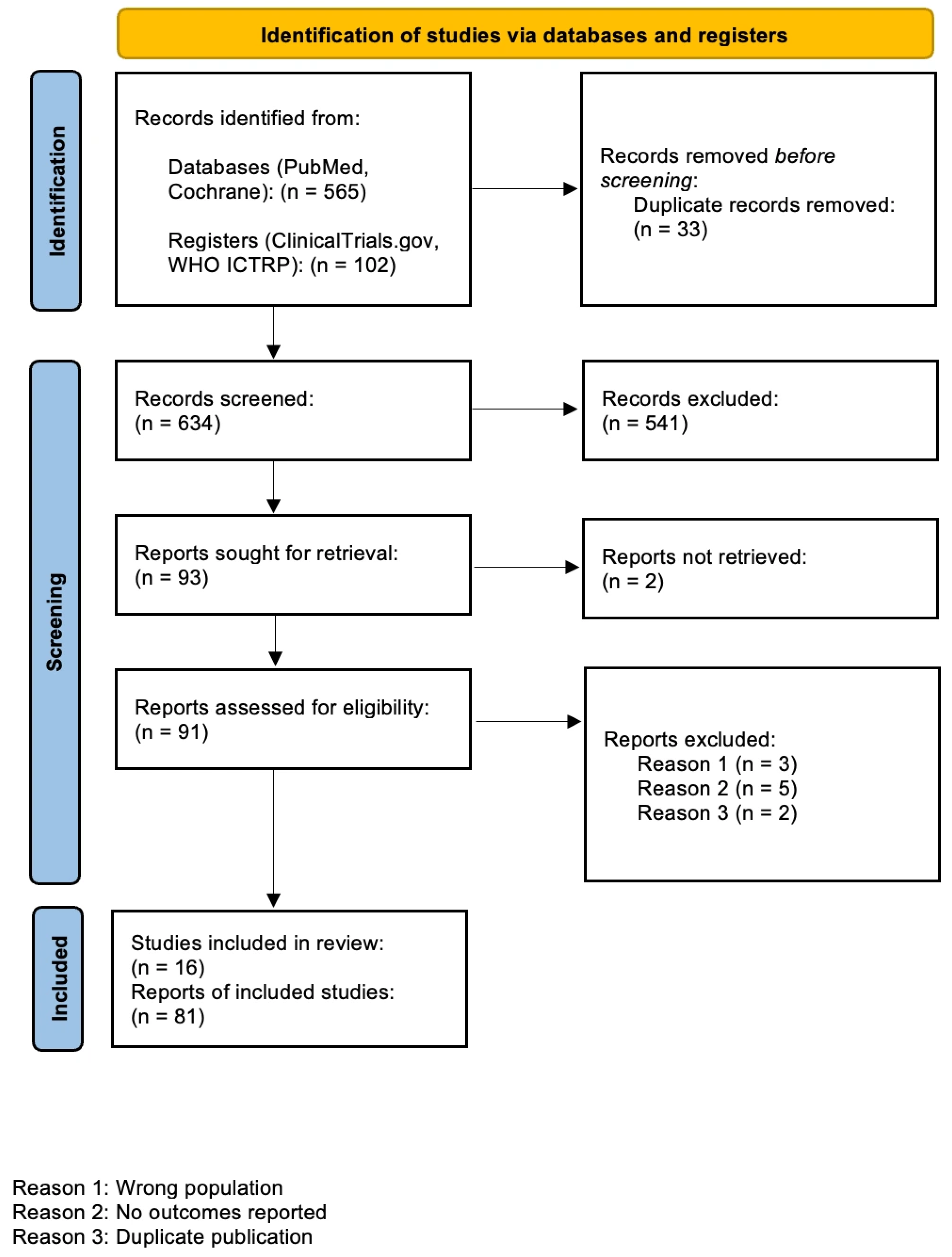
3.1. Selection Process
3.2. Risk of Bias
3.3. Study and Population Characteristics
3.4. Intervention and Comparison Characteristics
3.5. Outcome Characteristics
3.5.1. Survival Outcomes
3.5.2. Pathological Response Outcomes
3.5.3. Adverse Events and Safety Outcomes
3.5.4. Other Safety-Related Outcomes
4. Discussion
5. Conclusions
Supplementary Materials
Author Contributions
Funding
Institutional Review Board Statement
Informed Consent Statement
Data Availability Statement
Conflicts of Interest
Abbreviations
| ALK | Anaplastic Lymphoma Kinase |
| CTCAE | Common Terminology Criteria for Adverse Events |
| DFS | Disease-Free Survival |
| EFS | Event-Free Survival |
| EGFR | Epidermal Growth Factor Receptor |
| ICD | Immunogenic Cell Death |
| ICTRP | International Clinical Trials Registry Platform |
| MPR | Major Pathological Response |
| NK | Natural Killer |
| NSCLC | Non-Small-Cell Lung Cancer |
| OS | Overall Survival |
| pCR | Pathological Complete Response |
| PD-1 | Programmed Cell Death Protein 1 |
| PD-L1 | Programmed Death-Ligand 1 |
| PFS | Progression-Free Survival |
| PLELC | Pulmonary Lymphoepithelioma-Like Carcinoma |
| RCT | Randomized Controlled Trial |
| TRAEs | Treatment-Related Adverse Events |
| WHO | World Health Organization |
Appendix A

| Date | Results | Search Details | Query | Search Number |
|---|---|---|---|---|
| 2025/07/23 | 159 | (“Non-Small Cell Lung Cancer”[Title/Abstract] OR “NSCLC”[Title/Abstract] OR “carcinoma, non small cell lung”[MeSH Terms]) AND (“resect*”[Title/Abstract] OR “surg*”[Title/Abstract] OR “pulmonary surgical procedures”[MeSH Terms]) AND (“immunotherap*”[Title/Abstract] OR (“Immune”[Title/Abstract] AND “Checkpoint”[Title/Abstract] AND “inhibit*”[Title/Abstract]) OR (“Pembrolizumab”[Title/Abstract] OR “Nivolumab”[Title/Abstract] OR “Atezolizumab”[Title/Abstract] OR “Durvalumab”[Title/Abstract] OR “Ipilimumab”[Title/Abstract]) OR “immunotherapy”[MeSH Terms] OR “immune checkpoint inhibitors”[MeSH Terms]) AND (“chemotherap*”[Title/Abstract] OR “anti neoplastic”[Title/Abstract] OR “antineoplastic agents”[MeSH Terms] OR “drug therapy, combination”[MeSH Terms]) AND (“Perioperative”[Title/Abstract] OR “Adjuvant”[Title/Abstract] OR “Neoadjuvant”[Title/Abstract] OR “Preoperative”[Title/Abstract] OR “Postoperative”[Title/Abstract]) AND (“english”[Language] OR “german”[Language]) AND 2015/01/01:3000/12/31[Date—Publication] AND “humans”[MeSH Terms] AND (“randomized controlled trial”[Publication Type] OR (“Randomized”[Title/Abstract] AND “Controlled”[Title/Abstract] AND “Trial”[Title/Abstract]) OR “Randomised Controlled Trial”[Title/Abstract] OR (“systematic review”[Publication Type] OR (“Systematic”[Title/Abstract] AND “Review”[Title/Abstract]) OR (“meta analysis”[Publication Type] OR “meta analysis”[Title/Abstract] OR “meta analysis”[Title/Abstract])) OR (“Cohort Study”[Title/Abstract] OR “Cohort”[Title/Abstract] OR “Prospective Cohort”[Title/Abstract] OR “Retrospective Cohort”[Title/Abstract] OR “Prospective Study”[Title/Abstract] OR “Retrospective Study”[Title/Abstract])) | (#1 OR #2) AND (#3 OR #4) AND (#5 OR #6 OR #7 OR #8 OR #9) AND (#10 OR #11 OR #12) AND #13 AND #14 AND #15 AND #16 AND (#17 OR #18 OR #19) | 20 |
| 2025/07/23 | 1,364,693 | “Cohort Study”[Title/Abstract] OR “Cohort”[Title/Abstract] OR “Prospective Cohort”[Title/Abstract] OR “Retrospective Cohort”[Title/Abstract] OR “Prospective Study”[Title/Abstract] OR “Retrospective Study”[Title/Abstract] | (((((„Cohort Study”[Title/Abstract]) OR (Cohort[Title/Abstract])) OR („Prospective Cohort”[Title/Abstract])) OR („Retrospective Cohort”[Title/Abstract])) OR („Prospective Study”[Title/Abstract])) OR („Retrospective Study”[Title/Abstract]) | 19 |
| 2025/07/23 | 589,104 | “systematic review”[Publication Type] OR (“Systematic”[Title/Abstract] AND “Review”[Title/Abstract]) OR (“meta analysis”[Publication Type] OR “meta analysis”[Title/Abstract] OR “meta analysis”[Title/Abstract]) | Systematic Review[Publication Type] OR (Systematic[Title/Abstract] AND Review[Title/Abstract]) OR (Meta-Analysis[Publication Type] OR Meta- Analysis[Title/Abstract] OR „Meta Analysis”[Title/Abstract]) | 18 |
| 2025/07/23 | 746,089 | “randomized controlled trial”[Publication Type] OR (“Randomized”[Title/Abstract] AND “Controlled”[Title/Abstract] AND “Trial”[Title/Abstract]) OR “Randomised Controlled Trial”[Title/Abstract] | Randomized Controlled Trial[Publication Type] OR (Randomized[Title/Abstract] AND Controlled[Title/Abstract] AND Trial[Title/Abstract]) OR „Randomised Controlled Trial” [Title/Abstract] | 17 |
| 2025/07/23 | 22,840,636 | “humans”[MeSH Terms] | “humans”[Filter] | 16 |
| 2025/07/23 | 14,429,963 | 2015/01/01:3000/12/31[Date—Publication] | (“2015”[Date—Publication]: “3000”[Date—Publication]) | 15 |
| 2025/07/23 | 35,157,946 | “english”[Language] OR “german”[Language] | (“english”[Language]) OR (“german”[Language]) | 14 |
| 2025/07/23 | 1,217,367 | “Perioperative”[Title/Abstract] OR “Adjuvant”[Title/Abstract] OR “Neoadjuvant”[Title/Abstract] OR “Preoperative”[Title/Abstract] OR “Postoperative”[Title/Abstract] | ((((Perioperative[Title/Abstract]) OR (Adjuvant[Title/Abstract])) OR (Neoadjuvant[Title/Abstract])) OR (Preoperative[Title/Abstract])) OR (Postoperative[Title/Abstract]) | 13 |
| 2025/07/23 | 370,851 | “drug therapy, combination”[MeSH Terms] | Drug Therapy, Combination[MeSH Terms] | 12 |
| 2025/07/23 | 525,843 | “antineoplastic agents”[MeSH Terms] | Antineoplastic Agents[MeSH Terms] | 11 |
| 2025/07/23 | 563,184 | “chemotherap*”[Title/Abstract] OR “anti neoplastic”[Title/Abstract] | (Chemotherap*[Title/Abstract]) OR (Anti- neoplastic[Title/Abstract]) | 10 |
| 2025/07/23 | 15,782 | “immune checkpoint inhibitors”[MeSH Terms] | Immune Checkpoint Inhibitors[MeSH Terms] | 9 |
| 2025/07/23 | 364,114 | “immunotherapy”[MeSH Terms] | Immunotherapy[MeSH Terms] | 8 |
| 2025/07/23 | 25,540 | “Pembrolizumab”[Title/Abstract] OR “Nivolumab”[Title/Abstract] OR “Atezolizumab”[Title/Abstract] OR “Durvalumab”[Title/Abstract] OR “Ipilimumab”[Title/Abstract] | ((((Pembrolizumab[Title/Abstract]) OR (Nivolumab[Title/Abstract])) OR (Atezolizumab[Title/Abstract])) OR (Durvalumab[Title/Abstract])) OR (Ipilimumab[Title/Abstract]) | 7 |
| 2025/07/23 | 47,993 | “Immune”[Title/Abstract] AND “Checkpoint”[Title/Abstract] AND “inhibit*”[Title/Abstract] | ((Immune[Title/Abstract]) AND (Checkpoint[Title/Abstract])) AND (Inhibit*[Title/Abstract]) | 6 |
| 2025/07/23 | 185,864 | “immunotherap*”[Title/Abstract] | Immunotherap*[Title/Abstract] | 5 |
| 2025/07/23 | 83,533 | “pulmonary surgical procedures”[MeSH Terms] | Pulmonary Surgical Procedures[MeSH Terms] | 4 |
| 2025/07/23 | 2,829,407 | “resect*”[Title/Abstract] OR “surg*”[Title/Abstract] | (Resect*[Title/Abstract]) OR (Surg*[Title/Abstract]) | 3 |
| 2025/07/23 | 79,655 | “carcinoma, non small cell lung”[MeSH Terms] | Carcinoma, Non-Small-Cell Lung[MeSH Terms] | 2 |
| 2025/07/23 | 101,255 | “Non-Small Cell Lung Cancer”[Title/Abstract] OR “NSCLC”[Title/Abstract] | („Non-Small Cell Lung Cancer”[Title/Abstract]) OR (NSCLC[Title/Abstract]) | 1 |
References
- World Health Organization. Global Cancer Observatory, Lung. Available online: https://gco.iarc.who.int/media/globocan/factsheets/cancers/15-trachea-bronchus-and-lung-fact-sheet.pdf (accessed on 4 February 2026).
- American Cancer Society. What Is Lung Cancer? Available online: https://www.cancer.org/cancer/types/lung-cancer/about/what-is.html (accessed on 4 February 2026).
- Siddiqui, F.; Vaqar, S.; Siddigui, A.H. Lung Cancer. In StatPearls [Internet]; StatPearls Publishing: Treasure Island, FL, USA, 2026. Available online: https://www.ncbi.nlm.nih.gov/books/NBK482357/ (accessed on 4 February 2026).
- National Cancer Institute. Non-Small Cell Lung Cancer Treatment (PDQ®)-Health Professional Version. Available online: https://www.cancer.gov/types/lung/hp/non-small-cell-lung-treatment-pdq (accessed on 4 February 2026).
- Forde, P.M.; Spicer, J.; Lu, S.; Provencio, M.; Mitsudomi, T.; Awad, M.M.; Felip, E.; Broderick, S.R.; Brahmer, J.R.; Swanson, S.J.; et al. Neoadjuvant Nivolumab plus Chemotherapy in Resectable Lung Cancer. N. Engl. J. Med. 2022, 386, 1973–1985. [Google Scholar] [CrossRef] [Scilit] [PubMed]
- Wakelee, H.; Liberman, M.; Kato, T.; Tsuboi, M.; Lee, S.H.; Gao, S.; Chen, K.N.; Dooms, C.; Majem, M.; Eigendorff, E.; et al. Perioperative Pembrolizumab for Early-Stage Non-Small-Cell Lung Cancer. N. Engl. J. Med. 2023, 389, 491–503. [Google Scholar] [CrossRef] [Scilit] [PubMed]
- Jeon, H.; Wang, S.; Song, J.; Gill, H.; Cheng, H. Update 2025: Management of Non-Small-Cell Lung Cancer. Lung 2025, 203, 53. [Google Scholar] [CrossRef] [Scilit] [PubMed]
- Stanley, R.; Flanagan, S.; Reilly, D.O.; Kearney, E.; Naidoo, J.; Dowling, C.M. Immunotherapy through the Lens of Non-Small Cell Lung Cancer. Cancers 2023, 15, 2996. [Google Scholar] [CrossRef] [Scilit] [PubMed]
- Zer, A.; Ahn, M.J.; Barlesi, F.; Bubendorf, L.; De Ruysscher, D.; Garrido, P.; Gautschi, O.; Hendriks, L.E.; Jänne, P.A.; Kerr, K.M.; et al. Early and locally advanced non-small-cell lung cancer: ESMO Clinical Practice Guideline for diagnosis, treatment and follow-up. Ann. Oncol. 2025, 36, 1245–1262. [Google Scholar] [CrossRef] [Scilit] [PubMed]
- Clarivate. EndNote, version 21; Clarivate: Philadelphia, PA, USA, 2023.
- U.S. Department of Health and Human Services. Common Terminology Criteria for Adverse Events (CTCAE). Available online: https://dctd.cancer.gov/research/ctep-trials/for-sites/adverse-events/ctcae-v5-5x7.pdf (accessed on 5 February 2026).
- Higgins, J.; Savović, J.; Page, M.; Sterne, J. Revised Cochrane Risk-of-Bias Tool for Randomized Trials (RoB 2): Template for Completion; Cochrane: London, UK, 2019. [Google Scholar]
- Higgins, J.; Savović, J.; Page, M.; Sterne, J. Revised Cochrane Risk-of-Bias Tool for Randomized Trials (RoB 2): Guidance for Parallel-group Trials; Cochrane: London, UK, 2019. [Google Scholar]
- Wells, G.; Shea, B.; O’Connell, D.; Peterson, J.; Welch, V.; Losos, M.; Tugwell, P. The Newcastle-Ottawa Scale (NOS) for Assessing the Quality of Nonrandomised Studies in Meta-Analyses; Ottawa Hospital Research Institute: Ottawa, ON, Canada, 2011. [Google Scholar]
- Wells, G.; Shea, B.; O’Connell, D.; Peterson, J.; Welch, V.; Losos, M.; Tugwell, P. Coding Manual for the Newcastle-Ottawa Scale (NOS); Ottawa Hospital Research Institute: Ottawa, ON, Canada, 2011. [Google Scholar]
- Page, M.J.; McKenzie, J.E.; Bossuyt, P.M.; Boutron, I.; Hoffmann, T.C.; Mulrow, C.D.; Shamseer, L.; Tetzlaff, J.M.; Akl, E.A.; Brennan, S.E.; et al. The PRISMA 2020 statement: An updated guideline for reporting systematic reviews. BMJ 2021, 372, n71. [Google Scholar] [CrossRef] [Scilit] [PubMed]
- Yue, D.; Wang, W.; Liu, H.; Chen, Q.; Chen, C.; Liu, L.; Zhang, P.; Zhao, G.; Yang, F.; Han, G.; et al. Perioperative tislelizumab plus neoadjuvant chemotherapy for patients with resectable non-small-cell lung cancer (RATIONALE-315): An interim analysis of a randomised clinical trial. Lancet Respir. Med. 2025, 13, 119–129. [Google Scholar] [CrossRef] [Scilit] [PubMed]
- Lu, S.; Zhang, W.; Wu, L.; Wang, W.; Zhang, P.; Investigators, N. Perioperative Toripalimab Plus Chemotherapy for Patients with Resectable Non–Small Cell Lung Cancer: The Neotorch Randomized Clinical Trial. JAMA 2024, 331, 201–211. [Google Scholar] [CrossRef] [Scilit] [PubMed]
- Cascone, T.; Awad, M.M.; Spicer, J.D.; He, J.; Lu, S.; Sepesi, B.; Tanaka, F.; Taube, J.M.; Cornelissen, R.; Havel, L.; et al. Perioperative Nivolumab in Resectable Lung Cancer. N. Engl. J. Med. 2024, 390, 1756–1769. [Google Scholar] [CrossRef] [Scilit] [PubMed]
- Heymach, J.V.; Harpole, D.; Mitsudomi, T.; Taube, J.M.; Galffy, G.; Hochmair, M.; Winder, T.; Zukov, R.; Garbaos, G.; Gao, S.; et al. Perioperative Durvalumab for Resectable Non-Small-Cell Lung Cancer. N. Engl. J. Med. 2023, 389, 1672–1684. [Google Scholar] [CrossRef] [Scilit] [PubMed]
- Provencio, M.; Nadal, E.; González-Larriba, J.L.; Martínez-Martí, A.; Bernabé, R.; Bosch-Barrera, J.; Casal-Rubio, J.; Calvo, V.; Insa, A.; Ponce, S.; et al. Perioperative Nivolumab and Chemotherapy in Stage III Non-Small-Cell Lung Cancer. N. Engl. J. Med. 2023, 389, 504–513. [Google Scholar] [CrossRef] [Scilit] [PubMed]
- Lei, J.; Zhao, J.; Gong, L.; Ni, Y.; Zhou, Y.; Tian, F.; Liu, H.; Gu, Z.; Huang, L.; Lu, Q.; et al. Neoadjuvant Camrelizumab Plus Platinum-Based Chemotherapy vs Chemotherapy Alone for Chinese Patients with Resectable Stage IIIA or IIIB (T3N2) Non–Small Cell Lung Cancer: The TD-FOREKNOW Randomized Clinical Trial. JAMA Oncol. 2023, 9, 1348–1355. [Google Scholar] [CrossRef] [Scilit] [PubMed]
- Lei, M.; Zhang, X.; Hu, L.N.; Fu, S.; Xiao, M.; Long, Z.; Zhu, H.; Zhou, Y.; Hong, S. Perioperative immunotherapy plus chemotherapy versus chemotherapy alone for patients with resectable pulmonary lymphoepithelioma-like carcinoma. Lung Cancer 2025, 199, 108057. [Google Scholar] [CrossRef] [Scilit] [PubMed]
- Shuai, Y.; Liu, J.; Yang, Y.; Huang, X.; Ye, J.; Zhu, L.; Hu, J. Neoadjuvant immunochemotherapy versus chemotherapy for elderly patients with IB-IIIB non-small-cell lung cancer in real-world practice. BMC Cancer 2025, 25, 1150. [Google Scholar] [CrossRef] [Scilit] [PubMed]
- Wang, Y.; Ma, X.; Ma, K.; Chen, X.; He, H.; Zhao, X.; Fan, M.; Xu, Y. Efficacy and safety of neoadjuvant chemoimmunotherapy and chemotherapy in patients with potentially resectable stage IIIA/IIIB NSCLC: A retrospective study. Front. Immunol. 2025, 15, 1479263. [Google Scholar] [CrossRef] [Scilit] [PubMed]
- Wang, K.; Er, J.; Zhang, Y.; Song, C.; Yu, Y.; Gao, R.; Xu, H.; Dong, X.; Yuan, L.; Liu, Q.; et al. Increased opioid consumption in neoadjuvant immunotherapy plus chemotherapy for patients with non-small-cell lung cancer: A multicenter, prospective cohort study. CNS Neurosci. Ther. 2024, 30, e14893. [Google Scholar] [CrossRef] [Scilit] [PubMed]
- Yang, Z.; Wang, S.; Yang, H.; Jiang, Y.; Zhu, L.; Zheng, B.; Fu, H.; Ma, J.; Xie, H.; Wang, Z.; et al. Treatment patterns and clinical outcomes of patients with resectable non-small cell lung cancer receiving neoadjuvant immunochemotherapy: A large-scale, multicenter, real-world study (NeoR-World). J. Thorac. Cardiovasc. Surg. 2024, 168, 1245–1258.e17. [Google Scholar] [CrossRef] [Scilit] [PubMed]
- Zhou, S.; Liu, Y.; Liu, K.; Zhang, J.; Liang, H.; Wu, Y.; Ye, H.; Liang, Y.; Zhang, J.; Huang, W. Comparison of neoadjuvant chemoimmunotherapy and chemotherapy alone for resectable stage III non-small cell lung cancer: A real-world cohort study. Front. Immunol. 2023, 14, 1343504. [Google Scholar] [CrossRef] [Scilit] [PubMed]
- Liu, Z.; Gao, Z.; Zhang, M.; Wang, X.; Gong, J.; Jiang, S.; Zhang, Z. Real-World Effectiveness and Prognostic Factors Analysis of Stages I-III Non-Small Cell Lung Cancer Following Neoadjuvant Chemo-Immunotherapy or Neoadjuvant Chemotherapy. Ann. Thorac. Cardiovasc. Surg. 2022, 28, 111–120. [Google Scholar] [CrossRef] [Scilit] [PubMed]
- Yang, C.-F.J.; McSherry, F.; Mayne, N.R.; Wang, X.; Berry, M.F.; Tong, B.; Harpole, D.H., Jr.; D’Amico, T.A.; Christensen, J.D.; Ready, N.E.; et al. Surgical Outcomes After Neoadjuvant Chemotherapy and Ipilimumab for Non-Small Cell Lung Cancer. Ann. Thorac. Surg. 2018, 105, 924–929. [Google Scholar] [CrossRef] [Scilit] [PubMed]
- Wang, C.; Wang, W.; Liu, H.; Chen, Q.; Chen, C.; Liu, L.; Zhang, P.; Zhao, G.; Yang, F.; Han, G.; et al. Perioperative tislelizumab plus neoadjuvant chemotherapy for patients with resectable non-small-cell lung cancer: Final analysis of the randomized RATIONALE-315 trial. Ann. Oncol. 2026, 37, 544–554. [Google Scholar] [CrossRef] [Scilit] [PubMed]
- Cascone, T.; Awad, M.M.; Spicer, J.; He, J.; Lu, S.; Tanaka, F.; Cornelissen, R.; Petruzelka, L.B.; Ito, H.; Koch, L.D.O.; et al. Perioperative nivolumab (NIVO) vs placebo (PBO) in patients (pts) with resectable NSCLC: Updated survival and biomarker analyses from CheckMate 77T. J. Clin. Oncol. 2025, 43, LBA8010. [Google Scholar] [CrossRef] [Scilit]
- Spicer, J.D.; Garassino, M.C.; Wakelee, H.; Liberman, M.; Kato, T.; Tsuboi, M.; Lee, S.H.; Chen, K.N.; Dooms, C.; Majem, M.; et al. Neoadjuvant pembrolizumab plus chemotherapy followed by adjuvant pembrolizumab compared with neoadjuvant chemotherapy alone in patients with early-stage non-small-cell lung cancer (KEYNOTE-671): A randomised, double-blind, placebo-controlled, phase 3 trial. Lancet 2024, 404, 1240–1252. [Google Scholar] [CrossRef] [Scilit] [PubMed]
- Spicer, J.; Girard, N.; Provencio, M.; Wang, C.; Mitsudomi, T.; Awad, M.M.; Vokes, E.E.; Taube, J.M.; Lupinacci, L.; Saylors, G.B.; et al. Neoadjuvant nivolumab (NIVO) + chemotherapy (chemo) vs chemo in patients (pts) with resectable NSCLC: 4-year update from CheckMate 816. J. Clin. Oncol. 2024, 42, LBA8010. [Google Scholar] [CrossRef] [Scilit]
- Sordo-Bahamonde, C.; Lorenzo-Herrero, S.; Gonzalez-Rodriguez, A.P.; Martínez-Pérez, A.; Rodrigo, J.P.; García-Pedrero, J.M.; Gonzalez, S. Chemo-Immunotherapy: A New Trend in Cancer Treatment. Cancers 2023, 15, 2912. [Google Scholar] [CrossRef] [Scilit] [PubMed]
- Garg, P.; Pareek, S.; Kulkarni, P.; Horne, D.; Salgia, R.; Singhal, S.S. Next-Generation Immunotherapy: Advancing Clinical Applications in Cancer Treatment. J. Clin. Med. 2024, 13, 6537. [Google Scholar] [CrossRef] [Scilit] [PubMed]
- Mitsudomi, T.; Heymach, J.V.; Reck, M.; Taube, J.M.; Gao, S.; Horio, Y.; You, J.; Li, G.; Van Luong, D.; Saeteng, S.; et al. Surgical Outcomes with Neoadjuvant Durvalumab Plus Chemotherapy Followed by Adjuvant Durvalumab in Resectable NSCLC. J. Thorac. Oncol. 2025, 20, 1639–1654. [Google Scholar] [CrossRef] [Scilit] [PubMed]
- Li, S.; Xu, C.; Meng, Y.; Li, Y.; Yang, J.; Du, J.; Zhang, F.; Liao, H.; Ma, X. Efficacy and Safety of Neoadjuvant Immunotherapy plus Chemotherapy versus Neoadjuvant Chemotherapy in Non-Small Cell Lung Cancer Treatment: A Mixed Method Meta-Analysis Based on Global Randomized Controlled Trials. MedComm 2025, 6, e70211. [Google Scholar] [CrossRef] [Scilit] [PubMed]
- Sorin, M.; Prosty, C.; Ghaleb, L.; Nie, K.; Katergi, K.; Shahzad, M.H.; Dubé, L.R.; Atallah, A.; Swaby, A.; Dankner, M.; et al. Neoadjuvant Chemoimmunotherapy for NSCLC: A Systematic Review and Meta-Analysis. JAMA Oncol. 2024, 10, 621–633. [Google Scholar] [CrossRef] [Scilit] [PubMed]
- Zhang, Q.; Duan, J.; Zhang, Y.; Yang, L.; Li, D. Perioperative or neo/adjuvant chemoimmunotherapy versus chemotherapy for resectable non-small cell lung cancer: A systematic review and network meta-analysis. Syst. Rev. 2025, 14, 24. [Google Scholar] [CrossRef] [Scilit] [PubMed]

| Year of Publication | Authors (Study Name) | Domain 1 | Domain 2 | Domain 3 | Domain 4 | Domain 5 | Overall Risk of Bias |
|---|---|---|---|---|---|---|---|
| 2025 | Yue et al. [17] | Low risk | Low risk | Low risk | Low risk | Low risk | Low risk |
| 2024 | Lu et al. [18] | Low risk | Some concerns | Some concerns | Low risk | Low risk | Some concerns |
| 2024 | Cascone et al. [19] | Low risk | Low risk | Low risk | Low risk | Low risk | Low risk |
| 2023 | Wakelee et al. [6] | Low risk | Low risk | Low risk | Low risk | Low risk | Low risk |
| 2023 | Heymach et al. [20] | Low risk | Low risk | Low risk | Low risk | Low risk | Low risk |
| 2023 | Provencio et al. [21] | Low risk | Some concerns | Some concerns | Low risk | Low risk | Some concerns |
| 2023 | Lei, J. et al. [22] | Low risk | Low risk | Low risk | Some concerns | Low risk | Some concerns |
| 2022 | Forde et al. [5] | Low risk | Some concerns | Low risk | Low risk | Low risk | Some concerns |
| Year of Publication | Authors (Study Name) | Selection | Comparability | Outcome | Overall |
|---|---|---|---|---|---|
| 2025 | Lei, M. et al. [23] | 3/4 | 2/2 | 2/3 | 7/9 |
| 2025 | Shuai et al. [24] | 4/4 | 2/2 | 3/3 | 9/9 |
| 2025 | Wang, Y. et al. [25] | 3/4 | 2/2 | 2/3 | 7/9 |
| 2024 | Wang, K. et al. [26] | 4/4 | 2/2 | 3/3 | 9/9 |
| 2024 | Yang, Z. et al. [27] | 4/4 | 2/2 | 2/3 | 8/9 |
| 2023 | Zhou et al. [28] | 4/4 | 0/2 | 2/3 | 6/9 |
| 2022 | Liu et al. [29] | 4/4 | 2/2 | 2/3 | 8/9 |
| 2018 | Yang, C.-F.J. et al. [30] | 4/4 | 0/2 | 3/3 | 7/9 |
| Author (Trial Name), Year | Country | Study Design | Total Sample Size: n (Intervention vs. Comparison) | Disease Stage | Median Age (Range)/Age (Intervention vs. Comparison) | Sex: n (%) (Intervention vs. Comparison) | Reference Number |
|---|---|---|---|---|---|---|---|
| Yue et al. (RATIONALE-315), 2025 [17] | China | Phase III RCT (double-blinded), multicenter | 453 (226 vs. 227) | IIA-IIIA | 62 (57–67) vs. 63 (56–68) | Male: 205 (91%) vs. Male: 205 (90%) | [17,31] |
| Lei, M. et al., 2025 [23] | China | Retrospective cohort study, single-center | 72 (24 vs. 48) | IIA-IIIB (PLELC) | 52.5 (29–71) vs. 50.5 (29–66) | Male: 10 (41.7%) vs. Male: 21 (43.8%) | [23] |
| Shuai et al., 2025 [24] | China | Retrospective cohort study, single-center | 140 (93 vs. 47) | IB-IIIB | 70 (67.0–73.5) vs. 70 (66.3–71.0) | Male: 83 (89.2%) vs. Male: 38 (80.9%) | [24] |
| Wang, Y. et al., 2025 [25] | China | Retrospective cohort study, single-center | 71 (46 vs. 25) | IIIA-IIIC | 58.5 (52.0–64.0) vs. 59 (54.5–64.5) | Male: 38 (82.6%) vs. Male: 20 (80.0%) | [25] |
| Lu et al. (Neotorch), 2024 [18] | China | Phase III RCT (double-blinded), multicenter | 404 (202 vs. 202) | IIIA-IIIB | 62 (56–65) vs. 61 (56–65) | Male: 181 (89.6%) vs. Male: 189 (93.6%) | [18] |
| Cascone et al. (CheckMate 77T), 2024 [19] | Multinational | Phase III RCT (double-blinded), multicenter | 461 (229 vs. 232) | IIA-IIIB | 66 (37–83) vs. 66 (35–86) | Male: 167 (72.9%) vs. Male: 160 (69.0%) | [19,32] |
| Wang, K. et al., 2024 [26] | China | Prospective cohort study, multicenter | 84 (42 vs. 42) Final analysis: 81 (41 vs. 40) | IIA-IIIA | 65 (60–70) vs. 65 (59–67) | Male: 33 (80.5%) vs. Male: 27 (67.5%) | [26] |
| Yang, Z. et al. (NeoR-World), 2024 [27] | China | Retrospective cohort study, multicenter | 540 (270 vs. 270) | IA-III | 61 (56–66) vs. 59 (53–64) (Including patients with EGFR/ALK mutations) | Male: 369 (90.4%) vs. Male: 551 (80.6%) (Including patients with EGFR/ALK mutations) | [27] |
| Wakelee et al. (KEYNOTE-671), 2023 [6] | Multinational | Phase III RCT (double-blinded), multicenter | 797 (397 vs. 400) | IIA-IIIB | 63 (26–83) vs. 64 (35–81) | Male: 279 (70.3%) vs. Male: 284 (71.0%) | [6,33] |
| Heymach et al. (AEGEAN), 2023 [20] | Multinational | Phase III RCT (double-blinded), multicenter | 802 (400 vs. 402) | IIA-IIIB | 65 (30–88) vs. 65 (39–85) | Male: 252 (68.9%) vs. Male: 278 (74.3%) | [20] |
| Provencio et al. (NADIM II), 2023 [21] | Spain | Phase II RCT (open-label), multicenter | 86 (57 vs. 29) | IIIA-IIIB | 65 (58–70) vs. 63 (57–66) | Male: 36 (63%) vs. Male: 16 (55%) | [21] |
| Zhou et al., 2023 [28] | China | Retrospective cohort study, single-center | 59 (26 vs. 33) | IIIA-IIIB | ≤60 years: 61.6% >60 years: 38.4% vs. ≤60 years: 48.4% >60 years: 51.6% | Male: 24 (92.4%) vs. Male: 27 (81.9%) | [28] |
| Lei, J. et al. (TD-FOREKNOW), 2023 [22] | China | Phase II RCT (open-label), multicenter | 94 (47 vs. 47) Final analysis: 88 (43 vs. 45) | IIIA-IIIB | 61 (54–65) vs. 61 (54–65) | Male: 34 (79.1%) vs. Male: 40 (88.9%) | [22] |
| Forde et al. (CheckMate 816), 2022 [5] | Multinational | Phase III RCT (open-label), multicenter | 358 (179 vs. 179) | IIIA-IB | 64 (41–82) vs. 65 (34–84) | Male: 128 (71.5%) vs. Male: 127 (70.9%) | [5,34] |
| Liu et al., 2022 [29] | China | Retrospective cohort study, single-center | 170 (79 vs. 91) | IB-IIIB | ≥60 years: 64.6% <60 years: 35.4% vs. ≥60 years: 53.8% <60 years: 46.2% | Male: 66 (83.5%) vs. Male: 75 (82.4%) | [29] |
| Yang, C.-F.J. et al., 2018 [30] | United States | Prospective and retrospective cohort study, single-center | 55 (13 vs. 42) | IB-IV | 59 (51–75) vs. 62 (33–76) | Male: 5 (38%) vs. Male: 21 (50%) | [30] |
| Study | Intervention (n) | Immunotherapy Timing | Comparison (n) |
|---|---|---|---|
| Yue et al. (RATIONALE-315), 2025 [17] | Tislelizumab + Cisplatin/Carboplatin + Paclitaxel/Pemetrexed | Perioperative | Cisplatin/Carboplatin + Paclitaxel/Pemetrexed |
| Lei, M. et al., 2025 [23] | Tislelizumab (9) Sintilimab (7) Toripalimab (4) Pembrolizumab (3) Camrelizumab (1) + Platinum + Taxanes (20) Platinum + Gemcitabine (2) Paclitaxel (2) | Perioperative | Platinum + Taxanes (31) Platinum + Gemcitabine (11) Platinum + Pemetrexed (6) |
| Shuai et al., 2025 [24] | Camrelizumab (30) Tislelizumab (20) Pembrolizumab (16) Nivolumab (14) Sintilimab (11) Durvalumab (2) + Cisplatin/Carboplatin + Paclitaxel | Neoadjuvant | Cisplatin/Carboplatin + Paclitaxel |
| Wang, Y. et al., 2025 [25] | NR + Platinum-based therapy | Perioperative | Platinum-based therapy |
| Lu et al. (Neotorch), 2024 [18] | Toripalimab + Cisplatin/Carboplatin + Docetaxel/Paclitaxel/Pemetrexed | Perioperative | Cisplatin/Carboplatin + Docetaxel/Paclitaxel/Pemetrexed |
| Cascone et al. (CheckMate 77T), 2024 [19] | Nivolumab + Cisplatin/Carboplatin | Perioperative | Cisplatin/Carboplatin |
| Wang, K. et al., 2024 [26] | PD-1 monoclonal antibody + Cisplatin + Paclitaxel/Pemetrexed | Neoadjuvant | Cisplatin + Paclitaxel/Pemetrexed |
| Yang, Z. et al. (NeoR-World), 2024 [27] | Pembrolizumab/Camrelizumab/Tislelizumab/Sintilimab/Nivolumab/Durvalumab/Toripalimab/(Sintilimab + Nivolumab) + Cisplatin/Carboplatin/Nedaplatin/Oxaliplatin/Loplatin + Paclitaxel/Gemcitabine/Pemetrexed | Perioperative | Platinum-based therapy |
| Wakelee et al. (KEYNOTE-671), 2023 [6] | Pembrolizumab + Cisplatin + Gemcitabine/Pemetrexed | Perioperative | Cisplatin + Gemcitabine/Pemetrexed |
| Heymach et al. (AEGEAN), 2023 [20] | Durvalumab + Cisplatin/Carboplatin | Perioperative | Cisplatin/Carboplatin |
| Provencio et al. (NADIM II), 2023 [21] | Nivolumab + Carboplatin + Paclitaxel | Perioperative | Carboplatin + Paclitaxel |
| Zhou et al., 2023 [28] | Pembrolizumab/Tislelizumab/Sintilimab/Camrelizumab/Nivolumab + Platinum-based therapy (+ Gemcitabine/Etoposide) | Neoadjuvant | Platinum-based therapy |
| Lei, J. et al. (TD-FOREKNOW), 2023 [22] | Camrelizumab + Cisplatin/Carboplatin/Nedaplatin + Paclitaxel | Neoadjuvant | Cisplatin/Carboplatin/Nedaplatin + Paclitaxel |
| Forde et al. (CheckMate 816), 2022 [5] | Nivolumab + Cisplatin/Carboplatin | Neoadjuvant | Cisplatin/Carboplatin |
| Liu et al., 2022 [29] | Pembrolizumab (34) Nivolumab (20) Sintilimab (13) Camrelizumab (12) + Platinum + Paclitaxel (50) Platinum + Pemetrexed (26) Other regimens (3) | Neoadjuvant | Platinum + Paclitaxel: 52 Platinum + Pemetrexed: 32 Other regimens: 7 |
| Yang, C.-F.J. et al., 2018 [30] | Ipilimumab + Cisplatin/Carboplatin + Paclitaxel | Neoadjuvant | Platinum-based therapy |
| Year | Authors (Study Name) | Survival (Intervention vs. Comparison) | HR (95% CI); p-Value |
|---|---|---|---|
| 2025 | Yue et al. (RATIONALE-315) [17] | 12 mo EFS: 80% vs. 68% | 0.56 (0.40–0.79); p = 0.0003 |
| 24 mo EFS: 68% vs. 52% | 0.56 (0.40–0.79); p = 0.0003 | ||
| 36 mo EFS 64.7% vs. 48.0% | 0.58 (0.43–0.79); NR | ||
| 12 mo OS: 95% vs. 91% | 0.62 (0.39–0.98); p = 0.019 | ||
| 24 mo OS: 89% vs. 79% | 0.62 (0.39–0.98); p = 0.019 | ||
| 36 mo OS: 79.3% vs. 69.3% | 0.65 (0.45–0.93); 0.009 | ||
| 2025 | Lei, M. et al. [23] | Median EFS: NE vs. 35.0 mo | 0.42 (0.19–0.93); p = 0.031 |
| Median OS: NE vs. NE | 0.27 (0.04–1.91); p = 0.188 | ||
| Survival rates at median of 47.0 mo (2.0–135.0 mo): 100% vs. 79.2% | NR | ||
| 2025 | Shuai et al. [24] | Median DFS: NE vs. 19.4 mo | 0.247 (0.122–0.501); p < 0.001 |
| 2 yr DFS rate: 83.1% vs. 45.2% | NR | ||
| Median OS: NE vs. 41.8 mo | 0.265 (0.115–0.611); p < 0.001 | ||
| 2 yr OS rate: 89.8% vs. 74.2% | NR | ||
| 2025 | Wang, Y. et al. [25] | Median DFS: NE vs. 15 mo | 0.186 (0.073–0.479); p < 0.001 |
| 2 yr DFS rate: 85.0% vs. 36.3% | NR | ||
| 2 yr OS rate: 85.1% vs. 82.5% | NR | ||
| 2024 | Lu et al. (Neotorch) [18] | Median DFS: NE vs. 22.0 mo | 0.49 (0.31–0.76); p < 0.001 |
| Median EFS: NE vs. 15.5 mo | 0.40 (0.27–0.57); p < 0.001 | ||
| Median OS: NE vs. 30.4 mo | 0.62 (0.38–1.00); p = 0.05 | ||
| 2024 | Cascone et al. (CheckMate 77T) [19] | Median EFS: 46.6 mo vs. 16.9 mo | 0.61 (0.46–0.80); NR |
| 18 mo EFS: 70.2% vs. 50.0% | 0.58 (97.36% CI: 0.42–0.81); p < 0.001 | ||
| 30 mo EFS: 61% vs. 43% | 0.61 (0.46–0.80); NR | ||
| 30 mo OS: 78% vs. 72% | 0.85 (0.58–1.25); NR | ||
| 2024 | Wang, K. et al. [26] | NR | NR |
| 2024 | Yang, Z. et al. (NeoR-World) [27] | 2 yr DFS: 80.5% vs. 63.6% | 0.50 (0.36–0.70); p < 0.001 |
| 2 yr OS: 91.6% vs. 83.4% | 0.91 (0.64–1.30); p = 0.604 | ||
| 2023 | Wakelee et al. (KEYNOTE-671) [6] | Median EFS: 47.2 mo vs. 18.3 mo | 0.59 (0.48–0.72); NR |
| 24 mo EFS: 62.4% vs. 40.6% | 0.58 (0.46–0.72); p < 0.001 | ||
| 36 mo EFS: 54% vs. 35% | 0.59 (0.48–0.72); NR | ||
| 24 mo OS: 80.9% vs. 77.6% | NR; p = 0.02 | ||
| 36 mo OS: 71% vs. 64% | 0.72 (0.56–0.93); p = 0.0052 (one-sided) vs. p = 0.0054 (one-sided) | ||
| 2023 | Heymach et al. (AEGEAN) [20] | Median EFS: NE vs. 25.9 mo | 0.68 (0.53–0.88); p = 0.004 |
| 12 mo EFS: 73.4% vs. 64.5% | NR | ||
| 24 mo EFS: 63.3% vs. 52.4% | NR | ||
| 2023 | Provencio et al. (NADIM II) [21] | 24 mo PFS: 67.2% vs. 40.9% | 0.47 (0.25–0.88); NR |
| 24 mo OS: 85.0% vs. 63.6% | 0.43 (0.19–0.98); NR | ||
| 2023 | Zhou et al. [28] | 2 yr DFS rate: 76.9% vs. 63.8% | NR; p = 0.129 |
| 2023 | Lei, J. et al. (TD-FOREKNOW) [22] | Estimated 12 mo DFS: 93.2% vs. 81.4% Estimated 24 mo DFS: 78.4% vs. 71.7% | 0.54 (0.19–1.54); NR |
| Estimated 12 mo EFS: 93.0% vs. 76.9% Estimated 24 mo EFS: 76.9% vs. 67.6% | 0.52 (0.21–1.29); NR | ||
| 2022 | Forde et al. (CheckMate 816) [5] | Median EFS: 31.6 mo vs. 20.8 mo | 0.63 (97.38% CI: 0.43–0.91); p = 0.005 |
| 4 yr EFS rate: 49% vs. 38% | 0.66 (0.49–0.90); NR | ||
| 4 yr OS rate: 71% vs. 58% | 0.71 (98.36% CI: 0.47–1.07); p = 0.0451 | ||
| Median OS: NE vs. NE | 0.57 (99.67% CI: 0.30–1.07); p = 0.008 | ||
| 2022 | Liu et al. [29] | 2 yr DFS: 67.2% vs. 39.5% | NR; p = 0.019 |
| 2018 | Yang, C.-F.J. et al. [30] | 30-day survival: 100% vs. 100% | NR |
| 90-day survival: 100% vs. 98% | NR |
| Year | Authors (Study Name) | pCR (Intervention vs. Comparison) | MPR (Intervention vs. Comparison) | pCR: (95% CI); p-Value | MPR: (95% CI); p-Value |
|---|---|---|---|---|---|
| 2025 | Yue et al. (RATIONALE-315) [17] | pCR: 41% vs. 6% | MPR: 56% vs. 15% | RD: 35% (28–42); p < 0.0001 | RD: 41% (33–49); p < 0.0001 |
| 2025 | Lei, M. et al. [23] | pCR: 33.3% vs. 4.2% | MPR: 54.2% vs. 12.5% | OR: 1.44 (1.08–1.92); p < 0.002 | OR: 1.91 (1.22–2.99); p < 0.001 |
| 2025 | Shuai et al. [24] | pCR: 32.2% vs. 16.1% | MPR: 64.4% vs. 25.8% | NR; p = 0.101 | NR; p < 0.001 |
| 2025 | Wang, Y. et al. [25] | pCR: 36.4% vs. 8.3% | MPR: 65.9% vs. 16.7% | OR: 7.215 (1.436–36.256); p = 0.016 | OR: 11.442 (2.982–43.898; p < 0.001 |
| 2024 | Lu et al. (Neotorch) [18] | pCR: 24.8% vs. 1.0% | MPR: 48.5% vs. 8.4% | RD: 23.7% (17.6–29.8); p < 0.001 | RD: 40.2% (32.2–48.1); p < 0.001 |
| 2024 | Cascone et al. (CheckMate 77T) [19] | pCR: 25.3% vs. 4.7% | MPR: 35.4% vs. 12.1% | OR: 6.64 (3.40–12.97); NR | OR: 4.01 (2.48–6.49); NR |
| 2024 | Wang, K. et al. [26] | pCR: 24.39% vs. 5% | NR | NR; p = 0.026 | NR |
| 2024 | Yang, Z. et al. (NeoR-World) [27] | pCR: 36.3% vs. 7.4% | MPR: 61.1% vs. 23.0% | OR: 7.12 (4.33–12.3); p < 0.001 | OR: 5.27 (3.64–7.71); p < 0.001 |
| 2023 | Wakelee et al. (KEYNOTE-671) [6] | pCR: 18.1% vs. 4.0% | MPR: 30.2% vs. 11.0% | RD: 14.2% (10.1–18.7); p < 0.0001 | RD: 19.2% (13.9–24.7); p < 0.0001 |
| 2023 | Heymach et al. (AEGEAN) [20] | pCR: 17.2% vs. 4.3% | MPR: 33.3% vs. 12.3% | RD: 13.0% (8.7–17.6); p < 0.001 | RD: 21.0% (15.1–26.9); p < 0.001 |
| 2023 | Provencio et al. (NADIM II) [21] | pCR: 37.0% vs. 7.0% | MPR: 53.0% vs. 14.0% | RR: 5.34 (1.34–21.23); p = 0.02 | RR: 3.82 (1.49–9.79); NR |
| 2023 | Zhou et al. [28] | pCR: 34.6% vs. 3.0% | MPR: 65.3% vs. 15.1% | RR: 11.423 (1.544–84.493); p = 0.004 | RR: 4.315 (1.836–10.142); p < 0.001 |
| 2023 | Lei, J. et al. (TD-FOREKNOW) [22] | pCR: 32.6% vs. 8.9% | MPR: 65.1% vs. 15.6% | NR; p = 0.008 | NR; p < 0.001 |
| 2022 | Forde et al. (CheckMate 816) [5] | pCR: 24.0% vs. 2.2% | MPR: 36.9% vs. 8.9% | OR: 13.94 (99% CI: 3.49–55.75); p < 0.001 | OR: 5.70 (3.16–10.26); NR |
| 2022 | Liu et al. [29] | pCR + MPR: 53.2% vs. 14.3% | pCR + MPR: 53.2% vs. 14.3% | NR; p < 0.001 | NR; p < 0.001 |
| 2018 | Yang, C.-F.J. et al. [30] | pCR: 15% vs. 12% | NR | NR; p = 0.66 | NR |
| Year | Authors (Study Name) | TRAEs Any Grade (%) (Intervention vs. Comparison) | Grade ≥ 3 TRAEs (%) (Intervention vs. Comparison) | Serious TRAEs (%) (Intervention vs. Comparison) | Discontinuation Due to TRAEs (%) (Intervention vs. Comparison) | Fatal TRAEs (%) (Intervention vs. Comparison) |
|---|---|---|---|---|---|---|
| 2025 | Yue et al. (RATIONALE-315) [17] | 99% vs. >99% | 73.0% vs. 67.3% | 15% vs. 8% | 13% vs. 9% | 2% vs. 1% |
| 2025 | Lei, M. et al. [23] | 91.7% vs. 89.6% | 41.7% vs. 39.6% | NR | NR | NR |
| 2025 | Shuai et al. [24] | NR | 19.4% vs. 8.5% | NR | NR | NR |
| 2025 | Wang, Y. et al. [25] | 80.4% vs. 64.0% | 10.9% vs. 8.0% | NR | NR | 0% vs. 0% |
| 2024 | Lu et al. (Neotorch) [18] | 99.5% vs. 98.5% | 63.4% vs. 54.0% | NR | 9.4% vs. 7.4% | 3.0% vs. 2.0% |
| 2024 | Cascone et al. (CheckMate 77T) [19] | 97.4% vs. 97.8% (Any Cause) 89.0% vs. 87.0% (possibly related) | 32.5% vs. 25.2% | 19.3% vs. 9.6% | 19.3% vs. 7.4% | 0.9% vs. 0% |
| 2024 | Wang, K. et al. [26] | NR | NR | NR | NR | NR |
| 2024 | Yang, Z. et al. (NeoR-World) [27] | NR | NR | NR | NR | NR |
| 2023 | Wakelee et al. (KEYNOTE-671) [6] | 96.7% vs. 95.0% | 44.9% vs. 37.3% | 17.7% vs. 14.3% | 12.6% vs. 5.3% | 1.0% vs. 0.8% |
| 2023 | Heymach et al. (AEGEAN) [20] | 96.5% vs. 94.7% (Any Cause) 86.8% vs. 80.7% (possibly related) | 42.4% vs. 43.2% (Any Cause) 32.4% vs. 32.9% (possibly related) | 37.7% vs. 31.4% | 12.0% vs. 6.0% | 1.7% vs. 0.5% |
| 2023 | Provencio et al. (NADIM II) [21] | 88% vs. 90% | 19% vs. 10% | NR | 7.0% vs. 3.4% | NR |
| 2023 | Zhou et al. [28] | 84.6% vs. 63.6% | 4.6% vs. 33.3% | NR | NR | NR |
| 2023 | Lei, J. et al. (TD-FOREKNOW) [22] | 95.3% vs. 88.9% | 25.6% vs. 11.1% | NR | NR | 0% vs. 0% |
| 2022 | Forde et al. (CheckMate 816) [5] | 82.4% vs. 88.6% | 33.5% vs. 36.9% | 11.9% vs. 10.2% | 10.2% vs. 9.7% | 0% vs. 1.7% |
| 2022 | Liu et al. [29] | NR | NR | NR | NR | NR |
| 2018 | Yang, C.-F.J. et al. [30] | NR | NR | NR | NR | NR |
Disclaimer/Publisher’s Note: The statements, opinions and data contained in all publications are solely those of the individual author(s) and contributor(s) and not of MDPI and/or the editor(s). MDPI and/or the editor(s) disclaim responsibility for any injury to people or property resulting from any ideas, methods, instructions or products referred to in the content. |
© 2026 by the authors. Licensee MDPI, Basel, Switzerland. This article is an open access article distributed under the terms and conditions of the Creative Commons Attribution (CC BY) license.
Share and Cite
Lehner, S.; Singer, J.; Hackner, K.; Armster, K.; Dietl, W.; Ghanim, B. Pre- or Perioperative Immunotherapy Combined with Chemotherapy Versus Chemotherapy Alone in Resectable Non-Small Cell Lung Cancer (NSCLC): A Systematic Literature Review. Cancers 2026, 18, 2002. https://doi.org/10.3390/cancers18122002
Lehner S, Singer J, Hackner K, Armster K, Dietl W, Ghanim B. Pre- or Perioperative Immunotherapy Combined with Chemotherapy Versus Chemotherapy Alone in Resectable Non-Small Cell Lung Cancer (NSCLC): A Systematic Literature Review. Cancers. 2026; 18(12):2002. https://doi.org/10.3390/cancers18122002
Chicago/Turabian StyleLehner, Sophie, Josef Singer, Klaus Hackner, Karin Armster, Wolfgang Dietl, and Bahil Ghanim. 2026. "Pre- or Perioperative Immunotherapy Combined with Chemotherapy Versus Chemotherapy Alone in Resectable Non-Small Cell Lung Cancer (NSCLC): A Systematic Literature Review" Cancers 18, no. 12: 2002. https://doi.org/10.3390/cancers18122002
APA StyleLehner, S., Singer, J., Hackner, K., Armster, K., Dietl, W., & Ghanim, B. (2026). Pre- or Perioperative Immunotherapy Combined with Chemotherapy Versus Chemotherapy Alone in Resectable Non-Small Cell Lung Cancer (NSCLC): A Systematic Literature Review. Cancers, 18(12), 2002. https://doi.org/10.3390/cancers18122002