Staged Resection with Temporizing VAC and Local Recurrence for Soft Tissue Sarcomas: A Multi-Institutional Review

 , , , , , , , , and
Simple Summary
Abstract
1. Introduction
2. Materials and Methods
2.1. Patient Selection
2.2. Data Collection
2.3. Statistical Methods
3. Results
3.1. Unmatched Cohort Analysis
3.2. Matched Cohort Analysis
4. Discussion
Limitations
5. Conclusions
- •
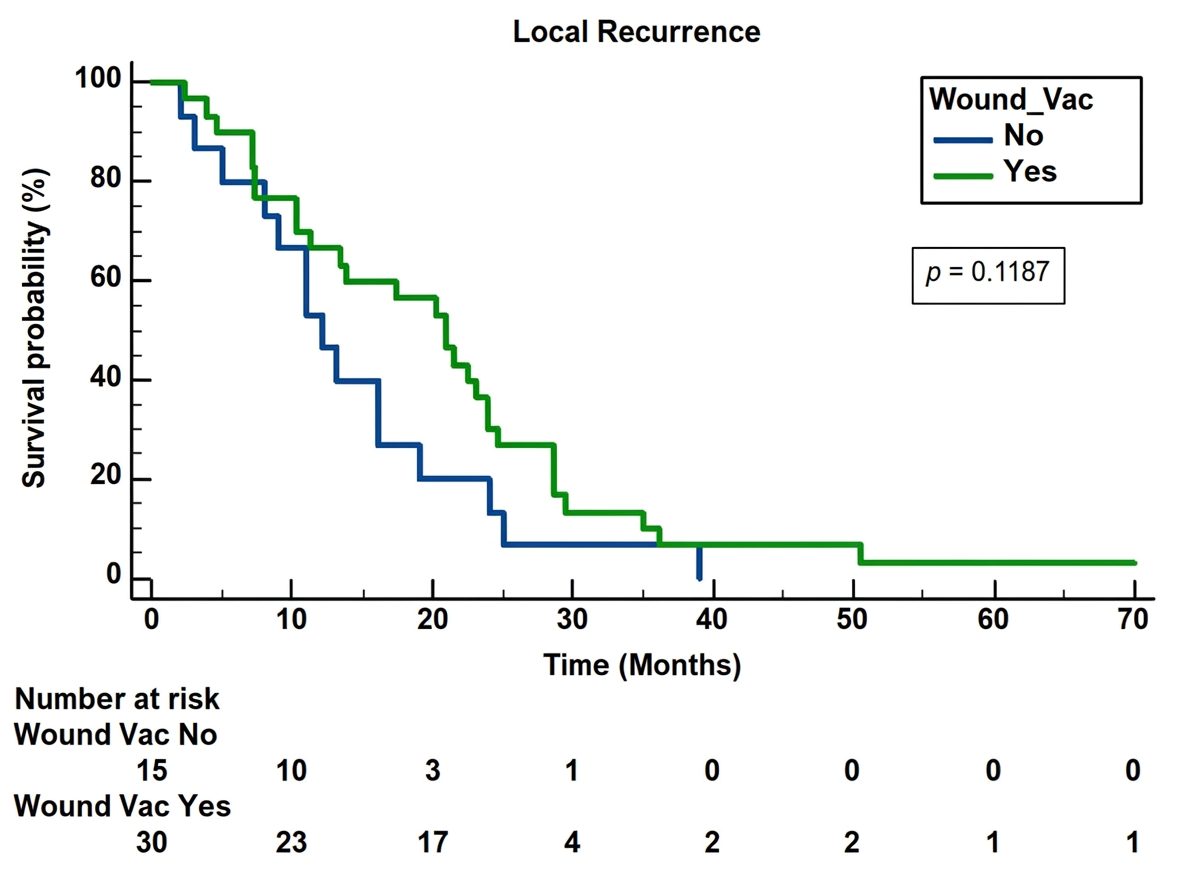
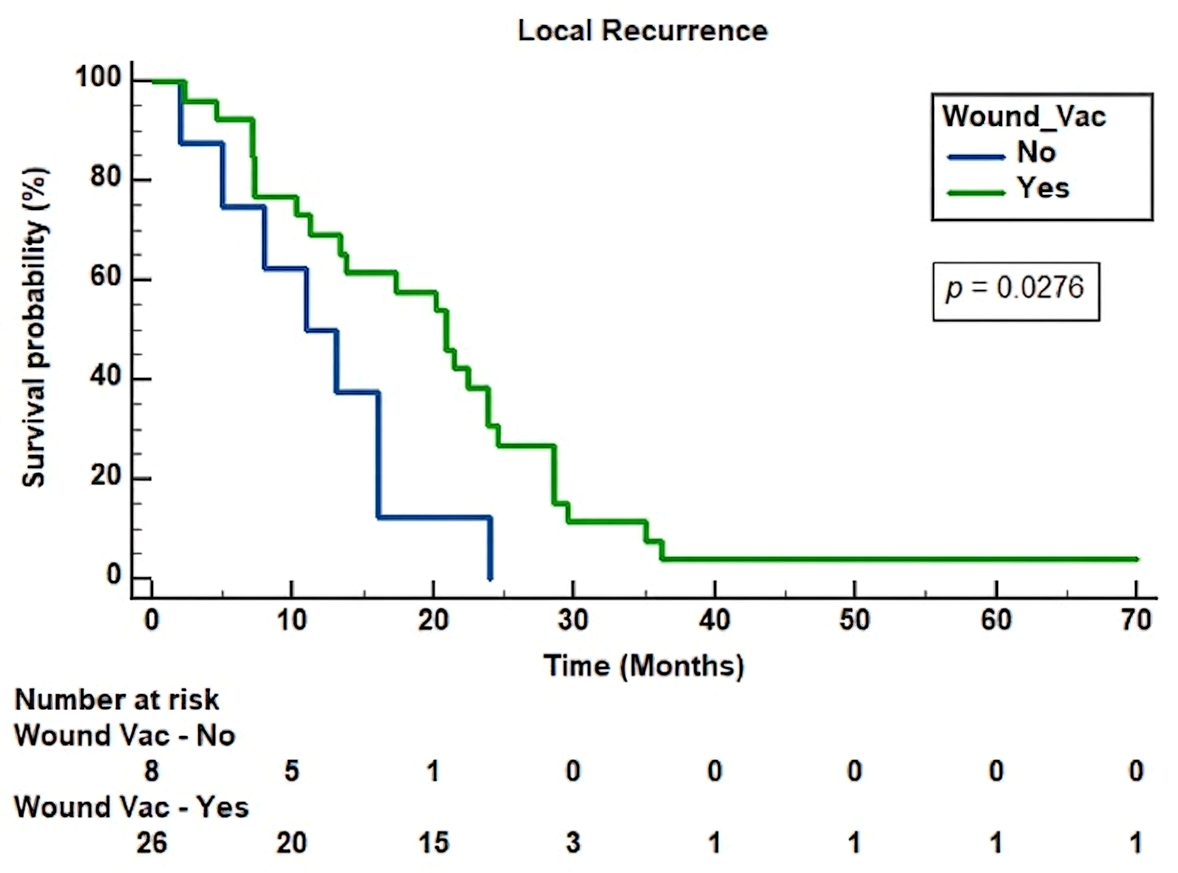
- Staged resection with temporizing VAC was not associated with improved LR rates, with the VAC cohort possessing intrinsically higher-risk tumor biology and complex oncologic presentations.
- •
- LR risk in such complex patients may not be fully mitigated by surgical staging.
- •
- VAC use should be viewed as an adjunct for complex reconstructive planning and facilitation of radiation therapy.
- •
- Future efforts should focus on establishing standardized indications for staged resection in STS surgery.
Supplementary Materials
Author Contributions
Funding
Institutional Review Board Statement
Informed Consent Statement
Data Availability Statement
Conflicts of Interest
Abbreviations
| VAC | Vacuum-assisted closure |
| STS | Soft tissue sarcoma |
| LR | Local recurrence |
| DFSP | Dermatofibrosarcoma protuberans |
| UPS | Undifferentiated pleomorphic sarcoma |
Appendix A

| Non-VAC (n = 331) | VAC (n = 188) | |||
|---|---|---|---|---|
| Variable | n (%) or Mean ± SD | n (%) or Mean ± SD | p-Value | |
| Age (years) | 59.92 ± 18.90 | 63.86 ± 15.62 | 0.02 | |
| Gender | Male | 202 (61) | 97 (51.6) | 0.037 |
| Female | 129 (39) | 91 (48.4) | ||
| Race | White | 215 (69.8) | 157 (86.3) | <0.001 |
| Non-White | 93 (30.2) | 25 (13.7) | ||
| Ethnicity | Hispanic/Latino | 6 (2) | 19 (10.3) | <0.001 |
| Non-Hispanic/Latino | 298 (98) | 165 (89.7) | ||
| Tumor diameter (cm) | 5.46 ± 3.72 | 5.69 ± 3.48 | 0.226 | |
| Tumor diameter | Less than 5 cm | 178 (65.7) | 93 (50.5) | 0.033 |
| 5–10 cm | 90 (29.5) | 75 (40.8) | ||
| Greater than 10 cm | 37 (12.1) | 16 (8.7) | ||
| Grade | 1 | 71 (23.6) | 9 (5.4) | <0.001 |
| 2 | 132 (43.9) | 50 (29.9) | ||
| 3 | 98 (32.6) | 108 (64.7) | ||
| Stage | 1 | 65 (23.3) | 14 (8.4) | <0.001 |
| 2 | 121 (43.4) | 73 (44) | ||
| 3 | 90 (32.3) | 72 (43.4) | ||
| 4 | 3 (1.1) | 7 (4.2) | ||
| Presenting status | Primary | 318 (96.1) | 165 (87.8) | <0.001 |
| Recurrent | 13 (3.9) | 23 (12.2) | ||
| Site | Upper extremity | 106 (32) | 49 (26.2) | 0.007 |
| Lower extremity | 189 (57.1) | 114 (60.4) | ||
| Trunk | 36 (10.9) | 19 (10.2) | ||
| Scalp | 0 (0) | 6 (3.2) | ||
| Prior unplanned excision | No | 193 (58.3) | 82 (43.6) | 0.001 |
| Yes | 138 (41.7) | 106 (56.4) | ||
| Diagnosis | Myxofibrosarcoma | 84 (25.4) | 91 (48.4) | <0.001 |
| UPS | 34 (10.3) | 22 (11.7) | ||
| Leiomyosarcoma | 68 (20.5) | 9 (4.8) | ||
| Fibrosarcoma | 21 (6.3) | 1 (0.5) | ||
| Other STS | 124 (37.5) | 65 (34.6) | ||
| Initial margin status | Negative | 291 (87.9) | 126 (67) | <0.001 |
| Positive | 40 (12.1) | 62 (33) | ||
| Final margin status | Negative | 291 (87.9) | 175 (93.1) | 0.062 |
| Positive | 40 (12.1) | 13 (6.9) | ||
| Radiation | No | 218 (65.8) | 61 (32.4) | <0.001 |
| Yes | 113 (34.2) | 127 (67.6) | ||
| Chemotherapy | No | 319 (96.4) | 159 (84.6) | <0.001 |
| Yes | 12 (3.6) | 29 (15.4) | ||
| Soft tissue coverage | Primary closure | 159 (48) | 27 (14.4) | 0.001 |
| Skin graft | 68 (20.5) | 60 (31.9) | ||
| Flap reconstruction | 104 (31.4) | 101 (53.7) | ||
| Follow up | 45.27 ± 25.35 | 38.99 ± 27.05 | 0.001 | |
| LR | No | 315 (95.2) | 158 (84) | <0.001 |
| Yes | 16 (4.8) | 30 (16) | ||
| Metastasis | No | 284 (85.8) | 159 (84.6) | 0.704 |
| Yes | 47 (14.2) | 29 (15.4) | ||
| Time to metastasis (months) | 22.77 ± 27.58 | 17.07 ± 17.03 | 0.674 | |
| Overall survival | Alive | 278 (84) | 167 (88.8) | 0.129 |
| Dead | 53 (16) | 21 (11.2) | ||
| No LR (n = 473) | LR (n = 46) | |||
|---|---|---|---|---|
| Variable | n (%) or Mean ± SD | n (%) or Mean ± SD | p-Value | |
| Age (years) | 60.59 ± 17.67 | 69.09 ± 18.23 | 0.001 | |
| Gender | Male | 267 (56.4) | 32 (69.6) | 0.086 |
| Female | 206 (43.6) | 14 (30.4) | ||
| Race | White | 337 (75.6) | 35 (79.5) | 0.555 |
| Non-White | 109 (24.4) | 9 (20.5) | ||
| Ethnicity | Hispanic/Latino | 21 (4.7) | 4 (9.3) | 0.263 |
| Non-Hispanic/Latino | 424 (95.3) | 39 (90.7) | ||
| Tumor diameter (cm) | 5.40 ± 3.41 | 6.98 ± 5.17 | 0.048 | |
| Tumor diameter | Less than 5 cm | 251 (56.5) | 20 (44.4) | 0.158 |
| 5–10 cm | 148 (33.3) | 17 (37.8) | ||
| Greater than 10 cm | 45 (10.1) | 8 (17.8) | ||
| Grade | 1 | 80 (18.8) | 0 (0) | <0.001 |
| 2 | 170 (39.9) | 12 (28.6) | ||
| 3 | 176 (41.3) | 30 (71.4) | ||
| Stage | 1 | 78 (19.3) | 1 (2.4) | <0.001 |
| 2 | 181 (44.8) | 13 (31.7) | ||
| 3 | 137 (33.9) | 25 (61) | ||
| 4 | 8 (2) | 2 (4.9) | ||
| Presenting status | Primary | 446 (94.3) | 37 (80.4) | 0.002 |
| Recurrent | 26 (5.7) | 9 (19.6) | ||
| Site | Upper extremity | 144 (30.5) | 11 (23.9) | 0.017 |
| Lower extremity | 277 (58.7) | 25 (54.3) | ||
| Trunk | 48 (10.2) | 7 (15.2) | ||
| Scalp | 3 (0.6) | 3 (6.5) | ||
| Prior unplanned excision | No | 248 (52.4) | 27 (58.7) | 0.416 |
| Yes | 225 (47.6) | 19 (41.3) | ||
| Diagnosis | Myxofibrosarcoma | 155 (32.8) | 20 (43.5) | 0.040 |
| UPS | 47 (9.9) | 9 (19.6) | ||
| Leiomyosarcoma | 75 (15.9) | 2 (4.3) | ||
| Fibrosarcoma | 21 (4.4) | 1 (2.2) | ||
| Other STS | 175 (37) | 14 (30.4) | ||
| Initial margin status | Negative | 390 (82.5) | 27 (58.7) | <0.001 |
| Positive | 83 (17.5) | 19 (41.3) | ||
| Final margin status | Negative | 428 (90.5) | 38 (82.6) | 0.12 |
| Positive | 45 (9.5) | 8 (17.4) | ||
| Radiation | No | 252 (53.4) | 26 (56.5) | 0.684 |
| Yes | 220 (46.6) | 20 (43.5) | ||
| Chemotherapy | No | 441 (93.2) | 37 (80.4) | 0.006 |
| Yes | 32 (6.8) | 9 (19.6) | ||
| Soft tissue coverage | Primary closure | 176 (37.2) | 10 (21.7) | 0.035 |
| Skin graft | 118 (24.9) | 10 (21.7) | ||
| Flap reconstruction | 179 (37.8) | 26 (56.5) | ||
| Follow up | 43.96 ± 26.18 | 33.04 ± 23.64 | 0.003 | |
| VAC | No | 315 (66.6) | 16 (34.8) | <0.001 |
| Yes | 158 (33.4) | 30 (65.2) | ||
| Metastasis | No | 410 (86.7) | 33 (71.7) | 0.006 |
| Yes | 63 (13.3) | 13 (28.3) | ||
| Time to metastasis (months) | 20.24 ± 24.92 | 23.03 ± 21.56 | 0.359 | |
| Overall survival | Alive | 411 (86.9) | 34 (73.9) | 0.016 |
| Dead | 62 (13.1) | 12 (26.1) | ||
References
- Wisdom, A.J.; Raut, C.L.; Haddox, J.L.; Hornick, J.L.; Jagannathan, J.P.; Painter, C.A.; Baldini, E.H. Clinician’s Primer for Soft Tissue Sarcomas: Nuances of Histologic Subtypes. Cancer 2025, 131, e35772. [Google Scholar] [CrossRef] [PubMed]
- Deo, S.; Pathak, B.; Sharma, J.; Kumar, S.; Bhoriwal, S.; Mishra, A.; Mandal, A.; Saikia, J.; Barwad, A.; Thulkar, S.; et al. Temporospatial Recurrence Patterns and Predictive Factors for Recurrences in 984 Patients with Adult Soft Tissue Sarcomas. J. Surg. Oncol. 2025, 132, 529–538. [Google Scholar] [PubMed]
- Sawamura, C.; Matsumoto, S.; Shimoji, T.; Okawa, A.; Ae, K.; Zhang, X. How Long Should We Follow Patients with Soft Tissue Sarcomas? Clin. Orthop. Relat. Res. 2014, 472, 842–848. [Google Scholar] [CrossRef] [PubMed]
- von Konow, A.; Ghanei, I.; Styring, E.; Vult von Steyern, F. Late Local Recurrence and Metastasis in Soft Tissue Sarcoma of the Extremities and Trunk Wall: Better Outcome After Treatment of Late Events Compared with Early. Ann. Surg. Oncol. 2021, 28, 7891–7902. [Google Scholar] [CrossRef] [PubMed]
- Eilber, F.C.; Rosen, G.; Nelson, S.D.; Selch, M.; Dorey, F.; Eckardt, J.; Eilber, F.R. High-Grade Extremity Soft Tissue Sarcomas: Factors Predictive of Local Recurrence and Its Effect on Morbidity and Mortality. Ann. Surg. 2003, 237, 218–226. [Google Scholar] [CrossRef] [PubMed]
- Posch, F.; Leitner, L.; Bergovec, M.; Bezan, A.; Stotz, M.; Gerger, A.; Pichler, M.; Stöger, H.; Liegl-Atzwanger, B.; Leithner, A.; et al. Can Multistate Modeling of Local Recurrence, Distant Metastasis, and Death Improve the Prediction of Outcome in Patients with Soft Tissue Sarcomas? Clin. Orthop. Relat. Res. 2017, 475, 1427–1435. [Google Scholar] [CrossRef] [PubMed]
- Bilgeri, A.; Klein, A.; Linder, L.H.; Nachbichler, S.; Knösel, T.; Birkenmaier, C.; Jansson, V.; Baur-Melnyk, A.; Dürr, H.R. The Effect of Resection Margin on Local Recurrence and Survival in High Grade Soft Tissue Sarcoma of the Extremities: How Far Is Far Enough? Cancers 2020, 12, 2560. [Google Scholar] [CrossRef] [PubMed]
- Potter, B.K.; Hwang, P.F.; Forsberg, J.A.; Hampton, C.B.; Graybill, J.C.; Peoples, G.E.; Stojadinovic, A. Impact of Margin Status and Local Recurrence on Soft-Tissue Sarcoma Outcomes. J. Bone Jt. Surg. Am. 2013, 95, e151. [Google Scholar] [CrossRef] [PubMed]
- Sugiura, H.; Tsukushi, S.; Yoshida, M.; Nishida, Y. What Is the Success of Repeat Surgical Treatment of a Local Recurrence after Initial Wide Resection of Soft Tissue Sarcomas? Clin. Orthop. Relat. Res. 2018, 476, 1791–1800. [Google Scholar] [CrossRef] [PubMed]
- Byerly, S.; Chopra, S.; Nassif, N.A.; Chen, P.; Sener, S.F.; Eisenberg, B.L.; Tseng, W.W. The Role of Margins in Extremity Soft Tissue Sarcoma. J. Surg. Oncol. 2016, 113, 333–338. [Google Scholar] [PubMed]
- Hays, T.R.; Singh, G.; Saragossi, J.; Park, J.; Shekar, S.; Marquez, J.E.; Dagum, A.B.; Khan, S.U.; Khan, F.A.; Bui, D.T. Negative-Pressure Wound Therapy Versus Standard Surgical Dressings after Malignant Tumor Resection: A Systematic Review and Meta-Analysis. Plast. Reconstr. Surg. 2022, 150, 655e–670e. [Google Scholar] [CrossRef] [PubMed]
- Heller, D.R.; Rohde, C.; Ananthakrishnan, P. Staging Resection and Reconstruction with Temporary Wound VAC Coverage in a Case of Giant Cystosarcoma Phyllodes of the Breast. Int. J. Surg. Case Rep. 2015, 6, 84–87. [Google Scholar] [CrossRef] [PubMed][Green Version]
- National Comprehensive Cancer Network. NCCN Clinical Practice Guidelines in Oncology: Soft Tissue Sarcoma. Version 3.2026. Available online: https://www.nccn.org/professionals/physician_gls/pdf/sarcoma.pdf (accessed on 23 May 2026).
- Fourman, M.S.; Ramsey, D.C.; Kleiner, J.; Daud, A.; Newman, E.T.; Schwab, J.H.; Chen, Y.L.; DeLaney, T.F.; Mullen, J.T.; Raskin, K.A.; et al. Temporizing Wound Vac Dressing until Final Negative Margins Are Achieved Reduces Myxofibrosarcoma Local Recurrence. Ann. Surg. Oncol. 2021, 28, 9171–9176. [Google Scholar] [CrossRef] [PubMed]
- Gonzalez, M.R.; de Groot, T.M.; Werenski, J.O.; Fourman, M.S.; Morse, A.S.; Lozano-Calderón, S.A. Wound Vacuum-Assisted Closure Temporization after Tumor Resection of Soft Tissue Sarcomas—A Cost Analysis in a Propensity-Score Matched Population. J. Surg. Oncol. 2024, 130, 301–309. [Google Scholar] [CrossRef] [PubMed]
- Fourman, M.S.; Ramsey, D.C.; Newman, E.T.; Schwab, J.H.; Chen, Y.L.; Hung, Y.P.; Chebib, I.; Deshpande, V.; Nielsen, G.P.; DeLaney, T.F.; et al. Assessing the Safety and Utility of Wound Vac Temporization of the Sarcoma or Benign Aggressive Tumor Bed Until Final Margins Are Achieved. Ann. Surg. Oncol. 2022, 29, 2290–2298. [Google Scholar] [CrossRef]
- Werenski, J.O.; Gonzalez, M.R.; Fourman, M.S.; Hung, Y.P.; Lozano-Calderón, S.A. Does Wound Vac Temporization Offer Patient-Reported Outcomes Similar to Single-Stage Excision Reconstruction after Myxofibrosarcoma Resection? Ann. Surg. Oncol. 2024, 31, 2757–2765. [Google Scholar] [CrossRef] [PubMed]
- Berner, J.E.; Crowley, T.P.; Teelucksingh, S.; Lee, D.; Ghosh, K.M.; Beckingsale, T.B.; Rankin, K.S.; Ragbir, M. The Importance of Clear Margins in Myxofibrosarcoma: Improving Local Control by Means of Staged Resection and Reconstruction. Eur. J. Surg. Oncol. 2021, 47, 2627–2632. [Google Scholar] [CrossRef] [PubMed]
- Garayua-Cruz, L.; Broida, S.E.; Sullivan, M.H.; Folpe, A.L.; Welliver, M.X.; Lee, K.N.; Siontis, B.L.; Robinson, S.I.; Ho, T.P.; Okuno, S.H.; et al. Staged Reconstruction Is Not Necessary Following Oncologic Resection of Superficial Myxofibrosarcoma. Cancers 2025, 17, 3637. [Google Scholar] [CrossRef] [PubMed]
- Biau, D.J.; Ferguson, P.C.; Chung, P.; Griffin, A.M.; Catton, C.N.; O’Sullivan, B.; Wunder, J.S. Local Recurrence of Localized Soft Tissue Sarcoma: A New Look at Old Predictors. Cancer 2012, 118, 5867–5877. [Google Scholar] [CrossRef] [PubMed]
- Italiano, A.; Le Cesne, A.; Mendiboure, J.; Blay, J.Y.; Piperno-Neumann, S.; Chevreau, C.; Delcambre, C.; Penel, N.; Terrier, P.; Ranchere-Vince, D.; et al. Prognostic Factors and Impact of Adjuvant Treatments on Local and Metastatic Relapse of Soft-Tissue Sarcoma Patients in the Competing Risks Setting. Cancer 2014, 120, 3361–3369. [Google Scholar] [CrossRef] [PubMed]
- Lawrenz, J.M.; Mesko, N.W.; Marshall, D.C.; Featherall, J.; George, J.; Gordon, J.; Vijayasekaran, A.; Nystrom, L.M.; Schwarz, G.S. Immediate Versus Staged Soft Tissue Reconstruction after Soft Tissue Sarcoma Resection Has Similar Wound and Oncologic Outcomes. Ann. Plast. Surg. 2020, 85, 163–170. [Google Scholar] [CrossRef] [PubMed]
- Siegel, G.W.; Kuzon, W.M.; Hasen, J.M.; Biermann, J.S. Staged Soft Tissue Reconstruction Following Sarcoma Excision with Anticipated Large Cutaneous Defects: An Oncologically Safe Alternative. Iowa Orthop. J. 2016, 36, 104–108. [Google Scholar] [PubMed]
- Haldeman, P.B.; Harfouche, C.; Rosales, R.; Trimm, C.; Chun, L.; Reid, C.; Flint, J.H.; Chiarappa, F. Immediate and Delayed Flap Reconstruction Have Equivalent Outcomes and Associated Costs Following Soft Tissue Sarcoma Surgery. J. Surg. Oncol. 2024, 130, 562–568. [Google Scholar] [CrossRef] [PubMed]
- Stauss, R.; Aigner, A.; Richter, A.; Suero, E.; Altemeier, A.; Savov, P.; Ettinger, M.; Omar, M. The Prognostic Significance of Surgical Resection Margins for Local Recurrence, Distant Metastasis, and Overall Survival in Sarcoma. J. Surg. Oncol. 2023, 128, 1160–1170. [Google Scholar] [CrossRef] [PubMed]
- Stojadinovic, A.; Leung, D.H.Y.; Hoos, A.; Jacques, D.P.; Lewis, J.J.; Brennan, M.F. Analysis of the Prognostic Significant of Microscopic Margins in 2,084 Localized Primary Adult Soft Tissue Sarcomas. Ann. Surg. 2002, 235, 424–434. [Google Scholar] [CrossRef] [PubMed]
- Hoang, M.N.; Doumanidis, P.; Nyqvist, E.; Löfgren, J.; Hesla, A.C.; Tsagkozis, P. Effect of Surgical Margins on Local Recurrence Patterns of Myxofibrosarcomas: A Retrospective Cohort Study From the Stockholm Sarcoma Centre. J. Surg. Oncol. 2025, 132, 1116–1121. [Google Scholar] [CrossRef] [PubMed]
- Riouallon, G.; Larousserie, F.; Pluot, E.; Anract, P. Superficial Myxofibrosarcoma: Assessment of Recurrence Risk According to the Surgical Margin Following Resection. A Series of 21 Patients. Orthop. Traumatol. Surg. Res. 2013, 99, 473–477. [Google Scholar] [CrossRef] [PubMed]
- Albertsmeier, M.A.; Rauch, A.; Roeder, F.; Hasenhütl, S.; Pratschke, S.; Kirschneck, M.; Gronchi, A.; Jebsen, N.L.; Cassier, P.A.; Sargos, P.; et al. External Beam Radiation Therapy for Resectable Soft Tissue Sarcoma: A Systematic Review and Meta-Analysis. Ann. Surg. Oncol. 2018, 25, 754–767. [Google Scholar] [CrossRef] [PubMed]
- Jebsen, N.L.; Trovik, C.S.; Bauer, H.C.F.; Rydholm, A.; Monge, O.R.; Hall, K.S.; Alvegard, T.; Bruland, O.S. Radiotherapy to Improve Local Control Regardless of Surgical Margin and Malignancy Grade in Extremity and Trunk Wall Soft Tissue Sarcoma: A Scandinavian Sarcoma Group Study. Int. J. Radiat. Oncol. Biol. Phys. 2008, 71, 1196–1203. [Google Scholar] [CrossRef] [PubMed]
- Naghavi, A.O.; Gonzalez, R.J.; Scott, J.G.; Mullinax, J.E.; Abuodeh, Y.A.; Kim, Y.; Binitie, O.; Ahmed, K.A.; Bui, M.M.; Saini, A.S.; et al. Implications of Staged Reconstruction and Adjuvant Brachytherapy in the Treatment of Recurrent Soft Tissue Sarcoma. Brachytherapy 2016, 15, 495–503. [Google Scholar] [CrossRef] [PubMed]


| Univariate Analysis | Multivariate Analysis | ||
|---|---|---|---|
| Variable | OR (95% CI) | OR (95% CI) | p-Value |
| Temporizing VAC | 3.738 (1.979, 7.062) | 2.910 (1.408, 6.014) | 0.004 |
| Presenting Status | 4.018 (1.760, 9.174) | 3.080 (1.257, 7.549) | 0.014 |
| Chemotherapy | 3.352 (1.488, 7.551) | 1.954 (0.810, 4.717) | 0.136 |
| Radiation | 0.881 (0.479, 1.622) | 0.468 (0.233, 0.942) | 0.033 |
| Follow Up | 0.981 (0.967, 0.995) | 0.988 (0.974, 1.003) | 0.114 |
| Initial Margin | 3.307 (1.756, 6.227) | 2.603 (1.287, 5.265) | 0.008 |
| Non-VAC (n = 157) | VAC (n = 157) | |||
|---|---|---|---|---|
| Variable | n (%) or Mean ± SD | n (%) or Mean ± SD | p-Value | |
| Age (years) | 62.4 ± 18.35 | 64.50 ± 15.31 | 0.278 | |
| Gender | Male | 93 (59.2) | 81 (51.6) | 0.173 |
| Female | 64 (40.8) | 76 (48.4) | ||
| Race | White | 96 (64.9) | 131 (86.8) | <0.001 |
| Non-White | 52 (35.1) | 20 (13.2) | ||
| Ethnicity | Hispanic/Latino | 2 (1.4) | 16 (10.5) | 0.001 |
| Non-Hispanic/Latino | 137 (98.6) | 137 (89.5) | ||
| Tumor diameter (cm) | 6.02 ± 4.04 | 6.03 ± 3.52 | 0.551 | |
| Tumor diameter | Less than 5 cm | 80 (54.4) | 71 (46.1) | 0.041 |
| 5–10 cm | 45 (30.6) | 68 (44.2) | ||
| Greater than 10 cm | 22 (15.0) | 15 (9.7) | ||
| Grade | 1 | 9 (5.7) | 9 (5.7) | 1 |
| 2 | 50 (31.8) | 50 (31.8) | ||
| 3 | 98 (62.4) | 98 (62.4) | ||
| Stage | 1 | 8 (5.4) | 14 (9) | 0.172 |
| 2 | 76 (51.7) | 67 (42.9) | ||
| 3 | 61 (41.5) | 68 (43.6) | ||
| 4 | 2 (1.4) | 7 (4.5) | ||
| Presenting status | Primary | 151 (96.2) | 137 (87.3) | 0.004 |
| Recurrent | 6 (3.8) | 20 (12.7) | ||
| Site | Upper extremity | 50 (31.8) | 38 (24.2) | 0.141 |
| Lower extremity | 91 (58) | 102 (65) | ||
| Trunk | 16 (10.2) | 13 (8.3) | ||
| Scalp | 0 (0) | 3 (1.9) | ||
| Prior unplanned excision | No | 92 (58.6) | 72 (45.9) | 0.024 |
| Yes | 65 (41.4) | 85 (54.1) | ||
| Diagnosis | Myxofibrosarcoma | 43 (27.4) | 85 (54.1) | <0.001 |
| UPS | 23 (14.6) | 19 (12.1) | ||
| Leiomyosarcoma | 28 (17.8) | 9 (5.7) | ||
| Fibrosarcoma | 7 (4.5) | 1 (0.6) | ||
| Other STS | 56 (35.7) | 43 (27.4) | ||
| Non-VAC (n = 157) | VAC (n = 157) | |||
|---|---|---|---|---|
| Variable | n (%) or Mean ± SD | n (%) or Mean ± SD | p-Value | |
| Initial margin status | Negative | 141 (89.8) | 105 (66.9) | <0.001 |
| Positive | 16 (10.2) | 52 (33.1) | ||
| Final margin status | Negative | 141 (89.8) | 145 (92.4) | 0.428 |
| Positive | 16 (10.2) | 12 (7.6) | ||
| Radiation | No | 96 (61.5) | 42 (26.8) | <0.001 |
| Yes | 60 (38.5) | 115 (73.2) | ||
| Chemotherapy | No | 147 (93.6) | 134 (85.4) | 0.017 |
| Yes | 10 (6.4) | 23 (14.6) | ||
| Soft tissue coverage | Primary closure | 65 (41.4) | 20 (12.7) | <0.001 |
| Skin graft | 37 (23.6) | 48 (30.6) | ||
| Flap reconstruction | 55 (35) | 89 (56.7) | ||
| Follow up | 42.94 ± 25.66 | 40.60 ± 27.99 | 0.165 | |
| LR | No | 149 (94.9) | 131 (83.4) | 0.001 |
| Yes | 8 (5.1) | 26 (16.6) | ||
| Metastasis | No | 123 (78.3) | 130 (82.8) | 0.318 |
| Yes | 34 (21.7) | 27 (17.2) | ||
| Time to metastasis (months) | 20.06 ± 26.55 | 17.00 ± 17.70 | 0.89 | |
| Overall survival | Alive | 118 (75.2) | 138 (87.9) | 0.004 |
| Dead | 39 (24.8) | 19 (12.1) | ||
| No LR (n = 280) | LR (n = 34) | |||
|---|---|---|---|---|
| Variable | n (%) or Mean ± SD | n (%) or Mean ± SD | p-Value | |
| Age (years) | 62.64 ± 16.45 | 68.47 ± 19.92 | 0.013 | |
| Gender | Male | 151 (53.9) | 23 (67.6) | 0.129 |
| Female | 129 (46.1) | 11 (32.4) | ||
| Race | White | 199 (74.8) | 28 (84.8) | 0.203 |
| Non-White | 67 (25.2) | 5 (15.2) | ||
| Ethnicity | Hispanic/Latino | 14 (5.4) | 4 (12.5) | 0.12 |
| Non-Hispanic/Latino | 246 (94.6) | 28 (84.8) | ||
| Tumor diameter (cm) | 5.84 ± 3.44 | 7.51 ± 5.71 | 0.189 | |
| Tumor diameter | Less than 5 cm | 137 (51.1) | 14 (42.4) | 0.268 |
| 5–10 cm | 101 (37.7) | 12 (36.4) | ||
| Greater than 10 cm | 30 (11.2) | 7 (21.2) | ||
| Grade | 1 | 18 (6.4) | 0 (0) | 0.029 |
| 2 | 94 (33.6) | 6 (17.6) | ||
| 3 | 168 (60) | 28 (82.4) | ||
| Stage | 1 | 21 (7.8) | 1 (3) | 0.051 |
| 2 | 133 (49.3) | 10 (30.3) | ||
| 3 | 109 (40.4) | 20 (60.6) | ||
| 4 | 7 (2.6) | 2 (6.1) | ||
| Presenting status | Primary | 262 (93.6) | 26 (76.5) | 0.003 |
| Recurrent | 18 (6.4) | 8 (23.5) | ||
| Site | Upper extremity | 81 (28.9) | 7 (20.6) | 0.024 |
| Lower extremity | 174 (62.1) | 19 (55.9) | ||
| Trunk | 23 (8.2) | 6 (17.6) | ||
| Scalp | 1 (0.4) | 2 (5.9) | ||
| Prior unplanned excision | No | 143 (51.1) | 21 (61.8) | 0.238 |
| Yes | 137 (48.9) | 13 (38.2) | ||
| Diagnosis | Myxofibrosarcoma | 114 (40.7) | 14 (41.2) | 0.003 |
| UPS | 34 (12.1) | 8 (23.5) | ||
| Leiomyosarcoma | 35 (12.5) | 2 (5.9) | ||
| Fibrosarcoma | 7 (2.5) | 1 (2.9) | ||
| Other STS | 90 (32.1) | 9 (26.5) | ||
| Initial margin status | Negative | 225 (80.4) | 21 (61.8) | 0.013 |
| Positive | 55 (19.6) | 13 (38.2) | ||
| Final margin status | Negative | 257 (91.8) | 29 (85.3) | 0.206 |
| Positive | 24 (8.2) | 5 (14.7) | ||
| Radiation | No | 118 (42.3) | 20 (58.8) | 0.067 |
| Yes | 161 (57.7) | 14 (41.2) | ||
| Chemotherapy | No | 254 (90.7) | 27 (79.4) | 0.068 |
| Yes | 26 (9.3) | 7 (20.6) | ||
| Soft tissue coverage | Primary closure | 78 (27.9) | 7 (20.6) | 0.275 |
| Skin graft | 78 (27.9) | 7 (20.6) | ||
| Flap reconstruction | 124 (44.3) | 20 (58.8) | ||
| Follow up | 43.02 ± 26.95 | 31.48 ± 23.77 | 0.009 | |
| VAC | No | 149 (53.2) | 8 (23.5) | 0.001 |
| Yes | 131 (46.8) | 26 (76.5) | ||
| Metastasis | No | 228 (81.4) | 25 (73.5) | 0.272 |
| Yes | 52 (18.6) | 9 (26.5) | ||
| Time to metastasis (months) | 17.89 ± 22.83 | 24.31 ± 25.54 | 0.542 | |
| Overall survival | Alive | 231 (82.5) | 25 (73.5) | 0.203 |
| Dead | 49 (17.5) | 9 (26.5) | ||
| Univariate Analysis | Multivariate Analysis | ||
|---|---|---|---|
| Variable | OR (95% CI) | OR (95% CI) | p-Value |
| Temporizing VAC | 3.697 (1.618, 8.447) | 4.117 (1.593, 10.640) | 0.003 |
| Radiation | 0.513 (0.249, 1.057) | 0.256 (0.109, 0.602) | 0.002 |
| Initial Margin | 2.532 (1.194, 5.371) | 1.995 (0.848, 4.695) | 0.114 |
| Chemotherapy | 2.533 (1.005, 6.381) | 1.819 (0.665, 4.972) | 0.244 |
| Follow Up | 0.980 (0.964, 0.997) | 0.986 (0.969, 1.004) | 0.137 |
| Presenting Status | 4.479 (1.776, 11.297) | 4.003 (1.458, 10.989) | 0.007 |
Disclaimer/Publisher’s Note: The statements, opinions and data contained in all publications are solely those of the individual author(s) and contributor(s) and not of MDPI and/or the editor(s). MDPI and/or the editor(s) disclaim responsibility for any injury to people or property resulting from any ideas, methods, instructions or products referred to in the content. |
© 2026 by the authors. Licensee MDPI, Basel, Switzerland. This article is an open access article distributed under the terms and conditions of the Creative Commons Attribution (CC BY) license.
Share and Cite
Chose, C.; Karadimas, T.; Hederick, L.; Griffin, A.M.; Jajoo, V.; Cummings, C.; Connolly, J.; Huynh, T.H.; Newman, E.T.; Raskin, K.A.; et al. Staged Resection with Temporizing VAC and Local Recurrence for Soft Tissue Sarcomas: A Multi-Institutional Review. Cancers 2026, 18, 1984. https://doi.org/10.3390/cancers18121984
Chose C, Karadimas T, Hederick L, Griffin AM, Jajoo V, Cummings C, Connolly J, Huynh TH, Newman ET, Raskin KA, et al. Staged Resection with Temporizing VAC and Local Recurrence for Soft Tissue Sarcomas: A Multi-Institutional Review. Cancers. 2026; 18(12):1984. https://doi.org/10.3390/cancers18121984
Chicago/Turabian StyleChose, Chloe, Thomas Karadimas, Lucy Hederick, Anthony M. Griffin, Veena Jajoo, Caleb Cummings, Joseph Connolly, Thien Huong Huynh, Erik T. Newman, Kevin A. Raskin, and et al. 2026. "Staged Resection with Temporizing VAC and Local Recurrence for Soft Tissue Sarcomas: A Multi-Institutional Review" Cancers 18, no. 12: 1984. https://doi.org/10.3390/cancers18121984
APA StyleChose, C., Karadimas, T., Hederick, L., Griffin, A. M., Jajoo, V., Cummings, C., Connolly, J., Huynh, T. H., Newman, E. T., Raskin, K. A., Ferguson, P. C., Wunder, J. S., Joyce, D., Binitie, O., Mhaskar, R., Lozano-Calderon, S. A., Tsoi, K., & Lazarides, A. L. (2026). Staged Resection with Temporizing VAC and Local Recurrence for Soft Tissue Sarcomas: A Multi-Institutional Review. Cancers, 18(12), 1984. https://doi.org/10.3390/cancers18121984