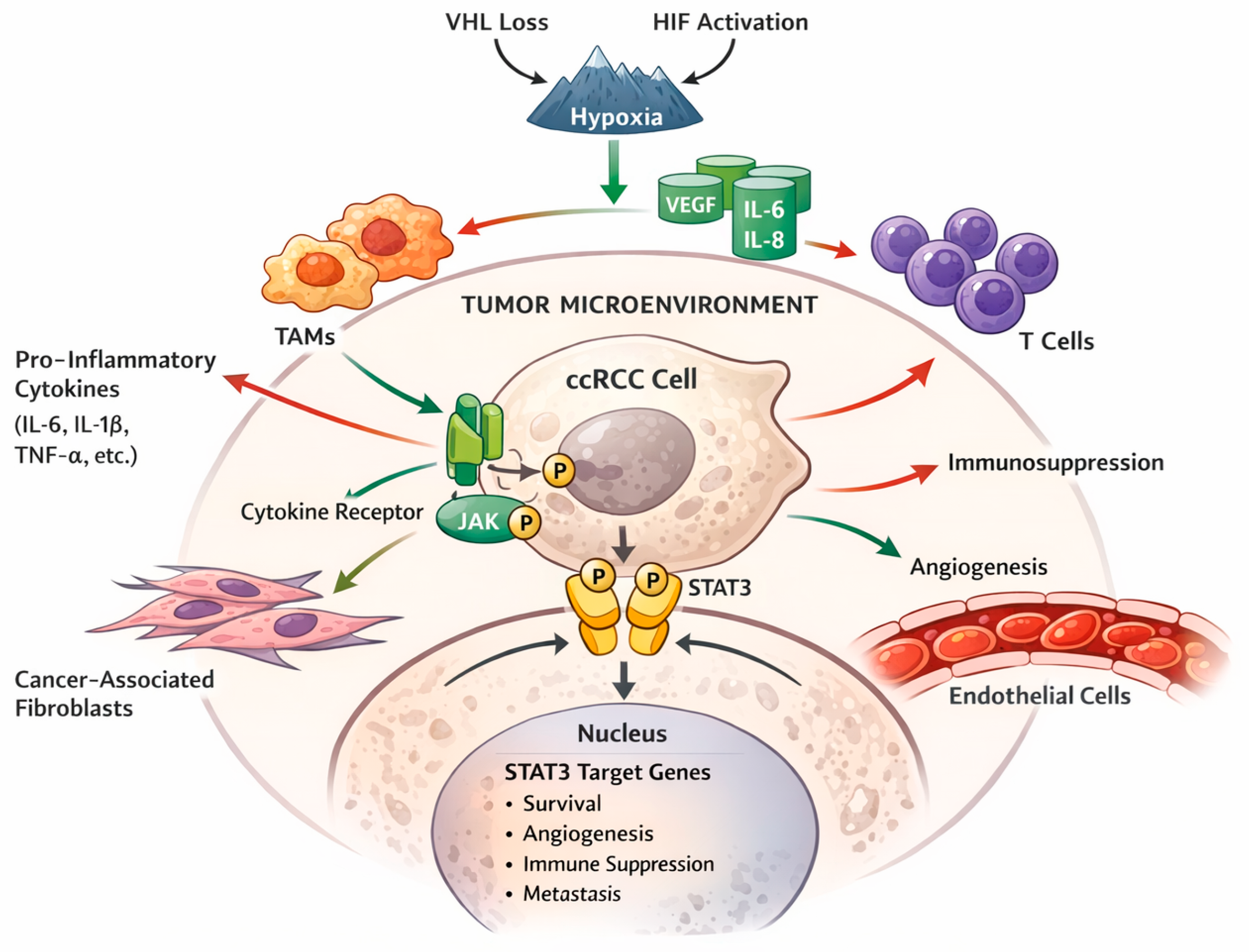
Cytokine-STAT3 Signaling Axis in Clear Cell Renal Cell Carcinoma: Implications for Tumor Microenvironment and Biomarker Discovery
 , ,
, ,
Simple Summary
Abstract
1. Introduction
2. Material and Methods
Literature Search Strategy
3. Clear Cell Renal Cell Carcinoma and the Tumor Microenvironment
4. Cytokines in Clear Cell Renal Cell Carcinoma Pathophysiology
4.1. Interleukins
4.2. Chemokines and Chemokine Receptors
4.3. Tumor Necrosis Factor and Related Cytokines
4.4. Integrated Cytokine Networks in ccRCC
5. Molecular Mechanisms of STAT3 Activation and Regulation
5.1. Canonical STAT3 Activation Pathway
5.2. Oncogenic Functions of STAT3 in ccRCC Cells
5.3. STAT3 as a Modulator of the Tumor Immune Microenvironment
5.4. STAT3 at the Intersection of Cytokine and Hypoxia Signaling in ccRCC
5.5. Non-Canonical STAT3 Signaling and Crosstalk with Other Pathways
5.6. Implications for Biomarker Development and Therapeutic Targeting
6. Evidence Linking Cytokine Signaling and STAT3 Activation in Clear Cell Renal Cell Carcinoma
6.1. Conceptual Framework of Cytokine–STAT3 Interactions
6.2. Evidence from Experimental and Clinical Studies
6.3. Integration of Tissue-Based Cytokine Profiles with STAT3 Activation
6.4. Crosstalk Across Biological Compartments: Tissue, Plasma, and Urine
6.5. Biological and Translational Implications
7. Cytokine Profiles in Tissue, Urine, and Plasma: Evidence from ccRCC Patients
7.1. Cytokine Alterations in Tumor Tissue
7.2. Urinary Cytokine Profiles and Their Clinical Relevance
7.3. Plasma Cytokines as Systemic Inflammatory Indicators
7.4. Integrative Analysis Across Biological Compartments
7.5. Implications for Biomarker Development
8. Diagnostic and Prognostic Implications of Cytokine–STAT3 Signaling in ccRCC
8.1. Diagnostic Considerations
8.2. Prognostic Implications
8.3. Integrating Cytokine and STAT3 Readouts
8.4. Limitations and Need for Validation
9. Future Directions
10. Conclusions
Author Contributions
Funding
Institutional Review Board Statement
Informed Consent Statement
Data Availability Statement
Acknowledgments
Conflicts of Interest
Abbreviations
| BCL-2 | B-cell lymphoma 2 (antiapoptotic protein) |
| BCL-XL | B-cell lymphoma-extra-large (antiapoptotic protein) |
| CC | CC chemokine family |
| CCL | CC motif chemokine ligand |
| CD8+ | Cluster of differentiation 8 positive T cells (cytotoxic T lymphocytes) |
| c-MYC | MYC proto-oncogene (transcription factor regulating proliferation) |
| CXC | CXC chemokine family |
| CX3C | CX3C chemokine family |
| CXCL | CXC motif chemokine ligand |
| DNA | Deoxyribonucleic acid |
| ECM | Extracellular matrix (structural component of the TME) |
| ELR | Glutamic acid–leucine–arginine motif (pro-angiogenic sequence in chemokines) |
| EMT | Epithelial–mesenchymal transition (process promoting invasion and metastasis) |
| G-CSF | Granulocyte colony-stimulating factor (hematopoietic growth factor) |
| GM-CSF | Granulocyte–macrophage colony-stimulating factor (immune cell regulator) |
| GPCRs | G protein-coupled receptors (cell surface signaling receptors) |
| HIF | Hypoxia-inducible factor (transcription factor activated by hypoxia) |
| HIF-1α | Hypoxia-inducible factor 1 alpha (key regulator of hypoxic response) |
| HIFs | Hypoxia-inducible factors (family of hypoxia-responsive transcription factors) |
| IFN | Interferon (cytokine involved in immune responses) |
| IFN-γ | Interferon gamma (pro-inflammatory cytokine) |
| IFNs | Interferons (family of immune-regulating cytokines) |
| IL | Interleukin (cytokine family involved in immune regulation) |
| IL-6 | Interleukin 6 (pro-inflammatory cytokine linked to STAT3 activation) |
| IL-8 | Interleukin 8 (pro-angiogenic chemokine) |
| ILs | Interleukins (group of cytokines with diverse immune functions) |
| JAK | Janus kinase (cytoplasmic tyrosine kinase) |
| JAKs | Janus kinases (family of signaling kinases) |
| MCL-1 | Myeloid cell leukemia 1 (antiapoptotic protein) |
| M-CSF | Macrophage colony-stimulating factor (regulator of macrophage differentiation) |
| MDSC | Myeloid-derived suppressor cell (immunosuppressive cell population) |
| MMP | Matrix metalloproteinase (enzyme degrading extracellular matrix) |
| MMPs | Matrix metalloproteinases (enzymes involved in tissue remodeling and invasion) |
| NK | Natural killer cells (innate immune cytotoxic cells) |
| PDGF-BB | Platelet-derived growth factor BB (growth factor promoting proliferation and angiogenesis) |
| PIAS | Protein inhibitor of activated STAT (negative regulator of STAT signaling) |
| p-STAT3 | Phosphorylated STAT3 (active form of STAT3) |
| RCC | Renal cell carcinoma |
| SIRS | Systemic inflammatory response syndrome |
| SOCS | Suppressor of cytokine signaling (negative feedback regulator of cytokine pathways) |
| STAT3 | Signal transducer and activator of transcription 3 (transcription factor mediating cytokine signaling) |
| TAM | Tumor-associated macrophage (pro-tumor immune cell) |
| TAMs | Tumor-associated macrophages (immunosuppressive macrophage population) |
| TGF | Transforming growth factor (cytokine regulating cell growth and immune responses) |
| TGF-β | Transforming growth factor beta (immunosuppressive cytokine) |
| TIL | Tumor-infiltrating lymphocyte (immune cells within the tumor) |
| TME | Tumor microenvironment (complex cellular environment of the tumor) |
| TNF | Tumor necrosis factor (pro-inflammatory cytokine) |
| TNF-α | Tumor necrosis factor alpha (key mediator of inflammation) |
| TNF-β | Tumor necrosis factor beta (lymphotoxin involved in immune regulation) |
| TK | Tyrosine kinase (enzyme mediating signal transduction) |
| Tregs | Regulatory T cells (immunosuppressive T-cell subset) |
| VEGF | Vascular endothelial growth factor (key mediator of angiogenesis) |
| VHL | Von Hippel–Lindau tumor suppressor gene |
| YAP/TAZ | YAP (Yes-associated protein) and TAZ (transcriptional coactivator with PDZ-binding motif) |
| ZEB1 | Zinc finger E-box-binding homeobox 1 (transcription factor promoting EMT) |
References
- Capitanio, U.; Bensalah, K.; Bex, A.; Boorjian, S.A.; Bray, F.; Coleman, J.; Gore, J.L.; Sun, M.; Wood, C.; Russo, P. Epidemiology of renal cell carcinoma. Eur. Urol. 2019, 75, 74–84. [Google Scholar] [CrossRef] [PubMed]
- Larcher, A.; Campi, R.; Bex, A.; Bray, F.; Bukavina, L.; Jonasch, E.; Jemal, A.; Linehan, W.M.; Marandino, L.; Mir, M.C.; et al. Epidemiology of renal cancer: Incidence, mortality, survival, genetic predisposition, and risk factors. Eur. Urol. 2025, 88, 341–358. [Google Scholar] [CrossRef] [PubMed]
- Makino, T.; Kadomoto, S.; Izumi, K.; Mizokami, A. Epidemiology and prevention of renal cell carcinoma. Cancers 2022, 14, 4059. [Google Scholar] [CrossRef] [PubMed]
- Alaghehbandan, R.; Siadat, F.; Trpkov, K. What’s new in the WHO 2022 classification of kidney tumours? Pathologica 2022, 115, 8–22. [Google Scholar] [PubMed]
- Rizzo, M.; Caliò, A.; Brunelli, M.; Pezzicoli, G.; Ganini, C.; Martignoni, G.; Camillo, P. Clinico-pathological implications of the 2022 WHO renal cell carcinoma classification. Cancer Treat. Rev. 2023, 116, 102558. [Google Scholar] [CrossRef] [PubMed]
- Díaz-Montero, C.M.; Rini, B.I.; Finke, J.H. The immunology of renal cell carcinoma. Nat. Rev. Nephrol. 2020, 16, 721–735. [Google Scholar] [CrossRef] [PubMed]
- Anker, J.; Miller, J.; Taylor, N.; Kyprianou, N.; Tsao, C.K. From bench to bedside: How the tumor microenvironment is impacting the future of immunotherapy for renal cell carcinoma. Cells 2021, 10, 3231. [Google Scholar] [CrossRef] [PubMed]
- Cinque, A.; Minnei, R.; Floris, M.; Trevisani, F. The clinical and molecular features in VHL renal cancers: Close or distant relatives with sporadic clear cell renal cell carcinoma? Cancers 2022, 14, 5352. [Google Scholar] [CrossRef] [PubMed]
- Xiao, F.; Guan, Y.; Song, H.; Xiang, W. Hypoxia-driven immune escape in clear cell renal cell carcinoma: A prognostic model and dual-functional biomarker PLOD2 for immunotherapy stratification. J. Cancer 2026, 17, 217–234. [Google Scholar] [CrossRef] [PubMed]
- Landskron, G.; De la Fuente, M.; Thuwajit, P.; Thuwajit, C.; Hermoso, M.A. Chronic inflammation and cytokines in the tumor microenvironment. J. Immunol. Res. 2014, 2014, 149185. [Google Scholar] [CrossRef] [PubMed]
- Zhang, C.; Liu, W.; Yang, P.; Lin, R.; Pu, L.; Zhang, H. Dual roles of innate immune cells and cytokines in shaping the breast cancer microenvironment. Front. Immunol. 2025, 16, 1654947. [Google Scholar] [CrossRef] [PubMed]
- Hu, X.; Li, J.; Fu, M.; Zhao, X.; Wang, W. The JAK/STAT signaling pathway: From bench to clinic. Signal Transduct. Target. Ther. 2021, 6, 402. [Google Scholar] [CrossRef] [PubMed]
- Chan, S.; Liu, Z.; Chen, Y.; Chen, S.; Liang, Y.; Yang, Z.; Zhang, Z.; Li, M.; Zhang, X.; Liu, X. The JAK-STAT signaling-related signature serves as a prognostic and predictive biomarker for renal cell carcinoma immunotherapy. Gene 2024, 927, 148719. [Google Scholar] [CrossRef] [PubMed]
- Johnson, D.E.; O’Keefe, R.A.; Grandis, J.R. Targeting the IL-6/JAK/STAT3 signalling axis in cancer. Nat. Rev. Clin. Oncol. 2018, 15, 234–248. [Google Scholar] [CrossRef] [PubMed]
- Tolomeo, M.; Cascio, A. The multifaced role of STAT3 in cancer and its implication for anticancer therapy. Int. J. Mol. Sci. 2021, 22, 603. [Google Scholar] [CrossRef] [PubMed]
- Rébé, C.; Ghiringhelli, F. STAT3, a master regulator of anti-tumor immune response. Cancers 2019, 11, 1280. [Google Scholar] [CrossRef] [PubMed]
- Gołus, M.; Bugajski, P.; Chorbińska, J.; Krajewski, W.; Lemiński, A.; Saczko, J.; Kulbacka, J.; Szydełko, T.; Małkiewicz, B. STAT3 and its pathways’ dysregulation—Underestimated role in urological tumors. Cells 2022, 11, 3024. [Google Scholar] [CrossRef] [PubMed]
- Gupta, S.; Kanwar, S.S. Biomarkers in renal cell carcinoma and their targeted therapies: A review. Explor. Target. Antitumor Ther. 2023, 4, 941–961. [Google Scholar] [CrossRef] [PubMed]
- Zhou, Y.; Tao, L.; Qiu, J.; Xu, J.; Yang, X.; Zhang, Y.; Tian, X.; Guan, X.; Cen, X.; Zhao, Y. Tumor biomarkers for diagnosis, prognosis and targeted therapy. Signal Transduct. Target. Ther. 2024, 9, 132. [Google Scholar] [CrossRef] [PubMed]
- Holbrook, K.L.; Quaye, G.E.; Noriega Landa, E.; Su, X.; Gao, Q.; Williams, H.; Young, R.; Badmos, S.; Habib, A.; Chacon, A.A.; et al. Detection and validation of organic metabolites in urine for clear cell renal cell carcinoma diagnosis. Metabolites 2024, 14, 546. [Google Scholar] [CrossRef] [PubMed]
- de Vivar Chevez, A.R.; Finke, J.; Bukowski, R. The role of inflammation in kidney cancer. Adv. Exp. Med. Biol. 2014, 816, 197–234. [Google Scholar] [CrossRef] [PubMed]
- Giraldo, N.A.; Sanchez-Salas, R.; Peske, J.D.; Vano, Y.; Becht, E.; Petitprez, F.; Validire, P.; Ingels, A.; Cathelineau, X.; Fridman, W.H.; et al. The clinical role of the TME in solid cancer. Br. J. Cancer 2019, 120, 45–53. [Google Scholar] [PubMed]
- Arjumand, W.; Sultana, S. Role of VHL gene mutation in human renal cell carcinoma. Tumour Biol. 2012, 33, 9–16. [Google Scholar] [PubMed]
- Signoretti, S.; Flaifel, A.; Chen, Y.B.; Reuter, V.E. Renal cell carcinoma in the era of precision medicine: From molecular pathology to tissue-based biomarkers. J. Clin. Oncol. 2018, 36, 3553–3559. [Google Scholar] [CrossRef] [PubMed]
- Coulibaly, A.; Velásquez, S.Y.; Kassner, N.; Schulte, J.; Barbarossa, M.V.; Lindner, H.A. STAT3 governs the HIF-1α response in IL-15 primed human NK cells. Sci. Rep. 2021, 11, 7023. [Google Scholar] [CrossRef] [PubMed]
- Geissler, K.; Fornara, P.; Lautenschläger, C.; Holzhausen, H.J.; Seliger, B.; Riemann, D. Immune signature of tumor infiltrating immune cells in renal cancer. Oncoimmunology 2015, 4, e985082. [Google Scholar] [CrossRef] [PubMed]
- Shapiro, D.D.; Dolan, B.; Laklouk, I.A.; Rassi, S.; Lozar, T.; Emamekhoo, H.; Wentland, A.L.; Lubner, M.G.; Abel, E.J. Understanding the tumor immune microenvironment in renal cell carcinoma. Cancers 2023, 15, 2500. [Google Scholar] [CrossRef] [PubMed]
- Kovaleva, O.V.; Samoilova, D.V.; Shitova, M.S.; Gratchev, A. Tumor-associated macrophages in kidney cancer. Anal. Cell Pathol. 2016, 2016, 9307549. [Google Scholar] [CrossRef] [PubMed]
- He, Z.; Zhang, S. Tumor-associated macrophages and their functional transformation in the hypoxic tumor microenvironment. Front. Immunol. 2021, 12, 741305. [Google Scholar] [CrossRef] [PubMed]
- Aghaei, M.; Bahreiny, S.S.; Mahdizade, A.H.; Abbasi, A.; Magharati, A.; Yousefi-Avarvand, A. Cytokine-mediated tumor sensitization: Mechanistic frameworks and therapeutic opportunities in cancer immunotherapy. Clin. Exp. Med. 2026, 26, 135. [Google Scholar] [CrossRef] [PubMed]
- Errarte, P.; Larrinaga, G.; López, J.I. The role of cancer-associated fibroblasts in renal cell carcinoma: An example of tumor modulation through tumor/non-tumor cell interactions. J. Adv. Res. 2019, 21, 103–108. [Google Scholar] [PubMed]
- Joshi, R.S.; Kanugula, S.S.; Sudhir, S.; Pereira, M.P.; Jain, S.; Aghi, M.K. The role of cancer-associated fibroblasts in tumor progression. Cancers 2021, 13, 1399. [Google Scholar] [CrossRef] [PubMed]
- Jiang, H.; Wei, Z.; Zhao, H. Immune surveillance as a pharmacological target in the early stages of cancer. Front. Mol. Biosci. 2025, 12, 1643024. [Google Scholar] [CrossRef] [PubMed]
- Lin, E.; Liu, X.; Liu, Y.; Zhang, Z.; Xie, L.; Tian, K.; Liu, J.; Yu, Y. Roles of the dynamic tumor immune microenvironment in the individualized treatment of advanced clear cell renal cell carcinoma. Front. Immunol. 2021, 12, 653358. [Google Scholar] [CrossRef] [PubMed]
- Hu, Q.; Zhu, Y.; Mei, J.; Liu, Y.; Zhou, G. Extracellular matrix dynamics in tumor immunoregulation: From tumor microenvironment to immunotherapy. J. Hematol. Oncol. 2025, 18, 65. [Google Scholar] [CrossRef] [PubMed]
- Hinshaw, D.C.; Shevde, L.A. The tumor microenvironment innately modulates cancer progression. Cancer Res. 2019, 79, 4557–4566. [Google Scholar] [CrossRef] [PubMed]
- Turlej, E.; Domaradzka, A.; Radzka, J.; Drulis-Fajdasz, D.; Kulbacka, J.; Gizak, A. Cross-talk between cancer and its cellular environment: A role in cancer progression. Cells 2025, 14, 403. [Google Scholar] [CrossRef] [PubMed]
- Massagué, J. TGFβ signalling in context. Nat. Rev. Mol. Cell Biol. 2012, 13, 616–630. [Google Scholar] [CrossRef] [PubMed]
- Akdis, M.; Aab, A.; Altunbulakli, C.; Azkur, K.; Costa, R.A.; Crameri, R.; Duan, S.; Eiwegger, T.; Eljaszewicz, A.; Ferstl, R.; et al. Interleukins (from IL-1 to IL-38), interferons, transforming growth factor β, and TNF-α: Receptors, functions, and roles in diseases. J. Allergy Clin. Immunol. 2016, 138, 984–1010. [Google Scholar] [CrossRef] [PubMed]
- Chow, M.T.; Luster, A.D. Chemokines in cancer. Cancer Immunol. Res. 2014, 2, 1125–1131. [Google Scholar] [CrossRef] [PubMed]
- Hunter, C.A.; Jones, S.A. IL-6 as a keystone cytokine in health and disease. Nat. Immunol. 2015, 16, 448–457. [Google Scholar] [CrossRef] [PubMed]
- Dinarello, C.A. Overview of the IL-1 family in innate inflammation and acquired immunity. Immunol. Rev. 2018, 281, 8–27. [Google Scholar] [PubMed]
- Turner, M.D.; Nedjai, B.; Hurst, T.; Pennington, D.J. Cytokines and chemokines: At the crossroads of cell signalling and inflammatory disease. Biochim. Biophys. Acta 2014, 1843, 2563–2582. [Google Scholar] [CrossRef] [PubMed]
- Monjaras-Avila, C.U.; Lorenzo-Leal, A.C.; Luque-Badillo, A.C.; D’Costa, N.; Chavez-Muñoz, C.; Bach, H. The tumor immune microenvironment in clear cell renal cell carcinoma. Int. J. Mol. Sci. 2023, 24, 7946. [Google Scholar] [CrossRef] [PubMed]
- Linehan, W.M.; Schmidt, L.S.; Crooks, D.R.; Wei, D.; Srinivasan, R.; Lang, M.; Ricketts, C.J. The metabolic basis of kidney cancer. Cancer Discov. 2019, 9, 1006–1021. [Google Scholar] [CrossRef] [PubMed]
- Kamińska, K.; Czarnecka, A.M.; Escudier, B.; Lian, F.; Szczylik, C. Interleukin-6 as an emerging regulator of renal cell cancer. Urol. Oncol. 2015, 33, 476–485. [Google Scholar] [CrossRef] [PubMed]
- Voronov, E.; Carmi, Y.; Apte, R.N. The role of IL-1 in tumor-mediated angiogenesis. Front. Physiol. 2014, 5, 114. [Google Scholar] [CrossRef] [PubMed]
- Gelfo, V.; Romaniello, D.; Mazzeschi, M.; Sgarzi, M.; Grilli, G.; Morselli, A.; Manzan, B.; Rihawi, K.; Lauriola, M. Roles of IL-1 in cancer: From tumor progression to resistance to targeted therapies. Int. J. Mol. Sci. 2020, 21, 6009. [Google Scholar] [CrossRef] [PubMed]
- Huang, D.; Ding, Y.; Zhou, M.; Rini, B.I.; Petillo, D.; Qian, C.N.; Kahnoski, R.; Futreal, P.A.; Furge, K.A.; Teh, B.T. Interleukin-8 mediates resistance to antiangiogenic agent sunitinib in renal cell carcinoma. Cancer Res. 2010, 70, 1063–1071. [Google Scholar] [CrossRef] [PubMed]
- Rizzo, M.; Varnier, L.; Pezzicoli, G.; Pirovano, M.; Cosmai, L.; Porta, C. IL-8 and its role as a potential biomarker of resistance to anti-angiogenic agents and immune checkpoint inhibitors in metastatic renal cell carcinoma. Front. Oncol. 2022, 12, 990568. [Google Scholar] [CrossRef] [PubMed]
- Mannino, M.H.; Zhu, Z.; Xiao, H.; Bai, Q.; Wakefield, M.R.; Fang, Y. The paradoxical role of IL-10 in immunity and cancer. Cancer Lett. 2015, 367, 103–107. [Google Scholar] [CrossRef] [PubMed]
- Kuen, D.S.; Kim, B.S.; Chung, Y. IL-17-producing cells in tumor immunity: Friends or foes? Immune Netw. 2020, 20, e6. [Google Scholar] [CrossRef] [PubMed]
- Parihar, J.S.; Tunuguntla, H.S. Role of chemokines in renal cell carcinoma. Rev. Urol. 2014, 16, 118–121. [Google Scholar] [PubMed]
- Pichler, R.; Siska, P.J.; Tymoszuk, P.; Martowicz, A.; Untergasser, G.; Mayr, R.; Weber, F.; Seeber, A.; Kocher, F.; Barth, D.A.; et al. A chemokine network of T cell exhaustion and metabolic reprogramming in renal cell carcinoma. Front. Immunol. 2023, 14, 1095195. [Google Scholar] [CrossRef] [PubMed]
- Bikfalvi, A.; Billottet, C. The CC and CXC chemokines: Major regulators of tumor progression and the tumor microenvironment. Am. J. Physiol. Cell Physiol. 2020, 318, C542–C554. [Google Scholar] [CrossRef] [PubMed]
- Abdul-Rahman, T.; Ghosh, S.; Badar, S.M.; Nazir, A.; Bamigbade, G.B.; Aji, N.; Roy, P.; Kachani, H.; Garg, N.; Lawal, L.; et al. The paradoxical role of cytokines and chemokines at the tumor microenvironment: A comprehensive review. Eur. J. Med. Res. 2024, 29, 124. [Google Scholar] [CrossRef] [PubMed]
- Wang, M.; Zhao, Y.; Xu, K.; Liu, C.; Zhong, H.; Wu, Y.; Zhang, K.; Wei, S. Cancer-associated fibroblasts in clear cell renal cell carcinoma: Functional heterogeneity, tumor microenvironment crosstalk, and therapeutic opportunities. Front. Immunol. 2025, 16, 1617968. [Google Scholar] [CrossRef] [PubMed]
- Balkwill, F.R. The chemokine system and cancer. J. Pathol. 2012, 226, 148–157. [Google Scholar] [PubMed]
- Teicher, B.A.; Fricker, S.P. CXCL12 (SDF-1)/CXCR4 pathway in cancer. Clin. Cancer Res. 2010, 16, 2927–2931. [Google Scholar] [CrossRef] [PubMed]
- Shen, J.; Xiao, Z.; Zhao, Q.; Li, M.; Wu, X.; Zhang, L.; Hu, W.; Cho, C.H. Anti-cancer therapy with TNFα and IFNγ: A comprehensive review. Cell Prolif. 2018, 51, e12441. [Google Scholar] [CrossRef] [PubMed]
- Montfort, A.; Colacios, C.; Levade, T.; Andrieu-Abadie, N.; Meyer, N.; Ségui, B. The TNF paradox in cancer progression and immunotherapy. Front. Immunol. 2019, 10, 1818. [Google Scholar] [CrossRef] [PubMed]
- Taniguchi, K.; Karin, M. NF-κB, inflammation, immunity and cancer: Coming of age. Nat. Rev. Immunol. 2018, 18, 309–324. [Google Scholar] [CrossRef] [PubMed]
- Yang, S.; Wang, J.; Brand, D.D.; Zheng, S.G. Role of TNF–TNF receptor 2 signal in regulatory T cells and its therapeutic implications. Front. Immunol. 2018, 9, 784. [Google Scholar] [CrossRef] [PubMed]
- Yu, H.; Lee, H.; Herrmann, A.; Buettner, R.; Jove, R. Revisiting STAT3 signalling in cancer: New and unexpected biological functions. Nat. Rev. Cancer 2014, 14, 736–746. [Google Scholar] [CrossRef] [PubMed]
- Kartikasari, A.E.R.; Huertas, C.S.; Mitchell, A.; Plebanski, M. Tumor-induced inflammatory cytokines and the emerging diagnostic devices for cancer detection and prognosis. Front. Oncol. 2021, 11, 692142. [Google Scholar] [CrossRef] [PubMed]
- Luxton, R.; Kiely, J.; Drake, M. Interleukins in urine and blood as markers of infection and as risk factors for systemic conditions. Eur. Urol. Focus 2024, 10, 706–709. [Google Scholar] [CrossRef] [PubMed]
- O’Shea, J.J.; Schwartz, D.M.; Villarino, A.V.; Gadina, M.; McInnes, I.B.; Laurence, A. The JAK–STAT pathway: Impact on human disease and therapeutic intervention. Annu. Rev. Med. 2015, 66, 311–328. [Google Scholar] [PubMed]
- Huynh, J.; Chand, A.; Gough, D.; Ernst, M. Therapeutically exploiting STAT3 activity in cancer—Using tissue repair as a road map. Nat. Rev. Cancer 2019, 19, 82–96. [Google Scholar] [PubMed]
- Banerjee, K.; Resat, H. Constitutive activation of STAT3 in breast cancer cells: A review. Int. J. Cancer 2016, 138, 2570–2578. [Google Scholar] [PubMed]
- Parveen, S.; Fatma, M.; Mir, S.S.; Dermime, S.; Uddin, S. JAK–STAT signaling in autoimmunity and cancer. Immunotargets Ther. 2025, 14, 523–554. [Google Scholar] [CrossRef] [PubMed]
- Teng, Y.; Ross, J.L.; Cowell, J.K. The involvement of JAK–STAT3 in cell motility, invasion, and metastasis. Jak-stat 2014, 3, e28086. [Google Scholar] [CrossRef] [PubMed]
- Veglia, F.; Sanseviero, E.; Gabrilovich, D.I. Myeloid-derived suppressor cells in the era of increasing myeloid cell diversity. Nat. Rev. Immunol. 2021, 21, 485–498. [Google Scholar] [CrossRef] [PubMed]
- Wculek, S.K.; Cueto, F.J.; Mujal, A.M.; Melero, I.; Krummel, M.F.; Sancho, D. Dendritic cells in cancer immunology and immunotherapy. Nat. Rev. Immunol. 2020, 20, 7–24. [Google Scholar] [PubMed]
- Ciucci, T.; Vacchio, M.S.; Bosselut, R. A STAT3-dependent transcriptional circuitry inhibits cytotoxic gene expression in T cells. Proc. Natl. Acad. Sci. USA 2017, 114, 13236–13241. [Google Scholar] [CrossRef] [PubMed]
- Haase, V.H. Inflammation and hypoxia in the kidney: Friends or foes? Kidney Int. 2015, 88, 213–215. [Google Scholar] [CrossRef] [PubMed]
- Castillo-Rodríguez, R.A.; Trejo-Solís, C.; Cabrera-Cano, A.; Gómez-Manzo, S.; Dávila-Borja, V.M. Hypoxia as a modulator of inflammation and immune response in cancer. Cancers 2022, 14, 2291. [Google Scholar] [CrossRef] [PubMed]
- Laudisi, F.; Cherubini, F.; Monteleone, G.; Stolfi, C. STAT3 interactors as potential therapeutic targets for cancer treatment. Int. J. Mol. Sci. 2018, 19, 1787. [Google Scholar] [CrossRef] [PubMed]
- Wang, H.Q.; Man, Q.W.; Huo, F.Y.; Gao, X.; Lin, H.; Li, S.R.; Wang, J.; Su, F.C.; Cai, L.; Shi, Y.; et al. STAT3 pathway in cancers: Past, present, and future. MedComm 2022, 3, e124. [Google Scholar] [CrossRef] [PubMed]
- Lee, H.; Jeong, A.J.; Ye, S.K. Highlighted STAT3 as a potential drug target for cancer therapy. BMB Rep. 2019, 52, 415–423. [Google Scholar] [CrossRef] [PubMed]
- Li, X.; Cho, Y.S.; Han, Y.; Zhou, M.; Liu, Y.; Yang, Y.; Zhuo, S.; Jiang, J. The Hippo pathway effector YAP inhibits NF-κB signaling and ccRCC growth by opposing ZHX2. J. Biol. Chem. 2025, 301, 108430. [Google Scholar] [CrossRef] [PubMed]
- Zou, S.; Tong, Q.; Liu, B.; Huang, W.; Tian, Y.; Fu, X. Targeting STAT3 in cancer immunotherapy. Mol. Cancer 2020, 19, 145. [Google Scholar] [CrossRef] [PubMed]
- Loo, S.W.; Pui, T.S. Cytokine and cancer biomarkers detection: The dawn of electrochemical paper-based biosensor. Sensors 2020, 20, 1854. [Google Scholar] [CrossRef] [PubMed]
- Adesoye, T.; Tripathy, D.; Hunt, K.K.; Keyomarsi, K. Exploring novel frontiers: Leveraging STAT3 signaling for advanced cancer therapeutics. Cancers 2024, 16, 492. [Google Scholar] [CrossRef] [PubMed]
- Vargová, D.; Dargaj, J.; Dohál, M.; Fraňová, S.; Ľupták, J.; Škorňová, I.; Švihra, J.; Briš, L.; Slávik, P.; Šutovská, M. Immune analysis of urine and plasma samples from patients with clear cell renal cell carcinoma. Oncol. Lett. 2024, 27, 281. [Google Scholar] [CrossRef] [PubMed]
- Samad, M.A.; Ahmad, I.; Hasan, A.; Alhashmi, M.H.; Ayub, A.; Al-Abbasi, F.A.; Kumer, A.; Tabrez, S. STAT3 signaling pathway in health and disease. MedComm 2025, 6, e70152. [Google Scholar] [CrossRef] [PubMed]
- Zhang, Z.; Li, Q.; Wang, F.; Ma, B.; Meng, Y.; Zhang, Q. Identifying hypoxia characteristics to stratify prognosis and assess the tumor immune microenvironment in renal cell carcinoma. Front. Genet. 2021, 12, 606816. [Google Scholar] [CrossRef] [PubMed]
- Zhang, S.; Zhang, E.; Long, J.; Hu, Z.; Peng, J.; Liu, L.; Tang, F.; Li, L.; Ouyang, Y.; Zeng, Z. Immune infiltration in renal cell carcinoma. Cancer Sci. 2019, 110, 1564–1572. [Google Scholar] [CrossRef] [PubMed]
- Braun, D.A.; Street, K.; Burke, K.P.; Cookmeyer, D.L.; Denize, T.; Pedersen, C.B.; Gohil, S.H.; Schindler, N.; Pomerance, L.; Hirsch, L.; et al. Progressive immune dysfunction with advancing disease stage in renal cell carcinoma. Cancer Cell 2021, 39, 632–648. [Google Scholar] [CrossRef] [PubMed]
- Vargová, D.; Dargaj, J.; Fraňová, S.; Dohál, M.; Ľupták, J.; Švihra, J.; Briš, L.; Grendár, M.; Šutovská, M. Immunobiochemical profile of clear cell renal cell carcinoma: A preliminary study. Gen. Physiol. Biophys. 2023, 42, 387–401. [Google Scholar] [CrossRef] [PubMed]
- Lee, M.H.; Laajala, E.; Kreutzman, A.; Järvinen, P.; Nísen, H.; Mirtti, T.; Hollmén, M.; Mustjoki, S. The tumor and plasma cytokine profiles of renal cell carcinoma patients. Sci. Rep. 2022, 12, 13416. [Google Scholar] [CrossRef] [PubMed]
- Thuya, W.L.; Cao, Y.; Ho, P.C.; Wong, A.L.; Wang, L.; Zhou, J.; Nicot, C.; Goh, B.C. Insights into IL-6/JAK/STAT3 signaling in the tumor microenvironment: Implications for cancer therapy. Cytokine Growth Factor Rev. 2025, 85, 26–42. [Google Scholar] [CrossRef] [PubMed]
- Tošić, I.; Frank, D.A. STAT3 as a mediator of oncogenic cellular metabolism: Pathogenic and therapeutic implications. Neoplasia 2021, 23, 1167–1178. [Google Scholar] [CrossRef] [PubMed]
- Propper, D.J.; Balkwill, F.R. Harnessing cytokines and chemokines for cancer therapy. Nat. Rev. Clin. Oncol. 2022, 19, 237–253. [Google Scholar] [CrossRef] [PubMed]
- Jordaens, S.; Zwaenepoel, K.; Tjalma, W.; Deben, C.; Beyers, K.; Vankerckhoven, V.; Pauwels, P.; Vorsters, A. Urine biomarkers in cancer detection: A systematic review of preanalytical parameters and applied methods. Int. J. Cancer 2023, 152, 2186–2205. [Google Scholar] [CrossRef] [PubMed]
- Kirchmeyer, M.; Servais, F.; Ginolhac, A.; Nazarov, P.V.; Margue, C.; Philippidou, D.; Nicot, N.; Behrmann, I.; Haan, C.; Kreis, S. Systematic transcriptional profiling of responses to STAT1- and STAT3-activating cytokines in different cancer types. J. Mol. Biol. 2020, 432, 5902–5919. [Google Scholar] [CrossRef] [PubMed]
- Greten, F.R.; Grivennikov, S.I. Inflammation and cancer: Triggers, mechanisms, and consequences. Immunity 2019, 51, 27–41. [Google Scholar] [CrossRef] [PubMed]
- Netea, M.G.; Domínguez-Andrés, J.; Barreiro, L.B.; Chavakis, T.; Divangahi, M.; Fuchs, E.; Joosten, L.A.B.; van der Meer, J.W.M.; Mhlanga, M.M.; Mulder, W.J.M.; et al. Defining trained immunity and its role in health and disease. Nat. Rev. Immunol. 2020, 20, 375–388. [Google Scholar] [CrossRef] [PubMed]
- Xu, H.; Tu, B.; Li, H.; Shan, Y. From chronic inflammation to immune escape: Mapping the tumor microenvironment evolution in renal cell carcinoma. Front. Immunol. 2025, 16, 1683844. [Google Scholar] [CrossRef] [PubMed]
- Liu, G.; Xiong, D.; Che, Z.; Chen, H.; Jin, W. A novel inflammation-associated prognostic signature for clear cell renal cell carcinoma. Oncol. Lett. 2022, 24, 307. [Google Scholar] [CrossRef] [PubMed]
- Vargová, D.; Ľupták, J.; Dargaj, J.; Fraňová, S.; Kocmálová, M.; Šutovský, J.; Švihra, J.; Škorňová, I.; Slávik, P.; Grendár, M.; et al. Cytokines in renal cell carcinoma: A step towards earlier detection and targeted therapy. Adv. Exp. Med. Biol. 2022, 1374, 63–72. [Google Scholar] [CrossRef] [PubMed]
- Lorente, D.; Trilla, E.; Meseguer, A.; Arevalo, J.; Nemours, S.; Planas, J.; Placer, J.; Celma, A.; Salvador, C.; Regis, L.; et al. The role of STAT3 protein as a prognostic factor in clear cell renal carcinoma: Systematic review. Actas Urol. Esp. 2019, 43, 118–123. [Google Scholar] [CrossRef]
- Arévalo, J.; Campoy, I.; Durán, M.; Nemours, S.; Areny, A.; Vall-Palomar, M.; Martínez, C.; Cantero-Recasens, G.; Meseguer, A. STAT3 phosphorylation at serine 727 activates specific genetic programs and promotes clear cell renal cell carcinoma aggressiveness. Sci. Rep. 2023, 13, 19552. [Google Scholar] [CrossRef] [PubMed]
- Deng, J.; Tu, S.; Li, L.; Li, G.; Zhang, Y. Diagnostic, predictive and prognostic molecular biomarkers in clear cell renal cell carcinoma: A retrospective study. Cancer Rep. 2024, 7, e2116. [Google Scholar] [CrossRef] [PubMed]
- Hwang, J.; Holl, E.; Wu, Y.; Agarwal, A.; Starr, M.D.; Reyes Martinez, M.A.; Wang, A.Z.; Armstrong, A.J.; Harrison, M.R.; George, D.J.; et al. Circulating immune biomarkers correlating with response in patients with metastatic renal cell carcinoma on immunotherapy. JCI Insight 2025, 10, e185963. [Google Scholar] [CrossRef] [PubMed]
- Kruk, L.; Mamtimin, M.; Braun, A.; Anders, H.J.; Andrassy, J.; Gudermann, T.; Mammadova-Bach, E. Inflammatory networks in renal cell carcinoma. Cancers 2023, 15, 2212. [Google Scholar] [CrossRef] [PubMed]
- Huang, Q.; Zhong, Y.; Dong, H.; Zheng, Q.; Shi, S.; Zhu, K.; Qu, X.; Hu, W.; Zhang, X.; Wang, Y. Revisiting signal transducer and activator of transcription 3 (STAT3) as an anticancer target and its inhibitor discovery: Where are we and where should we go? Eur. J. Med. Chem. 2020, 187, 111922. [Google Scholar] [CrossRef] [PubMed]
- Yi, M.; Li, T.; Niu, M.; Zhang, H.; Wu, Y.; Wu, K.; Dai, Z. Targeting cytokine and chemokine signaling pathways for cancer therapy. Signal Transduct. Target. Ther. 2024, 9, 176. [Google Scholar] [CrossRef] [PubMed]
- Wong, V.; Goodstein, T.; Montenegro, G.B.; Srinivasan, R.; Singer, E.A. Biomarkers in advanced renal cell carcinoma: Current practice and future directions. Curr. Opin. Oncol. 2025, 37, 274–282. [Google Scholar] [CrossRef] [PubMed]
- Chehrazi-Raffle, A.; Meza, L.; Alcantara, M.; Dizman, N.; Bergerot, P.; Salgia, N.; Hsu, J.; Ruel, N.; Salgia, S.; Malhotra, J.; et al. Circulating cytokines associated with clinical response to systemic therapy in metastatic renal cell carcinoma. J. Immunother. Cancer 2021, 9, e002009. [Google Scholar] [CrossRef] [PubMed]
- Liu, X.; Zhang, M.; Shao, C.; Sun, H.; Zhang, B.; Guo, Z.; Sun, J.; Qi, F.; Zhang, Y.; Niu, H.; et al. Blood- and urine-based liquid biopsy for early-stage cancer investigation: Taking clear renal cell carcinoma as a model. Mol. Cell. Proteom. 2023, 22, 100603. [Google Scholar] [CrossRef] [PubMed]
- Kelly, J.F.; Samarska, I.V.; Ramaekers, B.; Marcelissen, T.; van Roermund, J.G.; Aarts, M.J.B.; Kerkhofs, T.; Hermans, T.; van Osch, F.; de Meyer, T.; et al. Renal cell carcinoma detection: A systematic review in diagnostic urinary biomarkers. BMC Cancer 2025, 25, 1672. [Google Scholar] [CrossRef] [PubMed]
- Wang, Y.; Shen, Y.; Wang, S.; Shen, Q.; Zhou, X. The role of STAT3 in leading the crosstalk between human cancers and the immune system. Cancer Lett. 2018, 415, 117–128. [Google Scholar] [CrossRef] [PubMed]
- Bakrim, S.; Fessikh, M.E.; Elhrech, H.; Omari, N.E.; Amanullah, M.; Ming, L.C.; Moshawih, S.; Bouyahya, A. Targeting inflammation in cancer therapy: From mechanistic insights to emerging therapeutic approaches. J. Transl. Med. 2025, 23, 588. [Google Scholar] [CrossRef] [PubMed]
- Nie, J.; Zhou, L.; Tian, W.; Liu, X.; Yang, L.; Yang, X.; Zhang, Y.; Wei, S.; Wang, D.W.; Wei, J. Deep insight into cytokine storm: From pathogenesis to treatment. Signal Transduct. Target. Ther. 2025, 10, 112. [Google Scholar] [CrossRef] [PubMed]


| Class | Functional Subgroups | Physiological Effects |
|---|---|---|
| Transforming Growth Factors (TGFs) [38,39] | TGF-β | Stimulation of fibroblast proliferation and extracellular matrix production; inhibition of matrix metalloproteinase expression |
| Hematopoietins [40] | G-CSF, GM-CSF, M-CSF | Stimulation of proliferation and differentiation of myeloid progenitor cells |
| Erythropoietin | Regulation of erythropoiesis | |
| Thrombopoietin | Regulation of megakaryocyte proliferation and platelet production | |
| Interleukins (ILs) [39,41,42] | IL-3, IL-7, Flt3 ligand | Stimulation of hematopoiesis |
| IL-1, IL-6 | Pleiotropic pro-inflammatory effects | |
| IL-2, IL-4, IL-5, IL-12, IL-13 | Regulation of T- and B-lymphocyte cooperation and differentiation | |
| Chemokines [43] | α: CXC | Chemotaxis of granulocytes and lymphocytes; stimulation of angiogenesis and inflammation |
| β: CC | Chemotaxis of monocytes | |
| γ: C, δ: CX3C | Chemotaxis of lymphocytes | |
| Interferons (IFNs) [39,40] | Type I: IFN-α, IFN-β, IFN-ε, IFN-κ, IFN-ω, IFN-δ, IFN-τ | Antiviral immunity; antiproliferative effects |
| Type II: IFN-γ | Antitumor activity; immune response to intracellular pathogens | |
| Type III: IFN-λ1–4 | Antiviral immunity | |
| Tumor Necrosis Factors (TNF) [39] | TNF-α (cachectin) | Pro-inflammatory and pyrogenic effects; activation of innate immunity; induction of endothelial adhesion molecules; apoptosis; systemic inflammatory response syndrome |
| TNF-β (lymphotoxin-α) | Effects similar to TNF-α |
| Study Design | Biological Material | Main Objective | Principal Findings | Evidence Level | Major Limitations |
|---|---|---|---|---|---|
| Translational immune profiling study [88] | Human ccRCC tumor tissue | Characterization of immune dysfunction across disease stages | Progressive immune dysregulation was associated with advancing ccRCC stage, highlighting the importance of the tumor immune microenvironment | Translational mechanistic evidence | Not specifically focused on cytokine–STAT3 signaling |
| Exploratory clinical study [89] | Tumor tissue | Characterization of the immunobiochemical profile of ccRCC | Distinct cytokine alterations were identified in ccRCC tissue and were associated with tumor-associated immune responses | Tissue-based clinical association | Preliminary observational study |
| Clinical translational study [90] | Tumor tissue and plasma | Comparison of local and systemic cytokine profiles | Demonstrated compartment-specific cytokine signatures and differences between tumor-derived and circulating inflammatory mediators | Translational clinical evidence | Predominantly correlational findings; external validation required |
| Clinical translational study [84] | Urine and plasma | Evaluation of immune and cytokine profiles in ccRCC | Distinct immune alterations were identified in urine and plasma, supporting compartment-specific inflammatory responses | Exploratory biomarker evidence | Clinical utility requires further validation |
| Clinical biomarker study [104] | Peripheral blood | Identification of circulating immune biomarkers associated with immunotherapy response | Several circulating immune biomarkers correlated with treatment response in metastatic RCC patients receiving immunotherapy | Clinical biomarker evidence | Prospective external validation remains necessary |
| Cytokine | Tumor Tissue | Urine | Plasma | Potential Biological Relevance |
|---|---|---|---|---|
| IL-6 | ↑ | ↑ | ↑ | STAT3 activation, tumor progression, systemic inflammation |
| IL-10 | ↑ | Variable | Variable | Immunosuppression and immune regulation |
| CXCL10 | ↑ | ↑ | Variable | Immune-cell recruitment and inflammatory signaling |
| G-CSF | ↑ | Variable | Variable | Myeloid-cell recruitment and immune modulation |
| CCL3 | ↑ | Not consistently reported | Variable | Tumor-associated inflammation and immune-cell trafficking |
Disclaimer/Publisher’s Note: The statements, opinions and data contained in all publications are solely those of the individual author(s) and contributor(s) and not of MDPI and/or the editor(s). MDPI and/or the editor(s) disclaim responsibility for any injury to people or property resulting from any ideas, methods, instructions or products referred to in the content. |
© 2026 by the authors. Licensee MDPI, Basel, Switzerland. This article is an open access article distributed under the terms and conditions of the Creative Commons Attribution (CC BY) license.
Share and Cite
Šutovská, M.; Dohál, M.; Gondáš, E.; Mažerik, J.; Švihra, J., Jr.; Cipková, L.; Fraňová, S.; Ľupták, J. Cytokine-STAT3 Signaling Axis in Clear Cell Renal Cell Carcinoma: Implications for Tumor Microenvironment and Biomarker Discovery. Cancers 2026, 18, 1972. https://doi.org/10.3390/cancers18121972
Šutovská M, Dohál M, Gondáš E, Mažerik J, Švihra J Jr., Cipková L, Fraňová S, Ľupták J. Cytokine-STAT3 Signaling Axis in Clear Cell Renal Cell Carcinoma: Implications for Tumor Microenvironment and Biomarker Discovery. Cancers. 2026; 18(12):1972. https://doi.org/10.3390/cancers18121972
Chicago/Turabian StyleŠutovská, Martina, Matúš Dohál, Eduard Gondáš, Jozef Mažerik, Ján Švihra, Jr., Lucia Cipková, Soňa Fraňová, and Ján Ľupták. 2026. "Cytokine-STAT3 Signaling Axis in Clear Cell Renal Cell Carcinoma: Implications for Tumor Microenvironment and Biomarker Discovery" Cancers 18, no. 12: 1972. https://doi.org/10.3390/cancers18121972
APA StyleŠutovská, M., Dohál, M., Gondáš, E., Mažerik, J., Švihra, J., Jr., Cipková, L., Fraňová, S., & Ľupták, J. (2026). Cytokine-STAT3 Signaling Axis in Clear Cell Renal Cell Carcinoma: Implications for Tumor Microenvironment and Biomarker Discovery. Cancers, 18(12), 1972. https://doi.org/10.3390/cancers18121972