Theranostic Approaches to Radioiodine-Refractory Differentiated Thyroid Cancer: A Narrative Review

 , , , and
Simple Summary
Abstract
1. Introduction
2. Methodology
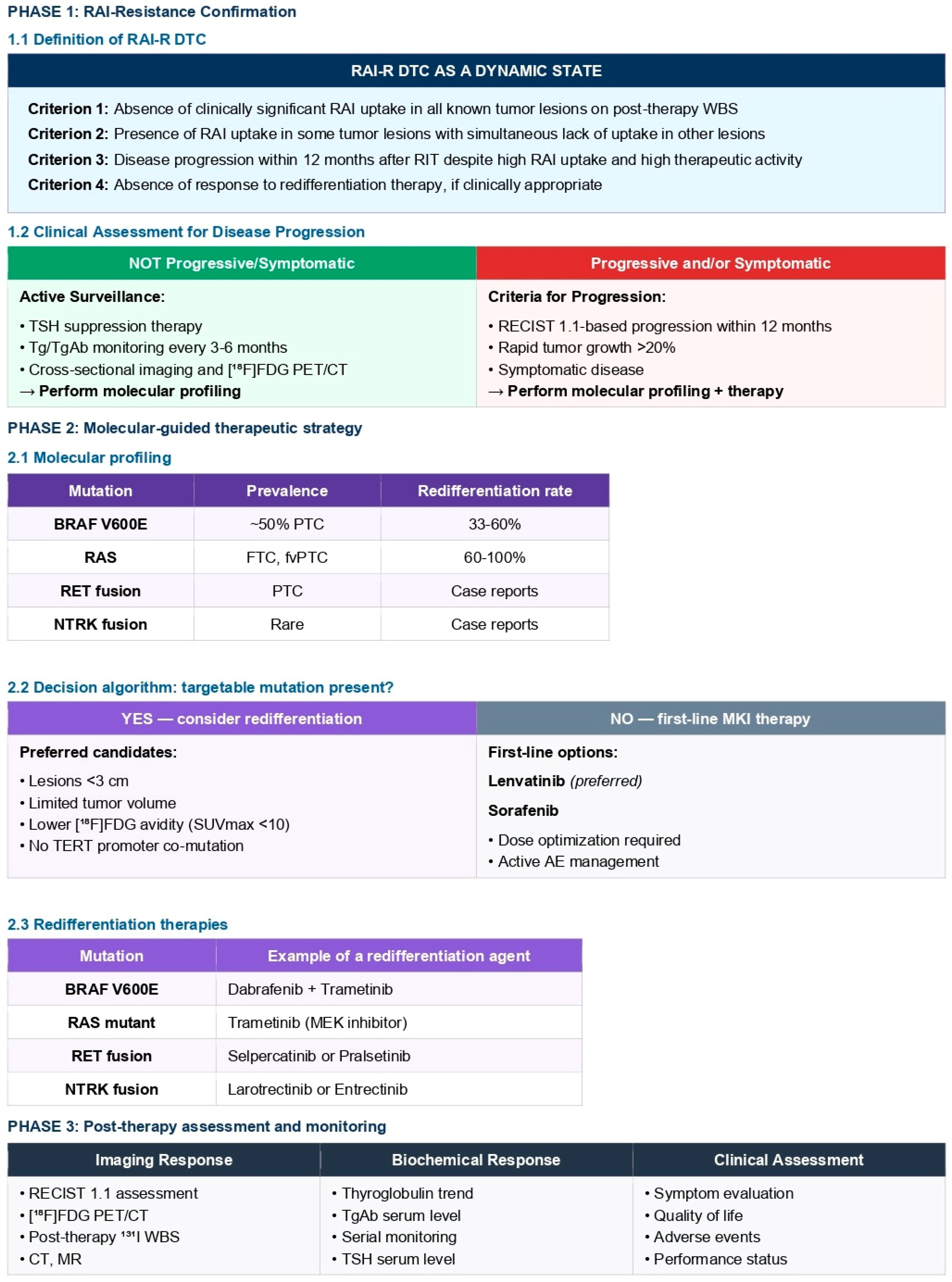
3. Definition of Radioiodine-Refractory Differentiated Thyroid Cancer
4. Molecularly Targeted Therapies in Radioiodine-Refractory DTC
5. Redifferentiation Strategies and Radioiodine Therapy
6. Non-Radioiodine Theranostics in Thyroid Cancer
6.1. Somatostatin-Receptor-Targeting Radiopharmaceuticals
6.2. PSMA-Targeting Radiopharmaceuticals
6.3. Fibroblast Activation Protein-Targeting Radiopharmaceuticals
6.4. Astatine-211
7. Discussion
8. Conclusions
Author Contributions
Funding
Institutional Review Board Statement
Informed Consent Statement
Data Availability Statement
Conflicts of Interest
References
- Avram, A.M.; Giovanella, L.; Greenspan, B.; Lawson, S.A.; Luster, M.; Van Nostrand, D.; Peacock, J.G.; Ovčariček, P.P.; Silberstein, E.; Tulchinsky, M.; et al. SNMMI Procedure Standard/EANM Practice Guideline for Nuclear Medicine Evaluation and Therapy of Differentiated Thyroid Cancer: Abbreviated Version. J. Nucl. Med. 2022, 63, 15N–35N. [Google Scholar]
- Giovanella, L.; Tuncel, M.; Aghaee, A.; Campenni, A.; De Virgilio, A.; Petranović Ovčariček, P. Theranostics of Thyroid Cancer. Semin. Nucl. Med. 2024, 54, 470–487. [Google Scholar] [CrossRef]
- Shi, K.; Zhang, X.; Sun, C.; Sun, Y.; Tian, T.; Huang, R. BRAF/MEK Inhibitors for Redifferentiation in Patients with Radioiodine Refractory Thyroid Cancer: A Systematic Review and Meta-Analysis. Endocrine 2026, 91, 121. [Google Scholar] [CrossRef] [PubMed]
- Giovanella, L.; Deandreis, D.; Vrachimis, A.; Campenni, A.; Ovcaricek, P.P. Molecular Imaging and Theragnostics of Thyroid Cancers. Cancers 2022, 14, 1272. [Google Scholar] [CrossRef] [PubMed]
- Boucai, L.; Zafereo, M.; Cabanillas, M.E. Thyroid Cancer: A Review. JAMA 2024, 331, 425–435. [Google Scholar] [CrossRef]
- Lin, Y.S.; Wang, R.F.; Huang, R.; Wen, Q.; Cao, W.; Chen, L.B.; Guo, Y.; Hou, X.R.; Li, L.; Li, X.Y.; et al. Chinese Management Guidelines for Radioactive Iodine-Refractory Differentiated Thyroid Cancer (2025 Edition). Eur. J. Nucl. Med. Mol. Imaging 2025, 52, 3859–3876. [Google Scholar] [CrossRef]
- Wadsley, J. Redifferentiation Therapy for Iodine Refractory Differentiated Thyroid Cancers: Current Status. Thyroid 2023, 33, 662–663. [Google Scholar] [CrossRef] [PubMed]
- Zeyghami, W.; Hansen, M.L.U.; Jakobsen, K.K.; Groenhøj, C.; Feldt-Rasmussen, U.; von Buchwald, C.; Hahn, C.H. Liquid Biopsies in Thyroid Cancers: A Systematic Review and Meta-Analysis. Endocr. Relat. Cancer 2023, 30, e230002. [Google Scholar] [CrossRef]
- Hamidi, S.; Hofmann, M.C.; Iyer, P.C.; Cabanillas, M.E.; Hu, M.I.; Busaidy, N.L.; Dadu, R. Review Article: New Treatments for Advanced Differentiated Thyroid Cancers and Potential Mechanisms of Drug Resistance. Front. Endocrinol. 2023, 14, 1176731. [Google Scholar] [CrossRef]
- Van Nostrand, D.; Veytsman, I.; Kulkarni, K.; Heimlich, L.; Burman, K.D. Redifferentiation of Differentiated Thyroid Cancer: Clinical Insights from a Narrative Review of Literature. Thyroid 2023, 33, 674–681. [Google Scholar] [CrossRef]
- Lorusso, L.; Cappagli, V.; Valerio, L.; Giani, C.; Viola, D.; Puleo, L.; Gambale, C.; Minaldi, E.; Campopiano, M.C.; Matrone, A.; et al. Thyroid Cancers: From Surgery to Current and Future Systemic Therapies through Their Molecular Identities. Int. J. Mol. Sci. 2021, 22, 3117. [Google Scholar] [CrossRef]
- Babu, G.; Kainickal, C.T. Update on the Systemic Management of Radioactive Iodine Refractory Differentiated Thyroid Cancer (Review). Mol. Clin. Oncol. 2021, 14, 35. [Google Scholar] [CrossRef]
- Ha, L.N.; Iravani, A.; Nhung, N.T.; Hanh, N.T.M.; Hutomo, F.; Son, M.H. Relationship between Clinicopathologic Factors and FDG Avidity in Radioiodine-Negative Recurrent or Metastatic Differentiated Thyroid Carcinoma. Cancer Imaging 2021, 21, 8. [Google Scholar] [CrossRef]
- Petranović Ovčariček, P.; de Keizer, B.; Campennì, A.; Kreissl, M.C.; Deandreis, D.; Tuncel, M.; Giovanella, L. Radioiodine-Refractory Thyroid Cancer-Is It Time to Change the Definition in Light of Novel Redifferentiation Therapies? Eur. J. Nucl. Med. Mol. Imaging 2025, 52, 380–385. [Google Scholar] [CrossRef] [PubMed]
- Petranović Ovčariček, P.; Campenni, A.; de Keizer, B.; Deandreis, D.; Kreissl, M.C.; Vrachimis, A.; Tuncel, M.; Giovanella, L. Molecular Theranostics in Radioiodine-Refractory Differentiated Thyroid Cancer. Cancers 2023, 15, 4290. [Google Scholar] [CrossRef] [PubMed]
- Michael Tuttle, R.; Ahuja, S.; Avram, A.M.; Bernet, V.J.; Bourguet, P.; Daniels, G.H.; Dillehay, G.; Draganescu, C.; Flux, G.; Führer, D.; et al. Controversies, Consensus, and Collaboration in the Use of 131I Therapy in Differentiated Thyroid Cancer: A Joint Statement from the American Thyroid Association, the European Association of Nuclear Medicine, the Society of Nuclear Medicine and Molecular Imaging, and the European Thyroid Association. Thyroid 2019, 29, 461–470. [Google Scholar] [CrossRef]
- Schlumberger, M.; Brose, M.; Elisei, R.; Leboulleux, S.; Luster, M.; Pitoia, F.; Pacini, F. Definition and Management of Radioactive Iodine-Refractory Differentiated Thyroid Cancer. Lancet Diabetes Endocrinol. 2014, 2, 356–358. [Google Scholar] [CrossRef]
- Sacks, W.; Braunstein, G.D. Evolving Approaches in Managing Radioactive Iodine-Refractory Differentiated Thyroid Cancer. Endocr. Pract. 2014, 20, 263–275. [Google Scholar] [CrossRef]
- Giovanella, L.; Van Nostrand, D. Advanced Differentiated Thyroid Cancer: When to Stop Radioiodine? Q. J. Nucl. Med. Mol. Imaging 2019, 63, 267–270. [Google Scholar] [CrossRef]
- Kist, J.W.; De Keizer, B.; Van Der Vlies, M.; Brouwers, A.H.; Huysmans, D.A.; Van Der Zant, F.M.; Hermsen, R.; Stokkel, M.P.M.; Hoekstra, O.S.; Vogel, W.V.; et al. 124I PET/CT to Predict the Outcome of Blind 131I Treatment in Patients with Biochemical Recurrence of Differentiated Thyroid Cancer: Results of a Multicenter Diagnostic Cohort Study (THYROPET). J. Nucl. Med. 2016, 57, 701–707. [Google Scholar] [CrossRef]
- Petranović Ovčariček, P.; Tuncel, M.; Aghaee, A.; Campennì, A.; Giovanella, L. Redifferentiation Therapies in Thyroid Oncology: Molecular and Clinical Aspects. J. Clin. Med. 2024, 13, 7021. [Google Scholar] [CrossRef]
- Van Nostrand, D. Radioiodine Refractory Differentiated Thyroid Cancer: Time to Update the Classifications. Thyroid 2018, 28, 1083–1093. [Google Scholar] [CrossRef]
- Haugen, B.R.; Alexander, E.K.; Bible, K.C.; Doherty, G.M.; Mandel, S.J.; Nikiforov, Y.E.; Pacini, F.; Randolph, G.W.; Sawka, A.M.; Schlumberger, M.; et al. 2015 American Thyroid Association Management Guidelines for Adult Patients with Thyroid Nodules and Differentiated Thyroid Cancer: The American Thyroid Association Guidelines Task Force on Thyroid Nodules and Differentiated Thyroid Cancer. Thyroid 2016, 26, 1–133. [Google Scholar] [CrossRef]
- Ringel, M.D.; Sosa, J.A.; Baloch, Z.; Bischoff, L.; Bloom, G.; Brent, G.A.; Brock, P.L.; Chou, R.; Flavell, R.R.; Goldner, W.; et al. 2025 American Thyroid Association Management Guidelines for Adult Patients with Differentiated Thyroid Cancer. Thyroid 2025, 35, 841–985. [Google Scholar] [CrossRef] [PubMed]
- Aashiq, M.; Silverman, D.A.; Na’ara, S.; Takahashi, H.; Amit, M. Radioiodine-Refractory Thyroid Cancer: Molecular Basis of Redifferentiation Therapies, Management, and Novel Therapies. Cancers 2019, 11, 1382. [Google Scholar] [CrossRef]
- Landa, I.; Pozdeyev, N.; Korch, C.; Marlow, L.A.; Smallridge, R.C.; Copland, J.A.; Henderson, Y.C.; Lai, S.Y.; Clayman, G.L.; Onoda, N.; et al. Comprehensive Genetic Characterization of Human Thyroid Cancer Cell Lines: A Validated Panel for Preclinical Studies. Clin. Cancer Res. 2019, 25, 3141–3151. [Google Scholar] [CrossRef]
- Jin, Y.; Van Nostrand, D.; Cheng, L.; Liu, M.; Chen, L. Radioiodine Refractory Differentiated Thyroid Cancer. Crit. Rev. Oncol. Hematol. 2018, 125, 111–120. [Google Scholar] [CrossRef] [PubMed]
- Buffet, C.; Wassermann, J.; Hecht, F.; Leenhardt, L.; Dupuy, C.; Groussin, L.; Lussey-Lepoutre, C. Redifferentiation of Radioiodine-Refractory Thyroid Cancers. Endocr. Relat. Cancer 2020, 27, R113–R132. [Google Scholar] [CrossRef]
- Volpe, F.; Nappi, C.; Zampella, E.; Donna, E.D.; Maurea, S.; Cuocolo, A.; Klain, M. Current Advances in Radioactive Iodine-Refractory Differentiated Thyroid Cancer. Curr. Oncol. 2024, 31, 3870–3884. [Google Scholar] [CrossRef] [PubMed]
- Hiromasa, T.; Wakabayashi, H.; Watanabe, S.; Yamase, T.; Kinuya, S. Enhancing Radioactive Iodine (RAI) Incorporation in RAI-Refractory Differentiated Thyroid Cancer: Current Insights. Eur. Thyroid J. 2025, 14, e240319. [Google Scholar] [CrossRef]
- Kebebew, E.; Weng, J.; Bauer, J.; Ranvier, G.; Clark, O.H.; Duh, Q.Y.; Shibru, D.; Bastian, B.; Griffin, A. The Prevalence and Prognostic Value of BRAF Mutation in Thyroid Cancer. Ann. Surg. 2007, 246, 466–470. [Google Scholar] [CrossRef] [PubMed]
- Deandreis, D.; Ovčariček, P.P.; Campenni, A.; Vrachimis, A.; Giovanella, L. A Spotlight on Redifferentiation Strategies and Target Modulation in Differentiated Thyroid Cancer. Clin. Transl. Imaging 2021, 9, 405–408. [Google Scholar] [CrossRef]
- Liu, J.; Liu, R.; Shen, X.; Zhu, G.; Li, B.; Xing, M. The Genetic Duet of BRAF V600E and TERT Promoter Mutations Robustly Predicts Loss of Radioiodine Avidity in Recurrent Papillary Thyroid Cancer. J. Nucl. Med. 2020, 61, 177–182. [Google Scholar] [CrossRef]
- Fugazzola, L.; Elisei, R.; Fuhrer, D.; Jarzab, B.; Leboulleux, S.; Newbold, K.; Smit, J. 2019 European Thyroid Association Guidelines for the Treatment and Follow-Up of Advanced Radioiodine-Refractory Thyroid Cancer. Eur. Thyroid J. 2019, 8, 227–245. [Google Scholar] [CrossRef]
- Fagin, J.A.; Wells, S.A. Biologic and Clinical Perspectives on Thyroid Cancer. N. Engl. J. Med. 2016, 375, 1054–1067. [Google Scholar] [CrossRef]
- Lamartina, L.; Anizan, N.; Dupuy, C.; Leboulleux, S.; Schlumberger, M. Redifferentiation-Facilitated Radioiodine Therapy in Thyroid Cancer. Endocr. Relat. Cancer 2021, 28, T179–T191. [Google Scholar] [CrossRef]
- Toro-Tobon, D.; Morris, J.C.; Hilger, C.; Peskey, C.; Durski, J.M.; Ryder, M. Clinical Outcomes of Radioactive Iodine Redifferentiation Therapy in Previously Iodine Refractory Differentiated Thyroid Cancers. Thyroid 2024, 34, 70–81. [Google Scholar] [CrossRef]
- Leboulleux, S.; Dupuy, C.; Lacroix, L.; Attard, M.; Grimaldi, S.; Corre, R.; Ricard, M.; Nasr, S.; Berdelou, A.; Hadoux, J.; et al. Redifferentiation of a BRAFK601E-Mutated Poorly Differentiated Thyroid Cancer Patient with Dabrafenib and Trametinib Treatment. Thyroid 2019, 29, 735–742. [Google Scholar] [CrossRef] [PubMed]
- Leboulleux, S.; Benisvy, D.; Taieb, D.; Attard, M.; Bournaud, C.; Terroir-Cassou-Mounat, M.; Lacroix, L.; Anizan, N.; Schiazza, A.; Garcia, M.E.; et al. MERAIODE: A Phase II Redifferentiation Trial with Trametinib and 131I in Metastatic Radioactive Iodine Refractory RAS Mutated Differentiated Thyroid Cancer. Thyroid 2023, 33, 1124–1129. [Google Scholar] [CrossRef] [PubMed]
- Leboulleux, S.; Do Cao, C.; Zerdoud, S.; Attard, M.; Bournaud, C.; Lacroix, L.; Benisvy, D.; Taïeb, D.; Bardet, S.; Terroir-Cassou-Mounat, M.; et al. A Phase II Redifferentiation Trial with Dabrafenib-Trametinib and 131I in Metastatic Radioactive Iodine Refractory BRAF p.V600E-Mutated Differentiated Thyroid Cancer. Clin. Cancer Res. 2023, 29, 2401–2409. [Google Scholar] [CrossRef]
- Weber, M.; Kersting, D.; Riemann, B.; Brandenburg, T.; Führer-Sakel, D.; Grünwald, F.; Kreissl, M.C.; Dralle, H.; Weber, F.; Schmid, K.W.; et al. Enhancing Radioiodine Incorporation into Radioiodine-Refractory Thyroid Cancer with MAPK Inhibition (ERRITI): A Single-Center Prospective Two-Arm Study. Clin. Cancer Res. 2022, 28, 4194–4202. [Google Scholar] [CrossRef] [PubMed]
- Ho, A.L.; Grewal, R.K.; Leboeuf, R.; Sherman, E.J.; Pfister, D.G.; Deandreis, D.; Pentlow, K.S.; Zanzonico, P.B.; Haque, S.; Gavane, S.; et al. Selumetinib-Enhanced Radioiodine Uptake in Advanced Thyroid Cancer. N. Engl. J. Med. 2013, 368, 623–632. [Google Scholar] [CrossRef]
- Gomes, F.F.; Montali da Assumpção, L.V.; Etchebehere, E.C.D.S.C.; Zantut-Wittmann, D.E. Characterization of the Patient Profile and Efficacy of Empirical Radioiodine Therapy in Differentiated Thyroid Cancer with Biochemical Evidence without Identified Iodine-Avid Structural Metastatic Disease. Endocr. Connect. 2026, 15, e250712. [Google Scholar] [CrossRef] [PubMed]
- Taprogge, J.; Abreu, C.; Yusuf, S.; Ainsworth, G.; Phillip, R.H.; Gear, J.I.; Gregory, R.; Leek, F.; Murray, I.; Coulson, A.B.; et al. The Role of Pretherapy Quantitative Imaging and Dosimetry in Radioiodine Therapy for Advanced Thyroid Cancer. J. Nucl. Med. 2023, 64, 1125–1130. [Google Scholar] [CrossRef]
- Schlumberger, M.; Tahara, M.; Wirth, L.J.; Robinson, B.; Brose, M.S.; Elisei, R.; Habra, M.A.; Newbold, K.; Shah, M.H.; Hoff, A.O.; et al. Lenvatinib versus Placebo in Radioiodine-Refractory Thyroid Cancer. N. Engl. J. Med. 2015, 372, 621–630. [Google Scholar] [CrossRef] [PubMed]
- Cabanillas, M.E.; McFadden, D.G.; Durante, C. Thyroid Cancer. Lancet 2016, 388, 2783–2795. [Google Scholar] [CrossRef]
- Kiyota, N.; Robinson, B.; Shah, M.; Hoff, A.O.; Taylor, M.H.; Li, D.; Dutcus, C.E.; Lee, E.K.; Kim, S.-B.; Tahara, M. Defining Radioiodine-Refractory Differentiated Thyroid Cancer: Efficacy and Safety of Lenvatinib by Radioiodine-Refractory Criteria in the SELECT Trial. Thyroid 2017, 27, 1135. [Google Scholar] [CrossRef]
- Suzuki, C.; Kiyota, N.; Imamura, Y.; Goto, H.; Suto, H.; Chayahara, N.; Toyoda, M.; Ito, Y.; Miya, A.; Miyauchi, A.; et al. Exploratory Analysis to Predict Optimal Tumor Burden for Starting Lenvatinib in Patients with Radioiodine-Refractory Differentiated Thyroid Cancer. Front. Oncol. 2021, 11, 638123. [Google Scholar] [CrossRef]
- Brose, M.S.; Worden, F.P.; Newbold, K.L.; Guo, M.; Hurria, A. Effect of Age on the Efficacy and Safety of Lenvatinib in Radioiodine-Refractory Differentiated Thyroid Cancer in the Phase III SELECT Trial. J. Clin. Oncol. 2017, 35, 2692–2699. [Google Scholar] [CrossRef]
- Brose, M.S.; Nutting, C.M.; Jarzab, B.; Elisei, R.; Siena, S.; Bastholt, L.; De La Fouchardiere, C.; Pacini, F.; Paschke, R.; Shong, Y.K.; et al. Sorafenib in Radioactive Iodine-Refractory, Locally Advanced or Metastatic Differentiated Thyroid Cancer: A Randomised, Double-Blind, Phase 3 Trial. Lancet 2014, 384, 319–328. [Google Scholar] [CrossRef]
- Subbiah, V.; Cabanillas, M.E.; Kreitman, R.J.; Wainberg, Z.A.; Cho, J.Y.; Keam, B.; Schellens, J.H.M.; Soria, J.C.; Wen, P.Y.; Zielinski, C.; et al. Dabrafenib and Trametinib Treatment in Patients with Locally Advanced or Metastatic BRAF V600-Mutant Anaplastic Thyroid Cancer. J. Clin. Oncol. 2018, 36, 7–13. [Google Scholar] [CrossRef]
- Wirth, L.J.; Sherman, E.; Robinson, B.; Solomon, B.; Kang, H.; Lorch, J.; Worden, F.; Brose, M.; Patel, J.; Leboulleux, S.; et al. Efficacy of Selpercatinib in RET-Altered Thyroid Cancers. N. Engl. J. Med. 2020, 383, 825–835. [Google Scholar] [CrossRef] [PubMed]
- Drilon, A.; Laetsch, T.W.; Kummar, S.; DuBois, S.G.; Lassen, U.N.; Demetri, G.D.; Nathenson, M.; Doebele, R.C.; Farago, A.F.; Pappo, A.S.; et al. Efficacy of Larotrectinib in TRK Fusion-Positive Cancers in Adults and Children. N. Engl. J. Med. 2018, 378, 731–739. [Google Scholar] [CrossRef]
- Bible, K.C.; Kebebew, E.; Brierley, J.; Brito, J.P.; Cabanillas, M.E.; Clark, T.J.; Di Cristofano, A.; Foote, R.; Giordano, T.; Kasperbauer, J.; et al. 2021 American Thyroid Association Guidelines for Management of Patients with Anaplastic Thyroid Cancer. Thyroid 2021, 31, 337–386. [Google Scholar] [CrossRef]
- Dunn, L.A.; Sherman, E.J.; Baxi, S.S.; Tchekmedyian, V.; Grewal, R.K.; Larson, S.M.; Pentlow, K.S.; Haque, S.; Tuttle, R.M.; Sabra, M.M.; et al. Vemurafenib Redifferentiation of BRAF Mutant, Rai-Refractory Thyroid Cancers. J. Clin. Endocrinol. Metab. 2019, 104, 1417–1428. [Google Scholar] [CrossRef]
- Brose, M.S.; Robinson, B.; Sherman, S.I.; Krajewska, J.; Lin, C.C.; Vaisman, F.; Hoff, A.O.; Hitre, E.; Bowles, D.W.; Hernando, J.; et al. Cabozantinib for Radioiodine-Refractory Differentiated Thyroid Cancer (COSMIC-311): A Randomised, Double-Blind, Placebo-Controlled, Phase 3 Trial. Lancet Oncol. 2021, 22, 1126–1138. [Google Scholar] [CrossRef]
- Lin, Y.; Qin, S.; Yang, H.; Shi, F.; Yang, A.; Han, X.; Liu, B.; Li, Z.; Ji, Q.; Tang, L.; et al. Multicenter Randomized Double-Blind Phase III Trial of Donafenib in Progressive Radioactive Iodine-Refractory Differentiated Thyroid Cancer. Clin. Cancer Res. 2023, 29, 2791–2799. [Google Scholar] [CrossRef]
- Lasolle, H.; Schiavo, A.; Tourneur, A.; Gillotay, P.; de Faria da Fonseca, B.; Ceolin, L.; Monestier, O.; Aganahi, B.; Chomette, L.; Kizys, M.M.L.; et al. Dual Targeting of MAPK and PI3K Pathways Unlocks Redifferentiation of Braf-Mutated Thyroid Cancer Organoids. Oncogene 2023, 43, 155–170. [Google Scholar] [CrossRef] [PubMed]
- Meng, C.; Song, J.; Long, W.; Mu, Z.; Sun, Y.; Liang, J.; Lin, Y. A User-Friendly Nomogram for Predicting Radioiodine Refractory Differentiated Thyroid Cancer. Front. Endocrinol. 2023, 14, 1109439. [Google Scholar] [CrossRef] [PubMed]
- Kersting, D.; Seifert, R.; Kessler, L.; Herrmann, K.; Theurer, S.; Brandenburg, T.; Dralle, H.; Weber, F.; Umutlu, L.; Führer-Sakel, D.; et al. Predictive Factors for RAI-Refractory Disease and Short Overall Survival in PDTC. Cancers 2021, 13, 1728. [Google Scholar] [CrossRef]
- Shen, H.; Zhu, R.; Liu, Y.; Hong, Y.; Ge, J.; Xuan, J.; Niu, W.; Yu, X.; Qin, J.J.; Li, Q. Radioiodine-Refractory Differentiated Thyroid Cancer: Molecular Mechanisms and Therapeutic Strategies for Radioiodine Resistance. Drug Resist. Updates 2024, 72, 101013. [Google Scholar] [CrossRef]
- Leboulleux, S.; Boucai, L.; Busaidy, N.; Durante, C.; Fagin, J.A.; Fazeli, S.; Gianoukakis, A.G.; Haugen, B.R.; Kang, H.; Konda, B.; et al. Redifferentiation Therapy in Unresectable or Metastatic Radioactive Iodine Refractory Thyroid Cancer: An International Thyroid Oncology Group Statement. Lancet Diabetes Endocrinol. 2025, 13, 516–527. [Google Scholar] [CrossRef]
- von Hinten, J.; Viering, O.; Bundschuh, R.A.; Cagliyan, F.; Wengenmair, H.; Pfob, C.H.; Nagarajah, J.; Lapa, C.; Kircher, M. Feasibility of Short-Term Redifferentiation in Patients with Radioactive Iodine-Refractory Metastatic Thyroid Cancer. J. Nucl. Med. 2025, 66, 1192–1196. [Google Scholar] [CrossRef] [PubMed]
- Yaringaño, J.; Hernando, J.; García-Álvarez, A.; Iglesias-Felip, C.; Zafón, C.; Vivancos, A.; Roca-Herrera, M.; Pérez-Fernández, S.; Martínez-Badal, S.; Elguero, B.; et al. Case Report: Lorlatinib for the Treatment of ALK-Rearranged Poorly Differentiated Thyroid Carcinoma after Progression to Prior ALK-Specific Tyrosine-Kinase Inhibitor. Front. Oncol. 2026, 16, 1802225. [Google Scholar] [CrossRef]
- Minaldi, E.; Ramone, T.; Ciampi, R.; Romei, C.; Casalini, R.; Gambale, C.; Prete, A.; Lorusso, L.; Agate, L.; Torregrossa, L.; et al. Molecular Profile of Advanced Radioiodine-Refractory Thyroid Cancer and Response to Lenvatinib Treatment. J. Clin. Endocrinol. Metab. 2026, dgag074. [Google Scholar] [CrossRef] [PubMed]
- Dotinga, M.; de Geus-Oei, L.-F.; Dibbets-Schneider, P.; Stam, M.K.; Pool, M.; Pereira Arias-Bouda, L.M.; Kapiteijn, E.; Vriens, D.; van Velden, F.H.P. A Phantom Study to Achieve Comparable 124I PET Recovery and Address Scanner Variability for Dosimetry Purposes in (Re)Differentiated Thyroid Cancer. Phys. Med. 2026, 145, 105772. [Google Scholar] [CrossRef]
- Werner, R.A.; Sayehli, C.; Hänscheid, H.; Higuchi, T.; Serfling, S.E.; Fassnacht, M.; Goebeler, M.E.; Buck, A.K.; Kroiss, M. Successful Combination of Selpercatinib and Radioiodine after Pretherapeutic Dose Estimation in RET-Altered Thyroid Carcinoma. Eur. J. Nucl. Med. Mol. Imaging 2023, 50, 1833–1834. [Google Scholar] [CrossRef] [PubMed]
- Potter, S.L.; Rainusso, N.; Sher, A.C.; Quintanilla, N.M.; Chelius, D.C.; Dimachkieh, A.; Mahajan, P. Selpercatinib Increases Radioactive Iodine Avidity in RET-Fusion Pediatric Thyroid Carcinoma. Pediatrics 2025, 156, e2024070336. [Google Scholar] [CrossRef]
- Groussin, L.; Clerc, J.; Huillard, O. Larotrectinib-Enhanced Radioactive Iodine Uptake in Advanced Thyroid Cancer. N. Engl. J. Med. 2020, 383, 1686–1687. [Google Scholar] [CrossRef]
- Groussin, L.; Theodon, H.; Bessiene, L.; Bricaire, L.; Bonnet-Serrano, F.; Cochand-Priollet, B.; Leroy, K.; Garinet, S.; Pasmant, E.; Zerbit, J.; et al. Redifferentiating Effect of Larotrectinib in NTRK-Rearranged Advanced Radioactive-Iodine Refractory Thyroid Cancer. Thyroid 2022, 32, 594–598. [Google Scholar] [CrossRef]
- Castellanos, L.E.; Yedururi, S.; Waguespack, S.G. Redifferentiation Effect of Larotrectinib for NTRK Fusion-Positive Pediatric Thyroid Cancer and Outcomes After Therapy. J. Endocr. Soc. 2025, 9, bvaf098. [Google Scholar] [CrossRef]
- Cabanillas, M.E.; Busaidy, N.L.; Sherman, S.I. Redifferentiation Therapy-Returning to Our Roots in a Post-Kinase Inhibitor World. Clin. Cancer Res. 2022, 28, 4164–4166. [Google Scholar] [CrossRef]
- Gulec, S.A.; Benites, C.; Cabanillas, M.E. Molecular Perspectives in Radioactive Iodine Theranostics: Current Redifferentiation Protocols for Mis-Differentiated Thyroid Cancer. J. Clin. Med. 2024, 13, 3645. [Google Scholar] [CrossRef]
- Leboulleux, S.; Benisvy, D.; Taieb, D.; Attard, M.; Bournaud, C.; Terroir, M.; Al Ghuzlan, A.; Lamartina, L.; Schlumberger, M.J.; Godbert, Y.; et al. 1743MO MERAIODE: A Redifferentiation Phase II Trial with Trametinib Followed by Radioactive Iodine for Metastatic Radioactive Iodine Refractory Differentiated Thyroid Cancer Patients with a RAS Mutation. Ann. Oncol. 2021, 32, S1204. [Google Scholar] [CrossRef]
- Leboulleux, S.; Cao, C.D.; Zerdoud, S.; Attard, M.; Bournaud, C.; Benisvy, D.; Taieb, D.; Bardet, S.; Terroir-Cassou-Mounat, M.; Betrian, S.; et al. MERAIODE: A Redifferentiation Phase II Trial with Trametinib and Dabrafenib Followed by Radioactive Iodine Administration for Metastatic Radioactive Iodine Refractory Differentiated Thyroid Cancer Patients with a BRAFV600E Mutation (NCT 03244956). J. Endocr. Soc. 2021, 5, A876. [Google Scholar] [CrossRef]
- Rothenberg, S.M.; Daniels, G.H.; Wirth, L.J. Redifferentiation of Iodine-Refractory BRAF V600E-Mutant Metastatic Papillary Thyroid Cancer with Dabrafenib-Response. Clin. Cancer Res. 2015, 21, 5640–5641. [Google Scholar] [CrossRef]
- Jaber, T.; Waguespack, S.G.; Cabanillas, M.E.; Elbanan, M.; Vu, T.; Dadu, R.; Sherman, S.I.; Amit, M.; Santos, E.B.; Zafereo, M.; et al. Targeted Therapy in Advanced Thyroid Cancer to Resensitize Tumors to Radioactive Iodine. J. Clin. Endocrinol. Metab. 2018, 103, 3698–3705. [Google Scholar] [CrossRef] [PubMed]
- Burman, B.; Tuttle, R.M.; Grewal, R.K.; Sherman, E.J.; Baxi, S.S.; Boucai, L.; Sabra, M.; Fish, S.; Pentlow, K.S.; Haque, S.; et al. Phase 2 of Trametinib plus Radioiodine in RAS-Mutant and Wild-Type, Radioiodine-Refractory Thyroid Cancer (ETCTN9446). J. Clin. Oncol. 2022, 40, 6089. [Google Scholar] [CrossRef]
- Chan, H.P.; Chen, I.F.; Tsai, F.R.; Kao, C.H.; Shen, D.H.Y. Reversing “Flip-Flop” Phenomenon of 131 I and Glucose Avidity in RET-Fusion Positive Radioiodine-Refractory Thyroid Cancer Lesions After Treatment of Pralsetinib. Clin. Nucl. Med. 2023, 48, E147–E148. [Google Scholar] [CrossRef]
- Lee, Y.A.; Lee, H.; Im, S.-W.; Song, Y.S.; Oh, D.-Y.; Kang, H.J.; Won, J.-K.; Jung, K.C.; Kwon, D.; Chung, E.-J.; et al. NTRK and RET Fusion–Directed Therapy in Pediatric Thyroid Cancer Yields a Tumor Response and Radioiodine Uptake. J. Clin. Investig. 2021, 131, e144847. [Google Scholar] [CrossRef] [PubMed]
- Iravani, A.; Solomon, B.; Pattison, D.A.; Jackson, P.; Ravi Kumar, A.; Kong, G.; Hofman, M.S.; Akhurst, T.; Hicks, R.J. Mitogen-Activated Protein Kinase Pathway Inhibition for Redifferentiation of Radioiodine Refractory Differentiated Thyroid Cancer: An Evolving Protocol. Thyroid 2019, 29, 1634–1645. [Google Scholar] [CrossRef] [PubMed]
- Arawker, M.H.; Habibullah, F.; Fu, L.; Baral, S.; Qiu, X. Theranostic and Radionuclide-Based Treatment Approaches for Radioiodine-Refractory Thyroid Cancer: From Biology to Clinical Application. Mol. Imaging Biol. 2026, 28, 212–226. [Google Scholar] [CrossRef]
- Bozkurt, M.F.; Virgolini, I.; Balogova, S.; Beheshti, M.; Rubello, D.; Decristoforo, C.; Ambrosini, V.; Kjaer, A.; Delgado-Bolton, R.; Kunikowska, J.; et al. Guideline for PET/CT Imaging of Neuroendocrine Neoplasms with 68Ga-DOTA-Conjugated Somatostatin Receptor Targeting Peptides and 18F–DOPA. Eur. J. Nucl. Med. Mol. Imaging 2017, 44, 1588–1601. [Google Scholar] [CrossRef]
- Almeida, L.S.; Araújo, M.C.; Zantut-Wittmann, D.E.; Assumpção, L.V.; Souza, T.F.; Silva, C.M.; Argenton, J.L.; Santos, A.O.; Mengatti, J.; Ramos, C.D.; et al. Effect of Thyroid-Stimulating Hormone in 68Ga-DOTATATE PET/CT of Radioiodine-Refractory Thyroid Carcinoma: A Pilot Study. Nucl. Med. Commun. 2018, 39, 441–450. [Google Scholar] [CrossRef]
- Parihar, A.S.; Mittal, B.R.; Kumar, R.; Shukla, J.; Bhattacharya, A. 68Ga-DOTA-RGD2 Positron Emission Tomography/Computed Tomography in Radioiodine Refractory Thyroid Cancer: Prospective Comparison of Diagnostic Accuracy with 18F-FDG Positron Emission Tomography/Computed Tomography and Evaluation Toward Potential Theranostics. Thyroid 2020, 30, 557–567. [Google Scholar] [CrossRef]
- Ocak, M.; Demirci, E.; Kabasakal, L.; Aygun, A.; Tutar, R.O.; Araman, A.; Kanmaz, B. Evaluation and Comparison of Ga-68 DOTA-TATE and Ga-68 DOTA-NOC PET/CT Imaging in Well-Differentiated Thyroid Cancer. Nucl. Med. Commun. 2013, 34, 1084–1089. [Google Scholar] [CrossRef]
- Watanabe, S.; Hirata, K.; Takenaka, J.; Munakata, Y.; Magota, K.; Wakabayashi, N.; Koga, H.; Kudo, K. Somatostatin Receptor Expression for Peptide Receptor Radionuclide Therapy in Japanese Patients with Recurrent or Metastatic Differentiated Thyroid Cancer. Ann. Nucl. Med. 2026, 40, 539–551. [Google Scholar] [CrossRef]
- Enke, J.S.; Bundschuh, R.A.; Wienand, G.; Reitsam, N.G.; Kircher, M.; Pfob, C.H.; Lapa, C.; Dierks, A. Somatostatin Receptor Antagonists as a Theranostic Option in Iodine-Refractory Thyroid Carcinoma. J. Nucl. Med. 2023, 64, 2001. [Google Scholar] [CrossRef]
- Versari, A.; Sollini, M.; Frasoldati, A.; Fraternali, A.; Filice, A.; Froio, A.; Asti, M.; Fioroni, F.; Cremonini, N.; Putzer, D.; et al. Differentiated Thyroid Cancer: A New Perspective with Radiolabeled Somatostatin Analogues for Imaging and Treatment of Patients. Thyroid 2014, 24, 715–726. [Google Scholar] [CrossRef] [PubMed]
- Maghsoomi, Z.; Emami, Z.; Malboosbaf, R.; Malek, M.; Khamseh, M.E. Efficacy and Safety of Peptide Receptor Radionuclide Therapy in Advanced Radioiodine-Refractory Differentiated Thyroid Cancer and Metastatic Medullary Thyroid Cancer: A Systematic Review. BMC Cancer 2021, 21, 579. [Google Scholar] [CrossRef] [PubMed]
- Lee, D.Y.; Kim, Y. Il Peptide Receptor Radionuclide Therapy in Patients with Differentiated Thyroid Cancer: A Meta-Analysis. Clin. Nucl. Med. 2020, 45, 604–610. [Google Scholar] [CrossRef]
- Israeli, R.S.; Powell, C.T.; Fair, W.R.; Heston, W.D.W. Molecular Cloning of a Complementary DNA Encoding a Prostate-Specific Membrane Antigen. Cancer Res. 1993, 53, 227–230. [Google Scholar]
- Ciappuccini, R.; Saguet-Rysanek, V.; Giffard, F.; Licaj, I.; Dorbeau, M.; Clarisse, B.; Poulain, L.; Bardet, S. PSMA Expression in Differentiated Thyroid Cancer: Association with Radioiodine, 18FDG Uptake, and Patient Outcome. J. Clin. Endocrinol. Metab. 2021, 106, 3536–3545. [Google Scholar] [CrossRef]
- Heitkötter, B.; Steinestel, K.; Trautmann, M.; Grünewald, I.; Barth, P.; Gevensleben, H.; Bögemann, M.; Wardelmann, E.; Hartmann, W.; Rahbar, K.; et al. Neovascular PSMA Expression Is a Common Feature in Malignant Neoplasms of the Thyroid. Oncotarget 2018, 9, 9867–9874. [Google Scholar] [CrossRef]
- Verma, P.; Malhotra, G.; Meshram, V.; Chandak, A.; Sonavane, S.; Lila, A.R.; Bandgar, T.R.; Asopa, R.V. Prostate-Specific Membrane Antigen Expression in Patients with Differentiated Thyroid Cancer with Thyroglobulin Elevation and Negative Iodine Scintigraphy Using 68Ga-PSMA-HBED-CC PET/CT. Clin. Nucl. Med. 2021, 46, E406–E409. [Google Scholar] [CrossRef]
- Damle, N.A.; Bal, C.; Singh, T.P.; Gupta, R.; Reddy, S.; Kumar, R.; Tripathi, M. Anaplastic Thyroid Carcinoma on 68 Ga-PSMA PET/CT: Opening New Frontiers. Eur. J. Nucl. Med. Mol. Imaging 2018, 45, 667–668. [Google Scholar] [CrossRef]
- Sollini, M.; di Tommaso, L.; Kirienko, M.; Piombo, C.; Erreni, M.; Lania, A.G.; Erba, P.A.; Antunovic, L.; Chiti, A. PSMA Expression Level Predicts Differentiated Thyroid Cancer Aggressiveness and Patient Outcome. EJNMMI Res. 2019, 9, 93. [Google Scholar] [CrossRef] [PubMed]
- Martiniova, L.; De Palatis, L.; Etchebehere, E.; Ravizzini, G. Gallium-68 in Medical Imaging. Curr. Radiopharm. 2016, 9, 187–207. [Google Scholar] [CrossRef] [PubMed]
- Sanchez-Crespo, A. Comparison of Gallium-68 and Fluorine-18 Imaging Characteristics in Positron Emission Tomography. Appl. Radiat. Isot. 2013, 76, 55–62. [Google Scholar] [CrossRef] [PubMed]
- Piron, S.; Verhoeven, J.; Vanhove, C.; De Vos, F. Recent Advancements in 18F-Labeled PSMA Targeting PET Radiopharmaceuticals. Nucl. Med. Biol. 2022, 106–107, 29–51. [Google Scholar] [CrossRef]
- Seifert, R.; Telli, T.; Opitz, M.; Barbato, F.; Berliner, C.; Nader, M.; Umutlu, L.; Stuschke, M.; Hadaschik, B.; Herrmann, K.; et al. Unspecific 18F-PSMA-1007 Bone Uptake Evaluated Through PSMA-11 PET, Bone Scanning, and MRI Triple Validation in Patients with Biochemical Recurrence of Prostate Cancer. J. Nucl. Med. 2023, 64, 738–743. [Google Scholar] [CrossRef]
- Grünig, H.; Maurer, A.; Thali, Y.; Kovacs, Z.; Strobel, K.; Burger, I.A.; Müller, J. Focal Unspecific Bone Uptake on [18F]-PSMA-1007 PET: A Multicenter Retrospective Evaluation of the Distribution, Frequency, and Quantitative Parameters of a Potential Pitfall in Prostate Cancer Imaging. Eur. J. Nucl. Med. Mol. Imaging 2021, 48, 4483–4494. [Google Scholar] [CrossRef] [PubMed]
- Rizzo, A.; Racca, M.; Dall’Armellina, S.; Delgado Bolton, R.C.; Albano, D.; Dondi, F.; Bertagna, F.; Annunziata, S.; Treglia, G. Potential Role of PSMA-Targeted PET in Thyroid Malignant Disease: A Systematic Review. Diagnostics 2023, 13, 564. [Google Scholar] [CrossRef] [PubMed]
- Van den Broeck, B.; Debacker, J.M.; Bauters, W.; Creytens, D.; Ferdinande, L.; Huvenne, W.; Lapauw, B.; Schelfhout, V.; Van Laeken, N.; Verroken, C. Potential Application of [18F]AlF-PSMA-11 PET/CT in Radioiodine Refractory Thyroid Carcinoma. EJNMMI Res. 2024, 14, 82. [Google Scholar] [CrossRef]
- Sonavane, S.; Salvi, O.; Asopa, R.V.; Basu, S. Assessing Krenning’s Score on 68 Ga-DOTATATE PET-CT and MiPSMA Score on 68 Ga-PSMA-11 PET-CT in TENIS: A Comparison with FDG PET/CT and Examining the Feasibility of Targeted Radionuclide Therapy. Nucl. Med. Commun. 2024, 45, 690–701. [Google Scholar] [CrossRef] [PubMed]
- de Vries, L.H.; Lodewijk, L.; Braat, A.J.A.T.; Krijger, G.C.; Valk, G.D.; Lam, M.G.E.H.; Borel Rinkes, I.H.M.; Vriens, M.R.; de Keizer, B. 68Ga-PSMA PET/CT in Radioactive Iodine-Refractory Differentiated Thyroid Cancer and First Treatment Results with 177Lu-PSMA-617. EJNMMI Res. 2020, 10, 18. [Google Scholar] [CrossRef]
- Wächter, S.; Di Fazio, P.; Maurer, E.; Manoharan, J.; Keber, C.; Pfestroff, A.; Librizzi, D.; Bartsch, D.K.; Luster, M.; Eilsberger, F. Prostate-Specific Membrane Antigen in Anaplastic and Poorly Differentiated Thyroid Cancer-A New Diagnostic and Therapeutic Target? Cancers 2021, 13, 5688. [Google Scholar] [CrossRef]
- Sartor, O.; de Bono, J.; Chi, K.N.; Fizazi, K.; Herrmann, K.; Rahbar, K.; Tagawa, S.T.; Nordquist, L.T.; Vaishampayan, N.; El-Haddad, G.; et al. Lutetium-177–PSMA-617 for Metastatic Castration-Resistant Prostate Cancer. N. Engl. J. Med. 2021, 385, 1091–1103. [Google Scholar] [CrossRef]
- Petranović Ovčariček, P.; Garo, M.L.; Giovanella, L. PSMA-Targeted Radioligand Therapy in Metastatic Prostate Cancer: Comprehensive Analysis of Recent Evidence. Eur. J. Nucl. Med. Mol. Imaging 2025, 52, 1242–1245. [Google Scholar] [CrossRef]
- Sakulpisuti, C.; Charoenphun, P.; Chamroonrat, W. Positron Emission Tomography Radiopharmaceuticals in Differentiated Thyroid Cancer. Molecules 2022, 27, 4936. [Google Scholar] [CrossRef]
- Fu, H.; Huang, J.; Sun, L.; Wu, H.; Chen, H. FAP-Targeted Radionuclide Therapy of Advanced Radioiodine-Refractory Differentiated Thyroid Cancer with Multiple Cycles of 177 Lu-FAPI-46. Clin. Nucl. Med. 2022, 47, 906–907. [Google Scholar] [CrossRef]
- Dendl, K.; Koerber, S.A.; Kratochwil, C.; Cardinale, J.; Finck, R.; Dabir, M.; Novruzov, E.; Watabe, T.; Kramer, V.; Choyke, P.L.; et al. FAP and FAPI-PET/CT in Malignant and Non-Malignant Diseases: A Perfect Symbiosis? Cancers 2021, 13, 4946. [Google Scholar] [CrossRef] [PubMed]
- Piscopo, L.; Volpe, F. PET/CT Imaging with Radiolabeled FAPI: New Opportunities for Diagnosis and Treatment of Thyroid Cancer. Eur. J. Nucl. Med. Mol. Imaging 2024, 51, 800–802. [Google Scholar] [CrossRef] [PubMed]
- Chen, Y.; Zheng, S.; Zhang, J.; Yao, S.; Miao, W. 68Ga-DOTA-FAPI-04 PET/CT Imaging in Radioiodine-Refractory Differentiated Thyroid Cancer (RR-DTC) Patients. Ann. Nucl. Med. 2022, 36, 610–622. [Google Scholar] [CrossRef]
- Fu, H.; Fu, J.; Huang, J.; Pang, Y.; Chen, H. 68Ga-FAPI PET/CT Versus 18F-FDG PET/CT for Detecting Metastatic Lesions in a Case of Radioiodine-Refractory Differentiated Thyroid Cancer. Clin. Nucl. Med. 2021, 46, 940–942. [Google Scholar] [CrossRef] [PubMed]
- Zheng, K.; Zhou, W.; Yang, J.; Zhang, Y.; Jiang, C.; Xie, A.; Peng, X.; Dai, J.; He, H.; Peng, X.; et al. [18F]AlF-NOTA-FAPI-04 PET/CT Improves Detection of Subcentimeter Recurrent Lesions in Differentiated Thyroid Cancer. Eur. J. Nucl. Med. Mol. Imaging 2025, 53, 398–407. [Google Scholar] [CrossRef]
- Nourbakhsh, S.; Salehi, Y.; Farzanehfar, S.; Ghaletaki, R.; Bakhshi Kashi, M.; Abbasi, M. FAPI PET/CT Provides Higher Uptake and Better Target to Back Ground in Recurrent and Metastatic Tumors of Patients with Iodine Refractory Papillary Thyroid Cancer Compared with FDG PET CT. Nuklearmedizin 2025, 64, 188–192. [Google Scholar] [CrossRef]
- Ballal, S.; Yadav, M.P.; Moon, E.S.; Roesch, F.; Kumari, S.; Agarwal, S.; Tripathi, M.; Sahoo, R.K.; Mangu, B.S.; Tupalli, A.; et al. Novel Fibroblast Activation Protein Inhibitor-Based Targeted Theranostics for Radioiodine-Refractory Differentiated Thyroid Cancer Patients: A Pilot Study. Thyroid 2022, 32, 65–77. [Google Scholar] [CrossRef]
- Tosato, M.; Favaretto, C.; Kleynhans, J.; Burgoyne, A.R.; Gestin, J.F.; van der Meulen, N.P.; Jalilian, A.; Köster, U.; Asti, M.; Radchenko, V. Alpha Atlas: Mapping Global Production of α-Emitting Radionuclides for Targeted Alpha Therapy. Nucl. Med. Biol. 2025, 142–143, 108990. [Google Scholar] [CrossRef]
- Watabe, T.; Kaneda-Nakashima, K.; Liu, Y.; Shirakami, Y.; Ooe, K.; Toyoshima, A.; Shimosegawa, E.; Fukuda, M.; Shinohara, A.; Hatazawa, J. Enhancement of 211At Uptake via the Sodium Iodide Symporter by the Addition of Ascorbic Acid in Targeted α-Therapy of Thyroid Cancer. J. Nucl. Med. 2019, 60, 1301–1307. [Google Scholar] [CrossRef]
- Watabe, T.; Hosono, M.; Kinuya, S.; Yamada, T.; Yanagida, S.; Namba, M.; Nakamura, Y. Manual on the Proper Use of Sodium Astatide ([211At]NaAt) Injections in Clinical Trials for Targeted Alpha Therapy (1st Edition). Ann. Nucl. Med. 2021, 35, 753–766. [Google Scholar] [CrossRef]
- Watabe, T.; Liu, Y.; Kaneda-Nakashima, K.; Sato, T.; Shirakami, Y.; Ooe, K.; Toyoshima, A.; Shimosegawa, E.; Wang, Y.; Haba, H.; et al. Comparison of the Therapeutic Effects of [211At]NaAt and [131I]NaI in an NIS-Expressing Thyroid Cancer Mouse Model. Int. J. Mol. Sci. 2022, 23, 9434. [Google Scholar] [CrossRef]
- Watabe, T.; Mukai, K.; Naka, S.; Sasaki, H.; Kamiya, T.; Hayakawa, T.; Fukuhara, A.; Takano, T.; Shirakami, Y.; Ooe, K.; et al. First-in-Human Study of [211At]NaAt as Targeted α-Therapy in Patients with Radioiodine-Refractory Thyroid Cancer (Alpha-T1 Trial). J. Nucl. Med. 2025, 66, 1941–1947. [Google Scholar] [CrossRef]
- Sathekge, M.M.; Lawal, I.O.; Bal, C.; Bruchertseifer, F.; Ballal, S.; Cardaci, G.; Davis, C.; Eiber, M.; Hekimsoy, T.; Knoesen, O.; et al. Actinium-225-PSMA Radioligand Therapy of Metastatic Castration-Resistant Prostate Cancer (WARMTH Act): A Multicentre, Retrospective Study. Lancet Oncol. 2024, 25, 175–183. [Google Scholar] [CrossRef]
- Higashi, T.; Nishii, R.; Yamada, S.; Nakamoto, Y.; Ishizu, K.; Kawase, S.; Togashi, K.; Itasaka, S.; Hiraoka, M.; Misaki, T.; et al. Delayed Initial Radioactive Iodine Therapy Resulted in Poor Survival in Patients with Metastatic Differentiated Thyroid Carcinoma: A Retrospective Statistical Analysis of 198 Cases. J. Nucl. Med. 2011, 52, 683–689. [Google Scholar] [CrossRef]
- Roth, E.M.; Lubitz, C.C.; Swan, J.S.; James, B.C. Patient-Reported Quality-of-Life Outcome Measures in the Thyroid Cancer Population. Thyroid 2020, 30, 1414. [Google Scholar] [CrossRef] [PubMed]
- Li, Y.; Wang, P.; Cao, J.; Liu, H. Multidisciplinary Team Diagnosis and Treatment of Well-Differentiated Thyroid Carcinoma: Current Landscape and Future Prospects. Oncologist 2026, 31, oyag017. [Google Scholar] [CrossRef] [PubMed]
- Giovanella, L.; Garo, M.L.; Campenní, A.; Petranović Ovčariček, P.; Görges, R. Thyroid Hormone Withdrawal versus Recombinant Human TSH as Preparation for I-131 Therapy in Patients with Metastatic Thyroid Cancer: A Systematic Review and Meta-Analysis. Cancers 2023, 15, 2510. [Google Scholar] [CrossRef]
- Filetti, S.; Durante, C.; Hartl, D.M.; Leboulleux, S.; Locati, L.D.; Newbold, K.; Papotti, M.G.; Berruti, A. ESMO Clinical Practice Guideline Update on the Use of Systemic Therapy in Advanced Thyroid Cancer. Ann. Oncol. 2022, 33, 674–684. [Google Scholar] [CrossRef] [PubMed]
- Mebarki, L.; Andre, E.; Subtil, F.; Bournaud, C.; Borson-Chazot, F.; Lifante, J.C.; Abeillon, J.; Castellnou, S.; Descotes, F.; Raverot, V.; et al. A Histo-Clinical Score to Predict Evolution to Radioactive Iodine-Refractory of the Follicular Cell-Derived Thyroid Carcinoma (PREDIRAIR): A Single-Centre, Prospective, Cohort Study. eClinicalMedicine 2026, 94, 103839. [Google Scholar] [CrossRef]
- Kappenstein, M.; Koehler, V.F.; Ninosu, N.; Koch, C.; Kreissl, M.C.; Bojunga, J.; Groener, D.; von Bubnoff, N. Real-World Efficacy and Safety of Lenvatinib and Sorafenib in Thyroid Cancer: A Retrospective, Propensity-Score-Matched Study. Thyroid 2026, 10507256261442836. [Google Scholar] [CrossRef]
- Petranović Ovčariček, P.; Tuncel, M.; Kreissl, M.C.; Campennì, A.; de Keizer, B.; Deandreis, D.; Giovanella, L. Re: Chinese Management Guidelines for Radioactive Iodine-Refractory Differentiated Thyroid Cancer (2025 Edition). Eur. J. Nucl. Med. Mol. Imaging 2025, 52, 4364–4367. [Google Scholar] [CrossRef]
- Cortas, C.; Charalambous, H. Tyrosine Kinase Inhibitors for Radioactive Iodine Refractory Differentiated Thyroid Cancer. Life 2024, 14, 22. [Google Scholar] [CrossRef]
- Verburg, F.A.; Amthauer, H.; Binse, I.; Brink, I.; Buck, A.; Darr, A.; Dierks, C.; Koch, C.; König, U.; Kreissl, M.C.; et al. Questions and Controversies in the Clinical Application of Tyrosine Kinase Inhibitors to Treat Patients with Radioiodine-Refractory Differentiated Thyroid Carcinoma: Expert Perspectives. Horm. Metab. Res. 2021, 53, 149–160. [Google Scholar] [CrossRef]




| Year | Source | Key Criteria |
|---|---|---|
| 2014 | Schlumberger et al. [17] | At least one lesion is radioiodine-negative and progressive. |
| 2014 | Sacks & Braunstein [18] | Negative diagnostic scan with structural disease; [18F]FDG-positive lesions; cumulative activity > 22 GBq. |
| 2015 | ATA Guidelines [23] | No uptake on first post-therapy whole-body scan; loss of prior uptake; mixed uptake; progression despite uptake. |
| 2019 | ATA/EANM/SNMMI/ETA Joint Statement [16] | Current criteria are inadequate, and clinicians should not treat them as hard rules for stopping radioiodine. |
| 2025 | ATA Guidelines [24] | Strong criteria: no uptake on post-therapy scan despite structural disease; progression < 6 months after therapy despite positive scan. Supplemental: negative diagnostic scan; mixed uptake. Criteria should risk-stratify, not mandate therapy decisions. |
| Example of Agents | Clinical Maturity | Current Clinical Positioning | Main Limitations |
|---|---|---|---|
| Multikinase inhibitors Lenvatinib (preferred), sorafenib | Standard of care Guideline-supported | First-line systemic therapy in progressive, symptomatic, or RECIST-progressive RAI-R DTC. Recommended by 2025 ATA. | Non-curative; continuous administration required; substantial chronic toxicity (hypertension, proteinuria, diarrhea, HFSR, fatigue); frequent dose reductions and interruptions |
| Genotype-matched selective TKIs e.g., BRAF + MEK: dabrafenib–trametinib; RET: selpercatinib, pralsetinib; NTRK: larotrectinib, entrectinib | Standard of care Guideline-supported in molecularly selected disease | Preferred first-line when an actionable driver is identified on NGS. Endorsed by the 2025 ATA in genotype-matched settings. | Requires comprehensive NGS access; acquired resistance, high drug cost, and reimbursement variability |
| Redifferentiation therapy Short-course targeted therapy followed by Na[131I]I selumetinib; dabrafenib ± trametinib; trametinib; selpercatinib; larotrectinib | Emerging Limited, mostly phase II evidence | Individualized option in selected patients with an actionable driver, and preferably predicted lesional absorbed dose ≥ 20 Gy at activity ≤ MTA | Heterogeneous response across drivers (BRAF V600E 33–60%; RAS 60–100%); preferably with Na[131I]I PET/CT dosimetry access; optimal duration and sequencing have not been established; response low with TERT co-mutation |
| PRRT (SSTR-targeted) [177Lu]Lu-DOTATATE, [90Y]Y-DOTATOC | Investigational Retrospective series; no DTC-specific RCT | Off-label use in highly SSTR-expressing RAI-R DTC after failure of standard systemic therapy. No regulatory approval for DTC. | Heterogeneous SSTR expression in DTC; not all lesions are targetable; overlapping toxicity with prior Na[131I]I; no randomized prospective data in DTC |
| PSMA-directed radioligand therapy [177Lu]Lu-PSMA | Investigational Case reports; no prospective data | Not routinely recommended. May be considered in individual cases with strong lesional PSMA uptake after exhaustion of standard options. Ideally, within prospective clinical trials. | PSMA expression heterogeneous and predominantly neovascular; no validated dosimetric predictor of response; potential salivary toxicity additive to prior Na[131I]I |
| FAPI-based theranostics [177Lu]Lu-FAPI | Investigational Pilot series only | Not recommended outside clinical trials. May be considered in FAPI-avid lesions when standard options have failed. | Limited reports and short follow-up; response durability unknown |
| Targeted alpha therapy Na[211At]At (NIS-mediated uptake; not retained via TPO) | Investigational First-in-human phase I | Clinical trials only. Potential future role in patients with preserved NIS expression who have progressed on Na[131I]I and systemic therapies. | Limited geographic availability; dose-limiting hematological toxicity at higher activities; Na[211At]At, not organized by TPO, limited intracellular retention; optimal multi-cycle regimen and combinations not yet defined |
| Study (First Author, Year) | Driver/Agent(s) | Design | Preparation | N | Meaningful RAI Reuptake | Treated with [131I] → Response | Key Limitations |
|---|---|---|---|---|---|---|---|
| BRAF V600E-mutated (and mixed) RAI-R DTC | |||||||
| Rothenberg, 2015 [76] | BRAF V600E Dabrafenib 150 mg bid | Prospective, phase I/pilot | rhTSH | 10 | 6/10 (60%) new sites of uptake on diagnostic Na[131I]I WBS | 6/10 received empiric 5.5 GBq Na[131I]I; at 3 months PR 2/6, SD 4/6 | Small cohort; diagnostic rather than quantitative imaging; short follow-up; no lesional dosimetry; one grade 3 cutaneous squamous cell carcinoma |
| Dunn, 2019 [55] | BRAF V600E Vemurafenib 960 mg bid × 4 weeks | Prospective, phase II | rhTSH; Na[124I]I PET/CT dosimetry | 12 enrolled; 10 completed | 6/10 (60%) new or increased uptake on Na[124I]I PET/CT | 4/6 met dosimetric threshold (≥20 Gy, AA ≤ 11.1 GBq) and received Na[131I]I; at 6 months PR 2/4, SD 2/4 | Small cohort; supportive molecular data (increased thyroid-differentiation score and NIS mRNA) in 3 biopsied cases |
| Jaber, 2018 [77] | BRAF V600E (9), NRAS (3), WT (1) Single-agent or combination BRAF ± MEK inhibitors (dabrafenib; vemurafenib; dabrafenib + trametinib; trametinib) | Retrospective, single-center | Variable; mostly empiric | 13 | 8/13 (62%) restored Na[131I]I uptake on diagnostic WBS | 8 received median 7.4 GBq Na[131I]I; 1 treated empirically without clear restoration. At median 14.3-month follow-up: PR 3/9, SD 6/9 (including the empirically treated patient) | Retrospective design; median targeted therapy duration 14.4 months (range 0.9–76.4); only 3/9 underwent dosimetric pre-therapy evaluation; heterogeneous prior exposure |
| Leboulleux, 2019 [38] | BRAFK601E (poorly diff. DTC) Dabrafenib + trametinib | Case report | rhTSH | 1 | Restored Na[124I]I uptake | 1/1 received Na[131I]I; biochemical and structural PR | Single patient; not generalizable |
| Weber, 2022 [41] | BRAF-mutated (6)/BRAF wild-type (14) Dabrafenib 75 mg bid + trametinib 2 mg (BRAF-mut); trametinib 2 mg (BRAF-WT) × 21 days | Prospective, single-center, two-arm | rhTSH; Na[123I]I SPECT/CT-gated; dosimetry-guided Na[131I]I | 20 (6 BRAF-mut, 14 BRAF-WT) | 7/20 (35%) met redifferentiation criteria (T/B > 4 and >2× liver uptake): 2/6 BRAF-mutated, 5/14 BRAF wild-type | All 7 responders received dosimetry-guided Na[131I]I (mean 300 mCi, range 273–422). Thyroglobulin decline in 4/7 (57%). At 1 year: PR 1/7, SD 5/7, PD 1/7 SUVpeak < 10 on [18F]FDG PET associated with successful redifferentiation (p = 0.01). | Small per-arm numbers; no comparator; short Na[131I]I preparation window (21 days) |
| Leboulleux, 2023 [40] | BRAF V600E Dabrafenib 150 mg bid + trametinib 2 mg × 6 weeks | Prospective, phase II, multicenter * | rhTSH; empiric 5.5 GBq Na[131I]I on day 35 regardless of diagnostic WBS | 24 enrolled; 21 evaluable | Post-therapy WBS uptake in 20/21 patients | All evaluable patients received Na[131I]I; at 6 months PR 8/21 (38%), SD 11/21 (52%), PD 2/21 (10%). Second course in 11 eligible patients: 1 CR, 6 PR, 2 SD, 1 PD, 1 NE PFS 82% at 1 year, 68% at 2 years. | No randomized comparator; separating targeted-therapy effect from Na[131I]I contribution is difficult; requires longer follow-up for durability |
| RAS-mutated (and mixed) RAI-R DTC | |||||||
| Ho, 2013 [42] | Mixed (NRAS 5, BRAF 9, other 6) Selumetinib 75 mg bid × 4 weeks | Prospective, phase I (landmark proof-of-concept) | rhTSH; Na[124I]I PET/CT dosimetry | 24 enrolled; 20 evaluable | 12/20 (60%) restored uptake overall NRAS: 5/5 (100%) BRAF: 4/9 (44%) | 8/12 met dosimetric threshold (≥20 Gy, AA ≤ 11.1 GBq) and received Na[131I]I; at 6 months PR 5/8, SD 3/8. All NRAS patients with restored uptake met the threshold and received RIT Only 1/4 of BRAF patients met the threshold. | Landmark proof-of-concept; small BRAF subgroup; MEK single-agent likely suboptimal in BRAF-mutated disease |
| Leboulleux, 2023 [39] | RAS-mutated Trametinib 2 mg daily × 6 weeks | Prospective, phase II, multicenter * | rhTSH; fixed empiric 5.5 GBq Na[131I]I on day 35 | 11 enrolled; 10 evaluable | Increased Na[131I]I uptake in ~2/3 of patients | All evaluable patients received Na[131I]I; at 6 months PR 2/10 (20%), SD 7/10 (70%), PD 1/10. Second course in 3 patients: 1 maintained PR 18 months; 2 PD. Median PFS 1 year. | Small cohort; single-agent MEK inhibition suboptimal in some patients; 2/11 treatment discontinued (grade 3 colitis; grade 2 LVEF decrease) |
| Burman, 2022 [78] | RAS-mutant and RAS wild-type Trametinib + Na[131I]I | Phase II, prospective | rhTSH; Na[124I]I PET/CT dosimetry (≥20 Gy, AA ≤11.1 GBq) | 34 (25 RAS-mut; 9 RAS-WT) | RAS-mut: 15/25 (60%) met dosimetric threshold RAS-WT: 3/4 BRAF and 1/4 RET met threshold | RAS-mut: 14/15 received Na[131I]I; at 6 months PR 8/14 (57%), SD 3/14 (21%), PD 3/14 (21%); PFS 44% at 6 months RAS-WT (BRAF/RET/STK11): 3 SD, 1 PR (PR in a BRAF-mutant patient) | Heterogeneous comparator groups |
| RET-altered RAI-R DTC | |||||||
| Chan, 2023 [79] | RET fusion Pralsetinib | Case report | rhTSH | 1 | Reversed “flip-flop” of Na[131I]I and [18F]FDG avidity; restored RAI uptake in metastatic lesions | Received Na[131I]I; structural and biochemical response | Single patient |
| Werner, 2023 [67] | RET-altered Selpercatinib 160 mg bid × 3 weeks (after 15.5 months of prior selpercatinib therapy) | Case report with pre-therapy dosimetry | rhTSH; individualized dosimetric planning | 1 | Intense uptake on diagnostic Na[131I]IWBS; lesional absorbed dose up to 197 Gy | Received 9.4 GBq Na[131I]I; previously iodine-negative lung nodules showed intense uptake on post-therapy scan; Tg decline; nodule shrinkage on CT | Single patient; proof-of-principle with unusually high achievable lesion doses |
| NTRK fusion–positive (and mixed) RAI-R DTC | |||||||
| Groussin, 2020 [69] | EML4–NTRK3 fusion Larotrectinib 100 mg bid | Case report | rhTSH | 1 | Marked restoration of Na[124I]I uptake after 6 months of larotrectinib | Received Na[131I]I; structural and biochemical response | Single patient; durability limited by TERT co-mutation concern |
| Lee, 2021 [80] | TPR–NTRK1 and CCDC6–RET fusions (pediatric) Larotrectinib 100 mg bid (NTRK); selpercatinib 80 mg bid (RET) | Two pediatric cases with comprehensive genomic profiling | Variable | 2 | Both cases: decreased tumor size and reinduced RAI uptake following fusion-directed therapy | Both received Na[131I]I; structural and biochemical response | Very small case series; pediatric cohort; generalizability to adult disease unproven |
| Mixed drivers | |||||||
| Iravani, 2019 [81] | BRAF V600E (3) and NRAS (3) BRAF: dabrafenib + trametinib or vemurafenib + cobimetinib × 4 weeks NRAS: trametinib 2 mg daily × 4 weeks | Prospective, single-center | Variable | 6 (3 BRAF V600E PTC; 2 FTC + 1 PDTC with NRAS) | 4/6 (67%) restored uptake: 3/3 BRAF V600E; 1/3 NRAS | 4/6 proceeded to Na[131I]I. At median 16.6-month follow-up: partial imaging response beyond 3 months in 3/4 (2 BRAF, 1 NRAS) | Small cohort; heterogeneous histologies and drivers. Protocol evolved during enrolment. |
| Toro-Tobon, 2024 [37] | Mixed (BRAF, RAS, RET, ALK) Trametinib, selpercatinib, pralsetinib, alectinib, or dabrafenib + trametinib × 4 weeks | Retrospective, single-center | rhTSH-stimulated Na[123I]I WBS at week 3 | 33 | 19/33 (57.6%) restored uptake overall By driver: RAS 100%; invasive EFVPTC and FTC 100%; classical PTC 42.1%; BRAF-mutant 38.9% | Redifferentiated patients proceeded to high-activity Na[131I]I. Additional ~20% tumor reduction at 6 months beyond the ~12% shrinkage at 3 weeks. No significant PFS or time-to-next-therapy differences vs. the non-redifferentiated group. Anaplastic transformation in 2/33 (6.1%); 5/33 (15.1%) died during follow-up (all post-RIT). | Retrospective; selection bias. Safety signal on anaplastic transformation warrants longer follow-up |
| von Hinten, 2025 [63] | Mixed drivers Short-course driver-matched targeted therapy | Feasibility, prospective | rhTSH | Small cohort (feasibility) | Clinically meaningful RAI reuptake in a subset | Patients meeting imaging criteria proceeded to Na[131I]I; biochemical responses reported with short follow-up. | Feasibility focus; emphasizes short-course approach; follow-up <12 months |
Disclaimer/Publisher’s Note: The statements, opinions and data contained in all publications are solely those of the individual author(s) and contributor(s) and not of MDPI and/or the editor(s). MDPI and/or the editor(s) disclaim responsibility for any injury to people or property resulting from any ideas, methods, instructions or products referred to in the content. |
© 2026 by the authors. Licensee MDPI, Basel, Switzerland. This article is an open access article distributed under the terms and conditions of the Creative Commons Attribution (CC BY) license.
Share and Cite
Petranović Ovčariček, P.; Tuncel, M.; Huellner, M.W.; Campennì, A.; Giovanella, L. Theranostic Approaches to Radioiodine-Refractory Differentiated Thyroid Cancer: A Narrative Review. Cancers 2026, 18, 1937. https://doi.org/10.3390/cancers18121937
Petranović Ovčariček P, Tuncel M, Huellner MW, Campennì A, Giovanella L. Theranostic Approaches to Radioiodine-Refractory Differentiated Thyroid Cancer: A Narrative Review. Cancers. 2026; 18(12):1937. https://doi.org/10.3390/cancers18121937
Chicago/Turabian StylePetranović Ovčariček, Petra, Murat Tuncel, Martin W. Huellner, Alfredo Campennì, and Luca Giovanella. 2026. "Theranostic Approaches to Radioiodine-Refractory Differentiated Thyroid Cancer: A Narrative Review" Cancers 18, no. 12: 1937. https://doi.org/10.3390/cancers18121937
APA StylePetranović Ovčariček, P., Tuncel, M., Huellner, M. W., Campennì, A., & Giovanella, L. (2026). Theranostic Approaches to Radioiodine-Refractory Differentiated Thyroid Cancer: A Narrative Review. Cancers, 18(12), 1937. https://doi.org/10.3390/cancers18121937